
A Potential Positive Development On The White Sox’ Roster
Most baseball fans are surely aware that not a lot is going right for the White Sox. They are currently 3-22, the worst record in baseball. But there are some hopeful signs with at least one player on the roster: catcher Korey Lee.
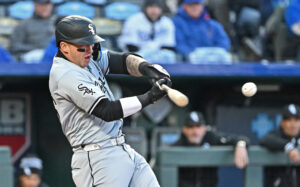
Now 25 years old, Lee was a first-round pick of the Astros, selected 32nd overall in 2019. As he climbed up the minor league ladder, he earned a reputation as a glove-first catcher. In terms of his offense, he clearly had some power but the production was fairly hollow apart from that.
In 2022, he played in 104 Triple-A games and hit 25 home runs. However, he also struck out 28.5% of the time and only walked at an 8.1% clip. Since he was playing for the Sugar Land Space Cowboys in the hitter-friendly Pacific Coast League, his .238/.307/.483 batting line only translated to a wRC+ of 90.
That production was 10% below league average overall but is around par for a catcher. He also got to make his major league debut that year but clearly did not get out to a roaring start in the big leagues. His first 26 plate appearances led to a batting line of .160/.192/.240.
He was sent back to Sugar Land in 2023 and took a step back. He got into 68 games for the Space Cowboys and hit just five home runs. He lowered his strikeout rate to 24.8% but his walk rate also ticked down to 5.6%. His .283/.328/.406 line led to a wRC+ of 77.
In spite of the tepid offense, the Sox decided to take a shot on him. When trading Kendall Graveman at last year’s deadline, they flipped him to the Astros for Lee straight up. His bat did not improve in the immediate aftermath of that deal. He hit .255/.309/.275 in Triple-A, striking out 40% of the time, and then .077/.143/.138 in the majors.
Coming into 2024, Lee still had an option remaining and the Sox clearly intended to use it. They grabbed a couple of more experienced catchers in Martín Maldonado and Max Stassi and were seemingly going to break camp with that pair, as Lee was optioned on March 20. But then Stassi required an Opening Day stint on the injured list due to hip inflammation, so Lee was recalled.
So far, the results have been good at the major league level. We’re talking about 46 plate appearances over 17 games, so small sample size caveats definitely apply, but Lee is slashing .279/.326/.465 for a wRC+ of 129. His 6.5% walk rate is a bit below average but he’s also only striking out a 19.6% clip so far.
Looking under the hood also shows some encouraging signs. Lee has a barrel rate of 9.7% thus far, almost triple the 3.3% rate he had over 2022 and 2023. His expected batting average, on-base and slug are all up.
Perhaps the most encouraging development is in the plate discipline department. He had previously swung at 36.9% of pitchers outsize the zone but has dropped that number to 29.1% this year. Even when he does chase, he’s missing less, as his 69.6% contract rate outsize the zone is a big jump from his previous rate of 51.3%.
On pitches in the zone, he’s up to an 86.8% swing rate compared to 78% in his previous seasons. His called strike rate was 11.6% coming into the year but is down to 8.2% this season. He had a 15.8% swinging strike rate in the majors in the previous two years, and even higher in Triple-A, but is at 13.6% so far this year.
This is obvious baseball stuff, but swinging at more pitches in the zone and chasing less, while also whiffing less often, is going to lead to fewer strikeouts. Again, it’s a very small sample size but it’s progress in the area that has been Lee’s biggest weakness.
Scouting reports on Lee have long highlighted that he has a cannon for an arm and is a strong blocker. Perhaps there’s still some room to grow in terms of framing but the overall defensive package is considered to be above average. At the plate, the power has been there but the strikeouts were a concern. Whether he can continue to show the positive signs from the early weeks of this season will be something for the Sox to monitor.
In the short term, it’s possible the Sox may have a difficult decision to make. Stassi started a rehab assignment early in the year but was injured again after a backswing hit his hand, per Scott Merkin of MLB.com. He hasn’t yet resumed his rehab assignment but will presumably be ready to rejoin the team at some point.
Perhaps they would consider optioning Lee to the minors when Stassi is back, but cutting Maldonado should also be on the table. He has a strong reputation in the league for his work with pitchers but he’s approaching his 38th birthday and is awful at the plate. He hit .183/.260/.333 for the Astros over the past three seasons and is down to a line of .048/.091/.071 so far this year.
Even if they value Maldonado’s intangibles enough to overlook that offense, moving on from Stassi could also be a consideration. He was acquired from Atlanta in the offseason with that club paying Stassi’s salary down to the league minimum, meaning the Sox aren’t financially committed to Stassi in any way.
In the long term, it will be quite nice for the Sox is Lee can hang onto this improved plate discipline. He came into this year with just 71 days of service time. Assuming he stays with the big league club for the rest of the year, the Sox will still be able for five more seasons after this one.
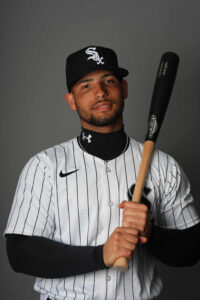
He seems destined to be joined on the roster by Edgar Quero at some point. Acquired from the Angels in the trade that sent Lucas Giolito and Reynaldo López to the Angels, Quero is effectively the inverse to Lee, as he is considered to be more of a bat-first catcher.
In 1,190 minor league plate appearances thus far in his career, Quero has drawn walks in 15% of them while only striking out at an 18.8% clip. He’s also hit 33 home runs and slashed .280/.407/.458. At Double-A this year, he already has five home runs and has a line of .294/.387/.627 for a 197 wRC+. Since he spent all of last year in Double-A as well, a promotion to Triple-A should be imminent. He’s currently ranked the #58 prospect in the whole league by FanGraphs while Keith Law of The Athletic recently gave him the #67 spot.
The glove-first Lee and the bat-first Quero should make for a nice pairing behind the plate for the Sox if all goes according to plan. Lee hits from the right side while Quero is a switch hitter. The inverse profiles should allow the club to deploy them situationally, depending on whether offense or defense is preferred on a given day or a given situation. Almost no club has an everyday catcher these days, so the Sox could split the playing time, with the designated hitter slot also giving them a way to have both in the lineup with regularity. If one of these two backstops takes a step forward and is ahead of the other, the team could tip the scales of the playing time accordingly.
For fans of the Sox, there’s not a lot to feel good about in the present. That means looking to the future is the best bet at finding hope or even just a reason to follow the team. When it comes to the catching depth, there seems to be a bit of sunshine peeking out over the horizon.
Big Hype Prospects: Manzardo, Acuna, Luciano, Quero, Saggese
The Trade Deadline seems to be happening early this year. Between the time I begin writing and this is posted, there might be more deals involving big-name prospects. This week, we’ll focus on the recently completed swaps. We’ll check back on the leftovers next time.
Five Big Hype Prospects
Kyle Manzardo, 23, 1B, CLE (AAA)
313 PA, 11 HR, 1 SB, .238/.342/.442
Manzardo burst onto Top 100 prospect rankings last season with a flashy 22-homer performance in nearly 400 plate appearances split between High- and Double-A. He has all the traits armchair prospect analysts (like myself) crave – plus discipline, a high rate of contact, and above-average exit velocities. If there was a fly in the ointment, his combination of high BABIPs and frequent fly balls seemed untenable. This season, he’s dropped to a more plausible .269 BABIP while maintaining the fly ball rate. His 2023 numbers more closely match his identity. His power outcomes have backed up, but there’s little cause for long-term concern. Additionally, Progressive Field is friendly to left-handed power hitters. Manzardo is undersized for a first baseman, and his power draws 45 and 50 grades on the 20/80 scouting scale. The profile reads a lot like a four-inches-shorter, left-handed Rhys Hoskins.
Luisangel Acuna, 21, 2B/SS, NYM (AA)
402 PA, 7 HR, 42 SB, .315/.377/.452
Repeating Double-A after a rough first exposure last season, Acuna has looked comfortable at the level. His BABIP-fueled batting line is 21 percent above league average (121 wRC+) despite middling power numbers. Like his brother, Luisangel has terrorized opponents on the basepaths. Scouts rate him as merely an above-average runner. There is a degree of swing-and-miss (12.4% SwStr%) to Acuna’s game that calls his future role into question. He’s expected to grow into average or better power if he can learn to lift the ball more consistently. Whether or not he can do so without developing a strikeout problem could depend on the sort of adjustment required. Lift-related mechanical changes tend to exacerbate whiff issues. In some cases, the issue is the location of contact – an adjustment that can yield positive results without negative repercussions. Acuna’s swing is violent and loud. Change could prove challenging. Despite strong walk rates, Acuna is an aggressive swinger, particularly at breaking balls below the zone.
Necessary offensive adjustments aside, there’s also question about Acuna’s future defensive role. He’s a physically capable shortstop who yet lacks polish. Lately, we’ve grown accustomed to seeing shortstop prospects with precocious defensive ability. Acuna could be asked to move over to second or third to better accommodate his ascent alongside Francisco Lindor.
Marco Luciano, 21, SS, SFG (MLB)
(AA) 242 PA, 11 HR, 6 SB, .228/.339/.450
The only member of today’s column who wasn’t traded, the Giants rushed Luciano to the Majors to cover a short-term opening at shortstop. Despite tepid overall numbers at Double-A, Luciano caught a heater beginning in late June. He batted .315/.397/.500 over his final 63 plate appearances at the level. His success carried over to a 27-plate appearance stint in Triple-A where he batted .292/.370/.625 with Major League caliber exit velocities. He’s 3-for-11 with five strikeouts thus far in the Majors. The once uber-prospect has developed into a slug-over-contact future third baseman. His strikeout rate might check in north of 30 percent. Only 11 qualified hitters have strikeout rates above 30 percent. The good news is nine of 11 have above-average batting lines. The two who don’t – Teoscar Hernandez and Byron Buxton – are celebrated hitters. Luciano will look to join this cohort of hitters.
It’s unlikely Luciano sticks with the contending Giants in the short term.
Edgar Quero, 20, C, CWS (AA)
321 PA, 3 HR, 1 SB, .246/.386/.332
A switch-hitter, Quero emerged as a bat-first catching prospect last season when he hit .312/.435/.530 with 17 home runs and 12 stolen bases in 515 Low-A plate appearances. The Angels made the curious decision to skip him past High-A – perhaps seeking to pair him with a better defensive instructor. His discipline remained in evidence this season. The power… not so much. Another plausible explanation of Quero’s aggressive assignment is to see if he merited moving to a different position to accommodate his bat. Instead, the Angels moved him from the organization entirely in the Lucas Giolito trade. Look for Chicago to slow the roll on Quero’s development. His defensive skills are reported to remain relatively raw.
Thomas Saggese, 21, 3B, STL (AA)
418 PA, 15 HR, 8 SB, .313/.379/.512
Saggese doesn’t have the physical traits evaluators crave, but he makes up for it with a hard-nosed playstyle. Part of the Jordan Montgomery trade, it feels like he was always destined to join the Cardinals. His tools draw a collection of 40 and 50 grades, but his feel for quality contact allows the total package to play up. Multiple reports reference his success against sliders. Something to watch is how he performs against upper-level pitchers with big fastballs and command. The Cardinals might seek to add corner outfield to Saggese’s bag of tricks. He fits best at third base, is considered too short for first base, and just passes at second base. The Cards love their role players to possess a deep well of utility.
Three More
Tekoah Roby, STL (21): The prospect headliner of the Montgomery trade, Roby has a four-pitch repertoire of above-average offerings. His best weapon is a double-plus curve ball. He’s currently sidelined with a shoulder injury. There’s relief risk for health reasons only – the stuff and command are sufficient to project a mid-rotation role.
Marco Vargas, NYM (18): Stolen from the Marlins in the David Robertson trade, Vargas is one of the flashier talents in the complex. He’s batting .283/.457/.442 with nearly twice as many walks as strikeouts and a strong rate of contact. Power development will decide whether he’s viewed as a future utility fielder or core performer.
Adam Kloffenstein, STL (22): Part of the return for Jordan Hicks, Kloffenstein is a big right-hander with a limited repertoire. He tunnels a sinker and slider in a way reminiscent of Brady Singer and Brad Keller. He has a solid feel for command and projects to eat innings in an uninspiring way. He’s pitched to a 3.24 ERA in 89 Double-A frames.
Did I miss a detail or nuance? DM me on Twitter @BaseballATeam to suggest corrections.
Angels Acquire Lucas Giolito, Reynaldo Lopez
The Angels are pushing the chips in. The Halos swung a late-night trade for Lucas Giolito and Reynaldo López from the White Sox, the teams announced. Prospects Edgar Quero and Ky Bush are going back to Chicago.
Los Angeles declared themselves buyers this evening when they formally took Shohei Ohtani off the trade market. Once they committed to making a push in Ohtani’s final season of club control, there was little reason not to act boldly. They’ve done just that, surrendering two of their top prospects for the top rental starter available and a relief upgrade.
Ironically, Giolito and López both landed with the White Sox in the same trade nearly seven years ago. Both had debuted with the Nationals in 2016 before being included in the Adam Eaton package during that year’s Winter Meetings. They’ve spent the past six-plus seasons on Chicago’s South Side.
Giolito has developed into the more valuable of the duo. After a disastrous 2018 season, the Southern California native blossomed into an upper mid-rotation starter. He has posted a sub-4.00 ERA in four of the past five years, including a 3.79 mark through 121 frames this season.
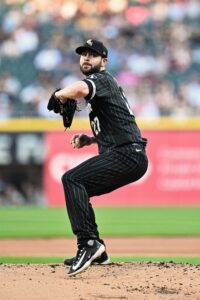
He has backed up that solid run prevention with above-average peripherals. Giolito is striking out 25.8% of opponents against an 8.3% walk rate. He’s generating swinging strikes on 11.9% of his offerings. It’s a third consecutive season in which he’s been above-average across the board.
Giolito hasn’t quite developed into the ace it seemed he might become when he finished in the top 10 in Cy Young balloting in 2019-20. His average fastball speed is down a tick from those peak seasons, and he’s lost a few whiffs on each of his offerings. Still, the 29-year-old is a clear playoff caliber starter. He averages just under six innings per start while holding opponents to a .232/.301/.430 batting line. Giolito is effective against hitters of either handedness and has essentially avoided any major injuries in his MLB career.
That kind of durability and effectiveness should be a major boost to a Halos’ rotation that entered play Wednesday ranked 20th in the majors in ERA. Ohtani is the one pitcher allowing fewer than four earned runs per nine on the season. Reid Detmers has a 4.38 ERA but a strikeout rate north of 29% that suggests he fits well in the middle of a rotation. Patrick Sandoval and Griffin Canning have been fine back-end arms. Tyler Anderson has underperformed in the first season of a three-year deal, working to a 5.18 ERA. He slots sixth in the Halos’ six-man starting staff, while Giolito’s addition should firmly push Jaime Barria into long relief if the rest of the group stays healthy.
Barria has been more effective out of the bullpen than when pressed into rotation work. Giolito’s acquisition indirectly upgrades the relief corps in that regard, while the addition of López helps the bullpen in a more straightforward way.
The 29-year-old righty moved to relief for good by the start of the 2022 season. He was excellent in that role last year, pitching to a 2.76 ERA across 65 1/3 frames. It has been more of a mixed bag in 2023. López carries a 4.29 ERA in 42 innings. His walks have jumped from a minuscule 4.3% clip last year to a concerning 12.4% rate.
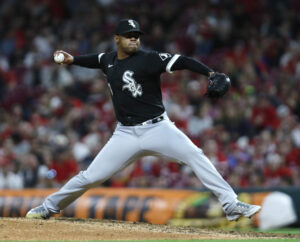
However, the uptick in free passes has been paired with a jump in whiffs. López has punched out a career-best 29.2% of batters faced. He’s picking up swinging strikes on 13.4% of his offerings while averaging 98.3 MPH on his heater and 87.9 MPH on the slider. López is a high-octane arm to pair with Matt Moore as setup options in front of closer Carlos Estévez. The Halos could look for additional ways of bolstering the middle innings mix between now and the August 1 trade deadline.
Both Giolito and López are firmly win-now pieces. Each is an impending free agent. Giolito is arguably the top non-Ohtani starter who’ll hit the open market. He’s on his way to exceeding nine figures. That always made it likely the White Sox — whose franchise-record expenditure is the $75MM Andrew Benintendi pact — would not re-sign him.
A midseason deal, while not unexpected, is a nice boost to Giolito’s eventual earning power. Players traded midseason cannot be tagged with a qualifying offer. Giolito would obviously have received one had the Sox retained him past the deadline, but he’ll now hit the open market without a signing team needing to forfeit draft capital.
The more immediate benefit, of course, is that both pitchers will get a chance to compete for a postseason spot. The Halos are four games out in the Wild Card race and seven back in the AL West. They’re clearly pushing the chips in for this season and figure to continue to be aggressive in the next few days. Adding corner infield help with Anthony Rendon and Brandon Drury on the shelf and Jared Walsh struggling enough to be optioned to Triple-A makes plenty of sense; to that end, the Halos have reportedly been in touch with the Nationals regarding third baseman Jeimer Candelario.
As part of that all-in mentality, the Angels relinquished a pair of their most talented prospects. Quero is one of the game’s top minor league backstops. The switch-hitter reached Double-A by his 20th birthday and is holding his own in a pitcher-friendly setting. Over 317 plate appearances, Quero owns a .245/.385/.332 batting line. He’s only hit three home runs but is walking at a massive 17% clip while striking out just 16.7% of the time.
That kind of plate discipline is exceptionally rare for a hitter so young. The Cuban-born backstop is the sport’s #61 overall prospect at FanGraphs and 85th at Baseball America. Scouting reports predictably rave about his advanced offensive skills and suggest he has a good chance to be a regular in the long term.
The Halos already have a potential catcher of the future in Logan O’Hoppe. Acquired from the Phillies last summer, O’Hoppe has been limited to 21 big league contests because of a labrum tear in his shoulder. He’s controllable for five seasons beyond this one, though, perhaps making Quero a little more expendable to the organization.
Chicago had no such long-term answer behind the dish. Yasmani Grandal is headed to free agency on the heels of a fine but unexceptional year. It’s probably unreasonable to expect Quero to immediately succeed Grandal as the #1 backstop next season, but it doesn’t seem out of the question he could reach the majors at some point in 2024. That upper minors proximity is surely appealing to a Chicago team reloading for next year.
Bush, a 23-year-old southpaw, was also at Double-A. A second-round pick out of St. Mary’s in 2021, he ranked ninth among Angels’ prospects in Eric Longenhagen’s recent organizational rankings at FanGraphs. Both Longenhagen and Kiley McDaniel of ESPN (on Twitter) suggest the 6’6″ hurler has a chance to stick as a starter and praise his slider, though Longenhagen raises concerns about his low-90s fastball. Bush has been a little homer-prone in his first six Double-A starts but is striking out nearly 30% of opponents there.
It’s a strong return for a pair of impending free agents, with Quero the clear headliner. Yet it’s understandable the Angels would part with those players (particularly with O’Hoppe in the fold) to make a push this season. Their aggressiveness extends beyond the prospect capital, as the trade officially pushed them into luxury tax territory.
The Halos were right around the $233MM competitive balance tax threshold before the move. They’re taking on what remains of the respective $10.4MM and $3.625MM arbitration salaries for Giolito and López. That’s around $3.75MM on Giolito and $1.31MM on López. That’ll push their estimated CBT figure to around $238MM pending future additions.
It’s clear owner Arte Moreno will sign off on paying the tax for the first time. The financial penalties of doing so are rather minimal. As a first-time payor, they’ll pay a 20% tax on expenditures between $233MM and $253MM. The tax money they’re taking on with today’s trade is just over $1MM, a marginal amount in comparison to the team’s overall spending.
More notably, surpassing the CBT reduces the draft compensation they’d receive if they lose a qualified free agent. Teams that pay the luxury tax receive a compensation pick after the fourth round if a player rejects a qualifying offer and signs elsewhere. Clubs that stay below the threshold get a compensatory choice between Competitive Balance Round B and the third round.
Ohtani will obviously reject a QO. If the Angels don’t re-sign him, going past the CBT means they’re moving the draft compensation back a couple rounds. That’s a risk worth taking to maximize the chances of getting to the playoffs in Ohtani’s final season of arbitration. The Angels are all-in, and while this’ll probably be their biggest move of deadline season, there’s no reason to think it’s their last.
Jeff Passan of ESPN first reported the Angels and White Sox were finalizing a trade of Giolito and López for Quero and Bush.
Images courtesy of USA Today Sports.
MLB Announces Futures Game Rosters
Major League Baseball announced rosters for the 2023 Futures Game this evening. The contest — a seven-inning exhibition between some of the sport’s most talented minor leaguers — kicks off All-Star festivities in Seattle on Saturday, July 8.
As Jonathan Mayo of MLB.com notes, 28 of the 50 players on the roster are included on MLB Pipeline’s recent Top 100 prospects list. Six of Pipeline’s top ten will participate. The full rosters (MLB Pipeline prospect rank included, if applicable):
American League
- Clayton Beeter, Yankees RHP (AAA)
- Lawrence Butler, A’s OF (AA)
- Junior Caminero, Rays INF (AA), #17 prospect
- Jonathan Cannon, White Sox RHP (High-A)
- Joey Cantillo, Guardians LHP (AAA)
- Jonatan Clase, Mariners OF (AA)
- Shane Drohan, Red Sox LHP (AAA)
- David Festa, Twins RHP (AA)
- Harry Ford, Mariners C (High-A), #29 prospect
- Drew Gilbert, Astros OF (AA), #76 prospect
- Jackson Holliday, Orioles INF (High-A), #1 prospect
- Spencer Jones, Yankees OF (High-A)
- Colt Keith, Tigers INF (AA), #43 prospect
- Heston Kjerstad, Orioles OF (AAA), #40 prospect
- Will Klein, Royals RHP (AAA)
- Justyn-Henry Malloy, Tigers INF (AAA)
- Kyle Manzardo, Rays INF (AAA), #42 prospect
- Marcelo Mayer, Red Sox INF (AA), #5 prospect
- Kyren Paris, Angels INF (AA)
- Edgar Quero, Angels C (AA), #72 prospect
- Sem Robberse, Blue Jays RHP (AA)
- Tyler Soderstrom, A’s C (AAA), #37 prospect
- Owen White, Rangers RHP (AAA), #48 prospect
- Nick Yorke, Red Sox INF (AA), #91 prospect
- Yosver Zulueta, Blue Jays RHP (AAA)
National League
- Mick Abel, Phillies RHP (AA), #46 prospect
- Ryan Bliss, Diamondbacks INF (AA)
- Jackson Chourio, Brewers OF (AA), #3 prospect
- Justin Crawford, Phillies OF (Low-A), #90 prospect
- Pete Crow-Armstrong, Cubs OF (AA), #10 prospect
- Yanquiel Fernandez, Rockies OF (AA), #97 prospect
- Kyle Harrison, Giants LHP (AAA), #14 prospect
- Tink Hence, Cardinals RHP (High-A), #66 prospect
- Brady House, Nationals INF (High-A), #75 prospect
- Jordan Lawlar, Diamondbacks INF (AA), #7 prospect
- Noelvi Marte, Reds INF (AA), #19 prospect
- J.P. Massey, Pirates RHP (High-A)
- Jackson Merrill, Padres INF (High-A), #12 prospect
- Jacob Misiorowski, Brewers RHP (High-A), #93 prospect
- Patrick Monteverde, Marlins LHP (AA)
- B.J. Murray, Cubs INF (AA)
- Nasim Nunez, Marlins INF (AA)
- Jeferson Quero, Brewers C (AA), #79 prospect
- Endy Rodriguez, Pirates INF/C (AAA), #39 prospect
- Dalton Rushing, Dodgers C (High-A), #51 prospect
- Victor Scott II, Cardinals OF (High-A)
- Spencer Shwellenbach, Braves RHP (Low-A)
- Mike Vasil, Mets RHP (AAA)
- Carson Whisenhunt, Giants LHP (AA)
- James Wood, Nationals OF (AA), #6 prospect
Big Hype Prospects: Quero, Carter, Graceffo, Painter, Amador
This week on Big Hype Prospects, we take a look at some precocious youngsters in the upper minors.
Five Big Hype Prospects
Edgar Quero, 19, C, LAA (A)
515 PA, 17 HR, 12 SB, .312/.435/.530
Recently selected as the Angels Minor League Player of the Year by Baseball America, Quero has surged in the Angels system and likely ranks as their second-best farmhand behind Logan O’Hoppe. For what it’s worth, Baseball America’s midseason update has Quero behind O’Hoppe, Zach Neto, and Ky Bush, but it’s pretty clear to me that he’s since leapfrogged at least Bush.
Quero progressed considerably both offensively and defensively this season. He’s now viewed as likely to not only remain a catcher but to do so as a quality defender. As a hitter, he’s a consistent contact machine with advanced plate discipline for his age. He has a knack for finding gaps (35 doubles, two triples) and could grow into more home run power as he ages. For a 19-year-old with non-elite power (by scouting grade), hitting 17 dingers is a lovely platform. His 8.4 percent swinging strike rate is superior to most teenagers – even those that eventually go on to post high rates of contact. His 12 steals have come in 17 attempts, a sign he might not run much as he advances.
One tiny detail that will often be missed in surface-level analysis – Quero was hit by pitch 21 times. Among Major Leaguers, only Willson Contreras (23) has been hit by more than 20 pitches this season. While Quero’s OBP captures this trait, his walk rate does not. He’s listed as having a 14.2 percent walk rate and 17.7 percent strikeout rate. He actually has 94 walks plus hit-by-pitches compared to 91 strikeouts. It’s debatable whether this is a good trait for a minor leaguer since bean balls lead to injuries.
Evan Carter, 20, OF, TEX (AA)
(A+) 447 PA, 11 HR, 26 SB, .287/.388/.476
Carter, a second-round pick in the weird 2020 draft, was on track to jump onto Top 100 lists last season before a season-ending stress fracture in his back ended his campaign. While that may sound ominous, it’s a simple injury to maintain via core exercises. He spent the bulk of 2022 in High-A, earning a late-season promotion to Double-A in order to continue his season. Per Baseball America, he now ranks above Josh Jung as the Rangers top farm hand.
Carter is frequently praised for his swing decisions, but scouting reports often take time to focus on his weaknesses too. He has the size and physicality of a power hitter. His swing is thought to be prone to ground ball contact, though that didn’t show up in his incredibly balanced batted ball profile in High-A. He’s a capable center fielder whom multiple evaluators comp to Brandon Nimmo due to the discerning eye, a similar left-handed swing, and game power that is expected to underperform his stature. That said, the Rangers are sometimes criticized for asking their prospects to max out on power. Don’t sleep on the potential for 20-or-more homer upside once he’s in his 20s. His max exit velocity is already above the Major League average.
Gordon Graceffo, 22, SP, STL (AA)
(A+) 93.2 IP, 7.98 K/9, 2.31 BB/9, 3.94 ERA
Graceffo opened 2022 in High-A. In eight starts (45.2 innings), he chewed through the level with a 0.99 ERA, 11.04 K/9, and 0.79 BB/9. He’s performed more ordinarily at Double-A. A 5.07 FIP suggests he’s even struggled a bit more than his ERA portends. He’s performed particularly well of late. In 16.2 innings this month, he’s allowed no runs, five hits, two walks, and two hit batters with 22 strikeouts. His latest start began with five perfect innings before he allowed a hit in the sixth. Unlike most pitching prospects in their second pro season, he’s carried a fairly substantial workload of 139.1 innings. For perspective, only 56 big leaguers have thrown more frames. He also rates 10th among minor leaguers.
He possesses a four-pitch repertoire of above-average offerings complemented with average or better command. In essence, this is the Zac Gallen starter kit. The FanGraphs report mentions the shape of his fastball plays down. Basically, it’s contact-prone and won’t necessarily limit the quality of said contact. This appears to be an organizational shortcoming with the Cardinals – whether by choice, happenstance, or some other reason.
Andrew Painter, 19, SP, PHI (AA)
24.1 IP, 11.84 K/9, 0.74 BB/9, 1.11 ERA
Painter is a candidate to claim the mantle of top minor league pitcher once Grayson Rodriguez matriculates. In a past episode of BHP, I compared Painter to Spencer Strider due to what might play as a two-pitch repertoire. Reports have since surfaced that he’s gained confidence in an improved changeup. I also failed to account for their difference in stature – Painter is seven inches taller which greatly affects the shape of his fastball.
While he hasn’t induced quite as many swinging strikes as Strider did through his ascent, Painter has shown better command and pitchability. Given his early success in Double-A following 17 dominant starts in A-ball, he could be on track to debut in 2023. It’s rare for pitchers to reach the Show in their age 20 season. In fact, the youngest pitchers in the Majors this season are 22, though Luis Patino was 20 when he debuted. He even set a season-high of 27 batters faced on September 3, more than most big leaguers face in a start.
Adael Amador, 19, SS, COL (A)
555 PA , 15 HR, 26 SB, .292/.415/.445
Similarly to Quero, Amador remained in Low-A all season where he was able to focus on making modest improvements without being overmatched. He’s seen as a high-probability shortstop prospect who recorded more walks than strikeouts, makes a ton of contact, and isn’t a complete zero in the power department. He hits too much pulled, ground ball contact, but he has plenty of time to make adjustments. Excellent plate discipline is an important and underrated ingredient when it comes to altering a young player’s batted ball profile. While some scouting reports suggest he’ll shift to second base down the line, my own interpretation is that this isn’t strictly necessary. Defensively, he might fit best as a first-division utility man capable of suiting up all over the diamond. Not to say that he’s similar to Chris Taylor, but that role would be an excellent use of Amador’s talents.
Five More
Jackson Chourio, MIL (18): Like Carter, Chourio earned a promotion to Double-A mostly in order to continue his season. Thus far, he’s just 1-for-11 with three walks and four strikeouts. He’s also just 18-and-a-half, eight months the junior of the next-youngest hitter at the level (see next). If he can salvage a strong finish, he might be on pace to arrive in the Majors as a teenager.
Deyvison De Los Santos, ARI (19): Another promotee for the purpose of extending his season, De Los Santos flashed through Low- and High-A this season while bashing 21 home runs and posting some gaudy BABIPs. Those helped to hide swing-and-miss issues with his approach that at times evokes Pedro Cerrano. Plate discipline remains an ongoing issue for the potent teenager.
Francisco Alvarez, NYM (20): Recently sidelined with a loose body in his ankle, Alvarez returned to action a few days ago. He launched a home run on Tuesday. The Mets have gotten next to no offense from their catchers and might be willing to take desperate measures as the Braves nip at their heels in the NL East race.
Tink Hence, STL (20): Profiled in detail last week, Hence made a third straight scoreless start. He even faced a career-high 16 batters. The Cardinals continue to carefully manage his innings this season, combining short starts with a full week between outings.
Chase Silseth, LAA (22): Though he’s made seven big league appearances spanning 28.2 innings (6.59 ERA), Silseth has yet to appear in Triple-A. The 22-year-old has pitched excellently in Double-A with a 2.28 ERA, 11.93 K/9, 2.93 BB/9, and a flashy 17.8 percent swinging strike rate. He delivered a six-inning scoreless outing on Thursday with nine strikeouts for the Rocket City Trash Pandas.