
Brewers Notes: Chourio, Vaughn, Misiorowski, Henderson
Jackson Chourio‘s 2026 debut may be delayed by at least a few more days, as the outfielder fouled a ball off his left ankle during a Triple-A rehab game on Saturday. “We got an X-ray on it right away and thank God it’s negative,” Brewers manager Pat Murphy told the Milwaukee Journal Sentinel’s Todd Rosiak and other reporters, though “we’ve got to see how he progresses. Today’s going to be a critical day.”
It isn’t uncommon to see players placed on the injured list in these instances, as even if a foul ball may not fracture or break anything, there can often be lingering soreness for days afterwards. Given Chourio’s importance to the Brewers, the team isn’t likely to rush anything in terms of his return, even if that means Chourio spends more time in Triple-A or his official rehab period is halted entirely.
Chourio knows all too well how a seemingly innocuous injury can linger, as x-rays were also negative on his left hand when he was hit by a pitch during a World Baseball Classic exhibition on March 4. The outfielder went onto play in the WBC and for the Brewers during the rest of Spring Training, but some additional soreness led to a check-up MRI just prior to Opening Day, and a new diagnosis of a minor hairline fracture.
As such, Chourio has yet to see any big league action this year, and he was already beyond the initial recovery timeline of 2-to-4 weeks. Monday was expected to be his activation date from the 10-day IL, before that errant foul ball delivered another setback.
It isn’t all bad news for the start of tomorrow’s series with the Cardinals, however, as Andrew Vaughn is expected to be activated from the 10-day IL. Vaughn’s 2026 campaign consists of just one game, as he sustained a hamate bone injury on Opening Day that required surgery. His recovery process hasn’t hit any snags, so he’ll return within the usual 4-to-6 week timeline associated to hamate surgeries.
After being dealt from the White Sox to the Brewers last June, Vaughn’s bat came to life, as he hit .308/.375/.493 with nine home runs in 254 plate appearances with his new club. Jake Bauers has done decently well while getting most of the first base playing time in Vaughn’s absence, but naturally Milwaukee’s lineup will benefit from getting closer to full strength.
It also looks like Jacob Misiorowski may have dodged a bullet after leaving his last start due to a hamstring cramp. Misiorowski came out a running drill yesterday feeling fine, but Murphy cautioned that the Brew Crew won’t be fully comfortable with the right-hander’s status until he throws without any discomfort. If all goes well, Misiorowski should line up to make his next start on Wednesday in St. Louis.
Brandon Woodruff‘s placement on the 15-day IL on Friday already left Milwaukee’s rotation even more short-handed, as Quinn Priester has yet to pitch this season due to a nerve problem in his throwing shoulder. The Brewers turned to Logan Henderson for the spot start today in Woodruff’s place, and Henderson delivered a quality start in the 3-2 loss to the Nationals. Henderson allowed two runs on three hits over six innings of work, while recording eight strikeouts and zero walks.
Henderson’s young career has been plagued by injuries to date, and he has logged only 302 1/3 pro innings (269 in the minors, 33 1/3 in the majors) since he was a fourth-round pick for Milwaukee in the 2021 draft. The right-hander made his MLB debut last season in the form of 25 1/3 innings, but his rookie year was cut short by elbow inflammation in early August. While the Brewers will continue to be careful with Henderson’s innings, today’s start might well earn him more looks in the big league rotation.
Chad Patrick To Open Season In Brewers’ Rotation
Jacob Misiorowski and Chad Patrick will open the season in the Brewers’ rotation, manager Pat Murphy tells Adam McCalvy of MLB.com. The rest of the starting five is still up in the air depending on injuries and camp performance.
Brandon Woodruff and Quinn Priester are locks for rotation roles when healthy. Woodruff is the likelier of the two to be available by Opening Day. The Brewers are exercising caution in building him back from last year’s season-ending lat injury. He’ll make his Cactus League debut tomorrow against the Angels.
Priester is behind due to what appears to be minor wrist discomfort. The righty threw batting practice early in Spring Training but hasn’t faced hitters since then. Priester told reporters yesterday that he’s still playing catch but occasionally feels the nagging soreness (video via Curt Hogg of The Milwaukee Journal Sentinel). Testing hasn’t revealed anything off structurally, but he’s unlikely to be ready for the start of the season in less than three weeks.
Misiorowski was a lock to make the season-opening rotation regardless of Woodruff’s and Priester’s statuses. Patrick entered camp as the favorite for the fourth starter role but seemed less assured of a job. That’s less a reflection of his own performance than the fact that Milwaukee’s depth pushed him out of the starting five in the second half of last season.
Patrick turned in a 3.52 earned run average over his first 19 career appearances. Milwaukee nevertheless optioned him to Triple-A on July 6 once Woodruff returned from shoulder surgery. Patrick spent six weeks in the minors. The Brewers used him in a swing role when they recalled him in mid-August. He pitched out of the bullpen in the playoffs, tossing nine innings of two-run ball with 11 punchouts across six appearances.
The 27-year-old Patrick never garnered much fanfare as a prospect. He’s a former fourth-round pick who was traded for Jace Peterson and Abraham Toro, respectively, before making his MLB debut. It’d be easy to lose him in the shuffle of Milwaukee’s more well-known controllable arms. Patrick nevertheless earned a roster spot by striking out more than a quarter of opponents with a 3.53 ERA across 119 2/3 innings as a rookie. He built up to three innings and 52 pitches this afternoon in his second Spring Training start.
If Woodruff avoids the injured list, the Brewers would have three-fifths of their opening rotation in place. Trade pickups Brandon Sproat and Kyle Harrison join Logan Henderson and Robert Gasser in the battle for the final two spots.
Murphy noted today that left-handers Aaron Ashby and DL Hall are being considered as potential starters as well. Both southpaws worked out of the bullpen or as openers last year. That’s likely where they’ll be used most frequently, though they can work as tandem starters or multi-inning relievers if they don’t win a traditional rotation role.
The Brewers’ Rotation Options After Peralta Trade
The Brewers traded ace Freddy Peralta and swingman Tobias Myers to the Mets last week. Milwaukee generally, though not always, trades its best players as they approach their final year before free agency. There was never much chance they were going to meet Peralta’s asking price on another contract. That left the front office to decide whether to move him for controllable pieces or hold him through his final arbitration year and collect a compensatory draft pick when he signed elsewhere.
They opted for the former once the Mets put Jett Williams and Brandon Sproat on the table, albeit in a deal that also cost them a potential rotation arm in Myers. It’s obviously not the start of a rebuild for a team that had MLB’s best record and advanced to the NL Championship Series a year ago. They’re counting on their pitching pipeline to continue to produce as they aim for a fourth straight division title.
How will Pat Murphy’s starting staff line up?
Locks
Woodruff is back as the veteran anchor and their clear #1 starter. The righty accepted a $22.025MM qualifying offer, a move that probably surprised Milwaukee’s front office to an extent. President of baseball operations Matt Arnold acknowledged that getting Woodruff back made them more comfortable parting with Peralta (relayed by Curt Hogg of The Milwaukee Journal-Sentinel). The 2026 payroll factors into that to an extent, yet Peralta’s $8MM salary shouldn’t have been a hang-up even by Brewers’ standards. There were other players they could have moved (e.g. Andrew Vaughn, Trevor Megill) if ownership mandated a payroll reduction.
The Brewers can feel comfortable about having an established top-of-the-rotation starter. The big question is how many innings they can reasonably expect. Woodruff missed all of 2024 rehabbing from shoulder surgery. A handful of smaller injuries delayed his ’25 debut, and he sustained a season-ending lat strain after 12 starts. He has pitched 131 2/3 frames over the past three seasons. Woodruff enters camp fully healthy, but it’s fair to wonder if he can shoulder 150 innings.
The 25-year-old Priester is now the second-most experienced Milwaukee starter. He and Robert Gasser are the only other starters with more than a year of MLB service time; the majority of Gasser’s service came on the injured list working back from UCL surgery.
Priester began the ’25 season in Triple-A with the Red Sox. Dealt to Milwaukee in a rare April trade of significance, the former first-rounder was a revelation. He tossed 157 1/3 innings of 3.32 ERA ball behind a massive 56.1% grounder percentage. Milwaukee had a stretch of 19 consecutive wins in his outings between May and September. Priester has serviceable but not elite swing-and-miss stuff. It’s a sinker-slider profile geared toward keeping the ball on the ground. That approach comes with some batted ball variability but plays well in front of a strong infield defense.
Upside Plays
Misiorowski was arguably the #1 pitching prospect in MLB when the Brewers called him up in June. He began his career in electric fashion, allowing two earned runs or fewer in six of his first seven starts. Milwaukee didn’t let him work deep into games, but he lit up the radar gun while missing plenty of bats. His performance wavered down the stretch, and evaluators’ longstanding concerns about his command pushed him into a bullpen role for the playoffs. Misiorowski impressed again in October, striking out 16 over 12 innings of three-run ball in a trio of postseason outings.
Overall, the 6’7″ righty finished his debut campaign with a 4.36 ERA across 66 innings. He’s certainly not going to be the back-end innings eater usually associated with a mid-4.00s ERA, though. Misiorowski has ace stuff with walk issues that may yet land him in high-leverage relief. He should get a full look in the rotation this year, albeit with questions about his start-to-start efficiency.
Henderson may not be a Misiorowski-level prospect, yet his 2025 debut was also highly anticipated by Milwaukee fans. He was called up in April and pitched well over four starts before being squeezed off the MLB roster. The Brewers brought him back up after the trade deadline. He made one start before being diagnosed with elbow inflammation and spending the rest of the season on the injured list. The 23-year-old righty allowed five runs while striking out a third of opponents over his first 25 1/3 MLB innings.
Baseball America ranked Henderson 96th on their Top 100 prospects list last week. They credit him with plus control and a plus changeup, while his 93 MPH fastball plays above its velocity because of his release angle and spin. Henderson has always been effective in the minors, posting a 3.26 ERA with a 32% strikeout rate over his career. Can he continue to miss bats at a high rate against MLB hitters without really trusting his cutter or slider? He might also run into some home run trouble as a fly-ball pitcher with average velocity whose fastball works best at the top of the strike zone. There are questions about the ultimate ceiling, but Henderson’s first five starts couldn’t have gone much better.
Sproat will try to immediately replace Peralta in the starting five. He also landed in the back quarter of the aforementioned BA prospect list — a few spots above Henderson, in fact. Sproat has much bigger stuff, sitting 96-97 with above-average to plus grades on his slider, curveball and changeup. His command isn’t nearly as polished. Sproat walked 10.4% of opponents over 26 Triple-A appearances last year, and he was hit around a little bit over four starts as a September call-up. The 6’3″ righty has a shot to be a mid-rotation starter, but the command will need to improve if he’s going to get there.
Back-End Arms
Patrick was a 26-year-old rookie whom the Brewers acquired from the A’s in 2023 for journeyman infielder Abraham Toro. There wasn’t a whole lot of fanfare when he broke camp for his MLB debut last spring. Patrick went on to a seventh-place finish in Rookie of the Year balloting after tossing 119 2/3 innings of 3.53 ERA ball. There’s a decent chance he would have placed more highly had the team’s rotation depth not pushed him to Triple-A when Woodruff returned to action on July 6.
The righty spent six weeks in the minors through no real fault of his own. He worked in a swing role once he was recalled in the middle of August. Patrick pitched well in either role and had an excellent postseason, firing nine innings of two-run ball with 11 strikeouts. He has a six-pitch mix led by a plus cutter that helped him punch out a quarter of opponents. Patrick probably doesn’t have the ceiling of some of his teammates but should enter camp with a leg up on Henderson and Sproat for the fourth or fifth starter role.
Acquired from San Diego in the Josh Hader trade, Gasser had an impressive five-start debut in 2024. He blew out and underwent elbow surgery that kept him off an MLB mound until last September. The southpaw started two games and gave up six runs (only two earned) with four walks and five strikeouts across 5 2/3 frames. His minor league rehab numbers were quite a bit better. The 26-year-old Gasser has a 3.72 ERA with a 28% strikeout rate in just over 200 career Triple-A frames. He’s on the older side for a prospect because of the injury but still looks like a viable back-end starter.
Likely Relievers
Angel Zerpa, Aaron Ashby and DL Hall each have starting experience but fit better in the bullpen. All three were used primarily as relievers last season — with the Royals, in Zerpa’s case — and join Jared Koenig in giving Milwaukee a quartet of big arms from the left side out of the bullpen.
Zerpa has solid command and gets a ton of ground-balls, but his sinker/slider combination leaves him vulnerable to right-handed hitters. He’d probably need to pick up a splitter or cutter if he’s going to turn over a righty-heavy lineup twice in a game. Ashby hasn’t managed to stay healthy as a starter, while Hall’s command is too big an obstacle. They’re all capable of working multiple innings and could get some action as openers, as Ashby did a few times in the postseason to match him up against Kyle Tucker and Shohei Ohtani.
The other two starters on the 40-man roster, Carlos Rodriguez and Coleman Crow, project as up-and-down arms. Rodriguez has decent stuff but has been walk-prone in the minors. He has allowed 18 runs in 22 career big league innings. Milwaukee added Crow to the roster at the beginning of the offseason to keep him out of minor league free agency. He’s the organization’s #30 prospect at Baseball America and has fringy stuff despite impressive strikeout rates in the minors.
——————————–
Even without Peralta, Milwaukee has a talented group of starters. Their collective lack of experience behind Woodruff means they’ll probably add a fifth starter or swingman on a one-year deal to reduce the load on their young arms. As is always the case for the Brewers, they’re likely to mix in some tandem starts/openers while shuffling pitchers up and down from Triple-A. Woodruff is their only starter who can’t be sent to the minor leagues, while Rob Zastryzny is their only out-of-options reliever. They’ll have a lot of roster flexibility if they want to incorporate bullpen games or a six-man rotation to keep pitchers’ innings in check.
Jacob Misiorowski Extension Talks Reportedly Yet To Gain Traction
Right-hander Jacob Misiorowski set the league on fire when he debuted in early June. The early returns for the lanky fireballer were so impressive that he earned an All-Star bid after just five games in the big leagues. Securing Misiorowski long-term is likely a priority for the Brewers, but those discussions haven’t gone too far at this point, per Curt Hogg of the Milwaukee Journal Sentinel. Hogg mentioned extension talks between the parties “have not occurred with any real momentum yet.”
Misiorowski tossed five hitless innings against St. Louis in his June 12 debut. He followed it up with a quality start against the Twins, and then five scoreless innings in a win over the Pirates. Misiorowski stumbled for the first time against the Mets (five earned runs in 3 2/3 innings), but bounced back by striking out 12 Dodgers. The 23-year-old pitched a scoreless inning in the All-Star game, earning a hold. A few rough appearances out of the All-Star break led to a 4.36 ERA for the season, though his 3.56 SIERA suggests he was more effective than that mark.
Extending Misiorowski is not without risk, considering his relatively light workload history and high-powered arsenal. The righty has accrued 233 2/3 innings in the minors since getting drafted in 2022. He added 66 innings in the majors this year. Misiorowski’s 129 1/3 innings between Triple-A and the big leagues in 2025 were a career high as a professional by more than 30 innings.
Misiorowski’s fastball averaged over 99 mph with the Brewers. His slider sat at a blistering 94.1 mph, while his changeup, if you can call it that, averaged 92.3 mph. The exceptional velocity on all of his offerings is part of the reason Misiorowski is effective, but busting the radar gun on every pitch can lead to a higher chance of injury.
Misiorowski won’t be arbitration-eligible until 2029. It’s tough to nail down what a potential extension would look like, given his lack of experience. The top contract handed out to a pre-arbitration pitcher is the six-year, $75MM deal Atlanta gave Spencer Strider back in 2023. Strider already had 134 big-league innings under his belt when he got the extension, including a dominant 2022 campaign that saw him post a 2.67 ERA with a 38.3% strikeout rate across 31 appearances. Eury Perez profiles similarly to Misiorowski from a talent and risk perspective, and he’s already had extension discussions with the Marlins. However, even at 22 years old, Perez has put up nearly three times as many MLB innings as Misiorowski.
With the Brewers reportedly worried about payroll, locking down Misiorowski at a discounted rate as soon as possible would be desirable. If he delivers a full season in the rotation with close to the results he had in 2025, the price is only going to go up. Hogg mentioned Milwaukee is “definitely willing to talk,” but that doesn’t mean they’ll be able to get on the same page with Misiorowski and his representatives.
Photo courtesy of Kirby Lee, Imagn Images
Brewers Notes: Misiorowski, Megill, Quintana
The Brewers need one win over the Reds or a Phillies loss to the Twins to secure the #1 seed in the National League. Although this weekend isn’t a meaningless series for the Brew Crew, they’re far more concerned about shaping plans for the Division Series that’ll begin eight days from now.
That includes using Jacob Misiorowski out of the bullpen in preparation for his expected postseason role. The 23-year-old will make his first career relief appearance behind lefty Robert Gasser tomorrow (link via Adam McCalvy of MLB.com). Gasser will likely be limited to 3-4 innings as he continues building back from last year’s elbow surgery. Misiorowski should work multiple innings out of the ‘pen.
The rookie righty was so electric over his first few appearances that he was named to the All-Star Game five starts into his career. He has a 5.45 earned run average in the second half. Misiorowski has only gone beyond five innings once over his past nine times out. He has very little experience turning a lineup over more than twice. Milwaukee prefers to let him max out over shorter stints in high-leverage situations in October.
Milwaukee’s bullpen should get another big boost this weekend. Closer Trevor Megill is expected back from the 15-day injured list on Sunday, reports Curt Hogg of The Milwaukee Journal-Sentinel. The Brewers will probably get him into that game regardless of the score to ensure he gets on the mound before the start of the postseason. Megill, who has 30 saves with a 2.54 ERA, has missed the past month with a forearm strain. Skipper Pat Murphy has since used a committee approach in the ninth inning. Abner Uribe, Jared Koenig and Aaron Ashby have each recorded saves in Megill’s absence.
Jose Quintana won’t pitch this weekend but also seems to be trending towards a return in the Division Series. The veteran starter tossed three innings in a live batting practice session this afternoon (via the MLB.com injury tracker). Quintana has been down since the middle of September with a strained left calf.
If he’s healthy, Quintana could line up to start Game 3 of the NLDS. Milwaukee will very likely go with Freddy Peralta and Quinn Priester in the first two contests. Brandon Woodruff hasn’t officially been ruled out for the Division Series, but that’d require him returning from a lat strain after a minimal stint. If Woodruff can’t make it back, Quintana and rookie righty Chad Patrick would presumably be the options to take the ball in the third game. Murphy wouldn’t wait long to get into a deep bullpen in that one.
Brewers Considering Relief Role For Jacob Misiorowski
The Brewers are considering the possibility of using Jacob Misiorowski out of the bullpen over the final week of the season as they determine what role to use him in during the playoffs, manager Pat Murphy told reporters (including Curt Hogg of the Milwaukee Journal Sentinel) last night.
Misiorowski, 23, made waves when he debuted back in June by posting massive strikeout totals in the first few starts of his career and landed a somewhat controversial All-Star nod just five starts into his MLB career. At that time, he had a 2.81 ERA and a 33.7% career strikeout rate. He turned in another pair of strong (albeit abbreviated) starts to round out the month of July and bring his ERA down to 2.70 while his strikeout rate crept up to an incredible 36.4%. Unfortunately, he would miss the first two weeks of August due to a tibia contusion after he was hit by a comebacker on the mound.
Since returning from the injured list, Misiorowski has begun to look somewhat over-matched at times. A five-run blowup against the Reds in Cincinnati where the right-hander recorded just four outs marked an inauspicious return from the shelf, and he left the month of August having posted a 9.58 ERA in three starts. That was easy enough to dismiss as a fluke given the continued excellence of his peripherals, highlighted by a game against the Diamondbacks where Misiorowski struck out ten of his opponents in just five innings of work while walking only one.
The right-hander’s September struggles have been harder to dismiss, however. The run prevention hasn’t been as significantly troubling, as he’s surrendered just a 4.50 ERA. Unlike his disastrous August, however, the peripheral numbers suggests Misiorowski’s poor results this month have been entirely earned. His strikeout rate has plummeted to just 22.6% over four September starts, and with three of his eight career home runs allowed in just those last four starts he’s starting to have problems with the long ball as well.
All told, Misiorowski has a 6.23 ERA and 4.11 FIP across seven starts since returning from the injured list. Those are, put simply, not the numbers of a playoff caliber starter. The Brewers aren’t an organization that’s afraid to buck conventional wisdom, so perhaps those poor results don’t necessarily rule him out for getting the ball in a playoff game. With that being said, it’s hard to argue with Brandon Woodruff and Freddy Peralta as the club’s top two starters. Quinn Priester has more than earned a spot in the playoff rotation as well at this point, and in situations where a fourth starter is needed it would be understandable if the Brewers preferred to go with someone like rookie righty Chad Patrick or (if he returns from the injured list in time) veteran southpaw Jose Quintana for that final rotation spot.
If the Brewers are seriously considering leaving Misiorowski out of their playoff rotation, then it stands to reason that getting him some experience coming out of the bullpen over the final week of the regular season would be a good idea. It could allow Misiorowski to get used to pitching for just one or two innings at a time, allow him to worry less about trying to sustain his elite stuff over multiple innings, and allow the club to get a preview of how effective he could be if allowed to let loose in a relief role. For an organization that has previously relied on elite bullpen talents like Josh Hader and Devin Williams in big playoff moments, adding another arm with sky-high upside to the relief corps ahead of October can’t hurt as the Brewers look to win their first playoff series since 2017.
Brewers Place Jacob Misiorowski On 15-Day Injured List
The Brewers announced this morning that they’ve placed right-hander Jacob Misiorowski on the 15-day injured list (retroactive to July 31) due to a left tibia contusion. Right-hander Logan Henderson was recalled to replace Misiorowski on the active roster.
Misiorowski was expected to start today’s game against the Nationals, but instead will head to the shelf. That the right-hander’s injury doesn’t involve his arm is surely heartening news for fans in Milwaukee, but it’s nonetheless worrisome for such a key piece of the club’s recent surge to miss any time at all while the team is locked in a heated division race with the Cubs. Any amount of time missed by such a talented arm will be a blow, but if Misiorowski misses only the minimum he could be back on the mound for the club’s series opener against the Reds on August 15.
The rookie was somewhat controversially named an All-Star this year despite having just five appearances in the majors under his belt prior to this year’s All-Star game, but Misiorowski has done everything in his power to justify that honor with a 2.70 ERA, 3.10 FIP, and an absurd 36.4% strikeout rate in 33 1/3 innings. Misiorowski’s huge strikeout numbers are somewhat balanced out by a 10.9% walk rate, but his overpowering stuff (which includes a fastball that averages 99mph on the radar gun) is more than enough to make up for those pitfalls when it comes to control.
Misiorowski isn’t the only injury of note the Brewers have suffered in recent days. Star outfielder Jackson Chourio is on the injured list due to a hamstring strain and might not be back until September. Another major piece of the club’s outfield puzzle, Sal Frelick, was pulled from yesterday’s game due to knee soreness in what the Brewers described (according to Curt Hogg of the Milwaukee Journal Sentinel) as “precautionary.” With Chourio and Misiorowski out of commission for the time being and Frelick’s status uncertain, the Brewers are looking very banged up after a quiet trade deadline that saw them add only backup catcher Danny Jansen from the Rays and injured right-hander Shelby Miller of the Diamondbacks while trading away starter Nestor Cortes in a deal with the Padres.
The 21-year-old Henderson is another impressive young arm, as he made his big league debut earlier this year and has looked quite good in four spot starts. He’s posted a 1.71 ERA and a 3.05 FIP in 21 innings of work at the big league level this year while striking out 35.8% of his opponents, though a 3.59 ERA and 27.9% strikeout rate in 16 appearances at Triple-A is slightly less impressive. Regardless, Henderson will have the opportunity to further establish himself as the next man up in a crowded rotation mix that has sent arms like Chad Patrick and Tobias Myers to Triple-A as depth.
Brewers Promote Jacob Misiorowski
June 12: The Brewers announced today that they’ve formally selected Misiorowski’s contract. He’ll start tonight’s game. Righty Easton McGee was optioned to Triple-A in his place, while Woodruff was indeed moved to the 60-day IL to clear a 40-man spot.
June 10: The Brewers are calling up pitching prospect Jacob Misiorowski, reports Jeff Passan of ESPN. The righty will start Thursday’s game against the Cardinals. Milwaukee will need to make room for him on the active and 40-man rosters. The latter should be as easy as Brandon Woodruff being transferred to the 60-day injured list since he’s already been out longer than that.
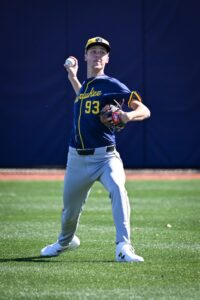
Misiorowski, 23, is one of the top prospects in baseball. The Brewers selected him with a second-round pick in the 2022 draft and signed him with a $2.35MM bonus, more than double the $1.1MM slot value for that pick.
Since then, he has been climbing the ladder with very exciting results. His fastball sits in the high-90s and can get into triple digits. He also has a curveball, slider and a lesser-used changeup. Those pitches have helped him strike out a lot of opponents though control is clearly still a work in progress.
He got a brief professional debut in 2022, making just two Single-A appearances. In 2023, he logged 71 1/3 innings while climbing as high as Double-A. He posted a 3.41 earned run average while punching out 35% of hitters, but he also gave out free passes at a high rate of 13.4%. Last year, he split his time between Double-A and Triple-A, logging 97 1/3 innings. The Brewers moved him to a relief role late in the year as a way of monitoring his workload. He had a 3.33 ERA, 30.5% strikeout rate and 14.4% walk rate.
The numbers have been similar this year. He has logged 63 1/3 Triple-A innings thus far with a 2.13 ERA and 31.6% strikeout rate. His 12.3% walk rate is an improvement for him but still about four ticks above typical major league average, which is 8% for starters this year.
Misiorowski still has some things to work on, particularly the control and the workload, but the arsenal is clearly exciting. Baseball America currently lists him as the #21 prospect in the league. FanGraphs has him at #27. ESPN‘s most recent update put him at #30. Baseball Prospectus had him at #65 in the offseason. MLB Pipeline currently has him further down at #68, with a bit more concern that the control issues will eventually push him to the bullpen. Keith of Law of The Athletic had similar concerns when giving Misiorowski the #87 slot coming into the year.
Time will tell if Misiorowski is destined for the bullpen or can stick in the rotation but it’s understandable that the Brewers will keep trying the starting path until they get some clarity. There’s simply far more value in an excellent starting pitcher compared to an excellent reliever. Even if it doesn’t work out, the bullpen path will still be available as a fallback. Even Law, the most bearish of those prospect evaluators, believes Misiorowski has a future as an elite closer.
For now, the Brewers will see if Misiorowski can evolve into a big league starter. The rotation has been constantly shifting for Milwaukee this year, mostly due to injuries. Woodruff was expected to start the season on the injured list, recovering from last year’s shoulder surgery, but his rehab has also hit a few snags. He battled some ankle tendinitis and also suffered an elbow contusion from a comebacker and is still likely a few weeks away. Robert Gasser had Tommy John surgery last summer and is another guy the club knew would be on the IL to start this year.
In addition to Woodruff and Gasser, several other pitchers have missed some time. Nestor Cortes is still on the shelf, having suffered a flexor strain back in April. Tobias Myers missed time due to an oblique strain. Aaron Civale had a hamstring strain, Jose Quintana a shoulder impingement and DL Hall a lat strain.
Around all those transactions, the club has been trying to find various solutions. Quintana was a spring signing. The Brewers traded for Quinn Priester a week into April. Several minor leaguers have been called up. As the club has been spinning those plates, 12 different pitchers have started for the team already this year. Some of those have been openers, but it’s clearly been a bit of a whirlwind.
As of this moment, the rotation consists of Freddy Peralta, Civale, Priester, Quintana and Chad Patrick, with Hall doing some starting but also some long relief work. It’s not totally clear what the club plans to shift with Misiorowski’s promotion. It could simply be a spot start. Perhaps they will go with a six-man rotation for a while. Priester and Patrick both have options and could be sent down, though Patrick’s numbers this year have been far better than Priester’s.
The Brewers are still in the playoff race. Their 35-32 record currently has them just three games back of the final National League Wild Card spot. Regardless of how they perform over the next few weeks, it’s possible to imagine them trading some starting pitching this summer. Woodruff, Quintana, Civale and Cortes are all impending free agents, which would make them logical trade chips. A bolder move would be Peralta, who can be controlled through 2026 via an $8MM club option.
Sending one or more of them out of town would theoretically downgrade this year’s rotation but the Brewers could perhaps provide replacements from within the system while bolstering another part of the roster or simply adding some prospect talent. Hall could be given a more proper rotation gig. Gasser could get back in the mix later in the year. Myers, Logan Henderson and other arms are in Triple-A and could be recalled.
The Brewers don’t have a lot of spending capacity, so this kind of tough balancing act is normal for them. Recent years have seen them trade away guys like Josh Hader and Corbin Burnes while still trying to field a competitive team. Those trades usually see them targeting a mix of MLB-ready talent and prospects or draft picks. Given the number of rotation options they have in the mix now, another move of that nature may be in the cards this summer.
That will be a situation for the next few weeks. For now, one of the most electric arms in the minor leagues is coming up to the show. As a consensus top prospect, Misiorowski is eligible for the prospect promotion incentives. The Brewers can’t earn an extra draft pick based on his performance in awards voting this year because they didn’t call him up early enough. Misiorowski can earn himself a full year of service time if he finishes in the top two in Rookie of the Year voting, though that will be a long shot. The race is still fairly wide open but Misiorowski is getting called up late and is already near his personal high in innings pitched in a season, so it’s possible the club eases off his workload at some point later in the year.
Photo courtesy of Dave Kallmann, Imagn Images
Brewers Move Aaron Civale To Bullpen
The Brewers plan to move right-hander Aaron Civale from the rotation to the bullpen now that top prospect Jacob Misiorowski has been promoted for his major league debut, manager Pat Murphy tells the team’s beat (link via Adam McCalvy of MLB.com).
It’s a tough shift for Civale, a pending free agent who’s been pitching well since returning from a seven-week stay on the injured list due to a hamstring strain. The 29-year-old righty — 30 tomorrow — has tossed 19 innings with a 3.32 ERA and 17-to-6 K/BB ratio since being reinstated on May 22. The results have been solid, though it bears mentioning that Civale hasn’t exactly been efficient. He’s yet to pitch more than 5 1/3 innings in a start and was lifted from his most recent appearance after 80 pitches in 4 2/3 frames.
Even still, Civale’s first appearance in relief with the Brewers will be the first relief outing of his entire professional career. Since being selected by Cleveland in the third round of the 2016 draft, he’s pitched in 86 minor league games and 122 major league contests. Every single one of them has been a start. Between that history as a starter, Civale’s broader track record of big league success and his run of solid results since returning from the injured list, the move surely comes as a surprise to the righty. Murphy conceded that Civale was “not happy” when informed of the decision.
Milwaukee bought low on Civale just under 11 months ago, sending minor league infielder Gregory Barrios to the Rays in an early July swap to acquire him. At the time of the trade, Civale had limped to an ERA north of 5.00, but he righted the ship with the Brewers and pitched to a 3.53 ERA in 14 starts with Milwaukee over the season’s final three months. Between that solid finish to his ’24 season and his first five starts in ’25, Civale touts a 3.84 earned run average with a 20.7% strikeout rate and 7.9% walk rate in 96 innings as a Brewer.
Civale has averaged only five innings per start, but Milwaukee tends to have quicker hooks on its starting pitchers than most organizations. Only the Marlins have allowed a pitcher to face hitters a third time less often than the Brewers in 2025 — and by a margin of only two batters (243 for Milwaukee to 241 for Miami). Dating back to last year, Milwaukee pitchers have the fourth-fewest instances of facing a batter for a third time within a game. Civale’s career splits the second and third trip through the order are virtually identical: opponents facing him a second time in a game have a .257/.307/.451 slash compared to .255/.310/.451 a third time. (In the Brewers’ and Rays’ defense, those splits were more pronounced in 2024.)
All of that is to say, some frustration from Civale is understandable. Starting games is all he’s known since being drafted, and he’s now being asked to change roles less than three months from free agency at a time when he’s not pitching poorly. However, as I noted when recently looking at Milwaukee’s sudden and surprising glut of starting pitching, some tough decisions were bound to be made.
This certainly falls under that category. The team surely does not take lightly the fact that a move to the bullpen could have real ramifications on Civale’s earning power on the open market, but the alternatives would have been burning Quinn Priester‘s final option year (at a time when he’s also pitching well) or optioning Chad Patrick — one of the NL Rookie of the Year frontrunners. Milwaukee could also have kept Misiorowski in Triple-A, but he’s pitched a 2.13 ERA there this season, including a 1.81 mark with a 33.5% strikeout rate over his past nine starts. Command is an issue — he’s walked 10.8% of opponents in that stretch, including nine in his past seven innings — but Misiorowski’s results and ability to miss bats generally seem worthy of a big league look.
Any mention of a veteran player being unhappy with a role change is going to prompt speculation about a trade — particularly when he’s affordable and playing on an expiring contract. Milwaukee would likely have gotten interest in Civale (and teammates Jose Quintana and Freddy Peralta) for those reasons anyhow, however, and there’s no indication that Civale has asked or will ask for a trade — frustration notwithstanding. Given the frequency of pitching injuries and the unconventional manner in which the Brewers tend to deploy their pitching staff, it wouldn’t be all that surprising if Civale found himself back in the rotation before long.
Today’s news and his manager’s willingness to concede some frustration on the player’s behalf do perhaps nominally increase the likelihood of an eventual trade. That said, one need only look at the Brewers’ deadline dealings over the years and the current state of their pitching staff to realize that a Civale trade was already a distinct possibility regardless.
The Brewers’ Surprising Rotation Depth
Less than two months ago, conversations surrounding the Brewers’ rotation depth struck a wildly different tone than they do at present. Early in the 2025 campaign, Milwaukee’s injured list read more like a litany, and the team was so pressed for starting pitching that it swung a rare April trade of consequence, bringing in righty Quinn Priester from the Red Sox in exchange for a Competitive Balance draft pick and two prospects.
Fast forward six to seven weeks, and the Brewers have incurred some fan backlash for optioning righty Logan Henderson to Triple-A Nashville amid a brilliant start to his big league career. Fellow righty Chad Patrick might be the NL Rookie of the Year frontrunner at the moment — and he, too, could soon find himself optioned to Nashville. Manager Pat Murphy touched on the topic when asked by Curt Hogg of the Milwaukee Journal-Sentinel about how the Brewers plan to handle their rotation when Jose Quintana and Brandon Woodruff make their respective returns from the injured list within the next week or two.
Optioning Patrick wouldn’t be due to any concerns with his performance — far from it. The 26-year-old righty has never been a particularly touted prospect — he was acquired from the D-backs for journeyman infielder Jace Peterson and did not rank among Milwaukee’ top 30 prospects at Baseball America at any point — but has nevertheless emerged as a key piece of the pitching staff in 2025.
Patrick has pitched 57 2/3 innings and turned in a sterling 2.97 ERA with a slightly below-average 21.2% strikeout rate but a strong 7.5% walk rate. He’s probably going to have some regression in the home run department, based on his bottom-of-the-scale 26% ground-ball rate, a fair bit of hard contact allowed and a home park that’s quite conducive to the long ball, but that’s largely beside the point. Patrick’s production thus far has been nothing short of a godsend, and nothing in his performance would seem to dictate a demotion to the minor leagues.
As Murphy alluded to in his comments, however, such decisions aren’t always based on merit. The Brewers know all too well what it’s like to have a pitching staff stretched so thin that they need to go outside the organization for help. As already mentioned, they did just that within the first week of April. Teams try their best to avoid depleting depth and putting themselves in position to need to make that kind of move — which is how Patrick might well find himself in Nashville before long.
Milwaukee currently has Freddy Peralta, Aaron Civale, Patrick and Priester as starters on the active roster. Quintana and Woodruff are nearing returns. Both will be plugged into the rotation. Quintana was terrific for the Brewers before hitting the IL with a shoulder impingement. He tells Adam McCalvy of MLB.com that he expects to be activated to start this Sunday. Woodruff has in the past pitched like an ace when healthy and is in the second season of a two-year, $17.5MM deal. He’s going to get the opportunity to show he can again be a top-of-the-rotation presence.
When Quintana returns, the Brewers can go to a five-man staff. Woodruff’s return would present more questions. There aren’t enough starting spots for the number of generally competitive or established arms in Milwaukee’s rotation — a problem that seemed unfathomable in early April.
Priester has been the “weakest” performer of the group, carrying a 4.23 ERA in 44 2/3 innings. His paltry 16.6% strikeout rate and hefty 11.9% walk rate aren’t a great combination, prompting metrics like FIP (4.64) and SIERA (4.78) to cast a less favorable light on his performance. However, he’s also been doing his best work of late. Priester has a 2.76 ERA, 19.4% strikeout rate and 6.5% walk rate over his past three turns. He’s also down to only one minor league option year. Priester was optioned to Triple-A by the Red Sox at the end of camp but recalled by the Brewers following the early trade; since he spent fewer than 20 days in the minors, Priester didn’t actually burn through that option. Sending him down now for a period of 20 days or longer would exhaust that final option year.
That type of consideration typically doesn’t sit well with fans, but effective option management helps to preserve depth and avoid situations like the one the Brewers faced early in the season when they had more than an entire rotation’s worth of arms on the injured list — most of whom incurred their injuries in rapid succession. Preserving Priester’s final option beyond the current season carries some notable benefit, but the Brewers will obviously have to give some real thought to exhausting it anyhow.
Moving Priester to a swingman role is another option, but that would require either burning the final option year for Aaron Ashby or DL Hall or parting with Tyler Alexander entirely. Again, any of those scenarios will probably be considered, but come with a blend of short- and longer-term ramifications. Fans will surely bristle if the short-term considerations lead to Patrick following Henderson to Triple-A, but all MLB organizations are always toeing the line between maximizing short-term results and preserving long-term depth. That’s especially true of a cost-conscious Brewers club.
Whatever comes of the ostensible logjam, it’s also bearing in mind that it’s a short-term issue in and of itself. Injuries are inevitable, and if the Brewers somehow get to the trade deadline with the quintet of Peralta, Woodruff, Civale and Quintana healthy, there will probably be pitching-hungry teams inquiring about established, affordable veterans like Quintana and Civale, who’ll be free agents at season’s end.
Peralta, of course, will draw interest and present the Brewers with their latest decision on a cornerstone veteran whose club control is dwindling; they hold a club option over his 2026 season, after which he’ll be a free agent. In many regards, he’ll present the Brewers with similar decisions to the ones they’ve faced in the past on Josh Hader, Corbin Burnes, Devin Williams and Willy Adames. They’ll surely have compelling trade offers this summer, in the offseason and at the 2026 deadline — or they could go the route they did with Adames: hang onto Peralta through the end of his control window and make him a qualifying offer.
None of this even touches on the presence of top prospect Jacob Misiorowski — one of the top young arms in all of professional ball. The 2022 second-rounder, who turned 23 last month, boasts a 1.60 ERA in 56 1/3 Triple-A innings. He’s averaging 97.4 mph on a four-seamer that can climb into triple digits and has fanned 32.2% of his opponents against a 10% walk rate. At some point, this summer, he’ll likely make his MLB debut. Injured lefty Nestor Cortes is a piece in this spiraling puzzle as well. He went on the injured list after just two starts due to a flexor strain but resumed playing catch earlier this month. Once he’s healthy, he’ll also be a rotation option.
The presence of Patrick, Henderson, Misiorowski, Priester, the already-optioned Tobias Myers and lefty Robert Gasser — on the mend from last year’s Tommy John surgery — is of extra importance with each of Woodruff, Quintana, Civale and Cortes reaching free agency at season’s end. (Quintana and Woodruff have mutual options, but it’s been more than a decade since any mutual option in all of MLB was exercised by both team and player.) It also gives the Milwaukee front office plenty of paths to consider at this year’s trade deadline. They could deal from their collection of established veterans in an effort to bring in some infield help and potentially backfill the rotation via in-house arms.
In all likelihood, there will be innings available for the entire contingent of young arms over the final two-thirds of the season. Regardless, they’ll all be in consideration for full-fledged rotation spots come 2026. That likely reliance on this group of young arms only makes it more understandable if the Brewers want to avoid burning the final option years on pitchers like Priester, Ashby and Hall, as that flexibility might be of greater utility next year when working with a younger staff.