
Extension Notes: Baez, Minor, Realmuto
Reports back in November indicated that the Cubs had initiated extension talks with star shortstop Javier Baez, but Baez himself said as recently as mid-February that talks on that front have been “up and down.” Asked about the potential of signing a long-term deal in the wake of this week’s seven-year extension for division rival Christian Yelich, Baez told Gordon Wittenmyer of the Chicago Sun-Times that Yelich’s seven-year, $188.5MM extension “doesn’t have anything to do with mine.” Baez acknowledged that he and the Cubs are still “working on” a long-term deal, though there’s no indication that talks have gained significant momentum.
Cubs president of baseball ops Theo Epstein declined to discuss talks with Baez or any other player in detail, merely indicating that the Cubs have tried to sign several players long term. “It’s not worth talking about,” Epstein said of his team’s extension efforts. “If we can get it done, we will. If we can’t, then we’ll move forward. But players don’t have an obligation to sign.” Baez is earning $10MM in 2020 and will be arbitration-eligible one last time next winter before reaching free agency in the 2021-22 offseason.
Some more notes on potential extensions for high-end players…
- Mike Minor has previously made his desire to sign an extension with the Rangers known, but the left-hander told Sam Blum of the Dallas Morning News that “nothing’s happened.” The 32-year-old said he’s not the type to “put a hard deadline kind of thing” on talks before immediately contradicting that statement (to an extent) by adding that he doesn’t want to discuss a new contract during the season. Getting a new deal done before Opening Day would be a “best case” scenario, per Minor, who pitched to a 3.59 ERA with 8.6 K/9, 2.9 BB/9, 1.30 HR/9 and a 40 percent ground-ball rate in a career-high 208 1/3 innings with Texas in 2019. Minor is owed a $9.83MM salary in 2020 — the final season of a three-year, $28MM deal signed with Texas prior to the 2018 campaign. Minor figures to be one of the better arms available on next year’s market and was an honorable mention on the first edition of MLBTR’s 2020-21 Free Agent Power Rankings.
- The Phillies continue to discuss an extension with free-agent-to-be J.T. Realmuto, writes Todd Zolecki of MLB.com. The desire to get a long-term deal worked out isn’t exactly a well-kept secret, as both sides have made their desire to continue the relationship beyond 2020 known. Zolecki reports that talks between the two sides are moving slowly at this point, however. Realmuto for the first time this spring publicly acknowledged that the two sides are indeed talking but wouldn’t specify beyond that, simply stating that there’s “no update” at this time. Realmuto landed second on the first edition of MLBTR’s Free Agent Power Rankings, wherein Tim Dierkes observed that the 29-year-old is one more strong season away from being the first free-agent catcher to ever sign a deal worth more than $100MM.
Rangers View Danny Santana As Primary Center Fielder
Rangers manager Chris Woodward said today that long-time utilityman Danny Santana will see most of the action in center field to open the year, as MLB.com’s TR Sullivan reports on Twitter.
That’s hardly surprising, as the team has long signaled this arrangement after the offseason dust settled. But there was some new uncertainty when the Rangers began running Nick Solak up the middle.
So, does this mean the end of the Solak experiment? Not necessarily. Woodward says the hitter in search of a position has actually looked fairly comfortable since trying out the new spot.
Solak, 25, has limited professional experience on the outfield grass, with most of that coming in the corners. But the Rangers are looking for creative ways to get him into the lineup — quite understandably, given that he has a nice track record of hitting in the minors and posted a .293/.393/.491 slash in his first 135 MLB plate appearances last year.
The switch-hitting Santana was also long a middle infielder before increasingly shifting into outfield duties. He appeared all over the place in a breakout 2019 season, all while slashing a robust .283/.324/.534. Whether he can sustain that outburst remains to be seen. Santana was similarly productive as a rookie back in 2014 but had a long dry spell in the interim.
In the aggregate, it probably doesn’t matter all that much how the Rangers sort things to begin the season. Both Santana and Solak come with some upside and some desirable flexibility. They each also have questions to answer. No doubt the team’s plan is to adapt as the season unfolds.
8 AL West Pitchers Looking For Bounce-Back Years
Our preseason series exploring potential bounce-back candidates for 2020 began with a look at several AL West hitters hoping to rebound. Let’s stay in the division and focus on a group of talented pitchers who want to put disappointing seasons behind them…
Corey Kluber, RHP, Rangers: Kluber was the Rangers’ highest-profile offseason pickup and someone who’s now near the front of a revamped rotation, but the Indians decided the 33-year-old was expendable in the wake of a truncated 2019. In a limited number of innings (35 2/3), Kluber came nowhere near his two-time Cy Young form, notching a 5.80 ERA/4.06 FIP, and didn’t pitch past May 1 as a result of a broken forearm. Kluber did strike out almost 10 batters per nine when he was healthy enough to take the mound, but he offset that with some of the worst walk (3.79 BB/9), groundball (40 percent) and average fastball velocity (91.6 mph) marks of his career. With the Rangers holding an $18MM option or a $1MM buyout over him for 2021, this is an especially pivotal season for Kluber.
Jose Leclerc, RHP, Rangers: Leclerc was an absolute force during a breakout 2018, but his run prevention numbers took noticeable steps backward because of control problems. He lost his job as the Rangers’ closer at one point early in the year and wound up with a 4.33 ERA and 5.11 BB/9 in 68 2/3 innings. However, the 26-year-old did get a lot better after a terrible May, and he also concluded with 13.11 K/9 and a career-high 96.8 mph average fastball velocity (1.5 mph better than he recorded during his dream ’18).
Andrew Heaney, LHP, Angels: Considering their lack of high-end pitching additions in the offseason, it’s particularly important for the the Angels to get a healthy and better version of Heaney in 2020. Injuries victimized Heaney last year, holding him to 95 1/3 innings of 4.91 ERA/4.63 FIP ball. He also struggled to induce grounders (33.6 percent), which helped lead to an 18.3 percent home run-to-fly ball rate. But Heaney did log 11.14 K/9 against 2.83 BB/9 with a personal-best average fastball velocity (92.5 mph) and a career-high swinging-strike rate (14.1 percent).
Lou Trivino, RHP, Athletics: Trivino had an outstanding rookie year from the A’s bullpen in 2018, but with the clear exception of his 97 mph-plus velocity, just about everything went downhill last season. Fewer strikeouts and more walks meant far more runs against, with Trivino’s ERA/FIP shooting from the twos and threes to 5.25/4.53 over 60 frames during a year that ended early because of rib issues. And Trivino wasn’t as lucky as he was a rookie, as his batting average on balls in play and strand rate each went the wrong way. On a more encouraging note, the 28-year-old did rank near the top of the majors in a few notable Statcast categories, including average exit velocity against (85.5 mph).
Joakim Soria, RHP, Athletics: Soria was another A’s reliever who may not have produced as the team hoped he would have in 2019. The A’s signed Soria to a two-year, $15MM deal in December 2018 after a terrific season between the White Sox and Brewers, but for the most part, he couldn’t match what he did then. That’s not to say Soria was bad – he still posted a 4.30 ERA/3.62 FIP with 10.3 K/9 and 2.61 BB/9, and his mean fastball velocity remained in the 93 mph range. Also, as with Trivino, Soria was something of a Statcast favorite, mostly earning good marks in that area.
Yusei Kikuchi, LHP, Mariners: On the heels of an excellent tenure in his homeland of Japan, Kikuchi was a high-profile signing for the Mariners entering the 2019 campaign. They guaranteed Kikuchi $56MM on a contract that could max out at $109MM, but Year 1 of the deal probably didn’t go to the Mariners’ liking. In his first season in the majors, the 28-year-old recorded a 5.46 ERA/5.71 FIP – both among the worst in the game – across 161 2/3 innings. He relied primarily on a fastball-slider-curve mix, but all three of those offerings ranked among the least effective of their kind, per FanGraphs. Kikuchi did walk fewer than three hitters per nine, though his K/9 (6.46) placed sixth from the bottom out of 75 pitchers who accumulated at least 150 innings.
Carl Edwards Jr., RHP, Mariners: It wasn’t long ago that Edwards was a key component of the Cubs’ bullpen. As recently as 2018, he put up a 2.60 ERA/2.93 FIP with 11.6 K/9 across 52 innings, though that stellar production did come in spite of a 5.54 BB/9 and a lowly 28.9 percent groundball rate. Edwards found a way to dodge home runs then, as he gave them up on just 3.8 percent of the many fly balls he allowed, but he wasn’t able to do so during an abbreviated, shoulder injury-plagued 2019 in the majors. Edwards only totaled 17 innings between the Cubs and Padres (his other 17 2/3 frames came in Triple-A ball), and he gave up HRs 15 percent of the time en route to an abysmal 8.47 ERA/5.74 FIP. His control got worse along the way, as he surrendered almost seven walks per nine, and so did his strikeout rate. Edwards fanned a little over 10 hitters per nine, but his strikeout percentage fell almost six points from the prior year, while his swinging-strike rate dropped nearly 4 percent. Still, for $950K, you can’t fault the Mariners for rolling the dice.
Yoshihisa Hirano, RHP, Mariners: Hirano’s another low-cost bullpen flier for the Mariners, whom they inked for $1.6MM last month. No doubt, they’re hoping they get a version of Hirano closer to 2018 than ’19. The former Diamondback recorded a 2.44 ERA/3.69 FIP in his first year in the majors, but those numbers rose to 4.75 and 4.04, respectively, last season. Hirano also generated fewer ground balls, gave up more home runs and issued more walks, though he did see his K percentage go up almost 4 percent, finishing with 10.36 per nine. Like the Edwards signing, there’s little to no harm from the M’s perspective in taking a chance on a rebound.
7 AL West Hitters Looking For Bounce-Back Years
As the season draws closer, we’ll be examining several prominent players around the majors who are hoping for bounce-back years. Let’s start with a group of well-known American League West position players whose numbers dipped dramatically in 2019…
Justin Upton, LF, Angels: The 32-year-old Upton has been terrific for the majority of his career (otherwise, the Angels wouldn’t have given him a five-year, $106MM guarantee after 2017), but last season was a nightmare. A foot injury kept Upton out until June, and his season ended prematurely in September on account of a right knee issue. When Upton was healthy enough to take the field, he batted a disappointing .215/.309/.416 with 12 home runs and a career-worst 30.5 percent strikeout rate (5 percent worse than his lifetime mark). Compared to 2018, his fly ball percentage and launch angle went way up, but his average exit velocity dropped almost 4 mph, and his hard-hit rate plummeted. The banged-up Upton was even worse in left field, where he accounted for minus-13 Defensive Runs Saved and a minus-5.2 Ultimate Zone Rating. Upton recently told Jeff Fletcher of the Orange County Register that he’s healthy and aiming for a rebound. The Angels will likely need one from him if they’re going to break a five-year playoff drought; if they get one, Upton should form a lethal offensive quartet with Mike Trout, Anthony Rendon and Shohei Ohtani.
Andrelton Simmons, SS, Angels: Like his teammate Upton, Simmons missed a significant number of games last year because of injury issues. Ankle troubles limited Simmons to 103 games, his fewest since 2012, and his effectiveness at the plate waned compared to the prior couple years. While Simmons has never been an offensive force, the defensive maven’s slightly above-average work with the bat from 2017-18 helped him combine for 10.4 fWAR in that span. Simmons only put up a .264/.309/.364 line in 424 PA last year, though he did continue to avoid strikeouts (8.7 percent), and his wizardry in the field helped him to a respectable 1.7 fWAR. However, he still finished near the bottom of the majors in several key offensive Statcast categories. For instance, Simmons’ xwOBA (.265) ranked in the bottom 2 percent of the league and fell 59 points from 2018. The ankle may have been holding Simmons back, but regardless, a return to form in 2020 would aid the Angels and the pending free agent’s bank account.
Khris Davis, DH, Athletics: Yet another injury case from 2019, Davis’ normally elite power was sapped during a season in which he fought hip, oblique and hand problems. After three straight 40-home run seasons (and four in a row in which he hit .247), he finished with a .220/.293/.387 line and 23 HRs over 533 PA. His ISO sunk like a stone, going from .302 in 2018 to .166 last year, and his hard contact went way down in the process. The 32-year-old has already been slowed by a calf injury early in camp, but indications are that it’s minor. Oakland will need that to be the case, especially considering the commitment the low-budget club made to Davis before last season. It still owes him $16.75MM on a two-year, $33.5MM contract that hasn’t worked out for the team so far.
Stephen Piscotty, RF, Athletics: The missed time theme continues. Piscotty’s 2019 ailments ranged from frightening (a melanoma on his right ear) to more conventional (knee and ankle injuries). The 29-year-old made just 93 appearances as a result, and he didn’t produce like the big-hitting, 3.0-fWAR player he was in 2018 when he did play. Piscotty hit .249/.309/.412 with 13 homers and 0.6 fWAR in 393 PA, though his hard-hit percentage and average exit velocity both increased. There may be hope for return to his career-best output, then, but Piscotty will first have to get over yet another health issue. He’s dealing with an oblique/rib cage injury that could jeopardize his status for Opening Day.
Mitch Haniger, RF, Mariners: Haniger was quietly great in 2018, but his playing time and his numbers sagged last season. He sat out 99 games after suffering a ruptured testicle at the beginning of June, didn’t play again after that and still hasn’t returned to health. Haniger just underwent his second surgery in the past few weeks – a microdiscectomy on his back – leaving it up in the air when he’ll debut in 2020. The 29-year-old is the Mariners’ best player, though, and if they can get a healthy version back sometime in 2020, he’s as logical a bounce-back candidate as anyone.
Mallex Smith, OF, Mariners: Smith looked like a quality pickup for the Mariners when they acquired him from the Rays after the 2018 campaign. At that point, the speedster was coming off a 3.5-fWAR, 40-steal showing in Tampa Bay. Smith amassed even more stolen bases in is first year in Seattle (46), but the rest of his stats tanked. The 26-year-old hit a weak .227/.300/.335 in 566 trips to the plate, while his defensive output was similarly poor (minus-12 DRS, minus-9.5 UZR). The combination of subpar offense and defense led to a replacement-level fWAR for Smith, who also fell victim to a massive decline in batting average on balls in play. He logged an inflated .366 BABIP in ’18 and a .302 mark in that category last season, which partially explains the drastic difference in year-to-year production.
Rougned Odor, 2B, Rangers: If you’re a Rangers fan (or even part of the organization), you may be tired of Odor’s inconsistency. He has been a 2.0-plus-fWAR player three times in his career, most recently in 2018, but a replacement-level or worse performer twice. That includes last season – even though Odor walloped 30 homers, he was only able to slash .205/.283/.439 in 581 tries. Along the way, the left-handed Odor posted his worst strikeout percentage (30.6) and was eaten alive by righty pitchers, who held him to a dismal .190/.260/.417 line. If there’s a silver lining, it’s that Odor was much better in the second half of the season, ending the year with a flourish after general manager Jon Daniels expressed frustration with his production in late August. The Rangers still owe Odor $36MM through 2022, making it all the more important for the club to receive at least passable production from him.
Rangers’ Brock Burke To Undergo Shoulder Surgery
The Rangers will be without one of their top pitching prospects for all of the 2020 season, as the organization announced Monday that lefty Brock Burke will undergo arthroscopic surgery to repair fraying and a partial tear in the labrum of his left shoulder this week. He’s not expected to pitch again until 2021.
Burke wasn’t projected to crack the Opening Day roster, but he would’ve functioned as a key depth piece for the club’s reworked rotation. He’s already on the 40-man roster and made his MLB debut last August — shortly after his 23rd birthday. Burke struggled in six big league starts (22 runs in 26 2/3 innings), but he posted a 3.90 ERA with 9.2 K/9, 2.6 BB/9 and a minuscule 0.4 HR/9 across three minor league levels last year. The Rangers initially acquired him from the Rays in last offseason’s three-team swap that sent Jurickson Profar to Oakland.
Texas’ offseason acquisitions of Corey Kluber, Kyle Gibson and Jordan Lyles pushed Burke and fellow left-hander Kolby Allard out of the rotation mix early in the season, but both pitchers were one big league injury away from being summoned from Triple-A Nashville to the newly constructed Globe Life Field in Arlington. Earlier this winter, Baseball America ranked Burke 21st among Rangers prospects — the same slot he occupied on FanGraphs’ most recent ranking of the Texas minor league system. He’s generally regarded as a potential back-of-the-rotation starter who gets by with average across-the-board stuff rather than a particular plus offering.
Burke will likely be placed on the 60-day injured list to open a 40-man roster spot at some point this spring, thus positioning him to accrue a full year of Major League service time while he rehabs from Friday’s upcoming procedure. That’s surely not the way that the Rangers would’ve preferred to open a 40-man spot, but the club does have several non-roster invitees in camp who stand a realistic chance of making the team. Matt Duffy, Greg Bird, Sam Travis, Cody Allen, Blake Swihart, Edinson Volquez, Juan Nicasio and Derek Law are among the notable non-roster players in big league camp with Texas in 2020.
Al Notes: Thornton, Jays, Romero, Calhoun
Some news and notes from American League spring training camps:
- Trent Thornton is the favorite to claim the final spot in the Blue Jays’ season-opening rotation, reports Scott Mitchell of TSN. The 26-year-old actually led the Jays in innings (154.1) last season, but the results weren’t in line with what one would want from a staff ace. He posted a 4.84 ERA with slightly worse than average strikeout (22.0%) and walk (9.0%) rates. This offseason, the front office went to work on bolstering that pitching staff. They signed Hyun-Jin Ryu and Tanner Roark to multi-year deals, brought back Matt Shoemaker, and acquired Chase Anderson in a trade with Milwaukee. Another offseason addition, Shun Yamaguchi, figures to be Thornton’s biggest competition for the #5 rotation spot. Because of his experience in relief in NPB, however, Yamaguchi seems more likely to open the season in the bullpen, Mitchell reports.
- Seeing that new-look staff in action will be a bit more difficult for some Blue Jays’ fans. Beginning this season, live Jays’ games will be blacked out on MLB.tv throughout Canada, reports Andrew Stoeten of the Athletic. Instead, Canadian viewers will have to subscribe to Sportsnet NOW to stream games. A subscription to that platform also offers non-baseball programming but doesn’t come with the MLB.tv advantage of offering live access to every MLB game in real time. It’s surely frustrating news for a certain segment of the Canadian fan base.
- Twins’ reliever Fernando Romero won’t report to the team “for the foreseeable future,” manager Rocco Baldelli tells Jeff Wheeler of the Minneapolis Star-Tribune. A visa issue resulted in Romero being denied entrance to the United States. He’ll now need to resubmit several documents to gain customs’ approval, Wheeler reports, a process that could take several weeks. It’s possible Romero misses all of spring training, he adds. A lengthy delay would be a blow to the 25-year-old’s hopes of earning a big league bullpen job out of camp. Long one of the organization’s top prospects, Romero struggled in 15 MLB relief appearances in 2019.
- Willie Calhoun has a firm hold on the Rangers’ left field job, notes Evan Grant of the Dallas Morning News. More importantly, it seems Calhoun’s found a better peace of mind as he enters spring training than he’d carried into previous seasons, as Grant explores. After some tumult following his early-season demotion in 2019, the 25-year-old has forged stronger relationships with many in the organization. Grant’s profile is worth a full perusal for those interested in Calhoun’s growth as a person and player.
Rangers Getting Nick Solak Work In Center Field
Acquired in a July trade that sent righty Peter Fairbanks to the Rays, Rangers infield prospect Nick Solak impressed upon being promoted to the show late in 2019, hitting .293/.393/.491 with five home runs, six doubles, a triple and two steals in 135 plate appearances. Pair that with his .289/.362/.532 slash in Triple-A last year, and it’s easy to see why Rangers president of baseball ops Jon Daniels, manager Chris Woodward and the rest of the organization’s decision-makers are so intrigued by Solak’s potential.
However, while there’s room for flexibility in the infield, the Texas organization is more focused on having Solak learn a position that is largely new to him this spring; Woodward tells Evan Grant of the Dallas Morning News that learning the ropes in center field is Solak’s “top priority” in Spring Training. Danny Santana is currently the team’s top option in center, but playing Solak there would free Santana to bounce around the diamond.
It’s a semi-surprising development for the 25-year-old Solak, who has played just 165 professional innings in center — nearly all of which came with the Rays’ Double-A affiliate back in 2018. He’s played left field a bit more regularly (506 pro innings), but the overwhelming majority of Solak’s experience on defense has come at second base, where he’s logged 2951 innings.
The possibility of Solak suiting up as even a semi-regular option in center field is indeed intriguing. Playing Solak in the outfield and not at third base would free the Rangers to use Todd Frazier at the hot corner regularly, giving former top prospect Ronald Guzman and perhaps non-roster players like Greg Bird and Sam Travis a chance to impress at first base. It’d also allow Santana to shift into a super-utility role that probably better suits him; the Twins tried Santana as a regular center fielder early in his career without much success.
For much of the offseason, center field looked to be an area of need in Arlington. (Of course, it very arguably still does, even with the Solak wrinkle now in play.) Delino DeShields has been the Rangers’ most regular option in recent years, but he’s now in Cleveland. Joey Gallo logged significant innings there in 2019 and graded out surprisingly well in the estimation of many defensive metrics, but the Rangers seem to prefer him in right field. Prospects Leody Taveras and Julio Pablo Martinez need more time to develop. And the Rangers clearly weren’t enamored of the options on the free-agent and trade markets — at least not at their respective asking prices.
Can Solak successfully make the move? FanGraphs’ Eric Longenhagen pegs his speed and arm at average on the 20-80 scale but grades him as a well below-average defender overall (though he nevertheless checked in as the game’s No. 109 overall prospect on Longenhagen’s rankings). Jim Callis and Jonathan Mayo offer similar opinions at MLB.com, calling him a “fringy” defender all over the infield and outfield despite his athleticism and ability to run. Of course, if Solak hits like he did in Triple-A and in his big league debut, the Rangers might very well be able to live with some defensive growing pains as he adjusts to increased outfield reps. Santana will remain on hand as an option, should the experiment prove unsuccessful, but the manner in which Solak takes to his new position will be an fascinating scenario to watch as the Cactus League progresses.
AL Notes: C. Davis, Choo, Tigers
Then among the most threatening sluggers in baseball, Orioles first baseman Chris Davis re-signed with the team on a seven-year, $161MM contract prior to the 2016 campaign. Davis was coming off a 47-home run, 5.4-fWAR season at the time, but his output has tanked since he signed his contract. The lefty swinger was stunningly unproductive from 2018-19 – an 854-plate appearance run in which he hit .172/.256/.308 with 28 HRs. Davis easily ranked last in the majors in fWAR in the process, accounting for minus-4.5.
The 33-year-old Davis, cognizant of how far he has fallen with the Orioles, admitted Monday (via Roch Kubatko of MASNsports.com) that he recently considered retiring. “I’d be lying if I told you that wasn’t at least talked about toward the end of the season last year and this offseason,” he said. “I know what I’m capable of. I know what I expect of myself and I don’t want to continue to just struggle and be a below-average, well below-average producer at the plate. And I don’t think that’s fair to these guys. And I don’t think, honestly, it’s fair to our fans, or to anybody that’s associated with Baltimore.”
For now, Davis is hanging around and hoping for a better showing in 2020. If that doesn’t occur, though, it’ll be interesting to see if he walks away or the Orioles cut him. The soon-to-be 34-year-old still has another $69MM left on his contract (including deferrals), so an early breakup wouldn’t be easy for either side.
- Speaking of uncertain futures, Rangers outfielder Shin-Soo Choo is going into the last season of his own lucrative the deal – the seven-year, $130MM contract he inked with the club before the 2014 campaign. It could prove to be the final season in the majors for the 37-year-old, who hasn’t decided whether to play in 2021, per Jeff Wilson of the Star-Telegram. If Choo does elect to play past this year, though, he’d like to remain a Ranger, according to Wilson. Overall, the gamble the Rangers took on Choo in free agency hasn’t necessarily worked out as planned, but he remains a solid offensive player and an on-base machine. Choo slashed .265/.371/.455 with 24 home runs and 15 stolen bases in 660 trips to the plate last season.
- Tigers left-hander Joey Wentz halted his live bullpen session Monday as a result of forearm soreness, Chris McCosky of the Detroit News writes. Wentz brushed it off as fatigue, though it could still be worth monitoring going forward. After all, Wentz is one of the most promising arms in the Tigers’ system. The 22-year-old joined the organization last July in a trade with the Braves centering on reliever Shane Greene. Wentz then finished the season in dominant fashion as a member of the Tigers’ Double-A team, with which he pitched to a 2.10 ERA and put up 13.0 K/9 against 1.4 BB/9 across 25 2/3 innings.
Danny Santana Changes Representation
Rangers utilityman Danny Santana has changed representation and is now a client of Gene Mato of Mato Sports Management, Jon Heyman of MLB Network tweets.
For the 29-year-old Santana, the agency switch comes on the heels of one of his most productive seasons. He burst on the scene as a member of the Twins in 2014, totaling 3.9 fWAR in his 430-plate appearance rookie campaign, but then struggled in the next four years. Between the Twins and the Braves from 2015-18, Santana batted a disastrous .219/.256/.319 line with six home runs over 735 plate appearances. Just three hitters managed a worse fWAR than Santana’s minus-2.3 during that span.
Thanks to his years-long stretch of posting subpar numbers, Santana had to settle for a minor league contract with the Rangers in December 2018. The signing has worked out swimmingly for both sides so far. The switch-hitting Santana wound up totaling 511 PA of .283/.324/.534 of offense at the big league level last season. He was one of seemingly countless MLB players to power up during a home run-happy season, bashing 28 HRs en route to a 20-20 year (he also had 21 stolen bases) and 1.9 fWAR. However, it was alarming that Santana struck out in just about 30 percent of trips to the plate while walking a little under 5 percent of the time.
While skepticism may be warranted in regards to Santana’s 2019 offensive outburst, he should at least continue to give the Rangers a versatile, affordable performer. He saw quite a bit of action at every infield position and all outfield spots last season, and remains someone Texas expects to lean heavily on heading into 2020. Santana’s due to make $3.6MM this year – his second-last season of arbitration eligibility.
Santana’s change in representation will be reflected in MLBTR’s Agency Database, which contains agent info on thousands of Major League and Minor League players. If you see any errors or omissions within, please let us know: mlbtrdatabase@gmail.com.
Camp Battles: Rangers’ First Base Situation
After a run as a well-regarded prospect, Rangers first baseman Ronald Guzman made his major league debut in 2018. Since then, though, few teams have gotten less from the position. Guzman’s defense has drawn praise, but that only goes so far when you struggle to hit at an offensively charged position. He’s coming off a two-year stretch in which he slashed a less-than-stellar .229/.307/.415 with 25 home runs in 723 plate appearances. Guzman accounted for just 0.1 fWAR along the way, and his lack of production even led the Rangers to option him to Triple-A Nashville last season.
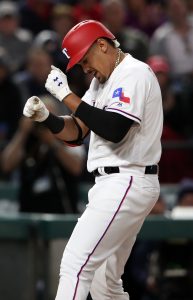
In the wake of Guzman’s weak 2019, it wouldn’t have been a surprise to see the Rangers make an improvement at first base in the offseason. Even for modest prices, there were apparent free-agent upgrades available (Eric Thames and Justin Smoak come to mind). The Rangers even considered signing pricey outfielder Nick Castellanos and putting him at first, but he wound up with the Reds.
Having struck out on Castellanos, the Rangers have just about stood pat at first in recent months. Therefore, Guzman’s the front-runner to start again in 2020. He does have an option remaining, however, so the Rangers could send him back to the minors and still retain him if he doesn’t win the job in camp.
Cognizant of the fact that he may be in a make-or-break situation, the 25-year-old Guzman worked hard to better himself during the winter. He sought help from one of the game’s best offensive players in recent memory, former Ranger and current Twin Nelson Cruz, as Evan Grant of the Dallas Morning News explained earlier this week.
On the heels of his work with Cruz, both Guzman and the Rangers seem optimistic he’ll finally begin realizing his potential in 2020. If that doesn’t happen, though, there are other in-house first base choices to whom they could turn. Granted, there may not be a clear answer on the roster at all.
The Rangers brought in former Yankees first baseman Greg Bird on a minor league contract Feb. 4. As a prospect and then as a rookie in 2015, when he batted .261/.343/.529 with 11 homers in 178 plate appearances, Bird looked like a possible long-term answer at first for the Yankees. But a series of injuries – including to his foot, shoulder, ankle and knee – helped take a sledgehammer to his Yankees career. Bird missed all of 2016 and was unproductive from 2017-19, appearing in a paltry 10 games in the last of those seasons. The Yankees let the 27-year-old Bird go a few months ago, and he now has to prove himself all over again.
The Rangers also took a low-risk flier on former Red Sox first baseman Sam Travis over the winter. Like Guzman and Bird, Travis was once a quality prospect. Now 26, Travis wasn’t especially impressive at the Triple-A or major league levels from 2017-19. Consequently, the Red Sox – despite needing a first baseman at the time – moved on from Travis a month ago.
If you’re not inspired by Guzman, Bird or Travis, it’s hard to blame you. Problem is that the Rangers aren’t teeming with obvious solutions otherwise. In theory, veteran third baseman Todd Frazier could man the position, but that seems improbable unless the club puts Nick Solak or Danny Santana at the hot corner or does the unlikely and acquires the Cubs’ Kris Bryant or the Rockies’ Nolan Arenado in a blockbuster preseason trade. Should no trade occur, Solak or Santana may see some time at first, but the Rangers might prefer to move the versatile duo around the diamond.
Considering their current options, it looks as if it’ll be another bleak year at first base for the Rangers. The club has made real improvements elsewhere, particularly to its starting staff, but it doesn’t appear that’ll happen at first before the season opens. The spot’s devoid of impact players in free agency, so it would take an unexpected trade in order to find a slam-dunk upgrade now.
Photo courtesy of USA Today Sports Images.