
Nationals Will Make Extension Offers To Juan Soto, Trea Turner In Near Future
The Washington Nationals have famously fielded top-heavy rosters typically built around a core of strong starting pitching. Since Washington’s first playoff appearance in 2012, they’ve advanced to postseason play five times in nine years, always on the backs of their starting pitching. The starting pitching units on their playoff teams (2012, 2014, 2016, 2017, 2019) ranked 1st, 1st, 2nd, 4th, and 3rd in the Majors by FIP and 5th, 2nd, 1st, 2nd, and 1st by fWAR. Gio Gonzalez, Jordan Zimmermann, Tanner Roark, Max Scherzer, and Stephen Strasburg each posted multiple 3.0+ fWAR seasons for Nats’ playoff teams, and Patrick Corbin is halfway there after a 4.7 fWAR season in 2019.
On the position player side, a core of Bryce Harper, Jayson Werth Ryan Zimmerman, and Ian Desmond added Anthony Rendon in 2014. They morphed by swapping Daniel Murphy and Trea Turner into the core group for Desmond and Werth by 2016. Before 2019, this unit faced their most monumental change yet, letting Harper leave for Philly as Juan Soto developed in his place. Rendon left after the title team in 2019, and it’s now been three years since Zimmerman aka “Mr. National” played a central role in the offense.
Present day, the Nats’ offensive core is a smaller unit than it’s been in year’s past, but it might be the strongest foundation of a Nationals team to date. Soto is one of the best offensive players in the game, compared today to Ted Williams by the Athletic’s Jayson Stark. Turner is one of the game’s most dynamic and underrated superstars.
Victor Robles certainly seemed like a key member of this core unit in 2019, and they hoped Carter Kieboom might step into Rendon’s place at the hot corner, but neither cemented their place in the inner circle during a rough 2020 season. The slow ascent of Kieboom and Robles has made Soto and Turner all the more important to the Nats’ future. Beyond their obvious talents, at 22 and 27 years old, they’re the youngest ties to the 2019 title team.
Starting pitching has been this team’s past, but Scherzer is 36, Strasburg is 32 and twice lost seasons to injury, and Corbin is 31. Their top prospects are a couple of power arms in Jackson Rutledge and Cade Cavalli, and Cole Henry, Andry Lara, Jeremy De La Rosa, and Tim Cate provide some backing in that regard, but there’s much uncertainty in projecting arms. The Nationals future seems to lie in the hands of Soto, Turner, and to a lesser extent, Robles and Kieboom.
The clock is ticking, however, and the cost is rising. Turner will make $13MM this season with one more year of arbitration before free agency after 2022. Soto became arbitration eligible for this first time this winter as a Super Two player. He’ll make $8.5MM in 2021 with three more turns through arbitration before free agency after 2024. He’ll be just 26 years old.
The conversation inevitably turns to potential extensions, and there have been internal discussions about what it might cost to lock their two superstars into long-term deals. In fact, there will be long-term contract offers on the table in the near future, per Jesse Dougherty of the Washington Post (via Twitter).
They’ve made offers in the past, however. Per MLB.com’s Jessica Camerato (via Twitter), GM Mike Rizzo said earlier today, “We’ve discussed internally with ownership about it. We’re in the midst of making decisions on what a timeframe would look like … We certainly have made & will make a long-term extension offer to both players sometime in the near future.”
Since the Braves extended Ronald Acuña Jr. to a well-below-market eight-year, $100MM extension, and the Padres extended Fernando Tatis to a 14-year $340MM extension, Soto might be the best young player without a long-term deal in place. Acuña signed his deal after winning Rookie of the Year with a 4.3 bWAR season in 111 games. Tatis signed after two years of service time and 7.0 bWAR through 143 total games. Soto has just 0.143 more service time than Tatis, but he’s begun the arbitration process, played in 313 games, won a World Series, and accrued 9.7 bWAR. How much will it cost to extend the next Ted Williams? That’s a difficult question, especially when he’s represented by Scott Boras.
If there’s any organization comfortable dealing with mega-agent Boras, it’s the Nationals, who have dealt with him over the years both to sign long-term deals in the case of Strasburg and Scherzer and to not sign those deals with Harper and Rendon. The Nats should have a pretty clear idea about what it would take to sign Soto – or if it’s even possible.
As for Turner, the CAA client might want to wait and see how next winter’s free agent market shakes out. One way or another, a market price will be set for star shortstops as Francisco Lindor, Javier Baez, Carlos Correa, Marcus Semien, Trevor Story, and Corey Seager all sign new contracts. If he does wait, 2021 could be a make-or-break season for Turner. While he’s flashed tremendous potential, he’s also dealt with injuries that have cut short some of his most productive seasons. He finished 7th in MVP voting during the shortened 2020 season.
Xander Bogaerts signed a six-year, $120MM extension in April 2019 with the Red Sox, which could be used as a comparison point. You can check MLBTR’s Extension Tracker to find your own comps. Bogaerts – a Boras client – signed after 5.046 days of service time at 26 years old with 759 games and 15.6 bWAR under his belt. Turner is at 4.135 days of service time right now. He’ll be in the territory of Bogaerts’ 5.046 service time days by the time he turns 28-years-old in June. At present, Turner has notched 541 games and 16.6 bWAR.
One thing we know about Washington and long-term deals is that money will have to be deferred. That said, they’ve shown willing to spend high-end money for the right players. Even though they’ll pay Strasburgh $35MM a season through 2026, and Corbin escalating salaries of $23.4MM, $24.4MM and $35.4MM through 2024, the Nats have some long-term payroll flexibility. Schezer’s $42MM deal comes off the books after this season, as does deals for Brad Hand, Starlin Castro, Daniel Hudson, Yan Gomes, Jon Lester, Alex Avila, Josh Harrison, and Zimmerman. They can also takes a $3MM buyout for Kyle Schwarber over an $11MM option. That’s a total of $73.6MM that could come off the books following 2021. Of course, in that circumstance, Rizzo would also have to back-fill nine roster spots.
Nationals Release Jeremy Jeffress
The Nationals have released right-hander Jeremy Jeffress, Jesse Dougherty of the Washington Post reports. The move was made due to “personnel reasons,” GM Mike Rizzo said in a statement.
Jeffress only signed his minor league contract with the Nats back on February 22, and would have earned at least $1.25MM in guaranteed salary had he made Washington’s MLB roster. While the timing of the release is somewhat unusual, it could be that the Nationals made a quick decision on Jeffress and simply chose to cut him now rather than prolonging his stay in camp. Jeffress may also now get something of an early jump on catching on with another team, though several other veteran relief pitchers are still available.
Looking to pitch in his 12th Major League season, Jeffress posted a 1.54 ERA over 23 1/3 innings with the Cubs last season, though numerous advanced metrics (ranging from a 4.96 SIERA to a .161 BABIP) indicated that a lot of good fortune went into Jeffress’ sterling ERA. It was something of a reversal of his 2019 season, as the secondary statistics indicated that Jeffress pitched better than his 5.02 ERA over 52 innings with the Brewers.
Jeffress has a career 3.08 ERA and 56.6% grounder rate over 424 1/3 career frames with five different clubs, with the majority (304 2/3 IP) of that work over parts of seven seasons with Milwaukee. Reports back in January indicated that multiple clubs were considering Jeffress, so one of those teams could again come calling with a minor league deal now that the 33-year-old is back on the market.
Nationals Sign Justin Miller To Minors Deal
The Nationals recently signed right-handed reliever Justin Miller to a minor league contract, as originally reported by the Talk Nats blog (Twitter link). As per Jesse Dougherty of the Washington Post, Miller’s deal does not include an invitation to Washington’s big league spring camp.
There’s familiarity between Washington and Miller, who pitched for the team from 2018-19. He fared quite well in the first of those seasons, in which he gave the Nationals 52 1/3 innings of 3.61 ERA/3.34 SIERA ball with quality strikeout and walk rates of 27.9 percent and 7.9 percent, respectively. Miller was unable to replicate that performance during the Nationals’ World Series-winning 2019 campaign, though, owing in part to shoulder troubles. He totaled 15 2/3 frames, recorded a 4.02 ERA/5.46 SIERA and experienced a severe drop in strikeout percentage (16.9) before his season ended in mid-May.
The 33-year-old Miller, also a former Tiger and Rockie, spent time with the Blue Jays and Reds organizations last season. He didn’t appear in the majors with either team.
Jon Lester Will Undergo Surgery To Remove Thyroid Gland
Nationals left-hander Jon Lester will undergo surgery to have his thyroid gland removed on Friday, manager Dave Martinez announced today (link via Jesse Dougherty of the Washington Post). Assuming all goes well, the surgery is only expected to keep him out of action for roughly a week’s time, the manager added.
The 37-year-old Lester has been dealing with fatigue early in camp. After some consultations with medical experts and a slate of tests, he opted to have the surgery this week with the hope that it’ll prevent further symptoms during the 2021 season. He’s traveling to New York today.
Lester signed a one-year, $5MM deal with the Nationals over the winter, setting the stage for him to slide into the rotation behind Max Scherzer, Stephen Strasburg and Patrick Corbin. The contract reunites him with Martinez, who was his bench coach in Chicago from 2015-17, and with fellow free-agent signee Kyle Schwarber.
Back in 2006, during his rookie year with the Red Sox, Lester was diagnosed with lymphoma and was away for nearly a year while undergoing chemotherapy. Since going into remission and returning to the mound, he’s been among the game’s most durable starters. The five-time All-Star made at least 31 starts per season over a 12-year period from 2008-19, averaging 199 innings per season. Along the way, he also kicked in 144 2/3 innings of 2.55 ERA ball in the postseason and took home NLCS MVP honors in 2016. During last year’s shortened season, he started a dozen games.
While Lester isn’t the ace he was at his peak, his status as one of the game’s most reliable sources of innings makes him plenty appealing for a Nationals club that needed a steady presence behind an established top three. Lester struggled to a 5.16 ERA last summer, but he also posted his lowest walk percentage and highest ground-ball rate since 2015. A clearer schedule for the lefty will be known after the procedure, but the early projection that he could be back to work after just a week obviously bodes well for both Lester and the Nats.
East Notes: Mets, Orioles, Nationals
Mets President Sandy Alderson said that he expects extension talks with Francisco Lindor and Michael Conforto to begin soon, per Bob Nightengale of USA Today (via Twitter). Both players are scheduled for free agency after the 2021 season. Lindor, for his part, has made clear that he will not negotiate an extension beyond opening day, so the window is now for Alderson and the Mets. Alderson also put forth Noah Syndergaard‘s name as a potential extension candidate as well, notes Tim Healey of Newsday (via Twitter). Syndergaard, of course, is on the way back from Tommy John surgery and won’t likely appear until mid-season, but he will also be a free agent at year’s end. Extending those three would certainly cost a chunk of change, but the Mets do have roughly $100MM coming off their payroll next offseason. Interestingly, Marcus Stroman was not mentioned as an extension candidate. His $18.9MM salary could help provide the necessary raises next season for Lindor, Conforto, and Syndergaard. While we’re here, let’s check in with some other clubs in the East…
- Orioles outfielder Cedric Mullins is giving up switch-hitting to bat lefty full-time, writes Rich Dubroff of Baltimorebaseball.com. After a horrendous 2019, Mullins bounced back somewhat in 2020, doing enough to stay on the Major League roster to appear in 48 games and 153 plate appearances with a palatable .271/.315/.407 slash line. Mullins is trying to make the Orioles roster as a fourth outfielder, though there are certainly more at-bats available if he proves capable. Giving up his right-handed swing could force him into a more straight platoon, but he hasn’t been helped by his work on the short side of that split anyhow. For his career, Mullins has hit just .146 as a right-hander with a 26 wRC+ (versus 90 wRC+ as a lefty). The split was even more pronounced last season when he earned a 118 wRC+ as a left-handed hitter versus 34 wRC+ from the right side. If nothing else, Mullins should be able to simplify his routine by focusing on one swing.
- Erick Fedde may have stumbled upon a solution to his wandering fastball command, writes Jesse Dougherty of the Washington Post. In his first start of the spring, Fedde turned to his cutter, a pitch that has long eluded him as he has tried to establish himself as a Major League pitcher. Fedde’s cutter did not help his cause in either 2018 or 2020, per Fangraphs pitch values, though in 2019 it was his best offering. Fedde is competing for the Nats fifth starter job, though he’s not likely to win the job out of camp. With one option remaining, the Nationals have more roster flexibility with Fedde than with his competitors Joe Ross and Austin Voth. For Fedde to stick long-term, he probably needs both his sinking fastball and his cutter to work with more consistency.
Outfielder Notes: Kirilloff, Kiermaier, Robles
Twins top outfield prospect Alex Kirilloff has a definite chance to make the opening day roster, per the Athletic’s Dan Hayes. Not unrelated, the Twins should face a fair amount of outside pressure to get Kirilloff on the roster from day one. Especially in the aftermath of Mariners’ CEO Kevin Mather openly copping to service time manipulation, it would be poor optics for the Twins to suggest Kirilloff needs more development time. After all, if he was ready to make his Major League debut in the playoffs last season – when service time is not accrued – one would think he is ready to make the lineup for games in April. That said, the 23-year-old former first round pick had not played about Double-A before going 1-for-4 against the Astros during the wild card series. Even so, all signs point to Kirilloff starting the season in the starting lineup. Minnesota let Eddie Rosario walk in free agency in part to make room, and with Royce Lewis being lost for the 2021 season due to injury, the Twins might feel some urgency to “carpe diem,” as it were, and make the most of Kirilloff’s window. Without him, Jorge Polanco probably plays second base while Luis Arraez could slide to the outfield. Elsewhere on the grass…
- The Rays are cautiously easing Kevin Kiermaier into action this spring, writes Marc Topkin of the Tampa Bay Times. Kiermaier is experiencing hip soreness, and the Rays don’t want the issue lingering into the season. Kiermaier has dealt with a number of “lingering” health issues over the years that’s limited his playing time. Kiermaier was largely healthy in 2020, appearing in 49 games and slashing .217/.321/.362 before notching some big hits in the postseason, including three home runs. Of course, Kiermaier’s value proposition has never been hit bat. The three-time gold glove centerfielder is the linchpin of the Rays’ defensive scheme. They’ve made sure to acquire rangy outfielders to flank him in recent years (Manuel Margot, Randy Arozarena, Austin Meadows, Brett Phillips), but Kiermaier remains the best defender of the bunch.
- It’s been well-documented now that Victor Robles‘ attempt to add muscle for the 2020 season might have played a part in his diminished defensive metrics. He still managed 2 outs above average by Statcast’s measure, while -4 DRS and -3.6 UZR painted a less rosy picture. Robles, of course, was an all-world defender in 2019 by any measure: 23 OAA, 23 DRS, 5.3 UZR. Robles has reversed course after adding 15 pounds last offseason, reporting to camp as the slimmer version of himself once more, per Pete Kerzel of MASNsports.com. The Nationals are assuming Robles will be back to his elite self in centerfield, as they’ll need him to cover lots of ground while sharing the grass with Kyle Schwarber and Juan Soto. Both Schwarber (-3 OAA) and Soto (-2 OAA) have worked hard to improve themselves in the field, but neither one rates particularly well.
Health Notes: Yordan, E-Rod, Bailey, Nottingham, Parra
After he missed all but two games last season, the Astros are set to welcome back slugger Yordan Alvarez this year. It appears the 2019 AL Rookie of the Year will be limited solely to designated hitter, though, as manager Dusty Baker said Friday (via Brian McTaggart of MLB.com) that it’s “very unlikely” he’ll play any outfield in 2021. Alvarez underwent surgery on both knees, and Baker commented, “It’s shown in the past that whenever [Alvarez] plays in the outfield, he’s hurting for two or three days, you know what I mean?” If Alvarez doesn’t see any action in the grass, it’ll leave left field to Michael Brantley, who battled his own injury troubles a year ago and spent most of his season at DH.
- Red Sox left-hander Eduardo Rodriguez will return to the mound Saturday when he throws two innings in a simulated game, Chris Cotillo of MassLive.com relays. That’s welcome news after Rodriguez missed all of last year because of myocarditis and COVID-19. Rodriguez was one of Boston’s top pitchers during the previous couple seasons, and as a pending free agent, the 27-year-old is heading into a pivotal campaign.
- Reds right-hander Brandon Bailey announced on Twitter that he underwent Tommy John surgery on Friday. It was the second TJ procedure for the 26-year-old Bailey, whom the Reds acquired from the Astros in November. The 26-year-old Bailey made his major league debut last season in Houston with 7 1/3 innings of two-run ball, six hits allowed, and four walks against three strikeouts. During his most recent minor league action in 2019, Bailey recorded a 3.30 ERA with more than a strikeout per inning across 92 2/3 Double-A frames.
- Brewers catcher Jacob Nottingham is not recovering from late-December thumb surgery as quickly as expected. Nottingham is only doing “small baseball activities” right now and will not be ready for the start of Cactus League play, according to manager Craig Counsell (via Todd Rosiak and Tom Haudricourt of the Milwaukee Journal Sentinel). A healthy Nottingham and free-agent pickup Luke Maile figured to jockey for the No. 3 catcher position behind Omar Narvaez and Manny Pina, so Nottingham’s injury could help Maile in his quest to land that job. Nottingham, who is out of minor league options, amassed 54 plate appearances last year and hit .188/.278/.458 with four home runs.
- Nationals outfielder Gerardo Parra underwent right knee surgery in the fall and is currently at 70 to 80 percent, he told Jesse Dougherty of the Washington Post and other reporters Friday. Parra expects to be ready for Opening Day, but having signed a minor league deal in the offseason, he has work to do this spring in order to earn a spot on Washington’s roster.
Kelvin Herrera Announces Retirement
Two-time All-Star and 2015 World Series champion Kelvin Herrera announced today, via Twitter, that he is retiring after spending parts of 10 seasons in the Major Leagues.
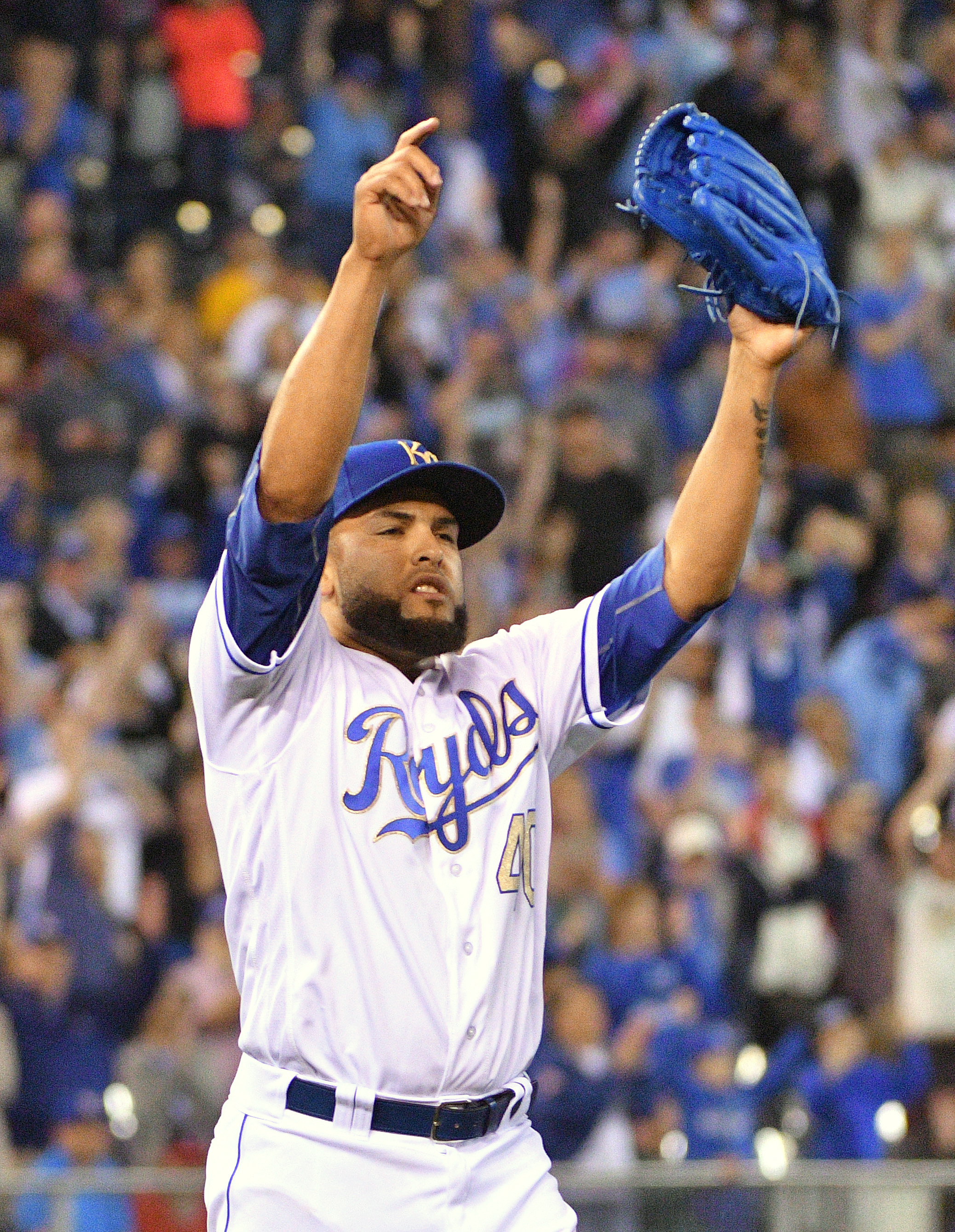
“I want to thank everyone who has been a part of my career, starting with the Kansas City Royals organization who believed in this kid from Tenares, Dominican Republic and gave him a chance to do something meaningful with his life,” Herrera wrote in his announcement. “From ownership, to the Front Office, the staff, my teammates and last but not least, the fans, I owe you guys everything.”
Herrera goes on to thank both the Nationals and White Sox organizations for welcoming him as well. For the time being, Herrera says he plans to focus on his family and the next chapter of his life.
It’ll no doubt surprise some readers to see that Herrera is still just 31 years old. He’s been around the Majors for a decade due to the Royals calling on him for his Major League debut at just 21 years of age.
Herrera pitched in just two games late in that 2011 season, but the right-hander was an immediate success in 2012 — his first full season at the MLB level. In 84 1/3 innings, he worked to a pristine 2.35 ERA with 19 holds, three saves and a heater that averaged a blistering 98.5 mph. In a normal year, that overwhelming success would’ve no doubt garnered Rookie of the Year consideration, but 2012 happened to also be the rookie season for Mike Trout, Yoenis Cespedes and Yu Darvish, who commanded nearly every top-three vote on the ballot that year.
Even without any Rookie of the Year love, Herrera had established himself as a dominant late-inning arm in short order, and that’s the exact role he’d over the next half decade as a steady presence at the back of some elite Kansas City bullpens. From 2012-16, Herrera pitched 354 1/3 regular-season innings with the Royals and notched a collective 2.57 ERA with 106 holds and 17 saves.
The bullpen was in many ways the backbone of the Royals’ back-to-back World Series runs in 2014-15, and Herrera joined teammates Wade Davis, Greg Holland and (in 2015) Ryan Madson in forming a juggernaut late-inning group that gave opposing lineups absolute fits. Each of Herrera, Davis and Holland posted ERAs south of 1.50 and appeared in at least 65 games during the 2014 season. Herrera was as untouchable during the postseason as he was in the regular season, combining for 28 2/3 innings of 1.26 ERA ball in his playoff career.
With the Royals out of contention during Herrera’s final year of club control in 2018, they made the decision to trade him to the Nationals for a package of young players including Kelvin Gutierrez, Blake Perkins and Yohanse Morel. Herrera was injured for part of his time with the Nats, going down with a Lisfranc tear in his foot, but he gave them 18 1/3 innings of 4.34 ERA ball before reaching free agency and signing a two-year pact with the White Sox. Things didn’t pan out in Chicago, as Herrera was tagged for 39 runs in just 53 2/3 innings across his two seasons there.
Herrera’s peak was brief but absolutely dominant, and he’ll go down in Royals lore as an absolutely vital member of a bullpen that fueled a baseball renaissance in Kansas City and brought home the club’s first title in three decades. He’ll hang up the spikes with a career 3.21 ERA, 119 holds, 61 saves and 510 strikeouts in 513 2/3 innings of regular-season work — plus the aforementioned sterling postseason track record. Best wishes to Herrera and his family in whatever the future holds.
Nationals To Sign Jeremy Jeffress To Minors Deal
The Nationals have reached an agreement with right-hander Jeremy Jeffress on a minor league deal, MLB.com’s Mark Feinsand reports (Twitter links). Jeffress will earn $1.25MM if he reaches the Nats’ big league roster, plus he can earn up to $1.25MM more in bonuses.
Jeffress has been an effective reliever for most of his 11 seasons in the majors, and was an All-Star as recently as the 2018 season when pitching for the Brewers. He struggled in 2019, however, posting a 5.02 ERA with a 48.4% grounder rate that marked the only time the groundball specialist had fallen under the 50% threshold over a full season.
Jeffress had a rebound with the Cubs last season, delivering a 1.54 ERA and 54.4% grounder rate over 23 1/3 innings and allowing only a single home run. However, Jeffress benefited from a tiny .161 BABIP against some otherwise unimpressive Statcast numbers, and his .496 SIERA painted a much uglier picture of Jeffress’ performance. His 19.3K% and 13.6BB% were also well below average.
At the cost of just a Spring Training invitation, there isn’t any risk to the Nationals in taking a look to see if Jeffress can still contribute as he enters his age-33 season. Jeffress joins Luis Avilan, Javy Guerra, Aaron Barrett, and T.J. McFarland as veteran relievers on minor league deals in Washington’s camp.
Nationals Notes: Martinez, Turner, Robles
Dave Martinez already broke new ground in Nationals’ managerial history by winning the World Series in 2019, but in 2021, he will again traverse new territory previously untrod by Nats’ managers: a fourth season on the job. Davey Johnson won Manager of the Year in 2012, Matt Williams won the award in 2014, and Dusty Baker became the first Nats’ manager to win back-to-back NL East titles in 2016 and 2017, but each of Martinez’s predecessors were let go before a fourth campaign (or third in the case of Williams and Baker).
Martinez figures to blow well past the three-year record previously held by Johnson, Jim Riggleman and Manny Acta. Martinez was given a contract extension last year, freeing him to take the long view in the development of his young players, including superstar Juan Soto, writes Jesse Dougherty of the Washington Post. The Nationals – reactionary to disappointing playoff losses in the past – seem to have a new view under Martinez, weathering a difficult 2020 without missing a beat. They’ll enter 2021 expecting to contend, and Martinez will look to check another box off his list by winning an NL East title.
Part of his forward-thinking approach is mulling new ways to maximize production from his superstars Soto and Trea Turner. This season, the question is whether or not to move Turner from the leadoff spot, writes Mark Zuckerman of MASNsports.com. The Nationals don’t necessarily have another prime candidate to step into the top spot of the lineup, however. Martinez would like to try Victor Robles at the top of the order against southpaws, writes Zuckerman. Beyond a small sample size of success leading off, Robles has done little to prove himself a natural candidate as a table-setter. He owns a 5.3 percent career walk rate and a 36.7 percent first pitch swing percentage – a good deal more aggressive than the league average of 28.3 percent.
Viewing Turner as a middle-of-the-order bat is sound, however. Though he’s mostly known for being one of the fastest players in the game, Turner’s bat carries serious thunder: Turner boasts a .216 ISO and 130 wRC+ over the past two seasons. He’s performed 18 percent better than average with the bat for his career. Turner has largely been underrated in part because his most impressive performances have come in seasons cut short either because of a late promotion (2016), injury (2019) or the pandemic (2020). It was his return from injury that largely prompted the Nationals magical run in 2019, however, as Turner famously returned in May to hit .296/.352/.487 despite a broken finger. The Nationals are relying heavily on Turner to be the offensive superstar he was in 2020, when he was on pace for a 7+ fWAR season at a 162-game pace.