
Gio Gonzalez Announces Retirement
Veteran left-hander Gio Gonzalez took to Instagram this afternoon to announce his retirement from baseball after a 13-year Major League career. The 35-year-old Hialeah, Fla. native was in camp with the Marlins on a minor league deal and called simply donning the jersey of his hometown club one of his “biggest dreams.” However, Gonzalez also added that his “body wasn’t keeping up with [his] mind.” The lefty offered a heartfelt thanks to the Athletics, Nationals, Brewers, White Sox, Yankees and Marlins organizations.
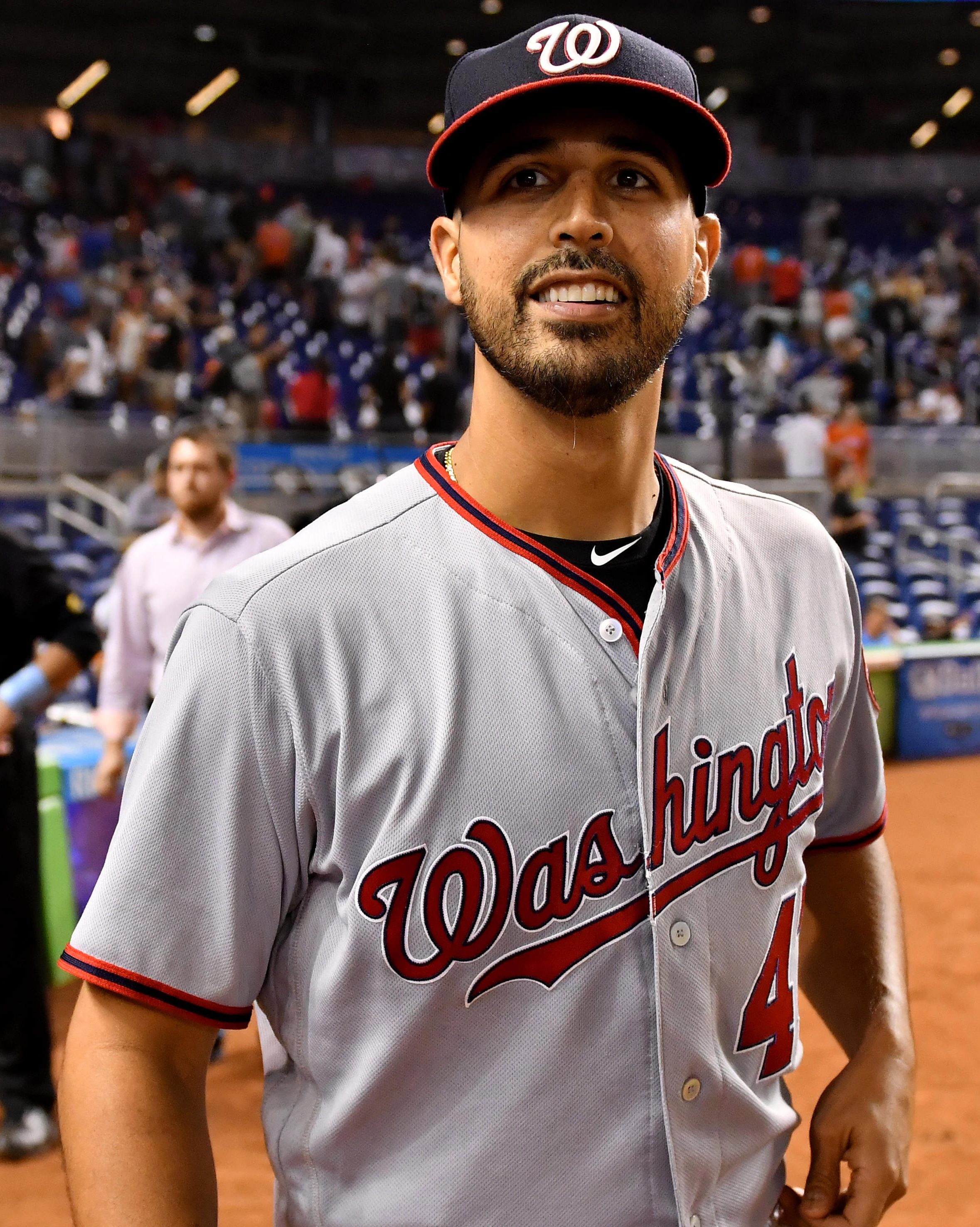
“My heart and mind are finally at peace with my decision,” Gonzalez wrote at the conclusion of his post. “Here’s one last tip of the cap! I’m coming home to my wonderful family. I love u!”
Gonzalez was the No. 38 overall draft pick by the White Sox back in 2004 and had, to say the least, an unconventional career arc with the team. Chicago traded him to the Phillies in Dec. 2005 as part of the Jim Thome blockbuster, only to reacquire him a year later alongside Gavin Floyd in the trade that sent Freddy Garcia to Philadelphia. Gonzalez was close to big league ready at that point and looked as though he could make his debut with the team that originally drafted him … until the White Sox again traded him away — this time to the Athletics as part of the return for Nick Swisher.
Between his draft status, his inclusion in trades for three high-profile big leaguers and his annual placement on Baseball America’s Top 100 prospect list from 2006-09, it was clear that Gonzalez was highly regarded within the industry. It took him a bit to deliver on that talent, but he did so in a big way with a breakout showing in 2010, when he tossed 200 2/3 innings of 3.23 ERA ball and solidified himself as part of the Athletics’ rotation.
That marked the first of six consecutive seasons in which the durable Gonzalez would make at least 27 starts and pitch to a sub-4.00 ERA. Oakland, as is often the case, traded him when he was on the cusp of arbitration eligibility, shipping him to the Nationals in return for a prospect package of four future big leaguers: A.J. Cole, Tommy Milone, Derek Norris and Brad Peacock.
Gonzalez was nothing short of excellent in Washington, finishing third in National League Cy Young voting in his first season as a Nat. He inked a five-year, $42MM contract extension with the Nats in Jan. 2012 and would go on to spend the next seven seasons in D.C. under the terms of that deal (which contained a pair of club options). Gonzalez’s first season with the Nationals was his best, but he finished sixth in NL Cy Young voting in 2017 — his final full year with the club. In parts of seven years there overall, Gonzalez racked up 1263 1/3 innings of 3.62 ERA ball and helped the Nats to four postseason berths.
With the Nats out of playoff contention in 2018, they traded Gonzalez to the Brewers for a pair of prospects. Gonzalez was brilliant in five starts down the stretch with Milwaukee, helping pitch the Brewers into the postseason. He re-signed with the Brewers in April 2019 after being granted his release from a minor league deal with the Yankees organization and again pitched quite well, tossing 87 1/3 frames of 3.50 ERA ball.
In the 2019-20 offseason, Gonzalez had a full-circle moment when he signed a one-year contract to return to the White Sox. He finally took the mound with his original organization on July 26 last summer. Gonzalez was tagged for six runs in his first appearance, but he bounced back with 28 innings of 3.54 ERA ball for the South Siders the rest of the way.
Gonzalez will walk away from baseball as a two-time All-Star who twice finished sixth or better in his league’s Cy Young voting. Long one of the game’s more underrated starters, his career body of work stands as a testament to his consistency: in 1933 innings, Gonzalez went 131-101 a 3.70 ERA and 1860 strikeouts. He earned more than $73MM in a career valued by Baseball-Reference at 30.1 wins above replacement and valued by FanGraphs at 32.1 WAR. Gonzalez never won a ring but appeared in the postseason five different times, made a pair of All-Star Games and was always good for an entertaining interview. It was a strong career by any measure, and Gonzalez will head into retirement having left his mark on several fanbases and countless teammates and coaches around the sport.
Offseason In Review: Washington Nationals
After their first losing season since 2011, the Nationals made several short-term additions to reload the roster for another shot at contention.
Major League Signings
- Brad Hand, RP: One year, $10.5MM ($6.5MM is deferred, to be paid out from 2022-24)
- Kyle Schwarber, OF: One year, $10MM (includes $3MM buyout of $11.5MM mutual option for 2022)
- Jon Lester, SP: One year, $5MM
- Alex Avila, C: One year, $1.5MM
- Josh Harrison, IF/OF: One year, $1MM
- Ryan Zimmerman, 1B: One year, $1MM
- Sam Clay, RP: One year, $575K
- Total spend: $29.575MM
Trades & Claims
- Acquired 1B Josh Bell from the Pirates for RHPs Wil Crowe and Eddy Yean
- Claimed SP Rogelio Armenteros off waivers from the Diamondbacks
Notable Minor League Signings
- Gerardo Parra, Javy Guerra , Jordy Mercer, Luis Avilan, T.J. McFarland, Welington Castillo, Hernan Perez, Yasmany Tomas, Justin Miller, Blake Swihart, Humberto Arteaga, Aaron Barrett, Jefry Rodriguez, Ramon Flores, Sean Nolin
Notable Losses
- Adam Eaton, Sean Doolittle, Michael A. Taylor, Kurt Suzuki, Asdrubal Cabrera, Eric Thames, Brock Holt, Roenis Elias, Howie Kendrick (retired), Anibal Sanchez (unsigned), Sam Freeman (unsigned)
General manager Mike Rizzo is no stranger to generating winter headlines, but there were no true blockbuster additions to the Washington roster this offseason, as the Nats (like most teams around baseball) took a more measured approach to spending in response to the pandemic-shortened 2020 campaign. This doesn’t mean Rizzo took it easy, however — the Nationals were one of the offseason’s busier teams, considering the sheer volume of familiar names added on both one-year MLB contracts and minor league deals.
The Nationals waited until late December to make a truly noteworthy transaction, picking up Josh Bell in a trade that sent young right-handers Wil Crowe and Eddy Yean to the Pirates. This was one of Washington’s few moves made with an eye beyond just 2021, as Bell has two years of arbitration eligibility remaining before he qualifies for free agency after the 2022 season. Earning $6.3MM this coming, Bell will be a pretty cost-effective piece for D.C. even if he has a good enough season to merit a big arbitration raise next winter, and naturally the club wouldn’t mind such an expenditure if it meant Bell was back to his old self.
The switch-hitting slugger batted just .226/.305/.364 in 223 plate appearances last year, with Bell also posting the highest strikeout rate and lowest walk rates of his five-year MLB career. That performance surely lowered the Pirates’ asking price in trade talks, and the Nationals must feel they’ve bought low on a player who was an All-Star in 2019. Crowe and Yean are prospects of some note, but not blue-chippers in a Washington farm system that is already pretty deep in pitching.
The Bell trade broke the seal on the Nats’ winter business to some extent, as the team soon thereafter moved on another power bat by bringing Kyle Schwarber to the District. The Cubs (as part of their own payroll crunch) non-tendered Schwarber after he hit .188/.308/.393 with 11 homers in 224 PA, a big step backwards from the above-average production Schwarber delivered in his previous five years in Wrigleyville.
Adding Bell and Schwarber probably won’t do much to help a Nationals defense that struggled badly in 2020. What the two sluggers can bring, the Nats hope, is suitable lineup protection hitting behind Trea Turner and Juan Soto. There is some risk involved if either of the two new faces continue to hit at their 2020 levels, but at least the risk is minimized to just the 2021 season, since D.C. can walk away from either Bell or Schwarber next offseason if things don’t work out.
This type of strategy informed the Nationals’ entire winter, as the team is rolling the dice on a number of bounce-back candidates in hope of landing at least a few bargain scores. While Washington has shown a willingness to exceed the luxury tax threshold (if only by a bit) in the past, the club would surely like to avoid another tax payment if possible, and the Nats are estimated to sit roughly $13.25MM below the $210MM Competitive Balance Tax limit. It leaves the team with a bit of breathing room for midseason additions, though the Nationals’ number will escalate depending on how many of their minor league signings make the roster and lock in guaranteed salaries.
Washington could have saved itself $500K if the team had just claimed Brad Hand on waivers last October, as Hand’s $10MM club option (that was eventually declined by the Indians) was less than the $10.5MM deal that Hand signed with D.C. in January. Still, the Nats weren’t alone in passing on Hand at that time, quite possibly because they and other clubs didn’t have their 2021 budgets planned at that point in the offseason.
An “extra” $500K also isn’t exactly a big price to pay for a former three-time All-Star. Though Hand’s velocity and strikeout numbers dropped a bit in 2020, he still posted some very strong numbers as Cleveland’s closer. Hand is an easy replacement for Sean Doolittle (who struggled last year and left for the Reds in free agency) and his addition could help stabilize a Nationals relief corps that has been a weak spot for years.
Unfortunately, as is often the case with the Washington bullpen, new problems emerge as quickly as old problems are corrected. Will Harris‘ status is in question due to a blood clot in his right arm, while Tanner Rainey has yet to pitch this spring due to a muscle strain near his collarbone. This opens the door for one of many relievers in camp on minor league deals (such as Javy Guerra, T.J. McFarland, Luis Avilan, Aaron Barrett, and more) to win jobs, or the Nationals could fill at least one bullpen role with one of the pitchers who doesn’t win the fifth spot in the rotation.
Joe Ross, Erick Fedde, and Austin Voth are all out of options, so the Nats will have to figure out a way to keep them on the big league roster unless they want to risk losing any of the hurlers on a waiver placement. D.C. can ill-afford losing a starter-capable arm for nothing, both because innings will be harder to fill this season, and because there is a fair amount of injury risk within the veteran top four of Washington’s rotation.
Stephen Strasburg tops this list, as the right-hander has been slowed by a calf injury this spring after missing all but two starts of 2020 due to carpal tunnel syndrome. Between Strasburg, Max Scherzer, and Patrick Corbin, the Nationals reinforced this experienced group with an even older pitcher in 37-year-old Jon Lester. It has been some time since Lester was a true top-of-the-rotation force, and his 5.16 ERA in 2020 (albeit over only 61 innings) was the worst of his career. While the Nats obviously think Lester can improve on that statistic in a more normal season, Lester’s primary function will be to act as a durable innings-eater.
Returning to the position-player side, the Nationals said goodbye to several regulars from their World Series team, as Adam Eaton (White Sox), Michael A. Taylor (Royals), Kurt Suzuki (Angels), and Asdrubal Cabrera (Diamondbacks) all left the District as free agents and Howie Kendrick decided to retire. Some familiar faces were retained, however, as the Nats worked out a new contract with longtime franchise stalwart Ryan Zimmerman, and utilityman Josh Harrison was re-signed for a second season with the club.
Zimmerman will serve as Bell’s backup, while Harrison could end up in a more significant role given the unsettled state of the D.C. infield. On paper, Harrison will play much everywhere on the diamond in a super-utility capacity. In practice, however, Harrison might end up getting more regular work in the infield since Carter Kieboom has followed up a rough 2020 season with a lack of production in Spring Training. (Kieboom was also mentioned in trade rumors over the winter.) It is possible the Nationals could end up using Starlin Castro at third base and Luis Garcia as the regular second baseman, but since Garcia is also inexperienced, having a versatile veteran like Harrison on hand becomes even more important.
The Nationals did at least consider making a much bigger splash to their everyday lineup, as such free agents and trade targets as D.J. LeMahieu, J.T. Realmuto, Carlos Santana, Eugenio Suarez, and Kris Bryant were all reportedly considered at different points in the offseason. While Harrison, Alex Avila or (“Baby Shark” sing-alongs notwithstanding) Gerardo Parra don’t have the same cache as those star names, it seems like Washington is opting to wait until next winter to start considering more big-ticket additions.
Only three players are on guaranteed contracts for the 2022 season, though the trio of Corbin, Harris, and Strasburg accounts for $67MM in payroll (roughly $11.5MM of Strasburg’s salary is deferred). As well, the Nationals are surely hoping that some of their payroll space will be taken up by long-term extensions with Soto and Turner. A Soto extension might well be the priciest contract in baseball history, while Turner is more of an immediately pressing concern, since Soto is controlled through the 2024 season and Turner only through 2022. Scherzer is also entering his final year under contract, and it’s probably safe to assume the Nats will have some talks about another deal for their longtime ace.
It makes for an interesting dynamic heading into 2021, as the Nationals will challenge for a return to the playoffs, but they are also well-positioned to pivot into being deadline sellers should they fall out of contention. The 2022 Nationals may look quite different, but there is still enough of the old championship core remaining this year for Washington to make a proper 162-game defense of the 2019 World Series title.
How would you grade the Nationals’ offseason? (Poll link for app users)
Grade the Nationals' offseason
-
B 50% (1,346)
-
C 33% (894)
-
A 8% (220)
-
D 5% (138)
-
F 3% (79)
Total votes: 2,677
Erick Fedde No Longer Has Fourth Option
An arbiter has ruled that Nationals right-hander Erick Fedde does not have a fourth minor league option season, reports Jesse Dougherty of the Washington Post (Twitter link). That means that Fedde, a former first-round pick, is now out of minor league options and thus cannot be sent to Triple-A without first being exposed to waivers.
As MASNsports.com’s Mark Zuckerman outlined in February 2020, the Nationals were granted a fourth option over Fedde for the 2020 season because the league’s rules stipulate that such an option be granted when a player has exhausted all three minor league options despite not completing five “full” seasons (between the Majors and Minors combined).
A “full” season, under those terms, entails 90 or more days on an active roster, be it a big league or minor league roster. Time on the injured list does not count toward that definition. As such, Fedde’s 2015 season — what would’ve been his first “full” season after being drafted 18th overall in 2014 — did not count because he was recovering from Tommy John surgery for much of the year and did not accrue the requisite 90 days. Heading into the 2020 season, he’d played four “full” seasons but expended all of his options. A fourth option was granted to the Nats.
The Nationals didn’t use that option last year on Fedde, keeping him at the MLB level all season. The confusion surrounding Fedde, and others, was whether last year’s shortened schedule constituted a “full” season. It was fewer than 90 days in length, but service time and salary were prorated, so it could be argued that time on the roster for the purposes of determining minor league option eligibility should be treated similarly. Fedde and agent Scott Boras likely appealed that because he spent the 2020 season on the roster for the maximum time possible (67 days), he now has five “full” seasons under his belt, voiding the fourth option.
It’s a notable development for the Nationals’ pitching staff. Fedde had previously looked to be a potential odd man out behind fellow righties Joe Ross, the likely fifth starter, and Austin Voth, who’ll likely open the year in the ‘pen. Both Ross and Voth had a leg up in the competition by virtue of the fact that they were out of minor league options, but Fedde is now in a similar position and thus much more likely to make the Opening Day roster.
There’s room for the Nats to carry all three hurlers, but the sudden lack of an option for Fedde would deprive them of some bullpen flexibility. Brad Hand, Tanner Rainey and Daniel Hudson obviously aren’t going anywhere at the back of the ‘pen, and Wander Suero seems to be on solid ground as well. Voth is quite likely penciled into a long relief spot because of his own lack of options. Adding Fedde to that mix could make it tougher for a non-roster hopeful like Javy Guerra, Luis Avilan or T.J. McFarland to crack the roster. It’s also not great news for 40-man relievers like Kyle Finnegan and Ryne Harper, each of whom does have minor league options remaining.
Earlier this spring it came to light that several players were awaiting word on whether they do or do not have a fourth minor league option. The Cardinals’ Justin Williams, the Cubs’ Adbert Alzolay and the Angels’ Jaime Barria were among the many players who are currently in this state of limbo. Derrick Goold of the St. Louis Post-Dispatch tweeted earlier this afternoon that some from that group have been informed that they are indeed out of options, so it seems Fedde is the first known player among that bunch.
NL East Health Notes: Soroka, Phillies, Nats, D. Smith
Braves general manager Alex Anthopoulos told Fox Sports South that right-hander Mike Soroka could make his season debut in mid-April, David O’Brien of The Athletic relays. Soroka got through his third simulated game of the spring without any issues Friday. The 23-year-old remains on the comeback trail from a torn right Achilles that limited him to three starts last season. Before that, Soroka burst on the scene with 174 2/3 innings of 2.68 ERA pitching in 2019.
More from the National League East:
- Phillies catcher J.T. Realmuto played a sim game Friday and could make his Grapefruit League debut next week, manager Joe Girardi announced (via Matt Breen of the Philadelphia Inquirer). The star has been on the mend from a fractured right thumb. Girardi added that outfielder Adam Haseley is “ahead of schedule” in his recovery from a groin strain. Haseley, who went down March 5, hasn’t officially been ruled out for Opening Day.
- Sticking with the Phillies, righty Vince Velasquez has an oblique injury, Girardi told Matt Gelb of The Athletic and other reporters. The severity is unknown, but oblique injuries often lead to absences that last for multiple weeks. It could be another shot to Philly’s staff, which has also seen Zach Eflin and Spencer Howard deal with injuries this spring. Velasquez could be their fifth starter to open 2021 if Eflin and Howar aren’t ready to go. In the event all three are shelved, though, it might open the door for veteran minor league addition Ivan Nova to claim a job.
- Nationals center fielder Victor Robles exited Friday’s game with back tightness, per Jesse Dougherty of the Washington Post. It doesn’t seem particularly serious, but the Nats will know more Saturday. Meanwhile, it was an encouraging day for righty Stephen Strasburg, who got through a 74-pitch sim game without any problems, Mark Zuckerman of MASNsports.com tweets. A calf injury has slowed Strasburg this spring, after the former World Series MVP missed almost all of 2020 – the first season of a seven-year, $245MM contract – with carpal tunnel syndrome.
- Mets slugger Dominic Smith informed Anthony DiComo of MLB.com and other reporters that he could return to Grapefruit League action as early as Sunday. Smith, the favorite to start in left field for the Mets, has been dealing with a right wrist issue that has sidelined him for the past couple of the days. He posted back-to-back excellent seasons at the plate from 2019-20, during which he combined for a .299/.366/.571 line with 21 home runs in 396 PA.
Will Harris Has Blood Clot In Right Arm
Nationals reliever Will Harris has a blood clot in his right arm, Mark Zuckerman of MASNSports.com reports. The 36-year-old will visit a specialist in St. Louis to determine the severity of the issue.
Harris hasn’t pitched since March 9, and it now appears unlikely he’ll be ready to take the mound when the Nationals’ season starts April 1. That would be a blow to Washington’s bullpen, which received 17 2/3 innings of 3.06 ERA pitching from Harris in 2020 – the first season of the three-year, $24MM contract he signed after an excellent run with the Astros from 2015-19.
A healthy Harris would have joined Tanner Rainey and closer Brad Hand as the Nationals’ primary late-game options at the beginning of the season. With Harris on the shelf, though, manager Dave Martinez said the Nats are considering righties Wander Suero and Kyle Finnegan to fill more significant roles. Both pitchers turned in quality results across a combined 48 1/3 innings a year ago.
NL Notes: Rodgers, Carrasco, Cardinals, Nationals
Rockies infielder Brendan Rodgers left yesterday’s Spring Training contest after pulling up while trying to steal second base. He has since been diagnosed with a right hamstring strain, per Thomas Harding of MLB.com (Twitter link). It isn’t yet clear if the issue threatens his availability for Opening Day. If healthy, the former #3 overall pick looks to have a clear path to everyday playing time at second base. Should he be forced to miss time, Garrett Hampson or Josh Fuentes could stand to see an increased role (the latter at third base with Ryan McMahon playing the keystone). Chris Owings is also back in camp as a non-roster invitee and has plenty of second base experience.
More from the Senior Circuit:
- Carlos Carrasco was slowed a bit by elbow soreness early in his first camp with the Mets. The right-hander played catch this morning and will throw a bullpen session Tuesday. He told reporters (including Tim Britton of the Athletic) that he expects to be ready for Opening Day. Manager Luis Rojas echoed Carrasco’s optimism about his potential season-opening availability, although the skipper cautioned that’ll partially depend on “how things go (next) week” (via Enrique Rojas of ESPN).
- The recent injury to Kwang-hyun Kim gives Daniel Ponce de Leon a good shot to begin the season in the Cardinals‘ rotation, writes Derrick Goold of the St. Louis Post-Dispatch. Miles Mikolas‘ own health woes had already opened up a spot, likely to be claimed by John Gant. Now, with Kim questionable to be ready for Opening Day after experiencing some back stiffness, there could be another job available behind Jack Flaherty, Adam Wainwright and Carlos Martínez. The Cards will also continue to lengthen out Jake Woodford and Johan Oviedo, Goold notes. Ponce de Leon has more MLB starting experience than those two, seemingly giving him the clearest path to the job if Kim isn’t fully recovered by the first week of April.
- Nationals starter Jon Lester feels good after throwing a pair of innings of live batting practice this morning (per Jesse Dougherty of the Washington Post and Maria Torres of the Athletic). Lester underwent surgery to remove his thyroid gland last week. Lester’s teammate Aaron Barrett had a minor surgery of his own, relays Dougherty. The 33-year-old reliever underwent a cleanup procedure on his right knee earlier this week but has returned to camp.
Stephen Strasburg Day-To-Day With Calf Injury
2:23 pm: Fortunately, it seems there’s not much cause for concern. Strasburg felt some discomfort in his left calf but says the issue is “nothing major” (via Dougherty). “It’s not something that’s going to require any sort (of) long-term recovery. It’s definitely good news. So day-to-day,” Strasburg added.
1:23 pm: Nationals starter Stephen Strasburg left his Spring Training outing early this afternoon, Jesse Dougherty of the Washington Post was among those to note (video provided by Alex Fast of Pitcher List). He appeared to show discomfort in his lower half.
There’s no indication at this point the issue is particularly serious. A return to form from Strasburg is key to the Nats’ hopes of contending in the NL East in 2021. After shining in the regular season between 2017-19, he took his game to new heights in the 2019 playoffs, helping Washington to a championship and winning World Series MVP honors. Unfortunately, carpal tunnel syndrome limited Strasburg to just five innings over two starts in 2020.
The Nationals are hoping for Strasburg to join Max Scherzer, Patrick Corbin and Jon Lester in the season-opening rotation. The fifth spot remains undecided between Joe Ross and Erick Fedde, although Ross appears to have the inside track.
East Notes: Andujar, Chirinos, Brasier, Rainey
Miguel Andújar has been held back by soreness in his right hand/wrist area and will see a specialist tomorrow, Yankees manager Aaron Boone told reporters (including Marly Rivera of ESPN and Lindsey Adler of the Athletic). That evaluation will surely provide a clearer diagnosis and timetable for Andújar’s return to action, but this seemingly raises the possibility of a season-opening IL stint. Andújar hasn’t played much over the past two years after a strong rookie season in 2018. The 26-year-old has been frequently mentioned as a possible trade candidate based on the offensive upside he showed a few years ago and his lack of an obvious path to playing time in New York. The Yankees could continue to hold onto him as high-minors depth, though, as Andújar has an option year remaining.
More from the game’s East divisions:
- Fellow Yankee Robinson Chirinos will also see a specialist tomorrow as he seeks a second opinion on his fractured right wrist (via Rivera and Bryan Hoch of MLB.com). Surgery is a possibility, per Hoch. Chirinos has been in camp as a non-roster invitee. The 36-year-old catcher is typically a productive hitter for his position but struggled in 82 plate appearances between the Rangers and Mets in 2020.
- Red Sox reliever Ryan Brasier seems unlikely to be ready for Opening Day, per Chris Cotillo of MassLive and Alex Speier of the Boston Globe. Manager Alex Cora revealed this morning that Brasier fractured a pinky over the offseason and was also absent early in camp for personal reasons. That pair of obstacles has delayed his ramp-up process, and it doesn’t seem he’ll be able to build up sufficient strength in time for April 1. The right-hander posted a decent 3.96 ERA/3.86 SIERA over 25 innings last season.
- Another reliever slowed down by injury is Nationals right-hander Tanner Rainey. The fireballing 28-year-old has yet to pitch in a Spring Training game due to a minor muscle strain near his right collarbone, writes Jesse Dougherty of the Washington Post. He was able to throw a 30-pitch bullpen session yesterday though. Washington manager Dave Martinez expressed some hope Rainey will be able to make it back by Opening Day, but that doesn’t appear to be certain. Rainey was quietly excellent for the Nats last season, tossing 20.1 innings of 2.66 ERA/2.30 SIERA ball.
What The Nationals See In Joe Ross
The Nationals continue to lean Joe Ross’ direction for their fifth starter spot, per Jesse Dougherty of the Washington Post (via Twitter). The Nats’ organization has long been enamored with Ross’ potential. But it’s been a long and winding road.
Injuries and poor performance had all but done in Ross in the first half of 2019. Austin Voth and Erick Fedde were both getting starts ahead of him, and a stint as a long man out of the pen proved disastrous. He posted an 11.17 ERA/6.27 FIP in 19 1/3 innings out of the bullpen. A .415 BABIP didn’t help matters, nor did Freddie Freeman and the Braves, who blew him up for four earned runs in one inning on June 22nd, an outing that resulted in Ross’ demotion to the minors.
Then, with the Nats playing like one of the best teams in baseball, ace Max Scherzer missed the first three weeks of August. Ross stepped in. Surprisingly, he didn’t miss a beat. He made eight starts the rest of the way with a 2.75 ERA over 39 1/3 innings. The Nats went 7-1 in those games.
What Ross found, and what the Nats saw in him, wasn’t just a solid stretch of games. It was a return to his roots. He came into the league in 2015 as a two-pitch pitcher: sinker and slider. He added a change-up for 2016. Over those first two seasons, he had a 3.52 ERA/3.46 FIP over 181 2/3 innings. But injuries piled up, culminating in Tommy John surgery in 2017. He made just 16 starts in 2017-18 covering 89 2/3 innings with a 5.02 ERA/5.14 FIP.
Those were injury-riddled seasons, but something else happened those two seasons. Ross started to re-work his pitch mix, relying less on his sinker. Instead of 54% sinkers, 38% sliders, and 8% change-ups, Ross threw 47% sinkers, 35% sliders, 11% change-ups, and 8% four-seamers. In three starts after returning from Tommy John in 2018, however, his four-seam usage jumped to 30.4% – his most-used offering.
Ross started the same way in 2019 – with lots of fastballs. Over the final two months, however, he returned to a sinker-heavy approach, dropping his fastball usage to 15.1% in August and 21.6% in September. It took Ross awhile to find his sinker again after returning from injury, but he found it in August 2019.
His fastball, of course, does serve a function. It has the potential to be a better swing-and-miss offering than his sinker. His heater generated a 22.8% swing-and-miss rate in 2019 to just 14.9% on his sinker. His most important pitch might be his change-up, an area of specialty for new pitching coach Jim Hickey.
After opting out of the 2020 season, Ross made his first spring start yesterday, tossing 39 pitches against the Mets. Ross spoke about rushing, missing high with his fastball, and trying to focus on his change-up, per MLB.com’s Jessica Camerato.
Manager Davey Martinez hopes to get him closer to 50 pitches in his second outing. If Ross can build up his stamina and avoid injury, he’s going to be the Nats’ fifth starter. The inside track is his.
From the outside, it’s easy to see Ross’ 5.21 ERA/4.91 FIP since 2017, and question whether he’s the best option. But the decision-makers in Washington likely remember the best of Ross. Martinez leaned on him down the stretch in their title-winning season. He called on Ross the morning of game five and pushed him into emergency duty, again, when Scherzer woke up unable to lift his arm. The Nats lost that game, but Ross gave them five innings just two days after throwing 19 pitches in game three.
GM Mike Rizzo knows the best parts of Ross as well. He is, after all, the GM who acquired him. What’s more, the deal that brought Ross to Washington is one of the most successful trades on Rizzo’s lengthy resume. That was the same deal that would eventually deliver Trea Turner as a player to be named later.
There’s a lot of history there. Ross was 21-years-old when Rizzo acquired him. The Nationals have invested a lot of time into his development, and if he can be the guy the organization thinks he can be, he’ll be a steal while making just $1.5MM in 2021. He even has one season of arbitration remaining after 2021.
In tracing Ross’ journey with Rizzo over these past six years, it’s easy to see just how muddying the human element of the game can be. One could look at the projections for Ross, 1.1 fWAR by STEAMER, 0.5 fWAR by ZiPS, and see not much upside. Especially for a Nats’ team that hopes to return to contention in a crowded NL East. For Rizzo, Martinez, and Ross, however, the upside is more than a few wins above replacement. It’s redemption. It’s mentorship and perseverance and the culture of their club. It’s validation all around.
Over the past couple of years, the Nats made headlines by letting superstars Bryce Harper and Anthony Rendon walk in free agency. But as an organization, the Nats like to believe in their people. Ask Ryan Zimmerman, who’s been with the team for 15 years. Or Aaron Barrett, whom the Nats helped return to the bigs after a four year absence and two gruesome injuries. Or even Stephen Strasburg, whom the Nats famously tried to protect by keeping him out of the playoffs because they believed that was best for his long-term health.
It’s not surprising, then, that the Nationals want to believe in Ross. They’re going to give him every opportunity to break camp as their fifth starter. He’s also out of options, which serves as a nice metaphor while also describing his roster status. If he’s not able to put it all together this season, Rizzo and the Nats might finally move on, as they’ve proven themselves capable of doing. But for now, he’s their guy.
NL Notes: Jeffress, Nationals, Varsho, Howard
The Nationals‘ release of Jeremy Jeffress yesterday carried some mystery, both because it came so early in Spring Training (and within three weeks of Jeffress signing with the Nats) and because GM Mike Rizzo used the odd phrasing of describing the release as due to “personnel reasons.” Rizzo didn’t provide much further clarification in speaking with Mark Zuckerman of MASNsports.com and other reporters today, apart from saying that Jeffress’ release was “an employment issue” and not related to on-field performance.
Jeffress himself has weighed in, texting Jesse Dougherty of the Washington Post to say that the Nationals’ given reason for releasing him was “not true,” without specifying what the club said. The veteran reliever also wrote a pair of tweets yesterday, one stating “I’m not what they say I am, I’m what God says! I don’t deserve this false negativity!” and another since-deleted tweet saying that his former agent “jus ruined my life.” It remains to be seen if the reason behind Jeffress’ release will ever fully come to light, but if nothing else, this uncertain situation would seem to hamper Jeffress’ chances of catching on with another team.
More from the National League…
- “Catcher/center fielder” isn’t exactly a common defensive skillset, and while Daulton Varsho saw more time in the outfield than he did behind the plate in his rookie season, the Diamondbacks are clear about their top prospect’s future role. “We see him as a catcher who can play other positions, not as a center fielder who can catch,” Arizona assistant general manager Amiel Sawdaye told The Athletic’s Zach Buchanan. Varsho is happy to play wherever, and the outfield might be his clearest path to more MLB playing time in 2021, considering the D’Backs have Carson Kelly and Stephen Vogt as their regular catching duo. The team doesn’t want to take too much time away from Varsho’s development as a catcher, however, given the amount of specialized work that goes into learning the position at the big-league level.
- The Phillies also face a question about how to deploy a top prospect, as Spencer Howard has never thrown more than 112 innings in any of his four pro seasons. As Matt Breen of the Philadelphia Inquirer writes, the Phils could start Howard in the minors since rotation space could be hard to find, or they could manage his innings throughout the season in a relief role on the MLB roster. The latter option would leave the door open to Howard eventually making some starts in 2021, though it would require the Phillies to also keep Howard stretched out in something of a swingman role so he could more easily shift into working as a starting pitcher. A second-round pick for the Phillies in the 2017 draft, Howard’s minor league climb was slowed by some shoulder problems in 2019, and he has yet to pitch at Triple-A ball. Philadelphia promoted Howard to the majors last summer after watching him at the alternate training site, and Howard posted a 5.92 ERA over 24 1/3 innings and six starts.