
Nationals Acquire Richard Lovelady
The Nationals announced Thursday that they’ve acquired left-hander Richard Lovelady from the Mets in exchange for cash. Fellow southpaw Ken Waldichuk, who was recently recommended for Tommy John surgery, moves to the 60-day IL to open a spot on the 40-man roster. The Mets designated Lovelady for assignment over the weekend.
Lovelady was with the Nats in spring training but wound up going back to the Mets for a fourth stint in the past year when New York scooped him off waivers a couple weeks before Opening Day. He wound up making the Mets’ roster and has since pitched 7 1/3 innings of relief, holding opponents to three earned runs (3.68 ERA) on eight hits and four walks with six punchouts.
The 30-year-old Lovelady has now pitched in parts of seven big league seasons. He’s shown glimpses of promise — most notably, his 2021 performance with Kansas City — but has yet to carve out a consistent role in a big league bullpen. The southpaw has a 5.25 ERA in 118 1/3 major league frames with a big 51.9% grounder rate and strikeout and walk rates only a hair worse than average (20.9% and 8.9%, respectively). In parts of seven Triple-A seasons, he has a 2.61 ERA, a 26.9% strikeout rate and a 7% walk rate.
Lack of consistency notwithstanding, Lovelady continues to intrigue major league clubs. Though he hasn’t had a lot of staying power, he’s spent the better part of the past four years shuffling on and off 40-man rosters around the league. That’s underscored by the fact that he has well over three years of big league service time — with a viable path to crossing the four-year mark at some point in 2026 — despite his modest innings count in the majors.
The Nats will be Lovelady’s seventh team in the majors. In addition to the previously mentioned Mets and Royals, he’s also pitched for the A’s, Rays, Cubs and Blue Jays. He’s out of minor league options, so he’ll be added right to the major league roster when he reports to the team. Washington currently has three lefties in the ‘pen: Cionel Pérez, PJ Poulin and the recently recalled Mitchell Parker. Pérez, like Lovelady, is out of minor league options. Both Pérez (8.22 ERA in 7 2/3 innings) and Poulin (4.50 ERA, more walks than strikeouts in eight innings) have struggled this year.
Ken Waldichuk Recommended For Tommy John Surgery
The Nationals made some moves on the pitching staff today, with both right-hander Cole Henry and left-hander Ken Waldichuk landing on the 15-day injured list. Henry has a rotator cuff strain and Waldichuk left forearm tightness. Mark Zuckerman of Nats Journal reports that Waldichuk has been recommended for Tommy John surgery but is seeking a second opinion. Manager Blake Butera says that Henry got an MRI that didn’t find anything too serious, per Zuckerman. Right-handers Jackson Rutledge and Orlando Ribalta were recalled as the corresponding moves for the IL placements.
It’s brutal news for Waldichuk, who was clearly hurt in yesterday’s game. After throwing a pitch, he pointed to his elbow and walked off the field with trainers. That makes today’s update fairly unsurprising but it’s nonetheless awful for the southpaw.
Waldichuk previously underwent Tommy John surgery in May of 2024, then a member of the Athletics. His missed that entire season. He was back on the mound in 2025 but was kept in the minors. He rode the transaction carousel this winter after the A’s designated him for assignment. He was claimed by Atlanta, went to the Rays in a cash deal, then to Washington via waivers.
He opened the season in the Washington bullpen and made five appearances, his first big league action since 2023. Now it seems he’s slated for yet another lengthy absence. Assuming his second opinion confirms the first, he’ll go under the knife, miss the remainder of 2026 and will be recovering for a chunk of 2027 as well. That will mean a stretch where he spent the bulk of four years in the injury wilderness.
Waldichuk was originally drafted by the Yankees and was traded to the A’s as part of the 2022 deal which sent Frankie Montas and Lou Trivino to the Bronx. In the year-plus after that deal, he tossed 175 2/3 innings for the A’s with a 5.28 earned run average. He had often put up better numbers in the minors, including a 2.84 ERA on the farm in 2022, which presumably played a role in so many clubs being interested in him this winter.
But he is now facing a tough road ahead. He’ll be transferred to the 60-day injured list at some point, even if he avoids surgery. If the surgery comes to pass, he’ll still be mid-recovery at season’s end. Waldichuk just qualified for arbitration a few months ago as a Super Two player. He can be retained for 2027 via arbitration and controlled through 2029 but he’ll be a non-tender candidate if he’s still months away from being healthy.
Photo courtesy of Patrick Gorski, Imagn Images
Nationals Have Not Yet Made Extension Offer To Daylen Lile
The Nationals only have one player on a guaranteed contract past the 2026 season: catcher Keibert Ruiz, who signed an eight-year, $50MM extension ahead of the 2023 campaign. So, president of baseball operations Paul Toboni should have plenty of financial flexibility for 2027 and beyond. After all, his team’s payroll right now is less than half of what it was during Washington’s World Series-winning 2019 season. As Spencer Nusbaum of The Athletic recently acknowledged, some of those savings have been put toward improving the club’s scouting and player development. Even so, it would be surprising if Toboni weren’t at least considering extending any of the Nationals’ talented young players.
If there’s anyone the Nationals and their fan base would most love to lock up long-term, it’s outfielder James Wood. However, the All-Star slugger isn’t the only extension candidate on the roster. He isn’t even the only left-handed hitting, 23-year-old, corner outfield extension candidate on the roster. And while this second outfielder might not be a star of Wood’s stature, he would certainly be easier (and less expensive) for Washington to extend: Daylen Lile.
Nusbaum wrote about Lile earlier this week. Crucially, he acknowledged that “the Nationals have yet to broach Lile with an extension offer.” Meanwhile, Lile’s thoughts on the matter boiled down to “whatever happens, happens.” Yet, Nusbaum also reported that Beverly Hills Sports Council, Lile’s agency, is “always open to engaging with teams in extension conversations.” Two of their notable clients include Jackson Chourio and Kristian Campbell, both of whom signed similar early-career extensions. It’s worth noting that Lile already has more MLB service than either Chourio or Campbell had when they signed their deals, and he was never anywhere close to being the same caliber of prospect. In other words, Chourio and Campbell are far from perfect comps. Nonetheless, it does matter that Lile’s representatives are open to negotiating this type of contract, especially because Wood’s agency, Boras Corporation, has a reputation for opposing pre-arbitration extensions. (Although, the deal that fellow Boras client Cooper Pratt just signed is proof that’s not a hard-and-fast rule).
Lile debuted last May and earned a regular role in the starting lineup by mid-June, looking more and more comfortable as his rookie year went on. His .956 OPS in the second half ranked second among qualified NL hitters, trailing only MVP Shohei Ohtani. His 1.212 OPS in September bested even Ohtani’s, and his 1.83 Win Probability Added in the month was the highest in Major League Baseball. All told, Lile finished his first MLB campaign with an .845 OPS and a 132 wRC+. He hit nine home runs, 15 doubles, and an incredible 11 triples in just 91 games. His strikeout rate and whiff rate both put him among the best 20% of hitters in the league. Only three players took as many trips to the plate as Lile and posted both a higher contact rate and a higher isolated power: José Ramírez, Cody Bellinger, and Isaac Paredes. At season’s end, 11 of 30 BBWAA voters named Lile on their NL Rookie of the Year ballots. He finished fifth.
The sample was small, just 351 PA, and Lile’s success was largely limited to one red-hot month within that already small sample. He also dragged his overall numbers down with shockingly poor defensive metrics (-14 DRS, -8 OAA, -10 FRV) and disappointing baserunning for a player with his speed (8-for-14 in stolen base attempts). Still, he demonstrated real promise, giving himself a strong foundation to build upon in his first full MLB season. Nusbaum notes that evaluators within the Nationals organization “believe in the bat.”
So, despite Lile’s slow start in 2026 – his swing decisions have been worse, and his groundball rate has spiked – it’s not hard to see why an extension might appeal to Washington’s front office. Lile showed off his high ceiling in 2025, but he remains far from a sure thing. If the Nationals truly believe in his bat, now would be their chance to secure him beyond his arbitration years before his price shoots up.
Davey Lopes Passes Away
The Dodgers announced today that Davey Lopes passed away today at the age of 80. Lopes made his debut as a player in the early 1970s and went on to have a career as a coach and manager, making him a staple of the game for the bulk of five decades.
Lopes was a late bloomer. He didn’t make it to the majors until 1972, which was his age-27 season. Even then, he only got into 11 games for the Dodgers. The following year, his age-28 campaign, he finally established himself as a big league regular. He became the club’s second baseman and showed off the speed that would become his standout trait. He swiped 36 bags that year, his first of what would eventually be a 14-year streak of stealing at least 15 bases.
He stayed on the Dodger roster through the 1981 season, mostly covering the keystone but also with occasional action at shortstop, third base and in the outfield. The Dodgers had a very consistent infield during that stretch, with Steve Garvey the mainstay at first, Lopes at second, Bill Russell at short and Ron Cey at third.
Lopes played in 1,207 games for the Dodgers from his 1972 debut until the end of that 1981 campaign. He hit .262 in that time and launched 99 home runs but the eye-popping stat was his 418 stolen bases. He led the league in steals in both 1975 and 1976, with 77 in the former and 63 in the latter. The second instance was particularly impressive as injuries limited him to only 117 games. In 1978, he won a Gold Glove and also made the All-Star team, the first of four straight All-Star selections.
The Dodgers were quite good in that time but couldn’t quit win a title for most of it. They lost the World Series to the Athletics in 1974, then to the Yankees in both 1977 and 1978. In 1981, they were able to get the job done, topping the Yankees 4-2. Lopes stole ten bases in in 16 postseason games that year.
Prior to the 1982 season, he was traded to the A’s, kicking off the journeyman phase of his career. He would also bounce to the Cubs and Astros, playing past his 42nd birthday. He finished his career with 7,340 plate appearances over 1,812 games. He racked up 1,671 hits, including 155 home runs. He scored 1,023 runs and drove in 614. His 557 steals put him 26th on the all-time list.
He quickly pivoted to his post-playing career by becoming a bench coach with the Rangers. That was followed by stints as a first base coach with the Orioles and Padres. He was hired to manage the Brewers for the 2000 season. The club did not fare well and he was fired early in 2002. He never got another managerial gig and had a 144-195 record in that job. He then went back to being a first base coach, starting with a return to the Padres, followed by stints with the Nationals, Phillies, Dodgers and back to the Nationals. He retired from coaching after the 2017 season.
We at MLB Trade Rumors join the rest of the baseball world in sending condolences to the Lopes family as well as everyone else mourning him today.
Photo courtesy of Jayne Kamin-Oncea, Imagn Images
Nationals Release Matt Mervis
The Nationals have released first baseman Matt Mervis, per Bobby Blanco of MASNsports.com. He’d signed a minor league deal over the winter, spent spring training with the Nats, and opened the season with their Triple-A club in Rochester.
Mervis appeared in only one game with Washington’s top minor league affiliate prior to being released, going 0-for-4 with a walk and a strikeout. He was 3-for-12 with a pair of walks and strikeouts in 14 official spring plate appearances. He went 3-for-11 with a pair of doubles for Israel during the World Baseball Classic.
The Nationals added Mervis as first base depth back in December, but since signing him they acquired first base prospect Abimelec Ortiz from the Rangers as part of their return for MacKenzie Gore and more recently brought Curtis Mead over from the White Sox, giving them another first base option on the MLB roster and pushing Andres Chaparro down to Rochester. The need for further depth was lessened, as was Mervis’ role on the Rochester roster, and the two sides have now parted ways.
Mervis has logged big league time in each of the past three seasons, suiting up for both the Cubs and Marlins. He’s routinely clobbered Triple-A pitching, slashing a combined .264/.359/.522 with 71 long balls in 1318 plate appearances at the top minor league level. Strikeouts have been an issue his past few trips through Triple-A, however, and they’ve been an insurmountable obstacle for Mervis in the majors. Through 261 big league plate appearances, Mervis has slashed .165/.238/.322 with a huge 34.5% strikeout rate. Among the 521 players who tallied at least 250 plate appearances from 2023-25, Mervis ranked 502nd with a 66.9% overall contact rate and 506th with a 76.7% contact rate on pitches within the strike zone.
Mervis is now free to sign with any club seeking some first base depth and/or a left-handed power hitter to stash in Triple-A. Speculatively speaking, he also has a profile that we’ve seen command interest overseas in the past, though there’s no indication that’s a possibility for the 27-year-old slugger (28 later this month).
Dodgers Acquire Jake Eder
11:07am: The two teams have announced the trade. Los Angeles is sending cash back to Washington. Righty Jake Cousins, who’s recovering from Tommy John surgery, heads to the 60-day IL to open a 40-man roster spot.
10:37am: The Dodgers are set to acquire left-hander Jake Eder from the Nationals, according to Spencer Nusbaum and Ken Rosenthal of The Athletic. Eder was designated for assignment this past weekend when Washington acquired infielder Curtis Mead from the White Sox.
A fourth-round pick by the Marlins in 2020, the now-27-year-old Eder was a touted prospect in Miami’s system before requiring Tommy John surgery at the Double-A level. He was flipped from the Marlins to the White Sox in exchange for Jake Burger at the 2023 trade deadline, but things didn’t pan out in Chicago.
Eder only briefly made the majors with the ChiSox, tossing two innings of relief and allowing one run. He was sitting on a 3.94 ERA in 29 2/3 Double-A frames with the Marlins at the time of that swap before being shelled for 22 runs in 17 1/3 innings with the White Sox’ Double-A affiliate in Birmingham. Eder made another 24 starts with Birminham in 2024 but was torched for a 6.61 ERA.
The Sox traded Eder to the Angels for cash one year ago yesterday. He pitched 18 1/3 MLB frames (4.91 ERA, 19.2 K%, 11.5 BB%) before being traded to the Nationals as part of Washington’s return for veteran relievers Andrew Chafin and Luis Garcia. He pitched only seven innings in Washington’s system following that swap. Eder allowed only two earned runs in 6 2/3 spring innings with the Nats (2.70 ERA) but walked six batters in that time.
Eder has typically sat 92-94 mph with his four-seamer and complemented the pitch with a slider and changeup. His slider has graded out well in limited big league time, but opponents have teed off on that changeup, which is part of the reason righties have a .289/.407/.422 line against him in 54 plate appearances. During this spring’s small sample of work, he noticeably ramped up his slider usage and scaled back the frequency of his changeups.
Eder has a minor league option remaining, so the Dodgers don’t have to plug him right onto the big league roster. He can head to Oklahoma City and serve as Triple-A depth. Los Angeles currently has four lefties in its major league bullpen — Tanner Scott, Alex Vesia, Jack Dreyer, Justin Wrobleski — but Eder can provide some length, should the need arise. Of course, it also shouldn’t come as a surprise if the Dodgers try to quickly run Eder through waivers themselves the next time they need a 40-man roster spot, hoping that they can pass hum through unclaimed and retain him as non-roster depth.
White Sox Trade Curtis Mead To Nationals For Boston Smith
The White Sox have acquired catcher Boston Smith from the Nationals for infielder Curtis Mead, both teams have announced. Mead was designated for assignment earlier this week after falling short of an Opening Day roster spot. Smith was a sixth-round pick in the 2025 draft. To open up a 40-man roster spot for Mead, Washington designated lefty Jake Eder for assignment.
A former top prospect with the Rays, Mead spent the final two months of 2025 with the White Sox after coming over in the Adrian Houser trade. He scuffled to a 64 wRC+ in 41 games with the club. Mead hit .233 with a couple of home runs in 10 spring games as he battled for a big-league job. He lost out on the final bench spot to outfielder Tristan Peters.
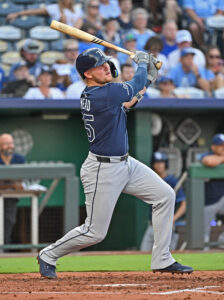
Mead signed with the Phillies as a minor league free agent in 2018. He was dealt to the Rays straight up for future All-Star Cristopher Sanchez the following year. Mead mashed in the minors in his first full season in the Tampa Bay organization, delivering a 142 wRC+ across three levels in 2021. He continued to pound minor league pitching over the next two seasons.
MLB Pipeline ranked Mead as the Rays’ No. 2 prospect in 2023, behind only right-hander Taj Bradley. He debuted with the club that year, holding his own as a 22-year-old with a .253/.326/.349 slash line in 92 plate appearances. Despite the respectable debut, Mead was limited to part-time work with the Rays in 2024 and 2025. His production was underwhelming at the plate, though he did provide some defensive versatility. Mead spent time at first base, second base, and third base, while also making an appearance at shortstop.
Washington has been active in the infield market over the past week. The club acquired Jorbit Vivas and Zack Short from the Yankees in separate deals. Mead will now join the list. It’s unclear whether he’ll be with the big-league club or head to the minors. Chicago was more in need of an outfielder to fill out the roster following the Brooks Baldwin injury, but the Nats are thinner on the dirt.
Smith was selected with the No. 171 overall pick out of Wright State. The backstop popped 26 home runs in his final season with the Raiders. The 23-year-old has yet to suit up in the minors. Chicago has a pair of talented young catchers on the big-league squad in Kyle Teel and Edgar Quero. Veteran Reese McGuire is currently backing up Quero as Teel deals with a hamstring strain suffered in the World Baseball Classic.
Eder was signed by the Marlins as an undrafted free agent in 2020. He was traded to the White Sox for Jake Burger at the 2023 trade deadline. After a handful of uninspiring seasons in the minors with Chicago, he was sent to the Angels for cash in March 2025. Eder made eight appearances for the big-league club, pitching to a 4.91 ERA across 18 1/3 innings. The lefty found his way to the Nationals in a trade that sent relievers Andrew Chafin and Luis García back to the Angels. Eder was tagged for seven earned runs over seven minor league innings with Washington.
Photo courtesy of Mark J. Rebilas and Peter Aiken, Imagn Images
Poll: Who Will Win The NL East?
With the first game of the 2026 season already in the rearview mirror, the offseason is now complete for MLB’s 30 teams. Until the playoffs begin, teams will be focused on a smaller goal: winning their division. In the run-up to the start of the season, we have been conducting a series of polls to gauge who MLBTR readers believe is the favorite in each division. The Blue Jays came out on top in the AL East, and the Tigers did the same in our poll on the AL Central, and the Mariners were predicted to win the AL West. In the NL West, the Dodgers predictably came out on top, while the the Cubs won a plurality (42%) of the votes in the NL Central. Today, we’ll round out this series of polls with a look at the NL East. All teams are listed in order of their 2025 regular season record:
Philadelphia Phillies (96-66)
The Phillies won the NL East in dominant fashion last year, but repeating that feat figures to be a much taller order in 2026. That’s because Philadelphia’s biggest offseason moves were focused on the same core that they’ve used for the last several years. Kyle Schwarber and J.T. Realmuto re-signed. Cristopher Sanchez and Jesus Luzardo signed extensions. But none of that meaningfully pushes the ball forward relative to 2025. There were some external additions of note, like Adolis Garcia and Brad Keller, but the Phillies seem very comfortable banking on youngsters like Justin Crawford and Andrew Painter to pick up the slack left by departing All-Stars Ranger Suarez and Nick Castellanos. Will that be enough to keep them at the top of the NL East?
New York Mets (83-79)
The Mets completely overhauled their entire organization this offseason after missing the playoffs by a hair in 2025. Pete Alonso, Edwin Diaz, Brandon Nimmo, Starling Marte, and Jeff McNeil (among others) are gone. Marcus Semien, Jorge Polanco, Bo Bichette, Devin Williams and Luis Robert Jr. (among others) have arrived to replace them. The result is a completely overhauled lineup that offers the potential for a very impressive offense on paper but comes with real defensive questions as Bichette and Polanco are set to be tasked with learning new positions. With that said, the team’s biggest addition of the winter is surely Freddy Peralta, who will lead a rotation that also stands to get a full season from Nolan McLean this year. It was an unorthodox retool of the roster in Queens this offseason, but this year’s team built around Juan Soto and Francisco Lindor certainly has a chance to be a lot stronger than the one they leaned on last season.
Miami Marlins (79-83)
The Marlins surprised baseball fans in 2025 by nearly making it all the way back to .500, but that wasn’t enough to convince president of baseball operations Peter Bendix to call off the rebuild early. Edward Cabrera and Ryan Weathers were shipped out the door, while the team’s additions were fairly modest. Owen Caissie joined the team as part of the Cabrera trade return and could be a 30-homer bat in right field, mirroring 2025 All-Star Kyle Stowers in left once the latter is healthy, but a team relying on Christopher Morel at first base and Chris Paddack to be your big free agent additions to the lineup and rotation doesn’t offer much reason for optimism about the club’s division chances. Pete Fairbanks was a strong addition to the bullpen, but Miami will need a big rebound from Sandy Alcantara plus significant steps forward from youngsters like Connor Norby, Max Meyer, and Agustin Ramirez if they’re going to compete for the East.
Atlanta Braves (76-86)
No team in baseball had a more disappointing season last year than the Braves. Virtually everything went wrong in Atlanta last season, as the entire roster struggled with injuries and under-performance outside of a few bright spots like Drake Baldwin and Matt Olson. The good news for Atlanta is, they still have a very talented core on paper. Ronald Acuna Jr. is a superstar with an MVP award on his mantle. Chris Sale is a future Hall of Famer. Spencer Strider and Austin Riley are certainly capable of bouncing back. Additions like Robert Suarez and Mike Yastrzemski should be helpful, though Ha-Seong Kim is starting the season on the injured list after signing on to be their starting shortstop. The bones of a great team are certainly present, but it’s anyone’s guess whether Atlanta can perform up to that level this year.
Washington Nationals (66-96)
The Nationals enter 2026 with little reason for hope in the short-term. James Wood looks like a budding superstar, but MacKenzie Gore has been traded and CJ Abrams could follow suit later this year. Offseason additions like Zack Littell and Miles Mikolas in the rotation should help to eat innings but neither offers substantial upside. Fans in D.C. could hope for big years from players like Wood, Abrams, Cade Cavalli and Brady House, but even with those things going right, the best case scenario would be convincing newly-minted president of baseball operations Paul Toboni to try and make a more substantial effort to compete next year. It would take a minor miracle to get the Nationals into the postseason for 2026, much less as the champions of the NL East.
How do MLBTR readers think the NL East will play out this year? Will the Phillies hang on to win it again despite running it back? Will the Mets’ massive retool work out? Or will a team like the Marlins or Braves surprise and take the crown for themselves? Have your say in the poll below:
Who will win the NL East in 2026?
-
Philadelphia Phillies 40% (2,316)
-
New York Mets 33% (1,894)
-
Atlanta Braves 21% (1,198)
-
Washington Nationals 4% (212)
-
Miami Marlins 3% (152)
Total votes: 5,772
MLBTR Podcast: The PCA and Sanchez Extensions, And Prospect Promotions And Reassignments
The latest episode of the MLB Trade Rumors Podcast is now live on Spotify, Apple Podcasts, and wherever you get your podcasts! Make sure you subscribe as well! You can also use the player at this link to listen, if you don’t use Spotify or Apple for podcasts.
This week, host Darragh McDonald is joined by Anthony Franco of MLB Trade Rumors to discuss…
- The extension between the Cubs and Pete Crow-Armstrong (recorded prior to the numbers being reported) (2:20)
- The extension between the Phillies and Cristopher Sánchez (7:00)
- The Braves losing Spencer Strider to the injured list (14:00)
- Is there a trend of starting pitcher prospects being used in major league bullpens? (18:15)
- The Nationals optioning Dylan Crews and Harry Ford, with Josiah Gray landing on the 60-day IL (23:35)
- Carson Benge making the Mets‘ Opening Day roster (30:30)
- JJ Wetherholt making the Cardinals‘ Opening Day roster (35:40)
- The Pirates not breaking camp with Konnor Griffin (39:15)
- The Guardians not breaking camp with Travis Bazzana (44:40)
- The Blue Jays starting the season with José Berríos and Trey Yesavage on the injured list (49:20)
- The Marlins optioning Braxton Garrett (55:55)
Check out our past episodes!
- Banged-Up Reds And Braves, Kevin McGonigle, And Spring Breakouts – listen here
- Jesús Luzardo’s Extension, Atlanta’s Depth, And Zack Littell – listen here
- Max Scherzer, The Red Sox’ Lineup, Spring Extension Candidates, And More! – listen here
The podcast intro and outro song “So Long” is provided courtesy of the band Showoff. Check out their Facebook page here!
Photo courtesy of Kyle Ross, Imagn Images
Yankees Trade Zack Short To Nationals
The Yankees have traded infielder Zack Short to the Nationals in exchange for cash, per announcements from both clubs. Short, who’d been a non-roster invitee to Yankees camp, will head to Triple-A Rochester with his new organization for the time being.
Short, 30, signed a minor league deal with New York back in December and hit .278/.480/.333 in 25 spring plate appearances. He’s played in parts of four major league seasons between the Tigers, Mets, Red Sox, Braves and Astros, tallying a total of 594 plate appearances. In that time, he’s slashed .172/.271/.296 with 15 homers, 10 steals, a stout 11.8% walk rate and a bloated 29% strikeout rate.
The Nationals are relatively thin on infield depth, and Short has experience at second base, shortstop and third base in the majors — more than 300 innings at each position (including 784 at shortstop). He hasn’t posted especially strong defensive grades, but he’s a versatile right-handed bat with modest pop and solid on-base skills. His low batting averages persist even in Triple-A, where he’s batted just .216 in six seasons, but he also sports a .353 on-base percentage in that time.
Looking around the Nationals’ infield, CJ Abrams is the lone established player. Former first-round pick Brady House will get another look at third base, while Nasim Nunez and Luis Garcia Jr. look like options at second base and first base. Infielder Jorbit Vivas also came over from the Nats in a more notable trade and is out of minor league options, so he’ll mix in to some extent, as will righty-swinging first baseman Andres Chaparro.