
Nationals Option Josiah Gray, Robert Hassell III
The Nationals announced a trio of camp cuts this morning. Starter Josiah Gray, outfielder Robert Hassell III and reliever Julian Fernández will all begin the season in the minors.
Gray was an All-Star in 2023 after making 30 starts with a 3.91 ERA. He was hit hard over two starts the following season and underwent UCL surgery in July. Gray didn’t pitch in MLB last year as he rehabbed the injury. He made a trio of abbreviated starts in the minors to at least get some game action in before the offseason began.
The 28-year-old has taken the ball twice in camp. He pitched 4 2/3 frames of one-run ball with five strikeouts. The Nationals will continue his buildup as a depth starter at Triple-A Rochester. Mitchell Parker, Andrew Alvarez and Jake Eder are also on the 40-man roster but beginning the season in the minors.
Gray’s demotion seemingly positions Jake Irvin as Washington’s fifth starter. Cade Cavalli will take the ball on Opening Day against Matthew Boyd and the Cubs. Miles Mikolas, Foster Griffin and Zack Littell signed one-year free agent deals that should lock them into the rotation.
Irvin led the team with 180 innings last season, but he was tagged for an ugly 5.70 ERA while striking out fewer than 16% of opponents. That left him to compete for a rotation role this spring. To his credit, the 29-year-old righty has had an excellent camp. Irvin has allowed just two runs while striking out 15 across 13 1/3 innings. He has toyed with a deeper pitch mix, throwing more cutters and sliders after leaning mostly on his fastballs and curveball last year.
Hassell, a former top 10 pick who came over from San Diego in the Juan Soto trade, hit .223/.257/.315 over his first 70 MLB games last year. He struck out nine times while walking just once in 29 spring plate appearances. Hassell heads back to Triple-A, where he had a strong season (.310/.383/.456 in 76 games) a year ago.
The Nationals have James Wood, Jacob Young and Daylen Lile assured of spots in the MLB outfield. Dylan Crews will presumably be in there as well, though it’s at least conceivable that the Nats could determine he’d benefit from Triple-A reps. The former second overall pick limped to a .208/.280/.352 showing in his first full MLB season. He has only picked up three hits while striking out 10 times in 32 plate appearances this spring. Offseason waiver pickup Joey Wiemer has also had a rough camp and still has an option remaining.
Nationals Option Harry Ford
The Nationals announced today that catcher Harry Ford has been optioned to Triple-A Rochester while fellow backstop Riley Adams has been reassigned to minor league camp. That seems to set the stage for Keibert Ruiz and Drew Millas to be the club’s catching tandem at the beginning of the season.
The Nats have an interesting long-term catching mix. They acquired Ruiz from the Dodgers as part of the 2021 deal sending Max Scherzer and Trea Turner to the Dodgers. He and the club agreed to an extension in 2023, a deal which runs through 2030 and has club options for 2031 and 2032.
But since the start of 2024, he has poor defensive numbers and a .235/.266/.345 batting line. FanGraphs has considered him to be 1.3 wins below replacement level in that span. He was acquired and extended by the previous front office regime. President of baseball operations Mike Rizzo was fired last year as the club’s rebuild failed to proceed as hoped.
Paul Toboni was hired to replace Rizzo. One of the first significant moves of his tenure was to trade reliever Jose A. Ferrer to the Mariners, with Ford being the headliner of the return. Ford is one of the top catching prospects in the league. Seattle drafted him 12th overall in 2021 and signed him to a bonus of $4.4MM. With Cal Raleigh locked in as the catcher in Seattle, it made sense for the Mariners to put Ford on the trade block. Presumably, the Nats hope Ford is their primary catcher in the long term.
Ford’s major league track record consists of just eight games so far. He got into 97 Triple-A games last year and put up a .283/.408/.460 line. Even in the hitter-friendly environment of the Pacific Coast League, that was 25% better than league average, by measure of wRC+. His defense was once considered questionable but he has made enough progress that he is expected by many evaluators to stick behind the plate for the long term.
Though Ford is still only 23 years old and lacking in experience, the Nats could have considered carrying him on the Opening Day roster due to the Prospect Promotion Incentive. He would have been PPI eligible if the Nats kept him on the active roster for long enough to earn a full year of service time. He could have then earned them an extra draft pick if he won Rookie of the Year or Most Valuable Player in his pre-arbitration seasons.
The Nats didn’t get a long look at him during Spring Training, as Ford joined the Great Britain team in the World Baseball Classic. He has only appeared in seven Grapefruit League contests, with a lackluster .214 /.353/.286 line in those.
For now, it seems the Nats will have Ford getting regular reps in the minors. That will give Ruiz a chance to continue as the regular catcher in the big leagues. Despite his recent struggles, it’s not out of the question for Ruiz to get back on track. He is only 27 years old and was able to be a league average hitter as of a few years ago.
If that doesn’t come to fruition, then it’s possible a time will come where Ford pushes for a regular role, which will get Ruiz bumped into being an overpaid backup. His contract isn’t especially onerous on an annual basis but there’s still quite a ways to go. He will make $5MM this year and next, followed by a salary of $7MM in 2028 and then $9MM in each of the final two years. That means he is still guaranteed $35MM over the next five years. The club options are valued at $12MM and $14MM, with no buyouts.
The timing of Ford’s eventual recall to the majors will impact his future earning power. He currently has 28 days of service time. If he spends about six weeks or more on optional assignment this year, he won’t be able to reach the one-year mark, which will push his path to free agency by a year. It also could impact when he qualifies for arbitration, depending on where the Super Two cutoff lands in future seasons.
Photo courtesy of Sam Navarro, Imagn Images
Mets Claim Richard Lovelady
The Mets announced that left-hander Richard Lovelady has been claimed off waivers from the Nationals. Right-hander Justin Hagenman was placed on New York’s 60-day injured list in the corresponding move, as Hagenman will now miss the first two months of the season recovering from a rib fracture.
It’s a quick return to Queens for Lovelady, who was designated for assignment by the Mets in late January and then claimed by the Nationals. After a little over a month in Washington’s spring camp, Lovelady was DFA’ed again since the Nats needed roster space for the newly-signed Zack Littell.
Lovelady broke into the majors with the Royals in 2019, and he spent his first three big league seasons in Kansas City before a Tommy John surgery cost him the entirety of the 2022 season. Since recovering from his surgery, Lovelady has become a regular on the transactions list, as he has bounced around to multiple clubs in a series of trades, waiver claims, signings and re-signings. Since the start of the 2023 campaign, Lovelady has a 5.19 ERA, 20.7% strikeout rate, and 9.0% walk rate over 69 1/3 innings with five different teams at the Major League level.
This nomadic stretch includes multiple stints with the Mets over the last year, beginning last June when New York signed Lovelady after he’d opted out of a minor league contract with the Twins. Lovelady ended up posting a 6.30 ERA over 10 innings with the Amazins, while also being DFA’ed and outrighted three different times. The southpaw refused the first of those outrights and elected free agency, but soon re-signed with the Mets.
Lovelady has been out of minor league options following the 2024 season, which is why he has been ping-ponged around without much roster security. While the Mets clearly see enough in Lovelady to keep re-acquiring him, he is likely viewed as no more than left-handed bullpen depth, and a possible candidate for another DFA if New York needs roster space. Lovelady is signed for 2026 on a split contract that he inked with the Mets in October, and is guaranteed a $350K salary in the minors and $1MM in the majors.
Hagenman was a 23rd-round pick for the Dodgers in the 2018 draft, and signing with the Mets last offseason helped pave the way for the righty to make his MLB debut in 2025 as part of the Mets’ revolving door of pitchers. Hagenman posted a 4.56 ERA across his first 23 2/3 innings in the Show, with an impressive 23 strikeouts against only two walks but also four homers allowed.
After spending most of his minor league career in a strict relief role, Hagenman has been used more as a swingman in Boston and New York’s Triple-A teams over the last two years. He was viewed as a longshot candidate to make the Mets’ Opening Day roster anyway, but this rib injury will now heavily delay Hagenman’s work even at Triple-A Syracuse. One minor silver lining is that the placement on the big league 60-day IL will earn Hagenman some Major League service time.
Which Top Prospects Could Be On 2026 Opening Day Rosters?
In the not-too-distant past, it was relatively rare for organizations to break camp with their very best prospects on the roster. It still happened at times, but MLB's service time structure was set up such that keeping a top prospect in the minors for even two weeks to begin the season effectively ensured that he'd be controllable for seven years rather than the standard six. There were obvious exceptions to this thinking -- Atlanta fans surely remember Jason Heyward breaking camp as a 20-year-old and belting a three-run homer on Opening Day -- but there were far more cases of keeping a player in the minors to buy the extra year. Kris Bryant, Vladimir Guerrero Jr., George Springer and others were all called to the majors just when they'd spent enough time in the minors to give their clubs an extra year of control. There was nothing inherently nefarious about the gambit; teams were operating within the collectively bargained rules and making business decisions.
The 2022-26 collective bargaining agreement sought to implement some real incentives for teams to bring their best players north to begin the season, however, and by and large they've been effective. With the Prospect Promotion Incentives (PPI), any prospect who appears on two recognized top-100 lists and is called up early enough to earn a full service year can net his team a bonus draft pick, either in that season's Rookie of the Year voting or in MVP/Cy Young voting over the next three seasons.
There's also a disincentive to holding a player down. For those same qualified top prospects, a top-two finish in either league's Rookie of the Year voting will net a full year of major league service time, regardless of when they were called up. Said prospects still have around 90% of a season in such instances, which is more than enough time to turn in a ROY-worthy performance.
Teams now know that holding a player down for 15 days or so might lead to him getting a full year of service anyhow and comes with the disadvantage of rendering that player ineligible for future PPI picks. As such, it's become increasingly common for touted prospects to break camp on their teams' rosters.
With that in mind, and with fewer than two weeks to go until Opening Day, it seems worth running through a slate of top prospects who could factor into their teams' Opening Day plans.

Unlock Subscriber-Exclusive Articles Like This One With a Trade Rumors Front Office Subscription
- Access weekly subscriber-only articles by Tim Dierkes, Steve Adams, and Anthony Franco.
- Join exclusive weekly live chats with Anthony.
- Remove ads and support our writers.
- Access GM-caliber tools like our MLB Contract Tracker
Nationals Option Mitchell Parker
The Nationals announced Friday they’ve optioned left-handers Mitchell Parker, Andrew Alvarez and Jake Eder. That takes three pitchers, one of whom has been on the MLB roster for the last two years, out of the mix for the Opening Day rotation.
Parker’s demotion is the most notable. He had been in the big leagues since his first callup in April 2024. Parker had a solid rookie year, turning in a 4.29 ERA across 29 starts. His sophomore season was a lot less encouraging. Parker was tagged for 5.68 earned runs per nine over 164 2/3 innings. He had the ninth-highest ERA and sixth-lowest strikeout rate (14.2%) among pitchers who reached 100 innings.
The 26-year-old Parker took the ball twice this spring. His command was erratic, as he walked five batters over 3 2/3 innings. He’ll begin the season at Triple-A Rochester as he tries to get on track.
Alvarez and Eder were also competing for rotation spots. The former is a 26-year-old rookie who turned in a 2.31 ERA over five major league starts last season. Alvarez doesn’t throw especially hard and had middling strikeout and walk numbers in his MLB look. He’ll head back to Triple-A, where he made 25 starts and posted a 4.10 ERA with a league average 21.5% strikeout rate last season.
The Nats acquired Eder from the Angels as part of last summer’s Andrew Chafin deadline deal. He was immediately optioned to Triple-A and quickly landed on the injured list. The 6’4″ southpaw was once a notable prospect but has struggled to find the strike zone consistently. He walked six batters across 6 2/3 frames this spring.
First-year skipper Blake Butera has already tabbed righty Cade Cavalli as the Opening Day starter. The Nats added Zack Littell, Miles Mikolas and Foster Griffin on one-year free agent deals. Littell’s signing was just finalized this week, but he was able to throw 39 pitches over three innings in his Spring Training debut this afternoon. He’ll probably have time to build up for Opening Day.
Josiah Gray, Brad Lord, and Jake Irvin are in the mix for the fifth starter spot. Gray is coming back from internal brace surgery that cost him the entire 2025 season. He has struck out five over 4 2/3 innings of one-run ball in camp.
Lord pitched to a 4.34 ERA across 130 2/3 innings last year in a swing role. He has allowed four runs (three earned) with four strikeouts over 7 1/3 frames. Irvin led the Nats with 180 innings a year ago but was tagged for a 5.70 ERA and led the majors in earned runs and homers allowed. He has had an excellent start to the spring, though, firing 8 1/3 frames of two-run ball while punching out 10.
MLBTR Podcast: Jesús Luzardo’s Extension, Atlanta’s Depth, And Zack Littell
The latest episode of the MLB Trade Rumors Podcast is now live on Spotify, Apple Podcasts, and wherever you get your podcasts! Make sure you subscribe as well! You can also use the player at this link to listen, if you don’t use Spotify or Apple for podcasts.
This week, host Darragh McDonald is joined by Anthony Franco of MLB Trade Rumors to discuss…
- The Phillies and Jesús Luzardo signing an extension (1:55)
- Johan Rojas reportedly testing positive for a PED and how that impacts the Phillies (16:55)
- The Braves losing Jurickson Profar to yet another PED suspension and Joey Wentz to a season-ending injury (22:15)
- The Nationals signing Zack Littell (36:25)
- The Pirates trading Kyle Nicolas to the Reds for Tyler Callihan (43:40)
- The Rangers signing Andrew McCutchen to a minor league deal (48:45)
- The Astros dealing with a Jeremy Peña injury and how that impacts the ongoing Isaac Paredes trade rumors (53:30)
Check out our past episodes!
- Max Scherzer, The Red Sox’ Lineup, Spring Extension Candidates, And More! – listen here
- Twins And Orioles’ Injuries, The Guardians And Angels’ Quiet Offseasons, And Chris Sale’s Extension – listen here
- The Tigers’ Rotation, A Brewers-Red Sox Trade, And Late Free-Agent Signings – listen here
The podcast intro and outro song “So Long” is provided courtesy of the band Showoff. Check out their Facebook page here!
Photo courtesy of Kyle Ross, Imagn Images
Nationals Sign Zack Littell
The Nationals have formally added a second veteran starter in free agency, announcing the addition of righty Zack Littell on a one-year deal with a mutual option for the 2027 season. Littell, a client of CAA, will reportedly be guaranteed $7MM with another $2.5MM available to him via innings-based incentives. Left-hander Richard Lovelady was designated for assignment to open roster space, per the team.
Littell’s deal reportedly pays him a $3MM salary but also includes a $4MM buyout on that mutual option. Since mutual options are never exercised, that amounts to little more than an accounting measure; the Nats are kicking $4MM of his $7MM commitment to the 2027 books rather than the 2026 books. The contract is also said to contain $100K bonuses for every tenth inning pitched from 100 through 140. Littell can earn $250K for reaching each of 150 and 160 innings, and the deal has $500K bonuses upon reaching 170, 180 and 190 innings.
Heading into the offseason, we ranked Littell 35th among the offseason’s top 50 free agents, predicting a two-year deal. He’ll have to settle for just a one-year pact, and the righty could be on the move again relatively soon if the rebuilding Nationals move him at the trade deadline.
The 30-year-old Littell is a veteran of eight big league seasons but spent most of that time in a bullpen role. In the first five seasons of his MLB career, Littell posted a 4.08 ERA (104 ERA+) with lackluster peripherals in 169 2/3 innings of work. After the 2022 campaign, Littell rode the DFA and waiver carousel throughout the 2022-23 offseason. He eventually wound up with the Red Sox to start the season, but he made just two appearances in the majors before being once again designated for assignment. That led him to the Rays, with whom he managed to transform himself from a fringe member of the 40-man roster into a solid rotation arm.
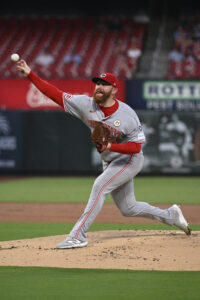 Upon arriving in Tampa, Littell moved into a swing role for the remainder of the 2023 campaign. He posted a 3.93 ERA with a nearly matching 3.99 FIP in 87 innings split between 14 starts and 12 relief appearances. Littell’s 19.8% strikeout rate in those outings was hardly exciting, but he made up for it with pinpoint command that allowed him to post a 2.5% walk rate and an 8.2% barrel rate.
That control and command style was enough to earn him a full-time rotation job headed into the Rays’ 2024 season, and he rewarded the team with a career year. In 29 starts for the Rays in 2024, Littell posted a 21.5% strikeout rate against a 4.7% walk rate while pitching to a 3.63 ERA (110 ERA+) with a 3.81 FIP. His 156 2/3 innings of work made him just one of just 71 pitchers to throw more than 150 innings that year, and only 15 of those pitchers surrendered fewer runs than Littell.
Littell remained generally effective in terms of run prevention last year, logging a 3.81 ERA (111 ERA+) in a career-high 186 2/3 innings across 32 starts for the Rays and Reds. The bottom-line results were similar, but Littell’s rate stats took worrying steps in the wrong direction. His strikeout rate plummeted to just 17.1%, while his barrel rate jumped to 9.8% as he allowed the second-most homers in all of baseball last season. Perhaps some of that can be explained by Littell pitching his home games at the hitter-friendly Steinbrenner Field and Great American Ballpark, but a 4.40 SIERA suggested that Littell was more of a back-end starter than his results may have indicated.
The result was a soft free agent market for Littell this offseason. A reunion with the Rays once seemed to be on the table, but Tampa Bay instead brought in Steven Matz and Nick Martinez. KSTP’s Darren Wolfson reports that the Twins at least checked in late in the offseason, but weren’t inclined to match the Nationals’ offer.
The Nationals were the ones to ultimately bring Littell into the fold, with some past connections possibly helped complete the deal. New president of baseball operations Paul Toboni formerly worked in the Red Sox front office, new manager Blake Butera spent years managing in Tampa’s farm system, and new pitching coach Simon Matthews was the Reds’ assistant pitching coach in 2025, so all three have direct familiarity with Littell’s work.
D.C. is unlikely to compete for a playoff spot this year as they reboot their rebuilding efforts under Toboni. As such, the team has pursued just short-term and relatively inexpensive veteran signings like Littell and Miles Mikolas, and made another move for the future in trading MacKenzie Gore to the Rangers. The Gore trade diminished an already questionable Washington rotation, so Littell will reinforce a starting five that seems set to include Mikolas and another new signing in Foster Griffin. The last two spots in the rotation figure to go to some combination of Cade Cavalli, Brad Lord, Josiah Gray, Jake Irvin, and Mitchell Parker.
ESPN.com’s Kiley McDaniel and Jeff Passan were the first to report the agreement between the two sides. The Baltimore Banner’s Andy Kostka (multiple links) had the details about the one-year term and mutual option. The Banner’s Andrew Golden first reported the financial guarantee. Jon Heyman of The New York Post and Spencer Nusbaum of The Athletic added specifics about the breakdown and incentives.
Inset photo courtesy of Joe Puetz — Imagn Images
Nationals Designate Richard Lovelady For Assignment
The Nationals have designated left-handed reliever Richard Lovelady for assignment, per a club announcement. His roster spot goes to righty Zack Littell, whose previously reported one-year deal with the Nats is now official.
Washington claimed Lovelady off waivers from the Mets back on Jan. 29. He’d signed a split major league deal with the Mets back in October, which the Mets hoped would help him to pass through waivers so he could be stashed in Syracuse as Triple-A depth. That didn’t work out, at least not on their initial attempt, as the Nats quickly scooped him up. Lovelady will now either be traded within the next five days or placed back on waivers, which are a 48-hour process. His DFA will be resolved within a week’s time.
Lovelady has had a solid showing with the Nats so far in camp. He’s allowed a run on four hits and three walks in four innings while fanning seven batters. He allowed 11 runs in 11 2/3 big league innings between the Blue Jays and Mets in 2025 but posted a a terrific 1.66 ERA with a 26.3% strikeout rate, 8.6% walk rate and 52.6% ground-ball rate in 38 Triple-A frames.
Lovelady is no stranger to posting strong numbers in the upper minors but running into some MLB struggles. He’s logged 111 MLB frames in his career and posted a 5.35 ERA but thrived with a 2.61 ERA, 26.9% strikeout rate and 7% walk rate in 175 2/3 Triple-A innings across parts of seven seasons. Although Lovelady hasn’t had consistent success in the majors, he did log a solid 4.25 ERA with quality strikeout, walk and grounder rates in 78 1/3 big league frames from 2022-24.
Since he’s out of minor league options, Lovelady couldn’t simply be sent back to Triple-A. The Nats will hope he clears waivers and can be stashed in the upper minors within their system, just as the Mets tried to do. He cleared waivers on several occasions last year but was also selected to a major league roster five different times between Toronto and New York, including that major league deal with the Mets in October. He’s ping-ponged on and off MLB rosters of the Royals, A’s, Cubs, Jays and Mets dating back to 2022, so it’s certainly possible another club with a need for some bullpen depth takes a low-cost flier via waivers or a cash swap.
Paolo Espino Announces Retirement
Right-hander Paolo Espino is retiring after 19 seasons in pro ball, as the 39-year-old announced that he is hanging up his glove after the World Baseball Classic is over. The longtime member of Panama’s national team saw action in both the 2006 and 2009 editions of the WBC, and is looking to pitch for his country one more time before calling it a career.
A 10th-round pick for Cleveland in the 2006 draft, Espino finally made it to the Show in March 2017 when he was 30 years and pitching with the Brewers. He tossed 24 total innings that season between the Brewers and Rangers and then didn’t resurface in the majors again until 2020 when he was a member of the Nationals.
The bulk of Espino’s time in the big leagues was spent in a Washington uniform, as the right-hander threw 233 innings over 82 games with the Nats (out of 265 2/3 career innings and 97 games). Throughout his time with the Nationals and over his career as a whole, Espino worked in a variety of roles, including as a regular starter, long reliever, bulk pitcher behind an opener, or as the proverbial last man in the bullpen reserved for blowout duty.
Espino posted a 5.12 ERA over his 265 frames with the Brewers, Rangers, Nationals, and Blue Jays, as his 8 2/3 innings over three outings with Toronto in 2024 marked the final appearances of his MLB career. The Jays outrighted Espino off the 40-man roster at the conclusion of the 2024 campaign and he elected free agency, eventually signing with Conspiradores de Queretaro of the Mexican League for part of the 2025 season.
We at MLB Trade Rumors congratulate Espino on his fine career, and we wish him all the best in his post-playing endeavors.
Nationals Notes: Wood, Cavalli, Williams
Spring Training is a time for players to work at different positions in low-stakes settings. Perhaps the most interesting development from the first week of Nationals camp is that All-Star outfielder James Wood has made a couple starts in right field. Two of his first three Spring Training appearances have come at the position.
The 23-year-old has not played right field in a regular season MLB game. Wood had a little over 400 innings there in the minor leagues. He has been exclusively a left fielder or designated hitter over his season and a half in the majors.
Nats manager Blake Butera hasn’t made any declarations about a position change. There’s no harm in reintroducing Wood to the position even if they intend for him to see the majority of his regular season work in left. The Nationals didn’t get him any action in right field during Spring Training 2025.
Daylen Lile was the primary right fielder after he came up in May. Lile hit the ground running offensively, batting .299/.347/.498 through his first 91 MLB contests. It was a different story on the other side of the ball. Lile was among the worst defensive outfielders in the league. He’s a good athlete with plus speed but turned a handful of easy outs into hits with poor routes or questionable decisions to let catchable balls drop in front of him.
Lile made 21 starts in left field and 52 in right. He didn’t grade well at either position. Wood has also had poor defensive metrics, albeit not to the same extent. If the Nationals feel he’s the better corner defender of the two, they could prefer to have Wood in right field against lineups that skew left-handed. They’ll each get a decent amount of DH work as well.
Dylan Crews can play anywhere in the outfield, though he doesn’t have much left field experience in pro ball. Jacob Young is easily the team’s best outfield defender. He’ll be in center whenever he’s in the lineup but fits best in a fourth outfield role because of his light bat.
However the outfield sorts itself out, those four players all go into camp with spots on the MLB roster secured. That’s not true of many players on the pitching staff. Free agent signees Miles Mikolas and Foster Griffin join Cade Cavalli and Josiah Gray as likely members of the season-opening rotation. Gray missed all of last season recovering from July 2024 internal brace surgery. Cavalli came back from Tommy John surgery of his own last year. He made 10 starts late in the season, pitching to a 4.25 ERA across 48 2/3 innings.
Andy Kostka of The Baltimore Banner wrote about the pitchers’ respective rehab processes this week. President of baseball operations Paul Toboni told reporters that Cavalli is “full go” this spring. That might also include a repertoire adjustment.
The 27-year-old righty said he worked with pitching coaches Simon Mathews and Sean Doolittle to incorporate a sweeper. Cavalli’s primary breaking ball is an 86 mph knuckle-curve that has more of a vertical shape. A sweeper would give him something with an east-west profile that he can run away from right-handed hitters. Cavalli tossed two scoreless innings in his exhibition debut this week.
Gray has yet to get into a Spring Training game, though he’s expected to be fully built up by Opening Day. If he secures the fourth starter role, that’d leave one spot available for a group including Jake Irvin, Mitchell Parker, Brad Lord, Andrew Alvarez and Jake Eder.
Veteran right-hander Trevor Williams is midway through his own surgical rehab. He underwent an internal brace procedure last July and figures to be out at least through the All-Star Break. As Mark Zuckerman of Nats Journal wrote recently, Williams paused his throwing program and went for precautionary imaging after feeling some elbow soreness last weekend. It’s common for pitchers to have pauses along the way in their return from elbow ligament procedures. Butera downplayed the team’s concern on Saturday, though the Nationals haven’t provided any specifics on the MRI results.