
2026-27 Club Options: NL East
In recent weeks, MLBTR has looked forward to next winter’s option classes. We’ll move now to the NL East, where a former MVP and Cy Young winner are the most notable names.
Previous: AL East, AL Central, AL West
Atlanta Braves
- Ronald Acuña Jr., RF: $17MM club option ($10MM buyout)
This is as easy as they get. The Braves will exercise their $17MM option for 2027 and have a matching provision for the ’28 season. The first comes with a $10MM buyout, while the second has no buyout. It’s highly likely the Braves are going to pick them both up anyway, but it could be a moderately closer call for Atlanta after 2027 if Acuña has a bad or injury-riddled year.
The Braves have remarkably raced to the second-best start in MLB despite relatively underwhelming work from the five-time All-Star. Acuña has only connected on two home runs with a .252/.367/.382 slash line through his first 35 games. He missed a couple weeks with a Grade 1 strain of his left hamstring and returned to the lineup yesterday.
- Ozzie Albies, 2B: $7MM club option (no buyout)
Albies agreed to a pair of $7MM team options on his exceedingly club-friendly 2019 extension. He signed away up to four free agent years for a $35MM guarantee that’d max out at $45MM if the Braves exercised the options — the first of which contained a $4MM buyout.
For a few years, it was among the biggest bargain contracts in the league. A pair of down seasons in 2024-25 reduced the surplus value somewhat, though Atlanta still had an easy call to exercise the first option last winter. Picking up the second should require even less deliberation.
Albies has rebounded to hit .271/.329/.441 and is third among second basemen with eight home runs. The NL second base field is crowded, but Albies is putting together a strong case for his fourth All-Star selection while playing on a salary just above what Isiah Kiner-Falefa and Miguel Rojas commanded as free agents.
- Tyler Kinley, RHP: $5.5MM club option ($1.25MM buyout)
Atlanta acquired Kinley from the Rockies last summer. He pitched brilliantly down the stretch, but they nevertheless declined his $5.5MM option for 2026 in favor of a $750K buyout. They re-signed Kinley two months later on a $4.25MM free agent deal. He’s making $3MM this season and will be paid either a $1.25MM buyout or stick around for next season via $5.5MM team option.
Kinley, a slider specialist, has had a somewhat shaky start this season. His 23% strikeout rate is virtually unchanged from last year, but his walks have ticked up and he has been victimized by the home run ball. Kinley has given up a longball in four of his last eight times out. He’s up to 10 runs allowed (nine earned) across 20 2/3 innings.
The Braves have still used Kinley in a decent number of leverage situations. He’s tied for second on the team behind Dylan Lee with six holds. This one could go either way, but he’ll need to get on track to remain in skipper Walt Weiss’ circle of trust.
Miami Marlins
- Sandy Alcantara, RHP: $21MM club option ($2MM buyout)
The Marlins’ deadline will hinge largely on what to do with Alcantara. He’s making $17MM in the final guaranteed season of the $56MM extension he signed in 2021. Alcantara has rebounded from an abysmal first half of the ’25 campaign, as he clearly had trouble dialing in his command when he initially returned from a Tommy John procedure.
Alcantara carries a 3.53 ERA with an above-average 49% grounder rate over his first 10 starts. He has allowed 3.47 earned runs per nine in 23 starts going back to last summer’s All-Star Break. The Cy Young form probably isn’t coming back, but Alcantara would be a lock for a team’s playoff rotation. He’s still sitting in the 97-98 mph range with his four-seamer and sinker, albeit with a slight drop in strikeouts.
Miami’s only guaranteed money for the 2027 season is the $10MM they’ll send to the Yankees on the Giancarlo Stanton contract. None of their arbitration-eligible players would cost more than a few million dollars. Ken Rosenthal of The Athletic wrote earlier this month that Alcantara is a favorite of owner Bruce Sherman.
It would take another major injury or an atrocious second half for Alcantara’s option not to get picked up. The bigger question is whether that’ll be by the Marlins. They’re 22-27 and fourth from the bottom in a competitive National League. FanGraphs has their postseason chances below 5%. The prospect return would be higher this summer than it’d be at the 2027 deadline given the extra playoff run they’re marketing to a contender. Will the Fish keep Alcantara as a veteran rotation anchor or shop him as one of the best available arms?
New York Mets
- Luis Robert Jr., CF: $20MM club option ($2MM buyout)
The Mets took on Robert’s $20MM salary for the 2026 season in last winter’s trade with the White Sox. They didn’t surrender a whole lot in terms of young talent — Luisangel Acuña’s stock has tumbled over the past couple seasons — but it was still a sizable financial bet on Robert staying healthy and rebounding from two straight subpar offensive years.
Robert hit well for the first two weeks before falling into a slump in the middle of April. He had a .224/.327/.329 slash over 98 plate appearances when he landed on the injured list with lumbar disc inflammation. Initial hopes that it’d be close to a minimal stint haven’t panned out. He’s coming up on a monthlong absence without a clear timeline for when he’ll ramp up baseball activities.
The bet on Robert’s tools and early-career success hasn’t panned out so far. They’ve needed to call upon prospect A.J. Ewing earlier than expected. Ewing has shown a very disciplined approach through his first eight MLB games after an excellent start to the year in Triple-A. It’s too early to simply lock Ewing into the 2027 center field job, but the Mets would be better for it if he nails down the position with a strong rookie season. That’d solidify the increasingly probable chance that Robert gets bought out.
Philadelphia Phillies
- None.
Washington Nationals
- Zack Littell, RHP: $12MM mutual option ($4MM buyout)
Washington added Littell on a one-year, $7MM free agent deal. They included a $12MM mutual option that comes with a $4MM buyout. That’s an accounting mechanism that allows them to pay Littell more than half the money at the end of the season rather than throughout the summer in salary. They presumably hoped to shed some of the buyout responsibility by flipping Littell at the deadline, though the backloaded nature meant they’d have needed to cover some of it to find a trade partner.
That’s probably a moot point, as Littell hasn’t pitched well enough to merit much attention. He owns a 6.10 ERA with a career-low 10.6% strikeout rate while giving up 14 home runs in just 41 1/3 innings. He’s the only pitcher with 40+ frames who is allowing a homer once in every three innings pitched. Most of that damage came in April, but Littell has only recorded four strikeouts in 12 1/3 frames this month. If the Nationals didn’t have one of the worst rotations in MLB, they’d probably have given more consideration to moving on from Littell already.
Note: The Nationals hold respective club options on Cade Cavalli ($4MM) and Max Kranick ($850K). Both players would remain eligible for arbitration if Washington declines.
MLBTR Podcast: Jesús Luzardo’s Extension, Atlanta’s Depth, And Zack Littell
The latest episode of the MLB Trade Rumors Podcast is now live on Spotify, Apple Podcasts, and wherever you get your podcasts! Make sure you subscribe as well! You can also use the player at this link to listen, if you don’t use Spotify or Apple for podcasts.
This week, host Darragh McDonald is joined by Anthony Franco of MLB Trade Rumors to discuss…
- The Phillies and Jesús Luzardo signing an extension (1:55)
- Johan Rojas reportedly testing positive for a PED and how that impacts the Phillies (16:55)
- The Braves losing Jurickson Profar to yet another PED suspension and Joey Wentz to a season-ending injury (22:15)
- The Nationals signing Zack Littell (36:25)
- The Pirates trading Kyle Nicolas to the Reds for Tyler Callihan (43:40)
- The Rangers signing Andrew McCutchen to a minor league deal (48:45)
- The Astros dealing with a Jeremy Peña injury and how that impacts the ongoing Isaac Paredes trade rumors (53:30)
Check out our past episodes!
- Max Scherzer, The Red Sox’ Lineup, Spring Extension Candidates, And More! – listen here
- Twins And Orioles’ Injuries, The Guardians And Angels’ Quiet Offseasons, And Chris Sale’s Extension – listen here
- The Tigers’ Rotation, A Brewers-Red Sox Trade, And Late Free-Agent Signings – listen here
The podcast intro and outro song “So Long” is provided courtesy of the band Showoff. Check out their Facebook page here!
Photo courtesy of Kyle Ross, Imagn Images
Nationals Sign Zack Littell
The Nationals have formally added a second veteran starter in free agency, announcing the addition of righty Zack Littell on a one-year deal with a mutual option for the 2027 season. Littell, a client of CAA, will reportedly be guaranteed $7MM with another $2.5MM available to him via innings-based incentives. Left-hander Richard Lovelady was designated for assignment to open roster space, per the team.
Littell’s deal reportedly pays him a $3MM salary but also includes a $4MM buyout on that mutual option. Since mutual options are never exercised, that amounts to little more than an accounting measure; the Nats are kicking $4MM of his $7MM commitment to the 2027 books rather than the 2026 books. The contract is also said to contain $100K bonuses for every tenth inning pitched from 100 through 140. Littell can earn $250K for reaching each of 150 and 160 innings, and the deal has $500K bonuses upon reaching 170, 180 and 190 innings.
Heading into the offseason, we ranked Littell 35th among the offseason’s top 50 free agents, predicting a two-year deal. He’ll have to settle for just a one-year pact, and the righty could be on the move again relatively soon if the rebuilding Nationals move him at the trade deadline.
The 30-year-old Littell is a veteran of eight big league seasons but spent most of that time in a bullpen role. In the first five seasons of his MLB career, Littell posted a 4.08 ERA (104 ERA+) with lackluster peripherals in 169 2/3 innings of work. After the 2022 campaign, Littell rode the DFA and waiver carousel throughout the 2022-23 offseason. He eventually wound up with the Red Sox to start the season, but he made just two appearances in the majors before being once again designated for assignment. That led him to the Rays, with whom he managed to transform himself from a fringe member of the 40-man roster into a solid rotation arm.
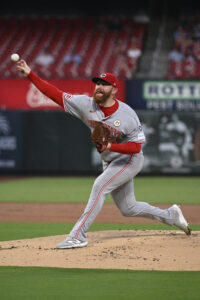 Upon arriving in Tampa, Littell moved into a swing role for the remainder of the 2023 campaign. He posted a 3.93 ERA with a nearly matching 3.99 FIP in 87 innings split between 14 starts and 12 relief appearances. Littell’s 19.8% strikeout rate in those outings was hardly exciting, but he made up for it with pinpoint command that allowed him to post a 2.5% walk rate and an 8.2% barrel rate.
That control and command style was enough to earn him a full-time rotation job headed into the Rays’ 2024 season, and he rewarded the team with a career year. In 29 starts for the Rays in 2024, Littell posted a 21.5% strikeout rate against a 4.7% walk rate while pitching to a 3.63 ERA (110 ERA+) with a 3.81 FIP. His 156 2/3 innings of work made him just one of just 71 pitchers to throw more than 150 innings that year, and only 15 of those pitchers surrendered fewer runs than Littell.
Littell remained generally effective in terms of run prevention last year, logging a 3.81 ERA (111 ERA+) in a career-high 186 2/3 innings across 32 starts for the Rays and Reds. The bottom-line results were similar, but Littell’s rate stats took worrying steps in the wrong direction. His strikeout rate plummeted to just 17.1%, while his barrel rate jumped to 9.8% as he allowed the second-most homers in all of baseball last season. Perhaps some of that can be explained by Littell pitching his home games at the hitter-friendly Steinbrenner Field and Great American Ballpark, but a 4.40 SIERA suggested that Littell was more of a back-end starter than his results may have indicated.
The result was a soft free agent market for Littell this offseason. A reunion with the Rays once seemed to be on the table, but Tampa Bay instead brought in Steven Matz and Nick Martinez. KSTP’s Darren Wolfson reports that the Twins at least checked in late in the offseason, but weren’t inclined to match the Nationals’ offer.
The Nationals were the ones to ultimately bring Littell into the fold, with some past connections possibly helped complete the deal. New president of baseball operations Paul Toboni formerly worked in the Red Sox front office, new manager Blake Butera spent years managing in Tampa’s farm system, and new pitching coach Simon Matthews was the Reds’ assistant pitching coach in 2025, so all three have direct familiarity with Littell’s work.
D.C. is unlikely to compete for a playoff spot this year as they reboot their rebuilding efforts under Toboni. As such, the team has pursued just short-term and relatively inexpensive veteran signings like Littell and Miles Mikolas, and made another move for the future in trading MacKenzie Gore to the Rangers. The Gore trade diminished an already questionable Washington rotation, so Littell will reinforce a starting five that seems set to include Mikolas and another new signing in Foster Griffin. The last two spots in the rotation figure to go to some combination of Cade Cavalli, Brad Lord, Josiah Gray, Jake Irvin, and Mitchell Parker.
ESPN.com’s Kiley McDaniel and Jeff Passan were the first to report the agreement between the two sides. The Baltimore Banner’s Andy Kostka (multiple links) had the details about the one-year term and mutual option. The Banner’s Andrew Golden first reported the financial guarantee. Jon Heyman of The New York Post and Spencer Nusbaum of The Athletic added specifics about the breakdown and incentives.
Inset photo courtesy of Joe Puetz — Imagn Images
Which Clubs Could Provide A Landing Spot For The Top Remaining Starters?
Every offseason, at least a handful of free agents linger on the market well into spring training. At times, that's been true even of the top names on the market. Bryce Harper and Manny Machado both signed their free agent contracts in February. Blake Snell, Matt Chapman and Jordan Montgomery all signed contracts in March during the 2023-24 offseason.
Things are a bit different this winter. The very top names among this year's crop of free agents have all come off the board. Framber Valdez and, to a lesser extent, Zac Gallen were the remaining big-ticket items on the market before signing in Detroit and Arizona, respectively.
Though there's no marquee superstar left unsigned, there are still some good starters on the board. Lucas Giolito, Zack Littell and Max Scherzer top the remaining group. In Scherzer's case, it's not entirely clear whether he'll sign prior to Opening Day. Scherzer is healthy and ready to sign at any time, but he told The Athletic's Ken Rosenthal late last month that he's being selective with his next home and would be content to wait to sign midseason if an opportunity on one of his preferred teams does not present itself. It stands to reason that Scherzer prefers a clear win-now club with realistic postseason aspirations. Any preferences beyond that -- be they geographic, monetary or otherwise -- are personal preferences that he has not divulged.
Giolito and Littell, however, are ready-made mid-rotation starters who, unlike their quadragenarian free agent counterpart, seemingly aren't lingering as a means of personal preference. Each has his flaws, certainly, but there's little doubt that either is a big league-caliber starter and that there are teams around the game who'd benefit from adding them to the rotation.
Let's take a look at each pitcher and which teams might have the remaining budget space and/or rotation need to make a play.

Unlock Subscriber-Exclusive Articles Like This One With a Trade Rumors Front Office Subscription
- Access weekly subscriber-only articles by Tim Dierkes, Steve Adams, and Anthony Franco.
- Join exclusive weekly live chats with Anthony.
- Remove ads and support our writers.
- Access GM-caliber tools like our MLB Contract Tracker
Rays Interested In Zack Littell
The Rays are known to be looking to add some veteran depth to their rotation, and such former Tampa players as Zach Eflin and Adrian Houser are known to be on the team’s radar. Yet another ex-Ray is also being eyed for a reunion, as Marc Topkin of the Tampa Bay Times reports that Zack Littell is also drawing interest from the club.
Littell first arrived in Tampa in May 2023, after the Rays claimed the right-hander off waivers from the Red Sox. At the time, Littell had started only four of his 147 career games in parts of six Major League seasons, and had delivered inconsistent results as a reliever. However, in yet another win for the Rays’ excellent pitching development staff, Littell went from a multi-inning reliever to a proper starter by season’s end, and he then became a rotation staple over the next two seasons.
Over 376 2/3 innings in a Tampa Bay uniform, Littell posted a 3.68 ERA, 19.39% strikeout rate, and a superb 3.92% walk rate. Littell has had trouble keeping the ball in the park and he doesn’t miss many bats, but his elite control and durability made his transition to the rotation a very successful one. With the Rays falling out of contention at the deadline, Littell was dealt to the Reds as part of a three-team trade that also involved the Dodgers, and Littell had a 4.39 ERA over 53 1/3 innings to help Cincinnati reach the playoffs.
Only ten pitchers in all of baseball topped Littell’s 186 2/3 innings pitched in 2025. These ability to eat innings would be a major help to any rotation, but especially a Tampa Bay staff that has a few question marks behind Drew Rasmussen and Ryan Pepiot. Shane Baz was only so-so in his first full MLB season, Ian Seymour looked good as a rookie but has only 57 big league innings under his belt, and Shane McClanahan hasn’t pitched in over two years due to injury. Topkin’s piece includes the positive note that McClanahan is having “a somewhat normal offseason” throwing progression as he recovers from the nerve issue that sidelined him for all of 2025, and the next checkpoint will come when McClanahan starts throwing off a mound in mid-January.
MLB Trade Rumors ranked Littell 35th on our list of the winter’s top 50 free agents, and projected the righty for a two-year, $24MM contract. A three-year deal isn’t out of the question since Littell is entering his age-30 season and there’s plenty of value in a durable arm who can reliably cover innings, yet in terms of average annual value, Littell’s asking price should remain within the Rays’ limited spending range.
In comparison to the other known pitching targets, Littell will cost more than Eflin or Houser, but also brings more to the table in terms of reliability. This could make the front office more willing to make what counts as a significant financial plunge for the Rays, though more money could be freed up by trading other players off the current roster.
Reds Acquire Zack Littell In Three-Team Trade
The Reds announced the acquisition of starting pitcher Zack Littell from the Rays in what’ll reportedly be a three-team trade. Righty Brian Van Belle is headed from Cincinnati to Tampa Bay. The Reds are reportedly sending pitching prospect Adam Serwinowski to the Dodgers, who’ll trade catcher Hunter Feduccia to Tampa Bay. Reliever Paul Gervase and minor league catcher Ben Rortvedt are headed from the Rays to the Dodgers. As of Wednesday night, only the Littell for Van Belle/Serwinowski portion of the trade has been finalized.
Littell tossed five scoreless innings tonight against the Yankees in his final appearance with the Rays. That lowered his earned run average to an impressive 3.58 mark across 22 starts. Littell turned in a very similar 3.63 ERA in 29 appearances a season ago. He has led the Rays in innings in each of the past two seasons while putting together steady mid-rotation results.
It’s excellent work for a player whom the Rays snagged off waivers from the Red Sox a little over two years ago. Littell had bounced around the league mostly as a middle reliever before Tampa Bay built him up as a starter. His fantastic control played well in a rotation role. Throwing strikes is the 29-year-old’s standout trait. Littell has walked fewer than 5% of opposing hitters in consecutive seasons. He issued four free passes tonight in the Bronx, but that’s only the second time he has done so in the past two years.
Littell doesn’t have eye-popping stuff. He sits in the 91-92 MPH range with both his four-seam fastball and sinker. Neither his slider nor splitter are huge swing-and-miss offerings. Littell had roughly average strikeout and whiff rates a season ago. This year’s 16.6% strikeout rate and 9.1% swinging strike percentage are each subpar. Littell surrenders a lot of hard contact and has had issues with the home run ball throughout his career. That includes an MLB-high 26 longballs allowed this season.
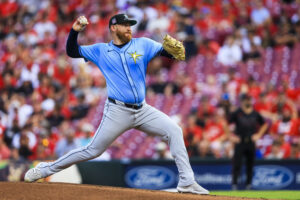
That profile seems a suboptimal fit for a pitcher who’ll now call the extremely hitter-friendly Great American Ball Park home. Littell’s consistency was clearly a plus for Cincinnati. He has worked at least five innings in all but one start this year. He has allowed three or fewer runs in 18 of 22 appearances. Littell has had a better season than Nick Martinez and Brady Singer have managed. Rookie Chase Burns has also been up and down over his first six starts.
Adding Littell will push Martinez to the bullpen. Ace Hunter Greene is on a rehab assignment as he works back from a groin strain. That’ll presumably push Burns back to Triple-A. Cincinnati would have a starting five of Greene, Nick Lodolo, Andrew Abbott, Littell and Singer at that point.
Littell is playing on a $5.72MM salary for his final year of arbitration. The Reds are taking on a little more than $1.8MM for the final two months. He’ll be a free agent at season’s end. Tampa Bay wasn’t going to make him a qualifying offer. They’ve played terribly this month and dropped below .500 with tonight’s loss. Their 3.5 game deficit in the Wild Card race isn’t insurmountable, but the team’s performance coming out of the All-Star Break discouraged the front office enough that they’re at least soft sellers.
Trading Littell, their only true impending free agent, is the obvious starting point. Closer Pete Fairbanks and second baseman Brandon Lowe are controllable for next season via club options. Shortstop Ha-Seong Kim has a $16MM player option. Yandy Díaz and Drew Rasmussen are each signed through 2026 with team options covering the ’27 campaign. Lefty reliever Garrett Cleavinger is arbitration controlled through 2027. It remains to be seen how aggressively they’ll shop players whom they control beyond this season, but the Rays have the potential to make a significant impact on the deadline.
The Reds part with a couple controllable players to land Littell. Serwinowski, a 6’5″ left-hander, is the more significant loss. The Reds drafted him out of high school in 2022. He has developed into one of their more intriguing low minors pitchers. Serwinowski ranked 10th in the Cincinnati system at MLB Pipeline and 12th at Baseball America. Eric Longenhagen of FanGraphs had him as high as sixth in the organization in May. Scouting reports praise his plus fastball-slider combination, crediting him with a mid-90s heater that can touch 97. Like many tall young pitchers, he has below-average command. Serwinowski also doesn’t have a great third pitch, raising questions about his ability to turn a lineup over multiple times.
There’s a decent chance the 21-year-old will end up as a reliever, but it’s easy to see the appeal of a pitcher with this kind of stuff and physical projection. Serwinowski has spent the season in High-A, allowing a 4.84 ERA across 74 1/3 innings. He has punched out an above-average 27.7% of batters faced while walking nearly 12% of opponents. He’s the headliner of the return from the Dodgers’ perspective as a low minors development flier.
Van Belle, 28, has yet to make his MLB debut. The Red Sox called him up in June but designated him for assignment a few days later without getting him into a game. Cincinnati added him on a cash deal and has kept him on optional assignment to Triple-A Louisville. A former undrafted free agent out of the University of Miami, Van Belle has combined for 81 1/3 innings of 3.21 ERA ball at the top minor league level this year. That comes with a below-average 20.2% strikeout rate but a sterling 3.2% walk percentage. His fastball barely scrapes 90 MPH, but he’s a fantastic strike-thrower who relies mostly on a mid-80s changeup to stay off barrels. He’ll provide the Rays a depth starter or long relief type who is in his first of three minor league option seasons.
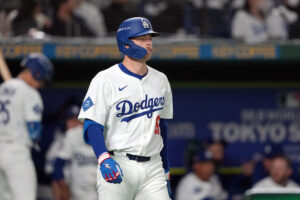
Feduccia is the bigger get from Tampa Bay’s perspective. He’s a 28-year-old catcher who had a limited path to playing time behind Will Smith and Dalton Rushing in L.A. Feduccia has held a spot on the 40-man roster for two seasons but has only gotten into seven MLB games. He has been forced to bide his time in Triple-A, where he owns a .277/.387/.450 batting line in more than 1200 plate appearances. A left-handed hitter, he takes plenty of walks and has decent contact skills with minimal power.
Eric Longenhagen of FanGraphs slotted Feduccia 31st among Dodger prospects in his writeup of the farm system in April. Longenhagen wrote that he struggles to control the running game but is a plus receiving catcher. Tampa Bay has cycled through catchers for years. They swapped out Danny Jansen for Nick Fortes in separate trades with Milwaukee and Miami earlier this week. Feduccia could push the out-of-options Matt Thaiss for the backup job immediately. He’s in his second of three option years and could be assigned to Triple-A Durham if the Rays don’t want to risk losing Thaiss on waivers.
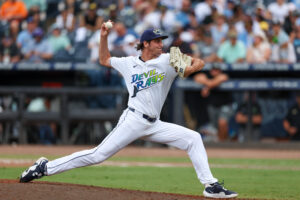
Landing him required sending the 25-year-old Gervase to Los Angeles. A 6’10” righty reliever, Gervase was acquired from the Mets last July. Tampa Bay promoted him a few weeks ago. He has made five appearances, giving up three runs across 6 1/3 innings. He has posted monster strikeout numbers in Durham, fanning nearly 40% of opponents while pitching to a 3.12 ERA across 28 appearances. Gervase has paired that with a 7.5% walk rate that represents dramatically improved control relative to his early minor league work. The LSU product leans mostly on a 93-94 MPH fastball and mixes in a slider and cutter. He’s in his first option year and will begin his Dodger career as middle relief depth.
Rortvedt, who is not on the 40-man roster, backfills L.A.’s lost catching depth at Triple-A. At age 27, he’s actually younger than Feduccia but has far more MLB experience. He’s a .186/.276/.265 hitter in 209 big league contests. Rortvedt hit .095 in 26 big league games this year before Tampa Bay ran him through waivers. He is hitting .183 in 19 Triple-A games. He’ll be a minor league free agent at the end of the season if the Dodgers don’t call him up before then.
Jeff Passan of ESPN first reported that the Reds were closing in on a deal for Littell. Gordon Wittenmyer of The Cincinnati Enquirer reported that Cincinnati was giving up Van Belle and Serwinowski. USA Today’s Bob Nightengale first mentioned the three-team trade, with C. Trent Rosecrans of The Athletic relaying that the Rays were flipping Serwinowski elsewhere. Passan had the Dodgers’ involvement and the full breakdown.
Images courtesy of Imagn Images.
Latest On Rays’ Deadline Possibilities
The Rays stumbled into the All-Star Break. The Red Sox swept them in a four-game set at Fenway to conclude the first half. Tampa Bay has dropped 11 of their past 14 games. They’d climbed as high as 11 games above .500 in late June; they’re now just three over at 50-47.
Like many other fringe contenders, the Rays face a pivotal upcoming two weeks. They’ll play host to the Orioles and White Sox for very winnable series coming out of the Break. They’ll hit the road for sets in Cincinnati and a four-game series against the Yankees running through July 31. President of baseball operations Erik Neander acknowledged to Marc Topkin of The Tampa Bay Times that the club’s deadline plans will in part be shaped by how they begin the second half.
“We’ve got to make up some ground,” Neander said of a team that sits a game and a half behind the Mariners for the last AL Wild Card spot. “There’s a belief in this team. … But these are really big games that will have some sort of influence on our decision-making as the month draws to a close.”
Unsurprisingly, Neander expressed hope that the team plays well enough for the front office to add. “I’d like to think that just about anything I think this group is capable of over these few weeks will lead us in a position where we’re looking to at least improve somewhere on the roster, if not significantly so,” he told Topkin. “But we’ve got to go out and play well and win. If we don’t, or if we have a stretch the way we had the last couple of weeks going into the Break, that comes with all sorts of additional questions that I’d much rather not think about.”
The Rays rarely operate as strict buyers or sellers. Remaining consistently competitive while operating with bottom five payrolls requires an openness to listening on veteran players even in years where they’re simultaneously trying to add to the big league roster. Tampa Bay already made one notable trade this month, acquiring controllable setup man Bryan Baker from Baltimore for the 37th pick in last Sunday’s draft. They could continue to add to the bullpen and/or bring in a right-handed bat (ideally in the outfield).
At the same time, they’ll certainly get calls on their more expensive players. Chris Cotillo of MassLive reported last night that the Red Sox would be interested in Yandy Díaz if the Rays make him available. Boston has an obvious need for a right-handed hitting first baseman. Still, it’s not clear if the Rays will shop Díaz at all — much less to a division rival that currently sits 2.5 games above them in the standings.
Ken Rosenthal of The Athletic wrote this morning that the Rays would likely hold onto Díaz, who is signed at a bargain rate for another two and a half seasons. He’s making $10MM this year and is guaranteed $12MM for next season. There’s a $10MM club option for ’27 that would vest at $13MM if he takes 500 plate appearances next year. Díaz and the Rays initially agreed to the extension in 2023 and restructured it just this spring to guarantee his ’26 earnings while adding the option year.
Rosenthal argues the Rays may be reluctant to trade Díaz so soon after he agreed to a team-friendly extension. That said, one could’ve made a similar point regarding Tyler Glasnow — whom the Rays traded to the Dodgers a little over a year after he signed an extension. Rosenthal nevertheless suggests that Tampa Bay would be likelier to move second baseman Brandon Lowe or closer Pete Fairbanks if the team doesn’t play well coming out of the Break.
Lowe went on the injured list with left oblique tightness last week but could be reinstated when first eligible tomorrow. He’s making $10.5MM this year and controllable for another season on an $11.5MM club option. Lowe started the year slowly but has been on a tear since May and is up to 19 homers with a .272/.324/.487 batting line.
Fairbanks has a 2.75 ERA and has gone 15-18 in save opportunities over 36 innings. His strikeout rate has been trending down for a couple seasons, though, dropping to a career-low 20.7% clip. While Fairbanks is playing this year on an extremely affordable $3.667MM salary, his contract contains an increasingly expensive club option for 2026.
That initially came with a $7MM base value but contained up to $6MM in escalators. Fairbanks has already pushed the option price to $8MM by reaching 125 appearances over the past three seasons and topping 25 games finished this year. It’ll climb by another $1MM when he makes three more appearances, $1MM more with 18 appearances, and another $1MM with 23 more games. It’d jump by $500K apiece with three, eight, and 13 more games finished.
Unless he suffers a significant injury, Fairbanks should push the option value well into eight figures. That’d make him one of the highest-paid players on the 2026 roster. As long as they’re in the playoff picture, the Rays may view that as an offseason problem. This year’s salary can only climb by a maximum of $300K. Yet it’s a factor for a front office that needs to balance the short and long term as much as any.
Beyond Lowe and Fairbanks, the Rays seem likely to shop a starting pitcher. Impending free agent Zack Littell is the most obvious candidate, but USA Today’s Bob Nightengale reported over the weekend that they’re open to inquiries on controllable righty Taj Bradley.
The Rays have a strong rotation of Ryan Pepiot, Drew Rasmussen, Shane Baz, Littell and Bradley. Hard-throwing righty Joe Boyle is pitching in multi-inning relief, but Neander reiterated to Topkin that the Rays would be comfortable using Boyle as a starter if a spot opened. They’re also hopefully a couple weeks away from Shane McClanahan making his long-awaited return from injury.
Could The Rays Still Move A Starting Pitcher?
The Rays entered the offseason with at least seven rotation-caliber arms on the roster. Each of Shane McClanahan, Taj Bradley, Drew Rasmussen, Zack Littell, Shane Baz, Jeffrey Springs and Ryan Pepiot has had success in a big league rotation, though injuries have hobbled several of that group in recent years. Tampa Bay already thinned out that stock of arms (and, naturally, trimmed payroll) by shipping Springs and lefty Jacob Lopez to the A’s in a deal netting them righty Joe Boyle, minor leaguers Will Simpson and Jacob Watters, and a Competitive Balance (Round A) draft pick in 2025.
The Rays now have “only” six starters with proven (to varying levels) track records in the majors. Marc Topkin of the Tampa Bay Times writes that they’re still planning on a five-man rotation, however, adding that trading a starter in the late stages of spring training is “not out of the question.” At best, that very lightly leaves the door for a trade propped open. There’s nothing to strongly suggest the Rays are planning to deal from the rotation. Still, it’s nonetheless worth examining the team’s options if it comes to that point.
The veteran Littell would be the most obvious candidate to change hands. Tampa Bay moved the now-29-year-old righty from the bullpen to the rotation midway through the 2023 season, and the results have been better than anyone could’ve reasonably predicted. Littell solidified the staff in the second half of ’23 and pitched a career-high 156 1/3 innings with a 3.63 ERA over 29 starts last season. Since moving to a starting role after the Rays claimed him from the Red Sox, Littell has started 40 games and logged a combined 3.65 ERA with a lower-than-average 20.4% strikeout rate but a sensational 4.1% walk rate.
Each of the Rays’ other starting pitchers is signed or controlled via arbitration through at least the 2027 season. Littell is a free agent following the 2025 campaign. He’s being paid a reasonable $5.72MM. He’s not an ace by any stretch of the imagination, but based on how he’s fared since July 2023, the right-hander could step into the third, fourth or fifth spot in most big league rotations.
Trading anyone from the rest of the group is tougher to envision. McClanahan has pitched at a Cy Young level when healthy but missed all of 2024 recovering from Tommy John surgery. He’s controlled through 2027. Moving him right now would mean moving their most talented starter at a time when they’d be selling low. Rasmussen signed a two-year deal with a club option earlier this offseason. That bought out his remaining arbitration seasons and gave Tampa Bay control over his first free-agent year by way of that 2027 club option. Flipping him so soon after signing him to that deal is extremely difficult to envision; MLB teams simply don’t sign a player to extension and then trade him prior to ever appearing in their jersey under the terms of that new contract.
Baz and Pepiot are under club control through 2028. The former is earning $1.45MM in 2025, while the latter has yet to reach arbitration. (Baz did so as a Super Two player.) Bradley can’t become a free agent until the 2029-30 offseason. We’re talking about the Rays, so the “never say never” caveat always applies to some extent, but acquiring four or five seasons of anyone from that bucket would very likely come at a steep price and require a team to part with MLB-ready bats that are both high-upside and controllable for a similar or even lengthier window.
Any team even contemplating a trade from the rotation at this stage of the calendar will be wary, of course. As we’ve seen throughout the league — most prominently up in the Bronx — perceived starting pitching “surpluses” can turn into deficits quickly this time of year. The Rays won’t move someone just to trim payroll, but they have depth even beyond the six arms mentioned here.
The previously mentioned Boyle, for instance, is having a nice spring and has experience in a big league rotation already. Following his acquisition in the Springs trade, president of baseball operations Erik Neander called the 6’7″ righty someone who has “the physicality and the stuff to fit at the front of the rotation.” Boyle averages nearly 98 mph on his heater but has severe command issues that need to be ironed out. Righty Jacob Waguespack might be Triple-A bound but has 105 2/3 big league innings under his belt. Prospects Joe Rock and Ian Seymour both had some success in Triple-A last year (the latter in particular). There’s no such thing as “too much” rotation depth, but that group could further embolden the Rays to listen on Littell or another big league starter if a team makes a compelling offer.
Rays Notes: Littell, Outfield, Caballero, Front Office
The Rays made a long-awaited trade from their rotation depth last week when they packaged left-hander Jeffrey Springs and reliever Jacob Lopez in a deal with the A’s that brought back right-hander Joe Boyle, two minor leaguers, and a pick in Competitive Balance Round A of the 2025 draft. Prior to that deal, Springs was viewed alongside right-hander Zack Littell as the two most likely Rays hurlers to be moved this winter. Now that Springs is off the board, however, ESPN’s Jeff Passan suggests that the Rays are “less likely” to part with Littell this winter.
That’s not exactly surprising. After all, while the Rays have a considerable rotation surplus with a number of excellent potential arms, those arms generally come with question marks. Shane McClanahan and Drew Rasmussen will both have recently returned from elbow surgery and could see their innings managed, while youngsters like Shane Baz, Ryan Pepiot, and Taj Bradley have never even thrown 150 innings in a big league season before in their careers. That leaves Littell, who threw 156 1/3 innings of work across 29 starts for the Rays last year, as potentially the club’s most durable arm headed into 2025. Given the frequency with which pitchers get hurt in the modern game, having a sixth starter locked and loaded is hardly a bad idea in case of injuries for any club, to say nothing of the value it could provide a club with a rotation that sports as many injury risks as the Rays’ does.
Of course, it’s impossible to rule out a trade completely when discussing a player with just one year remaining before free agency on the Rays. The club’s front office typically attempts to cash in their players on the trade market before they reach free agency, and even if Littell starts the season with the Rays a midseason trade can’t be ruled out. With that said, Marc Topkin of the Tampa Bay Times recently suggested that the club might be more or less done making moves after dealing Springs and adding Danny Jansen in free agency. One place Topkin suggests the club could look to make an addition is in the outfield, particularly if a lefty bat were to fall into the club’s lap in free agency or via trade. Topkin makes particular mention of Joc Pederson and Jurickson Profar as hypothetical options, though he’s quick to note that either player would surely need to see their market in free agency crater before they’d become realistic options for the Rays as things stand.
A more likely outcome in Topkin’s view seems to be going with internal options. That could include giving infielder José Caballero a serious look in the outfield. With Josh Lowe locked into one starting outfield spot and some combination of Jonny DeLuca, Christopher Morel, and Richie Palacios slated to handle the rest of the playing time on the grass as things stand, mixing Caballero in would give the club additional depth in the outfield should they fail to make an external addition. It’s easy to imagine Caballero’s strong glove at shortstop translating fairly well to the outfield grass, and getting a speedster who stole an AL-best 44 bases in just 483 plate appearances last year into the lineup more regularly could help to spark the club’s offense. With that being said, Caballero’s .227/.283/.347 (83 wRC+) slash line last year likely isn’t enough to make it as an outfield regular unless he proves to be a plus defensive option in center.
Turning to off-the-field matters, Topkin also reports that the club currently has no plans to install a GM beneath president of baseball operations Erik Neander. Current Marlins president of baseball operations Peter Bendix served as GM of the Rays under Neander before taking his current gig with Miami last winter, but Topkin suggests that the club’s current set up of two vice presidents and four assistant GMs serving as Neander’s top lieutenants suits the Rays just fine and that Bendix’s title will remain unfilled for the foreseeable future.
Rays Could Deal From Rotation Depth This Offseason
After the club’s first losing season in six years, the Rays are headed into what figures to be a pivotal offseason for the club as they look to remain contenders in a highly competitive AL East division. As noted by Marc Topkin of the Tampa Bay Times, one way the club could look to address its lackluster offense (29th in the majors in runs scored this year) this winter is by trading from their rotation depth to acquire a bat, even if that bat doesn’t address their reported offseason priority of improving the club at catcher.
For a Tampa club that enters the winter in serious need of an offensive boost, it’s hard to deny the logic in dealing from their deep group of available arms. Youngsters Taj Bradley, Shane Baz, and Ryan Pepiot all emerged as solid, affordable rotation options for the club this year, and Zack Littell‘s first full season in a big league rotation seems to have established him as a quality mid-rotation option with one year to go before free agency.
Meanwhile, Jeffrey Springs returned to make seven solid starts for the club in the second half after undergoing Tommy John surgery early last year and Drew Rasmussen also rejoined the club’s pitching staff late in the year following his own 2023 elbow surgery. Rasmussen pitched primarily in a relief role this year, never throwing more than 38 pitches in an outing, but figures to be a rotation option for the Rays come Spring Training. That also figures to be the case for lefty Shane McClanahan, who went under the knife last August but figures to be ready for Spring Training as well.
With at least seven quality rotation options even after dealing away Aaron Civale and Zach Eflin at the trade deadline over the summer, it would certainly make sense for the club to explore dealing from that depth in order to address the offense. The Braves, Cubs, and Red Sox are all already known to be interested in adding rotation help this winter, while the Orioles and Mets are among the many other teams that could stand to benefit from adding a starter or two this winter as well. With even more clubs sure to look to bolster their pitching when the offseason fully gets underway following the World Series, the Rays should be well positioned to make a deal if they so choose.
Given the club’s small-market payroll and focus on long-term sustainability, it would be something of a surprise to see the Rays move on from any of Bradley, Baz, or Pepiot without recouping a similarly talented and controllable bat in return. On the other hand, it wouldn’t be a shock if clubs were hesitant to deal for McClanahan or Rasmussen given the former hasn’t pitched in more than a year while the latter hasn’t stretched out to start since returning from injury. That could leave Littell and Springs as the most likely candidates to be dealt this winter, with each hurler having various pros and cons as a trade candidate.
When it comes to Littell, the argument for dealing him is rather straightforward: the righty is only under team control through the end of the 2025 season and projects for a not insignificant $4.8MM in his final trip through arbitration according to MLBTR contributor Matt Swartz, so by dealing him the Rays could save a bit of money to address other areas of the roster while also potentially bringing in a more controllable player to complement their offense. With that being said, Littell’s status as a rental could dampen the return for his services somewhat on the heels of a 3.63 ERA campaign that was more solid than excellent.
If teams aren’t scared off by Springs’s lack of volume over the past few years, then, he might be able to bring back a more significant return. After all, the southpaw has been dominant when healthy with a 2.44 ERA and 3.10 FIP in 184 1/3 innings of work since 2022, when he first became a starter. Results that strong would be valuable to virtually any rotation in baseball, and Springs’s $21.75MM guarantee over the next two years lands in the sort of sweet spot that would make him a relative bargain for other teams while still clearing a significant financial burden off the books in Tampa, allowing Erik Neander and his front office to explore further upgrades in free agency even beyond what Springs would bring back in trade.