
Matt Garza Out At Least Four To Six Weeks With Lat Strain
Brewers right-hander Matt Garza learned today that a strained lat muscle will sideline him for the next four to six weeks, he told reporters, including Tom Haudricourt of the Milwaukee Journal-Sentinel (Twitter link). Garza has been dealing with some tightness in his shoulder, but based on his comments, he wasn’t anticipating anything overly serious from his medical examinations. Via MLB.com’s Adam McCalvy (Twitter link), Garza told the media: “I’m not afraid of work, it just wasn’t what I was looking forward to at the beginning.”
Garza, 32, was expected to return to the Brewers’ rotation after losing his spot late last season, but he’ll now spend the foreseeable future on the disabled list instead. Right-hander Zach Davies stands out as a likely candidate to step into the rotation alongside fellow right-handers Wily Peralta, Jimmy Nelson, Taylor Jungmann and Chase Anderson, although top prospect Jorge Lopez received some Major League experience in 2015 as well. And, as McCalvy further tweets, the Brewers won’t need a fifth starter through the first 11 games due to scheduled off days, so there’s no immediate need to promote a starter in Garza’s place. For the time being, righty Tyler Cravy will be promoted to take Garza’s roster spot.
While the rebuilding Brewers aren’t expected to contend this season, it’s nonetheless a disappointing way to begin the season. After losing potential closer Will Smith to a freak LCL tear, Garza’s injury thins out the pitching depth a bit more and also eliminates the possibility of the once-excellent veteran rebuilding some trade stock with a strong early showing. While Garza could, of course, do so upon his return in what appears to be May or June (based on the presented timetable), he already has a fairly lengthy injury history under his belt, and a recent shoulder issue won’t do his stock any favors come July even if he’s pitching well. Last season, Garza struggled to a career-worst 5.63 ERA in 148 2/3 innings.
Garza is entering the third season of a four-year, $50MM contract with Milwaukee which also contains a complex fifth-year option that is largely dependent on the health of his right arm. (The $5MM club option turns into a $13MM vesting option if Garza throws 110 games over the course of the contract’s first four seasons but also shrinks to just a $1MM option if he spends more than 130 days of a season on the disabled list.) The Brewers owe Garza a combined $25MM between the 2016 and 2017 seasons, which is spread out evenly by annual salaries of $12.5MM.
In further injury news, the Brewers have also lost bullpen candidate Yhonathan Barrios to shoulder surgery, as McCalvy tweets. The 24-year-old Barrios, acquired from the Pirates last summer in exchange for Aramis Ramirez, had his rotator cuff repaired by renowned surgeon Dr. James Andrews. Barrios made his big league debut with the Brewers in 2015, firing 6 2/3 scoreless innings out of the ‘pen. In that brief but dominant cameo, Barrios allowed just three hits and no walks while averaging 96.4 mph on his heater and striking out seven hitters. His minor league work wasn’t quite as impressive, however; Barrios logged a solid 2.83 ERA in 60 1/3 innings between Double-A and Triple-A, but the hard-throwing righty also averaged just 5.5 strikeouts against 3.3 walks per nine innings pitched.
Mets, Rene Rivera Agree To Minor League Deal
The Mets and veteran catcher Rene Rivera have agreed to a minor league deal, reports Marc Topkin of the Tampa Bay Times (via Twitter). Rivera, 32, was released by the Rays last month after the Rays decided that Hank Conger and Curt Casali would comprise their primary catching tandem in 2016. The new agreement with New York marks a return to the Mets organization for Rivera, who spent the 2009 season playing with their Triple-A affiliate.
Rivera, a client of MDR Sports Management, is considered to be a premium defensive catcher but also was one of baseball’s worst hitters in 2015 when he batted .178/.213/.275. A minuscule .230 batting average on balls in play contributed heavily to that lack of productivity, but Rivera has never been much of a hitter with the exception of the 2014 season, when he batted .252/.319/.432 in 103 games with the Padres. That year looks like as much (if not more) of an outlier as last season’s woeful campaign, however, and something in the middle — Rivera is a career .211/.258/.331 hitter — is probably a more realistic expectation.
Despite lacking much in the way of offensive upside, Rivera is a standout defender, which is the reason that the Rays stuck with him in 2015. Rivera has halted 38 percent of stolen base attempts against him over the life of his big league career, and he has consistently graded out as a well above-average pitch framer, including a 2014 season in which Baseball Prospectus rated him as the game’s third-best backstop in terms of stealing strikes for his pitchers.
The Mets were said in Spring Training to be on the lookout for a veteran backup catcher, as the club doesn’t like the idea of young Kevin Plawecki playing sparingly in a backup role but also isn’t high on Johnny Monell serving as the primary backup to Travis d’Arnaud. While Rivera’s deal is of the minor league variety, it’s possible that the Mets could eventually promote him to serve as a defensive-minded backup to d’Arnaud while allowing Plawecki to receive everyday at-bats at the minor league level.
Pirates Extend Gregory Polanco
2:42pm: Heyman has the full breakdown, via Twitter: after a $3MM signing bonus, Polanco will receive a $1MM salary next year, then consecutive paydays of $3.5MM, $5.5MM, $8MM, and $11MM. The options are for $12.5MM (with a $3MM buyout) and $13.5MM ($1MM buyout).
10:50am: In a move that seemed years in the making, the Pirates have announced a five-year extension with outfielder Gregory Polanco. The Beverly Hills Sports Council client receives a reported $35MM guarantee in the contract, which includes two option years (with performance escalators) that could boost its total value to $60MM over seven seasons.
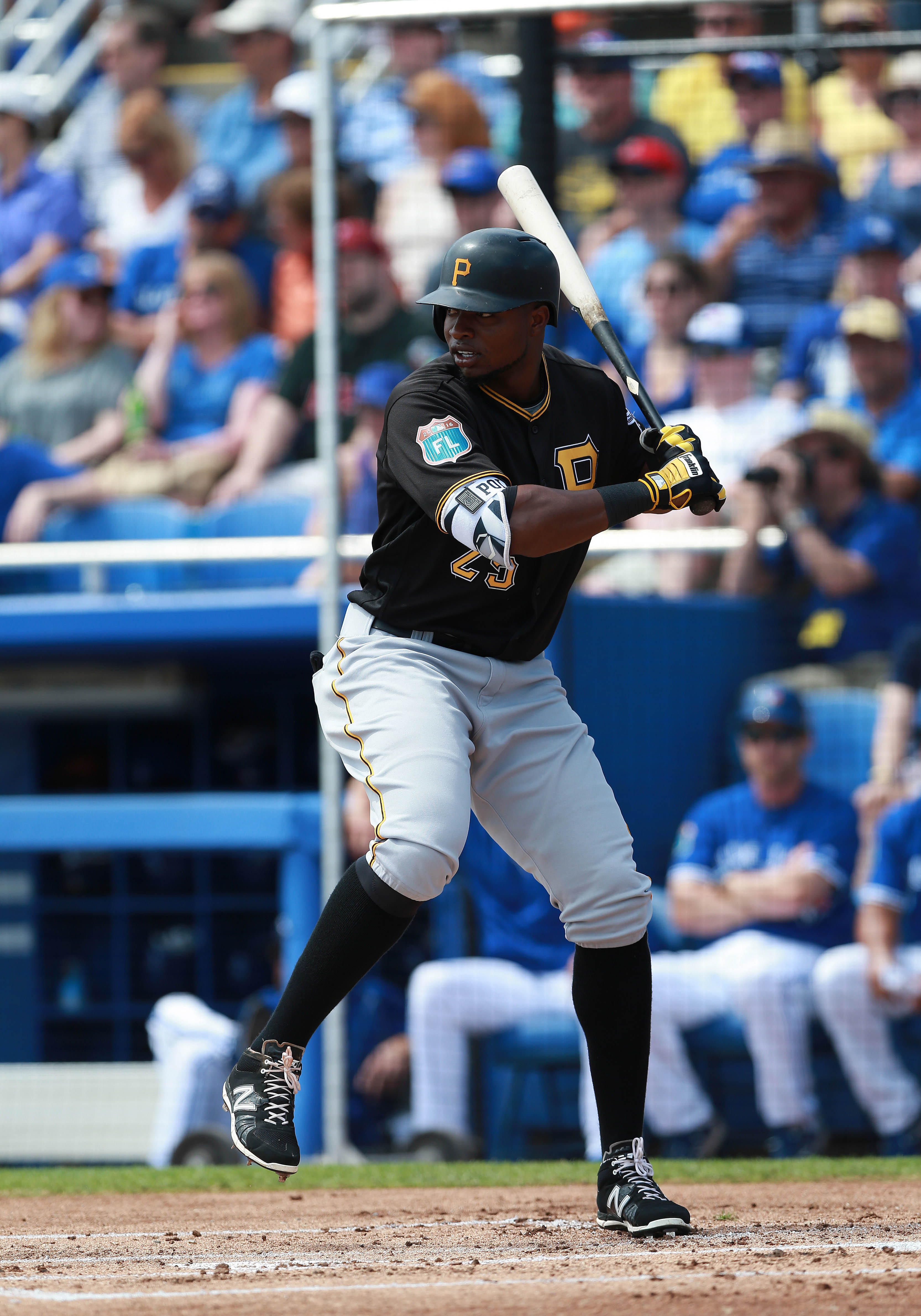
Polanco, 24, was previously controllable through the 2020 season. The extension, which begins with the 2017 campaign, will guarantee those seasons and extend control through the 2021 campaign, thus buying out his first season of free agency. If Pittsburgh picks up both options, he can reach free agency after the 2023 season, when he would be headed into his age-32 season.
The first option year is for $12.5MM and includes a $3MM buyout, while the second is priced at $13.5MM ($1MM buyout). Both could increase by a combined total of $2MM if Polanco can reach the as-yet unreported escalators.
Polanco is entering his third Major League season, though he has not yet reached two full years of service time. He’s a career .249/.316/.369 hitter in 964 plate appearances. Scouts expect him to grow into his fledgling power. A center fielder in the minors, Polanco has mostly played right field due to the presence of Andrew McCutchen and Starling Marte. Polanco drew rave reviews for his right field defense last season, rating at 6.8 runs above average per Ultimate Zone Rating and 11 runs above average per Defensive Runs Saved.
Considered a consensus Top 25 prospect league-wide prior to the 2014 season in which he was promoted, Polanco has certainly shown flashes of promise but hasn’t yet emerged as the star many believed him to be capable of becoming. In particular, he’s displayed some potentially concerning struggles against left-handed pitching. Same-handed opponents have held Polanco to a paltry .183/.239/.264 batting line in 228 big league plate appearances. Clearly, he’s young enough to make some strides in that department, but the tight-budgeted Pirates will hope that Polanco doesn’t continually require a platoon partner and can instead combine with McCutchen and Marte to form one of the league’s best outfield trios.
The Pirates are known for locking up pre-arbitration eligible talent. McCutchen and Marte both inked similar extensions early in their careers. McCutchen signed a six-year, $51.5MM extension with one option while Marte accepted $31MM over a six-year term with two options. The club also worked out a four-year, $27.3MM extension with Josh Harrison prior to the 2015 season. That deal also includes two options.
This is far from the first time in which the Pirates have attempted to lock up Polanco. Pittsburgh, in fact, reportedly made a seven-year offer to Polanco before he was even promoted to the Major Leagues, and those talks continued into the summer following his promotion that June. The Bucs took another run at extending Polanco last spring but ultimately tabled extension talks early in the season. With this new agreement in place, the Pirates now control Polanco longer than any other member of the active roster.
Jeff Passan of Yahoo Sports first reported the deal on Twitter. Ken Rosenthal of FOX Sports (via Twitter) had financial parameters, while MLB Network’s Jon Heyman (Twitter links: 1; 2; 3; 4; 5) added finalized value and details on the pact.
Photo courtesy of USA Today Sports Images.
Reds Return Rule 5 Pick Jake Cave To Yankees
Reds’ Rule 5 selection Jake Cave has been sent back to the Yankees, MLB.com’s Matt Kardos reports on Twitter. It appears that New York is accepting his return, as Cave is said to be heading to Triple-A.
Cincinnati had designated Cave for assignment on Sunday, but he’s obviously cleared waivers already. The 23-year-old hasn’t shown much pop in his recent minor league results or his relatively extensive spring action with the Reds. But as MLBTR’s Brad Johnson explained in previewing the Rule 5 festivities, Cave could still turn into a useful player, particularly if he can tap into some of the power and speed tools he’s shown at times.
Submit Your MLBTR Mailbag Questions
Happy Opening Day! (Well, for most of the league, anyway … .) We’re gearing up for another edition of the MLBTR Mailbag after taking a few weeks off with Steve Adams on vacation. He’s back and we’re ready to take your questions as the season gets started.
If you have a question you’ve been mulling over and would like MLBTR’s take, let us know: mlbtrmailbag@gmail.com. We can’t get to every one, of course, but remember that you can also send questions our way on Tuesday and Thursday afternoons in the weekly live chats hosted by Steve and myself, respectively. Also remember that Mailbag questions are welcome throughout the week, so feel free to send them at any time.
MLB Releases 2016-17 International Bonus Pools
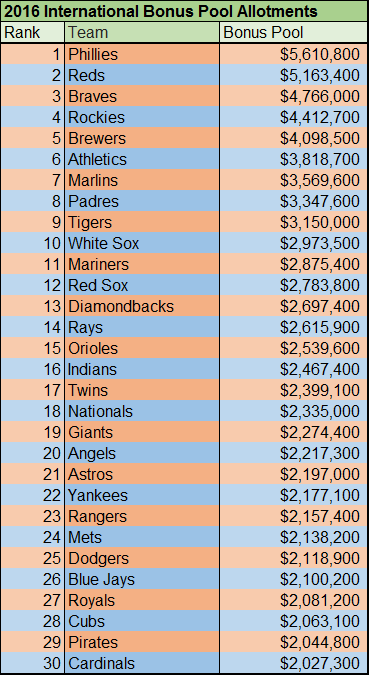
Major League Baseball has released the bonus pools that will apply to the 2016-17 international market, as Baseball America’s Ben Badler provides and as are reflected in the table below (mobile link). We had a post on the draft slots for the coming year earlier this morning; both spending allocations represent increases that were reported back in February by BA’s Hudson Belinsky (which we covered here, including year-over-year changes by clubs as things stood at the time).
Teams have proven much more willing to blow past these international signing caps than those applicable to the amateur draft. But there are still significant penalties for doing so. As MLBTR’s Steve Adams has explained, these are the rules that come with the pools:
Penalties for the international bonus pool are as follows (international bonus pools only apply to players who are under the age of 23 and have fewer than three years of professional experience):
- All overages are taxed at 100 percent.
- Exceed bonus pool by 5 to 10 percent: Team is not allowed to sign a player for more than $500K in the following international signing period.
- Exceed by 10 to 15 percent: Team is not allowed to sign a player for more than $300K in the following international signing period.
- Exceed by more than 15 percent: Team is not allowed to sign a player for more than $300K in the following two international signing periods.
Of course, many organizations will not be in position to utilize their full allotments and will be looking to trade slots after incurring those penalties in prior years. As Badler has previously explained, the Dodgers, Giants, Cubs, and Royals are serving two-year $300K+ signing bans beginning in 2016-17. The Blue Jays will face a one-year limitation period for the coming market. Meanwhile, the Diamondbacks, Angels, Rays, Red Sox and Yankees are set to finish out their own pair of signing seasons on the sidelines, but will be able to re-enter the market fully for 2017-18.
Those and other organizations could look to achieve value from their allocations by trade, rather than by utilizing them for signings. Rival clubs will be looking to offset taxes or avoid penalties by padding their totals. Acquiring more spending money can only be accomplished by trading for specific signing slots — which are all provided at Badler’s above-linked post. Of course, teams can’t just take on as much as they wish; instead, they can only increase their original allotment by half its initial value.
By virtue of finishing with the worst record in the game last year, the Phillies not only pick up the top overall pick in the coming draft but also receive the largest international spending allocation. The Reds have the second most cash to spend, but their situation is still dependent upon whether and when the team formalizes a reported deal with infielder Alfredo Rodriguez. It seems likely that his $6MM bonus won’t hit the books until the new period starts on July 2nd, thus avoiding a broader spending ban for a coming year in which the club has significant capacity to add international talent.
With rules governing Cuban amateurs set to undergo significant change, there could be an interesting crop of new talent to accompany the typical July 2 wave from other parts of the world. That has also led to some timing issues in reaching agreements, as is the case with Rodriguez and also interesting Cuban youngster Lazaro Armenteros, who reportedly could be headed to the Padres — but only after the new signing period opens. Along with San Diego, the Braves and Nationals are among the clubs expected to blow past their pools and take on maximum penalties. Likewise, the Brewers, Cardinals, Phillies, and Rangers are also believed to be lining up big international outlays, and the Twins have also been mentioned as a possible big spender. These are among the teams that could be looking at summer swaps to add to the spending allocations listed in the table.
Offseason In Review: Washington Nationals
This is the latest entry in MLBTR’s Offseason In Review series. The full index of Offseason In Review posts can be found here.
The Nationals missed on several major free-agent targets, but added multiple veteran pieces to a still-talented core.
Major League Signings
- 2B Daniel Murphy: Three years, $37.5MM
- RP Shawn Kelley: Three years, $15MM
- RP Oliver Perez: Two years, $7MM
- INF Stephen Drew: One year, $3MM
- RP Yusmeiro Petit: One year, $2MM
- Total spend: $64.5MM
Notable Minor League Signings
- Bronson Arroyo, Burke Badenhop, Matt Belisle, Sean Burnett, Chris Heisey, Reed Johnson, Aaron Laffey, Nick Masset, Brendan Ryan, Logan Schafer (since released), Scott Sizemore, Jhonatan Solano
Trades And Claims
- Acquired OF Ben Revere from Blue Jays for RP Drew Storen and $2.125MM
- Acquired RP Trevor Gott and SP/RP Michael Brady from Angels for INF Yunel Escobar and $1.5MM
Extensions
- None
Notable Losses
- Ian Desmond, Doug Fister, Casey Janssen, Nate McLouth, Denard Span, Craig Stammen, Matt Thornton, Dan Uggla, Jordan Zimmermann
Needs Addressed
The Nationals entered the winter with more roster questions than they’d faced in quite some time, and proceeded to answer them with a modest and methodical series of transactions. Along the way, though, Washington dabbled in some higher-priced assets.
The first order of business was to plug arms into a bullpen that was in need of multiple new options. With Casey Janssen (declined option), Craig Stammen (non-tender), and Matt Thornton (expired contract) moving off of the roster, and several injuries and performance issues limiting the in-house options, this represented the clearest roster hole for the club.
Thus, even while president and GM Mike Rizzo was trying to woo the heavily-pursued Ben Zobrist, he quietly added southpaw Oliver Perez and swingman Yusmeiro Petit to begin the process of rebuilding the pen. While the Nats missed on Zobrist, they still followed through on a deal to send out infielder Yunel Escobar to the Angels, thus adding an interesting young reliever in Trevor Gott. And when they lost out on ace setup man Darren O’Day — who returned to the Orioles when they promised a fourth season — Rizzo and co. went out and got the underrated Shawn Kelley, who received three years and $15MM in a deal that took some time to be finalized. Of course, the Nats were also collecting minor league free agents all along the way. The spring pen competition included not only incumbents such as Blake Treinen, but veteran bounceback candidates including sinkerballer Burke Badenhop, former Nats lefty Sean Burnett, and longtime big leaguers Nick Masset and Matt Belisle.
Those moves bolstered the relief corps, but failed to address the situations of the team’s two best relievers: Jonathan Papelbon, fresh off of a rather public altercation with star Bryce Harper just months after coming over from the rival Phillies, and Drew Storen, the twice-deposed closer who the Nats had drafted and developed. And the reliever additions left unaddressed — or exacerbated — other needs. Having parted with Escobar to get Gott, the Nats lacked a clear option at second. The two obvious options — Anthony Rendon and Danny Espinosa — were already set to move to the left side of the infield, which had already lost Ian Desmond to free agency. And Denard Span also hit the open market, leaving the relatively untested-but-toolsy Michael Taylor atop the depth chart in center.

Rizzo first inked Daniel Murphy, who signed for less than expected — and far less than some were unrealistically calling for after his torrid post-season run. A qualifying offer certainly reduced the tab in terms of dollars, but meant that the Nats had to cough up a pick. The long-time Mets stalwart isn’t much of a fielder at second, but brings the lineup a much-needed left-handed contact bat with some pop. He’ll join Rendon, first baseman Ryan Zimmerman, and catcher Wilson Ramos as regulars in the infield. Espinosa appears to have the reins at short, but he’ll be accompanied by veteran Stephen Drew and could eventually be displaced by top prospect Trea Turner.
The Nats then solved two open issues in one move, sending Storen to the Blue Jays to acquire two seasons of Ben Revere — who is a somewhat lesser and more extreme version of Span himself. Revere hits for little power and draws few walks, and his glove hasn’t always rated well in center, but he hits for a high average and is one of the game’s most electric baserunners.
Revere, Taylor, and Jayson Werth look to be set up for some kind of outfield rotation, with Bryce Harper sure to see near-full duty as he tries to repeat his MVP campaign from a year ago. That’s a sensible mix, which provides its share of flexibility and upside, but the team tried to do even more. Washington was among the teams that tried to get Jason Heyward before he joined Zobrist with the Cubs, and later lost out to the Mets in pursuit of Yoenis Cespedes (after already adding Revere).
The outfield-related moves and non-moves just mentioned combine to set the stage for some of the many questions still confronting the Nats in 2016 …

Phillies Release Ernesto Frieri
The Phillies have released veteran righty Ernesto Frieri, as Triple-A director of media relations & broadcasting Matt Provence noted on Twitter. Frieri had seemed set to open the season with Lehigh Valley, but will instead head back to the open market.
It’s been some time since Frieri was an effective major league reliever, and he wasn’t able to show enough this spring to stick with the Philadelphia organization. Once a high-strikeout, late-inning option, Frieri’s velocity and swinging strike rates plummeted last year with the Rays. Though he did retire eight batters by way of strikeout this spring, he also allowed nine earned runs and five long balls in his seven innings of action.
Bryan Mitchell Undergoes Toe Surgery, Out “At Least” Four Months
Yankees righty Bryan Mitchell underwent toe surgery yesterday and is expected to miss “at least” four months of the coming season, manager Joe Girardi told reporters, including MLB.com’s Bryan Hoch (Twitter link). It wasn’t clear previously whether Mitchell would require a procedure after fracturing his toe at the end of camp.
While New York had already absorbed the news of Mitchell’s absence for the first half of the year, the fact that he had to go under the knife appears to extend the timeline for a return. Initial reports suggested a minimum three-month absence, but now the 24-year-old will need to recover and rehab from the surgery.
At this point, it seems, the Yankees are unlikely to have a chance to see Mitchell back in action before the trade deadline. If the team is in position and has pitching needs, that may help tilt the needle towards an outside addition.
Mitchell was viewed as an important piece of a pitching staff that has some health questions in the rotation and potential depth concerns in the pen. He likely would have played a significant middle relief role to open the year, while remaining available as a rotation option if a need arose.
Though he was never a hyped prospect, the former 16th-round pick has shown some interesting skills early in his major league career. He lit up the radar gun and showed the ability to miss some bats in a relief role last year, though his walks are a concern and he didn’t fare well in the earned run department. Mitchell had shown well this spring, permitting just one earned run in 14 2/3 frames while posting an 11:1 K:BB ratio.
MLB Releases 2016 Draft Bonus Slots
Major League Baseball has released the final draft bonus slots to teams, and MLB.com’s Jim Callis provides the figures. As he explains, and the attached table reflects (mobile link), the Reds have the highest total draft spending power and are one of five clubs with over $10MM in bonus pool money.
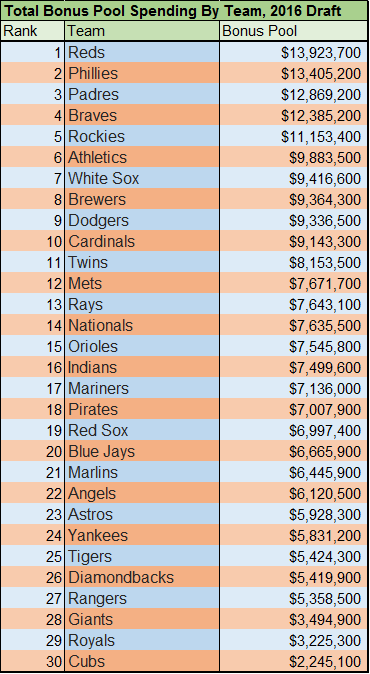
Among the other interesting notes in the post, Callis says that the total draft pool this year adds up to $234,331,200. Last year, he adds, a cool $248,831,830 was spent on bonuses — nearly $40MM of which came outside the top ten rounds.
Having the largest amount of cash to distribute is one thing, but teams still need to be able to put it to strategic use. Last year, the Astros showed the power of the pool money by convincing Daz Cameron to convince other teams he was uninterested in signing because Houston had a big bonus sitting for him (ultimately, $4MM) with the 37th pick. The Diamondbacks, meanwhile, left a significant portion of their total spending capacity untapped, though senior VP DeJon Watson explained that the club got the players it wanted and also felt it would have been difficult to get a player to wait until the 43rd selection (Arizona’s second pick).
In that regard, the volume of top selections matters, too, because it increases an organization’s flexibility — especially as the always fluctuating draft board begins to unfold. The Phillies don’t make their second choice until the first pick of the second round, while the Reds sit at 35th.
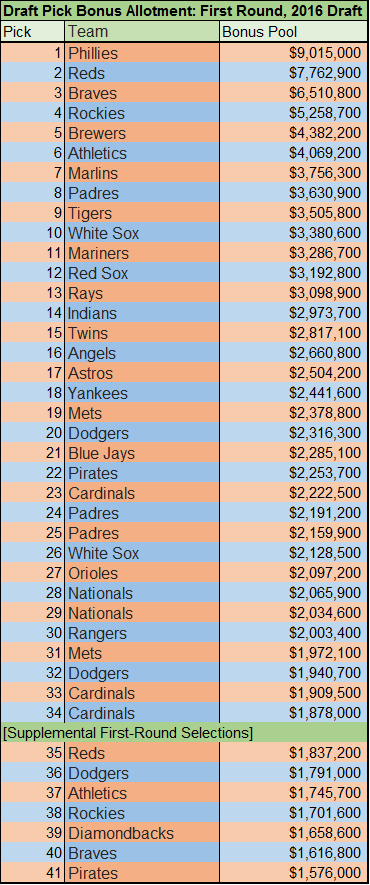
In terms of actual bonus allocations for each pick, you’ll need to check out the full piece from Callis to see all of the first ten rounds. But we’ve compiled a table for the first round, at right (mobile link).
Other teams stand out with interesting early pick combinations, including the White Sox (#10, #26); Cardinals (#23, #33, #44); and Dodgers (#20, #32, #36). While it’s certainly possible to simply take the best players on the board and sign them for close to the pool money, these are among the organizations that will have more elbow room to pursue creative combinations.
If you’re in need of a refresher for how draft bonus caps work, MLBTR’s Steve Adams has broken things down, making clear why teams have never yet gone more than 5% past their spending allotment. As Steve wrote:
All bonus money directed toward a player selected in the Top 10 rounds of the draft counts against a team’s bonus pool, as does any bonus money that exceeds $100K to players selected in rounds 11 through 40 (for example, a $180K bonus to a team’s 11th-round pick would result in $80K being removed from its draft pool). As a reminder, the penalties for exceeding draft bonus pools are as follows:
- Exceed by 0 to 5 percent: 75 percent tax on the overage.
- Exceed by 5 to 10 percent: 75 percent tax on the overage plus the loss of a first-round pick in the following year’s draft.
- Exceed by 10 to 15 percent: 100 percent tax on the overage plus the loss of a first- and second-round pick in the following year’s draft.
- Exceed by more than 15 percent: 100 percent tax on the overage plus the lost of a first-round pick in the following two drafts.