
Braves Notes: Profar, Kelenic, De La Cruz, Pitching Staff
The Braves finally made their first significant move of the offseason this week, coming to terms with Jurickson Profar on a three-year, $42MM contract that’ll install him as their new everyday left fielder. Atlanta president of baseball operations Alex Anthopoulos confirmed in chatting with the Braves beat yesterday that Profar will be ticketed for regular work in left field, with Jarred Kelenic and Bryan De La Cruz (who signed a split major league deal earlier this winter) competing for at-bats in right field (link via MLB.com’s Mark Bowman).
Profar told reporters via Zoom this morning that landing with the Braves is a near-ideal scenario. As a native of Curacao, he grew up idolizing countryman Andruw Jones and watching him with the Braves. He’ll now be united with friend and countryman Ozzie Albies with those same Braves. Profar indicated that as soon as free agency began, his top two preferences were to remain in San Diego or sign in Atlanta (via Justin Toscano of the Atlanta Journal-Constitution). The Padres, who are dealing with a payroll crunch and ownership infighting, never came close to Atlanta’s offer at any point in free agency, per Jeff Sanders of the San Diego Union-Tribune.
With Profar slated for everyday work in left field and Michael Harris II in center, that leaves right field as the only place for Kelenic and De La Cruz to get playing time early in the season. Ronald Acuña Jr. will be back to man right field eventually but is expected to miss more than a month of the season as he finishes off rehabbing last year’s torn anterior cruciate ligament in his left knee. A platoon is possible, but Anthopoulos made clear that Kelenic “will get a lot of reps in right field” this spring and “will have every opportunity to be that guy.”
Kelenic, 25, came to the Braves by way of a convoluted series of salary dump trades last year. The former No. 6 overall pick and top prospect was effectively purchased from the Mariners, with Atlanta taking on the underwater contracts of first baseman Evan White and lefty Marco Gonzales to get Kelenic to Atlanta. Gonzales was subsequently traded to the Pirates, who took on about $3MM of his $12MM salary. White was shipped to Anaheim in return for another pair of underwater contracts: David Fletcher and Max Stassi. The Braves quickly flipped Stassi to the White Sox for a player to be named later, agreeing to pay the bulk of Stassi’s salary. When factoring in the dead money they absorbed and the associated luxury tax hits, they spent around $32MM to acquire Kelenic.
Suffice it to say, year one of the gambit didn’t play out as hoped. Kelenic got out to a decent start in April, slumped in May, had a monster showing in June, and then tanked for the majority of the final three months. On the whole, he hit .231/.286/.393. His 15 homers were a new career-high, but he also fanned in almost 30% of his plate appearances while providing slightly below-average defense in the outfield and slashing only .206/.236/.279 against lefties.
That anemic performance against southpaws is where De La Cruz could come into play. The longtime Marlin and brief Pirate was non-tendered earlier this winter and quickly scooped by by Atlanta. De La Cruz makes for an odd platoon partner for Kelenic, however. His right-handed bat is very clearly more productive versus lefties than the lefty-swinging Kelenic, but De La Cruz has still been a below-average hitter against southpaws in his career: .270/.315/.390 (92 wRC+). Considering Kelenic has only been about average versus righties in his career, it’s an underwhelming platoon unless one or both players take a substantial step forward.
That shouldn’t be a long-term issue, of course. Acuña should be back sometime in May or June. At that point, the Braves can rely on a Profar-Harris-Acuña alignment from left to right. Kelenic, whom Anthopoulos praised as an option capable of playing all three outfield spots, could then slide into more of a fourth outfield role with De La Cruz serving as a depth option in Triple-A.
With the outfield largely settled, the question of what’s next for the Braves naturally arises. Anthopoulos said last night that he has the flexibility needed to add to the rotation and/or bullpen (via David O’Brien of The Athletic). No deal in either department is close, however, and the veteran baseball ops leader emphasized that any rotation arm that’s brought in would need to be a decisive upgrade over in-house arms like Grant Holmes and Ian Anderson. Both are out of minor league options and thus very likely ticketed for roster spots to begin the season. O’Brien speculates that Atlanta will add a reliever and forgo a prominent rotation acquisition.
The Braves currently have Chris Sale, Reynaldo Lopez and Spencer Schwellenbach in the top three spots of the rotation. Spencer Strider will return at some point in the season’s first half after undergoing UCL surgery last April. Depth options in Triple-A include Davis Daniel, Bryce Elder and prospects Hurston Waldrep and AJ Smith-Shawver. Once Strider returns, that’s a lot of arms for what’s effectively one rotation spot — assuming good health for each of Sale, Lopez and Schwellenbach.
As O’Brien suggested then, a bullpen addition makes a bit more sense. The Braves will likely be without Joe Jimenez all season after the right-hander underwent knee surgery, subtracting a key piece of their late-inning relief group. With Raisel Iglesias, Aaron Bummer, Pierce Johnson and Dylan Lee all on board, there’s still a strong high-leverage foundation, but there’s plenty of room to add a reliever and still remain under the luxury tax threshold, if that’s a goal.
RosterResource currently projects the Braves for a bit more than $230MM of tax obligations, leaving them nearly $11MM from the $241MM threshold. Notable unsigned relievers who could fit into that budget include Kyle Finnegan, Phil Maton, Andrew Chafin, Danny Coulombe, Tim Hill and injury rebound candidates such as Kendall Graveman, Lou Trivino and Keynan Middleton. If the Braves are willing to cross the tax threshold for a third straight season (or engineer a trade to clear up a bit more breathing room), names like Carlos Estevez and David Robertson remain available on the market.
Braves Sign Jurickson Profar
The Braves announced that they have signed free agent outfielder Jurickson Profar to a three-year, $42MM deal. The MVP Sports Group client will make $12MM this year and then $15MM in each of the next two seasons. Atlanta designated right-hander Connor Gillispie in a corresponding move.
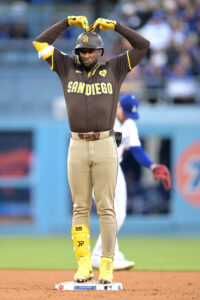
Profar, 32, has been wildly inconsistent in his career but is coming off his best season. Once a top prospect with the Rangers, he made it to the majors as a 19-year-old but struggled in his first few seasons. He eventually showed some promise but frustratingly alternated between good and bad seasons.
He had one of those down seasons in 2023, which is why the Padres were able to sign him last offseason for just $1MM, barely above the league minimum. The Padres probably couldn’t have dreamed about the return on investment they would eventually get from that.
Profar got into 158 games and stepped to the plate 668 times. His 15.1% strikeout rate and 11.4% walk rate were both strong numbers but fairly normal for him. He managed to do more damage when he connected, without sacrificing any of his trademark plate discipline. His 24 home runs were a career high. The three numbers in his .280/.380/.459 slash line were all personal bests as well, apart from a .471 slugging percentage in his nine-game debut back in 2012. His 139 wRC+ easily eclipsed his previous personal high of 113 and was also put him in the top 15 among qualified hitters last year. The switch-hitter did that damage from both sides of the plate, with a 137 wRC+ as a lefty and 147 as a righty.
Given his capricious production over the years, it would be fair to be a bit skeptical that he could keep that kind of performance going. However, there are some encouraging numbers under the hood. Profar’s 44.8% hard hit hate rate, 91.1 mile-per-hour average exit velocity and 7.2% barrel rate were all significantly better than anything he had done before. His .302 batting average on balls in play was a career high but just a bit above the .291 league average.
Though Profar has played all over the diamond in his career, he’s mostly a left fielder now. He’s barely played the other outfield slots in his career. He hasn’t really been an infield regular since 2019. He logged just 18 innings at first base last year, the only place he played apart from left field during the campaign.
Profar’s work in left hasn’t been especially well regarded. Last year, he was given a grade of -8 from Defensive Runs Saved and -6 from Outs Above Average. Despite that, thanks to his huge offense and ten stolen bases, FanGraphs considered him to be worth 4.3 wins above replacement on the season.
That production was huge for the Padres, given that they had notable financial restraints, which is why they took that $1MM flier on Profar. They surely would have welcomed him back, given the longstanding ties between Profar and president of baseball operations A.J. Preller. However, their financial situation is perhaps even more grim now than it was a year ago. They reportedly need to make significant cuts to the budget while also looking for solutions on the roster. In addition to Profar’s absence in left, they have question marks behind the plate, in the rotation and at shortstop.
Profar has also expressed a fondness for San Diego and probably wanted to go back, but he also probably recognized that this is probably his best chance at a free agent payday. He had previously signed a three-year, $21MM deal with the Padres going into 2021 but opted out of that pact after two years. He settled for modest one-year deals in the past two offseasons but has now secured himself a strong three-year deal. MLBTR predicted a three-year, $45MM deal for him at the start of the offseason.
For Atlanta, outfield has stood out as a clear area for improvement this winter. Ronald Acuña Jr. suffered a torn ACL in his left knee last year and missed the second half of the season. He’ll be back in right field at some point in 2025 but probably not on Opening Day. Players like Ramón Laureano and Jorge Soler were used to cover for Acuña’s absence but jettisoned after the season. Soler was flipped to the Angels while Laureano was non-tendered. The club’s acquisition of Jarred Kelenic last offseason also didn’t go especially well. He struck out 29.6% of the time and hit .231/.286/.393 for a wRC+ of 86.
Time will tell how the club plans to play it once everyone is healthy. Michael Harris II will be in center but Atlanta has its designated hitter spot committed to Marcell Ozuna. Profar and Kelenic can flank Harris for now but Acuña will eventually be back. The lefty-swinging Kelenic has better numbers against righties but the club presumably isn’t giving the Profar $42MM to be a short-side platoon guy.
Perhaps Kelenic will eventually get pushed into a fourth outfielder role once Acuña is back, though he may have a bit of time to prove himself worthy of more. Ozuna is an impending free agent, so perhaps the foursome of Harris, Acuña, Profar and Kelenic can better co-exist in 2026 and beyond. Kelenic does have an option remaining, so some time in the minors is possible as well.
With Profar now in the fold, RosterResource calculates Atlanta’s payroll at $212MM and their competitive balance tax number at $230MM. The latter is $11MM shy of this year’s base threshold. They opened last year at $223MM, per Cot’s Baseball Contracts.
President of baseball operations Alex Anthopoulos has previously said that he expects payroll to rise and that the club is willing to pay the tax again this year. However, most of his moves have been focused on adding financial breathing room. As mentioned, Soler was flipped in a salary dump and Laureano was cut. Travis d’Arnaud had his club option turned down. The club restructured the contracts of Aaron Bummer and Reynaldo López to kick some money down the road.
If there is still some powder dry, then perhaps Atlanta will pivot to adding some pitching in the coming weeks. They were connected to Nathan Eovaldi earlier in the winter and reportedly had an agreement in place with Jeff Hoffman, with Hoffman to be stretched out as a starter, before they grew concerned by something they saw in his shoulder during his physical. They were also connected to reliever Tanner Scott earlier in the winter. All those guys have signed elsewhere but the interest indicates Atlanta is looking to add to the staff.
For clubs still looking for outfield help, the market is essentially out of everyday players now. Juan Soto, Teoscar Hernández, Anthony Santander, Tyler O’Neill and Profar are now all off the board. The best remaining outfielders are role players like Harrison Bader, Randal Grichuk and Alex Verdugo. Clubs like the Royals, Astros and Blue Jays have been connected to Profar this winter, though the Jays signed Santander earlier this week.
Gillispie, 27, just signed a non-guaranteed contract with Atlanta in November. He made his major league debut with Cleveland last year but only logged eight innings and was non-tendered at season’s end. In his minor league career, he has thrown 426 1/3 innings with a 4.01 earned run average, 24.3% strikeout rate and 9.4% walk rate. Atlanta will have one week of DFA limbo to figure out what’s next for him. Since the waiver process takes 48 hours, any potential trade talks would have to come together in the next five days.
Robert Murray of FanSided was first with the agreement between Atlanta and Profar.
Yankees Claim Allan Winans
The Yankees have claimed right-hander Allan Winans off waivers from the Braves, who designated him for assignment earlier in the week, as first reported by Chase Ford of MiLB Central.
The 29-year-old Winans saw big league time with the Braves in both 2023 and 2024. He’s been hit hard in the majors, yielding a 7.20 ERA in 40 frames, but has a strong track record in Triple-A. Through 256 innings at the top minor league level, Winans sports a 3.26 ERA, 21.8% strikeout rate and 6.9% walk rate. He has a minor league option remaining, making him a candidate to give the Yankees some depth in the starting staff or length out of the bullpen.
Winans sits just 90-91 mph with his four-seamer and 89-90 mph with his sinker, coupling those offerings with a low-80s changeup and upper-70s slider. He’s excelled at limiting walks and piling up weak contact throughout his time in Triple-A, which has helped to offset below-average velocity and bat-missing capabilities. Major league hitters haven’t made hard contact with much frequency, but the hard contact he does allow tends to be quite loud; he’s averaged 1.80 homers per nine frames and allowed 10% of his batted balls to be barreled up, per Statcast.
The Yankees have multiple open spots on their 40-man roster, so they won’t necessarily need to make a corresponding move to accommodate Winans. He’ll compete for a spot on the Opening Day roster this spring, but with a crowded rotation that could lead to a trade of Marcus Stroman and a generally veteran bullpen, the Yankees seem likelier to open the year with Winans in Triple-A — assuming he remains on the 40-man roster for the rest of the offseason.
Rich Hill, Jesse Chavez Plan To Pitch In 2025
Veteran pitchers Rich Hill and Jesse Chavez are 45 and 41 years young, respectively, and both recently told Susan Slusser of the San Francisco Chronicle that they intend to pitch in 2025. Both hurlers appeared in the majors this past season, albeit quite briefly in Hill’s case.
Hill made clear from the beginning of the 2023-24 offseason that his plan was to sign midseason. Doing so, he hoped, would keep his arm fresh down the stretch after he faded badly in 2023. More importantly, it would afford him more time to be at home early in the year with his family and to coach his son’s team. He wound up signing an incredible eighth contract with the Red Sox in August but pitched just 3 2/3 MLB frames before being designated for assignment and released.
As recently as 2022, Hill pitched a full season and was generally effective, despite that being his age-42 campaign. That year saw him make 26 starts, pitch 124 1/3 innings and notch a respectable 4.27 ERA with a 20.7% strikeout rate and 7% walk rate — despite averaging just 88.5 mph on his four-seamer. He was out to a solid start in 2023 with the Pirates, working to uncannily similar numbers through 13 starts (4.23 ERA, 21.5 K%, 7.4 BB%). Hill hit a wall at that point, however, and limped to a 6.57 ERA over his final 74 innings.
Hill hinted earlier this offseason that while he was still (at the time) undecided about pitching in 2025, if he did so it would likely again be on more of a full-season schedule. He’s also suggested he wouldn’t limit himself to pitching with teams near his Boston-area home. Only time will tell whether a club takes a look, but there’s little harm in what would surely be a minor league deal and non-roster invitation to camp.
As for Chavez, he’s coming off a much different year. Though he’s on the “wrong” side of 40, Chavez looked solid. In 63 1/3 innings for the Braves, he notched a sharp 3.13 ERA with a passable, albeit below-average 20.8% strikeout rate and a quality 7.2% walk rate. Chavez’s sinker sat at a career-low 90.7 mph, and his cutter lagged further behind at 88.5 mph on average. But the crafty right-hander nevertheless enjoyed plenty of success, due in no small part to solid command and a plethora of weak contact.
Atlanta generally used Chavez in low-leverage spots last year, but he was a member of the team’s setup core as recently as 2023, when he picked up 13 holds and regularly appeared in medium- and high-leverage situations over the life of 36 games.
Despite his age, Chavez has now turned in four straight seasons with a sub-4.00 ERA. His collective earned run average dating back to 2021 is a sparkling 2.91, and he’s logged at least average walk rates every year along the way, with the ’24 campaign being the only one of the four wherein his strikeout rate was below-average. Chavez has posted better-than-average grounder rates in each of the past two seasons, too.
Chavez seems to find his way back to the Braves every season. He signed a minor league deal with Atlanta in 2021, was selected to the major league roster in June and quickly emerged as a key bullpen piece. He inked a minor league deal with the Cubs in 2022, made the Opening Day roster with Chicago, and was traded to the Braves less than three weeks later in exchange for Sean Newcomb, who’d been designated for assignment. The Braves traded him to the Angels at that year’s deadline, but when the Angels placed Chavez on waivers late in August, there were the Braves to once again claim him back.
Chavez signed a minor league deal with Atlanta in November 2022 and spent most of the 2023 season on their roster. He inked a minor league deal with the White Sox last winter, was cut loose late in camp and, to the shock of no one, signed a minor league deal with the Braves. They selected him to the 40-man roster three days later.
Another minor league deal between Chavez and the Braves isn’t necessarily a foregone conclusion, but it sure wouldn’t come as much of a surprise, either. The fit is even more sensible with Atlanta already having lost right-hander Joe Jimenez to knee surgery that’ll probably wipe out his entire 2025 season.
Braves, Chasen Shreve Agree To Minor League Deal
The Braves are in agreement with lefty reliever Chasen Shreve on a minor league contract, reports Jon Heyman of The New York Post. The CAA client will be in camp as a non-roster invitee and would lock in a $1.3MM base salary if he makes the big league roster.
Shreve, a former Atlanta draftee who debuted with 15 appearances for the club in 2014, made one MLB appearance as a member of the Rockies last season. He tossed a scoreless inning. That extended the veteran southpaw’s streak to 11 consecutive years logging some major league action. Shreve spent most of the ’23 season in the big leagues. He combined for 50 appearances between the Tigers and Reds, working to a 4.63 ERA across 44 2/3 frames.
While his big league appearance came with Colorado, Shreve played for a trio of Triple-A affiliates last year. He spent time in the Rangers, Yankees and Rox systems. Shreve turned in a cumulative 2.62 earned run average across 34 1/3 innings at the top minor league level. He fanned a strong 26.7% of opponents against a slightly higher than average 9.2% walk percentage. He got swinging strikes at a near-14% clip.
The results were good, but Shreve doesn’t have the velocity that teams prefer to stockpile in the bullpen. His fastball averaged 90 MPH in Triple-A last season. He averaged 89.4 MPH during his only major league appearance. He leans frequently on his slider and splitter to compensate for the fringe velocity. Shreve has neutral platoon splits over his career, so he’s not a great fit for lefty specialist work.
That’s not an issue for an Atlanta team that’ll have Aaron Bummer and Dylan Lee in the late innings. Angel Perdomo is out of options and will need to stick on the MLB roster or be made available to other teams. Depending on whether they carry Perdomo and keep Rule 5 pick Anderson Pilar, Atlanta could have two or three middle relief spots up for grabs in camp.
Braves Sign Curt Casali To Minors Deal
The Braves have signed catcher Curt Casali to a minor league contract, Just Baseball Media’s Aram Leighton reports. Atlanta is Casali’s 11th different organization over his 14 professional seasons.
The last eleven of those seasons have come in the big leagues, with Casali amassing 543 career games with the Rays, Mariners, and two separate stints apiece with the Reds and Giants. Most recently, Casali suited up 41 times for San Francisco last season, stepping in as the primary backup catcher after Tom Murphy was lost for the season due to a knee injury.
Casali has mostly worked in a backup or part-time capacity, appearing in as many as 84 games twice (2016 with the Rays and 2019 with the Reds) in his career. His most productive overall stretch came with Cincinnati from 2018-2020, when he hit .260/.345/.440 in 485 plate appearances while working in what was more or less a timeshare with Tucker Barnhart behind the plate. Casali’s offensive numbers have tailed off significantly since, and he had only a .194/.293/.250 slash line in 125 PA with the Giants last season.
His glovework also took a downturn in 2024, as Statcast rated his blocking, framing, and caught-stealing numbers all below average. This could be a sign of age catching up to Casali as he enters his age-36 season, but he has a solid reputation as a defensive catcher who works well with pitchers.
Atlanta declined its $8MM club option on Travis d’Arnaud, and the longtime Braves backstop then signed with the Angels in one of the offseason’s more significant early moves. Sean Murphy will look to rebound from a down year as the Braves’ starting catcher and Chadwick Tromp is penciled in as the backup, though Casali and Sandy Leon are two well-traveled veterans who will provide some competition in Spring Training. The other name to watch here is Drake Baldwin, as the top prospect hit well in 334 PA with Triple-A Gwinnett last season and is expected to make his MLB debut at some point in 2025.
Tanner Scott Weighing Multiple Offers, Could Sign This Weekend
The market may be heating up for free agency’s top reliever. Jon Morosi of the MLB Network reports that Tanner Scott is weighing multiple multi-year offers and may choose his team by this weekend.
Morosi suggests that the Cubs are among Scott’s top suitors. Chicago president of baseball operations Jed Hoyer said this week that the bullpen is “probably the area we’ve been focused on most in free agency.” There’d be no bigger upgrade than Scott, though that’d be an out-of-character move for Hoyer’s front office. The Cubs have not signed a free agent reliever to a multi-year deal or a guarantee above $9MM in more than five years.
Sahadev Sharma of The Athletic writes that while the Cubs do indeed like Scott, they may be reluctant to meet the asking price. Previous reporting has suggested that Scott’s annual salary could approach $20MM on what’d presumably be a three- or four-year contract. Even if the money doesn’t quite get to that level, this would be a major investment. Scott should easily land the top reliever deal of the winter.
The Dodgers have been tied to Scott for months. After landing Roki Sasaki, a back-end reliever is the last box on L.A.’s offseason checklist. The Braves have also shown interest, while the Mets were more recently reported as a suitor. That no longer seems to be the case. New York agreed to terms with A.J. Minter on a two-year, $22MM guarantee this afternoon. Mike Puma of The New York Post reports that the Minter deal means the Mets are expected to drop their run at Scott.
Scott has been one of the best relievers in baseball for two seasons. He fired 78 innings of 2.31 ERA ball for the Marlins in 2023. The 30-year-old southpaw was even better last year. Scott earned his first All-Star nod and combined for a sterling 1.75 earned run average through 72 frames between Miami and the Padres. He averages nearly 97 MPH on his fastball and has punched out at least 28% of opposing hitters in three straight seasons.
Braves Claim Amos Willingham, Designate Allan Winans
The Braves have claimed right-hander Amos Willingham off waivers from the Nationals, per a team announcement. Righty Allan Winans was designated for assignment in a corresponding move. Washington had designated Willingham for assignment last week.
Willingham, 26, is a Georgia native and Georgia Tech product who’s pitched in the majors in each of the past two seasons with the Nats. He’s totaled only 25 1/3 innings and been torched for a 7.11 ERA in that tiny sample, but the 6’4″, 223-pound righty has enjoyed plenty of success in the upper minors. Willingham was unscored upon in the brief 10 2/3 innings he spent at the Double-A level and carries a combined 3.47 ERA in parts of two Triple-A seasons (93 1/3 innings). He’s punched out a solid 23.3% of his Triple-A opponents — albeit against a more problematic 10.8% walk rate.
The claim of Willingham adds a power arm to the Braves’ depth chart — one who still has a minor league option year remaining. Willingham has averaged 95.9 mph on his heater in the majors and ran it up to 98 mph in his lone big league outing this past season. Though his strikeout rate in Triple-A was roughly in line with the major league average, his 13.1% swinging-strike rate against minor league opponents was well north of MLB’s 11.1% average. He pairs that heater with a 90 mph cutter and 85 mph slider.
Winans, 29, has pitched in the majors in each of the past two seasons as well. He’s similar to Willingham — beyond their identical ALW initials — in that both have struggled in the big leagues but pitched well in Triple-A. Winans has an ugly 7.20 earned run average with a 20.9% strikeout rate and 6.6% walk rate in the majors. In parts of three Triple-A campaigns, however, he touts a 3.26 ERA, 21.8% strikeout rate and 6.9% walk rate. That’s come in a sample of 256 innings, as Winans has operated primarily as a starting pitcher. Both pitchers also have one minor league option remaining.
The similarities broadly stop there. Winans sits just 90-91 with his four-seamer and 89-90 with his sinker. He pairs those modest fastballs with an upper-70s slider and a changeup that sits 82-83 mph. He’s generally gotten by in the minors with sub-par velocity thanks to strong command and a knack for inducing weak contact. Big league hitters haven’t made a lot of hard contact on average, but when they do square Winans up, the results haven’t been pretty. He’s yielded a 10% barrel rate and been tagged for an average of 1.80 home runs per nine innings pitched.
The Braves will have five days to look for a potential trade partner for Winans. At that point, they’d have to place him on outright waivers, which take an additional 48 hours to process.
Notable International Signings: 1/15/25
January 15 marks the official opening of the international signing period. The majority of top talents have reached verbal agreements with teams months or years in advance, they’re allowed to formally put pen to paper to begin their affiliated careers. The signing period technically runs until December 15, but many of the top signees ink their contracts as soon as first eligible.
This year’s international market has been thrown into disarray, to an extent, by the emergence of star NPB right-hander Roki Sasaki on the market. While Sasaki is an established professional in every sense of the word over in Japan, his age (23) and the fact that he has fewer than six seasons of pro ball in another country under his belt make him an “amateur” under the purview of Major League Baseball’s international free agency structure.
As such, we’ve seen both the Dodgers and Padres both hold off on finalizing longstanding agreements with other teams and, in some cases, let players with whom they’ve had standing verbal agreements instead pursue other opportunities. The Dodgers, for instance, saw Dominican shortstop Darell Morel instead agree to a $1.8MM bonus with the Pirates. That worked out for Morel, who’d agreed to sign for roughly half that amount with Los Angeles (likely more than a year prior). Baseball America’s Ben Badler reports that Venzuelan outfielder Oscar Patiño also walked away from his Dodgers deal ($400K) to sign for a $570K bonus with the White Sox. FanGraphs’ Eric Longenhagen reported yesterday that Dominican outfielder Teilon Serrano, another Dodgers commit, will instead sign with the Twins now. He’ll receive roughly $1MM from Minnesota, per Francys Romero of BeisbolFR.com.
Those defections will sting for the Dodgers if they’re unable to ultimately sway Sasaki to sign in Los Angeles, though there will be other opportunities to spend those dollars down the road. Unexpected amateur players can pop up well after a signing period has commenced, and Los Angeles would also have the ability to trade some any unused international money. The Dodgers have long been regarded as the Sasaki favorite — so much so that agent Joel Wolfe had to publicly deny speculation regarding a predetermined agreement between the two sides — and the recent run of prospects bolting from their international class does little to quell that perception. The Dodgers, Padres and Blue Jays are the three finalists for Sasaki, whose posting window closes on Jan. 23.
Turning back to the rest of the class, Badler has a team-by-team breakdown of the most prominent signings over at Baseball America, as well as scouting reports and (in some cases) projected bonuses for as many as 100 players. Longenhagen runs through his own list of 50 international prospects with their expected team and signing bonus over at FanGraphs, as well as a detailed look at some of intricacies and idiosyncrasies of Sasaki’s unique free agent saga. Romero runs through 35 high-profile international talents and their expected team/signing bonus at his site as well. At MLB.com, Jesse Sanchez and Jesse Borek have their own ranking of the top 50 in the class, with scouting reports on each. Those interested in the finer details of this year’s collection of international amateurs are highly encouraged to check out those resources in full. Badler, Longenhagen, Romero, Sanchez and many others around the baseball world dedicate enormous portions of their time and efforts to covering this topic to the fullest.
Note: This is not a comprehensive list of all international signings, nor is it intended to be. If your favorite team is not listed here, it’s not because they’ve sat out the IFA market. There are a few dozen players who’ll sign $1MM+ bonuses and a few hundred who’ll ink six-figure bonuses. Those interested in a comprehensive rundown of the international class can check out links to the excellent work from Badler, Romero, Sanchez and Longenhagen provided above. We’ll run down some of the top signing bonuses here, focusing on those that check in at $2.5MM or more. These are ordered by reported signing bonus, and this list will be updated multiple times today:
- Elian Peña, SS, Mets: The Mets paid a reported $5MM bonus to Pena, per Badler, which represents a whopping 80% of their $6.261MM bonus pool. Currently listed at 5’11” and 170 pounds, Pena is a lefty-swinging shortstop who’s expected to move down the defensive spectrum but have more than enough bat to profile at third base or second base if all pans out. Badler and Romero both liken his power potential to that of Rafael Devers, praising his pitch recognition, plate discipline and willingness to draw walks. He turned 17 in October.
- Andrew Salas, SS/OF Marlins: The younger brother of Twins infield prospect Jose Salas (originally signed by Miami but traded to Minnesota alongside Pablo Lopez) and current Padres top prospect Ethan Salas, Andrew will turn 17 in March. He’s a switch-hitter who’s touted for his patient approach, good swing decisions and balance on both sides of the plate. MLB.com lauds him as a potential plus defender both at shortstop and in center field. Salas was born in Florida but moved to Venezuela, his family’s native country, and is already bilingual as a result. The Marlins are committing a $3.6MM bonus to the youngest of the three Salas brothers, per Romero.
- Cris Rodriguez, OF, Tigers: Rodriguez receives a $3.2MM bonus from Detroit, per Badler. Already 6’4″ and 200 pounds with his 17th birthday still two weeks away, Rodriguez stands out for his bat speed and raw power. Badler calls him a potential 30-homer slugger who’ll probably settle into a corner but for the time being runs well enough to have a chance in center. MLB.com’s report calls Rodriguez a “near carbon copy” of Eloy Jimenez at this same age, even down to hailing from the same city in the Dominican Republic and possessing a similarly aggressive approach. The Tigers will hope Rodriguez can do a better job of avoiding injuries, but Rodriguez possesses thunderous power — more so than any other player in this class.
- Josuar de Jesus Gonzalez, SS, Giants: Badler and Romero both note that some scouts have graded De Jesus as the top prospect overall in this year’s class (Sasaki excluded). MLB.com indeed ranks him as the top non-Sasaki talent in the class. Listed at 5’11” and 175 pounds, the 17-year-old switch-hitter draws 70 grades for his speed (on the 20-80 scale) and also plus bat speed and the defensive tools required to convince scouts he can stick at shortstop. He’s landing a $3MM bonus from San Francisco, Badler reports.
- Diego Tornes, OF, Braves: Tornes won’t turn 17 until July. He’s younger than many of the players in this year’s class but still received a $2.5MM bonus (per Badler) thanks to a projectable 6’4″, 200-pound frame that scouts think is a portent for plus power. He’s a switch-hitter who’s praised for plus bat speed and physicality that are well beyond some of his older peers on this year’s class. MLB.com feels he’ll eventually settle into an outfield corner, where he has an above-average arm and — at least at present — above-average speed.
MLBTR Podcast: The Jeff Hoffman Situation, Justin Verlander, And The Marlins’ Rotation
The latest episode of the MLB Trade Rumors Podcast is now live on Spotify, Apple Podcasts, and wherever you get your podcasts! Make sure you subscribe as well! You can also use the player at this link to listen, if you don’t use Spotify or Apple for podcasts.
This week, host Darragh McDonald is joined by Steve Adams of MLB Trade Rumors to discuss…
- Jeff Hoffman signing with the Blue Jays after his agreements with the Orioles and the Braves fell apart, both due to concerns relating to his physical (2:05)
- The Giants signing Justin Verlander (12:00)
- The Marlins lose Braxton Garrett for the year (15:55)
- The Mariners signing Donovan Solano (26:10)
Plus, we answer your questions, including…
- With the Reds getting a new TV deal, can they sign Anthony Santander or Jurickson Profar? (31:30)
- What do you make of the Nationals‘ offseason so far? (37:55)
- What would a Kyle Tucker extension look like for the Cubs? (44:30)
Check out our past episodes!
- Brent Rooker’s Extension, Gavin Lux, And Catching Up On The Holiday Transactions – listen here
- Kyle Tucker To The Cubs, And Trades For Devin Williams And Jeffrey Springs – listen here
- Winter Meetings Recap – listen here
The podcast intro and outro song “So Long” is provided courtesy of the band Showoff. Check out their Facebook page here!