
The Rays May Have Another Cy Young Contender
After a strong two-season run in Houston, right-hander Charlie Morton entered free agency last winter as one of the best starters available. Interest in Morton was widespread, thanks in part to the Astros’ decision not to issue him a qualifying offer, though age (35) prevented him from reeling in a long-term deal. Morton ultimately accepted a two-year, $30MM offer from the Rays in December. Six months later, it’s looking like one of the steals of the offseason.
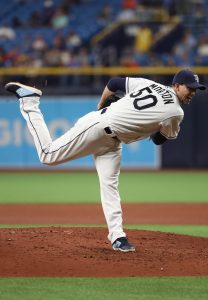
Facing the Athletics on Monday, Morton turned in his second consecutive seven-inning shutout and fourth straight quality start. During that four-appearance, 27-inning rampage, Morton yielded a mere three earned runs on 14 hits and posted 31 strikeouts against four walks. The Rays won all of those games, giving them a 10-4 record when Morton has taken the ball this season. Thanks in part to low-budget Tampa Bay’s decision to splurge (by its standards) on Morton, its sporting one of the American League’s leading records at 41-26
While Morton’s recent production has no doubt boosted his numbers, he has been consistently good all season. Morton’s ERA hasn’t risen any higher than 3.60, where it sat after his initial start of the season, and now rests at a microscopic 2.10. He trails only the Twins’ Jake Odorizzi among AL starters in that category, and most of his other production also ranks near the very top of his league. Take a look…
- FIP: 2.67 (second)
- WAR: 2.6 (fourth)
- xFIP: 3.33 (fourth)
- Weighted on-base average against: .254 (fifth)
- Strikeouts per nine: 10.84 (seventh)
- Expected weighted on-base average against: .271 (seventh)
- Innings: 81 1/3 (15th)
The least impressive figure there is Morton’s innings total, though it still represents a step forward for someone who has long battled durability issues. Morton has never thrown 175 innings in a season, but he’s on pace for almost 200 this year.
We can’t necessarily call this a late-career renaissance because, with all due respect to Morton, his time in the majors wasn’t rife with great moments before he got to Houston. However, a significant rise in Morton’s fastball velocity in 2016 with the Phillies was likely the beginning of his awakening. Unfortunately for Morton and the Phillies, a hamstring tear late that April brought a quick conclusion to his season and, for all intents and purposes, an end to his short run in Philly. He headed to the Astros the next season, which began a 313 1/2-inning stretch of 3.36 ERA/3.53 FIP pitching, and helped the team to a World Series title in 2017.
It was somewhat of a surprise that Houston didn’t make more of an effort to retain Morton after last season, but the Rays have been the beneficiaries of the Astros’ choice. The Rays have gotten a different pitcher than the Astros’ version of Morton, not just in terms of results.
The hard-throwing Morton’s main pitch in 2018 was his four-seam fastball, which he threw at a 31.1 percent rate, according to Statcast. He complemented it with a curveball (29.3 percent), a sinker (27.1), a splitter (6.3) and a cutter (6.3). Now, he’s throwing his curve (36 percent) significantly more than any other pitch, with his sinker (24.2), four-seamer (23.5), cutter (11.8) and splitter (4.4) checking in as his secondary offerings. Morton has lost some velocity since last year, which could at least partially explain his change in approach. At the same time, though, if your curve’s as dominant as his, why not throw it as much as possible? The pitch ranks in the league’s 94th percentile as far as spin rate goes, per Statcast, and hitters have mustered a putrid .142/.170 wOBA/xwOBA against it. According to FanGraphs’ pitch values, it’s the premier curve in the AL.
If Morton continues to use his curve this effectively, he may end up in serious contention for the AL Cy Young just one year after fellow Ray Blake Snell won it. In the event Morton wins the award, he and Snell would become the first AL teammates to take home the honor in back-to-back seasons since the Indians’ CC Sabathia and Cliff Lee accomplished the feat in 2007-08. Even better for the Rays, Morton, Snell, Tyler Glasnow (if he returns from the injured list) and opener Ryne Stanek could make for a dominant postseason rotation should the team team clinch a playoff spot.
Photo courtesy of USA Today Sports Images.
Corey Seager Suffers Hamstring Injury
Dodgers shortstop Corey Seager exited the team’s game Tuesday with a left hamstring injury. Manager Dave Roberts said afterward the club believes he suffered a Grade 2 strain, though Seager will undergo an MRI for confirmation (via Pedro Moura of The Athletic).
If the Dodgers’ fears are correct, Seager could end up missing at least a few weeks. To cite one recent example, Astros outfielder George Springer suffered a Grade 2 hamstring strain May 25 and still hasn’t returned. A similar absence would mean another frustratingly short campaign for Seager, the 2016 NL Rookie of the Year who underwent Tommy John surgery last season and missed all but 26 games as a result. The 25-year-old also required left hip surgery in August, though his season was already long over at that point.
Seager had been enjoying a healthy, productive 2019 prior to incurring his latest injury. Not only has Seager appeared in 66 of the Dodgers’ 68 games, but he has slashed .279/.359/.468 (121 wRC+) with eight home runs and 2.1 fWAR over 265 plate appearances.
Seager’s production would be difficult to replace, especially given the tear he has been on this month. However, the cushion the 45-23 Dodgers have built in the National League West and the NL as a whole will give them some breathing room without Seager. For now, LA’s poised to turn to Chris Taylor as its primary shortstop, per Bill Plunkett of the Orange County Register.
MLB Draft Signings: 6/12/19
Here are the latest notable MLB draft signings…
- Second-round outfielder Matt Gorski (No. 57) has signed a below-slot deal with the Pirates, according to Jim Callis of MLB.com. He’ll earn $1MM, down from the $1,243,600 recommended slot value of the selection. Callis and Jonathan Mayo ranked Gorski as the 112th-best player in the draft, crediting the Indiana Hoosier with possessing “one of the best toolsets in college baseball.” They contend the 21-year-old Gorski could become a 20-20 player and a plus center fielder in the majors, though he’ll have to overcome concerns regarding the length of his swing.
- Along with inking Gorski, the Pirates signed third baseman Jared Triolo for full slot value ($870K), Callis tweets. Triolo, out of the University of Houston, went to the Pirates in Comp Round B (No. 72 overall). Callis and Mayo had him at No. 146 going into the draft, noting, “He doesn’t have any plus tools or glaring flaws, and scouts love his makeup.”
- The Angels have signed second-rounder Kyren Parris, the team announced. Parris’ pick, No. 55, came with a $1.31MM slot value, but he received $1.4MM, Kiley McDaniel of FanGraphs relays. McDaniel and colleague Eric Longenhagen rated the 17-year-old Parris as the draft’s 39th-best player, thanks in part to his speed, defensive skills at shortstop, and a “projectable” frame.
- The Rockies announced the signings of several picks, including second-round infielder Aaron Schunk. The 62nd pick, Schunk received the full slot value of $1.1MM, Callis reports. Callis and Mayo, who had Schunk 92nd in his class, write that the Georgia Bulldog could develop into a .270/20-HR hitter and a quality third baseman in the pros.
Health Notes: Angels, Gordon, Brewers, M. Kemp, Reds
The Angels appear likely to activate left fielder Justin Upton sometime during their upcoming road trip from June 13-23, Jeff Fletcher of the Orange County Register suggests. Upton, out all season because of a toe injury, began a rehab assignment last Friday. Meanwhile, injured shortstop Andrelton Simmons is “progressing quickly” and may start taking live at-bats soon, per Fletcher. Simmons hasn’t played since May 20 because of a Grade 3 left ankle sprain.
- The Mariners activated second baseman Dee Gordon from the 10-day injured list Tuesday, the team announced. They optioned righty Matt Festa to Triple-A Tacoma in a corresponding move. Gordon’s back after missing 19 games with a right wrist contusion. The 31-year-old trade candidate is off to a .280/.309/.366 start (85 wRC+) with three home runs and 12 steals on 14 attempts across 177 plate appearances.
- Brewers right-hander Jhoulys Chacin is on track to return during their series in San Diego, which runs from June 17-19, Tom Haudricourt of the Milwaukee Journal Sentinel tweets. Chacin has been on the IL since June 2 with a lower back strain. Before that, he struggled to build on last season’s quality performance, logging 58 innings of 5.74 ERA/5.75 FIP ball with 6.83 K/9 and 4.5 BB/9.
- Mets minor league outfielder Matt Kemp is dealing with lingering effects of a broken rib he suffered in April, according to Mike Puma of the New York Post. The Mets placed Kemp on the minor league IL as a result. The 34-year-old Kemp settled for a minors pact with the Mets on May 24, three weeks after Cincinnati released him. Kemp slashed a brutal .200/.210/.283 (23 wRC+) in 62 plate appearances with Cincy and hasn’t been much better as a member of the Mets’ Triple-A affiliate in Syracuse. So far, Kemp has hit .235/.278/.324 (52 wRC+) in 36 tries at the minors’ top level.
- Reds righty reliever Robert Stephenson began a Triple-A rehab stint Tuesday, according to the team. Stephenson went to the IL on May 31 with a cervical strain. Once a well-regarded starting pitching prospect, Stephenson looked as if he was emerging as a credible reliever before his injury. In his first full-time look out of the bullpen, the 26-year-old has notched a 3.96 ERA/2.58 FIP with 12.6 K/9 and 3.6 BB/9 across 25 innings.
Tigers Notes: Zimmermann, Ross, Goodrum
Detroit’s rotation has been without its elder statesmen, injured right-handers Jordan Zimmermann and Tyson Ross, for a large portion of the season. It’s going to stay that way for at least a little while longer, Anthony Fenech of the Detroit Free Press explains.
Zimmermann, down since April 26 with a sprained right UCL, pitched a rain-shortened rehab game at the Single-A level Saturday and “just didn’t feel comfortable with his stuff,” manager Ron Gardenhire told Fenech, adding: “He wants to get back into a normal routine before he comes up here and pitches, which is absolutely 100% right. You can’t come up here with below average stuff.”
The 33-year-old Zimmermann will make another rehab stint this week with a to-be-determined affiliate, per Fenech. At this point, it’s unclear how much more time Zimmermann will miss. Barring setbacks, though, a pitcher’s rehab stint is allowed to go on for up to 30 days. Zimmermann’s began June 8.
Ross, 32, hasn’t started a rehab assignment since landing on the injured list May 12 with a nerve issue in his right elbow. He’s now dealing with a stiff neck and won’t return to throwing for “probably five days,” Fenech writes.
Thanks to an unattractive combination of injury and performance woes, Zimmermann and Ross are all but guaranteed to go down as failed free-agent signings for Detroit. Zimmermann parlayed high-end production as a member of the Nationals from 2009-15 into a five-year, $110MM contract with the Tigers heading into 2016, but the union hasn’t worked out at all for the club. Zimmermann owns a 5.29 ERA/4.82 FIP in 427 innings as a Tiger, and the former workhorse hasn’t exceeded 160 frames in a season since signing his deal. The Ross investment’s going to hurt Detroit a lot less, as it only gave him a one-year, $5.75MM guarantee last winter. Still, his woeful numbers – a 6.11 ERA/5.92 FIP with 6.37 K/9 and 4.58 BB/9 in 35 1/3 innings – aren’t what the Tigers had in mind when they signed Ross.
Injuries to starters, not just to Zimmermann and Ross, have been an unfortunate theme for struggling Detroit in 2019. In addition to the absences of Zimmermann and Ross, the Tigers have been without righty Michael Fulmer and lefty Matt Moore for all or most of the season. Fulmer underwent Tommy John surgery before the campaign began, while Moore turned in one and a half excellent starts before undergoing season-ending right knee surgery in mid-April.
With Zimmermann, Ross, Fulmer and Moore unavailable, the Tigers’ rotation has seen a potential ace emerge in Matthew Boyd, though the 28-year-old could be an in-season trade candidate. Meanwhile, fellow 20-somethings Spencer Turnbull and Daniel Norris have also offered encouraging signs. They’re the only members of the Tigers’ rotation who have racked up at least 10 starts this season. Ryan Carpenter and Gregory Soto, who have combined for 10 starts, have joined Zimmermann and Ross in recording horrific production.
In further unwelcome news for the Tigers, one of their top position players, Niko Goodrum, departed Tuesday’s loss to the Royals with “significant” right knee swelling, Chris McCosky of the Detroit News tweets. It’s unclear whether Goodrum will require an IL stint, though. The switch hitter’s batting .233/.315/.393 (90 wRC+) with six homers and seven steals on nine tries through 248 plate appearances. More impressively, the versatile Goodrum has seen action at every position but pitcher and catcher this year.
Latest On Giancarlo Stanton, Aaron Judge, Dellin Betances
The Yankees have been without injured corner outfielders Giancarlo Stanton and Aaron Judge for almost the whole season, but it appears they’ll be back in the team’s lineup soon. Manager Aaron Boone suggested Tuesday that the sluggers could return during an upcoming homestand that spans from June 17-26, per Bryan Hoch of MLB.com (Twitter links). In the meantime, both players will need to tune up in the minor leagues. Stanton started a rehab assignment at the High-A level Tuesday, while Judge is likely to embark on a rehab stint with either Triple-A Scranton or another affiliate this weekend.
New York’s one of nine teams that have cracked at least 100 home runs this year, but it hasn’t gotten any from the prodigious Stanton. The 29-year-old totaled only eight plate appearances before going to the injured list with a biceps strain April 1. While that problem is in the past, Stanton has since dealt with left shoulder and calf issues – the latter of which forced him back to the IL on May 22 shortly after he began a rehab assignment.
Judge, meanwhile, headed to the IL on April 21 with a significant left oblique strain. He opened his age-27 season with a flourish before that, slashing .288/.404/.521 (145 wRC+) with five homers in 89 trips to the plate.
Just as the Yankees’ offense has had to get by without Stanton and Judge, among others, their bullpen has been forced to survive without one of its best pieces. Right-hander Dellin Betances hasn’t pitched this season after being diagnosed with a bone spur in his shoulder in early April. That injury has healed, but the four-time All-Star is now battling a right lat strain. Although Boone announced it’s a low-grade strain, the Yankees will shut Betances down “for a few weeks,” Hoch writes.
“He’s still going to play a big role for us this year, just a little later than we thought,” Boone said of Betances.
Free Agent Stock Watch: Yasiel Puig
Looking to return to relevance and break their five-year playoff drought in 2019, the Reds operated aggressively on the trade market during the offseason. The club swung multiple noteworthy deals, including a swap with the Dodgers in which they netted outfielders Yasiel Puig and Matt Kemp and left-hander Alex Wood. So far, though, that trade hasn’t delivered the on-field value the Reds wanted. They released Kemp in early May after he got off to a miserable start, while Wood hasn’t taken the field at all because of a back injury. That leaves Puig, who was perhaps the Reds’ biggest acquisition of the offseason. To this point, however, the 28-year-old has been a bust in Cincinnati.
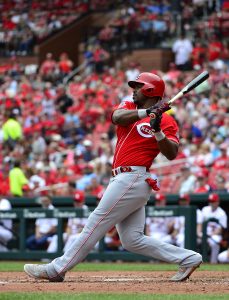
Having signed a seven-year, $42MM contract with the Dodgers back in 2012, when he left Cuba for the majors, Puig already cashed in once earlier in his career. Although Puig was inconsistent in LA, he lived up to his pact as a member of the Dodgers, with whom he slashed .279/.353/.478 (129 wRC+) and totaled 108 home runs, 60 steals and 16.7 fWAR over 2,765 plate appearances from 2013-18.
The Reds were surely expecting Dodgers-esque production from Puig, but instead, he has managed a terrible .212/.256/.385 line with 11 HRs in 242 trips to the plate. His 63 wRC+ is eighth worst among 170 hitters who have amassed at least 200 PA.
Unfortunately for Puig and the Reds, his massive downturn in offensive production isn’t simply a byproduct of bad luck. Sure, Puig’s measly .230 batting average on balls in play is likely to climb, and his weighted on-base average (.270) sits far below his expected wOBA (.312). Nevertheless, Puig ranks around the middle or lower half of the league in xwOBA, expected batting average, expected slugging percentage and hard-hit rate, according to Statcast. The right-hander’s also walking at a career-worst rate, striking out more than ever, chasing way more pitches outside the zone, not making nearly enough contact and, for the first time, getting stymied by same-handed pitchers. Relative to last season (heatmaps via FanGraphs: 2018, 2019), righties have been operating less in the middle of the plate against Puig, who hasn’t been able to come up with an answer.
When Puig has put the bat on the ball this season, the majority of his connections have ended up in the air. However, while many players have benefited from elevating the ball more, the opposite has been true for Puig. He’s racking up far more flies and far fewer grounders than he ever has, but that isn’t a great approach if you’re not hitting the ball with authority. Puig’s exit velocity on flies and line drives has fallen from 93.7 mph to 91.7 since last year, while his mean FB distance has dropped from 328 feet to 316.
It’s clear Puig’s offensive game is suddenly rife with red flags, though he has remained a capable defender and base runner in Cincinnati. Since his MLB career began, Puig has logged 44 Defensive Runs Saved with a 12.5 Ultimate Zone Rating, including four and 1.3 in those categories as a right fielder this season. Meanwhile, even though his sprint speed has decreased, Puig has swiped nine bases on 11 attempts.
Although it’s nice that Puig can flash the leather and run the bases, his ability to produce at the plate has been his calling card thus far. And if Puig doesn’t rebound in that aspect soon, it’s going to further drive his trade value into the ground as the July 31 deadline approaches. Worsening matters for Puig, it could make it difficult for him to secure anything more than a one-year, prove-it deal upon reaching the open market in the winter. With Marcell Ozuna, Nicholas Castellanos, Avisail Garcia, Corey Dickerson and perhaps Kole Calhoun also among corner outfielders set to hit free agency, Puig will have serious competition off what could go down as a nightmarish platform season for him.
Photo courtesy of USA Today Sports Images.
This Date In Transactions History: Cubs Land Jorge Soler
It has been seven years since the Cubs landed a player they thought would become a long-term linchpin. On June 11, 2012, they won the bidding for free-agent Cuban outfielder Jorge Soler. At least a few teams bid upward of $20MM for Soler, who had just turned 20 a few months prior, but Chicago emerged victorious with a nine-year, $30MM offer. At the time, Soler was seen as a top 50 prospect in the sport.
The power-hitting Soler tore through the Cubs’ minor league system beginning the summer he signed and wound up debuting in Chicago two years later. When the Cubs promoted him late in the 2014 season, Soler was even more of a celebrated prospect. He justified the hype initially, slashing a strong .292/.330/.573 (148 wRC+) with five home runs in 97 plate appearances. Thanks to that run, Soler cemented himself as the Cubs’ everyday right fielder heading into 2015; however, his numbers took a dive that season, during which he hit .262/.324/.399 (95 wRC+) with 10 homers in 404 trips to the plate.
Despite his underwhelming output in 2015, Soler was once again in the Cubs’ season-opening lineup in ’16. The franchise ultimately won its first World Series in 108 years that season, but Soler didn’t play a huge role. While Soler turned in decent production in the regular campaign and the playoffs, injuries helped limit him to 264 PA during the season. After celebrating their championship that fall, the Cubs elected to part with Soler, deciding there was no longer a place for him in an outfield that also had Ben Zobrist, Albert Almora, Kyle Schwarber, Jason Heyward, Jon Jay and Matt Szczur in the fold.
On Dec. 7, 2016, just over a month after it won the World Series, Chicago traded Soler to the Royals for reliever Wade Davis. Although Davis only had another year of control left, the Cubs needed a replacement for departed closer Aroldis Chapman. That helped deem Soler expendable in the Cubs’ eyes, and though Davis lasted just one season in their uniform, they haven’t really missed Soler.
Since he joined the Royals in 2017, Soler has batted .234/.310/.450 (101 wRC+) and swatted 28 HRs in 633 attempts. Soler was particularly subpar during his first year in KC, in which he endured a lengthy minor league demotion, but bounced back in 2018 before suffering a season-ending left toe fracture in mid-June. In his return from that injury, Soler’s once again giving the Royals respectable offensive production this season, though his paltry .293 on-base percentage somewhat overshadows his 17 homers. The same is true of Soler’s defense (minus-7 DRS, minus-2.0 UZR), which has graded negatively for most of his time in the majors.
Considering how much excitement there was when Soler signed with the Cubs, the 27-year-old has posted a somewhat disappointing big league career. Soler may move on to a third team soon, given rumors that the non-contending Royals are open to trading just about anyone on their roster. Wherever he plays next season, it’ll be the final year of the contract Soler agreed to with the Cubs seven years ago.
Howie Kendrick Is Killing The Ball
Howie Kendrick has been a quality major leaguer throughout most of his career, which began in 2006. Kendrick’s a lifetime .292/.335/.427 hitter with a 108 wRC+ and 29.9 fWAR in a combined 6,129 plate appearances with the Angels, Dodgers, Phillies and Nationals. But now, a month from his 36th birthday, the infielder/outfielder may be better than ever.
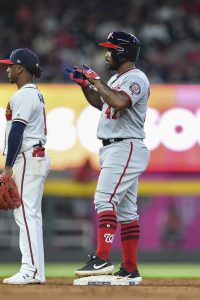
Kendrick collected two hits and a pair of walks in the Nationals’ win over the White Sox on Monday, raising his line to .333/.376/.604 (149 wRC+) in 178 trips to the plate this season. That’s impressive for anyone, let alone an aging player who missed nearly all of 2018 thanks to the ruptured right Achilles he suffered last May. Kendrick’s output is all the more extraordinary when considering there doesn’t appear to be anything particularly fluky about it.
Never known for striking out much, Kendrick’s doing it almost less than ever this season, having gone down on strikes a meager 14.6 percent of the time. At the same time, Kendrick has never quite rivaled Mike Trout at drawing walks. That has remained the case in 2019, though his current rate (6.7 percent) stands as one of the highest figures of his career. And the righty-swinging Kendrick has always been tough on both same- and left-handed pitchers, which has certainly been true this season.
Kendrick’s increase in production stems largely from an uptick in power. His ISO (.270) is twice his career number (.135), in part because of a greater emphasis on hitting fly balls. Kendrick’s pulling the ball more than ever, going less to the opposite field than he ever has, and his newfound power reflects that. His FB rate (32.6 percent) is more than 8 percent his lifetime figure (24.1), and his launch angle – which was in the one-degree range from 2015-17 before climbing to 7.9 during his injury-limited 2018 – has skyrocketed to 9.2.
Kendrick’s effort to put the ball in the air more has paid serious dividends. He already has 11 home runs, seven fewer than his most in a season; although his 24.4 percent HR-to-FB rate isn’t going to hold, both Kendrick’s approach at the plate and the way he’s hitting the ball suggest a massive drop-off may not be in the offing. Kendrick’s swinging and missing a career-best rate and making more contact than he has at any point, particularly on pitches outside the strike zone. When Kendrick has connected, he has posted the majors’ 14th-best weighted on-base average (.408), per Statcast. And that’s hardly just a product of good fortune, as shown by his 11th-ranked expected wOBA (.424). Kendrick’s xwOBA ranks in the majors’ 96th percentile, while his expected slugging percentage (.610; 96th), expected batting average (.328; 99th), hard-hit rate (50 percent; 93rd percentile) and exit velocity (91.7 percent; 88th) also reside toward the top of the league.
If there’s one problem with Kendrick’s offensive game, it’s a lack of speed. While Kendrick has been a double-digit stolen base threat for the majority of his career, he has swiped a mere two on four attempts dating back to last season. According to Statcast’s sprint speed metric, Kendrick is now one of the majors’ slowest runners. Kendrick’s .331 batting average on balls in play may decline as a result, especially considering he’s hitting the ball on the ground most of the time, and the lack of speed won’t help his cause in the field either. To Kendrick’s credit, though, he’s still a versatile defender, having logged double-digit appearances at first, second and third base this season.
Kendrick’s superb late-career showing looks like an important development for him and the Nationals. Not only is Kendrick helping his future earning power a few months away from another trip to free agency, but he could aid in a playoff push for the Nats. Worst-case scenario for Washington: If the club falls out of the postseason race and decides to sell before the July 31 deadline, it’ll likely have a solid trade chip on its hands in Kendrick. The veteran’s on a non-prohibitive $4MM salary, making him all the more enticing to potential suitors.
Photo courtesy of USA Today Sports Images.
Quick Hits: Keuchel, Red Sox, Moncada, Castellanos
After signing a one-year, $13MM contract with the Braves last week, left-hander Dallas Keuchel made his first minor league tuneup with their Single-A affiliate Monday. Unsurprisingly, the accomplished Keuchel looked too advanced for the level, throwing seven shutout innings and 77 pitches of one-hit, one-walk ball with nine strikeouts. The soft-tossing 31-year-old’s fastball sat in the high 80s and maxed out at 89, per Tim Tucker of the Atlanta Journal-Constitution. Afterward, Keuchel suggested he could return to the majors following one more minor league start. Braves manager Brian Snitker said that “we’ll talk to [Keuchel] to see where he’s at” after he takes the mound one more time. Barring setbacks, though, Keuchel does seem likely to end up in Atlanta after that outing.
More from around the majors…
- Red Sox pitching prospect Darwinzon Hernandez will make his first career start Tuesday against the Rangers, Christopher Smith of MassLive.com relays. MLB.com ranks the southpaw as the Red Sox’s best pitching prospect and No. 3 overall farmhand. The 22-year-old Hernandez got his first taste of the majors earlier this season with 2 1/3 scoreless innings out of Boston’s bullpen. Hernandez has been a mixed bag in 2019 at the Double-A level, where he has averaged a hefty 13.17 strikeouts per nine but has offset that with an untenable walk rate (7.14 BB/9) and a 5.13 ERA in 40 1/3 frames.
- White Sox third baseman Yoan Moncada left the team’s game Monday with upper back tightness, James Fegan of The Athletic was among those to tweet. Moncada’s day-to-day, though he seems optimistic it’s not any kind of serious injury (via Daryl Van Schouwen of the Chicago Sun-Times). The 24-year-old has arguably been the White Sox’s foremost position player this season, having slashed .295/.348/.506 (128 wRC+) with 12 home runs and 2.1 fWAR in 274 plate appearances.
- With the Tigers out of contention and their top hitter, Nicholas Castellanos, not signed past this season, he has largely checked out from a leadership role, Anthony Fenech of the Detroit Free Press observes. However, that doesn’t mean Castellanos isn’t working hard. As Cody Stavenhagen of The Athletic explains (subscription required), Castellanos has made a real effort to ameliorate his much-maligned defense. A former high school shortstop, Castellanos struggled at the outset of his big league career at third and has continued to have difficulty since moving to the corner outfield in 2017. Castellanos’ defense still isn’t a plus, as Stavenhagen notes, but the metrics have liked the 27-year-old’s work better during his platform season. So has manager Ron Gardenhire, who told Stavenhagen, “He’s on a mission to become a good outfielder, and I think he’s made a ton of improvement.”