
Three Needs: Atlanta Braves
This is the latest edition in MLBTR’s Three Needs series. Click to read versions on the Tigers, Reds, Pirates, Giants and Mets.
The Braves were among baseball’s absolute worst teams in each of the previous two seasons, finishing near the bottom of the majors in both wins and run differential. While they’re still below average in those categories (22nd in winning percentage, 19th in run differential), there has been progress this season. At 67-80, the Braves should surpass the 70-victory mark for the first time since 2014. That would obviously be a baby step, but moving forward with a healthy Freddie Freeman and the game’s No. 1-ranked farm system give the Braves legitimate reasons for hope heading into 2018. A productive offseason from general manager John Coppolella probably wouldn’t transform Atlanta into a playoff contender overnight, though pushing toward the .500 mark next year wouldn’t be an unreasonable goal. Here’s how Coppolella could make that happen…
1.) Acquire a front-line starter:
This is certainly a lot easier said than done, but the Braves’ actions indicate that they’re motivated to add a top-caliber starter. They’ve attempted to trade for Chris Sale, Chris Archer, Sonny Gray, Jose Quintana and Michael Fulmer, to name some high-profile hurlers, dating back to last season. Sale, Gray and Quintana have since switched teams, taking them off the table for Atlanta, but Coppolella could still try for Archer and Fulmer, among others.
Fulmer, the Braves’ primary target at this year’s non-waiver trade deadline, seems more likely than Archer to end up on the move in the offseason. The Tigers are at the very beginning of what should be a long rebuild, after all, so it would behoove them to listen to offers Fulmer. Considering how strong their pipeline is, the Braves may be in better position than anyone else to land Fulmer, who will enter his age-25 season and final pre-arbitration campaign in 2018.
There are a couple potential free agents to keep an eye on, too, with two-way superstar Shohei Otani reportedly set to emigrate from Japan and fellow countryman Masahiro Tanaka a possibility to opt out of his contract with the Yankees. As a 23-year-old ace who won’t significantly cash in because of the new collective bargaining agreement, most teams will kick the tires on the flamethrowing Otani during the offseason. The Braves could be among those clubs, though they’re in an especially disadvantageous position from an international spending standpoint. Where Otani will sign is extremely difficult to forecast, especially when factoring in his offensive prowess. For instance, will he strongly consider heading to the National League, where his only at-bats are likely to come on days he pitches and in pinch-hitting situations? That’s not a concern with Tanaka – who, unlike ace-caliber free agents-to-be in Yu Darvish and Jake Arrieta, is on the right side of 30. Set to turn 29 in November, Tanaka won’t come cheap, as vacating his pact with the Yankees would mean leaving $67MM on the table.
Whether it’s one of the above starters or another high-end type, the front of the rotation is certainly an area worth addressing for the Braves. The club’s starters rank 22nd in the majors in fWAR (6.7) – a good portion of that (1.5) came from now-Yankee Jaime Garcia, whose final Braves start was back on July 21 – and 23rd in ERA (4.89).
2.) Upgrade at third base:
The performance of Johan Camargo has prevented third base from being a complete disaster this year for Atlanta, but continuing to count on him would be a gamble. While the 23-year-old rookie has given the Braves respectable production (.303/.336/.474 in 225 plate appearances), it’s smoke and mirrors to a large degree. Camargo’s .373 batting average on balls in play isn’t going to last, and his success has come in spite of a K/BB ratio (.23) that’s well below the league average (.40). Further, as Statcast shows (via Baseball Savant), Camargo’s expected weighted on-base average (.299) pales in comparison to his actual wOBA (.347).
Fortunately for the Braves, there will be more proven options available in free agency. The length of a potential commitment they make at the hot corner could depend in part on how far away the Braves think prospects Kevin Maitan and Austin Riley are. For example, if they’re counting on either to come up in the next couple years, that could rule out Royals slugger Mike Moustakas, who will easily score the largest contract among impending free agent third basemen. Less expensive choices will include Todd Frazier, Eduardo Nunez and, if he’s willing to move from shortstop to third, Zack Cozart. Frazier or Cozart would provide some punch to a Braves lineup that ranks 27th in ISO (.152), while Nunez would give a team in need of a baserunning boost a notable jolt in that area. Nunez also happens to be an above-average hitter, and the Braves don’t have enough of those.
The trade route could also be a viable avenue, with Chase Headley (Yankees), Jed Lowrie (Athletics) and Asdrubal Cabrera (Mets) standing out as Band-Aid types who might end up on the block in the offseason.
3.) Improve the corner outfield:
Center fielder Ender Inciarte has been terrific during his two years as a Brave, but they haven’t given him adept complements in either season. That’s going to change sometime soon when all-world prospect Ronald Acuna comes to the majors, but the Braves could still use at least one better corner outfielder in the meantime.
While Matt Kemp and Nick Markakis would’ve made for an appealing duo several years ago, their days as decent starters appear long gone. Those two have combined for just 0.4 fWAR this year, making them the main culprits behind the Atlanta outfield’s 29th-place ranking in that category (2.1). The Braves’ nine non-Inciarte outfielders have combined for minus-0.6 fWAR. Even including Inciarte’s production, 26 individual major league outfielders have matched or bettered the output of the Braves’ group of 10.
All of the above is to say that the Braves need to stop living in the past with at least one of the Kemp-Markakis tandem. The problem is that they may be stuck with the pair. Kemp, who will turn 33 next Saturday, is owed $21.5MM per year through 2019. The Braves would likely have to swallow nearly that entire sum to have any hope of moving him. It would be easier (but still difficult) to deal the soon-to-be 34-year-old Markakis, who’s the better and cheaper of the two (he’s due $10.5MM in 2018, the final season of his contract). Continuing with Markakis as a regular until Acuna debuts at some point in 2018 wouldn’t be catastrophic – at least he still gets on base – but adding another corner man should still be a priority.
Among impending free agents, Jarrod Dyson stands out as a clear upgrade who wouldn’t require the Braves to break the bank. Dyson will turn 34 next summer and doesn’t offer much as a hitter, which are concerns, but the current Mariners center fielder is outstanding on the bases and with the glove. It just so happens that the Braves need help in those areas.
Alternatively, Andrew McCutchen (Pirates), Avisail Garcia (White Sox), Brett Gardner (Yankees) and Stephen Piscotty (Cardinals), to name a few, may be worth looking into as possible trade candidates.
[RELATED: Braves News & Rumors On Facebook]
Reds Claim D.J. Peterson From White Sox
The Reds have claimed infielder D.J. Peterson off waivers from the White Sox. Cincinnati transferred reliever Drew Storen to the 60-day disabled list in a corresponding move. The White Sox also outrighted catcher Alfredo Gonzalez to Double-A Birmingham, reducing their 40-man total to 38, Colleen Kane of the Chicago Tribune tweets.
This is the second time this year a club has claimed Peterson. He previously went to the White Sox on Aug. 6 after the Mariners designated him for assignment at the end of July. For Seattle, moving on from the 25-year-old meant cutting ties with a 2013 first-round pick and a player who was once a highly regarded prospect. Peterson struggled this season with the Mariners’ Triple-A affiliate and did the same in his 97-plate appearance stint with the White Sox’s top farm team, giving him a .252/.315/.404 batting line in 518 PAs. The righty-swinger still hasn’t ascended to the majors, and he won’t report to the big league club upon his arrival to the Reds, according to C. Trent Rosecrans of the Cincinnati Enquirer (on Twitter).
The 25-year-old Gonzalez also hasn’t gotten past the minors since signing with the Astros as an international free agent in 2008. This year, his first in the Chicago organization, the Venezuelan hit .208/.306/.301 in 249 trips to the plate with Birmingham.
Orioles Outright Richard Rodriguez, Select Tanner Scott
1:13pm: Rodriguez has cleared waivers and been outrighted to Norfolk, per an announcement from Baltimore.
10:22am: The Orioles announced that they’ve designated right-hander Richard Rodriguez for assignment. The team selected left-hander Tanner Scott from Double-A Bowie in a corresponding move.
The 27-year-old Rodriguez, who’s in his third season with the Baltimore organization, got his first taste of major league action in 2017. It didn’t go well, as Rodriguez allowed nine earned runs on 12 hits and three walks, with three strikeouts, over 5 2/3 innings. He was far better across 70 2/3 frames this year at Triple-A Norfolk, where he pitched to a sparkling 2.42 ERA and logged 10.19 K/9 against 2.29 BB/9. Rodriguez was similarly effective at the Triple-A level in each of the previous two seasons.
A sixth-round pick in 2014, the hard-throwing Scott has developed into one of the Orioles’ top prospects. MLB.com ranks the 23-year-old sixth among Baltimore’s farmhands and suggests that he has the potential to become an excellent major league reliever. Scott worked out of the rotation with Bowie this season, but with just 69 innings in 24 starts, he averaged fewer than three frames per appearance. Along the way, Scott overcame a bloated walk rate (6.00 BB/9) with an 11.17 K/9, to go with a 52.1 percent groundball rate, en route to a 2.22 ERA.
West Notes: Rockies, D-backs, Rangers
Rockies outfielder/first baseman Ian Desmond has shown troubling signings in the first season of a five-year, $70MM contract, of MLB.com notes. Along with a .273/.319/.367 batting line that’s 35 percent worse than league average (per FanGraphs’ wRC+ metric), Desmond’s groundball rate and exit velocity have trended in the wrong direction. His 63.1 percent grounder mark is nearly 12 percent worse than his yearly average and ranks last among hitters with at least 300 PAs. At the same time, Desmond’s exit velo has dropped from 90.5 mph last season to 87.4 mph this year. But health issues have likely contributed to Desmond’s drop-off, as the soon-to-be 32-year-old has been on the disabled list three different times. Indeed, Desmond told Randhawa that the injuries – including the fractured left hand he suffered in spring training – have made it difficult for him to establish himself this season. Based on his track record, Desmond expects to return to form. “Line drives and hard contact. For me, that’s my game,” Desmond said. “I’ve got to utilize my speed, and I think there’s complete validity in hitting the ball in the air and launch angle and all that stuff, but at the same time, my swing and the results I’ve been able to produce over the years is plenty for me. And I think that game plays anywhere. The thing is just a matter of getting the swings off and timing.”
More from the majors’ West divisions:
- The Diamondbacks are pleased with the progress shortstop Ketel Marte has made in his first year with the organization, Nick Piecoro of the Arizona Republic writes. Since the Diamondbacks acquired him from the Mariners last winter in a blockbuster trade that also included Jean Segura, Taijuan Walker and Mitch Haniger, Marte has made plate discipline and defensive improvements, Piecoro points out. The 23-year-old is running a 10.7 percent walk rate, up from 3.9 percent in 2016, and has hit a playable .271/.350/.409 in 206 plate appearances (compared to .259/.287/.323 in 466 PAs last season). And after receiving negative marks as a defender a year ago (minus-two defensive runs saved, minus-10.3 Ultimate Zone Rating), Marte has been respectable in the field for the D-backs (five DRS, 0.3 UZR). “He’s done a great job, especially given that we’re in a pennant chase,” general manager Mike Hazen told Piecoro. “He’s handled the position, locked it down after we lost both guys (Nick Ahmed and Chris Owings) to injury in the middle of the year.”
- The bounce-back year Delino DeShields has enjoyed this season could put him in line for a starting spot in the Rangers’ outfield in 2018, per T.R. Sullivan of MLB.com. DeShields impressed as a Rule 5 pick in his rookie year, 2015, but plummeted to earth last season. He has returned in 2017 to bat a solid .280/.352/.383 with 28 stolen bases in 388 plate appearances. The Rangers have also been impressed with the speedster’s work in center filling in for the injured Carlos Gomez, with manager Jeff Banister saying: “It starts with ownership of playing center field. If you watch, I see things between pitches, he’s moving the left fielder over because he’s moving, or he’s moving the right fielder toward the foul line because of what he is seeing. It starts with that preparation. You are the leader, you are the quarterback.” With Gomez scheduled to hit free agency over the winter, DeShields could take over center for good next season.
Drew Storen To Undergo Tommy John Surgery
Reds reliever Drew Storen will undergo Tommy John surgery, C. Trent Rosecrans of the Cincinnati Enquirer reports (on Twitter). A right elbow strain has prevented Storen from taking the mound since Sept. 1, which will go down as his final appearance of the year, and the injury led the Reds to place him on the disabled list a week ago.
In addition to ending his 2017 campaign early, the procedure is all but guaranteed to take Storen out of play for next season. The 30-year-old is due to hit free agency during the upcoming winter, but both the injury and his underwhelming production in recent seasons will work against him on the open market.
Storen, whom the Reds signed to a one-year, $3MM deal last January, pitched to a 4.45 ERA in 54 2/3 innings this season and posted some of the worst strikeout and walk rates of his career (7.9 K/9 and 3.79 BB/9). He also saw his velocity dip for the second straight year, which happened to be his second subpar season in a row. As a member of the Blue Jays and Mariners in 2016, Storen combined for 51 2/3 frames of 5.23 ERA ball. Only five qualified relievers have prevented runs at a worse rate than Storen’s 4.82 ERA over the past two years.
At his best, Storen was one of the game’s most effective relievers from 2010-15, when he worked as a setup man and a closer in Washington. Storen, whom the Nationals chose 10th overall in the 2009 draft, amassed 334 innings of 3.02 ERA pitching in D.C. and recorded 8.65 K/9 against 2.59 BB/9.
MLBTR Originals
Recapping MLBTR’s original content from the past week:
- Reds shortstop Zack Cozart has quietly been one of the majors’ best players this year, leading Steve Adams to make arguments for and against the team issuing the impending free agent an $18.1MM qualifying offer after the season. Steve also polled readers on whether the rebuilding Reds should extend the pricey offer to Cozart. The majority of voters believe they’d be wise to do so.
- Next, Steve highlighted 10 soon-to-be free agents who have boosted their stock since signing one-year contracts last winter. Perhaps the greatest success story has been Rays first baseman Logan Morrison, whose $2.5MM salary has shockingly bought the club a .243/.348/.517 batting line with 36 home runs in 555 plate appearances.
- Jeff Todd offered an update on the nine players who have vesting options for 2018 in their contracts. Options for Rockies closer Greg Holland and Nationals left-hander Gio Gonzalez have already vested.
- Jeff also broke down how the players selected in last winter’s Rule 5 draft have fared this season, noting that several picks have likely done enough to stick with their teams into 2018.
- MLBTR’s “Three Needs” series continued with pre-offseason looks at some of the decisions and moves the Tigers, Reds, Pirates and Mets could make over the winter.
NL Notes: Phillies, Reds, Giants
The latest on a few National League clubs:
- Second baseman Cesar Hernandez has emerged as either a legitimate building block for the Phillies or someone they could dangle over the winter in an effort to acquire sorely needed starting pitching help, Ryan Lawrence of PhillyVoice.com observes. The 27-year-old has combined for 7.0 fWAR and 5.5 rWAR in 1,139 plate appearances dating back to last season, thanks in part to a .293/.367/.406 batting line. Hernandez’s OBP over that span ranks 24th in the majors, and the Phillies’ front office places a great deal of value in his ability to get on base, Lawrence writes. The switch-hitter is controllable through 2020 via arbitration, further adding to his appeal.
- Reds prospect Hunter Greene entered this year’s draft as a right-handed pitcher/shortstop, but the second overall pick is no longer eyeing a two-way career. Rather, he’s solely focused on pitching, C. Trent Rosecrans of the Cincinnati Enquirer reports. The 18-year-old revealed that he feels a “lot more natural” on the mound and suggested that working as both a pitcher and a position player in the pros would’ve been too physically taxing for him. “Big kudos to the guys in the big leagues who are playing every day, it’s a lot of work on the body, the arm and the feet. It’s a lot,” Greene said. “To be able to have rest days and recover and be able to have that day where you go out and perform and pitch at your best, it’s more comfortable for me.”
- Giants general manager Bobby Evans announced Saturday that the team will exercise Matt Moore‘s $9MM option for 2018. For his part, Moore told Jonathan Hawthorne of MLB.com and other reporters that he didn’t expect the Giants to make a decision on his future so soon. The southpaw is glad they did, though. “It makes me very happy. … It definitely did take me by surprise,” Moore said. “It was something cool to kind of see because it’s probably a month and a half before they even have to do anything.” The 28-year-old Moore has pitched to an uncharacteristically bloated 5.39 ERA this season, but he noted that the Giants’ decision to bring him back indicates they believe his 2017 struggles are a blip. “It is nice to have the confidence that this is something that’s very temporary — the type of season I’m having isn’t expected here on out,” he stated.
Three Needs: New York Mets
This is the latest edition in MLBTR’s Three Needs series. Read versions on the Tigers, Reds, Pirates and Giants.
Fresh off back-to-back playoff seasons, the Mets entered 2017 with championship aspirations but have instead endured a Murphy’s Law campaign. Injuries and subpar performances have been the norm this year for the Mets, who have limped to a 63-84 record and have allowed 84 more runs than they’ve scored (783 to 679). With the exception of right-hander Jacob deGrom, all of New York’s stars have missed significant time with injuries. Even the Mets’ brightest spot of 2017, breakout outfielder Michael Conforto, couldn’t get through the year unscathed. Conforto suffered a torn left shoulder capsule in August, though the Mets don’t expect it to negatively affect him next season. As the Mets hope Conforto fully recovers from surgery over the next several months, their general manager (be it Sandy Alderson or someone else) will use the offseason to upgrade their roster in the hopes of returning to contention in 2018. Here’s a look at a few things New York could do during the winter…
1.) Add reliable starting pitching:
Ace Noah Syndergaard hasn’t pitched since suffering a torn lat muscle in his right arm on April 30, thus depriving the Mets of one of the game’s elite starters for nearly the entire season. He and deGrom will front the Mets’ rotation next year, though, giving the team an enviable one-two punch and taking pressure off the remainder of the rotation. New York is in dire need of help behind that duo, however, as counting on any other in-house options entering 2018 would be a substantial risk.
Former ace and 2016 thoracic outlet syndrome surgery recipient Matt Harvey‘s career has gone off the rails since last season, meaning the Mets will have to decide whether to bring the 28-year-old back in 2018 for his final arbitration-eligible campaign. Zack Wheeler and Steven Matz each endured rough seasons that ended early on account of injuries, which is all the more trouble considering they came into the year with durability questions. And both Robert Gsellman and Seth Lugo have taken sizable steps backward since serving as key starters for the Mets in 2016. Rafael Montero, the only other Met to log double-digit starts this season, has been passable (4.83 ERA, 4.09 FIP in 85 2/3 innings), but it’s unclear whether he has done enough to warrant a spot for next year. The soon-to-be 27-year-old won’t have any minor league options remaining when 2018 rolls around.
From 2014-16, the Mets had Bartolo Colon in the fold as someone to provide 30-plus starts of roughly 4.00 ERA ball to complement their top-of-the-rotation arms. They’ve clearly missed that type of starter this season, though the year Colon has had with the Braves and Twins suggests he wouldn’t have been part of the solution anymore for New York. Any of Jhoulys Chacin, Marco Estrada, Doug Fister (whom the Mets courted as a free agent earlier this year) or John Lackey could make sense if the Mets aren’t in big-spending mode on the open market. But if New York is willing to splurge on an expensive starter, Lance Lynn would be a strong fit. Lynn missed 2016 after undergoing Tommy John surgery, but he has otherwise delivered nothing but quality seasons of 175 or more innings since 2012.
2.) Sort out the infield:
It’s safe to say Amed Rosario, one of the game’s premier prospects, will continue to man shortstop in 2018. Uncertainty abounds everywhere else in the Mets’ infield, including at third base, where injuries have ruined team captain and seven-time All-Star David Wright‘s career. Neck, back and shoulder problems have limited the longtime superstar to 75 games since the start of the 2015 season, and he hasn’t played in a major league contest since May 1, 2016. The Mets can’t expect anything out of the 34-year-old going forward, then, especially considering he underwent right rotator cuff surgery earlier this month. Wright is due an astronomical $20MM salary in 2018, but the Mets will save 75 percent of that figure via insurance for as long as he’s on the disabled list.
Wright replacements Jose Reyes, Asdrubal Cabrera, Wilmer Flores and T.J. Rivera have been reasonably effective in his stead this year, but it’s no sure thing any will be the answer at third next season. Reyes and Cabrera aren’t even locks to be on the team in 2018, in fact, as the former is a free agent-to-be and the latter has a team option. Barring trades, Flores and Rivera will be back (notably, the latter is recovering from Tommy John surgery), but they’ve never been single-position players. Those two could continue to rotate among third, second and first next year, which, combined with a Cabrera return, would mitigate the need for a major infield acquisition in the offseason. Otherwise, the Mets could conceivably add an established player at any of those spots, depending in part on whether they think rookie first baseman Dominic Smith is already a capable starter. In the aggregate, the 22-year-old hasn’t been all that productive since the Mets promoted him in the first half of August, and he wasn’t a world-class minor league producer. While Smith’s September numbers are gaudy (.300/.375/.620 in 56 plate appearances), an unsustainable batting average on balls in play (.379) and below-average strikeout and walk numbers paint a less rosy picture.
If they’re not content with Smith and/or their other infield options, there should be some reasonably priced potential targets available for the Mets in the offseason. First base types in Yonder Alonso, old friends Lucas Duda and Jay Bruce, and Logan Morrison will be on the market as cheaper alternatives to Eric Hosmer and Carlos Santana. Eduardo Nunez and Todd Frazier lead the way at third behind Mike Moustakas, who may prove to be too expensive for the Mets’ taste. Reds shortstop Zack Cozart could also entice third base-needy teams in free agency, though his lack of durability may scare away a Mets team that has dealt with a deluge of injuries lately. Considering his baserunning prowess, Nunez would be a good fit for New York, which ranks 25th in the majors in FanGraphs’ BsR metric and 29th in steals. Nunez can also play second, where the upcoming free agent class lacks players who are obvious upgrades over what the Mets already have. The same is likely true of the trade market, as the Tigers’ Ian Kinsler and the Dodgers’ Logan Forsythe have underwhelmed this year. The Athletics’ Jed Lowrie has fared well, on the other hand, but injuries have been problematic for him during his career.
3.) Get relief help:
Mets relievers finished 2016 second in the majors in fWAR and sixth in ERA. One year later, they’re 19th and 29th in those categories. There’s currently little in the way of confidence-inspiring in-house options beyond AJ Ramos, Jerry Blevins and Jeurys Familia, the latter of whom has been one of many high-profile Mets to suffer through an unexpectedly terrible season, perhaps leaving room for multiple additions. Indeed, the Mets are zeroing in on the bullpen as an area they’ll need to address in the offseason. As MLBTR’s Jeff Todd wrote Wednesday, former Met Addison Reed, Brandon Kintzler, Juan Nicasio, Anthony Swarzak and Pat Neshek could land on the Mets’ radar over the winter. Those are just a handful of many soon-to-be available veteran relievers who would figure to better the team’s late-game situation.
Baseball Blogs Weigh In: AL Cy Young, J.D., Phillies, Tribe, Padres
This week in baseball blogs…
- Cleveland Indians Perspective compares the work the American League’s top two starters, the Tribe’s Corey Kluber and the Red Sox’s Chris Sale, have done against playoff-bound teams this season.
- The Sports Tank regards the Diamondbacks’ summer acquisition of ex-Tigers slugger J.D. Martinez as one of the greatest midseason moves in baseball history.
- Sports Talk Philly wants the Phillies to inquire about Blue Jays right-hander Marcus Stroman in the offseason.
- Big Three Sports delves into Indians righty Carlos Carrasco‘s success.
- The Giants Cove sees the Padres as a powerhouse in the making.
- TheIntrepidSTL says Cardinals righty Michael Wacha is tipping his changeup.
- Stats Swipe believes the Twins could cause problems for the Yankees if they meet in the AL wild-card round.
- Jays From the Couch examines potential offseason scenarios involving Toronto third baseman Josh Donaldson.
- Notes From The Sally details what made the Red Sox’s Jay Groome and the Braves’ Joey Wentz the top pitchers in the South Atlantic League this year.
- Camden Depot opines that Mark Trumbo‘s presence is problematic for the Orioles.
- Clubhouse Corner’s Bernie Pleskoff looks at the AL division leaders and the playoff snapshot.
- DiNardo’s Dugout (podcast) discusses the Indians’ winning streak and Shohei Otani, and makes postseason predictions.
- District On Deck explains how the Nationals won the National League East.
- Call to the Pen focuses on potential in-house answers for the Phillies’ rotation heading into 2018.
- Motor City Bengals expects the Tigers’ future success to be based on a potentially dynamic rotation.
- BP Toronto writes about struggling Blue Jays right fielder Jose Bautista and the unpredictability of baseball.
- Inside the ‘Zona studies the changes Diamondbacks righty Jimmie Sherfy underwent before reaching the majors.
- Pirates Breakdown goes behind the scenes for Double-A Altoona’s Eastern League championship victory.
- The 3rd Man In talks with young righty Ian Bedell, one of the top pitching prospects set to enter next year’s draft.
- A’s Farm names its organizational all-star team for 2017.
- Outfield Fly Rule doles out 2017 awards to Braves minor leaguers.
- Jays Journal lists five positive takeaways from Toronto’s season.
- Pinstriped Prospects chats with Yankees farmhand Steven Sensley.
- Extra Innings interviews Europe’s top minor league prospect, the Royals’ Marten Gasparini.
- The Runner Sports (links here) wonders if Yankees right fielder Aaron Judge can break the rookie home run record (49, by Mark McGwire in 1987) and profiles Astros catcher prospect Chuckie Robinson.
- MetsMind looks ahead to the team’s 2018 bullpen.
- Everything Bluebirds is concerned the Blue Jays will be too loyal to aging veterans in the future.
- Elite Sports NY notes that the Yankees added to an already crowded group of middle infield prospects when they signed Dominican teenager Ronny Rojas last week.
- RSNStats goes back in time to the Red Sox’s 1918 World Series win, the only Fall Classic ever played in September.
- Mets Daddy recaps an odd day at Citi Field.
- Rotisserie Duck names the top 10 baseball card sets of all-time.
Submissions: ZachBBWI @gmail.com.
MLBTR Poll: Giancarlo Stanton’s 2017 HR Total
Marlins right fielder Giancarlo Stanton continued marching toward the 60-home run mark on Saturday when he slugged his 54th long ball of the year, a 456-foot shot off Braves left-hander Max Fried. While the 68-74 Marlins lost the game and have dropped 11 of their past 13 to plummet from playoff contention, Stanton still seems likely to garner serious NL MVP consideration even if he doesn’t reach 60. The 27-year-old currently leads every other NL player by at least 17 homers, after all, and has slashed an incredible .282/.377/.646 in 604 plate appearances.
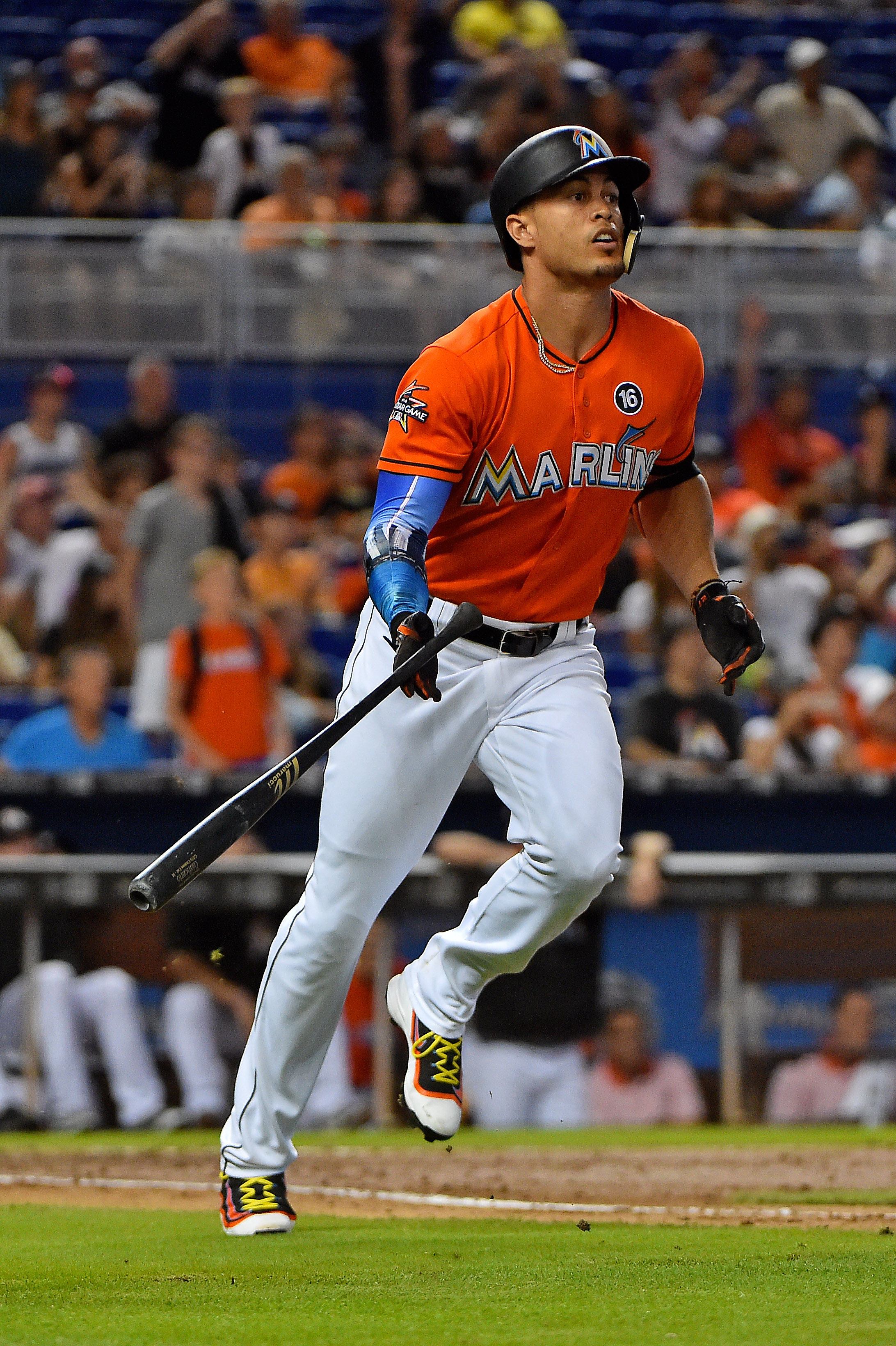
The excellence Stanton has exhibited could be difficult for MVP voters to ignore, particularly if he does reach the celebrated 60 figure by season’s end. In doing so, the 27-year-old would follow Barry Bonds, Mark McGwire, Sammy Sosa, Roger Maris and Babe Ruth as the sixth player to accomplish the feat (McGwire and Sosa each did it multiple times) and the first since 2001. That was the year Bonds smashed a record 73. Remarkably, Stanton may have outdone his former hitting coach had he been as otherworldly in the season’s first half as he has been since the All-Star break.
While Stanton racked up a “mere” 26 long balls in 369 PAs between Opening Day and mid-July, he’s already at 28 through 235 attempts over the nearly two months since the Yankees’ Aaron Judge upstaged him at the Home Run Derby on Stanton’s turf in Miami. Stanton has gone yard every 8.39 trips to the plate in the second half, which would translate to 83 over a 700-PA season (Stanton’s on track for 698). Should Stanton continue to stay healthy and hammer HRs at his second-half pace, he’d finish the year with around 65 – a number only Bonds, McGwire (twice) and Sosa (twice) have matched or exceeded.
As superb as Stanton has been, it goes without saying that it will be immensely difficult for him to keep raking at his current clip over the Marlins’ final 20 games of the season. But both the slate of mostly unspectacular starting pitchers scheduled to face Stanton over the next couple weeks and the Marlins’ three-game set at Colorado’s Coors Field thereafter should aid him in his quest to go deep at least six more times this year. Clearly, Stanton’s on the verge of posting one of the most awe-inspiring offensive seasons in the history of the sport. The question is: Will he pull it off?
How many HRs will Giancarlo Stanton finish with this year?
-
Between 61 and 64 55% (3,261)
-
Fewer than 60 21% (1,274)
-
60 16% (955)
-
65 or more 8% (451)
Total votes: 5,941
Photo courtesy of USA Today Sports Images.