
Astros Place Juan Centeno On Outright Waivers
The Astros have placed catcher Juan Centeno on outright waivers in order to remove him from the team’s 40-man roster, according to a report from Jake Kaplan of the Houston Chronicle.
Centeno is still on the waiver wire, but Kaplan writes that Houston is hoping he’ll clear and remain with the organization at Triple-A. It’ll be his choice whether to do so, as he was previously outrighted by the Twins in 2016.
With a fully-stocked MLB roster, the ‘Stros were likely always going to need to clear some space before potentially adding players from outside the organization. The 28-year-old Centeno was particularly vulnerable given the presence of Brian McCann, Evan Gattis, and Max Stassi.
Centeno has seen big league action in each of the past five seasons, carrying a composite .235/.289/.339 slash line through 315 plate appearances with four different organizations. The left-handed hitter spent most of 2017 at Triple-A, hitting .311/.354/.383 in hist 257 plate appearances
Central Notes: Votto, Kinsler, Twins Pitching Targets
Just in case there was any doubt, MLB.com’s Mark Sheldon writes in response to a fan inquiry that there’s no indication whatsoever that Reds first baseman Joey Votto will end up being moved this winter. The polished batsman, who very nearly took home National League MVP honors for the 2017 season, has given every indication that “he doesn’t want to leave the Reds,” says Sheldon, and can control his own fate through a full no-trade clause.
- Tigers second baseman Ian Kinsler does not enjoy quite so much control over his own fate, but does have a ten-team no-trade list that was drawn up at the end of the 2017 campaign.* Katie Strang of The Athletic (subscription link) has the latest on his interesting trade candidacy, including a look at the feasibility of a move to third for the veteran — which some teams have reportedly considered as they weigh an offer to acquire him. At present, it is not publicly known which teams have contemplated that possibility or — yet more importantly — which are among those that cannot acquire Kinsler without his consent. The Detroit organization would obviously need to work with Kinsler and his representatives if it were to find a match with one of the ten protected rivals, but Strang reports that, at least as of last week, that subject has not yet been broached. As we discussed in examining his potential market yesterday, there are perhaps only a few very clear trade matches on paper at this point, though certainly a fair number of others could be imagined depending upon a variety of factors. Kinsler’s no-trade rights may not come into play at all, but might also afford him an opportunity to nix a move if it is not to his liking.
- While the Twins are said to be taking a look at a variety of controllable starters, there’s “no indication” at this point that they have engaged with the Rays on Chris Archer or the Marlins on Dan Straily, according to Mike Berardino of the St. Paul Pioneer-Press (via Twitter). It stands to reason, though, that both would at least draw internal consideration. The former is quite a lofty target for any team, as he’d draw huge interest if he’s made available in trade talks. The latter is a useful hurler in his own right after turning in solid results for two consecutive years. Straily’s affordable control would surely hold some appeal to Minnesota, though for the same reason the Marlins will likely set forth a relatively steep asking price for a starter who is noted more for his steadiness and contract than anything approaching dominant peripherals.
- The Twins will need to chase down some relief arms, too. Darren Wolfson of 1500 ESPN reports on his podcast (audio link) that the club has engaged the Padres on Brad Hand and the Rays on Alex Colome. Minnesota was previously reported to have chatted with the Reds about Raisel Iglesias, and these new names fit the same general profile as established late-inning arms with affordable remaining control. All will come with appropriately lofty price tags. Berardino also tweets that Cubs lefty Justin Wilson might represent a target for the Twins. Having struggled last year upon landing in Chicago, Wilson could conceivably become available, though that’s far from certain. Minnesota eyed the power southpaw in the past, says Berardino, though that occurred before the current front office leadership came into office.
*An earlier version of this post wrongly suggested that Kinsler had not yet compiled his current no-trade list and mistakenly attributed that notion to Strang’s report. The error was ours and we apologize for any confusion.
Process For Signing Prospects Stripped From Braves
Yesterday brought final word on the long-awaited penalties for the Braves’ amateur signing infractions. Among other things, the Atlanta organization has been stripped of a dozen prospects who were brought in through improper means.
Many of those players were part of a highly-regarded crop of international talent, so they will be of keen interest to other teams. That’s particularly true now that they have had their first taste of the minors, increasing the information available to make an evaluation. MLB will also stage a showcase at the end of the month for these young players.
New information, of course, isn’t always a good thing. Kevin Maitan, the top name on the list of newly-minted free agents, certainly did not boost his stock with a .220/.273/.323 showing in the Appalachian League. Those with Baseball America subscriptions will certainly want to read an updated scouting report on Maitan from J.J. Cooper, who also provides a look at the best of the other prospects who have now been set free.
So, what’s the process for signing these players? We learned some elements of the process yesterday, and MLB.com’s Jonathan Mayo provides a more complete look at the ad hoc rules that will apply here. Here’s a breakdown:
- The players — who get to keep their original bonuses but cannot be represented by the agents that negotiated their original contracts — will be subject to international signing pool restrictions but are otherwise free to sign with any organization.
- MLB teams will be allowed a fresh $200K of bonus pool space to work with to sign any of these prospects. They may elect to draw from either their current signing period pool allocation or that of the 2018-19 period (but not both).
- All MLB teams but the Braves can sign the prospects between December 5th of this year and January 15th of the next. Any players that do not sign within that period will no longer be eligible to receive a signing bonus. The Braves are eligible to pursue any still-unsigned prospects (without a bonus offer) beginning on May 1, 2018.
MLB Announces Permanent Ban For John Coppolella
Major League Baseball has instituted a lifetime ban on former Braves general manager John Coppolella, according to an announcement from commissioner Rob Manfred. The heavy punishment comes as the league moves to punish his former organization for amateur signing infractions during his tenure as GM. Coppolella had already resigned from the Atlanta organization.
Beyond the lifetime ban for Coppolella, the Commissioner’s Office has banned former Braves international scouting director Gordon Blakeley for one year, and commissioner Rob Manfred has also indicated that other members of the Braves’ international scouting staff will be disciplined. Here’s the full statement from Manfred:
My office has completed a thorough investigation into violations of Major League Rules by the Atlanta Braves. The Braves cooperated throughout the investigation, which was conducted by MLB’s Department of Investigations. The senior Baseball Operations officials responsible for the misconduct are no longer employed by the Braves. I am confident that Terry McGuirk, John Schuerholz, Alex Anthopoulos and their staffs have and will put in place procedures to ensure that this type of conduct never occurs again and which will allow the Club to emerge from this difficult period as the strong and respected franchise that it has always been.
The investigation established that the Braves circumvented international signing rules from 2015 through 2017. During the 2015-16 international signing period, the Braves signed five players subject to the Club’s signing bonus pool to contracts containing signing bonuses lower than the bonuses the Club had agreed to provide the players. The Club provided the additional bonus money to those players by inflating the signing bonus to another player who was exempt from their signing pool because he qualified as a ‘foreign professional’ under MLB rules. Consistent with the rules, the Braves could have signed all of the 2015-16 players for the full, actual signing bonus amounts. Had the Club signed the five players to contracts containing their actual bonuses, however, the Braves would have exceeded their signing bonus pool by more than five percent and would have been, under MLB rules, restricted from signing any players during the next two signing periods for contracts with bonuses greater than $300,000.
As a result of the 2015-16 circumvention, the Braves were able to sign nine high-value players during the 2016-17 signing period who would have been unavailable to them had the Club accurately accounted for its signings during the 2015-16 signing period. These players were Juan Contreras, Yefri del Rosario, Abrahan Gutierrez, Kevin Maitan, Juan Carlos Negret, Yenci Peña, Yunior Severino, Livan Soto and Guillermo Zuniga. In addition, the Braves entered into additional ‘package’ agreements in 2016 and 2017 in which they signed Brandol Mezquita, Angel Rojas and Antonio Sucre for reduced amounts, and provided additional money to those players’ agents by signing other players affiliated with their agents to contracts with inflated bonuses. In order to remedy these violations, I am releasing these players from their contracts with the Braves and declaring them free agents eligible to sign with any other Club. The procedures governing the players’ release and the signing process will be communicated to MLB Clubs under separate cover.
The investigation also determined that the Braves: (i) agreed to sign six players to inflated signing bonuses pursuant to an agreement with prospect Robert Puason‘s agent in exchange for a commitment that Puason would sign with the Club in the 2019-20 signing period; and (ii) offered prospect Ji-Hwan Bae extra-contractual compensation. In order to remedy these violations, I am prohibiting the Club from signing Robert Puason when he becomes eligible to sign, and disapproving the contract between Bae and the Braves, which has not yet become effective.
While the remedies discussed above will deprive the Braves of the benefits of their circumvention, I believe that additional sanctions are warranted to penalize the Club for the violations committed by its employees. Accordingly, the Braves will be prohibited from signing any international player for more than $10,000 during the 2019-20 signing period, which is the first signing period in which the Braves are not subject to any signing restrictions under our rules; and the Braves’ international signing bonus pool for the 2020-21 signing period will be reduced by 50 percent.
The investigation also determined that the Braves offered impermissible benefits, which were never provided, to a player they selected in the First-Year Player Draft in an attempt to convince him to sign for a lower bonus. As a penalty for the Club’s attempted circumvention involving a draft selection, the Braves will forfeit their third-round selection in the 2018 First-Year Player Draft.
With respect to individual discipline, former Braves General Manager John Coppolella will be placed on the permanently ineligible list, effective immediately. Former Braves Special Assistant Gordon Blakeley will be suspended for a period of one year, effective immediately, and may not perform services for any MLB Club during his suspension. I intend to discipline other Braves’ International Baseball Operations employees who participated in the misconduct after the completion of our internal procedures. My staff will speak to the Players Association and officials in the Dominican Republic regarding appropriate consequences for the representatives of the players who intentionally participated in schemes to circumvent our rules, none of whom are certified by the Players Association.
The ramifications are significant for the Braves, whose capacity for amateur talent acquisition over the next several years will be hammered. Both Maitan and Gutierrez were ranked among the Braves’ top 30 prospects at MLB.com, with Maitan having ranked fifth overall and Gutierrez ranking 30th. The forfeiture of those prospects will mean that more than $10MM worth of amateur bonuses have now been squandered, and the Braves will also feel that pain of MLB’s sanctions in next year’s amateur draft and through the 2021 season on the international market.
The role that former president of baseball operations John Hart did or didn’t play in these infractions remains unclear, but Hart, who was given a reduced role in the front office upon the hiring of new GM Alex Anthopoulos, announced his resignation from the organization last week. A split between the two sides seemed largely inevitable; either Hart played a knowing role in the most significant circumvention of MLB’s international amateur free agency system to date, or he exhibited a stunning level of negligence in allowing these infractions to be committed without his knowledge. Neither of those scenarios seems excusable.
The Braves have also issued a statement on the matter:
Today, Major League Baseball informed the Atlanta Braves organization of sanctions being levied as a result of their investigation. As MLB stated, the Braves cooperated fully throughout this investigation and we understand and accept the decision regarding the penalties that have been handed down. As we expressed last week, our organization has not lived up to the standard our fans expect from us and that we expect from ourselves. For that, we apologize. We are instituting the changes necessary to prevent this from ever happening again and remain excited about the future of Braves baseball. We do not plan to comment further on this matter.
That the Braves won’t comment further on the matter runs somewhat contrary to comments made by Braves CEO Terry McGuirk last month. Speaking with Tim Tucker of the Atlanta Journal-Constitution, McGuirk stated: “I don’t think there will be any questions (unanswered) when we are able to discuss it.”
Meanwhile, Blakeley has also issued a statement on his year-long suspension (via Ken Rosenthal of The Athletic, on Facebook):
I am obviously very disappointed in the Commissioner’s decision regarding my suspension, particularly given my 32 years of untarnished service to the game. That said, I am in the digesting the Commissioner’s findings and considering all of my options going forward. I take responsibility for my actions in this situation; however, I always acted under the direction of my superiors.
Latest On NPB-MLB Posting Negotiations
Last night, we learned that the Major League Baseball Player’s Association had extended its deadline to finalize an agreement regarding the transfer system for players moving between Japan’s Nippon Professional Baseball and Major League Baseball. With a new union-imposed stopping point at 8pm EST today, the parties in interest — including the three entities just mentioned as well as NPB’s member teams, individually — are expected to continue negotiating in hopes of finding agreement on posting rules that will allow NPB clubs to make certain players available to MLB teams — including, especially, young Japanese phenom Shohei Ohtani.
We’ll use this post to track and analyze the key news on talks as it hits the wire:
- There’s general optimism that something will get done, Jon Heyman of Fan Rag tweets. Sherman tweets that the talks are “down to [a] few items,” but notes that the signals are that tonight’s deadline is a firm one for reaching agreement.
Earlier Updates
- There has been a critical potential settlement of one major sticking point, according to MLB Network’s Jon Morosi (Twitter links). MLB and MLBPA have resolved their differences regarding the question of when NPB teams would have the ability to “pull back” posted players who do not achieve a contract that would convey sufficient transfer fee value to their would-be former organization. This provision — the details of which remain unknown — will still need to be considered by NPB and its teams, of course, but resolution of the matter might conceivably put the parties on track to finalizing a deal.
- “Pull back” rights are of particular importance to the system’s operation because the new rules under contemplation would allow NPB teams to collect a percentage of a contract’s guarantee as the transfer fee, rather than a fixed transfer amount determined before the player in question tries to work out an agreement with a MLB club. Understandably, NPB teams are interested in protecting themselves if a player’s market does not develop as hoped, while the union is likely concerned with the possibility that too much latitude might engender disruptions in the broader player market, potentially harming MLB free agents.
- While that report generally strikes an optimistic tone, Joel Sherman of the New York Post (Twitter link) hears that “big hurdles” remain. Whether those revolve around the pull-back issue or others is not clear at this moment.
MLB Strips Braves Of 12 Prospects, Applies Future Amateur Restrictions
The Braves are slated to lose their rights to a dozen young prospects as punishment for international signing violations. Additionally, the Atlanta organization will face limitations on their amateur signing rights in the future.
Most notably, perhaps, the Braves will lose their rights to highly regarded prospect Kevin Maitan, as Jon Heyman of Fan Rag first reported (via Twitter) and as earlier reporting suggested. A long list of others are also being stripped from the organization, as Ben Badler of Baseball America reported earlier. Backstop Abrahan Gutierrez, shortstop Yunior Severino, righty Juan Contreras, shortstop Livan Soto, righty Yefri del Rosario, shortstop Yenci Pena, righty Guillermo Zuniga, outfielder Juan Carlos Negret, and outfielder Antonio Sucre are also heading on to the open market, according to the Baseball America report. Those prospects were members of the club’s vaunted 2016-17 July 2 class. A big name from the following signing period, Korean shortstop Jihwan Bae, is also being taken from the team, per Jeff Passan of Yahoo Sports, with outfielder Brandol Mezquita and shortstop Angel Rojas rounding out the list of departing prospects.
Maitan, in particular, was viewed as one of the best young international players in recent memory at the time of signing. Despite a tough debut in the Appalachian League, the infielder ranks 38th on MLB.com’s latest list of the top prospects in baseball. Even if it’s true that the current front office is not quite as enamored with Maitan as some others, he’s a notable asset to lose. (BA’s J.J. Cooper rounds up the latest impressions of Maitan right here.)
Looking forward, the Braves will also face restrictions for future amateur classes, as Passan details. The club will be capped at $10K per player for the 2019-20 period and will not be allowed to sign shortstop Robert Puason. According to Passan, the investigation found that the team had improperly agreed to a deal with him ahead of his market eligibility. In 2020-21, Atlanta will operate with half of the hard-capped spending capacity it otherwise would have had access to. Also, owing to an offer of “extra benefits” to 2017 draftee Drew Waters, the Braves will lose their third-round pick in next summer’s draft.
Other organizations will surely flock to sign the players that are now free agents. Those prospects will be allowed to retain their original bonuses in addition to negotiating new ones. Generally, those players will be subject to the already-extant rules and limitations in the international arena. But Passan tweets that teams will be allowed to use currently available international funds or draw from their 2018-19 pool to sign these players (but may not utilize both). MLB organizations still have uncommitted international money — some of it likely earmarked for Shohei Ohtani and a few other quality names still available — so there could be quite some competition for the former Braves prospects.
Clearly, the Braves took a significant hit for the amateur infractions that occurred during the regime of president of baseball operations John Hart and GM John Coppolella. Those two executives have departed already (see here and here), with the latter having received the brunt of the public scrutiny. Though precise details are still largely unreported, Passan says signing-bonus packaging was the primary concern identified. While the Yahoo Sports report acknowledges that other organizations have likely engaged in generally similar behavior, it seems the Braves’ actions were particularly brazen and widespread.
Newly minted GM Alex Anthopoulos will still have plenty of talent to work with, but the cupboard of young talent won’t be quite as stocked as the organization had hoped when it snapped up an impressive group of international free agents — evidently, through illicit means. On the one hand, these penalties won’t have any direct effect at the MLB level, since none of these players was close to the big leagues. On the other, Anthopoulos will not have as much flexibility to part with far-off talent if he enters the trade market in search of assets. That’s all the more notable given the restrictions on international spending rights for the coming seasons. The net result is that the Braves’ talent intake at the most youthful level will have been substantially curtailed for multiple consecutive seasons. Such a result runs directly counter to the overall strategy that the organization had employed.
For Anthopoulos to craft an overall slate of players that promises the kind of sustainability that Atlanta (like all organizations) hopes to create, he’ll have to remain all the more mindful of finding opportunities to draw in younger assets even while exploring ways of moving the major league roster into position to contend. Taking chances on talented but risky players on the 40-man roster is one way of infusing talent, but the club would need to sacrifice certainty and/or tie up valuable roster spots to do much of that. It’s also possible that the Braves will end up moving some higher-level prospects to build out the lower levels, though again that’s a diversion of resources that could otherwise be utilized in other ways. Any way you slice it, the organization will be much more constrained than it would have been absent the penalties. Of course, that also seems to be a fairly natural result of the fact that the team acquired these young players in an improper manner (the details of which, somewhat surprisingly, have yet to be fully detailed in firm reports).
Aaron Judge Undergoes Shoulder Surgery
Breakout Yankees slugger Aaron Judge has undergone arthroscopic surgery on his left shoulder, according to a club announcement. Per the announcement, Judge received a “loose-body removal and cartilage clean-up.”
Fortunately for New York, the surgery does not seem to be a major concern for the young outfielder. He is expected to wrap up his rehab in time to participate fully for Spring Training.
Last spring, expectations for Judge were mixed. He had struggled in his MLB debut in 2016 and was not even a sure thing to make the Opening Day roster. But he ended up turning in a monster campaign, taking home Rookie of the Year honors and placing second in the MVP race in the American League.
Looking For A Match In An Ian Kinsler Trade
The offseason is off to a sluggish start, due perhaps to the ongoing trade talks involving Marlins star Giancarlo Stanton and the as-yet unresolved posting situation of Shohei Ohtani. Resolution on both matters may well come before long. In the meantime, we’re left to wonder which dominoes might be first to be knocked over thereafter — or, perhaps, whether some other transactions could jumpstart the action.
One player who we have consistently labeled a clear trade candidate is Ian Kinsler of the Tigers. He’s a quality veteran with one year left on his contract who’s currently employed by an organization that’s clearly rebuilding. And Detroit’s top baseball executive, Al Avila, has hardly made a secret of the club’s interest in taking offers.
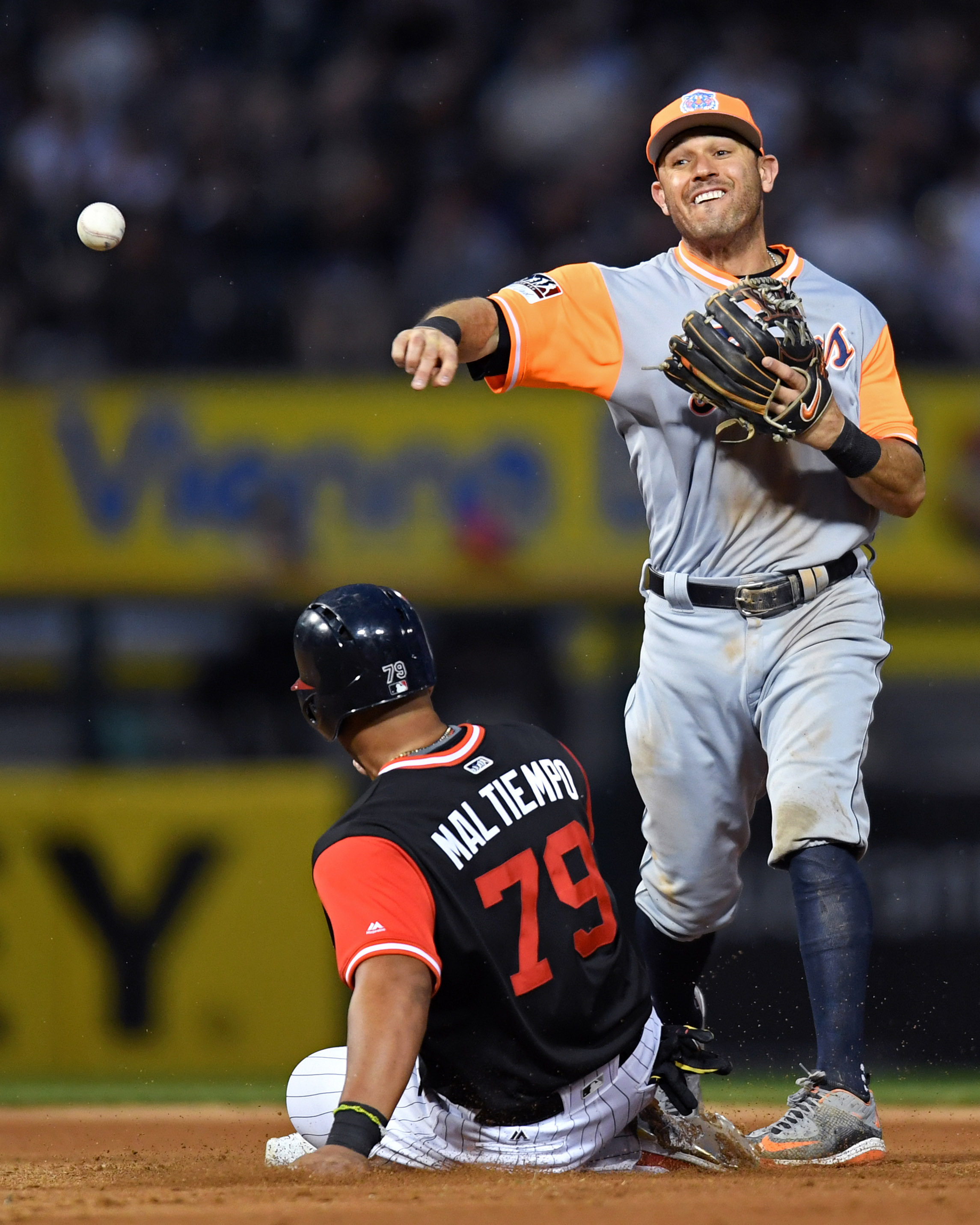
With that in mind, it’s worth analyzing his market. Let’s start by sketching the asset under question. Kinsler is set to earn a manageable $11MM salary this year before reaching the open market. Though he’s 35 years of age and hit just .236/.313/.412 last year, Kinsler made plenty of hard contact and was likely somewhat unfortunate to carry a .244 batting average on balls in play. He also produced at a much loftier .288/.348/.484 clip the season prior and has a history of solidly above-average offensive work. Perhaps even more importantly, Kinsler has long rated as a superior defender and has been exceptionally durable, reaching 600 plate appearances every year since 2011.
There are other players available at second base, which will have an impact. On the trade side, Dee Gordon of the Marlins is much younger and comes at a similar annual cost over a three-year term, while the Phillies could be willing to deal the youthful and inexpensive Cesar Hernandez. Neil Walker is the top available free agent, with Howie Kendrick and Brandon Phillips among the other potential alternatives. Still, no other player carries quite the profile of Kinsler, whose reliability and palatable contract hold obvious appeal.
There are a few other considerations that could enter the picture. Per MLB.com’s Jon Morosi, via Twitter, at least some organizations have considered acquiring Kinsler with the intention of utilizing him at third base. That’s a bit of a surprise, given that Kinsler is about as entrenched as any player at his usual position and has no more than nominal experience at third as a professional. Even if he can handle the hot corner, the added uncertainty would seem to reduce some of the very features that make Kinsler such an appealing target in the first place. It also may tie into his limited no-trade rights, which allow him to block deals to ten teams (though we don’t know which for the current season). While we don’t know for certain just what considerations will drive Kinsler’s views, it stands to reason that he’d be open to moving to a contending team at this stage.
With all that out of the way … where might Kinsler represent a match?
Angels — The Halos are already rumored to be looking at Kinsler, among other options. The organization has a clear need at second, possesses the payroll space and the competitive desire for this sort of player, and recently dealt for Justin Upton from Detroit. As fits go, this is about as clean as it gets. Of course, every other second baseman or team with one to trade will also be engaged with L.A. GM Billy Eppler, and he’ll likely shop around for value.
Blue Jays — While the Jays are in need up the middle, it’s not obvious from the outside that Kinser would really make the most sense. On the one hand, if Kinsler is willing to move around a bit, he’d look to be a solid match for the club’s stated desire in a utility player that might see near-regular action. On the other, he may or may not embrace that sort of role — which would be of particular relevance if the Jays are on Kinsler’s no-trade list. Indeed, Kinsler has reportedly nixed a move to Toronto previousy. It’s conceivable that the Jays could get creative, perhaps using Devon Travis as the utility-oriented player and installing Kinsler full-time at second, but that’s entering the realm of messy speculation.
Braves — Atanta is one of the organizations that could in theory view Kinsler as an option at third. He’d represent a solid veteran presence, plug a need (if he and the team are comfortable with making that position change), and avoid clogging the future balance sheet or blocking prospect Austin Riley in the future. At the same time, new GM Alex Anthopoulos is just settling in and it’s not yet entirely clear how he’ll proceed this winter. File the Braves under “not inconceivable but not outwardly likely.”
Brewers — There was some rumored interest from Milwaukee in Kinsler at the trade deadline and the Brewers haven’t yet firmed things up at second. There are options on hand, as the club struck a new contract with Eric Sogard and still has Jonathan Villar. And Milwaukee might like the idea of pursuing Neil Walker, who was the player ultimately added over the summer. Generally, though, acquiring Kinsler might allow the Brewers to boost their chances at competition without a huge outlay or long-term commitment, so they seem to be one of the more promising fits.
Giants — Third base is open; as above, then, this is a speculative fit in that regard. San Francisco has reportedly also at least engaged in some thought of trade permutations that might involve current second bagger Joe Panik, though at present it hardly seems likely that he’ll end up moving. Particularly if the team ends up breaking the bank to add Giancarlo Stanton or otherwise makes significant moves toward a rebound, Kinsler could make for a good value that wouldn’t compound the team’s concerns about adding aging veterans on lengthy contracts.
Mets — We’ve seen the Mets connected to Kinsler and the team is definitely weighing its options at second, so this makes immediate sense on paper. New York is believed to be working with some payroll restraints, though, so other moves could foreclose Kinsler as a plausible option. On the other hand, the team may like the idea of gaining a boost without adding too much salary, so it’s also imaginable that it would pursue Kinsler and then try to find cheaper upgrades in its other areas of need. (There are quite a few options in the first base/corner outfield market that the team is also exploring.)
Royals — Whit Merrifield established himself at second, but perhaps he or Kinsler could be options at third. The Royals will be walking a fine line this winter, weighing the risks of a big payroll with the desire to sustain competitiveness and perhaps bring back one or two of its own star free agents. It’s not impossible to imagine Kinsler fitting in if the team manages to land Eric Hosmer and wants to install a solid veteran without tacking onto the future balance sheets, though it’s an awfully tight fit at first glance.
That really represents the field of the most likely suitors, as things stand. Roster changes can always shake things up, of course, and organizations such as the Yankees and Cardinals could in theory end up seeing Kinsler as an option at second or third if they first line up corresponding moves involving existing players. (At least some chatter has suggested those teams are considering infield moves, though it’s exceedingly speculative at present.) Somewhat similarly, the Dodgers reputedly had interest in Kinsler in the past, but they picked up their option over Logan Forsythe and it’s tough to imagine both fitting sensibly on that roster. There’s a match in terms of potential need for some other clubs — the Pirates, Diamondbacks, and Rays, for example — but the payroll limitations at play in those situations make it difficult to imagine without several intervening developments first coming to pass.
All told, then, the clearest matches on paper exist with three organizations. The Angels, Brewers, and Mets could all simply install Kinsler as an everyday option at second without significantly altering other aspects of their roster construction. But other transactions could create new fits, and it’s also far too soon to rule out other clubs getting a bit creative.
Photo courtesy of USA Today Sports Images.
East Notes: Jays, Orioles, Jeter, Rizzo
It’s possible the Blue Jays could weigh a run at star free agent outfielder J.D. Martinez, Jon Heyman of Fan Rag writes. At the moment, that seems like a fairly tenuous connection; Heyman explains that the team has “at least considered” Martinez but may also be hesitant to participate in a bidding war to get him. But that’s more than we’ve heard of at least some other conceivable landing spots for the best hitter on this year’s open market; the Cardinals, for instance, are said not to have much inclination to pursue him.
Here’s more from the eastern divisions:
- The Orioles nearly swung a trade last night with the Rockies, Roch Kubatko of MASNsports.com reports. The organizations were discussing a deal in which Baltimore would pick up righty Konner Wade in exchange for international pool funds. Though nothing ended up getting done, Kubatko suggests it could still be a possibility. He also goes on to discuss the O’s decisions on protecting players from the Rule 5 draft, including a few names that could be targeted by other organizations.
- Tim Healey of the Sun Sentinel takes an interesting look at Marlins CEO Derek Jeter‘s crash course in running a baseball front office. Jeter has called the move “overwhelming” in the same way it was to finally reach the majors as a player, acknowledging he’ll have to “learn on the job” to a large extent. President of baseball ops Michael Hill suggests the two have established a good working relationship out of the gates. As ever, the proof will be in the doing; the Marlins made a small swap yesterday, but have much bigger fish to fry this winter.
- While the Nationals front office has long been helmed by Mike Rizzo, his future with the organization is not assured at present. Chelsea Janes of the Washington Post writes that Rizzo and ownership have yet to discuss a new deal. And the veteran executive says he isn’t going to be the one to kick off talks, saying he’ll “allow [ownership] to talk to me if they choose to” and noting that he’s comfortable entering the offseason without a long-term contract. Janes tackles some of the many facets to the situation in the post, which is worth a full read.
Hisashi Iwakuma Says He Is Weighing Offer To Return To Mariners
Veteran righty Hisashi Iwakuma told reporters in his native Japan that he is weighing an offer to return to the Mariners, as the Japan Times reports (h/t MLB.com’s Greg Johns). The precise nature of the team’s proposal is not known.
The 36-year-old Iwakuma says that, while there’s nothing official at the moment, he may “be able to make a positive announcement soon.” He added that he hopes to rehab his surgically repaired shoulder “in time for the start of the new season.”
The 2017 campaign was more or less a total wash for Iwakuma, who turned in six mediocre starts before his shoulder put him on the shelf. He lost nearly three miles per hour on his average fastball while recording only 16 strikeouts and surrendering seven long balls in 31 frames.
Seattle recently made the easy call to decline a $10MM club option over Iwakuma, preferring instead to pay him a $1MM buyout. That decision wrapped up the contract — a one-year pact with consecutive vesting/club options — that brought the veteran hurler back to the M’s after a physical scuttled a deal with the Dodgers in the 2015-16 offseason.
As MLBTR’s Connor Byrne detailed in examining the Mariners’ offseason needs, the club has a variety of options on hand to fill out the staff. But while GM Jerry Dipoto has generally expressed satisfaction with the existing unit, there are plenty of questions — and opportunities — remaining in the rotation.
Taking a low-risk shot on the respected Iwakuma would certainly be one way for the team to open the door to finding some quality innings. In 2016, Iwakuma turned in 199 innings of 4.12 ERA pitching. And he was quite a bit more productive in the four seasons before that, working to a cumulative 3.17 ERA with 7.6 K/9 and 1.7 BB/9 through 653 2/3 frames after moving to Seattle from Japan’s Rakuten Golden Eagles before the 2012 campaign. Regaining anything approaching that form, though, will obviously require a full return to health.