
Injury Notes: Kaprielian, Ross, Beltre, Bush, Gutierrez, Bailey, M’s
Yankees pitching prospect James Kaprielian is weighing whether or not to undergo surgery, GM Brian Cashman told reporters including Erik Boland of Newsday (Twitter links). Cashman didn’t make clear just what surgical options might be on the table for the 23-year-old, who is said to have experienced elbow pain recently, but all the hints suggest it could be a significant injury. “The rehab process has not been successful,” said Cashman, “so he’s facing some decisions.” Kaprielian also dealt with elbow problems last year, limiting his ability to gain minor-league experience, but there were still suggestions that the 2015 first-rounder might factor at the MLB level this year.
Here’s more on some health situations from around the game:
- The Rangers have provided some updates on several players, all via T.R. Sullivan of MLB.com (links to Twitter). Righty Tyson Ross will need to hold off on his rehab for a bit after experiencing upper back spasms. While it doesn’t appear as if there’s any broader concern, it will slow his timeline by at least a week. Meanwhile, Adrian Beltre‘s new calf injury will likely cost him enough time to be measured in weeks rather than days, per assistant GM Mike Daly. Understandably, the club is charting a cautious course with the veteran, who had been nearing his return from calf issues before suffering another strain in a different area of the muscle. Finally, the team will wait to see how setup man Matt Bush responds to an injection before determining whether he’ll need a DL stint for his sore shoulder.
- Dodgers outfielder Franklin Gutierrez is headed to the 10-day DL with a hamstring strain, as Bill Shaikin of the Los Angeles Times reports (Twitter links). He’ll be replaced for the time being by Trayce Thompson, but skipper Dave Roberts says it’s expected to be only a one-to-three-week layoff.
- The Angels have placed righty Andrew Bailey on the 10-day DL to rest his inflamed shoulder, per a club announcement. He’ll be replaced on the active roster by fellow righty Daniel Wright. It’s not yet clear just how long Bailey will be down. For Wright, this’ll be his third call-up to the majors; he saw action last year with both the Reds and Angels, working both as a stater and from the pen.
- Mariners righty Tony Zych could be nearing a return, as Bob Dutton of the Tacoma News Tribune reports, with Steve Cishek not farm behind him. It remains to be seen whether Zych will head to the MLB roster, as he could also be optioned. Manager Scott Servais praised the righty’s form after a sim game, saying he looked “very sharp.”
Braves Place Matt Kemp On 10-Day DL, Promote Johan Camargo
The Braves have announced that outfielder Matt Kemp is headed to the 10-day DL. He’ll be replaced on the active roster by infielder Johan Camargo, as David O’Brien of the Atlanta Journal-Constitution first tweeted.
Kemp, who last played on Friday, has been bothered by a hamstring injury. Evidently, it hasn’t improved enough to believe he’ll be ready to return within the next few days. Still, the placement is backdated to April 8th, and with the new ten-day minimum it could be a short absence.
The veteran outfielder was off to a strong start, with eight hits (two of them home runs) in his 17 trips to the plate. The 32-year-old is looking to follow up on his strong numbers upon arriving in Atlanta last summer. Over his 241 plate appearances with the Braves, he slashed .280/.336/.519 with a dozen home runs while dramatically improving his plate discipline numbers (20 walks, 56 strikeouts) after a power-only first half with the Padres.
It’s a somewhat aggressive promotion for Camargo, meanwhile, who only just reached Triple-A. But he’ll likely function as a little-used bench option as he gets his first taste of the majors. Camargo hit just .267/.304/.379 over 491 plate appearances at Double-A last year, but did hit well in MLB camp this spring. The versatile infielder — he’s a switch-hitter who has seen action at short, second, and third in the minors — seems like a long-term possibility for a reserve role, as Eric Longenhagen of Fangraphs wrote in his recent look at the Braves’ farm.
Transaction Retrospection: The Elvis Andrus Extension
In early April of 2013, the Rangers struck what was then described by GM Jon Daniels as “an unusual deal” with shortstop Elvis Andrus. Daniels was likely referring to the complicated structure, which included two opt-out opportunities (following the 2018 and 2019 campaigns), but it has proven unusual in other ways.
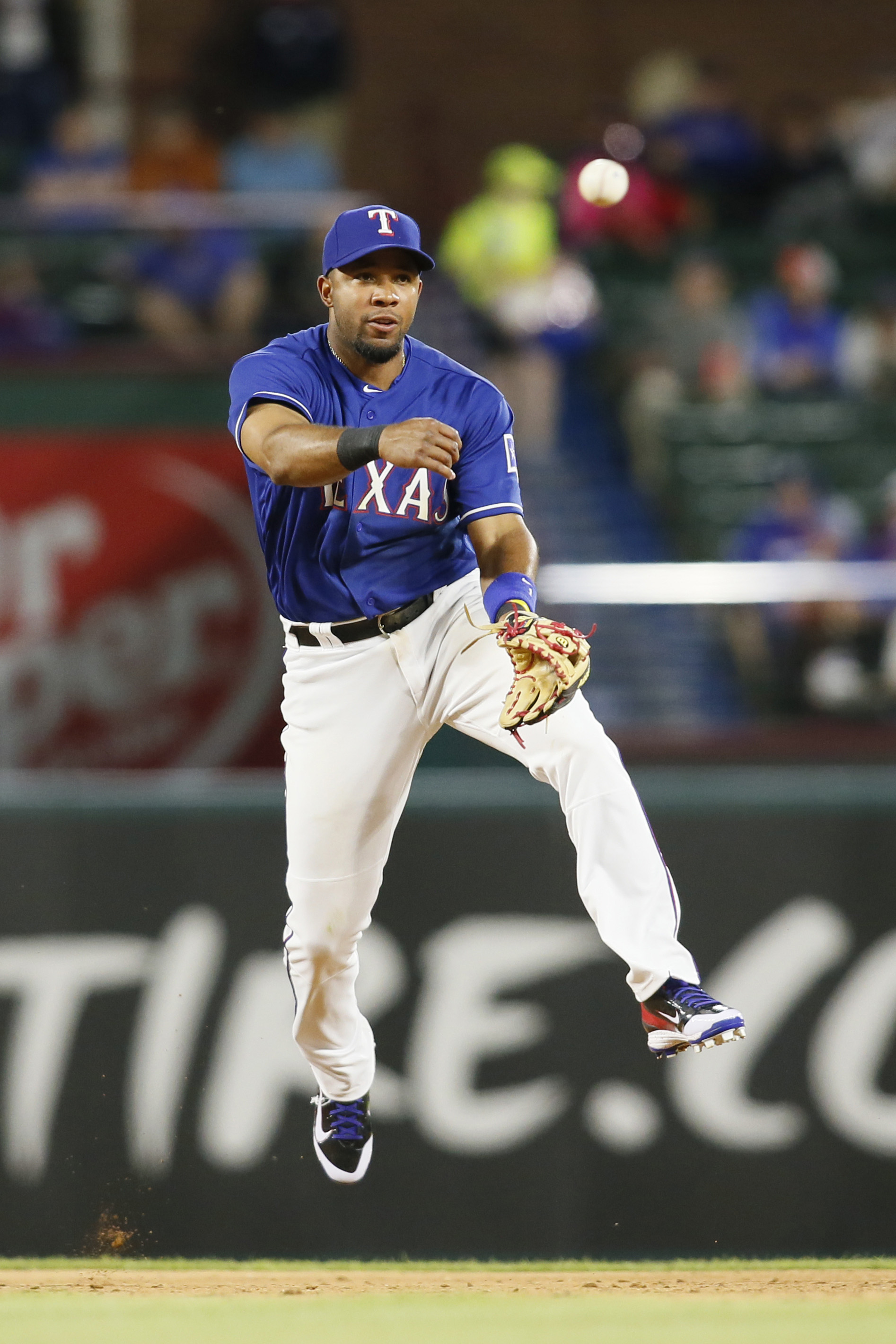
Opt-out provisions are now fairly common, particularly in large free-agent deals and extensions reached with players who already have significant service time. But contracts of the size of the Andrus deal — which guaranteed him $120MM over eight years (beginning in 2015) — are a rarity for players of that general service time. Andrus, who had already agreed to one prior extension, had just begun his 4+ service-class year. Since his deal was made, just two players with at least three but less than five years of service — i.e., experienced players who aren’t entering a contract year — have cleared $100MM in guaranteed money. Those other deals went to franchise faces Giancarlo Stanton and Freddie Freeman.
Indeed, Andrus looks like something of an outlier when you expand the terms further to include 2+ players and look a bit further back. In addition to the three players noted above, here’s the list of players who scored nine-figure guarantees when they had more than two but less than five years of service (within the time period covered by MLBTR’s Extension Tracker):
- Kyle Seager (2+): seven years, $100MM
- Evan Longoria (4+): six years, $100MM
- Ryan Braun (3+): five years, $105MM
- Ryan Howard (4+): five years, $125MM
- Mike Trout (2+): six years, $144.5MM
- Miguel Cabrera (4+): eight years, $152.3MM
- Troy Tulowitzki (4+): ten years, $157.75MM
- Buster Posey (2+): eight years, $159MM
- Joey Votto (4+): ten years, $225MM
Needless to say, these were all players who were (or, at least, were viewed by their organizations as) franchise-level talents. Andrus was certainly on the young side for this group; he was then entering his age-24 campaign. Only Trout and Freeman were younger, the latter only marginally so. And its fair to note that Andrus landed clearly on the low side of the total guarantees included in this somewhat arbitrary list.
Still, it was then and remains surprising to see Andrus in such company. Also, the opt-out opportunities weren’t present in those other contracts, which reduced the team’s upside. He had yet to post even a league-average batting line (and wouldn’t crack that barrier until 2016). And though he did rate as a high-quality fielder and outstanding baserunner, he graded out more as a quality first-division regular than a superstar. Fangraphs and Baseball-Reference each valued his 2011 season as his best, with the former crediting him with 4.0 WAR and the latter pegging the overall value at 4.2 WAR.
The first two years after the agreement weren’t kind to the team. Between 2014 and 2015, Andrus slashed just .261/.312/.345. While he swiped 52 bags, he was gunned down on 24 attempts. And his fielding grades took a precipitous tumble. Entering the 2016 season, Texas was still on the hook for $103MM over the following seven years. And it seemed rather unlikely that Andrus would bail on the contract’s back end.
Things did change for the better last year, however. Though Andrus didn’t recover his standing as a baserunner and gloveman, he did finally break through somewhat at the plate. Over 568 plate appearances, he slashed .302/.362/.439 — representing career-best marks in all three categories and working out to a 112 wRC+. There were some underlying changes at work, many of which represented carryovers from a shift that began the season prior. It was in 2015 that Andrus began to take a more aggressive approach, increasing his swing rate, producing a big drop in his groundball-to-flyball ratio and increasing the number of balls he pulled while largely maintaining his typically excellent contact skills.
Of course, Andrus wasn’t all that good with the bat in 2015. The biggest difference between that season and his strong 2016? Yep, a fifty point jump in BABIP (from .283 to .333). It’s an open question whether 2015 was weighed down by bad luck or whether 2016 was boosted by good fortune — perhaps the answer lies somewhere in the middle — but the Rangers will surely hope it’s the former. Andrus has hit well in the early going in 2017, despite carrying a .278 BABIP, though it’s far too soon to know whether that will continue.
As things stand, Andrus will open the current season with a six-year, $88MM deal that still includes the two opt-out chances. (Andrus can opt out of four years and $58MM or three years and $43MM.) It’s questionable whether he’d have received anything like that on the open market this past winter, though perhaps that depends in part upon how organizations view his current tools and how they value his 2016 season — which B-Ref values at a robust 3.7 WAR, but Fangraphs pegs at only 2.1 WAR.
It seems rather unlikely that the Rangers will get the kind of value they hoped for when they paid Andrus like a premier player. Indeed, they arguably didn’t even receive a fair ROI for the $15MM salaries Andrus took down in each of the past two seasons. But it’s still possible the deal could work out reasonably well over the long run, or even that he’ll find cause to opt out; after all, with two productive years, Andrus could conceivably expect to find yet more money on the open market in advance of his age-30 season.
Photo courtesy of USA Today Sports Images.
Brennan Boesch To Retire
We’ll track the day’s minor moves right here …
- Outfielder Brennan Boesch is set to retire, according to Bill Shaikin of the Los Angeles Times (via Twitter). Boesch, who’ll turn 32 tomorrow, spent parts of six seasons in the majors, appearing with the Tigers, Yankees, Angels, and Reds. He last cracked the bigs in 2015, but saw the bulk of his action from 2010-12 with Detroit. At his best, in his sophomore campaign, Boesch slashed .283/.341/.458 with 16 home runs. The left-handed hitter spent last year with the Red Sox organization, missing much of the season due to a broken wrist and batting just .221/.266/.345 in 158 Triple-A plate appearances upon his return.
Central Notes: Martinez, Reds, Hughes, Thames
Tigers right fielder J.D. Martinez was able to take BP yesterday, manager Brad Ausmus tells Evan Woodberry of MLive.com (via Twitter). That puts the slugger a bit ahead of schedule in his rehab timeline from a lisfranc sprain in his right foot. The expectation had been that Martinez would not resume baseball activities until mid-April. Detroit is obviously hoping to get Martinez back quickly, while also balancing the need to ensure he doesn’t suffer a setback along the way.
Here’s more from the central divisions:
- Reds skipper Bryan Price is backing up the organization’s promise to utilize unconventional bullpen tactics, as C. Trent Rosecrans of the Cincinnati Enquirer writes. Yesterday, top setup man (and occasional closer option) Michael Lorenzen entered with the bases loaded in the third, putting out that fire and staying in to record three scoreless frames. (That’s not all; Lorenzen will also factor as a pinch-hitter.) Top baseball ops man Dick Williams has preached outside-the-box thinking for the rebuilding organization, with flexible, multi-inning relief outings representing one point of apparent focus. Top closer option Raisel Iglesias is also slated to continue throwing more than one frame from the pen at times, as he did on 17 occasions last year.
- New Brewers reliever Jared Hughes discussed his transition from the NL Central-rival Pirates with Todd Rosiak of the Milwaukee Journal-Sentinel. He wasn’t surprised when he was cut loose by Pittsburgh, the only organization he had known to this point. “They told me early in spring that if it wasn’t going to be a great spring that they might need to part ways,” said Hughes. He noted, though, that struggling in camp is mostly a byproduct of his big frame. “I’ve got long levers,” said Hughes. “I need to get the timing of my sinker. … My sinker was not sinking the way it should have been. By the end of spring I was getting groundball outs. I’d imagine the Brewers saw it, and that’s what I’m doing now in the season.” Indeed, Hughes has generated eight grounders in 4 1/3 scoreless innings, though he has also issued four walks against just one strikeout thus far.
- Another new Brewers player, first baseman/outfielder Eric Thames, took a much more circuitous route to Milwaukee. MLB.com’s Adam McCalvy details how he landed with the Brewers, identifying the statistical and scouting analysis — as well as the “old-school sit-down” — that led to the three-year, $16MM pact. Thames, who is back in the majors for the first time since 2012, is off to a fine start. He owns a .333/.429/.611 slash through 21 plate appearances, though that comes with the usual sample caveats. Thamas has also gone down on strikes eight times against three walks and has hit safely on over half the balls he put in play.
Orioles To Re-Sign Michael Bourn
The Orioles have reached agreement on a new minors deal with veteran outfielder Michael Bourn, according to ESPN.com’s Jerry Crasnick (via Twitter). He’ll report to extended spring training, Roch Kubatko of MASNsports.com tweets.
Bourn, 34, seemed likely to make the O’s roster when he signed on over the winter, but a broken finger intervened. In the meantime, Baltimore has opened the season with fellow minor-league signee Craig Gentry functioning as a defensively-minded reserve outfielder.
Once Bourn is back to health, then, he’ll be working to unseat Gentry. If and when he returns to the majors, he’ll look to pick up where he left off last year, when he slashed .283/.358/.435 in a 55 plate appearance stint with the O’s. That’s a tiny sample, of course, and Bourn has not been nearly so productive otherwise in recent campaigns.
Injury Notes: Bradley, Posey, Segura, Osuna, Desmond, Gray/Bassitt, Weaver
The Red Sox have placed center fielder Jackie Bradley Jr. on the 10-day DL, as Ian Browne of MLB.com was among those to report. Bradley was diagnosed with a knee sprain caused by a misstep while running the bases. An MRI did not reveal more significant damage, so the hope is he won’t miss much more than the minimum.
Let’s check in on a few health situations of note from around the game …
- Giants star Buster Posey departed the club’s game today after being struck in the head by an errant pitch, but thankfully indications are he escaped any significant injury. As Andrew Baggarly of the Mercury News writes, Posey passed a concussion test and told teammates he was fine. That’s not conclusive, of course, but for now the team does not plan to make a roster move to fill in for the stellar backstop, as Baggarly further notes on Twitter.
- Mariners shortstop Jean Segura was also pulled today with an injury, though it doesn’t appear to be a major concern. Manager Scott Servais told reporters, including MLB.com’s Greg Johns (Twitter link), that it’s a “very mild” hamstring issue. For now, at least, the key offseason addition won’t be headed for the DL, with Servais calling him day to day.
- The Blue Jays anticipate that closer Roberto Osuna will be able to return to action tomorrow, as Ben Nicholson-Smith of Sportsnet.ca reports. The excellent young reliever opened the year on the 10-day DL owing to a cervical spasm, though that placement was backdated. He made it through a sim game and now seems ready to return to the majors — where he’ll try to pick up where he left off in a strong 2016 season.
- There are several important Rockies players still working back from injury, and Nick Groke of the Denver Post has the latest. Ian Desmond, Tom Murphy, and David Dahl all seem to be progressing, with the trio possibly slated to return by the end of the month. Desmond, who’ll suit up at first base for the first time when he’s ready, seems to have the clearest progression at this point. Per Groke, Desmond will start to throw and field at some point this week.
- Athletics righties Sonny Gray and Chris Bassitt are making strides in their rehabs, as Susan Slusser of the San Francisco Chronicle reports. Grey’s lat strain is healing well enough that he was able to work up to 35 pitches from the bullpen today. That could leave him on track to return tot he majors before April is out, per the report. Bassitt, meanwhile, is on the cusp of a rehab stint, though Slusser notes that he’s likely to take a full month in the minors since he’s working back from a year-long layoff owing to Tommy John surgery.
- Though he’s currently stashed at Triple-A, Cardinals righty Luke Weaver is a key piece of the organization’s depth (and future rotation plans). He is headed for a DL stint with lower back stiffness, as MLB.com’s Jenifer Langosch reports on Twitter. At present, it’s not clear what kind of an absence is anticipated.
Minor MLB Transactions: 4/10/17
Here are the latest minor moves from around the game:
- Righties Ray Black and Ian Gardeck have reached minor-league agreements with the Giants after clearing waivers, per Henry Schulman of the San Francisco Chronicle (via Twitter). Both 26-year-old relievers were moved off the 40-man recently. Black possesses a huge fastball and has shown big strikeout tallies at times, but he also has yet to demonstrate anything close to the command needed to succeed in the majors. Gardeck, meanwhile, is returning from Tommy John surgery. In 2015, he pitched to a 3.54 ERA with 10.8 K/9 against 2.5 BB/9 over 86 1/3 innings at High-A.
- The Mets have reached a minors deal with first baseman Cody Decker, per Jon Heyman of Fan Rag (via Twitter). Decker, 30, has also spent some amount of time at most every other spot on the diamond. He earned a brief call-up in 2015 with the Padres, the organization he had been with for his entire career until last season. Last year, Decker bounced between the Royals, Rockies, and Red Sox organizations, hitting a combined .230/.284/.484 with 19 home runs in 335 plate appearances in the upper minors.
- Joining the Cardinals on a minor-league deal is first baseman Rangel Ravelo, per Matt Eddy of Baseball America (Twitter link). The 24-year-old played most recently in the Athletics organization, where he was known for his high-contact approach and solid on-base abilities. Ravelo struggled last year, though, slashing just .262/.334/.395 with eight long balls in 416 Triple-A plate appearances.
Offseason In Review: Washington Nationals
This is the latest entry in MLBTR’s Offseason In Review series. The full index of Offseason In Review posts can be found here.
For the third time in five years, the 2016 Nats followed up on their NL East crown with a first-round departure from the postseason. And yet again, the club endeavored this winter to build around one of the game’s best core groups of talent.
Major League Signings
- Matt Wieters, C: two years, $21MM (can opt out after 2017)
- Joe Blanton, RP: one year, $4MM
- Stephen Drew, IF: one year, $3.5MM
- Adam Lind, 1B: one year, $1.5MM (includes $500K buyout on $5MM mutual option)
- Chris Heisey, OF: one year, $1.4MM
- Total spend: $31.4MM.
Trades And Claims
- Acquired OF Adam Eaton from White Sox in exchange for SP Lucas Giolito, SP Reynaldo Lopez, SP Dane Dunning
- Acquired C Derek Norris (later released) from Padres in exchange for SP Pedro Avila
- Acquired RP Enny Romero from Rays in exchange for SP Jeffrey Rosa
- Acquired SP Kyle McGowin and RP Austin Adams from Angels in exchange for IF Danny Espinosa
- Acquired RP Jimmy Cordero from Phillies in exchange for PTBNL (RP Mario Sanchez)
Options Exercised
- Gio Gonzalez, SP: one year, $12MM
Notable Minor League Signings
- Matt Albers (released & re-signed), Aaron Barrett, Joey Butler, Tim Collins, Neal Cotts, Grant Green, Jeremy Guthrie, John Lannan, Josh Outman, Joe Nathan (released & re-signed), Jhonatan Solano, Jacob Turner, Vance Worley (released)
Notable Losses
- Matt Belisle, Espinosa, Giolito, Lopez, Mark Melancon, Wilson Ramos, Ben Revere (non-tendered), Marc Rzepczynski
Nationals Roster; Nationals Payroll Information
Needs Addressed
Getting over the hump in the postseason is not a straightforward matter. The Nationals lost a tight NLDS series last year, much as they did in their two prior efforts. For top baseball exec Mike Rizzo and his staff, there was little reason to do more this winter than to keep adding around a talented core at the major league level.
While there was no glaring area that the team failed in last year, there were needs that opened as the offseason got underway. But the organization wasn’t just interested in filling holes; it came into the winter looking to add impact talent.
Thus it was that Washington pushed hard for a deal to land ace lefty Chris Sale from the White Sox, losing out in a classic Winter Meetings bidding war to the Red Sox. While starting pitching was hardly an area of need, plugging Sale into the already formidable staff would’ve added another high-end player. Missing on him, then, did not mean checking down to another rotation option.
Instead, when the Sale pursuit fell through, the club pivoted quickly to outfielder Adam Eaton. With the groundwork already laid with Chicago, a deal came together in short order. Three talented young hurlers — Lucas Giolito, Reynaldo Lopez, and Dane Dunning — were shipped out to pick up five years of bargain-rate control over the 28-year-old Eaton. We’ll take a closer look at that swap in the “deal of note” section below.
Eaton will return to center in D.C. He’s best-suited to right, but ought to be at least an average defender in center. Plugging him there meant moving exciting youngster Trea Turner to his native shortstop, which in turn would’ve meant a return to the bench for Danny Espinosa. Instead, the Nats shipped him out to the Angels and went on to re-sign Stephen Drew to function as the primary reserve infielder. Prospect Wilmer Difo is also available should a need arise in the infield.
While pursuing Eaton, the Nationals reportedly also sought to grab veteran closer David Robertson from the Sox. The Nats had already failed to re-sign Mark Melancon — the 2016 deadline acquisition whose departure created an opening in the 9th — and would soon fall short in a bid to draw Kenley Jansen from the Dodgers.
The closer’s role thus became an ongoing saga over the course of the winter, perhaps drawing added attention owing to the team’s recent ups and downs at the position. It seemed at times that a match on Robertson was nearly inevitable, and some reports suggest that ownership nixed a deal. In the end, though, the Nationals held off on a big move, instead holding a competition in camp.
The club ultimately chose Blake Treinen and his power sinker over a roll of the dice on youngster Koda Glover. That seemed underwhelming to some, and constitutes a risk of sorts, particularly given Treinen’s sometimes-spotty command. But he certainly possesses a closer’s arsenal — a mid-to-upper nineties fastball with tons of movement, a wipeout slider, and a change that he can go to when needed — and could round into a quality closer. If not, Glover could earn a shot or yet another mid-season move could follow.
Washington didn’t end up holding pat entirely in the pen. The club made a late move to add Joe Blanton, who was a quality set-up man last year for the Dodgers and cost just $4MM. And Enny Romero, acquired in a minor trade earlier in the winter, represents another huge arm from the left side. He’ll step into the void created when Felipe Rivero was sent out to acquire Melancon, though whether he can harness his power stuff remains to be seen. The Nats also brought in a variety of veteran minor-league free agents to bolster the depth and provide some camp competition.
The other major question entering the winter was what the Nationals would do at the catching position. Wilson Ramos left without compensation — he wasn’t made a qualifying offer — after his breakout season was ended with a second ACL tear. The Nats moved quickly to add Derek Norris, but never seemed fully committed to pairing him with Jose Lobaton and weren’t quite ready to turn things over to light-hitting defensive star Pedro Severino.
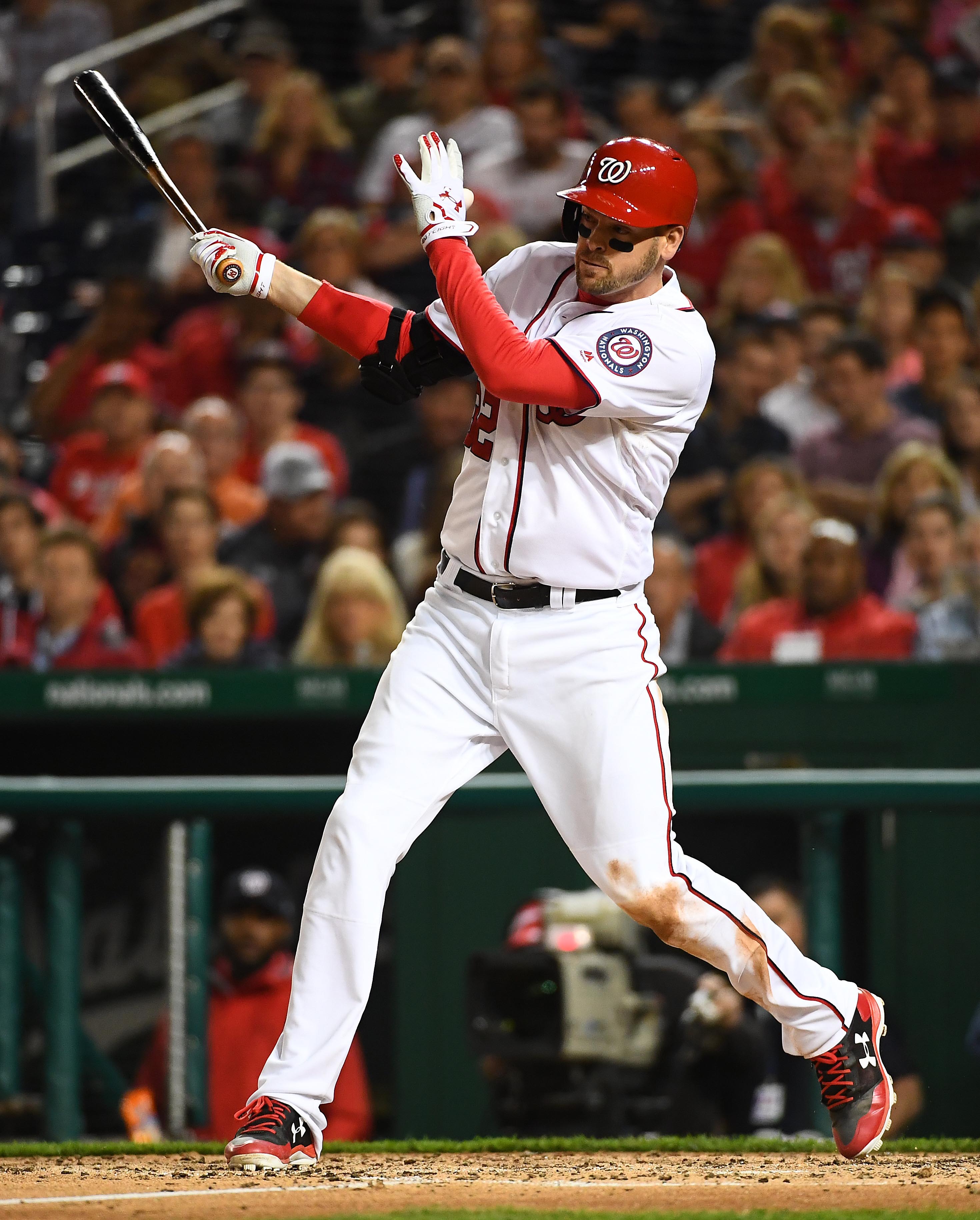
At the same time, veteran receiver Matt Wieters languished on the market. Given the longstanding relationship between agent Scott Boras and the Nationals’ ownership group, it came as little surprise when the sides finally lined up. While the price seems fair enough despite Wieters’s underwhelming results of late, there was an argument to be made that the club would have been just as well off sticking with Norris. Instead, he was released, meaning the team paid him about one-sixth of his $4.2MM arb salary and parted with prospect Pedro Avila in order to carry Norris as an insurance policy over the spring.
 Brad Mills-USA TODAY Sports” width=”241″ height=”300″ />
There’s not a ton of upside in the Wieters deal, since he can opt out if he has a strong 2017 season and will not be eligible to receive a qualifying offer. But the Nationals obviously felt it was worth the premium to add the respected veteran; time will tell whether that was a wise choice.
The short-term veteran additions carried over to other areas as well. Adam Lind will take over for Clint Robinson as the lefty bench bat and reserve first baseman; he’d be a bargain with his $1.5MM guarantee if he can return to anything approaching his 2013-15 form. And Chris Heisey will return to reprise his role as an extra outfielder and righty pinch-hitting option.
Questions Remaining
As befits their status as a reigning division champ and favorite to return to the postseason in 2017, the Nationals don’t have any glaring holes on the roster. But that doesn’t mean there aren’t some areas of potential concern.
Let’s start with the bullpen, which has fans wringing their hands already just a few games in. Treinen has had a few hiccups, as have Glover and others. It’s too soon to reach any judgments, of course, but the ninth inning will be watched closely and the trade deadline could seem far away if at least one member of that duo can’t consistently lock up games late.
Truth be told, the rest of the pen look solid on paper. But Shawn Kelley is being handled with care, especially after departing his last postseason outing with what seemed at the time to be a scary arm issue. Blanton is 36 years old and may have worn down late last year. From the left side, Sammy Solis has had his share of health issues, Romero has yet to show he has the command to pitch in the majors, and one wonders how long Oliver Perez can continue to beguile opposing hitters.
Jeremy Guthrie seemed likely to take a slot in the pen as a long man after making one start, but a disastrous outing led to a quick DFA. He has been replaced by Matt Albers for the time being. In terms of depth, there aren’t many proven commodities waiting at Triple-A, though there are some options. Trevor Gott still hasn’t produced results in D.C. despite his big fastball; other 40-man members include Rafael Martin, Austin Adams, Jimmy Cordero, and Matt Grace, while a few veterans such as Neal Cotts and Joe Nathan are also on hand if there’s a need.
The depth is perhaps of greater concern in the rotation, which looks to be a solid unit 1 through 5. Max Scherzer answered most of the questions about his health — he’s recovering from a finger fracture — with a strong first outing. But Stephen Strasburg remains a long-term health risk after missing time again with a forearm injury late in 2016. Gio Gonzalez is coming off of a down year and remains inconsistent, while Tanner Roark seems a solid starter who’s also a good bet to regress somewhat after a stellar campaign. And Joe Ross — who is in Triple-A to open the year but ought to be called upon soon — has experienced shoulder issues at times.
If any of those pitchers goes down, it’s an open question how the Nats will proceed. Guthrie had seemingly been slated to serve as a swingman, but it’s unclear whether he’ll remain in the organization. The next man up could be A.J. Cole, who was once seen as a top prospect but who has yet to show he can take the final step. Austin Voth has generated quality results in the upper minors, but it’s unclear whether he can do the same in the bigs. The Nats parted with minor-league signee Vance Worley late in camp, so reclamation project Jacob Turner is likely the top non-roster starter remaining.
There’s little doubt of the talent level in the lineup, which features established hitters at just about every position. But Bryce Harper needs to show that 2016 was a blip — he’s off to a promising start, and seems healthy after some strange questions about his shoulder — and Turner will try to show he can sustain his incredible performance from his rookie year. (The latter is now shelved with a hamstring strain, though the hope is it’s not a major issue.) Eaton’s ability to handle center is somewhat in question, though that’s not a huge concern and the team could utilize Michael Taylor or Brian Goodwin at times if there’s a need for more glove. Anthony Rendon and Daniel Murphy were outstanding last year, but the former has shown some fragility at times and the latter will be looking to sustain levels of production that greatly exceeded his career mean.
For the most part, it’s picking at nits at those positions. The Nats have greater concerns at the three remaining spots on the diamond. Left fielder Jayson Werth is closing in on his 38th birthday and hasn’t hit much in the past two seasons. The same is true of Zimmerman, whose production fell off a cliff (.218/.272/.370) in 2016. Both he and Werth have had their share of injury troubles over the years, and they’ll both need to stay healthy while increasing their output as they age for the team to reach its potential. While Lind is a nice piece as a reserve/platoon first baseman, he’ll be stretched if he’s asked to play the outfield or hit against left-handed pitching. And then there’s the catching position, where Wieters and Jose Lobaton look like a good-enough, but hardly overwhelming unit. Both are potential free agents at season’s end, so there’s plenty of incentive, and Severino is about as good a backup plan as any team has behind the dish.
Deal Of Note
The Nats’ acquisition of Eaton drew its share of negative attention, with many focusing on the fact that Eaton isn’t exactly a tools-laden superstar. But he’s a highly valuable player, particularly given his contract rights, and the deal lines up as a reasonably fair one on paper.
That’s not to say that it doesn’t hurt to lose the arms, of course, though it’s far from clear whether any member of the trio will be an impact major league starter. Giolito had solid numbers in the upper minors last year, but showed less velocity than expected and was hit hard in a brief big league stint. The Nats achieved tremendous value in nabbing him with the 16th pick of the 2012 draft, but seemingly soured on him. Clearly, he was no longer seen as the type of surefire ace that he had been characterized as this time last year.
Lopez came to the Nats with decidedly less fanfare as a low-key international signee, but turned himself into a top-flight prospect who arguably bypassed Giolito. He, too, showed well in his first stints at Double-A and Triple-A, but didn’t quite dominate upon ascending to the bigs. But he averaged 95.8 mph with his fastball in the majors and was trusted with a postseason roster spot. The question with Lopez has always been whether he’d stick in the rotation or turn into a late-inning power arm; that’ll be answered in Chicago at some point in the coming years.
It’d be a mistake to overlook Dunning, who was seen by many as a nice value after being overshadowed as a collegiate pitcher in a talented staff at the University of Florida. The 22-year-old showed well in his first foray into the professional ranks, though he’s a few years away from the big leagues.
Sacrificing those pitchers not only meant losing a lot of future control rights, but also changed the depth calculus for the 2017 season. Giolito and Lopez probably wouldn’t have cracked the Opening Day roster, but both would have been in contention for call-ups at any stage during the year after dipping their toes in the waters in 2016. As noted above, there are at least some questions regarding the Nats’ pitching depth; to be fair, though, the club also enjoys rather lengthy control rights over its existing starters.
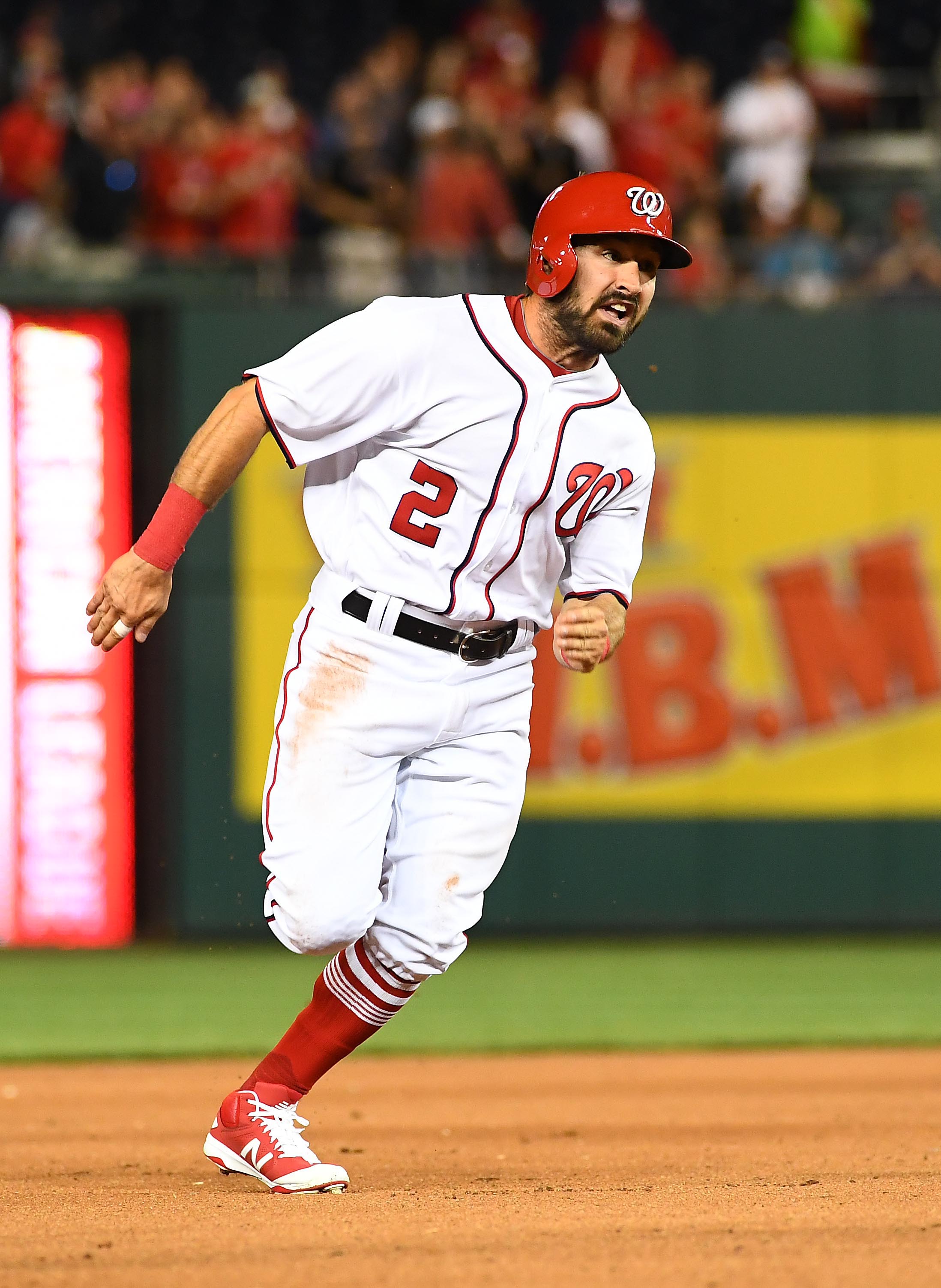
So, was it worth it? As ever, that’ll be evaluated over a long period of time, particularly given the fact that Eaton’s value is so wrapped up in his contract. In essence, he’s an established star who’s being paid more like an arb-eligible player. He’s guaranteed just $18.4MM over the next three campaigns and can be controlled for a total of $20MM (with $3MM in total buyouts) for two more years. That brings the possible tab to less than forty million bucks to control Eaton’s age-28 through age-32 campaigns.
Eaton doesn’t hit a lot of long balls and doesn’t swipe a lot of bags; he has landed in the teens in both counting stats in recent years. He walks only at an average rate. But he has been remarkably steady since establishing himself as a full-time player. Eaton has posted .362, .361, and .362 OBPs in his last three years while landing at identical .144 isolated slugging marks and popping 14 long balls apiece in the past two — establishing a new power benchmark after showing little pop previously. And he has been worth between four and five runs a year on the bases in his prior two campaigns, as well.
In a way, the major open question on Eaton is the glove — both in terms of general quality and his function to the Nats. Metrics split on his work in center in 2014 — DRS loved him (+11) while UZR was not a fan (-3.3) — but agreed he struggled there in the ensuing season. Then came a move to right, where Eaton rated as an elite defender — in terms of both his throwing arm and range — by measure of both major defensive ratings in 2016. The difference? In 2015, he rated as a three-to-four win player. Last year, he check in with about six WAR.
Clearly, the Nationals believe he’ll handle center capably enough, since that’s where he’s headed to open his tenure with his new club. But the fact that he has shown such capability in a corner spot also allows some flexibility moving forward. Werth’s contract is up this year, while Harper is slated for free agency after 2018. Importantly, the club managed to hang onto top prospect Victor Robles this winter; he could one day be a superstar in center, with Eaton lining up beside him.
They say you have to give value to get it, and that’s typically the case. Clearly, the Nationals did so here. But given the organization’s slate of quality veterans, it made sense to prioritize the near-term. And adding Eaton not only filled a need, but did so in a way that left the team with plenty of future value and won’t fill up much future payroll space — a heightened concern given the big guarantees made to Scherzer and Strasburg, the still-open question of Harper’s future, and the ongoing MASN television rights fees dispute that has forced the Nats to backload many of their major contracts.
Overview
There’s still a lot to like about the Nats as they try once again to break through with their long window of contention. But the questions never stop coming, and there’s a big one on the horizon with Harper. The team’s decision to make him a stunning arbitration raise hints that the pocketbooks could open up for a player who has been — and may be again — among the game’s best. As things stand, though, time’s a-wastin’ on winning while the phenom is in D.C., and the club will likely be aggressive in filling any needs that arise during the season.
So, how do you think the Nats handled the winter? (Link to poll for mobile app users.)
How would you grade the Nationals' offseason?
-
B 42% (777)
-
C 32% (597)
-
D 10% (184)
-
A 9% (162)
-
F 8% (146)
Total votes: 1,866
Photos courtesy of USA Today Sports Images.
Dodgers Acquire Joe Gunkel
The Dodgers have acquired righty Joe Gunkel from the Orioles, per a club announcement. Los Angeles will send cash or a player to be named later in return.
Gunkel was designated for assignment recently by Baltimore, after the club claimed young fireballer Miguel Castro. Now, he’ll became the latest hurler to make the move to the Dodgers, who are seemingly always gathering rotation depth.
The 25-year-old had a notable 2015 season. After moving from the Red Sox to the O’s via trade, Gunkel threw 104 1/3 innings of 2.59 ERA ball with 6.0 K/9 against only 1.3 BB/9. He continued to exhibit elite command last year, but gave up quite a few more hits and earned runs while working to a 4.02 ERA in 161 innings — most of them at Triple-A.