Each AL Team’s Top Recent Draft Class
With the MLB draft scheduled for next week, let’s take a look at each American League team’s most successful draft class in recent memory. Using Baseball Reference’s draft tracker, we can sum the combined career bWAR of each player selected by each team in a given year. It’s a simple shorthand, not a perfect measure, but it’ll give some insight into which teams have really hit in certain years.
First, a quick note on the methodology. For simplicity, we’re limiting this search to the 2006-2015 classes. A player’s value is only included if he signed with the club, although he needn’t have actually played for his drafting team in the majors. (So, the 2008 Yankees don’t get credit for drafting but failing to sign Gerrit Cole, while the 2007 Red Sox do get credit for drafting and signing Anthony Rizzo, even though he was traded before ever playing an MLB game for Boston). Of course, a player drafted in 2006 has had more time to rack up value than one drafted in 2015, so we’ll note in each team’s capsule if a more recent class is on the verge of taking over from an older class. On to the results…
- Angels: 2009 (109.3 bWAR) – Go figure. Picking one of the greatest players of all time is a heck of a way to kick off a draft class. But this 2009 class wasn’t just about Mike Trout, even if he’s accounted for about two-thirds of its cumulative value. That year, the Angels also selected Patrick Corbin, Randal Grichuk, Garrett Richards and Tyler Skaggs. Former MLBTR contributor Chuck Wassterstrom took a behind-the-scenes look at this class a few years ago.
- Astros: 2009 (53.2 bWAR) – Not a single one of the Astros’ top five rounders in 2009 reached the majors. The late rounds, though, were a smashing success with J.D. Martinez (20th), Dallas Keuchel (7th) and Kiké Hernández (6th) accounting for the class’ value. Of course, Martinez did his damage elsewhere after the Astros released him.
- A’s: 2012 (37.7 bWAR) – The A’s 2012 class produced seven big leaguers, most notably Matt Olson. He leads a group that also included Addison Russell and Max Muncy, who have played most or all of their MLB careers elsewhere.
- Blue Jays: 2009 (39.2 bWAR) – They won’t get credit for selecting James Paxton in supplemental round one here, but Yan Gomes was a nice find in the tenth round, though he would play only briefly in Toronto before being dealt to Cleveland. Outside of Gomes, the Blue Jays found a few nice role players, including Jake Marisnick, Aaron Loup, Ryan Goins, and others.
- Indians: 2011 (38.7 bWAR) – Selecting Francisco Lindor eighth overall in 2011 was a key to Cleveland’s 2016 AL pennant. So too was then-closer Cody Allen, whom they grabbed in the 23rd round. With Lindor mid-prime, the class’ value should just continue to grow.
- Mariners: 2006 (40.2 bWAR) – Doug Fister and Chris Tillman went on to become mid-rotation starters for a time (Fister arguably even a bit more than that), albeit with other clubs. Fifth overall pick Brandon Morrow disappointed as a starter but had a late-career renaissance as a quality reliever before various injuries derailed him.
- Orioles: 2007 (43.2 bWAR) – Although only four players from this class would wind up making the Majors, the combination of Jake Arrieta and Matt Wieters makes the 2007 draft a pretty solid one for the O’s. While Wieters, the fifth overall pick, maybe didn’t turn out to be the franchise cornerstone he was hailed to be, he has nonetheless had a nice career. Arrieta had a slow start in Baltimore, but would of course earn a Cy Young with the Cubs. It’s worth noting that this spot will be taken by the 2010 class before too long, almost entirely on the back of Manny Machado.
- Rangers: 2008 (33.3 bWAR) – Despite garnering only a 25th-round selection, Tanner Roark has turned out to be the most productive player in this class. First-round choice Justin Smoak deserves a mention too, though his career didn’t really take off until he’d been traded out of Texas. The 2011 class, headed by Kyle Hendricks, is not far behind and could claim this title in the near future.
- Rays: 2006 (81.5 bWAR) – Franchise legend Evan Longoria does a lot of the heavy lifting for this class, having amassed 56 total WAR by age 34. Even so, there are some other quality players here: Desmond Jennings and Alex Cobb are the other notables, with Jennings carving out a solid MLB career as a tenth-round pick.
- Red Sox: 2011 (70.2 bWAR) – This is far and away the best Sox draft class in recent memory, and it shouldn’t surprise anyone. Mookie Betts, one of the finest players in baseball, established himself as Boston’s franchise player after he was selected in the fifth round. Even outside of Betts, this class yielded a few key members of the Red Sox 2018 World Series team, with Jackie Bradley Jr. and relief ace Matt Barnes also coming out of that draft.
- Royals: 2007 (47.1 bWAR) – Speaking of drafting World Series contributors, the Royals in 2007 added both Mike Moustakas and Greg Holland, both of whom turned out to be central in the Royals’ playoff runs in 2014 and 2015. And that’s before mentioning third-rounder Danny Duffy, who’s still with Kansas City and inked a nice extension prior to 2017.
- Tigers: 2007 (20.6 bWAR) – With just 20.6 WAR, the Tigers’ best draft in recent memory doesn’t compare favorably to the rest of the AL, and that partly illuminates the franchise’s current standing in baseball. The notable player from the 2007 class is Rick Porcello, who had some nice years to begin his career with the Tigers and would later win a Cy Young. Maybe they get bonus points for discovering high-schooler D.J. LeMahieu, who wouldn’t sign with the team, in round 41?
- Twins: 2009 (32.4 bWAR) – Between Kyle Gibson and Brian Dozier, the Twins drafted a pair of staples on the Minnesota teams of the mid-2010s. But with both playing elsewhere now, keep an eye on the 2012 draft class, which features a trio of young centerpieces for a new era of Twins baseball: Byron Buxton, Jose Berrios, and Taylor Rogers are up-and-comers who could rack up a lot of value as they enter their primes.
- White Sox: 2010 (55.3 bWAR) – Chris Sale carries the 2010 class for the South Siders, by far the best draftee in an otherwise mediocre string of years for Chicago. That said, 2010 yielded a couple of other role players for the White Sox, with Addison Reed, Jake Petricka, and Tyler Saladino all making nice MLB contributions.
- Yankees: 2006 (69.4 bWAR) – Whereas many teams’ success in a given year is determined by one standout player, the Yankees’ installment on this list displays a surprising breadth of quality players, without a single superstar. Evidently, the 2006 Yankees cornered the market on MLB relievers: Ian Kennedy, David Robertson, Dellin Betances, Mark Melancon, and Joba Chamberlain are the five most productive players from the Bombers’ draft that year (granted, Kennedy didn’t transition to the bullpen until last year).
AL East Notes: Severino, Red Sox, Snell, Boras
After undergoing Tommy John surgery during Spring Training, Yankees right-hander Luis Severino tells George A. King III of the New York Post that “things have been progressing well” in the initial stages of the rehabilitation process. Severino has been working with team trainers at the Yankees’ Spring Training facility in Tampa “since the day after I had my surgery,” and said he has “been making steady progress — lifting, doing exercises. Since three months ago…I feel way better. I’m doing everything I need to do right now so that I can start throwing this summer.”
Given the normal 12-15 month timeline attached to TJ recovery, it would be a boon for both Severino and the Yankees if he is able to return by Opening Day 2021 (assuming next season begins as usual in late March), and it’s probably more realistic to assume he’ll miss at least a month of a regularly-scheduled 2021 campaign. Severino already missed almost all of the 2019 season due to lat and shoulder injuries, tossing only 20 1/3 total innings over the regular season and postseason.
More from around the AL East…
- Had the season begun as expected, the Red Sox “would have had some tough decisions to get down to 26” players on the Opening Day roster, manager Ron Roenicke tells Peter Abraham of the Boston Globe. Now, since Major League rosters are expected to be expanded by anywhere from two to four extra players, it “will give us a chance to keep some players we like,” Roenicke said. This is one small silver lining amidst a wholly unique season that will present many difficulties for all teams, as Abraham outlines how Roenicke is trying to keep his team prepared both in the short term and in preparation of whatever shape the 2020 season (if it happens at all) could take. Providing updates on a few players, Roenicke said starters Eduardo Rodriguez, Nathan Eovaldi, Martin Perez, and Ryan Weber have been throwing two simulated innings per week in order to stay fresh, with the idea being that the quartet can quickly ramp up to being able to toss five innings by the end of an abbreviated second Spring Training.
- Rays left-hander Blake Snell recently became the Boras Corporation’s newest client, which agent Scott Boras calls “a great opportunity for us,” the Tampa Bay Times’ Marc Topkin writes. “We consider him an elite performer who is still at the beginning of his career,” Boras said, noting that his agency’s “resources” in both on-field preparation and off-the-field endeavors make for “a great combination” with Snell. The southpaw’s contract runs through the 2023 season, and while there isn’t any immediate opening for the Boras Corporation to receive a commission on a future deal, Boras repeatedly dismissed the suggestion that his change in representation could be a step towards finding a new team. “The main idea right now is that we’re going to work with the team to provide every resource and to make [Snell] a better Ray,” Boras said.
Latest On Teams’ Plans For Minor League Pay
3:14pm: The Astros will also pay their minor leaguers through August, Chandler Rome of the Houston Chronicle tweets. The Red Sox will do the same, Julian McWilliams and Alex Speier of the Boston Globe write. The Reds will pay theirs through Sept. 7, the end of the scheduled minor league season, per C. Trent Rosecrans of The Athletic.
2:16pm: As teams throughout the league make sweeping releases at the minor league level, neither the Twins nor the Royals plan on cutting any players, per ESPN’s Jeff Passan and MLB Network’s Jon Heyman (Twitter links). The Twins and Royals will also commit to paying all of their minor league player the current $400 weekly stipend through Aug. 31 — the would-be end of the minor league season — while providing full benefits. The Twins are also committing to front-office and baseball ops staff through at least the end of June, Do-Hyoung Park of MLB.com tweets.
To this point, no other clubs in the league have made such a commitment. The Marlins, Padres and Mariners all agreed to pay their minor leaguers through season’s end, although none of that bunch is known to be entirely avoiding minor league releases. Seattle, in fact, reportedly cut 50 minor league players this week already. The volume of players being released around the league is jarring — the D-backs cut a reported 64 players — although it should be noted that many of the releases would’ve come at the end of Spring Training under normal circumstances anyhow.
That doesn’t detract from the gesture made by the Twins or Royals, of course. It’s a stark contrast to an organization such as the Athletics, who informed minor league players earlier this week that they’ll no longer be paid after May 31. As MLB.com’s Jim Callis observes (on Twitter), the decision made by the Twins and Royals could quite likely prove beneficial in recruiting undrafted players who are selecting among teams while capped at a $20K signing bonus this summer.
Latest Minor League Releases
Minor League Baseball has never faced greater uncertainty than it presently does, with contraction widely expected later this year and significant doubt as to whether a 2020 minor league campaign will even be able to take place. Over the past several days, we’ve seen wide swaths of minor league releases due to myriad reasons. It’s common for players to be released late in Spring Training, but those cuts didn’t happen this year. Between that, the likely absence of a minor league season and the typical wave of releases that precede the annual MLB draft, cuts have been abundant.
The Score’s Robert Murray tweets several clubs who’ve made undetermined numbers of releases: the Brewers, Reds, Nationals, Rays, Cardinals and Blue Jays among them. MLB Network’s Jon Heyman tweets that the Diamondbacks have released a whopping 64 players in recent days. In all likelihood, all 30 teams will make significant cuts. The Orioles, White Sox, Rockies and Mariners are already known to have done so.
Most of the players who’ve been cut loose have yet to be named — and the majority of them won’t be especially recognizable to any but diehard fans of a particular organization. We’ll track some former big leaguers and other notable names in this post and update as more information comes to light…
- The Mets cut 39 players loose this week, with first baseman Joey Terdoslavich and right-handers Nick Rumbelow and Rob Whalen among those let go, according to Roster Roundup. Newsday’s Tim Healey had previously reported an unspecified number of players were being cut loose. Each of Terdoslavich, Rumbelow and Whalen has big league experience. Terdoslavich, 31, was at one point a fairly well-regarded farmhand with the Braves, for whom he appeared in 2013-15. Rumbelow pitched with the Mariners in 2018-19 but hasn’t replicated the high-end performance he showed in Triple-A when working back from Tommy John surgery. Whalen, 26, had announced his retirement at one point but opted for a comeback this past winter. He logged 36 innings between the Braves and Mariners from 2016-18.
- The Red Sox announced Friday the release of 22 minor league players. While none of the bunch has appeared in the Majors, there are some notable names in there all the same. Infielder Nick Lovullo, 26, is the son of former Sox bench coach and current D-backs skipper Torey Lovullo. He’d been with the organization since being selected in the 20th round of the 2016 draft. Boston also cut ties with infielder Juremi Profar — the younger brother of Padres second baseman Jurickson Profar. Boston inked the younger Profar brother to a minor league pact back in November after he’d spent seven years in the Rangers organization. The Boston Globe’s Pete Abraham tweeted the whole list for those interested.
From Released To Elite
J.D. Martinez did not start his major league career in auspicious fashion, but as a 20th-round pick in 2009, it’s remarkable that the outfielder even made his way to the bigs. Houston took Martinez in the draft, and though he was highly productive in the organization’s system through 2011, he was unable to transfer that success to the bigs from the get-go. Martinez amassed 975 plate appearances as an Astro from 2011-13, but he hit a subpar .251/.300/.387 with 24 home runs during that time. Houston gave up on Martinez after that.
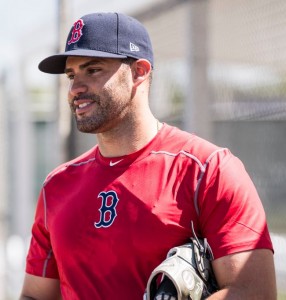
On March 22, 2014, the Astros said goodbye to Martinez, releasing him a half-decade after drafting him. However, Martinez has been on a rampage since then. Thanks to the help of hitting coaches Craig Wallenbrock and Robert Van Scoyoc, Martinez has turned into one of the best offensive players in baseball over the past several years.
The Tigers signed Martinez to a minor league contract in March 2014, and it proved to be a brilliant move for the club. Martinez became a star that year, in which he posted a line of .300/.361/.551 (145 wRC+) in 1,886 plate appearances. But Detroit, not expecting to be able to sign the soon-to-be free agent before 2018, traded him to Arizona in July 2017 in a deal that netted them infield prospects Dawel Lugo, Sergio Alcantara and Jose King.
Unfortunately for Detroit, no one from the Lugo-Alcantara-King trio has given the team any value at the major league level thus far, and nobody from the that group is among MLB.com’s top 30 prospects for the Tigers right now. The D-backs probably don’t have any regrets, then, even though Martinez didn’t last long in their uniform. Over 257 PA in the desert, Martinez batted an incredible .302/.366/.741 (170 wRC+) with 29 homers, helping lead Arizona to a wild-card berth. The Diamondbacks got past that round against the Rockies, but they couldn’t overcome the Dodgers in the NLDS. That proved to be the end of the line for Martinez as part of the club.
After a drawn-out trip to free agency in the ensuing winter, the Red Sox signed Martinez to a five-year, $110MM guarantee in late February of 2018. There’s a narrative that players decline once they get a large payday, but that’s not the case for Martinez. Since he signed with Boston, Martinez has gone to a pair of All-Star Games, helped the Red Sox to a World Series championship (2018) and batted .317/.392/.593 (154 wRC+) with 79 homers in 1,306 PA. It’s obvious at this point that Martinez, now 32 years old, is among the premier hitters in baseball. Not bad for someone whom a team once gave up on in exchange for nothing.
Photo courtesy of USA Today Sports Images.
Quick Hits: Latest On The Impact Of Coronavirus Around The Game
As players and owners work on negotiating a financial accord to allow for the start of play, opinions have trickled in from all reaches of the baseball-sphere with personal stances about how best to reboot gameplay. After Blake Snell set off a bit of a firestorm with his concerns about returning to the field, many players have chimed in to support the lefty hurler. Obviously, many players are justifiably concerned about what gameplay would mean for their safety and the safety of their families. No one understands this as much as Yoan Moncada, whose 1-year-old daughter was recently hospitalized. She’s doing better now, and Moncada, despite the scare, is ready to return to play should that become a possibility, per Daryl Van Schouwen of the Chicago Sun-Times. Van Schouwen provides a quote from Moncada, who said, “[My family is] concerned, as everybody is. But if the conditions are safe, they’re going to be good with it. But it is a concern no matter what.” Obviously, everyone has been affected in some form or fashion by this pandemic, and players face difficult personal decisions ahead before returning to play. Of course, COVID-19 has hurt not just the players and owners…
- While most of the focus has remained on the league’s attempts to return to the playing field, the consequences of the shutdown are hitting home for many professionals in the field. The Reds, Rays, and Marlins have announced furloughs that are to begin in June, and the latest from MLB Network’s Jon Heyman (via Twitter) has the Angels among the teams considering the same. Officially, the Angels are still on the fence. It is nonetheless an unfortunate and troubling development for those involved. Hopefully, some of the larger market franchises will be better equipped to weather the storm for their employees.
- Beyond the question of will-they-or-won’t-they play a 2020 season, there are ancillary questions that need answering in the event of a shortened 2020 season. Joel Sherman of the New York Post runs through a whole host of those issues that will require answers at some point. Among Sherman’s inquiries are topics ranging from a potential trade deadline to drug testing to the practical concerns of the games themselves. Baseball is in a better position than heavy-contact sports like basketball and football, but the game still cannot be played with players keeping a 6-foot distance from one another. It helps that the primary action takes place between a batter and pitcher standing 60 feet and 6 inches apart, but there is plenty of potential for in-game contact, as well as the mere fact of shuffling 26-man rosters from stadium to stadium together.
- The Red Sox will be able to resume play at Fenway Park this season according to Boston Mayor Marty Walsh. There are, of course, a number of conditions to meet before play resumes at Fenway. For instance, fans will not be allowed in attendance, per Michael Silverman of the Boston Globe. There will also be safety measures that the city of Boston must sign off on before play resumes. Still, it may give players a welcome sense of familiarity to be able to play in their home ballparks, even without fans in the seats. The number of teams that will be able to resume play in their home parks remains up in the air for now, though that does seem to be the goal for most teams.
How Boston Landed One Of Its Most Valuable Pitchers
Andrew Miller was the sixth overall pick of the Tigers in the 2006 draft and continued as an elite prospect for a little while after that, but it took the left-hander several years to truly make his mark as a major leaguer. Miller began as a starter in Detroit, but after struggling over parts of two seasons, the team dealt him and others to the Marlins in December 2007 for Miguel Cabrera in one of the most impactful trades in the two clubs’ histories. Miller didn’t pan out in Miami from 2008-10, though, and he went to Boston after the last of those seasons in exchange for lefty Dustin Richardson.
Richardson never even threw a pitch as a Marlin, whereas the Red Sox are still profiting from the trade to this day. While Miller continued to flounder in his first year with the Red Sox, the 6-foot-7, 205-pounder moved to the bullpen on a full-time basis the next season. That represented a eureka moment for Miller, who began a years-long run as one of the most imposing late-game options in baseball.
Miller held his own in Boston into the 2014 season, but with the team well out of contention at that year’s deadline, it traded the then-pending free agent to the AL East rival Orioles. Miller went on to provide 20 dominant regular-season innings in Baltimore, which coasted to a division title, as well as 7 1/3 scoreless, one-hit frames in the playoffs. The Orioles lost the ALCS in four games to the Royals, however, and then saw Miller head to a different division rival – the Yankees – during the ensuing period of free agency. In light of those results, and considering what they gave up for Miller, perhaps the O’s now regret the trade. Boston definitely doesn’t, having received one of its top pitchers in Eduardo Rodriguez for Miller.
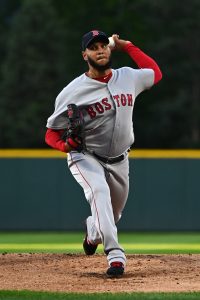
Dating back to the deal, the Red Sox have seen Rodriguez turn into an above-average major league starter. Rodriguez, who debuted with Boston in 2015, is the owner of a lifetime 4.03 ERA/3.94 FIP across 699 innings. Although Rodriguez didn’t prove to be a workhorse in his first four years in the league, that changed last season. The 27-year-old Rodriguez was one of 15 pitchers who accumulated 200-plus frames (203 1/3, to be exact), and he posted a 3.81 ERA/3.86 FIP with 9.43 K/9 and 3.32 BB/9 to rank 24th among starters in fWAR (3.7). Ace-like numbers? No, though Boston was surely pleased with that production from a hurler who was on an eminently affordable $4.3MM salary. And the team could get at least two more seasons from Rodriguez, who won’t be eligible to become a free agent until after 2021.
While he hasn’t shown himself to be a true No. 1 starter, the Red Sox can’t be displeased with acquiring Rodriguez for someone on an expiring contract. Meanwhile, the Rockies may be kicking themselves for passing on Rodriguez. Peter Gammons reported in 2014 that the O’s agreed to send Rodriguez to Colorado for fellow southpaw Jorge De La Rosa, but Rockies owner Dick Monfort vetoed the deal. De La Rosa stayed in Colorado through 2016, though the team didn’t contend then or in his last couple years on its roster.
You never know how Rodriguez would have turned out as a Rockie – everyone knows it’s a bear to pitch in their home park – but he has certainly held up well in the AL East. Rodriguez is now one of the most valuable players Boston has.
Photo courtesy of USA Today Sports Images.
Is Big Papi A Hall Of Famer?
Baseball fans love to debate which players should make it to the Hall of Fame, and with the designated hitter position so prominent in the news at the moment, it got me to thinking about David Ortiz‘s Cooperstown case. The Boston legend will be eligible to make it there in 2022, and there’s a strong argument he should wind up with a plaque in the museum.
Ortiz is one of the most feared hitters in recent memory, but his career began inauspiciously in Minnesota. As a Twin from 1997-2002, Ortiz amassed 1,693 plate appearances and batted .266/.348/.461 (106 wRC+) with 58 home runs. The Twins then cut ties with Ortiz, but at the behest of Pedro Martinez, the Red Sox signed Big Papi to a non-guaranteed contract in January 2003. Now, in terms of franchise-altering steals, that could rank in Boston sports lore with the Patriots getting Tom Brady in the sixth round of the 2000 NFL Draft.
Ortiz was a smash success with the Red Sox from the jump, as he slashed .288/.369/.592 (145 wRC+) and put up 31 homers in 509 trips to the plate during his first season with the team. The Red Sox lost to the hated Yankees in the ALCS that year, but they and Ortiz frequently ruled the sport after that. During the rest of Ortiz’a career from 2004-16, all of which was spent in Boston, the Red Sox won three World Series. He was a 10-time All-Star and a .290/.386/.570 hitter (146 wRC+) who piled up 483 homers with the team during that span. Along with his regular-season accomplishments, Ortiz was a monster in the playoffs. When the chips were down in the fall, Ortiz was known to thrive. He was a World Series MVP (2013) and an ALCS MVP (2004 – the year the Red Sox overcame a 3-0 deficit against the Yankees) who appeared in 85 postseason games between his two clubs and hit .289/.404/.543 with 17 HRs.
As for the regular season, Ortiz ranks 65th all-time in wRC+ (140) and 182nd among position players in fWAR (51.0). He ended his career a .286/.380/.552 hitter who racked up the 17th-most homers ever, 541, and remained an elite hitter even in his last season. Ortiz’s amazing run didn’t come without issues, though. Back in 2009, the New York Times reported Ortiz tested positive for performance-enhancing drugs in his breakout 2003 campaign. Ortiz vehemently denied those claims, as you’d expect, and commissioner Rob Manfred came to the slugger’s defense in 2016. Manfred said (via the Boston Globe) it was “entirely possible” Ortiz didn’t take PEDs, adding that “he’s never been a positive at any point under our (testing) program” that began in 2004.
Even if you’re OK with brushing off the PED questions when it comes to Ortiz’s Hall of Fame candidacy, are you willing to be as forgiving when it comes to a lack of defensive impact? For the most part, Ortiz was a full-time DH during his career, which some purists frown upon. For example, former Mariners superstar Edgar Martinez is one of the greatest DHs ever, but it took him until his final year on the ballot (2019) to get to Cooperstown. He’d have been a first-ballot pick for me if I had a vote, though, and the same applies to Ortiz. However, as Hall of Fame expert and FanGraphs writer Jay Jaffe explained in a piece for SI.com in 2016, “a spot in Cooperstown is no certainty” for Ortiz. Do you think it should be?
(Poll link for app users)
Is David Ortiz A Hall Of Famer?
-
Yes 73% (12,237)
-
No 27% (4,501)
Total votes: 16,738
Which 15 Players Should The Red Sox Protect In An Expansion Draft?
The last MLB expansion draft took place on November 18th, 1997. Each of the 28 existing teams was able to initially protect 15 players, with the Devil Rays and Diamondbacks mostly alternating picks to fill their new rosters.
The first round consisted of one player being taken from each of the 28 teams, giving the Devil Rays and D’Backs 14 players each. At that point, each of the 28 teams was able to protect an additional three players. After the completion of the second round, each team added another three players to their protected list. In the third round, the Rays and D’Backs would each take an additional seven players, with each new club ending up with 35 in total.
Detailed rules can be found here, but basically each team’s best prospects were not eligible for the draft. Still, about a quarter of the players chosen were minor leaguers. Also, players with no-trade clauses or ten-and-five rights had to be put on protected lists unless they waived those rights. And there would be no reason to protect players eligible for free agency.
We thought it would be fun to determine each team’s current 15-player protected list, as if a new two-team expansion draft is scheduled for November. For simplicity’s sake, only players with MLB experience will be eligible for our mock expansion draft.
So far, we’ve done the Yankees.
Next up, we’ll shape a 15-player protected list for the Red Sox.
Free agents Mitch Moreland, Martin Perez, Collin McHugh, Jackie Bradley Jr., Kevin Pillar, and Brandon Workman will be excluded. The Red Sox have club options on Moreland and Perez, but I don’t think they would burn protected spots on them regardless.
Dustin Pedroia, Chris Sale, J.D. Martinez, and Xander Bogaerts automatically take up four of the 15 spots due to their no-trade rights. That leaves 11 more players to protect. I’ve decided to lock in six more spots for the following players:
Rafael Devers
Eduardo Rodriguez
Christian Vazquez
Andrew Benintendi
Alex Verdugo
Michael Chavis
That leaves five spots for these 19 players:
Matt Barnes
Ryan Brasier
Colten Brewer
Austin Brice
Nathan Eovaldi
Matt Hall
Heath Hembree
Darwinzon Hernandez
Tzu-Wei Lin
Chris Mazza
Josh Osich
Jose Peraza
Kevin Plawecki
Mike Shawaryn
Jeffrey Springs
Josh Taylor
Phillips Valdez
Marcus Walden
Ryan Weber
With that, we turn it over to the MLBTR readership! In the poll below, please select exactly five players that you think the Red Sox should protect in our upcoming mock expansion draft. Click here to view the results.
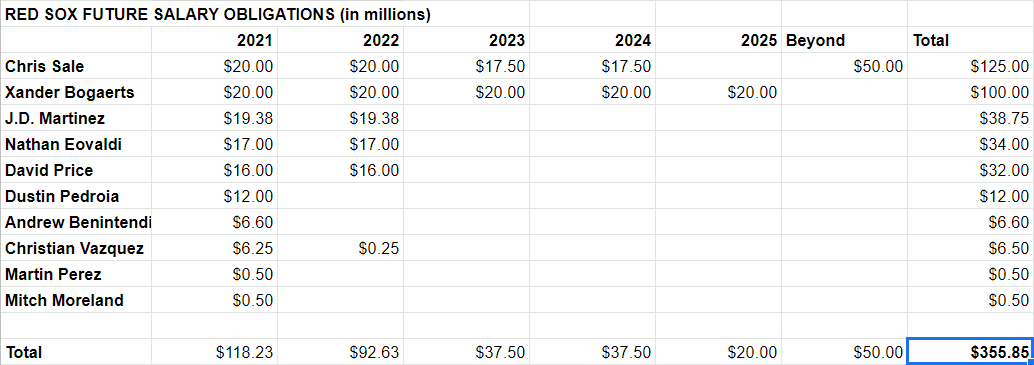
Red Sox’ Future Payroll Features Highly Paid Stars
2020 salary terms are set to be hammered out in the coming days. But what about what’s owed to players beyond that point? The near-term economic picture remains questionable at best. That’ll make teams all the more cautious with guaranteed future salaries.
Every organization has some amount of future cash committed to players, all of it done before the coronavirus pandemic swept the globe. There are several different ways to look at salaries; for instance, for purposes of calculating the luxury tax, the average annual value is the touchstone, with up-front bonuses spread over the life of the deal. For this exercise, we’ll focus on actual cash outlays that still have yet to be paid.
We’ll run through every team, with a big assist from the Cot’s Baseball Contracts database. First up is the Red Sox:
Red Sox Total Future Cash Obligation: $355.85MM
*includes Chris Sale contract deferrals
*includes remaining obligations to David Price (traded to Dodgers)
*J.D. Martinez can opt out of contract after 2020
(click to expand/view detail list)