
Ben Zobrist Could Return This Season
The Cubs have been without utilityman Ben Zobrist since May 8 as he deals with a divorce, but they’re “open” to welcoming him back “later in the season,” president of baseball operations Theo Epstein told Jesse Rogers of ESPNChicago.com and other reporters Thursday.
If the 38-year-old Zobrist does return in 2019, it’s “likely” to come toward the end of the season – possibly in September – a source tells Rogers. Notably, the Cubs won’t have to pay Zobrist for however long he stays away from the team. The club has already saved upward of $2MM since Zobrist’s leave began, and it’ll continue to pocket the same amount per month while he’s out. The money the Cubs haven’t had to shell out for Zobrist helped them sign free-agent closer Craig Kimbrel to a three-year, $43MM contract last week.
The Kimbrel addition has been a benefit of Zobrist’s disappearance, yet it’s not surprising that Epstein is hopeful the respected veteran will return. The four-year, $56MM contract the Cubs handed Zobrist entering the 2016 season likely stands as one of the smartest moves Epstein has made atop their baseball department. The switch-hitting, defensively versatile Zobrist has been one of the Cubs’ MVPs for a sizable portion of his tenure, and he played an important role in their drought-breaking World Series championship during his first year in their uniform.
Now in the last season of his deal, Zobrist did get off to a slow start on the field while dealing with a distracting situation off it. He opened 2019 with a .241/.343/.253 line (69 wRC+), no home runs and a nearly nonexistent .012 ISO in 99 plate appearances before going on the restricted list. If Zobrist does return toward year’s end and the contending Cubs are in position to clinch another postseason berth, he may need to log much better numbers than he has so far in order to earn a spot on their playoff roster. Fellow Cubs second basemen David Bote and Addison Russell have recorded far superior production to Zobrist in 2019, while the same holds true for the corner outfield-capable group of Kris Bryant, Jason Heyward, Kyle Schwarber and even the just-added Carlos Gonzalez.
Who Will Win The NL Central?
The National League Central looked like a three-team race at the beginning of the season, and not much has changed two months into the campaign. The Brewers, Cubs and Cardinals – the most hyped clubs in the division coming into the year – are at the top. After winning the division a year ago, the Brewers are 39-29, a half-game better than the Cubs. The Cardinals are a less impressive 33-33, five games back, though they’re certainly not out of the race. Meanwhile, the Reds and Pirates are eight and nine games behind, respectively. Neither looked likely to challenge for the NL Central at the outset of the season. They haven’t done anything to change anyone’s mind yet.
Led by reigning MVP right fielder Christian Yelich, brilliant free-agent acquisition Yasmani Grandal and offseason re-signing Mike Moustakas, the Brewers boast one of the majors’ most valuable groups of position players. Their pitching hasn’t been as useful, on the other hand, as a rotation that was devoid of an ace entering the season has dealt with ineffectiveness and injuries throughout the year. However, the team still features elite reliever Josh Hader, with Jeremy Jeffress and Adrian Houser among those supporting him.
The Cubs’ position player mix has been even better than the Brewers’ this year, largely because Javier Baez, Kris Bryant, Anthony Rizzo, Willson Contreras and David Bote have each offered strong production. Chicago’s rotation is probably better equipped, too, as Kyle Hendricks, Cole Hamels, Jose Quintana and Jon Lester are all proven commodities. Although, Yu Darvish hasn’t rebounded as hoped in his second year as a Cub. Darvish & Co. have handed off to a bullpen that hasn’t been lights-out this year, but it’s about to welcome all-time great closer Craig Kimbrel, whom the Cubs signed to a three-year, $43MM contract last week. Kimbrel would have been a match for the Brewers, making it all the more beneficial for the Cubs that they landed him (on paper, at least).
As for the Cardinals, they’ve fallen short of expectations after trading for ex-Diamondback Paul Goldschmidt, one of the premier position players in recent memory, and signing reliever Andrew Miller in the offseason. Both players have logged somewhat disappointing production to date, though Goldschmidt’s still an imposing presence and Miller has improved after a rocky start. Regardless, neither the Cardinals’ cast of hitters nor their relief corps is their most pressing issue. It’s their rotation, which hasn’t gotten high-end numbers from anyone. Jack Flaherty and Miles Mikolas have gone backward after impressive showings in 2018, while Dakota Hudson‘s peripherals portend trouble. Adam Wainwright‘s much closer to average than ace-like these days (and he’s now on the injured list with a hamstring issue), and nobody has nailed down the fifth spot in the Redbirds’ starting staff.
Considering the talent peppered throughout the Cardinals’ roster, it would be foolhardy to rule them out as potential division winners this season. Furthermore, with the trade deadline still yet to occur, St. Louis or anyone else in the division could put itself over the top with a shrewd acquisition(s) leading up to July 31. For now, though, the edge clearly belongs to the Cubs and the Brewers. FanGraphs currently projects the NL Central to finish in this order: Cubs (91-71), Brewers (87-75), Cardinals (83-79), Reds (78-84), Pirates (75-87). How do you expect it to shake out?
(Poll link for app users)
Who will win the NL Central?
-
Brewers 44% (5,171)
-
Cubs 32% (3,832)
-
Cardinals 11% (1,253)
-
Reds 10% (1,130)
-
Pirates 4% (500)
Total votes: 11,886
Cubs Place Carl Edwards Jr. On 10-Day Injured List
The Cubs have sent right-hander Carl Edwards Jr. to the 10-day IL due to a left thoracic strain, according to several reports. Edwards’ 25-man roster spot will be filled by southpaw Tim Collins, who is being called up from Triple-A. The placement is retroactive to June 10, with ESPN.com’s Jesse Rogers noting that Edwards hasn’t pitched since reporting the discomfort on that date.
After an ugly start to the season that led to a minor league demotion for almost a month, Edwards has pitched much better since returning to Chicago’s bullpen. Edwards has a 2.03 ERA over 13 1/3 innings since rejoining the big league roster, with opponents hitting a measly .094 against him. Without getting too carried away by a small sample size, Edwards’ three walks over 13 1/3 frames is also a positive sign, given the career 4.9 BB/9 rate the righty carried into the 2019 season.
Collins joined the Cubs on a late-spring signing, and is back up on the big league roster for the third time this season, giving Chicago a third left-handed relief option alongside Mike Montgomery and Kyle Ryan. Collins has seen action in five MLB games this year, with a 3.86 ERA over 4 2/3 innings of work.
This Date In Transactions History: Cubs Land Jorge Soler
It has been seven years since the Cubs landed a player they thought would become a long-term linchpin. On June 11, 2012, they won the bidding for free-agent Cuban outfielder Jorge Soler. At least a few teams bid upward of $20MM for Soler, who had just turned 20 a few months prior, but Chicago emerged victorious with a nine-year, $30MM offer. At the time, Soler was seen as a top 50 prospect in the sport.
The power-hitting Soler tore through the Cubs’ minor league system beginning the summer he signed and wound up debuting in Chicago two years later. When the Cubs promoted him late in the 2014 season, Soler was even more of a celebrated prospect. He justified the hype initially, slashing a strong .292/.330/.573 (148 wRC+) with five home runs in 97 plate appearances. Thanks to that run, Soler cemented himself as the Cubs’ everyday right fielder heading into 2015; however, his numbers took a dive that season, during which he hit .262/.324/.399 (95 wRC+) with 10 homers in 404 trips to the plate.
Despite his underwhelming output in 2015, Soler was once again in the Cubs’ season-opening lineup in ’16. The franchise ultimately won its first World Series in 108 years that season, but Soler didn’t play a huge role. While Soler turned in decent production in the regular campaign and the playoffs, injuries helped limit him to 264 PA during the season. After celebrating their championship that fall, the Cubs elected to part with Soler, deciding there was no longer a place for him in an outfield that also had Ben Zobrist, Albert Almora, Kyle Schwarber, Jason Heyward, Jon Jay and Matt Szczur in the fold.
On Dec. 7, 2016, just over a month after it won the World Series, Chicago traded Soler to the Royals for reliever Wade Davis. Although Davis only had another year of control left, the Cubs needed a replacement for departed closer Aroldis Chapman. That helped deem Soler expendable in the Cubs’ eyes, and though Davis lasted just one season in their uniform, they haven’t really missed Soler.
Since he joined the Royals in 2017, Soler has batted .234/.310/.450 (101 wRC+) and swatted 28 HRs in 633 attempts. Soler was particularly subpar during his first year in KC, in which he endured a lengthy minor league demotion, but bounced back in 2018 before suffering a season-ending left toe fracture in mid-June. In his return from that injury, Soler’s once again giving the Royals respectable offensive production this season, though his paltry .293 on-base percentage somewhat overshadows his 17 homers. The same is true of Soler’s defense (minus-7 DRS, minus-2.0 UZR), which has graded negatively for most of his time in the majors.
Considering how much excitement there was when Soler signed with the Cubs, the 27-year-old has posted a somewhat disappointing big league career. Soler may move on to a third team soon, given rumors that the non-contending Royals are open to trading just about anyone on their roster. Wherever he plays next season, it’ll be the final year of the contract Soler agreed to with the Cubs seven years ago.
Minor MLB Transactions: 6/10/19
We’ll kick the morning off with some of the game’s minor moves throughout the league…
- Righty David Carpenter was outrighted to Triple-A after clearing waivers, the Rangers announced. His return to the majors proved spirited but brief, as the 33-year-old was hit hard in his lone appearance. He had produced strong results at Triple-A, however, working to a 1.76 ERA with a 17:4 K/BB ratio in 15 1/3 innings. Perhaps Carpenter will find his way back up to the bigs at some point.
- The Cubs granted right-hander Matt Carasiti his release from their Triple-A club over the weekend, per Tommy Birch of the Des Moines Register (Twitter links). He quickly latched on with the Mariners on a new minor league pact and has already appeared in his first game with Seattle’s top affiliate in Tacoma, where he allowed an earned run in 1 2/3 innings of work. In 27 innings of work with Chicago’s Iowa affiliate this season, Carasiti notched a 2.67 ERA with 7.7 K/9, 3.7 BB/9 and a 54.1 percent ground-ball rate. The 27-year-old righty has a 2.85 ERA with 98 strikeouts against 36 walks in parts of three Triple-A campaigns (85 1/3 innings). He’s also had some success overseas, with a 3.98 ERA in 103 2/3 innings in his lone season pitching in Japan’s Nippon Professional Baseball, and he made a brief big league appearance with the Rockies in 2016. Carasiti allowed 16 runs in 15 2/3 innings with the Rox, though he’s pitched fairly well at every turn since that rough debut.
- The White Sox released minor league corner infielder D.J. Peterson, according to the Triple-A International League’s transactions page. A former first-round pick (Mariners, 2013) and Top 100 prospect, Peterson has yet to make his Major League debut. After a productive year with the Reds’ Triple-A affiliate in 2018, he’s struggled to a dismal .189/.268/.370 slash through 143 plate appearances so far in 2019. The right-handed-hitting Peterson has ample experience at both infield corners but spent more time at third base than at first in his brief time with the White Sox. He’s a career .254/.310/.424 hitter in 1320 plate appearances across parts of five Triple-A seasons.
Health Notes: Reds, Wood, Cedeno, Diaz, Fletcher
On Saturday, Reds southpaw Alex Wood threw a bullpen session for the first time since April, writes Mark Sheldon of MLB.com. Wood has been dealing with lower back spasms since he was acquired in the same trade that sent Yasiel Puig and Matt Kemp to Cincinnati, and setbacks suffered in March and April led to the lefty being shut down for about a month. While there is no timetable for his return to an MLB field and his Reds debut, it’s promising that Wood is once again throwing and feeling well enough to move forward with his recovery. As Sheldon notes, Wood will still need to build up a foundation before he can return to the field, a process that likely includes several more bullpen sessions followed by facing live hitters, and finally a minor-league rehab assignment. Barring any further setbacks, completing those steps will allow Wood to join a Reds team that has actually fielded one of the National League’s best pitching staffs. To be sure, Wood, who has some experiencing working out of a bullpen role with the Dodgers, would represent a luxury for the last-place Reds even if there is not a spot for him in the starting rotation.
- Cubs left-hander Xavier Cedeno, out since May 21 with left wrist inflammation, will begin a rehab assignment today with the Triple-A Iowa Cubs, according to Jordan Bastian of MLB.com. Cedeno, who also began the season on the injured list, has managed just two innings for the Cubs, largely functioning as a lefty specialist. While he’s yet to allow a run, the 32-year-old has walked three batters and has struck out just one. Cedeno was signed by the Cubs last winter to a one-year deal worth up to $900k.
- Astros shortstop Aledmys Diaz, who is currently rehabbing from a left hamstring strain, has suffered a setback, according to Jake Kaplan of The Athletic. It’s unknown how long the setback will keep Diaz, who hasn’t played since May 26, on the shelf, but with Carlos Correa out of the lineup, the Astros would like to get Diaz healthy sooner than later. By and large, it’s been Myles Straw and Jack Mayfield seeing the most action at short with both Diaz and Correa sidelined, and while they have filled in capably, neither can match Diaz’s above-average .831 OPS.
- The Angels‘ David Fletcher was out of the lineup for the second consecutive game today due to left shoulder soreness, tweets Rhett Bollinger of MLB.com. However, he adds that manager Brad Ausmus said that a stint on the injured list looks unlikely at this time. It’s good to hear for an Angels team that has had to endure injuries to other infielders Zack Cozart and Andrelton Simmons, especially considering that Fletcher has arguably been the team’s second-best player this season.
Cubs Sign First-Rounder Ryan Jensen To Below-Slot Deal
Per Jon Heyman of MLB Network, the Cubs and first-round selection (27th overall) Ryan Jensen have agreed on a $2MM signing bonus, a deal over $500K south of the $2.57MM slot value for the pick (Andersen Pickard was first with the agreement).
Jensen, a right-hander from Fresno State, was projected by many outlets as a second-to-third round pick in the weeks leading up the draft, a fact reflected in his comparatively modest bonus. The six-foot righty dominated in late-season action, though, often flashing upper-nineties heat in the latter stages of his college starts. Jensen’s second-tier pre-draft status can be explained by his inconsistent array of secondary pitches, which often lagged behind his hard-to-ignore heat.
The pick is a departure from recent-year philosophy in Chicago’s high-level picks, as senior VP of player development and amateur scouting Jason McLeod explained Wednesday. After a mid-decade eruption of star-level talent graduating from the system, the Cubs farm has sputtered in recent seasons: by some accounts, the team doesn’t have a single top-100 prospect on its current ledger, though last year’s first-rounder Nico Hoerner has impressed in his first professional taste.
David Bote: Starman?
Cubs infielder David Bote had one of the best offensive games of the 2019 season Wednesday, going 4 for 4 with a home run and seven runs batted in to help his team to a 9-8 win over the Rockies. The 26-year-old failed to reach base in either of the Cubs’ games since then, but he’s still off to a rousing start this season. After hitting .239/.319/.408 (95 wRC+) with six home runs during his 210-plate appearance debut in 2018, Bote has slashed .276/.349/.481 (117 wRC+) with seven HRs in 175 tries this year.
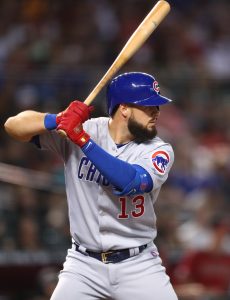
So far, Bote – an 18th-round pick in 2012 – is more than justifying the Cubs’ decision to hand him a five-year, $15MM extension in April. Bote was one of the least known players to receive a new deal during the league’s extension craze back in the spring, though he may be establishing himself as a long-term cog for the Cubs. However, it’s still up in the air whether Bote’s Year 2 improvement is real or a mirage.
As was the case last season, Bote’s walking in better than 9 percent of plate appearances. That’s a bit above the league-average mark (8.7). At the same time, Bote has slashed his strikeout percentage from 28.6 to 25.1, cut his swinging-strike rate a hair and made more contact. So far, so good.
On the other hand, even though Bote possesses better speed than most, he’s unlikely to sustain the .340 batting average on balls in play that has helped prop up his numbers this year. That’s especially true given that Bote has become much more of a fly ball hitter since last season. On that subject, it’s worth noting Bote has hit the ball with far less authority when he has elevated it this year compared to his initial campaign. Bote battered fly balls and line drives at a lofty 96.6 mph average in 2018, but that figure has sunk just below 93 this year, according to Statcast. Given that information, it’s unsurprising Bote’s expected weighted on-base average (.315) comes up well short of his real wOBA (.361).
While stardom doesn’t look as if it’s in the offing for Bote (not yet, at least), his value to the Cubs is apparent. The inexpensive Bote’s ability to chip in respectable offense while playing scratch to plus defense at second and third base is a package most teams would sign up for in a heartbeat. That certainly includes the Cubs, who haven’t recalled infielder/outfielder Ian Happ since demoting him to Triple-A prior to the season, may never see utilityman extraordinaire Ben Zobrist put on their uniform again, and have received woeful production from offseason second base pickup Daniel Descalso.
Photo courtesy of USA Today Sports Images.
Cubs Sign Craig Kimbrel
June 7, 6:44pm: The team has formally announced the contract.
Jon Heyman of MLB Network has further details. (Links to Twitter.) Games-finished escalators can boost the option buyout value from the $1MM base; Kimbrel can add another $1MM apiece by reach 53 games finished in 2020 and 2021. The option vests if Kimbrel finishes 110 total games between 2020 and 2021, at least 55 of which come in the latter season, and a doctor determines that he does not have a “non-temporary” injury (the details of which are surely defined in the contract).
Kimbrel also picks up no-trade protection. He can’t be dealt this season without his approval. He’ll have an eight-team no-trade list for the 2020 season. The deal does not provide any limitations thereafter.
9:11am: Kimbrel has passed his physical, per Heyman (Twitter links), and an introductory press conference is set to take place prior to today’s game.
June 5, 9:06PM: The deal pays Kimbrel $10MM this season, and $16MM in both 2020 and 2021, ESPN.com’s Jeff Passan reports (Twitter link). There is a vesting option for 2022 that pays Kimbrel $16MM if it vests, Heyman reports (via Twitter), while it becomes a club option if it doesn’t vest. The buyout of the option year is $1MM.
Also from Passan, Kimbrel could potentially join the Cubs before June 20. The closer “has been electric” in workouts in front of scouts.
8:21PM: Craig Kimbrel‘s long wait in the free agent market is over. The closer has agreed to a multi-year deal with the Cubs that will become official once Kimbrel passes a physical, The Athletic’s Ken Rosenthal reports (links to Twitter). Rosenthal originally reported the dollar figure as close to $45MM, and MLB Network’s Jon Heyman reports that Kimbrel will be paid $43MM (via Twitter) through the 2021 season. Kimbrel is represented by SportsMeter.
Unsurprisingly, Kimbrel’s protracted time on the open market wrapped up shortly after the amateur draft. Since Kimbrel turned down a one-year, $17.9MM qualifying offer from the Red Sox, any team that signed the veteran closer had to give up some type of compensation in the form of at least one draft pick, plus potentially international signing bonus money and even another pick depending on the identity of the team who landed Kimbrel. However, this draft pick compensation no longer applied to Kimbrel (or fellow free agent holdout Dallas Keuchel) once draft day hit, removing one of the key hangups any interested team might have had about a signing.
As well, Kimbrel and his representatives aimed very high in their initial contract demands, reportedly looking for a nine-figure deal that would’ve set a new record for a free agent closer. That said, it’s very common for free agents to hit the market with a big asking price as a starting point, yet Kimbrel’s market never seemed to really develop even as the offseason continued and his contract demands fell into the three-year range.
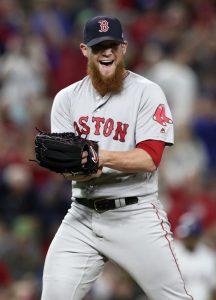 It could be that the market has simply shifted, and front offices are no willing to commit the type of long-term financial commitments (especially with draft and international market penalties involved) for free agent stoppers that were available to the likes of Aroldis Chapman, Kenley Jansen, or Mark Melancon just as recently as the 2016-17 offseason. That said, it’s still a surprise to realize that over a third of the season elapsed before any club was willing to ink a player with as sterling a track record of ninth-inning success as Kimbrel.
With a career 1.91 ERA, 14.7 K/9, and 4.23 K/BB rate over nine seasons and 532 2/3 career innings, Kimbrel’s resume could very well eventually land him in Cooperstown down the road. While 2018 wasn’t as dominant as some of his past years, Kimbrel still seemed to have a viable platform year with a 2.74 ERA, 13.86 K/9, and 3.10 K/BB over 62 1/3 frames for the World Series-champion Red Sox.
Beyond the surface numbers, however, there were some red flags. It was hard to ignore Kimbrel’s increased struggles in the second half of last season, and then through Boston’s playoff run (a 5.91 ERA over 10 2/3 postseason innings). Kimbrel has also had some control issues in two of the last three seasons, with a 4.48 BB/9 last year and a 5.09 BB/9 in 2016. These issues could have been enough for teams to hesitate about guaranteeing five or six years to a pitcher in his 30’s (Kimbrel turned 31 in late May) when he was perhaps already showing some signs of slowing down.
Multiple teams were linked to Kimbrel’s market at various points over the last seven months, including several showing increased interest in the last couple of weeks as the draft (or, the qualifying offer expiration date) approached on June 3. The Rays, Phillies, Braves, Brewers, Twins, Nationals, and Red Sox all had some degree of interest while Kimbrel was available.
While the Cubs always seemed like a good on-paper fit, they seemingly only emerged late in the game due to some unexpected luxury tax room opening up. Ben Zobrist‘s placement on the restricted list on May 8 means that his salary no longer counted towards Chicago’s luxury tax calculations, and if Zobrist misses the entire season (which seems increasingly likely at this juncture), the Cubs would have around $9MM to work with, money has seems to have fueled their push for Kimbrel.
Theo Epstein and company headed into the offseason with a need for bullpen help, with closer Brandon Morrow undergoing elbow surgery in November and still without a clear timetable to return. Despite needs in the pen and elsewhere on the roster, however, the Cubs were very circumspect about their winter spending, due to a desire to stay under the maximum luxury tax threshold and team chairman Tom Ricketts’ controversial claim that “we don’t have any more” to spend.
Prior to the Kimbrel signing, Roster Resource projected the Cubs at just over $227.7MM in luxury tax payroll, putting the team in line for a 20% tax on every dollar spent above the $206MM luxury tax line, and then an additional 12% surtax for going more than $20MM over the line. The average annual value of Kimbrel’s deal works out to $14.333MM per season, thus keeping the Cubs from exceeding the $246MM maximum penalty threshold. Spending more than $246MM would cost the Cubs 62.5% surcharge on the overage, and their top draft pick in 2020 would be dropped by ten slots.
So it could be a win-win situation for Chicago, as the team looks to both avoid the top tax threshold while also getting a closer to bolster a bullpen that has generally been around the middle of the pack this season. With Pedro Strop returning from the injured list and now Kimbrel’s addition, the Cubs suddenly have a much deeper pen to help them in their fight to win the NL Central. Signing Kimbrel prior to June 3 would’ve cost the Cubs not only more money in salary, but also $500K in international bonus pool money and their second-highest pick in the 2019 draft (which ended up being the 64th overall selection).
For Kimbrel and his representatives, landing a multi-year contract represents some measure of a victory after the long wait, as several suitors were only interested in inking Kimbrel to a one-year deal for the remainder of the 2019 campaign. While three years and $43MM is considerably less than Kimbrel expected at the start of the winter, the term isn’t far from four years/$70MM predicted by MLB Trade Rumors’ Top 50 Free Agents list back at the start of November, though nobody could’ve expected the wild path Kimbrel could take to eventually land his next contract. If Kimbrel ends up pitching up to expectations, one suspects several teams will be kicking themselves over not signing Kimbrel when they had the chance.
The stopper is undoubtedly relieved to simply get his focus back on baseball, as he’ll now join a contender in pursuit of another World Series ring. The question now is when Kimbrel will actually join the Cubs, as while he has been training on his own in preparation for the season, it remains to be seen how long it will take for him to ramp up to be ready for MLB hitters. The other looming question could concern Kimbrel’s effectiveness, as other players whose qualifying offer-induced long waits in free agency (Stephen Drew and Kendrys Morales in 2014) both struggled badly after sitting out months of the season.
Photo courtesy of USA Today Sports Images
Minor MLB Transactions: 6/7/19
Here are Friday’s minor moves from around the game…
- First baseman/outfielder Jim Adduci cleared waivers after being designated for assignment by the Cubs and has been assigned outright to Triple-A Iowa, per the league’s transactions page. He’d have had the right to reject an outright assignment in favor of free agency, but Tommy Birch of the Des Moines Register reports (via Twitter) that Adduci was indeed added to the Iowa roster, with Matt Carasiti landing on the temporarily inactive list in a corresponding move. The 34-year-old Adduci was hitless in five plate appearances during his extremely brief time with the Cubs before being designated for assignment to accommodate the addition of Carlos Gonzalez. He hit .261/.306/.478 through 41 games in Iowa earlier this season and .267/.290/.386 in 185 plate appearances for the Tigers in 2018.