
AL Notes: Red Sox, Rusney, Sale, Indians, Pujols
Remember Rusney Castillo? Signed to a seven-year, $72.5MM contract in August 2014, the Cuban outfielder had a rough season in the majors with the Red Sox the next year and has barely appeared in the majors since. The Red Sox have minimized their luxury-tax bill by keeping Castillo in the minors, and he’s likely to stay with Triple-A Pawtucket this season, but he’ll be a free agent thereafter. The 32-year-old discussed his status with Jason Mastrodonato of the Boston Herald, saying: “My goal remains the same: I want to make it to the big leagues. And if given the opportunity, give 100% to Boston. That’s the goal, to get up there.” As Mastrodonato notes, there’s at least an outside chance Castillo will return to Boston late in the season if the team’s well under the tax threshold by then (he’s due a $14.3MM salary, so it could be a tall order to fit him in). Castillo will first have to impress in Pawtucket for that to happen, though. He wasn’t great at the highest level of the minors in 2019, when he hit .278/.321/.448 with 17 home runs in 493 plate appearances.
- Sticking with the Red Sox, ace Chris Sale has been on the mend from 2019 elbow problems and a recent bout of pneumonia, but he’s recovering well. Sale’s “progressing quickly and could begin to face live hitters soon,” Chris Cotillo of MassLive.com writes. However, it’s not clear whether Sale will be ready for the start of the season. The 30-year-old had a stunning amount of difficulty preventing runs in 2019, when his ERA ballooned from 2.11 the prior season to a career-worst 4.40, but most of his other numbers looked fine. Sale notched a 3.39 FIP/2.93 xFIP with 13.32 K/9 and 2.26 BB/9, suggesting he’s still a front-of-the-rotation talent.
- Indians closer Brad Hand turned in excellent overall production yet again in 2019, but his effectiveness waned to a worrisome degree from late June through the end of the season. That was thanks in part to injuries that limited him to 57 1/3 innings – his fewest in more than a half-decade. Hand dealt with left arm fatigue that kept him out of action for a large portion of September, and he ended the year with his worst average fastball velocity (92.9 mph, compared to 94.1 in 2018) since 2012. “For whatever reason this tired arm affected my arm slot and pitches,” Hand told Paul Hoynes of cleveland.com, adding, “This year I’ll probably take a few more steps and stay ahead of it.” Manager Terry Francona’s hopeful that Hand will build up his velocity slowly this spring, as opposed to maxing out before the season starts. This is the last guaranteed year on Hand’s contract, but if he continues to hold his own, it’s hard to believe the Indians (or, if they trade him, another team) won’t exercise his $10MM club option for 2021.
- Angels manager Joe Maddon will sit down with first baseman/designated hitter Albert Pujols nearer to the season to discuss his 2020 role, per Rhett Bollinger of MLB.com. The 40-year-old future Hall of Famer appeared in 131 games last season, but it went down as the third straight campaign in which he logged below-replacement-level numbers. Pujols batted .244/.305/.430 with 23 homers and minus-0.2 fWAR over 545 plate appearances. The majority of his work came at first, though he may have to battle Tommy La Stella for reps at the position this season. And Pujols probably won’t get much time at DH because of the presence of Shohei Ohtani.
Camp Battles: The Indians’ Outfield
For a team that has averaged 95 wins a year over the last four seasons, the Indians have consistently taken a mix-and-match approach to their outfield amidst this run of success. Of course, having star infielders (i.e. Francisco Lindor, Carlos Santana, Jose Ramirez) and a seemingly neverending pipeline of starting talent can allow a club to put less of a focus on its outfielders, and Cleveland would’ve ideally hoped that more of its highly-regarded outfield prospects would have taken the leap to everyday status by this point. Still, the Tribe is now entering a fifth season of outfield uncertainty, and hoping that at least one of its question marks can enjoy a true breakout campaign.
Let’s begin with the one everyday lock in Oscar Mercado, though Mercado’s actual position on a game-by-game basis could be in flux. The 25-year-old is coming off a solid rookie season that saw him perform decently well at the plate (95 wRC+, 96 OPS+) and impressively well with the glove in 698 2/3 innings in center field — +6 Outs Above Average, +5.8 UZR/150, +9 Defensive Runs Saved. It’s safe to assume that Mercado will get the lion’s share of time in center again in 2020, though his ability to play all three positions will allow manager Terry Francona to shift other players into the outfield based on matchups.
Those other players? It’s quite a long list:
- Delino DeShields: Depending on your defensive metric of choice, DeShields was either slightly behind (UZR/150, DRS) Mercado in defensive value last season, or ahead (Statcast ranked DeShields tied for fifth among all outfielders in baseball with +12 OAA in 2019), plus DeShields has a longer track record of outstanding glovework. It stands to reason that DeShields will handle center when Mercado is used in the corners, though it remains to be seen if DeShields will hit enough to move beyond mere fourth-outfielder duty. The 27-year-old hit only .246/.326/.342 over 1936 career plate appearances with the Rangers, though it’s possible the change of scenery from Texas to Cleveland could help.
- Domingo Santana: Signed to a one-year MLB contract (with a 2021 club option) earlier this week, Santana is decidedly not an option in center field, and even the corner outfield might be a stretch for a player who posted some of the worst defensive numbers of any player in baseball. If Santana does indeed end up being used mostly as a designated hitter, the fact that he was signed at all could hint at the Tribe’s belief that…
- Franmil Reyes is capable of better things as a right fielder after two seasons of mediocre fielding. Acquired as part of the three-team Trevor Bauer blockbuster last summer, Reyes hit .249/.310/.512 with 37 home runs over 548 PA between the Padres and Indians in 2019. The power is already there and the overall hitting potential has shown some flashes of improvement, and though Cleveland used Reyes almost exclusively at DH after the trade, the team surely hopes that they can get at least a couple of seasons’ worth of passable fielding work from Reyes to maximize his overall roster value (even if a mostly-DH role is ultimately in his future).
- Jordan Luplow: Among all qualified hitters in 2019, only J.D. Martinez and Alex Bregman had a higher wRC+ against left-handed pitching than Luplow, who crushed southpaws to the tune of a .320/.439/.742 slash line and 198 wRC+ over 155 PA. Even with other big righty bats like Santana and Reyes on hand, Luplow’s incredible splits will ensure that he’ll at least see platoon action, and Luplow has the added defensive edge of being able to play the corners decently well (and could even handle center field in a pinch). If Luplow is to play a larger role, he’ll have to greatly improve his desultory .596 career OPS over 225 PA against right-handed pitching.
- Greg Allen: The switch-hitting Allen offers a bit of balance to all of these right-handed hitters, though he hasn’t much from either side of the plate over 586 Major League plate appearances. Allen can technically play all three outfield positions, though his glovework in the corners is much more highly regarded than his performance in center field. Assuming at least one of the left-handed bats remaining on this listing emerges, Allen may find himself beginning the 2020 season in the minors.
- Tyler Naquin: He likely won’t factor into the Opening Day picture, as much as Naquin is making excellent progress after suffering a torn ACL at the end of August. Still, Naquin looks on pace to return on the shorter end of his original seven-to-nine month recovery period, which adds another left-handed bat to the Indians’ mix. 2019 was shaping up as easily Naquin’s best season since his 2016 rookie year, so a post-hype breakout might yet be in the cards for Naquin if he can get healthy.
- Jake Bauers: Acquired as part of last offseason’s three-team deal that brought Carlos Santana back to Cleveland, Bauers’ first year with the Tribe was a disaster, as he posted an overall sub-replacement season (-0.4 fWAR) while struggling at both the plate and in the field. Bauers is still only 24 years old and is a former top-100 prospect, so it’s clearly far too early for the Indians to give up on him, but he’ll be on a much shorter leash than last season.
- Bradley Zimmer: Speaking of former top prospects, Zimmer missed almost all of the 2018-19 seasons due to shoulder surgery. MLB.com ranked Zimmer as the 22nd-best prospect in baseball entering the 2017 campaign, but a forgettable rookie season and then his extended injury absence turned Zimmer from building block to afterthought. He could be the biggest wild card of any player on this list, assuming Zimmer is healthy.
- Daniel Johnson: A part of the three-player package the Indians received from the Nationals in the November 2018 Yan Gomes trade, Johnson’s first season in Cleveland’s farm system was a successful one, as he hit .290/.361/.507 over 547 combined PA at the Double-A and Triple-A levels. MLB.com’s scouting report notes that Johnson’s strong throwing arm and overall defense alone could earn him steady work as a fourth outfielder at the big league level, so if he can manage to hit as well, there’s certainly room for Johnson gain playing time with the Tribe.
One bit of good news for the Indians in sorting out all these players is that they don’t face any specific roster crunch, as Santana is the only one of these players who no longer has a minor league option. That affords Francona and the front office the opportunity to freely evaluate these players during Spring Training without feeling forced into a tough roster choice based on team control. Given the sheer number of outfielders on hand, it also wouldn’t be entirely shocking if the Tribe dealt away from this surplus. If a few of these names really stand out during camp, Cleveland might feel comfortable enough in its depth to consider one of the other players expendable if another outfield-needy team came calling with an interesting trade offer.
Orioles Claim Andrew Velazquez, Designate Richard Urena
The Orioles have claimed utilityman Andrew Velazquez off waivers from the Indians, per a club announcement. To create roster space, the team designated fellow infielder Richard Urena.
Velazquez, a 25-year-old switch-hitter, has only minimal MLB experience. In 648 total plate appearances at the Triple-A level, he owns a .260/.316/.415 batting line with 16 home runs.
If Urena clears waivers, he’ll likely end up competing for a job with Velazquez … among others. Both of these players have similar backgrounds — including that they primarily came up as shortstops. Velazquez has greater experience at other spots, particularly the outfield.
The field is rather broad. Urena had himself been claimed off waivers recently. With that move, the O’s dropped Pat Valaika, who’s also still in camp — as is fellow recent addition Ramon Urias. Other utility candidates with MLB experience include Stevie Wilkerson, Jose Rondon, Dilson Herrera, and Jesmuel Valentin. Those and perhaps still other players will be looking to win spots in the bench mix, as the O’s appear set to go with a double-play combo of Jose Iglesias and Hanser Alberto.
Red Sox, Padres Reportedly Still Negotiating Wil Myers Swap
FEBRUARY 19: The Pads are indeed interested in both Lindor and Senzel, Dennis Lin of The Athletic reports (subscription link). It’s even possible that the Myers talks with the Red Sox could morph into a three-team arrangement involving the Reds, Lin adds.
FEBRUARY 18: Spring Training is now upon us. Prior talks failed to result in a deal. And yet the Red Sox are still holding talks with the Padres about a potential deal that would send first baseman/outfielder Wil Myers to Boston, according to Kevin Acee of the San Diego Union-Tribune.
Details are about as firm as you could ever hope to see them in a rumor of a potential swap. As before, the Friars want the Sox to take over about half of Myers’s salary (total guarantee of $61MM) over the next three years. Young talent would go to Boston to sweeten the pot. Players that have been discussed include Cal Quantrill, Luis Campusano, and Gabriel Arias, though it’s not clear which would be included and the Sox wouldn’t be able to obtain all of them just to take on half of what’s owed Myers.
That leaves out one major component of the as-yet-uncompleted trade talks: what would come back from the Red Sox? The original chatter between these teams involved Mookie Betts, who is no longer in the Boston stable. There’s no real indication just yet as to what current Red Sox might pique the interest of Padres GM A.J. Preller.
Yet more intriguing? The real goal, per Acee, is to swing a blockbuster for a high-level talent. He notes Nick Senzel of the Reds and Francisco Lindor of the Indians as longstanding targets, but it’s not really clear whether either is realistically available at this point. There aren’t many other conceivable candidates to be acquired who’d meet the description of a “difference-making” performer.
It’s fair to hold some skepticism here, especially as to the possible second prong of this scenario. Then again, Preller once pulled off a trade for Craig Kimbrel just before the start of a season, so it’s tough to rule out any mid-spring fireworks.
Latest On Francisco Lindor’s Future
After an offseason of trade rumors, the Indians still employ superstar Francisco Lindor. This is the time of year for extension talks and there are indications of mutual interest. But it’s far from clear there’s a match to be made.
Both Lindor and Cleveland president of baseball operations Chris Antonetti addressed the shortstop’s contract situation today, with ESPN.com’s Alden Gonzalez covering. He’s slated to earn $17.5MM this year with one more year of arbitration eligibility remaining, though the only hope of him remaining in town for the long run would be a new deal of some kind.
Lindor left no doubt he sees Cleveland as “home” and expressed a strong desire to stay and win with his sole professional organization. The 26-year-old also suggested he thinks a long-term contract is possible — and not just in the perfunctory way we sometimes hear from players.
“If the negotiations or whatever makes sense, it’s gonna happen,” Lindor said of a potential blockbuster extension. “The team is not broke. The league is not broke. There’s money.”
So, if Lindor truly wants to stay and feels the economic bridge can be spanned … is there a chance? Antonetti was rather less sanguine, his comments leaving the sense that player and team may well be fated by broader forces to part.
While he says there have been “meaningful efforts” to reach a deal in the past and acknowledges Lindor’s sincerity, Antonetti struck a realistic tone. While the team would also “love for Francisco to be here long-term,” Antonetti explained, it just isn’t that simple.
“It’s not because of a lack of desire on our part, or not because of a lack of desire on Francisco’s part. But more when you look at the economics of baseball and the realities of building championship teams in a small market, it gets really tough. The interest is there, the desire is there, on both sides, to try to get something done. And whether or not that’s possible we just don’t know.”
That stance jives with prior comments of Indians owner Paul Dolan, who has made clear he doesn’t find $300MM+ contracts plausible in the near future for his organization. Dolan also has advised fans to enjoy Lindor while he’s still with the club.
Mike Clevinger To Undergo Knee Surgery
7:03pm: Clevinger is expected to be able to return to action in six to eight weeks, the team tells reporters including MLB.com’s Mandy Bell (Twitter link).
8:58am: Indians ace Mike Clevinger is slated to undergo surgery to repair a partial tear of the medial meniscus in his left knee, reports Zack Meisel of The Athletic (Twitter link). Clevinger has been on crutches after sustaining the injury while training earlier this week. A timetable for his return is not yet known.
While a meniscus tear typically isn’t a season-ender, it also seems highly unlikely that Clevinger would be ready to open the season in the Cleveland rotation. The extent of his rehab will be determined following the operation, but even a return on the short end of typical meniscus timelines would leave Clevinger with little (if any) time to ramp up for the season.
The Indians, for the first time in several years, will head into the season as underdogs in the American League Central — and the loss of Clevinger for any portion of the season will only dampen their hopes. The team is deep in pitching options, but Clevinger and fellow righty Shane Bieber were the two best options at manager Terry Francona’s disposal. (Carlos Carrasco, of course, is immensely talented but more of a wild card following last year’s battle with leukemia.)
Bieber and Carrasco figure to front the rotation now, and the Indians will likely choose among Zach Plesac, Aaron Civale, Adam Plutko, Jefry Rodriguez, Logan Allen and Scott Moss to round out the final three spots in the rotation. Both Plesac (3.81 ERA in 115 2/3 innings) and Civale (2.34 ERA in 57 2/3 innings) looked sharp in their respective MLB debuts in 2019, although fielding-independent pitching metrics considered both to be more than a full run worse than his eared run average. Plutko has been up and down with the Indians over the past three seasons, posting a combined 5.08 ERA/5.61 FIP in 189 2/3 frames. Rodriguez posted similar results to the rest of that group (4.63 ERA/4.54 FIP in 46 2/3 innings).
The 22-year-old Allen, meanwhile, is a well-regarded southpaw who came over in last summer’s three-team Trevor Bauer/Franmil Reyes/Yasiel Puig blockbuster. He’s light on big league experience but considered one of the organization’s more promising arms. Moss, too, was acquired in that swap. Unlike Allen, he’s yet to make his big league debut. He did post strong numbers in the upper minors in 2019, however, including a hearty 159 strikeouts in just 130 2/3 frames. Control is an issue for the 6’6″ lefty, but he’ll get a look as a potential option in the coming weeks.
Indians Designate Andrew Velazquez For Assignment
The Indians announced Friday that they’ve designated infielder Andrew Velazquez for assignment. His spot on the 40-man roster goes to outfielder/designated hitter Domingo Santana, whose one-year deal with the Indians has now been formally announced.
Velazquez, 25, appeared in five games with the Indians in 2019 and went 1-for-11. He’s appeared sparingly at the MLB level between the Tampa Bay and Cleveland organizations, hitting .152/.222/.242 in a minuscule sample of 36 plate appearances. The Indians acquired him just this past July in exchange for international bonus pool allotments.
The versatile Velazquez is a shortstop by nature but has also logged ample time in center field, at second base and at third base throughout an eight-year minor league tenure. He’s a career .260/.316/.415 hitter in 648 plate appearances at the Triple-A level. Cleveland will have a week to trade Velazquez, place him on outright waivers or release him. He does have two minor league option years remaining, so a club seeking some versatile infield depth could place a speculative claim if it has the roster flexibility at present.
Indians Complete Deal With Domingo Santana
The Indians have completed their rumored contract with outfielder/designated hitter Domingo Santana, tweets Ken Rosenthal of The Athletic. The Wasserman client will earn a $1.5MM guarantee, and his contract comes with a $5MM club option or a $250K buyout. Santana can earn $500K in bonuses for days spent on the roster in 2020, and each roster bonus he triggers will boost the value of next that 2021 club option. In total, the deal can reportedly max out at two years and $7.5MM.
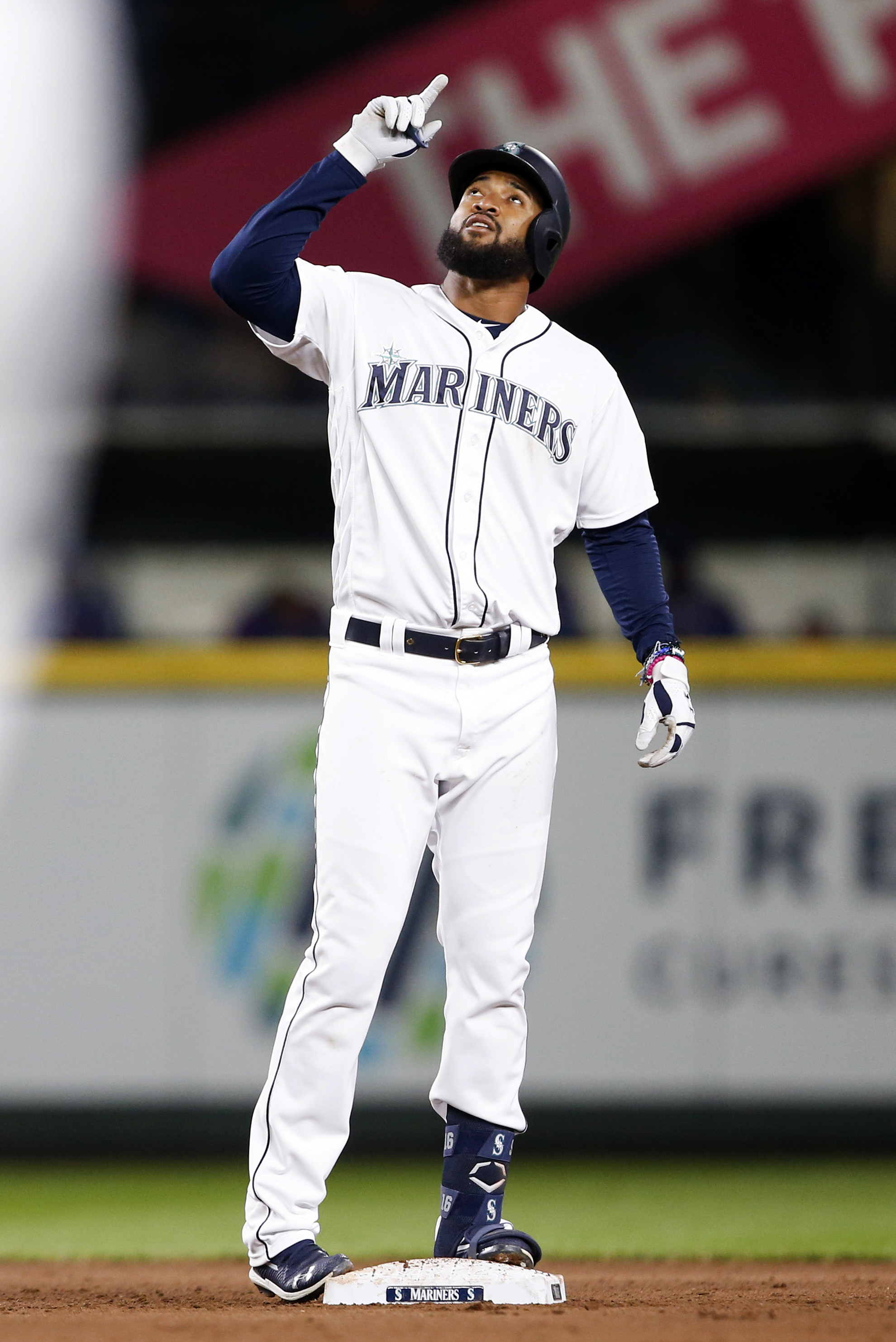
Still just 27 years old, Santana was an offensive force with the Brewers as recently as 2017, when he slashed .278/.371/.505 with 30 home runs and 29 doubles (good for a 126 OPS+ and 127 wRC+). However, Santana was the beneficiary of a .363 average on balls in play that year, punched out in nearly 30 percent of his plate appearances and played a below-average right field. It’s impossible to say whether those traits gave the Brewers concern about his ability to produce moving forward or whether the team simply found the value in a pair of marquee offseason acquisitions too great to pass up. Regardless, Santana was effectively pushed to a bench role the following year after Milwaukee traded for Christian Yelich and signed Lorenzo Cain to join Ryan Braun in the outfield.
The 2018 season wasn’t a great one for Santana. One can point to the fact that he was already a regression candidate or suggest that his newfound limited role was a difficult adjustment. Whatever the reason, Santana’s .265/.328/.412 slash through 235 plate appearances marked a substantial downturn. He was traded to the Mariners for Ben Gamel last winter.
In Seattle, Santana once again found himself in a near-regular role, and his production bounced back to an extent. In 507 plate appearances, he hit .253/.329/.441 with 21 homers, 20 doubles and a triple. It wasn’t the same level of pop that he displayed in 2017, but it was a nice bounceback effort all the same. Santana’s strikeout rate only worsened, though, as he fanned in 32.3 percent of his trips to the plate. And, his already shaky glovework bottomed out in 2019 when defensive metrics graded him as one of baseball’s worst defenders at any position (-17 Defensive Runs Saved, -16.1 Ultimate Zone Rating, -13 Outs Above Average).
Santana’s fit in Cleveland is admittedly something of a curious one, as the Indians already have an extremely similar player in Franmil Reyes. Both lumbering, defensively-challenged sluggers hit from the right side of the dish and profile better as a designated hitter than as an outfielder. Santana draws more walks and runs slightly better; Reyes has more power, strikes out a bit less and boasted 99th-percentile marks in exit velocity and hard-hit rate in 2019. Overall, they bring comparable skill sets to an already-crowded Indians outfield mix (though Reyes would seem to have more offensive upside).
Oscar Mercado should have center field locked down after a strong debut campaign in 2019, leaving Santana and Reyes as two options in the outfield corners. The problem is that right-handed-hitting Jordan Luplow is also in the corner mix, and his otherworldly production against lefties should at least ensure him a platoon role. Cleveland also acquired Delino DeShields Jr. — another right-handed bat — in the Corey Kluber salary dump. The switch-hitting Greg Allen is in the mix, too, as are lefty-swinging Jake Bauers, Bradley Zimmer and (once recovered from last year’s ACL tear) Tyler Naquin.
Santana is an affordable addition to the fray, to be sure, and there’s little doubt that he deepens the club’s reservoir of options in the corners and at DH. That said, it’s also not clear that Santana is an upgrade over what they already had in house.
Details On Mets’ Pursuit Of Francisco Lindor In December
The Mets were one of several teams reported to have interest in Francisco Lindor back when the Indians are seemingly testing the market for the All-Star shortstop earlier this winter. Jeff McNeil was known to be one of Cleveland’s prime targets in talks with the Mets about Lindor, and The Athletic’s Ken Rosenthal (subscription required) recently shed a bit more light on the “significant dialogue” between the Amazins and the Tribe.
“The Mets aggressively tried to acquire [Lindor] at the winter meetings,” Rosenthal writes, noting that it would “likely” have cost New York a three-player package consisting of Amed Rosario and two prospects. Both this proposal and Cleveland’s interest in McNeil were too much for the Mets, however, and beyond the cost in trade chips, Rosenthal has also heard from some corners that “finances played a significant role” in negotiations.
Lindor’s salary for the 2020 season hadn’t yet been finalized by early December, though MLBTR’s Matt Swartz projected the shortstop for a $16.7MM payday in his second of three arbitration-eligible seasons. As it happened, Lindor topped this projected number by agreeing to a $17.5MM deal for 2020, an even healthier raise than expected over the $10.55MM salary he earned in 2019. Assuming Lindor has another outstanding year in the coming season, his arb number for 2021 now looks to fall in range of $23MM-$24MM.
Still, something in the neighborhood of $41MM over a two-year span is more than reasonable for a player of Lindor’s caliber. The Mets were known to be trying to move Jeurys Familia and/or Jed Lowrie in order to create payroll space, and the club hasn’t made any hugely expensive acquisitions this winter, signing Dellin Betances, Rick Porcello, Michael Wacha, and Brad Brach to one-year contracts for a combined $25.6MM in guaranteed money (a total that could rise significantly based on options and incentive clauses in the various deals).
Taking on both a big salary and parting ways with controllable talent like Rosario, McNeil, or prospects was too much for the Mets’ liking, which isn’t an unreasonable stance. McNeil, after all, has been outstanding in his two MLB seasons and Rosario is coming off the best of his three big league campaigns, with the 24-year-old starting to deliver on some of the potential that made him one of baseball’s best prospects. That said, the overall crux of Rosenthal’s piece examines how the Mets are still feeling the impact of last offseason’s blockbuster trade with the Mariners, as the added salaries of Robinson Cano and Edwin Diaz (who both struggled badly in 2019) have limited payroll flexibility, while moving top prospects Jarred Kelenic and Justin Dunn both thinned out New York’s farm system and also made the team seemingly more wary about moving any more of its top minor leaguers.
Had the Mets not swung that deal with Seattle, who knows how the Amazins’ fate could have changed both during the 2019 season or into their business this offseason, as New York could have been more willing to take the jump on a swap for Lindor or another trade target in Starling Marte (though the Pirates also put a high asking price on Marte in talks with the Mets).
To be fair, Rosenthal notes that as great a player as Lindor is, he “was a luxury item, not a must-have” for a Mets club that already had Rosario, plus top prospects Ronny Mauricio and Andres Gimenez coming up the pipeline at shortstop. There’s also the fact that the Indians may not have been “especially motivated to act” on a Lindor trade, as the big returns Cleveland reportedly wanted in any potential deal indicated that the Tribe would only move Lindor if presented with a special offer. The door now appears to be closed on the possibility of Lindor being dealt this winter, as Cleveland addressed their own payroll concerns by trading Corey Kluber to the Rangers.
Indians Sign Cameron Rupp To Minor League Deal
The Indians have agreed to a minor league deal with former Phillies catcher Cameron Rupp, per a team announcement. The former Phillies backstop will be in Major League camp when Spring Training opens.
Rupp, 31, hasn’t been in the big leagues since the 2017 season. He’s bounced between the Triple-A affiliates for the Twins, Rangers, Mariners, Tigers and A’s over the past couple of seasons, hitting for some power but struggling to get on base or hit for average. That general description is well in line with the skill set that Rupp displayed with the Phillies from 2013-17, when he appeared in 296 games and hit .234/.298/.407 with 39 homers in 1127 plate appearances.
The Indians don’t have an immediate need for a backup option, as Sandy Leon was brought in to support starter Roberto Perez, who enjoyed a breakout 2019 season at the plate. The Cleveland organization is a bit thin on catching depth in the upper minors, though, so Rupp will give them an experienced option to pair with fellow offseason signee Beau Taylor in Triple-A Columbus if he shows well in Spring Training.