
Latest On MLB Teams’ Plans For Employees
A variety of MLB teams have already revealed plans for the year for non-player employees. Some have instituted furloughs and/or pay cuts while others have committed to carry employees through the fall. Still other teams are taking things on a month-to-month basis, with several revealing their latest plans in recent days.
At least three teams have decided to continue paying employees in full through at least the end of June. The Cardinals are one such team, Derrick Goold of the St. Louis Post-Dispatch reports on Twitter. The Twins are also in that camp, Jeff Passan of ESPN.com tweets. And the White Sox are adjusting work hours but not take-home pay, per Ken Rosenthal of The Athletic (via Twitter).
Elsewhere in the central divisions, there were some cuts. The Cubs are keeping their full slate of employees at full-time capacity, but are instituting some salary reductions, Jeff Passan of ESPN.com reported on Twitter. And though the Pirates will not draw down their baseball operations staff, they will reduce pay in that arena while furloughing some business employees, as Jason Mackey of the Pittsburgh Post-Gazette reports.
Out west, the Giants will retain their entire full-time staff but will be trimming pay for those earning over $75K, Henry Schulman of the San Francisco Chronicle reports. Part-timers have been furloughed.
The Astros have committed to maintaining full pay and benefits for full-time employees, but only through June 5th, Chandler Rome of the Houston Chronicle reports. Whether some action could occur beyond that point remains to be seen. The Orioles are also still in flux, but the organization appears to be leaning towards keeping staff as usual through June, per Dan Connolly of The Athletic (via Twitter).
Which 15 Players Should The Twins Protect In An Expansion Draft?
In a few weeks, we’ll be running a two-team mock expansion draft here at MLBTR. Currently, we’re creating 15-player protected lists for each of the existing 30 teams. You can catch up on the rules for player eligibility here.
So far, we’ve done the Royals, Tigers, Indians, White Sox, Rays, Yankees, Red Sox, Blue Jays, and Orioles. The Twins are next.
We’ll start by removing free agents Nelson Cruz, Homer Bailey, Tyler Clippard, Rich Hill, Alex Avila, Marwin Gonzalez, Jake Odorizzi, Ehire Adrianza, and Trevor May from consideration. We’ll also take out righty Sergio Romo, who has a club option for 2021.
Josh Donaldson will take one spot on the protected list due to his no-trade clause. I’ll lock down ten additional players:
Max Kepler
Jose Berrios
Jorge Polanco
Mitch Garver
Miguel Sano
Byron Buxton
Michael Pineda
Kenta Maeda
Taylor Rogers
Luis Arraez
That leaves four players to choose from this group:
Jorge Alcala
Willians Astudillo
Jake Cave
Randy Dobnak
Tyler Duffey
Zack Littell
Sean Poppen
Eddie Rosario
Devin Smeltzer
Cody Stashak
Lewis Thorpe
LaMonte Wade Jr
Matt Wisler
With that, we turn it over to the MLBTR readership! In the poll below (direct link here), select exactly four players you think the Twins should protect in our upcoming mock expansion draft. Click here to view the results.
How Does Twins’ Future Payroll Look After Spurt Of Multi-Year Contracts?
2020 salary terms are set to be hammered out in the coming days. But what about what’s owed to players beyond that point? The near-term economic picture remains questionable at best. That’ll make teams all the more cautious with guaranteed future salaries.
Every organization has some amount of future cash committed to players, all of it done before the coronavirus pandemic swept the globe. There are several different ways to look at salaries; for instance, for purposes of calculating the luxury tax, the average annual value is the touchstone, with up-front bonuses spread over the life of the deal. For this exercise, we’ll focus on actual cash outlays that still have yet to be paid.
We’ll run through every team, with a big assist from the Cot’s Baseball Contracts database. Next up is the Twins:
(click to expand/view detail list)
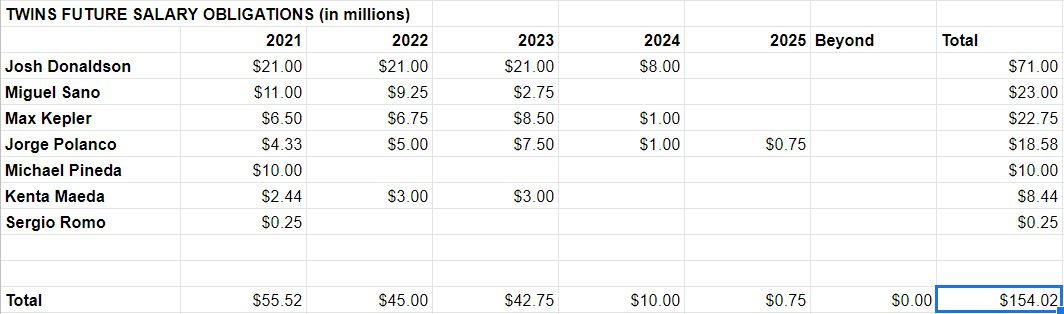
Twins Total Future Cash Obligation: $154.02MM
*includes buyout of club options
*does not include portion of Kenta Maeda’s 2021 salary owed by Dodgers
*estimated 2021 salary for Michael Pineda (specific contract breakdown unknown)
Central Notes: Twins, Bryant, Mize, Reds
Let’s check in on a few teams from the game’s Central divisions…
- The Twins signed injured left-hander Rich Hill in December with the expectation he’d miss a large part of the season. That was before the coronavirus pandemic ran amok, though, and now the Twins might get a full season (if there is one) out of Hill. The 40-year-old, who’s still recovering from the primary revision surgery he underwent in November , told Betsy Helfand of the Pioneer Press, “(I’ve) been able to make the most out of the situation so I’m right where I should be as far as rehab progression-wise, so if we do have a season, I should be ready to go when we kick off something of a spring training.” That means the Twins could get an entire season out of a hurler who has been one of the most effective starters in the majors on a per-inning basis since his out-of-nowhere breakout in 2015. Dating back to then, Hill has combined for a 2.91 ERA with 10.67 K/9 and 2.82 BB/9 in 466 1/3 frames as a member of the Red Sox, Athletics and Dodgers.
- Cubs third baseman/outfielder Kris Bryant is scheduled to become a free agent after the 2021 season. In theory, a shortened or canceled 2020 campaign could have a negative effect on his market if he does reach free agency, but agent Scott Boras doesn’t expect it to damage Bryant or any of the other star players who could be available then. “For the players who are the great players — because there’s always only a few great players — I don’t think it’s going to have anywhere near the impact,” Boras told Gordon Wittenmyer of NBC Sports Chicago, “because those great players are somebody you would sign for 10 years, and you can defer the cost. You just backload the contracts. You can do things with long-term contracts; you could wait for better times but still get the player for today.”
- Righty Casey Mize, the No. 1 pick in the 2018 draft, may be the best prospect in the Detroit organization. But with a minor league campaign unlikely to happen, Mize could miss out on further professional seasoning this year. So what’s the solution? Well, Evan Woodbery of MLive.com makes a case that the Tigers should just put him in their rotation this season. Doing so would burn a year of service time, and it’s unlikely Mize would help make the Tigers a playoff-caliber team even in a shortened season, but there’s no denying he is one of the most talented players in the organization. Mize spent the majority of last year in Double-A, where he pitched to a 3.20 ERA with 8.69 K/9 and 2.06 BB/9 in 78 2/3 innings.
- The Reds will start temporarily furloughing employees – less than 25 percent of them – on June 1, C. Trent Rosecrans of The Athletic tweets. Those individuals will continue to receive benefits while laid off, though.
A Quietly Built, Quietly Strong Bullpen
The 2019 Twins captured the baseball world’s attention with their historic home run output, and most of the other talk surrounding the team focused on questions within the rotation. The Twins won the AL Central with ease but were yet again bounced by the Yankees in a familiarly lopsided series. Entering the offseason on a low note and with four starting pitchers reaching free agency, the focus was again on the rotation. Yet somewhere along the way, the Twins quietly put together one of the most formidable collections of relievers in the game.
Following last year’s All-Star break, Twins relievers ranked ninth in the Majors in ERA (4.03) but led MLB in FIP (3.56), xFIP (3.87), SIERA (3.53) K-BB% (20.7%) and walk rate (5.9%). The Twins, long known for their reliance on soft-tossing, “pitch to contact” arms, saw their bullpen post the fifth-best overall strikeout percentage (26.6%). They tied for fourth in swinging-strike percentage (13.1%) and ranked fifth in opponents’ chase rate on pitches outside the strike zone (33.9%).
A half season’s worth of bullpen data is obviously not a definitive declaration of their status as elite, but the post-All-Star-break qualifier is of some note with regard to the Twins in particular. Minnesota opened the season with a host of reclamation projects and cast-offs in the relief corps. From Opening Day through the Midsummer Classic, the Twins saw Mike Morin, Blake Parker, Matt Magill, Ryne Harper, Adalberto Mejia and Trevor Hildenberger all make at least 13 appearances and total 14 or more innings. Harper, to his credit, was a legitimate contributor — although fielding-independent metrics forecast some regression, and his production faded in the second half.
The rest of that largely nondescript group was more or less out of the picture in the second half. Mejia, Morin, Magill and Parker were designated for assignment in a span of two weeks in mid-July. Mejia was claimed by the Angels, Morin was traded to the Phillies for cash, Parker also signed in Philadelphia after electing free agency, and Magill was traded to Seattle for cash. Harper’s role was reduced as his results regressed, and Hildenberger only tossed 2 1/3 innings as September call-up before being non-tendered in the winter. (Harper was designated for assignment and traded to the Nats in February.)
What was left of the Twins’ bullpen proved to be a remarkably effective unit.
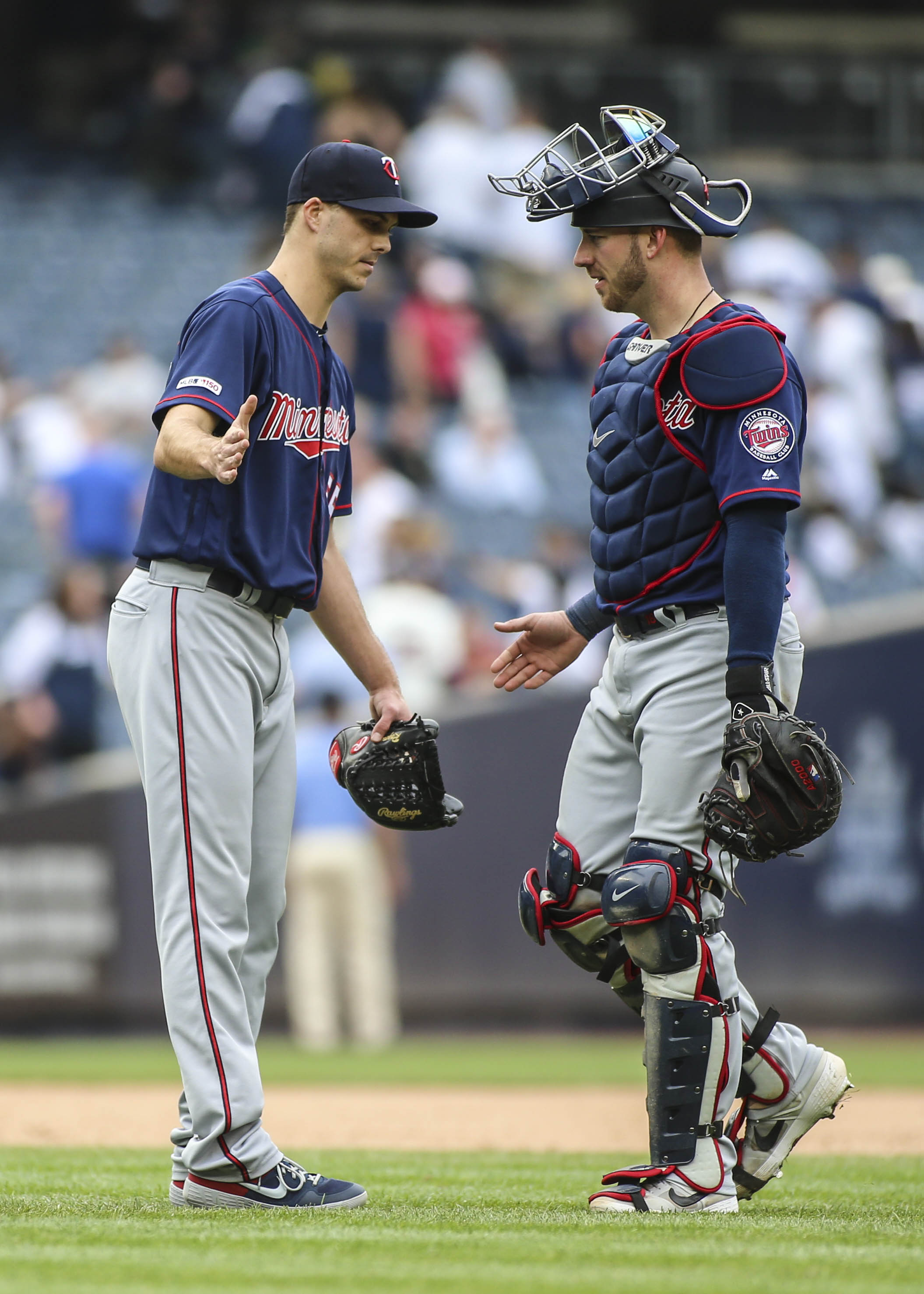
Taylor Rogers cemented himself as the club’s closer after the addition of a new slider spurred a 2018 breakout. He threw his first slider in 2018 on Memorial Day, and dating back to that game, Rogers owns a 2.07 ERA (2.52 FIP, 2.77 xFIP) with 11.4 K/9, 1.6 BB/9, 0.77 HR/9 and a 48.7 percent ground-ball rate in 117 1/3 innings.
Tyler Duffey showed promise as a starter in his debut season with Minnesota but had bounced between the Majors and minors since. Duffey has acknowledged that at first, he wasn’t fully comfortable or familiar with much of the new data that was presented to him by the Twins’ analytics department, but he fully bought in this year and ditched his two-seamer and changeup to go with a four-seam and curveball-heavy arsenal. The result? A 2.50 ERA (3.06 FIP, 2.94 xFIP) with a career-high 12.8 K/9 and a whopping 15.3 percent swinging strike rate. In the second half of the season, Duffey posted a 1.53 ERA with a 47-to-8 K/BB ratio.
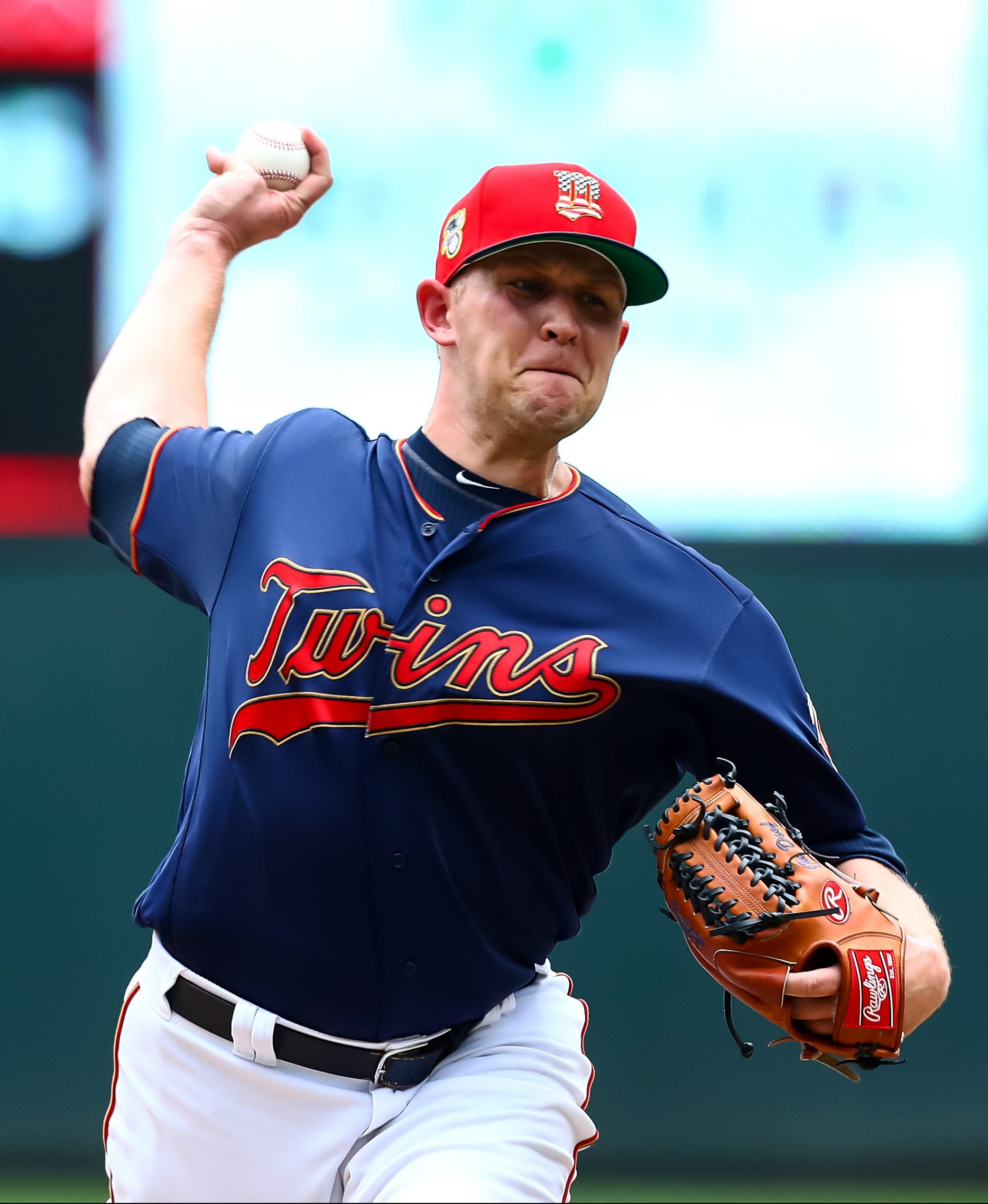
Another former starter, Trevor May, has steadily improved his relief work since returning from Tommy John surgery in 2018. The 30-year-old free-agent-to-be rattled off 64 1/3 innings of 2.94 ERA ball in 2019, including a 2.81 ERA (3.81 FIP, 3.67 xFIP) in 32 second-half innings. May saw his strikeout percentage spike from 25.5% in the first half to a hefty 35% in the second half, and his walk rate made similarly positive gains (11.9% in the first half; 7.3% in the second).
The Twins’ late-July acquisition of veteran Sergio Romo wasn’t the biggest headline grabber of deadline season, but the three-time World Series champ pitched 22 2/3 innings of 3.18 ERA ball (3.35 FIP, 3.91 xFIP) with a pristine 27-to-4 K/BB ratio. The two-plus months Romo spent in the organization clearly made a favorable impression, as he returned on a one-year, $5MM deal with a club option for the 2021 season.
But the most anonymous parts of the bullpen’s success were rookie right-handers Zack Littell and Cody Stashak.
Littell, a 24-year-old rookie, was summoned for depth in mid-May and took a long-relief beating during a blowout in order to save the ‘pen (eight runs in four innings). Optioned to Triple-A the next day, Littell returned about a month later and proceeded to reel off 30 2/3 innings of 0.88 ERA ball with a 27-to-8 K/BB ratio. The only runs scored against him came on a trio of solo homers. Obviously, Littell isn’t going to make it through a season with a 100% strand rate, but that dominant finish to the year likely cemented his spot in the ‘pen.
As for Stashak, he was never regarded as a prospect of particular note even within the Twins’ system, but he logged a 3.13 ERA with a 23-to-1 K/BB ratio in 23 innings in his MLB debut. Stashak is an extreme fly-ball pitcher who doesn’t throw especially hard or generate great spin on his heater or four-seamer … yet he posted an eye-popping 28.7% swinging-strike rate on his slider last year. There’s likely some regression coming for both Littell and Stashak, but both positioned themselves as near-term pieces even if they do take a step back.
At this point, outside of Rogers, the closer, it’s perhaps become apparent that this is a group of all right-handers. As such, targeting lefty relievers seemed like a logical course of action this winter. And the Twins did indeed go out and get the reliever who was the second-toughest pitcher on lefties in all of baseball last year (min. 30 innings): Tyler Clippard — another righty.
Clippard joined the Twins on a modest $2.75MM guarantee for the 2020 season, and while he doesn’t throw with his left hand (obviously), his dominant changeup makes him an excellent weapon against southpaw swingers all the same. Lefties posted a laughable .123/.210/.255 batting line against Clippard in 2019. That translated to a .207 wOBA, tying Roberto Osuna and trailing only Oliver Drake (another former Twin — oops) for best in the big leagues. That wasn’t necessarily a one-year aberration, either, as Clippard has better career numbers against lefties (.187/.266/.322) than righties (.207/.295/.387).
If the Twins want to add a true lefty to the mix, they can always move Devin Smeltzer and/or hard-throwing Lewis Thorpe into that role, although the plan for them appeared to be to continue working as starters early this spring. Perhaps expanded rosters will bring that pair and others into play; righties Randy Dobnak, Jorge Alcala and Sean Poppen all made their big league debuts last year, with Dobnak in particular impressing as a starter. Waiver claim Matt Wisler is another depth option with an intriguing Statcast profile. Among non-roster players, southpaw Danny Coulombe punched out 61 hitters in 36 1/3 Triple-A frames last year and had looked impressive with the Twins this spring. Jhoulys Chacin could give some long relief innings and provide rotation depth.
The Twins’ bullpen may be lacking a bit in name value, but among the 366 pitchers who faced at least 200 hitters last year, the Twins placed five in the top 70 in terms of xwOBA: Rogers (20), Duffey (22), Clippard (31), Romo (43) and May (tied for 70th). And none of their second half success was attributable to their biggest deadline pickup — righty Sam Dyson, who now famously kept a shoulder injury to himself prior to being traded and required surgery after just 11 1/3 ugly innings.
When a team jettisons about half its bullpen in a two-week span in July and sees its primary deadline acquisition bust, most would expect rough waters ahead. Instead, the Twins quietly enjoyed some of the best relief work of any club in last year’s second half and look well positioned for the future. Both May and Clippard will be free agents this coming winter, but there’s plenty of room to re-sign either and several depth in-house depth options to step up into those spots should they land elsewhere.
Remember When The Twins Traded Wilson Ramos For Matt Capps?
Nearly ten years ago, the Twins traded top catching prospect Wilson Ramos to the Nationals for closer Matt Capps. Was the move justified? MLBTR’s Steve Adams makes his video debut in today’s discussion with Jeff Todd.
The Twins’ Breakout Slugger
Last July, a happier time when something called Major League Baseball was actually taking place, I wrote a piece singing the praises of Twins catcher Mitch Garver. At that point, Garver was amid a breakout season in which he served as a key member of the Twins’ high-powered offense, aka the Bomba Squad – a unit that piled up an all-time record 307 home runs. Garver contributed about 10 percent of those, totaling 31 and finishing as one of five Twins who hit 30 or more.
Garver wasn’t just a one-trick pony who offered just power last year, either, as he wound up with an outstanding .273/.365/.630 line over his 359 plate appearances. Because he was part of a behind-the-plate timeshare with Jason Castro, Garver made just 93 appearances on the season. That means he hit a homer every three games; he also wound up with a .357 isolated power mark that paced all players who amassed 300-plus trips to the plate (AL MVP Mike Trout and AL Rookie of the Year Yordan Alvarez were his closest competitors).
Speaking of Trout, he has a new teammate in Castro, who will be the Angels’ starting catcher in 2020 if a season ever gets underway. The Twins, meanwhile, are now poised to hand the reins to Garver, whom free-agent addition Alex Avila will back up. Judging by what he did last season, Garver has a chance to end up as the Twins’ most productive catcher since Joe Mauer‘s heyday donning the tools of ignorance.
It wasn’t just a matter of Garver posting all-world bottom-line production with the bat last season. He also ranked among Statcast’s top hitters in one important category after another. To name some examples, Garver was in the 85th percentile or better in average exit velocity, hard-hit percentage, expected slugging percentage and expected weighted on-base average (.380, compared to a real wOBA of .405). He was also remarkably consistent, evidenced by a 155 wRC+ in the first half and a 154 mark in the second. Furthermore, the right-handed slugger managed numbers that were easily above average against lefties and righties alike (198 wRC+ versus LHPs, 130 off RHPs).
It’s not easy to find a red flag when it comes to Garver’s 2019 offensive outburst. Adding to his appeal, he performed pretty well behind the plate. Sure, Garver threw out a paltry 16 percent of would-be base stealers (league average was 11 points better), but he did finish a solid 28th in Baseball Prospectus’ Framing Runs Above Average metric and a slightly better 24th as a pitch framer.
All said, the Twins seem to have stumbled on a gem in Garver, who joined the organization as a ninth-round pick in 2013 and who appears to have developed into a formidable all-around contributor. The 29-year-old was quietly one of the reasons the Twins won 101 games and an American League Central title last season. If they’re going to enjoy similar success going forward, it wouldn’t be a surprise to see Garver continue to have a big hand in it.
Photo courtesy of USA Today Sports Images.
Why The Twins Could Trade A Slugger This Winter
While some clubs have struggled to find continuity in their outfield — the Cardinals, Padres and Blue Jays come to mind — the Twins have enjoyed a rather reliable trio in recent years. True, injuries to Byron Buxton have frequently held him out of the lineup, but the general expectation over the past three to four seasons has been that Buxton would be flanked by left fielder Eddie Rosario and right fielder Max Kepler. Since 2016, Rosario ranks fourth among MLB left fielders in innings. Kepler ranks seventh in right-field innings. Both would likely rank higher on those leaderboards were it not for occasional stints manning center field while Buxton mended from injuries.
And yet, as much of the team’s young core has been locked up on long-term deals — Kepler, Jorge Polanco and Miguel Sano are now all signed through at least 2023 — Rosario finds himself nearing free agency. The 27-year-old slugger agreed to a $7.75MM salary this winter and is controlled through 2021. There have reportedly been some talks between the two sides in recent years, but nothing has come together. Other key members of the Twins core remain unsigned (e.g. Buxton, Jose Berrios, Taylor Rogers) but are controlled an additional year beyond Rosario.
Moreover, the Twins now find themselves with a pair of corner prospects pushing for a spot in the big leagues sooner than later. Former first-round picks Alex Kirilloff (2016) and Trevor Larnach (2018) both rank comfortably among the game’s best overall prospects and both found success in Double-A in 2019. The former returned from a wrist injury to hit .283/.343/.413 (121 wRC+) through 411 plate appearances, while the latter hit .295/.387/.455 in 181 PAs — good for a 148 wRC+ that was an exact match for his mark through 361 PAs in Class-A Advanced.
Both Kirilloff (No. 9 overall on Keith Law’s prospect rankings at The Athletic) and Larnach (No. 45 at Baseball America) are 22-year-old corner outfielders with bats that have been deemed close to MLB-ready. Both would’ve likely advanced to Triple-A in 2020 had the season begun under normal circumstances, and it’d be reasonable to think that either could’ve made his MLB debut this year. Each notched an OPS north of 1.100 during brief Spring Training showings (30 PAs for Larnach, 22 for Kirilloff). Beyond that pairing, Brent Rooker posted a 139 wRC+ in Triple-A last year. He’s not as highly regarded and may be more of a first base or DH type in the long run, but Rooker’s been playing left field regularly since being drafted 35th overall in 2017.
It’s unlikely that any of those prospects would’ve been plugged directly into the Major League lineup to begin the season under any circumstance, but it’s nevertheless notable that Rosario’s name crept up in trade rumblings this winter. Had a deal come together, the Twins could’ve added a one-year stopgap, turned to Marwin Gonzalez as a primary outfielder and/or given Jake Cave an opportunity to establish himself. As it turned out, retaining Rosario only left the club with enhanced depth.
At some point in the near future, the Twins will have to ask whether they’re better off paying Rosario another raise in arbitration — though it remains to be seen how much of an increase he’ll get over his current salary next time — or whether some combination of Kirilloff, Larnach, Cave and Rooker can provide similar or greater value at a fraction of the price. Minnesota only has $55.5MM on the 2021 books as of this writing, so it’s not as if payroll is an immediate issue, but Rosario’s game isn’t without its flaws, either.
A former high-end prospect himself, Rosario has never demonstrated much plate discipline, but his swing-happy tendencies revved up to new levels last year. Jeff McNeil was the only qualified hitter in the Majors last year who swung at a higher percentage of pitches than Rosario’s 59.1 (although he didn’t chase out of the zone nearly as much as Rosario and had a markedly better contact rate on pitches in the zone). On top of that, only three qualified hitters chased balls out of the zone more than Rosario.
To his credit, Rosario has greatly improved his bat-to-ball skills, cutting his strikeout rate from 25.7 percent in 2016 to 14.6 percent in 2019. But Rosario’s penchant for swinging at pitches out of the zone leads to far more weak contact than one would expect from a player who hit 32 home runs in 2019. His 89.1 mph average exit velocity ranked 123rd of 250 qualified hitters, per Statcast, and his 36 percent hard-hit rate ranked 166th in that same grouping. Despite his clear power, Rosario hasn’t ranked higher than the 34th percentile of big league hitters in terms of hard-hit rate in any of the past four seasons. His expected weighted on-base average (xwOBA) has hovered around league average or a bit below.
This isn’t intended as a piece meant to disparage Rosario, who has proven himself to be a useful corner outfielder. He’s averaged 27.6 homers over the past three seasons, ranks seventh in the Majors in outfield assists in that time and, with the exception of a 2019 season during which he played through a notable ankle injury, he’s graded out as a reliable and at times well-above-average defender.
A rangy left fielder with a strong arm, consistently solid batting averages and 25- to 30-homer pop is a fine player — even if he comes with some on-base deficiencies. But when corner outfield options are typically plentiful in free agency and there are a pair of top-tier prospects looming in the upper minors, it’s easy to see the front office debating Rosario’s future. Rosario isn’t going to fetch a top-of-the-rotation arm in a trade given his rising price, questionable OBP and waning club control, but the Twins will still surely ponder whether their resources can be better allotted elsewhere soon — if they haven’t already.
Some may argue that Buxton or even Kepler are the better pieces for the Twins to consider moving from the current outfield group. But Buxton’s 80-grade glove and speed are harder to replace, and he’s controlled an additional year while currently earning less than half of Rosario’s salary. In terms of ceiling, he’s the highest of the bunch even in spite of his frequent injuries. Kepler’s extension, meanwhile, allows the Twins to control him for another five years and $38MM — the final season of which is a $10MM club option.
The alternative, of course, is to eventually look to package some of the aforementioned young talent to address other areas of need — likely high-end rotation help. The Twins’ offseason quest to bolster the starting staff ended up with more quantity-over-quality outcome than many expected, as the club missed on its top targets and instead pivoted to a surprising four-year deal with Josh Donaldson. Part of the reason they weren’t able to add an impact starter was the simple fact that virtually none were available in trade, but that could change down the road.
With three former top 40 picks thriving in the upper minors, two of them top 100 picks, and a long-entrenched mix of quality regulars at the MLB level, it seems inevitable that Minnesota’s outfield depth will undergo some form of reshaping in the near future. (None of this even mentions 2017 No. 1 overall pick Royce Lewis — a shortstop who some feel is destined to end up in center field instead.) Of course, this is the type of logjam that rebuilding clubs look forward to eventually trying to manage, and it serves as a reminder that despite their current lack of prototypical “ace,” the Twins are well-positioned for another run of competitive years in the American League Central.
Prospect Faceoff: 2 Future AL Central Stars?
The Twins’ Royce Lewis and the Royals’ Bobby Witt Jr. are among the jewels of their respective clubs’ farm systems, and if we’re to believe prospect gurus, there isn’t much separation between the two. Both players are regarded as top 30 prospects, MLB.com ranking Lewis ninth, FanGraphs placing him 13th and Baseball America putting him in the No. 26 spot. Witt checks in at Nos. 10, 23 and 24 on those lists.
Lewis, now 20 years old, entered the professional ranks as the No. 1 overall pick in 2017. At $6.725MM, Lewis received what was then the largest bonus ever given to a player drafted out of high school. Lewis came roaring out of the gates at the lower levels that year and the next season, though his production has dropped of late. He made his debut in Double-A ball last season and batted .231/.291/.358 (88 wRC+) with just two home runs in 148 plate appearances, though it’s worth noting that he was much younger than the typical player at that level. And Lewis, to his credit, did absolutely thrive dominate during the autumn in the Arizona Fall League, where he earned Most Valuable Player honors. There are some concerns about his “cacophonous” swing, as FanGraphs’ Eric Longenhagen explained in February, but he added that “the star-level talent will eventually shine through.”
Just where Lewis will line up in the majors remains to be seen. He’s versatile enough to play multiple positions (including center field), and the Twins seem to have found a long-term answer at short in Jorge Polanco. Likewise, the Royals are in nice shape at short with Adalberto Mondesi, so it’s up in the air where Witt will fit if he does arrive in Kansas City someday. They and the Twins can worry about how best to align their defenses at a later date, though.
[RELATED: When Will The Royals Contend Again?]
Witt, the son of former MLB hurler Bobby Witt, joined the Royals as the No. 2 pick in last year’s draft. He, like Lewis, got to the majors after a tremendous performance as a high school shortstop, and wound up signing for an almost $7.8MM bonus. But Witt endured his struggles during his initial taste of pro ball last summer, hitting .262/.317/.354 (85 wRC+) with only one homer in 180 PA in rookie ball. Nevertheless, Longenhagen compared Witt to Rockies star Trevor Story just a couple weeks ago, writing, “There are going to be some strikeouts but Witt is a big, athletic specimen who is very likely to not only stay at shortstop but be quite good there.”
Whichever positions these two play, we’ll be looking at a couple AL Central standouts if they develop according to plan in the coming years. Which prospect would you choose?
(Poll link for app users)
Royce Lewis or Bobby Witt Jr.?
-
Lewis 50% (1,630)
-
Witt 50% (1,630)
Total votes: 3,260
How To Get A Job In Baseball, According To GMs
Working in baseball operations for a Major League team is a dream job for many baseball fanatics. If front office job-seekers are being honest, the pinnacle would be to one day land in the GM’s chair and call the shots on trades, free agent signings, and draft picks. But in such a competitive field, how do you stand out? What should you focus on to become as appealing as possible to an MLB team in a job interview?
Seven years ago, I polled many MLB executives on their advice for high school students with front office aspirations. With so many new executives in the game since then, I decided to move a bit further down the career path and ask this question:
What one piece of advice would you give to a college student who hopes to work in baseball operations one day?
I posed this question to many of MLB’s top-ranking baseball operations executives. Just like the rest of us, these people are currently sheltered in place with their families trying to get some work done in these difficult and strange times. The following ten execs kindly took the time to answer my question: Ross Atkins of the Blue Jays, Jeff Bridich of the Rockies, Ben Cherington of the Pirates, James Click of the Astros, Mike Elias of the Orioles, Derek Falvey of the Twins, Matt Kleine of the Brewers, Dayton Moore of the Royals, Brodie Van Wagenen of the Mets, and Dick Williams of the Reds. Their answers are below.
I always think of the creative examples of how several of the current team’s GMs and Presidents got their foot in the door when asked this question. Without sharing those ideas specifically, I tell the individual who asked to think of something that they can bring to the table today that would be beneficial for a baseball operations team. Is there something that they do or can do that would have an immediate impact even if very small. It could be data analysis, programming, scouting, performance coaching, or leadership/communication application but ideally in the form of a project or deliverable and in a perfect world something that the organization doesn’t already have.
I believe that if those looking to get into baseball have excelled in other arenas they should think about how they have done that and share that in a way that is applicable to baseball as that is usually an attractive approach to those who are deciding to add to their operations teams. – Ross Atkins, Blue Jays Executive Vice President, Baseball Operations & General Manager
In terms of trying to trying to get into the world of baseball operations out of college, mindset and attitude will determine a lot. Create for yourself a mindset built around relentlessness, flexibility and hard work. The typical college school year and/or graduation timeframe do not lineup perfectly with when most Major League teams are hiring. So there could be some lag time between leaving college and getting hired.
Also, there usually are hundreds, maybe thousands, more applicants for jobs than there are jobs available. So chances are you’ll hear a bunch of “Nos” before you hear a “Yes”. That’s where relentlessness, flexibility and work ethic come into play. Your first opportunity in the baseball industry may not come in the perfect shape, size and package that you desire – but that’s OK. Be flexible in what you are willing to do and where you’re willing to work (be that departmentally or geographically).
At some point in your job search, you may feel like you are being annoying or that you’re bothering team employees too often. But know that relentlessness and persistence often pay off. It’s tough to count up how many times we have said over the years, “You have to give that person credit for his/her persistence,” whether we hired that person or not. If the worst outcome is that you are not hired (yet) but you are given credit for your relentless desire to work in the game, then it’s worth it.
Finally, look at the job search process like it is a job in itself. Put in the time. Make sure your resume is as good as it possibly can be. Ask thoughtful questions of any and all people who could help you. And always be ready – after you’ve sent off your resume and applied for a job, you never know when a team might call you. Those people who are ready for an in-depth discussion at a moment’s notice usually make a good first impression. – Jeff Bridich, Rockies Executive Vice President & General Manager
It’s hard to narrow down to one but if I had to I’d say finding opportunities to solve complicated problems in groups. Almost all of the work we do in baseball operations focuses on assessing, predicting, or improving human performance. Human performance is complicated. Almost none of the work we do in baseball is done by ourselves. Just about everything we do is done by teams of people. So I’d say the more practice combining those two things the better. – Ben Cherington, Pirates General Manager
There’s no magic bullet, no secret code to getting into baseball. All of us have a unique story about how we got here, so play to your strengths and put yourself in as good a position as possible to take any job that you’re offered, even if – especially if – it’s not in the area in which you see yourself long term. Every job is an opportunity to show what you can do, a chance to gain valuable experience and perspective on how the game works, and to make sure that this lifestyle is something you want to take on. Finally, don’t get discouraged! It took a lot of us a long time to get into the game, but it’s worth it. – James Click, Astros General Manager
I think there are so many public forums today to showcase your work online. Whether it’s contract analysis, data analysis, or scouting evaluation that you want to do, you can start to build this body of work on your own, before anyone hires you. It is so helpful when we are interviewing when someone has a portfolio already started. It shows how you work and think, but also shows initiative and that you are truly passionate about this line of work. – Mike Elias, Orioles Executive Vice President and General Manager
I’d recommend that you don’t wait around for the perfect opportunity to come your way and instead find a way to create one. People who want to work in baseball will reach out and say they’re just waiting for that “break” to come their way. It’s not uncommon that a year later we’ll hear from them again still waiting for that opening to show up.
My suggestion – dive into a topic within the game that interests you, learn as much as you can about it, and then generate a work product that shows you have the baseline skills and passion to impact a baseball operation as soon as you walk through the door. Don’t be afraid to try something because you might fail. Of all the resumes we get, it’s the ones that are accompanied by a work product (and therefore a willingness to put yourself out there) that generate the most interest. – Derek Falvey, Twins President of Baseball Operations
My advice to students is to create baseball-specific opportunities for yourself. Don’t wait for them to come to you. Volunteer to capture video, analyze data or operate pitch tracking software for your school’s team. Connect with your Sports Information Director and ask how you can help. Learn SQL. Learn Spanish. Contact baseball-centric websites and volunteer your time. Devise your own work product that attempts to solve meaningful questions you believe are currently unanswered within the public sphere. This is especially important because providing MLB clubs with examples of self-driven work product showcases your curiosity, thought process, and reasoning. It’s equally as important – if not more so – than a strong resume.
Students should also understand that our approach to hiring is shaped by our constant pursuit of the next marginal win. How can the next hire help us win games both today and in the future? Students who approach us with hard skills, novel work product and a strong resume quickly move to the front of that line. – Matt Kleine, Brewers Vice President – Baseball Operations
As it pertains to teams and front office, compatibility is the most important trait. This will only exist if you have an above and beyond attitude with the commitment to do the jobs that others simply find meaningless. You must have an “others first” mindset and model that behavior. Finally, never stop looking at this game from the eyes of your youth. – Dayton Moore, Royals Senior Vice President – Baseball Operations/General Manager
1. When interviewing with a prospective employer/executive, be specific about the area in which you want to work. Prove to your audience that you have you done the research in his/her area of focus. This will enable you to be versed enough to hold a meaningful conversation. Those who want a “PARTICULAR job” are much more compelling than those who simply just want “a job.”
2. Be willing to work in any city that has an opportunity to further your pursuits. Don’t let geography limit your search. – Brodie Van Wagenen, Mets Executive Vice President & General Manager
The best way to get your foot in the door is to figure out how you can solve a problem for me that I may not have even known I had. It makes for a much more effective cold call when you email your resume into an organization if you can articulate what you can do that the Reds are not doing today that could make us better. At least it makes us more likely to read further.
Keep abreast of the evolving trends in the industry and tailor your coursework accordingly. If you have baseball experience, focus on adding database management or machine learning or something technical. And if you are technically skilled, work on adding the baseball experience however you can. – Dick Williams, Reds President of Baseball Operations