
Free Agent Profile: Matt Wieters
Once the game’s most-hyped prospect, switch-hitting catcher Matt Wieters has put in six years of Major League service with the Orioles. After five-plus years as a very good, durable backstop, Wieters missed a year due to Tommy John surgery and played in 75 games this season.
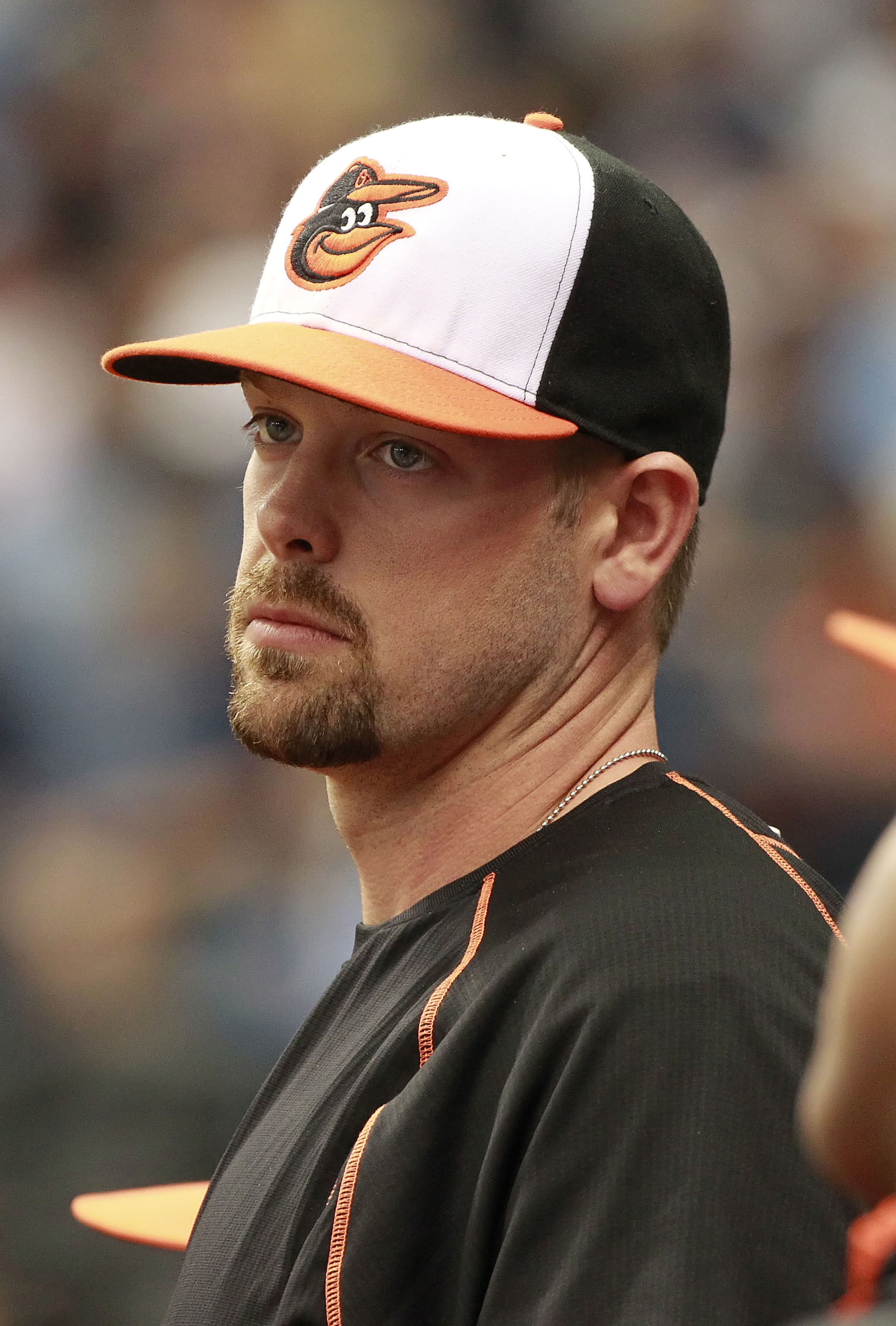 Strengths/Pros
Wieters is an above average hitter for a catcher. In 2015, the average catcher hit .238/.302/.376 with a Weighted Runs Created Plus of 85. Wieters hit .267/.319/.422 with a wRC+ of 100. He displayed a league average bat, even though catchers generally hit significantly worse. He has shown good pop, leading all catchers with 67 home runs from 2011-13. Wieters made the All-Star team twice in that span, and again in 2014 after a 26-game hot start to that season.
Defensively, Wieters has been among the game’s best at preventing stolen bases. The stat Stolen Base Runs Saved credits catchers for throwing out runners and preventing them from attempting to steal in the first place, and Wieters led all of baseball from 2011-13. The simpler version of this is caught stealing percentage, and Wieters was among the top four qualified catchers in each of 2011-13 seasons. Wieters has also been one of baseball’s best at blocking pitches. He won Gold Glove awards in 2011 and ’12.
As with Justin Upton, it feels like Wieters may not have reached his ceiling. The Orioles drafted Wieters fifth overall in 2007, and his 2009 big league debut was highly anticipated. In 2008, Baseball America wrote that Wieters had “the makings of a legitimate star,” a switch-hitter with plus bat speed, good plate discipline and pitch recognition, and excellent defense including plus-plus arm strength. He doesn’t turn 30 until May, and is easily the best free agent catcher.
Weaknesses/Cons
From 2011-13, Wieters caught 3,539 2/3 innings, the most in baseball. The ability to catch more than 140 games per season would be considered a huge positive, but as Wieters heads into free agency, we have to question how many innings behind the plate he can handle for the next several years. Wieters’ 2014 season ended on May 10th with elbow soreness, and he had Tommy John surgery in June of that year. Though he was at one point on track to be ready for Opening Day, Wieters experienced elbow tendinitis in March and started the year on the DL. His season debut came on June 5th.
From the day of Wieters’ season debut, he started at catcher for 55 of the team’s 109 games. He battled a hamstring strain in August and a wrist injury in September. Still, there was no point this season where Wieters was used like a regular catcher by the Orioles. As Mark Brown of Camden Chat pointed out, he only caught on consecutive days four times this year. He’s not a good enough hitter for significant time at DH or first base to be appealing as part of a long-term contract, as it was with Brian McCann. In a given year, anywhere from 11-18 catchers get at least 900 innings behind the dish, and a team giving a multiyear pact to Wieters will need confidence he can do that.
Exploring the question of Wieters’ ability to stay behind the plate long-term, one must consider his massive size. He is literally the only regular catcher in baseball history who is 6’5″ and 230 pounds. Dropping the weight requirement to 220 gives a list of five total catchers (including Wieters himself). One of those is Joe Mauer, who was done catching by age 31 due to a lengthy history of concussions as well as back and leg injuries.
Looking at Wieters’ pitch framing data at StatCorner, he’s below average at getting pitches outside of the zone called strikes for his pitchers. The stat is called oStr%, and Wieters was the worst in baseball this year among those with a sample of 4,000 or more pitches. He was below average at this key framing skill from 2012-14 as well. Also, it’s unclear whether Wieters’ once-vaunted arm is as effective at preventing stolen bases. He threw out 30.8% of attempted thieves this year, which would have ranked eighth among qualifiers.
I believe Wieters will receive and turn down a qualifying offer from the Orioles, meaning signing him would require a team to forfeit its first eligible draft pick. This could present an issue for a team like the Mariners, who probably wouldn’t want to give Wieters a decent-sized contract and also forfeit the 11th overall draft pick.
Personal
Wieters was born in Charleston, South Carolina and resides in Sarasota, Florida with his wife and son in the offseason. According to Dan Connolly of the Baltimore Sun, Matt met his wife while attending Georgia Tech, and they also have a house in Atlanta. Will Graves of the Associated Press called him a “stoic cornerstone” for the Orioles in 2013, and more recently Connolly wrote, “Wieters’ leadership, steady influence and professionalism has been immeasurable.” Matt’s father, Richard, was a minor league pitcher for the Braves and White Sox, and as you’d expect, that sparked an interest in the game for Matt. He remained humble despite huge hype coming out of college and in his minor league career.
Market
Interest in Wieters will vary based on his contract demands and whether he receives a qualifying offer. I feel making a qualifying offer is a relatively easy “yes” for the Orioles, because he’d be worth $15.8MM on a one-year deal if he accepts. But why would a 29-year-old catcher, the best free agent at his position, decline his first chance at an open-market multiyear deal without fully exploring the market first? If all the multiyear offers are unacceptable, Wieters would probably be able to find a one-year deal worth close to $15.8MM in February or March. In March 2014, Wieters’ agent, Scott Boras, told ESPN’s Jerry Crasnick in reference to Stephen Drew and Kendrys Morales, “Everybody talks about these players turning down these [one-year] qualifying offers like they’re village idiots. The reason is, they don’t want to be in the same position again next year. If I’m a good player, I’m going to take the prospect of free agency.”
If Wieters becomes a one-year deal guy late in the offseason, opportunistic teams will swoop in, and the door could re-open to the Orioles. Before then, Boras needs to find a team that loves Wieters’ pedigree, and feels he can be a bargain on a multiyear deal if an offseason of normal rest brings back the durability he once had. Clubs that could enter the market for a starting catcher include the Rangers, Nationals, Braves, White Sox, Mariners, Twins, Rockies, Angels, and Astros. Of those nine teams, the Braves, White Sox, and Rockies have protected first round picks. The White Sox have not historically been involved with a lot of Scott Boras’ free agents, but we can’t rule them out. The Braves are a legitimate match. Wieters grew up rooting for the Braves, his father pitched in their minor league system, and he starred at Georgia Tech. Plus, former Oriole mainstay Nick Markakis joined the Braves last winter, and the team appears to have soured on young catcher Christian Bethancourt. The Rockies have Nick Hundley in place for 2016, but could see Wieters as a long-term solution behind the plate.
The Nationals are an under-the-radar fit. They were not happy with Wilson Ramos this year, according to MLB.com’s Bill Ladson, and the team’s management has a well-known strong relationship with Boras. Meanwhile, Jon Heyman of CBS Sports says the Rangers could take a look at Wieters, but only if he does not receive a qualifying offer. Surely Boras would appreciate the Orioles choosing not to make a qualifying offer, which would be extremely risk-averse. The O’s didn’t make a qualifying offer to Markakis last winter, which Mark Brown of Camden Chat theorized may have been a gesture of loyalty from owner Peter Angelos.
Wieters has little competition on the free agent market, but he will be affected by the availability of Brewers catcher Jonathan Lucroy. Any of the above teams could make a deal for Lucroy and drop out of the Wieters market.
Expected Contract
I can picture Boras coming out of the gates seeking Russell Martin/Brian McCann money for Wieters, meaning five years and $82-85MM. I don’t think he’ll get there, but I’m predicting a four-year, $64MM deal, even with a qualifying offer.
Offseason Outlook: San Diego Padres
After one of the most frenetic offseasons in recent history, the Padres entered the 2015 season with elevated expectations and a wildly different roster than the one inherited by first-year GM A.J. Preller. Unfortunately for the team, Preller’s high-profile acquisitions didn’t yield a postseason run or even a winning record.
Guaranteed Contracts
Matt Kemp, OF: $72MM through 2019 (Dodgers also owe Kemp $14MM through 2019)- James Shields, RHP: $65MM through 2018 (including buyout of 2019 option; Shields can opt out after 2016)
- Jedd Gyorko, 2B/3B/SS: $33MM through 2019 (including buyout of 2020 option)
- Melvin Upton, OF: $31.9MM through 2017
- Craig Kimbrel, RHP: $25MM through 2017 (including buyout of 2018 option)
- Alexi Amarista, 2B/SS/3B/OF: $1.3MM through 2016
Arbitration Eligible Players (service time in parentheses; projections via MLBTR)
- Marc Rzepczynski (5.132) – $3.0MM
- Andrew Cashner (5.126) – $7.0MM
- Cory Luebke (5.033) – $5.25MM arbitration projection; has a $7.5MM club option with a $1.75MM buyout.
- Tyson Ross (4.126) – $10.0MM
- Yonder Alonso (4.116) – $2.5MM
- Derek Norris (3.102) – $3.4MM
- Will Middlebrooks (3.057) – $1.5MM
- Brett Wallace (3.003) – $1.1MM
- Non-tender candidates: Rzepczynski, Luebke, Wallace
Free Agents
Contract Options
- Joaquin Benoit, RHP: $8MM club option with $1.5MM buyout
- Clint Barmes, SS: $2MM club option with $200K buyout
- Cory Luebke, LHP: $7.5MM club option with $1.75MM buyout
The Padres have crossed off the first item on their to-do list, and it probably shouldn’t come as a surprise that it was an out-of-the-box move. San Diego has tabbed 38-year-old Diamondbacks third base coach Andy Green as their new manager. While he comes with some notable minor league experience, this will be Green’s first taste of manging in the Majors.
As far as the contractual options facing the Padres, Cory Luebke’s is an easy call to decline, as the lefty hasn’t thrown a pitch since 2012 due to a pair of Tommy John surgeries. Clint Barmes’ option is cheap, but the Padres probably consider him redundant with Alexi Amarista projected to have a bench spot. Joaquin Benoit’s option is the toughest call. Metrics like FIP call for big regression, but he’s been able to routinely outperform them by sustaining abnormal BABIP marks and strand rates. While his walk and strikeout rates have each gone in the wrong direction, his velocity and swinging strike rate look good. This boils down to a one-year, $6.5MM decision on Benoit (he has a $1.5MM buyout). That seems reasonable, and even if the Padres don’t want him at that price, they could trade him. Picking up the option and paying $1.5MM to improve the return in a trade is a better outcome than simply buying him out.
Perhaps the biggest roadblock that option presents is that it would bring the 2016 payroll higher than their Opening Day mark from 2015, and there’s quite a bit of work to do around the diamond. An elevated payroll was always the expectation, as they received $18MM in 2015 salary relief in the Matt Kemp trade and also backloaded James Shields’ contract, but the baseball ops staff probably hoped there’d be less needs around the roster. Instead, they’ve already committed $71.9MM to the 2016 payroll, plus a projected $24.4MM for Tyson Ross, Andrew Cashner, Yonder Alonso, Derek Norris and Will Middlebrooks in arbitration, and then the potential Benoit option and league-minimum salaries needed to fill out the roster.
That crowded payroll is one reason that the Padres were said to be open to moving some of their more established contributors at the non-waiver trade deadline, though that never came to fruition. Many of those talks will be revisited this winter. In an odd way, the Padres’ 2015-16 offseason will be defined perhaps more so by who they subtract from the organization than by who they add. It’s unclear how much flexibility they’ll have for roster additions without eliminating some 2016 payroll concerns.
Shields, Craig Kimbrel and Melvin Upton represent the three largest salaries that San Diego could shop, but nearly every position on the diamond and every slot in the rotation could be subject to trade talks. That sets up a fascinating offseason but also makes the already-difficult task of attempting to outline a team’s winter nearly impossible.
Shields is a particularly tough sell, as he was more good than great in his first first year with Padres. Though his strikeout rate soared, so too did his homer-to-flyball rate, resulting in an elevated ERA and FIP. If another club is convinced the HR/FB spike is a fluke, Shields is more appealing, but $21MM annually is steep. He isn’t the quintessential “albatross” contract — he’s still a useful starter — but it’s fair to say he qualifies as the type of player that’s often moved in swaps of “bad” contracts.
One oft-floated suggestion was a swap of Pablo Sandoval with the Red Sox, though I don’t see the merit in that for San Diego unless Boston sweetens the deal with young talent. Sandoval is owed more money and was one of the game’s worst all-around performers in 2015. The Padres needn’t be that desperate to move Shields, who was useful in 2015.
Upton — Melvin, that is — possesses an undesirable contract of his own, although the older of the two Uptons did quietly enjoy a bounceback year in 2015. He didn’t reach his peak Tampa Bay production levels, but Upton slashed .259/.327/.429 and made solid contributions on the basepaths and defense. The $31.9MM he’s owed lines up reasonably well with the money remaining on the contracts of Ricky Nolasco, Ubaldo Jimenez and Matt Garza, though I’m not sure any of those pitchers’ teams would benefit from making such a deal. More realistic is that Upton will remain under contract as an overpriced fourth outfielder/platoon partner for defensive standout Travis Jankowski, which appears to be at least somewhat of a consideration.
The other significant salary the Padres could try to move is that of Kimbrel, but he, unlike Shields and Upton, would be in high demand. The Yankees, Astros, Red Sox, Nationals and Cubs all stand out as plausible trade partners, and each of those clubs possesses plenty of young talent. If he’s to trade Kimbrel, Preller would have to decide if the goal is to add Major League talent to help the 2016 club or package Kimbrel with a less desirable contract (i.e. Shields, Upton) to clear salary. Trading him for prospects doesn’t align with the Padres’ recent tactics.
If the Padres are able to free up some payroll, shortstop will be their biggest priority. Ian Desmond tops the free agent market, but despite a down season, he strikes me as likely to command, at minimum, a four-year deal (five is also possible). He’s already been connected to the Padres, but an expensive free-agent miss wouldn’t look good for the front office coming off a disappointing 2015 season, and the Friars have multiple needs. If Preller is again to turn to the trade market, a highly speculative list of partners includes the Cubs (Javier Baez, Starlin Castro), Mariners (Ketel Marte, Brad Miller, Chris Taylor), Astros (Jed Lowrie), Rays (Nick Franklin), Red Sox (Deven Marrero) and possibly Twins (Eduardo Escobar, Eduardo Nunez, Jorge Polanco).
There are more in-house options, at least, in the rest of the infield. Jedd Gyorko filled in at short late in the 2015 season, but he shouldn’t be asked to play there again for defensive reasons. Gyorko can handle both second base and third base, as can the younger Cory Spangenberg. The former is a righty, the latter swings from the left side, and the club also has the switch-hitting Yangervis Solarte (and disappointing Will Middlebrooks) available at the hot corner. Given the needs elsewhere, it’s possible to imagine Preller relying on this group again in 2016, though a free agent target wouldn’t be out of the question. Ben Zobrist, as we at MLBTR find ourselves saying frequently in these Offseason Outlooks, certainly makes some sense given his versatility, though his age makes him particularly risky for San Diego, given the current uncertainty permeating their roster.
The Padres quickly abandoned the idea of Wil Myers in center field and moved him to first base, but that now presents its own issues. With both Myers and Yonder Alonso figuring to be healthy in 2016, the Padres have two players for that first base spot. The best option for Myers is probably to shift to left field in place of the departing Justin Upton. That creates somewhat of a logjam, though, as top prospect Hunter Renfroe is a corner outfielder, as is former Top 100 prospect Rymer Liriano. Both are nearly MLB-ready, though Preller hasn’t shown an aversion to trading prospects.
Alonso could be a desirable trade piece for many teams — Milwaukee, Baltimore (if Chris Davis leaves), Pittsburgh, to name a few — but he’s also one of the precious few lefty bats the Padres have. And while he doesn’t hit for power, his overall offensive contributions this year were positive. There’s a case to be made that San Diego should move Alonso, go for broke, and make a run at Davis to inject some power into the lineup, but that’s a long shot.
If Alonso is moved, a left-field decision arises: trust Renfroe/Liriano or seek an outside addition. Colby Rasmus would give the Padres a much-needed left-handed bat, as would Gerardo Parra. If Preller and L.A. counterpart Andrew Friedman want to connect for another significant swap, the Dodgers have Carl Crawford and Andre Ethier, who could each be moved for a bad contract. The player the Padres received from the Dodgers last winter, Matt Kemp, seems like he’ll definitively be stationed in right field, so there appears to be at least one certain spot in the lineup.
Center field, again, comes with question marks. Jankowski is a gifted defender but doesn’t project to hit much. He could be a fine fourth outfielder, but he’s probably miscast as a starter. Jankowski and Upton could platoon here, but free agents Dexter Fowler and Denard Span or a trade candidate like Jackie Bradley would help to balance out the lineup and provide better offense. Span, in particular, is an intriguing buy-low candidate, as his injury could suppress his value and make him a relative bargain. Although, that also enhances the risk of signing him. If handedness isn’t a concern, Marcell Ozuna makes sense.
Like nearly every other position on the diamond, the Padres have some trade options behind the plate. Derek Norris is slated to make $3.4MM, so moving him could free up a bit of money, and Austin Hedges represents an MLB-ready replacement. However, the team could flip the defensively gifted and well-regarded Hedges in a trade to fill another hole. Norris had his worst season at the plate in 2015, so they could be selling low, though on the other hand his throwing improved quite a bit. On a thin catching market, he’d draw interest, and Hedges is superior defensively.
The rotation offers a bit more certainty, but not much. Shields, Tyson Ross and Andrew Cashner form a solid 1-2-3 atop the rotation, and young righty Colin Rea is a candidate for the back of the starting unit along with righty Odrisamer Despaigne and lefty Robbie Erlin. Ian Kennedy is set to depart as a free agent and should net the team a compensatory draft pick — I see little reason for him to accept a qualifying offer, as his durability and steady results should net him a more lucrative multi-year deal — though the team could look to retain him.
However, as previously mentioned, Shields is a definite trade candidate this winter, and the Padres fielded offers on both Ross and Cashner prior to the trade deadline. Cashner is only controlled through 2016, so it makes sense that he, in particular, could resurface in trade talks. The Cubs and Red Sox each showed interest in Ross, and the righty is the type of borderline-dominant arm that either team could pursue to bolster its rotation for at least two years, if not more via an extension. Names like Kyle Hendricks or Henry Owens could be part of a Ross trade (though not necessarily headliners), thereby giving San Diego an immediate, albeit lesser replacement. Cashner wouldn’t fetch as large of a haul, but he could bring back a big-league piece to help in a different area.
The Padres need to add at least one arm to the mix, possibly two if they move one of the current three rotation locks and don’t receive an immediate replacement in return. A lefty would help give opponents a bit of a different look, though adding quality innings should be an emphasis over pitcher handedness. One inexpensive possibility would be to try Brandon Maurer in the rotation again. The former Mariners prospect has blossomed into an excellent setup man but still deployed a three-pitch mix out of the ‘pen in 2015. Obviously, an innings limit would have to be a consideration.
Moving Maurer to the rotation could create a larger hole in the bullpen, where the Padres are also set to lose the underrated Shawn Kelley and could also non-tender Rzepczynski. Kevin Quackenbush and Nick Vincent could rejoin Benoit and Kimbrel (if neither is traded). Lefty Frank Garces battled his control in both the Majors and minors after a dominant Double-A campaign in 2014, so at least one cheap lefty relief option would be a nice pickup.
No first-year GM has ever made a splash as immediate and dramatic as Preller in 2014-15. Because no one could have reasonably predicted that level of activity, the Padres dominated headlines for much of the offseason, right up until their acquisition of Kimbrel on the eve of Opening Day. San Diego again mystified the baseball world by taking the opposite course of action this summer, standing pat despite the fact that they weren’t within reasonable striking distance of a postseason berth. The expectation here is that the Padres will again be in for an exceptionally active offseason, so much so that their course of action could play a key role in a number of other clubs’ winter gameplans as well.
Explaining The Qualifying Offer System
The qualifying offer system has been around since the 2012-13 offseason, but it remains a complicated and sometimes misunderstood process. Teams will be making their decisions in short order, so it’s a good time for a quick refresher on how things work.
Here are the key components of the system:
- The value of the qualifying offer, which is determined annually by averaging the top 125 player salaries from the previous year, will be worth $15.8MM this offseason. All qualifying offers are for the same duration (one year) and the same amount (i.e., $15.8MM for 2015-16).
- Teams have until five days after the World Series to make qualifying offers. At that point the players have seven days to accept.
- Once a team makes a qualifying offer, the player has two choices: he can accept the one-year deal or decline in search of other offers. If he declines the offer and signs elsewhere, his new team will have to surrender a top draft pick (see more on this below).
- No player has ever taken a qualifying offer, but if one does, he cannot be traded (absent consent) until June 15 of the following season (i.e., 2016), as Steve Kinsella of Sports Talk Florida recently noted and MLBTR has confirmed. Even if a player grants such consent, only $50K in cash can be exchanged as part of the trade.
- Teams that sign free agents who turned down qualifying offers will surrender their first unprotected draft pick in the following year’s draft. The first ten selections in the draft are protected. This year, the Phillies, Reds, Braves, Rockies, Brewers, Athletics, Marlins, Padres, Tigers, and White Sox have protected choices. Those clubs would surrender their second-highest selections if they reach terms with a QO-declining free agent.
- Forfeited picks don’t go to other MLB teams (as they used to under the old Type A/B system). Instead, they disappear and the first round is condensed. In turn, teams that lose a player who declined a qualifying offer are awarded a compensatory pick at the end of the first round, before the competitive balance choices. Such compensation picks are awarded in the inverse order of record. As a result of these rules, the draft order is constantly fluctuating over the offseason. Click here for last year’s ultimate draft order to see how it can end up looking.
- When a team re-signs a player that has previously declined a qualifying offer from that team, no draft forfeiture or compensation takes place.
- Only players who have been with their clubs for the entire previous season are eligible for compensation. Thus, players traded mid-season — e.g., Johnny Cueto, Ben Zobrist, Yoenis Cespedes, and David Price — are not eligible to receive a qualifying offer.
- Qualifying offers operate independently of options. Hence, a player can receive a qualifying offer even if their option is declined (whether by team or player) or if they opt out of a deal. Hence, Zack Greinke is eligible for a qualifying offer if he opts out of his contract, as expected.
If you’re interested in learning more about the qualifying offer system’s function in practice, check out these prior posts from MLBTR: Avoiding The Qualifying Offer; Contextualizing The Qualifying Offer System; Assessing The Qualifying Offer System & Its Purposes. Also, MLBTR has run polls on some of the many players who appear to be debatable qualifying offer candidates this season. You can read more on their situations, and see the poll results, at the following links: Marco Estrada (Blue Jays); Matt Wieters (Orioles); Denard Span (Nationals); Daniel Murphy (Mets).
This post is adapted, in part, from this 2012 post from former MLBTR scribe Ben Nicholson-Smith.
Offseason Outlook: Baltimore Orioles
With several key players hitting the free agent market and areas of need all over the diamond, the Orioles’ roster could look significantly different come Opening Day.
Guaranteed Contracts
- Adam Jones, OF: $49MM through 2018
- J.J. Hardy, SS: $28.5MM through 2017 (includes $2MM buyout of $14MM club option for 2018; option vests based on plate appearances)
- Ubaldo Jimenez, SP: $26.5MM through 2017
Arbitration Eligible Players (service time in parentheses; projections by MLB Trade Rumors)
- Brian Matusz (5.156) – $3.4MM
- Nolan Reimold (5.113) – $900K
- Paul Janish (4.156) – $600K
- Chris Tillman (4.113) – $6.2MM
- Miguel Gonzalez (4.095) – $4.9MM
- Ryan Flaherty (4.000) – $1.5MM
- Zach Britton (3.158) – $6.9MM
- Vance Worley (3.112) – $2.7MM
- Brad Brach (3.063) – $1.1MM
- Manny Machado (3.056) – $5.9MM
- David Lough (2.149) – $800K
- Non-tender candidates: Janish, Lough
Free Agents
The Orioles have one of the most distinguished free agent classes of any team, and yet even with all of these notables hitting the open market, Adam Jones sees it as an opportunity. “It’s going to be exciting to see what goes on this offseason because I know when you have a lot of free agents that means you have a lot of money to spend,” Jones told the Baltimore Sun’s Dan Connolly in a late-season interview. “And so, hopefully, I can influence some officials to spend a little bit of that money.”
Since Dan Duquette took over as executive VP of baseball operations in late 2011, the Orioles have indeed shown an increased willingness to spend, going from an $84MM Opening Day payroll in 2012 to just under the $119MM mark for last season’s opener. A nice chunk of that increase has gone to Jones himself via his six-year, $85.5MM extension, which is still the largest contract in O’s franchise history. The Orioles may well have to break that record in order to re-sign some of their own top free agents or add major talents to replace those departing stars, which also means overcoming a well-documented wariness to long-term free agent deals.
First, the good news for the Orioles and their fans. Manny Machado was healthy and had a superstar year, Jones continued to produce, Jonathan Schoop broke out as an everyday second baseman, Ubaldo Jimenez had a solid bounce-back campaign and Zach Britton cemented himself as a reliable closer while headlining one of the game’s better bullpens last season. Combine these with former fourth overall pick Kevin Gausman, who is now established as a full-time starter, and there are worse building blocks to have in place for a team looking to reload as an AL East contender.
The problem, however, is that these are also pretty much the only areas of relative certainty amidst a very unsettled Orioles roster. It’s possible that the O’s will have openings at first base (Chris Davis), setup man (Darren O’Day), right field (Gerardo Parra), catcher (Matt Wieters) and at the front of the rotation (Wei-Yin Chen).
Let’s begin with the rotation, as it stands out as an area of need even if Chen returns — a seemingly unlikely scenario, according to several pundits. Beyond Jimenez and Gausman, Chris Tillman and Miguel Gonzalez are likely to be back despite rough seasons that saw their ERAs catch up to their generally unimpressive career advanced metrics. It was poor timing for the arb-eligible pitchers, who failed to maximize their earning power. Assuming the Orioles bring them back, a total of $11.1MM in combined arbitration earnings is a very good price for two innings-eaters (though obviously Baltimore hopes the two can deliver more than just innings next year). If not, Tillman and Gonzalez could both potentially be non-tender candidates come next winter as their price tags keep rising.
A more aggressive move would be for the Orioles to non-tender Gonzalez (the less established of the two) this winter and replace him with one of Tyler Wilson or Mike Wright. This frees up more money to pursue a true top-of-the-rotation starter, and there’s no shortage of big-name aces on the market this winter. Baltimore could also tender Tillman and Gonzalez and then trade one or both to open a rotation spot, though they’d certainly be selling low on either pitcher.
Of course, the O’s have been particularly hesitant to spend big on pitching. Jimenez’s four-year, $50MM deal is the largest contract the team has ever given to a pitcher, and that’s probably one Duquette would like to have back given Jimenez’s up-and-down performance through two seasons. It’s probably safe to assume that David Price and Zack Greinke are out of Baltimore’s price range. Jordan Zimmermann or Johnny Cueto would command a deal worth at least twice Jimenez’s price tag, and any of the names in the second and third tiers of the free agent pitching market (Chen himself, Mike Leake, Jeff Samardzija, Yovani Gallardo, Ian Kennedy) are all good bets to exceed Jimenez’s number.
Could the Orioles deal for an ace? They may not have the trade chips available given their thin farm system, which could be even more lacking given Dylan Bundy‘s ongoing shoulder problems. The former top prospect is out of options, so while he could still emerge as a secret weapon if healthy, he’ll have only a short window in the Arizona Fall League and Spring Training to prove he’s fit.
Expect the O’s to look at Scott Kazmir, Marco Estrada, J.A. Happ or any other quality starters who posted Chen-like numbers in 2015 but could be signed on shorter-term deals than the four or even five years that Chen could command. Simply replacing Chen, of course, doesn’t solve Baltimore’s overall pitching issues. Either owner Peter Angelos shows a greater willingness to spend on free agent arms or else the Orioles will again be relying on a lot of things to go right for their incumbent starters.
The same question of spending also applies to Davis, who is projected by MLBTR’s Tim Dierkes to land a six-year, $144MM contract this offseason. Unlike the free agent pitching market, this winter’s list of available first basemen isn’t star-studded, so there’s no easy way to make up Davis’ 47 home runs. Someone like Adam Lind (if the Brewers either don’t pick up his option or look to trade him) could be at least a passable replacement; while Lind isn’t an everyday option since he can’t hit left-handed pitching, he could be platooned with prospect Christian Walker, a right-handed bat. The Orioles could also look to trade for a similar left-handed first baseman like Ryan Howard or Adam LaRoche, or sign a potential non-tender candidate such as Pedro Alvarez or Logan Morrison. The soon-to-be-posted Byung-ho Park could also be a consideration. After all, Baltimore has dabbled in the Korean market in recent years (e.g., Suk-min Yoon) and successfully nabbed Chen from Taiwan.
Filling that gap at first base would open the door for the Orioles to replace Davis’ power with a big corner outfield bat, though names like Justin Upton, Yoenis Cespedes, Jason Heyward would again require huge financial commitments. Baltimore’s only current corner outfield options are David Lough, Nolan Reimold and Junior Lake, so it’s probably no surprise that the team is interested in bringing Parra back to bolster either left or right field.
In late August, MLBTR’s Jeff Todd projected that Parra could earn a 3-4 year deal with an average annual value in the $10-$15MM range, though that was before Parra suffered through a miserable September and finished with only a .625 OPS in his 238 PA as an Oriole. Even if Parra’s poor finish lowered his price into the three-year/$24MM range, in my opinion Parra may not be worth such a commitment and the O’s could instead use that money on a more consistent free agent bat.
Given the question marks in the corner outfield spots and at first base, re-signing Steve Pearce could be a sneaky-important move for the Orioles given his versatility. Pearce battled some injuries last season and regressed after his big 2014 campaign, though he still hit 15 homers in 325 PA. While Pearce’s contract value is somewhat hard to predict, his price tag shouldn’t be all that big, unless the Orioles lose him to a team that can offer more regular playing time than the part-time role he’d likely receive in Baltimore.
Beyond the headline names on the free agent outfield market, it wouldn’t surprise me if the Orioles made runs at signing Ben Zobrist or Colby Rasmus, both of whom drew interest from Baltimore last winter. Since the O’s prefer shorter-term free agent deals in general, both could be good fits — Rasmus has said he may not want to play longer than a few more seasons, while Zobrist is entering his age-35 season and may not command too lengthy a contract. (Though a four-year deal isn’t out of the question for Zobrist since his versatility is expected to draw a large amount of interest in his services.)
As mentioned, the Orioles had a pretty strong bullpen last season. While O’Day’s great numbers were a big part of that success, Baltimore could withstand his departure by elevating someone like Brad Brach to the setup role. The O’s could also explore a pretty strong setup reliever market, looking at the likes of Mark Lowe, Tony Sipp or Shawn Kelley to replace O’Day (who may earn the largest contract of any relief pitcher this offseason), or perhaps go with lower-cost options.
The O’s also have a replacement for Wieters in the form of Caleb Joseph, who only hit .234/.299/.394 with 11 homers over 355 PA last year but is a solid defender and pitch-framer. There’s been speculation that Wieters might not even be issued a qualifying offer by the Orioles in the wake of his disappointing 2015 season, as the catcher struggled both offensively and defensively after returning from Tommy John surgery.
I tend to believe that Wieters would indeed reject a QO if offered. Firstly, it would be stunning if the first player to accept a qualifying offer was a Scott Boras client given how the agent has so harshly criticized the QO concept. Secondly, between the thin catching market and Wieters’ star pedigree, he’s sure to find a multi-year deal even in the wake of a tough season. Baltimore can therefore be pretty confident in issuing Wieters a qualifying offer and at least ensuring themselves a compensatory draft pick if he signs elsewhere.
The Orioles have just under $42MM committed to three players (Jones, Jimenez, J.J. Hardy) for 2016 and MLBTR projects roughly $34.9MM for their 11 arbitration-eligible players, assuming everyone is tendered a contract. Pre-arb players in regular roles (i.e. Schoop, Gausman, Joseph) will take up a few more roster spots at minimum salaries. If the 2016 payroll stays in the $119MM range, that leaves Duquette with approximately $42MM to work with this winter.
That’s certainly enough room to add at least one big salary into the mix. Since Angelos has specifically gone on record as saying the team will try to re-sign Davis, I would guess that if the Orioles are going to break the bank on a signing, it will be for the slugging first baseman since that kind of power is hard to find in today’s game. The O’s have been more willing to spend on position players (Jones, Hardy, Brian Roberts, Nick Markakis) than on pitchers, so it makes sense that they’d try harder to retain a familiar big bat than they would a free agent ace.
Jones, Jimenez and Hardy are also the only players signed beyond 2016, so the Orioles have space on the books for another long-term commitment. It seems likely, however, that the O’s will look to the future in another sense by considering extensions for Schoop and possibly Machado, though Duquette has said that a Machado extension isn’t a major priority for this offseason.
This certainly promises to be, by far, the Orioles’ busiest winter under Duquette, as his tenure has been marked more by canny under-the-radar acquisitions — i.e. Chen, Gonzalez or Pearce — than by flashy trades or free agent signings. Even the one-year, $8MM signing of Nelson Cruz in February 2014 (Duquette’s most successful free agent deal) was rather a unique circumstance given how Cruz’s market was chilled by a PED suspension and the qualifying offer.
Hardy was the only one of Baltimore’s free agents to re-sign last winter, as the Orioles lost Cruz, Markakis and Andrew Miller to free agency. The O’s have internal replacements for a few of this winter’s free agents, but another mass exodus would leave the team with simply too many holes to fill. Duquette will have to be creative and Angelos will have to be willing to go beyond his contractual comfort zone in order to get the Orioles back into playoff contention. If not…well, if last winter’s free agent 0-fer allegedly led to tension between Duquette and manager Buck Showalter, a repeat performance could result in some front office changes.
Free Agent Profile: Jordan Zimmermann
Teams will have to decide whether Jordan Zimmermann is a top-of-the-staff stalwart or a steady mid-rotation arm.
Strengths/Pros
Zimmermann is often credited with a “bulldog” mentality because he so consistently attacks hitters in the zone. He conveys a sort of unemotional intensity on the hill that contributes to his well-earned reputation for steadiness and relentlessness. But he’s not just a big, lumbering arm; Zimmermann is also an excellent athlete who moves well off the mound and fields his position well.
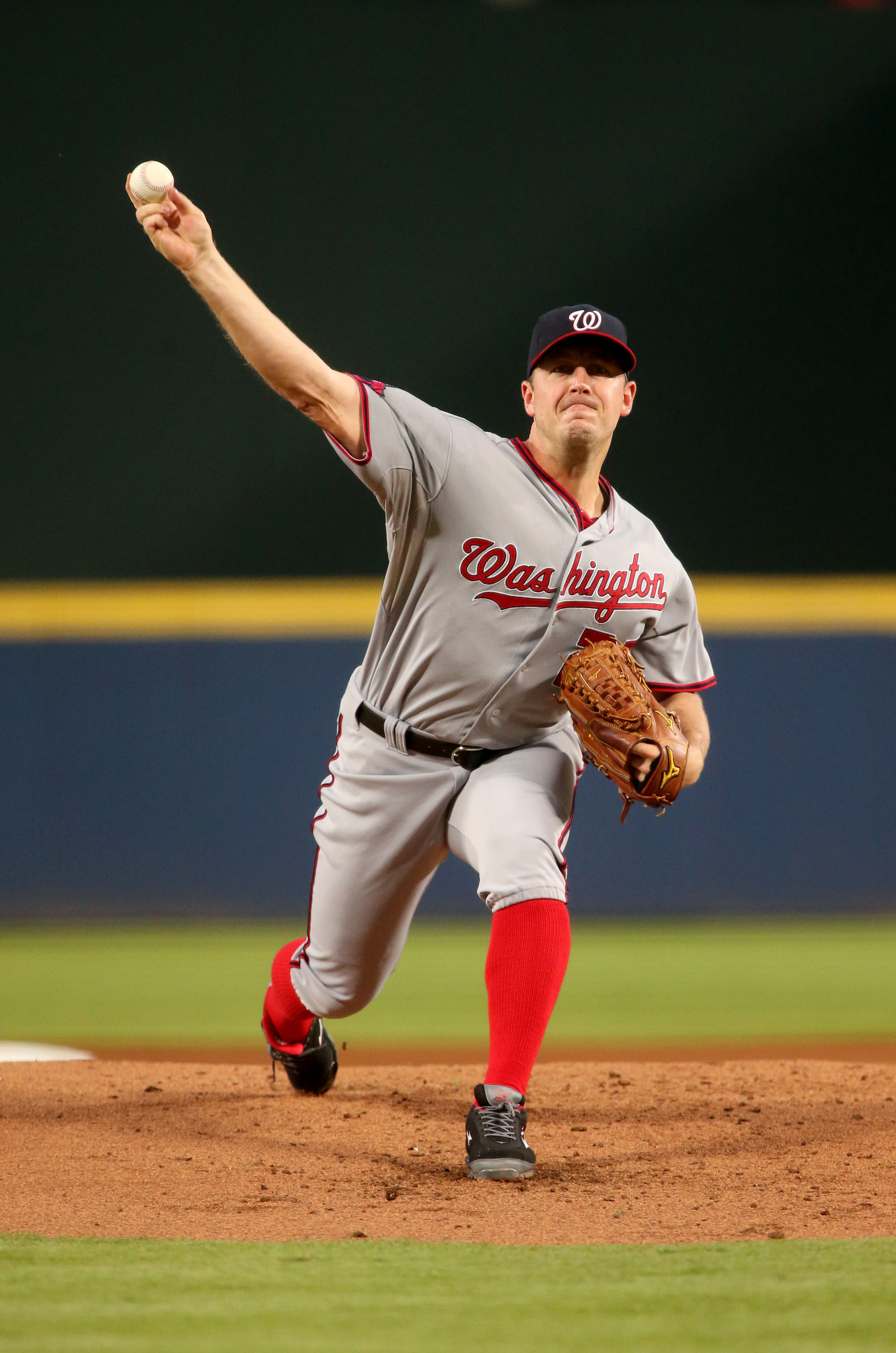
Age and innings go a long way in determining the length of free agent deals available to starting pitchers, and Zimmermann fares well in both regards. While he’s not the youngest arm on the market, he won’t turn thirty until May 23rd of next year.
Zimmermann has also been quite durable in recent years. He was shut down early in 2011, his first year back from Tommy John surgery, as the Nationals sought to build up his innings. In the four years since, Zimmermann has made at least 32 starts each season while compiling 810 1/3 total innings. Though he’s never put up gaudy single-season inning tallies, he is fifth in the game in total starts since the beginning of 2012 and ranks 12th in total frames over that span.
That’s a nice base to work from, but performance will obviously drive both years and value. Heading into this season, there was reason to believe that Zimmermann could reach (or even exceed) Jon Lester‘s six-year, $155MM deal with the Cubs. After all, he was coming off of two consecutive years in which he landed in the top ten in the National League Cy Young voting, building off of two very good seasons before that. His 2014 campaign, in particular, was outstanding: Zimmermann posted a 2.66 ERA with 8.2 K/9 against a league-low 1.3 BB/9.
While he has often described his approach as pitching to contact, Zimmermann has also shown the ability generate swings and misses (though, as explained below, that comes with some caveats). 2014 set a high-water mark for Zimmermann’s strikeouts, but he was able to return to that level over the latter half of last year, so it may be too early to write off his ability in that regard despite uninspiring overall numbers in 2015.
And focusing on the swings and misses tends to detract from the veteran’s single best skill: his impeccable control. Zimmermann has never permitted more than two free passes per nine innings over a full season. Since the start of 2011, only six starters with over 500 innings have bettered his walk rate.
Another area where Zimmermann has performed well is in limiting platoon splits. He’s been slightly better against righties historically, of course, but has handle opposite-handed hitters in equivalent manner in most regards. Lefties do draw walks at a higher rate (2.3 vs. 1.4 BB/9), but their overall production has not been markedly greater (.310 vs. .286 wOBA).
Weaknesses/Cons
There’s a lot to like, but 2015 represented a step back for the righty, and not just in the earned run department. Zimmermann’s 3.66 ERA was by far the highest full-season mark of his career, and his FIP (3.75), xFIP (3.82), and SIERA (3.83) marks all landed a fair sight over his career averages.
Of greatest concern to his outlook, perhaps, was the failure to maintain what had been a breakout season in the strikeout department. His 2014 swinging strikeout jump (from the mid-8 percent range to 10.3%) has basically dropped back to where it was before and now looks like an outlier. And that issue is compounded by the fact that Zimmermann doesn’t generate a ton of groundballs, having settled into the low-forty-percent range.
It is interesting to note that Zimmerman trended upwards in terms of strikeouts over the season’s second half, posting 8.3 K/9 over his final 90 innings of the year. But that was not accompanied by success, as it coincide with a large jump (from 0.64 to 1.60 HR/9) in home run proneness that almost entirely explains his earned run leap.
Bottom line: it’s not clear that Zimmermann can generate the whiffs you’d like to see while keeping the home runs in check. Doing both of those things drove his outstanding 2014, but he was running a HR/FB rate (6.4%) that was significantly below his career level (now 9.1%). This past year, while Zimmermann‘s batted ball results were in line with his track record, he allowed a career-high 1.07 HR/9 on a 10.9% HR/FB rate.
Zimmermann certainly has had success in the past despite middling K numbers, but he’s always outperformed ERA estimators. In particular, SIERA has never been a big fan — crediting him with just a 3.62 lifetime mark. He fares better by measure of FIP (3.40) and xFIP (3.57), but all those numbers paint him more as a steady mid-rotation arm than the somewhat higher-level arm that his 3.32 lifetime ERA might suggest.
As teams decide how to judge those numbers, they’ll also be looking at other recent indicators. The pitch value of his fastball (per Fangraphs) fell into the negative for the first time over a full season after consistently rating as a plus offering. Possibly reflecting some lost confidence, Zimmermann dropped his fastball use rate back into the low-60% range after it had risen to over 70% in 2014. He also continued to work higher in the zone with the pitch, continuing a trend from 2014. While that might have helped him restore the swings and misses, it came with too many long balls and marginal grounder rates.
So, what’s up with the heater? One possible root issue is an average velocity drop. The offering was still within one mile per hour of his top career speed, so it isn’t necessarily a huge red flag, but that velo loss — combined with the other issues and sagging production — isn’t particularly promising, either.
Another historical strength that came into some question last year is performance against left-handed bats. Zimmermann’s fastball-slider-curve mix is well-established and has long been effective, but he’s generally also sprinkled in the occasional change. He largely dropped that pitch last year. Whether or not that’s a contributing cause, Zimmermann allowed a .281/.338/.438 batting line to opposite-handed hitters. Those are his worst-ever full-season marks in each of the triple-slash stats.
Personal
Zimmermann is a native of Wisconsin and graduate of the University of Wisconsin-Stevens Point. ESPN.com’s Jerry Crasnick’s 2013 profile of Zimmermann paints him as something of a mid-western archetype. An outdoorsman in the offseason, he doesn’t put much of his personality on display publicly but is known to deliver “a wry sense of humor” in the clubhouse environment.
Jordan and his wife Mandy have two children, the second of whom was born just one day before he took the bump on July 12 of this year. It wasn’t his best outing, but Zimmermann wasn’t making any excuses. “Still have to go out there and throw the ball over the plate,” he said.
Market
As mentioned above, there was a time where the Lester deal looked plenty attainable for Zimmermann, who looked to be chasing David Price and Johnny Cueto in earning power. Now, the Relativity Client has clearly been bypassed by the older Zack Greinke and stands alongside Cueto as players whose value took a bit of a hit down the stretch. There’s competition, as well, from pitchers like Mike Leake, Jeff Samardzija, Wei-Yin Chen, and Japan’s Kenta Maeda.
Though he won’t reach the AAV achieved in the Lester deal or even the somewhat lighter pre-2012 Greinke pact ($147MM over six years), it still seems plausible that Zimmermann will get a sixth guaranteed year — possibly at a lower rate. There’s some wiggle room in his market, especially if some teams still prefer the suddenly questionable Cueto, but there ought to be a lot of clubs with interest, helping prop up his floor and creating the possibility of some upward movement.
There are any number of clubs that might pursue Zimmermann, some of whom won’t likely be after the two arms ahead of him. The fact that he’ll be bound by draft compensation will provide something of a limiting factor, but there ought to be a good number of suitors. Basically the entire AL East (Rays aside) could theoretically have interest, as might the Tigers, Astros, Cubs, Dodgers, and Giants. Somewhat less obvious teams like the Mariners, Angels, Twins, Marlins, Cardinals, and Diamondbacks could also make sense. And if Zimmermann’s market sags early, other opportunistic buyers might conceivably get involved. A return to the Nationals can’t be written off entirely, but that ship likely sailed when the sides were unable to match up on an extension.
Expected Contract
It might be on the higher side of his market, but given his durability and broad potential market, I think Zimmermann will get to six years — though he might have to sacrifice a bit of AAV to get there. I’ll predict a six-year, $126MM contract.
Offseason Outlook: Oakland Athletics
After an ugly 2015 season, the Athletics have plenty of flexibility, but also face plenty of uncertainty.
Guaranteed Contracts
- Billy Butler, DH: $20MM through 2017
- Coco Crisp, OF: $11.75MM through 2016 (plus 2017 club/vesting option)
- Sean Doolittle, P: $9MM through 2018 (plus 2019 and 2020 club options)
Arbitration Eligible Players (service time in parentheses; projections by MLB Trade Rumors)
- Ike Davis (5.155) – $3.8MM
- Sam Fuld (5.140) – $2.0MM
- Jesse Chavez (5.108) – $4.7MM
- Josh Reddick (5.050) – $7.0MM
- Craig Gentry (4.125) – $1.6MM
- Danny Valencia (4.118) – $3.4MM
- Fernando Abad (4.073) – $1.5MM
- Eric Sogard (4.064) – $1.7MM
- Brett Lawrie (4.055) – $3.9MM
- Felix Doubront (4.041) – $2.5MM
- Fernando Rodriguez (4.032) – $1.3MM
- Jarrod Parker (4.000) – $850K
- Drew Pomeranz (3.013) – $1.3MM
- A.J. Griffin (3.000) – $508K
- Evan Scribner (2.142) – $700K
- Non-tender candidates: Davis, Fuld, Gentry, Abad, Sogard, Doubront
Free Agents
After a season in which almost nothing went right, the Athletics will attempt to get back on track in 2016. How their ever-creative front office will accomplish that, though, is anyone’s guess. Now that they’ve lost a number of high-profile players (Josh Donaldson, Jon Lester, Jeff Samardzija, Scott Kazmir, Brandon Moss, Derek Norris, Jed Lowrie, Jason Hammel, Luke Gregerson) from their 2014 playoff run and still others (Ben Zobrist, Tyler Clippard) once their 2015 season fell apart, it seems wise to begin with an assessment of what, exactly, they still have.
Ace Sonny Gray still has a year remaining before he’s eligible for arbitration, and he looks like one of the game’s most potent young starters after a terrific 2015. The team also has several other starting pitchers (Jesse Chavez, Jesse Hahn, Chris Bassitt) who helped to one degree or another. Offensively, the A’s have a few young veterans who had decent seasons (like Josh Reddick, Stephen Vogt and Danny Valencia, with Billy Beane’s August claim of Valencia looking like a big win so far), and the team was also able to find playing time last year for a number of relative youngsters (Billy Burns, Marcus Semien, Josh Phegley, Mark Canha) who held their own and look like cheap future role players. The A’s lost 94 games last season, so it’s no surprise that they don’t exactly appear to be loaded with talent.
Of course, Donaldson, for example, once looked like little more than a cheap future role player too, and plenty of analysts have underestimated Oakland rosters barely flashier than the one the A’s have now. The 2015 A’s were also the victims of poor luck — they weren’t a good team, but they scored only 35 fewer runs than they allowed and might well have ended up with far more than 68 wins.
Still, this offseason is going to be a tough one for Beane and new GM David Forst. A series of questionable trades have left the Athletics with a limited talent base. In particular, their decision to deal Donaldson to the Blue Jays makes even less sense now than it did when it was consummated — the Athletics traded an MVP-type player with four years of control remaining and received only one good prospect (Franklin Barreto) plus a disappointing infielder (Brett Lawrie) and a couple low-wattage arms.
That the trade was a disaster for the Athletics is well known at this point, but I mention it here because it’s part of a pattern. Small-payroll teams need inexpensive stars like Donaldson. Other than Gray, the Athletics really don’t have any, and they don’t appear to have many players who have that potential, either. When they traded for Samardzija, they gave up Addison Russell, who already seems to be blossoming in Chicago. Then, when they dealt Samardzija themselves, they got Bassitt, Semien and Phegley, who look like good, helpful players, but not future stars. Their trade of Samardzija was, in isolation, a decent one, and it looks better after Samardzija had a subpar season in 2015, but the net result of the two deals is that it appears the A’s gave up an impact talent and didn’t receive one in return.
So now that potentially game-changing players like Donaldson and Russell are gone, how do the A’s build something new in their absence? For a 68-win team, the Athletics certainly have their fair share of decent players, and it’s easy to see any one of at least a dozen of them becoming useful contributors on a top-quality team. What they don’t seem to have is enough elite players to rally around, and it’s not clear where they’ll get them.
Many 68-win teams can upgrade simply by identifying positions where they have massive deficiencies and addressing those, but the A’s actually have fewer gaping holes than most. One priority, though, could be adding another corner outfielder or first baseman. Canha profiles decently as a semi-regular either in left field or at first base, and Vogt figures to pick up at bats at first base when he’s not catching, but the Athletics can use a bit of help. They’re unlikely to be top players for free agents, but they could find a lefty outfielder to upgrade on Sam Fuld — someone like Gerardo Parra or David Murphy might make sense, particularly with Jake Smolinski available to bat against lefties. Coco Crisp, a switch-hitter who’s under contract for next season, might be able to help in that regard, although he’ll play next season at age 36 and suffered through a miserable 2015 due to a lingering neck injury.
Beyond first base, the Athletics appear fairly set in the infield. With Lawrie and Valencia in the fold, the A’s can give Semien another shot at shortstop, although Beane seems open to using him at other positions at some point in the future. The A’s could add an infield backup via free agency, though, particularly if they decide to non-tender Eric Sogard.
The Athletics could also use an upgrade at DH; the three-year deal to which they signed Billy Butler was perplexing at the time, and it doesn’t make any more sense now. It seems more likely, though, that they’ll hope Butler improves in 2016, since he’ll still be just 30, and they owe him an additional $20MM. A trade involving another bad contract also might be a possibility.
Then there’s the rotation. Gray ought to be back, along with Chavez, Bassitt and Hahn, health permitting. Jarrod Parker, who hasn’t thrown a pitch in the big leagues since 2013, was back to throwing at the end of the season after spending most of it recovering from an elbow fracture. The 26-year-old Parker got off to a great start to his big-league career in 2012 and 2013, but there’s no telling what the Athletics can expect from him, if anything, after multiple arm injuries and two full years on the shelf. Another talented young starter, A.J. Griffin, is in a similar boat — he was making his way back from Tommy John surgery last June when he got shut down again, this time with a shoulder problem. Now he hasn’t appeared in the big leagues in two full years, either.
Beyond that, the Athletics’ best options right now are back-of-the-rotation types like Kendall Graveman, Aaron Brooks and Sean Nolin, plus Drew Pomeranz, who could conceivably move to starting full-time. (Sean Manaea, who they acquired in the Zobrist trade, could be in the rotation picture by midseason.) It’s safe to say, then, that they could add another starter this offseason without causing a logjam.
Given the Athletics’ extremely limited future commitments, they could easily sign a free agent starter, although it’s doubtful they would want to be on the hook for a contract that would still be on the books, say, three years from now. A creative short-term addition like Doug Fister, Mat Latos, Rich Hill, or old friends Trevor Cahill or Bartolo Colon might make sense.
Then again, all this speculation assumes the A’s will look to stay competitive next year without sacrificing their ability to compete in the future, but Beane often forgoes the obvious path. One off-the-grid possibility might be spending heavily on righty relievers in an attempt to improve by building a good bullpen around Sean Doolittle, Fernando Rodriguez and Pomeranz. Relievers would require shorter-term commitments than starters or position players, allowing the A’s to spend a bit while still keeping their payroll relatively clear in 2018 or 2019, when they might have a better core than they do now.
Beane has also alluded to the possibility that the team could extend Reddick, who is eligible for free agency following the 2016 season. Reddick was already a very good all-around player before cutting his strikeout rate in half over the past three seasons. The change came at the expense of some of his home-run power, but his newfound strike-zone judgment increases the possibility that he’ll continue to be productive in the near future, particularly since he’s still just 28.
Other than that, who knows? The only constant with the Athletics is change. Would it really be a shock if, after previously emerging as the high bidder for top international talents like Yoenis Cespedes and Michael Ynoa, the Athletics suddenly entered the bidding for Korean first baseman Byung-Ho Park? Would it be impossible for Beane to sense an inefficiency in the market and pounce on, say, a three-year deal for a bigger-name player at an unexpected position, given that most of the team’s current options are passable but unspectacular? Would it be a surprise if, after previously trading their top prospect (Daniel Robertson) for Ben Zobrist in an offseason in which they looked to be re-tooling, they dealt someone like Barreto for a big win-now upgrade? After emphatically denying he would trade Gray, would it be out of the question for Beane to deal him anyway, a year after an anonymous A’s official emphatically denied that the team would trade Donaldson? Could the A’s trade Vogt, say, or Chavez, or even Reddick? With Beane and Forst, there’s no telling.
Free Agent Profile: Justin Upton
Justin Upton, baseball’s first overall draft pick a decade ago, reaches free agency at age 28 with a solid track record of hitting for power.
Strengths/Pros
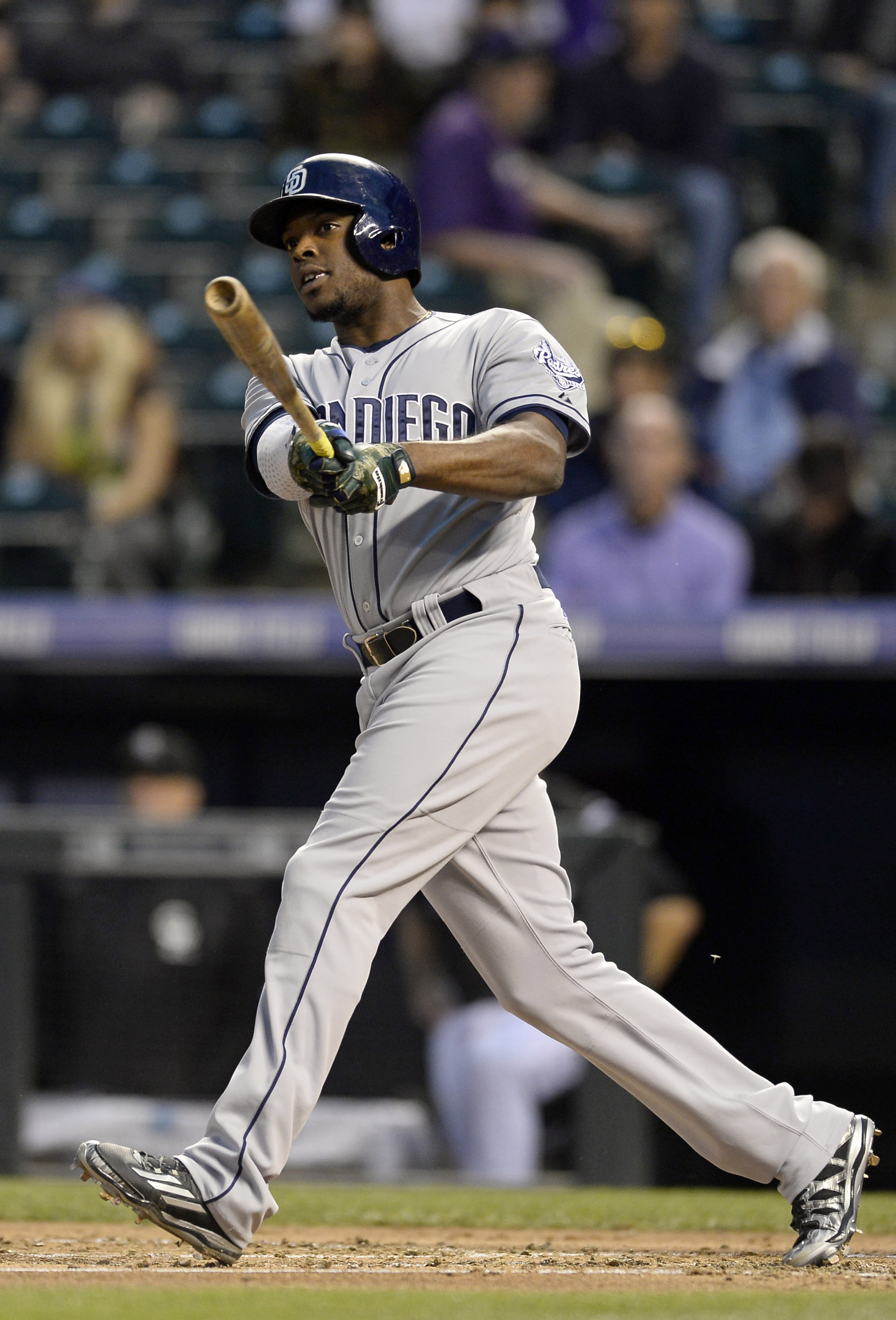 Upton’s pedigree is still an important selling point, because it implies he’s yet to reach his ceiling. According to Baseball America, Upton was on scouts’ radars when he was 14 years old. After he was drafted out of high school by the Diamondbacks in ’05, BA wrote that he had “unbelievable tools” and felt that the term “five-tool prospect” sold him short. Upton was the consensus pick for first overall, after older brother B.J. (now known as Melvin) went second overall to the Rays in 2002. Justin was seen as a patient, powerful hitter, with great bat speed, plus power potential, big-time speed, and a cannon for an arm.
Ten years later, Upton has 190 home runs under his belt through age 27. Of the 30 non-active players who accomplished that feat, 17 are in the Hall of Fame. Upton has 82 home runs over the last three seasons, 17th in baseball. Among those with 1500 plate appearances in that time, Upton ranks 22nd in slugging and 18th in ISO. Power is Upton’s main calling card, and at age 28, there may be more to come. Upton is also an asset on the basepaths, as his baserunning runs above average marks can attest.
I wouldn’t call Upton one of the best players in baseball, but he is one of the game’s better outfielders. Over the last three years, his 10.6 wins above replacement ranks 18th among outfielders. He was an All-Star in 2009, ’11, and ’15, finishing fourth in the MVP voting in ’11. Upton has been durable, averaging 152 games played over the last five seasons.
As we’ve mentioned, Upton will play most of next season at age 28. The only other top 30 free agent position players who will play next year in their 20s are Jason Heyward and Colby Rasmus. Upton’s age leaves room for upside and should result in his team getting more prime years.
Weaknesses/Cons
Let’s be honest: Upton hasn’t lived up to the mammoth expectations placed on him. He only reached 30 home runs once in his eight seasons, and that was four years ago. Power may be Upton’s strength, but fellow free agent Chris Davis has shown much more. Upton’s ability to get on base is nothing special, and one can name at least 20 hitters who have been better overall over the last three years. You can find at least 40 hitters who were better this year. Upside is nice, but if this is all Upton is, he’s a good player and not a great one.
Strikeouts are part of Upton’s game. He has whiffed in 25.8% of his plate appearances since 2013; only seven qualified hitters struck out more often. Oddly enough, all of them are either free agents or non-tender candidates.
Upton’s left field defense grades out as roughly average. Advanced metrics show he was a touch above average this year, and a touch below last year. I don’t consider it a strength or a weakness, but I felt his defense warranted mention.
Upton is expected to receive and turn down a qualifying offer from the Padres, so signing him will require draft pick forfeiture. This is not the case for one of his main market competitors, Yoenis Cespedes.
Personal
Upton was born in Norfolk, Virginia and resides in Scottsdale, Arizona with his wife. Justin grew up in a baseball family. His father Manny scouted for the Royals and White Sox, and older brother Melvin was drafted second overall in ’02. Justin battled an immaturity label early in his career, as outlined in this 2012 ESPN article by Robert Sanchez. It should be noted that he made his MLB debut at age 19. Upton signed a six-year, $51.25MM extension with the Diamondbacks in March 2010, but was traded to the Braves in January 2013. He spent 2013 and ’14 roaming the outfield alongside his brother Melvin, who had signed with Atlanta a few months prior. Then Justin was traded to the Padres in December 2014, and Melvin rejoined him after a separate deal in April.
Market
Upton should have plenty of suitors this winter, though he does not seem likely to re-sign with the Padres. The Orioles don’t have much at the outfield corners, and could have money to spend if they lose Chris Davis. The Yankees could be a suitor if they trade Brett Gardner. The Rangers could be a potential match if they have an appetite for another large contract. The White Sox have a need in the outfield, but have never spent even $70MM on a player. The Mariners could have a spot for Upton, but he rejected a trade to Seattle in 2013. I wouldn’t rule them out, however, in the case Upton has decided the Mariners are closer to contention now than they were two years ago. I’ve heard plenty of speculation that the Giants make a good fit for Upton, though it’s possible they’ll put their resources toward pitching.
Nationals GM Mike Rizzo was the scouting director when the Diamondbacks drafted Upton first overall, but a reunion would require moving Jayson Werth to right field and Bryce Harper to center. It’s unclear whether they’d be interested in doing so. The Dodgers have almost $40MM tied up in Carl Crawford and Andre Ethier next year. Trading one of them and signing Upton (not necessarily in that order) is plausible.
The Tigers could have a spot for Upton, but they seem likely to focus on starting pitching. Same goes for the Red Sox, who would also have to move an outfielder like Jackie Bradley to make room. The Angels, Astros, and Blue Jays could seek a left field upgrade this winter, but may prefer a left-handed hitter. The Jays, as well as the Indians, were on Upton’s four-team no-trade list last winter. The Indians would likely face budget restraints with Upton, and may not want to bring him on as a right fielder anyway.
The Royals could have an opening in left field if Alex Gordon departs, but they’ve never committed more than $55MM to a player. The Cardinals have plenty of in-house replacements if Jason Heyward departs. The Mets are a tough match even if Cespedes leaves, with Curtis Granderson and Michael Conforto at the corners. The Cubs also have more of a need at center field. The Phillies have little in place at the outfield corners and could afford Upton, but it would be odd for a rebuilding club and a tough sell for the player.
Expected Contract
Given his age, an opt-out clause should be a consideration for Upton. Agent Larry Reynolds would do well to get his client another crack at free agency at age 30 or 31, as no one would be surprised if Upton takes his game to another level and hits 40 home runs at some point. If an opt-out clause is obtained by Reynolds, I’d expect the total dollars to be reduced as a concession.
Coming off an inferior season to Chris Davis and Yoenis Cespedes, I’d expect Upton to receive a slightly lower average annual value. Plus, Upton’s age gives him a chance at a seventh year, which may also bring down the AAV. Something in the $20-22MM range could work. The end result might put all three players at a similar grand total. I’m putting Upton down for a seven-year, $147MM contract.
Photo courtesy of USA Today Sports Images.
MLBTR Originals
A look back at the original reporting and analysis found on MLBTR the last seven days:
- In celebration of Back to the Future Day, host Jeff Todd spoke with Back to the Future screenwriter and longtime Cardinals fan Bob Gale on the MLBTR podcast. A new episode of the MLB Trade Rumors Podcast is released every Thursday and can be accessed on iTunes, SoundCloud, and Stitcher.
- Two-time home run king Chris Davis is set to hit the free agent market and Tim Dierkes looked at his strengths and weaknesses in a comprehensive profile. Tim sees the Astros, Mariners, and Padres as some possible fits but he can also envision scenarios in which the Angels, Marlins, or Giants could make a play.
- In the last year, five franchise contract records were toppled and we could see more fall this offseason with nine potential $100MM free agents. Recently, Tim ran down the largest contract in franchise history for every MLB team.
- The Pirates will have to replace a number of key free agents and resolve several key arbitration cases this winter if they want to continue as contenders. Charlie Wilmoth looked at some of their offseason options.
- Mark Polishuk says that the Yankees might want to prioritize adding young depth to their veteran core rather than spending big on one free agent.
- Mark also examined Braves hurler Shelby Miller as a potential extension candidate. The 25-year-old hasn’t proven that he’s a frontline ace yet, but as a former consensus top-10 prospect, his very best baseball could still be in front of him.
- The Giants have money to spend on a pitching-heavy free agent market and Jeff looked at what else it will take for SF to get back to World Series contention. As Jeff notes, the team has a fair amount of cash on the books already for next year (about $120MM, before arb) and 2017 (~$73MM, pre-arb), but little thereafter.
- Recently, MLB Trade Rumors launched a brand new official Instagram account:@TradeRumorsMLB. Each day, we’re sharing conversation-inspiring images about the hottest topics in baseball. From there, we invite you to give us a like, weigh in with your thoughts in the comments section, and even share the link with a friend. So, what are you waiting for? If you don’t have an Instagram account, this is the perfect excuse to sign up and get one. Follow us on Instagram today!
- With Al Avila now atop the baseball operations pyramid, the Tigers will again act as buyers this winter in hopes of returning to the top of the AL Central, Steve Adams writes. The bullpen has been a problem area for Detroit over the years and Steve looked at several avenues the Tigers could take in order to correct their late-game pitching.
- MLBTR hosted chats on Wednesday (link) and Thursday (link).
Offseason Outlook: San Francisco Giants
The Giants have money to spend on a pitching-heavy free agent market. But what else can they do to set up another even-year World Series run?
Guaranteed Contracts
- Buster Posey, C: $130MM through 2021 (including buyout of 2022 club option)
- Hunter Pence, OF: $55.5MM through 2018
- Matt Cain, SP: $47.5MM through 2017 (including buyout of 2018 club option)
- Madison Bumgarner, SP: $22.75MM through 2017 (including buyout of 2018 club option; club also has 2019 option)
- Angel Pagan, OF: $11.25MM through 2016
- Jake Peavy, SP: $13MM through 2016
- Sergio Romo, RP: $9MM through 2016
- Santiago Casilla, RP: $6.5MM through 2016
- Javier Lopez, RP: $5MM through 2016
- Gregor Blanco, OF: $3.9MM through 2016
Arbitration Eligible Players (service time in parentheses; projections by MLB Trade Rumors)
- Yusmeiro Petit (5.016) – $2.4MM
- Brandon Belt (4.128) – $6.2MM
- Brandon Crawford (4.094) – $5.7MM
- Hector Sanchez (3.113) – $900K
- George Kontos (2.171) – $1.0MM
- Non-tender candidates: Sanchez
Contract Options
- Marlon Byrd, OF: $8MM club option (no buyout)
- Nori Aoki, OF: $5.5MM club option ($700K buyout)
Free Agents
Jeremy Affeldt, Alejandro De Aza, Tim Hudson, Mike Leake, Tim Lincecum, Ryan Vogelsong
The 2015 Giants didn’t quite match the World Series run of their predecessors, but that grand finish in 2014 came from an outfit that won only 88 regular season games. This year’s unit took home 84 victories, and was slightly better by measures such as BaseRuns and Pythagorean win-loss.
Importantly, GM Bobby Evans and his staff were able to stay in contention even without having made any large financial commitments before the season. The Giants reportedly tried for, but lost out on, players like Pablo Sandoval, James Shields, and Jon Lester. Instead, the club added older, short-term options: Jake Peavy, Sergio Romo, Nori Aoki, Ryan Vogelsong, and Casey McGehee.
As a result of that relatively quiet offseason a year ago, the Giants now have ample future spending capacity to deploy this winter. The team has a fair amount of cash on the books already for next year (about $120MM, before arb) and 2017 (~$73MM, pre-arb), but little thereafter. And this is an organization that pushed its Opening Day payroll over $170MM last year.
As they begin to utilize that financial flexibility, the Giants will surely look first at the rotation. Beyond the excellent Madison Bumgarner and righties Jake Peavy and Matt Cain, the starting staff is unsettled. Chris Heston is still in the mix after an up-and-down rookie year, and the organization hopes it will be able to turn to some young arms (including Clayton Blackburn, Tyler Beede, Kyle Crick, Ty Blach, and Chris Stratton) in the near future. But that group of pitchers is in need of supplementation. Bringing back Tim Lincecum on a low-risk contract won’t be enough, though he and the solid Yusmeiro Petit could be useful as swingmen. Peavy and Cain have just one and two years, respectively, left on their deals. And it would probably be overly optimistic to expect those upper-minors pitchers all to work out — let alone to do so in the near term.
The Giants will find a free agent market loaded with starting pitching options. Mike Leake, who spent the last several months in San Francisco after a deadline deal, appears to be at the top of the team’s list. He’ll be expensive, though more because he’s young enough to command a lengthy commitment than due to his expected annual salary. If that match-up falls through, Japan’s Kenta Maeda might offer a similar cost and age proposition. Though San Francisco has not been one of the more notably active teams in acquiring MLB-ready talent from Asia, its location on the west coast makes it a plausible destination (at least in theory).
It’s not at all inconceivable, though, that the club could pursue an even higher-end arm, whether or not it gets Leake. Remember, the team reportedly was willing to pay Lester $168MM over seven years. David Price could well be a target, and even if he proves too costly, the market includes a variety of other top-of-the-rotation options. Zack Greinke is the consensus second-best pitcher, and the Giants have previously been connected with Jordan Zimmermann. If San Francisco doesn’t go that route, or if it adds such a pitcher but misses on Leake, there are a variety mid-tier arms (like Ian Kennedy and Yovani Gallardo) as well as a host of bounce-back veterans (such as Doug Fister, Mat Latos, and Kyle Lohse) who could theoretically be considered as well. It’s difficult to prognosticate what direction San Francisco will take — we’ve seen the club pursue high-cost arms and short-term veterans in recent years — but there will be no shortages of possibilities.
San Francisco also could seek to add some depth to its pen, which will lose Jeremy Affeldt to retirement. The bulk of the unit should return, with Romo, Santiago Casilla, and Javier Lopez serving as a veteran core, accompanied by Petit, George Kontos and newer arms like Hunter Strickland and Josh Osich. A veteran pitcher or two — possibly including Lincecum, if he returns but doesn’t crack the rotation in the spring — probably wouldn’t hurt, but there’s not much work to do here.
There’s even less need for repair in the infield, where the Giants thrived in 2015. Matt Duffy made the loss of Sandoval seem like a blessing by putting up nearly five wins at a fraction of the cost. Brandon Crawford (shortstop), Joe Panik (second), Brandon Belt (first), and Buster Posey (catcher) rounded out what might’ve been the best infield in baseball. Then again, Panik dealt with back issues, while Belt had both a concussion and meniscus surgery late in the year, so they’ll need to get back to full health. Meanwhile, Duffy will need to prove that he isn’t a one-year wonder, and Crawford will look to maintain his ascendancy.
The outfield has some questions. While the situation looks straightforward at first glance, it may not be. Hunter Pence is a lock in right, and will hope for better health than he experienced last year. Gregor Blanco has been outstanding in a fourth outfielder role and will be back as well. Then, there’s center field, where Angel Pagan seemingly remains in line for regular duty.
It would be easy enough to say “add a left fielder” and call it a day, but it isn’t quite that simple. For one thing, Pagan had a wreck of a 2015 season and continues to deal with persistent injury issues. While Blanco has spent a good bit of time in center over his career, defensive metrics have always preferred him in the corner — especially the last two seasons. So, there’s an argument to be made that the Giants ought to consider adding a center field-capable player, whether as an upgrade or a platoon mate/back-up plan.
Even if the Giants simply look to add a left fielder, with the idea of continuing to use Blanco as an all-over-the-outfield sub, they face a tough decision on Nori Aoki‘s option. That looks like a cheap pick-up, but his concussion issues could be problematic. And there are other options. The Giants hold a $8MM option over deadline acquisition Marlon Byrd. While that seems a bit too expensive, the team has expressed some interest in retaining both Byrd and Alejandro De Aza, who was also added over the summer. All of those players have their merit for San Francisco, but it’s also arguable that the club should look for more impact out of that roster spot. On the other hand, such short-term options hold increased appeal given that corner outfield prospects Jarrett Parker and Mac Williamson are now near or at big league readiness.
In terms of targets, it’s really anyone’s guess for the reasons noted above. The market has a number of high-end options (e.g., Jason Heyward, Justin Upton, Yoenis Cespedes, Alex Gordon) and several shorter-term candidates with track records in center (such as Dexter Fowler, Colby Rasmus, Gerardo Parra, and Austin Jackson). And there is one free agent who might answer several of the team’s needs: Ben Zobrist. While the same can be said of many other clubs, and though the refrain has become tiresome, it nevertheless remains true that he’d offer a regular solution in the corner outfield in addition to providing coverage for the infield, where relative inexperience and injury questions are a factor despite the stellar 2015 performance.
Of course, it’s always possible to upgrade the bench, and that’s arguably more pressing with some injury questions surrounding multiple key regulars. Adding a reserve corner infielder/outfielder who can provide some pop might make sense, depending on how the team proceeds in left field, but the Giants have at least three important pieces covered. In addition to the aforementioned Blanco, 25-year-old Kelby Tomlinson impressed in his rookie year, and could serve a super-utility role.
Then there’s Andrew Susac, a very promising young backstop who could free Posey to spend more time at first. It’s certainly appealing to imagine a scenario where Susac, Posey, and Belt all play significant innings for San Francisco, but that may be hard to work out in practice without a DH — unless Belt spends more time in the outfield. While the current situation probably does not make for a serious roster crunch just yet, particularly as the team may prefer to wait another year to see how everything progresses, Susac could be a major trade piece for San Francisco if they look to add an arm through the trade market.
All said, there may not be a ton of pieces to add for the Giants. But deciding precisely which ones to pursue, and how to re-arrange the team’s in-house options to make that happen, won’t be easy.
Free Agent Profile: Chris Davis
Two-time home run king Chris Davis hits the free agent market for the first time, prior to his 30th birthday.
Strengths/Pros
Davis is the most prolific home run hitter in the game. He led the Majors with 47 home runs this year, and also topped all hitters with 53 in 2013. He has blasted 159 home runs since becoming a regular for the Orioles in 2012, most in baseball. Looking at isolated power, Davis is second only to Bryce Harper this year and second only to Giancarlo Stanton among qualified hitters since 2012. A left-handed hitter, Davis’ power carries over against same-side pitching. From 2012-15, no left-handed hitter with at least 600 plate appearances against southpaws can boast of a higher isolated slugging percentage against lefty pitchers. Davis’ power also extends to all fields, with some of the game’s best ISO figures on balls hit to center field and the opposite field.
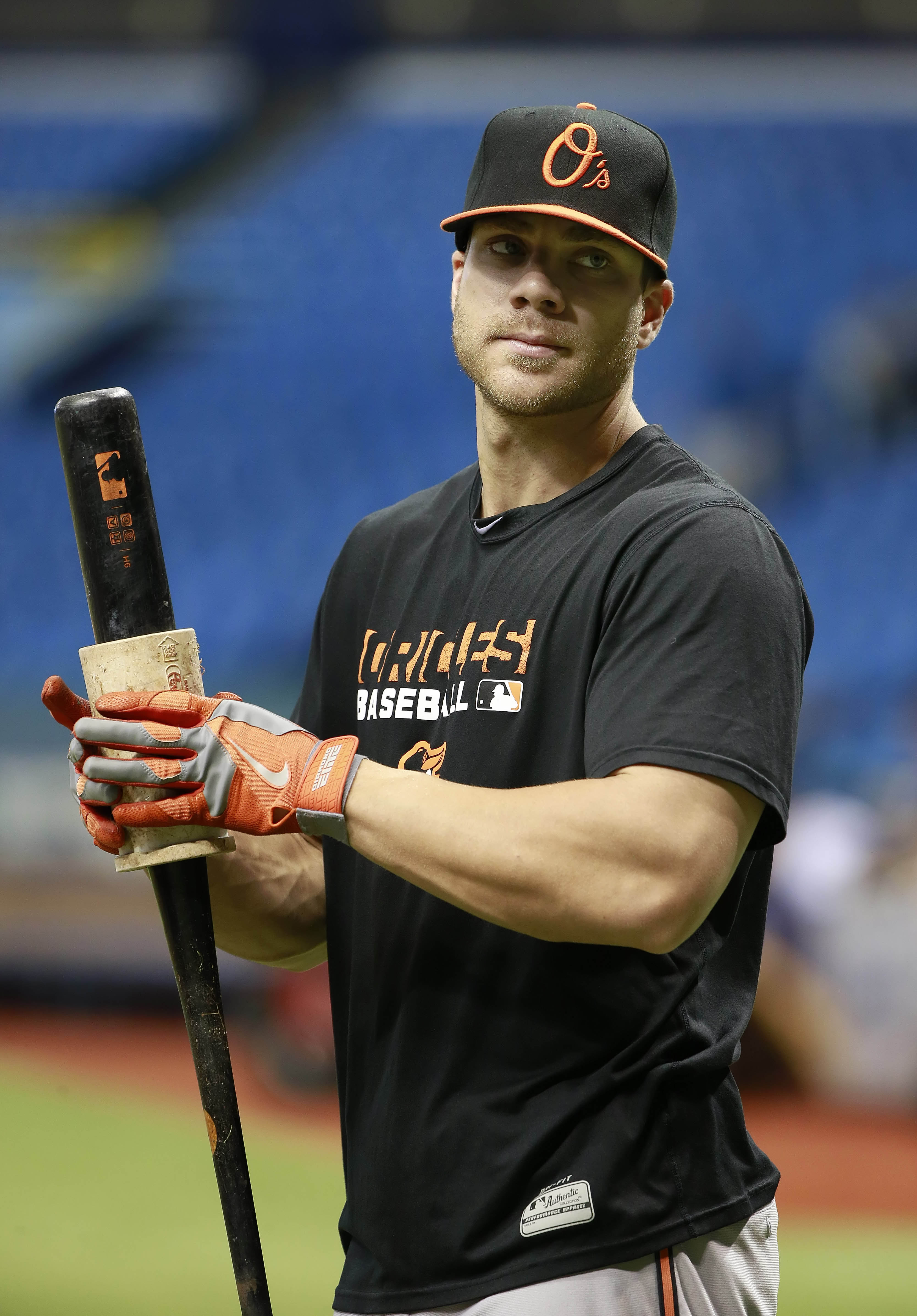 Davis is a bona fide middle of the order monster in his prime. Among free agents, only Yoenis Cespedes can compete with his power, but Cespedes has a less impressive track record as a hitter. Davis is also selective at the plate, with a 12.5% walk rate that ranked 13th in baseball this year.
Davis is generally regarded as a solid defensive first baseman. He was above average in the SABR Defensive Index this year and in UZR the last two years. He also has a touch of versatility, in that he logged 253 1/3 innings in right field this year and 149 1/3 at third base in 2014.
Age is on Davis’ side, as he doesn’t turn 30 until March and is five months younger than Cespedes. Davis has a good health record, as he hasn’t missed more than a week due to injury since missing 12 games with an oblique strain in early 2014. He played in 160 games in each of the 2013 and ’15 seasons.
Weaknesses/Cons
All that power comes with tons of strikeouts, as you might expect. Davis topped all of MLB with a 31.0% strikeout rate in 2015, and was also the game’s strikeout king in 2014 at 33.0%. Strikeouts affect a player’s batting average, and Davis is hitting .256 since 2012. Among those with at least 500 games played and 100 home runs since 2012, Davis’ batting average ranks 16th out of 19 players. So sure, power is a tradeoff, but Edwin Encarnacion and David Ortiz have much higher batting averages (and hence, OBPs) in that time.
With Davis, the biggest elephant in the room is his abysmal 2014 campaign, in which he hit .196/.300/.404 in 525 plate appearances before his season ended with a suspension for his use of Adderall, for which he did not have a therapeutic use exemption. Davis, who was initially diagnosed with Attention Deficit Hyperactivity Disorder in 2008, reportedly had an exemption for Adderall prior to the 2012 season. Eduardo A. Encina’s report for the Baltimore Sun from last December says it is believed Davis did not have an exemption for 2012 or 2013, years in which he played well. So at the least, Davis’ struggles in 2014 can’t be chalked up to ADHD medication, and he’s facing an 80-game suspension if he gets popped again. Ken Rosenthal of FOX Sports reported in February that Davis received an exemption for a different form of stimulant medicine, Vyvanse, for 2015.
Davis suffered an oblique strain in late April of 2014, which could perhaps be offered as a partial explanation for his struggles that year. Otherwise, it’s difficult to say why his batting average on balls in play dropped all the way down to .242 that year. The question a suitor will need to try to answer before locking Davis up is, “Will that happen again? If so, how soon?” Looking at some potential comparables, I find more good than bad, such as Carlos Delgado, David Ortiz, and even Jason Giambi. It is possible for Davis to be a good investment over his age 30-35 seasons.
Davis will be subject to a qualifying offer, so signing him will require draft pick forfeiture.
Personal
Davis was born in Longview, Texas, and resides in Dallas with his wife and daughter in the offseason. Chris’ nickname is Crush, a play on Kevin Costner’s character Crash Davis in Bull Durham. ESPN’s Eddie Matz profiled Davis in 2013, revealing a devout southern Baptist with a goofy sense of humor and an affinity for pumping iron. The article says Davis recommitted to his faith at a down point in his career, after the 2010 season. After failing to make the Rangers out of Spring Training, Davis told his fiancée he would go to seminary and become a minister or youth pastor if Texas didn’t promote or trade him that year. Davis did get the call, however, and was later traded to the Orioles with Tommy Hunter for Koji Uehara.
Market
The Orioles have expressed a desire to re-sign Davis, but I believe they’ll be outbid. The Astros, Mariners, and Padres are a few speculative fits. There are scenarios where the Angels, Marlins, or Giants could make a play. A half-dozen additional teams could be added if you’re willing to stretch. Still, first base doesn’t seem to be an in-demand position this winter, which goes hand-in-hand with the free agent market presenting few interesting alternatives at the position. Davis’ competition might be more with Cespedes, at the top end of the big bat market.
Expected Contract
Though no established position player received a six-year contract last winter, two non-superstars received seven-year deals the previous winter: Jacoby Ellsbury and Shin-Soo Choo. Both outfielders are represented by Scott Boras, as is Davis. Like Davis, Ellsbury and Choo had off-years on their resumes and still reached seven years in free agency. With Davis, I think it’s a matter of six or seven years. It’s a close call, but one reason I lean toward six is slugging first base types are generally not thought to age well. I’m pegging Davis for a six-year, $144MM deal.