
Free Agent Profile: Nori Aoki
Nori Aoki‘s one season with the Royals was the franchise’s best in recent history, and he was one of eight players who formed a suffocating defense that was crucial to the team’s run to the playoffs. Now, though, the CAA client is a free agent, and it’s unclear what the market might hold for a 32-year-old corner outfielder with minimal power.
Pros/Strengths
Aoki’s approach at the plate has resulted in excellent and consistent batting averages and OBPs. He’s batted .288, .286 and .285 in his three seasons in the big leagues, with OBPs of .355, .356 and .349. The 2014 AL league average OBP was .316, so Aoki was way ahead of the pack in that regard, and that was no accident — Aoki walks about as often as he strikes out, with 141 career strikeouts and 144 career walks. He hits both righties and lefties well (he batted .363/.428/.435 against lefties this season, which is noteworthy even though it’s unsustainable) and does not need to be platooned.
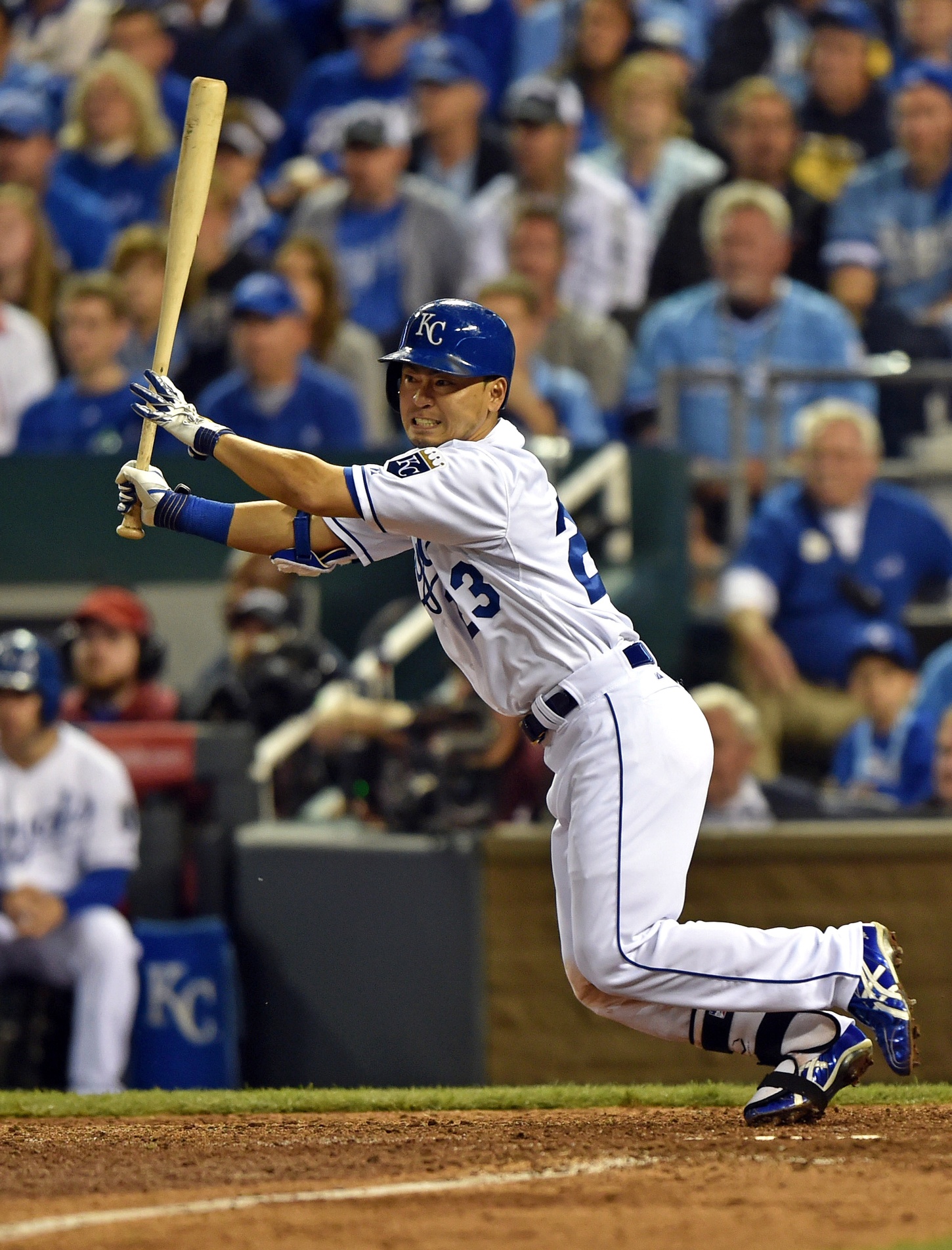 Like most Royals, Aoki is above average defensively for his position — he posted a 5.9 UZR in 2014 and is 8.2 runs above average in his three-year big league career. His speed hasn’t translated to great value on the bases, but it’s served him well defensively. Aoki has also been very durable, with a three-week stint on the disabled list with a groin strain in 2014 as the only significant absence since he arrived in the US.
Aoki has been at least a two-win player in two of his three seasons in the league, and if he can maintain his high on-base percentage, his secondary skills are good enough to hit that threshold. He also did not receive a qualifying offer, so the team that signs him won’t have to give up a draft pick.
Weaknesses/Cons
In 2012, his first season in the US, Aoki hit ten home runs and 51 overall extra-base hits, good power numbers for a table-setter. In the last two years, however, that power has vanished — Aoki had eight homers and 31 extra-base hits in 2013, and just one homer and 29 extra-base hits in 2014.
Aoki’s fly ball percentage has decreased from 27.7% in 2012 to 17.1% in 2014, and the average distance of those fly balls has decreased from about 280 feet in 2012 to 249 feet in 2014, ahead of only Donovan Solano, Elvis Andrus and Emilio Bonifacio on Baseball Heat Maps’ Flyball Leaderboard. Meanwhile, Aoki this year hit ground balls at a 61.9% rate this season, the second highest percentage among qualified hitters throughout MLB, behind Ben Revere and just ahead of an ancient Derek Jeter. In other words, unless there’s something about Aoki that hasn’t been revealed to us, his loss of power doesn’t appear to be a fluke.
A corner outfielder doesn’t need great power to be productive, but Aoki would lose value quickly if any of his other skills were to slip. His lack of power also limits his upside. Aoki’s Isolated Power last year was .075. Of the 13 qualified batters last season with Isolated Power numbers of below .090, only two — Revere and Dee Gordon — produced above average offensive value overall, according to Fangraphs.
Personal
Aoki, of course, starred for eight years with the Yakult Swallows in Japan before arriving in the United States. He was born in Hyuga, a small coastal city in Southern Japan, and his parents still reside there. Aoki and his wife, Sachi, have two young children.
Aoki’s interpreter, Kosuke Inaji, has worked with him in both Milwaukee and Kansas City and is “very much an extension of him,” Vahe Gregorian of the Kansas City Star writes. “He’s like our fifth outfielder,” Carlos Gomez said of Inaji when he and Aoki were with the Brewers.
Aoki wins plenty of praise as a teammate. “He had a great personality,” says former manager Ron Roenicke. “He fit in really well with the guys. We had fun with him. But he worked as hard as you could work. You can’t put more effort into the job than he did.”
Market
There aren’t many good position players available this offseason, but there are a fair number of outfielders, including Melky Cabrera, Yasmany Tomas, Colby Rasmus, Nick Markakis, Alex Rios and Torii Hunter. It’s possible Cabrera, in particular, might have to sign before the rest of the market develops. The Royals appear likely to have interest in retaining Aoki, and he could also fit in with the Reds, Twins, Mets, Cardinals, Blue Jays, Orioles, Rangers, Giants or Tigers. Nick Cafardo of the Boston Globe noted this week that the White Sox could be a possibility as well.
Aoki still profiles as a starter, but it’s unclear what his next team might be getting. His on-base ability is valuable, but the disappearance of his power is worrisome.
Expected Contract
A legitimate on-base threat is hard to find, and at his age (33 in January), Aoki could remain productive for at least two more years. He also has experience at all three outfield positions and could probably slide into a fourth outfielder role if his offense slips.
For all his drawbacks, Aoki was obviously a bargain throughout his previous contract, which paid him just $4.95MM total for the 2012 through 2014 seasons. This time around, he should be able to find a two-year contract at a significantly higher annual salary. He might end up being able to land a two-year, $16MM deal.
Photo courtesy of USA Today Sports Images.
Free Agent Profile: Hanley Ramirez
The Manny Ramirez era in Los Angeles is long over, but Hanleywood has given the Dodgers plenty of lasting memories in recent years. Hanley Ramirez is now hitting the free agent market and whether he winds up back with the Dodgers or with someone else, he’s all but certain to get paid big bucks.
Strengths/Pros
Offensively, Ramirez rates as one of the highest-impact free agents available. Last season, Ramirez slashed .283/.369/.448 with 13 homers in 128 games for the Dodgers. His career track record is even stronger with a batting line of .300/.373/.500. There aren’t many shortstops who offer the kind of pop that Ramirez can, either. He has yet to hit less than ten homers in a campaign and that low point comes from a partial season of play (2011). Over the last nine years, Ramirez has averaged 21 homers per season.

Ramirez has never played in a particularly homer-friendly environment, but he still boasts strong career numbers. With the Dodgers, Ramirez posted a .299/.368/.506 line in his two-and-a-half seasons, numbers that are eerily similar to his career slash line. When stacking his 2014 wRC+ against this winter’s other free agents (I modified the free agent leaderboard constructed by Steve Adams to exclude players with options that were exercised, like Ben Zobrist and Denard Span), he rates third among qualified hitters with a 135 rating. That puts him ahead of guys like Melky Cabrera and just a hair behind the big bat of Nelson Cruz.
Ramirez turned in a 3.4 WAR this past season and a particularly strong 5.0 WAR in 2013. He was a massive offensive weapon for the Dodgers in 2013 with a wOBA of .446. His closer-to-mortal .362 wOBA in 2014 is still quite strong, also good for No. 3 on the aforementioned free agent leaderboard. For his career, he has offered better-than-average strikeout and walk rates (16.6% and 9.6%) and his walk rate of 10.9% this past season was actually a step up from his total body of work. Both UBR and BsR scored him as an above-average baserunner this past season and are fond his career body of work on the bases.
A three-time All-Star, he shines especially bright when compared to the rest of the crop at the shortstop position. After Ramirez, the next best options are Stephen Drew, Jed Lowrie, and Asdrubal Cabrera. While all three are starter material, Ramirez clearly is of a different caliber and figures to out-earn all of them significantly in terms of average annual value and contract length.
Of course, Ramirez’s future might not be at shortstop. He also has 98 games of experience at third base to his credit, the bulk of which came in 2012 with the Marlins. The top of the third base market is healthier than at short, with options like Pablo Sandoval and Chase Headley, but Ramirez offers the most offensive potential of the three. A team could sign Ramirez to play shortstop, for now, and shift him over to third base down the line depending on the needs and opportunities that come up.
Weaknesses/Cons
Ramirez’s health has been an issue for years now. He’s phenomenal when he’s on the field, but it’s hard to count on getting a full season out of him given his track record. We first saw the injury bug strike in 2011 where he played in just 92 games, and in 2013, Ramirez took the field in just 86 games, his lowest output since becoming a full-time player.
Ramirez first started having shoulder trouble in 2010 and it only got worse in 2011 when he injured himself trying to make a diving catch in August of that year, causing him to miss the remainder of the season. In 2013, he tore a ligament in his thumb and missed a month after undergoing surgery. When he got back on the field, his hamstring cost him significant time. This past season, Ramirez was held back by several injuries, including a strained oblique.
While there are tons of great things to say about Ramirez’s bat, his fielding is not at all on the same level. Ramirez’s -15.6 UZR/150 rating from this past season is atrocious and his -8.8 career mark is pretty ugly as well. Defensive runs saved tells the same story – he cost the Dodgers nine runs in 2014 and has a -77 tally for his career.
I mentioned the possibility of a shift from shortstop to third base as a positive in the previous section, but here’s the other (and, maybe, more realistic take): a club signing Ramirez to a multi-year pact will likely have to put him at third base at some point to try and cover up his defensive shortcomings. When you look at his history of poor defense and injuries and consider that he’s on the wrong side of 30 (he’ll be 31 by Opening Day), there’s little reason to believe it’ll get better.
Ramirez will most definitely turn down the Dodgers’ qualifying offer, meaning that any other club signing him will forfeit its top unprotected pick.
Personal
Ramirez was born and raised in the Dominican Republic and attended Adbentista High School. Ramirez is married with three children – two sons and a daughter. In the summer of 2013, his youngest son showed everyone that he has a gorgeous swing, just like his father (Vine link).
Market
The Dodgers and Ramirez were discussing an extension in the early part of the season, but the two sides agreed to table talks when they could not bridge a sizable gap. A return is not out of the question, but rival evaluators told ESPN.com’s Buster Olney in September that they were sensing that the Dodgers would offer Ramirez the QO with the expectation that he would decline, sign elsewhere, and net them draft compensation. Of course, the new regime in L.A. headed by Andrew Friedman might feel differently.
More recently, Ramirez has reportedly told teams that he’s willing to play a position other than shortstop, which should make clubs with third base needs and possibly corner outfield needs more open to adding him. However, some clubs might have reservations about signing him and simply dropping him into the outfield. After all, he’s never played a single game there in his pro career.
The Yankees might be the most obvious fit for Ramirez, but reports this week indicated that they weren’t likely to pursue many of the big-name free agents on the market. Of course, as Steve pointed out in the linked piece, that report mentioned many top free agents by name, but Ramirez’s name was absent. If the Yankees are willing to pay market price for Ramirez, they can slot him in at shortstop in the short-term and transition him over to third or a corner outfield spot later on in the contract.
The Mariners and Giants could enter the mix as well, with San Francisco looking at him as a third base or left field option. The Tigers might make sense from a need standpoint, but they have so many large contracts on the books looking forward that adding a significant deal for Ramirez might be tough. A reunion with the Red Sox might be possible since he is willing to play third, and they’ve reportedly already reached out to him. The White Sox have money to spend, few significant long-term contracts on the books and lack a clear long-term option at third base. The A’s are in need of a shortstop and with a lefty-heavy offense, Ramirez’s big right-handed bat would be a welcome addition, though it’s hard to see his salary fitting into the budget. The Mets also probably won’t spend the money necessary to sign Ramirez, but the need is there.
Expected Contract
Ramirez was reportedly asking for over $130MM in the spring give up a chance at testing the open market, presumably on a five- or six-year pact. Given the lucrative deals signed by Jacoby Ellsbury ($153MM) and Shin-Soo Choo ($130MM) last winter, an AAV of $20MM or more seems feasible for Ramirez, who offers major offensive production at a premium position.
Even when considering Ramirez’s spotty health record and weak glove, it’s hard to envision a scenario where he doesn’t comes away as the highest paid positional player of the winter. Last winter, Ellsbury got a $153MM, seven-year pact, despite his own checkered injury history. I think Ramirez will approach that AAV with one less year, netting a six-year, $132MM deal.
Photo courtesy of USA Today Sports Images.
Offseason Outlook: Los Angeles Angels Of Anaheim
The Angels overcame season-long questions about their pitching depth to run away with the AL West, but late injuries in their rotation significantly weakened that group, which may have contributed to the team’s ALDS defeat at the hands of the Royals.
Guaranteed Contracts
- Albert Pujols, 1B: $189MM through 2021
- Mike Trout, OF: $139.5MM through 2020
- Josh Hamilton, OF: $83MM through 2017
- C.J. Wilson, LHP: $38MM through 2016
- Jered Weaver, RHP: $38MM through 2016
- Erick Aybar, SS: $17MM through 2016
- Joe Smith, RHP: $10.5MM through 2016
- Howie Kendrick, 2B: $9.5MM through 2015
- Huston Street, RHP: $7MM through 2015
- Chris Iannetta, C: $5.25MM through 2015
Arbitration Eligible Players (service time in parentheses; projections via Matt Swartz)
- Gordon Beckham, 2B/3B: (5.123): $5MM projected salary
- David Freese, 3B (5.028): $6.3MM
- Kevin Jepsen, RHP (4.163): $2.6MM
- Fernando Salas, RHP (4.048): $1.4MM
- Vinnie Pestano, RHP (3.053): $1.2MM
- Wade LeBlanc, LHP (3.032): $800K
- Hector Santiago, LHP (3.024): $2.2MM
- Collin Cowgill, OF (2.151): $900K
- Garrett Richards, RHP (2.148): $4MM
- Non-tender candidates: Beckham, LeBlanc
Free Agents
Other Salary Commitments
- Joe Blanton, RHP: $1MM
A year ago, the Angels’ primary goal in the offseason was to acquire controllable, affordable pitching to remain underneath baseball’s $189MM luxury tax threshold. GM Jerry Dipoto addressed that issue by acquiring left-handers Tyler Skaggs and Hector Santiago in the three-team Mark Trumbo trade at the 2013 Winter Meetings. Skaggs, however, will miss the 2015 season after undergoing Tommy John surgery in August. And, just weeks after Skaggs’ injury, the Angels lost breakout star Garrett Richards to a torn patellar tendon that will cost him six to nine months. That injury leaves open the possibility that he could be out for the beginning of the 2015 season as well.
In other words, the Angels again find themselves in need of young and/or inexpensive rotation options, and Dipoto has struck quickly — quickly enough that I had to rewrite a large portion of this outlook! — in acquiring right-hander Nick Tropeano (and catcher Carlos Perez) from the Astros in exchange for Hank Conger. While it may be early to pencil Tropeano into the Opening Day rotation, he did make four starts for the Astros in 2014, and one would think he’s firmly in the mix.
The Halos have three locks for the Opening Day rotation in Jered Weaver, C.J. Wilson and 2014 Rookie of the Year candidate Matt Shoemaker (whose emergence is nothing short of a godsend for the club in light of these injuries). Santiago and Tropeano could fill the fourth and fifth spots (if Richards needs to open the year on the DL), but options beyond that are thin. Cory Rasmus could be converted to a starter, but the Angels appear in need of more depth. That could come via minor league deals for veterans or further trades to acquire pitching talent that is ready or nearly ready to be tested in the Majors.
Salary-conscious moves such as that may be the norm for the Angels this winter. Dipoto and his staff will not have the limitless flexibility to which we became accustomed as the team went on a spending spree by adding Wilson, Albert Pujols and Josh Hamilton in recent years. Anaheim already has nearly $140MM in luxury tax commitments to the 10 players on the books for next season (Weaver, Wilson, Pujols, Hamilton, Mike Trout, Howie Kendrick, Erick Aybar, Huston Street, Joe Smith and Chris Iannetta), and as recently as late August, owner Arte Moreno was reportedly “adamant” about not crossing the luxury tax barrier. MLB.com’s Alden Gonzalez recently wrote that they could be just $10MM or so under that threshold with a full roster. As such, don’t expect to see the team springing for Max Scherzer, Jon Lester or James Shields.
In fact, any significant free agent addition may be tough to make due to the luxury tax, which is likely a contributing factor behind recent reports that the team is likely to move either Kendrick or David Freese. Kendrick is the more appealing of the two names given his steadier production and the weak class of free agent second basemen compared to third basemen. The Nationals, Blue Jays, Marlins, Orioles and Braves all make varying degrees of sense for Kendrick, who can block trades to the Jays and Marlins. I can see the Giants, Yankees, Red Sox, White Sox, Blue Jays and Nationals expressing interest in Freese, although that of course will depend largely on the landing places for the plentiful third base options presented by the open market (e.g. Pablo Sandoval, Chase Headley and Hanley Ramirez).
Of course, the Angels aren’t likely to move either for the sake of shedding salary. They’ll need to receive something of note in return, particularly for Kendrick. That could come either in the form of prospects to create some infield depth — an area in which the team improved with this week’s record signing of Cuban infielder Roberto Baldoquin — or through a cheaper rotation arm.
A trade of Kendrick or Freese would likely give the Angels some much-needed breathing room and could allow them to pursue a mid-range option for the rotation, if they see fit. I’d think that players such as Jason Hammel, Edinson Volquez and Justin Masterson are plausible free agent targets if enough salary is shed by moving an infielder, but Tropeano’s acquisition may simply point to the fact that free agent arms requiring significant salaries aren’t going to happen. An alternative such as Kyle Kendrick, who may only net a low salary one-year deal, could make sense as some early depth, though he may prefer a team with a clearer path to a full season’s worth of work in the rotation.
Turning to the bullpen, there doesn’t appear to be an urgent need for the Angels. Street will reprise his role as closer after posting dominant numbers all season. Smith excelled in his first year on the job, thriving as both a setup man and a part-time closer. Kevin Jepsen turned in a career year, and rookie Mike Morin emphatically announced his arrival to the Anaheim bullpen with a 2.90 ERA and 3.08 FIP. Even with some regression in his homer-to-flyball rate, he has the promise of being a solid bullpen piece. Fernando Salas, too, did his part after coming over from the Cardinals, registering a 3.38 ERA with even better FIP/xFIP marks and averaging more than a strikeout per inning. Vinnie Pestano pitched well after being acquired in August and may have earned a look in 2015.
All of those names, of course, are right-handed relievers. Lefty relief was another area of need for the Halos heading into the offseason, but Dipoto again struck quickly in acquiring Cesar Ramos from the Rays in exchange for prospect Mark Sappington. There could be room for another lefty even after that acquisition, but the need is definitely dampened. A run at Andrew Miller might be feasible if the team is able to drop Kendrick’s salary in a trade that also improves the minor league system, but the club could look at more affordable arms. Re-signing Joe Thatcher or making a run at Neal Cotts or Zach Duke would certainly be more financially feasible. The team is plenty familiar with Cotts after his work in the Rangers’ bullpen from 2013-14, and Duke had a quietly brilliant season out of the Milwaukee bullpen, posting a 2.45 ERA (2.14 FIP, 2.09 xFIP) with 11.4 K/9 against just 2.6 BB/9 in 58 2/3 innings.
While the pitching staff may have some new names in 2015, the lineup will look largely similar. Getting out from underneath the $83MM remaining on Hamilton’s contract would be a welcome reprieve, but that’s not likely, so the team will be left hoping that that the left fielder can rediscover some of the form he showed in his Rangers prime. Center field and right field will be occupied by the game’s best all-around player (Trout) and one of the game’s most underrated outfielders (Calhoun), respectively. Trout was worth nearly eight wins above replacement, and Calhoun was worth roughly four (depending on your preference between Fangraphs and Baseball-Reference), giving manager Mike Scioscia a highly productive duo.
In the infield, Aybar figures to man short, and one or both of Freese or Kendrick will return to the mix as well. In the event of a trade, the team could plug Grant Green in at either spot. While he’s yet to produce at the big league level, the former first-round pick drew strong praise from Angels assistant GM Matt Klentak when he was a guest on MLBTR’s Podcast recently. As an alternative, a run at Korean infielder Jung-ho Kang could give the team an option to push Green. Though Kang flirted with 40 homers in KBO last year, Major League scouts are split on how well that power will translate to the Majors. Uncertainty figures to prevent his price tag from being exorbitant.
Meanwhile, Pujols will share first base and DH duties with the young C.J. Cron, who hit .256/.289/.450 with 11 homers in 253 PA as a rookie. Despite his age, it’s likely that Pujols will spend more time in the field, as defensive metrics were unkind, to say the least, in Cron’s small sample at first base. Even when Baseball America ranked him second among Halos prospects entering the 2014 season, their scouting report noted that he would have to hit, because he’s already a below-average defender at first base.
That defensive limitation is one reason that I do think Cron’s name could also surface in trade talks with other AL clubs. As Pujols ages, the Angels will need to free up more and more DH time for the slugger, and they may not like the idea of committing to a 25-year-old who already appears to be headed for primarily DH duties. Of course, Pujols still logged more than 1,000 innings at first in 2014 (and graded out well, as usual), so the desire to clear DH time likely isn’t urgent yet.
Dipoto recently commented that most of his offseason additions would be tweaks to the team’s bench and bullpen. Green will occupy a spot if Kendrick and Freese are retained, and Collin Cowgill‘s strong work in 2014 seems likely to have earned him a job as a fourth outfielder next season. Perez, acquired with Tropeano, could become the backup catcher, or the team could pursue a veteran backstop on the free agent market, which bears plenty of options. John Buck, David Ross and Gerald Laird are all available this winter.
The team could have two more spots, and adding some power, particularly from the left side of the dish (should Cron require platooning), would seem prudent. The free agent market offers little, though a low-risk reunion with Kendrys Morales that would push Cron to the bench is somewhat intriguing. Dipoto could again work the trade market, and a couple of names I can envision as bench fits would be the Marlins’ Garrett Jones and the Blue Jays’ Juan Francisco.
The Angels will return the vast majority of a roster that won 98 games in 2014, so stating that there’s a need for any large change seems inaccurate. The team could move an infielder and add some bench pieces, but the early trades struck by Dipoto lessen the need to add more arms. Overall, the look and feel of the 2015 Angels figures to be similar to that of the 2014 Angels, which should position them for another strong season.
Free Agent Profile: Francisco Liriano
Francisco Liriano‘s last venture into the free agent market came on the heels of a down season split between the Twins and White Sox, and resulted in a low-risk two-year deal for the Pirates. After playing an integral role in two straight postseason appearances for Pittsburgh, the lefty will hit the open market in a much stronger position.
Strengths/Pros
There’s little doubting that Liriano has the talent to be one of the most dominant arms in the game. As a 22-year-old rookie in 2006, he looked to be an unhittable force (2.16 ERA, 10.7 K/9, 2.4 BB/9) that would have garnered Cy Young attention had Tommy John surgery not stopped his season at 121 innings. His recovery was longer than most, and while he struggled in 2008-09, he returned to form with a dominant 2010 season worth nearly six fWAR.
 Over his past two seasons with the Pirates, Liriano has turned in 323 1/3 innings of 3.20 ERA with 9.4 K/9, 4.0 BB/9 and a strong 52.4 percent ground-ball rate. Sabermetric ERA estimators such as FIP and xFIP both peg Liriano’s true talent with Pittsburgh at a 3.26 ERA, so both old-school and new-school lines of thinking paint him as a well above-average pitcher when he’s at his best.
Part of the reason for Liriano’s resurgence with the Bucs is that he’s rediscovered some life on his fastball. The 31-year-old has averaged 92.8 mph on his heater over the past two seasons, whereas in some of his weakest seasons, his velocity sat 90-91 mph. He doesn’t have the 94.7 mph average he did as a rookie, but his average velocity is still tops among free agent lefties.
When Liriano’s velocity is working, he racks up strikeouts at a prolific clip. He’s whiffed 9.2 hitters per nine innings throughout his career (even including his down seasons), and this year’s 9.7 K/9 mark trails only Max Scherzer among free agent starters.
Liriano turned 31 after the season, so he’ll pitch the entire 2015 regular season at that age. That makes him younger than a number of his peers in the second tier of the starting pitching market, including Ervin Santana, Brandon McCarthy and former teammate Edinson Volquez.
Weaknesses/Cons
For as good as Liriano can be, there’s no ignoring the inconsistency and injuries that have, to some extent, defined his career to this point. Liriano has finished with an ERA well north of 5.00 in three full seasons, and in two of those seasons he walked five hitters per nine innings. Agent Greg Genske of the Legacy Agency can point to Liriano’s longer-than-usual recovery from Tommy John surgery as the culprit for those marks in 2009 and shoulder inflammation for the 2011 season, but Liriano floundered under two separate pitching coaches in 2012 and was injury-free that year.
Even in his two excellent seasons with the Pirates, Liriano spent significant time on the DL in each campaign. The first was a freak accident — a fracture in his non-throwing arm sustained while falling in his apartment — but the second injury, an oblique strain, did cost him more than a month in 2014.
All told, Liriano has had seven trips to the DL in a nine-year career. As such, he’s topped 180 innings just once — back in his stellar 2010 season. As I noted in my profile of fellow injury-prone starter Brandon McCarthy, teams are likely to show trepidation when it comes to multi-year contracts for pitchers without a track record of durability. No matter how great the upside, the downside of receiving 100-120 innings and having to patch together that rotation spot with a potentially replacement-level arm is concerning.
Control has oft been an issue for Liriano throughout his Major League tenure as well. He averaged 4.5 walks per nine innings in 2014 and has averaged 3.9 for his career. The Pirates made a qualifying offer to Liriano, and while some were surprised by the decision, I expect him to reject in search of multiple years due to his age and recent success. As Santana showed last spring, even if the market collapses, it’s still possible to find a one-year contract at or near the value of the QO late in the offseason.
Personal
Liriano is married and has three children with his wife, per the Pirates media guide. They make their home in the Dominican Republic in the offseason. He comes from a good baseball family, as his cousin is Giants setup man/closer Santiago Casilla.
Liriano has a reserved and quiet image but is seen as an excellent teammate by those who have played with him and was asked to take up a leadership role with the Pirates in recent years, particularly following the departure of the veteran A.J. Burnett.
Market
Beyond the top three starters on the market, Liriano is in the mix for the top second-tier starter along with names like McCarthy, Santana and Kenta Maeda. Liriano’s camp can likely build a case that he has the highest ceiling among those arms, and despite the undeniable risk associated with Liriano, it’s an arguable point. Liriano misses more bats than the other three and has had four very strong seasons at the Major League level, even if there was some distance between them.
A large number of teams are going to be in the market for rotation help, and many won’t be able to afford the likes of Scherzer, Jon Lester and James Shields. Liriano could be the top target for some clubs, and it’s possible that one of the teams who inks one of the big three could wish to add Liriano as a second boost to the rotation. The Red Sox are said to be eyeing multiple starters and have been connected to Liriano, and the Cubs, too, are known to be seeking multiple starting pitchers. Both teams will have a protected first-round pick, as will the Astros, D’Backs, Rockies, Rangers and Twins, each of whom has some need in the rotation (it’s unclear if the Twins would have any interest in rekindling that relationship, however). I’ll also add the Mariners, Yankees, Giants, Royals and Dodgers as teams I could see entering the mix, though the M’s of course seem likely to first focus on their offense.
An interesting point raised to me by MLBTR’s Tim Dierkes is that Liriano and Russell Martin could make an interesting package this offseason. A team that signed Martin would have less to lose than others in adding Liriano, having already forfeited a pick, and the two have worked well together in the past. The Cubs, Rockies and Dodgers seem like at least plausible fits in that regard.
Expected Contract
Simply put, I’m of the strong belief that speculation regarding Liriano accepting a qualifying offer is largely overblown. Liriano will pitch all of next season at 31 years of age and is coming off a pair of strong seasons with flashes of brilliance in his past. There’s no ignoring the risk associated with his arm, but I believe that offers in the $10-15MM range could be waiting at the end of the offseason even if the multi-year deal Liriano’s camp covets ultimately fails to materialize.
Surrendering a first-round pick for Liriano is a risk, but there are 10 teams that can sign him for a second-round pick, and it’s not inconceivable that he ends up costing “only” a third-round pick if an aggressive team on the free agent front adds multiple players with QOs looming over their heads.
Players with this type of injury history and inconsistency rarely, if ever, get four-year deals, but we saw a less consistent Ubaldo Jimenez land four years last offseason. Regardless of how that deal looks now, it still serves as a reference point that upside can trump inconsistency. Liriano doesn’t have Jimenez’s durability so the fourth year feels like a reach (although I do feel it’s possible), but I believe he’ll receive some three-year offers. In the end, I’m predicting a three-year, $40MM contract for Liriano.
Photo courtesy of USA Today Sports Images.
Free Agent Profile: Nelson Cruz
Last winter, Nelson Cruz turned down a $14.1MM qualifying offer from the Rangers only to find that the market wasn’t anywhere close to what he had hoped. The Orioles wound up inking him to a one-year, $8MM deal which proved to be a brilliant signing. This time around, he shouldn’t have any trouble landing a multi-year deal.
Strengths/Pros
In 2014, Cruz turned in a .271/.333/.525 slash line with 40 homers on the way to his third career All-Star selection. Cruz’s 40 dingers weren’t just a career-high, it was the highest home run total of anyone in the majors in 2014. Cruz’s .525 slugging percentage was good for eighth in the majors, putting him above the likes of Jose Bautista, Miguel Cabrera, and David Ortiz. In a season where the Orioles got just 26 games out of Matt Wieters and lost Manny Machado for half the year, Cruz stepped up in a major way and helped propel them to first place in the American League East. 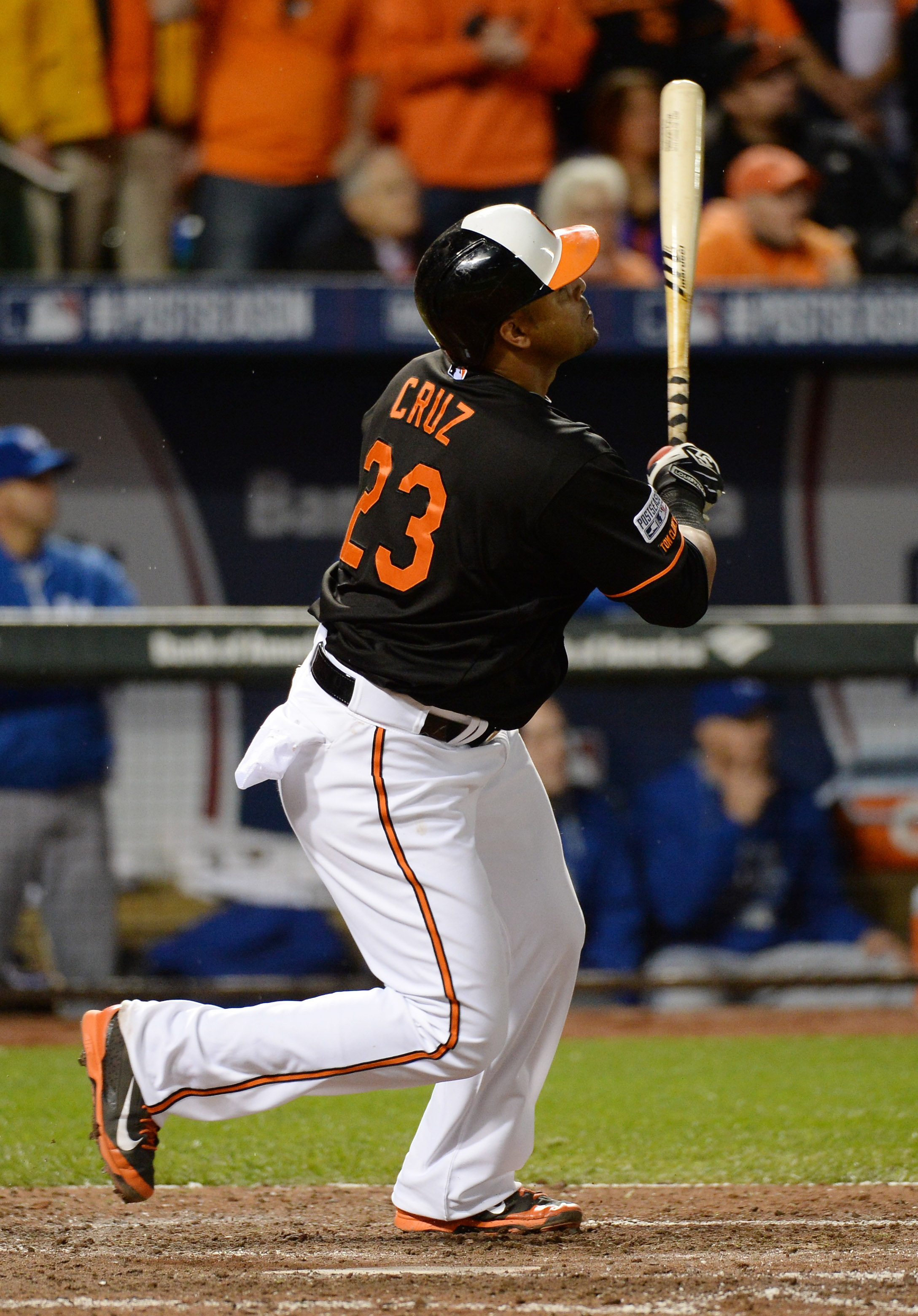
The advanced metrics were also very fond of Cruz’s 2014 performance. His 137 wRC+ put him in the upper echelon of sluggers. Meanwhile, Cruz’s .288 BABIP was actually a bit lower than his career average and his strikeout rate dipped, so there’s reason to believe he could bump his batting average a bit going forward. Cruz ranked seventh in MLB and first among this offseason’s free agent with a .254 ISO in 2014.
His 2014 may have been a pleasant surprise, but it didn’t come out of the blue. Cruz has a solid track record of quality offensive performance, dating back to his breakout 2009 season with the Rangers. In those six years, Cruz owns a .271/.332/.514 batting line with about 29 homers per season and an OPS+ of 123, showing that he was still well above average even when factoring in the hitter-friendly confines of Globe Life Park in Arlington.
Cruz has proven to be an elite hitter against left-handers with a career .314/.407/.569 while his .258/.310/.513 slash line against righties is nothing to sneeze at either.
Teams will also find his October body of work attractive, and with good reason. With his two home runs in the ALDS, Cruz leapfrogged some legendary names to climb up the all-time postseason home run ladder. With homers 15 and 16 against the Tigers, Cruz tied Carlos Beltran for ninth all-time. As Mark Saxon of ESPN.com noted, that vaulted him ahead of Alex Rodriguez, Johnny Bench, Barry Bonds, Joe DiMaggio, Mark McGwire, and, yes, Babe Ruth. Cruz got there in just 37 career postseason games, less than all of the other players listed.
Weaknesses/Cons
Unsurprisingly, the Orioles made a qualifying offer to Cruz, meaning that there will be draft pick compensation attached to signing him. In his last trip through free agency, the QO hurt his market (though his asking price was probably more to blame), leading to his discounted deal with Baltimore. Of course, the circumstances were different. For starters, Cruz was reportedly seeking as much as $75MM at the outset of free agency, unrealistic numbers that led to him settling in January. His value was also hurt by the tarnish of the Biogenesis scandal and the resulting 50-game suspension he served in 2013.
For all of his positives at the plate, there isn’t much that can be said for his agility or base running at this stage of his career. In 2014, Cruz put up a career-worst BsR of -3.3, putting him somewhere between “below average” and “poor” on the basepaths.
While Cruz graded well in a small sample this year (he had a UZR/150 of 3.8 with 3 defensive runs saved), he’s certainly not valued for his glove. He spent more of his time in the DH role, which he might be better suited for going forward. A team signing Cruz will be getting him for his mid-to-late 30s (he’ll start next year at 34 and turn 35 on July 1) and his agility in the field doesn’t figure to improve from here, to say the least.
Cruz’s WAR of 3.9 from this past season was his highest in years, a showing that was only bested by his 2010 season with the Rangers. In his last three seasons, his value has been teetering on that of a good player, but not necessarily a great one (although his suspension in 2013 did deflate that number).
On the whole, his age figures to dampen his value. While teams are usually looking to pay for prime years at the top of the market, Cruz’s remaining years could be a drop off from what we’ve seen over the last few.
Personal
As Steve Adams noted in his profile of Cruz last winter, he’s an accomplished two-sport athlete who played for the Dominican Republic Junior National Team in his younger days. His father also played professional baseball in the DR, so that sort of thing runs in the family. Cruz and his wife have two children.
Executive vice president Dan Duquette had great things to say about Cruz as a locker room presence earlier this month. “You can tell just by watching him, he’s the leader of the ballclub,” said Duquette, according to Eduardo A. Encina of The Baltimore Sun. Peter Schmuck of The Baltimore Sun wrote that Cruz created a comfort zone for the club’s younger latino players, like second baseman Jonathan Schoop. Adam Jones spoke glowingly about Cruz’s impact on the team.
Cruz changed agents in early October, joining Diego Bentz of Relativity Sports.
Market
As mentioned Encina’s piece, Duquette is realistic about his chances of keeping Cruz beyond this season. “He came here to have a platform year to get himself re-established to get him a long-term deal and that’s something we will have to consider,” Duquette said.
The Mariners probably regret passing on Cruz last offseason and they could try and make up for that mistake this time. They’re in need of a quality DH and are expected to chase the likes of Cruz and Victor Martinez. A reunion with the Rangers could be a possibility, but they previously balked at the idea of a three-year deal and it may not be any more palatable to them now. Cruz has been linked to the Yankees, though there isn’t a clear fit at this time with Beltran expected to return to right field. Giving Cruz DH time could be tough as well with Beltran, Alex Rodriguez, Mark Teixeira likely needing at-bats there. The Tigers, Royals, and Twins are also among the AL teams with potential interest. National League teams can and will certainly show interest, but it remains to be seen how far they will go given the concerns about his defense.
Expected Contract
Last season, Curtis Granderson signed a four-year, $60MM deal with the Mets, despite coming off of a season in which he missed 100 games. Cruz, meanwhile, played 159 games and belted 40 homers in his walk year. While there are many differences between the two players, including age (Granderson was 32 last winter, Cruz is 34), Cruz’s reps probably believe that they can match the years and top the total value of Granderson’s contract.
Complicating matters, of course, will be the qualifying offer and the same PED suspension that depressed his market value last winter. As Steve Adams wrote earlier this month about Melky Cabrera, no player with those two factors working against them has ever been able to cash in big in free agency.
Steve projected that Cabrera would land a five-year, $66.25MM and rightly noted that Cabrera is four years younger and has more defensive value. Still, Cruz has power on his side and that is at a major premium around the game. His age will preclude him from the same length on the contract but he can still get a very healthy payday for himself on a slightly shorter deal. I predict that Cruz will ultimately best Granderson’s deal from last winter with a four-year, $70MM deal.
Photo courtesy USA Today Sports Images.
Offseason Outlook: Washington Nationals
The Nationals have little in the way of glaring needs and could seek to defend their NL East crown with relatively few moves. But some big-picture issues are now squarely in focus, and significant change could occur for the first time in several years.
Guaranteed Contracts
- Ryan Zimmerman, 3B/1B/OF: $76MM through 2019 (including $2MM buyout of 2020 option) + $10MM personal services contract over five years post-playing career
- Jayson Werth, OF: $63MM through 2017
- Gio Gonzalez, SP: $23.5MM through 2016 (including $500K buyout of 2017 option)
- Jordan Zimmermann, SP: $16.5MM through 2015
- Ian Desmond, SS: $11MM through 2015
- Nate McLouth, OF: $5.75MM through 2015 (including $750K buyout of 2016 option)
- Matt Thornton, RP: $3.5MM through 2015
- *Bryce Harper, OF: $1MM plus $1.25MM in prorated bonus through 2015 (Harper signed MLB contract out of 2010 draft that left undecided whether he could opt into arbitration; Harper would qualify as Super Two with 2.159 years of service; matter will be resolved by negotiation or grievance)
Arbitration Eligible Players (service time in parentheses)
- Kevin Frandsen, UT (5.151): $1.2MM
- Tyler Clippard, RP (5.148): $9.3MM
- Jerry Blevins, RP (5.081): $2.2MM
- Doug Fister, SP (5.058): $11.4MM
- Ross Detwiler, RP/SP (5.002): $3.3MM
- Craig Stammen, RP (4.160): $2.1MM
- Drew Storen, RP (4.140): $5.8MM
- Stephen Strasburg, SP (4.118): $8.1MM
- Wilson Ramos, C (4.047): $3.2MM
- Jose Lobaton, C (3.138): $1.2MM
- Danny Espinosa, 2B/SS (3.113): $2.3MM
- *Bryce Harper, OF (2.159): $2.5MM (see above)
- Non-tender candidates: Frandsen
Contract Options
- Adam LaRoche*, 1B: $15MM mutual option ($2MM buyout)
- Rafael Soriano*, RP: $14MM club option(no buyout)
- Denard Span*, OF: $9MM club option ($500K buyout)
- Anthony Rendon, 2B/3B: club option of unknown value (signed MLB contract after 2011 draft)
*The Nationals have officially exercised Span’s option while declining the options on LaRoche and Soriano.
Free Agents
Another NL East crown, another gut-wrenching loss in the NLDS. That scenario pains Nationals fans, but probably does little to dissuade GM Mike Rizzo from his path. After all, most of his recent moves have turned out swimmingly for Washington. Brimming with talent at nearly every position, most of it still in prime years, the Nats would undoubtedly be among the favorites to take the 2015 World Series even if they did not make a single outside addition to the roster.
But as three straight years of disappointment – twice in the playoffs, once in failing to make them – have demonstrated, no assembly of talent is good enough. That alone is motivation for change. More significant, though, is the ticking of the service clocks of several core players who have driven the most successful run of any Washington, DC-based MLB team since the mid-1920s Senators.
As always, payroll is an important factor as well. Owner Mark Lerner said early in 2014 that the club was “beyond tapped out” in terms of player salary, but it is already on track to top last year’s nearly $137MM Opening Day tab. As things stand for 2015, the club has about $94MM in guarantees on the books before adding in the approximately $50MM in arb commitments outlined above. Of course, public statements must be taken with a grain of salt, particularly for a team with an ongoing TV rights fee dispute (the results of which could make a big difference in spending capacity) and many potential extension discussions to be had. But it remains to be seen what kind of flexibility Rizzo will have to work with.
Ultimately, the Nationals could just plug needs while exploring a few extension scenarios. Or the club could pursue bold, opportunistic moves that could serve the present while setting things up down the line. Let’s canvas the roster to identify the areas of opportunity and pressure points.
The outfield is the most straightforward area. Bryce Harper and Jayson Werth are locks for the two corner spots. And center fielder Denard Span’s $9MM option is certain to be exercised after a quality season from the 30-year-old. Youngster Michael Taylor is waiting in the wings up the middle, and the more advanced Steven Souza seems ready to contribute in a corner role, and Nate McLouth is set to return from a disappointing, injury-shortened first season in D.C. That group offers sufficient flexibility that trade possibilities cannot be discounted; the likeliest scenario, perhaps, would involve Souza going as part of a deal to address another area, though there could be some temptation to explore a trade involving Span to take advantage of a weak free agent crop of center fielders. (Of course, there are not necessarily that many teams in position to aggressively pursue new center fielders, either.)
In the infield, Wilson Ramos remains entrenched behind the plate, with Jose Lobaton locked in as the back-up. And Ian Desmond is unquestionably set to play short, though he will be entering his final year of team control. One of several still-youthful veterans who will reach free agency after the coming season, Desmond appears the most likely to ink a long-term extension. (Desmond has said he expects to stay with the team for the long run, though he reportedly turned down a seven-year extension last offseason that would have guaranteed him somewhere in the range of $85MM to $98MM.)
Ryan Zimmerman figures to move from his natural third base across to first, taking over for Adam LaRoche. Zimmerman’s inability to stick at third represents a significant downgrade in his value, though his bat is still solid and he has shown some promise of playing a serviceable corner outfield if need be. As for LaRoche, his $15MM mutual option seemed a reasonable value, but he just did not fit on the roster and will be allowed to walk (unencumbered by a qualifying offer) as a free agent.
The Nats would surely prefer to be weighing their options at first while fielding Zimmerman at third and emerging star Anthony Rendon at second. But that is not to be, and the resulting situation is not without its flexibility. Rendon’s bat is good enough to play anywhere on the diamond, and he showed the ability to add value with his glove at both second and third over the course of 2014. Washington will probably angle to add a player to take over at the keystone, keeping Rendon at his natural third base for the long haul, but could jump on a third baseman if the right opportunity presented itself. (The team was said to have interest in Adrian Beltre at the trade deadline, and I believe it could likewise be interested in an option like Chase Headley if he could be had on a short-term contract, though that seems unlikely.)
If the Nationals go looking for a second baseman, while keeping their eye on third, what are their options? The only internal option – former starter Danny Espinosa — is not reliable in the batter’s box against righties, though he could theoretically form a very good left-handed side of a platoon. His offensive upside, defensive prowess, young age, and relatively low cost makes him a player that the Nationals will not give away in trade, but neither is he a full-time option for a contender.
The free agent market is largely unappealing, being headed by players such as Asdrubal Cabrera (who had a late run with the Nats after the trade deadline) and Jed Lowrie. I do not see Rizzo committing to that kind of player on a lengthy deal, though he could jump on a shorter pact if it becomes an option. (Rizzo was willing, for instance, to give two years to Nate McLouth as a fourth outfielder, and could theoretically add a second baseman who would eventually become more of a utility option.) Bounceback candidate Stephen Drew could make sense, as the righty-masher would pair nicely with Espinosa.
There are more intriguing names that will at least potentially be available on the international scene. Korean star Jung-ho Kang could be posted, while no fewer than three well-regarded Cuban second baggers — Jose Fernandez, Hector Olivera, and Andy Ibanez (links to posts)– have (or may have) left their home island with intentions of ultimately landing MLB contracts. It is hard to know at this point what level of interest the Nationals, or other teams, will have in that group, however, and it remains to be seen precisely which of those players will be ready not only to sign but also to contribute on the MLB level in 2015.
Another possibility, of course, is for the Nationals to explore the trade market. Ben Zobrist of the Rays and Howie Kendrick of the Angels would seem to be fits, if they are made available, while Brandon Phillips is at least a hypothetical possibility if the Reds eat a good bit of salary. Alternatively, the Nationals could look to kill two birds with one stone. The team has indicated it is interested in adding a young shortstop to serve as depth and provide an alternative if a long-term deal cannot be reached with Desmond. While there may be an element of posturing there, the fact is that the system lacks any plausible younger options at the spot. A player such as Brad Miller of the Mariners or Didi Gregorius of the Diamondbacks could slot in at second while also serving as a long-term shortstop option. (Again, it does not hurt that Espinosa constitutes a platoon option to both of those left-handed hitters.)
What could the Nationals deal to bring such a return? Other than Souza — who could be a long-term piece but who does not have a path to a starting job for some time — pitching seems the likeliest area. The Nats could dangle any number of their better young arms, depending upon the return and the team’s overall strategy, and Rizzo has shown a willingness to use his prospects to barter. Among the prospect crop, high-upside Lucas Giolito, top-100 arm A.J. Cole, an emerging (and perhaps underappreciated) Blake Treinen, and several younger hurlers all hold appeal.
Of course, it bears noting that last year’s two most effective starters, Jordan Zimmermann and Doug Fister, are each playing on expiring contracts. If an extension is not to be had, then the possibility of movement must at least be considered. Zimmermann, in particular, spiked his performance level last year after turning down a reported five-year, $85MM extension offer. While it would be tough to deal away the homegrown star, it could make sense if he brought back a useful big league piece with greater control rights. The Mariners (Miller) and Red Sox (Mookie Betts, Xander Bogaerts) would presumably have both the interest in the arm and the types of chips that would interest the Nats, though it is far from clear that a mutually agreeable swap could be arranged. Chances remain fairly low that any of the Nats’ starters will be dealt, though if a blockbuster did go down, I would expect the Nationals to immediately become a player for a high-upside arm of some kind in free agency.
In all likelihood, last year’s front five will remain in place. In addition to Zimmermann and Fister, Stephen Strasburg could also be approached about an extension, though it’s not clear how much traction can be expected given that he is represented by Scott Boras. Otherwise, the team will probably hope for a rebound from Gio Gonzalez (though his 3.57 ERA was hardly poor, and was backed by a 3.02 FIP) while crossing its fingers that Tanner Roark does not turn into a pumpkin.
Of course, five is never enough pitchers for a full season. A significant free agent addition seems unlikely unless a trade or injury intervenes, though a minor league depth signing would make good sense. First up among internal options may be Treinen, the righty with a huge sinker who impressed in spot duty in 2014. Ross Detwiler is still under club control, though he has occupied an increasingly marginal position and could be trade fodder. Otherwise, Taylor Jordan will look to return from season-ending elbow surgery to remove bone chips and the Nats will continue to filter up a fairly promising set of young arms.
The bullpen, too, could carry forward in much the same form or could see some changes. Rafael Soriano is out at closer, and is all but certain to find a new home. Drew Storen, with Tyler Clippard behind him, remain the likeliest late-inning pairing, though this could theoretically be the year that the rumors come true and one is dealt. (Certainly, they will not be cheap to keep in tandem.) It would also not be surprising to see the Nationals try to add to a strong group; indeed, MLBTR’s Steve Adams suggests the team as a reasonable bidder for top relief arm David Robertson, and I agree that is a possible area that the Nats could look to upgrade — as they did two years ago with Soriano — given its lack of obvious areas for improvement. Otherwise, Craig Stammen and Aaron Barrett should form a solid middle-inning grouping, with Treinen also potentially a factor in the pen. Some combination of Jerry Blevins, Matt Thornton, Detwiler, and Xavier Cedeno will do the left-handed relieving. At least one right-handed addition would make sense, and the club could consider pursuing a solid veteran such as Burke Badenhop or Casey Janssen to add some solid depth.
Once again, 2015 provides ample opportunity for Rizzo to get creative. His sweet spot has been high-value, above-average regulars (Span, Fister, Blevins) and buy-low, high-ceiling prospects (Rendon, Cole, Giolito, Erick Fedde). I expect that he will again go hunting for value, while preparing for unexpected opportunities to arise, as he figures out how to fill the hole at second and deal with the running service clock of some of the team’s best players. But the pressure is on now to win while also keeping the window open for a still-young roster, and Rizzo will need to do it without trusted lieutenant Bryan Minniti. In a way, it’s his greatest challenge yet.
Offseason Outlook: St. Louis Cardinals
The Cardinals made it to the NLCS for the fourth straight year in 2014, but their season was overshadowed by Oscar Taveras‘ tragic death last month.
Guaranteed Contracts
- Adam Wainwright, SP: $78MM through 2018
- Matt Carpenter, 3B: $49.5MM through 2019
- Yadier Molina, C: $45MM through 2017
- Jhonny Peralta, SS: $37.5MM through 2017
- Matt Holliday, OF: $35MM through 2016
- Jaime Garcia, SP: $9.75MM through 2015
- Aledmys Diaz, SS: $5.5MM through 2017
- Randy Choate, RP: $3MM through 2015
- John Lackey, SP: ~$500K through 2015
Arbitration Eligible Players (service time in parentheses; projections by Matt Swartz)
- Jon Jay, OF (4.134): $4.5MM
- Peter Bourjos, OF (4.062): $1.6MM
- Daniel Descalso, INF (4.016): $1.4MM
- Lance Lynn, SP (3.119): $5.5MM
- Tony Cruz, C (3.105): $0.7MM
- Shane Robinson (2.141), OF: $0.5MM
Free Agents
One year after winning the NL Central with a 97-65 record, the Cardinals captured the division yet again, although this time they won 90 games and had to chase the Brewers most of the season. They also ran seven games ahead of their BaseRuns expected record, indicating that they weren’t as strong as they appeared.
Backing into a division championship betrays the kind of weakness many teams would love to have, of course, and the Cardinals’ 97-win season in 2013 was itself unsustainable, partially the result of a .330/.402/.463 line with runners in scoring position. Still, it’s worth looking closely at the Cards’ seven-win drop to see what it might mean going forward.
The 2014 Cardinals scored 160 runs fewer than the 2013 team did. Some offensive decline was inevitable, given the ’13 team’s hitting with scoring position and given that much of their 2013-14 offseason was dedicated to improving their defense — they let Carlos Beltran head to New York, signed veteran infielders Jhonny Peralta and Mark Ellis, traded David Freese for a good defensive outfielder in Peter Bourjos in a four-player deal, moved Matt Carpenter from second to third, and installed Kolten Wong at second. The moves worked, in a sense — the Cardinals’ team defensive efficiency improved from 21st in the Majors in 2013 to seventh in 2014. For all that, though, they actually allowed seven more runs than they did in 2013.
So what went wrong? Offensively, Taveras hit .239/.278/.312 in his first 248 plate appearances in the Majors. Outfielder Allen Craig had an awful half-season before being traded to Boston. Ellis batted a mere .180/.253/.213. And Matt Carpenter and Yadier Molina, while strong overall, took significant steps backward. Among the Cardinals’ pitchers, Adam Wainwright and Lance Lynn had great seasons, but Shelby Miller often struggled, Michael Wacha only pitched 107 innings, and the team got disappointing work from Nick Greenwood, Kevin Siegrist, Jason Motte and Justin Masterson.
Of course, none of this means it’s likely the Cardinals will struggle next year, only that they had a merely good season, not a dominant one. They can expect more in 2015 out of some of the players who were disappointing or hurt, like Carpenter and Wacha. Others who struggled, like Craig, Ellis and Masterson, have already left the organization.
The Cardinals have finally graduated everyone who’s likely to contribute from their brilliant 2009 draft, so the flow of talent from their farm system might be about to slow down somewhat, but in the meantime, they’ll have plenty of controllable seasons from young or young-ish players like Carpenter, Miller, Wacha, Wong, Matt Adams, Carlos Martinez and Trevor Rosenthal, and they have talented veterans at most of their other key positions.
The Cardinals’ collection of position players therefore needs only minor tweaking. Infielder Daniel Descalso hit .242/.333/.311 in a 2014 season and also didn’t grade well defensively; the Cardinals have said they plan to tender him, although they could consider dealing him instead. If they do, they could make a small move to acquire another bench infielder to pair with Pete Kozma — Cuban shortstop Aledmys Diaz, who played at Class A+ and Double-A last season, could need more time in the minors.
The tragic death of Taveras, a potential superstar, hangs over the outfield. Potential right fielder Randal Grichuk is unestablished and center fielders Jon Jay (who had wrist surgery this month and is expected to be ready for spring training) and Bourjos have at times been inconsistent. The Cardinals can, however, combat uncertainty with numbers — in addition to Grichuk, Bourjos, Jay, and left fielder Matt Holliday, they have credible fill-ins in Thomas Pham and top prospect Stephen Piscotty. The Cards already traded Allen Craig, and there was talk could deal another outfielder this offseason. Taveras’ passing might change their thinking on that, however, and someone like Bourjos, slated to be Jay’s backup, might seem less replaceable now.
The rotation is set with Wainwright, Lynn, Miller, Wacha and John Lackey, who has indicated he’ll honor the contract option that will pay him a league-minimum salary in 2015. Wainwright recently had surgery to fix some irritation in his elbow, but he’s expected to be ready in time for spring training. Jaime Garcia, who has a year and two team options left on the four-year deal he signed in 2011, will also try to return from surgery to fix thoracic outlet syndrome (a surgery the Cardinals weren’t thrilled about). It’s unclear when Garcia will return, whether he can stay healthy for any significant period, and what the Cardinals might be getting even if he is, so they’ll likely treat any contribution from him as a bonus. If anything goes wrong with the other five, the Cardinals have solid depth, with 2013 first-rounder Marco Gonzales possibly being the first to get the call. Gonzales could also work in relief.
The bullpen is set to lose Pat Neshek (who pitched 67 1/3 terrific innings after the Cards signed him to a minor league deal in February), the oft-injured Motte, and not much else. The Cardinals aren’t likely to re-sign Neshek or Motte, although they aren’t ruling out possible returns for either one. Rosenthal will likely return to the closer’s role, perhaps with the goal of reducing his high walk totals while remaining hard to hit. Martinez, who spent a chunk of his 2014 season in the Cardinals’ rotation, will be back as well, along with Seth Maness.
Lefty Randy Choate will be in the final season of a three-year deal, although the Cardinals could trade Choate (who they use in a specialist role that doesn’t allow him to get the amount of work he desires) and either use Siegrist as their top lefty or acquire another arm from outside the organization. Lefties batted .091/.205/.147 off Choate last season, but righties hit .357/.458/.481. If the Cardinals do look for a lefty pitcher, someone like Zach Duke or Neal Cotts, who are both usable against right-handed batters, might make sense. (Andrew Miller is also available, although at a significantly higher price.) Righty Sam Tuivailala, a third-round draft pick in 2010, could be the next hard thrower to make an impact in the Cardinals bullpen — he carved up Class A+ and Double-A this season, then threw 97 MPH in a couple September appearances in the big leagues.
Unlike last winter, when the Cardinals had an obvious hole at shortstop (which they filled with Jhonny Peralta, a signing that has gone brilliantly so far), this year the Cards don’t have many clear needs. They could therefore do most of their offseason shopping via small moves made on the trade market. Players like Descalso and Choate have limited value, but the Cardinals might be able to significantly upgrade somewhere by dealing an outfielder. They have expressed interest in finding a righty first baseman to pair with Adams, who posted a .528 OPS against lefties last year. Someone like Eric Campbell of the Mets or Tommy Medica of the Padres might fit the bill, or perhaps a Triple-A slugger like Jesus Aguilar of the Indians.
The Cardinals also could try to extend Lynn this offseason. They’re also planning to significantly increase payroll in the next several seasons, perhaps accounting for increased salaries for players like Lynn, Miller, Adams and Rosenthal, along with already-set increases for Carpenter. Even so, the Cardinals are in a good position going forward, since their deals for Wainwright, Holliday, Molina and Peralta aren’t backloaded. Eventually, the Cardinals might have to grapple with how long they’ll be able to depend on veterans like Wainwright, Molina and Peralta, but with that collection of stars and a large group of good, cheap players from their farm system, they appear set to contend again in 2015.
The Cardinals’ brief offseason has already been touched by tragedy. The sudden deaths of Taveras and his girlfriend Edilia Arvelo were awful not only for the Cardinals, but for Taveras’ home country. It’s impossible to know how the team might respond on the field, and that sort of speculation is outside MLBTR’s purview anyway. It seems early even to acknowledge, as we do here, that the organization will go on, and will pursue an offseason plan based partially upon the reality that it just lost a player in the worst way possible. Some things are bigger than baseball. Here’s wishing the Cardinals the best as they begin what will be a difficult winter.
Free Agent Profile: Sergio Romo
Sergio Romo is one of several big name relievers on the open market this winter. Despite his hiccups in 2014, he’s expected to find an attractive offer from a club betting on a rebound in 2015.
Strengths/Pros
In 2013, Romo looked like one of the top closers in the majors. The right-hander pitched to a 2.54 ERA with 8.7 K/9 and 1.8 BB/9 in 65 appearances (52 to close out the game) and rightfully earned his first career All-Star selection. In fact, while he found widespread recognition in 2013 as the Giants’ full-time closer, his body of work as a whole deserves a tip of the cap. Across seven seasons, Romo has proven himself to be a strong late-inning reliever, as evidenced by his career 2.51 ERA with 10.1 K/9 and 1.8 BB/9. Simply put, he has a track record of being aggressive enough to make hitters whiff while keeping the walks way, way down. 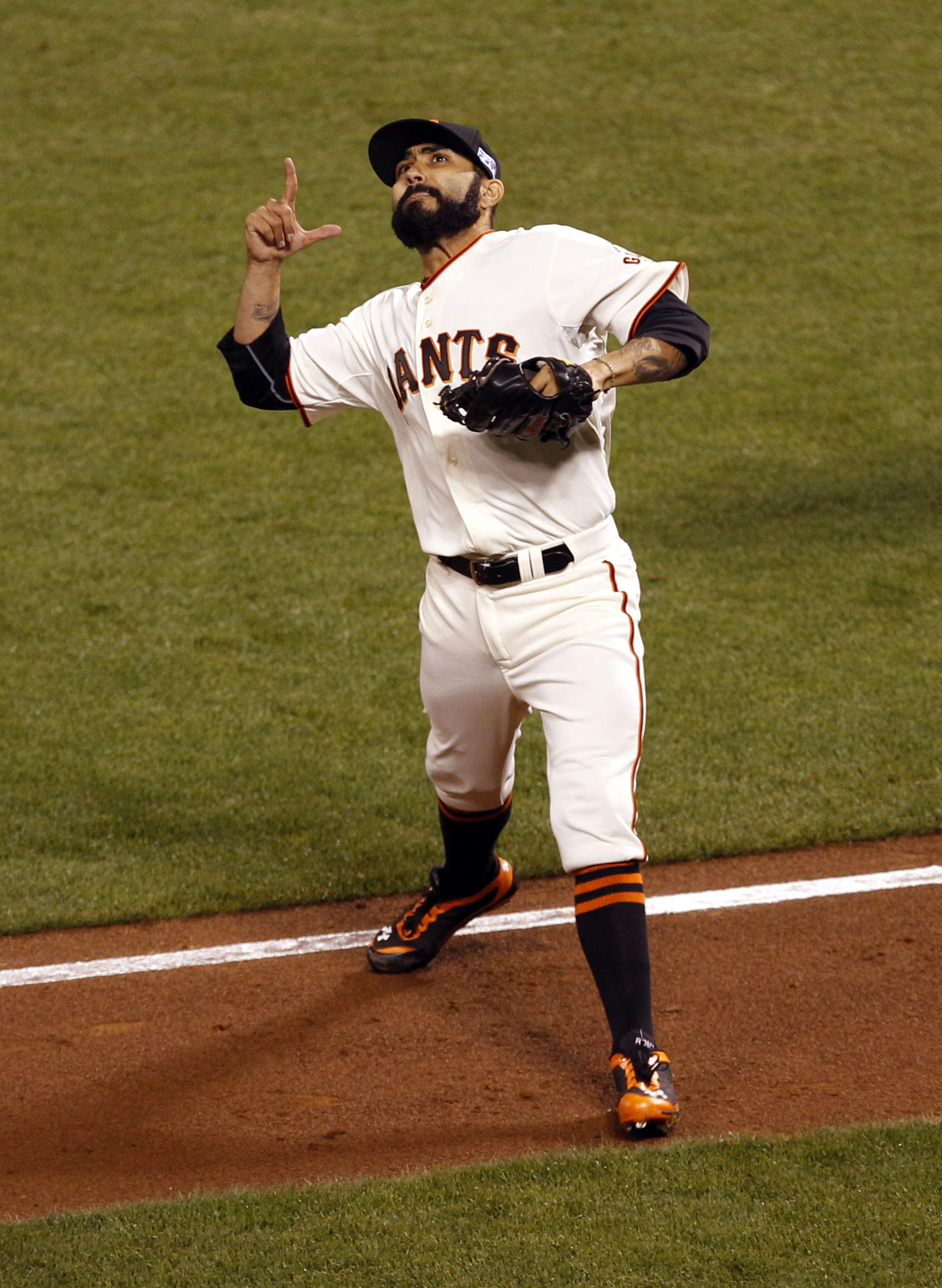
Aside from strong strikeout numbers and even stronger walk numbers, Romo’s resume shows that he is more durable than a lot of his peers. Since 2010, Romo has made no less than 64 appearances in a season. It’s not hard to imagine that continuing in 2015 and beyond since Romo doesn’t throw a tendon-tearing 100 mph fastball.
This past season obviously wasn’t Romo’s best, but there’s reason to believe that he can return to his old form. Romo’s HR/FB ratio of 13.0% in 2014 was the highest of his career and a regression towards his career average of 8.1% would go a long way towards tamping down his ERA.
Romo’s numbers haven’t been boosted by a home field advantage as his performance has pretty much been the same within the confines of AT&T Park as they have been on the road. Romo hasn’t shown much of a platoon split either. He has also been very strong through three postseason runs and has the experience of pitching in three World Series on his resume.
It should also be noted that the 31-year-old (32 by Opening Day) won’t be tied down by a qualifying offer this winter. And, while the sabermetric community may roll its eyes at the mention of saves, Romo is just one year removed from a 38-save season.
Weaknesses/Cons
Suffice to say, Romo didn’t have the kind of walk year he was hoping for. His strikeout and walk numbers were more or less there (9.2 K/9, 1.9 BB/9) but his 3.72 ERA left much to be desired and his 3.40 xFIP only granted him so much slack. Romo’s regular season efforts netted him a -0.3 WAR, the first negative posting of his career. In general, Romo’s xFIP has been about a half-run higher than his ERA would indicate, though a career mark of 3.02 is hardly a poor number.
Romo’s velocity has dipped a bit over the years, and he can’t afford to lose much more off of his 88 mph average from 2014. Among free agent right-handed relievers, Romo’s fastball had the slowest average. In fact, his heater was the fifth-slowest among all qualified relief pitchers in 2014.
Of course, losing the closer’s mantle this summer could hurt Romo’s stock and perception. He’ll likely be considered as a closing option by some clubs, but some may prefer him in a setup capacity.
Personal
Romo has two sons and greatly enjoys spending the bulk of his off time with them. He also has multiple charitable efforts in the state of California and is something of the gym rat. Romo makes his offseason home in Phoenix, Arizona.
In a lot of ways Sergio patterns his parenting style after his own dad, Frank. “If I become half the dad my dad is, I’ll be happy,” Romo told ESPN The Magazine’s Tim Keown.
As Keown detailed, Frank pushed Sergio to join the Navy out of high school but relented by giving him two years to pursue his baseball dream. It’s safe to say that was a good call. Romo turned into one of the stronger set-up men in MLB and in 2012, he got his chance to close when Brian Wilson suffered an unfortunate elbow injury and Santiago Casilla developed blisters.
“I have to admit, I wasn’t ready for what happened [in 2012],” Romo said. “I was afraid of a lot of the attention I got. I leaned on my teammates. I credit them for allowing me to be better than I think I really am. They brought the best out of me, and I didn’t have time to think about myself and my doubts. Many times I would think, ‘Man, how can they have so much faith and I’m sitting here doubting myself?’”
Market
Given his struggles in 2014, it’s hard to say whether the Giants would want to welcome back Romo, particularly if it would require a raise from his current $5.5MM salary. In early May, the Giants were hoping to lock Romo up for the long term. Now, that’s far from a given. In the spring, Romo appeared poised to stand as the top free agent closer this winter. Since then, Romo has arguably been leapfrogged by David Robertson, Andrew Miller, Luke Gregerson, and other available late-inning options.
Even if he’s not in the top-tier of eighth or ninth-inning guys, he’ll still get plenty of interest. The Yankees, if they lose Robertson, might want to fortify their bullpen with a less expensive option like Romo. Ditto for the Orioles and Andrew Miller, who Tim Dierkes sees fetching a four-year, $32MM deal. Recently, our own Steve Adams suggested the Indians as a possible fit for the veteran and teams like the White Sox, Astros, Dodgers, and Red Sox could also get in the mix. There will be tons of clubs on the lookout for bullpen arms, so agent Barry Meister figures field calls from a number of GMs.
Expected Contract
Romo is one of many notable bullpen arms available this winter and with so many options out there, he may not want to drag his feet in finding a deal. Waiting until after the New Year could mean settling for something far less lucrative than what he’s hoping for today. Still, if he’s intent on exploring the open market, he may have to wait for the dominoes to fall.
Romo will have more suitors once the runners-up for Robertson, Miller, and the like start to search out other options. Then again, maybe it won’t come to that. After topping the Royals, the afterglow of the Giants’ third World Series title in five years could help to facilitate a reunion early on in the process.
Ultimately, I see Romo signing a three-year, $21MM deal this offseason.
Photo courtesy of USA Today Sports Images.
Offseason Outlook: Baltimore Orioles
With the Orioles’ first AL East title and first ALCS appearance since 1997, it was a season to remember in Baltimore. Before following up, however, the O’s will have to take care of quite a bit of in-house business.
Guaranteed Contracts
- Adam Jones, OF: $62MM through 2018
- J.J. Hardy, SS: $40MM through 2017 (includes $2MM buyout of $14MM club option for 2018, option can vest)
- Ubaldo Jimenez, SP: $38.75MM through 2017
- Suk-min Yoon, SP: $4.15MM through 2016
- Ryan Webb, RP: $2.75MM through 2015
- Dylan Bundy, SP: $1.245MM through 2015
Arbitration Eligible Players (service time in parentheses; projections via Matt Swartz)
- Alejandro De Aza, OF (5.139): $5.9MM projected salary
- Matt Wieters, C (5.129): $7.9MM
- Steve Pearce, 1B/OF (5.116): $2.2MM
- Bud Norris, SP (5.068): $8.7MM
- Tommy Hunter, RP (5.066): $4.4MM
- Chris Davis, 1B (5.061): $11.8MM
- Brian Matusz, RP (4.156): $2.7MM
- Chris Tillman, SP (3.113): $5.4MM
- Miguel Gonzalez, SP (3.107): $3.7MM
- Ryan Flaherty, IF (3.000): $1MM
- Zach Britton, RP (2.158): $3.2MM
- Non-tender candidate: De Aza
Contract Options
- Nick Markakis, OF: $17.5MM mutual option with a $2MM buyout
- Nick Hundley, C: $5MM club option, no buyout
- Wei-Yin Chen, SP: $4.75MM club option with a $372K buyout
- Darren O’Day, RP: $4.25MM club option with a $400K buyout
Free Agents
The Orioles answered one of their biggest offseason questions before the ALCS even began, as the club inked J.J. Hardy to a three-year, $40MM extension. In keeping Hardy in the fold, the Orioles not only ensure their own stability at shortstop, but they also keep a very sought-after player away from potential rivals; the Yankees, for one, were rumored to be interested in Hardy’s services.
With over two-thirds of the roster due for arbitration raises or facing contract options, it’s no surprise that Orioles plan to increase their payroll for 2015. What remains to be seen is if that spending increase leaves room for new players, or simply reflects the fact that key contributors like Chris Tillman, Miguel Gonzalez and Zach Britton are no longer making minimum salaries.
I’d guess that Tillman will be approached about contract extensions this winter, as Dan Duquette will look to achieve some cost-certainty in future years by locking up a pitcher who looks like a key part of Baltimore’s future. The O’s had a similarly large arbitration class last winter, and they responded by trading the biggest projected contract (Jim Johnson) to free up payroll space and discussing extensions with the two players (Chris Davis, Matt Wieters) who projected as long-term pieces. In hindsight, the team benefited by not finalizing those extensions given how Wieters missed most of the season with injury and Davis took a big step back after his mammoth 2013 campaign. I’d expect one-year deals for both players in their third and final arb-eligible seasons, putting Wieters and Davis on pace for free agency in the 2015-16 offseason.
Now that Evan Meek has been outrighted off the Orioles’ 40-man roster, that leaves Baltimore with 11 players arbitration-eligible players this offseason. The only possible non-tender candidate could be Alejandro De Aza, and even he may be retained given the unsettled nature of Baltimore’s 2015 outfield. Matt Swartz projects the O’s will spend $56.9MM on these 11 players; add that to the roughly $43MM owed to six players on multiyear contracts and the $9MM total required for Wei-Yin Chen and Darren O’Day‘s options and the Orioles are now in the $109MM range for 19 players. That’s already more than the $107.46MM the club spent on payroll in 2014, according to Cot’s Baseball Contracts.
The Orioles have already addressed their four outstanding club options. Chen and O’Day, as expected, saw their options exercised while Nick Hundley‘s $5MM option was declined (Caleb Joseph is the cheaper backup catcher option for Wieters next season). The O’s also declined their half of Nick Markakis‘ $17.5MM option, and as MLBTR’s Steve Adams recently noted in his Markakis’ Free Agent Profile, declining the option makes it unlikely that the team will extend Markakis a qualifying offer.
In short, the long-time Oriole will be one of the most sought-after outfield bats on the free agent market. If Markakis indeed doesn’t have a qualifying offer tied to him, Adams projects him to receive a four-year, $48MM deal. By contrast, the O’s will make a qualifying offer to Nelson Cruz, which should diminish the slugger’s market a bit, though not to the same level as last winter, when Baltimore was able to sign Cruz to a one-year, $8MM deal that turned into a major bargain. It wouldn’t be a surprise if Cruz finds at least double that amount on his next contract, netting him in the $16MM average annual value range.
Baltimore seems to have made some solid progress in talks with Markakis and at least touched base with Cruz earlier this season, so the club is fully exploring the possibility of re-signing both players. If they feel they have a legitimate shot at bringing both back next year, another payroll-cutting move (such as non-tendering De Aza) would likely be forthcoming.
If both outfielders sign elsewhere, then the O’s have at least one ready corner outfield replacement ready in Steve Pearce. His big 2014 breakout ensures he’ll find an everyday role somewhere on the diamond and he has experience in both LF and RF. Delmon Young is also hitting free agency and could be brought back at a modest price; he could form a righty-lefty platoon with De Aza or David Lough in left field. Lough and De Aza would also expect to see playing time in the outfield even if Cruz or Markakis returns, as either veteran (Cruz especially) would see time at the DH spot.
Pearce’s positional flexibility and the lack of a full-time DH gives the Orioles some options if Cruz and Markakis indeed leave. This is just my speculation, but Adam LaRoche or Michael Cuddyer would be fits as solid veteran bats who can likely be had on short-term contracts. Both players would fill everyday roles, which would allow Buck Showalter to employ more platoon depth elsewhere should Pearce come back down to earth. If the Orioles wanted to go the full-time DH route, they could try to sign Victor Martinez, though his desired four-year contract might be lengthier than the O’s are willing to commit to a 35-year-old.
Around the infield, the O’s seem set with Manny Machado at 3B, Hardy at SS, Jonathan Schoop at 2B and Davis at 1B, though Hardy is the only one who doesn’t have some uncertainty hanging over him headed into next year. Machado has shown he’s one of the game’s top young stars when healthy, though he has undergone two significant knee surgeries in as many years. Schoop flashed some nice defense in his first full big league season, though he’ll be expected to show more at the plate than last year’s .598 OPS in 481 plate appearances.
As for Davis, he went from a 53-homer performance in 2013 to a below-average 94 wRC+ in 2014 and also missed the end of the season after being suspended 25 games for Adderall usage. Davis might be Baltimore’s biggest x-factor for 2015; if he returns to form, the slugger would more than make up for the possible loss of Cruz or Markakis. Then again, for the Orioles to re-sign those two, Davis could become a trade chip in order to free up payroll space. They’d be selling low on Davis, though the first baseman’s 2013 campaign is still fresh enough in everyone’s mind that he’ll draw interest.
The Orioles boasted one of the league’s top bullpens last season, and most of the principals are set to return with Britton closing and O’Day and Tommy Hunter as setup men. The team paid a heavy price (left-handed prospect Eduardo Rodriguez) to obtain Andrew Miller from the Red Sox at the All-Star break, and while Miller pitched very well down the stretch, the high price he’ll command in free agency will likely bring his stint in Baltimore to an end. It wouldn’t be a surprise to see the O’s pursue a veteran reliever for depth purposes.
Starting pitching could be the biggest area of surplus for Baltimore since the club has six rotation options (Tillman, Gonzalez, Chen, Bud Norris, Ubaldo Jimenez and Kevin Gausman), top prospect Dylan Bundy on his way back from Tommy John surgery and prospects Mike Wright and Tim Berry knocking on the Major League door for depth purposes. Tillman is the nominal ace, Jimenez is probably unmovable due to his big contract and poor performance last year, and Gausman and Bundy are untouchable as the future of the staff.
This leaves Gonzalez, Chen and Norris as possible trade chips — all solid, unspectacular pitchers with team control (Chen and Norris one year, Gonzalez three years) remaining. Norris is the most expensive, projected to earn $8.7MM in his final arbitration-eligible year. While that’s a reasonable salary for an innings-eater, it might also make him the most expendable for a team that’s looking to free up payroll space.
To speculate about a few possible trade partners looking for pitching, the Rockies and Pirates have a number of young outfielders to offer if the O’s were looking for external solutions to replace Cruz or Markakis. If a bigger-name solution was explored, the Braves could have Justin Upton and Jason Heyward on the market this offseason, though both players are only contracted through 2015 and Atlanta would require more in return than just one of the Gonzalez/Chen/Norris trio. Such teams as the Cubs, Twins, Diamondbacks, Mariners, Rangers and Angels are among the teams who could also be looking to trade for pitching this winter.
It seems contradictory to predict a surprise, yet given Duquette’s track record in Baltimore, expect him to make one under-the-radar acquisition (a la Chen, Gonzalez, Pearce, Young, Jason Hammel or Nate McLouth) that ends up paying big dividends for the Orioles. Making the most of unheralded acquisitions and raising the roster’s talent floor have been big reasons why the O’s are 274-212 with a pair of playoff appearances during Duquette’s regime. Much of the Orioles’ offseason will be shaped by what Cruz and Markakis do, but the club is still in position to contend in 2015.
MLBTR Originals
A look back at the original reporting and analysis found on MLBTR the past seven days as the San Francisco Giants celebrated their third World Championship in the last five years:
- Tim Dierkes unveiled the ninth annual MLBTR Top 50 Free Agents list and he included his predictions as to where each player will land.
- Where do you think these top 50 free agents will sign? Match your insight against the MLBTR staff and fellow MLBTR readers by entering the fourth annual MLBTR Free Agent Prediction Contest. You must have a Facebook account to register and the deadline to save your final picks is this Friday (November 7) at 11:59 PM (CT).
- MLB Trade Rumors Podcast featured host Jeff Todd recapping the week’s notable transactions and guests reliever Burke Badenhop discussing his upcoming free agency and Charlie Wilmoth of MLBTR and Bucs Dugout previewing the Pirates’ offseason. A new edition of MLB Trade Rumors Podcast will drop every Thursday and can be accessed on iTunes, SoundCloud, and Stitcher.
- Tim was the first to report the Brewers exercised Yovani Gallardo‘s $13MM club option and the White Sox declined the $4MM option on Felipe Paulino.
- There were six installments of MLBTR’s Free Agent Profile series this week.
- Prior to agreeing to a two-year, $18MM deal to remain with the Red Sox, Steve Adams predicted Koji Uehara would sign a one year, $11MM contract.
- On the subject of right-handed relievers, Steve feels the market for Pat Neshek is two years and $10MM.
- Zach Links estimates a two-year pact for Edinson Volquez worth $18MM.
- Jeff expects Jake Peavy will garner $28MM over two years and paydays of three years and $30MM for both Jason Hammel and Jed Lowrie.
- The Offseason Outlook series continued with the forecast for the Tigers (by Zach) and A’s (by Steve).
- Zach learned left-hander Brad Mills decided to sign a minor league deal with the A’s, after drawing interest from a number of clubs, because he felt Oakland presented the best opportunity to make a MLB roster.
- Jeff asked MLBTR readers which team will spend the most in free agency. You believe the Cubs (30%), Red Sox (22%), and the Yankees (16%) will be the market’s most active.
- Steve hosted the weekly live chat.
- Mark Polishuk gathered the best the baseball corner of the web had to offer in Baseball Blogs Weigh In.