
MLBTR Originals
A look back at the original reporting and analysis found on MLBTR this past week:
- MLB Trade Rumors Podcast featured host Jeff Todd reviewing the week’s transactions and discussing with Steve Adams how the early free agent signings will affect the market going forward. A new edition of MLB Trade Rumors Podcast will drop every Thursday and can be accessed on iTunes, SoundCloud, and Stitcher.
- Tim was the first to report Pablo Sandoval had a second meeting with the Red Sox.
- Tim expects the bidding for Sandoval to top out at a six years and $114MM. Sandoval is number five on MLBTR’s 2014-15 Top 50 Free Agents list.
- Braves President John Hart told Mark Polishuk the trade of Jason Heyward was due in part to an impasse in negotiations over a contract extension. “He wanted a two-year deal and wasn’t interested in a long-term extension unless the dollars were maybe beyond where the club certainly wanted to go,” said Hart. “We had a strong feeling he was going to go on the market. That’s what he wanted to do. We wanted to protect ourselves and position ourselves better.“
- After the A’s signed Billy Butler to a three-year, $30MM pact, Royals GM Dayton Moore explained to Zach Links his rationale for not exercising the club’s $12.5MM option on Butler and then working out a trade. “That’s something talked about but the timing of it really didn’t allow us to do that,“ Moore said. “There was nobody really willing to do that at the time. We just finished playing [in the World Series] and three days later we had to make a decision. If we would have found a viable trade partner, it’s something we would have done, or looked at. I don’t know if we would have done it because I’m not sure what the package would have been, but it’s something we certainly looked at.“
- Max Scherzer, MLBTR’s top ranked free agent, will receive $185MM over seven years, according to Tim.
- Steve Adams pegs Jon Lester (#2) for a six-year, $153MM contract and was right on the money with his Billy Butler (#41) prediction of a three-year deal worth $30MM.
- Charlie Wilmoth profiled Cubs left-hander Travis Wood as a non-tender candidate.
- A Major League source told MLBTR the Rangers will likely sell Jim Adduci‘s rights to a Korean or Japanese club.
- Tim was the first to learn Mitch Moreland left BBI Sports Group to join Bob Garber at RMG Baseball.
- Tim broke the news of the Angels adding right-hander Danny Reynolds to their 40-man roster and the Diamondbacks signing infielder/outfielder Jamie Romak to a minor league contract with an invitation to Spring Training.
- MLBTR learned the Tigers inked left-hander Omar Duran to a minor league deal, which includes a Spring Training invite.
- Zach was first with Bret Saberhagen‘s desire to return to MLB as a pitching or bullpen coach.
- Steve hosted the MLBTR live chat this week.
- Zach put together the best of the baseball blogosphere in Baseball Blogs Weigh In.
Free Agent Profile: Jon Lester
Ten months ago, the common belief was that Jon Lester would sign an extension that would keep him in a Red Sox jersey into his late 30s. A lot can change in a few months, however, and Lester soon found himself donning the green and gold of the Oakland A’s following a midseason trade from a surprisingly poor Boston club. Though many Red Sox fans wouldn’t have believed it would come to this, the lefty is now fair game on the open market.
Strengths/Pros
To put things in the simplest of forms, Lester is a true ace at this point in his career. He misses bats, has strong control and piles up innings. Among free agent starters, Lester’s 2.46 ERA last year leads the pack by a long shot, as does his 2.80 FIP. He was worth 6.1 wins above replacement, per Fangraphs’ version of the metric (which is based on FIP), and he was worth 5.8 wins when looking at RA9-WAR, which is based on actual runs allowed. Both metrics were tops among free agent starters. He struck out 220 hitters and walked just 48 in 219 2/3 innings this season (9.0 K/9, 2.0 BB/9).
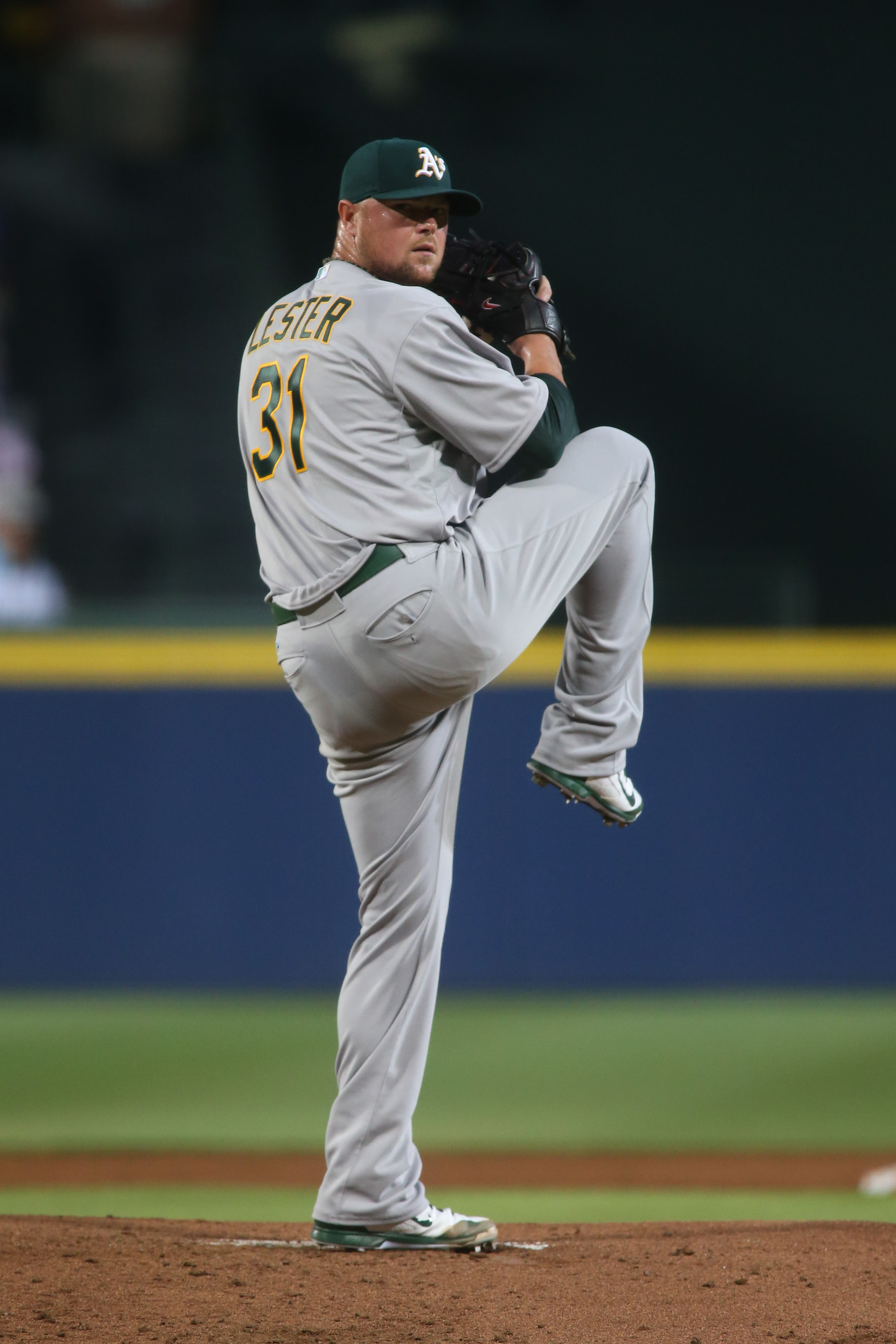 The 2014 campaign marked the sixth time in seven seasons that Lester has topped the 200-inning threshold, and he totaled a strong 191 2/3 in the lone season he fell short (2011). His 219 2/3 innings trails only Max Scherzer (220 1/3) and James Shields (227) among fellow free agents. Dating back to 2008, his age-24 season, Lester has averaged 207 innings per season. He’s hit the DL just once in that time, spending a mere 19 days on the shelf with a strained lat in his left shoulder. That minor injury is all that prevented him from seven straight 200-inning seasons.
Lester was a strikeout machine early in his career, but his K/9 numbers dipped in recent seasons, settling in the mid-7.00s before his resurgent 9.0 K/9 in 2014. Lester pounded the strike zone early this season, registering a 61.4 percent first-pitch strike rate — the highest mark of his career. Perhaps being ahead in the count more often than ever improved the effectiveness of his curveball, or perhaps it was the fact that he threw it slower than ever before (75.1 mph average), but Lester’s 18.2 percent whiff rate on his curve was easily the strongest of his career, resulting in the restored strikeout rate.
Most of Lester’s career has come in a large market in the game’s most hitter-friendly division, and he’s thrived in that setting, for the most part. Teams will appreciate that component of his game, and his postseason experience won’t hurt either. Lester has a 2.57 career ERA in 84 postseason innings. He’s a two-time World Series champion that has been on five playoff rosters.
Lester’s main competition this year will be Scherzer, with Shields representing the third-best arm on the market. However, unlike his peers atop this year’s free agent class, Lester does not have a qualifying offer attached to him; he was ineligible to receive one after being traded midseason and can therefore be signed without the forfeiture of a draft pick.
Weaknesses/Cons
Lester was flat out elite this season, much like he was in his first full three seasons, but from 2011-13, he looked more like a good starter than a truly great one. In that time, Lester posted a 4.03 ERA, 3.84 FIP, 7.7 K/9 and 3.1 BB/9 — useful numbers to be sure, but not the type of stats one associates with a pitcher in search of a six- or seven-year contract.
Though he averaged better than 93 mph on his fastball earlier in his career, Lester’s velocity settled into the mid-92 range from 2011-13 and dipped even further in 2014, averaging 91.8 mph. Of course, that’s still plenty of life, especially considering the fact that he’s left-handed.
Lester turns 31 in January, meaning that a six-year deal would run through his age-36 season and a seven-year pact would run through his age-37 campaign. Clearly, that’s a risky commitment, though such is the case with all top-of-the-market free agents. He’s younger than Shields, but Scherzer pitches most of next season at age 30, so his main competitor has age on his side.
Personal
Lester’s battle with cancer early on in his career was well-documented, and in addition to the great comeback story that culminated in him winning the clinching game of the 2007 World Series, that battle has shaped the work he’s done in the community. Lester partnered with Charity Wines to release his own line of red wine, the proceeds of which benefit the Fred Hutchinson Cancer Research Center. His NVRQT charity sends all of its proceeds to the Pediatric Cancer Research Foundation, and Lester explained how the charity came about and what it means to him in a guest column for the Boston Globe in 2013.
This past July, Peter Abraham of the Boston Globe wrote about the strides Lester has made in terms of maturity both on the mound and with the media after being a bit hot-tempered earlier in his career. (Abraham references glaring at umpires after questionable calls and the infamous chicken-and-beer incident as examples.)
Lester is married and has two sons. The Tacoma, Washington native now resides near Atlanta in the offseason.
Market
Lester is one of the arms referred to as the “Big Three” of this offseason, along with Scherzer and Shields. However, while MLBTR’s Tim Dierkes noted that a third or more of the teams in the league could have viable interest in Shields, the younger Lester figures to come with a higher price tag that may take him out of the picture for a number of clubs.
Lester stated multiple times that he’d like to return to Boston, and last winter he told reporters that he planned to be with the Red Sox until someone “ripped the jersey off his back.” However, the Red Sox made an initial offer of $70MM over four years, at that point, and while the reported $110-120MM offer they made today might have worked in March, it feels too light to make them a serious contender right now.
The other popular landing spot for Lester is the Cubs, where former Red Sox GM Theo Epstein is now president of baseball operations. Epstein and GM Jed Hoyer were members of the Boston front office when Lester emerged as a front-line starter, and the team is rich on young hitters without much in the way of high-upside pitching (Jake Arrieta is a notable exception).
Other teams that figure to enter the mix are the typical names we see assorted with high-end free agents. Though the Yankees maintain that they won’t pursue Lester, Scherzer or Shields, it’s possible they’ll change their tune if they’re unable to re-sign Brandon McCarthy and Chase Headley. The Dodgers have the cash to pull off a deal, though they’re said to be looking to tone down spending this winter. I still won’t rule them out as a possibility. The Tigers and Angels have high payrolls but cloudy long-term outlooks thanks to existing salary on the books. Neither seems a fit barring trades to create some long-term flexibility.
The rest of Lester’s market will have to consist of dark horses, and agents Seth and Sam Levinson of ACES will likely need to pitch to owners of some unlikely teams that Lester could be a franchise-altering decision. To this point, the Royals have shown some preliminary interest, and Lester is set to meet with the Braves on Thursday. The Cardinals have also been linked to Lester.
Beyond that, a team like the Astros has the long-term payroll freedom to make a move, as do the Marlins, who could feel that adding Lester would be a significant step toward building a perennial contender now that they’ve extended Giancarlo Stanton. The Nationals have plenty of money and are set to lose both Jordan Zimmermann and Doug Fister next winter. Trading one and swapping him out for Lester could is a long shot but not unthinkable. The Giants haven’t spent at this level on the free agent market since their ill-fated Barry Zito deal, but they have rotation needs and are flush with cash following the World Series. The Rangers deserve a mention as a team with a willingness to spend and a need for starters, but GM Jon Daniels has indicated they may not be big spenders on the open market. Could a reunion with his hometown Mariners be in the cards? Seattle’s primary need is offense, but if they again have trouble luring hitters to Safeco Field, GM Jack Zduriencik could double down on an existing strength and look to build an even more imposing rotation.
Expected Contract
As is often the case with big name free agents, it’s easy to look at Lester right now and think that outside of the traditional big spenders, there’s not much of a market for him if he’s seeking six or seven years at an annual value north of $20MM. With players of this caliber, the market isn’t always quick to reveal itself, but it does eventually materialize, and we typically see the top names get paid.
Lester has said free agency isn’t all about the money, but I’d be surprised if his agents hadn’t at least kicked around the goal of trying to break CC Sabathia‘s $161MM guarantee, which is still the record for a free agent pitcher. (The Yankees did spend $175MM on Masahiro Tanaka, but $20MM of that sum went to Tanaka’s former team in Japan.)
Were Lester coming off a pair of dominant seasons, as Scherzer is, I think there would be a better case for that figure. As it is, however, he showed a significant gap between his two most recent dominant seasons. Also of note is that Sabathia, like fellow high-priced hurlers Zack Greinke and Cole Hamels, signed his contract at a significantly younger age than Lester. While we have to account for some inflation, as those deals are now older (and Hamels’, of course, was not an open-market deal), Lester may have a hard time getting the seventh guaranteed season. Looking at the majority of the significant pitching contracts signed in recent history, guarantees typically stop in the age-36 season, if not sooner. If that’s the case, Lester would need to achieve a $27MM annual salary to top Sabathia on a six-year deal, which seems a touch steep.
In the end, I do think Lester can top the marks set by Hamels and Greinke. Lester was the best performer among free agent pitchers in 2014, so I can’t completely rule out him getting a seventh year and/or passing Sabathia’s mark. However, his age and the lack of a consistently dominant track record has me pegging him for a six-year, $153MM contract.
Photo courtesy of USA Today Sports Images.
Non-Tender Candidate: Travis Wood
In 2013, Travis Wood was a bright spot on a miserable Cubs team, posting a 3.11 ERA over 200 innings. That led to a $3.9MM payout in his first year of arbitration eligibility in 2014. A year later, he’s coming off a 5.03 ERA season, and he could be a non-tender candidate. So what changed?
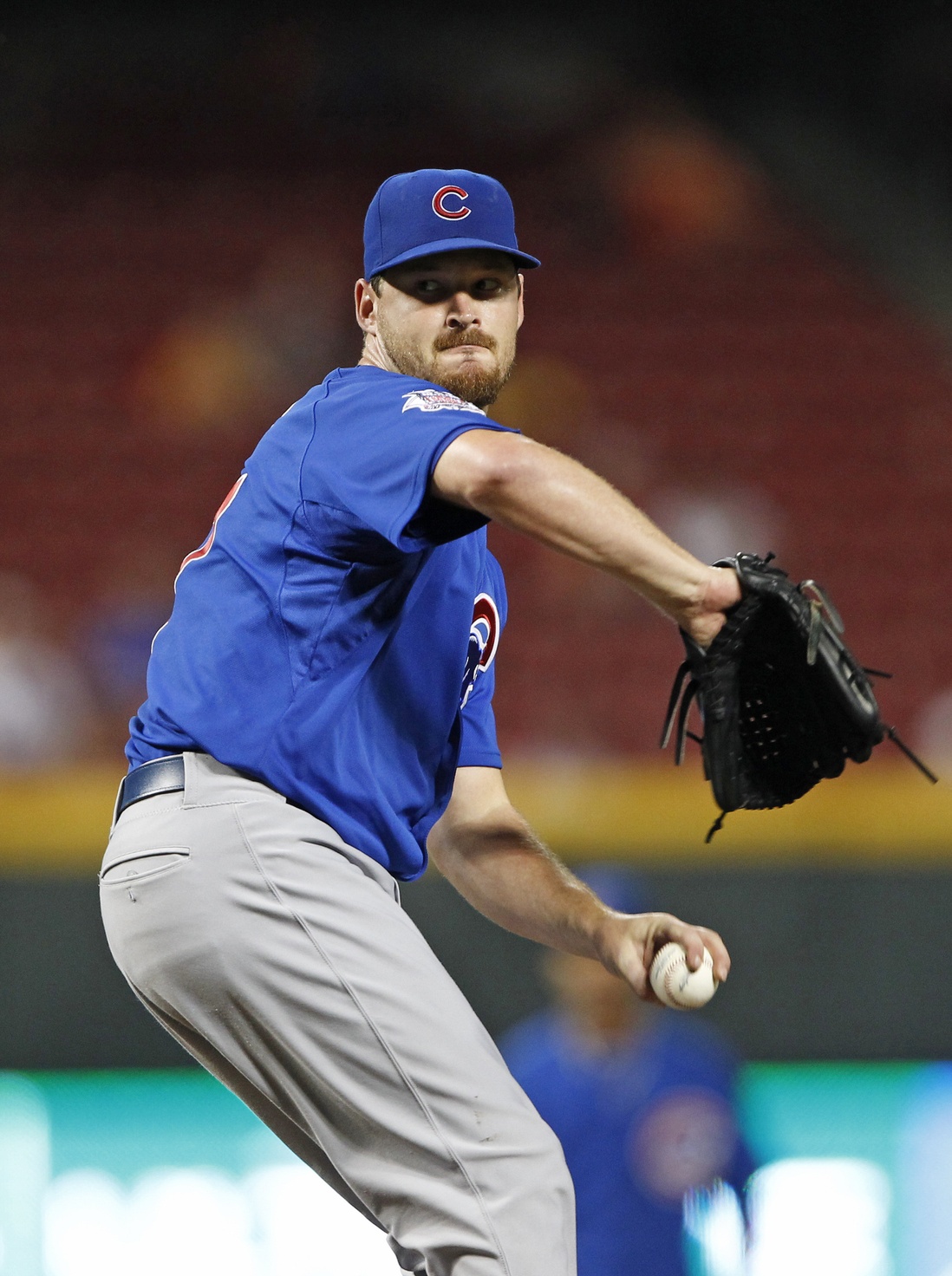 Actually, not much. Or, at least, not much Wood could have controlled. In 2013, Wood’s xFIP was 4.50. In 2014, it was 4.51. By far the most important cause of his two-run jump in ERA was a 72-point increase in his batting average on balls in play, from .248 to .320. Wood walked batters at a significantly higher rate (4.0 BB/9 vs. 3.0) in 2014, but he struck out more of them, too, and slightly increased his ground ball percentage, although he remained a fly ball pitcher. His command was worse, but not so much so that it represented a fundamental change. Perhaps the biggest difference between the two seasons was Wood’s cut fastball, which was lost a mile an hour in velocity and was far less effective in 2014. In general, though, the best way to explain the difference between the two seasons is that Wood wasn’t nearly as good as his 2013 ERA, nor as bad as his ERA last year.
Wood’s team has changed as well. Even if Wood hadn’t had a strong-looking 2013 season, he would have had utility on the 2014 Cubs, which looked poised to unload veteran starters like Jeff Samardzija, Jason Hammel and (if he had pitched well) Edwin Jackson. Having an innings eater like Wood makes sense when facing that kind of upheaval, and if Wood had somehow repeated his 2013 performance, he would have had trade value himself.
2015 is different. Jake Arrieta emerged during the 2014 season as a top young starter, and Kyle Hendricks and Tsuyoshi Wada had unexpectedly strong seasons as well. The Cubs are likely to continue to give chances to Jacob Turner, and Jackson is also still under contract. There’s also Eric Jokisch, Felix Doubront and Dan Straily as potential rotation candidates. And then, of course, the Cubs are expected to be major players for free agent pitching and could perhaps add two hurlers this offseason. Despite the wide variance in Wood’s ERAs, he’s essentially a back-end lefty who can soak up innings. That makes him useful, but perhaps not for the 2015 Cubs, who will have plenty of options who are either better or who have more upside.
Then, of course, there’s Wood’s salary. The Frontline client’s strong 2013 numbers set a relatively high baseline for his salaries during his arbitration years, and he’s projected to make $5.5MM in 2015. Many teams would likely see $5.5MM as more than Wood is worth, so it’s doubtful he has much trade value. Teams like the Braves, Diamondbacks, Phillies, Rangers, Twins or White Sox could have interest in Wood, but perhaps not so much that they’re willing to give up $5.5MM and trade talent to get him, particularly not so early in the offseason.
One factor working against Wood is that the free agent market for pitching is rather strong, particularly in comparison with the rest of the market. The non-tender deadline is December 2, and plenty of higher-upside arms will surely remain on the free agent market then. The most likely outcome, therefore, might be that the Cubs non-tender Wood, and he signs elsewhere later in the offseason.
Photo courtesy of USA Today Sports Images.
MLBTR Originals
A look back at the original reporting and analysis found on MLBTR the last seven days:
- MLB Trade Rumors Podcast featured host Jeff Todd recapping the week’s news, evaluating the international middle-infield market, and discussing the Blue Jays with Sportsnet’s Shi Davidi. A new edition of MLB Trade Rumors Podcast will drop every Thursday and can be accessed on iTunes, SoundCloud, and Stitcher.
- Jeff covered the GM Meetings in Phoenix for MLBTR and posted interviews with Nationals GM Mike Rizzo and Marlins President of Baseball Operations Michael Hill and GM Dan Jennings.
- Tim Dierkes was the first to report there are three “very unlikely” teams still in the mix for Yasmany Tomas.
- Tim broke the news of Victor Martinez declining the Tigers’ qualifying offer.
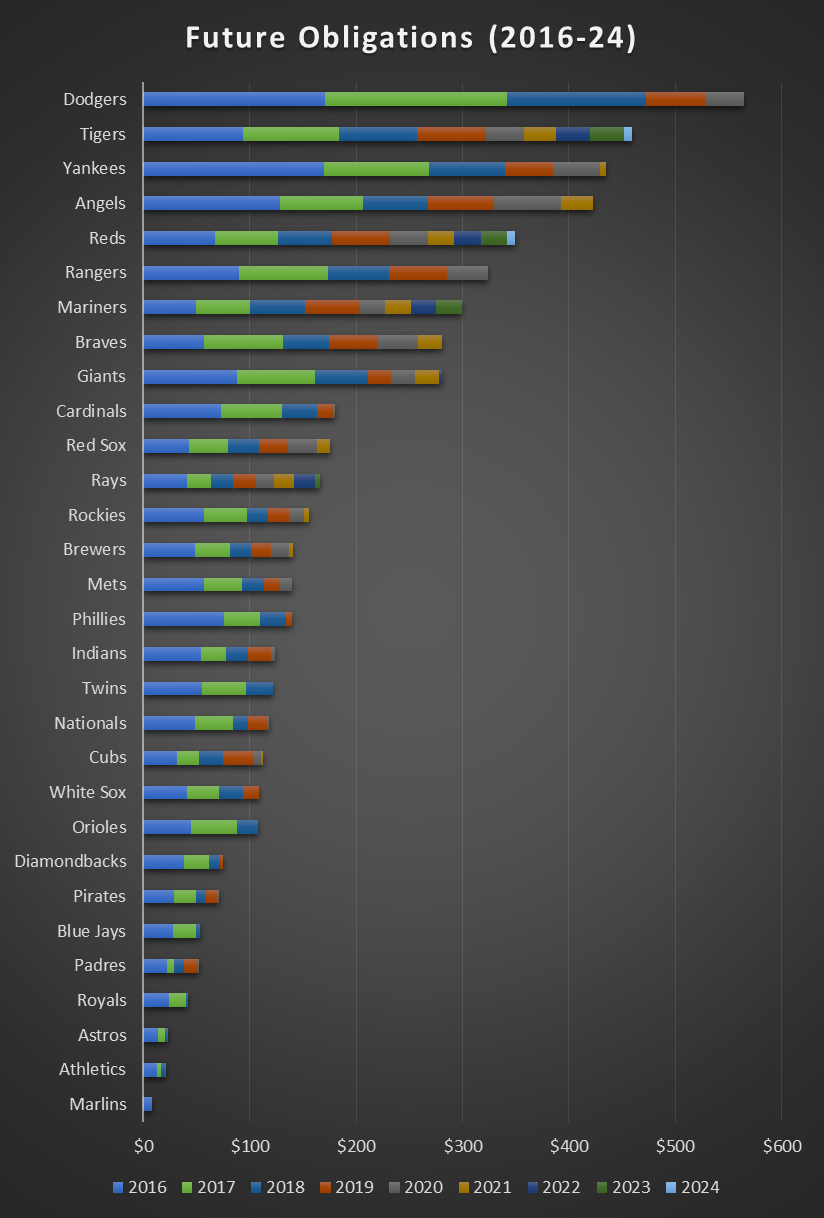
- Jeff charted the current and future salary obligations (2016-2024) for all 30 MLB teams.
- Steve Adams issued a Free Agent Profile of Russell Martin (five years, $72.5MM).
- Tim listed his non-tender candidates.
- Charlie Wilmoth profiled two of those non-tender possibilities: the Pirates’ Ike Davis and Gaby Sanchez.
- Zach Links summarized the Offseason Outlook for the Dodgers.
- MLBTR was the first to learn right-handers Esmerling Vasquez and Miguel Mejia signed with the Seibu Lions of Nippon Professional Baseball.
- MLBTR also learned the NPB’s Hokkaido Nippon Ham Fighters will decline their half of the mutual option on right-hander Anthony Carter.
- Tim hosted this week’s chat.
- Zach compiled the latest edition of Baseball Blogs Weigh In.
Non-Tender Candidates: Ike Davis & Gaby Sanchez
Teams have until December 2 at 11:59pm ET to decide which of their arbitration-eligible players they’ll tender contracts. By MLBTR’s reckoning, about 40 of those players are non-tender candidates, including two first basemen, Ike Davis and Gaby Sanchez, who platooned at the position for the Pirates in 2014.
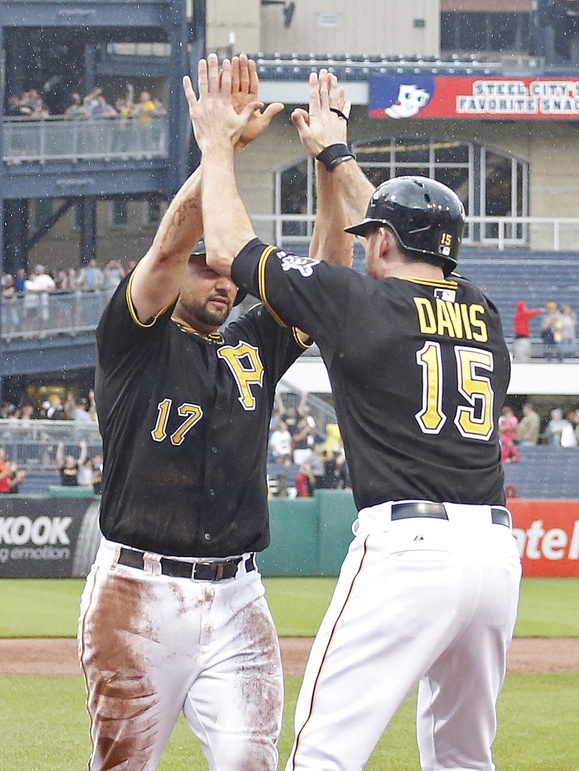 Davis is projected to make $4.4MM in 2015 after earning $3.5MM last season. Sanchez, meanwhile, is projected to make $2.7MM, a raise from $2.3MM. Those costs wouldn’t be exorbitant for any team, even the low-payroll Pirates, but after another somewhat disappointing season from Davis and an off year for Sanchez, it’s worth asking whether the Pirates’ money might best be spent elsewhere.
Perhaps just as important for Davis is the fact that Pedro Alvarez now appears to be a first baseman. The former No. 2 overall pick struggled with throws from third base in 2014, while utilityman Josh Harrison had an unexpectedly outstanding season and staked a claim on a starting job, which will likely end up being at third. GM Neal Huntington has said that Alvarez will likely get the bulk of the playing time at first base, and he called keeping Davis “probably a challenge.” Alvarez and Davis both bat left-handed, so they can’t share a position. Davis has been working out in the outfield this offseason, but there’s probably no space on the Pirates’ roster there, either, since the Pirates already have a top young lefty outfielder in Gregory Polanco and another reasonably strong one in Travis Snider.
It’s still possible that the Pirates could trade Davis, who could theoretically have a bit of value for a team in need of a lefty first base option. But Davis will be more expensive through arbitration than he was in 2014, when he had a .233/.343/.378 season that qualified as a modest disappointment. The trade that brought Davis to Pittsburgh early in the 2014 season didn’t cost the Pirates much (a minor league reliever in Zack Thornton and a young pitching prospect in Blake Taylor), and it’s unlikely the Bucs could get more than that if they traded Davis now. It’s also obvious that, unless they trade Alvarez, the Pirates don’t have space for Davis on their roster. So there’s little incentive for interested teams to do anything but wait until the deadline for the Pirates to cut him loose.
Sanchez is right-handed and has had a reputation as a strong hitter against lefties, so Alvarez’s move to first base doesn’t impact Sanchez the way it impacts Davis. Given Sanchez’s declining performance, however, the Pirates could decide to allocate resources elsewhere. Sanchez hit .229/.293/.385 last season. He was better against lefties, at .256/.318/.429, but perhaps not so well as to justify the expense and the roster spot, especially given that the NL Central is thin on left-handed pitching. Sanchez is a career .291/.382/.481 hitter against southpaws, but at 31, his 2014 performance might be closer to his expected level going forward.
Like Davis, Sanchez has little or no trade value. So the Pirates’ best option might be to non-tender him and save money to spend elsewhere. The Bucs could then look for a cheaper Triple-A slugger to platoon with Alvarez (who, like Davis, can certainly use a good platoon partner). They could also employ some more creative arrangement like having Tony Sanchez, who dabbled as a first baseman late last season at Triple-A Indianapolis, break camp as a righty first base option and third catcher. They could also attempt to bring Gaby Sanchez back for less than $2.7MM.
Davis, who is represented by Octagon, should still be able to land a big-league deal somewhere — his 10 homers last season weren’t anything to write home about, but .343 on-base percentages don’t grow on trees, and Davis is still just 27 (28 in March). The Marlins already have a lefty first baseman in Garrett Jones, but they reportedly like Davis and could have interest if he becomes a free agent. The Padres could also be a possibility, although it’s questionable whether they’ll see Davis as an upgrade over incumbent lefty first baseman Yonder Alonso.
Sanchez, who is represented by Beverly Hills Sports Council, would be a good fit (on a cheap Major League deal or minor league deal with an out clause) for a team looking for a partner for their lefty first baseman. St. Louis, where Matt Adams has a career .197/.227/.326 line against lefties, could be one possibility. A reunion with the Marlins, and with either Davis or Jones (who platooned with Sanchez in Pittsburgh in 2013) could make sense also.
Photo courtesy of USA Today Sports Images.
Future Payroll Obligations By Team
We have previously set out the 2015 payroll starting points for every club. Now, we’ll turn to future obligations. Obviously, teams that intend to add long-term contracts will need to keep a close eye on these figures.
I took a look at this same information last year at roughly the same time (see here and here). As I explained then, discounting future obligations is unquestionably necessary for a true picture, but is also a practical impossibility (for this exercise) given its complexity and broad range of variables. The basic premise is simple, of course: the further away an obligation, the more the discount rate compounds, and the less that obligation is valued in terms of present dollars. (That assumes, of course, that we will continue to experience an inflationary environment; otherwise, the opposite would be true.)
The future obligations chart and table that follow (all figures in $MMs) were compiled using the Cot’s Contracts database. That information reflects prorated signing bonuses, as is done for luxury tax calculations, so in that respect it may overstate (by a small amount) the actual budgeting situation for some teams. (Note also that the Tigers’ reported signing of Victor Martinez is not included; if that deal is consummated, it would add $17MM per season to Detroit’s tab over 2016-18.)
And in table form:
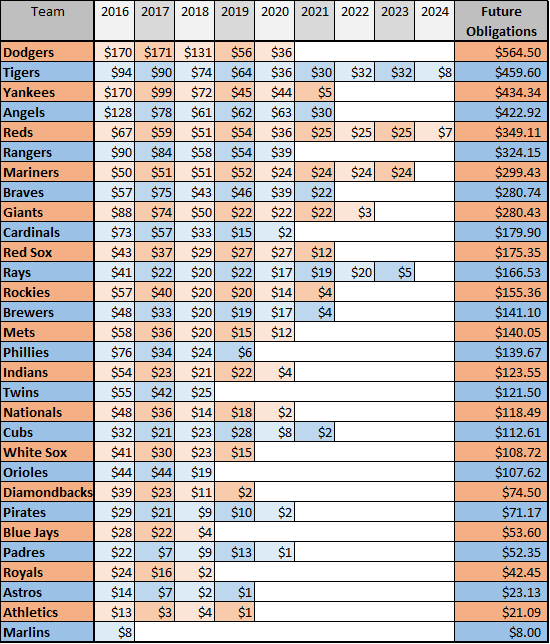
So, how have things changed since we last checked in about a year ago? Obviously there have been some significant commitments added and subtracted, and existing contracts are one year closer to completion.
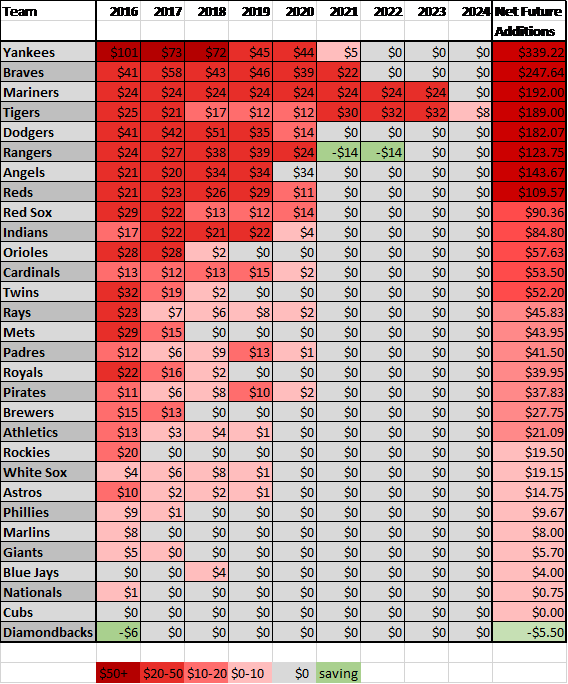
The following table shows how each team’s future balance sheet has changed on a year-by-year basis since last year (re-ordered highest to lowest):
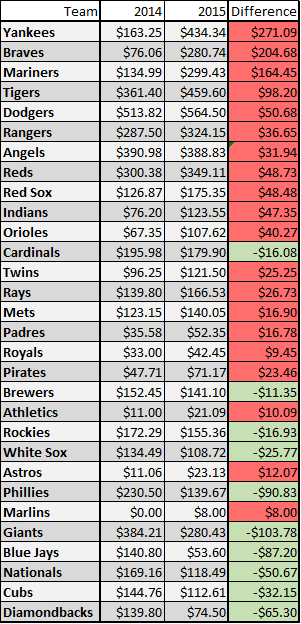
And finally, this table documents how each team’s total forward-looking commitments have changed from our last snapshot in November of 2013 (looking at 2015 and beyond) to the one taken this morning (looking at 2016 and beyond). In other words, the number you see in the column at the right shows you how much more or less in total future obligations a particular team is carrying now than they were at this time last year.
Free Agent Profile: Russell Martin
Russell Martin‘s last venture into the free agent market resulted in a two-year, $17MM contract with the Pirates — though Pittsburgh reportedly also offered a three-year, $21MM pact — that proved to be one of the best signings in recent history. Martin’s free agent stock has soared, and he now has a case to more than triple the total commitment on his last contract.
Strengths/Pros
Martin is coming off of arguably the strongest season of his career, having batted .290/.402/.430 with 11 home runs. His on-base percentage is the result of an excellent walk rate, 12.8 percent, that he has sustained throughout his entire career as a Major Leaguer (11.6 percent). Martin exhausts opposing pitchers, as evidenced by the fact that among players with 450+ plate appearances this season, Martin ranked ninth in pitches per PA at 4.21.
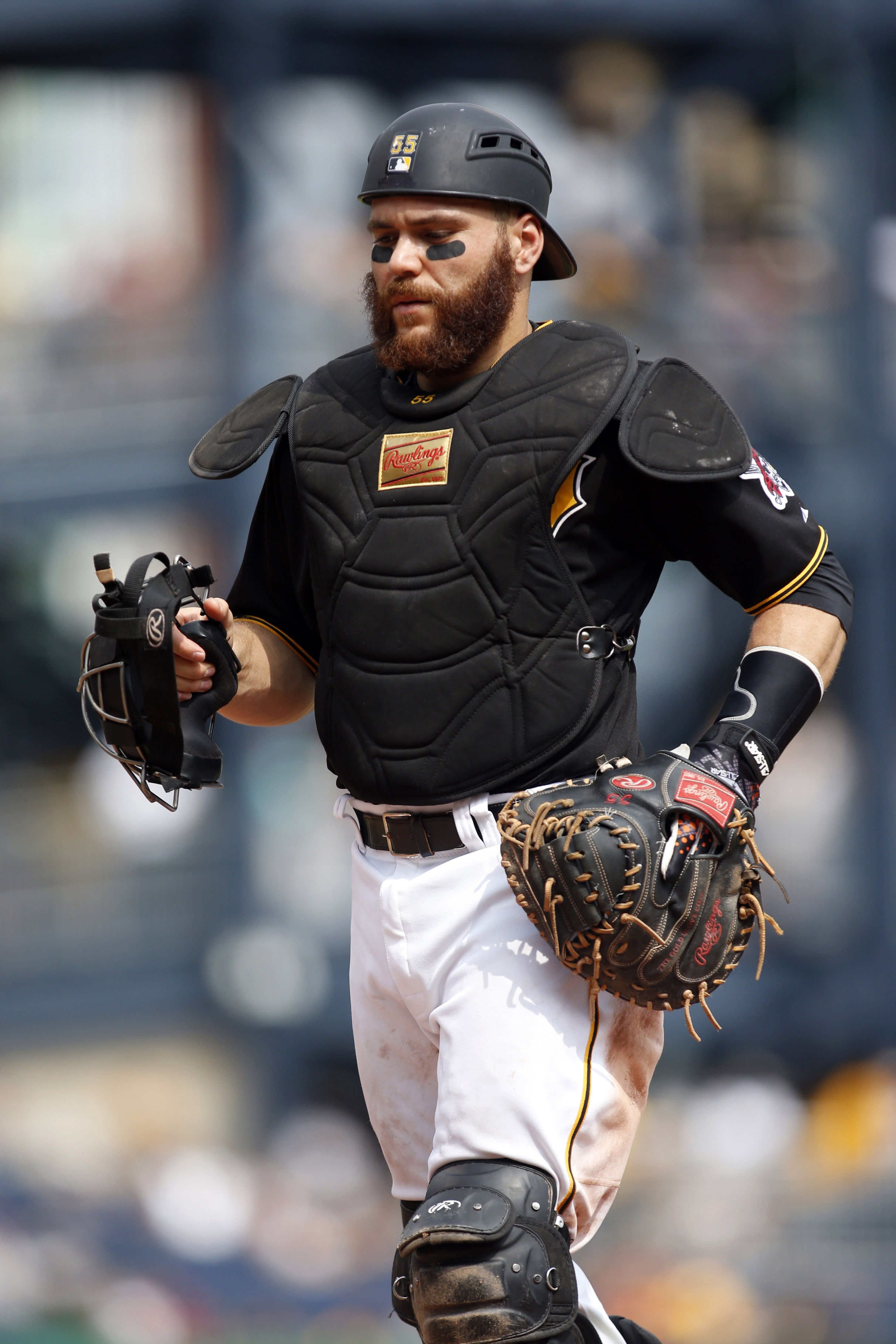 Martin’s .402 OBP would look solid next to any player, but it’s particularly impressive for a catcher. And even in 2013 when he batted .226/.327/.377, his park-adjusted numbers were better than the typical catcher. Martin has spent the past two seasons playing in PNC Park, which among baseball’s worst parks for right-handed hitters, perhaps deflating his rate stats. Yet he posted a park-adjusted OPS+ of 100 (league average) and 136 (36 percent above average) in 2013 and 2014, respectively. His wRC+ marks, also park-adjusted and on the same 100-point scale, were 102 and 140. For context, the league-average catcher has posted a 92 wRC+ over the past two seasons.
Catcher defense has become better quantified in recent seasons, and Martin’s among the best defensive backstops in baseball. He threw out 39 percent of potential base-stealers in 2014 and 40 percent in 2013, and his career average is 32 percent. This past season, the average MLB catcher caught 28 percent of runners. Pitch framing has also become an oft-cited component of a catcher’s worth (though it isn’t included in WAR), and Martin was among the league leaders in that category. StatCorner.com’s Matthew Carruth rated him 11.7 runs above average in framing, while Baseball Prospectus estimates that Martin netted his pitchers and extra 155 strikes despite not playing a full season.
In addition to his work both at and behind the plate, Martin is somewhat surprisingly fleet of foot for a catcher. That’s not to say he’s a burner, but he’s graded out as an average baserunner for his career and has dipped to only slightly below average on the bases in recent seasons (Fangraphs pegged him 1.1 runs below average in 2014). He’s also highly durable, having been on the DL just twice in his career (he did also undergo offseason knee surgery in 2011).
Weaknesses/Cons
Though the “strength” portion of Martin’s profile is rather robust, he’s not a player without his faults. Martin probably won’t repeat his sensational offensive numbers next year, or any other year for that matter. That .290 average was supported by a career-high .336 BABIP, and that BABIP should regress toward his career mark of .289 next year. Martin showed double-digit homer pop again in 2014, but his .140 isolated power mark (slugging minus average) was his lowest since 2010.
Martin turns 32 in February, so this next contract is going to offer little in terms of prime-age seasons. The team that signs him will likely be paying for his decline phase — and more so than with a typical free agent hitter. Travis Sawchik of the Pittsburgh Tribune-Review recently looked at the aging curve for catchers in the post-PED era and found that there isn’t a significant WAR drop-off from catchers’ age 32-35 seasons, and Martin is of course a fantastic athlete who keeps himself in incredible shape. While those factors may help his cause a bit, there’s no way around the fact that teams are going to have reservations about committing long-term to someone who plays the most physically demanding position on the field as he enters his mid-30s.
The Pirates made the easy call to extend a qualifying offer to Martin, who of course rejected, so he will require a team to forfeit its top unprotected pick in order to sign him.
Personal
Martin keeps himself in outstanding shape and began undergoing Muscle Activation Techniques (MAT) to help mend a balky hamstring, Bill Brink of the Pittsburgh Post-Gazette wrote in September. Also from Brink, Martin regularly does pilates and implemented a strict weightlifting routine this season to keep his strength up through the entire year. As ESPN’s Jerry Crasnick writes, Martin can often be found kicking a soccer ball around with teammates before games. Crasnick calls him a “born supe-jock,” noting that Martin enjoys playing ice hockey and doing yoga, and also entertains his teammates by walking on his hands with ease.
Per the Pirates media guide, the Canadian-born Martin spent three years living in France from ages 8-10. His middle name, Coltrane, is a nod to famed jazz musician John Coltrane, which is no surprise considering the fact that Martin’s father is an accomplished saxophonist. In 2009, Martin announced that he would donate $600K to the One Drop foundation, which seeks to combat poverty by providing access to clean water around the world.
Market
Martin excels at most facets of the game when compared to other catchers, but he’s even more impressive when stacked up against a weak crop of free agents this year. Simply put, he’s the prize of the catching market, and it’s not close. Geovany Soto, Nick Hundley, A.J. Pierzynski, John Buck and J.P. Arencibia are among the other options. The latter three were designated for assignment in 2014, while Hundley’s $5MM option was declined and Soto has hit .219/.291/.381 over the past three seasons. A team in need of a surefire starter behind the plate has two options: sign Martin or trade for a catcher.
And while the trade market may seem a good alternative, there aren’t many readily available regulars. The trade market for catchers is weak enough that Hank Conger, who has never served as a full-time option, got a respectable return for the Angels. The other options on the market are names like Jason Castro, Miguel Montero and Yasmani Grandal. Grandal and Castro are coming off down seasons at the plate, and Montero is owed $40MM over the next three seasons. Backup type options such as Rene Rivera and Carlos Corporan could also be had (though Rivera, coming off a surprisingly excellent season in San Diego, may be seen as more than that).
There’s been no shortage of early interest in Martin, though the four teams that appear to have been the most aggressive are the Pirates, Dodgers, Cubs and Blue Jays. The Pirates have long said they would love to retain Martin, and both owner Bob Nutting and GM Neal Huntington have said they’re willing to stretch payroll to make it happen.
Martin met with the Cubs, Blue Jays, Dodgers and Pirates this week at the GM Meetings, according to reports, and it’d be surprising if agent Matt Colleran didn’t at least explore talks with several more clubs. Those four teams appear to be the front-runners at this stage, however. If other teams are brought into the mix, I’d think that the Rockies, Astros, A’s, Rangers, Tigers and White Sox could be fits for Martin, though it’s unclear that all of those teams could actually afford him.
Expected Contract
When it comes to the free agent market, Martin is the lone starting catcher in a sea of backups and reclamation projects coming off injuries, poor performances or both. Despite his age and lack of pop when compared to Brian McCann, I’d be surprised if Colleran isn’t citing McCann’s five-year, $85MM contract from last winter as a talking point.
I feel that four years is the absolute floor for Martin, given his interest, and it’s hard to see him taking an annual value that’s much lower than McCann’s $17MM if he has to sacrifice a full year. Ultimately, I think there will be several teams involved and willing to go four years, but the team that pushes to a fifth year will be the one to land him. That fifth year will require him to take a hit on his annual value, and I think anything in the $70-75MM range is plausible, so I’m splitting the difference and projecting a five-year, $72.5MM contract.
Photo courtesy of USA Today Sports Images.
Offseason Outlook: Los Angeles Dodgers
Before the offseason even got underway, the Dodgers managed to make an impact signing that sent shockwaves through the baseball world. With a record-setting five-year, $35MM deal, Los Angeles convinced former Rays architect Andrew Friedman to head west and discover what it’s like to work with a seemingly limitless budget. With years of success in Tampa Bay on a consistently league-dwelling payroll, it’ll be fascinating to watch what Friedman can do with a Brinks truck at his disposal.
Guaranteed Contracts
- Clayton Kershaw, SP: $193MM through 2020
- Zack Greinke, SP: $94MM through 2018
- Matt Kemp, OF: $85.5MM through 2019
- Adrian Gonzalez, 1B: $85MM through 2018
- Carl Crawford, OF: $62.25MM through 2017
- Andre Ethier, OF: $56MM through 2017
- Hyun-jin Ryu SP: $25MM through 2018
- Yasiel Puig, OF: $24MM through 2018
- Erisbel Arruebarrena, SS: $16M through 2018
- Alex Guerrero, 2B: $14MM through 2017
- Dan Haren, SP: $10MM through 2015
- Brian Wilson, RP: $9.5MM through 2015
- Brandon League, RP: $7.5MM through 2015
- Juan Uribe, 3B: $6.5MM through 2015
- J.P. Howell, RP: $4.25MM through 2015
Arbitration Eligible Players (service time in parentheses; projections via Matt Swartz)
- A.J. Ellis, C (4.151): $3.8MM
- Kenley Jansen, RP (4.073): $8.2MM
- Darwin Barney, 2B (4.053): $2.5MM
- Justin Turner, IF (4.045): $2.2MM
- Drew Butera, C (4.018): $900K
- Scott Elbert, RP (3.086): $800K
- Dee Gordon, 2B (2.154): $2.5MM
Free Agents
- Hanley Ramirez, Chad Billingsley, Kevin Correia, Roberto Hernandez, Chris Perez, Jamey Wright, Paul Maholm
Other Payroll Notes
- Will receive a $3.9MM payment from the Red Sox in 2015 as a condition of their blockbuster trade.
- Billingsley will receive a $3MM buyout after the Dodgers declined his $14MM option for 2015.
When it was learned that Friedman would be joining the Dodgers, there was immediate speculation that longtime Rays skipper Joe Maddon could follow. When Maddon opted out of his contract with the Rays, the rumor mill started churning once again with many wondering if the Dodgers could fire Don Mattingly to replace him with the two-time American League manager of the year. However, the Dodgers were quick to release a statement making it clear that Donnie Baseball would be back in the dugout for 2015. Maddon, meanwhile, signed on with the Cubs.
Joining Friedman in the front office will be former A’s exec Farhan Zaidi and former Padres GM Josh Byrnes. Zaidi will serve as the club’s GM while Byrnes has been named the senior vice president of baseball operations. There are now a number of fresh faces in the Dodgers’ front office that have supplanted mainstays Ned Colletti (who remains in an advisory capacity), Logan White, and De Jon Watson, and the roster could see some similar turnover.
Hanley Ramirez and the Dodgers discussed an extension earlier in the year and the shortstop made it known that he wanted to be a “Dodger for life” and ink a long-term deal. Those talks were tabled in August as Ramirez was sidelined with an oblique injury and the two sides agreed to pick things up after the season. Now, it would appear that they’re more focused on replacing his .283/.369/.448 batting line than re-signing him to a new multiyear deal.
Ramirez rejected the Dodgers’ QO, so they’ll receive draft pick compensation if he goes elsewhere. Despite Ramirez’s injury history and his subpar defense at shortstop (-15.6 UZR/150 in 2014), he still figures to be amongst the most hotly-pursued free agents of the winter, especially given a willingness to play a position other than shortstop. Even if Ramirez’s future is at third base or in the American League where he can be a part-time DH, he will draw lots of attention. Recently, I profiled Ramirez and looked at his potential market this winter.
If Ramirez leaves, the Dodgers could look into a temporary solution at shortstop that would allow them to build a bridge to Corey Seager down the line, possibly in 2016. There are options on the open market, but not particularly glamorous ones: Stephen Drew, Asdrubal Cabrera, and Jed Lowrie stand as the best available shortstops beyond Ramirez. Looking in-house, shortstop Erisbel Arruebarrena is a defensive wizard and could be plugged in as the starter with help from Miguel Rojas, but that will require the Dodgers to make a significant offensive upgrade elsewhere.
The Dodgers’ best internal option offensively could be turning to Alex Guerrero at shortstop. Guerrero was signed to a four-year, $28MM deal in October of last year to play second base before something funny happened along the way: Dee Gordon emerged as a highly-productive second baseman for the Dodgers, earning his first All-Star nod in 2014. So, putting Guerrero on the opposite side of the bag from Gordon would be a no-brainer move if Ramirez leaves, right? Not exactly. Guerrero has previous experience at shortstop, but the Dodgers focused on getting him up to speed at second base last season, where he apparently wasn’t blowing observers away defensively. In theory, Gordon would be a very attractive trade candidate in an offseason where there isn’t much available on the free agent market at second base, and that would clear a path for Guerrero to play what might be his best position. Still, that would require a significant package for Gordon and a whole lot of faith from the Dodgers’ front office in Guerrero’s abilities. On the plus side, Guerrero is said to have recovered well from the incident with Miguel Olivo which cost him part of his ear.
The Dodgers’ outfield glut has been a topic of discussion for a long time now and they still have quite the logjam. Yasiel Puig, Matt Kemp, Andre Ethier, Carl Crawford, and Joc Pederson are all in the fold and it stands to reason that they would want to trade at least one of those players for help in another area. Ideally, the Dodgers would probably look to move Ethier and/or Crawford, allowing them to focus on a starting outfield of Kemp, Pederson, and Puig with Scott Van Slyke in support. Friedman, in fact, confirmed that a trade of at least one outfielder seems likely this offseason.
Ethier is owed an eye-popping $56MM after this season and that number could increase even further thanks to an attainable $17.5MM vesting option for 2018 that is tied to plate appearances in the preceding year. Trading Ethier, who once carried so much promise, would require the Dodgers to eat a significant portion of his salary. The 32-year-old (33 in April) slashed just .249/.322/.370 in 2014 with a very pedestrian 0.7 WAR.
Moving Crawford, 33, could be even tougher. Crawford gave the Dodgers a .300/.339/.429 slash line in 2014, an improvement over last season, but it’s a far cry from the work that Friedman got to witness up close for years in Tampa Bay. He also played in just 105 games and that won’t help ease his perception as an injury-prone player. Just like with Ethier, trading the four-time All-Star will mean picking up a good chunk of the check. That won’t necessarily be a problem for the cash-flush Dodgers, but finding a fit could still be tricky.
The Blue Jays could have vacancies to fill in left and center field if they lose both Colby Rasmus and Melky Cabrera to free agency. The Rangers, meanwhile, have a corner outfield vacancy after declining Alex Rios‘ $13.5MM club option. If the Dodgers pick up a very significant share of the check, teams like the Reds or White Sox could have interest. Ethier and Crawford have their flaws, but if the Dodgers can throw in enough cash, they could have appeal to clubs who are looking at a flat free agent outfield market. From a pure talent perspective, the Dodgers would certainly like to trade those two before Kemp, but he is the most expensive of the trio and has drawn significant trade interest in the past.
While the Dodgers have a surplus in the outfield, it appears that they have a good amount of work to do in the bullpen. Kenley Jansen (2.76 ERA, 1.93 xFIP, 13.9 K/9, 2.6 BB/9 in 2014) was stellar, but the bridge to him was anything but. On paper, a ‘pen featuring the likes of Brian Wilson, Chris Perez, and Brandon League (who admittedly did improve from a rough 2013) looked serviceable, but the Dodgers actually wound up with one of the worst bullpens in the majors in 2014. Injuries to Chris Withrow and others didn’t help matters. They’ll have J.P. Howell back in the mix, to serve as a reliable arm, but the Dodgers will make some changes this winter.
This year’s free agent reliever market features plenty of notable veteran names that will see big paydays, but that has never been Friedman’s style for building a bullpen in the past. And, after all, there’s already a great deal of money committed to the bullpen for 2015 with Wilson, League, Howell, and Jansen combining for roughly $30MM in salary. I would expect Friedman to scour the market for value options while keeping an eye out for quality relievers via trade, but then again, maybe he wants to take his new Ferrari convertible out for a spin after years of driving a sensible four-door sedan. If he wants to spend big, David Robertson and Andrew Miller would both look pretty nice in Dodger blue. Meanwhile, guys like Pat Neshek, Joba Chamberlain, and Jason Frasor would be a bit more sensible.
The Dodgers rotation will feature Clayton Kershaw, Zack Greinke, Hyun-jin Ryu, and Dan Haren but the fifth spot is a bit unclear at this point. Prospect Zach Lee might be a candidate to fill the role, but his 5.38 ERA with 5.8 K/9 and 3.2 BB/9 in Triple-A last season says that he’ll need some more seasoning before making his debut.
The free agent market is littered with older middle-of-the-rotation types, but Friedman’s newly-found deep pockets should lead him in a different direction. Someone like Justin Masterson, who will turn 30 in March, could make sense for the Dodgers. He’s one year removed from his best season ever (3.45 ERA with 9.1 K/9 and 3.5 BB/9), the advanced metrics say that he was better than the core stats would have you believe in 2014, and he is hopeful that he’ll be back to 100% health after an offseason of rest and rehabilitation. Want to go even younger? Japanese standout Kenta Maeda will be 27 in April and while the bidding for him should be fierce, it’s not out of the realm that the Guggenheim group could green light that signing. Recently, Mark Saxon of ESPNLosAngeles.com heard that the Dodgers were unlikely to go after any starter that would cost them a draft pick, which would rule out QO pitchers like Max Scherzer and James Shields. On the trade market, names like Johnny Cueto, Jeff Samardzija, and maybe Cole Hamels could make some sense for L.A. if they’re willing to part with prospects like Seager, Pederson or Julio Urias.
One more area to keep an eye on for the Dodgers is at catcher, where Ellis may have fallen out of favor as the team’s starter after hitting .191/.323/.254 last season. The Dodgers have already been connected to old friend Russell Martin — the clear prize of the free agent market. The price tag there is climbing by the day, but he’d make a great pitching staff even better and give some more offense behind the plate. If he’s too expensive or not keen on returning to his old stomping grounds, the Dodgers could look to the trade market where Jason Castro and Miguel Montero are said to be available.
With a whole lot of money and an executive at the helm who knows how to stretch a dollar, the possibilities for the Dodgers are endless this winter. Whatever path they take, they’ll return an elite rotation that should keep them firmly in the mix in next year’s NL West.
2015 Payroll Obligations By Team
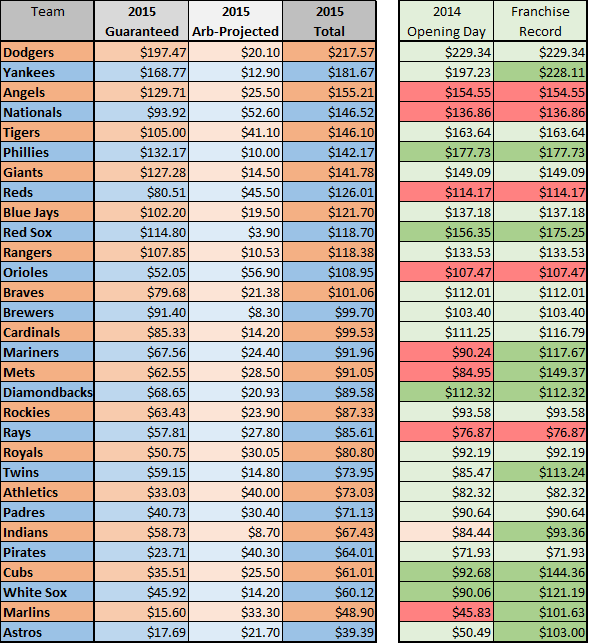
With decisions on options and qualifying offers in the books, let’s take a look at each team’s payroll obligations to see where things stand. I will publish a second post listing every club’s future payroll obligations, which obviously have an important bearing on their ability to take on longer-term obligations.
The payroll chart and table that follow were compiled using the Cot’s Baseball Contracts database and the arbitration projections from MLBTR/Matt Swartz. Of course, teams can still trim from these obligations not just by trading players, but also by non-tendering those who are arb-eligible. MLBTR’s Tim Dierkes recently posted his list of the most likely non-tender possibilities.
The chart provides useful context for each team’s offseason to come (figures are in $MMs). Of course, MLBTR has also produced more qualitative offseason outlooks for each team.
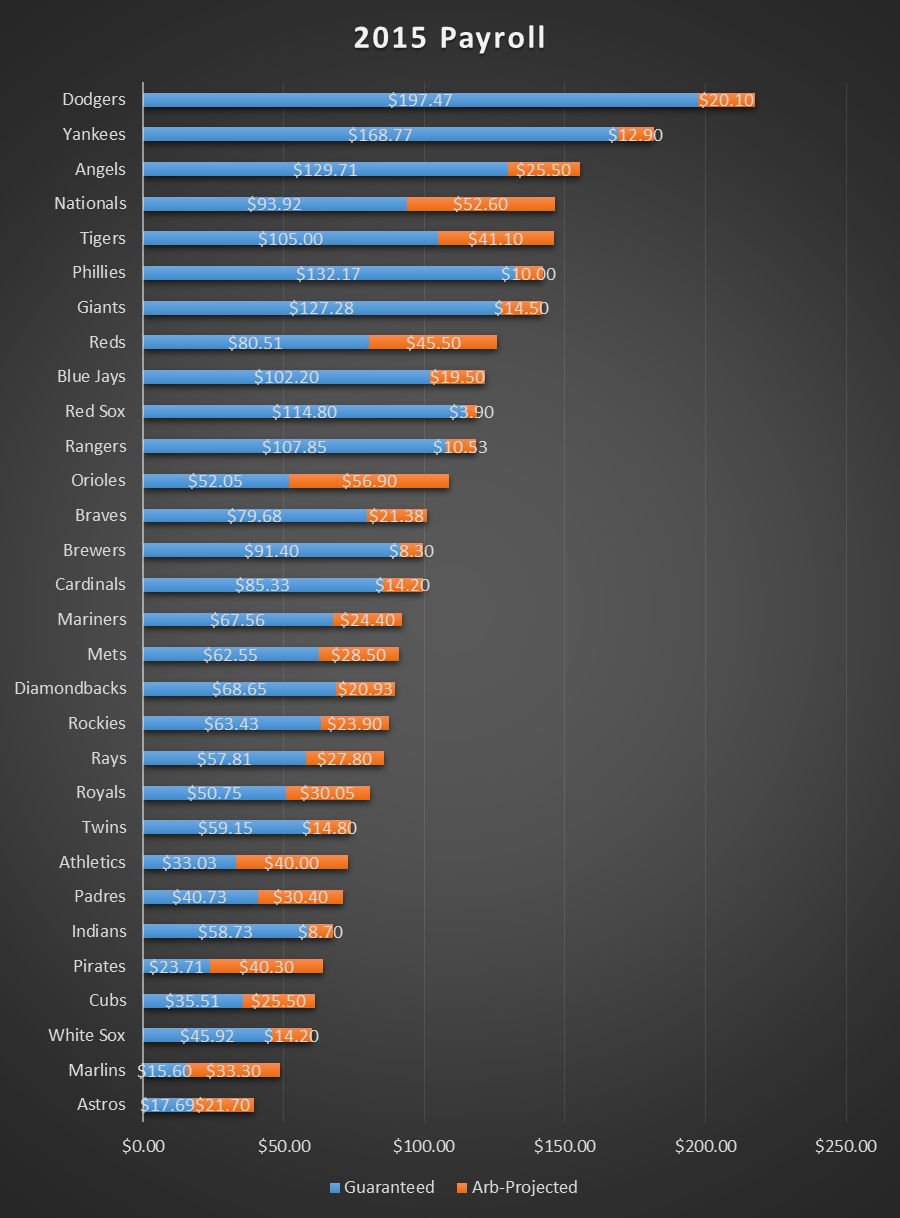
Here is the information in table form (all numbers in $MMs). I have also added a comparison to club’s 2014 Opening Day and franchise record payrolls for reference. (Red=currently exceeding; light green=currently short by $0-20MM; dark green=currently short by > $20MM.)
MLBTR Originals
A look back at the original reporting and analysis found on MLBTR this past week:
- MLB Trade Rumors Podcast featured host Jeff Todd reviewing the week’s notable transactions and discussing the Rockies’ offseason with Nick Groke of The Denver Post and MLBTR’s 2014-15 Top 50 Free Agents list with Tim Dierkes. A new edition of MLB Trade Rumors Podcast will drop every Thursday and can be accessed on iTunes, SoundCloud, and Stitcher.
- There were six new Free Agent Profile entries this week (ranking on MLBTR’s 2014-15 Top 50 Free Agents list in parenthesis).
- Tim’s prediction for James Shields (#3) is $95MM over five years.
- Zach Links envisions six years, $132MM for Hanley Ramirez (#4), four years, $70MM for Nelson Cruz (#9), and three years, $21MM for Sergio Romo (#35).
- Steve Adams foresees Francisco Liriano (#15) netting a three-year, $40MM deal.
- Charlie Wilmoth anticipates a two-year contract for Nori Aoki (#40) worth $16MM.
- Tim was the first to report Casey Janssen and Joey Gallo changed representation: Janssen leaving Jim McDowell for ACES and Gallo joining the Wasserman Media Group after being a client of The Legacy Agency.
- MLBTR previewed the Offseason Outlook for the Angels (by Steve), Nationals (by Jeff), Cardinals (by Charlie), and Orioles (by Mark Polishuk).
- MLBTR has made its projected 2015 arbitration salaries available for download in an Excel spreadsheet. The list can also be found in the sidebar under MLBTR Features.
- Brad Johnson asked MLBTR readers where Russell Martin will sign. Nearly 50% of you believe he will be wearing Cubbie blue.
- Steve hosted this week’s live chat.
- Charlie assembled the best of the baseball blogosphere for you in Baseball Blogs Weigh In.