
Mets Plan To Play Brandon Nimmo Primarily In Left Field This Season
The Mets plan to move Brandon Nimmo from center field to left field for the 2024 season at least, manager Carlos Mendoza revealed to reporters yesterday (link via Anthony DiComo of MLB.com). The outfield shuffle comes on the heels of New York’s offseason signing of Harrison Bader on a one-year, $10.5MM contract.
The move is hardly unexpected, given that Bader ranks as one of the sport’s top defenders in center, but it’s still notable just one year after Nimmo’s ability to handle center field was a contributing factor in the team’s decision to re-sign him on an eight-year, $162MM contract. President of baseball operations David Stearns suggested last month that a specific outfield alignment had not yet been settled upon, but the Mets will go with what looked to be the most probable option. With Bader on a one-year pact, it’s possible Nimmo will end up patrolling center again in the near future — and he could do so as soon as this season in the event of an injury to Bader. But for the time being, Mendoza made clear the plan is an alignment of Nimmo in left, Bader in center and Starling Marte in right field on most days.
Mendoza praised Nimmo’s openness to the move. Nimmo himself told DiComo and others that Stearns asked him early in the offseason about his willingness to move to a corner, should the team sign a free agent center fielder with plus defensive skills. “I told him, ‘Honestly, my goal at this point in my career is to win a World Series. If you think that creating a better outfield defense or adding these guys to our roster is going to help our chances of winning a World Series, then I’ll do whatever it takes to do that,'” Nimmo said.
On paper, it should give the Mets a strong defensive group on the grass. Nimmo’s defensive grades in center field took a step back in ’23, but Statcast and Ultimate Zone Rating both pegged him as roughly average. (Defensive Runs Saved was more bearish, casting his glovework as a negative.) Bader ranks fourth among all big league players, regardless of position, in Statcast’s Outs Above Average metric, dating back to the 2018 season. DRS has him tied for 18th among all MLB players in that same span. Marte posted negative grades in 2023 but was also hobbled by a groin strain in addition to missing time with migraines. At 35, he’s likely lost a step or two, but Marte previously graded as an elite left fielder — so a return to at least solid glovework in right field shouldn’t be out of the question.
In all likelihood, Nimmo will play some center this year. Bader has been on the injured list seven times in the past three seasons (once the Covid-related IL, but the 10-day IL on six other occasions). In that span, he’s dealt with a fractured rib, plantar fasciitis and strains of his groin, oblique and hamstring. As is common with many elite defenders in center, the devil-may-care attitude with which Bader approaches his craft leaves him susceptible to IL stints. The reckless abandon required to crash into a wall at full speed or lay out for spectacular diving grabs leads to plenty of highlight reel appearances but also plenty of bumps and bruises (if not worse).
In the big picture, the Mets’ outfield alignment could continue to change in the short term. Outfielder Drew Gilbert, acquired from the Astros in the Justin Verlander trade, is widely considered to be among the game’s top 100 prospects and could push for a spot in the majors this season. He’s a center fielder with a real chance to stick at the position. Next year’s free agent class in center is pretty thin — unless Cody Bellinger signs a deal that allows him to opt back into free agency next winter — though if the Bader fit works out, it’s always possible the two parties explore a longer-term fit.
Mets To Sign Luke Voit To Minor League Deal
Feb 19: The sides have agreed to terms, per Newsday’s Tim Healey, and Voit has joined the Mets in camp. Healey adds that the contract is expected to be finalized later today.
Feb 17: The Mets are reportedly “moving toward” a minor league deal with Luke Voit, according to Joel Sherman of the New York Post. SNY’s Andy Martino reported earlier this afternoon that the sides were discussing a potential deal, which would include an invite to big league Spring Training.
Voit, who celebrated his 33rd birthday earlier this week, started the 2023 season with the Brewers but struggled through 22 games with the big league club, hitting just .221/.284/.265 with a 36.5% strikeout rate and just three extra base hits (all doubles) in 74 trips to the plate. That brief stint in Milwaukee was the only big league action Voit saw last year, though he did rake to the tune of a .263/.420/.615 slash line at the Triple-A level in 45 games split between the Brewers and the Mets, the latter of whom he signed on with in June of last year after being released by Milwaukee earlier in the month.
While Voit’s 2023 campaign certainly left something to be desired, he’s also enjoyed his fair share of success throughout seven seasons in the big leagues. Voit made his debut in 2017 as a member of the Cardinals and hit to roughly league average results during a 62-game stint on the club’s bench, though he wouldn’t remain in the organization for long as he was traded to the Yankees in the deal that sent Giovanny Gallegos to St. Louis. That kicked off an incredible four-year stint in the Bronx where Voit slashed a whopping .270/.362/.519, including a dominant showing in the shortened 2020 season that earned him a ninth-place finish in NL MVP voting.
Voit’s tenure with the Yankees came to an end after the club landed Anthony Rizzo in a deal with the Cubs prior to the 2021 trade deadline before deciding to extend him the following offseason. With Rizzo entrenched at first base for the foreseeable future, the Yankees decided to flip Voit to the Padres just before the start of the 2022 season. Voit appeared in just 82 games for San Diego before he was swapped once again, this time to the Nationals as part of the blockbuster that sent Juan Soto to San Diego (where, coincidentally, Soto would eventually find himself traded to the Bronx back in December.)
If the deal is completed, Voit would provide the Mets with a veteran slugger who sports a 121 wRC+ for his career in the majors. While Voit certainly won’t be usurping star slugger Pete Alonso‘s role as the club’s everyday first baseman, Voit could provide competition for youngster Mark Vientos for the role of the club’s primary DH to open the season if the deal is completed. All signs in recent months have pointed toward the Mets offering Vientos a chance to establish himself in the majors to open the 2024 campaign, though he’s struggled to a .205/.255/.354 slash line in 274 trips to the plate at this point in his major league career. If Vientos’s struggles continue, Voit’s presence could give the club a veteran fallback option as they try to remain competitive in 2024 while primarily focusing on building for the 2025 season and beyond.
NL East Notes: Harper, Sale, Crick
After his recovery from Tommy John surgery necessitated a move to first base last season, Bryce Harper took well enough to his new position that the Phillies announced in November that Harper would be their regular first baseman in 2024 and beyond. The two-time NL MVP spoke to reporters (including The Athletic’s Matt Gelb) about the situation today, saying “I wanted them to know that I was on board with anything they wanted to do,” and that Harper left the decision about his position up to the club. “I said if you want me in right field, I’ll play right. If you want me at first, I’ll play first base. I think collectively, they said, first base is where we want you. I said, ‘OK, I’ll do everything I can to be there,’ ” Harper said. He is now spending his Spring Training further working on what seems to be his permanent new position, noting that “I don’t think I’ll move back out to right. I don’t. But never say never.”
Harper also confirmed that he is interested in extending his contract, as agent Scott Boras stated in December. The idea caught many by surprise given that Harper still has eight seasons and $196MM remaining on his original 13-year, $330MM contract, and he’ll be turning 39 years old in October 2031. While Harper said “I haven’t really thought too much about” his contract situation, he said that “playing into my 40’s, I mean, that’s the biggest thing for me. So I want to get that done.” It remains to be seen if Harper, Boras, and the Phillies could possibly reach some kind of deal to add two (or more?) years onto Harper’s contract, yet president of baseball operations Dave Dombrowski has downplayed the idea of a renegotiation.
More from around the NL East…
- Chris Sale has battled through several injury-plagued seasons, but the winter of 2023-24 “was the first time going into an offseason without dealing with something since 2018 or something like that,” the new Braves starter told The Athletic’s David O’Brien and other reporters. “It’s been a long time. I had a lot of fun this offseason, being able to play baseball and do things that I haven’t been able to do.” In both acquiring Sale from the Red Sox and then signing him to a two-year extension, the Braves are putting a lot of faith that the southpaw is ready to rebound as he enters his age-35 season. Atlanta even looked into acquiring Sale during the 2023 season, according to manager Brian Snitker.
- Mets reliever Kyle Crick is recovering from a Grade 4 calf strain and might not start throwing bullpens until closer to the end of spring camp, MLB.com’s Anthony DiComo writes. New York signed Crick to a minor league deal in December and he has no issue with pitching in the minors for the start of the season, given how his injury will seemingly prevent him making the Opening Day roster. Crick posted a 3.56 ERA over 187 1/3 relief innings with the Giants, Pirates, and White Sox from 2017-22, though he didn’t pitch in 2023 until surfacing in Dominican Winter League action a few months ago.
- There’s enough happening within the division that this is our second batch of NL East Notes today. Earlier on, Nick Deeds compiled another set of items about the Marlins, Phillies, Nationals, and Braves.
Mets Haven’t Yet Had Extension Talks With Pete Alonso
Pete Alonso is slated to become a free agent after the 2024 season, and the first baseman told reporters (including Andrew Battifarano of the New York Post) that there hadn’t yet been any talks with the Mets about a long-term extension. The only discussions between the two sides centered around the one-year, $20.5MM pact Alonso signed in January to avoid salary arbitration.
Alonso said that he would “welcome the idea” of remaining with the Mets for the rest of his career, saying “I definitely have envisioned myself being a lifelong Met, that’s something I’ve definitely thought about. I love New York, it’s a really special place for my family….but I can’t predict the future. And for me, I just want to focus on this season.”
Interestingly, Alonso said he is open to negotiating after Opening Day, which is something of a departure from most players’ stances on contract talks. The majority of players set the opener as an unofficial deadline to complete negotiations so they can get into the season without any financial concerns weighing on their minds as they start play. This deadline often isn’t absolute, of course, as it is common to see extensions announced a few days or even weeks into April, if the two sides are close enough to a deal by Opening Day that there’s willingness on both sides to finalize matters.
It also isn’t too unusual to see players sign extensions with their current teams with just a year remaining until free agency, though Mets president of baseball operations David Stearns spoke about the difficulties of such deals (without naming Alonso specifically) during an interview back in January. Alonso is also represented by Scott Boras, whose clients tend to test free agency rather than sign extensions, though Jose Altuve‘s recent extension with the Astros is one of a few high-profile examples of Boras Corporation clients opting to stay put with just a season to go before the open market.
If anything, there has been a lot more trade speculation about Alonso than extension buzz, though Stearns stated even in January that he was “pretty darn confident” Alonso would still be in New York’s lineup on Opening Day. A late deal could obviously still emerge in Spring Training if another team meets what is surely a big asking price, but if Alonso is dealt at all, a trade might be likelier closer to the trade deadline. Or, if the Mets are in contention at the deadline, a trade might simply not come at all, and the team will retain Alonso through at least a pennant race.
Alonso drew interest back at last year’s trade deadline, when the Mets responded to their subpar season by moving a lot of veteran players in an effort to cut some salary and (more importantly) add some younger talent to the organization. Alonso stayed put despite reported interest from teams such as the Cubs and Brewers, and Chicago has also reportedly inquired about Alonso’s services in trade talks this winter. The Cubs have since addressed first base by acquiring Michael Busch from the Dodgers, though that doesn’t necessarily close on the door on an Alonso deal, considering the DH slot or the possibility that Busch could be flipped to the Mets or perhaps to another team to create room.
Owner Steve Cohen would ultimately be calling the shots when it entails the type of mega-contract it would take to retain a top-tier slugger like Alonso. However, given how Cohen has finally landed Stearns to run the front office, it stands to reason that Cohen might not immediately overrule his PBO if Stearns doesn’t feel it would prudent to extend Alonso at the kind of price tag that Boras will naturally demand. Such contracts are also somewhat uncharted territory for Stearns, since apart from Christian Yelich‘s extension, Stearns didn’t have the financial resources in his past job with the Brewers to consider locking up star players as they approached free agency.
Mets, Ji-Man Choi Agree To Minor League Deal
The Mets are in agreement with first baseman Ji-Man Choi on a minor league contract, according to a Korean-language report from Naver Sports (h/t to Homin Lee). It’s a split deal that’d pay Choi at different rates for time spent in the majors versus Triple-A. While the deal’s base value is still unclear, Naver reports that the contract could max out at $3.5MM if Choi hits all his performance bonuses.
Choi, who turns 33 in May, is seeking to rebound after injuries ruined his 2023 season. The Pirates acquired the eight-year veteran from the Rays last winter to rotate between first base and designated hitter. Choi suffered an Achilles strain within the first two weeks and spent a couple months on the injured list. By the time he returned in early July, he found himself on the trade block.
Pittsburgh sent Choi to the Padres alongside Rich Hill at the deadline. Unfortunately, injuries again quickly intervened early in his stint with his new club. A ribcage strain sent him to the injured list by the middle of August. Choi suffered a Lisfranc injury when he fouled a ball off his right foot during his rehab stint. He was reinstated in mid-September but the Padres were out of contention by that point.
Choi finished his year with just 119 plate appearances over 37 games. He hit .163/.239/.385 in that minimal sample. Choi was quite a bit better for Tampa Bay over his four and a half seasons there. The left-handed hitter ran a .245/.352/.431 batting line in more than 1500 plate appearances with the Rays. That makes him a sensible depth acquisition on a non-roster deal.
The Mets have Pete Alonso locked in at first base. It seems likely they’ll take a look at Mark Vientos at designated hitter, although they’ve at least kept tabs on the market for J.D. Martinez. Choi could look to crack the roster as a lefty bench bat and complement to the righty-hitting Vientos at DH.
Mets Sign Shintaro Fujinami
Feb. 14: The Mets formally announced the signing of Fujinami. The team waited to make the deal official, as the corresponding roster is transferring infielder Ronny Mauricio, who’s recovering from an ACL tear, to the 60-day injured list. Players can’t be placed on the 60-day IL until spring training opens.
Feb. 2: The Mets have agreed to a deal with free-agent righty Shintaro Fujinami, reports Jon Heyman of the New York Post. He’ll earn at a $3.35MM rate in the majors on the one-year pact and can unlock an additional $850K worth of incentives. Joel Sherman of the New York Post reports that the contract does not contain any language preventing Fujinami from being optioned to the minors. Fujinami is represented by the Boras Corporation.
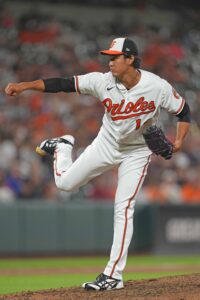
Fujinami, 29, was a high school rival of Shohei Ohtani and entered Nippon Professional Baseball, Japan’s top professional league, at the same point as the two-way phenom. Early in his NPB career, Fujinami looked the part of a burgeoning phenom himself. He went right from the NPB draft into the Hanshin Tigers’ rotation, pitching to a 2.75 ERA in 137 1/3 frames as a 19-year-old rookie. He turned in a sub-3.00 ERA in each of his first four seasons in NPB and was named an All-Star each year along the way.
Fujinami’s star faded beginning in his age-23 campaign. He’d already been showing some command struggles the year prior, and was controversially left in a game to toss a stunning 161 pitches in a single start — one that began with him surrendering five runs in his first three innings of work. The extent to which that contributed to his decline can’t be known, but Fujinami battled injuries and poor command for much of his remaining time in NPB. The Tigers sent him down to their minor league club on multiple occasions and shuffled him between the rotation and bullpen at various points as well.
In 2022, Fujinami had a resurgence. The hard-throwing righty made 10 starts and six relief appearances with the Tigers’ top team, pitching to a 3.38 ERA in 66 2/3 innings. He fanned 23.6% of his opponents and, most crucially, turned in a career-low 7.6% walk rate. That was not only the best mark of Fujinami’s career but the first time since 2016 he’s posted a walk rate under 10%.
That led to a one-year, $3.25MM deal with the Athletics last year. Fujinami’s MLB career started out in catastrophic fashion. He was absolutely shelled in four starts with Oakland (14.40 ERA) before moving to the bullpen and continuing to struggle, surrendering 15 runs in his next 12 1/3 innings of relief.
Things took a quick turn, however. Fujinami reined in his command beginning in early June, and for nearly two months leading into the trade deadline turned in a 3.18 ERA with a 24-to-9 K/BB ratio in 22 2/3 frames — all while averaging better than 99 mph on his fastball. The turnaround prompted the Orioles to send minor league righty Easton Lucas to the A’s in order to acquire Fujinami in a deadline swap. The 6’6″ righty didn’t quite sustain his recent run of strong results but didn’t regress to his disastrous early-season results, either. He tossed 30 innings with a 4.85 ERA as an Oriole, striking out a quarter of his opponents against an 11.9% walk rate.
Setting aside that miserable start to the year, Fujinami closed out his MLB rookie campaign with 48 innings of 3.94 ERA ball. He struck out 25.6% of opponents, walked 10.6% of them, yielded just a .206 opponents’ batting average, kept the ball on the ground at a 43.5% clip and averaged a massive 99.1 mph on his fastball in that time. That type of production would be plenty commensurate with a one-year deal at this price point — if not more — though there’s certainly some risk, given the tall righty’s first two months in 2023.
By guaranteeing Fujinami a 40-man roster spot and a not-insignificant $3.35MM, the Mets are placing a bet that he can at least sustain the performance he showed from June onward — if not improve upon it. There’s something to be said for a pitcher transitioning to a new league and new culture when making the jump from a foreign professional league to MLB, but the extent of Fujinami’s early struggles was nevertheless alarming. If the final four months of his performance are more representative of his abilities, however, he could make for a nice addition to a radically overhauled Mets bullpen.
New York has re-signed Adam Ottavino but also brought in newcomers Jorge Lopez, Michael Tonkin and Austin Adams — none of whom can be optioned without first clearing waivers. The Mets are also reportedly close to a deal with veteran lefty Jake Diekman, and SNY’s Andy Martino tweets that the team is still optimistic his deal will be completed. Given the mounting slate of bullpen additions, it’s quite possible the Mets try to pass someone like Tonkin or Adams through waivers; neither has five years of MLB service, and the salary agreed to on each player’s big league deal could help them clear waivers and head to Triple-A as depth options.
The Mets are set to pay the luxury tax for a third consecutive season in 2024 and are already well into the fourth and final tier of penalty levels. Any dollars spent at this point come with a 110% tax, meaning the Fujinami pact will cost them $7.035MM after taxes. If he unlocks the full $850K incentive package, that’d cost an additional $1.785MM after taxes, although getting to that point would very likely mean he’s pitched well enough to be worth that amount and then some. The Mets will need to open a spot on the 40-man roster for Fujinami and likely for Diekman (assuming that deal is indeed completed), so additional transactions should be on the horizon within the next few days.
Mets Notes: Diaz, Third Base, Alonso
Edwin Díaz threw a bullpen session on the back fields at Mets camp today, opening his Spring Training build-up. The two-time All-Star told reporters he had no obstructions over the winter after missing the entire 2023 campaign.
“It was my normal offseason, I did my normal routine,” Díaz told reporters (including Tim Britton of the Athletic). “I won’t be afraid to jump, to run. … I feel great.” That was the general expectation, as Díaz considered making a push to return at the end of last season before shutting things down with New York well out of contention.
The Mets are hopeful of a better showing than last year’s 75-87 performance. Díaz’s return is one of the reasons for optimism that they can hang around the playoff mix. He was the best reliever in baseball in 2022, when he struck out more than half the hitters he faced en route to a career-low 1.31 ERA across 62 innings.
While the team is hopeful of at least remaining in the Wild Card race, they’ve opted against making another all-in push for 2024. President of baseball operations David Stearns has pointed to the upcoming season as something of a evaluative year which they expect to serve as a stepping stone to a full-fledged run in 2025. That’s perhaps most evident in the team’s approach at third base and designated hitter. They’ve left the door ajar to making a run at a veteran DH while suggesting that the likelier outcome is giving playing time to Brett Baty and Mark Vientos to gauge whether they can serve important roles on the ’25 team.
Stearns left open the possibility for “some level of competition” among the in-house options at the hot corner this afternoon (relayed by Tim Healey of Newsday). Baty enters camp as the heavy favorite for the starting job despite his disappointing season. The former first-round pick and top prospect hit .212/.275/.323 with nine home runs in 389 plate appearances over his first full big league campaign. New York sent Baty to Triple-A for a few weeks in August as his struggles mounted. He raked in that brief minor league stint but again struggled after being recalled in September.
New York hasn’t done much to bring in serious competition for Baty this offseason. Stearns mentioned Vientos, Joey Wendle and Zack Short as others who could pick up playing time at the hot corner. Vientos is regarded as a below-average defender who is better served at first base or DH. He’d see the bulk of the DH reps unless the Mets somewhat surprisingly add a veteran bat like J.D. Martinez or Jorge Soler in the coming weeks. Wendle inked a $2MM free agent deal after hitting .212/.248/.306 in his second season with the Marlins. Short was a November waiver claim out of Detroit.
While Baty’s season could go in a number of directions, the Mets can feel safe about getting excellent production out of the other corner infield spot. Pete Alonso enters his platform year as one of the sport’s preeminent sluggers. Last month, he and the team agreed to a $20.5MM salary to avoid a hearing in his final winter of arbitration eligibility.
Throughout the offseason, the Mets have downplayed the chances of discussing a deal beyond the 2024 campaign. Stearns reiterated that the club didn’t have much expectation of signing Alonso to an extension. He called it “probably the most likely outcome” that the three-time All-Star hit the open market (link via Chuck King of the Associated Press). “Look, when you have a really talented player, who’s really good, who’s entering his final year of club control, who happens to be represented by Scott Boras, these things generally end up into free agency and we understand that,” he added.
The Mets have expressed confidence they could retain Alonso after he hits the open market, following the process of fellow Boras Corporation client Brandon Nimmo. Assuming he posts a typical platform year, Alonso should handily surpass the $162MM guarantee which Nimmo secured and could search for a contract approaching or exceeding $250MM.
Mets Sign Ben Gamel To Minor League Deal
3:20pm: Gamel will make a salary of $1.2MM in the majors or $35K per month at Triple-A, per Joel Sherman of The New York Post.
11:55am: The Mets have signed veteran outfielder Ben Gamel to a minor league contract, per a team announcement. The Wasserman client will be in big league camp as a non-roster invitee during spring training.
It’s the latest in a lengthy series of minor league deals and waiver claims of veteran depth options for the Mets this winter. The 31-year-old Gamel has appeared in eight big league seasons, spending the majority of his time with the Mariners and Pirates. He’s a career .252/.332/.384 hitter with strong plate discipline but minimal power. Gamel has walked in 10.1% of his career plate appearances, including an 11.8% clip since 2021 (838 trips to the plate). He’s never topped 11 homers in a season, however, and his career .131 ISO (slugging minus batting average) is well shy of average.
Defensively, Gamel has played all three outfield positions in the big leagues, but he’s best suited for left field work. Between the majors and minors, he’s played more than 2600 innings in center, but he’s only appeared at the position for one inning over the past two seasons. He’s also appeared sparingly at first base, giving him a bit of extra versatility.
There’s no immediate path to a roster spot for Gamel, as the Mets have the trio of Brandon Nimmo, Harrison Bader and Starling Marte slated to handle regular work, plus outfielders DJ Stewart and Tyrone Taylor on the 40-man roster. Gamel seems likely to join Trayce Thompson as a depth option in Triple-A Syracuse, where he’ll be the most experienced outfielder. That could make him the first man up in the event of an injury that creates a need for either an extra outfielder or a left-handed bat off the bench.
Mets Outright Austin Adams
TODAY: Adams has cleared waivers and been outrighted to Triple-A, the Mets announced. Adams has apparently decided to forego his opt-out opportunity and will remain with the organization, and attend Spring Training as a non-roster invitee.
FEBRUARY 6: Right-hander Austin Adams was designated for assignment by the Mets, per Anthony DiComo of MLB.com. That move opens a roster spot for Jake Diekman, whose previously-reported signing has now been officially announced by the club.
Adams, 33 in May, just signed with the Mets at the end of November. His contract is a non-guaranteed split deal, meaning he will earn different salaries depending on whether he’s in the majors or the minors. The exact figures of Adams’ contract haven’t been reported, but deals of this nature often feature a modest major league salary but the minor league salary is significantly larger than what the average minor leaguer would make.
While it might seem strange to sign a player and then cut him from the roster a few months later, the club is usually hoping for the player to pass through waivers unclaimed and then remain in the organization as non-roster depth. Adams has more than three years of service time, meaning he would have the right to reject an outright assignment and return to free agency. But since he has less than five years of service time, exercising that right would mean walking away from the money remaining on his deal.
For an example of this recently playing out, Austin Wynns signed a split deal with the Reds in December which will pay him $950K in the majors and $300K in the minors. A couple of weeks later, Wynns was designated for assignment and then outrighted after going unclaimed on waivers. Per the minor league CBA that was agreed to by MLB and MLBPA last April, the minimum salary of a Triple-A player is just under $36K, meaning Wynns will be making almost 10 times that even if he never gets his roster spot back. There’s been no reporting of him electing free agency since he was outrighted over a month ago, so he has presumably decided to accept and keep that $300K salary locked in as a floor for himself.
The Mets will be hoping the same happens with Adams, though there’s also a risk that some other club would claim him off waivers. That happened to the Orioles last year when they signed Jake Cave to a split deal, tried to get him off the roster but saw the Phillies swoop in with a waiver claim. If any club is particularly intrigued by the current deal Adams is on, they will have an opportunity to get him. The Mets will have one week to work out a trade or pass him through waivers.
Adams has 114 1/3 innings of major league experience to this point in his career, having allowed 4.17 earned runs per nine. His career strikeout rate of 33.1% is quite strong, but he’s paired that with notable control issues. His 14.6% walk rate is on the high side and he also amazingly plunked 24 hitters while with the Padres in 2021. That was the most of any pitcher in any season dating back to 1910, even though Adams only threw 52 2/3 innings of relief.
That doesn’t seem to have deterred the Mets, who appear to be taking a gamble this offseason in buying low on pitchers with control issues. Diekman has a 13.3% walk rate in his career while Shintaro Fujinami, also signed to a one-year deal, walked 12.6% of batters faced in his first MLB season. Yohan Ramírez, acquired in a small trade, also has big walk numbers. The same applies to guys who signed minor league deals like Cole Sulser, Yacksel Ríos, Chad Smith and Andre Scrubb. Adams may soon join that latter group as non-roster depth pitchers whom the Mets will be hoping to help harness their stuff.
NL East Notes: Culberson, E-Rod, Lugo, JDM, Mesa
It wasn’t surprising that longtime clubhouse favorite Charlie Culberson rejoined the Braves on a minor league deal last month, though eyebrows were raised at the news that Culberson was attempting to become a pitcher after 11 MLB seasons as a utilityman. In an interview with Justin Toscano of the Atlanta Journal-Constitution, Culberson said he began to pursue a pitching in earnest last August when he was playing with the Braves’ Triple-A affiliate, and he wasn’t entirely alien to the process given his 7 1/3 career innings of mop-up work at the big league level. “I loved pitching growing up, loved pitching through high school and here I am now getting a chance to try it on now toward — I’m not going to say ‘toward the end of my career’ but at this point in my career, I’m getting to try pitching,” Culberson said.
Culberson turns 35 in April, and Atlanta’s stacked lineup meant that he appeared in just one Major League game in 2023, despite several months on the active roster. It remains to be seen if pitching will provide Culberson with any clearer path to playing time, yet his fastball clocks in at 94mph, and his repertoire also consists of a split changeup and a cutter. He has also spent the last six months working with coaches and pitching instructors, and embracing the inherent difficulties of learning a new craft so deep into his career.
“For me, this has been a challenge making a position change, but I’m still playing baseball. I know how tough that is transitioning, and I’m sure it would be probably tougher transitioning out of baseball,” Culberson said. “Everything is just not gonna come easy for a lot of us in life, and at some point, you have to be ready and able to do something different, do something that’s not comfortable. Get out of your comfort zone.”
More from around the NL East…
- The Mets had some limited interest in Eduardo Rodriguez and old friend Seth Lugo this past offseason, The Athletic’s Will Sammon writes, though “neither exchange got serious.” Apart from a serious push to sign Yoshinobu Yamamoto, the Mets generally stayed away from pursuing any longer-term contract candidates, as such explorations into players like Rodriguez and Lugo were more akin to routine due diligence. Sammon notes that the same looks to be true of the Mets’ recent talks with J.D. Martinez, even if a probable one-year deal with Martinez would be less expensive than that it would’ve cost to land Rodriguez or Lugo. E-Rod ended up signing with the Diamondbacks for four years and $80MM, while Lugo (who pitched for New York from 2016-22) inked a three-year, $45MM contract with the Royals.
- Victor Victor Mesa was so highly touted as an international prospect that he received a $5.25MM bonus from the Marlins in 2018. Despite all the hype, however, Mesa has hit only .233/.289/.289 over 1211 career plate appearances in the minors, and The Miami Herald’s Barry Jackson writes that his time in the Marlins organization now looks to be over. While there hasn’t been an official parting of the ways, the 27-year-old Mesa isn’t expected to attend Spring Training camp, and was temporarily placed on the restricted list last July after leaving the Triple-A team prior to the start of a series in Gwinnett. Victor Mesa Jr. was also signed to a $1MM bonus at the same time as his older brother, and the younger Mesa has developed into an intriguing prospect, ranked by Baseball America as the sixth-best player in Miami’s farm system.