
NL East Notes: Culberson, E-Rod, Lugo, JDM, Mesa
It wasn’t surprising that longtime clubhouse favorite Charlie Culberson rejoined the Braves on a minor league deal last month, though eyebrows were raised at the news that Culberson was attempting to become a pitcher after 11 MLB seasons as a utilityman. In an interview with Justin Toscano of the Atlanta Journal-Constitution, Culberson said he began to pursue a pitching in earnest last August when he was playing with the Braves’ Triple-A affiliate, and he wasn’t entirely alien to the process given his 7 1/3 career innings of mop-up work at the big league level. “I loved pitching growing up, loved pitching through high school and here I am now getting a chance to try it on now toward — I’m not going to say ‘toward the end of my career’ but at this point in my career, I’m getting to try pitching,” Culberson said.
Culberson turns 35 in April, and Atlanta’s stacked lineup meant that he appeared in just one Major League game in 2023, despite several months on the active roster. It remains to be seen if pitching will provide Culberson with any clearer path to playing time, yet his fastball clocks in at 94mph, and his repertoire also consists of a split changeup and a cutter. He has also spent the last six months working with coaches and pitching instructors, and embracing the inherent difficulties of learning a new craft so deep into his career.
“For me, this has been a challenge making a position change, but I’m still playing baseball. I know how tough that is transitioning, and I’m sure it would be probably tougher transitioning out of baseball,” Culberson said. “Everything is just not gonna come easy for a lot of us in life, and at some point, you have to be ready and able to do something different, do something that’s not comfortable. Get out of your comfort zone.”
More from around the NL East…
- The Mets had some limited interest in Eduardo Rodriguez and old friend Seth Lugo this past offseason, The Athletic’s Will Sammon writes, though “neither exchange got serious.” Apart from a serious push to sign Yoshinobu Yamamoto, the Mets generally stayed away from pursuing any longer-term contract candidates, as such explorations into players like Rodriguez and Lugo were more akin to routine due diligence. Sammon notes that the same looks to be true of the Mets’ recent talks with J.D. Martinez, even if a probable one-year deal with Martinez would be less expensive than that it would’ve cost to land Rodriguez or Lugo. E-Rod ended up signing with the Diamondbacks for four years and $80MM, while Lugo (who pitched for New York from 2016-22) inked a three-year, $45MM contract with the Royals.
- Victor Victor Mesa was so highly touted as an international prospect that he received a $5.25MM bonus from the Marlins in 2018. Despite all the hype, however, Mesa has hit only .233/.289/.289 over 1211 career plate appearances in the minors, and The Miami Herald’s Barry Jackson writes that his time in the Marlins organization now looks to be over. While there hasn’t been an official parting of the ways, the 27-year-old Mesa isn’t expected to attend Spring Training camp, and was temporarily placed on the restricted list last July after leaving the Triple-A team prior to the start of a series in Gwinnett. Victor Mesa Jr. was also signed to a $1MM bonus at the same time as his older brother, and the younger Mesa has developed into an intriguing prospect, ranked by Baseball America as the sixth-best player in Miami’s farm system.
Billy Eppler Placed On Ineligible List Through 2024 World Series
Major League Baseball announced that former Mets general manager Billy Eppler has been placed on the ineligible list, beginning immediately and through the conclusion of the 2024 World Series. Per the announcement, Eppler violated rules regarding “improper use of Injured List placements, including the deliberate fabrication of injuries; and the associated submission of documentation for the purposes of securing multiple improper Injured List placements during the 2022 and 2023 seasons.” The league added that the investigation “concluded that the pattern of conduct was at Mr. Eppler’s sole direction and without any involvement of Club ownership or superiors. MLB considers the matter closed and will have no further comment.”
The Mets also released a statement on the matter: “The Mets have been informed of the conclusion of Major League Baseball’s investigation. With Billy Eppler’s resignation on October 5, 2023, and with David Stearns leading the Baseball Operations team, the Mets consider the matter closed and will have no further comment.”
Eppler himself provided comment to Joel Sherman of The New York Post: “I cooperated fully and transparently with MLB’s investigation, and I accept their decision.”
Eppler, 48, was hired to be the general manager of the Mets in November of 2021. The club hired David Stearns to be president of baseball operations in September of 2023, with the plan reportedly being for Eppler to stay on GM, working under Stearns. But on October 5, he resigned and it was reported that same day that the league was investigating him for improper use of the injured list.
It’s still not clear which specific players were involved or what the details of the transgressions were. A “phantom IL” placement has been sort of an open secret in baseball for years. If a player is struggling but cannot be sent to the minors due to being out of options or having more than five years of service time, then a club may place him on the injured list with some sort of nebulous injury such as “neck stiffness” or “back tightness”, then send him on a rehab assignment to get some work in the minors and try to get things back on track.
Deesha Thosar of Fox Sports relays that she spoke to various players about the issue who agreed that “every team does it” and expressed confusion as to why Eppler was being singled out. To this point, it’s unclear if the practice was taken to some unprecedented level or if this is the start of the league planning a bigger crackdown on the practice league-wide.
Per Joel Sherman and Dan Martin of The New York Post, the league was tipped off to the practice with the Mets via an anonymous letter, so it’s possible that the club simply got caught in a way that the league felt had to be addressed. Commissioner Rob Manfred discussed the investigation back in October, saying he wanted the department of investigations to “figure out whether we have a bigger problem” regarding injured list usage.
Time will tell whether this becomes a larger issue or if it goes down as an isolated incident. For now, it seems like no other members of the Mets will receive any punishment. By being on the ineligible list for the remainder of the 2024 season, Eppler won’t be able to get a job with any other MLB club until then.
Players Who Could Move To The 60-Day IL Once Spring Training Begins
28 out of the 30 clubs in the league currently have a full 40-man roster, with the Padres and Braves the only exceptions. That means that just about every transaction requires a corresponding move these days.
Some extra roster flexibility is on the way, as the 60-day injured list comes back when pitchers and catchers report to Spring Training, having gone away shortly after the conclusion of the World Series. This year, the Dodgers and Padres will have an earlier reporting date, due to their earlier Opening Day. Most clubs will begin their 2024 campaign on March 28, but those two clubs are playing a pair of games in Seoul on March 20 and 21. The official 60-day IL dates, per Joel Sherman of The New York Post, are February 8 for the Dodgers, February 11 for the Padres and February 14 for every other club. It’s fairly moot for the Padres since they only have 36 players on their 40-man roster right now, but the Dodgers could be moving guys to the IL as soon as today.
It’s worth pointing out that the “60 days” don’t start being counted until Opening Day. Although a team can transfer a player to the 60-day IL quite soon, they will likely only do so if they aren’t expecting the player back until end of May or later. Transferring a player to the 60-day IL also requires a corresponding move, so a club can’t just make the move in isolation.
There are still plenty of free agents still out there, including big names like Cody Bellinger, Matt Chapman, Blake Snell and Jordan Montgomery, as well as guys like Michael Lorenzen, Adam Duvall, Brandon Belt and many more. A player like Brandon Woodruff, who is expected to miss significant time and will need an IL spot himself, might be better able to secure a deal once IL spots open up. Perhaps the extra roster flexibility will spur some deals to come together in the next week or so. It could also increase the ability of some clubs to make waiver claims or small trades for players who have been designated for assignment.
Here are some players who are expected to miss some significant time and could find themselves transferred soon, sorted by division.
NL West
Diamondbacks: Drey Jameson
Jameson underwent Tommy John surgery in September of last year. He will almost certainly spend the entire 2024 season on the IL.
Dodgers: Clayton Kershaw, Dustin May, Tony Gonsolin, Nick Frasso
Kershaw is not officially signed yet, with his physical reportedly taking place today. It doesn’t seem as though it’s a coincidence that today is the first day the club can move players to the IL. He is recovering from shoulder surgery and not expected back until late in the summer. Gonsolin underwent Tommy John surgery in August and may miss the entire campaign. May had surgery in July to repair his flexor tendon as well as a Tommy John revision. He is expected to return at some point midseason. Frasso underwent labrum surgery in November and may miss the entire season.
Giants: Robbie Ray, Alex Cobb
The Giants acquired Ray from the Mariners in a trade last month, knowing full well that he underwent Tommy John surgery and flexor tendon repair in May of last year. He recently said that a return around the All-Star break would be a best-case scenario. Cobb underwent hip surgery in October and isn’t expected back until May at the earliest. His is a more of a borderline case since placing him on the IL would prevent him from returning until late May.
Padres: Tucupita Marcano
Marcano underwent ACL surgery in August of last year while with the Pirates. The Padres claimed him off waivers from the Bucs in November. Recovering from an ACL surgery usually takes about a year or so, meaning Marcano is likely to miss a decent chunk of the upcoming campaign. But as mentioned earlier, the Friars only have 36 players on their 40-man right now, meaning there’s no rush to get Marcano to the IL and open up a roster spot.
Rockies: Germán Márquez, Antonio Senzatela, Lucas Gilbreath
All three of these pitchers underwent Tommy John surgery last year. Gilbreath may be the closest to returning, as he went under the knife back in March. Márquez and Senzatela underwent their surgeries in May and July, respectively. General manager Bill Schmidt said recently that the club is hopeful Márquez can be back after the All-Star break but is anticipating Senzatela to miss the whole campaign.
NL Central
Brewers: None.
Cardinals: None.
Cubs: None.
Pirates: JT Brubaker, Mike Burrows, Johan Oviedo, Endy Rodríguez,
Brubaker and Burrows both underwent Tommy John surgery in April of last year. It’s possible they could be ready to go early in the upcoming season, as some pitchers return around a year after going under the knife. But most pitchers take 14 months or longer so their respective rehabs may push deeper into the upcoming season. Oviedo also underwent TJS but his was in November, meaning he’ll certainly miss the entire 2024 season. The same goes for Rodríguez, who underwent UCL/flexor tendon surgery in December.
Reds: None.
NL East
Braves: Ian Anderson, Penn Murfee, Ángel Perdomo
Anderson underwent Tommy John surgery in April of last year. He was on optional assignment at the time and spent the whole year on the minor league injured list. He could be placed on the major league IL this year if the club needs a roster spot, but they only have 37 guys on the 40-man as of today. Murfee underwent UCL surgery while with the Mariners in June of last year. The Braves signed him to a split deal even though he isn’t likely to be a factor until midseason. Perdomo also got a split deal despite undergoing Tommy John surgery in October of last year, meaning he will miss all of 2024. Since Murfee and Perdomo signed split deals, the club might try to pass them through waivers at some point rather than transferring them to the IL.
Marlins: Sandy Alcántara
Alcántara underwent Tommy John surgery in October and will have to miss the entire 2024 season.
Mets: Ronny Mauricio, David Peterson
Mauricio just suffered a torn ACL in December and will almost certainly miss the entire 2024 season. Peterson underwent hip surgery in November with a recovery timeline of six to seven months, meaning he won’t be able to return until May or June.
Nationals: Stephen Strasburg, Cade Cavalli, Zach Brzykcy
By all accounts, Strasburg will never be able to return to the mound due to nerve damage stemming from his battle with thoracic outlet syndrome. He and the Nats had a deal for him to retire but it reportedly fell apart due to some sort of squabble about his contract. His deal runs through 2026 and he may spend the next three years on the IL unless those retirement talks can be revamped. Cavalli had Tommy John surgery in March of last year, so he could return relatively early in the upcoming campaign. The Nats will probably only move him to the 60-day IL if they don’t think he can return before June. Brzykcy underwent Tommy John surgery in April of last year but was added to the club’s roster in November to keep him out of the Rule 5 draft.
Phillies: None.
AL West
Angels: José Quijada
Quijada underwent Tommy John surgery in May of last year and will miss some portion of the 2024 season. He’ll likely wind up on the 60-day IL unless the club expects him back within about a year of going under the knife.
Astros: Kendall Graveman, Luis García, Lance McCullers Jr.
Graveman recently underwent shoulder surgery and is expected to miss the entire 2024 season. García underwent Tommy John surgery in May of last year and will have to at least miss some of the upcoming campaign. Whether he goes on the 60-day IL or not will depend upon how his rehab is progressing. McCullers underwent flexor tendon surgery in June and isn’t expected back until late in the summer.
Athletics: Ken Waldichuk
In December, it was reported that Waldichuk is rehabbing from a flexor strain and UCL sprain. He and the club opted for a non-surgical approach involving a Tenex procedure and PRP injection. As of reporting from this weekend, he still hasn’t begun throwing. His situation will likely be monitored in the spring to see how his rehab proceeds.
Mariners: None.
Rangers: Jacob deGrom, Max Scherzer, Tyler Mahle, Carson Coleman
deGrom underwent Tommy John surgery in June of last year and is targeting a return this August. Mahle underwent the same procedure in May and the Rangers signed him to a two-year deal, knowing he likely won’t be able to return until midseason in 2024. Scherzer underwent back surgery in December and won’t be able to return until June or July. Coleman was a Rule 5 selection of the Rangers, taken from the Yankees. He had Tommy John in April of last year and will likely still be rehabbing for the early parts of the upcoming campaign.
AL Central
Guardians: Daniel Espino
Espino underwent shoulder surgery in May of last year with an estimated recovery timeline of 12 to 14 months. He was added to the club’s 40-man roster in November to keep him out of the Rule 5 draft.
Royals: Kris Bubic, Kyle Wright, Josh Taylor
Bubic underwent Tommy John surgery in April of last year and will have to miss at least some of the 2024 season. Whether he winds up on the 60-day IL or not will depend if the club thinks he can return before June. Wright underwent shoulder surgery while with Atlanta last year and will miss all of 2024. The Royals acquired him in a trade, hoping for a return to health in 2025 and beyond. Taylor was already on the IL due to a shoulder impingement in June of last year when he required surgery on a herniated disc in his lower back. His current status isn’t publicly known.
Tigers: None.
Twins: Josh Staumont
Staumont underwent surgery for thoracic outlet syndrome in July of last year while with the Royals. He was non-tendered by the Royals and then signed by the Twins. His recovery timeline is unclear at the moment.
White Sox: Matt Foster, Davis Martin
Both of these pitchers underwent Tommy John surgery last year, Foster in April and Martin in May. They could perhaps return early in the season if their rehabs go especially well, but they also might need to continue rehabbing until midseason.
AL East
Blue Jays: None.
Orioles: Félix Bautista
Bautista underwent Tommy John surgery in October of last year and will miss the entire 2024 season.
Rays: Jeffrey Springs, Drew Rasmussen, Shane McClanahan, Taylor Walls
Springs underwent Tommy John surgery in April of last year. He could be a factor in the early months of the season if his rehab is going well, as some pitchers can return after about a year, but he also may need a bit more time. McClanahan underwent the same procedure but in August and will likely miss the entirety of the upcoming season. Rasmussen was dealing with a flexor strain last year and underwent an internal brace procedure in July, which will keep him out until midseason. Walls underwent hip surgery in October and is more up in the air as there’s a chance he’s ready as soon as Opening Day, depending on how his rehab goes.
Red Sox: None.
Yankees: Jasson Domínguez
Domínguez underwent Tommy John surgery in September of last year. The return for hitters is generally shorter than pitchers, but the Yanks estimated his return timeline as 9-10 months, which will still keep him on the shelf until midseason.
Mets Remain In Contact With J.D. Martinez
February 7: Andy Martino of SNY wrote this afternoon that while the Mets have indeed stayed in touch with Martinez, there’s still a significant gap between the sides financially.
February 6: The Mets have had continued dialogue with J.D. Martinez’s camp at the Boras Corporation, reports Mike Puma of the New York Post (X link). There’s no indication a deal is close or necessarily likely, but New York continues to evaluate the market for veteran hitters.
Last week, The Athletic’s Will Sammon reported the Mets were leaning towards relying on young bats like Brett Baty and Mark Vientos at the designated hitter spot. That came with the caveat that New York was amenable to jumping into the fray for a veteran free agent if the player’s asking price fell into the club’s comfort zone. It seems the front office is keeping in contact with Martinez regarding that possibility.
Martinez and Jorge Soler are the top unsigned DH options. While the latter has reportedly had recent discussions with the Giants, there’s not yet an agreement between the two sides. The Mets have only been loosely tied to Soler this offseason, while their reported interest in Martinez dates back to December.
A six-time All-Star, Martinez is coming off a strong year with the Dodgers. He connected on 33 home runs over 479 trips to the plate. His .271/.321/.572 batting line was his best since 2019. In a typical offseason, he might have received the qualifying offer from Los Angeles. The Dodgers knew they were preparing for a pursuit of Shohei Ohtani, so they didn’t chance a QO that could’ve tied up more than $20MM on another DH. Once Ohtani agreed to sign with L.A., that forced Martinez to look for a third team in as many years.
There are some concerns with Martinez, even as he profiles as one of the best offensive players still available. He’ll turn 37 in August and is essentially limited to DH. Martinez was never a good defensive outfielder and has only started one game in left field over the last two seasons.
Last year’s power resurgence also came at the cost of a few more whiffs. Martinez punched out in a personal-high 31.1% of his plate appearances. He only made contact on 67.5% of his swings, the lowest rate of his career. So long as he continues hitting the ball as hard as he did a year ago, the strikeouts aren’t a huge concern. They don’t leave much margin for error if he loses any bat speed, however.
During his last free agent trip, Martinez inked a fairly modest $10MM contract. That was below general expectations and it seemed as if he took a discount to go to L.A., where he reunited with his previous hitting instructor (and current Dodger hitting coach) Robert Van Scoyoc. His camp could look for a two-year deal this time around. Even if he’s limited to one-year offers, Martinez should surpass the $12.5MM that the Diamondbacks guaranteed Joc Pederson and could look to exceed the $23.5MM which Teoscar Hernández secured from the Dodgers.
The Mets are taxed at a 110% rate for any further spending. They’re well into the fourth tier of luxury penalization and facing the highest penalties as a third-time repeat payor. Steve Cohen’s ownership tenure has been marked by a willingness to spend, but the organization has taken a more targeted approach to free agency during David Stearns’ first offseason as baseball operations president. They’re trying to strike a balance of remaining on the border of playoff contention in 2024 while looking to ’25 as their target for a renewed full-fledged push.
Angels Interested In Gio Urshela
The Yankees and Mets have shown interest in free agent infielder Gio Urshela, per Bryan Hoch of MLB.com, though the Angels and Marlins “have made better offers” to this point. The New York clubs were connected to Urshela at the end of last year, while the Marlins were connected to him yesterday. This is the first time that the Angels, for whom Urshela played in 2023, have been reported to be interested in a reunion.
The Halos acquired Urshela from the Twins in November of 2022, with Urshela one year away from free agency, sending prospect Alejandro Hidalgo the other way. Urshela had hit .290/.336/.463 over the previous four seasons between the Twins and Yankees, leading to a wRC+ of 119. That bat was enticing, as was his defense. With Anthony Rendon‘s mounting injury history, Urshela gave the club some insurance at third base, while the club also hoped he could fill in at other positions as well.
Unfortunately, the acquisition didn’t work out too well for the Angels. Urshela bounced around to all four infield positions but got into just 62 games on the year before suffering a pelvic fracture in June. He didn’t require surgery but it ended his season nonetheless. Before that injury, he hit just two home runs and his slash line was down to .299/.329/.374, translating to a 92 wRC+.
Despite that disappointing campaign, the reported interest suggests that the club has some confidence in Urshela bouncing back to health and improving his performance. Once again, there may not be a simple everyday job available to him, but putting him back into a multi-positional role would make sense.
The Halos are set to have youngsters Zach Neto and Nolan Schanuel at shortstop and first base, respectively. Schanuel held his own in his brief major league debut but is still a risk with just 51 professional games under his belt, having just been drafted last summer. Neto also debuted last year and performed well defensively, but with subpar offense. Third base remains an annual question, with Rendon having suffered through another injury-marred season in 2023.
Brandon Drury and Luis Rengifo are on hand to cover second base and one of these other positions, but bolstering the group overall by bringing Urshela back would improve the overall outlook. The Angels have often been hobbled by injuries or underperformance exposing a lack of depth in recent years. Urshela’s presence would give them some cover for another Rendon injury or any sophomore slump from Neto or Schanuel, or another unforeseen development.
The Halos should have plenty of spending room, looking at their budget at Roster Resource. They are currently slated for a budget of $173MM and a competitive balance tax figure of $188MM. Last year, their payroll finished at $215MM and their CBT just under the $233MM line. Those figures were set to be even higher before they fell out of contention and started taking cost-cutting measures as the season was winding down.
Assuming they are willing to get back near those levels again in 2024, there’s lots of things they could do. At the start of the offseason, MLBTR predicted Urshela for a two-year deal worth $20MM. He may not be able to get that high since it has turned out to be a fairly tepid market for position players and he is still lingering on the market in February. But with Spring Training starting shortly and clubs reportedly having offers out to the infielder, he may be coming off the board soon.
Phil Bickford Wins Arbitration Hearing Against Mets
Reliever Phil Bickford won his arbitration hearing against the Mets, as first reported by Joel Sherman of the New York Post (X link). His camp at ET Sports successfully argued for a $900K salary; the team had filed at $815K.
New York acquired Bickford in a minor deadline trade with the Dodgers. He threw 25 1/3 innings down the stretch, working to a 4.62 ERA. The former first-round pick fanned around a quarter of opponents against an elevated 11.4% walk rate. Those were similar strikeout and walk marks as he managed in Los Angeles. He finished the year with a 4.95 mark over a career-high 67 1/3 innings.
The 28-year-old Bickford has topped 50 innings in three consecutive seasons. After working to a 2.81 ERA for the Brewers in 2021, he has allowed nearly five earned runs per nine in each of the past two years. The Mets nevertheless tendered him a contract even as they’ve brought in various relievers this offseason. Bickford is out of options, so they’ll need to keep him in the big league bullpen or put him on waivers.
Latest On Mets’, Red Sox’ DH Plans
Earlier this offseason, the Mets were frequently rumored to be interested in adding a bat to their DH mix after parting ways with Dan Vogelbach at the non-tender deadline back in November. It now appears the club may have other priorities, however. According to a recent report from Will Sammon of The Athletic, the club intends to stick with its internal options at DH rather make a splash on the free agent market for a player such as J.D. Martinez or Jorge Soler, at least without prices falling “dramatically.” Sammon goes on to note that the club did not aggressively pursue deals with outfielder Teoscar Hernandez or first baseman Rhys Hoskins before the duo signed with the Dodgers and Brewers last month.
The news isn’t necessarily a surprise given comments from president of baseball operations David Stearns last month, which indicated that the club wasn’t interested in taking opportunities away from young players with veteran additions this winter. To that end, Sammon indicates that the likeliest use of the DH in Queens this year figures to involve plenty of playing time for 24-year-old slugger Mark Vientos, with DJ Stewart and Starling Marte also getting time at DH in addition to occasional reps in the outfield.
Vientos has struggled to a .205/.255/.354 slash line to this point in his big league career, but has just 274 trips to the plate in the majors under his belt. The youngster crushed Triple-A pitching to the tune of a .306/.387/.612 slash line in 61 games at the level last year and owns a career .247/.377/.499 line across six seasons in the minor leagues. The 30-year-old Stewart, meanwhile, spent parts of five seasons in a part-time role with the Orioles to roughly league average results at the plate but showed a bit more promise after joining the Mets on a minor league deal last year. Stewart slashed a solid .244/.333/.506 with 11 homers in just 185 trips to the plate across 58 games with the club last year, though that strong power production came with a hefty 30.3% strikeout rate.
Marte is a much more established hitter at the big league level than the other two likely members of the Mets’ DH mix. The 35-year-old veteran of 12 major league seasons boasts a career slash line of .287/.343/.445 and posted a 134 wRC+ as recently as 2022, but struggled badly in 341 trips to the plate last year amid groin, neck, and migraine issues last year. While Marte figures to be penciled in as the club’s everyday right fielder, the presence of both Stewart and Tyrone Taylor as other corner outfield options figure to give the Mets flexibility to utilize the DH spot for Marte on a semi-regular basis in hopes of keeping him healthier throughout the 2024 campaign.
While the Mets appear to be stepping away from the DH market in favor of internal options, it appears that the Red Sox still have interest in adding a right-handed bat to their lineup to replace the production of Justin Turner, who recently signed with the Blue Jays on a one-year deal. Boston was heavily connected to Hernandez before he signed in L.A. and was reported as a likely landing spot for Adam Duvall last month. More recently, Chris Cotillo of MassLive.com opines that a reunion with Duvall still makes for the Red Sox even though his free agency “isn’t as close to a resolution” as those past reports seemed to indicate at the time. Should the 35-year-old slugger ultimately land elsewhere, Cotillo suggests that the likes of Garrett Cooper, C.J. Cron, Donovan Solano, and Randal Grichuk could be potential fallback options for the club. Recent reporting has also linked Boston to veteran outfielder Tommy Pham.
It’s worth noting that each of those suggested options has a defensive home outside of DH. While the presence of Triston Casas at first base leaves the likes of Cooper and Cron likely to spend a majority of their time at DH if either were to sign in Boston, Solano has experience all around the infield and could fill a similar role to that of Turner last year as a right-handed hitter who can fill in at first, second, and third base while also getting regular at-bats out of the DH slot. Duvall and Grichuk, meanwhile, have experience at all three outfield spots and could join Tyler O’Neill as a right-handed complement to the club’s lefty-swinging outfield bats such as Masataka Yoshida, Wilyer Abreu, and Jarren Duran. Pham would likely fill a similar role, though he’s largely confined to the corner outfield spots and DH at this point in his career.
While Cotillo indicates that a bat that fits more around the margins of the club’s roster is the most likely addition for Boston to make to its lineup at this point in the winter, he doesn’t completely rule out a more significant addition. Cotillo cautions that a larger addition to the club’s roster is “unlikely at best” given the club’s recent comments, but nonetheless suggests that Soler could be a fit for the club if the club manages to clear payroll space. Reporting last month indicated that the club has fielded trade interest on both Yoshida and veteran closer Kenley Jansen, though a deal involving Jansen appears more likely than one involving Yoshida as things stand.
If the Red Sox can find a way to fit a Soler signing into their budget, he’d likely provide a major boost to the club’s lineup. The slugging outfielder is coming off a phenomenal season with the Marlins where he slashed .250/.341/.512 with 36 home runs and 24 doubles. That sort of production could be transformative for a Boston lineup that got just a .242/.305/.393 line out of its right-handed hitters last year. That slash line is good for a wRC+ of just 86, a bottom-four figure among major league clubs in 2023. By contrast, Soler posted a 126 wRC+ and owns a cumulative 117 wRC+ dating back to the 2018 season.
One bat of significance the Red Sox have no plans to pursue this winter, Cotillo notes, is Martinez. The veteran slugger slashed a strong .292/.363/.526 during his five-season tenure in Boston and crushed 33 home runs in just 117 games for the Dodgers last year, but Cotillo reports that the Red Sox have no interest in a reunion with their long-time DH. While Martinez’s bat is undeniably valuable, he lacks the ability to play the field demonstrated by other options Boston is reportedly considering and, per Cotillo, the veteran’s approach was not “universally loved” in the Red Sox clubhouse and contrasted with the style of leadership exhibited by Turner that made the 39-year-old so popular among his teammates last year.
Mets Sign Jake Diekman
The Mets announced the signing of free agent lefty Jake Diekman to a one-year contract. The veteran reliever, a client of the Beverly Hills Sports Council, is reportedly guaranteed $4MM. There’s a matching club option for the 2025 season, which Diekman would vest if he appears in 58 games this year.
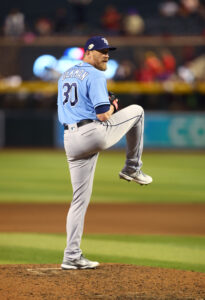
Diekman, 37, is a veteran of 12 major league seasons. The Mets would be the southpaw’s ninth club. He’s never had even average command of the strike zone (career 13.3% walk rate), but he’s a power-armed lefty who misses bats in droves and has managed to overcome his penchant for walks more often than not.
The 2023 season was an uneven one for Diekman, who opened the year with an ugly 11 1/3 innings in the White Sox bullpen before (like so many pitchers before him) making a 180-degree turnaround upon signing with the Rays. Diekman was rocked for 10 runs on 11 hits and 13 walks with the ChiSox but gave the Rays 45 1/3 frames of 2.18 ERA ball with a 28.6% strikeout rate and 13.5% walk rate. He averaged 95.7 mph on his heater during his time with Tampa Bay — right in line with the 95.6 mph he averaged over the seven seasons prior.
While Diekman has had some rough seasons interspersed throughout his mostly solid career, he’s never posted an ERA of 5.00 or higher and has kept his earned run average south of 4.00 in eight of his dozen MLB campaigns. On the whole, he sports a lifetime 3.82 ERA in 570 1/3 MLB innings, including a 3.67 ERA over the past four years.
Tampa Bay changed up his pitch usage a bit, as Diekman threw his changeup at a career-high 15.8% clip as a Ray. He’d previously never thrown the pitch at more than a 7% clip in any full season. In fact, Diekman entered the season with just 149 total changeups thrown in his career … before throwing 137 of them in 2023 alone. The results were strong: opponents batted just .176/.222/.294 in the 36 plate appearances that Diekman finished off with a changeup. His slider and four-seamer remained effective as ever; opponents hit just .161 and .175 while slugging .290 and .228 against that pair of offerings, respectively.
Lack of command has been the primary flaw holding Diekman back from standing as one of the game’s elite lefties. At age 37, that’s unlikely to change. But even with a bloated walk rate, the quality of Diekman’s pitches should continue to produce plenty of whiffs and a deluge of weak contact. Opponents have averaged a below-average 87.8 mph off the bat against him in his MLB career and hit just 33.6% of batted balls at 95 mph or greater. In 2023, opponents mustered a pitiful 84.6 mph average exit velocity and similarly feeble 26.4% hard-hit rate against him.
The Mets signed a quartet of free agent relievers to major league contracts before talks with Diekman gained traction, adding Jorge Lopez, Michael Tonkin, Austin Adams and, most recently, Adam Ottavino on one-year deals. That group figures to join returning veterans Edwin Diaz, Brooks Raley and Drew Smith in a revamped Mets bullpen.
One thing the Mets lack in the bullpen, following that slate of veteran additions, is flexibility. None of Diaz, Raley, Smith, Ottavino, Diekman, Lopez, Tonkin or Adams can be optioned to the minors, nor can Sean Reid-Foley or Phil Bickford. That sets the stage for the Mets to further shake up the relief mix, either by designating someone like Reid-Foley or Bickford for assignment or perhaps finding a trade partner for one or both of those holdovers.
The Mets are already in the highest tier of luxury taxation and are entering their third straight season exceeding the tax threshold. As such, every dollar they spend at this stage of the offseason is taxed at a 110% rate. Effectively, they’ll pay just over double whatever Diekman’s salary is in order to add him to the bullpen for the upcoming season. The Mets had a projected $309MM payroll and $322MM of luxury obligations even without Diekman, per Roster Resource. Both numbers jump even further north by $4MM.
Will Sammon and Ken Rosenthal of the Athletic first reported the Mets and Diekman were nearing an agreement. SNY’s Andy Martino reported the Mets had offered a one-year deal with a vesting option at around $4-5MM annually. Martino confirmed the sides had an agreement. MLB.com’s Anthony DiComo reported the $4MM guarantee, while Joel Sherman of the New York Post reported the $4MM option that vested with 58 appearances.
Red Sox Acquire Tyler Heineman, Designate Max Castillo
The Red Sox have acquired catcher Tyler Heineman from the Mets, per announcements from both teams. The latter club, who designated Heineman for assignment earlier this week, receive cash considerations in return. The Sox designated right-hander Max Castillo for assignment in a corresponding move.
Heineman, 33, is a switch-hitting catcher with part-time exposure in the big leagues since his 2019 debut. He has appeared in 104 games over four campaigns combined, walking in just 7.1% of his plate appearances but striking out at just a 12.4% clip. He has just one home run in that time, leading to a batting line of .218/.297/.282.
He finished the 2023 season on the Blue Jays’ roster but was claimed off waivers by the Mets in December. He lasted almost two months with that club before being nudged off the roster when they signed Adam Ottavino.
His major league track record is limited but he’s generally produced intriguing Triple-A results in a low-power, strikeout-dodging fashion. He’s stepped up to the plate 1,328 times at the Triple-A level and only has 23 homers in that time. But his 9.3% walk rate is fairly solid while his 15.1% strikeout rate is quite low. For reference, last year’s major league averages were 8.6% for walks and 22.7% for strikeouts. All of that has led to a line of .276/.350/.402.
Defensively, his track record is quite solid. Statcast considers him to be above average both in terms of throwing and blocking. Baseball Prospectus agrees and both outlets consider him to be a good pitch framer as well. The Sox have Connor Wong and Reese McGuire lined up to be their catching tandem in 2024, but Heineman still has one minor league option. That means he can be kept in Triple-A as depth until an injury creates a need at the big league level.
Castillo, 25 in May, has 59 2/3 innings of major league experience. He got those innings over the past two years, split between the Jays and the Royals. He has a 5.43 earned run average in that time, along with an 18.1% strikeout rate, 9.3% walk rate and 44.7% ground ball rate. He spent most of last year at Triple-A, posting an ERA of 4.58 in 116 innings at that level.
The Sox claimed him off waivers from the Royals a month ago but he’s now lost his roster spot a month later. Boston will have one week to work out a trade or try to pass him through waivers. He still has one option year remaining and could appeal to clubs looking for extra pitching depth.
Mets Sign José Rondón To Minor League Deal
The Mets have signed infielder/outfielder José Rondón to a minor league deal, as listed on his transactions tracker at MLB.com. The infielder announced the move on Instagram last week.
Rondón, 30 in March, has 169 games of major league experience, getting part-time action in four different seasons from 2016 to 2021. He bounced around from the Padres to the White Sox, Orioles and Cardinals in that time, making 380 plate appearances. He hit .216/.274/.353 in that time while playing all four infield positions, the outfield corners and even tossing an inning on the mound.
He was non-tendered by the Cardinals after that 2021 campaign and headed into the open market. In April of 2022, it was announced by Major League Baseball that Rondón was one of three players who received an 80-game suspension after testing positive for the performance-enhancing substance Boldenone.
He didn’t end up signing with an affiliated club that year, but joined the Toros de Tijuana of the Mexican League for the 2023 season. In 72 games for that club, he slashed .286/.367/.465. He then joined Leones del Caracas of the Venezuelan Professional Baseball League for winter ball, hitting .338/.413/.624 in 56 games for that club.
It appears those solid numbers in Mexico and/or the gaudy numbers in Venezuela attracted the attention of the Mets. It’s possible he’s more of an outfielder now, as that’s where he has been playing for the Leones, while the Toros only gave him brief time on the infield last year.
The Mets are set to have an outfield of Brandon Nimmo, Harrison Bader, Starling Marte and Tyrone Taylor this year, but all of them have dealt with significant injuries, either recently or in their career generally. DJ Stewart is on the roster but he’s considered a poor fielder and best suited for a designated hitter/bench bat role. Jeff McNeil could be in the outfield at some point but is slated to be the everyday second baseman for now.
To improve that depth, the Mets have signed guys like Trayce Thompson and Taylor Kohlwey to minor league deals but will now add Rondón into that mix as well. The Mets also have questions at third base, with Ronny Mauricio potentially missing the upcoming season due to a torn ACL. That leaves them with unproven younger players like Brett Baty and Mark Vientos alongside veteran utility guy Joey Wendle. If Rondón can still play the hot corner, that could be another path for him to get big league playing time if he can continue hitting the way he has been in winter ball.