
MLBPA Taking First Steps Toward Unionizing Minor League Players
In what could mark a monumental change for minor league players and for Major League Baseball alike, the Major League Baseball Players Association sent authorization cards to all minor league players late Sunday evening, wherein the minor leaguers were asked to vote on designating the MLBPA as their collective bargaining representatives. ESPN’s Joon Lee first reported that the cards had been sent out, and MLBPA executive director Tony Clark later confirmed to ESPN that the initial steps had been taken by the MLBPA. Evan Drellich of The Athletic has also taken a lengthy look at the matter. The MLBPA has since formally announced, via press release, an effort to unionize minor league players.
In the event that 30% of minor leaguers sign their authorization cards, the cards will be presented to the National Labor Relations Board as a means of displaying the substantial interest in unionization. At that point, an election would be held among minor league players. If a requisite 50% of those who vote do so in favor of the MLBPA becoming the collective bargaining arm of minor league players, the NLRB would subsequently require Major League Baseball to recognize the union. That election would be subject to the NLRB’s administrative process and could take months to advance, however.
In an email to player agents, Clark cited “poverty wages, oppressive reserve rules, discipline without due process, ever expanding off-season obligations, appropriation of intellectual property, substandard attention to player health and safety, and a chronic lack of respect for minor leaguers as a whole” as key factors for minor league players to consider when deciding whether to provide their authorization.
Clark’s email also included various financial data on recent minor league revenues, including an $864MM gross revenue from the 2019 season (prior to the Covid-19 pandemic); the recent sale of a majority stake in the Sacramento River Cats (the Giants’ Triple-A club) and their stadium for more than $90MM; and the fact that the majority of minor leagues salaries, ranging from $4800 annually in Rookie ball to about $15,400 annually in Triple-A, check in shy of the poverty line, as defined by the federal government (Twitter link via Drellich). Those salary figures are in direct contrast to MLB commissioner Rob Manfred’s recent assertion that he “rejects” the notion “that minor league players are not paid a living wage.”
Unionizing the minor leagues would be a massive undertaking for the MLBPA, which until this point has only represented the roughly 1200 players who are on Major League 40-man rosters at a given time. Expanding the union’s ranks to include the minor leagues would add more than four times that many members to the existing group. While it may also seem to present potential conflicts of interest between established players and the fledgling newcomers, an MLBPA official tells MLBTR that the union’s executive board voted “overwhelmingly” in favor of inviting minor leaguers and received no opposition on the matter. Furthermore, the proposed unionization efforts would give minor leaguers their own separate bargaining unit under the MLBPA umbrella, and any minor league CBA would be negotiated independently of the Major League CBA that was completed earlier this year.
The steps toward unionization come on the heels of a class action settlement that saw Major League Baseball pay out $185MM to more than 20,000 players, stemming from a dispute as to whether those players should be compensated for Spring Training. Major League Baseball’s antitrust exemption is also once again under a microscope, as bipartisan members of the Senate Judiciary Committee in late June called for a need to reexamine that now-century-old ruling.
Major League Baseball has taken steps in recent years to improve conditions for minor leaguers, most notably requiring teams to provide housing for their minor league players. Of course, many of those changes came only after MLB gutted the minor leagues, eliminating 42 minor league clubs in the 2020-21 offseason.
The MLBPA has been working in conjunction with Advocates For Minor Leaguers, an advocacy group whose mission statement cites a need to establish “fair pay and equitable treatment” for minor league players. “The game of baseball will be better for everyone when minor leaguers have a seat at the table,” Advocates executive director Harry Marino told ESPN.
As part of the joint initiative between the MLBPA and Advocates for Minor Leaguers, Clark and Marino announced this morning that “Each member of the Advocates for Minor Leaguers staff has resigned to take on a new role working for the MLBPA.”
“Minor Leaguers represent our game’s future and deserve wages and working conditions that befit elite athletes who entertain millions of baseball fans nationwide,” Clark said in Monday morning’s statement. “They’re an important part of our fraternity and we want to help them achieve their goals both on and off the field.”
Marlins Release Jesus Aguilar
TODAY: Aguilar cleared waivers and has been released, as per the Marlins’ MLB.com transactions page.
AUGUST 26: The Marlins have designated first baseman Jesus Aguilar for assignment, general manager Kim Ng announced to reporters (Twitter link via Jordan McPherson of the Miami Herald). All-Star Garrett Cooper is back from the injured list in a corresponding move.
Now that the trade deadline has passed, the only course of action for the Marlins will be to place Aguilar, 32, on waivers and hope that another club claims him. Given the $7.5MM guarantee on the struggling Aguilar’s 2022 contract, however, that appears quite unlikely. While Aguilar’s deal does carry a mutual option for the 2023 campaign, mutual options are rarely exercised, so teams will look at him as a pure rental.
There’s still about $1.6MM left to be paid out on the contract of Aguilar, plus a $200K buyout on that option. It’s hard to imagine a contending club dropping $1.8MM to claim a player who is hitting just .236/.286/.388 on the season as a whole — including a dismal .188/.246/.347 slash since the All-Star break. The overwhelming likelihood is that Aguilar will clear waivers and become a free agent — whether by being released or rejecting an outright assignment.
At that point, Aguilar would be free to sign a new contract with any team, and the new team would only owe him the prorated league minimum for any time spent on the MLB roster. The mutual option would no longer be a consideration, as he’ll have been released from the contract containing that clause. Aguilar would be postseason-eligible for a new club as long as he is signed (or, far less likely, claimed) prior to Sept. 1.
While a team isn’t likely to take a chance on Aguilar at the cost of his remaining salary, it stands to reason that several clubs would hold interest in signing him at the prorated league minimum. Aguilar hasn’t been himself in 2022, but as recently as 2020-21 he gave Miami a combined 726 plate appearances of .265/.336/.458 production, smacking 30 home runs and 33 doubles with an 18.3% strikeout rate against a solid 9.5% walk rate.
Aguilar doesn’t carry a significant platoon split, so at his best, he’s an above-average, everyday slugger with 30-homer pop … he just hasn’t been close to his best in 2022. His 23.2% strikeout rate is the highest it’s been since 2018, and Aguilar has seen his average exit velocity (87.7 mph) and hard-hit rate (35.4%) dip to career-worst levels in 2022.
Aguilar has generally graded out as a solid defender at first base, but he’s seen his typically solid grades take a step back in 2022, clocking in at -4 Defensive Runs Saved, a -1.4 Ultimate Zone Rating and zero Outs Above Average. He’s limited to first or designated hitter for the most part, with the lone exception being a few emergency appearances across the diamond at the hot corner over the years (27 career innings, including five in 2022).
Assuming Aguilar indeed clears waivers, teams in need of some offensive help at first base or designated hitter — or just a right-handed bat off the bench — could take a low-cost look in hopes of turning his season around. For the Marlins, they’ll use the remainder of the year to give a larger look to Lewin Diaz, who once ranked among the organization’s top prospects but has seen his stock tumble in recent seasons. The aforementioned Cooper also figures to see additional time in the lineup.
Mariners Sign Julio Rodriguez To Extension
The Mariners have locked up one of the sport’s brightest young stars on a record-setting contract, announcing late Friday night they’ve signed Rookie of the Year candidate Julio Rodriguez to an extension. The deal, which begins this season, guarantees him $210MM over 12 years and contains both player and club options that can extend the length of the contract and push the total value as high as $470MM. Rodriguez, an Octagon client, also reportedly receives a full no-trade clause.
It is one of the more complex contracts agreed upon in major league history. According to reports from ESPN’s Jeff Passan and Ken Rosenthal of the Athletic, Rodriguez will make $120MM through 2029. Per Rosenthal, that takes the form of a $15MM signing bonus to be paid up front, with $105MM to be distributed between 2023-29. After the contract’s seventh year (2028), the Mariners must decide whether to effectively re-extend Rodriguez for either eight or ten years, with the size and value of that long-term “club option” dependent on how Rodriguez finishes in MVP voting.
At minimum, Seattle will be deciding on whether to extend the contract by eight years and another $200MM. That figure could escalate as follows, depending on Rodriguez’s finishes in MVP balloting over the next seven years:
- $240MM over eight years with two or three top ten finishes
- $260MM over eight years with four top ten finishes
- $280MM over eight years if he wins an MVP and finishes in the top five once more or finishes in the top five of MVP balloting on three occasions
- $350MM over ten years if he wins two MVP awards or finishes among the top five in balloting on four occasions
In the event Rodriguez hits that highest threshold and the Mariners exercise the option, the contract would max out at 18 years and $470MM in total value.
If the Mariners do not exercise their multi-year option after Year 7, Rodriguez will have a five-year, $90MM player option he can exercise after Year 8 of the contract. (That option value could escalate as high as $125.5MM based on his finishes in Silver Slugger voting and All-Star appearances). That $90MM figure is considered guaranteed money, as is the case with all player options. Between the $120MM he’ll be paid over the next eight seasons and the $90MM base value of the player option, Rodriguez’s guarantee lands at the aforementioned $210MM. There is, of course, a scenario where the Mariners do not pick up their 8- to 10-year “club option,” and Rodriguez also declines his five-year “player option,” which would then allow him to reach free agency after collecting $120MM over eight years, when he’ll be heading into his age-30 campaign.
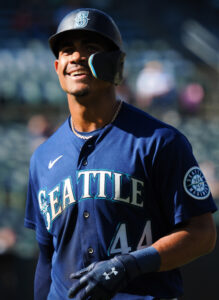
Rodriguez, 21, broke camp with the Mariners this season and, after a rough couple of weeks to begin the year, burst into immediate stardom and has established himself as one of the frontrunners for Rookie of the Year honors. He’s currently hitting .269/.328/.471 with 20 home runs, 19 doubles, three triples and 23 steals (in 29 tries) — plus above-average defensive contributions in center field.
Those numbers are at least slightly skewed by a poor start to the year in which Rodriguez batted .136/.208/.159 with a 45% strikeout rate. Dating back to April 22, Rodriguez has mashed at a .285/.342/.508 clip. That production is about 46% better than league average after weighting for park and league, by measure of wRC+, which places him in a three-way tie with Alex Bregman and the also recently-extended Austin Riley for 12th-best among qualified Major League hitters. Rodriguez also ranks 13th in the Majors in both average exit velocity (92 mph) and hard-hit rate (49.6%) in that time, and his 14.9% barrel rate is MLB’s ninth-best mark.
Add in the fact that he’s done all of this at 21 years of age and after skipping the Triple-A level entirely, and his rookie season becomes all the more remarkable. Given that youth and lack of upper-minors seasoning, it’s quite possible that even though Rodriguez already ranks among the game’s best hitters, we’ve yet to see the best he has to offer.
From a defensive standpoint, Rodriguez has more than held his own in center field this season, turning in positive marks in Defensive Runs Saved (2), Ultimate Zone Rating (0.3) and Outs Above Average (5). Many scouting reports penned before his MLB debut suggested that as Rodriguez ages and continues to fill out, he could be destined for a corner outfield slot, but given his 70- or even 80-grade raw power and the solid work he’s flashed in center this season, he’ll have both the bat and likely the defensive chops to be an above-average contributor in right or left field.
The $210MM guarantee will give Rodriguez the record for largest contract ever signed by a player with under a year of Major League service time. That distinction currently belongs to Rays shortstop Wander Franco, who inked an 11-year, $182MM extension last November.
Rodriguez will topple that mark with ease, although it’s not an apples-to-apples comparison. Franco wasn’t promoted until midseason and inked his deal in the winter, when the Rays had six full seasons of club control left over him. Because Rodriguez made the Opening Day roster, he’ll get a full year of service in 2022 and would “only” have had five additional years of club control remaining. In that respect, he could technically be considered more of a one-plus player (between one and two years of service time), although even when viewing the contract through that lens, it’s still a record-setting agreement; Ke’Bryan Hayes‘ $70MM extension in Pittsburgh was the previous record for a player with between one and two years of service.
Regardless of which service bracket one thinks more aptly applies to Rodriguez, this new deal now stands as the largest contract ever promised to a player with fewer than two years of Major League service time. In that aspect, Rodriguez and the Major League Baseball Players Association are surely pleased to see the precedent for young, superstar extensions moved even further forward.
All that said, there’s still potential for the contract to be quite favorable for the Mariners. Rodriguez would’ve likely earned near the league minimum in salary over the next two seasons (plus any payouts from the newly collectively bargained bonus pool for pre-arbitration players). A player with his upside and early dominance would likely have done quite well in arbitration, and while we can never know exactly how much he might’ve earned through that process, arbitration is generally based on precedent. Looking for recent comparables, Mookie Betts secured $57.5MM for his three arbitration seasons. If we put Rodriguez into that broad vicinity, his remaining five years of club control might have netted him somewhere in the range of $60MM — perhaps a few million more if he’d taken home an MVP Award and/or pushed the Betts precedent a bit further.
Rodriguez will be paid $15MM on average over the next eight seasons, with at least two free agent seasons bought out. That obviously pales in comparison to what he could’ve earned on the open market had he gone year-to-year and hit the free-agent market in advance of his age-27 season, and the Mariners will have an opportunity to keep him from hitting free agency at any point in his prime. That risk-reward tradeoff is the nature of early contract extensions, of course. There’s obviously ample risk of injury or downturn in performance for Rodriguez, all of which is baked into the relative discount rate for those open-market seasons.
From a team payroll vantage point, there’s ample room for Seattle to make a commitment of this nature. A significant portion of the team’s recent rebuild was dedicated to clearing long-term clutter from the books — e.g., the Robinson Cano trade — and the team’s long-term commitments are now rather minimal. Left-hander Robbie Ray is signed through the 2026 season, as is shortstop J.P. Crawford, but they’ll combine for just $37MM at that point. That would’ve only been Rodriguez’s fifth big league season, so the salaries on his contract will not quite have escalated to their maximum levels.
Looking more short-term, the books are also still accommodating. The Mariners, who’ll see veterans Mitch Haniger and Adam Frazier reach free agency at season’s end, had just over $63MM in guaranteed money on the 2023 payroll prior to this contract. That number doesn’t include an $8MM option for righty Chris Flexen, nor does it include a handful of arbitration raises: Luis Castillo (earning $7.35MM this season), Diego Castillo ($2.315MM), Paul Sewald ($1.735MM), Ty France (pre-arb) and Erik Swanson (pre-arb).
It’s a momentous day in Mariners history, one that firmly drives home the organization’s “win-now” mentality as it inches toward a postseason berth that would smash a two-decade playoff drought — currently the longest in major North American professional sports. There’s risk for both parties, but the contract is a continuation of the ever-growing trend of extending young stars at nine-figure rates that guarantee a player’s entire prime. The contract also locks Rodriguez down as the new face of Mariners baseball for the next decade-plus, ensuring them a charismatic, marketable star around whom to both build the roster and sell the product to the fanbase.
Jesse Sanchez of MLB.com first reported that the two sides were nearing an extension worth more than $200MM guaranteed and as much as $450MM in total value. ESPN’s Jeff Passan reported the contract length and exact guarantee. USA Today’s Bob Nightengale reported the agreement was in place. Passan and provided specifics on the financials. Rosenthal also reported the deal contained a full no-trade clause.
Image courtesy of USA Today Sports.
Phillies Activate Bryce Harper
The Phillies have reinstated reigning National League MVP Bryce Harper from the 60-day injured list, tweets Matt Gelb of The Athletic. Infielder/outfielder Yairo Munoz was optioned to Triple-A Lehigh Valley to open a spot on the active roster, while fellow outfielder Simon Muzziotti was recalled from Triple-A and placed directly on the 60-day injured list in order to clear a spot on the 40-man roster. Philadelphia also recalled southpaw Bailey Falter from Lehigh Valley to start tonight’s game.
Harper is hitting cleanup in today’s Phillies lineup and serving as their designated hitter — a role he figures to occupy down the stretch as he continues to nurse a ligament tear in his throwing elbow. That, of course, is not the injury that’s held Harper out for the past two months. Harper was playing through the elbow issue and serving as a highly productive DH before suffering a fractured thumb upon being hit by a pitch. He required surgery to address the issue and has been out of action since June.
The Phils weathered that absence extremely well, and they find themselves in strong playoff position as a result. Philadelphia heads into tonight’s game with a 70-55 record that places them firmly in possession of the National League’s second Wild Card spot. They’ll now welcome back Harper, owner of a massive .318/.385/.599 showing through 275 plate appearances, to the lineup for the season’s final five weeks. The aforementioned elbow ligament tear will keep Harper at DH, at least for the time being, but Philadelphia is no doubt thrilled to get his bat back in the lineup.
As for Muziotti, his 2022 season is over due to a torn patellar tendon in his right knee. The 23-year-old, one of the better outfield prospects in the organization, made his MLB debut this April and appeared in nine games. He spent the majority of the year with Double-A Reading, hitting .259/.339/.455 through 38 games. He’ll be paid at the prorated $700K MLB minimum rate for the rest of this season and collect around five weeks of big league service time while looking ahead to 2023.
Rays Extend Tyler Glasnow Through 2024
The Rays announced agreement Friday on a contract extension with Tyler Glasnow that will run through the 2024 season. The deal reportedly pays the Wasserman client $5.35MM in 2023, his final season of arbitration-eligibility, and jumps to a hefty $25MM in 2024. It also contains potential bonuses dependent upon Glasnow’s finishes in Cy Young balloting over the next two seasons.
Last year, the now-29-year-old Glasnow looked well on his way to establishing himself as one of the sport’s most dominant arms. Long a top prospect in the Pirates organization, Glasnow was infamously traded to the Rays, alongside Austin Meadows and Shane Baz, in exchange for Chris Archer — one of the most lopsided deals in recent memory.
He’s spent parts of four seasons with Tampa Bay — 2018-21 — and posted a combined 3.10 ERA and 3.19 FIP with 34.3% strikeout rate against a 7.9% walk rate. That includes a relatively slow start, as the big righty managed a 4.20 ERA through 11 appearances down the stretch after the 2018 deadline deal. Since the calendar flipped to 2019, Glasnow has been an excellent performer. He posted a microscopic 1.78 ERA across 60 2/3 innings in 2019, striking out a third of opponents while inducing grounders on over half the batted balls against him. While his ERA jumped to 4.08 during the shortened 2020 campaign, Glasnow punched out an even more impressive 38.2% of batters faced that season.
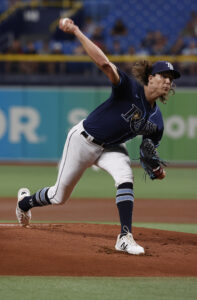
Everything seemed to be coming together last year, Glasnow’s age-27 campaign. He’d been on a potential Cy Young trajectory, starting 14 games and working to a 2.66 ERA over 88 frames through mid-June. He paired that with an elite 36.2% strikeout rate while generating swinging strikes on more than 17% of his offerings, but he blew out his elbow and was forced to undergo Tommy John surgery. That procedure ended his season and led to some speculation the payroll-conscious Rays could consider trading him last offseason, but there’s no indication they ever came close to doing so.
Glasnow maintained over the winter that he hoped to stick with Tampa Bay. He reiterated that sentiment when chatting with Marc Topkin of the Tampa Bay Times this afternoon, saying he’d much preferred to stay in the organization. The Rays held onto him throughout his rehab process, and the former fifth-rounder could make his return to the mound later this season. Glasnow told Topkin he’s headed to Triple-A Durham to throw some live batting practice sessions and could soon embark on a minor league rehab assignment.
It’s a bold move for the Rays, whom Topkin notes have never previously paid a player a $25MM annual salary (although franchise shortstop Wander Franco will reach that mark in 2028 under the terms of the 11-year extension he signed last November). Next year’s $5.35MM figure represents only a marginal bump over this year’s $5.1MM mark, reflecting the fact that he hasn’t pitched all season and wouldn’t have been in line for a notable arbitration raise. It’s the 2024 commitment to buy out Glasnow’s first free agent year that comes as a surprise.
It’s easy to see both the high risk and reward of the move from Tampa Bay’s perspective. If Glasnow picks up right where he’d left off pre-surgery, he’ll immediately form a fearsome pairing with AL All-Star starter Shane McClanahan at the top of the rotation. It’s not uncommon for ace-caliber hurlers to surpass $30MM annually over a multi-year free agent investment, one the Rays seem unlikely to make. Even factoring in the potential bonuses, a $25MM base salary in 2024 would be more than reasonable if Glasnow pitches as he did in 2019-21, and the team isn’t on the hook for any longer-term commitment. It’s a match for the guarantee the Astros gave Justin Verlander last winter coming off two seasons largely lost to a Tommy John surgery of his own. Verlander has returned to the top of the rotation and pitched exceptionally, and the Astros have been handsomely rewarded for their investment.
At the same time, there’s no sugarcoating the downside for Tampa Bay if Glasnow suffers an injury setback or performance regression. The Rays have never opened a season with a player payroll higher than this year’s estimated $83.9MM tab, per Cot’s Baseball Contracts. Presumably, owner Stuart Sternberg is willing to push that number upwards over the coming two seasons, but it remains to be seen whether they’ll eclipse nine figures by that point. Glasnow’s deal could wind up counting for around one-quarter of the team’s player expenditures, and the club also has fairly notable salaries for Manuel Margot ($10MM) and Brandon Lowe ($8.75MM) for that season. Players like McClanahan, Randy Arozarena and Drew Rasmussen will have reached arbitration-eligibility by then as well.
It’s a bold strike from an organization that doesn’t customarily make this kind of financial investment. If all goes well, the Rays will get an extra season of ace-level performance for a price below the free agent market value. Glasnow, meanwhile, locks in a fair amount of financial security as he wraps up his Tommy John rehab. He tacks on another year with a club for which he’s clearly comfortable playing, and he could still land a multi-year deal once he hits the open market in advance of his age-31 season. There’s risk for the Rays in committing a sizable portion of their expected 2024 payroll to a player who hasn’t thrown an MLB pitch in 14 months, but they’re clearly confident Glasnow will be no worse for wear than he was before he went under the knife.
Marc Topkin of the Tampa Bay Times first reported the Rays and Glasnow were in agreement on an extension that ran through 2024. Jeff Passan of ESPN was first to report the salary terms. Ken Rosenthal of the Athletic noted the presence of “significant” bonuses based on Cy Young finishes.
Image courtesy of USA Today Sports.
James Paxton Diagnosed With Grade 2 Lat Tear, Will Not Pitch This Season
Red Sox left-hander James Paxton has been diagnosed with a Grade 2 tear in his left lat muscle and will be shut down for the season, manager Alex Cora informed reporters (including Pete Abraham of the Boston Globe). It’ll go down as a completely lost season for the left-hander, who hasn’t pitched in a big league game since April 2021.
Paxton has dealt with numerous injuries throughout his career. He’s spent time on the IL in every year since 2014, including an extended absence for a left lat strain that season. Paxton has also been plagued by hand, forearm, chest, knee and elbow concerns. The arm injuries, in particular, have proven problematic over the past few years. The southpaw missed most of the shortened 2020 campaign trying to rehab from a flexor strain in his forearm. While he avoided undergoing surgery at the time, he blew out in the second inning of his first start the following year and required Tommy John surgery.
That procedure ended Paxton’s reunion tour with the Mariners last year before it got far off the ground, but the Red Sox nevertheless signed him to a $10MM guarantee this past offseason. That rather complex arrangement paid him a $6MM salary for this season and contained a pair of successive $13MM club options — essentially a two-year, $26MM deal — for the Sox to decide upon in conjunction this winter. If the team declines the options, Paxton would receive a $4MM player option for 2023 alone.
On the heels of a third straight injury-wrecked season, there’s essentially no chance the Red Sox commit $13MM salaries for the upcoming two years. It seems likely that Paxton will accept his $4MM option, although there’s at least a small possibility he foregoes that figure in search of an incentive-laden pact on the open market. If Paxton declines the player option, the Sox would’ve committed him $6MM for no return on their investment.
That’s not to say it was an entirely illogical bet for chief baseball officer Chaim Bloom and his staff to take last winter. At the time of Paxton’s signing in December, the club anticipated he’d contribute for the second half and a possible playoff push. Despite a minor delay as he dealt with elbow soreness in May, he indeed seemed on track to get on the mound for the season’s final month. Paxton had ramped up a throwing program and begun a rehab assignment last Thursday, but he faced just two batters before suffering the lat injury.
It has now been three years since Paxton was healthy, but he was an effective starter for the Yankees during his last extended stretch of action. He made 29 appearances in 2019, tossing 150 2/3 frames with a 3.82 ERA and an excellent 29.4% strikeout rate. A trio of teams (New York, Seattle and Boston) have taken successive shots to see if he can replicate that well above-average production in the years since then, but the series of injuries has unfortunately kept that from happening.
Boston is facing a fair bit of potential turnover in the rotation this offseason. Paxton has the aforementioned dual team/player options, while Nathan Eovaldi, Michael Wacha and Rich Hill will all be free agents. Chris Sale is under contract through 2024 but coming off another injury-plagued season of his own. Aside from Nick Pivetta — whose 4.24 ERA this season is a career-low — there isn’t much rotation certainty moving forward. Bloom and his staff will have their work cut out for them in overhauling much of that group, regardless of whether Paxton elects to return.
Phillies To Activate Bryce Harper From Injured List On Friday
Reigning NL MVP Bryce Harper will return to the Phillies’ active roster prior to their game with the Pirates on Friday, Philadelphia manager Rob Thomson told reporters (including MLB.com’s Todd Zelecki). The initial plan for Harper’s minor league rehab assignment planned for activation from the 60-day injured list on Monday, but Harper will instead return a bit earlier, as suggested by MLB Network’s Jon Morosi earlier today.
The Phillies first placed Harper on the 10-day IL due to his fractured left thumb back on June 26, so he’ll end up missing only slightly beyond the 60-day minimum. Harper has been making steady progress with his recovery ever since undergoing thumb surgery, and he will now again get to contribute to a Phillies team that has become one of baseball’s hottest teams.
The firing of Joe Girardi and Thomson’s installation as interim manager was the obvious turning point in Philadelphia’s season, as the Phils went 22-29 under Girardi and are currently 47-26 under Thomson. Not even losing one of the sport’s best hitters slowed down the Phillies, since they have a 31-20 record since Harper was sidelined.
Harper’s thumb was broken by a Blake Snell pitch on June 25, interrupting an unusual but still highly successful season for the 29-year-old. Due to a small UCL tear in his right elbow, Harper hasn’t played a game in the field since April 16, but his bat hasn’t been impacted by his new role as a full-time DH. Harper has 21 home runs and a .318/.385/.599 slash line over his first 275 plate appearances, with that .985 OPS standing as the fourth-highest of Harper’s career.
2022 will go down as another Harper season cut short by injury, but that will be a footnote if he is able to help the Phillies reach their first postseason since 2011. Philadelphia holds the second NL wild card slot, well back of the Braves for the first wild card but with a 3.5-game cushion over the Brewers (the top team outside the playoff picture).
Yankees To Place Nestor Cortes On 15-Day Injured List
The Yankees will place left-hander Nestor Cortes on the 15-day injured list prior to tomorrow’s game, according to The Athletic’s Lindsey Adler. Cortes is suffering from a groin injury. As reported earlier today, New York was preparing to place a then-unknown pitcher on the IL to make room for the promotion of minor league right-hander Greg Weissert.
While any pitching injury would’ve been a setback, losing Cortes for any amount of time is a tough blow to the Bronx Bombers. “Nasty Nestor” has been arguably the Yankees’ best starter this season, and one of the better pitchers in all of baseball. After surprisingly emerging as a rotation stalwart in 2021, Cortes has kept on rolling, posting a 2.68 ERA and above-average strikeout (25.9%) and walk (5.8%) rates over 131 innings of work. Despite a low-velocity four-seamer, Cortes’ fastball has been extremely effective, and his cutter isn’t far behind in terms of sheer effectiveness.
Though Cortes’ 131 innings is a new career high for the 27-year old over any pro season, there hasn’t been much sign that Cortes is slowing down, and he was expected to be a big weapon for the Yankees in October. This 15-day IL stint could perhaps serve as a bit of break in terms of keeping Cortes’ arm fresh, though naturally his groin issue is now a new concern. The severity of the injury or a possible timeline for Cortes’ return isn’t yet known.
New York enjoyed a great run of pitching health over the first half of the season, but several injuries have cropped up in recent weeks. The bullpen has taken the brunt of the injury woes, but the rotation hasn’t been immune, with Luis Severino out until mid-September due to a lat strain and now Cortes’ injury. The Yankees acquired Frankie Montas from the A’s at the deadline but also moved Jordan Montgomery to the Cardinals in another trade, plus Domingo German has been a little inconsistent (if generally solid) since making his season debut in July, after shoulder problems kept him on the sidelines.
Clarke Schmidt was recently called back up to the active roster, and the former first-rounder seems like the probable candidate to step into Cortes’ rotation spot. Over 22 games and 45 2/3 career innings at the MLB level in 2020-22, Schmidt has only made three starts, but the Yankees have mostly been using him in long relief this season and were stretching him out at Triple-A.
Nationals To Promote Cade Cavalli
The Nationals are calling up top pitching prospect Cade Cavalli for his Major League debut on Friday, per a club announcement. Grant Paulsen of 106.7 FM The Fan first reported Cavalli would be getting the call to the big leagues. The 2020 first-rounder will need to have his contract formally selected to the Major League roster before Friday’s game.
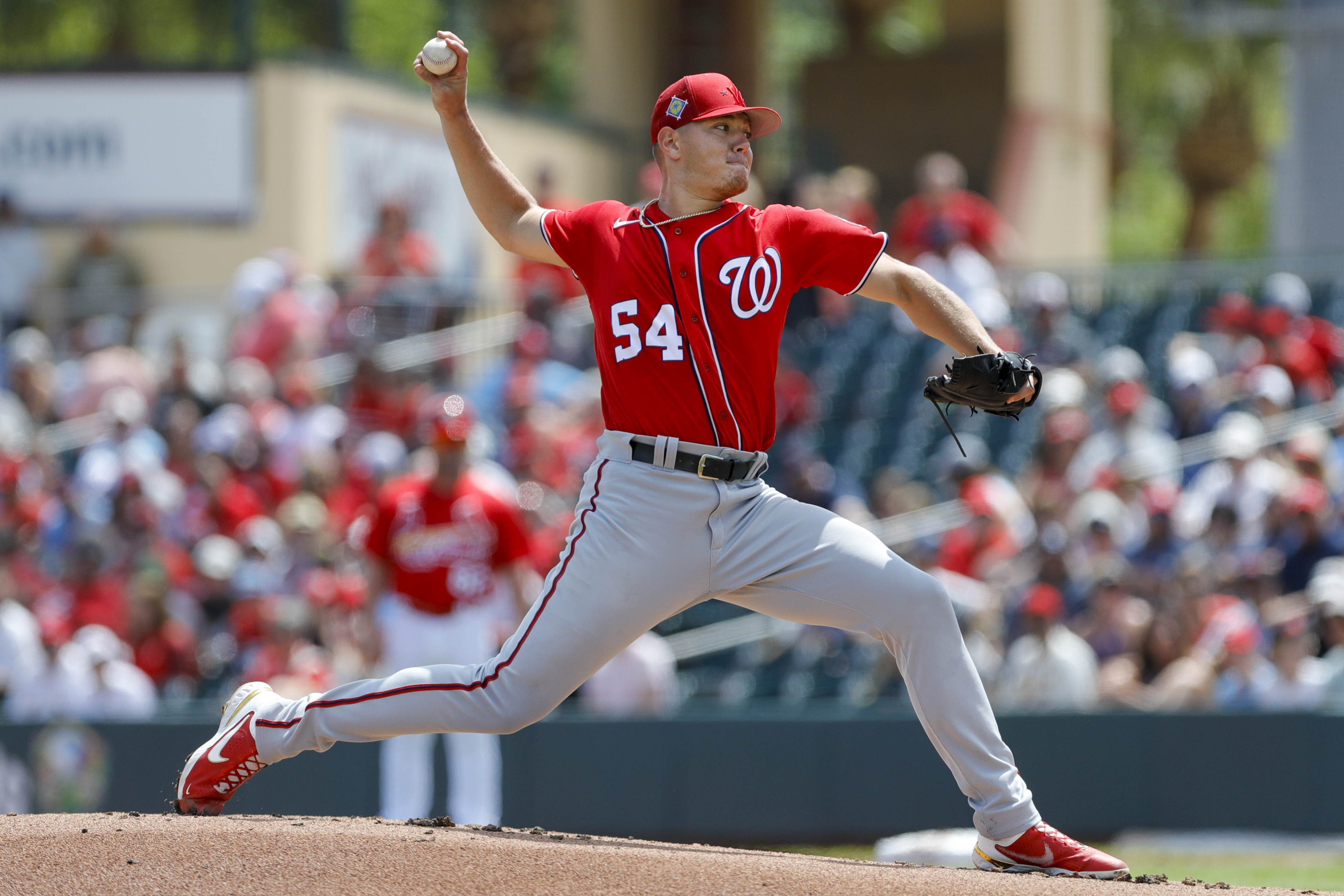
Cavalli, 24, was the No. 22 overall selection in 2020. The Oklahoma native and former Sooner star has enjoyed a solid season in Triple-A Rochester, where he’s notched a 3.71 ERA with a 25.9% strikeout rate, a 9.7% walk rate and a 43.1% grounder rate. Cavalli has gotten more comfortable in Triple-A and gotten stronger as the season wears on; after some rocky outings throughout his first 13 trips to the hill, he’s now rattled off a 1.47 ERA with a 43-to-12 K/BB ratio (29.7 K%, 8.7% BB%) in his past seven starts — a total of 36 1/3 innings.
The 6’4″, 240-pound Cavalli, in addition to his lofty draft status, currently ranks as one of the sport’s top pitching prospects. He checks in at No. 20 on FanGraphs’ most recent prospect rankings and is also featured prominently on the latest leaguewide lists from Baseball Prospectus (No. 29), Baseball America (No. 52) and MLB.com (No. 58).
Cavalli made the Futures Game roster in each of the past two seasons, though he was a late scratch from this year’s game due to a blister issue on his pitching hand. Fans who tuned into the 2021 game saw Cavalli touch 102 mph on the radar gun with a powerful heater that generally draws 70 grades on the 20-80 scale. Command issues, stemming in part from a violent delivery that gives some scouts concerns he’ll ultimately move to the bullpen, have been the big knock on Cavalli. He also works with a slider, curveball and changeup, each drawing praise as anywhere from an above-average to potentially plus pitch. Eric Longenhagen of FanGraphs writes in his scouting report that while there’s relief risk, “…if things click, Cavalli is going to be a monster.”
For the Nats, the hope is that Cavalli can achieve that top-of-the-rotation ceiling and join left-hander MacKenzie Gore and righty Josiah Gray as the nucleus of the team’s rotation for years to come. Because he’s being called up this late in the season, Cavalli can’t earn a full year of Major League service time and is also well past the point at which Super Two status is attainable. That means he’ll be controllable for six more seasons beyond this one — all the way through 2028 — and won’t be eligible to reach arbitration until after 2025 season. Of course, future demotions back to the minors could push back either of those trajectories.
Arte Moreno Exploring Possible Sale Of Angels
In a news release, the Angels ownership group announced that it is considering selling the team, and will start to explore a possible sale along with Galatioto Sports Partners (who have been retained as financial advisors during the process).
“It has been a great honor and privilege to own the Angels for 20 seasons,” owner Arte Moreno in the statement. “As an Organization, we have worked to provide our fans an affordable and family-friendly ballpark experience while fielding competitive lineups which includes some of the game’s all-time greatest players.”
“Although this difficult decision was entirely our choice and deserved a great deal of thoughtful consideration, my family and I have ultimately come to the conclusion that now is the time. Throughout this process, we will continue to run the franchise in the best interest of our fans, employees, players, and business partners.”
While any number of factors may have weighed into the Moreno family’s thought process, it was less than three months ago that Anaheim’s city council ruled against a long-gestating deal that would have seen Moreno’s management group purchase Angel Stadium and the entire 150-acre property around the ballpark. Moreno’s group was planning to develop the area into a multi-purpose residential and commercial space, similar to other “ballpark village” developments that have become common around both newer baseball stadiums and other venues in other sports.
However, the tentative agreement between Moreno and the city fell apart, in large part due to an ongoing federal investigation concerning alleged corruption, violations of state laws, and insider information. Former Anaheim mayor Harry Sidhu resigned his position, and the city council voted to overturn the Angel Stadium deal entirely in the wake of the scandal.
Though the stadium controversy led to fresh questions about the franchise’s future in Anaheim, it now seems like Moreno himself will be walking away from the Angels entirely. Moreno originally bought the team in April 2003 for a price of $184MM, taking over operations from the Walt Disney Company in the wake of the Angels’ 2002 World Series championship season.
That 2002 title still stands as the franchise’s lone championship, despite Moreno’s efforts to remake the Angels into a big-spending perpetual contender. Under Moreno’s stewardship, the Halos have regularly been at least a top-10 payroll team, even if Moreno’s willingness to spend didn’t lead to a willingness to cross the luxury tax threshold. (2004 was the only season the Angels ever made a luxury tax payment.)
The Angels reached the postseason five times between 2004-09, though they won only two playoff series and didn’t advance beyond the ALCS. The regular trips to October soon stopped, as an AL West title in 2014 (and a three-game sweep at the hands of the Royals in the ALDS) marked the Angels’ most recent postseason appearance. After winning 85 games in 2015, Los Angeles has had six consecutive losing seasons, with the struggling 2022 squad on its way to making it seven straight years of sub-.500 baseball.
As Moreno’s statement noted, “some of the game’s all-time greatest players” have worn an Angels uniform in the last 20 seasons, including the likes of Mike Trout, Albert Pujols, Vladimir Guerrero, and Shohei Ohtani. Despite these and other talents, the Angels simply haven’t been able to break through due to a host of other ill-advised acquisitions. While Moreno was willing to spend, this aggressiveness manifested itself in many major investments that simply didn’t pan out — i.e. Josh Hamilton, Justin Upton, Vernon Wells, Gary Matthews Jr., Zack Cozart, and (to date) Anthony Rendon.
Pujols’ ten-year, $240MM free agent deal is probably the defining transaction of Moreno’s ownership, and unfortunately symbolic of the Angels’ last decade of struggles. While Pujols was still an elite player heading into the 2012 season, giving such a major contract to a first baseman entering his age-32 season was seen as a risk, and those fears ended up being warranted. Pujols had a few good seasons in Anaheim, but injuries and the normal aging curve made him far less productive than during his prime years with the Cardinals.
Responsibility for these signings ultimately fell to Moreno himself, who was widely known to be far more involved in baseball operations than the average owner. The Angels have had five different general managers during Moreno’s tenure, with this revolving door reflective of Moreno’s lack of patience. As well, the Angels haven’t had much of a minor league pipeline in place to build around these high-priced acquisitions, as the Angels have routinely traded prospects and missed on several draft picks.
Trout is the major exception, of course, but the Angels haven’t been able to capitalize on having a homegrown prospect develop into a legendary player. Signing Ohtani was another huge moment for the organization, and while injuries have largely kept Trout and Ohtani from seeing a lot of time together in the same lineup, it still seems hard to believe that a team with two generational players hasn’t been able to even crack the .500 mark, let alone contend in October. Ohtani is a free agent after the 2023 season, and his future with the Angels will certainly be a major story over the next year-plus, with an ownership change now adding another intriguing wrinkle.
Major League Baseball now has two franchises known to be for sale, as the Lerner family is also widely expected to sell the Nationals. It is possible that any bidders for the Nats might also look into buying the Angels, and it’s safe to assume that either franchise will sell for at least $2.5 billion. The Angels’ proximity within the greater Los Angeles area could mean a higher price tag, though it also remains to be seen if the organization will necessarily remain in Anaheim.
As per the team’s Angel Stadium lease, the Angels are bound to their ballpark through 2029, with a club option to extend that lease through the 2038 season. While the Halos aren’t going anywhere in the short term, at least, a new owner might have designs on moving the team elsewhere. Conversely, a new owner might represent a new beginning for the Angels’ future in Anaheim, potentially a fresh start on talks about ballpark redevelopment, and perhaps even another name change. It’s probably safe to say that the old “Los Angeles Angels of Anaheim” mouthful will remain a thing of the past, but the club could also return to the “Anaheim Angels” moniker rather than being tied to Los Angeles.