
Ohtani: “No (Extension) Talks Yet” With Angels
Shohei Ohtani is coming off an MVP-winning season, the kind of showing Angels fans dreamed of when he chose to sign in Anaheim during his highly-publicized posting process over the 2017-18 offseason. It’s widely expected the Angels will try to work out a long-term deal with the two-way star, but those discussions didn’t get underway prior to the lockout.
Ohtani tells Sam Blum of the Athletic (via an interpreter) the team and his representatives at CAA Baseball have had “no talks yet” regarding an extension. Last October, the 27-year-old expressed openness to a long-term deal. He didn’t go into detail regarding the chances of eventually signing an extension when speaking with Blum, instead noting that he’s “in the second year of my two-year deal coming up this season” and “just trying to complete that last year of the two-year contract.”
As Ohtani noted, he signed a two-year contract last February that guaranteed him a total of $8.5MM to avoid arbitration through 2022. He’ll make $5.5MM this year and is scheduled to go through arbitration a final time before reaching free agency two seasons from now. Ohtani would be entering his age-29 season during his trip to the open market. That’s relatively young for a free agent, setting him up for a megadeal if he stays healthy and continues to perform at an elite level.
The parameters of a potential Ohtani extension are essentially impossible to predict. There are, of course, no contractual precedents for players with his skillset. Ohtani’s coming off a .257/.372/.592 showing with 46 home runs and 26 stolen bases. That overall offensive output checked in 52 percentage points above the league average by measure of wRC+, the fifth-highest mark among 135 batters with 500 or more plate appearances. While he didn’t perform particularly well in the abbreviated 2020 season, Ohtani has a wRC+ of 120 or better in his other three big league campaigns.
In addition to that middle-of-the-order offense, Ohtani has flashed at least middle-of-the-rotation upside. He’s worked 183 2/3 innings across 35 MLB starts, posting a 3.53 ERA/3.75 SIERA with a very strong 29.2% strikeout rate, albeit with an elevated 9.7% walk percentage. The majority of those frames came last season, when he put up a 3.18 ERA in 23 starts. He averaged north of 95 MPH on his fastball, backed up by an elite swing-and-miss secondary offering in his high-80s split.
Given Ohtani’s unique ability to produce at a high-end level on both sides of the ball, it stands to reason the Angels would love to keep him in the fold beyond the next couple seasons. The team does already have a pair of long-term investments in star position players on the books. Mike Trout is slated to make a bit north of $37MM annually through 2030, while Anthony Rendon will earn over $38MM per season from 2024 through 2026 under the terms of his backloaded deal. The Angels also owe Raisel Iglesias $16MM in both 2024 and 2025, while David Fletcher will make at least $14MM combined between 2024 and 2025.
Between those commitments, the Angels already have around $100MM guaranteed in the first two seasons of what are currently slated to be Ohtani’s free agent years. Anaheim set a franchise record with an outlay in the $182MM range to start last season. An Ohtani extension would probably require owner Arte Moreno to stretch his longer-term payrolls a bit further if the front office is to have the requisite payroll flexibility to supplement a Trout – Ohtani – Rendon core group.
Latest On Seiya Suzuki’s Market
TODAY: In another view of Suzuki’s market, Peter Abraham of The Boston Globe writes that “within the industry the Giants and Mariners are seen as the leading contenders” to land the outfielder.
Jan. 27: The consensus among general managers to whom Peter Gammons of The Athletic has spoken is that the Giants are perhaps the favorites to sign Suzuki (Twitter link). Again, it seems difficult to proclaim any concrete favorite when Suzuki has not yet traveled to the U.S. and is still planning multiple in-person meetings, but that bit of informed speculation is nevertheless of some note.
Elsewhere, Barry Jackson of the Miami Herald writes that the Marlins, known to be in the market for another power bat in the outfield, “appreciate” Suzuki’s skill set and have some level of interest, though he characterizes the Fish as something of a long shot to actually push a deal across the finish line.
Jan. 26: Star Nippon Professional Baseball outfielder Seiya Suzuki is set to travel to the United States in preparation for face-to-face negotiations with Major League teams once the lockout is lifted, per a report from Japan’s Nikkan Sports. Suzuki and agent Joel Wolfe of Wasserman have already conducted virtual meetings with at least eight clubs, and they’ll continue prepping for advanced negotiations once the transaction freeze has thawed.
Nikkan’s report suggests that the Padres, Cubs, Mariners and Giants are “expected” to be among the finalists for Suzuki once negotiations resume. That’s not an exhaustive list, but it’s worth noting that all four host their Spring Training in Arizona, particularly given this report’s implication that teams with Spring Training camps in Florida may be at a disadvantage when it comes to negotiating with Suzuki. If that’s indeed the case, it’d be a welcome preference for the four “expected” finalists and the Rangers — who’ve also been tied to Suzuki thus far. The Red Sox, Yankees and Blue Jays — each of whom hosts Spring Training in Florida — have all been linked to Suzuki as well, however, and Yahoo Japan suggests the Red Sox could be an early favorite (although it seems dubious to crown any kind of front-runner after just nine days of talks and before Suzuki has had a single in-person meeting).
A 27-year-old right fielder who won his fifth NPB Gold Glove in 2021, Suzuki is regarded as the best player to jump from NPB to Major League Baseball since Shohei Ohtani. That’s not a comparison between the two, of course — far from it. Scouting reports on Suzuki peg him as a potential everyday right fielder who can hit for power and play average or better defense, however, which should generate plenty of interest around the league.
MLBTR spoke to multiple Major League evaluators prior to the point at which Suzuki was formally posted by the Hiroshima Carp, receiving generally favorable reviews and hearing at least once that Suzuki is currently the best player in Japan. Dylan Hernandez of the L.A. Times received a similar opinion back in August, and Sports Info Solution’s Ted Baarda took a lengthier look at Suzuki in early November.
Statistically, Suzuki checks every box. He posted a mammoth .317/.433/.636 batting line with 38 home runs, 26 doubles and nine steals in 533 plate appearances this past season in Japan, and that’s roughly in line with the type of production he’s delivered dating back to 2018. Over the past four seasons, Suzuki owns a .319/.435/.592 slash line with 121 home runs, 115 doubles and four triples in 2179 plate appearances. He’s also walked nearly as often as he’s punched out, drawing a free pass in 16.1% of his plate appearances against just a 16.4% strikeout rate since 2018.
Of course, it remains to be seen just how Suzuki will fare against more advanced pitching. Major League Baseball features, in particular, considerably higher velocity than NPB hitters face on the regular. That’s often led to some struggles from NPB hitters making the jump to North American ball — including recent examples like Yoshi Tsutsugo and Shogo Akiyama — but it should be stressed that Suzuki is younger than either was upon coming to MLB and has a much better offensive skill set.
Whenever the transaction freeze lifts, Suzuki will have 21 days remaining in his 30-day posting window. He and Wolfe are free to use the entirety of that three-week window to find a new club, although given the possibility (if not the likelihood) that the start of Spring Training will be delayed, it could behoove them to act sooner than later in order to begin the process of making the already difficult transition to Major League Baseball.
As a reminder, any team that signs Suzuki will also owe a release fee to the Carp. The current iteration of the NPB/MLB posting system stipulates that an MLB team must pay a fee equal to 20% of the contract’s first $25MM, plus 17.5% of the next $25MM, and 15% of any money spent thereafter. That’s on top of the actual value of the contract. So, for instance, a $55MM contract for Suzuki would come with a $10.125MM release fee — a total investment of $65.125MM.
Salary that can be unlocked via club/player options, performance incentives, etc. is not immediately factored in but does fall under the purview of the release fee once Suzuki reaches those thresholds. For example, in that same $55MM hypothetical, if Suzuki’s new team were to exercise a $10MM club option for an additional season, they’d owe the Carp an additional $1.5MM in release fees. Were Suzuki to unlock a $1MM bonus based on total plate appearances, another $150K of release fees would go to the Carp.
David Ortiz Elected Into Baseball Hall Of Fame
The Hall of Fame announced this evening that David Ortiz has been elected by the Baseball Writers Association of America. He is the only player inducted by the BBWAA in this year’s election cycle.
“I am truly honored and blessed by my selection to the Hall of Fame—the highest honor that any baseball player can reach in their lifetime,” Ortiz wrote in a statement released by the Red Sox. “I am grateful to the baseball writers who considered my career in its totality, not just on the statistics, but also on my contributions to the Red Sox, the City of Boston, and all of Red Sox Nation. I am also grateful to my teammates, my managers and coaches and Red Sox ownership for their faith in me and allowing me to be part of three World Championships.”
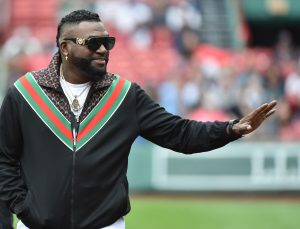
Ortiz received 77.9% of the vote, narrowly edging across the 75% threshold to earn induction on his first ballot. A native of the Dominican Republic, Ortiz originally began his career in the Mariners system. He was traded to the Twins as a prospect in 1996 and debuted with Minnesota late the following year. A solid but not elite hitter early in his career, Ortiz would spend the next half-decade with the Twins.
During the 2002 campaign, Ortiz tallied 466 plate appearances, a personal-high to that point. Despite posting a solid .272/.339/.500 line with 20 home runs, he was cut loose after the season. Signed by the Red Sox that offseason, he almost immediately emerged as one of the game’s most feared sluggers.
Ortiz hit .288/.362/.592 over 509 trips to the dish his first season in Boston. So began a run of five straight seasons with offensive output measured at least 45 percentage points above the league average by wRC+, with Ortiz finishing in the top five of AL MVP balloting each season. A fantastic postseason performer, he claimed the 2004 ALCS MVP award as part of the Red Sox’s drought-snapping World Series campaign and was excellent during Boston’s run to another championship three years later.
After a bit of a downturn between 2008-09, Ortiz somewhat surprisingly returned to his middle-of-the-order form as he neared his mid-30s. Between 2010 and 2016, the left-handed hitter never had a season with a wRC+ below 134. He was an instrumental factor in a third Red Sox title, claiming 2013 World Series MVP honors after putting up a comical .688/.760/1.188 showing in 25 plate appearances during a six-game series win over the Cardinals.
Ortiz remained an elite hitter through his 2016 retirement. He raked at a .315/.401/.620 clip during his final season, among the best showings of his illustrious run. That final campaign brought his career plate appearance total a bit north of 10,000 and he hung up his spikes owner of a .286/.380/.552 line. Ortiz tallied 2472 hits, 541 home runs (17th all-time) and drove in 1530 runs (23rd on the all-time list).
Despite his massive offensive production, it remained unclear until the very end whether Ortiz would have enough support to garner first-ballot selection. He was primarily a designated hitter, and his lack of defensive contributions were likely a sticking point for some voters. And, like many others on the ballot, Ortiz wasn’t without reported ties to performance-enhancing drugs.
According to reports, Ortiz failed a PED survey test in 2003. As Jay Jaffe of FanGraphs explored in much greater detail last month, however, MLB later suggested some players named in the survey test — which had been intended to remain anonymous — likely appeared on the list for substances that weren’t banned at the time. Ortiz was not named in the Mitchell Report, nor he was ever suspended for PED use during his career.
A significant enough portion of the BBWAA treated those results with sufficient skepticism to push Ortiz across the threshold for election, even as others on the ballot were excluded based on PED ties. A ten-time All-Star, Ortiz won seven Silver Slugger awards and was a key piece of three World Series teams. While Ortiz never won an MVP award, he appeared on ballots in eight separate seasons — including the aforementioned five consecutive top-five finishes. An icon in Red Sox’ franchise history, he’s now cemented as one of the greatest players in MLB history. MLBTR congratulates Ortiz — who’ll be enshrined alongside Era Committee inductees Buck O’Neil, Jim Kaat, Tony Oliva, Gil Hodges, Bud Fowler and Minnie Miñoso next summer — on his induction.
MLB, MLBPA Discuss Potential Bonus Pool For Pre-Arbitration Players, Changes To League-Minimum Salary
7:54 pm: According to Bob Nightengale of USA Today, the proposed pool system could allow players to increase their salaries by as much as 385% depending upon their WAR totals and placement in awards voting. He adds that under this system, reigning NL Rookie of the Year Jonathan India would be in line for a $1.193MM salary despite not yet being arbitration eligible.
3:31 pm: After weeks of silence between the two parties, Major League Baseball and the MLB Players Association met today for a second straight day as they work toward a new collective bargaining agreement. While an agreement is not believed to be anywhere close, there’s at least been some semblance of headway in talks (though the extent of that progress is debatable).
For instance, MLB Network’s Jon Heyman tweets that the MLBPA had sought to raise the minimum salary from $570,500 to $775,000 — but MLB had countered with a proposal for a $600K minimum. (For context, the minimum salary has risen between $7-10K in each of the past several seasons anyhow.) The league today moved that offer forward a bit further, offering a $615K minimum salary for players with less than one year of Major League service time, per Chelsea Janes of the Washington Post (Twitter link).
Of course, the value of that “concession” is rather subjective. As Travis Sawchik of The Score observes, in order to keep up with inflation, the league would’ve needed to push the minimum salary to $650K just to match the minimum salary from the start of the 2016-21 collective bargaining agreement. Viewed through that lens, the league’s offer could actually be seen as a step back. The Athletic’s Evan Drellich adds that the minimum salary for players with one to two years of service would be $650K under the current proposal, while players with between two and three years would receive at least a $700K salary.
Interestingly, Sawchik reports that MLB proposed fixed salaries at those league minimum figures for players in each service bucket. While players would presumably still be free to sign early-career contract extensions, that would eliminate the system of teams renewing contracts for pre-arbitration players at amounts slightly higher than the league minimum. As one recent example, the Mets offered Pete Alonso a salary a bit north of $650K in 2020 (nearly $100K more than that year’s league minimum) as a reward for his Rookie of the Year-winning 2019 campaign. Under MLB’s proposal, that kind of deal would no longer be permitted.
Janes adds that the league has also dropped proposed scenarios that would alter the arbitration system and eliminate Super Two status — a designation that allows some players to reach arbitration a year early. Shrinking the number of players who can reach arbitration seems like something that would’ve been a non-starter for the MLBPA anyhow, so as with the incremental increases to the minimum salary, taking that component off the table doesn’t feel like much of a step back.
More interestingly, Major League Baseball agreed to the MLBPA’s proposal for a bonus pool, funded by central revenues, to reward pre-arbitration players (Twitter link via Jared Diamond of the Wall Street Journal). Pre-arb players would be in line for bonuses based both on Awards voting and on reaching certain Wins Above Replacement markers, Janes notes.
That figures to present its own levels of complication, as there are multiple versions of Wins Above Replacement. Beyond needing to agree on which form of WAR to set as the standard, the concept isn’t likely to sit well with the proprietors of those metrics. Baseball-Reference’s Sean Forman has already taken to Twitter to explain how uncomfortable he is with the notion of players being assigned millions of dollars based on a metric that is constantly undergoing slight tweaks to keep up with changes in the game (his Twitter thread on the matter is well worth a full read). Additionally, as Sports Illustrated’s Emma Baccellieri points out (Twitter link), there are some obvious potential conflicts of interest in tying pre-arb bonuses to awards voting that is conducted by the media members who cover those players.
For this bonus structure to work, the two sides would need to agree on the particulars of the bonus pool — and it does not appear as though they’re remotely close to doing so. While it’s promising, to an extent, that MLB was at least amenable to the union’s proposed framework, ESPN’s Jeff Passan tweets that the MLBPA proposed a $105MM pool from which to reward those players. Not surprisingly, the league balked at that figure and countered with a $10MM pool — a figure at which players surely scoffed. Large as that gap may be, the mere fact that MLB is open to the concept clears the admittedly low bar set to declare progress in these talks.
It bears repeating that elements such as the minimum salary, arbitration and this newly conceptualized bonus pool for pre-arbitration players are all merely pieces of what is a much larger puzzle. The league’s larger priorities still include, perhaps most notably, the expansion of the playoff field — an endgame that would dramatically increase television and gate revenues at the most lucrative point in the MLB schedule. Players, meanwhile, have sought changes to a service-time structure that incentivizes teams to keep prospects in the minors longer than would otherwise be the case, a marked increase in the competitive balance (luxury) tax threshold, and measures to eliminate the incentives for teams to tank — among many other elements.
Suffice it to say, while it’s refreshing to hear of any progress, however slight, between the league and the union — it remains abundantly clear that major headway still needs to be made if Spring Training is to begin in mid-February, as currently scheduled. Most have suggested that a deal would need to be reached by Feb. 1 in order for that outcome.
The greatest concern is that any lack of accord between league and union will ultimately result in some portion of regular-season games being wiped out. Sportsnet’s Ben Nicholson-Smith and Drellich both suggested last night that Major League Baseball on Monday expressed a willingness to go down that road, if necessary, though the loss of regular-season games still figures to be a last resort and a worst-case scenario on all sides. There’s certainly a middle ground, where Spring Training could perhaps begin in late February or early March, paving the way for a truncated exhibition season and a full 162-game slate.
Whenever an agreement is reached, the league will also need to lift the current transaction freeze, sending front offices and player representatives alike into a frenzy to get the remaining group of unsigned free agents into Spring Training camps as quickly as possible and to resolve any outstanding arbitration cases. Front offices will need to work with fervor to complete any trades or other offseason dealings in an expedited fashion. The longer it takes for the league and union to strike a deal, the more hectic the aftermath of that agreement will be.
Bonds, Clemens, Schilling, Sosa Fall Off Hall Of Fame Ballot
With the Hall of Fame’s announcement this afternoon that David Ortiz was the only player elected by the Baseball Writers Association of America this year, the path to induction via the writers’ ballot has officially closed for four of the most notable players in recent history. Each of Barry Bonds, Roger Clemens, Curt Schilling and Sammy Sosa has exhausted their ten years on the ballot and will no longer be eligible for consideration by the BBWAA.
Bonds and Clemens have two of the greatest statistical resumes in major league history and would’ve been first-ballot Hall of Famers had it not been for their ties to performance-enhancing drugs. Bonds is the all-time leader in career home runs (762). Among position players, he ranks second all-time behind Babe Ruth in FanGraphs measure of Wins Above Replacement. Baseball Reference has Bonds and Ruth tied for first in career position player value (before accounting for Ruth’s contributions as a pitcher). Bonds won seven MVP awards and was a 14-time All-Star.
Clemens, meanwhile, has a strong case as the most accomplished pitcher in the game’s history. An 11-time All-Star and seven-time Cy Young award winner, he appeared in 24 MLB seasons and won seven ERA titles. He ranks third in career strikeouts (4,672), ninth in pitcher wins (354) and is third among pitchers (excluding Ruth) in BRef’s WAR metric.
Each of Bonds and Clemens have a laundry list of accolades, but their non-inductions are obviously not about any flaws in their numbers. Both players, instead, are left outside the Hall because of their ties to performance-enhancing drugs. Both players were named as alleged steroid users in Senator George Mitchell’s 2007 report. Each of Bonds and Clemens were summoned to testify as part of Congressional hearings on PED usage in baseball; Bonds was later convicted on an obstruction of justice charge for giving an evasive answer during his testimony.
Whether to include alleged steroid users in the Hall of Fame has been a subject of (often bitter) debate amongst fans and writers. “Sportsmanship” and “character” are among the factors the Hall includes in its instructed criteria for voters, and those terms have been leveraged to make both moral arguments and questions about the authenticity of those players’ numbers to support steroid users’ exclusions from the Hall. Enough voters remained steadfast in their objection to including those implicated with PED’s to keep either Bonds or Clemens from accruing enough late-ballot momentum to get across the 75% threshold for induction. Both players finished in the 65% – 66% range on their final years on the ballot — a small but obviously insufficient bump relative to last season’s 61% – 62% marks.
Schilling appeared in parts of 20 MLB seasons. A six-time All-Star, he never won a Cy Young but finished as a runner-up on three separate occasions. Schilling “only” won 216 career games, but he owned a 3.46 ERA over 3261 innings. His 3116 strikeouts place 15th on the all-time list. Among the top 14, Clemens is the only player not enshrined in the Hall of Fame.
Yet Schilling has seen dwindling support in recent years in the wake of a series of controversial public statements. As it became clear he was unlikely to be elected by the BBWAA, Schilling requested to have his name removed from this year’s ballot. That wasn’t granted, although he did see a 12-point drop in vote share between 2021 and 2022 after his push to be removed from consideration. Schilling appeared on 58.6% of ballots this year.
Sosa, somewhat curiously, never had the same level of support as any of Bonds, Clemens or Schilling. He received just 18.5% of the vote this year and never threatened election during his time on the ballot. Despite being one of just nine players to exceed 600 career home runs, Sosa’s career .273/.344/.534 slash line “only” checked in 24 percentage points above the league average by measure of wRC+. Moreover, he wasn’t a highly-regarded defender. But Sosa was one of the sport’s most famous and productive sluggers at his peak, hitting an astounding 332 home runs between 1998-2003 (more than 55 per season).
No doubt contributing to his dearth of support is that Sosa reportedly failed a 2003 survey test for performance-enhancing drugs. As Jay Jaffe of FanGraphs recently explored, though, MLB commissioner Rob Manfred later cast some doubt about the reliability of those results (which had been intended to remain anonymous). Ortiz also reportedly failed that same survey test, but enough voters looked on those results with skepticism to elect him on the first ballot. Sosa was never suspended for a PED test in his career, although he was hit with an eight-game ban in 2003 for corking his bat.
Each of Bonds, Clemens, Schilling and Sosa will need to rely on one of the Era Committees if they’re now to gain induction. Those committees have tended to be more favorable to candidates than has the BBWAA, although it remains to be seen how they’ll approach this particular group of highly controversial candidates.
As far as returning candidates go (full results available here), Scott Rolen jumped from 52.9% to 63.2% in his fifth year. Todd Helton (4th year) and Billy Wagner (7th year) each eclipsed 50%. Andruw Jones and Gary Sheffield both landed in the low-40% range, while Jeff Kent, Manny Ramirez, Omar Vizquel, Andy Pettitte, Bobby Abreu, Mark Buehrle and Torii Hunter received less than 30% of support. (Vizquel’s vote share was cut nearly in half after separate domestic violence and sexual harassment allegations were levied against him within the past thirteen months).
Among first-time candidates, only Alex Rodriguez (34.3%) and Jimmy Rollins (9.4%) received more than the 5% necessary to remain on the ballot for future consideration. As with Bonds and Clemens, Rodríguez has obvious Hall of Fame statistics but PED ties that’ll hamper his path to induction. Joe Nathan, Tim Lincecum, Ryan Howard, Mark Teixeira, Justin Morneau, Jonathan Papelbon, Prince Fielder, A.J. Pierzynski, Carl Crawford and Jake Peavy fell shy of the 5% threshold and dropped off the ballot, as did second-year candidate Tim Hudson.
MLBPA Drops Push For Earlier Free Agency Eligibility In Latest CBA Proposal
10:05 pm: Drellich reports that MLB remained displeased with the reduced proposed cuts to revenue sharing in the union’s latest offer, writing “there’s no indication” MLB is willing to make any alterations to the revenue sharing system.
4:45 pm: In addition to holding firm on their push for two-year arbitration, the MLBPA remained steadfast on a few more of their top goals. Jeff Passan of ESPN reports that the union proposal included a bump in the league minimum salary to $775K, the institution of an eight-team draft lottery and a $245MM base luxury tax threshold. All three issues had been known goals of the MLBPA in past proposals, and the setting of the CBT threshold is expected to be of particular import. In recent offers, MLB has pushed for tax thresholds in the $214MM – $220MM range, leaving a fairly significant gap between the parties.
3:51 pm: As part of this afternoon’s collective bargaining proposal, the MLB Players Association dropped its push for an earlier path to major league free agency, reports Evan Drellich of the Athletic. It now seems likely the next CBA will require players to accrue six years of MLB service time in order to reach the open market — as had been the case under prior agreements.
The game’s service time structure is one of the most contentious issues during ongoing negotiations. The MLBPA, desiring to get players to free agency earlier, had previously been pursuing a modified service/age threshold that would’ve allowed players to test the market after six years of MLB service or after five years of service if the player had reached a certain age (initially 30.5 years, later 29.5).
Major League Baseball had steadfastly refused to entertain that possibility, either pushing for a continuation of the six-year status quo or an age threshold (29.5, in MLB’s previous offers) that was independent of service time. It seems the league will get its wish to preserve the path to free agency as is, marking a significant development.
In an additional alteration, Drellich reports that the MLBPA agreed to alter its push for reduced revenue sharing from large-market organizations to small-market franchises. Chelsea Janes of the Washington Post adds more specifics, reporting (on Twitter) that the union’s latest offer included a revenue sharing cut in the $30MM range relative to the 2016-21 CBA.
Earlier in the winter, the union had been pushing to cut revenue sharing by around $100MM. The past CBA required recipients to use those funds “to improve (their) performance on the field,” but there was no provision that required teams to invest the money into player salaries (as opposed to such things as scouting, analytics or player development, all of which indirectly attempt to improve team performance). The MLBPA has expressed its belief that smaller-market clubs have been too content to pocket that money, filing grievances to that effect against the A’s, Marlins, Rays and Pirates in recent years.
As with an expedited path to free agency, the league has opposed modifications to the revenue sharing system. It remains to be seen whether that pushback is categorical or one of degree. The MLBPA’s proposal still included a revenue sharing cut, of course, but it’s significantly smaller than the union’s previous pushes in that regard.
While the MLBPA made a pair of notable steps towards MLB’s vision, one thing that hasn’t changed is the union’s desire for earlier arbitration eligibility. Drellich reports that the union’s proposal this afternoon would allow players to qualify for arbitration after reaching two years of MLB service, as have all of the PA’s past offers. (The previous CBA required three years for arbitration eligibility for most players). MLB has thus far refused to discuss earlier paths to arbitration, either. Whether the league will be more amenable to that possibility now that the union has made some changes in other key areas is unclear.
Janes tweets that this afternoon’s meeting lasted around two hours and fifteen minutes. Encouragingly, the parties are set to meet again tomorrow, according to a report from Hannah Keyser of Yahoo! Sports (Twitter link). At that sit-down, MLB plans to put forth some form of counter-offer, tweets Drellich, although the league won’t make a comprehensive proposal that hits on every topic of discussion. It seems possible today’s proposal will kick-start negotiations, which have moved at a glacial pace in the nearly two months since the start of the lockout.
That’s not to say agreement on a new deal is imminent. According to Drellich, the MLBPA “rejected most, if not all” of the terms the league put forth in its most recent offer, a bit more than two weeks ago. Jeff Passan of ESPN tweets that today’s meeting was “contentious;” Drellich categorized it as “heated.”
It also bears reiterating that the full specifics of the MLBPA’s proposal aren’t known. In addition to ongoing potential holdups regarding arbitration eligibility and revenue sharing, such issues as the competitive balance tax, league minimum salary and playoff expansion will need to be sorted out. With a bit more than a month before the scheduled start of the first Spring Training games, the parties have to make rapid progress in a number of areas if a disruption to the exhibition schedule is to be avoided.
Rays’ Tampa/Montreal Timeshare Plans Nixed By MLB
12:42 PM: Though he made no express commitments, Sternberg made his disappointment with the Executive Council’s decision clear. When asked explicitly if he’d explore moving the franchise out of the Tampa Bay region, Sternberg neither confirmed nor denied that such an idea had entered into his plans, stating that club brass “will see how the stands look this year…to help inform us as we move forward” but that they had been “all-in on this plan” and had “completely pushed our chips in.”
The owner also made a bit of news in disclosing that he’s privy to full-season proposals currently being put together by both the city of Tampa and Pinellas County (home to St. Petersburg) but expressed doubts about the long-term viability of either (it isn’t clear if Tampa’s full-season proposal involves the same Ybor City site that the split-season proposal did). Though he stated that “the region is willing to and able to and looking forward to supporting us in every way it can” and that he was “certainly going to be exploring things in the Tampa Bay region,” he also expressed doubts that the region could “handle 81 games of baseball…that just hasn’t happened to this point.” Asked directly if Tampa deserves a full-season baseball team, Sternberg responded simply that it “deserves to have baseball.”
Most striking, perhaps, were Sternberg’s comments on the long-term viability of single-city teams, even as he stands alone among owners in major sports in proposing a split-city arrangement. “Partial seasons are going to be the wave of the future in professional sports,” he stated, adding that Montreal has “earned the right to have baseball back.”
11:58 AM: In a blow to principal owner Stuart Sternberg’s attempts to secure a new ballpark in or around the city of Tampa, the Major League Baseball Executive Council officially quashed the Rays’ plans to split time between Tampa and Montreal, reports Marc Topkin of the Tampa Bay Times. MLB had given the Rays permission to explore the ‘sister city’ concept in 2019.
The decision puts the Rays future in the Tampa Bay region very much in doubt. As MLBTR explored last week, Tampa mayor Jane Castor expressed her commitment to keeping the Rays in the area but offered only qualified support for a proposed $700MM open-air ballpark in the northeast Tampa neighborhood of Ybor City, stating that the community would be best served by keeping the team in Tampa while all but ruling out the possibility of a significant investment of public funds into the project. The Rays had committed $350MM to the project.
It’s presently unclear whether the Ybor City plan, which called for the construction of a similar park in Montreal to host half the team’s games, is now effectively dead as well. Though unusual, the plan was not unprecedented. In both 2003 and 2004, their final two seasons before relocating to Washington, D.C., the Expos played 22 of their 81 home games at Hiram Bithorn Stadium in San Juan, Puerto Rico while under the stewardship of Major League Baseball; the league bought the team from Jeffrey Loria (who subsequently purchased the Marlins) ahead of the 2003 season.
The Rays’ lease on Tropicana Field — an object of near-universal derision around the game — runs through 2027. It obviously isn’t yet clear what would happen thereafter should the Rays fail to secure a new stadium, but a move to Nashville — where a group calling itself Music City Baseball has attempted to organize both an ownership group and community support for a potential big-league team in the city — could be an entirely live possibility. High-profile individuals associated with the project include former United States Attorney General Alberto Gonzales, former Titans running back Eddie George, and current White Sox manager Tony La Russa.
Carlos Correa Switches Agencies, Hires Boras Corporation
Free agent shortstop Carlos Correa has switched agencies and is now a client of Scott Boras and the Boras Corporation, according to Mark Berman of Fox 26. Correa had previously been represented by William Morris Endeavor.
Going into the offseason, Correa was widely considered to be part of a two-headed top of the free agent class, along with Corey Seager. Both offered similar appeal to prospective teams, as both shortstops entered free agency at the age of 27 and offered elite production on both sides of the ball. MLBTR placed Correa at the top of the annual Top 50 Free Agents, projecting him for a contract of $320MM over ten years, with Seager just behind in the number two slot and a projection of $305MM over ten years. Seager, represented by the Boras Corporation, beat his projection when the Rangers signed him to a ten-year deal worth $325MM. Correa, meanwhile, did not find a contract to his liking before the lockout and remains a free agent.
Back in September 2019, Correa took the unusual step of hiring WME to represent him, despite the fact that they were more of a show business agency and did not have longstanding MLB agents at that time. Back in September 2021, it was reported that the company was still trying to expand its baseball operations, hiring former Angels general manager Billy Eppler, along with some agents who had previously been with Excel Sports Management and CAA. (Eppler subsequently left WME to become general manager of the Mets.)
However, the most recent news surrounding the agency had been their parent company Endeavor’s attempts to purchase a variety of minor league teams, something which drew the ire of the MLBPA. In a report from Evan Drellich of The Athletic last week, he noted that the union had “warned WME Sports player representatives that they risk losing their certification as agents unless they divest themselves from the company.” MLBPA is in charge of agent accreditation and their regulations prohibit agents from acquiring or holding financial interests in professional baseball teams unless authorized by the MLBPA to do so. There is no evidence that the situation regarding WME and their minor league investments had anything to do with Correa’s departure, nor did Correa offer an explanation for his choice other than to praise the Boras Corporation’s expertise and experience.
Now Correa will exit the lockout with the sport’s most high profile agent in his corner to help him navigate what is widely expected to be a chaotic frenzy of activity, as teams and players try to finalize deals in the short window between a new CBA being signed and a new season beginning. Boras figures to have his hands full in that time, as he also represents other notable free agents, such as Nick Castellanos, Kris Bryant and Carlos Rodon.
Dodgers Promote Brandon Gomes To General Manager
The Dodgers announced this afternoon that they’ve promoted Brandon Gomes from assistant general manager to general manager. The move solidifies Gomes as a key member of a Los Angeles front office that also includes senior vice president Josh Byrnes and is helmed by president of baseball operations Andrew Friedman.
The move doesn’t come as much of a surprise. Gomes was mentioned as a candidate in the Mets search for a new front office leader earlier in the offseason, but reports out of New York fairly quickly suggested it likelier he would be promoted to Dodgers GM instead. (The Mets eventually landed on Billy Eppler). With Friedman still running the front office in L.A., Gomes’ promotion doesn’t come with the same level of roster control that landing the Mets job would have provided. Yet it affords him a notable step up in title and likely contains some form of pay bump for the 37-year-old to remain in a setting in which he’s obviously comfortable.
Gomes has climbed the front office ranks rather quickly over the past few years. The Massachusetts native began his pro career as a player in 2007, making his big league debut by May 2011. He spent the next four seasons as a middle relief option with the Rays. Tampa Bay outrighted Gomes off their 40-man roster following the 2015 campaign. After a minor league deal with the Cubs didn’t result in another big league opportunity, Gomes hung up his spikes and joined the Los Angeles front office. He reunited with Friedman — formerly Tampa Bay’s general manager — in Southern California.
Within a year, Gomes had ascended to director of player development. After a season in that role, he was promoted to AGM. Three years later, Gomes gets the nod as general manager, a notable step for the organization. With Friedman leading the charge as president of baseball ops, the Dodgers’ GM position has sat vacant in the three-plus years since Farhan Zaidi departed to become president of baseball operations with the archrival Giants.
By promoting Gomes to GM, the Dodgers could ward off interest among other clubs in poaching him, as the Mets apparently expressed this winter. Teams typically only allow their employees to interview elsewhere if a rival club is willing to offer a step up in title. A president of baseball ops or chief baseball officer position would qualify, but it’s unlikely the Dodgers would allow Gomes to assume a GM role — which, for most organizations, is now second in the front office hierarchy — with a new team.
Francisco Liriano Announces Retirement
Left-handed pitcher Francisco Liriano has announced his retirement, agent Mike Maulini tells Robert Murray of FanSided. Liriano debuted in 2005 with the Twins as a 21-year-old, and he last toed the rubber with the Pirates in 2019. All in all, Liriano appeared in 14 big-league seasons with the Twins, Blue Jays, White Sox, Tigers, Astros, and Pirates. MLBTR sends our sincere congratulations to Liriano on a long and successful career.
Liriano originally signed with the Giants as an amateur free agent out of the Dominican Republic on September 9, 2000. He would spend his first three professional seasons in San Francisco’s minor league system, reaching High-A in 2003 before being traded to the Twins in November. The deal would prove a good one for Minnesota, who received Liriano with Boof Bonser and Joe Nathan in exchange for catcher A.J. Pierzynski and cash. The deal marked the first of four times that Liriano would be traded throughout his professional career.
With the Twins, Liriano became a star. He burst onto the scene for a 96-win club in 2006, immediately crowned as the perfect sidekick/successor for ace Johan Santana. The 22-year-old threw 121 innings with a 2.16 ERA/2.55 FIP. Liriano was so impressive that he made the All-Star team, his only such appearance. Just as Liriano tantalized Minnesota’s fanbase with his electric arsenal, disaster ended the dream before it really even began: Liriano underwent Tommy John surgery in early November, knocking him out of the entirety of 2007.
He returned in 2008 to make 14 starts, posting a 3.91 ERA/3.87 FIP over 76 innings. Unfortunately, the electricity was gone from his game as his 30.4 percent strikeout rate from 2006 fell to 20.4 percent in his return season. Though some thump may have been gone from Liriano’s game, he proved to be an extremely resourceful and resilient professional, twice winning the Comeback Player of the Year award.
The first time came in 2010 when he rebounded from a difficult 2009 seasons to start 31 games and toss 191 2/3 innings with a 3.62 ERA/2.66 FIP, striking out more than 200 batters for the first time in his career. Liriano helped the Twins to 94 wins and a division title. He made just one postseason start as the Twins were bounced from the playoffs in a three-game sweep at the hands of the Yankees. That club was the third division winner of the past five years, but all three were swept out of the playoffs, and they tumbled to fifth place in 2011.
They stayed there in 2012, which helped lay the groundwork for the second trade of Liriano’s career. The Twins traded Liriano to the White Sox on August 1, 2012 for Eduardo Escobar and Pedro Hernandez.
Liriano signed a somewhat surprising deal with the Pirates that offseason that turned out to be a prescient move for the Buccos. Liriano made 26 starts in his first season with the Pirates, tossing 161 innings with a 3.02 ERA/2.93 FIP, a remarkable effort that won Liriano his second Comeback Player of the Year award. Liriano proved the perfect avatar for the Pirates’ own turnaround, who won 94 games and ended a 20-season playoff drought.
Not only did Liriano help get the Pirates to the postseason, he was the winning pitcher of a one-game playoff against the Reds, tossing seven innings of one-run baseball en route to a 6-2 win. That win might be the single greatest moment in the last 30 years of Pirates baseball. Remarkably, that team boasted a rotation that included a young(er) Charlie Morton and Gerrit Cole, but Liriano was the ace of that staff, and he pitched like it in the postseason.
The Pirates would go up 2-1 in the NLDS before ultimately falling in a five-game loss to the Cardinals. Liriano started a game three win as well, pitching six solid innings and giving up just three hits and two runs. Liriano even walked and drove in a run with a sacrifice in that game.
Liriano and the Pirates would return to the playoffs a wild card team in each of the next two seasons, running into a pair of buzzsaws in Madison Bumgarner and Jake Arrieta, both of whom threw complete game shutouts in their respective wild card contests. Liriano’s run in Pittsburgh was no less remarkable, however, as he posted a 3.65 ERA over 693 2/3 innings in parts of five seasons with the Pirates.
The 2016 season would mark the end of the second phase of Liriano’s career and begin the third. After a subpar start to the season for both player and team, Liriano was traded for the third time in his career. This time saw him shipped to the Blue Jays along with Reese McGuire and Harold Ramirez in exchange for Drew Hutchison.
He was traded for the last time at the deadline the next season. The Astros acquired Liriano for Nori Aoki and Teoscar Hernandez. He shifted to the bullpen, becoming a lefty specialist and winning a World Series with the 2017 Astros. He recorded a valuable out in each of game six and game seven, retiring Cody Bellinger on both occasions.
Because of the speed at which Liriano burst onto the scene, he probably ended up being slightly underrated throughout his career, one marked by reinvention. No matter the trial, Liriano pushed through it, making 300 career starts and appearing in 419 career games, tossing 1,813 2/3 innings and finishing with a 4.15 career ERA and 3.88 career FIP. He was an All-Star, a World Series winner, and he even tossed a no-hitter while a member of the Twins back in 2011. Congratulations to Liriano on a truly remarkable career.