
MLB Inspecting “Suspicious Baseballs” From Trevor Bauer’s Latest Start
10:41pm: If the league attempts to punish Bauer, the union “would challenge any discipline not covered under current rules,” Bill Shaikin of the Los Angeles Times tweets.
8:09pm: Major League Baseball announced last month that it plans to crack down on pitchers doctoring baseballs. Now, one of the game’s highest-profile pitchers, Dodgers right-hander Trevor Bauer, is under the league’s microscope, Ken Rosenthal of The Athletic reports.
Bauer started against the Athletics on Wednesday, when he yielded two earned runs on 10 strikeouts in 6 2/3 innings. The umpires from that game have since collected multiple “suspicious baseballs” that Bauer threw, according to Rosenthal, who writes that they “had visible markings and were sticky.” As Rosenthal notes, though, the league may not be able to prove whether it was Bauer who doctored the ball, so it’s unclear whether it will discipline him.
Of course, the fact that the league’s looking at Bauer is especially intriguing when considering some of the past comments the outspoken 30-year-old has made in regards to potential cheating. He accused Astros pitchers of using illegal means in 2018 in an effort to increase their spin rate, and he then called the team “hypocrites” and “cheaters” last year.
Bauer had a career campaign in 2020 as a member of the Reds, with whom he won the National Cy Young, before signing a three-year, $102MM guarantee with the Dodgers in free agency. The returns so far have been promising, as Bauer has posted 20 strikeouts against three walks while giving up six runs on six hits in 13 innings, though this latest development is unwelcome for him and the Dodgers.
Trevor Rosenthal Undergoes Thoracic Outlet Surgery
APRIL 8: Rosenthal underwent thoracic outlet surgery Thursday, Martin Gallegos of MLB.com tweets. He’ll be re-evaluated in eight weeks.
APRIL 7: After opening the season on the injured list due to a shoulder problem, Athletics closer Trevor Rosenthal could now require thoracic outlet surgery to address the injury, manager Bob Melvin announced to reporters Wednesday (Twitter link via Shayna Rubin of the San Jose Mercury News). It’s a sudden and troubling development for a struggling A’s club. The procedure would come with “at least” a 12-week recovery time, Matt Kawahara of the San Francisco Chronicle tweets. The right-hander is weighing his options and is expected to make a decision in the near future.
Rosenthal, 30, spent much of the offseason seeking a lucrative multi-year deal after turning in an absolutely dominant performance between the Royals and the Padres last season. However, when he wasn’t able to find a long-term deal to his liking, the hard-throwing righty opted for a one-year deal at a strong $11MM rate to serve as the closer at the pitcher-friendly O.Co Coliseum.
It was a surprise investment for an A’s club that spent most of the winter idling on the sidelines as teams throughout the league sifted through the free-agent market. Only after the A’s were able to shed a notable portion of Khris Davis‘ contract did they enter the free-agent waters, and even then, their initial expenditures were modest, one-year commitments to Yusmeiro Petit, Sergio Romo and Mitch Moreland. Rosenthal was an entirely different type of spend, and it’s now an open question whether they’ll get any real return on what was a major splash by their standards.
Thoracic outlet syndrome is the latest in a series of setbacks for Rosenthal, who broke into the league as one of the game’s most dominant young relievers with the Cardinals but has since struggled to stay healthy. Tommy John surgery wiped out Rosenthal’s entire 2018 season, and when he returned with the Nationals in 2019, he developed a sudden case of the yips. Rosenthal walked 26 of the 85 batters he faced between Washington and Detroit that season. He also hit another four batters and snapped off nine wild pitches in just 15 1/3 innings. He tried to find himself with the Yankees’ Triple-A club but faced just five hitters with Scranton, issuing three walks, hitting a fourth batter and throwing another wild pitch.
Those immense struggles made Rosenthal’s comeback in 2020 all the more remarkable. Not only did he rediscover some big league success, he emerged as one of the most dominant relievers in all of baseball. Through 23 2/3 innings between Kansas City and San Diego, Rosenthal notched a 1.90 ERA with an overpowering 41.8 percent strikeout rate, a strong 8.8 percent walk rate and a fastball that averaged 98.1 mph. It was vintage Rosenthal.
From here, the future is sadly muddied once again. The track record for pitchers coming back from thoracic outlet surgery is generally poor, and few pitchers have undergone both Tommy John surgery and a TOS procedure in such close proximity. Matt Harvey is the most prominent example of a pitcher to undergo both operations in a short time, missing the 2014 season due to Tommy John and then undergoing TOS midway through the 2016 campaign. Obviously, he’s been unable to rediscover the dominant form he displayed early in his career.
There are certainly success stories among pitchers who’ve had surgery to correct thoracic outlet syndrome. Recently retired righty and current Rangers general manager Chris Young credited the procedure with saving his career, and Rosenthal’s former Cardinals teammate, Jaime Garcia, enjoyed a productive three-year stretch upon returning from his own TOS operation.
For the Athletics, the new development on Rosenthal means they’ll be extra reliant on veterans like Romo, Petit and Jake Diekman in the late innings. Right-handers Lou Trivino and J.B. Wendelken have had their share of success in the big leagues as well; Wendelken in particular has been quietly dominant dating back to 2018. The A’s also have a former top 10 overall pick, left-hander A.J. Puk, as an intriguing option in the ‘pen this year as he looks to put his own injury woes in the rearview mirror.
Blue Jays Sign GM Ross Atkins To Five-Year Extension
9:32am: Atkins’ contract begins at the end of this season, so it covers the 2022-26 campaigns, Shi Davidi of Sportsnet tweets. He’s now signed one year longer than Shapiro.
8:37am: The Blue Jays announced Wednesday that they’ve signed general manager Ross Atkins to a five-year extension. The exact length of Atkins’ prior contract wasn’t publicly known, though he last inked an extension in June 2019. This new five-year pact lends some clarity to his contractual status and cements that Atkins and president Mark Shapiro, who was extended through the 2025 season earlier this year, will continue to head up Blue Jays operations for the foreseeable future.

Originally hired as the team’s general manager in Dec. 2015, Atkins has spent the past five years heading up Toronto’s baseball operations department. There were some lean years for the Jays from 2017-19 as Atkins, Shapiro and their front office team turned over the farm system and worked to compile a core upon which they could build. The Jays currently have the game’s third-best farm system, according to both Baseball America and The Athletic. The fruits of those efforts to restock the farm already began to manifest in 2020, when the Jays nabbed a playoff spot in last year’s expanded field.
With the likes of Bo Bichette, Vladimir Guerrero Jr., Cavan Biggio, Lourdes Gurriel Jr. and Teoscar Hernandez all coming together at the big league level, the Jays began supplementing that core on the free-agent market heading into the 2020 season. Hyun Jin Ryu inked a four-year, $80MM deal to head up a rotation that had vaunted pitching prospect Nate Pearson on the horizon, and the Jays made a larger splash this past offseason when they inked George Springer to the largest deal in franchise history: a six-year, $150MM contract.
Some of the current roster — Guerrero, Rowdy Tellez, Danny Jansen — was acquired prior to the hiring of Atkins. As is the case with most front-office shuffles, there’s some groundwork laid by the prior group that continues to shape the long-term direction of the club and some continuity from regime to regime. Tony LaCava, for instance, was an assistant GM under Alex Anthopoulos and still holds a key position (senior vice president of player personnel) in the current group.
[Related — GM Trade History: Blue Jays’ Ross Atkins]
Acquiring Hernandez from the Astros in exchange for Francisco Liriano is likely the most notable success on the trade market under Atkins, while key international signings like Gurriel and Alejandro Kirk have begun to provide value at the MLB level as well. Time will tell whether the investment in Springer proves fruitful, but the Ryu investment has paid off so far and it’s hard to fault a one-year pact for a player of Marcus Semien‘s caliber. There have certainly been missteps along the way — the Randal Grichuk trade worked out nicely; his extension did not — but Atkins has clearly commanded the confidence of ownership and is now being rewarded with a lengthy extension for his efforts.
For all of the Jays’ recent spending, the affordable nature of their young core gives them the flexibility to continue being aggressive on the market next winter. There was a clear stopping point this winter, as the Jays cooled their spending despite some a relatively questionable rotation composition. But the Jays only have about $65MM committed to the 2022 roster at present, and the only sizable arbitration raises on the docket figure to be Hernandez (who’ll get a bump from this year’s $4.325MM salary) and Guerrero (who’ll be arb-eligible for the first time).
The Blue Jays aren’t considered division favorites in 2021, but they have one of the game’s top farm systems, a promising core of controllable young big leaguers upon which to build, and considerable payroll flexibility heading into a historically strong class of free agents next winter. The future looks bright.
Yankees Acquire Rougned Odor
4:58pm: The Yankees will pay Odor the prorated minimum this year ($570,500) and next, but that money will not count against their luxury tax bill, Jon Heyman of MLB Network tweets.
2:32pm: The teams have announced the trade. The Rangers acquired outfielders Josh Stowers and Antonio Cabello in return for Odor and cash. Notably, Texas announced Cabello as a catcher/outfielder, though he’s played exclusively the outfield in his minor league career to date. Kiley McDaniel of ESPN ranked Cabello as the Yankees’ 18th-best prospect, tweeting that he has the necessary tools for both center field and catcher. Cabello, whom the Yankees signed out of Venezuela for $1.4MM in 2017, hasn’t climbed above rookie ball yet, though he’s still just 20 years old. He owns a .251/.344/.409 line with eight home runs in 443 professional plate appearances.
Stowers, 24, has now been part of two trades during his career. He was originally a second-round pick of the Mariners in 2018, but they dealt him to the Yankees as part of a three-team deal that also included the Reds and centered on righty Sonny Gray. Stowers slashed an impressive .273/.386/.400 with seven homers and 35 steals in Single-A ball in 2019, his lone season in the New York organization. However, FanGraphs’ Eric Longenhagen wrote over the winter that he doesn’t expect Stowers to max out as more than a fourth outfielder in the bigs.
1:22pm: The Yankees are sending a pair of prospects to the Rangers in the deal, tweets Sherman.
1:05pm: The Yankees and Rangers are finalizing a trade that will second second baseman Rougned Odor to New York, reports ESPN’s Jeff Passan (via Twitter). The Rangers designated Odor, who has two years and $27MM remaining on his contract, for assignment prior to Opening Day. Given that substantial commitment and the Yankees’ general aversion to paying the luxury tax, the Rangers are surely offsetting the majority of Odor’s contract in some capacity. Joel Sherman of the New York Post tweets that the two sides have agreed to a deal.
It’s a bit surprising to see the Yankees taking on Odor, although it’s hard to imagine a park better suited for the 27-year-old lefty hitter’s pull-happy approach than Yankee Stadium. Odor’s strikeout rates have climbed continually since he signed an ill-fated six-year, $49.5MM extension with the Rangers, and generally been a poor all-around performer due to significant on-base deficiencies.
However, Odor’s power has never really been in question. He has three 30-homer seasons in the past five years and swatted 10 long balls in just 148 plate appearances last year. The trade-off for that pop has been a strikeout rate that has soared north of 31 percent in the past two seasons and an overall .215/.279/.418 batting line through 1915 plate appearances dating back to 2017.
Odor figures to join a Yankees bench that currently features catcher Kyle Higashioka, outfielder Mike Tauchman, outfielder Brett Gardner and infielder Tyler Wade. The only one of the bunch who has a minor league option remaining is Wade, and given that he’s also the only infielder of that group, it seems likely that he’ll be bumped to accommodate Odor’s acquisition. That would make Gio Urshela the primary backup to Gleyber Torres at shortstop, with Odor likely handling third base should Urshela be pressed into action at short for any reason.
Brewers Trade Orlando Arcia To Braves
The Brewers and Braves have lined up on a rare, early-season trade involving three players on the teams’ respective 40-man rosters. The Brewers are sending infielder Orlando Arcia to the Braves in return for right-handed relievers Patrick Weigel and Chad Sobotka, per announcements from both teams. Weigel and Sobotka will report to the Brewers’ alternate training site.
While it’s a bit surprising to see a trade of any note taking place so early in the season, Arcia’s role with the Brewers has diminished in recent years. The hope at one point was that he’d be the long-term answer at short, but Luis Urias now looks to be the preferred option at that position for the Brew Crew. Arcia has also seen some time at third base this year, but Travis Shaw made the Brewers’ Opening Day roster and is expected to serve as the primary option at the hot corner.
Arcia is off to a 1-for-11 start to his 2021 season, but he turned in perhaps the best showing of his career last summer when he slashed .260/.317/.416 through 189 plate appearances. That said, it’s somewhat disappointing for that output to represent a career-best showing for Arcia, given that he once ranked among baseball’s top 10 overall prospects at both Baseball America and MLB.com. Arcia’s glove always gave him a decent floor, but his bat simply hasn’t come around as hoped. Through 1876 plate appearances at the big league level, he’s managed just a .244/.293/.364 batting line with 42 homers and 39 steals.
The Braves obviously don’t have a need for an everyday shortstop — Dansby Swanson has the position locked down — but Arcia gives them a utility option with a solid glove. He has 4250 career innings at shortstop, so it’s not a surprise that Atlanta would be comfortable sliding him over to either second base or third base.
Ehire Adrianza had been filling that role with the club, although there’s some uncertainty surrounding his status at the moment. Adrianza left the club to tend to a personal matter recently, and he was reportedly in the process of going through intake testing to return to the club. David O’Brien of The Athletic tweets that Adrianza is expected to return to the club by this weekend.
Arcia joins Adrianza, Johan Camargo and Pablo Sandoval as utility options off the bench for skipper Brian Snitker, although the Braves can’t carry that many backup infielders simultaneously. Both Arcia and Camargo have a minor league option remaining. Arcia is the more expensive of the two, with a $2MM salary to Camargo’s $1.36MM, and it would stand to reason that if the Braves are giving up some pitching to acquire him, he’d get the nod. At some point, the acquisition of Arcia could place the roster spot of one of the other backup infielders in jeopardy.
Depending on how things play out for Arcia in Atlanta, he could be an option for them not only in 2021 but in 2022. He currently has four-plus years of big league service, which means he’ll be controllable through the 2022 season via arbitration.
In exchange for Arcia, the Brewers will pick up a pair of optionable relievers — one of whom once rated as one of the better arms in a pitching-rich Braves system. The 26-year-old Weigel ranked ninth among Braves farmhands on Baseball America’s list back in 2017 and still checked in 14th this past offseason.
His career has been slowed by 2018 Tommy John surgery, but Weigel’s 2019 return from that procedure created some optimism. In 79 innings split between Double-A and Triple-A, the righty worked to a 2.73 ERA — albeit with less-encouraging strikeout and walk rates (21.6 percent and 12.5 percent, respectively). Weigel pitched in just one game with Atlanta last year, allowing a pair of runs in two-thirds of an inning. That’s his lone MLB appearance to date.
Sobotka, 27, has displayed a knack for missing bats but has also battled control issues in parts of three seasons with the Braves. The righty boasts a fastball that averages better than 96 mph and a career 28.8 percent strikeout rate through 47 big league innings, but he’s also walked 14.2 percent of his opponents and plunked three more.
The trade gives the Brewers some flexibility on the pitching staff in a season where most teams figure to need it more than ever before, but it also closes the book on one of the organization’s most promising farmhands in recent memory. They’ll now turn the reins over to Urias, a former top prospect himself, in hopes of better results. While Urias himself hasn’t had any real big league success yet, he’s more than three years younger than Arcia and has a vastly better track record in Triple-A, where he’s put together a .305/.403/.511 line in 867 plate appearances.
MLB Network’s Jon Heyman first reported that the Brewers were in talks to trade Arcia. FanSided’s Robert Murray reported that a deal with an unknown club had been reached. The Athletic’s Ken Rosenthal reported that the Braves were acquiring Arcia, and MLB.com’s Mark Bowman reported that Weigel and Sobotka were headed to the Brewers.
MLB Moves All-Star Game Out Of Atlanta; Colorado To Host
APRIL 5, 9:00pm: Colorado will indeed host the game, per Joel Sherman of the New York Post.
8:26pm: Coors Field in Colorado is expected to host this year’s All-Star Game, Buster Olney of ESPN tweets.
APRIL 2, 2:55pm: The Braves issued their own statement on the matter:
“The Atlanta Braves are deeply disappointed by the decision of Major League Baseball to move its’ 2021 All-Star Game.
“This was neither our decision, nor our recommendation and we are saddened that the fans will not be able to see this event in our city. The Braves organization will continue to stress the importance of equal voting opportunities and we had hoped our city could use this event as a platform to enhance the discussion. Our City has always been known as a uniter in divided times and we will miss the opportunity to address issues that are important to our community.
Unfortunately, businesses, employees and fans in Georgia are the victims of this decision. We will continue to support the community legacy projects which have been planned and are in process.”
1:58pm: Major League Baseball Commissioner Rob Manfred announced Friday that the league will relocate the All-Star Game and 2021 Amateur Draft, which had been set to take place in Atlanta, Ga.
“Over the last week, we have engaged in thoughtful conversations with Clubs, former and current players, the Players Association, and The Players Alliance, among others, to listen to their views,” Manfred said in a statement announcing the decision.
“I have decided that the best way to demonstrate our values as a sport is by relocating this year’s All-Star Game and MLB Draft. Major League Baseball fundamentally supports voting rights for all Americans and opposes restrictions to the ballot box. In 2020, MLB became the first professional sports league to join the non-partisan Civic Alliance to help build a future in which everyone participates in shaping the United States. We proudly used our platform to encourage baseball fans and communities throughout our country to perform their civic duty and actively participate in the voting process. Fair access to voting continues to have our game’s unwavering support.
“We will continue with our plans to celebrate the memory of Hank Aaron during this season’s All-Star festivities. In addition, MLB’s planned investments to support local communities in Atlanta as part of our All-Star Legacy Projects will move forward. We are finalizing a new host city and details about these events will be announced shortly.”
Mets, Francisco Lindor Agree On Ten-Year Extension
APRIL 5: The Mets have officially announced Lindor’s extension. Deesha Thosar of the New York Daily News provides the release here.
MARCH 31: The stalemate is over. The Mets have reportedly come to terms on a ten-year, $341MM contract extension with star shortstop Francisco Lindor, covering the 2022-31 seasons. Lindor will be paid a $21MM singing bonus, followed by flat $32MM salaries in each year of the deal. The contract calls for $5MM of the annual salaries to be deferred, paid annually from 2032-41, for a total of $50MM in deferrals. The deal also contains a 15-team no-trade clause without any opt-out provisions. Lindor is represented by SportsMeter.
The extension is a monumental development, both for the Mets and for the sport as a whole. New York acquired the 27-year-old Lindor, one of the sport’s brightest stars, in an offseason trade with the Indians. Now they’ll ensure he spends the bulk of his career in Queens.
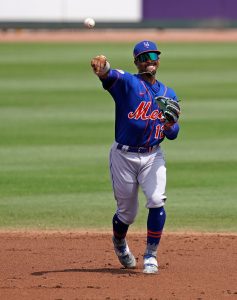
Lindor was the eighth overall draft pick by Cleveland back in 2011. He immediately became one of the game’s top prospects and moved quickly through the minors for a high school draftee, reaching the big leagues by June 2015. Lindor burst onto the scene that year with a .313/.353/.482 slash line as the Indians’ everyday shortstop, earning a runner-up finish in American League Rookie of the Year voting.
That sensational debut set the stage for a run of four consecutive star-level seasons. Between 2016-19, Lindor hit .284/.346/.495 (118 wRC+) with 118 home runs and 81 stolen bases. That’s quality offensive production from any player, but it’s particularly remarkable coming from a shortstop widely regarded as one of the game’s premier defenders. Lindor’s two-way production earned him an All-Star berth and a top 15 finish in AL MVP voting in each of those seasons.
That production did drop off a bit during the abbreviated 2020 season. Lindor played in all sixty games for Cleveland but hit a career-worst .258/.335/.415 (102 wRC+). It seems that average showing is something of a small sample anomaly, though. Lindor kept his strikeout rate at its customary 15.4% range (well better than the league average of 23.4%) while drawing walks in a career-best 9.0% of his plate appearances. His power production took a slight step back, but Lindor’s 89.9 MPH average exit velocity remained solid.
Clearly, the Mets aren’t concerned about that slight offensive downturn. They parted with four well-regarded young players (infielders Amed Rosario and Andrés Giménez and prospects Isaiah Greene and Josh Wolf) to acquire him and starter Carlos Carrasco from the Indians in January. They’re following that up with one of the largest contracts in MLB history.
Working out an extension with Lindor has been the Mets’ hope since they acquired him, but it seemed just a few hours ago the star infielder was headed for the free agent market. Lindor had rather definitively stated he wouldn’t negotiate an extension during the regular season, leaving the parties with dwindling time to work out a deal before tomorrow’s season opener. The Mets originally offered a ten-year, $325MM pact, while Lindor came back with a twelve-year, $385MM counterproposal. With the clock ticking, both sides budged a bit from their original asks, although Lindor ultimately relented on the deal’s length more significantly than the Mets did on the money.
That’s not to say he fared poorly. His deal checks in as the third-largest contract in MLB history in terms of total guarantee. Hardly coincidentally, it tops Fernando Tatís Jr.’s recent $340MM extension with the Padres by the narrowest of margins. The deferred money in Lindor’s deal keeps the contract’s actual value a bit below Tatís’, since none of the latter’s money is deferred. Nevertheless, Lindor picks up a symbolic $1MM more than one of the game’s other top shortstops. By average annual value, meanwhile, Lindor’s $34.1MM comes in sixth all-time. It is also easily the biggest financial outlay in Mets history.
Keeping one of the sport’s best players and most charismatic people for the next decade is certainly a huge development for the Mets on its own. But the Lindor deal also represents something of a symbolic leap for the organization’s future under new owner Steve Cohen. Under the previous ownership group, the Mets’ payrolls were closer to average than the top-of-the-market range one would expect from a team in New York City. The offseason sale of the franchise to Cohen, MLB’s richest owner, brought hope for Mets fans of a massive uptick in spending.
New York had an active winter, but they didn’t make a true splash at the top of free agency, to the consternation of some observers. By extending Lindor, the Mets keep one of the top players in next winter’s class off the market. The 2021-22 free agent shortstop class has drawn plenty of attention. It remains loaded, with Corey Seager, Trevor Story, Carlos Correa and Javier Báez all slated for the open market. Lindor was perhaps the face of that group, though, and he carried as much or greater earning power than his peers.
Because Lindor’s extension begins in 2022, the Mets’ books for the upcoming season are unaffected. The two sides had already agreed to a $22.3MM salary for this season to avoid his final potential trip through arbitration; Lindor will play out the year on that deal. Pushing the extension off a season also keeps the Mets’ competitive balance tax number for 2021 at the same level- around $194MM, in the estimation of Cot’s Baseball Contracts. That leaves New York with about $16MM of breathing room if they wish to stay below the $210MM tax threshold this year.
Lindor’s deal will count for $34.1MM (a deal’s average annual value is measured for CBT purposes) against the luxury ledger every year from 2022-31, assuming the luxury tax system is still in place under the terms of the next collective bargaining agreement. The deal pushes the Mets’ actual payroll number in 2022 to over $127MM, per Cot’s, with a projected luxury tax number of $135MM. New York will need to shell out another significant outlay (albeit nothing approaching the Lindor range) if they wish to keep star outfielder Michael Conforto from hitting free agency over the offseason. The Mets and Conforto have talked about an extension this spring and could continue those conversations into the season.
Regardless of what decisions Cohen and team president Sandy Alderson make in the coming months, they’ll be able to build around their new franchise shortstop. In the waning moments before their self-imposed extension deadline, the Mets and Lindor got the deal done.
Jon Heyman of MLB Network (Twitter link) was first to report an agreement had been reached and the deal’s general range, as well as the presence of some deferrals. Anthony DiComo of MLB.com was first with terms (Twitter link). Andy Martino of SNY (via Twitter) was first to report the existence of a no-trade clause and the absence of opt-out clauses. Bob Nightengale of USA Today was first to report the deal began in 2022 (via Twitter). Joel Sherman of the New York Post was first to report the $50MM in deferrals (Twitter link), as well as the yearly rates (Twitter link) and deferrals (on Twitter) and the fifteen-team no-trade clause (on Twitter).
Latest On Nationals’ Covid-19 Testing
TODAY: The Nationals have no new positive cases from their latest round of testing, per the Athletic’s Britt Ghiroli (via Twitter). The Nationals continue to work towards hosting the Braves on Monday, but no official announcement has yet been made.
4:55pm: Three Nationals players have tested positive, and the Nats are awaiting another test from a player that is likely positive, Rizzo told Britt Ghiroli of The Athletic and other reporters (Twitter link). Rizzo said one of those players has a fever, but the rest are asymptomatic. The entire team is now self-quarantining, Nightengale tweets. It’s unclear whether the Nats and Mets will play at all this weekend.
10:45am: Despite a previously scheduled off-day on Friday, the Nats and Mets will not make up their game tomorrow, tweets Olney. Joel Sherman of the New York Post hears the same, adding that the league prefers to exercise extreme caution, particularly given that the additional early off-days in the schedule and the two teams’ geographic proximity makes it easier to reschedule the opener.
USA Today’s Bob Nightengale tweets that the Nats are awaiting official confirmation from a follow-up test, but initial results from the latest wave of tests did reveal a second positive among their players.
10:15am: Tonight’s season-opening contest between the Nationals and the Mets has been postponed due to Covid-19 related issues, ESPN’s Buster Olney reports (Twitter link). The Nats were known to be down five players as of yesterday, due to one positive test from a player and five close contacts (four players, one staffer).
Nats general manager Mike Rizzo said yesterday that his club was expecting to make a series of corresponding roster moves and play as scheduled. That, apparently, will not be the case. ESPN’s Jeff Passan tweets that there are concerns about “at least one more” positive test among the Nationals this morning.
The names of the player or players who tested positive aren’t known, although some of the roster moves that had been planned by the Nationals had come to light. The Washington Post’s Jesse Dougherty reported last night that outfielder Yadiel Hernandez, infielder Luis Garcia and lefty Sam Clay were all ticketed for the Majors (Twitter links), while FanSided’s Robert Murray added that catcher Tres Barrera was in line to be added to the big league club as well.
Under the league’s 2021 health and safety protocols, an individual who tests positive is subject to a 10-day quarantine period, while close contacts are subject to seven-day quarantines. The first positive test for the Nationals came Monday morning, although the result wasn’t learned by the club until early Wednesday.
Nationals-Mets Series Postponed
12:16pm: Nationals general manager Mike Rizzo tells reporters that the fourth suspected positive has indeed been confirmed (Twitter links via Jesse Dougherty and Chelsea Janes of the Washington Post). The organization currently has 10 individuals in quarantine: the four positive cases and six (five players, one staff member) impacted by contact tracing.
11:23am: Major League Baseball announced Friday that it is postponing the entire weekend series between the Nationals and the Mets to allow for additional testing and contact tracing in the wake of multiple positive Covid-19 tests among the Nationals’ roster. At least three Nationals players tested positive leading up to Opening Day, and the team is said to be awaiting definitive word on what it believes is a fourth positive test.
It would appear, then, that the Mets’ season opener will be pushed back to Monday in Philadelphia. It’s not clear when the Nationals will get underway at this time. The league’s press release indicates only that it will “continue to provide scheduling updates as available.” At the moment, the Nationals are scheduled to host the Braves in a three-game series beginning Monday before traveling to the West Coast to take on the Dodgers next Friday.
Under the league’s 2021 health and safety protocols, an individual who tests positive is subject to a 10-day quarantine period, while close contacts are subject to seven-day quarantines. The first positive test for the Nationals came Monday morning, although the result wasn’t learned by the club until early Wednesday. Details surrounding the additional positives and potential absences — including the identity of the players in question — remain unclear.
Angels Sign David Fletcher To Five-Year Extension
The Angels made a key move on Opening Day, announcing a five-year, $26MM extension with second baseman David Fletcher. The contract will begin this season and run through the 2025 campaign. Fletcher, a client of the Ballengee Group, will earn $2MM in 2021, $4MM in 2022, $6MM in 2023 and 2024, and $6.5MM in the final guaranteed season of the deal. There is also a club option worth $8MM ($1.5MM buyout) for 2026 and an $8.5MM option ($1.5MM buyout) for 2027, Fabian Ardaya of The Athletic tweets.
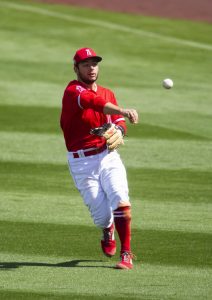
Fletcher wouldn’t have been eligible for arbitration until after this season, and he hadn’t been scheduled to reach free agency until the end of the 2024 campaign, but extending him will give the Angels the ability to lock in his annual salaries for the foreseeable future and delay a trip to the open market. It’s easy to see why the Angels are making this move, as the 26-year-old Fletcher has emerged as an important building block for the franchise since it spent a sixth-round draft pick on him in 2015.
Fletcher made his major league debut three years after the Angels picked him, and he has since proven that he’s a defensively versatile player who can at least offer league-average offense. He has lined up all over the infield and played some outfield, though the majority of his experience has come at second, short and third. With Anthony Rendon owning third for the long haul and Jose Iglesias set to play shortstop for the Angels this year, Fletcher will be their primary second baseman in 2021. He has fared quite well there with 13 Defensive Runs Saved and a 7.4 Ultimate Zone Rating in 100 games.
Fletcher has offered almost no power at the plate with an .098 isolated power mark and 10 home runs in 1,190 trips, but his career 10.3 percent strikeout mark is outstanding, as is his lifetime .292 average. Last year represented a personal-best offensive campaign for Fletcher, who batted .319/.376/.425 (123 wRC+) in 230 PA.
With this agreement in place, Fletcher joins Rendon and center fielder Mike Trout as cornerstone Angels position players who are locked up through at least the next half-decade.
Jon Heyman of MLB Network first reported an agreement was close. Jeff Passan of ESPN and Ardaya reported the numbers, and Jeff Fletcher of the Orange County Register tweeted the two sides had a deal in place. Photo courtesy of USA Today Sports Images.