
Nationals Release Trevor Rosenthal
The Nationals have released reliever Trevor Rosenthal, the team announced. The club recalled fellow right-hander Austin Voth from Double-A Harrisburg to take Rosenthal’s 25-man roster spot.
Rosenthal was a standout reliever for most of his run with the Cardinals from 2012-17, during which he was a dominant closer at times. However, Rosenthal’s Cardinals career came to an unfortunate end when he underwent Tommy John surgery in August 2017. He sat out 2018 while rehabbing the injury, but Rosenthal parlayed his track record in St. Louis into a $7MM guarantee with the Nationals last November. The Nats still owe Rosenthal approximately $3.73MM.
Washington’s hope upon signing Rosenthal was that he’d help repair a bullpen that was among the league’s worst in 2018. Instead, Rosenthal became the poster boy for an even sorrier Nationals relief corps this season. The trouble began right away for the 29-year-old Rosenthal, who failed to record a single out until his fifth appearance of the season. After a couple more weeks of struggles, the Nationals sent Rosenthal to the injured list April 26 because of a viral infection.
Rosenthal finally returned from a rehab assignment June 10, but his long layoff didn’t lead to a rebirth. Fittingly, he didn’t get anyone out during his final Nationals appearance in a loss Saturday versus the Braves, who posted three earned runs on three walks against him. Rosenthal concluded his disastrous D.C. run with a 22.74 ERA and 7.11 K/9 against an unbelievable 21.32 BB/9 in 6 1/3 innings.
As woeful as Rosenthal has been this year, he still has his Cardinals days and a 98 mph fastball on which to hang his hat. Consequently, teams could pursue Rosenthal on a minor league contract in his return to free agency.
Frankie Montas Gets 80-Game PED Suspension
In stunning news, Major League Baseball has issued an 80-game suspension to Athletics ace Frankie Montas for performance-enhancing drug use, Jon Heyman of MLB Network reports. Montas tested positive for banned substance Ostarine, according to Sam Dykstra of MLB.com.
“The A’s were disappointed upon learning of this suspension,” the team said in a statement. “We fully support MLB’s Joint Drug Prevention and Treatment Program and we will welcome Frankie back after the discipline has been served.”
Montas issued a statement of his own (via MLBPA Communications), saying, in part, “While I never intended to take any prohibited substance, I unfortunately and unknowingly ingested a contaminated supplement that I had purchased over-the-counter at a nutrition store here in the United States.”
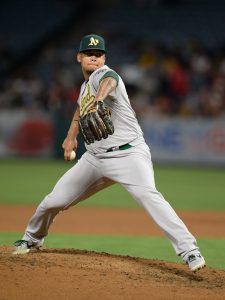
The 26-year-old added that he accepts responsibility for the ban and hopes to contribute to the A’s later in the season.
Montas, who’s earning $560K this year, won’t be paid during his suspension. More importantly for Oakland, though, he won’t be eligible for the postseason if the team clinches a berth. At 40-36, the A’s are just one game out of the AL’s second wild-card spot.
The A’s are in contention this season thanks in no small part to Montas, who performed like an ace in 2019 prior to this shocking development. In what will go down as his last start for at least a few months, the hard-throwing right-hander tossed eight innings of one-run, nine-strikeout ball in a win over the Rays on Thursday. It was the fourth straight quality start for Montas, owner of a sterling 2.70 ERA/2.86 FIP with 9.7 K/9, 2.1 BB/9 and a 50.8 percent groundball rate in 90 innings this season.
Should they stay in contention leading up to the July 31 trade deadline, the Athletics will have a chance to acquire starting help. However, it’s hard to believe anyone they’d acquire would make an impact similar to that of Montas, who’s near the top of the majors in most starting stats this year. The club does have important injury reinforcements working back – including Sean Manaea and Jesus Luzardo – who figure to make life easier for the Athletics once they return. However, any way you look at it, the loss of Montas is a devastating shot to the A’s rotation. It could have a significant effect on the AL playoff race as a result.
Photo courtesy of USA Today Sports Images.
MLB Authorizes Rays To Explore Montreal Season Split
3:04pm: St. Petersburg mayor Rick Kriseman does not sound quite as enthused by the idea as Sternberg. He says he previously informed the club that the city would not authorize talks with Montreal, John Romano of the Tampa Bay Times tweets.
12:46pm: In an eyebrow-raising development, Major League Baseball has granted authorization to the Tampa Bay Rays to explore the possibility of becoming a two-city franchise. The approval will allow the organization to pursue concepts in which the team would split its home games between Florida and Montreal. Marc Topkin of the Tampa Bay Times first tweeted the news and has more in a story.
Notably, this does not mean that the Rays necessarily will move to Montreal. Even a part-time move would likely not occur for several seasons. Rather, commissioner Rob Manfred says there’s a “broad grant” for Rays owner Stu Sternberg to build out options, as Evan Drellich of The Athletic tweets.
In a statement, Sternberg says he remains “committed to keeping baseball in Tampa Bay for generations to come.” But he says he also believes “this concept” — referring to some kind of Montreal split — “is worthy of serious exploration.”
It’s hard to fathom a situation where a Florida/Montreal split represents a long-term solution. Presumably, that’d mean building (or rehabbing) and operating facilities in both cities, creating untold logistical hurdles on top of those that already exist.
As things stand, the Rays are contractually obliged to play at the Trop through the 2027 campaign. Getting local authorities to release even a portion of home games seems like a challenge. League owners and the MLBPA will surely want to see details and have quite a few questions answered. And with conceivable two-market opportunities come vast potential inefficiencies.
Montreal has a storied history with the game of baseball. But the club lost the Expos to D.C. after the 2004 season and hasn’t hosted a big-league club since. The city has hosted some late-spring contests at Olympic Stadium, but that venue poses many of the same issues presented by the Rays’ current home at Tropicana Field.
While this development does more to create possibilities than answer questions about the club’s future, it comes with immediate consequences. The Rays have struggled to gain traction in stadium talks in the St. Petersburg/Tampa area. Recent plans for an Ybor City complex fell flat, leaving Sternberg and company looking for new options — and, no doubt, also some leverage.
Mets Shut Down Brandon Nimmo
The Mets have shut down injured outfielder Brandon Nimmo from baseball activities for the next month, Anthony DiComo of MLB.com was among those to report. Nimmo has been on the injured list since May 21 with a bulging disc in his neck.
Nimmo received his second epidural Tuesday since going on the IL, per DiComo. At this point, the Mets aren’t considering surgery for the 26-year-old, according to manager Mickey Callaway. Nevertheless, the fact that Nimmo will miss significantly more time than he already has is unwelcome news for the Mets, who – at 34-38 – haven’t had much go their way this season.
Nimmo, whom the Mets chose 13th overall in 2011, was one of the majors’ prominent breakout players in 2018. He slashed .263/.404/.483 (149 wRC+) with 17 home runs and 4.5 fWAR across 535 plate appearances. Nimmo wasn’t nearly as effective this year before going on the IL, evidenced by a .200/.344/.323 line (89 wRC+), though that was only a 161-PA sample size.
Even considering Nimmo’s massive offensive decline this season, a healthy version would likely be the Mets’ best option in center field. Carlos Gomez and Juan Lagares have gotten all the playing time in center since Nimmo went down, but neither player has produced. They’re now drawing up plans to turn to right fielder Michael Conforto in center, Jeff McNeil in right and Dominic Smith in left, according to Mike Puma of the New York Post. All three of those players have been among the Mets’ best hitters in 2019, but Conforto struggled mightily in center last season and Smith hasn’t shown he can handle the outfield on a consistent basis.
MLB, MLBPA Launching Bargaining Talks
Major League Baseball and the MLB Players’ Association have been circling one another warily for some time now, with occasional moments of accord but a pervasive sense of tension. Now, as Tyler Kepner of the New York Times reports, they’re headed back to the formal bargaining table long before the expiration of the current collective bargaining agreement at the tail end of the 2021 season.
Ever since the last Basic Agreement was hammered out, readily discernible changes in teams’ market behavior have spurred growing unhappiness from the players’ side. Union chief Tony Clark put it in stark terms to Kepner, saying flatly that “the system doesn’t work.” He also offered a warning: “either we’re going to have a conversation now, or we’re going to have a louder conversation later.”
Of course, there were indications of systemic problems even before the latest CBA, with increasingly analytically advanced teams finding new ways to achieve cost-efficient on-field performance. But the changes to the game’s governing document only exacerbated matters for players, with new luxury tax rules creating new spending disincentives for teams. After two tense winters, we saw a dizzying run of extensions this spring. That spate of dealing seemingly reflected some fear and uncertainty in the free agent process as well as labor peace more generally. It put new money in players’ pockets, but also took quite a few potentially valuable seasons of future performance out of future open-market scenarios.
Over the past two and a half years, the MLBPA has hired a chief negotiator, added a familiar face to advise on PR, launched a still-unresolved grievance action against several teams, and otherwise made clear it is readying for a larger battle. While the league and union attempted to sort through a range of matters over the offseason, only a few rule changes were implemented.
Every on-field or transactional tweak proposed has understandably been viewed through a broader economic lens. MLB commissioner Rob Manfred’s pace-of-play initiatives have met headwinds from the players, perhaps owing to a need to find leverage that’s otherwise lacking. After all, the CBA is binding until it expires. And the players’ side will face many challenges in winning a better deal.
All of those developments have felt like a prelude to the unusual and potentially quite complicated process that is now being plotted out. Understandably, the initial discussion is a logistical one. Kepner says that the bigwigs on both sides of the aisle have chatted in person about how to approach this early engagement on the CBA.
On the league side, deputy commissioner Dan Halem says the goal is “a system that satisfies our competitive-balance concerns and basically keeps the overall economics where they are — but at the same time addresses the issues that [the players are] going to bring to us.” He reemphasized MLB’s oft-stated position that the players continue to enjoy the same-sized pie slice they always have, framing the matter as “really a distribution issue.”
It’s unlikely that Clark and company would fully agree with that sentiment. All can agree broadly with the goals of enhancing competition and ensuring that the game’s best talent is playing in the majors as soon as it’s ready. But the players also desire those results because they hope to unlock new earning avenues for more of their members. Per Kepner, they also wish to “restor[e] meaningful free agency” and improve the earning power of players with lesser service time. That sounds like something quite a bit different from redistribution; it sounds like the players ultimately want more pie. There are different ways to count the leaguewide dollars and cents. The players will undoubtedly argue their share has fallen and seek more.
Moore: Royals Would Have “Crazy” Asking Price On Merrifield
Royals GM Dayton Moore strongly downplayed the likelihood of the team dealing away star utilityman Whit Merrifield, as Tom Martin of KCTV5 covers (video link, on Twitter). Calling Merrifield “one of the best players in all of baseball right now,” Moore says “the ask would be just crazy” if rivals come calling this summer.
It’s sensible for the K.C. exec to take a strong public position on Merrifield with the deadline now in sight. After all, he’d surely need something truly compelling to justify parting with a player who has now fully established himself as a high-quality all-around performer who’d improve any team in the league given his defensive versatility.
At the same time, Moore has now set a rather lofty standard at the outset of the trade season. Perhaps the Royals really do not have any interest at all in moving Merrifield. If they’d like to consider offers, though, they’ll now have to deal with a public perception that any return must be overwhelming.
There is an argument to be made that Merrifield would best be utilized as a trade piece. The Royals seem to be a ways from contention and still need to gather up youthful, controllable core assets.
Merrifield is already 30 years of age, which won’t be a turnoff to contenders but perhaps places him outside the optimal range for the Royals. He’s signed to quite an appealing contract that would suit most any budget, making him a high-value trade target. We just ranked Merrifield tenth on our initial list of the top 2019 deadline candidates, but that placement would be much higher if he was clearly available. Merrifield would perhaps be the most widely pursued position player on the market if put up for bidding.
Yankees Acquire Edwin Encarnacion
11:49pm: The trade has been officially announced by both teams. Jake Barrett was moved to the Yankees’ 60-day IL to make a 40-man roster spot for Encarnacion.
7:50pm: The Yankees have acquired first baseman/DH Edwin Encarnacion from the Mariners, ESPN.com’s Jeff Passan reports (Twitter link). Right-handed pitching prospect Juan Then is headed to the M’s in the trade, Joel Sherman of the New York Post reports, and USA Today’s Bob Nightengale adds that Then is the only player being acquired in exchange for Encarnacion.
According to The Athletic’s Ken Rosenthal (Twitter link), the two teams are “essentially splitting the money” owed to Encarnacion for the remainder of his contract. The slugger has roughly $9.25MM left on the $20MM owed to him this season, after accounting for the $5MM being covered by the Rays as per the terms of the three-team trade that brought Encarnacion to Seattle from Cleveland back in December. Encarnacion also has a $5MM buyout of a $20MM club option for the 2020 season.
The Yankees had a projected luxury tax number of slightly over $227.6MM prior to the trade, as estimated by Roster Resource’s Jason Martinez. The addition of Encarnacion will all but guarantee that New York exceeds the second-highest luxury tax threshold ($226MM), though it still keeps them below the maximum penalty threshold of $246MM, as Joel Sherman tweets that Encarnacion’s luxury tax hit is a modest $3.4MM. Should the Yankees exceed that $246MM figure, they’d be taxed at a 62.5 percent surcharge on the overage of every dollar beyond $206MM, plus their top draft pick in 2020 would be dropped by ten slots.
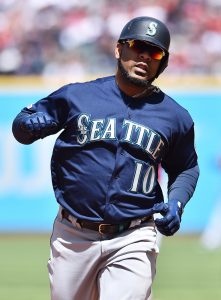
All in all, it’s a more than reasonable price for the Yankees to pay to add the American League’s leading home run hitter to their lineup. After going through a bit of a down year by his standards in 2018 (though still producing a 115 wRC+), the 36-year-old Encarnacion was back in top form in Seattle, with a .241/.356/.531 slash line and 21 homers over 289 plate appearances. Depending on how things go over the rest of the season, it’s also quite possible that the Yankees could pick up Encarnacion’s option for 2020, making him more than just a rental player.
With Encarnacion now in the fold to share first base and DH duties with Luke Voit, the Yankees have further boosted their already-strong lineup to near-Murderer’s Row levels when everyone is healthy. Encarnacion now joins an everyday mix that will include Voit, Gleyber Torres, Didi Gregorius, DJ LeMahieu, Giancarlo Stanton, Aaron Hicks, Aaron Judge, and Gary Sanchez, not to mention Brett Gardner, Clint Frazier, and Gio Urshela available off the bench. With this much depth on hand, it increases the chance that Frazier (who isn’t far removed from top-50 prospect status) could potentially become an expendable piece to acquire starting pitching at the deadline.
Encarnacion’s revived production only made him more of a trade chip for a Mariners team that continues to drastically overhaul its roster, and is willing to absorb salary to accommodate these trades. Daniel Vogelbach has already emerged as an everyday first baseman/DH in Seattle, leaving the Mariners free to deploy Ryon Healy in the other slot when he returns from the IL, or the M’s can rotate multiple players through the DH role to keep everyone fresh.
Mariners fans may question the relative lack of a return for a decorated slugger like Encarnacion, though as MLBTR’s Jeff Todd recently examined, the veteran’s market was relatively slim. He wasn’t really an ideal fit for everyday first base duty, which eliminated most NL teams, and even the American League market was relatively limited simply because there aren’t many teams still in realistic playoff contention. Adding Encarnacion might have put the Red Sox over the maximum tax threshold for the second straight year, though for the Astros and even the small-payroll Rays, they could regret not topping the relatively small amount of money and prospect capital it apparently would’ve cost to pry Encarnacion away from a Mariners club that was open to offers.
Then, 19, is a familiar name for Mariners fans, as Seattle originally signed Then as a 16-year-old out of the Dominican Republic in 2016. The Yankees acquired Then in November 2017 as part of the deal that sent Nick Rumbelow to the M’s, and MLB.com ranked Then as the 27th-best prospect in New York’s farm system. Then has yet to pitch this season, but has a 2.67 ERA, 3.77 K/BB rate, and 7.9 K/9 over his first 111 1/3 innings as a professional. According to MLB.com’s scouting report, Then doesn’t have a true plus pitch but “has a high floor” because of strong fastball command, a promising curveball, and “a changeup that’s advanced for his age.”
Photo courtesy of USA Today Sports Images
Noah Syndergaard Leaves Game Due To Hamstring Strain
Mets ace Noah Syndergaard left tonight’s start due to a right hamstring strain, the team announced. The injury took place during the seventh inning, as Syndergaard came up limping after a play that saw the Cardinals’ Yairo Munoz steal second base. The right-hander was immediately removed from the game after a visit from the trainer. An IL stint seems likely, since the description of the injury as a strain (as noted by Newsday’s Tim Healey) indicates a certain amount of severity.
Syndergaard hasn’t quite pitched up to his usual ace-like levels in 2019, with only a 4.45 ERA over 95 innings for New York. ERA indicators (3.56 FIP, 3.95 xFIP, 3.96 SIERA) are a bit more impressed by his performance, though overall, Syndergaard’s K/9, home run rate, swinging-strike rate, and hard-hit ball rate have all gone in the wrong direction from his 2018 numbers. That said, most of Syndergaard’s problems took place during a rough April, and he has since largely gotten on track over his last nine outings.
If and when Syndergaard misses time, the Mets don’t have much in the way of starting pitching options to fill the void. Wilmer Font or Chris Flexen could be again stretched out, veteran Ervin Santana is down at Single-A building up arm strength, while rookie Walker Lockett is perhaps the best healthy option at Triple-A.
In the big picture, an extended absence for Syndergaard might also push the Mets to turn towards selling prior to the trade deadline. New York entered tonight’s action with a 33-36 record, 7.5 games behind Atlanta in the NL East and five games behind the Cubs and Phillies in the wild card race. Two days ago, GM Brodie Van Wagenen was still expressing confidence that his team could remain in the postseason hunt, and while there’s still a lot of baseball to be played before July 31, the Mets could start exploring the market now for potential takers for some of their veteran assets.
Angels Designate Cody Allen For Assignment
The Angels designated Cody Allen for assignment today, recalling righty Taylor Cole in his stead, per Jeff Fletcher of the Southern California News Group (via Twitter).
The DFA represents part-two of a fairly sudden downturn in Cody Allen‘s career. Allen owned a 2.67 career ERA through 386 appearances from 2012-2017, notching 122 saves over that span in Cleveland. As the lockdown closer for the pennant-winning Indians, Allen’s consistency at the backend allowed manager Terry Francona to deploy Andrew Miller as a multi-inning, anytime-anywhere fireman and usher in a new era of bullpen dependence.
Last season was a decidedly less successful campaign for Allen as he struggled to a 4.70 ERA in 70 games in his final season in Cleveland. It was the first time he posted an ERA over 3.00 since his rookie season in 2012. He took six losses and blew five saves, but the decreased K-rate (27.7 K%) and increased walk rate (11.4 BB%) pointed to an even more substantial decline.
After inking $8.5MM in guaranteed money from the Angels, Allen walked 17.2% of the batters he faced, a mark in the bottom 1% league wide. He has also given up considerable hard contact (54.5%) as opponents have barreled him up at a 15% clip while getting the ball up in the air more frequently (65.2 FB%). Opponents’ average exit velocity of 94.3 mph ranks Allen ahead of only Reed Garrett (94.7 mph) and Alex Cobb (94.9 mph). Hard hit fly balls have unsurprisingly led to a 20.9 HR/FB%, 3.52 HR/9 and 6.26 ERA.
Allen has incentives in his contract that would have given him his first a many raises at 35 games finished, but with only four saves and 13 games finished, the Angels weren’t at risk of hitting those benchmarks anytime soon. Still, given the picture painted above, it’s hard to argue with the Angels’ decision to cut their losses.
The 30-year-old isn’t likely to be claimed, at which point he has the right to refuse a demotion and become a free agent. He’ll look to catch on somewhere, however, as he has no plans to retire, per Maria Torres of the LA Times (via Twitter). Given his fastball-reliant two-pitch arsenal, Allen will need to develop a new approach to remain viable at the big-league level. His four-seamer has slowed to an average 92.2 mph (from 93.5 mph last year and a career peak 96 mph in 2013), and though he’s become slightly-more invested in his curveball this season, usage rates were not considerably different than his career norms.
As for Cole, the 29-year-old righty owns a career 3.99 ERA across 27 career games, 26 of which have come with the Halos this year and last. He’s been hit hard in the minors this season, however, with a 5.51 ERA and 12.7 hits surrendered per nine innings.
Aaron Judge To Begin Rehab Assignment
The Yankees announced Friday that right fielder Aaron Judge will begin a rehab assignment with Triple-A Scranton/Wilkes-Barre tonight. Additionally, Giancarlo Stanton‘s rehab assignment will be moved up from Class-A Tampa to Triple-A as well.
It’s a breath of fresh air for a Yankees team that has been without its top two sluggers for nearly the entire season. Stanton has been on the injured list since April 1, while Judge was placed there alongside him 20 days later. The two have combined for just 23 games and 104 plate appearances between them, although that hasn’t stopped the Yankees from putting together the fourth-best record in the Majors as they jostle with the Rays for the AL East lead. The now-looming return of both Judge and Stanton only strengthens their position within the division.
Clint Frazier has had some misadventures patrolling right field in absence of Judge and Stanton, while the Yankees have turned to a host of others for shorter glimpses in right field and at designated hitter. Mike Tauchman, Kendrys Morales, Cameron Maybin and Mike Ford have all seen some time in one or both of those spots as New York has capably patched over the lineup in absence of arguably its two biggest bats.
There’s still no official timetable on the return of either Judge or Stanton. Given that Stanton’s already played a pair of games in Tampa, he seems likelier to return first, but it stands to reason that both will be back in the Yankees’ lineup within the next couple of weeks (barring any setbacks).