
How The Athletics Acquired A Cornerstone From A Division Rival
Apparently the Astros didn’t know everything that was coming in 2017. Their Nov. 20 trade with the Athletics netted them right-hander Brandon Bailey … in exchange for budding outfield star Ramon Laureano.
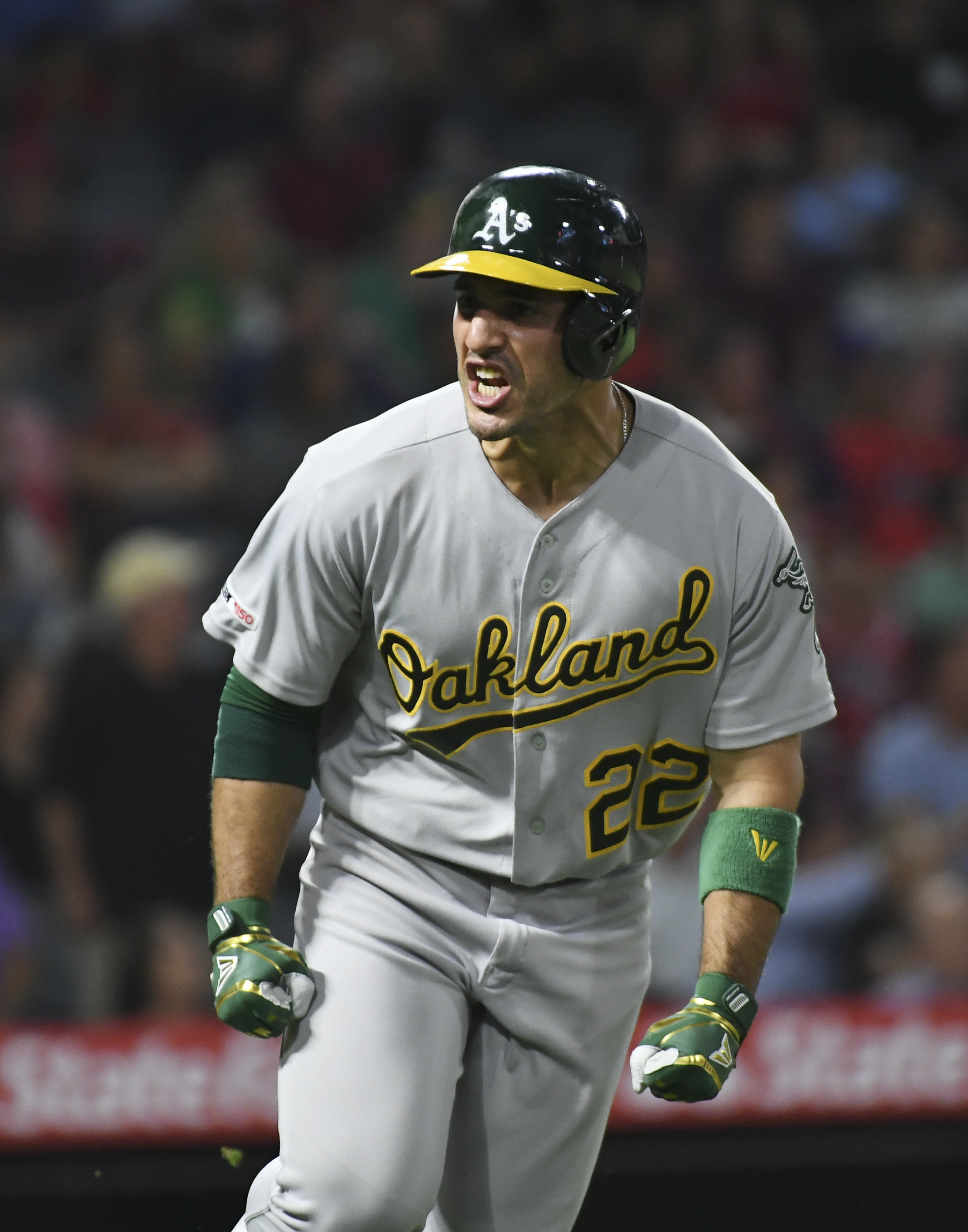
At the time of the swap, it barely drew notice. It certainly didn’t seem like any sort of egregious misstep. Laureano had turned in a woeful .227/.298/.369 slash in Double-A that year. He connected on 11 home runs and swiped 24 bags, showing a bit of pop and some speed, but his walk rate was cut in half from its 2016 mark. Scouting reports praised his glovework, but the Astros apparently didn’t think his defense was as good as it’s proven to be. Former GM Jeff Luhnow admitted to Chandler Rome of the Houston Chronicle last April that the Astros didn’t “quite [have] the defense rated as well as it’s played in the big leagues,” plainly calling the trade “one I’d love to have back.”
Laureano’s glove in 2019 didn’t play out quite as well as it did in 2018 — at least not in the estimation of most metrics. In just 385 innings in 2018, he logged +6 Defensive Runs Saved, a 3.7 Ultimate Zone Rating and +2 Outs Above Average. Those numbers dipped to +3, +0.7 and -5, respectively, in 1041 innings between center field and right field this past season. Even as his overall numbers might’ve taken a step back, Laureano showed off a cannon from both center and right. In 1426 innings at the MLB level, he’s racked up 17 assists — earning every bit of his “Laser Ramon” nickname.
As for his work at the plate, Laureano’s 2019 output matched his standout showing from his 2018 debut. Over the life of 481 plate appearances, he turned in a .288/.340/.521 batting line with 24 long balls and 13 stolen bases (in 15 attempts). That was good for a 126 wRC+ that lined up nicely with the 130 mark he posted as a rookie in 2018.
Overall, Laureano has appeared in 171 MLB games and taken 687 plate appearances — just over a full regular season’s worth of work. Between his outrageous arm, solid all-around defense, well-regarded baserunning ability and his strong work at the plate, he’s been worth 6.0 fWAR and 5.9 bWAR. That trade, considering the club control (through 2024) and low cost of acquisition, stands out as one of the best moves in recent memory for A’s executive vice president of baseball operations Billy Beane, GM David Forst and the rest of the Oakland staff.
Speaking of that cost of acquisition, it’s worth taking a look at what the Astros did get. The now-25-year-old Bailey is still a prospect of some note — albeit one that the ‘Stros almost lost for nothing. Houston opted to leave Bailey unprotected in December’s Rule 5 Draft, and the Orioles (headed up by former Astros assistant GM Mike Elias) snagged him with the second overall pick. Baltimore since returned him, but that selection speaks to Bailey’s ability in and of itself.
Last year, the right-hander logged a 3.30 ERA in a pitcher-friendly Double-A setting, averaging an even 10 strikeouts against 3.98 walks per nine innings pitched. He’s not an elite prospect, but Eric Longenhagen ranked him 30th among Houston farmhands at FanGraphs this winter, labeling him as a potential reliever with a “robust” arsenal. Clearly though, even if Bailey meets or exceeds that ceiling, he has a long way to go before making the Laureano swap look like anything less than a heist.
So, why did Houston move Laureano in the first place? The trade took place just prior to the deadline to set 40-man rosters in advance of the 2017 Rule 5 Draft, and the Astros weren’t set on adding Laureano after his aforementioned down year in Double-A. It’s a mistake that every club has made in some shape or form, and I’ll be the first to say that it’s not really fair to look back and make harsh judgments with the benefit of hindsight. That said, Astros decisionmakers have to cringe when they look back at the players they chose to preserve over Laureano.
The Astros themselves actually kept a 40-man roster spot open, which they used to select outfielder-turned-left-hander Anthony Gose from the Rangers in the Rule 5 Draft. Gose never pitched for Houston and wound up back with the Rangers. Preston Tucker was already on the 40-man roster but had posted a 102 wRC+ in Triple-A in 2017 without appearing in a big league game. He was designated for assignment less than a month after trading Laureano (clearing a roster spot for Hector Rondon). Houston also dedicated a 40-man roster spot to backup catcher Juan Centeno, whom they claimed off waivers a few days after trading Laureano.
As for players actually selected to the 40-man roster in protection from the Rule 5 Draft, Houston added lefty Cionel Perez and righty Dean Deetz. The former is still with the team but has yet to establish himself as a regular member of the pitching staff. The latter was hit with an 80-game PED suspension later that offseason and outrighted off the 40-man roster earlier this winter. He’s pitched 3 1/3 innings in the Majors.
Both Perez and Deetz were more highly regarded prospect at the time, and no one was labeling the Laureano deal any sort of heist or steal for the A’s. The purpose here isn’t to look back and say, “How could the Astros have possibly done this?!” but rather to give a tip of the cap to a savvy acquisition from the A’s that has not only greatly boosted their own long-term outlook but done so at the expense of a division powerhouse.
Oakland, after all, has Laureano penciled in as its center fielder for the next half decade and figures to reap enormous surplus value from his remaining pre-arb years and early arbitration seasons. For a low-payroll club, that’s all the more valuable. The Astros, meanwhile, are set to lose their entire outfield to free agency this winter. Vaunted prospect Kyle Tucker gives them one likely replacement, but it must be particularly difficult to see another would-be outfield cornerstone thriving with their closest competitor for AL West supremacy.
The A’s Draft Gamble That Paid Off
The A’s have built a pair of reigning playoff teams, a much-welcome return to relevancy after three consecutive last place finishes from 2015-17. Recently, they’ve been anchored by a perhaps still-underrated superstar. Over the past two seasons, Matt Chapman has hit .263/.348/.507 (131 wRC+) with 60 home runs in 1286 plate appearances. More notably, he’s proven himself a wizard at third base, racking up an absurd 68 defensive runs saved. With his achievements on both sides of the ball, Chapman has been worth 12.8 fWAR/16.6 bWAR in the last two seasons alone. Baseball Reference’s value metric places him as the third-most valuable position player in that time (behind only Mike Trout and Mookie Betts). Fangraphs slots him sixth, with Alex Bregman, Christian Yelich and Anthony Rendon joining Trout and Betts in the top five.
Regardless of where specifically one would slot Chapman among the game’s best players, it’s apparent he’s at least in the conversation. Given the player he’s become, it’d be easy to assume he was seen as a ‘can’t-miss’ talent dating back to his amateur days. That’s not really the case. He was the A’s first-round pick back in 2014, 25th overall. At the time, though, that pick could’ve been considered a bit of a reach, at least in comparison to public rankings.
Neither Baseball America nor MLB Pipeline had Chapman in their top 50 prospects pre-draft (BA slotted him 64th, while Pipeline placed him 82nd). Nor did he crack the top 30 of then-ESPN analysts Keith Law and Christopher Crawford the fall prior. That’s not meant to be a criticism of draft prognosticators. Despite his frame, Chapman never showed much power in games as an amateur. He hit a cumulative 13 home runs over his three years at Cal State Fullerton. It’s hardly surprising evaluators didn’t see a future 36-homer bat in the big leagues.
Questions about Chapman’s hitting prowess were prevalent enough that both Baseball America and MLB Pipeline pointed to pitching as a potential fallback. The elite arm strength he now shows off at the hot corner in Oakland helped him touch 98 MPH on the mound in college. While the consensus was that Chapman should be a given a shot in pro ball at third, where reviews on him defensively were always positive, it wasn’t hard to imagine him flaming out and moving to the mound someday.
To the A’s credit, they never seemed to budge on their evaluation of him as a hitter. Asked about a potential mound conversion for Chapman after the draft, A’s scouting director Eric Kubota shot down the idea to Jimmy Durkin of the Bay Area News Group. “He’s got a chance to be an elite defender at third base,” Kubota told Durkin. “He can really throw. We think his bat is ever-improving. We think there’s untapped power there. We think this is a guy who is going to develop into a power hitter.”
Kubota’s words look awfully prescient in hindsight. Obviously, the organization’s belief in Chapman wasn’t shared throughout the league. There’s no chance he’d have fallen to pick 25 if it were. If teams were to redraft the 2014 class today, Chapman would no doubt be at the top of most teams’ boards. His emergence is a credit to the A’s scouting and player development staffs (and a testament to Chapman himself), an example of the ideal progression teams dream of when they bring a talented player into the system. It’s also a reminder that teams’ evaluations of draft prospects can vary, sometimes to their immense success.
Remembering An Athletics One-Hit Wonder
It was 16 years ago that the Athletics traded away a successful homegrown talent in left-hander Mark Mulder, whom they sent to the Cardinals in exchange for righties Dan Haren and Kiko Calero and first baseman Daric Barton. Mulder was a former No. 2 overall pick (1998) who, along with Tim Hudson and Barry Zito, helped comprise the feared Big Three in Oakland’s rotation. While Mulder pitched to a 3.92 ERA as an Athletic and racked up almost twice as many wins (81) as losses (42) in their uniform, he struggled down the stretch in 2004, thereby sealing his fate with the club.
Although Mulder had a nice first season in St. Louis, injuries played a part in torpedoing his career from there, as he only threw 106 innings of 7.73 ERA ball from 2006-08. In hindsight, it wasn’t a great trade for the Cardinals, but the A’s did get serious value out of it. Haren turned in three highly productive seasons in Oakland before the team flipped him to Arizona in a major 2007 deal, while Calero enjoyed two impressive years out four with the club. By measure of fWAR, though, neither Haren nor Calero matched Barton’s top season as a member of the team. When comparing his best season with the rest of his career, Barton’s one of baseball’s clearest examples of a one-hit wonder from the previous decade.
It’s worth noting that Barton was actually one of the premier prospects in baseball during his days on the farm – Baseball America ranked him between 32nd and 67th four years running. As BA wrote before the 2007 season: “Oakland general manager Billy Beane called Barton the best hitter in the minors when he traded for him, and he remains the system’s best pure hitter. He has a textbook swing, fluid and short with a bit of loft, hinting at future power. His exceptional plate discipline allowed him to control the strike zone at Triple-A as a 20-year-old, and he’s advanced enough to know to use the whole field.”
Barton seemed on his way to proving his supporters correct, albeit over just 84 plate appearances, as he debuted in Oakland and batted a marvelous .347/.429/.639 (181 wRC+) with four home runs. But it took until 2010 for Barton to truly produce like a star over a full season. While Barton only mustered 10 homers in 686 PA and 159 games that year, he nonetheless totaled 5.0 fWAR, tying him with a couple familiar names in then-Phillie Jayson Werth and perennial Cardinal Yadier Molina. Barton got there on the strength of his exceptional eye and his strong defense. The lefty swinger posted the game’s eighth-highest on-base percentage and an overall line of .273/.393/.405 (126 wRC+), and he ranked among the sport’s top-graded fielders with 19 Defensive Runs Saved and an Ultimate Zone Rating of 11.8.
Oakland looked as if it had its long-term answer at first then, but it was all downhill from there. Barton’s numbers took a turn for the worse the next season and he was never a big league regular again. He continued to draw walks at a high clip, but the powerless Barton limped to a line of .216/.323/.284 (76 wRC+) with a mere four HRs and 0.1 fWAR during a 600-PA span over the rest of his time in the majors. The A’s even designated Barton for assignment in 2013, though he did stick with the organization into the next season. Barton hasn’t been heard from in the majors since then, though, and until today, he hadn’t been mentioned on MLBTR’s pages since the Blue Jays’ Triple-A club released him in July 2015.
Barton did play in Mexico for a few seasons after his run in MLB and Triple-A ended, but the 34-year-old’s now out of baseball. That surely wasn’t the way he or the A’s expected his career to conclude in the wake of his magical 2010 effort, but thanks to that one huge year, he had a more productive MLB career than most who appear in the league.
AL West Notes: Calhoun, Rangers, Athletics, Astros
Rangers outfielder Willie Calhoun suffered a horrible injury – a fractured jaw – when he took a 95 mph pitch to the face in early March. Fortunately, though, Calhoun’s doing well in his recovery. Calhoun told MLB Network Radio (via Brice Paterik of the Dallas Morning News} that he’s “back up to 100 percent.” He’s in line to play a key role for the Rangers this year after turning in a productive 2019 campaign, and could be a breakout candidate, but it took some time for the light bulb to go on for the former high-end prospect. The 25-year-old Calhoun believes he owes some of his recent success to Rangers general manager Jon Daniels. “JD really flat out just told me the stuff I needed to work on and he was saying at the time I don’t think I was doing as well offensively,” Calhoun said. “He said ‘if you’re going to be an offense only guy you’ve got to put up offense only numbers, like J.D. Martinez type numbers.” Calhoun got into better shape after that talk with Daniels, and the results have been encouraging since then. Check out Paterik’s piece for more quotes from Calhoun.
- Former Athletics minor leaguer Miguel Marte has passed away of COVID-19 at the age of 30, per Susan Slusser of the San Francisco Chronicle. Marte, a catcher/first baseman from the Dominican Republic, played in the A’s system from 2008-12. He left behind a wife and two children. If you’re interested in helping them, a GoFundMe page has been set up.
- The Astros have also lost somebody to the coronavirus. Bill Gladstone, who owned Single-A affiliate the Tri-City ValleyCats passed away of the illness Thursday, according to Chandler Rome of the Houston Chronicle. “Bill was a class act with a great passion for the game,” the Astros said in a statement. “Our entire Astros family sends our heartfelt condolences to his son, Doug, his daughter, Susan and to the entire Gladstone family.”
- As a result of the pandemic, roughly half of the Rangers’ full-time employees in baseball and business operations will face a reduction in pay after May 15, Evan Grant of the Dallas Morning News tweets. Those cuts in salary could range from 10 to 20 percent, and there’s no indication as to how long they’ll last, but the Rangers aren’t planning to lay off any of those employees at this point.
10 MLB Teams Whose Business Initiatives Face Coronavirus Hurdles
Like most every person or business, all thirty MLB teams face tough questions during the time of COVID-19. Some are relatively similar for all ballclubs, but there are obviously quite a few unique issues — some more pressing than others.
Dealing with the implications of this pandemic is probably toughest for organizations that are in the midst of executing or planning major business initiatives. We’ll run down some of those here.
Angels: The team has been cooking up potentially massive plans to develop the area around Angel Stadium. Fortunately, nothing is really in process at the moment, but it stands to reason that the project could end up being reduced in scope and/or delayed.
Athletics: Oof. The A’s have done a ton of work to put a highly ambitious stadium plan in motion. Massive uncertainty of this type can’t help. It isn’t clear just yet how the effort will be impacted, but it seems reasonable to believe the organization is pondering some tough decisions.
Braves: Luckily for the Atlanta-area organization, the team’s new park and most of the surrounding development is already fully operational. But with the added earning capacity from retail operations in a ballpark village comes greater exposure to turmoil.
Cubs: Like the Braves, the Cubs have already done most of the work at and around their park, but were counting on big revenue to pay back what’s owed (and then some). Plus, the Cubbies have a new TV network to bring up to speed.
Diamondbacks: Vegas?! Vancouver?! Probably not, but the Snakes do want to find a new home somewhere in Arizona. That effort is sure to be dented. Plus, the team’s recent initiative to host non-baseball events at Chase Field will now go on hiatus.
Marlins: The new ownership group has had some good vibes going and hoped to convert some of the positivity into a healthy new TV deal. That critical negotiation will now take place in a brutal economic environment.
Mets: So … this is probably not an optimal moment to be selling your sports franchise. The Wilpon family is pressing ahead with an effort to strike a new deal after their prior one broke down (at the worst possible time).
Orioles: That bitter television rights fee dispute that just won’t stop … it’s not going to be easier to find a resolution with less cash coming through the door. It was already setting up to be a rough stretch for the Baltimore org, with past TV money due to the Nationals and more bills to come, even while going through brutally lean years on the playing field.
Rangers: The new park is now built. While taxpayers footed much of the bill, the club still has to pay back a $600MM loan. Suffice to say the Rangers (and municipal authorities) anticipated game day revenues of more than $0 in year one when they planned out the loan repayment method.
Rays: The club’s preferred Ybor City option flamed out and it is currently engaged in a somewhat confusing effort to split time between the Tampa Bay area and Montreal. Existing hurdles to that arrangement seem only to be taller in the age of the coronavirus.
Others: We may be missing some, but it seems most other organizations are engaged more in usual-course sorts of business initiatives rather than franchise-altering efforts. For instance, the Nats have an interest in that TV deal as well. The Red Sox have been working to redevelop areas around Fenway Park. The Blue Jays are dabbling in future plans. And the Dodgers have a new TV rights deal, though that came to fruition after the pandemic hit and may not be impacted any more than any other existing carriage arrangements.
Latest On MLB Teams’ Cost-Cutting Efforts
There’s a spreading optimism — or, at least, a spread of reporting about optimism — regarding the return of baseball in 2020. But the pandemic shutdown has already stung MLB teams and the near-term revenue prospects remain poor, even if a television-only campaign is launched.
Unsurprisingly, even as teams prepare to refund fans for games that won’t be played as expected, we’re seeing enhanced efforts on the part of MLB organizations to cut costs. As Pirates GM Ben Cherington put it (via Jason Mackey of the Pittsburgh Post-Gazette), “revenues aren’t coming in” but “cash is still going out.”
The notoriously tight-fisted Bucs have enacted austerity policies. But sources tell Mackey that the team isn’t among those in the roughest shape financially around the game. The Pirates have stopped 401(k) contributions and suspended fellowship/internship programs while top-level leaders take reductions in pay. Cherington says “the full expectation is that [401(k)] contribution will go back into effect as soon as possible,” and emphasized that the hope was to “find some savings without too much impact on people and their everyday lives.”
None of these sorts of measures are pleasant, but Pirates employees seem to be in better stead than those of the Rays. Marc Topkin of the Tampa Bay Times reports that the low-budget Tampa Bay outfit has become the first MLB organization “to implement aggressive expense cutting moves” — in particular, furloughing some full-time employees and cutting the pay of others that earn above a certain threshold.
The Rays are covering health insurance for furloughed staff and the hope remains to bring many jobs back online. But the move reflects the stark realities of the sport in the era of COVID-19. Per Topkin, the top organizational leadership advised employees of concern that the revenue drag could continue for years to come.
Like the Rays, the Athletics have been scrimping and saving while working through difficult new-ballpark negotiations and planning. With those efforts now confronted by an entirely new sort of hurdle, and the near-term revenue outlook plummeting, the Oakland club is considering cuts of its own, according to Ken Rosenthal and Alex Coffey of The Athletic (subscription link). The A’s may actually be contemplating something rather more aggressive than what the Rays just enacted. The Athletic reports that the Oakland org is “discussing extensive layoffs” and could ultimately carry a “significantly smaller staff on both the business and baseball sides.”
Susan Slusser of the San Francisco Chronicle also examines the A’s situation. Employees say they have no idea what to expect and the team hasn’t responded to requests for comment. It remains to be seen how the situation will be handled, but with every other team in the league having already charted a path, the silence is ominous. Slusser doesn’t offer a definitive prediction, but does warn: “don’t be surprised” if major cuts occur.
These three teams may be pressed into action sooner than some peers, but the issues aren’t limited to lower-budget organizations. As Mackey writes in the above-linked post, and as we have covered in recent weeks, several other clubs have also pursued cost-reduction strategies that impact employees. And The Athletic reports that multiple teams around the league have had some level of internal discussion of major changes to their operations. At the moment, every team in baseball aside from the A’s and Rays has promised to retain full-time employees through the end of May. Hopefully, there’ll be sufficient clarity and optimism in the outlook at that point to avoid broader cuts.
Replacing An MVP-Contending Shortstop
Because of the coronavirus, the Athletics are facing at least one very sad possibility: Shortstop Marcus Semien may never wear their uniform again. Whether or not any kind of season happens, Semien will be eligible to reach free agency next winter. He’ll be among the most coveted players available, and the low-budget Athletics have never been known for splurging on anyone. The largest guarantee they’ve ever given out still belongs to former third baseman Eric Chavez, whom they signed to a $66MM guarantee way back in 2004. And frankly, if any one player on the current A’s is going to exceed that amount sometime soon, third baseman Matt Chapman is probably a better candidate than Semien.
Now, saying Oakland will probably prioritize Chapman isn’t a knock on Semien. But Semien’s a couple years older – his 30th birthday is in September, while Chapman just turned 27 today – and the A’s have less time to lock him up with a potential trip to free agency looming.
Should Semien walk, he’d be an enormous loss for the club. Originally acquired from the White Sox in a 2014 trade, Semien has gradually evolved into an elite shortstop. He was a decent player for the A’s from 2015-18, a four-year, 2,311-plate appearance stretch in which he accumulated 9.1 fWAR, but was only a league-average hitter throughout.
Semien truly turned a corner last season during a near-American League Most Valuable Player effort. He slashed .285/.369/.522 with 33 home runs and 10 stolen bases en route to 137 wRC+, the second-highest number among all full-time shortstops (only Boston’s Xander Bogaerts fared better). And while Semien’s work at short drew criticism in his younger days, 2019 represented his second straight resoundingly successful year as a defender. He put up 12 Defensive Runs Saved and managed a 6.7 Ultimate Zone Rating. The entire package was good for 7.6 fWAR, the fifth-highest amount in the majors and one that helped him to a third-place finish in AL MVP balloting behind Mike Trout and Alex Bregman.
It’s just about impossible to immediately replace what Semien brought to the table last season, but Oakland may soon have to make the attempt. The question is: How? As mentioned, the A’s aren’t big spenders. That said, it doesn’t seem crazy to think they could at least make an effort on Andrelton Simmons or Didi Gregorius, the next best free-agent shortstops in the upcoming winter’s class, if they only command short-term contracts. The rest of the market should be decidedly less inspiring at the position, but Oakland could plug in someone like Freddy Galvis or Jose Iglesias as affordable stopgaps capable of offering roughly league-average WAR totals. As for trades, would the A’s dare be aggressive enough to push their chips to the table for someone like Francisco Lindor of the Indians or the Rockies’ Trevor Story, free agents-to-be after 2021 who would surely be rentals for them?
Alternatively, there’s the chance of adding a second baseman via trade or free agency and shifting an in-house player to short. The trouble is that the A’s, Semien aside, don’t have any proven shortstop options from within their ranks. Franklin Barreto was once a premium middle infield prospect, but he hasn’t panned out so far, and he didn’t play much short in the minors from 2017-19. Sheldon Neuse appeared in all of nine minor league games there last season. Jorge Mateo has quite a bit of minors experience in the spot, but he hasn’t inspired at the plate. Vimael Machin‘s a Rule 5 pick, and seldom do they turn into valuable performers. Prospects like Nick Allen or Logan Davidson could eventually be the solution, though neither has even gotten to Double-A yet.
Every team is in a difficult position as a result of the pandemic, but Oakland ranks near the top. The Athletics are a back-to-back 97-win team who, as constructed, could compete for a World Series championship. Semien’s an important part of that, though, and nobody knows whether he’ll play for the club again. But regardless of whether a season happens, the A’s may be mere months away from facing the unenviable task of trying to replace a player who has become a star in their uniform.
Photo courtesy of USA Today Sports Images.
How Did The A’s End Up With Baseball’s Most Productive Reliever?
Okay, I’m sure some will take umbrage with the title here. But I chose my words pretty carefully. Liam Hendriks probably wasn’t baseball’s most effective reliever in 2019. He almost assuredly isn’t its best from a true-talent perspective. And the Aussie certainly isn’t its most valuable when it comes to control rights and contracts. (He’ll be a free agent at the end of the 2020 season.)
But … Hendriks did lead Major League Baseball’s bullpen denizens with a whopping 3.8 fWAR last year … the loftiest single-season tally since Eric Gagne‘s magical 2003 effort. (It’s 3.9 if you include his two “opener” outings.) Hendriks was also worth 3.5 rWAR, so it wasn’t just a quirk of the FIP-based Fangraphs tabulations. Prefer RA9 WAR? He was even more dominant.
But, you may protest, wins above replacement isn’t the best measure of a reliever. That’s no doubt true. The precise tabulations don’t really matter for our purposes here. Hendriks was in part able to out-WAR his fellow relievers because he threw so many innings — 85 in 75 appearances, one of the heaviest workloads in the game — but that just makes things more impressive. He ranked among the leaders in most major measures of effectiveness as well … including fielding-independent pitching measures FIP (2nd), xFIP (18th), and SIERA (5th).
This showing was exceedingly impressive, no matter the details. It was also … decidedly not consistent with Hendriks’s prior efforts on an MLB mound. Entering the 2019 season, his big league stat sheet reflected 406 innings of 4.72 ERA pitching.
How on earth did we get here?
We can mostly ignore the earliest stage of his career, when Hendriks — once a prospect of some note with the Twins — failed to make it as a starter. The Minnesota organization cut bait after 156 innings of 6.06 ERA pitching. Hendriks ultimately landed with the Blue Jays after a round of offseason waiver-wire musical chairs in the 2013-14 offseason. He first went from the Twins to the Cubs after the Minnesota org signed Phil Hughes. The Orioles prevented the Cubs from slipping Hendriks through waivers but cut him loose when they inked Ubaldo Jimenez.
The Toronto organization only gave Hendriks a few outings during the ensuing 2014 season before sending him to the Royals in a deal for Danny Valencia. Hendriks did have good Triple-A numbers that year. When the Royals needed 40-man space in the ensuing offseason, the Jays stepped back in and grabbed Hendriks back in a DFA limbo swap.
Finally, the stage was set for success. Hendriks moved into the bullpen in Toronto … and immediately exhibited a huge uptick in velocity. He was sitting over 95 mph in a relief capacity and having much more success at generating swings and misses. In 2015, Hendriks turned in 64 2/3 innings of 2.92 ERA ball with 9.9 K/9 against 1.5 BB/9. He didn’t allow many home runs (0.4 per nine) and even generated a strong 46.3% groundball rate (the only time he has ticked up in that department).
The Blue Jays decided to cash in at this point, shipping Hendriks to Oakland in exchange for steady veteran swingman Jesse Chavez. He continued the strong work for the most part. While his ERA trickled north, Hendriks still carried good peripherals and gave the A’s a lot of useful innings in his first two campaigns. Taking his 2015-17 efforts as a whole, Hendriks was a notable contributor: he threw between 64 and 64 2/3 frames in each season while compiling a 3.63 cumulative ERA and a total of 3.9 fWAR (precisely the tally he managed in the 2019 season alone).
Before Hendriks could break out, he had to go through the roughest patch since his time as a starter. He struggled with a groin injury and threw eleven terrible innings before being dumped to make way for Edwin Jackson. Hendriks sailed through waivers and could’ve elected free agency, but decided to stay with the A’s since doing otherwise would’ve meant giving up the remainder of his $1.9MM arbitration salary.
Expectations were low when the A’s unceremoniously brought Hendriks back onto the MLB roster for the stretch run with the September active roster expansion. But he had transformed himself while away and the results were immediately apparent — at both Triple-A (43:4 K/BB in 25 1/3 innings) and the big leagues (two earned runs, 10:3 K/BB in 13 innings). What changed? As Rian Watt of Fangraphs wrote recently, A’s pitching coach Scott Emerson credits Hendriks for having “transformed his body” and with it his “mindset” and “approach” during his demotion. Oh, and Hendriks added velocity — it was apparent late in 2018 and continued in 2019 — and figured out a better means of locating his curve to complement the heat.
That good old-fashioned hard work has served Hendriks well in the past; he credited strength training and clean living for his original, pre-2015 breakout. But this time he moved into much more exclusive territory, delivering a 96.8 mph average fastball and generating a big 17.0% swinging-strike. Hendriks ended up fifth among all relievers with 32.0% K%-BB%.
Remarkably, even as the A’s watched Blake Treinen fall from his perch (a 3.6 fWAR 2018 season), they were able to turn over the ninth inning to a similarly dominant hurler. Hendriks ended up locking up 25 saves for Oakland last year. He’s earning a reasonable $5.3MM in his final season of arbitration eligibility — which will actually be his tenth consecutive season of MLB action, owing to all the ups and downs over the years.
As for the future, we’ll have to see whether Hendriks can keep this going. But he only turned 31 in February, so he could have many good seasons ahead.
Athletics Notes: Ballpark, Coronavirus Impact
There’s not much new to report on around the game, but there has been a bit of chatter relating to the Athletics, so we’ll round it up here …
- In response to a reader question, Susan Slusser of the San Francisco Chronicle provides an initial assessment of the potential impact of the pandemic on the Athletics’ plans for a new ballpark. As she explains, it’s still far too soon to know how the outlook will change. But there’s little doubt the ambitious project — which has advanced through multiple tough stages and finally seemed on track to being realized — will face new hurdles and potential for delay or modification.
- The A’s are of the few teams that haven’t yet decided how to handle non-team employees during the MLB shutdown. Per Slusser, via Twitter, the Oakland org hasn’t yet promised salaries through the end of May but also hasn’t decided against that course. It’s unclear at this point whether the Athletics will follow the majority of ballclubs that have guaranteed ongoing paychecks at least to that point of the year.
- Perhaps this helps explain why the Mets snapped up Tim Tebow under then-GM Sandy Alderson? It turns out that when Alderson was running the Athletics, he tried to pull off an even bigger cross-sport stunner. Alderson tells ESPN.com’s Buster Olney (audio link) that he tried to keep Michael Jordan from joining the White Sox when the NBA legend decided to try his hand at baseball. To woo Jordan west, Alderson was willing to put him directly onto the A’s active roster. That likely would not have turned out terribly well from a baseball perspective, but it sure would’ve made the MJ saga even more interesting to follow at the time.
- Oh, and one more development: Mark Canha — who is hoping to build off of a breakout 2019 season — is trying not to obliterate private property with his MacGyver’ed batting practice setup.
MLBTR Poll: Third Base Building Blocks
Major League Baseball boasts a high number of quality third basemen, evidenced in part by the fact that nine regulars at the position totaled at least 4.5 fWAR last season. The Athletics’ Matt Chapman and the Red Sox’s Rafael Devers finished in the top five in that category, and as players who are controllable for the foreseeable future and only in their 20s, they represent a pair of the top building blocks in the game. The question, though, is which player you’d rather have going forward.
The easy answer (or so it seems) is Chapman, whose career production has trounced Devers’ since the two debuted in 2017. Not only is he a defensive wizard, but Chapman can flat-out hit. The soon-to-be 27-year-old’s all-around excellence had led to 15.5 fWAR thus far, including back-to-back seasons of 6.0 fWAR or better. He’s now coming off a career-best campaign as a power hitter in 2019, when he batted .249/.342/.506 (125 wRC+) with 36 home runs in 670 plate appearances.
Chapman still has four years of team control left, including one more pre-arb season (that’s if there is MLB in 2020). The same goes for Devers, so the two are even in that regard. As mentioned, Chapman’s output has crushed Devers’ in the aggregate. However, Devers closed the gap a season ago with a 5.9-fWAR showing, and he’s also several years younger than Chapman. Devers, who won’t even turn 24 until October, was roughly a league-average offensive player from 2017-18, but the proverbial light bulb went on last season during a .311/.361/.555 effort (132 wRC+) in which he slugged 32 homers over 702 PA.
Devers has nothing on Chapman at third – the former put up minus-10 DRS and plus-2.7 UZR last year; the latter recorded an otherworldly plus-34 DRS and plus-14.8 UZR – but they’re close in terms of offensive prowess. And Devers is so much younger than Chapman that it’s hard not to take that into consideration when comparing the two. Going by fWAR, Chapman was the third-most valuable third baseman in baseball in 2019. Devers was fourth. You can’t lose with either player, but all things considered, whom would you rather have heading into the future?
(Poll link for app users)
Matt Chapman or Rafael Devers?
-
Chapman 64% (2,415)
-
Devers 36% (1,365)
Total votes: 3,780