
West Notes: Greinke, Lopez, Padres, Lyles, Ragans
It has been something of a trying spring for Diamondbacks ace Zack Greinke. As Nick Piecoro of the Arizona Republic writes, the venerable starter is unlikely to be ready to take the ball on Opening Day — though that isn’t necessarily the primary concern for the organization. The more important consideration, surely, is to ensure that Greinke does not end up with a bigger problem after experiencing what the team is characterizing as minor groin tightness. Greinke was already laboring with sluggish fastball velocity, but it seems the team is generally still optimistic that he’ll be at full strength for the bulk of the coming season.
Here’s more from out west:
- The D-Backs are seeing renewed promise in young righty Yoan Lopez, Piecoro further writes. It’s an interesting look at the winding path that Lopez has taken since he signed a $8.25MM deal as an international free agent — a contract that cost the team double that amount and also put it in the penalty box for the ensuing two signing periods. The Cuban hurler pitched last year at the High-A level, allowing just three earned runs on 16 hits in 31 2/3 frames while recording a shiny 59:10 K/BB ratio. Beyond the results, Lopez has impressed with his stuff and a new attitude; it’ll certainly be interesting to see if he’s able to push for a chance at the majors at some point in the near future.
- The Padres are no longer considering Jordan Lyles for their rotation, MLB.com’s AJ Cassavell tweets. The veteran righty could still earn a pen slot; given that the Padres promised him $1MM for the season in a deal that includes a 2019 option, it would seem they expected to carry him on the roster in some capacity. But the 27-year-old has been roughed up this spring and in his recent MLB seasons. By Cassavell’s reckoning, also via Twitter, that leaves the battle for the club’s final two starting jobs to veterans Tyson Ross and Chris Young along with younger hurlers Luis Perdomo and Robbie Erlin.
- Rangers prospect Cole Ragans is slated for an elbow MRI, as Jeff Wilson of the Fort Worth Star-Telegram was among those to tweet. That’s certainly not the news the organization was hoping for at this stage of camp for a player who was taken 30th overall in the 2016 draft. The southpaw is still nowhere near the majors, having spent last season at the low A level, but he’s seen as a high-ceiling prospect and the Rangers are surely hoping to see him turn in a full season of development. Ragans racked up 87 strikeouts (but also 35 walks) in his 57 1/3 innings last year, ending the season with a 3.61 ERA. For now, it’s just a situation to monitor.
Spring Training Rule 5 Update
There were 18 players selected in the 2017 Rule 5 Draft — which is to say that 18 players who were left off their organizations’ respective 40-man rosters were selected by a new team and given a chance to break camp on a 25-man roster.
Eligibility for the Rule 5 Draft is dependent on age and minor league service time, but the Rule 5 is generally an opportunity for potential big leaguers who aren’t in their clubs’ immediate plans to break through elsewhere, so long as they can remain on their new club’s roster/disabled list for the entire season — including at least 90 days of active roster time. (A player who falls shy of those 90 days of active service due to DL time retains his Rule 5 status in following seasons until he has accumulated 90 active days on the 25-man roster.) Rule 5 players cannot be optioned to the minors without first being passed through outright waivers and, if they clear, then offered back to their original club for $50K (half of the $100K cost of making a Rule 5 pick in the first place).
Here’s a look at the spring standing of the current slate of Rule 5 picks:
- Victor Reyes, OF, Tigers (selected out of D-backs organization): The 23-year-old Reyes is hitting just .200/.243/.229 through 37 plate appearances after being selected with the No. 1 pick in this year’s Rule 5 Draft. Obviously that’s not the performance Detroit was hoping to receive, though that hasn’t ruled him out for a roster spot on a rebuilding club. Manager Ron Gardenhire recently called it a “really big” decision when chatting with the Detroit Free Press’ Anthony Fenech, who examines the decision at greater length in his column.
- Julian Fernandez, RHP, Giants (from Rockies): The 22-year-old Fernandez has yet to pitch above A-ball since debuting as a 17-year-old back in 2013, and he’s been hammered for 10 runs on six hits and four walks with six strikeouts in 3 1/3 innings with the Giants this spring. It’s tough to see him sticking, even if he can top 102 mph with his heater (as Baseball America’s J.J. Cooper noted on Twitter at the time of the draft).
- Nick Burdi, RHP, Pirates (from Twins via trade with Phillies): Burdi, recovering from Tommy John surgery, has yet to pitch this spring and will be on the disabled list to open the season.
- Carlos Tocci, OF, Rangers (from Phillies, via trade with White Sox): Tocci has swiped six bags and reportedly shown good leatherwork in the outfield, making him a plausible reserve outfield candidate if the Rangers decide to prioritize those attributes in rounding out their bench. On the other hand, he’s struggling at the plate this spring and does not exactly have a lengthy track record of hitting in the upper minors.
- Brad Keller, RHP, Royals (from D-backs, via trade with Reds): Though he managed only a 4.68 ERA at the Double-A level last year, Keller is being looked at as a reliever by a Kansas City organization that is in need of pitching depth. He has recorded seven strikeouts in six spring innings and seems to have a solid shot at taking a job.
- Burch Smith, RHP, Royals (from Rays, via trade with Mets): Once a well-regarded prospect whose career was derailed by injury, Smith put up some interesting numbers in the Arizona Fall League (including 29 strikeouts in 20 1/3 innings). He has been a bit wild this spring, handing out eight free passes in eight frames, but could join Keller in the K.C. pen.
- Anyelo Gomez, RHP, Braves (from Yankees): Yet another interesting player in a Yankees system that is producing too much talent for the team’s 40-man roster, Gomez ran up the ladder in a strong 2017 season, briefly reaching Triple-A and ending with a cumulative output of 70 1/3 innings of 1.92 ERA pitching with 11.1 K/9 and 2.7 BB/9. He hasn’t dominated this spring, but the Braves obviously like his arm and have plenty of reason to try to hang onto him in a year in which they do not expect to compete for the postseason.
- Nestor Cortes, LHP, Orioles (from Yankees): What’s that we were saying about the Yankees? Ah yes, another such player. The 23-year-old just ran up over a hundred innings of 2.06 ERA ball in the upper minors, with 9.0 K/9 and 2.8 BB/9. He has held his own as a starter this spring, too. With the O’s in need of both lefty relievers and rotation depth, he seems to be on track for a job.
- Jordan Milbrath, RHP, Pirates (from Indians): An intriguing side-arm reliever, Milbrath certainly came into camp with a shot at cracking the Pittsburgh pen. But it’s fair to wonder if that’s still possible now that he has struggled through six outings, coughing up eight earned runs on eight hits and seven walks in 5 1/3 innings.
- Elieser Hernandez, RHP, Marlins (from Astros): The pitching-needy Marlins snagged Hernandez after he showed well at the High-A level and in the Venezuelan Winter League. He has impressed this spring with nine strikeouts and no walks over ten innings, so the Marlins have every reason to stash him in the bullpen.
- Mike Ford, 1B, Mariners (from Yankees): An injury to Ryon Healy initially looked like it could help to open a door for Ford, but it’s a fairly short-term issue for Healy, and Ford is hitting just .150/.292/.325 through 48 PAs this spring. With Daniel Vogelbach on hand as another lefty swinging first base/designated hitter option, Ford could have a tough time sticking in Seattle.
- Luke Bard, RHP, Angels (from Twins): Bard was shelled for five runs in one-third of an inning in one of his outing but has otherwise impressed the Halos this spring, as Mike DiGiovanna of the L.A. Times recently wrote. Manager Mike Scioscia, in particular, sounded encouraged by Bard’s ability to throw multiple innings per outing. At present, he seems to have a decet chance of making the Angels’ roster.
- Tyler Kinley, RHP, Twins (from Marlins): The hard-throwing Kinley has allowed just two runs in seven innings with the Twins, but while he’s whiffed seven hitters in that time he’s also walked five. The Twins signed three free-agent relievers this winter and are aiming to contend in 2018, making it tough to see Kinley sticking on the roster all season (or even breaking camp with the club).
- Albert Suarez, RHP, D-backs (from Giants): Suarez has a 3.72 ERA with an 8-to-2 K/BB ratio in 10 2/3 innings for the D-backs this spring. His chances of landing a bullpen spot improved somewhat with an oblique injury to Randall Delgado. As Nick Piecoro of the Arizona Republic recently pointed out, because Suarez has been previously outrighted off the Giants’ 40-man roster, he would not need to be offered back to the Giants if he clears waivers and could instead elect free agency.
- Anthony Gose, LHP, Astros (from Rangers): Gose was already placed on waivers by the Astros and returned to the Rangers after clearing.
- Pedro Araujo, RHP, Orioles (from Cubs): The Baltimore organization certainly seems to be impressed with Araujo. He generated plenty of swings and misses in 2017 and has carried that over into camp, with seven Ks and just one walk in his five innings.
- Brett Graves, RHP, Marlins (from A’s): Though he produced tepid results in his first effort at the Double-A level last year, Graves maintained a solid K/BB ratio and obviously caught the Marlins’ eye. But he has had a messy spring and is now slowed by an oblique strain, so the odds are against him going north with the MLB team.
- Jose Mesa, RHP, Orioles (from Yankees): Indications are that Mesa is not quite keeping pace with his two fellow Rule 5 hurlers. Indeed, he has surrendered five walks and five earned runs in his 5 2/3 innings of Grapefruit League action.
Henderson Alvarez Signs With Mexican League Team
Righty Henderson Alvarez has agreed to a deal with the Mexican League’s Tigres de Quintana Roo, per Jon Heyman of Fan Rag (via Twitter).
It’s a bit surprising that Alvarez couldn’t find a camp invite this spring, as he has still yet to turn 28 and has certainly had some impressive seasons with the Marlins. Of course, he has also battled through shoulder injuries that have unfortunately taken a toll.
Alvarez was able to make it back to the majors late in 2017 with the Phillies. He carried a 4.30 ERA in his three starts but sported an ugly 6:11 K/BB ratio. Clearly, his fastball was not back to its peak form; he averaged less than 92 mph on his four-seamer, which once routinely clocked at a mean velocity of over 94.
Even at his best, Alvarez never got many swings and misses. But he induced plenty of worm burners (54.8% career groundball rate) with an oft-used sinker. Perhaps if he can rediscover his form on that pitch, he can eventually find his way back to the majors. The Mexican League gig will certainly offer Alvarez a chance to rebuild his strength and showcase for MLB scouts.
Offseason In Review: Detroit Tigers
This is the latest entry in MLBTR’s 2017-18 Offseason In Review series. Click here to read the other completed reviews from around the league.
The rebuilding Tigers did much of their heavy lifting on the trade front last summer, when they shipped out Justin Upton, Justin Verlander, Justin Wilson and J.D. Martinez, leading to a relatively quiet winter for the team that holds the No. 1 overall pick in the 2018 draft. GM Al Avila and his staff made a handful of small-scale free-agent pickups and one notable trade as they continue to look toward the future.
Major League Signings
- Mike Fiers, RHP: One year, $6MM (Controlled through 2019 via arbitration)
- Francisco Liriano, LHP: One year, $4MM
- Leonys Martin, OF: One year, $1.75MM (Controlled through 2019 via arbitration)
- Ryan Carpenter, LHP: One year, league minimum
- Total spend: $12.295MM
Notable Minor League Signings
- Derek Norris, Jarrod Saltalamacchia, Brayan Pena, Alexi Amarista, Travis Wood (suffered ACL tear in spring; since released), Louis Coleman, Niko Goodrum, Pete Kozma, John Lamb, James Russell, Enrique Burgos, Jim Adduci
Trades and Claims
- Traded 2B Ian Kinsler to the Angels in exchange for RHP Wikel Hernandez and OF Troy Montgomery
- Claimed RHP Johnny Barbato off waivers from the Pirates
- Selected OF Victor Reyes out of the Diamondbacks organization in the Rule 5 Draft
Notable Losses
- Kinsler, Anibal Sanchez (option declined), Bruce Rondon (non-tendered), Andrew Romine (waivers), Jairo Labourt (waivers)
Needs Addressed
The primary need for the Tigers over the past year-plus has simply been to build up a farm system that was depleted by years of aggressive “win-now” moves that left the minor league ranks perilously thin. In that same vein, paring back the big league payroll to clear room for future commitments has been paramount.
With that in mind, the Tigers surprised no one when they moved their top remaining trade chip: Ian Kinsler. A saturated market for second basemen and a sub-par 2017 season at the plate held down Kinsler’s value on the trade market, and his limited no-trade protection tied Avila’s hands. Detroit ultimately landed outfielder Troy Montgomery (ranked 26th among Tigers farmhands by MLB.com) and righty Wikel Hernandez in exchange for the veteran, shedding $12MM in 2018 payroll in the process.
Turning to the 2018 roster, while it certainly wouldn’t behoove the Tigers to spend heavily on rotation upgrades in a season where they’re likely to be one of the league’s worst teams, Detroit unquestionably lacked starting depth. Jordan Zimmermann has struggled enormously in his first two seasons with the Tigers. Michael Fulmer was coming off ulnar nerve transposition surgery. Matt Boyd and Daniel Norris have displayed flashes of potential but have not yet solidified themselves as long-term rotation cogs. Beyond that, the team’s options were thin.
Affordable deals for Mike Fiers and Francisco Liriano give the Tigers a pair of veteran stopgaps who could potentially become trade assets themselves this summer. In Fiers’ case, if he thrives in Detroit, he’s also controllable for the 2019 season via arbitration, making him all the more logical a piece. It’s cliche to call Liriano mercurial at this point, but the lefty has long shown a wide variance of outcomes on a season to season basis, and if the Tigers can get him to harness his control, he could net a semi-interesting piece this summer. Adding that pair could mean that Norris begins the year in Triple-A, whereas the out-of-options Boyd is a lock to make the roster.
The Tigers faced a similar dearth of outfield options and, accordingly, made a similarly low-cost stopgap acquisition in signing Leonys Martin to a one-year pact. Like Fiers, he’s controllable through the 2019 season via arbitration and could either emerge as a trade piece this summer or an affordable option over a two-year term. The fleet-footed veteran gives the Tigers an above-average defender in center field who can provide value on the bases even if his bat doesn’t bounce back to its 2013-14 and 2016 levels.
Detroit was undoubtedly pleased with the contributions of John Hicks at backup catcher last year, but given his lack of a track record in the Majors they brought in veterans such as Derek Norris, Brayan Pena and Jarrod Saltalamacchia as minor league depth options. The need for a utility infielder led to a comparable blend of minor league signings in Alexi Amarista, Pete Kozma and Niko Goodrum.
Questions Remaining
The list of remaining questions for the Tigers, as one would expect in the early stages of a rebuild, is plentiful. At present, the team lacks clear long-term options at both middle-infield positions and all around the outfield. Detroit’s system, at least, is stacked with outfield prospects, including Daz Cameron, Derek Hill and Christin Stewart, among many others. The infield, however, is murkier. While there’s some hope that Dawel Lugo (acquired in the J.D. Martinez trade) and Isaac Paredes (Justin Wilson/Alex Avila trade) could hold down infield spots in the long term, neither is considered a elite prospect by national outlets. That, of course, hardly means they won’t establish themselves as regulars, but it’s worth noting that the vast majority of Detroit’s top-ranked prospects are pitchers and outfielders.
That’s all the more problematic with Jose Iglesias in his final year of control and likely to be traded this summer. Dixon Machado has yet to prove his mettle in the Majors but will be handed the keys at second base. The lack of infield depth made the Tigers a logical suitor for someone like Neil Walker from my vantage point, as he’d have pushed Machado to a utility role (until Iglesias was traded at the very least) and could’ve emerged as a trade chip himself. Perhaps Walker wasn’t interested in signing with a rebuilding club, or perhaps the Tigers simply felt it better to give Machado everyday at-bats sooner rather than later. Regardless, their lack of infield depth seems fairly glaring.
Perhaps, then, that’ll be a potential area of focus as the Tigers look to do some further summer shopping on the trade market. Offseason pickups such as Fiers, Liriano and Martin all figure to be widely available, as do Iglesias and corner outfielder Nicholas Castellanos, both of whom were shopped this offseason but ultimately remained with the club. (The Tigers also reportedly explored extension talks with Castellanos, but it doesn’t seem as if the sides gained much traction.)
The larger question facing Detroit this summer will no doubt be whether the time is right to cash in on larger chips such as presumptive closer Shane Greene and, much more significantly, ace Michael Fulmer. While Fulmer in particular could be viewed as a building block, he’ll also likely be considered a difference-maker to contenders looking to bolster their rotations leading up to a postseason push.
The Tigers will be marketing a whopping four and a half years of control over Fulmer, which could lead to franchise-altering offers of young talent for the 2016 Rookie of the Year. Detroit, no doubt, would only move him for an otherworldly return given the lack of urgency to market him, but teams figure to line up with enticing offers. Scoring a big return in what feels like an increasingly likely trade of Fulmer — be it this summer or at some later point in the next 18 months — could rapidly accelerate the rebuild for Al Avila & Co.
Beyond that, this is largely a season where the Tigers will need to find out what they have in some key young pieces. Can Daniel Norris and Boyd cement themselves as big league starters? (And, if so, could they also be marketed this July or next winter? Norris actually has less team control remaining than Fulmer.) Can Jeimer Candelario establish himself as a starting-caliber third baseman? Is JaCoby Jones an everyday option in the outfield or more of a utility piece? It’s a critical year for several young pieces around the roster as the Tigers evaluate who will comprise the core of their next contending roster.
Overview
The Tigers brought in several stopgap options, as one would typically expect from a rebuilding club, but they held off on cashing in on some of their more appealing chips in Michael Fulmer and Shane Greene. Both could find themselves on the market again this winter, along with a host of other names, as Detroit still looks to be years away from once again emerging as a perennial threat. While last year’s deadline deals were as much about shedding salary as they were acquiring talent, their July maneuverings will take a different tone this summer, as they’ll be marketing more affordable and (in some cases) controllable assets.
Those deals, paired with the expiration of Victor Martinez‘s contract following the 2018 season, should help push the Tigers’ rebuild to the next stage, though the ultimate progress of that rebuilding effort will be largely dependent on whether their young assets that’ve already reached the Majors can break out in 2018. The Tigers have done quite a bit of maintenance on their long-term payroll since embarking on this rebuild, and their farm is in much better shape, but there’s still a lot of work to be done.
How do you grade the Tigers’ offseason efforts? (Link for app users.)
How Would You Grade The Tigers' Offseason?
-
C 35% (1,134)
-
D 28% (894)
-
B 17% (561)
-
F 17% (543)
-
A 3% (107)
Total votes: 3,239
Rangers Release Jon Niese
The Rangers have released veteran southpaw Jon Niese, as Evan Grant of the Dallas Morning News was among those to tweet. He had joined the organization on a minor-league deal over the offseason.
Niese, 31, never really got going this spring owing to injuries, including a recent diagnosis of a sub scapularis muscle strain. While it’s not clear at this point what kind of treatment that will require, it evidently was a significant enough issue that the team decided to part ways.
The long-time MLB starter had been looking to get back on track after turning in a middling 2016 effort that ended with knee surgery and then missing all of the ensuing campaign. Before things turned south, Niese had been quite a productive starter. Between 2008 and 2015, he compiled over a thousand innings of 3.91 ERA ball for the Mets.
Twins Acquire Jake Cave, Designate Kennys Vargas
The Twins have acquired outfielder Jake Cave from the Yankees, per Mike Berardino of the St. Paul Pioneer-Press (via Twitter). Righty Luis Gil goes to the Yankees in return. In a corresponding move, Minnesota has designated slugger Kennys Vargas for assignment.
The 25-year-old Cave just didn’t have a place in the Yankees’ plans with the organization already sporting a variety of quality outfielders at the MLB level. Meanwhile, Minnesota was likely not going to carry the out-of-options Vargas after signing Logan Morrison.
It’s not immediately clear how the 25-year-old Cave will fit on the Twins roster, given that the club already has left-handed-hitting outfielders in Eddie Rosario, Max Kepler, and Robbie Grossman (who is a switch-hitter). But the organization may just have decided it was worth taking a chance on Cave’s upside while letting him develop at Triple-A to start the year.
Last season, Cave turned in a robust .305/.351/.542 slash with 20 homers in 437 plate appearances in the upper minors. He’s considered a quality all-around player who can play any of the three outfield positions. Of course, Cave has yet to have a chance to show whether he can carry his promise into the majors.
The switch-hitting Vargas is a defensively-limited slugger who has shown some pop, but also some swing and miss, in reserve duty over the past four MLB campaigns. He carries a .252/.311/.437 overall slash with 35 home runs in 859 trips to the plate.
As for Gil, he’ll represent something of a far-off lottery ticket for the Yanks. The righty has not yet advanced past the Dominican Summer League, but did put up a solid stat line there last year. In 41 2/3 innings, he worked to a 2.59 ERA with 10.6 K/9 and 4.3 BB/9.
Rockies Re-Sign Carlos Gonzalez
March 16: ESPN.com’s Jerry Crasnick reports that Gonzalez is actually guaranteed just $5MM on his deal with the Rox, though he can earn $3MM of incentives quite easily (Twitter link). Per Crasnick, Gonzalez will earn a $1MM bonus for accruing 125, 150 and 175 days of Major League service time this season. In other words, as long as he’s on an active roster or disabled list (be it the Rockies’ or another team) for that number of days, he’ll receive those bonuses. In effect, he’ll get that $3MM so long as he isn’t released.
March 12: The club has announced the signing.
March 9, 12:23pm: Gonzalez will be guaranteed $8MM on his deal with the Rockies, per USA Today’s Bob Nightengale (Twitter link).
9:44am: The Rockies are reportedly set to bring right fielder Carlos Gonzalez back to Denver. Jon Heyman of FanRag Sports reports that the two sides are merely working through the final language details of the contract, and MLB.com’s Jon Morosi adds that there’s an agreement “in principle” on a one-year pact. Heyman reported last night that the two sides were close to an agreement on a one-year deal. Gonzalez is represented by the Boras Corporation.
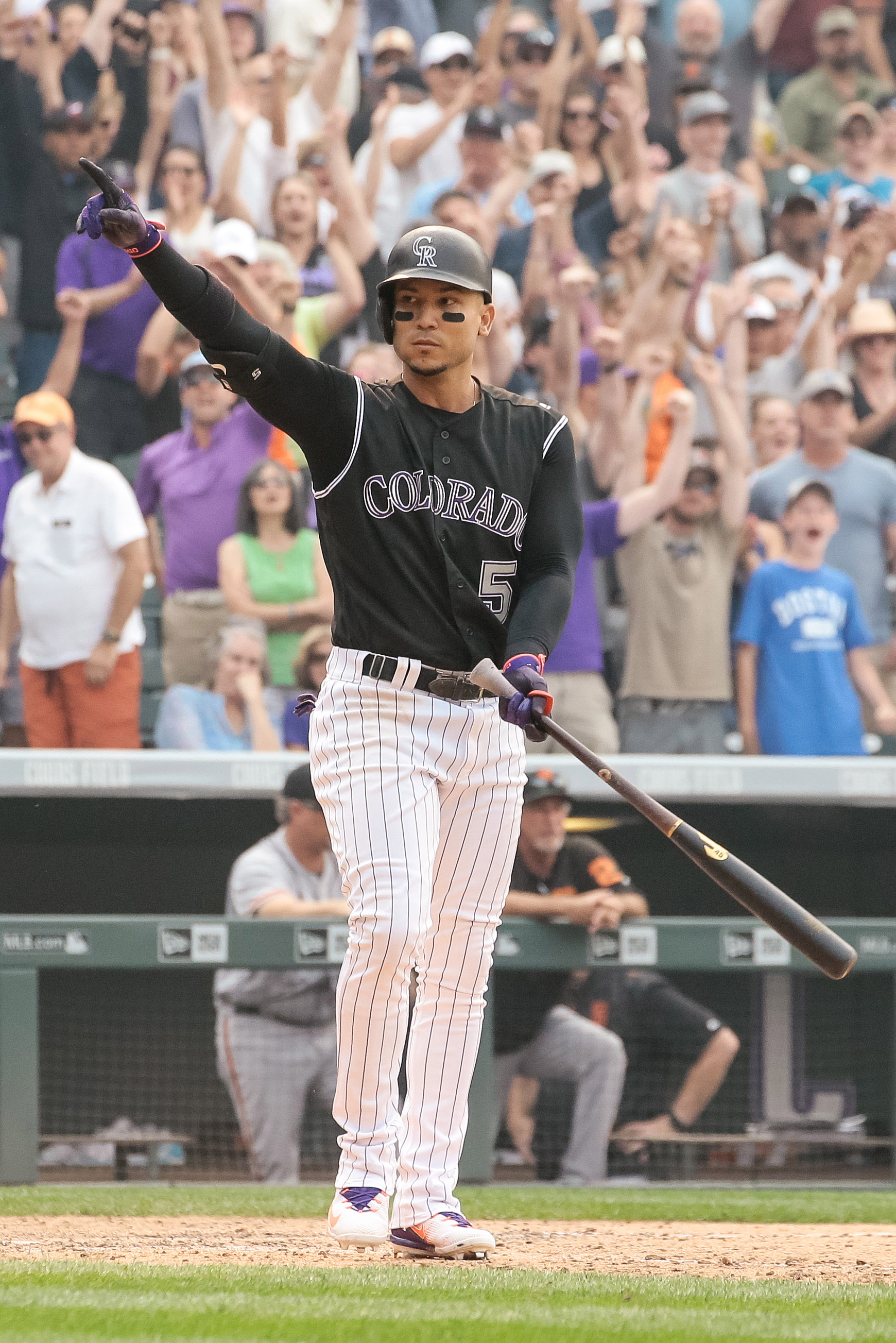
A reunion between the two sides has been reported to be a possibility for much of the offseason, but CarGo remained on the market well into Spring Training as he explored all opportunities. He’ll now return to the team with which he broke out as a star-caliber player back in 2010 and the team which he has thrice represented at the All-Star Game over the past nine seasons.
Gonzalez, 32, picked a poor time to struggle through one of the worst seasons of his big league career. The slugger posted a .262/.339/.423 slash and 14 home runs in 2017 — his lowest total in a full season at any point in his career. While he rebounded in the season’s second half and finished out his 2017 campaign with a torrid .327/.401/.553 batting line in his final 227 plate appearances of the season, that apparently didn’t prove convincing enough to garner a multi-year deal on the open market. (Gonzalez did sport a ridiculous .401 BABIP during that turnaround.)
He’ll now look to carry as much of that production as possible into a full season and rebuild his stock in an effort to land a longer-term pact next winter. Bryce Harper, of course, headlines the 2018-19 crop of free-agent outfielders, and CarGo will also face competition in the form of Andrew McCutchen, Adam Jones and longtime teammate Charlie Blackmon.
Gonzalez was one of baseball’s most feared hitters from 2010-13, when he batted .311/.370/.556 in nearly 2200 plate appearances with the Rockies. Since that time, he’s been more good than great, posting a collective .272/.332/.484 line, which translates to a 103 OPS+ after adjusting for Coors Field. To be fair, he’s turned in two fairly strong seasons — including a 40-homer 2015 campaign — against two weak seasons in that time, and his 2014 season was ruined by a knee injury that has not sent him back to the disabled list since.
As far as 2018 goes, Gonzalez will likely supplant Gerardo Parra as the primary right fielder. His return will present Rockies brass with a similar outfield quandary to the one they faced last spring, as the team will now have Blackmon and Gonzalez as outfield regulars with Parra, Ian Desmond, Raimel Tapia and a (hopefully) healthier David Dahl all in the mix for the remaining outfield at-bats. It’s possible that Gonzalez could be platooned to an extent, and there’s previously been talk of him eventually getting some occasional looks at first base, where Desmond also has experience. Extra time at first base for Desmond could take some time away from top prospect Ryan McMahon, but McMahon also has experience at second base and third base, giving skipper Bud Black plenty of opportunities to get creative with his lineup.
Regardless of how the team divides the playing time, the added depth should serve as a boon to the on-field product, and CarGo’s return should also go over well in the clubhouse. Rockies superstar Nolan Arenado recently lauded his longtime teammate in an interview with the Denver Post’s Patrick Saunders, and the Post’s Nick Groke tweeted this morning that the clubhouse seems energized by the news, with Blackmon stating that he “would love to have CarGo back.”
Photo courtesy of USA Today Sports Images.
Phillies Select Contract Of Pedro Florimon, Designate Eliezer Alvarez
The Phillies announced Friday that they’ve selected the contract of infielder/outfielder Pedro Florimon and designated infielder Eliezer Alvarez for assignment in order to clear a spot on the 40-man roster. The move seemingly indicates that Florimon will head north with the Phils as a utilityman to open the season, as he’s out of minor league options and now cannot be sent back to Triple-A without clearing waivers.
Florimon, a 31-year-old switch-hitter known for his glove at shortstop, spent the 2017 season with the Phillies organization and hit .348/.388/.478 in a tiny sample of 49 plate appearances with the big league club. That’s not representative of his skills at the plate over a larger sample, though, as he’s a lifetime .209./269/.308 hitter in 791 plate appearances between the Orioles, Twins, Pirates and Phils. Florimon has a gaudy +23 Defensive Runs Saved in 1808 career innings at shortstop, but he’s begun to move around the diamond more in recent seasons; the Phils gave him 79 innings in the outfield last year — his first big league action away from the infield.
The 23-year-old Alvarez hit .248/.318/.390 in 236 minor league plate appearances last season, most of which came at the Double-A level. He’s been primarily a second baseman in the minors, though he’s also seen a couple hundred innings of work at shortstop. Philadelphia acquired Alvarez from the Cardinals in the rare September trade that sent Juan Nicasio to St. Louis, and while he ranked 25th on the team’s top 30 prospect list this winter (via Baseball America), he’ll now likely be made available to all 29 other clubs via waivers or trade.
BA’s scouting report on Alvarez (subscription link) notes that he’s a contact-oriented hitter who projects to hit eight to 12 homers per season and has some question marks about his footwork on the defensive side of things. He did rank as high as No. 10 on the Cardinals’ top 30 prospects back in the 2016-17 offseason.
Reds Extend Eugenio Suarez
The Reds announced this morning that they’ve signed third baseman Eugenio Suarez to a seven-year contract extension that spans the 2018-24 seasons and contains a club option for the 2025 campaign. Suarez, an Octagon client, will reportedly be guaranteed a total of $66MM over the life of the contract, which does not include any incentives, escalators or no-trade protection.
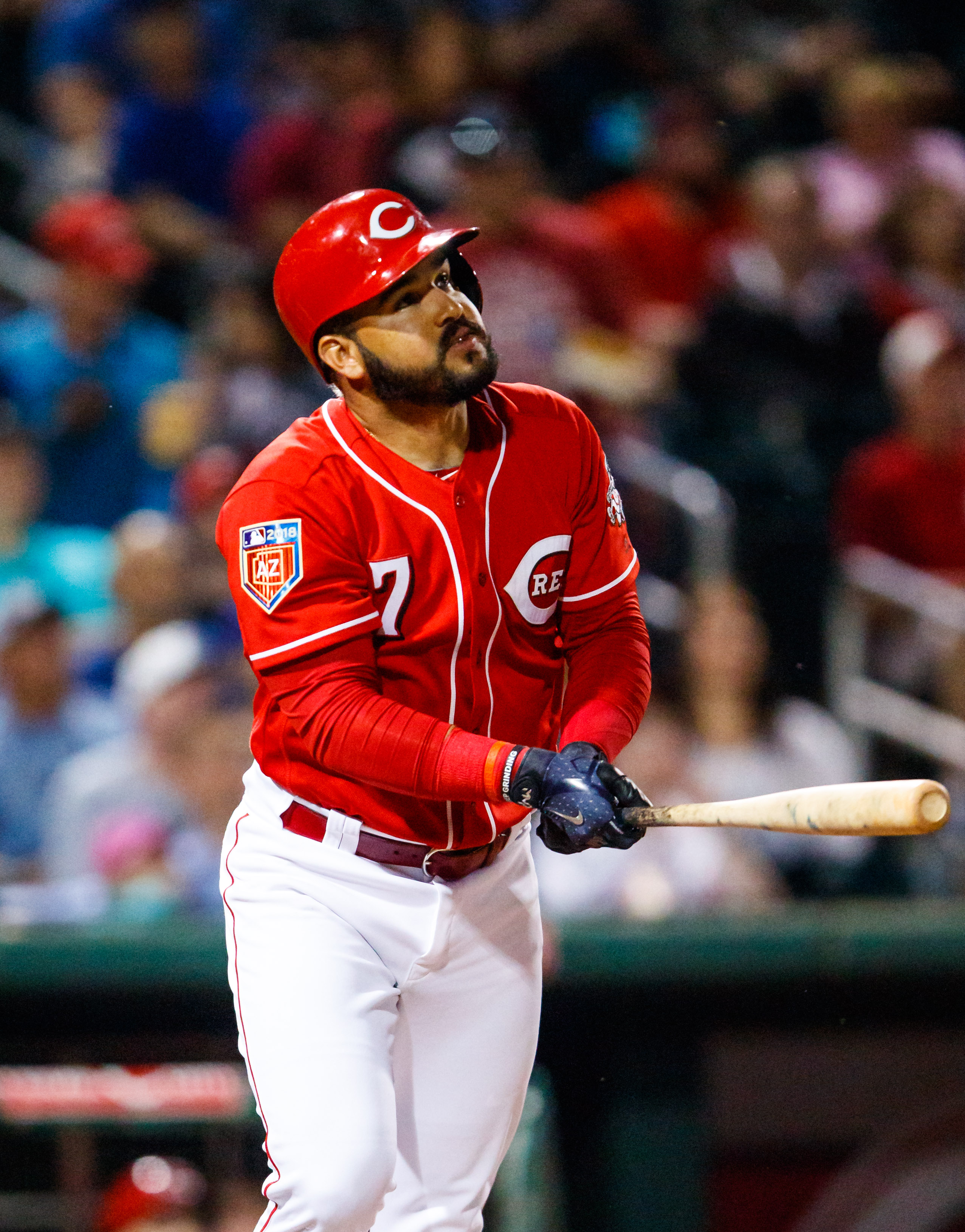
Cincinnati already controlled Suarez through the 2020 season via arbitration and had previously agreed to a $3.75MM salary for the 2018 season, meaning his new deal affords him $62.25MM over a six-year term that includes his final two arbitration seasons and at least his first four would-be free-agent years. If the option is exercised, he’ll secure a total of $79MM over an eight-year span.
Notably, the new contract reportedly reworks Suarez’s 2018 salary. He’ll receive a $2MM signing bonus and a $2.25MM salary this coming season before earning $7MM and $9.25MM in his final two arbitration years. He’ll then earn $10.5MM in 2021 and $11MM annually from 2022-24 before the club has an option on his age-33 campaign.
Cincinnati initially acquired Suarez, 26, alongside righty Jonathon Crawford in a lopsided trade that sent Alfredo Simon to the Tigers. Over the past three seasons, Suarez has seized the everyday third base job for the Reds, hitting a combined .260/.336/.438 — including a career-best .260/.367/.461 batting line and a career-high 26 home runs in 2017.
Suarez’s career year at the plate came in large part due to a massive jump in his plate discipline — a trait he’s improved with each full season in the Majors. After posting a meek 4.3 percent walk rate in his first year with the Reds in 2015, Suarez walked at an 8.1 percent pace in 2016 and saw that number soar to 13.3 percent in 2017. Suarez swung at pitches in the zone at a career-high rate while chasing out-of-zone offerings at a career-low 24.2 percent last season, illustrating an overall more patient approach.
Defensively speaking, the former shortstop looks to have found a new home on the diamond at the hot corner. Suarez posted solid marks of +1 DRS and a +0.7 Ultimate Zone Rating in 2016 and took a step forward in 2017 with respective ratings of +5 and +5.8 in those same metrics. In all, he was worth 3.7 rWAR and 4.1 fWAR last season.
From a financial standpoint, the deal certainly makes sense for the Reds, who’ll gain security over Suarez at a more affordable rate than recent three-plus service extensions for Wil Myers (six years, $83MM) and Kyle Seager (seven years, $100MM), as can be seen in MLBTR’s Extension Tracker. Cincinnati only has Joey Votto and Tucker Barnhart on the books beyond the 2020 season, so there’s plenty of room to fit in an $11MM annual value for Suarez’s would-be free-agent seasons.
Looking at the larger picture, the Suarez contract poses a minor impediment to top prospect Nick Senzel‘s arrival in the big leagues, though the Reds will surely find a place to work the former No. 2 overall pick into the lineup. Senzel has been working out at second base and shortstop, and his bat has made enough noise in the minors that the Reds will want to get him a look at the big league level sooner rather than later.
Last season, Senzel batted .321/.391/.514 with 14 homers and 14 steals through 507 PAs between Class-A Advanced and Double-A. While third base has been his only position in the minors to date, it now seems likely that he’ll be ticketed for middle infield duty once he forces his way onto the big league roster — likely at some point in 2018.
The Athletic’s C. Trent Rosecrans tweeted that the Reds were in the process of announcing an extension for Suarez. Mark Sheldon of MLB.com and John Fay of the Cincinnati Enquirer added details on the length of the deal (Twitter links). Tommy Stokke of LockedOnMLB.com reported the total guarantee and option value. Rosecrans reported the yearly breakdown (Twitter link).
Photo courtesy of USA Today Sports Images.
Jerad Eickhoff Out Six To Eight Weeks With Lat Strain
The Phillies received some bad news on their rotation today, as Jim Salisbury of NBC Sports Philadelphia reports (via Twitter) that right-hander Jerad Eickhoff has been diagnosed with a strained lat muscle and will be sidelined for the next six to eight weeks. Eickhoff had been projected to occupy a rotation spot behind newly signed Jake Arrieta and top incumbent starter Aaron Nola. Now, he’ll open the season on the disabled list.
The 27-year-old Eickhoff was considered a secondary or tertiary piece when he was traded from the Rangers to the Phillies in the blockbuster that sent Cole Hamels and Jake Diekman to Texas. However, he quickly emerged as a viable big league starter and has since provided the Phils with 376 1/3 innings of 3.87 ERA ball, averaging 8.0 K/9 against 2.6 BB/9 with a 39.2 percent ground-ball rate along the way.
Last season was Eickhoff’s worst in the Majors, as he limped to a 4.71 ERA thanks largely to an uncharacteristic spike in his walk rate (3.7 BB/9). Injuries likely played a part in his substandard control, as he missed time in June with a back strain and would again go on the DL in late August with nerve irritation in his hand — an injury that ultimately ended his season. Certainly, it’s not hard to see how either of those injuries could significantly diminish his control; Eickhoff, for context, averaged just 2.0 walks per nine innings through his first 248 1/3 MLB frames.
The initial estimate for Eickhoff’s absence would leave him out of action until at least the end of April and possibly up through mid-May, depending of course on how he responds to treatment and how his rehab progresses. Salisbury adds in a followup tweet that he’s currently being examined back in Philadelphia, which could give a clearer picture of how his rehab will be laid out.
Eickhoff’s injury improves the chances for fellow rotation hopefuls such as Vince Velasquez, Nick Pivetta, Ben Lively, Jake Thompson, Zach Eflin, Mark Leiter and non-roster invitee Drew Hutchison in Philadelphia. Obviously, as that group of names suggests, the Phils aren’t short on replacement options with some degree of MLB experience. It remains to be seen, though, if the injury will embolden the front office to make a move from outside the organization.
At first glance, this wouldn’t seem to make such a move especially more likely. GM Matt Klentak has previously suggested that the signing of Arrieta likely concluded his team’s offseason spending, and while Eickhoff was one of the team’s more reliable sources of innings, the injury is relatively short-term nature in nature.