
Dellin Betances’ Arbitration Case And The Value Of Closing
The baseball world is abuzz about the controversial recent comments of Yankees president Randy Levine, who criticized Dellin Betances’ $5MM filing in his losing arbitration case this past week. After emerging victorious in arbitration, Levine described the filing as a “half-baked attempt” to “change a well-established market” for setup men, further noting that Betances was not a closer — the reliever type that typically commands big arbitration salaries — any more than Levine himself was an astronaut.
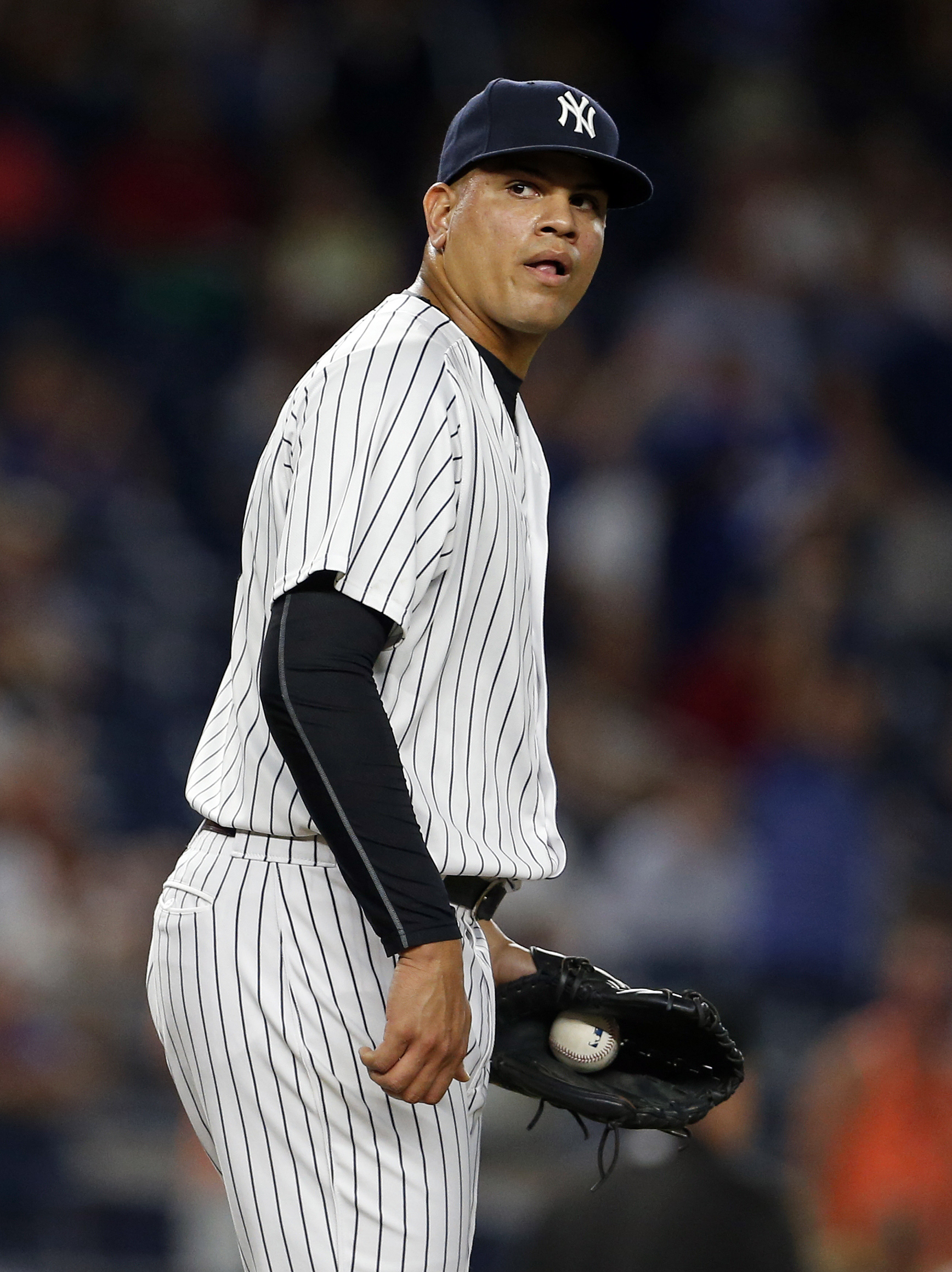 Levine’s decision to call out Betances after defeating him in a case was questionable, but he was right that arbitration pays relievers based on their role rather than their value. Indeed, my arbitration model forecasted Betances would land at $3.4MM, only a few ticks higher than the Yankees’ $3MM filing, and probably very close to where Betances could have bargained had he and the Yankees opted to negotiate a one-year deal to avoid arbitration.
Setting aside the decorum or business wisdom of the quote, the least accurate part of Levine’s comment was his description of Betances’ filing as an attempt to “change a well-established market.” Arbitration is not a market, or at least it is not a market in the way that people generally mean when they talk about markets. There are no multitudes of buyers and sellers trying to exchange the services of relievers in arbitration. Free agency is a market. Arbitration is a manufactured system of loosely defined rules that players and owners have agreed upon as part of the Collective Bargaining Agreement.
The difference is more than semantic. On the free agent market, Betances would be priced like a closer, in the sense that he pitches as well as one. Left up to a free market for his services, Betances could be paid like a closer. This happened just a couple years ago when Andrew Miller, with one career save, received a four-year deal for $36MM from none other than the New York Yankees.
Arbitration, on the other hand, follows a system of rules. Relievers are paid in arbitration based on a series of imperfect retrospective metrics that do not quite estimate value of a performance, rather than a prospective set of metrics designed to estimate the value of a performance, as teams attempt to use in free agency. Each player and team bargain independently, with no other buyers or sellers allowed to enter negotiations like in a typical market.
The most compelling comparables for Betances are those who primarily held setup roles, rather than closer roles, in the bullpen. Limiting to relievers in the last five years who had fewer than 20 saves in their platform year, we only get four pitchers who earned more than $2MM, and all four earned between $2.5MM-2.9MM. Even within that group (Neftali Feliz, Kris Medlen, Mark Melancon, and Drew Storen), all four pitchers had either been closers for longer periods of time than Betances. Medlen had been a starter for a period of time as well.
Looking only at setup men who accumulated large numbers of holds, the comps get even bleaker for Betances. Only four pitchers have gone into arbitration with 70 career holds (Betances has 78 career) in the last five years, and all have received less than $2MM.
Where Betances does differentiate himself is the fact that he has 22 career saves—he does have some closing history—and that he has struck out a whopping 404 hitters in 254 2/3 innings with a career ERA of 2.16. No one discussed in the part-time closer group above or the group with a significant number of career holds could touch those statistics.
And while detailed sabermetric statistics are unlikely to be persuasive in arbitration, Betances’ three All-Star berths were probably one of the better hopes for Betances and his representation. In fact, in recent years, only Craig Kimbrel entered his first year of arbitration with three career All-Star selections, and although he signed a multi-year deal, that only came after the Braves filed at $6.55MM, conceding quite a high value for a player recognized as Betances has been. Only two other players in the last five years even had two All-Star selections going into their first year of arbitration: Aroldis Chapman in 2014 and Andrew Bailey in 2012, who received $5MM and $3.9MM, respectively.
The catch is that Kimbrel had 139 career saves by the time he initially filed for arbitration, while Chapman had 77 and Bailey had 75. At just 22 career saves, Betances was bound to be paid mostly like a setup guy. My model estimates that had Betances’ 28 holds in 2016 all been saves (giving him 40), he would have been estimated to receive $4.5MM instead. If we turn his 50 holds in his pre-platform seasons into saves, that projection shoots up to $6.3MM. But turn those 78 relief appearances back from saves to holds, and we are left with his $3.4MM projection. Levine is, in fact, not an astronaut, and despite Betances’ performance being out of this world, he himself is neither an astronaut nor a closer.
So Betances does not in fact have the halo that typically accompanies a ninth-inning role. In the strictest sense of the word, he is not a closer. Okay … so he does not get coffee. Fine. But let’s discuss how Betances compares to other great relievers and figure out where he stands when we divorce ourselves from the role-based approach to paying arbitration-eligible players.
If arbitration were to reward relievers based on their performance, rather than their context-based statistics, Betances would have entered arbitration in a much more favorable position. Betances has 404 career strikeouts, which is more than any relief pitcher ever to enter arbitration for the first time in the modern era. In the last five years, only Kimbrel himself has even come close with 381 strikeouts, followed by Kenley Jansen at 347. Jansen received a one-year deal for $4.3MM back in 2014.
Limiting to pitchers with 300 career strikeouts and career ERAs under 2.50 (Betances is at 2.16), the only pitchers that emerge are closers already discussed above: Kimbrel, Chapman, and Jansen. From this perspective, Betances filing at $5MM would seem reasonable. Another potential comparable in terms of skill set would be Trevor Rosenthal, who received $5.6MM a year ago from the Cardinals with a 2.66 career ERA and 303 career strikeouts.
Of course, if we know that arbitration is based on retrospective performance, it stands to reason that looking at pitchers based on context-free numbers was unlikely to be persuasive. After all, a lights-out minor league pitcher gets paid the league minimum for his first three-plus seasons. Context matters. What might have been more compelling to an arbitration panel is a statistic like WPA or “Win Percentage Added” as presented by FanGraphs. This statistic simply uses a rough estimate of what the probability a team would win when a pitcher enters an inning (based on inning, score, and base-out situation) and again after he leaves or the inning ends.
For example, when Betances entered with a one-run lead in the bottom of the ninth inning on August 31 against the Royals, the Yankees had a 79% chance of winning. After he saved that game, that 79% chance reached 100%, which gave him 0.21 WPA that day. But when Betances came in with a one-run lead and a runner on first in the seventh inning of an April 12 hold opportunity against the Blue Jays, and struck out Jose Bautista before retiring the side in the eighth en route to a one-run victory, Betances got a nearly identical 0.20 WPA combined for the seventh and eighth innings, because of his large effect on the Yankees’ probability of winning that game as well.
String together Betances’ entire career thus far, and he has 9.30 WPA. That would stand right next to Kimbrel himself, who had 9.29 WPA through 2013 when he first entered arbitration. It would top Jansen, who stood at 7.46 WPA upon reaching arbitration, and well ahead of Chapman, Rosenthal, and Bailey, who had 5.77, 5.72, and 5.05 WPA, respectively at those points in their careers.
I doubt that would have made a strong enough case given the historical importance of saves and holds (in that order), but it might have helped a panel see an alternative way of valuing what Betances has added to the Yankees’ win totals, without resorting to the same old stat columns.
In the narrow sense, Levine is right that Betances has not been a closer. That is almost entirely why the Yankees won this case, because everything else would have shined a brighter light on Betances’ performance.
Photo courtesy of USA Today Sports Images.
Latest On Yankees’ Spending, Rivalry With Red Sox
Yankees GM Brian Cashman tells Evan Drellich of the Boston Herald that he wants his team to develop top talent rather than acquiring it via the free-agent market. The lens of the piece is the Yankees’ rivalry with the Red Sox, which has changed in recent years as the Yankees have backed away somewhat from their previously big-spending ways. Here’s the latest on the Yankees’ current approach, as well as a player the Yankees and Red Sox did compete with one another to acquire.
- A number of key players, including Bryce Harper and Manny Machado, are set to become free agents in the 2018-19 offseason. But Cashman says the Yankees aren’t building their strategy on the availability of those types of talents. “We’re not planning that way,” says Cashman. “We’re waiting to transition out of some contracts and some older players and then eventually I’m hoping that we develop enough young players that would prevent us from having to go crazy in the free agent market. … Doesn’t mean we won’t participate in free agency, but we’re hoping to develop.” The Yankees, of course, did make a splash in free agency this winter, signing Aroldis Chapman to a record-shattering deal for a reliever. They also added Matt Holliday and Chris Carter. Still, they didn’t dominate the winter the way they have in the recent past, and will head into 2017 with a number of young players at key positions.
- Going forward, Cashman says he expects to see different teams drive the winter market and the summer trade market depending on the year. “One year it was the Padres, they spent a ton of money,” he says, referring to the 2014-15 offseason, when the Padres made a number of high-profile trades and signed James Shields. “I think it’s every year it’s different, every winter it seems to be different and other clubs emerge and step up, just like at the deadline the Indians stepped up to deals with us. They’re a small market club that typically doesn’t do that. But this was their window time.”
- While the Yankees/Red Sox free agent arms race isn’t as frenzied as it’s been in years past, the two sides recently did compete for one free agent — Mexican pitcher Hector Velazquez, who went to the Red Sox on a low-profile deal when the Sox purchased his contract from the Piratas de Campeche in the Mexican League. “After the Caribbean Series they told me that the Red Sox were interested,” says Velazquez through a translator. “[S]oon after, Campeche, which is the team that I play for, told me that the Yankees were also interested. The way things in work in Mexico is, Campeche is the one who decides exactly who do you go to. They asked me at the end of the day who I wanted to go to, and I chose the Red Sox because they were the first ones to come to me.”
Quick Hits: Giants, Giolito, Peralta, Kinsler
Here’s the latest from around baseball as we head into the new week…
- The Giants may carry five outfielders on the 25-man roster in an effort to keep Hunter Pence and Denard Span fresh, MLB.com’s Chris Haft writes. Giants skipper Bruce Bochy said the club may also carry four outfielders plus one bench player capable of backing up at both an infield position and an outfield spot. Pence, Span, Jarrett Parker and Mac Williamson are expected to be regulars in the San Francisco outfield this year, with Parker and Williamson platooning in left field (unless one wins the job outright). Gorkys Hernandez, Mike Morse, Kyle Blanks, Kelby Tomlinson, Justin Ruggiano and Slade Heathcott are a few of the well-known names fighting for jobs in the Giants’ camp.
- Lucas Giolito sees his trade to the White Sox as “an immediate breath of fresh air,” the young righty tells USA Today’s Bob Nightengale. The highly-touted Giolito struggled in his MLB debut last season, posting a 6.75 ERA and walking 12 batters (against just 11 strikeouts) over 21 1/3 innings with the Nationals while being promoted and demoted multiple times. “Every start was like I have to do well or I’m going to get sent down to Triple-A. The team wanted to win, and if I wasn’t going to give them an opportunity to win, then they wouldn’t want me there. It made sense,” Giolito said. With the Sox in more of a rebuilding phase, Giolito is looking forward to getting more for an opportunity to properly acclimate himself to the majors.
- Jhonny Peralta is fully healthy and fully prepared for a move to third base, the veteran Cardinals infielder tells MLB.com’s Jenifer Langosch. Bothered by a thumb injury for much of 2016, Peralta batted only .260/.307/.408 over 313 PA as he lost his starting shortstop job to Aledmys Diaz. Peralta will now battle Jedd Gyorko for regular playing time at the hot corner while looking to re-establish himself before hitting free agency next winter. Peralta, who turns 35 in May, is hopeful of continuing to play “for a couple more years.”
- Offseason trade rumors ended up being “just talk” and thus of no concern to Tigers second baseman Ian Kinsler, the Associated Press reports. Kinsler and several other Tigers veterans were mentioned as potential trade candidates this winter, and Kinsler praised GM Al Avila for being straight-forward about what was happening. “To be up front and honest is always the best way to act in my opinion. That’s the way that I like to approach people, and that’s the way he approached us as a whole, as a team. Was it different? Absolutely, it was different. Most GMs would not do that,” Kinsler said.
AL East Notes: Bautista, Rusney, Weeks, Rays
In the wake of Dellin Betances‘ unusually public war of words with Yankees ownership in the wake of Betances’ arbitration hearing, a seemingly far more civil salary disagreement between the Yankees and another star was settled on this day in 1935. Long before salary arbitration was instituted in MLB, Lou Gehrig agreed to a $30K contract from New York for the upcoming season. This hefty-for-the-era salary made Gehrig the highest-paid player on the club, though it was still $7K short of Gehrig’s original demand. The Iron Horse didn’t seem too put off by the smaller paycheck, however, as he went on to hit .329/.466/.583 with 30 homers and a league-best 125 runs scored in a season that was, incredibly, a significant dropoff by Gehrig’s standards. He “only” posted 8.7 fWAR in 1935, as compared to his 10.7 fWAR season in 1934…so *clearly* the Yankees made a shrewd move in withholding that extra $7K. Gehrig, undoubtedly embarrassed by his subpar 1935 performance, rebounded for a 9.7 fWAR year in 1936.
Here’s the latest from around the AL East…
- Jose Bautista was choosing “between five or six places” this offseason before ultimately deciding to return to the Blue Jays, the slugger told Sportsnet’s Shi Davidi and other reporters. There wasn’t too much buzz surrounding Bautista’s market this winter, as he was ultimately able to land only one guaranteed year on an $18.5MM salary, though another two years and $36.5MM could be available in option years. While the list of suitors was “not as many as I was expecting,” Bautista said he is happy to be returning to his first choice team.
- Bautista also expressed some regrets about his public salary comments during last year’s Spring Training camp as well as comments made in private to Jays management. “I think in retrospect – I believe I can speak for myself and not for them – but I feel like I definitely could have handled things differently and maybe things would have played out different….Not necessarily changing the things that I said, maybe voicing them in a different setting and in a different way that might not get misconstrued and misunderstood the way that they did,” Bautista said. A lack of familiarity between the two sides contributed to the situation, he added.
- Rusney Castillo is something of a forgotten man in the Red Sox camp, as ESPN.com’s Scott Lauber writes that the outfielder has no clear path to MLB playing time or even the 40-man roster. Castillo is still hopeful of making an impact, as he is retooling his swing and is enjoying more personal comfort now that his five-year-old son and other family members have been able to leave Cuba to join him in the United States. Castillo signed a seven-year, $72.5MM deal with Boston in August 2014 but has just a .679 OPS over 337 big league plate appearances.
- The Rays essentially made “a coin-flip decision” to draft Delmon Young over Rickie Weeks with the first pick of the 2003 draft, Marc Topkin of the Tampa Bay Times writes. Drafting Weeks would’ve obviously significantly changed not only the Rays’ franchise history, but likely a good chunk of baseball history over the last decade-plus, as Topkin chronicles the chain reaction of events that would’ve been altered had Young not gone first overall. Weeks, after all these years, has finally ended up in a Tampa uniform after signing a minor league contract with the Rays earlier this month.
NL East Notes: Alderson, Walker, Mets, Werth, Phillies
Here’s the latest from the NL East…
- The Mets aren’t engaged in trade talks about their outfielders, GM Sandy Alderson told reporters (including Newsday’s Marc Carig). Curtis Granderson, Michael Conforto, Juan Lagares and Jay Bruce have all been mentioned in trade rumors this winter, with Bruce generating the least buzz though he seems to be the player the Mets would be most eager to move.
- Even with Bruce’s salary still on the books, the Mets were able to make moves to upgrade their bullpen later in the offseason. With the club’s 2017 payroll now estimated to be just under $154MM according to Roster Resource, the Mets have vastly increased spending since beginning the 2014 season with a payroll over less than $85MM. Alderson described the organization as being “all in” in pursuit of a championship, and he said he has the flexibility to add at the trade deadline if necessary.
- Alderson told Mike Puma of the New York Post and other media that he spoke with Neil Walker‘s representatives on Saturday and would soon be talking to Walker himself about a possible extension. According to reports earlier this week, the two sides have been in contact for much of the winter about an extension, potentially in the range of three years and $40MM.
- Jayson Werth told reporters (including Chelsea Janes of the Washington Post) that he and the Nationals had yet to discuss continuing their relationship beyond this season, though “there’s always a possibility.” The 38-year-old Werth, perhaps half-jokingly, said he was hoping to play for five more seasons, though such a scenario would be easier playing for an American League team that could offer him DH at-bats. Werth has hit .267/.358/.437 with 99 homers over 3138 plate appearances in his six years in Washington, a tenure marked by several injuries but also some outstanding play when healthy, particularly excellent seasons in 2013-14. Rather than worry about his next contract, Werth is only focused on getting the Nats deep into the postseason. “I feel like I’ve got a lot to prove, and I still feel like I’ve got a lot in the tank,” he said.
- Werth’s decision to leave the Phillies for a seven-year, $126MM free agent deal from the Nationals after the 2010 season generated a lot of controversy at the time, directed at both the Nats for seemingly overpaying and at Werth for leaving a contender to join a perennial also-ran. In hindsight, however, Bob Brookover of the Philadelphia Inquirer observes that Werth made the right choice in leaving the Phils just before their decline began, and just before the Nationals grew into an NL East power. “My focus was on winning, but at the time that’s not really what it looked like. Everybody was like, ‘The Nats were crazy, Werth is money hungry’ and whatever else was said,” Werth said. “Honestly, I was in a position to pick and choose what I wanted to do. What I thought was cool about the Nats was that it was a total underdog situation, but they had good owners…and a core group of players with a high ceiling. It was a situation where I thought we could build something.”
Royals Discussing Extension With Eric Hosmer; No Talks With Lorenzo Cain, Mike Moustakas
The Royals are discussing a contract extension with first baseman Eric Hosmer‘s representatives, FOX Sports’ Ken Rosenthal reports. Hosmer has set Opening Day as the deadline for negotiations, as he doesn’t want ongoing talks to distract him during the season. Should the two sides not reach an agreement by the Royals’ first game, Hosmer will test free agency after the season, though he did say he wants to remain in Kansas City.
“We are talking about certain extensions, stuff like that. But the way I see it right now, I just want to make it that far [to free agency]. And if I do make it that far without signing anything, I feel like I deserve that right to see what’s out on the market,” Hosmer said. “It’s not cutting this place out completely. It’s earning the right to see what else is out there, seeing my options, seeing what would be the best possible situation for me.”
Hosmer is far from the only Royals star scheduled to hit the open market next winter, though he appears to be the only one thus far contacted by the team about an extension. Lorenzo Cain and Mike Moustakas both tell Rosenthal that they haven’t been in talks about a new deal. (It can be inferred that Alcides Escobar, another pending free agent, also hasn’t been in negotiations with the club. Escobar was described by Rosenthal as “less of a priority” than the other three, given how Raul Mondesi Jr. could step in as Kansas City’s shortstop of the future.) Since Spring Training has just begun, of course, it stands to reason that Royals GM Dayton Moore will at least touch base with these players about potentially remaining in K.C. beyond the 2017 campaign.
It could be that Hosmer drew the early attention from the Royals because his potential extension could be the most complicated. The club expects Hosmer and agent Scott Boras to seek a ten-year deal, owing to both Hosmer’s young age (he is entering his age-27 season), the number of big-market teams that could be looking for first base help next winter.
Most players prefer to avoid having extension talks drag into the season, and in Hosmer’s case, he has some extra financial security — he has already earned $29.75MM through his four seasons of arbitration eligibility as a Super Two player, including a two-year extension and a $12.25MM deal for 2017 to avoid arbitration.
It should also be noted that Hosmer could use another full year to really establish himself as a player worthy of a mega-deal, as the first baseman has been rather inconsistent over his first six seasons. Hosmer posted fWARs of 3.2 in 2013 and 3.4 in the Royals’ championship season of 2015, though he sandwiched those strong years in between three years of (according to the fWAR calculation) not even replacement-level play. Hosmer posted a -1.7 fWAR in 2012, 0.0 in 2014 and -0.2 last season, when he hit .266/.328/.433 with 25 homers over 667 plate appearances. Despite that seemingly good slash line, Hosmer was barely above average in terms of runs created (101 wRC+) and he was rated as a below-average baserunner and defender. After mostly good grades in terms of Defensive Runs Saved and UZR/150 in the previous three years, Hosmer’s first base work took a tumble as per those two metrics in 2016 (minus-6 DRS, -6.1 UZR/150). Hosmer’s contact rate also declined last year, while he posted a career-worst 19.8% strikeout rate.
With so many key free agents, the coming offseason has been seen as a turning point for a Royals team that is trying to remain competitive while remaining fiscally responsible. This winter, Kansas City has dealt two pending free agents in Wade Davis and Jarrod Dyson while extending another (Danny Duffy). While the odds of re-signing everyone is next to impossible, Duffy’s extension would imply that K.C. also isn’t going to let everyone walk and go into a full rebuild, though one or two of the free agents could be moved at the trade deadline if the Royals aren’t in contention for a playoff berth.
Orioles Acquire Vidal Nuno
5:03PM: The trade is official, as per a Dodgers press release.
4:23PM: The Orioles are close to acquiring left-hander Vidal Nuno from the Dodgers in exchange for minor league right-hander Ryan Moseley, reports Eduardo A. Encina of the Baltimore Sun.

If Baltimore does acquire Nuno, it would be the second trade involving the 29-year-old in the past three-plus months. The Dodgers previously sent catcher Carlos Ruiz to the Mariners in November for Nuno, who has three years of club control remaining and will make a paltry $1.125MM in 2017. The swingman would provide the Orioles someone with extensive experience as both a starter and reliever – something they lost when Vance Worley departed in free agency – and perhaps push out-of-options southpaw T.J. McFarland off their roster.
In stints with the Yankees, Diamondbacks and M’s, the soft-tossing Nuno has combined for 126 appearances (42 starts) of 4.02 ERA pitching with 7.38 K/9 against 2.32 BB/9. He has been particularly tough on left-handed hitters, having held them to a .217/.285/.356 line, while righties have slashed .270/.320/.479. Nuno’s currently coming off a two-year stretch in which he recorded a 3.66 ERA, 8.05 K/9 and 2.01 BB/9 over 147 2/3 innings, though he generated ground balls at just a 39.7 percent clip.
The Orioles will have to create 40-man roster space for Nuno, Encina notes, while Ken Gurnick of MLB.com tweets that dealing the pitcher will enable the Dodgers to open up a spot for newly signed outfielder Franklin Gutierrez. They’ll also pick up the 22-year-old Moseley, whom the Orioles selected in the eighth round of last June’s draft. Moseley disappointed in 2016 at Texas Tech, per Baseball America (subscription required/recommended), which lists a “power-reliever future” as the best-case scenario for the 6-foot-1, 190-pounder. Moseley debuted professionally in short-season ball last year and registered a 3.20 ERA, 8.24 K/9 and 4.12 BB/9 in 19 2/3 innings.
Photo courtesy of USA Today Sports Images.
Quick Hits: Betances, Pace Of Play, Rox, Schwarber, Rays
Ace reliever Dellin Betances had more to say Sunday regarding his arbitration-related dispute with Yankees president Randy Levine, telling reporters – including George A. King III of the New York Post – that he has no regrets over comments he made Saturday. Betances added that he isn’t going to seek out Levine to potentially clear the air between the two. “I don’t feel I need to speak to him, I don’t know how [the Yankees] feel,’’ Betances said. “I am just going to try and prepare for the season and help the team as much as I can.’’ Further, on the heels of MLBPA executive Rick Shapiro calling Levine’s remarks “totally unprecedented” Saturday, union chief Tony Clark weighed in Sunday and referred to them as “unprofessional” (Twitter link via Yahoo Sports’ Jeff Passan).
More from around the majors:
- In an attempt to shorten games, MLB is interested in placing a runner on second at the beginning of extra innings, but that’s not something the players are ever going to sign off on, Clark told the New York Times’ Tyler Kepner (Twitter link via Susan Slusser of the San Francisco Chronicle). Clark actually laughed at the idea while shooting it down, but he did note that players are open to changing the intentional walk (Twitter links via Passan).
- While Rockies center fielder Charlie Blackmon‘s name came up in trade rumors during the winter, GM Jeff Bridich didn’t show any interest in dealing him for anything but a massive return. Should a trade come together in the next two years, Blackmon’s final seasons of team control, it seems he’d understand. “I just think they value me pretty high, I guess, and that’s why nothing happened,” Blackmon told Thomas Harding of MLB.com. “I think that’s good. But it’s my opinion that if a deal had come along where they had gotten a deal worth more than what I was worth, then they would’ve made the deal. And I would expect that to happen.”
- Cubs slugger Kyle Schwarber caught a bullpen session Friday for the first time since he tore multiple knee ligaments last April and informed Carrie Muskat of MLB.com on Sunday that he “loved it.” Schwarber realizes that he must “take it slow with the knee and the injury and everything like that,” though, and likely won’t do much catching this season with Willson Contreras and Miguel Montero on Chicago’s roster. “I’ve got to be ready at any time to come in late in the game from left field to maybe come catch and give those guys a blow,” Schwarber said. “It’s not like I’m going to be the everyday starter.”
- Although he emerged as the Rays’ best first base option last season, Brad Miller indicated Sunday that he’s on board with moving to second base this year to take over for the departed Logan Forsythe. “I’m not going to prepare for first at all this spring,” Miller told Bill Chastain of MLB.com. “Just try to get as many reps at second and short right now with the makeup of the team. Obviously, I know it’s a long year. I’ve been through changing positions before. So I understand.” After the Rays’ workout Sunday, manager Kevin Cash opined that Miller “looked outstanding” and was “really fundamentally sound.” The middle infield is nothing new for Miller, who has played 369 games at shortstop and 37 at the keystone. The results haven’t been pretty, however, as Miller has posted minus-27 Defensive Runs Saved and a minus-12.3 Ultimate Zone Rating in nearly 3,300 combined innings at the two positions.
NL Notes: Cubs, Weaver, Reds, Mets, Nats
Whether the Cubs extend right-hander Jake Arrieta prior to free agency next winter will be up to president of baseball operations Theo Epstein and general manager Jed Hoyer, chairman Tom Ricketts told Mark Gonzales of the Chicago Tribune. “They have the right perspective on what they have to put a great team on the field this year but have a longer term perspective in realizing decisions that affect this year might hurt us in a few years,” said Ricketts, who added that the reigning World Series champions will be “thoughtful and strategic” in deciding when to exceed the luxury-tax threshold. The Cubs spent past the mark for the first time last year, but they’re on track to avoid the penalty this season, estimates Jason Martinez of Roster Resource and MLBTR. Allowing Arrieta to walk in free agency next year would help the Cubs stay under the limit in 2018, too, though they’d also lose the 2015 NL Cy Young winner and one of the game’s top starters. It seems that will happen, however, as Arrieta’s agent, Scott Boras, could push for a $200MM-plus deal. In the meantime, Arrieta will make $15.6375M in his final year of team control.
More from the Senior Circuit:
- Before he accepted the Padres’ one-year, $3MM offer on Saturday, righty Jered Weaver drew interest from other teams, including the Reds, reports FanRag’s Jon Heyman (Twitter link). Weaver, a California native who spent the first 11 years of his career in Anaheim, could have signed for more money had he left his home state, per Heyman. In Cincinnati, the 34-year-old Weaver likely would have joined Anthony DeSclafani, Scott Feldman and Brandon Finnegan as locks for the rotation.
- A pair of high-profile Mets took small but encouraging steps in their injury recoveries Sunday, manager Terry Collins announced (via MetsBlog). Third baseman David Wright threw for the first time since he underwent neck surgery last June, accumulating 30 tosses from 60 to 70 feet, and “felt good” (Twitter link via Matt Ehalt of The Record). Right-hander Zack Wheeler, meanwhile, threw his first bullpen session since he he felt “tenderness” in his surgically repaired elbow earlier this week and didn’t report any problems afterward. Wheeler didn’t pitch in the majors in either of the past two seasons – and totaled just one minor league inning, at the High-A level, in that time – on account of a 2015 Tommy John procedure. Health permitting, Wheeler could slot back into the Mets’ rotation this year, but assistant general manager John Ricco told MLB Network Radio on Sunday that it’s too early to determine whether they’ll use the soon-to-be 27-year-old as a starter or reliever (Twitter link).
- As of early January, the Nationals were prepared to begin extension talks with contract-year manager Dusty Baker. While it’s unclear if discussions have since begun, Baker indicated Sunday that he expects to hammer out an agreement with the club in the near future. “I’m very confident that we’ll get things worked out,” Baker told Jorge Castillo of the Washington Post (Twitter link). “You’d like to do it sooner rather than later because I don’t want to be a distraction.” In 2016, Baker’s first season at the helm in D.C., the Nats improved from 83-79 to 95-67 en route to an NL East title, though they weren’t able to get past the Dodgers in the NLDS.
- While Braves second baseman Brandon Phillips claims he didn’t block the Reds’ initial attempt to trade him to Atlanta in November, members of the Cincy organization say otherwise, according to Zach Buchanan of the Cincinnati Enquirer. However, those individuals have elected against going on the record to dispute Phillips’ account so as not to create a public rift with the longtime franchise cornerstone.
AL Notes: Blue Jays, Yankees, Sox, Frazier
Blue Jays third baseman Josh Donaldson is likely to sit out the next two to three weeks on account of the right calf strain he suffered Friday, reports John Lott of The Athletic (Twitter link). The durable superstar hasn’t appeared in fewer than 155 games in any of the past four seasons and, barring a setback, it doesn’t appear this injury will affect his Opening Day availability.
Elsewhere in the AL…
- When first baseman Chris Carter was still unsigned at the end of January, his agent, Dave Stewart, suggested that the slugger would have to seriously consider signing in Japan. Carter ultimately didn’t have to take such a drastic measure, of course, as he inked a one-year deal with the Yankees earlier this month. Now, it doesn’t seem as though Japan was ever a legitimate possibility for Carter. The 2016 National League co-leader in home runs (41) told reporters – including Randy Miller of NJ.com – on Saturday that the notion of going to Japan was “probably not that real” and “was more just to cover all bases and check all options.” Carter did admit, however, that he “started getting antsy” when February rolled around and he didn’t have a contract. “It’s definitely a tough offseason this year, but it seems like the game is changing a little bit where there is more emphasis on complete players,” he stated.
- If Pablo Sandoval doesn’t reestablish himself as a capable third baseman this year, the Red Sox could eventually swing a trade for Todd Frazier of the White Sox, writes Nick Cafardo of the Boston Globe. Chicago will have paid more than half of Frazier’s $12.5MM salary by the trade deadline, which should make the 31-year-old an attractive target for Boston or other contenders, Cafardo observes. Given that the White Sox are amid a rebuild, it seems they’d prefer to ship out established veterans like Frazier sooner than later, as general manager Rick Hahn implied in an interview with MLBTR contributor Brett Ballantini earlier this week.
- The Yankees listened to offers for left fielder Brett Gardner over the winter, though no trade materialized. That surprised Gardner, who told Miller on Sunday that he expected a deal to occur. Considering Gardner’s a soon-to-be 34-year-old playing on a team that has committed itself to a youth movement, he could still end up on the move sometime soon. The careerlong Yankee addressed that, saying, “I guess on one hand obviously I don’t want to get traded, but on the other hand the fact that maybe some other teams have interest in me, I see that as a compliment.”
- White Sox center fielder Charlie Tilson suffered a stress fracture in his right foot and will cease impact activities for at least 10 days, tweets Colleen Kane of the Chicago Tribune. If healthy, the 24-year-old Tilson figures to start in center this season for the Sox, who acquired him from the Cardinals last July for reliever Zach Duke. In his big league debut in August, Tilson tore his hamstring and missed the remainder of 2016 as a result.