
Padres Reportedly Interested In Freddie Freeman
Earlier this morning, MLB Network’s Jon Heyman reported that the Red Sox had jumped into the bidding on star first baseman Freddie Freeman, and just hours later, Bob Nightengale of USA Today writes that the Padres, too, are looking into the possibility of signing Freeman.
The level of sincerity behind the Padres’ apparent interest isn’t clear. On the one hand, Freeman would unequivocally deepen their roster and bolster their lineup in a major way. On the other, the Padres already have a pricey first baseman, Eric Hosmer, whom they’ve been trying to trade in an effort to escape the remaining four years and $59MM on his contract. There’s also the fact that one of Freeman’s reported suitors, the Dodgers, just so happen to be a division rival for the Padres. Making an effort to drive up the price wouldn’t be out of the question.
That said, it’s worth taking a peak at just how a potential Freeman signing would impact the Padres, both in 2022 and in the long-term. The impact on the actual 2022 payroll would depend on contract structuring, but even a backloaded deal would boost the Padres’ currently $200MM payroll substantially.
Looking beyond the current season, the contracts of Manny Machado, Yu Darvish, Blake Snell, Fernando Tatis Jr., Drew Pomeranz, Ha-Seong Kim, Nick Martinez and Luis Garcia total about $114MM in guaranteed money. That doesn’t include player options for Jurickson Profar and Robert Suarez, which could be exercised — nor does it include arbitration raises to the likes of Dinelson Lamet, Austin Adams, Tim Hill, Chris Paddack and Emilio Pagan. Factoring in all of that, a Freeman deal could take reasonable 2023 payroll projections north of $160MM.
The broader concern would be the luxury-tax obligations associated with a Freeman deal. If he is indeed seeking something in the vicinity of $30MM annually, that’d send the Padres back into luxury-tax territory for what would be a second straight season. The Padres currently have about $217MM in luxury obligations, per Jason Martinez of Roster Resource, and there’s no getting around the huge CBT hit associated with any potential Freeman deal.
In fact, even if the Padres were able to move the entirety of Hosmer’s contract — which seems unlikely without at least taking some money back on in return — the subtraction of that $18MM luxury hit would only narrowly drop the Padres below $200MM in total. In other words, even if San Diego somehow traded all of Hosmer’s deal and replaced him with Freeman, the new contract would still push the Padres right back up against CBT precipice.
It’d be a surprise to see San Diego draw up a five- or six-year offer at top-of-the-market dollars to bring in Freeman when they’re still trying to unload Hosmer’s contract, but Padres president of baseball operations A.J. Preller is never one to shy away from an unexpected move.
Red Sox Reportedly Showing Interest In Freddie Freeman
The Freddie Freeman bidding has a new entrant, as MLB Network’s Jon Heyman tweets that the Red Sox have joined the fray. They’ll join a field that has already included the Yankees, Blue Jays, Dodgers and, somewhat surprisingly, the Rays. Tampa Bay reportedly made an offer to Freeman prior to the lockout, and Marc Topkin of the Tampa Bay Times reported last night that the Rays remain interested. However, he suggests their interest is limited to a shorter-term deal — presumably at what would be a massive annual rate. That doesn’t appear too likely, of course, given the interest from larger-market clubs with deep pockets. As of yesterday afternoon, reports indicated that the Yankees were “pessimistic” about their chances of signing Freeman, while other clubs viewed the Blue Jays as a serious threat.
A Freeman signing would give the BoSox an elite heart-of-the-order grouping, as he’d join Xander Bogaerts, Rafael Devers and J.D. Martinez in composing the team’s two-through-five hitters. Adding Freeman to the fold would likely mean supplanting 26-year-old Bobby Dalbec at first base, though even with his big finish to the 2021 season, Dalbec isn’t going to serve as a roadblock to a superstar of Freeman’s caliber. Dalbec struggled through a dismal first half before slashing .269/.344/.611 in his final 195 plate appearances, although he did so in spite of a 31.3% strikeout rate and still finished the year with an overall batting line of .240/.298/.494.
The larger question for the Red Sox is likely a matter of payroll — more specifically, the luxury tax. Last week’s newly ratified collective bargaining agreement bumped the tier-one threshold for penalization from $210MM to $230MM, but the Sox are already at about $209MM of luxury obligations (via Roster Resource’s Jason Martinez). Adding Freeman to the mix would send Boston soaring past that mark. The Sox have paid the tax in the past, but more recently ownership has been staunchly against doing so. Freeman is the type of player for whom many clubs might consider an exception, but it’s not yet clear whether Boston would feel that way or whether any Freeman interest is contingent on moving other salary.
If the Sox are indeed willing to pay the tax, it’d likely only be a one-year dip into those waters. Boston’s luxury obligations will plummet following the season, dropping from the current $209MM level all the way to $75MM. That doesn’t even include the possibility of Bogaerts opting out of his six-year, $120MM contract — which seems quite likely and would further shave another $20MM from that luxury ledger. The Red Sox have Martinez, Nathan Eovaldi, Jackie Bradley Jr., Christian Vazquez, Enrique Hernandez, Michael Wacha, Rich Hill, Matt Strahm and Kevin Plawecki all coming off the books following the 2022 season.
Again, that doesn’t make it any kind of lock that they’ll be comfortable putting forth a multi-year deal of six years in the $30MM annual value range, which is generally believed to be where Freeman’s asking price currently lies. But there’s a clear on-paper fit and the long-term payroll flexibility to make it work, as MLBTR’s Anthony Franco noted when picking the Sox to sign Freeman back in November.
Wherever Freeman lands, it’s become quite clear that he’s set to move on from the only organization he’s ever known. The Braves acquired Matt Olson in a trade with the Athletics yesterday — a move that president of baseball operations Alex Anthopoulos called the toughest transaction of his lengthy executive career while fighting back tears (video link via Bally Sports). Anthopoulos noted multiple times that he couldn’t “get into specifics” as to why the deal was so difficult to make, though the implication was clear.
Freddie Freeman Rumors: Monday
Freddie Freeman‘s 12-year run with Atlanta came to a close Monday afternoon, as the Braves acquired slugging first baseman Matt Olson from the Athletics. With the Yankees pessimistic on their chances of signing Freeman, here’s the latest…
- The Blue Jays have conveyed serious interest in Freeman, according to Jon Morosi of MLB Network. On Friday Morosi suggested Freeman’s signing was imminent and said the Dodgers were making a strong push.
- The Rays and Jays “have remained aggressive” on Freeman, according to MLB.com’s Mark Bowman.
- Joel Sherman of the New York Post (Twitter thread) notes that rival clubs perceive the Jays as a threat to utilize some of their available payroll space to make a splash on the offense. He also suggests the Yankees could make sense as a Freeman suitor, but notes that it’s unclear if ownership wants to take on a long-term deal when they’re hoping to work out a long-term extension with Aaron Judge at some point down the line.
Athletics Trade Matt Olson To Braves
The Freddie Freeman era in Atlanta appears all but over. The Braves announced Monday that they’ve acquired All-Star first baseman Matt Olson from the Athletics in exchange for a hefty package of minor league talent: center fielder Cristian Pache, catcher Shea Langeliers and right-handers Ryan Cusick and Joey Estes. While some Atlanta fans may hold out hope that the implementation of the universal designated hitter leaves open the possibility for both Olson and Freeman to coexist on the same roster, Braves president of baseball operations Alex Anthopoulos implied otherwise when discussing the trade with reporters. Anthopoulos held back tears today, calling the Olson trade the hardest transaction he’s ever had to make — a clear allusion to the team’s plans for Freeman (or lack thereof).
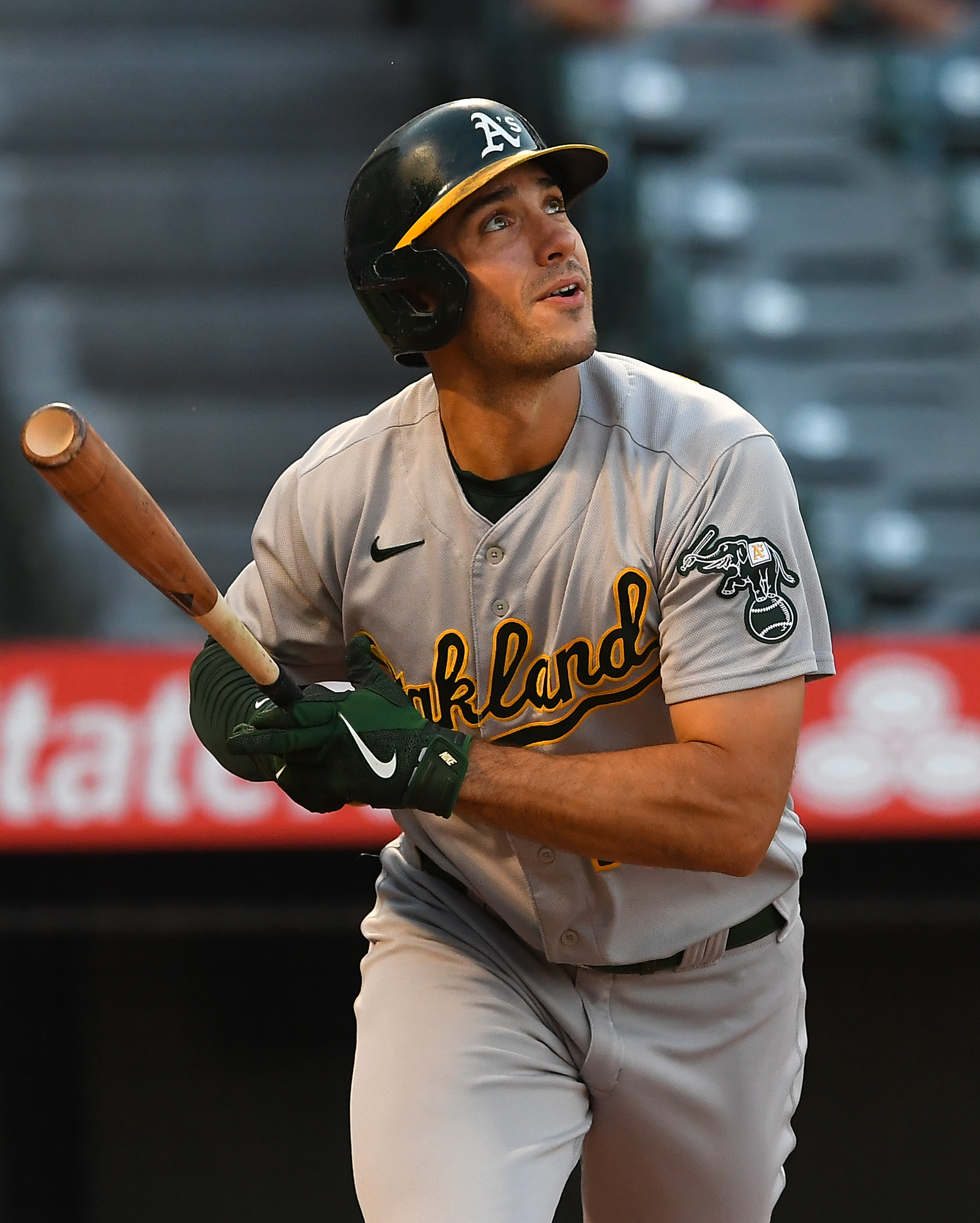
As is the case with Anthopoulos, the acquisition of Olson will be a bittersweet one for many Braves fans. While Olson is an elite first baseman with Atlanta roots, it’s long been difficult to fathom Freeman, the 2020 National League MVP, ultimately moving on and signing with a new team. Freeman was a homegrown star in every sense of the word, going from No. 78 overall draft pick in 2007 to a five-time All-Star, league MVP and World Series champion. He’s spent the past 12 seasons in Atlanta, thanks in large part to an eight-year, $135MM contract extension that kept him in Braves gear long beyond his arbitration years. Freeman has become synonymous with the Braves, but it now appears all but certain that this is a changing of the guard.
As far as replacements for Freeman go, it’s tough to dream up a better option than the Atlanta-born Olson, however. Set to turn 28 later this month, Olson is a two-time Gold Glover at first base who just wrapped up a career year that netted him his first All-Star nod. Over the past three years, Olson has cemented himself as one of the premier power threats in the game, swatting 89 home runs and 65 doubles while playing his home games in the cavernous Oakland Coliseum. This past season, Olson shed the “strikeout-prone” label when he cut his strikeout rate from 27.5% in 2019-20 all the way down to 16.8%. He did so while maintaining an excellent 13.1% walk rate and turning in the finest overall season of his career: .271/.371/.540 with a career-high 39 home runs.
Of course, Olson is far more than your prototypical bat-first, slugging first baseman. He’s a two-time Gold Glove winner who happens to lead all Major League first basemen with 34 Defensive Runs Saved dating back to 2017 (despite playing in just 59 games that year). Olson’s 22.8 Ultimate Zone Rating is also tops among first basemen in that span, and his 15 Outs Above Average (per Statcast) rank sixth in that same span. There’s an argument to be made that bittersweet as the change might be for Braves fans, Freeman is being replaced by the most well-rounded, prime-aged first baseman in the game.
The Braves will control Olson for at least the next two seasons, as he’s currently sitting on four-plus years of Major League service time. MLBTR contributor Matt Swartz projects a $12MM salary for Olson this coming season, and he’ll be due one more raise on that sum before qualifying as a free agent after the 2023 season. Of course, the Braves could well look to sign Olson to a long-term deal that would keep him with his hometown club far longer than those remaining two years of control. Atlanta reportedly balked at going six or more years on a potential Freeman extension, but Olson is four and a half years younger than Freeman, which could alleviate concerns about an eventual decline in the late stages of a long-term deal.
Just as it’s difficult for the Braves’ faithful to process the change, Athletics fans are surely reeling from the news as well. While periodic sell-offs of this nature have become second nature for Oakland diehards, the current core is one of the more talented and recognizable groups in recent memory. Olson was a fan favorite and beloved player at the Coliseum, but his departure begins to pave the way for what the A’s hope will be its next core group.
Pache and Langeliers are the true headliners here, though all four prospects ranked among the top 15 or so in the Braves’ farm. Pache, 23, has seen his stock dip a bit since being ranked as baseball’s No. 7 prospect (per Baseball America) in the 2020-21 offseason. That’s due both to a poor showing at the plate in the big leagues and a fairly pedestrian output in Triple-A Gwinnett. Pache received just 68 big league plate appearances in ’21 and batted .111/.152/.206, though it’s tough to glean much of anything from such a small sample. His work in Triple-A was more encouraging but not on par with his strong 2019 campaign in Double-A; in 353 trips to the plate with Gwinnett this past season, Pache batted .265/.330/.414.
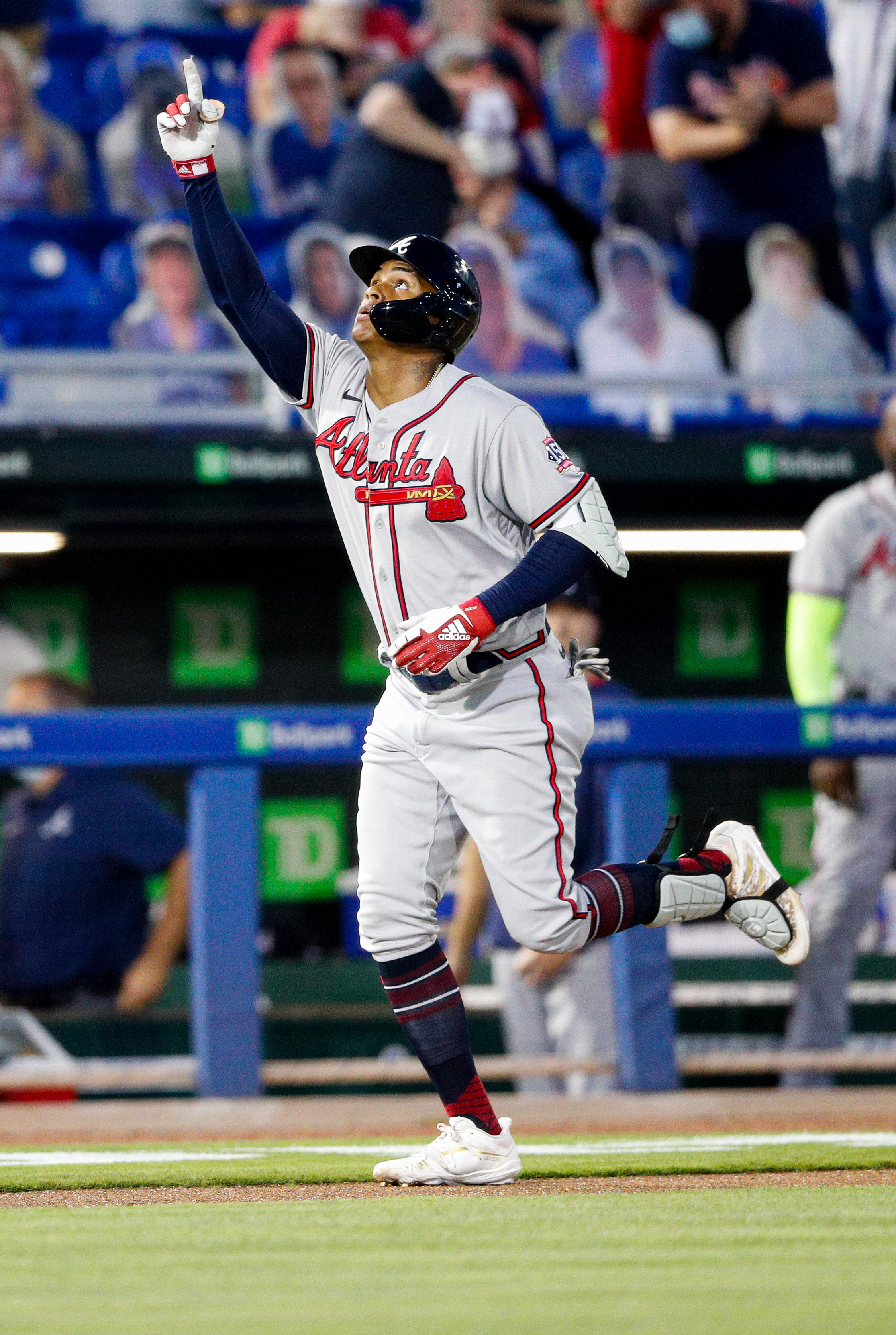
Offense has never been projected to be Pache’s primary selling point, however. That’s not to say he couldn’t develop into a solid big leaguer at the plate, of course, but much of his prospect allure has come from the fact that he’s a plus runner who received 80 grades for his defensive upside in the outfield. Considering the huge space he’ll now have to patrol at the Coliseum, that’s a particularly valuable skill to have. And, if Pache can turn in something close to his lifetime .280/.330./406 slash from the minor leagues, he ought to be able to solidify himself as a highly valuable big leaguer before long. Pache is still near universally regarded among the sport’s top 100 prospects.
Turning to the 24-year-old Langeliers, he’ll give the A’s another potential high-end catcher before long. Sean Murphy is the incumbent option there and had a fine season in ’21, but Langeliers was the No. 9 overall pick in 2019 and is fresh off a .256/.339/.494 showing between Double-A and a brief stop in Triple-A. Baseball America ranked Langeliers 54th among all prospects, calling him an excellent defender with a “cannon” arm and above-average power. That he reached Triple-A already in 2021, albeit only for five games, speaks to his proximity to the Majors. Langeliers also ranks as baseball’s No. 70 prospect at FanGraphs and No. 80 at The Athletic.
With Langeliers now perhaps the future behind the plate, Oakland will at least have the ability to more comfortably listen to offers on Murphy if they see fit. Murphy is controlled another four seasons and just won a Gold Glove while popping 17 home runs, but he’ll reach arbitration next year — around the time Langeliers is likely to be ready for an everyday audition at the big league level.
As for Cusick and Estes, both are well regarded in their own regard, even if they haven’t received the type of national attention that Pache and Langeliers have. Cusick was Atlanta’s first-round pick just last summer, joining the organization after posting huge strikeout totals during his sophomore and junior seasons at Wake Forest (37% overall). The 6’6″, 235-pound righty sits in the upper 90s with a heater that has touched 102 mph.
Command was an issue for Cusick in college, but in 16 1/3 innings with Low-A Augusta last season, Cusick punched out more than half of the 67 hitters he faced while issuing just four walks. It remains to be seen whether he can sustain those gains, but there’s huge potential if he can indeed refine his command. If not, a triple-digit fastball and this type of bat-missing ability will surely play up as a potential late-inning reliever. He was generally regarded among the system’s 10 best overall prospects.
As for the 20-year-old Estes, he was the Braves’ 16th-round selection in 2019 but has quickly elevated his profile. Drafted out Paraclete High School in Lancaster, Calif., Estes had a nondescript pro debut that lasted 10 innings in ’19, didn’t pitch due to the canceled 2020 minor league season and then broke out with a monster year as Cusick’s teammate in Low-A Augusta. Through 20 starts, a total of 99 innings, Estes notched a 2.91 ERA with a 32.1% strikeout rate and a 7.3% walk rate. He was an extreme fly-ball pitcher in 2021 (33.2% grounder rate), but that’s not a huge concern for the A’s, given their spacious home environs. Estes’ success came despite being nearly three years younger than the average competition he faced. While he and Cusick are both at least one, if not two full seasons away from making a big league impact, they both add some considerable upside to an Oakland system that was generally regarded among the thinnest in the sport.
“This is the cycle for the A’s,” Forst said back in early November when addressing reports of a likely payroll reduction. “We have to listen and be open to whatever comes out of this. This is our lot in Oakland until it’s not.” Those foreboding words have already manifested in the trade of two popular and productive A’s stars, and there’s little sense expecting that Oakland will put a foot on the brakes now. They’ve secured four new pitching prospects and a pair of ballyhooed close-to-the-Majors position players already (Pache, Langeliers), and things are likely just getting started.
As for the Braves, the acquisition of Olson will turn the page on perhaps the team’s most iconic player since Hall of Famer Chipper Jones. The 2020 MVP crowning for Freeman was a high note in his career, but the team’s storybook World Series run, with Freeman at the heart of the charge, will make an even more fitting end to this chapter in the team’s history. Olson will have major shoes to fill at Truist Park, but so long as he carries on at something near the .254/.348/.515 pace he’s tallied over his past 564 Major League games, the Braves will be in good hands.
ESPN’s Jeff Passan first reported that trade and all five players involved (Twitter thread).
Yankees Pessimistic On Chances Of Signing Freddie Freeman
The Yankees are pessimistic on free agent first baseman Freddie Freeman, according to Jon Heyman of MLB Network. The Yankees have also thus far said no to an ask of top prospect Anthony Volpe plus more for Oakland first baseman Matt Olson, Heyman explains. As such, a reunion with free agent Anthony Rizzo is suggested to be “the most realistic” first base addition for the Yankees.
Three days ago, Heyman wrote that the Dodgers and Braves are the most likely landing spots for Freeman, who reportedly has sought a six-year deal. The Yankees have since revamped the left side of the infield, shipping out Gio Urshela and adding Josh Donaldson and Isiah Kiner-Falefa from the Twins. The Yanks still have Luke Voit, DJ LeMahieu, and Gleyber Torres on the roster, so further adjustments may be coming.
Volpe, ranked by Baseball America as the tenth best prospect in the game, isn’t necessarily an unreasonable request by the A’s. Recent precedent for trading a five-WAR type player in the offseason with two years of control is rare, but the Marlins were able to land Sixto Sanchez and others when shopping J.T. Realmuto three years ago. Other clubs known to be in the mix for Olson include the Guardians, Rangers, Padres, and naturally the Braves if they lose Freeman.
Rizzo posted a 113 wRC+ for the Yankees in 200 plate appearances after coming over from the Cubs at the trade deadline.
Dodgers Reportedly “Making Strong Push” For Freddie Freeman
8:08pm: Jon Heyman of the MLB Network tweets that the Dodgers and Braves are Freeman’s most likely landing spots. He hears that Atlanta’s offers have been in the five-year, $140MM range.
7:32pm: Morosi adds that Freeman is expected to make his decision within the next 24 hours and could do so as soon as this evening.
7:04pm: The Dodgers are “making a strong push” for star first baseman Freddie Freeman, reports Jon Morosi of MLB.com (Twitter link). Los Angeles has put a formal offer on the table, Morosi adds.
Freeman is among the top free agents on the market, and it’s generally been expected he’d sign quickly in the wake of the end of the lockout. The Dodgers are among the teams who have been linked to the 2020 NL MVP, as are the incumbent Braves, Yankees, Blue Jays and — most surprisingly — Rays.
Many have long expected that Freeman, a career-long Brave, will re-sign with Atlanta on a long-term deal. Calls for the Braves to keep him around particularly mounted after the club wrapped up a World Series title in November. Freeman, of course, played no small part in Atlanta’s first championship in 26 years; after hitting .300/.393/.503 during the regular season, he posted an OPS above .990 in all three playoff rounds.
However, the Braves have reportedly been unwilling to offer a sixth guaranteed year to the 32-year-old first baseman. Freeman didn’t agree to terms with anyone before the lockout, and rumors swirled throughout the work stoppage that he and the club may go in different directions. There’s been no shortage of interest in Freeman’s services, and the Braves have at least looked into the possibility of trading for A’s star Matt Olson or signing Anthony Rizzo as contingency plans.
Of course, it’s far from a lock that Freeman will wind up departing. That the Dodgers are making a serious run at the five-time All-Star is no surprise. Atlanta could yet look to make another push themselves, and there’s no indication an agreement between Freeman and Los Angeles is imminent.
The first base market figures to see quite a bit of action in the coming days and weeks. Freeman and Rizzo have yet to sign. It’s widely believed the A’s will move Olson before the start of the season as they reportedly embark on a payroll-cutting effort. The Yankees have been tied to first base upgrades this offseason, which might make 2020 home run champ Luke Voit a realistic trade candidate as well.
Rays Made Offer To Freddie Freeman Pre-Lockout
Even as rumors regarding the possibility of Freddie Freeman leaving the Braves have increased since the beginning of the offseason, big-market clubs with deep pockets — Yankees, Dodgers, Blue Jays — have been viewed as the primary threats to lure him away. However, MLB Network’s Jon Heyman reports that the Rays not only showed interest in Freeman but made him an offer prior to commissioner Rob Manfred’s implementation of the current lockout.
It’s surprising to hear of the Rays even making any degree of play for a free agent of Freeman’s caliber, and many fans will surely poke fun and suggest comically small numbers from Tampa Bay. However, it’s at least worth breaking down the possibility, because when looking ahead at the Rays’ long-term payroll ledger, a massive commitment to Freeman might not be as far-fetched as it sounds.
The 2022 Rays are currently projected by Roster Resource’s Jason Martinez for an $83MM payroll. They’re also expected to field offers for veterans like Kevin Kiermaier, Manuel Margot, Austin Meadows and Tyler Glasnow, among others, following the lockout, which could drop that number back below the team’s $77MM Opening Day record. The mere mention of “franchise record payrolls” in the $77-83MM range serves to underscore just why fans would mock the notion of a Rays/Freeman match, but look ahead to the following season and it becomes easier to envision.
Beginning in 2023, the Rays only have three contracts on the books. Second baseman/outfielder Brandon Lowe will earn $5.25MM, lefty Brooks Raley is guaranteed $4.5MM, and burgeoning star Wander Franco is owed $2MM. The combined $11.75MM does not account for arbitration-eligible players, and the Rays do have their fair share of names who could elevate the total payroll.
Glasnow, projected by MLBTR contributor Matt Swartz to earn $5.8MM in 2021, will repeat that salary in 2022 if he doesn’t pitch this year while rehabbing from Tommy John surgery. Southpaw Ryan Yarbrough will be in line for a decent raise on top of this year’s $4.4MM projection. If he struggles in 2022, he’ll be a non-tender candidate. If he rebounds from an ugly 2021, he could emerge as a trade candidate, given the subsequent raise and the Rays’ considerable pitching depth. Meadows will be due a solid pay bump over this year’s $4.3MM projection, but again, he’s already seen as a trade candidate. Margot is a free agent after the 2022 season.
Beyond that group, the Rays’ arbitration commitments should generally be modest. Yonny Chirinos is projected at $1.2MM this season and will earn a raise depending on how well he rebounds from 2020 Tommy John surgery. Backup catcher Francisco Mejia will be owed a raise, but he’s only projected at $1.5MM himself this year. Ji-Man Choi will be in line for one final bump over this coming year’s $3.2MM salary, but he could very well be moved if the Rays pulled off a shocker and signed Freeman.
In other words: the Rays may have an enormous arbitration class in 2022, but that’s not likely to be the case in 2023. Trades, non-tenders and free agency will subtract from the current group, and the only players set to reach arbitration in ’23 are relievers Pete Fairbanks, Colin Poche, Ryan Thompson and JT Chargois. Notable names like Randy Arozarena, Drew Rasmussen and Luis Patino are on track to hit arbitration in 2024, but at that point the top end of the arb class will have thinned out.
The conventional wisdom behind a small-market club like Tampa Bay being unable to “afford” a mega-deal for someone of Freeman’s caliber is that it’d restrict them from making further additions. Tying up such a large percentage of team payroll in a single player can obviously be hazardous. However, the Rays’ next nucleus already appears more or less in place and isn’t likely to be expensive anytime soon. Franco signed an 11-year, $182MM contract extension and won’t see his salary reach peak levels until 2028 — seven years from now (and, one year shorter than the six years reportedly sought by Freeman).
The Rays’ rotation was something of a patchwork group in 2021, but looking ahead they’re hopeful that a combination of Shane McClanahan, Shane Baz and Patino can lead the charge. McClanahan and Baz won’t reach arbitration until 2025. Tampa Bay has several other high-end pitching prospects coming: Taj Bradley, Seth Johnson and Cole Wilcox among them. The organization likely still has high hopes for oft-injured former top pick Brendan McKay as well.
Looking up and down the lineup, Franco has shortstop locked down, and Brandon Lowe is on a team-friendly deal of his own at second base. Lowe is earning $4MM in 2022, $5.25MM in 2023 and $8.75MM in 2024. The Rays hold club options of $10.5MM and $11.5MM thereafter. If at any point the team believes Lowe’s contract to be unwieldy, he could be flipped in a trade, with top prospect Vidal Brujan stepping up at second base. Brujan could factor into the infield or outfield mix at other positions before then, and Taylor Walls gives Tampa Bay another solid, MLB-ready infield prospect to consider. Top outfield prospect Josh Lowe, meanwhile, seems likely to step into center field before long — perhaps even on Opening Day, if Kiermaier’s contract is moved post-lockout.
Obviously, not all of these players will turn into stars or even regulars, but for the next several seasons, the Rays can build their roster around the likes of McClanahan, Baz, Patino and Rasmussen on the pitching side and around Franco, Arozarena, both Lowes and perhaps Brujan on the position-player side. No one from that group will reach arbitration until at least 2024 (most not until 2025), and the Rays will probably succeed when it comes to persuading at least one or two of their pre-arbitration stars to sign a club-friendly extension. Tampa Bay doesn’t even have $15MM in guaranteed contracts on the books in any individual season from 2023-25 right now — a three-year span that would represent years two, three and four of a theoretical Freeman deal.
None of this is to say that a Freeman-to-the-Rays scenario is likely. Calling it a “long shot” possibility might be charitable, in fact. Tampa Bay will face steep competition from the incumbent Braves as well as a host of large-market teams looking to add a marquee bat to the lineup, and the Rays’ margin for error on a contract of this magnitude is infinitesimal compared to that of a team like the Dodgers, Yankees or even the Braves. But, when considering the Rays’ minimal long-term commitments and the wealth of MLB-ready, pre-arbitration talent they already have in the fold, it’s at least possible to squint and see how they could fit Freeman into the mix — even if he’s earning upwards of $30MM annually.
Max Muncy On Elbow Rehab, Freeman Rumors
Dodgers infielder Max Muncy missed the 2021 postseason after suffering a ligament tear in his left elbow at the end of the regular season, but the slugger tells David Vassegh of Dodger Talk on AM 570 that he expects to be ready to go whenever the 2022 season can finally begin (link includes audio of the full 13-minute interview). Muncy has already begun swinging a bat and says his rehab has been “progressing well.”
“I’m getting more time to get healthy,” says Muncy in reference to the ongoing MLB lockout, “but I’m not able to work with my guys on the [Dodgers’] staff. I can’t even talk to them, really. I’d probably be getting better treatment if I was getting worked on by them, but that’s just the unfortunate circumstances. It does give me a chance to get healthy, but I’m not getting the full extent of what I could be getting. I think even before the lockout, it was looking like I was going to be possibly ready for Opening Day. I think we’re still on that track right now.”
Although Muncy suffered a torn ulnar collateral ligament, he adds that Tommy John was “never really on the table for me,” as every doctor who evaluated him agreed that surgery wasn’t necessary. Muncy notes that the injury was “really bad news, but it was the best bad news can get.”
A healthy Muncy is a vital piece to the Dodgers’ lineup — particularly now that Corey Seager has departed via free agency. The 31-year-old Muncy turned in a .249/.368/.527 batting line last season while notching new career-high marks in home runs (36), doubles (26) and plate appearances (592). With Seager now in Texas and Cody Bellinger in need of a rebound following a disastrous 2021 season, Muncy has become the Dodgers’ most reliable source of left-handed power.
Of course, the rumors connecting the Dodgers to Freddie Freeman have only increased throughout the offseason, and Muncy was more than happy to voice his support for that hypothetical match.
“Imagine how dangerous we’d be if we get him in that lineup,” said Muncy. “It makes me really excited. Maybe it’s not as much first base [for me], but I think I’ve told you several times I enjoy playing second base more. If we get the DH, that’s going to be a rotating position. We’re not going to have one set DH, so that’s a way we can utilize it — to get people off their feet and get them rest days without getting them out of the lineup. I don’t think we’ll have a set DH, but that just means we’ll be rotating all around the field, and that, to me, is when it’s really fun.”
Slotting Freeman into the heart of the order would likely mean more multi-position work for the likes of Muncy, Chris Taylor and Gavin Lux. With the expected implementation of the universal designated hitter, any of those names could see some time at DH, as could third base stalwart Justin Turner. Muncy and Taylor both have a good bit of experience at the hot corner, and Lux notched one game there last year as well (in addition to getting his feet wet in the outfield). It’s all hypotheticals for now, although the general expectation is that whenever the lockout lifts, Freeman will act quickly in choosing his next destination.
Latest On Freddie Freeman
Freddie Freeman‘s ultimate free-agent destination has been one of the more fascinating storylines of the offseason. At the outset of free agency, most felt a reunion with the Braves was a fait accompli, but as Freeman’s stay on the market has lingered, there’s been increasing speculation about him signing elsewhere.
We can’t know when we’ll get a resolution, thanks to the ongoing lockout, but Joel Sherman of the New York Post reports that there’s an industry sense that Freeman will act quickly once the transaction freeze lifts. Specifically, Sherman suggests that within 48 hours of the freeze lifting, Freeman’s “path will be publicly known.” The Athletic’s Ken Rosenthal suggested something similar, albeit without the specific timeline, when writing late last month that both Freeman and the Braves could “act quickly” post-lockout.
Freeman’s fate is a renewed talking point among Braves fans in the wake of this morning’s earnings report from Liberty Media, which owns the Braves, although the newly available public insight into the team’s financials likely has little to no impact on their pursuit of Freeman. It’s always been a question of whether ownership and/or the front office deems Freeman’s asking price to be a prudent long-term move for the organization, and the team knew those figures would be going public at this point.
Perhaps more interesting, however, is Sherman’s suggestion that one theoretical Freeman suitor, the Blue Jays, has been given ownership approval for a “large increase in payroll” even after the additions of George Springer, Kevin Gausman and Jose Berrios over the past year-plus. The Jays’ desire to add a left-handed bat to the mix isn’t exactly a new revelation; they reportedly pursued Corey Seager prior to his deal with the Rangers and have been speculatively tied to names like Kyle Schwarber and the since-retired Kyle Seager. The Jays were even linked to Freeman as far back as Nov. 30. More recently, Rosenthal said on Sportsnet that he expects the Jays to be involved on Freeman whenever the lockout lifts (video link).
Toronto is just one speculative alternative, and Freeman has also been heavily linked to the Dodgers and Yankees in addition to the incumbent Braves. ESPN’s Buster Olney suggested in a recent appearance on the Michael Kay Show (audio link, with Freeman talk starting around 11 minutes) that the Mets at least “checked in” on Freeman prior to the lockout, although SNY’s Andy Martino wrote this morning that the chances of a Freeman/Mets deal coming together border on nonexistent. Olney, too, mentions the Blue Jays as a team that has inquired on Freeman (along with the Dodgers), and he more broadly discusses a growing industry sentiment that Freeman won’t return to the Braves.
The Braves’ best offer to this point has reportedly been a five-year, $135MM contract. He’s said to be eyeing a six-year pact on the heels of another outstanding season. Freeman followed up his 2020 NL MVP Award with a .300/.393/.503 showing and 31 home runs during the regular season, plus a .304/.420/.625 line with five home runs in 69 postseason plate appearances. It was yet another impressive season for the ever-reliable first baseman, who has a wRC+ of 132 or better (indicating he’s been at least 32 percentage points more productive than the league average hitter) every year since 2013.
It’s certainly possible the Braves and Freeman can yet bridge the gap that remained in talks through the imposition of the lockout. Yet Atlanta has at least explored some alternatives. The Braves reportedly looked into Anthony Rizzo as a free agent possibility, and they’ve been mentioned as a potential trade partner with the A’s on Matt Olson on multiple occasions. Sherman speaks with a few agents and one rival executive who speculate that Atlanta could even pivot to pursuing an Olson trade between the time the lockout is lifted and when Freeman signs. The executive notes that someone like Kyle Wright — a big league ready starter who was formerly a top five draftee and highly-regarded prospect — fits the mold of the near-MLB talent the A’s could look for in an Olson deal. Wright no longer has the trade value to center a package that could persuade the A’s to part with Olson, but he’d be a sensible option for Oakland to explore as an ancillary piece in talks with Atlanta.
That’s conjecture from people outside the Atlanta organization, to be clear. What president of baseball operations Alex Anthopoulos and his staff have planned for the post-lockout scramble won’t become evident until offseason activity actually resumes. Yet the growing industry chatter reinforces that Freeman remaining in Atlanta may not be the lock many anticipated as the Braves entered the offseason riding high on a World Series title, particularly as other possible suitors loom.
Liberty Media Reports Substantial Revenue Increase For Braves
As one of just two MLB clubs owned by a publicly traded company, the Braves are the rare team whose books are regularly opened to the public. That leads to some yearly insight into the team’s revenues and operating budget. This morning, Liberty Media announced its 2021 earnings, reporting $568MM in total Braves revenue, $104MM in OIBDA (operating income before debt and amortization) and a $20MM operating income (Twitter links via Eric Fisher of SportBusiness Group and Jeff Passan of ESPN, the latter of whom has screenshots of the report).
Those numbers are specific to the Braves, not Liberty Media as a whole, and they represent (as one would expect) marked increases over the previous year’s revenues, when the MLB season was played without fans and shortened to 60 games in length. In 2020, Liberty reported a total of $178MM in revenue and operating losses both in OIBDA (-$53MM) and operating income (-$128MM).
It’s worth pointing out, too, that the Braves and other MLB teams opened the season without home stadiums at full capacity — although the Braves were the first team to shift to full capacity near the end of April. Still, their season began with Truist Park at 33% capacity for their initial seven-game homestand and moved to 50% capacity for their second homestand — another seven-game set later in the month. Atlanta averaged 13,006 fans per game during that first homestand (per the attendance figures available at Baseball-Reference) and 19,224 fans per day in that second homestand (which included a seven-inning doubleheader). Over the remainder of the season, the Braves averaged 32,181 fans per game, according to those same attendance figures.
Of course, while the Braves, like every other team, surely lost some early-season gate revenue due to capacity restrictions of varying levels, the Braves also reeled in more postseason revenue than any other organization in the sport. Truist Park hosted eight playoff contests as the Braves eventually took home a World Series championship. Liberty Media lists 79 regular-season home games (accounting for a pair of doubleheaders) and eight postseason home games, with a reported $6MM in “baseball revenue” (not “profit”) per home game.
Future regular-season earnings for the Braves seem quite likely to rise — not only because they’ll very likely be able to open the 2022 season at full capacity but also because the team’s 2021 success has paved the way for a considerable hike in ticket sales. Liberty Media president Greg Maffei said today that the Braves’ 2022 season ticket sales are already the highest they’ve been since 2000 (Twitter link via Jeff Schultz of The Athletic). David O’Brien of The Athletic adds that premium seating at Truist Park has already been sold out.
The earnings report from Liberty Media comes at a time when eyes are more fixated on the financial component of the game than ever before. Major League Baseball and the MLB Players Association are deadlocked in labor strife that, at its core, boils down to how the two parties ought to divide the billions of dollars generated by the league on a yearly basis. Commissioner Rob Manfred has already taken a great deal of flak for his claims that the “return on those investments (into owning a baseball team) is below what you’d expect to get in the stock market,” and his critics have already meted out a fresh set of barbs on social media today in the wake of Liberty’s books being opened.
Braves fans, in particular, are taking note of the team’s financials, as an understandably vocal majority has grown frustrated with the lack of a new contract for franchise cornerstone Freddie Freeman. Today’s report will do little to deter fans’ belief that the team can “afford” to re-sign Freeman, but that does not mean that ownership and/or general manager Alex Anthopoulos will make it happen at all costs. It’s never really been a question of whether the Braves have the pure funds to outbid the field, after all, but rather one of whether ownership is comfortable making a commitment of that magnitude and perhaps whether the front office deems it to be prudent.
With regard to the labor discord, both the league and the union will interpret the figures differently for the purposes of negotiations. Ownership will presumably point to the $20MM operating income. The union will likely more heavily weight the OIBDA and note that these figures do not include (as pointed out by Ben Nicholson-Smith, on Twitter) tax benefits/write-offs, baseball-adjacent revenues from The Battery (the mixed-use development surrounding Truist Park) or the general appreciation in franchise value. The Battery, according to Liberty’s figures, generated an additional $42MM in revenue and added another $7MM onto the Braves’ OIBDA (for a total of $111MM). At the end of the day, while it’s new information for fans and the MLBPA, the league has surely been aware of these figures and their timeline for release and already has a sense of the role the specifics will play in negotiations.