
NL Notes: Posey, Scherzer, Stanek
After a year off, Giants icon Buster Posey will return as their “primary catcher” in 2021, manager Gabe Kapler told reporters (including John Shea of the San Francisco Chronicle) on Tuesday. Posey opted out of last season over family health concerns (he and his wife had just adopted twin girls who were born prematurely), and he discussed his decision this week with Andrew Baggarly of The Athletic. The 33-year-old told Baggarly he’s “comfortable” with the choice he made because of the unknowns at the time, including whether Major League Baseball would even be able to get through its season. Posey added that he’s “confident” he’ll play next year, which will be the last guaranteed season of his contract. The Giants may have an heir apparent in Joey Bart, but he and the rest of their catchers had rocky seasons in 2020. It now appears they’ll take a backseat to Posey for at least one more year.
- Nationals general manager Mike Rizzo said Tuesday he was unaware of any extension talks between the team and ace Max Scherzer. It appears those could get underway soon, though. Agent Scott Boras said he’ll get together with Nationals owner Ted Lerner after the new year, and “we’ll see how that goes” (via Todd Dybas of NBC Sports Washington). That doesn’t necessarily mean the two sides will just discuss Scherzer – Boras does represent other Nats, not to mention current free agents – but the three-time Cy Young winner does seem likely to be a key part of the discussion. Scherzer’s entering the last season of the seven-year, $210MM he signed with the Nationals in 2015.
- The Reds are among the teams interested in free-agent reliever Ryne Stanek, C. Trent Rosecrans of The Athletic reports. The 29-year-old right-hander spent last season in Miami, where he yielded eight earned runs on 11 hits (including three homers) and eight walks in just 10 innings. The Marlins non-tendered the hard-throwing Stanek after that ghastly showing. To Stanek’s credit, he isn’t far removed from a strong run from 2018-19 as a Ray and Marlin. He frequently worked as an opener then and combined for a 3.52 ERA/3.94 FIP with 10.67 K/9 against 4.14 BB/9 across 143 1/3 innings. Stanek will have another two years of arbitration eligibility left after 2021, so he could be a multiyear piece for the Reds or someone else if he bounces back.
Mike Rizzo Discusses Nationals’ Lineup, Rotation
While the Nationals don’t appear to be pursuing Cubs third baseman/outfielder Kris Bryant in a trade, general manager Mike Rizzo does have interest in landing a big bat before the 2021 season begins.
Speaking Tuesday with Mark Zuckerman of MASNsports.com and other reporters, Rizzo said the Nationals will “make offensive production a little more of a priority this offseason,” and ownership won’t stand in his way to spend on help. Rizzo left the door open for the team to address multiple positions, though he “downplayed” third base and catcher as glaring holes, Zuckerman writes. That could rule out high-profile free agents such as Justin Turner and J.T. Realmuto.
Where could the Nationals look instead? According to Rizzo: “I think we’re versatile in that it doesn’t have to be strictly a right fielder or strictly a left fielder. But a corner outfielder that complements the lineup, or a first baseman, would be the smoothest transition, because those are positions of need. With that said, you can get creative and get a bat in all sorts of ways. And with a little maneuvering, we’d feel comfortable doing it in all sorts of different creative ways.”
The Nationals do have two-thirds of their starting outfield set with superstar Juan Soto and Victor Robles, but it’s unclear who will replace the departed Adam Eaton in the other spot. George Springer, Marcell Ozuna, Michael Brantley and Joc Pederson appear to be the most desirable outfield free agents. It’s unknown whether the Nationals have shown interest in them, but they do have the recently non-tendered Kyle Schwarber on their radar. Schwarber’s production took a huge dip in 2020, but he was a well-above-average hitter in the two prior seasons.
Meanwhile, the stable of free-agent first basemen doesn’t look particularly exciting. Washington did make an effort to sign Carlos Santana, though he wound up with the Royals. Versatile infielder DJ LeMahieu may be able to play the position on a regular basis if given the chance, but the Nats reportedly aren’t going after him. Longtime Nat Ryan Zimmerman (who opted out of last season), C.J. Cron, Mitch Moreland, Tommy La Stella, Jake Lamb and Justin Smoak are some other available names. There certainly aren’t any stars in that group. Nevertheless, it shouldn’t be too tall of a task to upgrade over the Nats’ first basemen from last season, as each of Eric Thames, Asdrubal Cabrera and Howie Kendrick managed below-average production.
On the pitching side, the Nationals’ rotation went from one of the league’s best during their 2019 World Series-winning season to a disappointment during a disastrous ’20 for the team. Of course, it didn’t help that Washington had to go without right-hander Stephen Strasburg, who dealt with carpal tunnel syndrome and totaled just five innings for the season. Strasburg underwent surgery in September, but Rizzo expects him to be “full-go for spring training” (via Byron Kerr of MASNsports.com).
Strasburg still has six years left on his contract, while co-ace Max Scherzer is entering the last season of the seven-year, $210MM deal he inked in 2015. That has been among the most successful big-money signings ever, though another agreement doesn’t appear imminent. Rizzo revealed that there haven’t been “any substantive conversations about an extension for Max to my knowledge,” but he added that it “could be on the ownership level” and noted that extensions often come together during the spring.
Regardless of whether Washington extends the 36-year-old Scherzer, he’ll front its rotation with Strasburg and Patrick Corbin next year. The rest of their starting five is up in the air, but Rizzo hinted he will prioritize adding a veteran No. 4 starter after he addresses the team’s lineup, according to Kerr. As for the No. 5 role, manager Dave Martinez named Joe Ross, Austin Voth and Erick Fedde as in-house possibilities. He’s especially high on Ross, saying, “I want Joe to be in the rotation.” Ross opted out of last season over health concerns, but the 27-year-old plans to return in 2021.
Stephen Strasburg To Make 2020 Debut Sunday
Nationals right-hander Stephen Strasburg will make his 2020 debut Sunday against the Orioles, Jessica Camerato of MLB.com reports. Manager Dave Martinez indicated the Nationals are hopeful that Strasburg will give them 75 to 80 pitches in his first start of the season.
Strasburg has been on the shelf with a nerve issue in his right hand, which is certainly not the way he or the Nats expected him to begin the seven-year, $245MM contract they re-signed him to last offseason. Injuries have often been a problem for Strasburg, whose career began with great fanfare in 2010, but he stayed healthy in 2019 en route to a 209-inning campaign and a 3.32 ERA/3.25 FIP with 10.81 K/9 and 2.41 BB/9. He put the cherry on top with a marvelous playoff performance that concluded with a title for the team and a World Series MVP for himself.
This year’s Nationals have come out of the gates slowly at 4-5, but a few of the starters they’ve used – Max Scherzer, Patrick Corbin, Austin Voth and Erick Fedde – have done well to prevent runs. Scherzer left his start Wednesday with a hamstring injury, but the three-time Cy Young winner is optimistic he’ll make his scheduled start, per Camerato.
Max Scherzer Departs Early With Hamstring Injury
7:59pm: Thankfully, Scherzer is not dealing with an arm issue. He says he has a hamstring issue that flared up during the game, as Mark Zuckerman of MASNsports.com was among those to cover on Twitter.
5:32pm: The Nationals pulled ace Max Scherzer from tonight’s game after one inning. It’s not yet clear what drove the decision.
Scherzer had a bit of a rough frame, throwing 27 pitches and allowing one run. He had exhibited lower-nineties velocity — not necessarily a bright red flag in its own right, but a step down from his typical heat.
This is a developing story …
What Might A Max Scherzer Extension Look Like?
The last time he tried to sort out a new contract with his existing team, things didn’t exactly work out as hoped. But that doesn’t mean it isn’t worth it for the Nationals to try … after all, Max Scherzer was once open to doing a contract with the Tigers. And when he addressed the topic this spring, Scherzer expressed some degree of openness … though he also indicated he has no interest in pushing the topic himself with two seasons remaining on his old free agent pact.
[MLBTR on YouTube: What If Max Scherzer Stayed A Tiger?]
It’s worth wondering whether a deal might actually make sense for both Scherzer and the Nationals. Committing in advance to a pitcher is always cause for some trepidation, all the more so at the prices and ages at issue here. But … well, let’s just say I won’t be the one to ask the famously intense hurler whether he’s still up to the rigors of the sport.

Scherzer has mostly been an exceptionally durable pitcher, though his decade-long string of 30+ starts finally ended in 2019. He ran into some ailments in the postseason and experienced minor health issues this spring. There’s not much cause for worry, but it’s still a reminder of baseball mortality. Many great players have run into late-career roadblocks relatively suddenly.
Let’s be honest, though: Scherzer is still one of the very best in the business. While he missed five starts last season, he still provided 172 1/3 innings of 2.92 ERA ball. And he turned in a league-leading, career-low 2.45 FIP by generating 12.7 K/9 against 1.7 BB/9. His 2.88 xFIP matches his lowest mark since coming to D.C. Scherzer posted a career-best 16.3% swinging-strike rate while maintaining a 95.2 mph average four-seamer — tied for a personal high.
If Scherzer isn’t the single best pitcher in baseball, it’s only because Jacob deGrom and Gerrit Cole have elevated their own games that much more. There is one other guy who deserves mention, though, when considering the very top starters over the past two seasons. Like Scherzer, this Justin Verlander fella has only increased his output since leaving the Tigers, where they both once starred … and he isn’t exactly a spring chicken.
Verlander represents the key comp when considering a potential Scherzer extension. His new deal — which was inked last spring and was to go into effect for the 2020 season — represents a highly relevant bit of contractual precedent. At two years and $66MM, the deal provides Verlander with eye-popping money at quite an advanced stage of his career: his age-37 and 38 seasons. You can easily argue that it’s still a reasonably team-friendly rate of pay.
That pact was entered just before the start of the 2019 season, which was to be Verlander’s walk year. There weren’t any performance-based discounts: He was coming off of a doozy of a campaign in which he racked up 214 innings of 2.52 ERA ball with dominant peripherals and rising swinging-strike numbers. But Verlander quite understandably couldn’t pry loose both a premium average annual value and an overly lengthy commitment from the Astros.
Like Verlander, Scherzer is slated to reach free agency ahead of his age-37 campaign. To be fair, though, the latter will hit the open market at a bit more advanced age than the former would’ve. Scherzer turned 35 late last July, so while 2020 is designated his age-35 season, he’s actually closer in age right now to where Verlander was (he had just turned 36) when he inked his deal. But Scherzer is two full seasons away from free agency, rather than one, as was JV.
You have to think the Nationals would jump at the opportunity to tack on two years to Scherzer’s deal at the Verlander rate. There was no indication that the Nats and Scherzer were going to reach agreement before Spring Training, so perhaps this is a conversation for the 2020-21 offseason. More will be known then, especially if the team gets to watch its staff co-ace work in a truncated 2020 campaign. There’s less risk committing later, of course. But leverage will also be lost in the meantime.
Honestly, it might be worth making a run at a deal once the contract freeze is lifted; perhaps there were even some talks beforehand that never reached the public eye. While agent Scott Boras isn’t fond of deals that keep his players from the open market, he has worked extensively with Nationals ownership — including on two massive contracts with the team’s other top starter, Stephen Strasburg, one of which was an extension. Sorting something out to keep Max in D.C. through the end of his career would not only mean locking in another part of the team’s highly paid, three-headed pitching monster (Patrick Corbin being the other), but might ensure that Scherzer becomes the first player to don a Nationals cap in Cooperstown. (He’s not a sure thing just yet, but isn’t far from locking down future admission.)
Thing is: would Scherzer really be willing to settle for a two-year deal, even at a sum that tops Verlander by a bit? Or would he hold out for an even larger and/or longer deal? Cole just took home a $36MM AAV on his monster contract with the Yankees. Perhaps Mad Max — who has earned that appellation through unremitting competitiveness — would want to be paid at or above that level on an annual basis. Maybe he’d find it limiting to suggest he’s only worthy of a two-year extension. Scherzer certainly doesn’t seem like the type to settle for something fair and plan ahead for hanging up his spikes. Come to think of it, he may not be that interested in a deal at all. He’s obviously loaded already, so this wouldn’t be life-changing cash (not that it was for Verlander, needless to say). Scherzer might rather wait to return to free agency … unless, at least, the Nats proved willing to go absolutely wild with an offer to keep him without the need to top other bids. Could it take three guaranteed years? Four?!
It’s anyone’s guess what his personal view is, not to mention that of Boras, but it’s unlikely that it would make a ton of sense for the Nationals to over-commit. The team already placed a huge bet on Strasburg and will be paying Corbin major money through 2024, so there’s a lot of rotation cash on the books already. While Scherzer’s a living legend who’s arguably just as good now as ever before, the baseball reaper ultimately comes for all the great ones. The only risks are paying him a bit more or losing him free agency. Then again, with a pitcher as special Scherzer, the thought of a departure may be enough to spur the Nationals to enter completely new contractual terrain to forestall that possibility.
Photo courtesy of USA Today Sports Images.
What If Max Scherzer Stayed A Tiger?
The Tigers were unable to get a contract extension done with ace righty Max Scherzer before the 2014 season. What if they had ponied up the cash? Jeff Todd explores that alternate universe in today’s video.
Flashback: The Spring 2014 Contract Spat Between Max Scherzer & The Tigers
In the 2013-14 offseason, the Tigers were still riding high. Despite some postseason disappointments, the organization had run off three-straight AL Central titles and seemed poised for more. It also had a slate of big-time veterans coming ever closer to free agency.
The top priority, it seemed, was emergent ace Max Scherzer. He had seemingly supplanted Justin Verlander as the top dog on one of the best rotations in recent memory. But free agency beckoned at the end of 2014, Scherzer’s age-29 season.
You may recall that the Tigers ended up making a major long-term deal … but not with Scherzer. (No doubt we’ll write more on that one at some point soon.) Instead, club and player ended up engaging in a somewhat terse exchange of statements to the press at the end of camp, setting the stage for Scherzer’s ultimate departure.
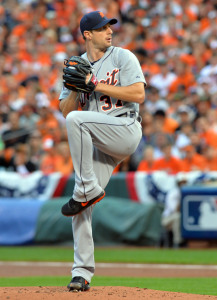
After showing so much tantalizing ability over the years, the former first-round draft pick finally put it all together in 2013. Scherzer spun 214 1/3 innings of 2.90 ERA ball, racking up 10.1 K/9 against 2.4 BB/9 and leading the league with a 0.970 WHIP. Scherzer not only nabbed his first All-Star appearance, but secured his first Cy Young Award.
The Tigers spent big and went for it under long-time owner Mike Ilitch, with veteran exec Dave Dombrowski swinging deals from the GM seat. Pursuit of an extension with Scherzer was inevitable.
Trouble was, Scherzer had taken his time turning into a complete pitcher. By the time the team was ready to place its bet on his future, he had ample leverage. And he had the game’s foremost lever puller running his negotiations: super-agent Scott Boras, long known for bringing his top clients to the open market.
Early-offseason moves freed some payroll availability; Dombrowski told MLBTR’s Zach Links the flexibility would make a Scherzer extension “more possible.” The sides were able to line up on a record-setting arbitration raise, which seemed generally promising. Scherzer indicated that he’d like to reach agreement on a deal to stay in Detroit for the long run.
And then came … a truly bizarre, late-spring exchange. We’ve occasionally seen teams issue statements when negotiations with a superstar fail to culminate in an agreement. But rarely are they so transparently salty as the one the Tigers unfurled …
“The Detroit Tigers have made a substantial, long-term contract extension offer to Max Scherzer that would have placed him among the highest paid pitchers in baseball, and the offer was rejected. As we have reiterated, it has been the organization’s intent to extend Max’s contract and keep him in a Tigers uniform well beyond the 2014 season. While this offer would have accomplished that, the ballclub’s focus remains on the start of the upcoming season, and competing for a World Championship. Moving forward there will be no further in-season negotiation and the organization will refrain from commenting on this matter.”
Well, then! Boras, naturally, responded. He wasn’t quite so spiteful, but certainly landed his own well-placed shot that left no doubt as to his views on the equal standing of the bargaining parties:
“Max Scherzer made a substantial long-term contract extension offer to the Detroit Tigers that would have placed him among the highest-paid pitchers in baseball, and the offer was rejected by Detroit. Max is very happy with the city of Detroit, the fans and his teammates, and we will continue negotiating with the Tigers at season’s end.”
So it seemed both sides had made their offers; neither proved amenable to further compromise. It emerged that the Tigers’ best offer was a match of the extant comparable of record: the six-year, $144MM Cole Hamels extension with the Phillies. The warring statements drew mixed reactions from the pundit class, but the consensus was that this number was never particularly likely to budge Boras and Scherzer.
Rather than bowing to worry over the season separating him from free agency, Scherzer took out an insurance policy. He was nearly as good in 2014 as he was in the season prior, landing a fifth-place Cy Young finish, obviating the need for that policy, and setting the stage for a proper bidding war. While there was indication at times that the Tigers remained involved, the team showed tepid interest and was not a finalist when push came to shove.
Scherzer, of course, signed a huge contract with the Nationals. Though the face value of $210MM didn’t account for deferrals, it handily topped the prior Tigers offer. Perhaps it was just as well for the Detroit organization. While the club was successful again in Scherzer’s final year, it crumbled in 2015, with Dombrowski stunningly departing after the trade deadline. Then again, Scherzer’s ongoing dominance made even that monster contract a relative bargain. Had the Tigers gone higher in their extension offer and managed to secure his services for the long haul, Scherzer would’ve been a nice trade chip to cash in and jump-start the rebuild.
Photo courtesy of USA Today Sports Images.
Max Scherzer Dealing With Side Discomfort
Star Nationals hurler Max Scherzer said today that he’s dealing with some discomfort in his side, as MLB.com’s Jessica Camerato (links to Twitter) was among those to report.
The issue led the team to give him a break from a scheduled competitive spring outing. But the excellent right-hander was still capable of throwing a 60-pitch pen session.
Scherzer says he’s dealing with an “ailment,” not an injury. The muscles in that region are a bit over-taxed after his last start, he explained, but he’s “absolutely not” concerned.
“There’s not even a strain,” Scherzer said, emphasizing that he won’t need to undergo an MRI. “This is purely just a fatigue, endurance thing,” he said.
Scherzer has been one of the game’s ultimate workhorses in recent seasons, but did miss a handful of starts in 2019. The long-dominant hurler also dealt with a neck issue during the World Series.
The champion Nats pushed their top arms to the limit last October, so they’ll need to mindful as they ramp back up in camp. Scherzer is 35 years of age, it’s fair to note, though he obviously pushes himself to remain in peak shape and he says his elbow and shoulder are in great form.
Nats Notes: Strasburg, Scherzer, Kieboom
While there’s no denying that huge money drove Stephen Strasburg‘s return to the Nationals, there were some other key elements that informed his decisionmaking this winter. As Britt Ghiroli of The Athletic reports (subscription link), Strasburg actually worked in family-related travel benefits into his negotiations and contract. Those changes will redound to the benefit of other players with the organization. Strasburg also negotiated for year-round access to Nationals Park and access to certain equipment for training.
The whole story provides a nice look at the shy but increasingly assertive Nats’ co-ace. More from D.C. …
- Strasburg has toiled quietly even under intense scrutiny. Max Scherzer isn’t exactly a trash-talker, but his mound-stalking and glowering certainly represent a challenge to opposing hitters. Both arms, and both personalities, have made the Nats’ pitching staff one of the best in the business for some time now. But for how long? Todd Dybas of NBC Sports Washington looks at the question whether Scherzer could end up inking a new deal with the club. The 35-year-old is presently two high-priced seasons away from a return to the open market. While it’s tough to imagine losing the rare pitcher that has outperformed a mammoth free agent deal, it’s also not an obvious situation for an extension. Scherzer says it’d be up to the team to “drive those conversations” if it wishes. On his side, he says he’s going to “stay in the moment” and not think too hard about the future.
- The Nats’ hopes for a repeat crown obviously rest on quite a few players. If there’s a clear wild card, it’s probably young infielder Carter Kieboom. MLB.com’s Jessica Camerato checks in on his progress at learning to handle the third base position. The top prospect is accustomed to the left side of the infield, having spent plenty of time at shortstop, but says it’s still an adjustment to move to the hot corner. He’s keeping a steady demeanor and focusing on the big picture, but it’s obvious he’s also receiving something of a trial by fire this spring. Both Kieboom and manager Dave Martinez expressed confidence … and emphasizing the need for loads of reps both in practice and at game speed. “We really believe that he could be our third baseman,” says Martinez.
Latest On Astros’ Sign-Stealing Scandal
The Astros’ sign-stealing scandal has been the dominant story in baseball over the past several weeks, though it didn’t come as a revelation to many throughout the game. A scout from another team told Barry Svrluga and Dave Sheinin of the Washington Post: “It was a big open secret, really big. Throughout baseball, throughout the scouting community, for several years, not just starting in 2017. I would say probably 2016, maybe earlier, through [2019], things were going on that were blatantly against the rules.”
If true, it further calls into question the Astros’ accomplishments in recent years. They amassed 100-plus victories in each of the past three campaigns, won the World Series in 2017 and took home the American League pennant a season ago. GM Jeff Luhnow and manager A.J. Hinch were suspended for a year apiece last month and lost their jobs as a result of their complicity in stealing signs during the team’s title-winning season. Luhnow, it seems, was a key part of a scheme called “Codebreaker” that the team used from 2017-18.
It’s possible neither Luhnow nor Hinch will work in the majors again as a result of their wrongdoing. That would’ve sounded ridiculous last fall when the Astros were the toast of the AL and vying for a World Series against the Nationals. The Nats upended the Astros in seven games, but Washington entered the Fall Classic wary of Houston’s shenanigans.
“It was amazing, once [it was assured] we were playing the Astros, how many people were coming out of the woodwork to let us know what they were doing,” one member of the Nationals told Svrluga and Sheinin.
Second baseman Brian Dozier, a National last season and a 2018 member of the Dodgers (whom the Astros took down in the 2017 World Series), received advance warning from his ex-LA teammates that Houston was behaving unethically. “Several” members of the Dodgers informed Dozier before last year’s World Series that the Astros were stealing signs, according to Svrluga and Sheinin. Meanwhile, former Astros and Nationals reliever Tony Sipp told Nats ace Max Scherzer to worry about Houston’s stealing of signs. The Nationals ended up overcoming it by using wristbands and multiple signs, as Svrluga and Sheinin explain in their piece.
The Astros advanced to the 2019 World Series by defeating the Yankees in the ALCS for the second time in three years. Like the Nationals, the Yankees suspected something was amiss.
“We’re so focused on them cheating, we’re forgetting we have to just go out and play,” one Yankees official said before the series, which the Astros ultimately won in six games.
Outfielder Carlos Beltran and catcher Brian McCann, both now retired from playing, are in the unique position of having suited up for the Astros and Yankees recently. Beltran even worked for the Yankees as a special advisor last season, and he informed “low level” New York officials of Houston’s cheating, per Ken Rosenthal, Evan Drellich and Marc Carig of The Athletic (subscription link). Beltran then became the Mets’ manager this past fall, only to lose his job last month as a result of the Astros’ violations.
While Beltran initially denied any knowledge of the Astros’ misdeeds, the 42-year-old potential Hall of Famer was apparently an important figure in them. McCann asked him to stop, two members of the 2017 Astros told The Athletic, but Beltran “steamrolled everybody.” At that point, he was one of the most accomplished individuals on the roster and someone whom younger players (and even Hinch) were basically reluctant to cross.
Beltran was part of commissioner Rob Manfred’s investigation into the Astros, but the latter elected against punishing any of the players from the 2017 club. However, if Beltran really was so instrumental in the Astros’ crimes, it’s hard to imagine him working in MLB again. He may even have less of a chance to get into Cooperstown. Regardless, this latest news on the Astros is yet another black mark on an organization that has taken a beating this winter.