
Mike Clevinger “Unlikely” To Pitch In Wild Card Round
10:47am: The Padres are still evaluating the decision on Clevinger and Lamet after their latest throwing sessions, per Dennis Lin and Ken Rosenthal of The Athletic (Twitter link). It doesn’t sound as though the club is formally committing to either pitcher’s availability (or lack thereof) just yet. They still have a bit more than an hour to submit their roster.
10:04am: Padres right-hander Mike Clevinger is unlikely to pitch in the Wild Card round, Jeff Passan and Jesse Rogers of ESPN report (Twitter link). There is “significant” concern after a Tuesday bullpen session, per the report, which casts doubt not only on Clevinger’s availability for the Wild Card round but for the entire postseason.
Acquired in a blockbuster, nine-player trade with the Indians on the morning of the trade deadline, Clevinger made four starts with the Padres and turned in 19 innings of 2.84 ERA ball with a 19-to-3 K/BB ratio. He was diagnosed with an elbow strain last week, however, and while he’s reportedly been cleared of any UCL damage, his status for the postseason has remained up in the air.
Clevinger’s injury is all the more concerning given that breakout righty Dinelson Lamet exited his most recent start after experiencing discomfort in his right biceps. Both pitchers threw earlier in the week, but it seems as though Clevinger hasn’t progressed to a point where he’s ready for game action. Lamet’s status remains unclear as well.
Quick Hits: Padres, M’s, Twins, White Sox
It’s possible Dinelson Lamet or Mike Clevinger could start Game 1 of the Padres’ series against the Cardinals on Wednesday, Kevin Acee of the San Diego Union-Tribune reports. It’s fantastic news for the Padres, who saw Lamet go down with right biceps tightness last Friday, while Clevinger suffered a sprained right elbow last Wednesday. At least in Clevinger’s case, it initially didn’t seem he would be ready for the start of the playoffs, but it now looks as if the Padres’ top starters (along with Zach Davies) will be ready when they begin their first postseason series since 2006.
- The Mariners will enter the upcoming offseason with a focus on upgrading their bullpen, per general manager Jerry Dipoto (via Greg Johns of MLB.com). Seattle would “like to add three or four guys down there that can stabilize that group and give us some certainty as we move toward the end of a game,” acccording to Dipoto. The Mariners, who finished with a 27-33 record, kept their long-running playoff drought going this year thanks in part to a weak relief corps that finished last in the AL in ERA (5.92).
- Twins third baseman Josh Donaldson (calf) and center fielder Byron Buxton (concussion) had “a relatively good day” Monday, according to manager Rocco Baldelli (via Betsy Helfand of the St. Paul Pioneer Press). Donaldson battled calf problems in the past, but that didn’t stop the Twins from signing him to a four-year, $92MM contract in the offseason. Further calf troubles have held Donaldson to 28 games this year, though, and he hasn’t played since Sept. 25. Buxton, who also has a history of injuries, only played in 39 regular-season games. However, even without full campaigns from either of those two, the Twins won 36 games en route to a second straight AL Central title. They should be even stronger if the two are ready for playoff action.
- White Sox left fielder Eloy Jimenez expects to be available for the team’s Game 1 playoff showdown in Oakland on Tuesday, Scott Merkin of MLB.com was among those to tweet. Jimenez hasn’t played since Sept. 24 because of a mid-foot sprain, but when he was able to take the field, he was one of Chicago’s most valuable hitters. As a .296/.332/.559 hitter in 226 plate appearances, the 23-year-old Jimenez helped the White Sox to their first playoff berth since 2008.
Mike Clevinger Suffers Sprained Right Elbow
SEPT. 25: Clevinger doesn’t have any UCL damage, per Robert Murray. Rather, he has been been diagnosed with a right elbow posterior impingement has received a cortisone shot, Cassavell tweets. The Padres haven’t given up on a wild-card return for Clevinger, according to manager Jayce Tingler (via Cassavell). “We’re optimistic that he will be able to pitch going forward,” said Tingler.
SEPT. 24: Clevinger has a sprained elbow, and the Padres won’t know until Sunday or perhaps at the beginning of next week whether he’ll be able to resume throwing this season, according to Acee. The likelihood is that Clevinger will at least miss the wild-card round, Jon Heyman of MLB Network tweets.
SEPT. 23, 5:56pm: The Padres are worried they’ll lose Clevinger for the playoffs because of a muscle strain or tendonitis, Kevin Acee of the San Diego Union-Tribune reports. He’s scheduled to undergo an MRI.
4:18pm: Padres right-hander Mike Clevinger threw a 1-2-3 first inning with two strikeouts against the Angels on Wednesday, but he departed after that for an undisclosed reason. The Padres were not planning on pulling Clevinger that soon in the game, AJ Cassavell of MLB.com tweets.
It’s worth noting that Clevinger had his previous start last Saturday pushed back because of bicep tightness, so this situation could be especially alarming news for the playoff-bound Padres. San Diego sent a haul to Cleveland for Clevinger at the Aug. 31 trade deadline, and the 29-year-old has since been highly effective over three starts. As a member of the Padres, Clevinger owns a 3.00 ERA with 17 strikeouts and three walks across 18 innings.
Based on what he has done as a Padre (not to mention his performance with the Indians over the past couple seasons), Clevinger could be a major difference maker in the playoffs for San Diego. The Padres do boast two other front-end starters in Dinelson Lamet and Zach Davies, while Chris Paddack and Garrett Richards offer another pair of proven options, but they won’t be at their best if they have to enter the postseason without Clevinger.
Additional Context On Padres’ Flurry Of Trades
The Padres were the most active buyer at the 2020 trade deadline — arguably of any trade deadline in recent history — reshaping their roster with additions of Mike Clevinger, Austin Nola, Trevor Rosenthal, Mitch Moreland and Jason Castro, among others. The dizzying sequence of additions hearkened back to the days when Matt Kemp labeled A.J. Preller a “rock star” GM during Preller’s frenetic first offseason on the job, but the biggest trades swung by the Padres over the weekend didn’t necessarily come together in straightforward fashion.
Preller, in fact, was informed Sunday evening that his Padres were “out” of the Clevinger bidding, USA Today’s Bob Nightengale reports (via Twitter). The Indians told the Padres that they were sitting on a better offer and likely to proceed in another direction. That call prompted the club to reconvene and alter its package, ultimately adding infield prospect Owen Miller and catcher Austin Hedges early Monday morning. Those pieces put San Diego’s offer over the top, it seems, as word of Clevinger’s trade to the Friars was out several hours before the 4pm ET deadline.
Hedges and Miller, the final two pieces of the Padres’ six-player package, added quite a bit more near-term value to the arrangement. Hedges is considered one of the best defensive catchers (if not the best) in the game and is controlled through the 2022 season. The 23-year-old Miller has yet to make his big league debut, but he slashed .290/.355/.430 in a full season at the Double-A level last year while playing three infield positions. He’s in Cleveland’s player pool now and could conceivably be an option this month. If not, he’ll certainly be in consideration for a call to the big leagues come 2021. With Cesar Hernandez playing on a one-year deal, it’s possible that Miller could be in the mix for regular playing time next season.
But the Clevinger blockbuster wasn’t the only Friars swap that required some persistent iterations. Mariners GM Jerry Dipoto told reporters after trading Nola, Austin Adams and Dan Altavilla to the Padres that he didn’t expect to trade Nola this summer (as opposed to Taijuan Walker, whom the M’s fully anticipated moving).
“They had called repeatedly on Austin Nola and we had repeatedly rebuffed that interest until the return just became too big for us to pass up in our minds,” Dipoto said Monday (link via MLB.com’s Greg Johns).
The key element of the trade for the Mariners was getting both infielder Ty France and outfield prospect Taylor Trammell in the deal. Dipoto didn’t hide his affinity for either player, revealing that he’s contacted the Padres on France repeatedly over the past couple seasons and been similarly drawn to Trammell dating all the way back to the 2016 draft. “As many phone calls as A.J. made to me this last week about Austin Nola, I have made as many to him over the last couple of years regarding Ty France,” said Dipoto.
With Nola and Castro now on hand, the Padres have completely remade their catching tandem midseason, but changes could yet be coming. The Athletic’s Dennis Lin reports (subscription required) that the club is contemplating a September promotion for 21-year-old Luis Campusano — a top-ranked catching prospect who was an in-demand piece himself at this year’s deadline. Per Lin, both the Indians and Rangers asked the Padres about Campusano in trade negotiations, but the Friars clearly weren’t inclined to include him in a deal. Cleveland initially sought Campusano and Luis Patino as centerpieces in the Clevinger deal, while the Rangers were interested in that pair as well as shortstop CJ Abrams when discussing Lance Lynn and Joey Gallo with the Padres.
The 21-year-old Campusano has yet to play above Class-A Advanced, but he tore through the pitcher-friendly California League last year, slashing .325/.396/.509 (148 wRC+). If the Padres do bring him up, they could rotate him, Nola and Castro through the catcher slot while maximizing Nola’s versatility with reps at any of first base, second base, third base or the outfield corners.
Suffice it to say, we could’ve seen any number of permutations of the Padres’ deluge of deals this past week. Such is the nature of a win-now team with a deep farm system. The club’s minor league system undoubtedly took a hit with this wave of trades, but San Diego also managed to hang onto the majority of its top-ranked prospects while clearly placing themselves in a better competitive position both now and into at least the 2022 season, after which Clevinger is scheduled to become a free agent.
Indians Notes: Marte, White Sox, Clevinger, Padres
Before the Diamondbacks traded Starling Marte to the Marlins yesterday, “the Indians made a run at” acquiring the outfielder, The Athletic’s Ken Rosenthal reports (subscription required). Marte would’ve been a enormous boost to Cleveland’s long-struggling outfield, and it is interesting to wonder what it would have cost the Tribe to land Marte. Looking at what the D’Backs accepted from Miami, the Indians would have had to surrender a pitcher with some proven MLB-level ability (like Caleb Smith), another big-league ready young arm (like Humberto Mejia), and a lottery ticket of a long-term pitching prospect like Julio Frias.
Beyond the prospect cost, it’s fair to assume that Marte’s financial cost was also a factor for Cleveland — Marte has $1.71MM remaining this year, and a $12.5MM club option for the 2021 season. Giving up a big prospect package and then declining Marte’s option wouldn’t have made much sense, and it isn’t yet clear what kind of payroll capacity the Tribe will have going into next season.
Some more Tribe notes…
- Also from Rosenthal, he shares some details on the talks between Indians and White Sox about a possible Mike Clevinger trade. The idea of a Clevinger trade to an AL Central rival seemed surprising at the time, and one Chicago official feels “the Indians used the Sox as a stalking horse, never intending to trade him within the division.” The White Sox also denied that right-hander Michael Kopech was offered to Tribe as part of the Clevinger negotiations.
- Clevinger wound up being traded to the Padres as part of a major deadline-day swap that saw the Indians acquire six players. It was a trade born from a lot of “familiarity” between the two organizations, as president of baseball operations Chris Antonetti told MLB.com’s Mandy Bell and other reporters. “We’ve spent a lot of time on their system….We have asked about all of these players in the past. Every one of them,” Antonetti said. “I would comfortably say, at this point, we’ve had hundreds of iterations of deals with the Padres.” Cleveland and San Diego have combined for five trades since July 2018.
- In other Clevinger news, Terry Pluto of the Cleveland Plain Dealer reports that the right-hander turned down an extension offer from the Indians in the spring of 2019. Terms and contract length weren’t revealed, though the deal would have almost assuredly gone beyond the four years of control the Tribe already held over Clevinger. The righty was coming off an impressive 2018 season and heading into his age-28 campaign, so purely speculatively, I wonder if the Tribe’s offer was at least somewhat similar to the five-year, $38.5MM extension (with two club option years) reached with Corey Kluber prior to the 2015 season. Kluber had a similar amount of service time and was coming off a better platform of a Cy Young Award-winning season, though he was also a year older than Clevinger would have been at the time of his hypothetical early-2019 extension.
Padres Acquire Mike Clevinger, Greg Allen In Nine-Player Trade With Indians
Four trades in 48 hours wasn’t enough for Padres general manager A.J. Preller. The Padres announced Monday the acquisition of right-hander Mike Clevinger, outfielder Greg Allen and a player to be named later from the Indians in exchange for a six-player package of outfielder/first baseman Josh Naylor, catcher Austin Hedges, right-hander Cal Quantrill, minor league shortstop Gabriel Arias, minor league left-hands Joey Cantillo and minor league infielder Owen Miller.
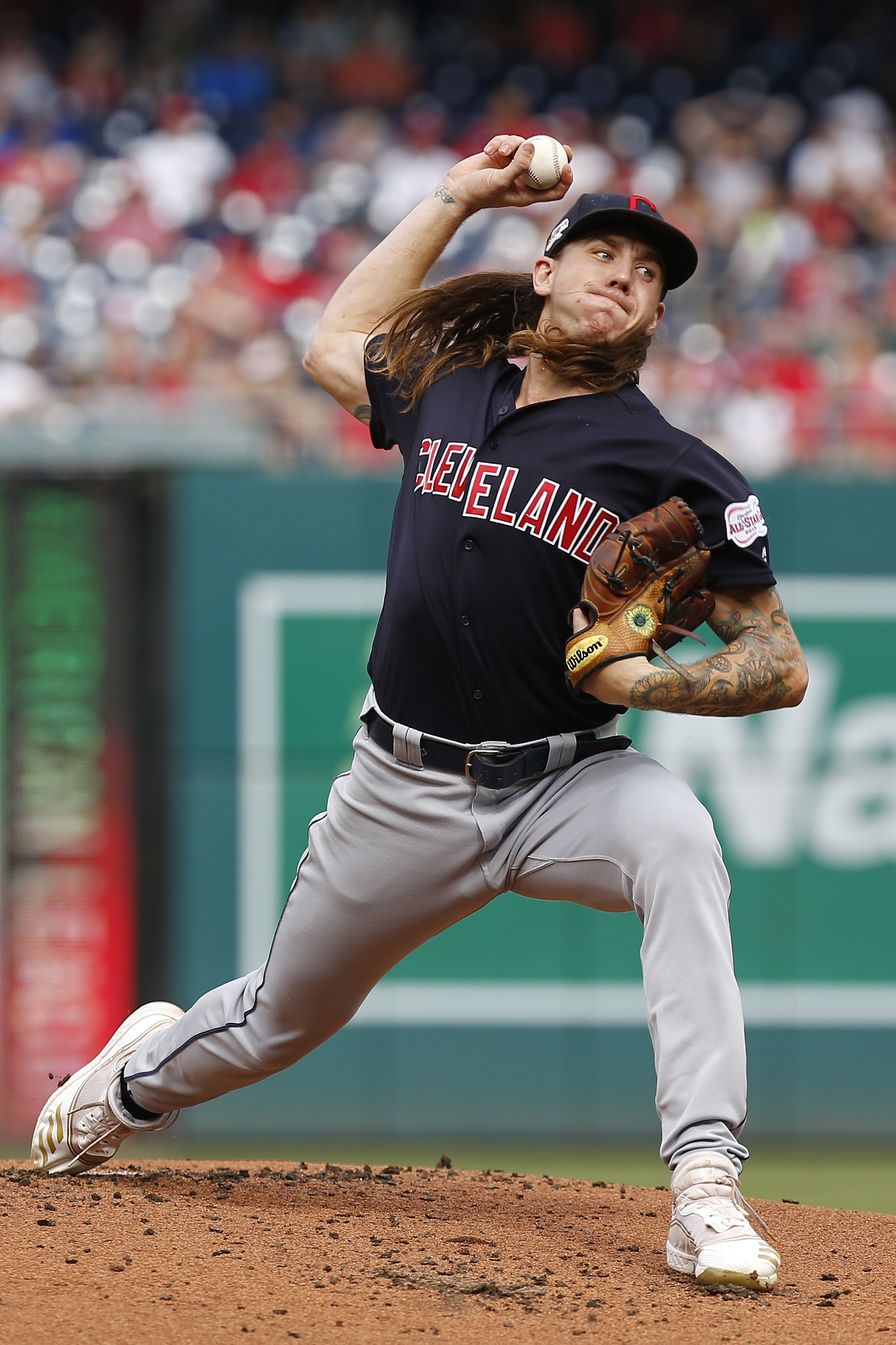
When Summer Camp was booting back up, a trade sending Clevinger out of Cleveland at a time when the Indians sat atop the AL Central standings would’ve seemed far-fetched. The club had already dealt away Trevor Bauer and Corey Kluber in the past 12 months, setting Clevinger up as a front-of-the-rotation workhorse.
Much has changed since that time, however. Clevinger drew ire from organizational higher-ups not only for breaking Covid-19 protocols but then taking a flight with the team rather than being forthcoming about his actions. That led to Clevinger being optioned to team’s alternate training site alongside Zach Plesac, who also violated protocols but was found to have done so before traveling with the club. Reports after the pair was optioned indicated that some teammates were so furious with the pair that they threatened to opt out of the season if Clevinger and Plesac were permitted to rejoin the club right away.
All the while, the Indians were receiving better-than-expected performances from other arms. Shane Bieber had already established himself as an above-average starter, but he’s ascended to bona fide Cy Young and MVP-caliber performance in the first month of play. Righty Aaron Civale has become the latest Cleveland pitching prospect to rise from obscurity to what looks like a high-end arm (3.72 ERA, 3.07 FIP in 46 innings). Carlos Carrasco is rounding back into form after last year’s frightening battle with leukemia. Triston McKenzie punched out 10 hitters in an electric MLB debut. And the aforementioned Plesac turned heads himself prior to being optioned (1.29 ERA, 24-to-2 K/BB ratio in 21 innings).
That hardly makes Clevinger expendable, but the Indians do seemingly have the depth to field a strong rotation even when subtracting one of the most talented pieces. And while Clevinger may have fallen out of favor a bit with the organization and/or teammates, there’s little denying that he is indeed among the game’s more talented arms. Dating back to 2017, the 29-year-old has compiled a 2.97 ERA and 3.43 FIP with averages of 10.2 strikeouts, 3.4 walks and 0.94 home runs allowed per nine innings pitched.
Beyond Clevinger’s high-end performance on the mound, his remaining club control only added to his allure among other clubs. He’s earning $4.1MM in 2020 — which prorates to about $1.48MM (with $617K yet to be paid) — and is controlled for an additional two seasons beyond the current campaign. For the Padres, that means that their rotation over the next two-plus seasons will feature a blend of Clevinger, Chris Paddack, Dinelson Lamet, MacKenzie Gore, Luis Patino and Zach Davies (though Davies is controlled only through 2021). It’s an enviable stockpile of arms — one that doesn’t even acknowledge the likes of Joey Lucchesi, Michel Baez and Adrian Morejon. Of course, some from that trio could yet be shipped out in trades to address other areas of need.
While Clevinger is the clear headliner of this deal — and perhaps of the entire 2020 trade deadline — he’s not the only piece going to San Diego. The Friars will also pick up four-plus years of control over the 27-year-old Allen. He’s out to a rough start in 2020 and has yet to really hit much in parts of four big league seasons, but Allen is a switch-hitting speedster with an above-average glove and experience at all three outfield spots.
He’s unlikely to push for a starting job, but Allen is a nice bench piece who can provide a late-inning jolt on the basepaths, a defensive upgrade or a more advantageous platoon matchup. He’ll need to improve upon a tepid .239/.295/.344 career slash if he’s to stick with the club into his arbitration years, but he won’t be arb-eligible until after the 2021 season, so he can be a solid reserve option next year at just north of the league minimum.
If Waldron is indeed the third piece headed to San Diego in the deal, he’s more of a long-term play than anything else. The 23-year-old was the Indians’ 18th-round pick in 2019 and posted a strong 2.96 ERA with a 57-to-4 K/BB ratio in 45 2/3 innings last year in his lone pro season. However, he did so as a college arm pitching at Rookie ball and Short-Season Class-A, where he was comfortably older than the majority of his competition. It’ll be much more telling to see how he performs against more advanced competition in 2021, but the early results are still of some note. Waldron wasn’t in the Indians’ pool, hence his inclusion as a PTBNL.
Turning to the Indians, they’ll get a high-volume return — but one that does not contain any of the Padres’ top-ranked prospects. It always seemed likely that for the Indians to move Clevinger, they’d need to acquire MLB-ready talent that can step right onto the roster. They’ll receive just that in Naylor, Hedges and Quantrill at the very least, and Miller probably isn’t too far behind.
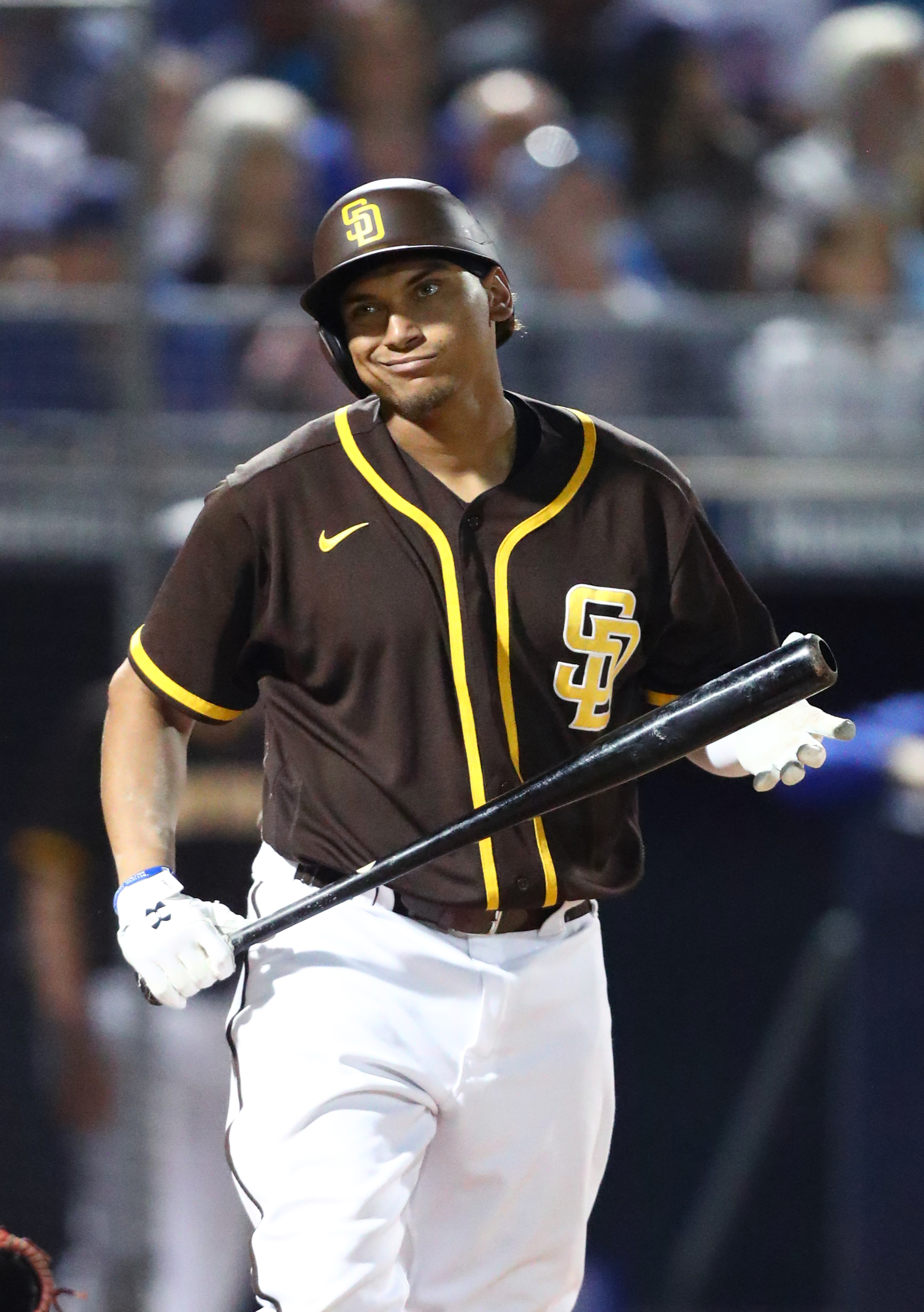
The 23-year-old Naylor was the No. 12 overall pick by the Marlins back in 2015 and was already traded once in the deal that sent Andrew Cashner from San Diego to Miami. He’s yet to cement himself as a big league regular but has fared quite well in the upper minors. The Padres haven’t exactly given Naylor an extended audition, but he’ll now presumably receive that in Cleveland. To this point in his career, Naylor is a .253/.315/.405 hitter in 317 MLB plate appearances. That’s not eye-catching production, but scouting reports have in the past credited him with plus-plus raw power and a potentially above-average hit tool. He hit .314/.389/.547 in Triple-A last year and .297/.383/.444 in a pitcher-friendly Double-A setting a year prior.
Naylor’s long-term home on defense could be either left field or first base, but with Carlos Santana and Franmil Reyes currently occupying first and the DH slot, respectively, Naylor seems likely ticketed for left field. In some ways, this is reminiscent of Cleveland’s bet on first baseman/outfielder Jake Bauers, but the club will hope for better results out of Naylor than they’ve received from Bauers so far. There’s certainly everyday upside present with Naylor, who can be controlled all the way through 2025, but it does seem a bit surprising that Cleveland brass didn’t focus on a more established young hitter.
Also going to Cleveland is Hedges, a 28-year-old defensive standout who has never provided much offense in the big leagues. The former top prospect has shown a bit of pop — career-high 18 homers in 2018 — but in total owns just a .199/.257/.359 slash through 1339 trips to the plate with San Diego. He’s obviously not a clear upgrade over Roberto Perez, but the Indians now possess two of the game’s very best defenders behind the dish.
Hedges, in fact, is widely regarded as MLB’s premier defensive catcher. Hedges was MLB’s best pitch framer in 2019, per Statcast, and has graded out at elite levels in that regard in each season of his career. He’s also thwarted 32 percent of stolen-base attempts against him while consistently drawing above-average marks for his pitch blocking abilities at Baseball Prospectus. Hedges is controlled through the 2022 season.
Quantrill, 25, brings another former first-round pick (eighth in 2016) and top prospect to the Indians organization. He’s shined in 17 1/3 frames as a multi-inning reliever in 2020 (five runs, 18-to-6 K/BB ratio), but he also struggled in a rotation role a year ago.
Quantrill has a low-spinning sinker (which is good for a sinker, as opposed to a four-seamer, where high spin is preferred) and has generally limited hard contact well, per Statcast. He may not have found his groove yet in the big leagues, but the Indians develop more quality arms than the vast majority of teams in the league. Getting their hands on a former top pick who was once a rather well-regarded prospect could yet yield some strong results, and Quantrill, like Naylor, is controllable through 2025.
Among the pure prospects headed to the Indians in this deal, Cantillo and Arias are regarded a bit more highly than Miller, though all three rank firmly in the middle ranks of an absolutely stacked farm system. Cantillo, 20, was a 16th-round pick in 2017 who has elevated his stock with a strong showing to this point in his pro career. He split last season between Class-A and Class-A Advanced, working to a combined 2.26 ERA with 11.6 K/9 against 2.7 BB/9. FanGraphs’ Eric Longenhagen writes that he’s currently tracking as a back-end starter but has a projectable frame that could allow for further growth and add some extra life to his pitches.
Arias, also 20, is regarded as an elite defender at short with some questions about his abilities at the plate. Baseball America ranked him ninth in the deep Padres system, praising his surprising raw power but noting that his current inability to lay off breaking balls out of the strike zone leads to untenable strikeout numbers. Arias is young, though, and he hit .302/.339/.470 in Class-A Advanced last year, so the tools are clearly there. Depending on how the bat progresses, he has everyday upside at shortstop.
Miller, 23, plays second base, shortstop and third base, and he turned in a solid .290/.355/.430 showing in a very tough Double-A setting last year. Miller has hit at every minor league stop and struck out at just a 15.4 percent rate in Double-A last season. MLB.com tabs him as a potential regular at second base, citing an arm that doesn’t quite play as a regular shortstop, or a utility man who can play three infield spots with a quality bat. He’s yet to make his big league debut, but Miller is the closest of the three minor leaguers in this deal.
We might not see a more franchise-altering deal than this at the 2020 deadline. For the Indians, it’s the type of trade fans are used to, painful as it might be. They’ll shed a player whose arbitration salary is on the rise and replace him with a bevy of young talent — a luxury that was possible due to the team’s superlative record in terms of developing starting pitching. They’re still in the driver’s seat as far as a potential postseason berth goes, but the club is quite likely weaker for the balance of the 2020 campaign. The long-term benefits should help the club sustain its long run of contending seasons in the AL Central, but that’ll be more of a challenge in and of itself as each of the White Sox, Tigers and Royals near the end of arduous rebuilding efforts.
The addition of Clevinger to an already formidable Padres rotation mix only further solidifies them as a win-now club for the foreseeable future, and they’re now a clear-cut postseason favorite in the NL. And unlike the last time the Padres went on an aggressive win-now tear, the Padres have the young foundation necessary — fronted by superstar Fernando Tatis Jr. — to support their recent wave of high-profile veteran acquisitions. They’ve completed a dizzying five trades since the weekend began — including a seven-player swap with Seattle last night — to remake an already strong club. The “Rock Star” GM is back, it seems, and the Padres certainly appear to be positioned better than they have been at any time in Preller’s tenure.
Ryan Spaeder reported last night that a deal sending Clevinger to Padres was in the works, though as of last evening he’d heard of some potential holdups in the deal. Robert Murray first reported that the deal was done (via Twitter). MLB Network’s Jon Heyman, ESPN’s Jeff Passan, The Athletic’s Ken Rosenthal and Bleacher Report’s Scott Miller all broke varying elements of the other players involved in the deal (all links to Twitter).
Latest On Mike Clevinger
AUG. 31: The Blue Jays “don’t seem to be heavily involved on Clevinger,” according to Heyman, who lists the Padres, Braves and perhaps the White Sox as teams that appear to be in the mix.
AUG. 30, 9:48PM: The Blue Jays also have interest in Clevinger, Heyman tweets, but it isn’t known if Toronto is the “mystery team.”
8:07PM: Speculation continues to swirl about a possible Mike Clevinger trade, with multiple reports surfacing earlier tonight that the Padres had seemingly moved into the driver’s seat for the Indians righty. The most recent word, however, is that other teams may have pulled ahead of San Diego, as USA Today’s Bob Nightengale (Twitter links) reports that the Tribe “have requested players’ physicals from at least two teams” but haven’t asked the Padres to submit such information.
A mystery team has made a better offer for Clevinger than the Padres, Nightengale writes. MLB.com’s Mark Feinsand (Twitter links) reported earlier tonight that the Braves were still in the Clevinger sweepstakes even though the Padres were the “frontrunners” at the time, and two rival executives told Feinsand that Atlanta could very well be the team “making an aggressive play” to now top San Diego’s offer. Top outfield prospect Drew Waters was reportedly part of the Indians’ trade ask from the Braves, according to MLB Network’s Jon Morosi (via Twitter).
The Padres don’t seem to be willing to move either Trent Grisham or Jake Cronenworth, MLB Network’s Jon Heyman (Twitter links), which could be a roadblock in a potential Clevinger trade. Also from Heyman, the Yankees don’t appear to be the mystery team in the Clevinger hunt, as there is “no belief anything’s close” between New York and Cleveland.
The White Sox and Dodgers were also rumored to be interested in Clevinger earlier today, and with this much buzz around the right-hander, one wonders how close Cleveland might get to someone meeting its reportedly “ridiculous” asking price in any Clevinger trade.
White Sox, Indians Reportedly Discussing Mike Clevinger Trade
The White Sox and Indians are “actively involved” in trade talks surrounding Cleveland right-hander Mike Clevinger, reports Bob Nightengale of USA Today. Jon Heyman of MLB Network adds the Braves, Yankees, Padres and Dodgers among Clevinger’s pursuers, adding that the right-hander has a “good chance” to be dealt.
As recently as Friday, it seemed unlikely Clevinger would go anywhere, with Cleveland apparently setting an extremely high price tag on him. The price tag seemingly remains high. Heyman hears that Cleveland would want big league talent in return (Twitter link), while Robert Murray reports that the initial ask was “four quality prospects.”
Clevinger’s violation of the Indians’ coronavirus protocols and subsequent demotion are well-known at this point and have made him an interesting trade candidate, although there’s no urgency (at least from an on-field perspective) for Cleveland to move him. Clevinger is controlled through 2022 via arbitration and has offered front-end production for most of the past four years.
The Braves and Yankees have been known to be targeting starting pitching, and Heyman adds that the Padres are seeking another starter. The Dodgers, meanwhile, are targeting players with multiple years of control, manager Dave Roberts told reporters (including Bill Punkett of the Orange County Register), so Clevinger fits the bill.
The White Sox are also in the market for starters (even more so with Gio González hitting the injured list this afternoon), although a Clevinger deal would be extremely surprising. Players of his caliber with multiple years of control are seldom traded within the division, even less often between two immediate contenders.
Report: Indians’ Asking Price For Mike Clevinger “Ridiculous”
Indians right-hander Mike Clevinger returned Wednesday from a team-imposed demotion that lasted almost two weeks after he violated coronavirus protocols. Clevinger threw six innings of two-run ball in a win over the Twins in his comeback, though there continues to be trade speculation centering on the 29-year-old as the Aug. 31 deadline draws closer. He’s “definitely being talked about in trade scenarios,” tweets Jon Heyman of MLB Network, but the Indians’ asking price is “ridiculous.”
Clevinger certainly isn’t the most popular player in the Cleveland organization in the wake of his recent off-field mistakes, though it’s hard to fault the club for placing a high price tag on him. After all, the hard-throwing Clevinger’s a proven front-line producer who’s affordable this year, in which he’s earning a prorated $4.1MM, and under control for two more full seasons via arbitration.
Since he broke out in 2017, Clevinger has posted a sparkling 2.97 ERA/3.43 FIP with 10.22 K/9 and 3.35 BB/9 in 470 1/3 innings. Along with AL Cy Young front-runner Shane Bieber, Aaron Civale and Carlos Carrasco, Clevinger helps give the Indians’ rotation one of the top quartets in baseball (and that’s without potential rising star Zach Plesac, whom the team optioned alongside Clevinger). There’s also rookie Triston McKenzie, who fired six innings of two-hit, one-run, 10-strikeout ball in his MLB debut versus the Tigers last Saturday.
Thanks in part to their overflow of quality starting pitching, the Indians have begun the year 19-12, atop the AL wild-card race and just a half-game behind the Twins in their division. With that in mind, there’s no reason for the contending Indians to part with Clevinger for anything less than a Godfather offer before Monday.
Indians Recall Mike Clevinger
Aug. 26: Cleveland has officially recalled Clevinger and optioned catcher Beau Taylor to the alternate site in a corresponding move. It’s worth noting, too, that while there’d been some drama surrounding the possibility that Clevinger’s path to free agency would be delayed if he spent 20 or more days at the alternate site, he’ll fall shy of that mark and remain on track for free agency after the 2022 campaign.
Aug. 25: The Indians announced that right-hander Mike Clevinger will be recalled from their alternate training site prior to tomorrow’s game with the Twins. Clevinger will get the start in his return to big league action.
It has been a whirlwind few weeks for Clevinger, who went from being the nominal ace of the Cleveland rotation to being placed on the restricted list, then sent to the club’s alternate training site, and now could even be a trade candidate. It all stems from the now-infamous incident that saw Clevinger and Zach Plesac violate the Tribe’s COVID-19 protocols by leaving the team hotel for a night out in Chicago, and then not admitting their fault until the club itself discovered the transgression. Clevinger’s involvement didn’t even come to light until Plesac had already issued an apology to his teammates after being quarantined.
The incident left many Indians players understandably upset at Clevinger and Plesac, particularly after Plesac compounded the problem with an Instagram video blaming the media for allegedly exaggerating the situation. In regards to Plesac, Cleveland president of baseball operations Chris Antonetti told MLB.com’s Mandy Bell and other reporters that after Clevinger’s recall was announced, Antonetti called Plesac to say “they don’t have an opportunity for him at this time at the Major League level.” As such, Plesac will continue to pitch at the alternate training site until an opening develops (or, given the August 31 trade deadline is nearing, perhaps until a trade can be worked out).
Amidst all this controversy, the Tribe is 17-12 and in possession of a wild card spot. Somewhat incredibly, Cleveland has barely missed Clevinger or Plesac, with Shane Bieber posting Cy Young-caliber numbers, Aaron Civale and Carlos Carrasco pitching well, and Triston McKenzie coming off an eye-opening Major League debut. Adam Plutko hasn’t been as effective, so he will likely be the odd man out now that Clevinger is back…or, perhaps just until Clevinger himself is dealt.
Clevinger has had an up-and-down year even just in terms of his on-field results. While he has a 3.24 ERA over 16 2/3 innings, ERA indicators (6.25 FIP, 5.38 xFIP, 5.46 SIERA) and batted-ball data (a .376 xwOBA that is much higher than his .338 wOBA) hint that Clevinger hasn’t been himself on the mound. Clevinger has been aided by a .205 BABIP and a 97.6% strand rate, while already allowing four home runs and 10 walks over his 16 2/3 frames.