
Latest On Furloughs, Pay Cuts Among MLB Clubs
6:09pm: The Rangers have committed to $400 a week for their minor leaguers through at least June, Levi Weaver of The Athletic was among those to report. The same goes for the Braves, per David O’Brien of The Athletic, as well as the Diamondbacks, Nick Piecoro of the Arizona Republic adds.
12:59pm: The Padres will also pay their minor leaguers the $400 weekly stipend through the end of August, Dennis Lin of The Athletic tweets.
12:34pm: Most of MLB’s 30 organizations agreed a ways back to pay their employees through the end of May. There were instances of lengthier commitments, but May 31 was broadly used as an initial endpoint, at which time fiscal matters would be reassessed. Minor league players have been receiving $400 weekly stipends during this time, but that arrangement is also only promised through the end of May. As you’d expect, clubs have begun to inform employees (both on the business and baseball operations side) and minor leaguers of their next steps. And, as you’d expect, in some instances it’s not pretty.
Yesterday was a particularly dark day in the Athletics organization, as ESPN’s Jeff Passan reports that the team informed minor league players they will no longer be paid their stipend as of June 1. Robert Murray of The Score shares the email that was sent to Oakland minor leaguers — one which was signed by GM David Forst rather than managing partner John J. Fisher. (Forst, of course, is being asked to play the messenger in this instance and is not the one making the decisions.)
Minor league players are generally undercompensated as a whole, and the $400 weekly stipend they’ve received over the past two months will now seemingly go down as the only baseball-related compensation they’ll receive in the calendar year. Their contracts, which are in a state of suspension but not terminated, bar them from “perform[ing] services for any other Club” and also render them ineligible for unemployment benefits, per The Athletic’s Emily Waldon (Twitter link).
As for the operations side of the equation, Athletics front office personnel will be either furloughed or see their pay reduced effective June 1 and running through the end of October, The Athletic’s Alex Coffey reports (Twitter thread). She adds that the maximum cut is 33 percent, and those determinations are based on seniority. Scouts aren’t considered front-office personnel, but they’ll be hit hard as well; USA Today’s Bob Nightengale tweets that A’s amateur and pro scouts alike will be furloughed from June 16 through Oct. 31. Fisher did write a letter to the club’s fanbase confirming the dramatic cuts (Twitter link via the San Francisco Chronicle’s Susan Slusser), emphasizing the pain that went into the decisions and his “deep commitment to the long-term future of the A’s.”
Those cutbacks are similar to the substantial cuts the Angels put in place earlier this month, but other L.A. club isn’t taking such rash measures. The Dodgers have informed all employees earning more than $75K that they’ll be subject to pay reductions beginning June 1, Ramona Shelburne of ESPN (Twitter thread). The extent of the reductions is dependent on overall salary — larger salaries get larger percentage cuts — and will be capped at 35 percent for the most part, although that they could be greater for the team’s very top executives. Those measures are being taken in an effort to avoid the type of large-scale furloughs being put in place in Oakland and Anaheim.
Across the country, the Nationals have implemented a series of partial furloughs both in baseball ops and business ops, Jesse Dougherty of the Washington Post reports (Twitter thread). The Nats are still covering full benefits and haven’t made any layoffs, but they’re implementing a sequence of 10 to 30 percent reductions in pay and total hours. The Brewers, meanwhile aren’t making any baseball ops furloughs but are furloughing some business operation employees, Todd Rosiak of the Milwaukee Journal-Sentinel tweets.
It’s not yet clear how every organization plans to handle the minor league pay dilemma, but Baseball America’s Kyle Glaser has heard from at least three clubs that plan to continue varying levels of compensation. The Phillies will keep paying their minor leaguers through at least June, but likely at less than the current $400 stipend. The White Sox are paying $400 per week through the end of June, and the Marlins have committed to paying their minor leaguers the full $400 per week through August — the would-be conclusion of the 2020 minor league season. The Marlins already informed players earlier this month that about 40 percent of the baseball ops department will be furloughed on June 1.
White Sox Release 25 Minor Leaguers
The White Sox are the latest team to make significant cuts in the minors, per The Athletic’s James Fegan, who reports that they have let go of 25 players (Fegan provides the entire list in his tweet). The White Sox will pay all of their minor leaguers, including those they just released, through the end of June, Fegan adds.
As you’d expect, most of the names here aren’t especially familiar. However, there are at least a couple notable players, including outfielder Josue Guerrero, whom the White Sox signed to a $1.1MM million bonus out of the Dominican Republic in 2016. Josue Guerrero, the nephew of Hall of Famer Vladimir Guerrero and the cousin of the Blue Jays’ Vladimir Guerrero Jr., didn’t post inspiring numbers as part of the White Sox’s system. In 244 plate appearances in rookie ball from 2017-19, the 20-year-old hit .224/.282/.365 with five home runs.
The White Sox also said goodbye to left-hander Byron Andre Davis, who Fegan notes was part of the return they received from the Royals in a 2017 trade centering on outfielder Melky Cabrera. Davis, now 26, dealt with injuries over the past couple years and hasn’t pitched in the minors since 2017.
Latest On MLB Teams’ Plans For Employees
A variety of MLB teams have already revealed plans for the year for non-player employees. Some have instituted furloughs and/or pay cuts while others have committed to carry employees through the fall. Still other teams are taking things on a month-to-month basis, with several revealing their latest plans in recent days.
At least three teams have decided to continue paying employees in full through at least the end of June. The Cardinals are one such team, Derrick Goold of the St. Louis Post-Dispatch reports on Twitter. The Twins are also in that camp, Jeff Passan of ESPN.com tweets. And the White Sox are adjusting work hours but not take-home pay, per Ken Rosenthal of The Athletic (via Twitter).
Elsewhere in the central divisions, there were some cuts. The Cubs are keeping their full slate of employees at full-time capacity, but are instituting some salary reductions, Jeff Passan of ESPN.com reported on Twitter. And though the Pirates will not draw down their baseball operations staff, they will reduce pay in that arena while furloughing some business employees, as Jason Mackey of the Pittsburgh Post-Gazette reports.
Out west, the Giants will retain their entire full-time staff but will be trimming pay for those earning over $75K, Henry Schulman of the San Francisco Chronicle reports. Part-timers have been furloughed.
The Astros have committed to maintaining full pay and benefits for full-time employees, but only through June 5th, Chandler Rome of the Houston Chronicle reports. Whether some action could occur beyond that point remains to be seen. The Orioles are also still in flux, but the organization appears to be leaning towards keeping staff as usual through June, per Dan Connolly of The Athletic (via Twitter).
12 Years Later, This Trade’s Still Paying Off For Yankees
It has been a dozen years since the Yankees swung a trade for outfielder Nick Swisher, who paid immediate dividends as part of the franchise and whose acquisition continues to benefit the organization to this day. On Nov. 13, 2008, the Yankees sent two minor league pitchers – Jeff Marquez and Jhonny Nunez – as well as veteran infielder Wilson Betemit to the White Sox for Swisher and young hurler Kanekoa Texeira. Most of the pieces in the swap – Marquez, Nunez and Texeira – failed to pan out in the majors, but the move revived the switch-hitting Swisher’s career and helped him land a sizable payday in free agency down the road.
If we go back to the start, Swisher opened his career as a rather effective member of the Athletics, who chose him 16th overall in the 2002 draft. As a member of the big club from 2004-07, Swisher batted .251/.361/.464 (118 wRC+) with 80 home runs and 10.0 fWAR over 1,924 plate appearances, aiding Oakland in three plus-.500 seasons and a playoff berth. However, almost six years after spending a high pick on him, the A’s sold the affable Swisher, dealing him to the White Sox in January 2008 for a package led by left-hander Gio Gonzalez. That worked out fine for Oakland, which received a couple terrific years from Gonzalez before trading him to the Nationals in December 2011 in yet another notable transaction.
While the A’s profited from Gonzalez’s presence, his career took a bad turn in his first year out of Oakland. The 2008 campaign was one of the worst of Swisher’s time in the game, and he was unable to win the favor of then-White Sox manager Ozzie Guillen as a result. While Swisher was seemingly a solid clubhouse presence in the majors, Guillen thought the opposite. He said in November 2008, a little while after the White Sox parted with Swisher: “To be honest with you, I was not happy with the way he was reacting at the end of the season. He wasn’t helping me either.” Maybe the relationship would have been better had Swisher produced, though he instead struggled to a .219/.332/.410 line (93 wRC+) in 588 PA. But Swisher did pop 24 home runs, his third of nine straight seasons with 20-plus, and Yankees general manager Brian Cashman decided to buy low on him.
To this day, the Swisher pickup looks like one of the most brilliant decisions of Cashman’s lengthy tenure atop New York’s front office. Swisher was a quality contributor throughout his time as a Yankee, including in a 2009 campaign that saw the team win its most recent World Series championship. From that season through 2012, Swisher’s last as a Yankee, he hit .268/.367/.483 (128 wRC+) with 105 HRs and 14.4 fWAR across 2,501 PA, also earning his lone All-Star berth in the process. But the Yankees were not willing to commit to Swisher once he became a free agent before 2013, which, for multiple reasons, was a wise call in hindsight.
In January 2013, the Ohio-born Swisher returned to his native state on a four-year, $56MM contract with the Indians. Unfortunately for Cleveland, it didn’t get anything close to the Yankees’ version of Swisher. Owing in part to knee problems, Swisher slashed a below-average .228/.311/.377 (92 wRC+) with 32 homers and minus-0.5 fWAR in 1,146 PA in an Indians uniform. They dealt Swisher and fellow outfielder Michael Bourn to the Braves for infielder Chris Johnson in August 2015. That proved to be Swisher’s final season in MLB, though he did return to the Yankees on a minor league contract in 2016 before his career came to an end later that year.

The season after Swisher said goodbye to pro baseball, another star was born in New York. Towering right fielder Aaron Judge, a top 100 prospect in his younger days, exploded on the scene in 2017, batting .284/.422/.627 (174 wRC+), smacking 52 homers and racking up 8.3 fWAR. Judge fell short of AL MVP honors then, but he won Rookie of the Year in his league and was part of a club that took the eventual title-winning Astros to a seven-game LCS.
While injuries have somewhat limited Judge’s availability since his initial season, you can’t argue with the production he has managed when he has been able to take the field. Since his second year, Judge has recorded a line of .278/.392/.528 (good for a 146 wRC+) and amassed 54 dingers with 9.7 fWAR.
Judge is now 28 years old, a two-time All-Star and perhaps the face of the Bronx-based franchise, but he may have never gotten there if not for Swisher. Allowing Swisher to depart in free agency entitled the Yankees to a compensatory selection in the ensuing draft. They used that pick, No. 32 in 2013, on Judge – a former Fresno State Bulldog. So, not only did the Yankees benefit from Swisher’s best seasons as a pro, but stealing him from the White Sox 12 years ago is still paying off for them in a big way.
Photo courtesy of USA Today Sports Images.
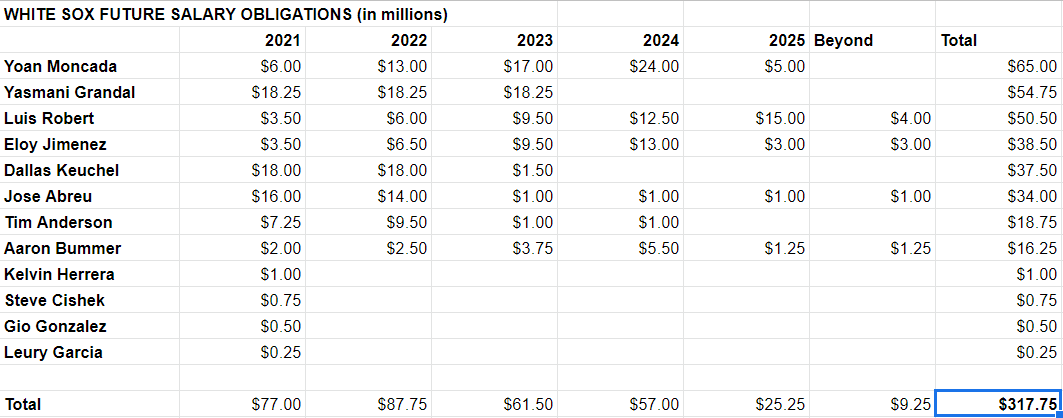
How Does White Sox’ Future Payroll Look After Busy Offseason?
2020 salary terms are set to be hammered out in the coming days. But what about what’s owed to players beyond that point? The near-term economic picture remains questionable at best. That’ll make teams all the more cautious with guaranteed future salaries.
Every organization has some amount of future cash committed to players, all of it done before the coronavirus pandemic swept the globe. There are several different ways to look at salaries; for instance, for purposes of calculating the luxury tax, the average annual value is the touchstone, with up-front bonuses spread over the life of the deal. For this exercise, we’ll focus on actual cash outlays that still have yet to be paid.
We’ll run through every team, with a big assist from the Cot’s Baseball Contracts database. Next up is the White Sox:
(click to expand/view detail list)
White Sox Total Future Cash Obligation: $317.75MM
*includes buyout of club options
*2023 option over Dallas Keuchel vests with clean physical, IP thresholds
Which 15 Players Should The White Sox Protect In An Expansion Draft?
In a few weeks, we’ll be running a two-team mock expansion draft here at MLBTR. Currently, we’re creating 15-player protected lists for each of the existing 30 teams. You can catch up on the rules for player eligibility here.
So far, we’ve done the Rays, Yankees, Red Sox, Blue Jays, and Orioles. The White Sox are next.
First, we’ll take Edwin Encarnacion, Gio Gonzalez, Steve Cishek, Kelvin Herrera, Leury Garcia, Alex Colome, and James McCann out of consideration, because they’ll be free agents after the season (although some have club options). We’ll lock in Yasmani Grandal, Dallas Keuchel, and Jose Abreu on our protected list due to no-trade protection in their contracts. I’m also going to lock in these eight players:
Yoan Moncada
Lucas Giolito
Eloy Jimenez
Luis Robert
Michael Kopech
Nick Madrigal
Tim Anderson
Dylan Cease
That leaves four spots for the following 14 players:
Carlos Rodon
Nomar Mazara
Evan Marshall
Reynaldo Lopez
Adam Engel
Jace Fry
Aaron Bummer
Carson Fulmer
Jose Ruiz
Jimmy Cordero
Zack Collins
Ian Hamilton
Danny Mendick
Seby Zavala
With that, we turn it over to the MLBTR readership! In the poll below, select exactly four players you think the White Sox should protect in our upcoming mock expansion draft. Click here to view the results.
A Shortstop Showdown
While they’re not in the same division, a pair of centrally based major league teams have produced a couple of the majors’ top-performing shortstops. The White Sox of the American League Central have seen Tim Anderson turn into a rather valuable player. The same goes for the Cardinals of the National League Central and Paul DeJong. They’re pretty similar in value, age and contract situations, but which of the two would you rather have?
Anderson, 26, was a first-round pick in 2013 who debuted in ’16 and took some time to find himself as a major league hitter. In 1,643 plate appearances from his first year through 2018, he hit a below-average .258/.286/.411 (86 wRC+) with 46 home runs and 51 stolen bases. A high strikeout rate (26 percent) and a low walk percentage (3.4) were part of the problem. Those K/BB trends largely stayed in place last year (2.9 percent and 21 percent, respectively), but Anderson nonetheless found another gear a hitter. He slashed .335/.357/.508 (130 wRC+) with 18 homers and 17 steals en route to a career-best 3.5 fWAR (he combined for 4.1 in the prior three seasons) and an AL batting title. Of course, he was also the beneficiary of a .399 batting average on balls in play – up .110 points from the previous year – and Statcast wasn’t as bullish as his bottom-line production (.363 weighted on-base average versus .328 expected wOBA).
Shifting to the defensive side, Anderson hasn’t been a consistently good player, at least not according to the metrics. By Defensive Runs Saved and Ultimate Zone Rating, he has been a plus player twice and a minus fielder twice. The most recent campaign fell into the latter category, as he posted minus-12 DRS with a minus-9.1 UZR. DeJong, meanwhile, has greatly outdone Anderson as a defender since debuting with the Cardinals in 2017. Last season, for instance, DeJong put up 26 DRS and 11.4 UZR, making him one of the sport’s top fielders.
Also 26, DeJong has graded as a solid performer on a regular basis dating back to his first game in the majors. He has been at least a 3.0-fWAR player every season, including a career-high 4.1 mark in 2019. DeJong, unlike Anderson, has struggled to hit for average of late, but he was a 30-HR man last year – a season in which he finished with a .233/.318/.444 mark (100 wRC+) across 664 plate appearances. Going by wRC+, it was the third consecutive time that DeJong registered league-average or better offensive numbers. That and his excellent defense have combined to make DeJong quite valuable for St. Louis.
Beyond the production on the field, you have to consider the two players’ contracts when comparing them. They’re pretty alike in that regard, too. Anderson inked a six-year, $25MM extension heading into the 2017 season. That deal also includes a $12.5MM club option for 2023 and a potential $14MM salary the next season. Whether or not the White Sox pick up either option, they’re surely not regretting the gamble now. Likewise, the Cardinals must be happy that they locked DeJong into a six-year, $26MM pact prior to 2018. That deal includes a $12.5MM option for 2024 and $15MM in ’25.
There’s a lot to like about both of these shortstops, but if you have to pick one, whom would you want on your team? (Poll link for app users)
Tim Anderson Or Paul DeJong?
-
DeJong 61% (3,859)
-
Anderson 39% (2,478)
Total votes: 6,337
How Nomar Mazara Can Reach His Potential With The White Sox
One of the wild cards of the 2020 season will be the development of 25-year-old outfielder Nomar Mazara, who will look to finally break out, this time in a new environment. By now, Mazara has had four whole seasons to prove himself at the Major League level, and in 2019 he was largely the same player as he was when he debuted with the Rangers in 2016. Last year was critical for the marriage between Mazara and the Rangers; if Mazara were to establish himself as a building block for Texas, he needed to take the leap that the club has been expecting since it signed him in 2011 as an amateur. Unfortunately, that progress didn’t really come, and the Rangers dealt Mazara to the outfield-needy White Sox in December.
At 6’4″ and 215 lbs., Mazara looks the part of an MLB slugger: his frame alone is enough to convince spectators that he’s got superstar potential. He’s almost in the Giancarlo Stanton/Joey Gallo class of physicality, and his mammoth home runs lend credence to that comparison—Mazara hit the longest homer in MLB last year with a Statcast-measured 505-foot blast. When Mazara gets into one, your eyes light up at the thought of him mashing with regularity.
But the fact of the matter is that Mazara has yet to hit more than 20 homers in a season, and has in fact never put up a season of even 1.0 WAR by FanGraphs’ measure (Baseball-Reference agrees). It’s been frustrating for Rangers fans to follow his development, not because he’s been a bad player, but simply because they recognize he could be so much more.
While his average exit velocity of 89.1 mph only ranked in the 51st percentile last year, his hardest-hit balls tell a different story: his maximum exit velo, 114.6 mph, ranked number 41 among all MLB hitters. That’s something you might expect from a perennial 30-homer guy, not someone who’s plateaued at the 20-home run threshold. So what’s holding him back?
For one thing, his ceiling has thus far been limited by just average on-base skills: Mazara has never walked at a rate higher than 9% in a single season, meaning that his yearly on-base percentage has consistently hovered around .320, which is just about MLB-average. Even when he does tap into his prodigious power, that leaves him a step below the likes of Gallo or Stanton, who command enough respect from pitchers—and are disciplined enough—to generate above-average walk rates.
Last year, Mazara was at his most aggressive since entering the big leagues: he swung the bat more often at pitches both inside and outside the zone, and that change yielded mixed results. As you might expect, more swings means that he also missed more often than ever, though that didn’t adversely affect his strikeout rate. His walk rate was the lowest of his career, but the more assertive Mazara was able to post his best hard-hit and slugging numbers yet, though not by a huge margin.
But none of that looks to be the driving force behind Mazara’s stagnation; we’ve seen plenty of players put up big power numbers with subpar plate discipline. To this point in his career, the most frustrating part of Mazara’s game is the frequency with which he does damage. Mazara just hasn’t been able to get to that power as often as we’d like to see. And whether he reaches his ceiling in Chicago seems to hinge on one particularly troubling facet of his game, and that’s his inability to pull the ball in the air.
To preface: generally, pulling fly balls is an undeniably good thing, at least for players with the strength to swing for the fences: in 2019, MLB hitters posted a cumulative wRC+ on pulled grounders of -5. That’s really bad. 100 denotes average, so we’re talking about 105% below average. On the other hand, that number for pulled fly balls was an astronomical 403. So pulling the ball tends to be a profitable endeavor for MLB sluggers. That’s no surprise, and it’s the reason baseball has experienced a “fly ball revolution” in the last half-decade.
But Mazara has thus far been unable to take advantage of that revolution. When he pulls the ball, the results just haven’t been there simply because he hits the ball on the ground too often: in 2019, 66% of the balls Mazara hit to right field were grounders, by the far the least favorable outcome for a player of his stature. In essence, the best way to get extra-base hits—fly balls to the pull field—just haven’t been a significant weapon in Mazara’s arsenal. When he does pull the ball, he simply isn’t doing as much damage as he could be by elevating the ball. That’s been the case for his entire career, and frankly I think it’s the single biggest thing preventing Mazara from becoming an All-Star.
Interestingly, the same trend isn’t true of his hits to the opposite field: in fact, he hit the ball in the air much more often when going to left field (54.1 FB%, compared to just 23.9 GB%), and that translated to better results: Mazara posted a 139 wRC+ when going the other way, which is well above league average. His production on opposite field swings gives us a glimpse of what could be if he’s able to generate a similar batted-ball distribution to his pull field. And one figures those numbers would only get better when he pulls the ball, where it’s easier for hitters to get to their strength. He’s capable of elevating the ball, and good things happen when he does, but to this point he’s failed to do so when it’s most advantageous.
He’ll get the starting right field gig with the White Sox this summer, and while Chicagoans might have preferred their team to go after someone with a more solid track record, the fruits of acquiring Mazara might be sweeter than any other outfielder on the market. The South Siders have had success developing young players in recent years, and Mazara could fit right in with their burgeoning young core. So whatever the mechanical or mental source of the trend we described above, they’ll hope the player development staff can unlock what Texas couldn’t and tap into Mazara’s electric talent. That could make the difference between whether he merely tantalizes with his potential, or actualizes it.
Quick Hits: Bloom, Draft, Krause, White Sox, Rangers
Red Sox chief baseball officer Chaim Bloom described some of the challenges that will come out of the unique circumstances surrounding this year’s MLB Draft in a discussion with the Jason Mastrodonato of the Boston Herald. Bloom’s organization is particularly aware of the value of an additional year of scouting, which allowed the team to select Andrew Benintendi in the first round in 2015—something that probably wouldn’t happen if teams’ exposure was limited to his nondescript freshman season the year before. But that’s precisely the scenario teams find themselves in now: they won’t have the same feel for which draft-eligible players would have taken an additional leap this season and might have to base those judgments on just a few weeks of play. In addition, the shortened format of the draft (no more than 10 rounds) could influence teams’ strategy, especially in the later rounds, where clubs might look to take risks on players who will command more than $20K (the maximum amount for which teams can sign undrafted players). All this means that more high school players might opt to forego pro ball in favor of a collegiate scholarship.
- Former Chicago Bulls front office executive Jerry Krause has received plenty of scrutiny recently, thanks to ESPN’s Michael Jordan docuseries, “The Last Dance.” But Krause’s tenure as the Bulls’ GM was bookended by a career as a baseball scout, where he worked most prominently with the White Sox. The Chicago Tribune’s Mark Gonzales reflects on Krause’s astute eye and resolution as a scout; he was instrumental in swaying White Sox higher-ups to make a play for shortstop Ozzie Guillen (then a Padres minor-leaguer), who would of course go on to play 13 years and rack up 19.5 WAR with the South Siders—not to mention his role in managing the 2005 World Series team.
- Beginning May 15, the Rangers will institute pay cuts for some of their full-time employees, according to Evan Grant of the Dallas Morning News. Per Grant, employees above a certain salary threshold will have their pay reduced by roughly 10-20%, which will affect approximately half of the team’s full-time staffers. That said, there won’t be any layoffs or furloughs at this time. A number of high-rankings Rangers execs, including GM Jon Daniels, had already begun taking pay cuts in April, but this round will expand the scope of those measures. They’re one of just a few teams that won’t be paying teams in full through May, with a handful of teams implementing similar pay cuts, while the Rays have furloughed some of their employees.
When A Can’t-Miss Prospect Misses
This isn’t how Carson Fulmer‘s career was supposed to go. The former Vanderbilt ace was one of the top-ranked prospects in his draft class back in 2015, and virtually no mock drafts compiled by Baseball America, FanGraphs, MLB.com, etc. that spring had him dropping out of the top 10. At one point, Baseball America projected Fulmer to go to the D-backs with the No. 1 overall pick. “Fulmer is the surest big leaguer on the board, with a floor of elite closer,” BA wrote of Fulmer at the time — a pretty resounding endorsement considering that three of the players eventually selected ahead of him were Dansby Swanson, Alex Bregman and Andrew Benintendi.
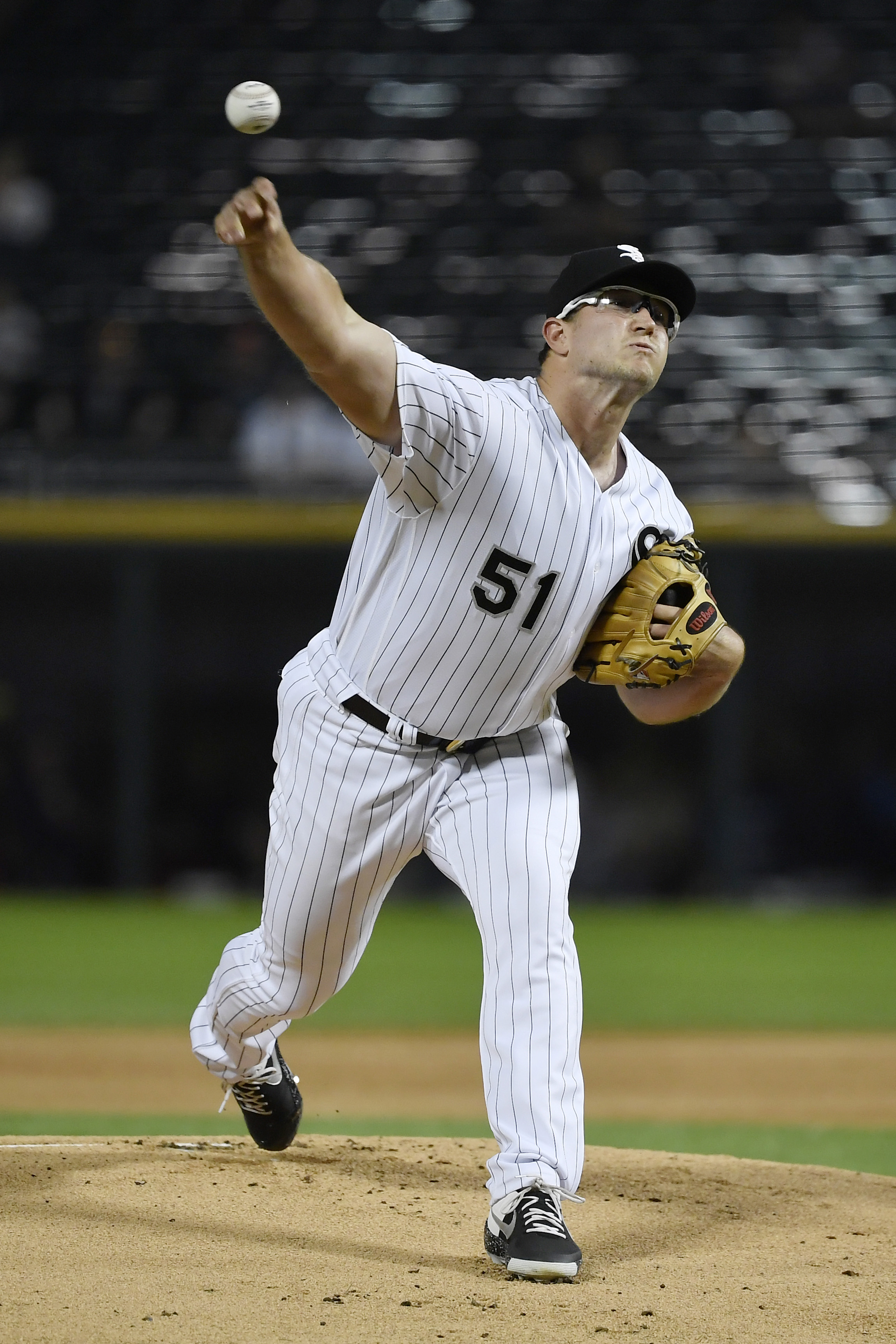
Obviously, things haven’t played out for the now 26-year-old Fulmer as hoped. Everything went according to plan following that ’15 draft. Fulmer pitched a scoreless frame in the Rookie-level Arizona League before being jumping up to the ChiSox’ Class-A Advanced affiliate. Despite being about two years younger than the average competition in that league, Fulmer allowed just five runs on 16 hits and nine walks with 25 strikeouts in 22 innings (2.05 ERA). That strong debut landed him on the top 100 lists at Baseball America (70) and MLB.com (38).
Fulmer’s numbers a year later weren’t as stout. He averaged better than a strikeout per inning but also more than five walks per nine frames while working to a 4.76 ERA out of the Double-A rotation. The Sox called him up to the big leagues that July despite the shaky numbers — just 13 months after he was drafted. Some will suggest that the organization rushed him to the Majors, but Fulmer was viewed as a potential quick mover from the time he was selected. He closed out the game in his big league debut, firing two shutout innings of relief in a loss to the Angels. The righty struggled in a handful of subsequent appearances and went back to Triple-A to finish out the season.
Since that time, Fulmer has been optioned back to the minors eight different times. He’s generally remained healthy but hasn’t succeeded either in Triple-A (5.39 ERA in 243 2/3 innings) or in the Majors (6.56 ERA in 94 2/3 innings). Now, Fulmer is out of minor league options, so the White Sox will have to carry him on the Major League roster or expose him to waivers whenever play resumes. In that regard, the likely expansion of rosters for at least part of the 2020 season will work nicely in Fulmer’s favor.
Fulmer’s velocity isn’t as high as it once was. A heater that reached 97mph “often” in college, per Baseball America, has averaged 93.2 mph in the Majors (93.7 mph in 2019). His command issues have been exploited by more advanced hitters, and his walk rate and frequency of wild pitches have spiked since reaching Triple-A.
Despite the lack of success at the game’s top levels, Fulmer isn’t without positive indicators. The spin rate on his four-seamer and curveball were both elite in 2019, ranking in the 91st percentile and 87th percentile among big league hurlers, respectively, per Statcast. He recorded healthy swinging-strike rates on his curve, cutter and changeup. In Triple-A, he racked up 51 strikeouts in just 34 innings — a 13.5 K/9 and 33.6 percent overall strikeout percentage that were both easily career-bests at any level.
Might a change in approach benefit him? A look at his career fastball usage at Brooks Baseball shows that he’s long worked down in the zone with the pitch and did so almost exclusively in 2019 — even at a time when much of the league is favoring four-seamers at the top of and above the strike zone. His avoidance of elevated fastballs would help to explain the paltry 4.2 percent swinging-strike rate on his four-seamer in 2019.
At this point, Fulmer has been leapfrogged by a host of new young arms in the Sox’ system — Lucas Giolito, Dylan Cease, Michael Kopech and Reynaldo Lopez among them. The White Sox’ initial hopes of Fulmer quickly ascending to the Majors to anchor a rotation alongside Chris Sale and Carlos Rodon have long since been dashed. There’s still room for him to carve out a long-term place in the team’s bullpen if he can piece it all together once games resume, but it’s far from certain that he’ll ever right the ship with the Sox. Chicago’s clear switch to a win-now mode should shorten whatever leash he’s been given in recent years. A change of scenery and a new outlook/approach could perhaps be best for Fulmer, but he’ll likely get one final shot to make things work with the South Siders.