
Latest On Furloughs, Pay Cuts Among MLB Clubs
6:09pm: The Rangers have committed to $400 a week for their minor leaguers through at least June, Levi Weaver of The Athletic was among those to report. The same goes for the Braves, per David O’Brien of The Athletic, as well as the Diamondbacks, Nick Piecoro of the Arizona Republic adds.
12:59pm: The Padres will also pay their minor leaguers the $400 weekly stipend through the end of August, Dennis Lin of The Athletic tweets.
12:34pm: Most of MLB’s 30 organizations agreed a ways back to pay their employees through the end of May. There were instances of lengthier commitments, but May 31 was broadly used as an initial endpoint, at which time fiscal matters would be reassessed. Minor league players have been receiving $400 weekly stipends during this time, but that arrangement is also only promised through the end of May. As you’d expect, clubs have begun to inform employees (both on the business and baseball operations side) and minor leaguers of their next steps. And, as you’d expect, in some instances it’s not pretty.
Yesterday was a particularly dark day in the Athletics organization, as ESPN’s Jeff Passan reports that the team informed minor league players they will no longer be paid their stipend as of June 1. Robert Murray of The Score shares the email that was sent to Oakland minor leaguers — one which was signed by GM David Forst rather than managing partner John J. Fisher. (Forst, of course, is being asked to play the messenger in this instance and is not the one making the decisions.)
Minor league players are generally undercompensated as a whole, and the $400 weekly stipend they’ve received over the past two months will now seemingly go down as the only baseball-related compensation they’ll receive in the calendar year. Their contracts, which are in a state of suspension but not terminated, bar them from “perform[ing] services for any other Club” and also render them ineligible for unemployment benefits, per The Athletic’s Emily Waldon (Twitter link).
As for the operations side of the equation, Athletics front office personnel will be either furloughed or see their pay reduced effective June 1 and running through the end of October, The Athletic’s Alex Coffey reports (Twitter thread). She adds that the maximum cut is 33 percent, and those determinations are based on seniority. Scouts aren’t considered front-office personnel, but they’ll be hit hard as well; USA Today’s Bob Nightengale tweets that A’s amateur and pro scouts alike will be furloughed from June 16 through Oct. 31. Fisher did write a letter to the club’s fanbase confirming the dramatic cuts (Twitter link via the San Francisco Chronicle’s Susan Slusser), emphasizing the pain that went into the decisions and his “deep commitment to the long-term future of the A’s.”
Those cutbacks are similar to the substantial cuts the Angels put in place earlier this month, but other L.A. club isn’t taking such rash measures. The Dodgers have informed all employees earning more than $75K that they’ll be subject to pay reductions beginning June 1, Ramona Shelburne of ESPN (Twitter thread). The extent of the reductions is dependent on overall salary — larger salaries get larger percentage cuts — and will be capped at 35 percent for the most part, although that they could be greater for the team’s very top executives. Those measures are being taken in an effort to avoid the type of large-scale furloughs being put in place in Oakland and Anaheim.
Across the country, the Nationals have implemented a series of partial furloughs both in baseball ops and business ops, Jesse Dougherty of the Washington Post reports (Twitter thread). The Nats are still covering full benefits and haven’t made any layoffs, but they’re implementing a sequence of 10 to 30 percent reductions in pay and total hours. The Brewers, meanwhile aren’t making any baseball ops furloughs but are furloughing some business operation employees, Todd Rosiak of the Milwaukee Journal-Sentinel tweets.
It’s not yet clear how every organization plans to handle the minor league pay dilemma, but Baseball America’s Kyle Glaser has heard from at least three clubs that plan to continue varying levels of compensation. The Phillies will keep paying their minor leaguers through at least June, but likely at less than the current $400 stipend. The White Sox are paying $400 per week through the end of June, and the Marlins have committed to paying their minor leaguers the full $400 per week through August — the would-be conclusion of the 2020 minor league season. The Marlins already informed players earlier this month that about 40 percent of the baseball ops department will be furloughed on June 1.
The Rangers’ New-Look Rotation Has Big-Time Upside
Historically, pitching has not been a strength of the Texas Rangers. The franchise has consistently found itself sorely lacking true aces; outside of Nolan Ryan, there aren’t really any iconic pitchers that come to mind when you think of the Rangers. Kenny Rogers, anyone?
That trend held true once again last year, with the Rangers posting an overall 5.09 ERA that ranked seventh-worst in baseball. That said, Lance Lynn and Mike Minor anchored the top of the rotation admirably, each garnering Cy Young consideration and holding the staff intact during the hot Texas summer.
But when the 2020 season boots up, Lynn and Minor will have some help, and starting pitching may indeed be a strength for this year’s iteration of the team. GM Jon Daniels and company made a concerted effort in the winter to acquire starting pitchers—and they did so at relatively little cost, meaning that a bit of short-term ambition likely won’t impeach on the franchise’s future plans.
Corey Kluber is the big-name addition, and the two-time Cy Young winner should do plenty to bolster the Rangers’ staff. Even so, the team didn’t mortgage the future to bring him aboard: Kluber is only guaranteed a contract for this year, with a vesting option that could keep him in Texas through 2021. Coming off a season in which he could pitch in just seven games, he was acquired in exchange for Delino DeShields and Emmanuel Clase, a move that was widely praised at the time and looks even worse for Cleveland in light of Clase’s PED suspension.
But the smaller-scale signings of Kyle Gibson and Jordan Lyles, while not deserving of the same attention as the acquisition of a decade-defining pitcher like Kluber, could together have just as great an impact on the Rangers’ success as Kluber. In the offseason, Lyles signed on with a two-year, $16MM deal, while Gibson earned himself a three-year contract worth $28MM. Together, they’ll make $19MM in 2020, just a hair more than Kluber’s salary.
Lyles has been around forever, it seems, breaking in as a young arm with the Astros and Rockies, but it took until his age-28 season for him to put it all together as a starter. After a slow start with the Pirates earned him a trade to Milwaukee, he put up career-best numbers, striking out 146 batters in 141 innings, an unprecedented rate for Lyles.
How come? The simple version is that Lyles began relying less and less on his sinker, a staple in his repertoire throughout the early stages of his career. His sinker usage dropped to a minuscule 1.7% last year while he threw four-seam fastballs 50.2% of the time, more than he ever had before. The curveball also became a more important weapon in his pitch mix.
That isn’t too unlike the formula that Lance Lynn rode to his career-best 2019 season. Just like Lyles, Lynn’s sinker usage hit a career low last year, replaced almost entirely by four-seam fastballs—largely in the upper part of the strike zone. This isn’t unique to the Rangers—the Astros’ unparalleled pitching brilliance hinges on this philosophy—and it’s a trend that has redefined the way we look at pitching in MLB.
It’s an approach that worked for the Rangers last year, Lynn’s first in Texas, and perhaps Daniels is confident that his staff can use it to produce similar results with Lyles and Gibson this year. Sure enough, the sinker has been Gibson’s most-used pitch through his first five years as a big-leaguer. Sound familiar? Granted, Gibson’s four-seamer hasn’t been a great pitch for him, but throwing fewer sinkers could in turn lead to a jump in his slider usage, a high-spin pitch that may be a hidden gem.
Still, pitching at the MLB level is not as simple as flipping a switch and saying, “sinker bad, four-seam good.” That approach can’t be uniformly applied to every pitcher in baseball with the same results; there’s a reason careers have been forged around the sinker. And yet, the proliferation of the high fastball in MLB lends credence to its value, and the Rangers may have pursued the likes of Gibson and Lyles with that style in mind.
But that’s only half the battle; the burden then falls on the coaching staff and players themselves to accept and implement adjustments. It’s why we still play the games when there’s such a wealth of knowledge out there. So we’ll anxiously await the 2020 season to see whether the on-field results look as good as the ideas that underpin them.
Andrus & Odor Occupy Top Spots On Rangers’ Future Payroll
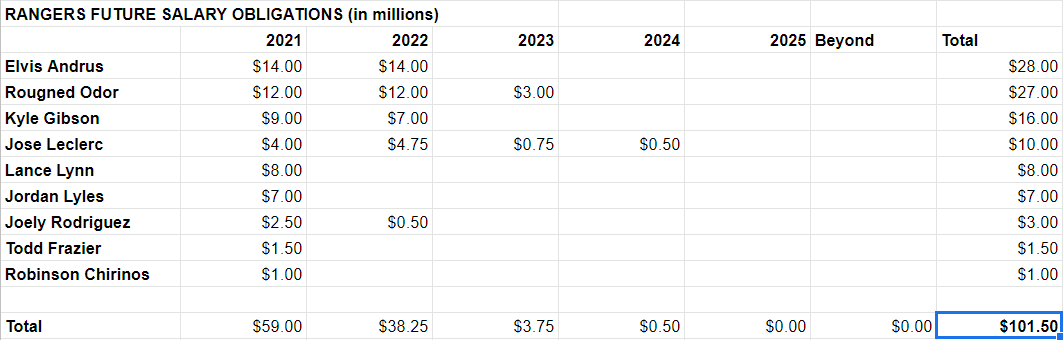
2020 salary terms are set to be hammered out in the coming days. But what about what’s owed to players beyond that point? The near-term economic picture remains questionable at best. That’ll make teams all the more cautious with guaranteed future salaries.
Every organization has some amount of future cash committed to players, all of it done before the coronavirus pandemic swept the globe. There are several different ways to look at salaries; for instance, for purposes of calculating the luxury tax, the average annual value is the touchstone, with up-front bonuses spread over the life of the deal. For this exercise, we’ll focus on actual cash outlays that still have yet to be paid.
We’ll run through every team, with a big assist from the Cot’s Baseball Contracts database. Next up is the Rangers:
(click to expand/view detail list)
Rangers Total Future Cash Obligation: $101.5MM
*includes buyouts on club options
*2023 club option ($15MM) over Elvis Andrus vests with 550 plate appearances in 2022 and/or 1,110 plate appearances in 2021-22
Which 15 Players Should The Rangers Protect In An Expansion Draft?
In a few weeks, we’ll be running a two-team mock expansion draft here at MLBTR. Currently, we’re creating 15-player protected lists for each of the existing 30 teams. You can catch up on the rules for player eligibility here.
So far, we’ve covered the Mariners, Athletics, Angels, Astros, Twins, Royals, Tigers, Indians, White Sox, Rays, Yankees, Red Sox, Blue Jays and Orioles. The Rangers are up next.
We’ll start by removing free agents Jeff Mathis, Shin-Soo Choo, Jesse Chavez, and Mike Minor from consideration. We’ll also remove Todd Frazier and Robinson Chirinos, who have club options for 2021 but probably aren’t worth protected spots.
Corey Kluber has an $18MM club option for 2021, and the Rangers’ decision on that will be dependent on how he performs in a possible 2020 season. I’ve decided to make the guess that the Rangers would use a protected spot on Kluber. We’ll also lock down Elvis Andrus due to his no-trade protection. I’ve decided to lock down starting pitchers Kyle Gibson and Jordan Lyles as well, who signed with the Rangers as free agents last December. That’s debatable, but some judgment calls are made in this process. Here’s the entire initial protected group of nine players:
Corey Kluber
Elvis Andrus
Lance Lynn
Danny Santana
Joey Gallo
Willie Calhoun
Nick Solak
Kyle Gibson
Jordan Lyles
That leaves six spots for the following 18 players:
Kolby Allard
Brock Burke
Luke Farrell
Nick Goody
Ronald Guzman
Taylor Hearn
Scott Heineman
Jonathan Hernandez
Ariel Jurado
Isiah Kiner-Falefa
Jose Leclerc
Brett Martin
Yohander Mendez
Rafael Montero
Joely Rodriguez
Rougned Odor
Joe Palumbo
Jose Trevino
With that, we turn it over to the MLBTR readership! In the poll below (direct link here), select exactly six players you think the Rangers should protect in our upcoming mock expansion draft. Click here to view the results.
A Front-Line Starter Who Got Away From The Rangers
Going back to his first season in the majors in 2014, just 11 other starters have outdone Cubs right-hander Kyle Hendricks‘ 3.14 ERA. That owes largely to an ability to limit walks, as Hendricks has issued just a bit over two free passes per nine innings during his career, as well a penchant for preventing damaging contact. Even though his typical fastball only clocks in around 86 mph, hitters can’t seem to square up Hendricks. Just last season, he ranked in the majors’ 97th percentile in exit velocity and its 88th percentile in hard-hit rate. It went down as yet another quality effort by Hendricks, who turned in a 3.46 ERA/3.61 FIP with his second-highest fWAR (4.1) across 177 innings.
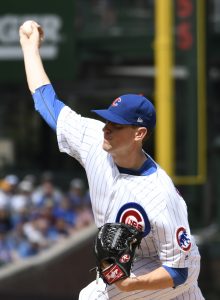
Not many could have expected Hendricks to pan out this well. The Rangers chose the former Dartmouth standout in the eighth round in 2011 (keep that in mind when unpicked players start signing after this year’s truncated five-round draft); although he went on to put up great production at the lower levels with the Rangers, he was never seen as a can’t-miss prospect. And at the July 2012 trade deadline, a little over a year after the Rangers drafted Hendricks, they traded him and third baseman Christian Villanueva (then a top 100-caliber prospect but now a member of Japan’s Nippon Professional Baseball) to the Cubs for veteran righty Ryan Dempster.
Dempster, who originally entered the pros as a third-rounder of the Rangers in 1995, got off to a strong start in 2012 before the Cubs traded him back to his original franchise. As MLBTR’s Tim Dierkes wrote when the swap occurred: “Dempster posted a 2.25 ERA with 7.2 K/9, 2.3 BB/9 and a 42.1% ground ball rate in 104 innings with the Cubs this year.”
Unfortunately for Texas, Dempster was unable to carry his Windy City effectiveness to the Lone Star State. While the Rangers did earn a playoff berth in 2012, they didn’t make it past the one-game wild-card round, and Dempster didn’t play much of a role in their regular-season success. He wound up tossing 69 innings of 5.09 ERA ball with the team before leaving for the Red Sox in free agency during the ensuing offseason. That proved to be a wise move for the last year of his career, as Dempster ended up as part of a World Series-winning Red Sox roster.
Dempster didn’t play a major role in Boston’s title, but Hendricks has gone on to be a key part of a championship winner since switching organizations. The Cubs took home their first World Series in 108 years in 2016, a season in which Hendricks recorded a league-best 2.13 ERA in 190 frames and added an jaw-dropping 1.42 ERA in 25 1/3 playoff innings. Three years later, the Cubs locked up Hendricks to what has always looked like an eminently reasonable contract extension, inking him to a $55.5MM guarantee over four seasons prior to the 2019 campaign.
We don’t know when we’ll see Major League Baseball again, but considering Hendricks’ track record, it seems safe to assume the 30-year-old will continue to hold his own when it does return. He’s one of the most valuable players on the Cubs, but he’s also one who got away for the Rangers.
Photo courtesy of USA Today Sports Images.
AL West Notes: Mariners, Rangers, Astros
Some news and notes from around the American League West…
- While Spring Training impressions were limited due to the mid-March shutdown, the Mariners were still encouraged by the progress demonstrated by some expected key players, manager Scott Servais said this week on MLB Network Radio on SiriusXM (Twitter link, with audio). In particular, lefty Justus Sheffield and righties Justin Dunn and Logan Gilbert looked to have taken notable strides. Sheffield, the centerpiece of the Mariners’ James Paxton return, allowed two runs on five hits and no walks with 12 punchouts in eight spring innings. Dunn, acquired alongside Jarred Kelenic in the Robinson Cano/Edwin Diaz blockbuster, whiffed 10 hitters in six innings while holding opponents to two runs in 6 2/3 frames. Gilbert, Seattle’s first-rounder in 2018, pitched four shutout innings with four strikeouts, no walks and one hit. The M’s are hopeful that this trio can soon ascend to the big league rotation alongside Marco Gonzales as the organization emerges from an accelerated rebuilding process. There’s clearly more to the belief that strides were made than those surface-level stats, but the trio’s showing nevertheless was heartening for Mariners fans.
- Rangers slugger Joey Gallo spoke with reporters about the dimensions of the newly constructed Globe Life Field, noting that the team’s new home park was “playing big as hell” during his batting practice session (link via Evan Grant of the Dallas Morning News). Gallo pointed out that the park is particularly deep in center field, where it’s 407 feet straightaway. That said, as Grant points out, the distance may not make a huge difference for Gallo, whose home runs to center field have averaged 434 feet in distance. GM Jon Daniels added that Gallo has been hitting with the roof closed, and opening it while hitting game balls against live pitching could change things. Still, it’d be a notable change for the Rangers to suddenly find themselves in a pitcher-friendly or even neutral park after long playing in one of the game’s most hitter-friendly stadiums. Gallo did offer positive reviews of the park’s artificial surface, calling it the “best turf I’ve ever been on” and touting its lack of “lingering side effects.” Gallo acknowledges that Rangers players were worried about the surface heading into the season, but his early experiences have allayed some of those concerns.
- The Astros are facing a potential exodus in the outfield this coming offseason, and Jake Kaplan of The Athletic notes in his latest mailbag column that they’re looking at a similar slate of departures post-2021, when Justin Verlander, Zack Greinke, Carlos Correa and Lance McCullers Jr. could all hit the open market. Houston will see George Springer, Michael Brantley, Yuli Gurriel and Josh Reddick hit the market after whatever type of 2020 season we get. Given their poorly regarded farm system — not to mention the loss of draft picks in 2020-21 — the ‘Stros are faced with an increasingly precarious position. It’s of course possible that the Astros could yet work out some extensions with various members of that core, but it’s also eminently apparent that a fair bit of roster turnover can be expected in the next couple of years — with several high-profile names likely to depart.
Quick Hits: Bloom, Draft, Krause, White Sox, Rangers
Red Sox chief baseball officer Chaim Bloom described some of the challenges that will come out of the unique circumstances surrounding this year’s MLB Draft in a discussion with the Jason Mastrodonato of the Boston Herald. Bloom’s organization is particularly aware of the value of an additional year of scouting, which allowed the team to select Andrew Benintendi in the first round in 2015—something that probably wouldn’t happen if teams’ exposure was limited to his nondescript freshman season the year before. But that’s precisely the scenario teams find themselves in now: they won’t have the same feel for which draft-eligible players would have taken an additional leap this season and might have to base those judgments on just a few weeks of play. In addition, the shortened format of the draft (no more than 10 rounds) could influence teams’ strategy, especially in the later rounds, where clubs might look to take risks on players who will command more than $20K (the maximum amount for which teams can sign undrafted players). All this means that more high school players might opt to forego pro ball in favor of a collegiate scholarship.
- Former Chicago Bulls front office executive Jerry Krause has received plenty of scrutiny recently, thanks to ESPN’s Michael Jordan docuseries, “The Last Dance.” But Krause’s tenure as the Bulls’ GM was bookended by a career as a baseball scout, where he worked most prominently with the White Sox. The Chicago Tribune’s Mark Gonzales reflects on Krause’s astute eye and resolution as a scout; he was instrumental in swaying White Sox higher-ups to make a play for shortstop Ozzie Guillen (then a Padres minor-leaguer), who would of course go on to play 13 years and rack up 19.5 WAR with the South Siders—not to mention his role in managing the 2005 World Series team.
- Beginning May 15, the Rangers will institute pay cuts for some of their full-time employees, according to Evan Grant of the Dallas Morning News. Per Grant, employees above a certain salary threshold will have their pay reduced by roughly 10-20%, which will affect approximately half of the team’s full-time staffers. That said, there won’t be any layoffs or furloughs at this time. A number of high-rankings Rangers execs, including GM Jon Daniels, had already begun taking pay cuts in April, but this round will expand the scope of those measures. They’re one of just a few teams that won’t be paying teams in full through May, with a handful of teams implementing similar pay cuts, while the Rays have furloughed some of their employees.
AL West Notes: Calhoun, Rangers, Athletics, Astros
Rangers outfielder Willie Calhoun suffered a horrible injury – a fractured jaw – when he took a 95 mph pitch to the face in early March. Fortunately, though, Calhoun’s doing well in his recovery. Calhoun told MLB Network Radio (via Brice Paterik of the Dallas Morning News} that he’s “back up to 100 percent.” He’s in line to play a key role for the Rangers this year after turning in a productive 2019 campaign, and could be a breakout candidate, but it took some time for the light bulb to go on for the former high-end prospect. The 25-year-old Calhoun believes he owes some of his recent success to Rangers general manager Jon Daniels. “JD really flat out just told me the stuff I needed to work on and he was saying at the time I don’t think I was doing as well offensively,” Calhoun said. “He said ‘if you’re going to be an offense only guy you’ve got to put up offense only numbers, like J.D. Martinez type numbers.” Calhoun got into better shape after that talk with Daniels, and the results have been encouraging since then. Check out Paterik’s piece for more quotes from Calhoun.
- Former Athletics minor leaguer Miguel Marte has passed away of COVID-19 at the age of 30, per Susan Slusser of the San Francisco Chronicle. Marte, a catcher/first baseman from the Dominican Republic, played in the A’s system from 2008-12. He left behind a wife and two children. If you’re interested in helping them, a GoFundMe page has been set up.
- The Astros have also lost somebody to the coronavirus. Bill Gladstone, who owned Single-A affiliate the Tri-City ValleyCats passed away of the illness Thursday, according to Chandler Rome of the Houston Chronicle. “Bill was a class act with a great passion for the game,” the Astros said in a statement. “Our entire Astros family sends our heartfelt condolences to his son, Doug, his daughter, Susan and to the entire Gladstone family.”
- As a result of the pandemic, roughly half of the Rangers’ full-time employees in baseball and business operations will face a reduction in pay after May 15, Evan Grant of the Dallas Morning News tweets. Those cuts in salary could range from 10 to 20 percent, and there’s no indication as to how long they’ll last, but the Rangers aren’t planning to lay off any of those employees at this point.
10 MLB Teams Whose Business Initiatives Face Coronavirus Hurdles
Like most every person or business, all thirty MLB teams face tough questions during the time of COVID-19. Some are relatively similar for all ballclubs, but there are obviously quite a few unique issues — some more pressing than others.
Dealing with the implications of this pandemic is probably toughest for organizations that are in the midst of executing or planning major business initiatives. We’ll run down some of those here.
Angels: The team has been cooking up potentially massive plans to develop the area around Angel Stadium. Fortunately, nothing is really in process at the moment, but it stands to reason that the project could end up being reduced in scope and/or delayed.
Athletics: Oof. The A’s have done a ton of work to put a highly ambitious stadium plan in motion. Massive uncertainty of this type can’t help. It isn’t clear just yet how the effort will be impacted, but it seems reasonable to believe the organization is pondering some tough decisions.
Braves: Luckily for the Atlanta-area organization, the team’s new park and most of the surrounding development is already fully operational. But with the added earning capacity from retail operations in a ballpark village comes greater exposure to turmoil.
Cubs: Like the Braves, the Cubs have already done most of the work at and around their park, but were counting on big revenue to pay back what’s owed (and then some). Plus, the Cubbies have a new TV network to bring up to speed.
Diamondbacks: Vegas?! Vancouver?! Probably not, but the Snakes do want to find a new home somewhere in Arizona. That effort is sure to be dented. Plus, the team’s recent initiative to host non-baseball events at Chase Field will now go on hiatus.
Marlins: The new ownership group has had some good vibes going and hoped to convert some of the positivity into a healthy new TV deal. That critical negotiation will now take place in a brutal economic environment.
Mets: So … this is probably not an optimal moment to be selling your sports franchise. The Wilpon family is pressing ahead with an effort to strike a new deal after their prior one broke down (at the worst possible time).
Orioles: That bitter television rights fee dispute that just won’t stop … it’s not going to be easier to find a resolution with less cash coming through the door. It was already setting up to be a rough stretch for the Baltimore org, with past TV money due to the Nationals and more bills to come, even while going through brutally lean years on the playing field.
Rangers: The new park is now built. While taxpayers footed much of the bill, the club still has to pay back a $600MM loan. Suffice to say the Rangers (and municipal authorities) anticipated game day revenues of more than $0 in year one when they planned out the loan repayment method.
Rays: The club’s preferred Ybor City option flamed out and it is currently engaged in a somewhat confusing effort to split time between the Tampa Bay area and Montreal. Existing hurdles to that arrangement seem only to be taller in the age of the coronavirus.
Others: We may be missing some, but it seems most other organizations are engaged more in usual-course sorts of business initiatives rather than franchise-altering efforts. For instance, the Nats have an interest in that TV deal as well. The Red Sox have been working to redevelop areas around Fenway Park. The Blue Jays are dabbling in future plans. And the Dodgers have a new TV rights deal, though that came to fruition after the pandemic hit and may not be impacted any more than any other existing carriage arrangements.
Quick Hits: Puig, Giants, Daniels, Starling
Let’s check in on three of the majors’ franchises…
- A report over the weekend all but placed free-agent outfielder Yasiel Puig in a Giants uniform. Henry Schulman of the San Francisco doesn’t seem nearly as confident a deal will come together, though, and Giants president of baseball operations Farhan Zaidi told Andrew Baggarly of The Athletic via text, “We are not having any conversations (internal or external) about player transactions at this point.” However, as Baggarly notes, that doesn’t mean a Puig signing isn’t under consideration. There’s a freeze on transactions because of the coronavirus, so even if the Giants do intend to pick up Puig, they’ll have to continue to wait to make the move. For what it’s worth, it wasn’t long ago that the Giants reportedly showed interest in Puig, who has a couple important connections in San Francisco. Zaidi and manager Gabe Kapler were both members of the Dodgers organization during at least part of Puig’s run with the Giants’ archrivals from 2013-18.
- Optimism about a 2020 season getting underway seems to be growing. One idea that came to the forefront last week includes a three-state plan in which Arizona, Florida and Texas would divvy up the games. Rangers president of baseball operations Jon Daniels spoke about that with Evan Grant of the Dallas Morning News, saying: “For a variety of factors, it makes a lot of sense. We’ve had some involvement from a due diligence standpoint, but I would not want to overstate that piece of it. I think [Dodgers president] Stan Kasten said about one percent of all ideas have become public; there have been a lot of ideas. That’s just one.” If a season does occur, the Rangers – after a fairly aggressive winter – will look to bounce back from three straight sub-.500 campaigns. Their roster doesn’t seem likely to undergo any more significant changes before a potential season happens. Asked how much time the Rangers have recently spent talking to other teams about upgrading their club, Daniels told Grant, “Very little; close to none.”
- Lynn Worthy of the Kansas City Star details how Royals outfielder Bubba Starling is dealing with the COVID-19 pandemic. As you’d expect, Starling is hoping to return to the field as soon as possible. The out-of-options 27-year-old had been competing to earn a roster spot before spring training shut down. Starling’s a former No. 5 overall draft pick in 2011 who had a run as an outstanding MLB prospect, but his career hasn’t gone according to plan thus far. He debuted in the majors last year and batted just .215/.255/.317 over 197 plate appearances. Starling also hasn’t been very productive in Triple-A ball, where he has hit .255/.305/.376 in 805 attempts, but he could still make a rebuilding KC team that’s in position to give chances to unproven players.