
NL Notes: Nationals, Dodgers, Mets
There’s a belief across baseball that the Nationals’ affinity for deferring money in contracts has somewhat hindered their pursuit of talent in free agency and could negatively affect them down the line as they attempt to avoid the luxury tax, according to Barry Svrluga of the Washington Post. “They’re unique. They’re the only team that operates like this,” an agent told Svrluga, who adds that team ownership won’t comment on its methods. The Nats are set to pay their newest addition, reliever Joe Blanton, $4MM on a one-year deal, but he’ll collect that money through 2019. Among far more expensive examples, starters Max Scherzer (signed through 2021) and Stephen Strasburg (2023) will be on the franchise’s books and through 2028 and 2030, respectively.
More from Washington and two other NL cities:
- Dodgers right-hander Brandon McCarthy has long been a control artist, which makes it rather startling that he walked 26 batters in an injury-shortened, 40-inning 2016. McCarthy returned from 2015 Tommy John surgery and also dealt with a hip issue, but it was a case of the yips that led to his spike in walks – including 15 over 8 1/3 innings (three starts) from Aug. 2-13 – as Bill Shaikin of the Los Angeles Times writes. “I think most of it was mechanical,” McCarthy said. “Usually, if you get the shanks in golf, something has gone wrong physically in your swing, and you lose your mental feel for what you are trying to do. It becomes sort of a self-fulfilling thing. I think that was really the extent of it.” McCarthy made a late-season mechanical adjustment and is optimistic the issue is behind him. The 33-year-old is now entering the penultimate season of a four-year, $48MM contract, but he’d have no qualms about retiring and leaving money on the table if he were to lose his desire to pitch. “The day where the motivation is not there to come in and do it, I have no problems ‘Gil Meche-ing it’ and just walking home and leaving it,” said McCarthy, referring to then-Royal Gil Meche’s decision to retire in 2011 and abandon a guaranteed $12MM. (For more on players who have battled the yips, check out FanGraphs’ Travis Sawchik’s piece from earlier this week.)
- The Mets are doubling down on last year’s roster, writes the New York Post’s Joel Sherman, who notes that they’re likely to open the season with 25 players who were on their team in 2016. “It doesn’t feel it’s stale, it feels as if we have consolidated our gains,” general manager Sandy Alderson said of the club’s roster, which managed 87 wins and a playoff berth last season despite myriad injuries. Of the 55 players the Mets invited to camp, just three weren’t in the organization a year ago, and the only newcomer who has much of a chance to make the team is left-hander Tom Gorzelanny, per Sherman.
- The Nationals are doing their due diligence on Eric Gagne as the former star closer looks to emerge from his yearslong retirement and return to the majors. Nats special assistant De Jon Watson was on hand at Dodgers camp Saturday to watch Gagne throw, relays Shaikin, who tweets that the right-hander topped out at 91 mph. Now 41, Gagne averaged just over 92 mph on his fastball in 2008, his latest major league action.
NL Notes: Strasburg, Albies, Peterson, Dahl
Stephen Strasburg threw well in his spring debut for the Nationals yesterday, representing a promising step for the key righty, as Mark Zuckerman of MASNsports.com reports. Notably, Strasburg also showed some tweaks to his approach that he evidently intends to carry into the 2017 season. Most interestingly, the veteran hurler worked exclusively from the stretch, explaining that he has toyed with that idea after finding it increasingly difficult to maintain his mechanics from a full windup. Likewise, he’s planning to pare back the usage of his slider, an offering that he relied on far more in 2016 than ever before. The hope is that by utilizing that pitch less, and backing off on his work between starts, Strasburg can better maintain his health throughout a full season.
Here’s more from the National League:
- Braves prospect Ozzie Albies is set to be examined on Monday, with hopes he’ll be cleared for full baseball activities, as David O’Brien of the Atlanta Journal-Constitution reports. Albies, who is working back from an olecranon fracture in his right elbow, may be ready for game action as soon as the middle of next week. That still doesn’t leave much time or opportunity for him to earn an Opening Day job, though that possibility likely evaporated when the injury took place. The 20-year-old will likely end up spending a bit more time refining his game in the upper minors, though it seems reasonable to anticipate he’ll get the call up to the majors at some point in the season to come.
- Meanwhile, fellow Braves prospect Dustin Peterson will be delayed to start the season after undergoing hamate surgery, per a club announcement. Removal of the hook of the hamate bone is a fairly common procedure, and doesn’t appear to pose a significant problem in the long run, but it tends to sap power for some time upon a player’s return. The 22-year-old outfielder is seen as an increasingly important part of Atlanta’s future. Last year, he slashed .282/.343/.431 and hit a dozen home runs in 578 plate appearances at Double-A, representing a big step forward from his prior output. Peterson came to the Braves from the Padres as part of the pre-2015 Justin Upton trade.
- The Rockies are exercising caution with prized young outfielder David Dahl, with manager Bud Black suggesting that his upper back injury is a bit more concerning than had initially been hoped, as Patrick Saunders of the Denver Post reports. Dahl will likely be out for a “few weeks” as the organization takes a closer look at the issue and treats it, which seemingly makes him unlikely to join the active roster at the start of the season. Just what that means for the organization remains unclear, but it likely clears the way for Gerardo Parra to handle regular duties in left field to begin the year. While a big showing from top prospect Raimel Tapia could present him with a chance to return to the majors, perhaps the injury opens the door most clearly for the right-handed-hitting Stephen Cardullo to head north with the club.
Pre-Arb Contracts Of Note: Correa, Syndergaard, Turner
Every team takes a different approach to the negotiation of contracts with players who have yet to qualify for arbitration. Technically, there’s no obligation to pay them any more than the league minimum salary, which currently sits at $535K. But all teams make some allowance for increases above that amount. Some use formulas with varying inputs; others appear largely ad hoc. Some range well over the minimum; others allow for only de minimis bumps. Read here for more on the process; better still, check out Zach Links’s reporting on the subject from early 2014.
We already learned recently of one notable 2017 pre-arb contract situation, as the Red Sox elected to renew Mookie Betts. A renewal occurs when the club can’t get the player to agree to the salary. The result is the same — the player gets what the team is willing to give — but the player gets to make clear his disapproval. In that case, Betts still received a relatively massive payday, with his $950K salary trailing only Mike Trout (in 2014) among pre-arb players.
Here are a few more notable salaries that have been reported since:
- The Astros ended up renewing their own pre-arb star, Carlos Correa, per Jon Heyman of Fan Rag. But he’ll get quite a bit less than Betts; in fact, for the second straight year, Correa will earn only the league-minimum rate of pay. (To be fair, he’s also one service class behind Betts.) As MLBTR previously reported, Houston has in prior years utilized a formula-based system that allows players to earn relatively meager boosts over the minimum, though it’s not known whether that specific approach is still followed. Clearly, though, Correa — one of the game’s most exciting young talents — would have been offered at least something more than the minimum. Presumably, then, he was docked back down owing to his refusal to sign, which is another element the Astros have reportedly employed. It obviously remains to be seen whether there’ll be any long-term strain on the relationship between player and team, but it’s not hard to see the possibility.
- There’s perhaps less cause for angst between the Mets and young ace Noah Syndergaard, who’ll earn $605,500 in 2016 with his renewal, as Heyman tweets. That’s certainly a reasonably significant increase over the minimum, and it falls in line with the team’s prior approach to setting arb salaries, as Joel Sherman of the New York Post reports. Syndergaard was hoping to earn a bit more, and declined to sign on to the team’s offer, but New York did not apply any penalty in setting the renewal price. It seems that the relationship between player and team remains harmonious, per Sherman. Syndergaard, unlike Correa, can also look forward to much higher earnings in the near future, as he’s nearly certain to achieve Super Two status.
- Finally, the Nationals have agreed to a $554,900 salary with emergent star Trea Turner, according to Heyman (via Twitter). That’s rather a healthy rate of pay for a player who’ll enter the year with just 135 days of service, though Turner’s outstanding half-season of work in 2016 — .342/.370/.567 with 13 home runs and 33 steals over 324 plate appearances — more than justifies such an increase. With Turner’s deal in the books, the Nats were able to line up with all 22 of their arb-eligible players. Looking ahead for the youngster, who’ll be moving back to his accustomed shortstop position this year, the biggest impact on his earnings (beyond his play) won’t be the team’s decision on how much to pay him before he reaches arbitration. Instead, it’ll be whether he can qualify for Super Two status. Without a 2015 cameo in the books, he wouldn’t have much of a shot; as things stand, he’ll be touch-and-go to reach arb eligibility a year ahead of the pack.
East Notes: Price, Norris, Gsellman, Wheeler
As the Red Sox await news on the fate of left-hander David Price, ESPN’s Buster Olney runs down the list of options for Boston in the event that Price is forced to sit out part of or all of the 2017 season (ESPN Insider subscription required and recommended). The Sox do still have five big league starters in the form of Chris Sale, Rick Porcello, Eduardo Rodriguez, Drew Pomeranz and Steven Wright, though each has come with recent injury troubles. Beyond that, the team is lacking in quality depth options, though Henry Owens, Brian Johnson, Roenis Elias and others are present in Pawtucket. Free agents such as Doug Fister, Colby Lewis and Jake Peavy are still on the market, and Jose Quintana, of course, looms on the trade market. Olney notes that the Red Sox would likely have to utilize top prospect Rafael Devers as the headliner in a theoretical Quintana deal, however.
Beyond that, the Sox could wait to see which of the Dodgers’ plethora of rotation options fails to secure a spot. Similar rotation crunches will arise organically around the league, so Boston could take a more patient approach and see which opportunities materialize as Opening Day draws nearer.
A few more notes pertaining to the game’s Eastern divisions…
- Michael Silverman of the Boston Herald writes that the Red Sox‘ lack of depth has been obvious all winter and opines that the team took an unnecessary gamble by relying so internal options and not signing more depth. President of baseball operations Dave Dombrowski suggested to him, however, that Boston’s glut of quality big league arms made it difficult to lure depth options to sign with the Red Sox this winter. Boston couldn’t guarantee any free-agent starter a spot in its rotation and couldn’t even offer much hope of being the first line of defense against an injury. Silverman notes that trading Clay Buchholz in a salary dump could come back to haunt the Sox, but Dombrowski said that even in light of a potential Price injury, he doesn’t regret moving Buchholz when he did. “You’re not going to just hold on to somebody in case things take place later on,” he told Silverman, also adding that it’s difficult to move that much salary this time of year.
- The Nationals are trying to move Derek Norris but finding it difficult to drum up interest in the catcher at his current $4.2MM salary, writes Jorge Castillo of the Washington Post. Castillo reports that the Angels, White Sox and Brewers are all wary of paying that type of money to a catcher that slashed just .186/.255/.328 last season. As FanRag’s Jon Heyman suggested yesterday, the Nats could ultimately just release Norris, as they’d only be on the hook for one-sixth of his salary (about $688K) due to the fact that arbitration salaries aren’t fully guaranteed prior to Opening Day. As for Norris himself, he acknowledged to Castillo that his D.C. days might be numbered but said he’s simply preparing to play the 2017 season somewhere. “It doesn’t change much for me other than the fact that it may or may not be the teammates I’ll be playing with,” said Norris. “So on my end it’s control what I can control. Go out there and play my games and get ready for a season.”
- Current indications are that right-hander Robert Gsellman is the leading candidate to occupy the fifth slot in the Mets‘ rotation out of Spring Training, tweets the Record’s Matt Ehalt. A source also suggested to Ehalt that righty Zack Wheeler could very well open the year on the disabled list and head to extended Spring Training to continue to build up strength after missing the past two seasons while recovering from 2015 Tommy John surgery. If Gsellman is indeed in the rotation and Wheeler in XST, that’d leave either a long relief/spot starting role or a spot in the Triple-A rotation for Seth Lugo. One can imagine that the spring performances from here on out could still dictate which of Gsellman or Lugo ultimately claims that rotation gig, though. Both were impressive in the debut campaigns last year.
NL East Notes: Mets, Reyes, Nola, Strasburg, Braves
The Mets face the potential departure of a big portion of their MLB position players after the season, as Joel Sherman of the New York Post writes. But the organization still hopes to fill many holes without going outside the organization. “I don’t think we will have to sign five free agents,” says assistant GM John Ricco. “Some of the answers will come from within, and I think between now and July we will get a better idea of what we have and what we need.” It’s certainly possible to imagine veteran Jose Reyes playing any number of roles this year and beyond; per Ricco, the team is confident that it would be able to work out a new deal to keep him if there’s a sensible role available.
Here’s more from the NL East:
- Phillies righty Aaron Nola showed well in his spring debut, representing a notable step in his recovery from an elbow injury, as Jim Salisbury of CSNPhilly.com reports. Nola, 23, showed good velocity and looked sharp, though perhaps that was to be expected. The big question for Nola and the Phils is whether his arm can stay healthy for the full season to come.
- Speaking of the Nola clan, older brother Austin Nola is attempting to convert into a catcher with the Marlins, as Clark Spencer of the Miami Herald reports. Nola, 27, has never really hit much in the minors and struggled to a .261/.308/.376 batting line last year over 407 Triple-A plate appearances. Nevertheless, he was given a 40-man roster spot as he makes the transition to a new position.
- Star Nationals hurler Stephen Strasburg will make his own spring debut tomorrow, as Mark Zuckerman of MASNsports.com reports on Twitter. He says he’s feeling healthy after missing the end of the 2016 season with a forearm strain. As ever, Strasburg’s health will be a key factor for the Nats in 2017.
- It seems the Braves are leaning toward carrying eight relievers to open the year, as Mark Bowman of MLB.com reports. Roster considerations could be at least a partial consideration, as Atlanta has several out-of-options relievers to consider. Going with a four-man bench would likely leave Kurt Suzuki, Jace Peterson, and Chase d’Arnaud on the roster with Emilio Bonifacio battling with Micah Johnson for the final spot, Bowman writes.
Heyman’s Latest: Nationals, Alvarez, Cubs, CarGo, Yankees, Colome
The latest notes column from Jon Heyman of FanRag Sports kicks off with an extremely early look at the potential market for Bryce Harper in two years, with Heyman listing the Yankees, Nationals and Phillies as teams that many within the industry think will vie for the 2015 NL MVP in free agency. The in-depth look at Harper focuses on the 24-year-old’s improved clubhouse demeanor and maturity in recent years and also adds more fuel to the rumors that Harper played part of the 2016 season through a shoulder injury that he’s reluctant to discuss. Heyman also touches base on Derek Norris later in the column, noting that there may be a better chance that Norris is simply released than traded. Washington agreed to a $4.25MM salary with Norris to avoid arbitration, but because arb contracts aren’t fully guaranteed, they could cut Norris before March 15 and only pay him 30 days termination pay — about $688K, by my math.
Some highlights from a lengthy look at all 30 teams around the league…
- Pedro Alvarez still has fans in the Orioles‘ front office, per Heyman, but there’s been “no evidence” of renewed contact between the two sides. The Twins talked to Alvarez’s camp at one point but haven’t been in touch recently, and while Rangers manager Jeff Banister is fond of Alvarez dating back to the pair’s days in Pittsburgh, there’s nothing to suggest the two sides could strike a deal.
- The Cubs met with Scott Boras recently and discussed Jake Arrieta, but there was “no traction” in talks between the two sides. Heyman paints a similar picture to the one that has surrounded extension rumors with Arrieta for the past several months; the Cubs would be amenable to a three- or four-year deal, but Arrieta and Boras are targeting something more along the lines of Max Scherzer‘s seven-year, $210MM contract. Heyman also notes that the Cubs made a play for right-hander Brad Ziegler this winter before he inked a two-year deal with the Marlins.
- Extension talks between the Rockies and Carlos Gonzalez are “on hold” for the time being. The team tried to explore talks with Gonzalez (another Boras client) recently, but with free agency just a few months away, hammering out a new deal has long seemed unlikely (and, I’d argue, unnecessary from the Rockies’ vantage point, given the plethora of outfield options in Denver).
- After spending a combined $99MM on Matt Holliday and Aroldis Chapman at the Winter Meetings in early December, Yankees GM Brian Cashman was told he only had $4MM to work with over the remainder of the winter, Heyman reports. That level of cash prevented the Yanks from luring targets like Travis Wood and Jerry Blevins to the Bronx but did prove to be enough to buy Chris Carter (and perhaps Jon Niese, who inked a minor league deal). Cashman also tells Heyman that he did receive trade offers for Brett Gardner, but the offers simply weren’t enticing.
- Rays closer Alex Colome was oft-rumored to have drawn trade interest last summer and earlier this offseason, though Heyman writes that the Nationals wouldn’t part with top outfield prospect Victor Robles in order to acquire him. Colome was outstanding in his first season in the ninth inning last year, logging 56 2/3 innings with a 1.91 ERA, 11.3 K/9, 2.4 BB/9 and a 47.1 percent ground-ball rate. The 28-year-old hasn’t even reached arbitration yet and is controllable through the 2020 season, so if he does eventually emerge as a potential trade chip, the asking price from the Tampa Bay front office would likely be deemed exorbitant by many clubs.
Nationals Designate Spencer Kieboom, Announce Joe Blanton Signing
The Nationals have designated catcher Spencer Kieboom for assignment, per a club announcement. His roster spot will go to righty Joe Blanton, whose signing was also announced.
Kieboom, 25, made it to the majors last year, though he received just a single opportunity to hit. He spent the bulk of the year at Double-A, where he slashed only .230/.324/.314 over 359 plate appearances. His younger brother, infielder Carter Kieboom, was taken by the Nats in the first round of last year’s draft.
For the elder Kieboom, there just wasn’t quite enough 40-man room for him to stick. Washington has yet to resolve its logjam behind the dish, which was created when Matt Wieters joined Derek Norris and Jose Lobaton as veteran options in camp. Pedro Severino and Raudy Read are also on the MLB roster.
NL East Notes: Braves, Nats Pen, Wright, Wheeler
Because they are owned by a public company, the Braves are required to disclose financial information that other organizations can keep in house. Those interested in reading up on the financial health of the Atlanta organization can check out this article from Tim Tucker of the Atlanta Journal-Constution, which rounds up some info from a recent conference call involving Liberty Media CEO Greg Maffei. The team lost money last year, though he says that was due in large part to its major international expenditures. Maffei also commented on reports that the Marlins might sell for $1.6B, saying that he was “not surprised” to see those numbers, while adding that he sees the Braves as a “far more valuable” franchise.
Here’s more from the NL East:
- The Nationals‘ failure to land a top-tier closer this winter didn’t match the hopes of skipper Dusty Baker, as Mark Zuckerman of MASNsports.com reports. Baker says he was hoping the team would bolster its 9th-inning situation, and suggested that he doesn’t expect any late-breaking move to do so. The veteran skipper continued to suggest that there’ll be a battle in camp to knight a closer. Just how Joe Blanton will fit into the mix (once his deal is made official) remains to be seen, but Baker called his addition “significant.”
- Mets third baseman David Wright is headed for a second opinion on his ailing shoulder, as Kristie Ackert of the New York Daily News reports. Whether or not that visit has any hope of substantially changing the outlook isn’t known. As of now, however, he’s slated to stop throwing for at least a few weeks. Read up on the latest on Wright here.
- After a delay caused by residual elbow soreness, Mets righty Zack Wheeler finally made it to his first live BP session of the spring today, as MLB.com’s Anthony DiComo tweets. Wheeler is scheduled to appear in game action for the first time on March 10th, at which time the organization may finally begin to get some clarity as to how much it can expect out of him this year. As with Wright, Wheeler has faced a non-linear road back from injuries. On the positive side for the Mets, Wheeler is just 26 years of age and is earning only $800K in his first season of arbitration eligibility.
Nationals To Sign Joe Blanton
The Nationals have struck a one-year deal with reliever Joe Blanton, pending a physical, according to Jorge Castillo of the Washington Post (via Twitter). Blanton is slated to receive a $4MM guarantee with $1MM in available incentives, Ken Rosenthal of FOX Sports tweets.
$3MM of that salary will be deferred, as Jon Heyman of Fan Rag (via Twitter) and Barry Svrluga of the Washingon Post (Twitter links) report, with $1MM payable in 2018 and the other $2MM kicked to 2019. Blanton will take home an additional $250K apiece upon reaching fifty and sixty innings, along with a nice $500K payout if he gets to seventy.
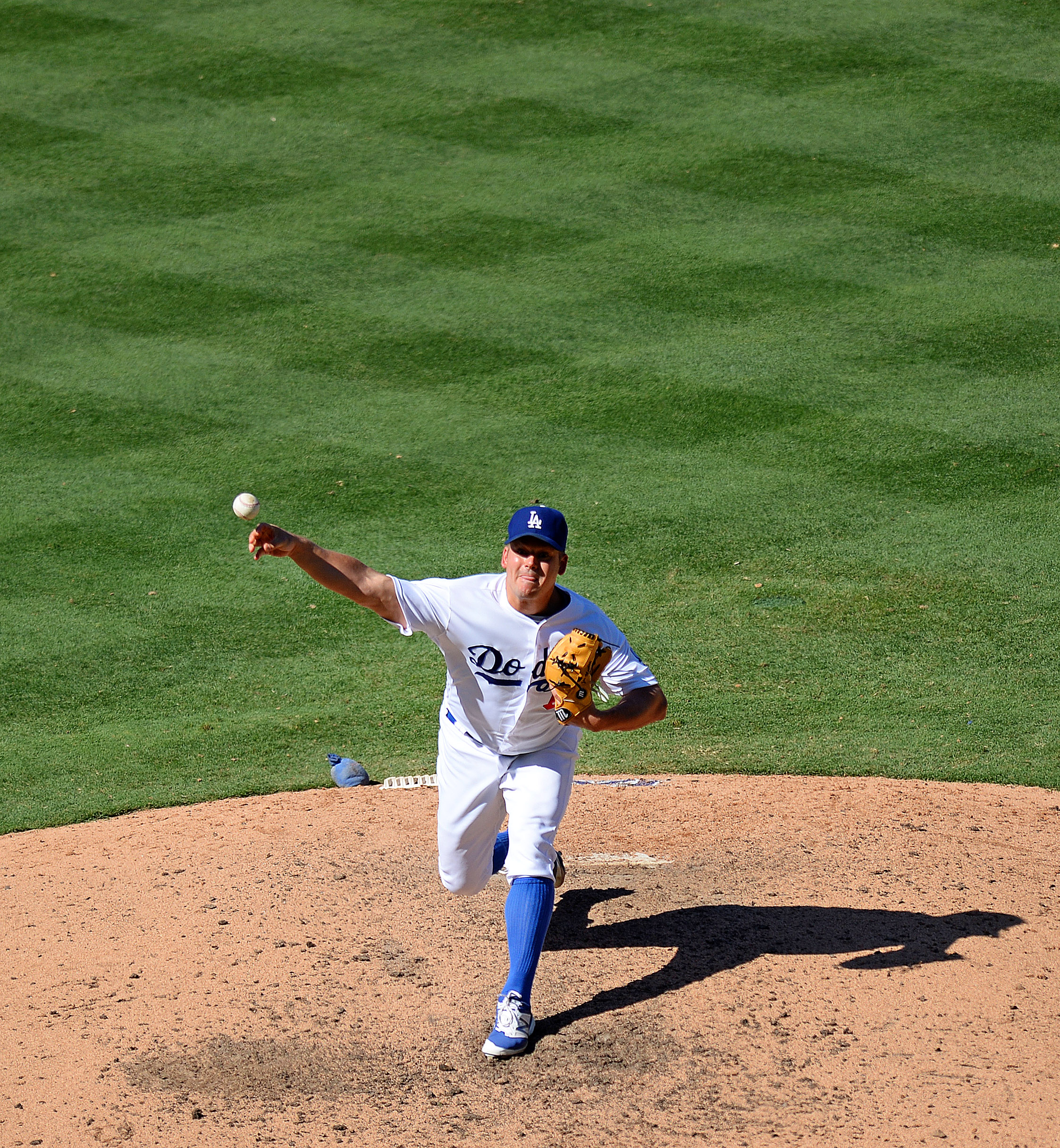
Though he’s coming off of a second consecutive season of steady bullpen production, the 36-year-old had languished on the market this offseason. When catcher Matt Wieters joined the Nats, Blanton was left as the last available name on MLBTR’s list of the top fifty free agents.
[RELATED: Updated Nationals Depth Chart]
It’s easy to see the fit in D.C., where the bullpen has remained somewhat in flux after the organization missed on closer targets Kenley Jansen and Mark Melancon. While Blanton doesn’t seem likely to factor directly into the competition for the ninth inning job, he’ll deepen the team’s late-inning corps.
It wasn’t long ago that Blanton seemed like he might be headed for retirement. His last full season as a starter came in 2013, when he scuffled to a 6.04 ERA with the Angels, and he sat out the following campaign. But the righty reemerged with the Royals in 2015, and thrived yet more upon moving to the Pirates that year in a mid-season trade.
The surprising showing of the newly minted reliever led to a $4MM deal with the Dodgers last year. That signing paid big dividends for Los Angeles, as Blanton worked to a 2.48 ERA with 9.0 K/9 against 2.9 BB/9. He carried a sturdy 80-inning workload, allowing just 55 base hits in that span.
It would be unwise to expect Blanton to continue generating a meager .240 batting average on balls put in play against him, but his other peripherals portend continued success. Though he drew far less grounders than usual (32.5% against a career average of 43.9%), Blanton tamped down the long balls that plagued him in the second half of his time working from the rotation. And he generated swinging strikes at an excellent 14.2% clip, representing an increase over his already-strong 2015 numbers (13.0%).
Beyond the ability he displayed, Blanton showed he’s still capable of carrying a heavy burden for a reliever while retaining his arm speed deep into his career. He averaged a career-best 91 mph with his fastball last year, with his slider and curve also rating as above-average offerings. While his change wasn’t as productive in 2016, Blanton’s starter’s arsenal also gives him some added flexibility. Though he surrendered free passes more frequently to the 111 lefty batters he faced than the 204 righties that came to the plate against him, Blanton held southpaw hitters to an anemic .186/.288/.258 batting line.
That’s not to say that Blanton comes without questions. He did falter in the NLCS, though he was aces for the Dodgers in their thrilling divisional series against the Nats, when he provided five scoreless innings over which he allowed just a single base knock and compiled five strikeouts against one walk. Of greater concern is his ability to continue succeeding while giving up a fair amount of hard contact (34.3%) while permitting many more flyballs (45.6%) than grounders (32.5%). And he did that while generating far fewer harmless infield pop-ups than he had in 2015 (15.2% versus 5.3%). If a few more of those flies end up in the seats — which is always possible when Nats Park heats up over the summer — then there could be some regression in store.
Regardless, it’s a solid value for the Nationals, who will add Blanton to a righty setup mix that also includes Blake Treinen, Shawn Kelley, and youngster Koda Glover. One of those three seems likely to take the closer’s job, though lefty Sammy Solis could also enter that discussion. Veteran right-handers Joe Nathan and Matt Albers now seemingly face taller odds in their bids to crack the Opening Day roster. It’s still tempting to wonder whether the organization will pursue an experienced closer before camp breaks, though the addition of Blanton likely draws down the available resources and reduces the likelihood of another significant move.
Photo courtesy of USA Today Sports Images.
NL East Notes: Nationals, Plawecki, Morgan, Coghlan
Matt Wieters‘ addition gives the Nationals at least nine Scott Boras clients on their roster — a fact that prompted Barry Svrluga of the Washington Post to explore the relationship between Boras and the Nationals. As Svrluga notes, Stephen Strasburg, Bryce Harper and Anthony Rendon were each drafted as Boras clients, and GM Mike Rizzo stated to Svrluga that he’d always draft the best talent available regardless of representation. Lefty Gio Gonzalez, meanwhile, switched to the Boras Corporation after being extended by the Nats. Still, there’s a strong relationship between Boras and Nats owner Ted Lerner, who negotiated Rafael Soriano‘s two-year, $28MM deal directly with Boras and, according to Svrluga, was the “primary architect” on Strasburg’s $175MM extension. Svrluga notes that some in the organization consider the relationship between Boras and Lerner to be unhealthy.
As for Wieters, Svrluga suggests that Boras set out targeting something in the range of the five-year deals signed by Brian McCann and Russell Martin in recent seasons, which prompted the Nats to pursue Derek Norris rather than Wieters. As his price dipped, the Nationals slowly reentered the picture and ultimately came away with what could very well prove to be a nice bargain. Nats fans, and those interested in the Lerner/Boras dynamic, are strongly encouraged to read Svrluga’s column in its entirety.
A bit more from the NL East…
- The Mets and Kevin Plawecki had an injury scare over the weekend when the 26-year-old catcher suffered an apparent knee injury on a play at the plate involving Nationals outfielder Rafael Bautista. However, while Plawecki was down for an extended period of time and had to be helped off the field, he’s been diagnosed with a knee contusion and should be cleared to resume workouts in the next few days, per Mike Puma of the New York Post. While Plawecki is a long shot to crack the Opening Day roster due to the presence of Travis d’Arnaud and Rene Rivera on the Mets’ roster, he once again figures to be the team’s first line of defense in the event of an injury to one of the primary two backstops (and d’Arnaud does have a lengthy injury history). While Plawecki has hit just .211/.287/.285 in 409 Major League plate appearances, he’s a lifetime .279/.331/.433 hitter in parts of three Triple-A seasons and is just two years removed from ranking among the game’s top 100 prospects.
- Former starter Adam Morgan is now vying for a spot as a lefty in the Phillies‘ bullpen and seemingly has a good chance to secure such a role, writes Ryan Lawrence of PhillyVoice.com. Manager Pete Mackanin would prefer to have two left-handers in his bullpen, Lawrence writes, and there are only five southpaws in camp with the Phils: Morgan, Joely Rodriguez, Elniery Garcia (a minor league starter) and non-roster veterans Sean Burnett and Cesar Ramos. Morgan tells Lawrence that he’d happily accept whatever role the Phillies ask of him, joking that he’d serve as the backup catcher if necessary. All but two of Morgan’s 38 Major League appearances have been starts, but the Phils have an emerging young core of rotation arms plus veterans in the form of Jeremy Hellickson and Clay Buchholz.
- Chris Coghlan discussed his unique journey through professional baseball and his hopes for making the Phillies roster out of Spring Training with CSNPhilly.com’s Jim Salisbury. Coghlan, who had interest from other clubs but chose to sign with the rebuilding Phillies — drew a parallel between the present-day Phillies and the 2014 Cubs team on which he played. (The Cubs lost 89 games before surging to the postseason in 2015 and a World Series title in 2016.) “We went from not being good to being really good,” said Coghlan. “We grew together and built relationships. This team is in a transition period of trying to groom guys, but they also need older guys to bridge the gap and I thought it would be a great opportunity. … I just want to come in here, establish myself, be a great teammate, lead by example and maybe I can stick around long term and see this thing through.”