
Junior Guerra Out At Least Six Weeks With Strained Calf
4:15pm: Brewers manager Craig Counsell offered a more pessimistic timeline, tweets MLB.com’s Adam McCalvy. The Milwaukee skipper said that Guerra will miss a minimum of six weeks and added that Guerra’s calf injury is “significant.” Left-hander Tommy Milone will step into the rotation and start in Guerra’s place on Saturday.
April 4, 3:48pm: Guerra tells Todd Rosiak of the Journal-Sentinel the early prognosis following an MRI calls for an absence of four to six weeks (Twitter link).
April 3: Brewers righty Junior Guerra exited his Opening Day start after suffering a right calf strain running the bases, as Todd Rosiak of the Milwaukee Journal-Sentinel reports (links to Twitter). He will require a stint on the 10-day DL.
It’s not yet clear how severe the injury is, but manager Craig Counsell indicated that he’ll need more than the minimum time away, as MLB.com’s Adam McCalvy tweets, the skipper says. Indeed, Guerra required crutches after undergoing his preliminary testing and treatment.
Even if it’s a relatively mild injury, it would be impossible to guess at the duration of Guerra’s absence. Milwaukee will surely exercise caution in bringing him back, and the timeline will no doubt be dictated by how he feels. Depending upon how well Guerra is able to maintain his arm strength while the calf heels, he may also require a rehab stint.
All said, there’s little in the way of long-term concern here, but it’s obviously disappointing to lose an Opening Day starter on the first game of the season. Guerra will remain one of the game’s most interest players to watch upon his return, when he’ll seek to continue the form that allowed him to compile 121 2/3 innings of 2.81 ERA ball last year as a 31-year-old rookie.
Seth Lugo Diagnosed With Slight UCL Tear
3:25pm: The Mets have issued a statement on Lugo’s injury, noting that he will be shut down for the next two weeks before beginning a throwing program. “Surgical repair of the UCL is still a possibility, depending on the results of the PRP, rest and throwing program,” the Mets add at the conclusion of the release.
11:39am: Mets righty Seth Lugo has been diagnosed with a “slight” tear in the ulnar collateral ligament of his pitching elbow, according to Marc Carig of Newsday (via Twitter). He is, however, not expected to require surgery. Instead, the current plan calls for a platelet-rich plasma injection followed by rest.
While a more significant tear to the UCL would obviously represent much worse news, it’s still a major loss for the Mets. Lugo had figured to represent a top-quality swingman after his excellent work in 2016. Instead, he’ll join Steven Matz on the shelf for at least a significant chunk of the season’s first half.
Lugo, 27, had gone largely without note until breaking through to the majors last year. He ended up providing 64 innings of 2.67 ERA pitching in 17 appearances — eight of them starts — while allowing just 49 base hits to go with 6.3 K/9 and 3.0 BB/9. Despite allowing hard contact at a 38.4% clip, Lugo managed to hold opposing hitters to a .230 batting average on balls in play.
Whether Lugo’s 2016 success is sustainable remains to be seen, but the Mets had hoped to find out by having him on hand to help out. Particularly with Matz also battling injury issues, the club’s depth has taken a hit early on.
Obviously, any UCL injury immediately raises the specter of a Tommy John procedure, but that’s not always the case. For one thing, many pitchers rest and then pitch through sprains (which are themselves slight tears). For another, there are a variety of alternative treatments and procedures currently rising in popularity. Given the preliminary diagnosis that has been reported thus far, it’s impossible to know how long Lugo might be sidelined.
It’s worth noting, too, that it’s not clear whether Lugo has actually suffered a recent injury. As James Wagner of the New York Times notes (Twitter links), it hasn’t yet been determined (if it’s possible to at all) whether Lugo has simply experienced inflammation from a preexisting issue. While the distinction may not matter much for his rehab course, it could conceivably change the way the medical staff assesses his susceptibility to further injury moving forward.
Mariners Claim Evan Marshall; Drew Smyly To 60-Day DL
The Mariners have claimed righty Evan Marshall off waivers from the Diamondbacks, per an announcement. Seattle has shifted lefty Drew Smyly to the 60-day DL to clear a roster spot.
Marshall, 26, was designated recently by the Snakes. Though he showed plenty of promise in his 2014 MLB debut year, Marshall has not been nearly as effective since. Last year, he was knocked around in 15 major league appearances and managed only a 4.59 ERA in his 33 1/3 Triple-A frames.
As for Smyly, the move likely doesn’t impact his timeline. A flexor strain was already slated to cost him six to eight weeks, and any length of rehab assignment would have extended that figure. While awaiting his return, the M’s will put his 40-man spot to use to ensure there’s adequate pitching depth on hand.
Offseason In Review: Philadelphia Phillies
This is the latest entry in MLBTR’s Offseason In Review series. The full index of Offseason In Review posts can be found here.
The Phillies’ front office, which continues to chart a steady rebuilding course, added short-term veterans to supplement a group of young talent that is steadily matriculating to the majors.
Major League Signings
- Jeremy Hellickson, SP: one year, $17.2MM (accepted qualifying offer)
- Michael Saunders, OF: one year, $9MM (includes $1MM buyout on $11MM club option)
- Joaquin Benoit, RP: one year, $7.5MM
- Andres Blanco, IF: one year, $3MM
- Total spend: $36.7MM.
Trades And Claims
- Acquired SP Clay Buchholz from Red Sox in exchange for 2B Josh Tobias
- Acquired 2B/OF Howie Kendrick from Dodgers in exchange for 1B/OF Darin Ruf, 2B/OF Darnell Sweeney
- Acquired RP Pat Neshek from Astros in exchange for cash/PTBNL (exercised $6MM club option)
- Acquired RP Pat Venditte from Mariners for OF Joey Curletta
- Acquired RP Mario Sanchez from Nationals as PTBNL in exchange for RP Jimmy Cordero
- Claimed RP David Rollins from Rangers (later lost via waiver claim)
- Claimed 3B Richie Shaffer from Mariners (later lost via waiver claim)
Notable Minor League Signings
- Pedro Beato, Sean Burnett (released), Chris Coghlan (released), Pedro Florimon, Hector Gomez, Ryan Hanigan (released), Bryan Holoday (released), Daniel Nava, Cesar Ramos
Extensions
- Odubel Herrera, OF: five years, $30.5MM (includes 2022 & 2023 club options)
Notable Losses
- Cody Asche (non-tendered), Peter Bourjos, A.J. Ellis, Matt Harrison (still owed $15MM), David Hernandez, Ryan Howard (declined club option), Charlie Morton (declined mutual option), Ruf
Phillies Roster; Phillies Payroll Information
Needs Addressed
With Ryan Howard’s departure, the Phillies have fully shed the stars that made up the organization’s most recent contending roster — with their salaries also now departing the payroll. Philadelphia is now building a new core, and just made the first long-term commitment to one of those pieces.
If you look at the Phillies’ future balance sheet, there’s just one name on it: Odubel Herrera, the former Rule 5 pick who is now controlled through 2023 after striking an extension over the winter. We’ll have more on that move below, in the “deal of note” section.
Interestingly, that was really the only significant forward-looking move the Phils made over the winter. There was some trade chatter, mostly surrounding second baseman Cesar Hernandez, but there was no urgency to deal him with three years of arbitration control remaining. And the Phils were never rumored to be chasing any controllable major leaguers.
Instead, the club seems content to nurture its existing group of young talent while continuing to build through the draft. But that’s not to say that GM Matt Klentak and company sat on their hands all winter. With massive spending capacity and a new TV contract, the plan called for some fairly significant investments in the 2017 roster — none of which, notably, will impact the future payroll.
That $36.7MM total spending figure listed above is a bit misleading. In addition to its free-agent commitments, Philadelphia struck three separate trades that essentially functioned the same way. The team gave up little in the way of players, but took on $30MM in salary. Combined with the open-market moves, two-thirds of Philly’s approximately $100MM Opening Day payroll comes from newly-added veterans.
So, what did they get for their money? There was no singular focus akin to the Braves’ and Padres’ rotation overhauls. Instead, the Phillies splashed veterans across the roster.
The rotation features some appealing young talent, though the Phillies obviously hoped to relieve the pressure on the arms that will be needed for the long haul. Jeremy Hellickson represented the first major addition when he somewhat surprisingly accepted the qualifying offer issued by the club. While the Phils surely would have been happy to recoup a draft pick, it’s hardly the worst result given the strategy. That said, if the club hopes to cash in on its thus-far worthwhile investment in Hellickson, it’ll need to deal him at the deadline; under the new rules, he’s not eligible for another QO.
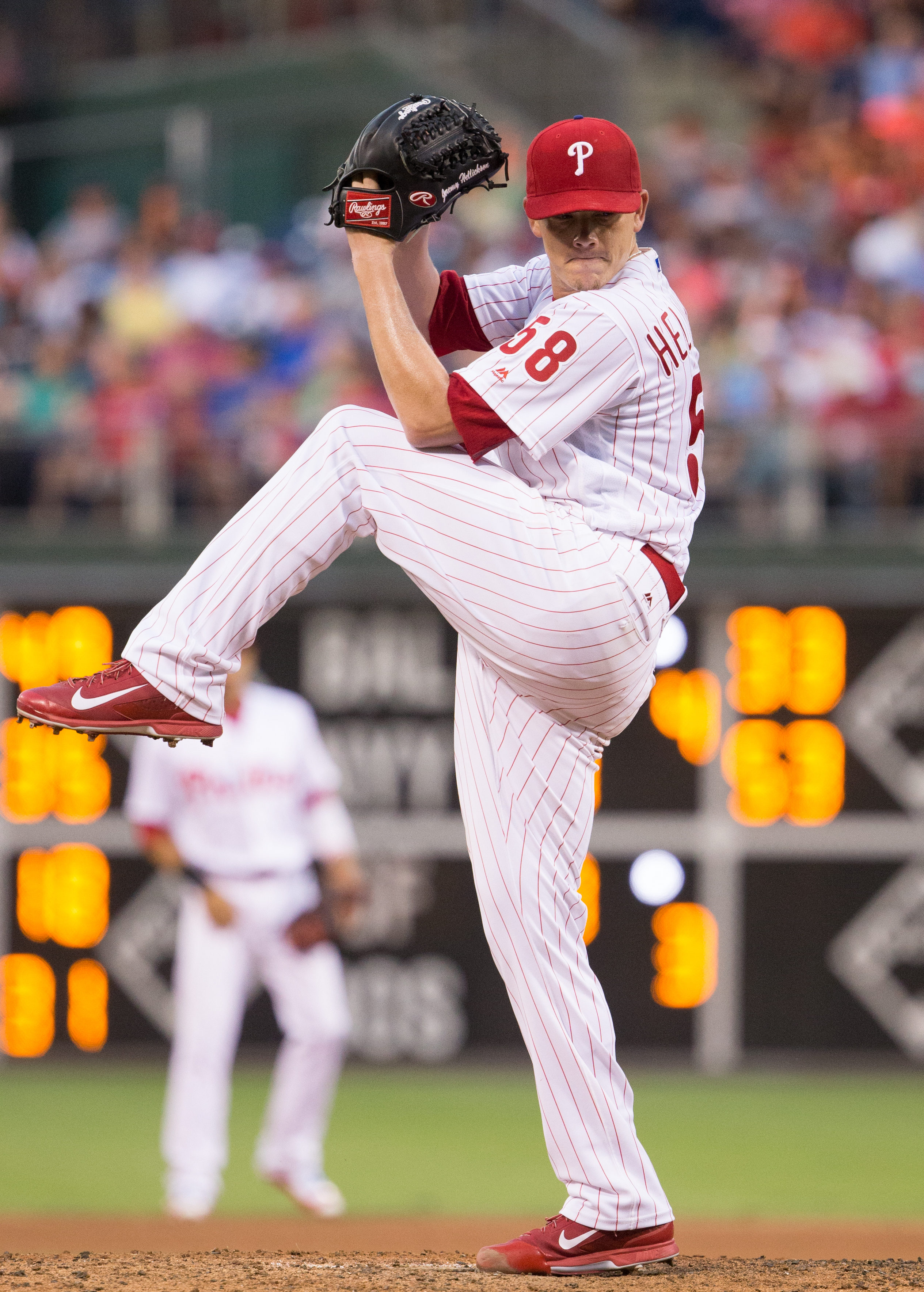
Despite the return of Hellickson, the Phillies elected to add Clay Buchholz to a staff that’ll also feature Aaron Nola, Vince Velasquez, and Jerad Eickhoff. There were alternatives to adding another veteran — Jake Thompson reached the majors last year and several 40-man members are throwing at Triple-A — but Philadelphia elected to take on Buchholz in hopes of a resurgence. If he can carry forward his strong work late in 2016 (2.86 ERA over his final 44 innings), then the Phillies can shop him over the summer or perhaps make a qualifying offer at season’s end.
The bullpen saw additions, too, with Pat Neshek coming via trade and Joaquin Benoit arriving from the open market. These elder statesmen both had promising results last year, but also come with questions. Neshek carried a 3.06 ERA while allowing less than one baserunner per inning through his typical blend of few walks and weak contact. But his success was driven by a BABIP-against mark (.216) that was even lower than usual (.236 career), and he was bombed when allowed to face lefties (.240/.321/.646 and ten home runs in just 55 plate appearances). Benoit, meanwhile, allowed just one earned run on 17 hits in his 23 2/3 innings with the Blue Jays, but had struggled with his control and long ball susceptibility over the first half of the season with the Mariners.
With the infield accounted for, Klentak and his charges turned to addressing an outfield that had received meager contributions from the corners in 2016. The first move, acquiring Howie Kendrick, may have been made in part to provide cover in the event that a deal was struck involving Hernandez. But the former second baseman was always penciled in to play left, and that’s where he’ll open the season. A paragon of consistency at the plate for the bulk of his career, Kendrick fell off last season and ended up hitting just .255/.326/.366 — though he did substantially increase his walk rate. While there’s not much upside to him as a left fielder, Kendrick at least represents a sturdy veteran who’ll plug a hole.
Next, the Phils staked a more interesting bet on Michael Saunders, whose deal includes an option for 2018. The 30-year-old was finally healthy and productive last year, though he faded badly after an outstanding start. Still, the overall results — .253/.338/.478 with 24 home runs over 558 plate appearances — were quite good, and Philadelphia would no doubt be pleased with a repeat performance.
That slate of moves was accompanied by the re-signing of veteran infielder Andres Blanco, who has been a handy member of the bench for the past two seasons.
Read more analysis below …
Pitching Notes: Kela, Gomez, Felix, Arroyo
As was reported recently, the Rangers have no interest in trading recently demoted power righty Keone Kela, who was optioned owing to his negative impact in the clubhouse. Both Evan Grant of the Dallas Morning News and Jeff Wilson of the Fort Worth Star-Telegram provide further detail on what went wrong, and you’ll want to check out those pieces for the full rundown. All said, it seems there’s plenty of space for Kela to work back into good standing with the organization, though it’s anyone’s guess how long he’ll be shelved in the minors and what it will take for him to return.
Here are a few more pitching notes from around the game:
- The Phillies took home an Opening Day win after Jeanmar Gomez shut the door in the ninth, but the closer role seems far from settled. As Ryan Lawrence of the Philly Voice reports, manager Pete Mackanin acknowledged after the game that he’s “concerned” with Gomez — who gave up a two-run home run and, in the skipper’s assessment, is struggling to work down in the zone. It seems the club will stick with him for now, but Mackanin suggested continue to evaluate and won’t hesitate to pull Gomez if he’s struggling.
- Long-time staff ace Felix Hernandez left his start yesterday for the Mariners with groin tightness, as Ryan Divish of the Seattle Times reports (Twitter links). But the expectation is that he won’t miss any time; the veteran righty says he’ll be ready for his next scheduled outing “for sure.” He did miss time last season with a calf strain that proved worse than initially suggested, though of course there’s no reason to believe this new injury will follow a similar course.
- Veteran hurler Bronson Arroyo is on track to return to the majors, as Mark Sheldon of MLB.com writes. After a sim game on Sunday resulted in “very, very positive reports,” in the words of manager Bryan Price, it seems Arroyo is slated to make his first MLB outing of the year on Saturday. Arroyo has battled injury ever since going he required Tommy John surgery in the middle of 2014, but has remarkably positioned himself to make it back to the hill at 40 years of age.
Latest On Mets’ Pitching Injuries
The Mets enjoyed a solid Opening Day win today on the back of a strong performance from starter Noah Syndergaard. But there are some new health concerns for the team’s pitching staff — though their gravity isn’t yet clear.
Syndergaard himself departed after six innings with a blister, as Kristie Ackert of the New York Daily News writes. It’s not expected to be a major issue, but the team is looking to get out ahead of things by giving him an added day of rest. Blisters can turn into significant injuries, to be sure, but there’s no reason at this point to think it’s more than a minor issue to be managed.
There’s more worry with lefty Steven Matz, who is already on the DL with elbow inflammation. The team’s position remains that he has been cleared of structural damage, as Marc Carig of Newsday reports, but Matz provided further information on the issue. He says that he has been diagnosed with a flexor tendon strain, which would seem to be a distinct injury from the bone chips that he had surgically removed over the offseason. Regardless, his timeline will surely be dictated by how he feels and what kind of progress the doctors observe, but the news adds to the 25-year-old’s growing list of arm ailments in his young career.
In theory, any such gaps in pitching coverage were to be covered by Seth Lugo, who filled in with aplomb last year. But as John Harper of the New York Daily News reports, manager Terry Collins hinted after today’s game that there may be some concern with Lugo’s status. “We lost Seth Lugo today for a period of time,” said Collins, who later added that “it’s going to be a couple of weeks, for sure,” before Lugo is able to return. There are no known details to this point, but clearly the Mets are anticipating that they won’t be able to use the 27-year-old for at least some fairly significant stretch.
In light of these new concerns, Collins stressed the need to maintain the health of the current five-man rotation, which explains the proactive move to get Syndergaard extra rest. As Harper notes, resurgent righty Rafael Montero — who’s currently operating out of the MLB bullpen — now seems to occupy a position of much greater importance than had been anticipated. If there’s a silver lining to this early test of the organization’s pitching depth, it’s that they had so much to begin with, so the current roster is still stocked with high-quality starters.
Poll: Grading The Cardinals’ Extension Of Yadier Molina
Yadier Molina exudes excellence and personifies the Cardinal Way. He’s one of the best and most durable catchers in the game. He’s coming off a year in which he slashed a robust .307/.360/.427 and continued to earn plaudits for his work behind the plate and guidance of the pitching staff.
So, the three-year, $60MM deal he just signed to stay with the Cardinals through 2020 would seem at first glance to be a slam dunk. It’s a top-of-the-market AAV for a catcher, true, but also just a three-year commitment. For a player who’s an arguable Hall-of-Famer and undisputed franchise icon — and, reputedly, a clubhouse leader without peer — it seems like an easy gamble to make.
On the other hand, Molina will turn 35 in the middle of the season that just kicked off. He hasn’t hit double-digit home runs since 2013, which is also the last time his isolated slugging mark exceeded .120. Molina’s surge at the plate last year was fueled by a career-high .335 BABIP. His defensive productivity seems likely to slow down at least somewhat as the wear and tear catches up; his durability is a feather in the cap, on the one hand, but he has also logged 1,583 games behind the dish (including today’s game) in the majors.
Consider, too, the opportunity cost. Around this time last year, the division-rival Pirates got Francisco Cervelli — then on the heels of an outstanding 2015 season and having just begun his age-30 campaign — to agree to a three-year deal at nearly half ($31MM) the guarantee Molina received. While Molina certainly has a claim to receiving the league’s top annual salary for a catcher, it’s tough to promise that rate at his age, and it’ll certainly tie up payroll that could’ve gone elsewhere. Remember, too, that the Cards have one of the game’s best catching prospects in Carson Kelly waiting in the wings at Triple-A.
There’s a middle ground here, of course. Molina has always been fairly reliant on batting average to reach base, because he doesn’t walk all that much. But he has continued to carry an outstanding contact rate and showed no signs of slowing in that regard in 2016. While the power won’t likely return to even average levels, perhaps he can keep hitting at a solid-enough rate so long as he maintains his hand-eye coordination. Likewise, the dark arts of the catcher — receiving, blocking, throwing, calling pitches, and managing a staff — are perhaps more dependent upon a blend of mental acuity, hard-earned experience, and ingrained reflexes than are the tools of any other position. And Kelly’s presence can be seen as a positive; perhaps he’ll help keep Molina fresh while learning from the game’s top catching sensei. The Cardinals have acted to lock up other core players to more manageable salaries, so the team can probably afford a bit of an extravagance to keep a key veteran who’ll provide continuity and unrivaled leadership.
So, there are several ways to characterize this signing. How do you view it? (Link for app users.)
How do you view the Cardinals' extension of Yadier Molina?
-
It may be a bit of an overpay for his on-field contributions, but makes sense for the Cards. 51% (4,847)
-
It's a good decision -- he's a key player who'll make what he's worth. 25% (2,350)
-
It only would have made sense at a lower rate or a shorter term. 17% (1,610)
-
It was time to move on and prepare for a Yadi-less future. 8% (727)
Total votes: 9,534
Offseason In Review: Colorado Rockies
This is the latest entry in MLBTR’s Offseason In Review series. The full index of Offseason In Review posts can be found here.
The Rockies obviously see an opportunity to contend in 2017, and made some hefty commitments over the winter to bolster that possibility. But ongoing pitching questions and a slate of spring injuries have clouded the outlook somewhat.
Major League Signings
- Ian Desmond, IF/OF: five years, $70MM (includes $2MM buyout of $15MM club option)
- Mike Dunn, RP: three years, $19MM (includes $1MM buyout of $6MM club/vesting option)
- Greg Holland, RP: one year, $7MM (includes $1MM buyout of mutual/vesting player option)
- Alexi Amarista, IF: one year, $1.25MM (includes $150K buyout of $2.5MM club option)
- Total spend: $97.25MM.
Trades And Claims
- Acquired RP James Farris from Cubs in exchange for SP Eddie Butler
Extensions
- Nolan Arenado, 3B: two years, $29.5MM (did not extend team control)
Notable Minor League Signings
- Domonic Brown, Matt Carasiti, Stephen Cardullo, Noel Cuevas, Chris Denorfia, Evan Grills, Ryan Hanigan, Mark Reynolds, Josh Rutledge (claimed in Rule 5 draft)
Notable Losses
- Butler, Jorge De La Rosa, Daniel Descalso, Nick Hundley, Ryan Raburn
Rockies Depth Chart; Rockies Payroll Information
Needs Addressed
After addressing the open managerial job with the hiring of Bud Black at the opening of the offseason, the Rockies had a wide-open slate of possibilities. The team could conceivably have pursued a variety of trade scenarios involving such established stars as Carlos Gonzalez and Charlie Blackmon. Instead, the club ended up keeping its core intact and adding the old-fashioned way: through some pretty big spending on the open market.
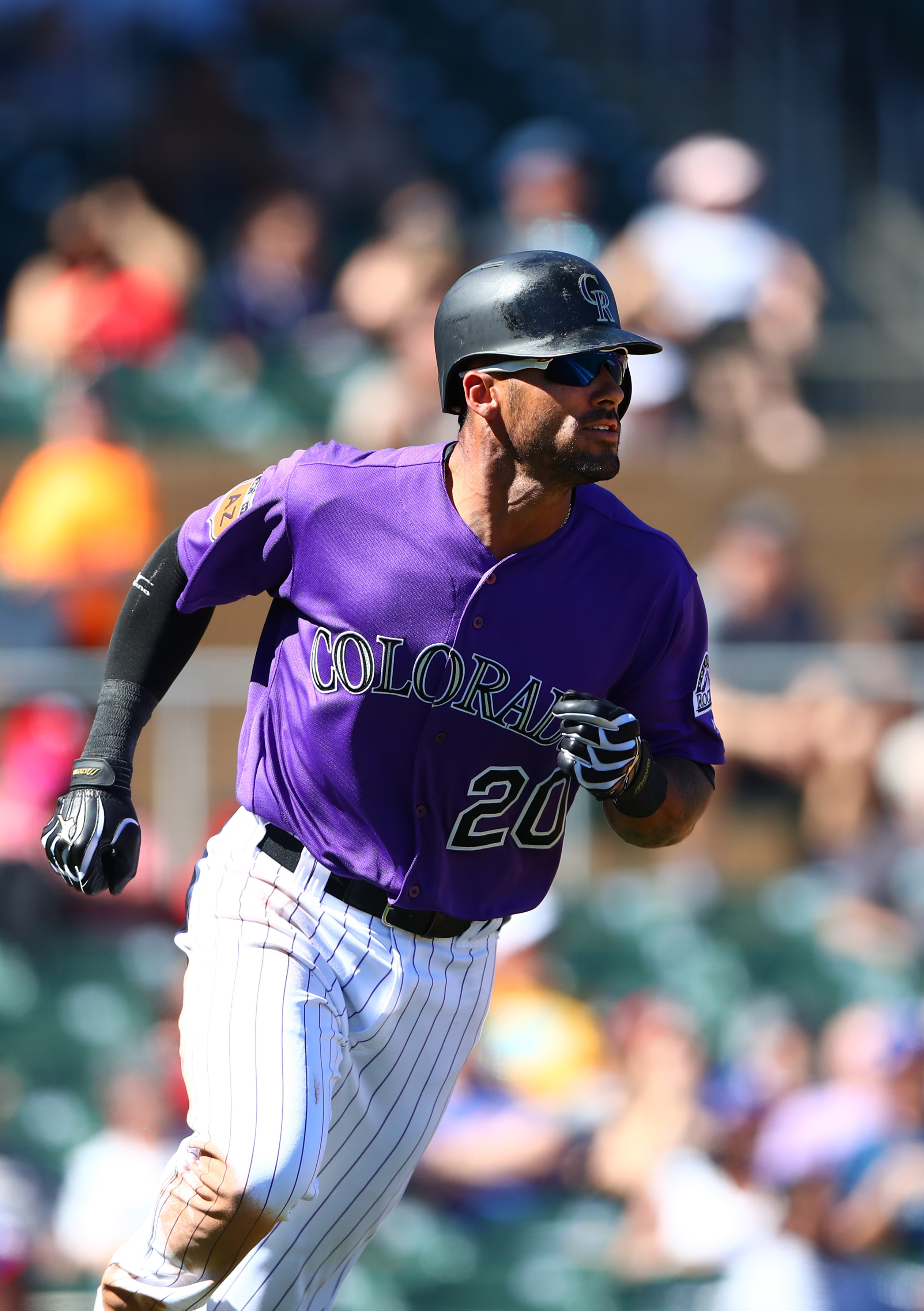
There were two major openings on the position-player side entering the winter: first base and catcher. Colorado elected to plunk down a lot of cash to add a productive veteran, but the player chosen came as quite some surprise. When the news broke that Ian Desmond was headed to the Rockies, it was generally assumed that he’d be playing in the outfield, with one of the team’s left-handed hitters — Gonzalez, Blackmon, Gerardo Parra, or perhaps even David Dahl — likely to be traded to address another need. Instead, the Rox stuck to their initial suggestion that Desmond would play first, though the organization notes that it values his versatility now and into the future. (More on that below.)
Behind the dish, the Rockies bypassed opportunities to pursue veterans via trade or free agency, where names like Matt Wieters, Jason Castro, Welington Castillo and (on the trade front) Brian McCann were available. Instead, the organization decided to rely on Tony Wolters, Tom Murphy, and Dustin Garneau. Murphy, who seems to have the greatest upside of the bunch, will be on the DL to open the year, so the Rockies made a late move to add veteran Ryan Hanigan.
Alexi Amarista was added to replace departing utilityman Daniel Descalso, but otherwise a bunch of friendly faces will be taking the field at Coors. In addition to the outfielders named above, high-power/high-strikeout shortstop Trevor Story is back from injury; Nolan Arenado and 2016 NL batting champion DJ LeMahieu will look to repeat their strong 2016 seasons at third and second base; and Mark Reynolds will return to first base (he re-signed on a minors deal) until Desmond, who suffered a fractured finger in Soring Training, is healthy. Rounding out the bench is Stephen Cardullo, an indy ball find who surprisingly spent time in the bigs last year.
Of course, the lineup was always seen as a strength for Colorado. Entering the winter, most expected the club to focus on pitching. Though the rotation finally had shown signs of life, it wasn’t exactly overloaded with established arms, and the bullpen had some clear holes.
The latter group got the attention that was expected, and then some. In addition to tendering a contract to Jake McGee despite his poor first year with the organization, Colorado gave Mike Dunn a surprising three-year deal and beat the market to roll the dice on Greg Holland, the once-elite reliever who’ll be returning from Tommy John surgery. That makes for one pricey relief corps. When you add the 2017 salaries of those three pitchers to what’s owed Adam Ottavino, Jordan Lyles, Chad Qualls, and the just-designated Jason Motte, the tab for this season alone lands just under $30MM.
But the rotation was another story. Content to keep its lefty-heavy outfield mix intact, and enamored of the relatively untested options on hand, the Rox did not add a single starter over the offseason.
Questions Remaining
The Rockies were arguably justified in staying their hand on adding another piece to the rotation. Entering camp, four spots were firmly accounted for (by Jon Gray, Tyler Anderson, Tyler Chatwood, and Chad Bettis). Beyond that quartet, there were quite a few contenders for the final job. Though adding a veteran to bolster the competition would have been nice, perhaps an appealing target couldn’t be enticed given the arms on hand and the prospect of pitching at Coors Field. And while the trade route surely was at least considered, either a lack of suitable matches or a differing strategy may simply have led the Rockies to a different approach.
Taking that course, though, always meant there’d be a lot of pressure on quite a few young pitchers. Teams know they’ll use more than five starters over the course of a season, so their depth charts must go at least eight or ten arms deep. In the case of the Rockies, outside of the top four arms listed above, the only potential starter in the organization who has more than eight MLB appearances under his belt is Chris Rusin, who thrived last year in a relief role. Prospects Jeff Hoffman and German Marquez are the only others who have seen any major league action at all, with each getting a taste of the bigs last year.
The situation worsened significantly with the terrible news that Bettis would require chemotherapy after his testicular cancer unexpectedly spread. Though he says it’s possible he could return this year, everyone’s first priority will remain Bettis’s well-being. Clearly, the team can’t count on a contribution from the steady performer in 2017.
Thus it was that the Rockies found it necessary to pluck two fresh arms from the farm to open the 2017 season. It seems that Antonio Senzatela (22) and Kyle Freeland (23) will get those jobs, with Marquez functioning as a swingman to open the season. The former was oustanding at Double-A in 2016, but he threw only 34 2/3 innings as the team exercised plenty of caution with a shoulder issue. While he had reached 154 frames in the prior season, asking for 32 starts would be a reach. Freeland, meanwhile, was the eighth overall pick in the 2014 draft. However, he only reached the upper minors last year and didn’t exactly dominate with a 3.89 ERA over 162 innings with 6.0 K/9 against 2.4 BB/9. Also of note: that innings tally represented a big jump after two consecutive partials seasons.
Whenever the next need opens up, the Rockies can turn to Rusin (once he’s healthy), Marquez, Hoffman, and perhaps Lyles. They’ll also be able to dip further into the farm, which includes pitchers such as 40-man members Shane Carle, Yency Almonte, and Zach Jemiola. That may well be sufficient depth, but the Rockies set to tap into an unusually youthful reservoir of starting pitching for an organization that has its sights set on contention.
The ‘pen faces its own questions, but they’re mostly of the typical kind. Overall, the unit has a fair bit of upside despite the recent health issues faced by pitchers such as Holland, McGee, Ottavino, and Qualls; those hurlers will be looking to return while others (Marquez, Carlos Estevez, and Miguel Castro, if he clears waivers) will try to convert impressive raw stuff into effectiveness.
You could say the same of the bulk of the lineup, which has a nice overall blend of stars, solid pieces, and role players. There may be minor quibbles about the lefty-heavy outfield mix — top prospect Raimel Tapia also hits from the left side — and the catching mix is as unestablished as any in baseball. The organization, though, seems to believe in the current catching options. And overall, the the collection of position players seems to be a good one.
Deal Of Note
That includes Desmond, the presumptive first baseman. He ought to be fine there, after all. If he’s a slightly above-average hitter and great baserunner, as he has been, and perhaps adds some value with the glove, he should be a solid-enough performer for the position.
But this is a club that enters the season with a record-setting $120MM payroll — prior to 2015, it had never even reached nine figures — and designs on more than competence. Desmond was the marquee addition, clearly. And teams generally accept that when they sign long-term deals with free agents — at least, those that aren’t abnormally youthful — they’re accepting that they’ll pay a premium later (in the post-prime years of the deal) in order to get a quality, established player on the MLB roster right away.
While we’ve heard plenty of explanations from the Rockies, and from observers, as to why Desmond will work at first base, it still seems an odd decision. Even granting that Desmond is a uniquely high-character player and that he could at least be an average hitter for the slugger’s position (though he’s only a league-average hitter for his career), the move represents a relatively enormous investment that just doesn’t come with much upside up front.
If the Rockies were so enamored of Desmond as a player and a person, perhaps the team ought to have lined up a trade for one of its left-handed-hitting outfielders. It’s reasonable to think that’d have had a reasonable chance of resulting in a pitching upgrade, at least. And it would have allowed the Rockies to take advantage of a free-agent market that was selling quality power bats for next to nothing.
While there’s admittedly some hindsight involved in that assessment, the awkward fit (barring trade) was apparent from the moment the deal was struck. And while Desmond’s future flexibility does carry value, but certainly not enough for that consideration alone to drive the signing. There’s still every chance that the contract will work out for Colorado. But every free-agent signing is a bet, and this one doesn’t seem particularly well-conceived.
Overview
This might all work out; even if not, it’s hard to criticize the Rockies too harshly for pushing some chips in. It’s always good to see a moribund franchise up its investment at an opportune time. And the unique circumstances of Coors Field certainly factor in, too, albeit in hard-to-discern ways. But from here, it doesn’t seem as if the organization got quite as much bang for its hundred-million bucks as perhaps it should have.
What’s your take on the Rockies’ winter? (Link to poll for mobile app users …)
How would you grade the Rockies' winter?
-
C 37% (643)
-
B 36% (624)
-
D 15% (265)
-
F 7% (122)
-
A 6% (103)
Total votes: 1,757
Blue Jays Extend Manager John Gibbons
APRIL 1: The deal is now complete, as Sportsnet’s Shi Davidi tweets.
MARCH 22, 7:54am: An agreement is in place, with the full deal “basically finished,” according to Shi Davidi of Sportsnet.ca.
MARCH 21, 4:23pm: The extension would cover the 2018 and 2019 seasons, according to the MLB Network Radio Twitter feed. The Jays would also have a club option on Gibbons for 2020.
11:58am: The Blue Jays are “finalizing” a new contract with skipper John Gibbons that will keep him in Toronto for multiple future seasons, according to Jon Heyman of Fan Rag. Rob Longley of the Toronto Sun reported last week on Twitter that the club believed it would likely strike such a deal with the manager.
Gibbons, 54, is in his second stint as the head of the Jays’ field staff. He has delivered three consecutive winning campaigns and guided the club to the postseason in each of the past two seasons, both of which ended with ALCS losses. All said, Gibbons carries a 644-614 record over parts of nine seasons as the Toronto skipper.
When the Jays changed front-office leadership last winter, the organization renegotiated its agreement with Gibbons to eliminate the anti-lame duck provision that had previously governed. Under the earlier deal, the team faced a decision on January 1st of each year. If Gibbons was still in his position at that point, the following year’s option would be picked up automatically and a new option year would arise.
With that new arrangement in place, 2016 figured to represent an important campaign as president Mark Shapiro and GM Ross Atkins assessed the organization and Gibbons’s leadership. As it turned out, the skipper drew high praise from Shapiro at the close of the campaign, when it was announced that Gibbons would return. Now, it seems there’ll be a lengthier commitment binding Gibbons to the Jays.
Reds Release Desmond Jennings
The Reds have released veteran outfielder Desmond Jennings, Zach Buchanan of the Cincinnati Enquirer reports on Twitter. It was already clear that Jennings wouldn’t head north with the MLB club.
Jennings, 30, had signed a minors deal that would have paid him $1.5MM had he cracked the roster. But he didn’t do enough in the Cactus League to induce the team to clear a 40-man spot to keep him. Jennings hit .195/.300/.415 with two home runs and two steals in his 18 games of action.
Once a solid regular with the Rays, Jennings has battled injuries over the past two seasons and hasn’t been effective when he has been able to take the field. From 2011 through 2014, though, he slashed .249/.327/.402, hit 47 homers, and swiped 86 bags while playing a solid center field in Tampa Bay.