
Quick Hits: Olney’s Latest, Free Agent Market, Diamondbacks
It’s been another slow winter for baseball’s veteran free agents, writes ESPN’s Buster Olney. Only six free agents have secured deals with more than two years fully guaranteed, none of whom have been over the age of 32, and there are over 200 unsigned free agents still seeking employment for the 2019 season. ESPN obtained a memo written by player agent Jeff Berry outlining some ideas on how to improve the troubling conditions that have developed in this labor market. Berry writes, “As advocates, our job is to fight for and protect player rights, and when necessary, try and help create solutions — not pointing fingers of blame and hoping things get better. And I wholeheartedly believe there are viable solutions to the core labor issues facing the game that can be remedied to the benefit of players, clubs and fans.” Take a look at the top remaining free agents available here, or track the market as a whole with MLBTR’s free agent tracker. For now, let’s take a look at a few of the specifics covered in Olney’s article, as well as some news from around the (slow-moving) winter market…
- Refining or reforming current practices regarding service time manipulation and player arbitration are two of the most-often disputed topics, per Olney, but there are other issues at hand as well, including how some people within the industry are unhappy about the way teams use the disabled list. This issue also encompasses the promotion/demotion process termed “portfolio management,” or the process wherein teams shuffle their rosters for particular series matchups throughout the season. While these in-season roster moves make sense from a strategic baseball standpoint, players lose money as a result, often to no fault of their own. For instance, a reliever whose option has already been used in a season might be vulnerable to demotion if unavailable due to overuse (say, if he pitched in three consecutive days). Even if said player is brought back to the big leagues after a couple of days, he still loses a significant amount of major league pay during that span. Thus, such a player loses money – not despite performing effectively – but because he performed effectively. Obviously, given the complexity of even the single above circumstance, there is no shortage of issues for the players’ union to focus their attentions in advance of December 1, 2021 – the date the current CBA expires.
- Turning to rumblings about player movement, it’s unlikely the Arizona Diamondbacks bring A.J. Pollock back to the desert even if his free agency drags on longer than expected. Given the flexibility of their roster, however, the Dbacks have options to replace him, writes the Athletic’s Zach Buchanan. The in-house alternatives may not be enough to call off the rebuild, but the number of roster iterations available gives GM Mike Hazen the time to make judicious decisions on the trade market. For example, Ketel Marte could move to center, with his spot at the keystone, then, filled by one of the attainable free agent second baseman on the market (DJ LeMahieu, Brian Dozier, Josh Harrison, Asdrubal Cabrera, Jed Lowrie). Alternatively, Eduardo Escobar could fill Marte’s spot at second should the Diamondbacks acquire a new third baseman (Jake Lamb would be expected to handle first, as is probably the case regardless). Given the absolute dearth of starting options available in free agency, if Marte stays at second, a center field replacement would likely come via trade. The Diamondbacks are unlikely to surrender much in the way of prospects at this stage of their rebuild, which makes finding a trade partner tricky, though not impossible. Their best bet might be to target a young veteran who may still have some upside. Specifically, Michael A. Taylor of the Nationals would be an intriguing player to see given 500 at bats, as might Keon Broxton of the Brewers.
Athletics Sign Mike Fiers
7:31PM: Fiers will earn $14.1MM in total, according to Janie McCauley of the Associated Press (Twitter link). The deal breaks down as $6MM in 2019, and $8.1MM in 2020.
Dec. 24, 1:02PM: The A’s have announced the deal (via Twitter).
Dec. 22:The Oakland Athletics are close to re-signing Michael Fiers, per the MLB Network’s Jon Morosi. Fiers will earn between $14MM and $15MM over a two-year span (Twitter links). The deal is pending a physical.
The dollar amount makes sense for both sides, considering Fiers was non-tendered by the A’s at season’s end while being projected to earn $9.7MM through arbitration. With this agreement, the A’s save themselves a couple million on their 2019 payroll while getting a second season of control, and Fiers gets more guaranteed money.
Fiers came to Oakland in August in exchange for two PTBNL, who turned into LHP Logan Shore and RHP Nolan Blackwood. He then contributed reliable innings for the A’s down the stretch as they struggled to keep rotation arms healthy en route to a surprising 97-win season. Pitching in the spacious arenas of Detroit and Oakland last season, Fiers tallied his best year as a pro: a 12-8 record with a 3.56 ERA across 172 innings.
Fiers threw more sliders than ever in 2018, a pitch he has steadily woven into his repertoire since 2015. The increase in slider usage corresponded with a similar decrease in sinker usage, leading to elevated launch angles and more flyballs (43.2 FB%) – all of which could signal sustainability for Fiers’ 2018 success. His peripherals don’t scream drastic transformation, though he did lower his walk rate to a career-low 1.94 BB/9.
Morosi recently reported Fiers was being courted by the Reds, Nationals, Rangers and Giants, all of whom would have been a poorer fit for Fiers, save perhaps the Giants, given his past home run issues. The Oakland Coliseum seems a good fit for the 33-year-old, who is at his best when keeping the ball in the air, but at his worst when unable to keep the ball in the yard.
Fiers ill join an unstable cadre of rotation arms in Oakland, with Daniel Mengden, Frankie Montas, Aaron Brooks, Paul Blackburn and Chris Bassitt being the in-house options for what’s sure to be another ragtag crew.
AL Notes: Rays, A’s, Angels
The Rays‘ primary motivation in inserting themselves into the Athletics‘ recent acquisition of Jurickson Profar was likely opening a spot on their 40-man roster, writes ESPN’s Keith Law (subscription link). In return for sending Brock Burke and Kyle Bird to Texas, the Rays received homer-prone reliever Emilio Pagan from Oakland and the Rangers’ draft pick in Competitive Balance Round A. Additional picks are always welcome, but the most important aspect of this draft pick is the slot value it adds to the Rays’ bonus pool. The pick comes with a slot value of between $1.6MM and $2MM, a valuable sum that extends beyond the pick itself. By boosting their bonus pool, the Rays have more flexibility should they want to go over slot, which is one way to snag a potential star. Given the Rays deep pool of young talent at the MLB level right now, they can afford to turn some of that excess prospect depth into further prospect wealth down the road.
A few other notes from around the American League…
- For the Athletics‘ part in the above deal, Law notes they took advantage of their own area of depth, the bullpen, to get their new starting second baseman. The signing of Joakim Soria more than makes up for the loss of Pagan, and in Profar they now have an inexpensive, versatile player who may still have some upside. Functionally, he’s not all that different from the guy he’ll be replacing, Jed Lowrie, who was brought in as a similarly high-upside, low-cost, versatile option when they went out and got him from another division rival via trade (Houston).
- The Angels have had a tough time building a winner around Mike Trout, but they’ve suffered their share of bad luck too, particularly in the rotation, per Jonah Keri of cbssports.com. The history of injuries to promising rotation arms is disheartening: Garrett Richards with knee issues in 2014 leading up to Tommy John surgery, Matt Shoemaker getting hit in the head with a line drive near the end of a promising 2016 season, Tyler Skaggs with Tommy John in 2016, Andrew Heaney’s various ailments that kept him sidelined for most of 2016 and 2017, and of course, Shohei Ohtani’s latest injury – and that’s before even touching on the bullpen. Keri documents the poor performances of acquired position players as further misfortune suffered under Arte Moreno’s leadership: Albert Pujols, Vernon Wells, Zack Cozart and Josh Hamilton all disappointed relative to their pre-Angels production. It does begin to feel like the Angels are cursed, and yet poor major league scouting could also be the culprit in many of these cases. The recent deals for Matt Harvey and Trevor Cahill, then, nicely sidestepped the issues above by building pitching depth on short-term deals, and Keri suggests a furthering of that strategy by pursuing buy low candidates like Sonny Gray, Julio Teheran or even Yasmani Grandal, should his asking price come down.
MLBTR Poll: Who Won The Dodgers/Reds Trade?
The Los Angeles Dodgers and Cincinnati Reds recently agreed to a seven-player trade that shook up the National League and set the rumor mill afire. In case you missed it, the deal sent the quartet of Yasiel Puig, Matt Kemp, Alex Wood, and Kyle Farmer, plus $7MM cash to the Reds in exchange for Homer Bailey and two prospects: Josiah Gray and Jeter Downs, the Reds’ 13th and 8th ranked prospects, respectively, per Fangraphs. Reactions and analysis have landed on both sides of the ledger, though any subsequent transactions stemming from the payroll and roster changes on either side will give further cause for debate down the line.
The Reds have been vocal about upgrading no matter the cost this winter, especially for pitching, and while the additions were to presumably come via increased spending in free agency, here they explore a more creative means of adding talent. Having seen enough of Homer Bailey over the years, President of Baseball Ops Dick Williams put the $28MM owed Bailey to good use in acquiring three proven major league contributors. Under different circumstances, Williams might be praised for not handcuffing the team with future payroll obligations, but given that this deal feels in part driven by Cincinnati’s inability to attract major free agents, the one-year contracts of Puig, Kemp and Wood only highlights the lack of guaranteed long-term value in the return.
The primary critique here for the Reds is that they surrendered twelve total years of control in Downs and Gray, who slot in as the Dodgers’ new #7 and #16 ranked prospects, per MLB.com. The complete absence of guaranteed future value puts a lot of pressure on the team to capitalize in 2019, a real challenge coming off a 95-loss season. Should Puig, Kemp and Wood walk at the end of the year, they will have surrendered legitimate future talent for a trio that’s not likely to pull them from the depths of the NL Central. Even if the Reds do surprise this season and leapfrog the Pirates, Cardinals, Cubs and Brewers, they still could lose this trio to free agency and be worse off for the future than they were before their acquisition.
On the other hand, attendance has waned at Great American Ballpark. Puig’s power and personality both ought to play well there and give fans something to root for. Further, if for instance, they’ve been unable to get much traction on this year’s crop of lefty free agent starters, then having a one year head start with Wood might be the best way to sign him long-term in Cincinnati. Prospects are high-risk assets, and it could be the Reds don’t believe the future value of Downs and Gray is all that high. Or, they might be banking on getting better prospect value in return at the trade deadline should the Reds fall out of contention early. There’s a lot of speculation above, but the fact is the Reds front office found a way to turn Homey Bailey into two exciting, productive players/trade chips (plus Matt Kemp).
For the Dodgers, they jettisoned 6 fWAR from their 2018 pennant winning team for $28MM in dead money and a pair of prospects. If they don’t turn around and use the cost savings in free agency, that’s a lot of talent to send away just so their billionaire owners can avoid paying the luxury tax. For all Puig’s antics, he brought real fire to the club, and in his six seasons with the team, not only did he accumulate 16.8 fWAR, but they won the NL West in each of those six seasons. As for Wood, one could argue there’s a lot of uncertainty around the lefties remaining in the Dodger rotation: Clayton Kershaw and Hyun-Jin Ryu have not been fully healthy, Rich Hill, 38, is a full decade older than Wood and Julio Urias, 22, may be ready to step into the rotation, but after missing almost all of 2018, he’s far from a sure thing. Wood has his own injury history, but he is a proven asset when healthy, which he has been of late, and he carries a career 3.29 ERA (3.36 FIP, 3.49 xFIP, 3.66 SIERA). As the adage goes, you can never have enough pitching.
On the other hand, the Dodgers added two pretty decent prospects and slipped below the tax line (for now) while dealing from areas of depth. The outfield was log-jammed anyway with Kemp and Puig. Without them, there should be enough at bats to go around for Chris Taylor, Joc Pederson, Enrique Hernandez, Andrew Toles and Cody Bellinger. Plus, top prospect Alex Verdugo, still only 22, may finally have the opportunity to shine at the big league level. As for the rotation, add Walker Buehler and Kenta Maeda to the names above and the Dodgers have enough top-of-the-line starting pitching to enter 2019 even if they decide to pocket the savings from this deal. Kemp and Puig were fun, but they were volatile on-field assets who were going to siphon at bats from the younger, higher upside outfielders (namely, Bellinger and Verdugo) already on the roster.
The elephant in the room, of course, is Bryce Harper. Heads were immediately sent spinning with the possibility of this move being a precursor to the Dodgers signing Harper in free agency, and what’s worse – that makes a lot of sense. They cleared payroll space and positional opportunity, in doing so creating the market/payroll/need fit that previously didn’t seem to exist for Harper. The White Sox and Phillies are ready to spend, but they likely can’t compete with a fully armed Los Angeles payroll. The Cubs are said to be watching, the Nationals haven’t given up on him in theory, and nobody believes the Yankees when they say they aren’t interested, which is, in-and-of-itself, a testament to how classic a suitor they really are.
This blockbuster has the makings of a touchstone moment that will, in part, define this winter’s dealings, but it’s time to see where MLBTR readers land on judging the returns. Does the flexibility this deal affords the Dodgers make them the winners? Or did the Reds take advantage of the Dodgers desire to shed some payroll and walk away with the better return? Let us know your Dodgers grade, your Reds grade, and who you think “won the deal” in this poll.
How Did The Dodgers Do?
-
B 33% (7,872)
-
C 32% (7,542)
-
A 17% (4,107)
-
D 11% (2,692)
-
F 6% (1,463)
Total votes: 23,676
How Did The Reds Do?
-
A 40% (9,491)
-
B 36% (8,665)
-
C 16% (3,777)
-
D 6% (1,326)
-
F 3% (687)
Total votes: 23,946
Who Won The Dodgers/Reds Trade?
-
Reds 45% (11,697)
-
Win-Win 25% (6,378)
-
Dodgers 18% (4,785)
-
Bryce Harper 9% (2,253)
-
Lose-Lose 3% (772)
Total votes: 25,885
Quick Hits: Kevin Cash, Orioles
Good news Rays fans, Kevin Cash is rising the ranks, up to 9th from 15th on nbcsports.com’s list of most handsome managers, per Mark Topkin of the Tampa Bay Times. Apparently winning agrees with him. There’s not much action around the league here on the morning of Christmas Eve, clearly, but MLBTR will be here throughout the holiday season to keep your baseball appetite sated. For now, let’s check in with the Baltimore Orioles…
- It’s a slow burn offseason for the Orioles and new decision-maker Mike Elias, writes Roch Kubatko of MASNsports.com. The new Executive VP and GM has tempered expectations since taking over last month, but even after checking the first box on his to-do list in bringing new manager Brandon Hyde over from the Cubs, player acquisition remains on the backburner. Given that Elias wasn’t installed until the offseason was already underway, it’s a good sign that Baltimore seems focused on the organizational recalibration of a new regime. The work of installing new operations and philosophies organization-wide isn’t sexy work, and it doesn’t produce much fodder to keep fans interested, but as Kubatko notes, it’s more pressing than roster construction at this juncture for the Orioles.
- That said, the additions they have made aren’t wholly irrelevant, not for a team likely to give extended tryouts to younger players at the major league level: Richie Martin, 24, is a former first rounder who hit .300 his second time through Double A last season, Drew Jackson, 25, spiked his power output to .196 ISO as he, too, repeated Double A, and Rio Ruiz, 24, has struggled at the major league level, but he’s also a known commodity for Elias, who drafted him with the first pick in the fourth round in his first season in Houston. Granted, there’s always a little smoke and mirrors when a player’s production jumps the second time through a level, and in Ruiz’s case, it’s hard to tell the difference between familiarity as a positive and sentimentality. Still, though it may not seem like much, some of Theo Epstein’s first moves in Chicago were taking Hector Rondon in the Rule 5 draft and trading for a player he’d previously drafted who had struggled to that point in the big leagues. That’s not to say Ruiz will turn into Anthony Rizzo – Rizzo was a highly touted prospect prior to his struggles in San Diego whereas Ruiz was a waiver claim – but these minor moves always have the potential to snowball into something more, and they’re the right kind of gambles for Elias and his team to be making barely a month into their Baltimore tenure.
Cubs Sign Kendall Graveman
TUESDAY: Per Heyman, Graveman will earn an additional $100K for each of the following performance milestones: 15 games started, 18 GS, 21 GS, 23 GS, and 25 GS. The incentives package means that Graveman can earn up to $2.5MM in 2019.
SUNDAY: Chicago has announced the signing.
SATURDAY: The Cubs have agreed to a deal with free agent pitcher Kendall Graveman, per ESPN’s Jesse Rogers (via Twitter).
Graveman gets a major league contract worth $575K for 2019 with a $3MM club option for 2020. That option year does not include a buyout. Even one day on the 2019 roster, however, will trigger an escalator clause to bring Graveman’s salary to $2MM, and he can earn an additional $500k in performance bonuses.
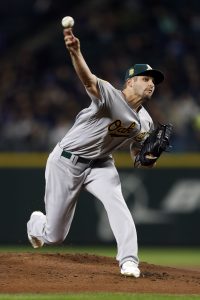
Graveman, 28, had been relatively productive the last four seasons for the Oakland A’s when not dogged by injury. His high water mark came in 2016, working to a 10-11 record in 186 innings over 31 starts with a 4.11 ERA (4.39 FIP). For his career, Graveman carries a 23-29 record and 4.38 ERA across 78 career starts.
The A’s say goodbye to another piece from the Josh Donaldson trade of 2014. Infielder Franklin Barreto is now the only player remaining from the trade that sent Oakland’s star third baseman to Toronto the year before he would win the MVP award with the Blue Jays. Graveman spent four seasons in Oakland, the last of which was mostly lost to injury. He made only seven starts in 2018 with a 7.60 ERA before undergoing Tommy John surgery.
For the Cubs, they get to closely monitor the recovery of a potential rotation arm in 2020 at a very low cost. From their presumed 2019 rotation, only Hamels will be a free agent after next season, but Kyle Hendricks will be entering his final year of arbitration, and Jose Quintana will be facing the first of consecutive club options. There’s almost no downside for the Cubs here, while Graveman gets to benefit from the medical resources of the a large market team as he rehabs from Tommy John.
The timetable for his 2019 return is as of yet unclear, but it’s not expected he will play much of a role, if any, on the Cubs next year, per Gordon Wittenmyer of the Chicago Sun Times (via Twitter).The Cubs signed Drew Smyly in a similar situation before last season, only to flip him to the Rangers to help cover the cost of Cole Hamels‘ club option this year. Garrett Richards, in a similar situation, signed for two years and $15.5MM guaranteed with the Padres, though he carries a longer track record of success than Graveman.
The financials of the deal were first reported by 670thescore.com’s Bruce Levine, while Fancred’s Jon Heyman noted earlier than Graveman received a major league deal (Twitter links). Heyman added the information about the escalator clause and performance bonus (via Twitter). Photo courtesy of USA Today Sports Images.
Padres, Blue Jays Discussing Marcus Stroman Deal
The Padres and Blue Jays are reportedly discussing a deal that would send Marcus Stroman to the friendly confines of San Diego, per sources close to MLB.com’s Jon Morosi.
The ongoing trade discussion would not include the uppermost echelon of Padres’ prospects, though Morosi names pitchers Logan Allen and Michael Baez as two prospects who could be on the table. Baez and Allen rank #7 and #8, respectively on MLB.com’s rankings of the Padres farm system, widely considered to be the best system in all of baseball.
For the Padres, it’s a good time to “buy-low” on Stroman, who is coming off easily his worst season in Toronto. He lost time to shoulder fatigue and a blister issue, finishing the year 4-9 with a 5.54 ERA in only 102 1/3 innings. GM A.J. Preller has been on the lookout for a veteran starter to help anchor their otherwise youthful rotation. At 28, with two years of team control remaining, Stroman certainly fits the mold.
The Blue Jays, meanwhile, appear ready to move on from their erstwhile ace. Though it was a rough 2018 for Stroman, he carries a 3.62 career FIP, marking a career worst 3.91 last year. The Reds were previously thought to be a logical trade partner, but the Padres young arms might be an ever better fit for the Blue Jays, who are a couple years from contending in a ruthless AL East. Already armed with some of the best position player prospects in the game, namely Vlad Guerrero Jr. and to a lesser degree, Bo Bichette, Toronto may view the arms in San Diego’s system as a better fit for their current timetable than Stroman.
It’s not a done deal by any means, but on the surface this appears like a solid match.
Mets Avoid Arbitration With Travis D’Arnaud
The Mets avoided arbitration with catcher Travis d’Arnaud, per USA Today’s Bob Nightengale (via Twitter), agreeing to a $3.515MM salary for 2019.
MLBTR’s Matt Swartz projected d’Arnaud for a slightly higher salary at $3.7MM, though in any regard, d’Arnaud will only earn a minor increase on his $3.475MM salary from 2018 due to yet another injury-plagued season. The catcher played in just four games last season due to a partial UCL tear in his throwing elbow. This was the latest in a long list of health problems that has limited d’Arnaud’s ability to stay on the field, as he has played in just 258 total games over the last four seasons.
As it stands today, d’Arnaud will be competing with Kevin Plawecki for the backup catcher position in New York, though he could be converted into more of a utility type. As Mike Puma of the New York Post reported yesterday, the Mets are shopping both Plawecki and d’Arnaud, though they are said to be willing to move forward with both on the 25-man roster backing up starter Wilson Ramos. There has been “significant” trade interest in the Mets’ backups, though Plawecki might be the easier to move given that d’Arnaud is coming off Tommy John surgery.
AL West Notes: Lorena Martin, Harvey, Kikuchi, Mariners, Rangers
Lorena Martin filed a wrongful termination lawsuit against the Seattle Mariners earlier this week, per Drew Perine of the News Tribune. Martin has been vocal in alleging a pattern of racial and gender discrimination from high ranking officials within the Mariners organization, who have unequivocally, and unsurprisingly, denied Martin’s accusations. Major League Baseball is said to be investigating the matter, but now the King County Superior Court will have the opportunity to make their own determination. Until these respective investigations are complete, let’s take a look at the baseball news from around the AL West…
- The Angels’ recent signing of Matt Harvey makes sense both in terms of team need and length of the deal, even if it took $11MM guaranteed to ink a pitcher whose 4.94 ERA from a year ago was seen as a pleasant surprise. Combined with the subsequent one-year, $9MM deal given to Trevor Cahill, the Angels have done well to add rotation arms without committing dollars beyond 2019. In terms of upside, GM Billy Eppler is hopeful Harvey can return to 2015 form when the dark knight posted a 2.71 ERA (3.05 FIP) in 189 1/3 innings for the Mets, though there is no single factor (conditioning or otherwise) prompting Eppler’s optimism, per Maria Torres of the LA Times (via Twitter). Whether he rediscovers his 2015 self or refines the 2018 version, Harvey has definite upside that should help Eppler in his stated goal to increase the team’s win expectancy. Ben Lindbergh and Jeff Sullivan speculated in a recent Fangraphs podcast about whether the decreased spin rate on Harvey’s curveball could be tied to the hand numbness he suffered as a symptom of thoracic outlet syndrome, which ended his 2016 season. Lindbergh and Sullivan are purely speculating, but it’s an interesting theory.
- Jerry Dipoto dropped some not-so-subtle hints that the Mariners have interest in Japanese lefty Yusei Kikuchi while on MLB Network Radio. That’s hardly a surprise, given Seattle’s long-term relationship with Japanese players. Still, Dipoto also interestingly noted “two years” as the timetable for the Mariners competing again in the West. That they are rebuilding certainly hasn’t escaped anyone, but knowing the timeframe in which Dipoto’s current strategy plans to produce fruit is worthwhile knowledge in interpreting Seattle’s transactions this offseason and beyond. How aggressively Dipoto sticks to this unofficial two-year timeline could speak to the level of symbiosis that exists between Dipoto and ownership.
- Texas GM Jon Daniels, meanwhile, does not want to put a timeframe on the Rangers’ rebuild. With Adrian Beltre retired and Jurickson Profar now in Oakland, the Rangers have turned the page on the most recent era of Rangers’ baseball, but the trade itself does not necessarily signal a longer rebuild, especially given the advanced development level of the prospects returned. While there was no urgency to deal Profar, a stalemate in extension talks with his agent Scott Boras appears to have been a (not at all surprising) contributing factor in Daniels’ willingness to move their former top prospect, writes Jeff Wilson of the Star-Telegram. With third base now vacated (again), Daniels made a point to snuff out any musings about Joey Gallo returning to the hot corner, as they will likely look outside the organization or give Patrick Wisdom, 27, an extended look. Eli White, one of the prospects acquired in the deal, has an outside shot of pushing his way to the majors next season, though he profiles more as an up-the-middle player.
Minor MLB Transactions: 12/22/18
We’ll use this post to track the minor moves from around the MLB today…
- The Indians announced they are bringing back outfielder Brandon Barnes on a minor league deal with a non-roster invitation to spring training. Barnes, 32, received over 100 plate appearances in the big leagues in each of the five seasons from 2012 to 2016, topping out with a .240/.289/.346 mark over 445 PA with Houston in 2013. He saw only two starts with the Indians last season, being used mostly as a pinch-hitter and late-game replacement, collecting 5 hits in 19 at-bats with one home run. Barnes can play all three outfield positions, and he even covered second for two innings last year, but it would be a surprise if he broke camp with the big league club. Still, he’ll be given a chance to earn a roster spot in the spring for a Cleveland organization that is still actualizing their 2019 outfield.
- The Cleveland Indians also invited right-hander Brooks Pounders to major league camp after inking the former Rockie to a minor league contract, per a team announcement (via Twitter). Pounders, 28, posted great strikeout (9.98 K/9) and walk rates (1.17 BB/9) over 14 appearances in Colorado, but he struggled overall in run prevention at the big league level with a 7.63 ERA. Advanced metrics paint a rosier picture for the 6’5″ Pounders (4.27 FIP, 3.67 xFIP, 3.15 SIERRA), who has also had cups of coffee with the Angels (in 2017) and Royals (in 2016). Clearly, there is enough talent for teams to continue to give Pounders a look, but he will need to produce consistently to emerge from a robust spring competition with a spot in the Cleveland bullpen. Like with Barnes in the outfield, there is an open path to playing time as of today, but lots is expected to change between now and Opening Day.