
Astros Notes: Outfield, Rotation, Pearson
The Astros spent most of the offseason looking to add a left-handed hitting outfielder. That hasn’t materialized with three weeks to go before the start of the regular season. General manager Dana Brown suggested the team was still hopeful of making such an acquisition after swapping Jesús Sánchez to Toronto for Joey Loperfido in the middle of February.
An external addition before Opening Day becomes less likely with every day that passes. Nevertheless, manager Joe Espada declined to name starters at any of the three outfield positions over the weekend (link via Matt Kawahara of The Houston Chronicle).
“I’m not ready to say that,” Espada said. “Obviously, we know what Jake Meyers can do in center, I feel really good about that. I feel really good about what Cam Smith can do in right. Zach Cole and the rest of those guys can play all three. But when it comes to who’s in there day one, not there yet.”
On paper, Meyers feels like the safest bet to play every day. He’s a plus defender in center field and is coming off his best season at the plate. The 29-year-old hit .292/.354/.373 with 16 stolen bases and a career-low 17.6% strikeout rate. A right calf strain bothered him during the second half and kept him to just under 400 plate appearances.
Cole and Smith are much less established. The former debuted in September and popped four home runs in his first 15 games. He also struck out 20 times in 52 plate appearances after fanning at a 35% clip in Triple-A. It’s tough to see that profile working over a larger sample unless he makes far more consistent contact.
Smith, a top prospect acquired in the Kyle Tucker trade, hit well for a few months before his numbers cratered in the second half. Smith’s upper minors experience before his promotion consisted of five games at Double-A. It’s impressive that he was able to keep his head above water in the big leagues with such little work against higher level pitching, but he should probably open this season in Triple-A. That’d be easier for the Astros to sort out if they’re able to acquire a veteran corner outfield bat.
Along with the outfield, the back end of the rotation has some uncertainty. Houston added a pair of mid-rotation hopefuls in Tatsuya Imai and Mike Burrows to slot behind Hunter Brown and Cristian Javier. The Astros are planning to begin the season with a six-man rotation. They only have two scheduled off days within the first 28 days. Most teams that sign a high-profile pitcher from Japan also prefer to use a six-man rotation to match the once a week schedule on which NPB starters are used.
The Astros took one-year fliers on Ryan Weiss and Nate Pearson to compete with internal options Lance McCullers Jr., AJ Blubaugh, Spencer Arrighetti and Jason Alexander for the final two jobs. Pearson is out of options and needs to be on the MLB roster in some capacity or exposed to waivers. It looks like he’ll be forced to begin the season on the 15-day injured list, however.
Espada said this afternoon that Pearson has slowed down his throwing program due to elbow soreness (relayed by Brian McTaggart of MLB.com). Pearson, who underwent a cleanup surgery on his elbow over the offseason, had been throwing bullpen sessions. He hasn’t gotten into a Grapefruit League game.
Josh Hader Still Uncertain For Astros’ Opening Day Roster
A bout of biceps inflammation in late January set Josh Hader back in his offseason prep, and has continued to limit the Astros closer during Spring Training. Hader’s throwing has been limited to games of catch, and Astros manager Joe Espada told reporters (including the Houston Chronicle’s Matt Kawahara) that Hader would continue on this route through the week.
Espada didn’t provide any clarity on when Hader might start to increase his throwing progression, or whether or not the left-hander might not be available for Opening Day. “I think we still have a little bit more time. Once we start getting down to that we’ll talk more on that, but right now it’s still premature just to see where we’re at by March 26,” Espada said.
Because Hader is a relief pitcher built for a limited workload, he naturally doesn’t require as much ramp-up as a starter. In each of the last three years, however, Hader has made at least six appearances in Spring Training games, and matching that number may be difficult given that we’re less than a month away from Houston’s first regular-season contest.
The biceps injury comes on the heels of a more serious injury setback for Hader, as a left capsule sprain prematurely ended his season last August. Surgery wasn’t required, and after completing a throwing program in November, Hader said that he expected to be ready for Spring Training. That might have well been the case, if it wasn’t for the biceps inflammation that again put Hader on the sidelines.
Bryan Abreu covered the majority of save chances when Hader was on the injured list last season, so Abreu would probably be Houston’s top choice as interim closer if Hader needs a 15-day IL stint to begin the 2026 campaign. While Abreu has more than proven himself capable of high-leverage work, obviously removing a star closer like Hader from the equation weakens the bullpen depth chart as a whole.
If Hader is absent, it will put more of a spotlight on the rest of the Astros’ relief corps, from both a quality and health perspective. To the latter point, Enyel De Los Santos has started throwing again and Espada said the right-hander should start working off the mound by next week.
De Los Santos picked up a right knee strain early in camp, but it appears as though the strain ended up being fairly minor. The missed time in camp may not have much impact on De Los Santos’ availability for Opening Day, as Espada said that since De Los Santos pitched in winter ball, the righty might be able to rebuild his arm strength in fairly short order.
De Los Santos signed with Houston last August and pitched pretty well down the stretch, posting a 4.03 ERA, 6.6% walk rate, and 26.4% strikeout rate over 22 1/3 innings in an Astros uniform. He avoided arbitration with the Astros by agreeing to a one-year, $1.6MM deal for the 2026 season, giving the 30-year-old a bit of stability after already playing for eight different teams over the course of his seven MLB seasons.
Under-The-Radar Trade Possibilities For The Astros
The Astros have spent the entire offseason looking for a left-handed hitting outfielder. They swapped Jesús Sánchez for Joey Loperfido last week. That saves around $6MM in the difference between Sánchez's arbitration salary and Loperfido's league minimum sum but doesn't change their lineup balance. They added Cavan Biggio on a minor league deal and are reportedly looking at Michael Conforto, who could also settle for a non-roster invite after a rough year in Los Angeles. They're fine depth targets but not locks to even be on the MLB roster -- much less to be a meaningful upgrade.
Free agency only offers those types of reclamation targets at this point. Beyond Conforto, there are also Max Kepler (suspended for the first 80 games after a failed PED test), Jesse Winker and Alex Verdugo. If the Astros are going to make a significant move, it'll have to be via trade. Most of their trade pursuits have been tied to their willingness to field offers on Isaac Paredes given their infield logjam. That's one avenue but obviously not the only way they could trade for a lefty-hitting outfielder.
MLBTR readers are familiar with the top trade targets who fit the bill. Either Jarren Duran or Wilyer Abreu would be an ideal fit but seem likelier to remain in Boston. The Cardinals could deal Lars Nootbaar this spring but may prefer to hold him until the deadline, as they'd be selling a little low with their left fielder coming off a pair of heel surgeries. Last week's Caleb Durbin/Kyle Harrison swap is a reminder that teams explore various avenues that don't involve players who have been the subject of public trade speculation. It's safe to assume the Astros have had some of those conversations behind the scenes. Let's run through a handful of affordable left-handed bats whom they could look to pry from another club.
- Daylen Lile, Nationals (pre-arbitration, controllable through 2031)
Lile made his MLB debut in late May and hit the ground running, at least offensively. He ran a .299/.347/.498 slash line with nine home runs through 351 plate appearances. Lile is an excellent pure hitter. He has advanced contact ability and has always hit a ton of line drives. Although he doesn't have huge power, he should have a strong offensive floor based on the batting average alone. He's a career .273 hitter in the minors and had the highest "expected" batting average in MLB last year (.302), per Statcast.
All that said, the 23-year-old looks more like a quality complementary player than a cornerstone of a rebuilding Nationals team. Lile was a mid-tier prospect during his climb through the farm system. Scouts have never doubted the hit tool but have questioned how much all-around impact he'll make. He has fringe-average power. Although he has plus straight line speed, his reads in the outfield are rough. Defensive Runs Saved had Lile a dismal 14 runs below average in just over 600 innings. He was 10 runs worse than average by Statcast.
Single-season defensive metrics can be fluky, but those grades match the eye test. Here are a handful of examples of Lile turning what should have been easy outs into hits, largely by playing very conservatively at the catch point. Maybe he'll improve with time, but he's not a good outfielder right now. The Astros haven't cared much about left field defense, playing Yordan Alvarez, late-career Michael Brantley, and Jose Altuve out there in recent years. The Nationals have a new front office that played no part in drafting or developing Lile. They'd presumably be open to conversations.

Unlock Subscriber-Exclusive Articles Like This One With a Trade Rumors Front Office Subscription
- Access weekly subscriber-only articles by Tim Dierkes, Steve Adams, and Anthony Franco.
- Join exclusive weekly live chats with Anthony.
- Remove ads and support our writers.
- Access GM-caliber tools like our MLB Contract Tracker
Poll: Which Team Had The Best Offseason?
The offseason has more or less come to a close at this point. While a handful of players remain available in free agency and there’s always a chance of a surprise trade or two throughout Spring Training, the vast majority of the heavy lifting has been done. As Spring Training begins, it’s worth checking in on what teams around the league did this winter to see which club had the strongest offseason. A look at a few of the candidates:
Baltimore Orioles
After a disastrous 2025 season that saw the club fall to the basement of the American League, the Orioles have been very busy in their efforts to turn things around. A rotation that struggled to stay above water last year saw the return of Zach Eflin as well as the additions of both Shane Baz and Chris Bassitt. Those additions may not have included the front-of-the-rotation ace the Orioles were widely expected to pursue, but the club was aggressive elsewhere on the roster. Ryan Helsley was brought in to close while Felix Bautista is injured, and the club swung a deal for Taylor Ward to help round out their outfield. By far the biggest addition of the winter, however, was slugger Pete Alonso, who signed a five-year, $155MM contract. Alonso adds a legitimate 40-homer threat to the middle of a lineup that struggled to generate much offense outside of Gunnar Henderson last year and was heavily slanted toward lefty hitters.
Chicago Cubs
It’s rare that a team would be in this conversation after losing the offseason’s top-ranked free agent, but there’s a lot to like about the 2026 Cubs even after bidding farewell to Kyle Tucker. Alex Bregman, signed to a five-year, $175MM deal, can’t be expected to be the same offensive force as peak-level Tucker, but he makes up for that by helping to complete what’s arguably become the best defensive infield in baseball alongside Dansby Swanson, Nico Hoerner, and Michael Busch. The move pushes Matt Shaw into a utility role, where he can serve as protection against injury for the club while also potentially sharing time with fellow youngster Moises Ballesteros at DH. The addition of Bregman was complemented by the decision to swing a trade for high-upside righty Edward Cabrera in the rotation. That likely pushes swingman Colin Rea back into a bullpen that’s been rebuilt with Phil Maton, Hunter Harvey, and Hoby Milner after losing Brad Keller, Andrew Kittredge, and Drew Pomeranz back in November.
Los Angeles Dodgers
The Dodgers’ offseason hasn’t been an exceptionally busy one, but the few moves they wound up making could prove to be the most impactful of any team this winter. They kicked off their offseason by poaching star closer Edwin Diaz away from the Mets, but their biggest splash was the addition of Tucker to their outfield. Diaz and Tucker are both All-Stars with among the highest ceilings in the game at their respective positions. Adding both to an already star-studded roster, the Dodgers managed to address the 2025 team’s biggest weaknesses: a lackluster outfield and a leaky bullpen. They also extended Max Muncy on an affordable one-year deal and reunited with Kiké Hernandez and Evan Phillips. After back-to-back World Series championships, the Dodgers look even better headed into 2026 despite their relatively low volume of transactions.
New York Mets
While the Dodgers mostly kept their 2025 team intact for 2026 with just a few additions, the Mets went in the opposite direction with a complete roster overhaul. Out went Alonso, Diaz, Brandon Nimmo, and Jeff McNeil. Replacing them is a host of talent ranging from new staff ace Freddy Peralta to relievers Devin Williams and Luke Weaver on the pitching side, and a cluster of position players headlined by star infielder Bo Bichette. In addition to Bichette, who’ll move to third base alongside shortstop Francisco Lindor, the team brought in Marcus Semien to handle the keystone, Jorge Polanco to cover first base, and Luis Robert Jr. to work in center field. It’s a busy offseason that completely changed the look of the team that failed to make the playoffs last year, though it remains to be seen if this team will better support Lindor and Juan Soto in their pursuit of a World Series championship.
Toronto Blue Jays
The Blue Jays finished just shy of a World Series championship last year, and this winter they acted like a team that wanted to leave no stone unturned in their efforts to close the gap. A new-look rotation added Dylan Cease at the front and Cody Ponce at the back. A lineup that lost Bichette in free agency looked to make up for it by bringing in Kazuma Okamoto and Jesus Sanchez. Meanwhile, the team’s shaky bullpen upgraded from hard-throwing righty Seranthony Dominguez by bringing in ever-reliable soft-tosser Tyler Rogers. Missing out on both Bichette and Tucker takes some of the punch out of Toronto’s offseason, but adding Cease to a rotation that already includes Kevin Gausman, Shane Bieber, and Trey Yesavage should make the Jays significantly more threatening than they already were last year.
Other Options
Plenty of teams had offseasons worthy of praise aside from the five listed above. The Tigers managed to snag arguably the top pitcher available in lefty Framber Valdez on a short-term deal while also reuniting with future Hall of Famer and Detroit legend Justin Verlander, though failing to upgrade the lineup is surely disappointing for fans hoping to see the team make the most of Tarik Skubal‘s likely last year in town.
The Red Sox were very busy this winter as they brought in Sonny Gray, Johan Oviedo, Willson Contreras, and Caleb Durbin via the trade market while signing Ranger Suarez and Isiah Kiner-Falefa in free agency, but the team’s failure to reunite with Bregman casts a shadow over their busy winter.
The Astros got the rotation depth they coveted, signing NPB star Tatsuya Imai to a three-year deal with multiple opt-outs and acquiring righty Mike Burrows in a three-team trade that sent outfielder Jacob Melton to the Rays. They’re still too right-handed and have a glut of infielders that could still lead to one more big spring trade.
The Pirates were very active by their usual standards, overhauling the lineup to bring in Ryan O’Hearn, Marcell Ozuna, and Brandon Lowe among others. The Rangers came into the winter without much room to add but managed to come away with a solid bat (Nimmo) for the lineup and a big arm (MacKenzie Gore) for the rotation nonetheless. The Mariners kept Josh Naylor and added Brendan Donovan to the infield. The A’s added only complementary pieces (McNeil, Aaron Civale) in terms of external additions but deserve praise for their franchise-altering extensions of Tyler Soderstrom and Jacob Wilson.
On the flipside, the rebuilding Cardinals managed to shed significant portions of the Contreras, Gray and Nolan Arenado contracts and pulled in a nice return from the Mariners (and Rays) in the three-team Donovan trade.
What team do MLBTR’s readers think had the best offseason this winter? Have your say in the poll below:
Which team had the best offseason?
Astros Sign CJ Alexander To Minor League Deal
The Astros have signed infielder/outfielder CJ Alexander to a minor league deal, according to his transactions tracker at MLB.com. The PSI Sports Management client has been assigned to Triple-A Sugar Land but could be invited to big league camp in spring training.
Alexander, 29, has a limited major league track record. He has 25 plate appearances over 10 games with four hits, all singles. He has not drawn a walk and has been struck out 11 times. He has had better showings in the minors, particularly in 2024, when he slashed .302/.361/.559 in Triple-A for a 130 wRC+. But his 2025 was a bit of a swoon, as he slashed .254/.335/.448 in the minors for a 91 wRC+.
Even if his offensive contributions are muted, Alexander can provide defensive versatility, as he has experience at all four corner spots. The Royals designated Alexander late in 2024, at which point he was claimed by the Athletics. He lasted on that roster until June of 2025, before going to the Yankees and Dodgers via subsequent waiver claims. The Dodgers passed him through waivers in July and he became a free agent at season’s end.
Alexander hits from the left side, which is something the Astros are looking for, with Yordan Alvarez the only lefty locked into an Opening Day roster spot. Alexander won’t solve that problem but there’s nothing wrong with a bit more depth.
The Houston infield is fairly crowded, with Carlos Correa at third, Christian Walker at first and Isaac Paredes backing both of them up. Unless a spring trade comes together, Alexander’s best path to playing time is the outfield corners. Houston projects to have Jake Meyers in center while Cam Smith, Joey Loperfido, Zach Cole, Zach Dezenzo and others battle for playing time in the corners. If Alexander can earn his way onto the roster at some point, he still has a minor league option remaining.
Photo courtesy of Neville E. Guard, Imagn Images
Astros Showing Interest In Michael Conforto
The Astros have been seeking a lefty-hitting outfielder for much of the offseason and have shown some recent interest in Michael Conforto, reports Brian McTaggart of MLB.com. McTaggart adds that Houston’s chances of trading infielder Isaac Paredes have “diminished” recently. Houston has reportedly been exploring the possibility of adding another lefty bat by way of a Paredes trade.
Conforto, 33 on March 1, is coming off a career-worst season with the Dodgers, wherein he slashed .199/.305/.333 in 486 trips to the plate. It’s the first decidedly below-average offensive performance in the big league career of the 2014 first-round pick and 2017 All-Star. That said, Conforto’s career has been on a downward trajectory since a shoulder injury caused him to miss the 2022 season.
Since returning from surgery, Conforto has played in three seasons with the Giants and Dodgers, hitting a combined .225/.316/.390 in 1444 plate appearances. He still draws plenty of walks (10.5% in that time) but hits more grounders and weak fly-balls than he used to, and his line-drive rate has dipped considerably (22.4% from 2015-21; 17.8% since). Conforto has generally hit righties well and been closer to average in left-on-left matchups, but he’s been better against lefties in each of the past two seasons (albeit in a small sample of 184 left-on-left plate appearances).
Given the lackluster overall performance since Conforto’s shoulder surgery and last season’s career-worst showing, the price tag to sign him won’t be prohibitive. At best, he’d command a low-cost one-year deal, but given that spring training is underway and interest doesn’t appear to have been robust throughout the winter, Conforto could also simply sign a minor league deal and head to big league camp with the Astros.
Yordan Alvarez is the only established left-handed hitter in Houston’s lineup. Young outfielders Zach Cole and Joey Loperfido are in the mix for Opening Day roster spots but have minimal major league experience. Broadly speaking, the outfield in Houston is rather unsettled, regardless of player handedness. Jake Meyers is locked into center field, but the rest of the picture seems fairly up for grabs. The team wants Alvarez to spend more time at DH than in left field this year. Cam Smith had a huge spring last year and a big start to his rookie season before fading considerably as the year went on. Cole struck out at a 35% clip in the minors. Loperfido posted roughly league-average offense with the Blue Jays’ Triple-A club (before being traded back to Houston last week). Former first-rounder Brice Matthews is a middle infielder by trade but has begun a transition to the outfield due to Houston’s crowded infield mix.
The Astros have explored trades of Paredes throughout the winter. His status as the starting third baseman was upended when they reacquired Carlos Correa at last year’s trade deadline. Paredes can also play first base, but that’s manned by Christian Walker in Houston. He’s owed $40MM over the next two seasons and unsurprisingly has not garnered much trade interest at that rate. An ideal situation might see the ‘Stros find a trade that sends Paredes out in exchange for a veteran corner outfielder, but they’ve come up empty despite considerable effort, so it’s not especially surprising to see them looking at some low-cost free agent alternatives in their quest to add a left-handed bat.
Astros Sign Cavan Biggio To Minor League Deal
The Astros have signed utility man Cavan Biggio to a minor league deal with an invite to big league Spring Training, per a team announcement.
Biggio, 31 in April, would be entering his eighth season as a big leaguer if he makes the Astros’ roster. A fifth-round pick by the Blue Jays in 2016, he turned in impressive performances for Toronto in his first two years with the club, slashing .240/.368/.430 with a wRC+ of 118 and 4.0 fWAR in 159 games between the 2019 and 2020 seasons. Entering the 2021 season, Biggio looked like a building block of the Blue Jays’ next core. He was the team’s everyday second baseman on paper, slotting in alongside fellow up-and-coming hitters Vladimir Guerrero Jr. (on the infield corners) and Bo Bichette (at shortstop).
Unfortunately, that hot start to Biggio’s career has since proved to be unsustainable. While Guerrero and Bichette both went on to find stardom with the Jays, Biggio fell into a utility role with the team. He hit just .219/.327/.351 (93 wRC+) throughout the remainder of his Jays career before being cut loose by the team in June of 2024. That left Biggio to spend the rest of the year bouncing between teams. He appeared in the majors with the Dodgers and Braves through the second half of the season before catching on with the Royals on a minor league deal last offseason. He’s hit just .184/.298/.286 (70 wRC+) with a 29.0% strikeout rate since leaving Toronto, including a lackluster 59 wRC+ in 37 games with Kansas City last year. He was designated for assignment shortly before the trade deadline and finished the 2025 campaign in the Angels’ minor league system, where he hit just .242/.375/.303 even in the inflated offensive environment of the Pacific Coast League.
Difficult as the past two seasons have been for Biggio, there’s still some reason to believe that he can rebound to be a valuable player in a part-time role. Biggio has a career 13.5% walk rate, and it’s never fallen below 10% for a single season. That offers a solid floor of on-base ability that can be difficult to find in bench players; after all, Biggio managed a .296 OBP with the Royals last year despite hitting well below the Mendoza line. He also offers impressive versatility, with lots of experience in all four corners as well as second base. That upside was clearly enough for the Astros to decide to roll the dice on Biggio as a potential bench contributor this year, bringing him into camp and offering him the opportunity to earn a spot on the roster.
Biggio’s odds of actually making the roster are hard to figure out. On the one hand, the Astros haven’t made their desire to get more left-handed a secret, and their recent trade of Jesus Sanchez to the Blue Jays removed one of their few experienced lefty bats from the lineup. On the other hand, Biggio has primarily played the infield throughout his career, and the Astros’ infield mix is already very crowded. Carlos Correa, Jeremy Pena, Jose Altuve, and Christian Walker all figure to play more or less every day around the diamond, which leaves Isaac Paredes (who is also an everyday-caliber player on merit) left to fight for at-bats as it is. Combine that surplus of infield talent with plenty of uncertainty at the infield corners, and Biggio’s best shot at making the roster could be as a part-time corner outfielder, competing with Joey Loperfido and Zach Cole in that role.
Of course, that could change in a hurry if the team’s reported trade talks involving Paredes come to fruition. If more room is created on the bench, Biggio could slot in nicely as a more offensively-oriented complement to Nick Allen on the club’s bench. Brice Matthews and Shay Whitcomb could also compete for bench spots on the infield, in the event that Paredes (or, perhaps, Walker) finds himself traded prior to Opening Day.
Astros, Blue Jays Swap Jesús Sánchez For Joey Loperfido
The Blue Jays have acquired outfielder Jesús Sánchez from the Astros in exchange for fellow outfielder Joey Loperfido, per announcements from both clubs. Both players are on the 40-man roster, so no corresponding moves will need to be made.
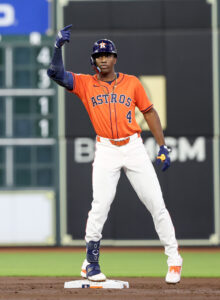
Sánchez’s tenure in Houston will only wind up lasting half a season. Houston acquired the lefty-swinging slugger from Miami at last year’s deadline in a trade sending righty Ryan Gusto, minor league infielder Chase Jaworsky and minor league outfielder Esmil Valencia to the Marlins.
Sánchez came to the Astros with a track record of hitting right-handed pitching but struggled against right-handed and left-handed opponents alike in his new environs. He slashed just .199/.269/.342 (71 wRC+) in 160 plate appearances as an Astro — a far cry from the .253/.319/.428 line he’d posted in nearly 1300 plate appearances with the Fish dating back to Opening Day 2023.
The Astros could have non-tendered Sánchez on the heels of those struggles but chose to keep him around despite a projected arbitration salary of some note. The two parties agreed to a $6.8MM deal for the 2026 season. Toronto will take on the entirety of that sum in this swap and, as a second-time luxury payor in the top penalty tier, pay a 90% tax on top of what they will pay Sanchez.
It’s a heavy price to buy low on a player, but Sánchez touts a career .253/.324/.450 batting line against right-handed pitching and has plenty of encouraging underlying metrics. He’s averaged a hearty 91.1 mph off the bat in his career and logged a robust 45.7% hard-hit rate. Last year’s 75.9 mph bat speed ranked in the 93rd percentile of MLB hitters.
Sánchez is limited to the outfield corners on the defensive side of things but offers solid range and a plus arm. In 2777 career innings in right field, he’s been credited with 11 Defensive Runs Saved. Statcast rates him five Outs Above Average in that time. He hasn’t played as much left field but has above-average marks there from both DRS and OAA.
The Jays don’t have an immediate path to regular at-bats for Sánchez, who’s out of minor league options. He’ll presumably occupy a part-time role, mixing into the outfield corners alongside fellow lefty swingers Nathan Lukes and Addison Barger, who figure to patrol the corners alongside center fielder Daulton Varsho. Sánchez gives the Jays a viable option in either outfield corner and can obviously log some time at designated hitter if George Springer needs a breather. He’s a nice bat to have in a limited role, and if he hits well enough to merit a raise in arbitration, he can be controlled through the 2027 season.
The addition of Sánchez adds some power to a lineup that will again be without last winter’s major offseason signing, Anthony Santander, for an extended period of time. Santander missed significant time in 2025 and hit poorly when on the field due to ongoing shoulder troubles. He recently underwent surgery on that balky shoulder and will be sidelined for five-plus months.
Toronto had obviously been hoping that an offseason of rest could get Santander back to the form he showed in Baltimore from 2022-24, when he slashed .244/.317/.478 with 105 home runs (including 44 in 2024). Instead, it’ll be another largely lost season for the switch-hitting slugger. Sánchez doesn’t have the same offensive ceiling due to his long-running platoon struggles, but he adds some power to help the Jays compensate for that loss.
Loperfido, 26, returns to the organization that originally drafted him with this trade. Houston sent him to Toronto alongside righty Jake Bloss and infielder Will Wagner in exchange for left-hander Yusei Kikuchi at the 2024 trade deadline. He wasn’t likely to break camp with the Jays and may not do so in Houston, either. He’s entering his final minor league option season and has five years of club control remaining.
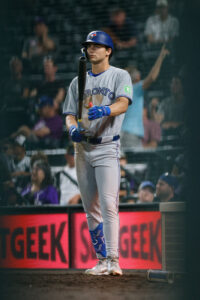
While Loperfido slashed .333/.379/.500 in 104 plate appearances for Toronto last season, there was a fair bit of smoke and mirrors involved in that batting line. His offensive output was propped up by a huge .431 average on balls in play that won’t be sustainable over a larger sample, and Loperfido logged a somewhat concerning 26% strikeout rate against just a 3.8% walk rate. His batted-ball metrics (87.3 mph average exit velocity, 37.1% hard-hit rate) were well below average. Loperfido spent the bulk of the 2025 season in Triple-A and was roughly a league-average hitter there, slashing .264/.341/.401 with a 21.4% strikeout rate and a below-average 7.8% walk rate.
Loperfido will have a chance to break camp with the ‘Stros but will need to earn his spot with a big spring performance. Houston has Jake Meyers locked into center field but minimal certainty otherwise. Rookie Zach Cole hit well in a 15-game cup of coffee last year, but he also struck out in 38% of his plate appearances after fanning at a 35% clip in the minors. His hit tool is a major red flag. Cam Smith was the talk of spring training last year, and the former top prospect had a hot start to his big league career before fading as the season went on.
Houston has been on the lookout for left-handed bats throughout the offseason and has continued its search in camp. Loperfido gives them a lefty hitter but does so at the cost of the left-handed Sánchez, so there’s no net gain. However, the most important aspect of this morning’s trade for the Astros could simply be shedding Sánchez’s $6.8MM salary from the books. General manager Dana Brown said in announcing the trade that he’s “not done” making moves (via Matt Kawahara of the Houston Chronicle).
Astros owner Jim Crane is reluctant to cross the luxury tax threshold for what’d be a second straight season, and prior to moving Sánchez, Houston was within $5MM or so of the $244MM tax line. Brown and his staff in the front office now have some extra breathing room as they look to make further additions to the roster. Houston’s infield logjam has been well-documented this winter, and corner infielder Isaac Paredes‘ name, in particular, has surfaced in frequent trade speculation. With some extra financial breathing room, the Astros have more leeway to make other additions without necessarily needing to move Paredes or find a taker for pricey first baseman Christian Walker (owed $40MM over the next two seasons) on the heels of a down year.
Astros, Pirates Have Discussed Joey Bart
Earlier this month, the Pirates were reported to have interest in trading for Astros third baseman Isaac Paredes. That no longer seems to be on the table now that Pittsburgh has agreed to a one-year, $12MM contract with DH Marcell Ozuna. Indeed, Jason Mackey of the Pittsburgh Post-Gazette confirmed that those trade talks have “since gone quiet.” However, Mackey also added a notable tidbit about those talks: The two sides discussed catcher Joey Bart as part of the package the Pirates would send to the Astros in exchange for the two-time All-Star Paredes. Mackey went on to speculate that it wouldn’t be surprising to see Bart come up in future trade talks as well.
After years of struggling to live up to his top-prospect billing in San Francisco, Bart blossomed into a productive part-time player with Pittsburgh. Over the past two seasons, he owns a .745 OPS and a 110 wRC+ in 173 games. His defensive metrics have been poor but passable, considering his above-average offense. All in all, he has produced 1.3 FanGraphs WAR in back-to-back campaigns; his 2.6 total fWAR puts him among the game’s top 25 catchers since 2024.
As valuable as Bart has been for the Pirates the last two years, they can afford to part with him. General manager Ben Cherington told reporters (including Mackey) that he believes former top prospects Henry Davis and Endy Rodríguez are capable of handling a “primary” catcher’s workload. He expressed the same faith in rookie Rafael Flores Jr. While Cherington went on to say that he will “hold onto that depth” for as long as he can, eventually, he’ll have to make a decision. The Pirates can’t carry four catchers on their Opening Day roster. The club certainly could decide to stick with Bart, the most proven choice, and option two of Davis, Rodríguez, and Flores to the minors. Yet, trading Bart also seems to be on the table.
The Astros still make sense as a suitor. After losing Victor Caratini in free agency to the Twins, Houston only has two catchers on its 40-man roster: starter Yainer Diaz and projected backup César Salazar. Non-roster invitee Carlos Pérez is the only other backstop in camp with big league experience. Salazar is entering his age-30 season with a .586 OPS, 0.3 fWAR, and 36 MLB games to his name. Pérez hasn’t played in the majors since 2023. And while Diaz ranked seventh among catchers in defensive innings last year, he still only started 111 games. There’s no question he could use a more proven backup.
The Rays are another potential suitor to consider; they were reportedly hoping to trade for a catcher back in January after missing out on free agent J.T. Realmuto. The Red Sox are another team that was, at least at one point, looking to improve behind the dish. Bart is set to make $2.53MM in his second year of arbitration eligibility. He will remain under team control through 2027.
Astros Notes: Hader, Diaz, Trade Market
Astros closer Josh Hader is behind schedule in camp after imaging revealed biceps inflammation a couple weeks ago, manager Joe Espada told the team’s beat as camp opened this morning (link via Chandler Rome of The Athletic). Espada added that Hader has already been resting for the past 10 days or so and is scheduled to resume throwing from flat ground today. Hader himself told reporters that he felt “pretty good” after his brief shutdown (video via MLB.com’s Brian McTaggart). He acknowledged being a “probably a few weeks behind” due to the minor setback. Hader didn’t rule out Opening Day but also declined to put a firm timetable on his rehab.
The 31-year-old lefty (32 in April) is entering the third season of a five-year, $95MM contract in 2026. Hader enjoyed a decent first season in Houston and a dominant second campaign; overall, he’s pitched to a 3.06 earned run average while striking out a colossal 37.4% of opponents against a roughly average 8.5% walk rate. He’s picked up 62 saves along the way. Bryan Abreu would be the top candidate for saves early in the season if Hader were to miss time.
Elsewhere in the Houston bullpen, righty Enyel De Los Santos is current shut down from throwing for a couple days due to a strain in his right knee (via McTaggart). The 30-year-old De Los Santos was a nice bargain addition in August. Houston signed the well-traveled righty to a big league deal after he was cut loose in Atlanta. He went on to pitch 22 1/3 innings as an Astro, working to a 4.03 ERA with far more encouraging rate stats (26.4 K%, 6.6 BB%). He was dinged for five home runs in that time — an average of 2.01 per nine frames — which continued a worrying trend from the 2024 season. However, the long ball wasn’t an issue for him in Atlanta, and De Los Santos yielded just 0.53 HR/9 from 2022-23 in Cleveland. He’s playing out his final season of club control on a $1.6MM salary.
Espada also announced to reporters this morning that catcher Yainer Diaz suffered a foot sprain on a slide into second base during the Dominican Winter League season (video via McTaggart). The injury took place back in December, and Diaz immediately flew to Houston for a diagnosis and to begin treatment. He’s catching bullpens, swinging the bat and throwing as normal, though he’s on what Espada described as a “modified” running program while the foot is in its final stages of mending. There’s no indication that Diaz will miss time to begin the season or even be hobbled early during exhibition play, but it’s still something to keep an eye on; Houston has reportedly already been poking around the market for a backup catcher.
In broader terms, the Astros remain active in both the free agent and trade markets. They’ve reportedly been seeking a left-handed-hitting outfielder as part of the return in any trade talks surrounding infielder Isaac Paredes, who remains available for clubs looking to add some thump at the infield corners and/or at designated hitter. General manager Dana Brown suggested today that trade talks have slowed down in general since camp opened but stated that Houston remains open to roster changes throughout the course of spring training (via Matt Kawahara of the Houston Chronicle).
In addition to seeking a backup catcher, looking for a lefty-hitting outfielder, and exploring trade scenarios for Paredes and pricey first baseman Christian Walker, the Astros have spent much of the offseason listening to interest in center fielder Jake Meyers.