
Astros, Blue Jays Swap Jesús Sánchez For Joey Loperfido
The Blue Jays have acquired outfielder Jesús Sánchez from the Astros in exchange for fellow outfielder Joey Loperfido, per announcements from both clubs. Both players are on the 40-man roster, so no corresponding moves will need to be made.
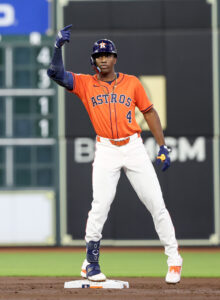
Sánchez’s tenure in Houston will only wind up lasting half a season. Houston acquired the lefty-swinging slugger from Miami at last year’s deadline in a trade sending righty Ryan Gusto, minor league infielder Chase Jaworsky and minor league outfielder Esmil Valencia to the Marlins.
Sánchez came to the Astros with a track record of hitting right-handed pitching but struggled against right-handed and left-handed opponents alike in his new environs. He slashed just .199/.269/.342 (71 wRC+) in 160 plate appearances as an Astro — a far cry from the .253/.319/.428 line he’d posted in nearly 1300 plate appearances with the Fish dating back to Opening Day 2023.
The Astros could have non-tendered Sánchez on the heels of those struggles but chose to keep him around despite a projected arbitration salary of some note. The two parties agreed to a $6.8MM deal for the 2026 season. Toronto will take on the entirety of that sum in this swap and, as a second-time luxury payor in the top penalty tier, pay a 90% tax on top of what they will pay Sanchez.
It’s a heavy price to buy low on a player, but Sánchez touts a career .253/.324/.450 batting line against right-handed pitching and has plenty of encouraging underlying metrics. He’s averaged a hearty 91.1 mph off the bat in his career and logged a robust 45.7% hard-hit rate. Last year’s 75.9 mph bat speed ranked in the 93rd percentile of MLB hitters.
Sánchez is limited to the outfield corners on the defensive side of things but offers solid range and a plus arm. In 2777 career innings in right field, he’s been credited with 11 Defensive Runs Saved. Statcast rates him five Outs Above Average in that time. He hasn’t played as much left field but has above-average marks there from both DRS and OAA.
The Jays don’t have an immediate path to regular at-bats for Sánchez, who’s out of minor league options. He’ll presumably occupy a part-time role, mixing into the outfield corners alongside fellow lefty swingers Nathan Lukes and Addison Barger, who figure to patrol the corners alongside center fielder Daulton Varsho. Sánchez gives the Jays a viable option in either outfield corner and can obviously log some time at designated hitter if George Springer needs a breather. He’s a nice bat to have in a limited role, and if he hits well enough to merit a raise in arbitration, he can be controlled through the 2027 season.
The addition of Sánchez adds some power to a lineup that will again be without last winter’s major offseason signing, Anthony Santander, for an extended period of time. Santander missed significant time in 2025 and hit poorly when on the field due to ongoing shoulder troubles. He recently underwent surgery on that balky shoulder and will be sidelined for five-plus months.
Toronto had obviously been hoping that an offseason of rest could get Santander back to the form he showed in Baltimore from 2022-24, when he slashed .244/.317/.478 with 105 home runs (including 44 in 2024). Instead, it’ll be another largely lost season for the switch-hitting slugger. Sánchez doesn’t have the same offensive ceiling due to his long-running platoon struggles, but he adds some power to help the Jays compensate for that loss.
Loperfido, 26, returns to the organization that originally drafted him with this trade. Houston sent him to Toronto alongside righty Jake Bloss and infielder Will Wagner in exchange for left-hander Yusei Kikuchi at the 2024 trade deadline. He wasn’t likely to break camp with the Jays and may not do so in Houston, either. He’s entering his final minor league option season and has five years of club control remaining.
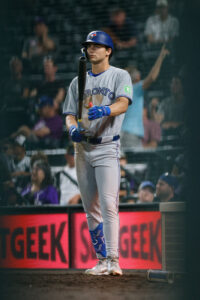
While Loperfido slashed .333/.379/.500 in 104 plate appearances for Toronto last season, there was a fair bit of smoke and mirrors involved in that batting line. His offensive output was propped up by a huge .431 average on balls in play that won’t be sustainable over a larger sample, and Loperfido logged a somewhat concerning 26% strikeout rate against just a 3.8% walk rate. His batted-ball metrics (87.3 mph average exit velocity, 37.1% hard-hit rate) were well below average. Loperfido spent the bulk of the 2025 season in Triple-A and was roughly a league-average hitter there, slashing .264/.341/.401 with a 21.4% strikeout rate and a below-average 7.8% walk rate.
Loperfido will have a chance to break camp with the ‘Stros but will need to earn his spot with a big spring performance. Houston has Jake Meyers locked into center field but minimal certainty otherwise. Rookie Zach Cole hit well in a 15-game cup of coffee last year, but he also struck out in 38% of his plate appearances after fanning at a 35% clip in the minors. His hit tool is a major red flag. Cam Smith was the talk of spring training last year, and the former top prospect had a hot start to his big league career before fading as the season went on.
Houston has been on the lookout for left-handed bats throughout the offseason and has continued its search in camp. Loperfido gives them a lefty hitter but does so at the cost of the left-handed Sánchez, so there’s no net gain. However, the most important aspect of this morning’s trade for the Astros could simply be shedding Sánchez’s $6.8MM salary from the books. General manager Dana Brown said in announcing the trade that he’s “not done” making moves (via Matt Kawahara of the Houston Chronicle).
Astros owner Jim Crane is reluctant to cross the luxury tax threshold for what’d be a second straight season, and prior to moving Sánchez, Houston was within $5MM or so of the $244MM tax line. Brown and his staff in the front office now have some extra breathing room as they look to make further additions to the roster. Houston’s infield logjam has been well-documented this winter, and corner infielder Isaac Paredes‘ name, in particular, has surfaced in frequent trade speculation. With some extra financial breathing room, the Astros have more leeway to make other additions without necessarily needing to move Paredes or find a taker for pricey first baseman Christian Walker (owed $40MM over the next two seasons) on the heels of a down year.
Astros Notes: Paredes, Walker, Smith, McCullers
The Astros have seemingly had too many infielders all winter but general manager Dana Brown has consistently downplayed the possibility of a trade, doing so again this week. Privately, the club may be less certain about holding everyone. Chandler Rome of The Athletic reports that some people within the team are questioning the viability of carrying everyone on the roster and that a trade is becoming more realistic.
Last year, the Astros had Isaac Paredes at third base and Christian Walker at first, at least for the first half of the season. Paredes suffered a significant hamstring strain in July, which prompted the Astros to acquire Carlos Correa from the Twins. Going into 2026, they project to have Jeremy Peña at shortstop, Jose Altuve at second base, Correa at third and then either Walker or Paredes at first.
Putting Paredes at the keystone and using Altuve in the outfield is generally seen as less than ideal. Altuve was bad in the outfield last year. Paredes hasn’t played second base since 2023 and there’s skepticism about how viable he would be if put back there again, though the Astros will have him do some drills there during camp.
Most of the rumors have therefore involved the Astros trading either Walker or Paredes and having the other cover first base. Walker is coming off a bit of a down year and is owed $20MM annually for another two years, making him hard to trade, especially since he’s about to turn 35. Paredes would have value but his lower salary is appealing to an Astros club looking to limbo under the luxury tax. He’ll make $9.35MM this year, less than half of Walker. He’ll get a bump in 2027 but would still be well under Walker’s $20MM salary.
If a trade doesn’t come together, manager Joe Espada would be left to find playing time for everyone by scattering off-days around the group. Using the designated hitter spot will be a challenge because the club wants to have Yordan Alvarez in there as often as possible. Though Brown has downplayed the rumors over and over again, there’s still time for a trade to come together.
Rome also notes that the Astros plan to give Cam Smith some center field reps in spring training. Smith came up as a third baseman but the Astros moved him to right field last year so that he would have a better path to playing time. He earned a big league job and showed some promise but his .236/.312/.358 batting line was subpar.
The bar for passable offense is a bit lower in center field, where teams often prioritize defense. Smith graded out well in right field last year, getting credited with 12 Defensive Runs Saved and one above par by Outs Above Average. His sprint speed was ranked in the 95th percentile last year, so he should have the wheels to move to center. The Astros considered some center field time for Smith last year but he didn’t get any game time there.
If Smith can hack it up the middle, that could open up a few possibilities for the club. They have been looking to add a left-handed bat to the lineup and could perhaps slot someone into right field. They have Jesús Sánchez on the roster but he struggled late last year and has been in some trade rumors. Center fielder Jake Meyers has also been in trade rumors and perhaps the club could feel more comfortable pulling the trigger there if Smith seems viable in the middle spot.
Turning to the pitching staff, Espada noted this week that Lance McCullers Jr. would be built up a starter in camp, per Brian McTaggart of MLB.com. McCullers was a starter for most of last year but was moved to the bullpen in August. Injuries led to him missing the 2023 and 2024 seasons. He was back on the mound last year but his velocity was down and he posted a 6.51 earned run average on the year.
Whether he can turn things around and get back on track is anyone’s guess. He will be further removed from his lengthy injury odyssey but the results in 2025 weren’t encouraging. The Astros may have a six-man rotation for a decent amount of 2026. McCullers projects to be in there with Hunter Brown, Cristian Javier, Tatsuya Imai, Mike Burrows and Ryan Weiss, with guys like Nate Pearson, Spencer Arrighetti, AJ Blubaugh, Miguel Ullola, Jason Alexander, Colton Gordon and Kai-Wei Teng also on the roster. Over the course of the season, Ronel Blanco, Hayden Wesneski and Brandon Walter will be trying to come back from Tommy John surgeries performed in 2025. McCullers is going into the final season of the extension he signed in 2021 and will be paid $17MM this year.
Photo courtesy of Charles LeClaire, Imagn Images
Will The Imai Signing Spur An Astros Trade?
The Astros finalized their three-year, $54MM deal with Tatsuya Imai this afternoon. It came as a surprise that the Japanese righty ended up in Houston — not because the Astros didn’t need a starter, but due to what appeared to be a tight budget.
Imai settled for an $18MM average annual value that landed below most projections. Houston got a short-term deal at a reasonable salary by offering opt-out chances after each of the first two seasons. RosterResource projects their Opening Day payroll around $242MM. They’re at an estimated $238MM in luxury tax commitments. The Astros also need to pay a $9.975MM release fee to Imai’s NPB club, the Seibu Lions. That does not count against their luxury tax ledger, though it’s a not insignificant sum for what could amount to one year of Imai’s services if he opts out.
The Astros opened the 2025 season with a $220MM payroll. Their season-ending luxury tax number landed just shy of $246MM, subjecting them to a modest ($1.5MM) bill for exceeding the $241MM base threshold. Next season’s cutoff is $244MM. They’re already projected within $6MM of that number. A team’s luxury tax payroll is not finalized until the end of the year, meaning in-season acquisitions count on a prorated basis towards that sum. So do any unlocked incentives and contracts for players on minor league deals who are selected onto the MLB roster.
Early offseason reporting indicated that Houston owner Jim Crane was reluctant to go beyond the tax line for what would be a third straight season. Chandler Rome of The Athletic wrote this morning that remains the case even with Imai on the books.
Will that be a firm mandate? Crane was loath to pay the CBT in each of the past two offseasons as well. That changed quickly in 2024, when they responded to a season-ending injury to Kendall Graveman by signing Josh Hader — a deal that rocketed them into tax territory. Houston stayed below the CBT line entering the ’25 season. Then came an opportunity to reacquire Carlos Correa at the deadline, again pushing them above. The owner has changed his mind before.
As it stands, it’s difficult to see the Astros staying below the tax line throughout the 2026 season. They’d be very limited in what they can accomplish at the trade deadline. RosterResource’s calculation is unofficial and pending resolution on a number of arbitration cases, so there are decent-sized error bars in the $238MM estimate, but the broader point remains that they’re not far below the CBT line. Some clubs prefer to have more than $10MM in payroll room for in-season additions.
That could lead the front office to clear a few million in an offseason trade. Let’s look at how their payroll is shaping up.
Players on Guaranteed Contracts (10)
- Carlos Correa, Jose Altuve, Yordan Alvarez, Christian Walker, Josh Hader, Tatsuya Imai, Lance McCullers Jr., Cristian Javier, Ryan Weiss, Nate Pearson
Correa, Altuve and Alvarez obviously aren’t getting traded. Hader anchors the bullpen and is headed into the third season of a five-year deal; he’s not going anywhere. Imai, Weiss and Pearson signed free agent contracts this offseason. That only leaves three possibilities from this group.
Javier is headed into the fourth season of a five-year, $64MM extension. His deal comes with a $12.8MM luxury tax hit. Tommy John surgery wiped out most of his last two seasons. He made it back for eight starts at the end of last year. His whiff rate was down compared to pre-surgery levels but the raw stuff didn’t look much different. It’s fair to attribute his inconsistency to some rust off the layoff. A team with a deeper rotation might consider selling low in this situation, but that’s not a luxury the Astros can afford. They’d need to replace him in the middle of the rotation and are unlikely to find anyone better in free agency for less than $13MM annually.
McCullers is making $17MM in the final season of his five-year extension. Injuries cost him all of 2023-24. He pitched to a 6.51 ERA around three more IL stints last year. He might be looking at minor league offers if he were a free agent. No one is taking any of this contact unless the Astros attach a prospect to convince a team to pay down a small percentage. Maybe that’d work for a rebuilding club, but McCullers also locked in full no-trade rights when he crossed the 10-year service threshold last season. There’s probably not much to be done about this one.
Of the players on guaranteed deals, that only leaves Walker. He’s owed $40MM over the next two seasons and counts for $20MM against the tax ledger. His first year in Houston was a disappointment. Despite hitting 27 homers, he had a below-average .238/.297/.421 batting line over 640 plate appearances. Walker’s typically excellent defensive metrics tanked. He picked things up offensively with a near-.800 OPS in the second half, though even that narrative is clouded by a .277 on-base percentage in September.
Altogether, Baseball Reference graded Walker as a replacement level player. FanGraphs credited him with one win. He wouldn’t come close to $40MM for his age 35-36 seasons if he were a free agent. Even getting another team to cover half the contract would be a stretch. (Ryan O’Hearn, who is two years younger, just signed a two-year deal at $14.5MM annually coming off a .281/.366/.437 season that was valued between 2-3 WAR.) The Astros could probably find a taker if they paid Walker down to $7-8MM per season, yet that’d be a lot of dead money to eat a third of the way into the contract. General manager Dana Brown downplayed the chance of moving Walker at the GM Meetings in early November, calling him the team’s “everyday first baseman.”
Arbitration-Eligible Players (12)
- Enyel De Los Santos, Bryan Abreu, Steven Okert, Isaac Paredes, Jesús Sánchez, Jeremy Peña, Jake Meyers, Hunter Brown, Yainer Diaz, Nick Allen, Bennett Sousa, Hayden Wesneski
There’s no chance of a Hunter Brown trade. Dana Brown said at the Winter Meetings that teams weren’t even asking about Peña because they’re aware “there’s no way” they’d move their franchise shortstop (via Rome).
De Los Santos will make $1.6MM after avoiding arbitration. The Astros could have non-tendered him if they just wanted that small amount off the books. Okert, Allen, Sousa and Wesneski are all projected by MLBTR contributor Matt Swartz for $2MM salaries or less. Savings compared to the $780K minimum would be negligible. They’re useful role players or, in Wesneski’s case, a potentially valuable long-term piece.
Abreu ($5.9MM projection) and Diaz ($4.5MM projection) are probably too valuable to trade. The former is their best setup man, the latter their starting catcher. While there’d be significant interest in both, they’re not easily replaced by someone making the league minimum. That leaves three players: Paredes, Meyers and Sánchez.
Paredes is projected for a $9.3MM salary and has two years of remaining control. The GM said in November that the team had “no interest” in moving him. Paredes had an excellent start to his Astros tenure, hitting 20 homers with a .254/.352/.458 line over 438 plate appearances. He missed most of the second half with a significant hamstring injury. The Astros responded by acquiring Correa to play third base. Paredes could factor in at second base but is unlikely to be a strong defender there. Walker is penciled in at first for now with Alvarez and Altuve splitting left field and designated hitter.
The Astros dangled Meyers for a controllable starter early in the offseason. It would’ve been a bit of a sell-high situation on the heels of a career-best .292/.354/.373 showing at the plate. He’s less likely to move now that the Astros dealt outfield prospect Jacob Melton to Tampa Bay in the three-team trade to land starter Mike Burrows. Meyers’ $3.5MM projection isn’t onerous, and trading him would place a lot of faith in rookie Zach Cole to step up as an everyday center fielder.
That may leave Sánchez as their top candidate for a pure salary dump move. He’s projected for a $6.5MM salary, and it came as a surprise that Houston tendered him a contract at all. Sánchez was a disappointment after a deadline deal from Miami, batting .199/.269/.342 over 160 plate appearances while making a handful of defensive lapses. They could shop Sánchez and add a cheaper left-handed free agent outfielder (e.g. Mike Tauchman, Michael Conforto) to compete with Cole and Cam Smith for right field playing time.
Astros Have Received Interest In Jesus Sanchez
The Astros are losing Framber Valdez to free agency, leaving them in need of multiple starting pitchers behind ace Hunter Brown. Houston has taken cheap one-year fliers on former top prospect Nate Pearson and KBO returnee Ryan Weiss to compete for spots at the back of the staff. Those are fine dice rolls, but they’ll need to acquire someone whom they can comfortably slot alongside Cristian Javier in the middle of the rotation.
If owner Jim Crane remains loathe to cross the luxury tax line, the front office won’t have much flexibility to add free agent starting pitching. Chandler Rome of The Athletic writes that the club is indeed more likely to address the rotation via trade. One of the league’s weakest farm systems won’t do them any favors, so they might be looking at dealing from the MLB roster to accomplish that.
Houston is reportedly open to dealing standout defensive center fielder Jake Meyers for pitching. Meyers is coming off a career-best season at the plate and is controllable via arbitration for two seasons. He’s the best trade chip in the Houston outfield, but he’s not the only candidate to move this offseason. Rome reports that the Astros have gotten interest from other clubs in right fielder Jesús Sánchez as well.
That could explain why Sánchez remains on the roster at all. MLBTR contributor Matt Swartz projects him for a $6.5MM salary in his third of four trips through the arbitration process. It came as a surprise that Houston tendered him a contract. Sánchez had a very poor finish to the 2025 season, batting .199/.269/.342 over 160 plate appearances after being acquired from Miami at the trade deadline. Combined with the escalating salaries and the payroll restrictions, it made him a non-tender candidate.
General manager Dana Brown acknowledged at last month’s GM Meetings that he was open to trade inquiries on Sánchez. Even if they’re not especially interested in paying him $6-7MM, it seems they found enough interest that they didn’t want to let him go for no return.
Sánchez isn’t going to net a mid-rotation arm, but it’s possible they swap him for a back-end starter. Teams like the Royals, Pirates, Guardians and Phillies could look to the trade market for a corner outfielder. While Sánchez has never lived up to his billing as a top prospect, he was an alright everyday player throughout his time with the Marlins. He was a league average hitter between 2021 and the ’25 deadline, hitting .246/.312/.432 in nearly 1900 plate appearances. He has plus bat speed and has typically posted strong exit velocities, though his batted ball metrics also collapsed in Houston.
Even if the Astros are unlikely to swap Sánchez for their biggest rotation pickup of the offseason, a change-of-scenery deal would create a bit of spending room. Trading both Sánchez and Meyers would leave them very thin in the outfield, and dealing the former would subtract one of their few left-handed bats. While Dana Brown has already said they’re not interested in moving Isaac Paredes, that might be something the front office needs to consider later in the offseason if they can’t find a mid-rotation arm in a different way.
Astros Aiming To Stay Under Luxury Threshold
For a second straight offseason, Astros owner Jim Crane is “wary” of exceeding the luxury tax threshold, Chandler Rome of The Athletic reports. Dipping under the tax line was a clear priority for Houston last offseason as well.
This year’s first-tier luxury threshold lands at $244MM. Per RosterResource, the Astros are currently about $25MM shy of that mark. Their DFA of Ramon Urias and last night’s trade of fellow utilityman Mauricio Dubón (for lower-priced utility option Nick Allen) trimmed a net $8.7MM off that payroll projection, which uses MLBTR contributor Matt Swartz’s projected arbitration salaries.
Houston’s current $218.9MM luxury tax projection could — and very likely will — dip further over the next 36 hours. The deadline to tender contracts to arbitration-eligible players is tomorrow at 5pm ET. The ‘Stros have several plausible non-tender candidates, including outfielder Jesus Sanchez ($6.5MM projected salary), reliever Enyel De Los Santos ($2.1MM projection) and outfielder Taylor Trammell ($900K projection). If the Astros move on from that trio, they’d trim a net $7.15MM from the current $218.9MM projection.
The Astros are known to be in the market for rotation help — they already took a cheap one-year flier on former top prospect Nate Pearson, guaranteeing him $1.35MM — and have been working to balance out a heavily right-handed lineup for the better part of the past calendar year. Framber Valdez is a free agent, leaving Hunter Brown atop a starting staff with more question marks than reliable contributors.
Cristian Javier is a quality mid-rotation arm when healthy, but 2026 will be his first full year back from Tommy John surgery. Lance McCullers Jr. returned from a two-year injury absence in 2025 but struggled badly. Spencer Arrighetti missed most of the season with a broken thumb. Jason Alexander was a surprise contributor in 2025, but he’s a journeyman 33-year-old with no prior MLB success who’d struggled in Triple-A from 2023-24. J.P. France pitched just four MLB frames and was hit hard in Triple-A after spending the first two-thirds of the season rehabbing from shoulder surgery. Left-hander Colton Gordon was tagged for a 5.34 ERA in 19 starts as a rookie. Righty AJ Blubaugh impressed in his first 32 big league innings but was tagged for a 5.27 ERA in a much larger Triple-A sample. Each of Ronel Blanco, Hayden Wesneski and Brandon Walter underwent Tommy John surgery. Prospect Miguel Ullola could factor in, but he’s yet to pitch in the majors and has poor command.
Suffice it to say, the need for starting pitching is acute, but the means to acquire it aren’t exactly plentiful. The Astros can certainly add one free agent starter at a notable salary, but that’d eat up a good chunk of the space they have between their current standing and the first luxury tier. Adding a left-handed bat to a lineup where Yordan Alvarez and rookie outfielder Zach Cole are the only current options (assuming Sanchez is non-tendered or traded) will also cut into the gap. Houston would presumably prefer to add another catcher, too; current backup Cesar Salazar hit just .213/.353/.353 in Triple-A this past season and has just 67 career plate appearances in the majors. He’ll turn 30 in March. And of course, most teams prefer to maintain at least a little financial wiggle-room for in-season dealings.
The trade market always presents alternative options, but Houston’s farm system is in dire straits. The Astros have long shown a knack for coaxing strong performances out of pitchers who weren’t considered top-tier talent throughout the industry (though the team clearly stalled in that regard this past season). However, that doesn’t mean other clubs will be lining up to surrender established talent in exchange for minor leaguers from what’s widely regarded as a bottom-five system in the game.
It’s feasible that further trades could be engineered to create more spending power, but GM Dana Brown has downplayed the possibility of moving first baseman Christian Walker (owed $40MM through 2027) and flatly said that he has “no interest” in trading infielder Isaac Paredes ($9.3MM projected salary). As things stand, the Astros have limited spending power to address their needs and an even more limited stock of minor league talent to peddle if they try to upgrade via trade. There are never any “easy” answers when trying to assemble a competitive roster with sufficient depth to navigate a 162-game season, but Brown & Co. are staring at their most complicated puzzle in recent memory.
Astros Announce Several Roster Moves
The Astros announced a lengthy slate of post-deadline moves Friday. Houston reinstated shortstop Jeremy Pena from the injured list and designated infielder Zack Short for assignment. The Astros also activated newly reacquired Carlos Correa and fellow trade acquisitions Jesus Sanchez and Ramon Urias, adding all three to the active roster.
In corresponding roster moves, Infield prospect Brice Matthews and outfield prospect Jacob Melton were optioned to Triple-A Sugar Land. The ‘Stros also recalled righty Nick Hernandez to take the roster spot of righty Ryan Gusto, who was traded to the Marlins in the Sanchez deal. Finally, right-hander Nick Robertson was outrighted to Triple-A after clearing waivers. He’d been designated for assignment earlier in the week.
Pena wound up missing more than a month due to a fracture in his ribcage. He was in the midst of a breakout, MVP-caliber season prior to landing on the injured list. The 27-year-old has slashed .322/.378/.489 (143 wRC+) with 11 homers, 18 doubles, a triple and 15 steals in 350 plate appearances. He was also playing Gold Glove-caliber defense at shortstop, generating plus marks from Defensive Runs Saved (7) and Outs Above Average (4). He’ll return to his customary shortstop, while the newly reacquired Correa will slide over to third base in deference to the young shortstop who he mentored during the pair’s prior overlap in the Astros organization.
As for Short, he’ll be placed on waivers within the next five days now that the trade deadline has passed. He’s appeared in 22 games and taken 56 plate appearances with just a .220/.291/.380 output to show in that small sample. The 30-year-old Short has appeared in parts of five big league seasons and is a .172/.271/.296 hitter in 594 trips to the plate as a major leaguer. He’s a solid defender at multiple infield positions but is out of minor league options, so he’ll either clear waivers or have to stick on the major league roster of another club that claims him.
Astros Acquire Jesús Sánchez
The Astros have acquired left-handed hitting outfielder Jesús Sánchez from the Marlins. In exchange, Miami has received right-hander Ryan Gusto, infield prospect Chase Jaworsky, and outfield prospect Esmil Valencia. Both teams have announced the trade.
Houston was known to be seeking a left-handed bat ahead of the deadline, to help balance out a lineup that is sorely missing star slugger Yordan Alvarez. Sánchez is no Alvarez, but he has provided the Marlins with above-average power throughout his career, particularly against right-handed pitching. He has hit double-digit home runs in each of the past five seasons, while his career .184 isolated power (ISO) is about 15% better than league average. Mediocre on-base skills and a typically high strikeout rate mean his overall numbers are closer to average (career 100 wRC+), but he has been consistently productive with the platoon advantage. Sánchez has hit 60 of his 69 home runs against right-handers, with a .203 ISO and a 115 wRC+. He has been particularly effective against righties this year, with a career-best 125 wRC+ and a 19.4% strikeout rate. While his 27.6% strikeout rate against southpaws is still quite high, his overall 20.8% strikeout rate is easily the lowest of his career; this is the first year he has ever had a strikeout rate better than the league average.
Sánchez is strictly a platoon bat, with a .178/.226/.284 career slash line against lefties, but that shouldn’t be a problem for the Astros, who rank second in MLB in OPS and wRC+ against left-handed pitching and have enough right-handed hitters that they shouldn’t have any trouble shielding Sánchez from southpaws. However, the only lefties on their active roster right now are Taylor Trammell and Jacob Melton, as well as the switch-hitting Victor Caratini and Cooper Hummel, and they rank among the bottom half of teams in OPS and wRC+ against right-handers. So, it’s not hard to see how Sánchez slots in and improves the lineup. He can take outfield playing time that’s been going to Hummel, Melton, and Trammell, and/or DH reps that have been going to Caratini against right-handed pitching.
In exchange for Sánchez, who is making $4.5MM this year and remains under team control through arbitration through 2027, the Marlins receive a rookie hurler and two position player prospects. According to MLB Pipeline, Jaworsky, 21, is the headliner; they have him ranked as Houston’s no. 13 prospect, while Valencia is no longer on the organizational top 30. Similarly, Baseball America put Jaworsky at no. 22 and did not rank Valencia in their latest update. Most sources agree that Jaworsky projects as a utility infielder with good speed, but a lack of power means he’ll need to improve his plate discipline in order to get enough out of his hit tool. FanGraphs, interestingly, is higher on Valencia (Astros no. 20) than Jaworsky (no. 26). The 19-year-old outfielder seems to have a higher offensive ceiling but carries more risk, in large part due to poor swing decisions. Ultimately, both players project as role players; that’s not too surprising considering Sánchez himself isn’t an everyday player.
As for Gusto, he wasn’t a name that many had an eye on entering the season, but the 26-year-old has been surprisingly effective in his first big league campaign. Through 24 games (14 starts), he has a 4.92 ERA and a much more impressive 3.92 SIERA over 86 innings pitched. He helped the Astros survive a great number of pitching injuries over the first four months of the season, but with Houston looking to add pitching today and hoping to reinstate some arms from the IL soon, Gusto was expendable. He will now be able to help the Marlins fill innings over the remainder of the season, and they’ll have him under team control (with three option years remaining) for another five seasons.
Sánchez heading to the Marlins was first reported by Michael Schwab. MLB.com’s Mark Feinsand added that the Marlins would receive Gusto in the deal. Barry Jackson of the Miami Herald reported the Marlins would also get back two prospects in exchange for Sánchez. Isaac Azout of Fish on First identified one of the prospects as Jaworsky, while Craig Mish of Sportsgrid identified the other as Valencia.
Latest On Ryan O’Hearn
All-Star first baseman/DH/right fielder Ryan O’Hearn will be a free agent after the season, making him an obvious trade candidate given the Orioles’ struggles this year. MLB.com’s Mark Feinsand says Baltimore’s price on O’Hearn is nonetheless “very high,” though that may be standard posturing with the trade deadline about two hours away.
O’Hearn, 32, has an excellent 134 wRC+ in 361 plate appearances this year. It’s worth noting, however, that most of his production came in the season’s first two months, as the lefty slugger has slipped to a 92 wRC+ since June. Also consider that O’Hearn requires a platoon partner; the Orioles sit him against southpaws on a regular basis.
The “very high” price tag, then, feels like a bit of a stretch, but O’Hearn is still a solid bat in a market light on those. One potential suitor is the Rangers, according to Jon Morosi of MLB Network, althoughEvan Grant of the Dallas Morning News doesn’t see the fit. The Brewers were connected to O’Hearn two days ago. Feinsand notes that the Astros were interested in O’Hearn, but the Marlins’ Jesus Sanchez is “now high on Houston’s radar.”
O’Hearn is earning $8MM this year, meaning about $2.5MM remains. Given that the 2026 qualifying offer will likely be north of $21MM, the Orioles almost have to trade O’Hearn prior to the deadline to recoup some value.
Latest On Marlins Pitchers, Outfielders
2:38pm: MLB.com’s Bryan Hoch reports that the Yankees have pitched the Marlins on a potential package deal involving Alcantara and Bender.
10:25am: All eyes are on Sandy Alcantara today, with less than seven hours to go until the MLB trade deadline. The former Cy Young winner sports an ugly post-Tommy John 6.36 ERA in 21 starts, but he has totaled 12 scoreless innings in his last two starts against the Padres and Cardinals.
Alcantara is controlled through 2027 by virtue of the contract extension he signed over three years ago. The Astros and Red Sox were linked to him yesterday, while the Mets, Padres, and Cubs are among those previously connected. This morning, Jon Heyman of the New York Post adds another potential suitor: the Yankees.
The Yankees have Luis Gil set to make his season debut Sunday against the Marlins following his spring lat strain, which may send Cam Schlittler back to Triple-A (if the latter isn’t included in a trade today). Gil will join veterans Max Fried, Carlos Rodon, and Marcus Stroman, as well as Will Warren. As Greg Joyce of the New York Post wrote yesterday, a rotation acquisition by the Yankees would force a choice between Warren and Stroman.
With a competitive balance tax payroll around $314MM after additions of Ryan McMahon, Amed Rosario, and Austin Slater, the Yankees face a 110% tax on every dollar they add this summer. Alcantara is earning $17MM this year and next, with a club option for 2027. Acquiring Alcantara would mean adding more than $6MM to the Yankees’ CBT ledger for this year, plus a tax of around $6.7MM.
Teams seeking starting pitching are also intrigued by hard-throwing Marlins righty Edward Cabrera. Cabrera, 27, is having a better season than Alcantara and is under team control through 2028 at much lower (expected) salaries than Alcantara. As such, it makes sense that the Yankees are interested in Cabrera, as Jon Morosi of MLB Network reports today with five hours left until the deadline. The Marlins are eyeing powerful Yankees outfield prospect Spencer Jones, notes Morosi. According to Will Sammon of The Athletic, “interest in both Alcantara and Cabrera is very high.”
Sammon also notes that a pair of Marlins righty relievers are drawing interest in Ronny Henriquez and Calvin Faucher. Henriquez’s 32.4 K% ranks 20th among relievers this year, and he’s been mentioned as an under-the-radar trade candidate by MLBTR several times this month. Given that Henriquez was a February waiver claim who had limited MLB experience with the Twins, he’s under team control through 2030.
As you might expect, Sammon reports that Faucher is more likely to be traded today. Faucher, 30 in September, has a 3.73 ERA, 23.2 K%, and 10.7 BB% this year with a 44.2% groundball rate. He’s less intriguing than Henriquez, but is under control through 2029. Righty Anthony Bender has also been in rumors this month.
Finally, Sammon points out that Marlins outfielders Jesus Sanchez and Dane Myers are also drawing interest. Sanchez, 28 in October, is under team control through 2027. He’s a left-handed hitter who has a slightly above average 104 wRC+ since 2023, though against righties he’s at 119 during that time. Myers, a December 2022 waiver claim from the Tigers, is under team control through ’29. He’s a righty hitter who can serve as a lefty masher, given his 141 wRC+ against southpaws in 172 plate appearances dating back to 2023.
Sanchez has been playing right field for the Marlins, often sitting against lefties. Myers has been taking most starts in center, occasionally sharing with Javier Sanoja.
Astros Interested In Dylan Cease
TODAY: Cease is the Astros’ “main target,” a source tells MLB.com’s Mark Feinsand.
JULY 29: The Astros have Padres right-hander Dylan Cease atop their deadline wish list, according to a report from Ken Rosenthal and Chandler Rome of The Athletic. Houston is also known to be looking for a bat and the report lists Willi Castro of the Twins, Jesús Sánchez of the Marlins and Jake McCarthy of the Diamondbacks as names the Astros are considering. MLBTR covered Houston’s interested in Castro earlier this week.
The Houston rotation has had a rough go in terms of health this year. They started the season with Luis Garcia, J.P. France and Cristian Javier on the injured list due to surgeries in previous years. They’re all still on the shelf. Since the start of the season, Ronel Blanco and Hayden Wesneski have required Tommy John surgery, putting them out for the rest of the year. Spencer Arrighetti suffered a fractured thumb in a freak accident, getting hit during batting practice, and has been out for almost three months now. In the past two weeks, Lance McCullers Jr. hit the IL with a blister and Brandon Walter was sidelined by elbow inflammation.
They still have a strong one-two punch atop the rotation with Framber Valdez and Hunter Brown but things get dicey after that. Currently, Colton Gordon, Ryan Gusto and Jason Alexander are filling in. The Astros will naturally want to add some arms and push those guys down the depth chart. It’s possible they could get some guys off the IL in the coming months, but it’s understandable that they don’t want to rely on that.
Cease has been one of the most reliable pitchers in the game. Since getting promoted in 2019, he hasn’t gone on the injured list, apart from a two-day stint on the COVID list in 2021. He made 12 starts in the shortened 2020 season. He has made at least 32 starts in each full season since. He’s already up to 22 this year.
That reliability would certainly be attractive to the Astros amid all the injuries, though the quality has often been quite strong as well, as Cease has regularly struck out roughly 30% of batters faced. His earned run average has oscillated over the years thanks to some wobbles in his batting average on balls in play, strand rate and home run rate. His advanced metrics have held more steady. For his career, he has a 3.69 FIP and 3.82. In a full season, he’s never had a SIERA higher than 4.10 or a FIP higher than 3.72.
This year’s 4.79 ERA in on the high side, though at least part of that seems to be beyond Cease’s control. His .323 BABIP, 68.5% strand rate and 13.3% homer to fly ball rate are all to the unfortunate side. His 3.64 FIP and 3.37 SIERA suggest he’s largely been the same guy as in previous seasons. His ERA is also inflated a bit by a nine-run shellacking in his third start of the year.
Though Cease makes plenty of sense for the Astros on the field, there are other matters to consider. He is making $13.75MM this year, which leaves about $4.5MM left to be paid out. The Astros have clearly tried to avoid the competitive balance tax this year, dumping money in the offseason by trading Kyle Tucker and Ryan Pressly. RosterResource currently pegs the club’s CBT number at $236MM, just $5MM from the base threshold of the tax. That’s just an estimate and it might be off by a few million in either direction.
Perhaps the Astros can add Cease and stay under the line but they also want to add a bat, which could make it tricky. On the other hand, the report from The Athletic suggests that owner Jim Crane likes star players and might be willing to cross the line in order to get someone like Cease. He was reportedly willing to cross the line in the offseason in order to re-sign Alex Bregman, though Bregman ultimately landed with the Red Sox.
The Astros will also have to offer the Padres something they would like. The Friars aren’t selling in the commonly understood sense. Their plan with dealing Cease is to perhaps save some money, add a left fielder or a catcher, or prospects, or some combination of those goals. They could then use either the prospects or the saved money to acquire another starting pitching to replace Cease.
Houston doesn’t have a strong farm system, so perhaps the prospect part will be hard for them to pull off, though they could help out in some of the other areas. Catcher Victor Caratini is having a good year, though Yainer Diaz is struggling, so perhaps the Astros wouldn’t want to part with Caratini. Though if they did, Caratini is making $6MM this year, so flipping him would give the Astros some extra CBT space.
In the outfield, the Astros are currently without Jake Meyers and Yordan Alvarez. Their current mix includes Cam Smith, Taylor Trammell, Jose Altuve, Jacob Melton, Cooper Hummel and Chas McCormick. Houston’s not giving a ton of playing time to McCormick, who has some decent seasons on his track record. However, he hasn’t been good for a couple of years now, so the Padres probably don’t have too much interest. Trammell has been hitting well lately but while striking out in more than 30% of his plate appearances. Hummel has been DFA fodder all year. Altuve and Smith aren’t going anywhere. Melton might be hard to pry loose because he hits left-handed, something the Astros lack, and is covering center field with Meyers out.
The report from The Athletic points out that the Astros traded three notable prospects to get a rental pitcher at last year’s deadline, flipping Jake Bloss, Joey Loperfido and Will Wagner to the Jays for Yusei Kikuchi. Perhaps they could do so again, though it’s unclear if they have the farm system to do it.
If they have some guys the Padres like, it’s theoretically possible that the Friars could then use those guys to upgrade elsewhere. A sequence of events like this helped them land Cease in the first place. They traded Juan Soto to the Yankees for a bunch of pitchers, including Michael King and Drew Thorpe. They then quickly put Thorpe in a package to send to the White Sox to get Cease. Perhaps the Astros can make it work but they will have competition. Cease has also been connected to the Mets, Cubs, Blue Jays, Rays, Red Sox and Yankees.
As for the hitters, the Astros have also suffered a number of injuries to the lineup. As mentioned, Alvarez and Meyers are on the shelf, as well as shortstop Jeremy Peña, third baseman Isaac Paredes and others. Astros general manager Dana Brown has said the club would love to get a lefty bat, ideally one who could play the infield and/or left field. Players like Altuve, Mauricio Dubón and Zack Short have some defensive versatility, giving the Astros a bit of flexibility in what kind of bat they add.
Sánchez has been a roughly league average bat in his time with the Marlins. He has a .243/.310/.425 career batting line and a wRC+ of exactly 100. He is making $4.5MM this year, which leaves about $1.5MM left to be paid out. He can be controlled via arbitration for another two seasons. He’s been far better against righties in his career, which could appeal to Houston. He has a .179/.228/.287 slash against southpaws but a .258/.330/.459 line otherwise. The rebuilding Marlins likely aren’t clinging too tightly to him.
McCarthy has been good in the past but not this year. He slashed .285/.349/.400 for a 110 wRC+ in 2024, also adding 25 steals and quality defense. This year, he has a brutal .158/.232/.277 line and was sent to the minors for a few months. He did hit well in Triple-A, slashing .314/.401/.440, so perhaps the Astros see a path to getting him back on track. He still hasn’t qualified for arbitration and is being paid around the league minimum, which would be attractive for the Astros.
Photo courtesy of Sam Navarro, Imagn Images