
Latest On Alex Bregman’s Market
Alex Bregman remains unsigned with less than a month until pitchers and catchers report to Spring Training. Bregman won’t be returning to the Astros after rejecting a reported six-year, $156MM offer that led Houston to pivot to an Isaac Paredes/Christian Walker corner infield tandem.
Early in the offseason, it seemed Bregman and his representation at the Boras Corporation were seeking to eclipse the $200MM mark. Whether that’s still the goal isn’t clear, though it stands to reason that some teams are hopeful he could move off a lofty ask as he lingers on the open market.
To that end, Bruce Levine of 670 The Score writes that the Cubs recently had “casual” conversations with Boras about Bregman. Levine suggests that the Cubs aren’t interested in offering a long-term deal. It seems they’re on the periphery of the market in case the two-time All-Star considers a shorter term with opt-out clauses. There’s nothing to suggest Bregman is currently willing to do so, however.
Chicago traded Paredes as the centerpiece of the Kyle Tucker blockbuster. Top prospect Matt Shaw is the favorite for the third base job. Shaw combined for a huge .284/.379/.488 slash with 21 homers and 31 stolen bases between Double-A and Triple-A last season. Giving him the starting job would be justifiable, but there’s no guarantee that even a prospect of Shaw’s caliber hits the ground running against big league pitching. The Cubs don’t really have a capable fallback in case Shaw falters. Vidal Bruján, Luis Vázquez and Rule 5 pick Gage Workman are the backup infielders on the 40-man roster.
Bregman would provide a much higher floor. He popped 26 homers with a .260/.315/.453 line in his final season in Houston. Bregman remained an All-Star caliber player despite taking dramatically fewer walks than he had in his previous six seasons. He’s entering his age-31 season, so while it’s understandable if teams are reluctant to commit six or seven years, Bregman shouldn’t be in danger of any kind of immediate drop-off.
The Cubs have sat out the top of the market for consecutive offseasons. They haven’t made a nine-figure investment since committing $177MM to Dansby Swanson over the 2022-23 winter. Chicago was never a factor on Juan Soto, nor did they seemingly have any interest in playing at the top of the starting pitching market. They’ve been loosely linked to Jack Flaherty, though it appears they’re similarly waiting on the fringe of the market in case a buy-low opportunity presents itself. The Cubs have roughly $198MM in luxury tax commitments, according to the RosterResource calculations, putting them more than $40MM shy of the base threshold.
Mariners Acquire Miles Mastrobuoni, Designate Nick Raposo
The Mariners announced that they have acquired infielder/outfielder Miles Mastrobuoni from the Cubs. The latter club had designated him for assignment last week and now receives cash considerations for his departure. Seattle designated catcher Nick Raposo for assignment to open a roster spot.
Mastrobuoni, 29, has been a part-time big leaguer over the past few years. Over the past three seasons, he has appeared in 119 games and taken 272 plate appearances, mostly with the Cubs but also with the Rays. He has a tepid .219/.279/.263 batting line in that time but has stolen 16 bases in 17 tries while providing defensive versatility. He has spent time at the three infield positions to the left of first base as well as the outfield corners.
As is often the case with a depth player like this, the minor league performance has been better. Over the past three years, he’s had 982 Triple-A plate appearances with 22 home runs, an 18.1% strikeout rate, 12.8% walk rate, .278/.371/.434 slash line and 114 wRC+.
The Mariners have been looking for infield upgrades this winter. They lost Justin Turner to free agency, turned down an option on Jorge Polanco and non-tendered Josh Rojas. That left them with J.P. Crawford at shortstop and no clear answers for the other positions. They have various possible solutions on the roster, including Luke Raley, Dylan Moore, Ryan Bliss, Austin Shenton and others, though strengthening the group has clearly been a goal this winter. The club signed Donovan Solano this week but shouldn’t be done.
Mastrobuoni won’t fix everything but he’s a solid addition to that cluster of potential contributors. He can bounce around to multiple positions and steal a few bases at least. The offense in the majors hasn’t been good yet but the minor league numbers have been better, perhaps suggesting there’s potential for more there. He also has an option remaining, meaning he doesn’t need to be given an active roster spot and can be shuttled between the minors and majors with relative ease.
Raposo, 27 in June, was just claimed off waivers from the Blue Jays last month. He hasn’t yet made his major league debut. He first got a 40-man roster spot from the Cardinals last summer, when both Iván Herrera and Willson Contreras were injured, but never got into a game. He went from the red birds to the blue birds in August when the Jays claimed him off waivers, though Toronto lost him to Seattle a few months later.
In his four years of minor league experience, he has a .241/.321/.387 line and 85 wRC+ in 808 plate appearances. Baseball Prospectus has given him solid marks for his blocking and throwing in the minors. He still has a couple of options and just a handful of days of service time.
The M’s will now have a week to figure out what’s next for Raposo. That could be a trade or Raposo could be put on waivers again. The waiver process takes 48 hours so any trade talks would need to happen in the next five days.
Dodgers, Padres, Blue Jays Reportedly Finalists For Roki Sasaki
The Roki Sasaki frenzy is nearing its completion. Several teams have reportedly been told that they won’t be signing the right-hander and now Jeff Passan of ESPN reports that the Dodgers, Padres and Blue Jays are the three finalists. The Cubs are no longer in the running, according to Mike Rodriguez, with Sahadev Sharma of The Athletic adding that the Cubs have been informed of their status.
It seems that today was the day that Sasaki and his reps started informing teams that had been eliminated from the running. Earlier today, various reports indicated that the Giants, Yankees, Mets, Rangers and Diamondbacks would not be signing Sasaki. The Mariners were vaguely connected to Sasaki at times and hadn’t been expressly eliminated, but it seems they didn’t make it to the podium as one of the top three.
Sasaki’s decision has been one of the biggest wild cards hanging over the offseason. Since he’s coming over to the big leagues before his 25th birthday, he’s considered an amateur under MLB rules and is therefore subject to the international bonus pool system. As such, no club could be initially ruled out just based on economics, as is usually the case with other free agents.
Each team gets an annual pool of money that they are allowed to spend on international amateurs. This year’s pools are in the $5-8MM range, with the smaller-market clubs mostly having the slightly larger ones. Teams can trade for more pool space but they can’t increase their initial allotment by more than 60%. A posting fee will also be owed to the Chiba Lotte Marines, Sasaki’s former club in Japan, though that will only add 20% of the bonus. As such, each team has roughly the same ability to pay Sasaki a few million bucks.
Sasaki is likely therefore to decide based on factors beyond money. After all, if money was his top priority, he probably would have waited until he turned 25. That’s what Yoshinobu Yamamoto did, which led to a $325MM deal from the Dodgers.
No one can say for sure what Sasaki is prioritizing, though the Dodgers and Padres have been seen as logical suitors for a while now. Both clubs are on the West Coast, which is closer to Japan, perhaps a favorable factor when considering the flights for Sasaki and his family members. The Dodgers also have a strong reputation as a whole, having made the postseason in each year going back to 2013, with a fresh World Series victory in 2024. The Padres don’t have quite the same track record of success but have been good in recent years.
Both clubs also have Japanese players on the roster, with the Dodgers having Yamamoto and Ohtani, while the Padres have Yu Darvish. Some reports have suggested Sasaki and Darvish have an especially close relationship.
The Jays have been floated as a landing spot for Sasaki far less than the Dodgers or Padres, which is sensible. They are not on the West Coast. They had a strong run of contention from 2020 to 2023 but are coming off a down season. They had Yusei Kikuchi until last year’s trade deadline but don’t currently have a Japanese player on the roster.
In April of 2023, Ken Rosenthal of The Athletic wrote that “Some Japanese players are uncomfortable being major-league teammates with other Japanese players because of the importance of seniority in Japan’s hierarchical culture, major-league executives and agents say.” That piece was examining the possibility of Ohtani singing with the Mets when they already had Kodai Senga on the roster. Sasaki’s agent Joel Wolfe has downplayed the importance of a club having Japanese players on its roster, either positively or negatively. “That was never a topic of discussion,” Wolfe said last month, per Alden Gonzalez of ESPN.
It’s possible that Sasaki will be attracted to playing in another country for other reasons. Wolfe has suggested that the Japanese media was often unkind to Sasaki, which could perhaps make it preferable for him to be in a smaller market. Toronto isn’t exactly a small market but it would be further away from the American media spotlight. The Blue Jays are also owned by Rogers Communications, the media company that broadcasts the club’s games on television and radio. Perhaps that would allow the Jays to promise Sasaki a more guarded environment in terms of media access. Toronto is also a city with a reputation for its diversity and relatively low crime rates.
Those are all speculative arguments, but the same could be said about the arguments for Sasaki preferring Los Angeles or San Diego. Sasaki and Wolfe have given very few clues about what will be used to make the final decision, leaving the baseball world to mostly guess.
Whatever he decides will likely have ripple effects into the rest of the offseason. The Padres have a tight budget and needs all over their roster. Trading Dylan Cease is reportedly one potential solution to their situation, which would perhaps become more likely if they sign Sasaki. The Dodgers already have lots of rotation options and might consider a trade of their own if they add Sasaki. That’s perhaps less likely with the Jays, who have been trying to add a starting pitcher all winter without success thus far.
There will also be domino effects elsewhere. Whichever team signs Sasaki will likely have to walk away from verbal commitments to teenagers in Latin America, as they will need to redirect bonus money to Sasaki. That will lead to those players then looking for other clubs. Some of this has seemingly already started to happen, as the Pirates are reportedly going to sign Darell Morel, a Dominican shortstop that had previously been committed to the Dodgers.
It won’t take long for all of these knock-on effects to really ramp up. Sasaki’s posting window closes on January 23, meaning resolution will be coming in less than a week. He can’t officially sign until January 15, when the new international signing period begins, though it’s possible an agreement could be reported before then.
Cubs Designate Michael Arias For Assignment
The Cubs announced Monday that they’ve designated right-hander Michael Arias for assignment. His spot on the 40-man roster will go to fellow right-hander Colin Rea, whose previously reported one-year deal is now official.
Arias, 23, was selected to Chicago’s 40-man roster in the 2023-24 offseason in order to protect him from the Rule 5 draft. The infielder-turned-reliever spent the 2024 season in the upper minors, pitching to a combined 4.77 ERA in 60 innings between Double-A and Triple-A. Arias was more effective at the former than the latter, logging a 3.75 ERA in Double-A but a 5.35 mark in Triple-A.
Command was an issue for Arias at both levels, as has been the case since he moved to the mound. The hard-throwing righty sits mid-90s with his sinker but has walked a dismal 16.5% of opponents in his professional career — including 19.6% of his opponents in 36 1/3 Triple-A frames this past season.
Even with that notable flaw, Arias still landed 11th on FanGraphs’ recent ranking of the Cubs’ farm system. Eric Longenhagen and Travis Ice profiled the righty, touting a potential plus-plus changeup, a bat-missing slider and the ability to work multiple innings in relief. Arias’ location struggles — FanGraphs’ report notes that Arias “hasn’t even progressed to 40-grade control” yet — are prominent enough that the Cubs are comfortable trading him or exposing him to waivers.
While the Cubs may feel they don’t have room for him on their 40-man, Arias is a 23-year-old with a sinker up to 98 mph, a pair of average or better secondaries, and two minor league option years remaining. He seems like he’ll draw interest from another club, be it via a small trade or simply via waivers. The Cubs have five days to trade Arias. After that, he’ll need to be placed on waivers (a 48-hour process).
Cubs Sign Colin Rea
Jan. 13: The Cubs have announced Rea’s signing.
Jan. 10: The Cubs are in agreement with Colin Rea on a one-year, $5MM guarantee. Rea receives a $4.25MM salary for the upcoming season and is guaranteed a $750K buyout on a $6MM club option for 2026. The right-hander is represented by Joe Speed. The Cubs have a full 40-man roster and will need to open a spot in order for this deal to become official.
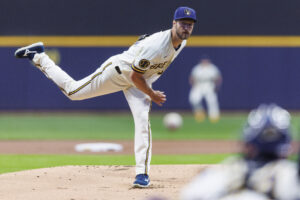
Rea, 34, is coming off a solid two-year run with the Brewers. Over the 2023 and 2024 seasons, he tossed 292 1/3 innings for Milwaukee, making 49 starts and nine relief appearances. He allowed 4.40 earned runs per nine. His 19.9% strikeout rate was a bit below league average, but he showed strong control with a 6.6% walk rate.
The Brewers could have retained Rea for 2025 via a modest $5.5MM club option, but they somewhat surprisingly put him on waivers to see if any other club wanted him at that price point. No team ended up claiming him, so the Brewers simply went for the $1MM buyout instead. By getting $5MM from the Cubs on top of that $1MM buyout, Rea will come out marginally better financially than if the Brewers had simply picked up the option.
By joining the Cubs, Rea will be reunited with manager Craig Counsell, who was the skipper in Milwaukee before coming to Chicago a year ago. Rea was also with the Brewers in 2021, though he only got to pitch six innings in the majors that year. He then headed to Japan for the 2022 season, parlaying his decent performance over there into a return to the Brewers two years ago.
Rea doesn’t overpower hitters, averaging around 93 miles per hour on his fastball over the past two years, but he can keep them off balance with a diverse mix of six pitches. Per Statcast, he also threw a sinker, cutter, sweeper, splitter and curveball. He also didn’t lean on any one pitch too often, topping out with his sinker in each of the past two seasons, around 30% of the time in each year. That’s helped him have fairly neutral splits, with lefties hitting .257/.308/.465 against him last year and righties at .258/.315/.429.
For the Cubs, Rea is likely to slot into a similar swing role to the one he served with the Brewers. Chicago signed Matthew Boyd earlier this winter, adding him to a rotation mix that already had Justin Steele, Shota Imanaga and Jameson Taillon. Rea and Javier Assad have somewhat similar numbers over the past two years and could perhaps compete for the fifth spot in the rotation if everyone is healthy, with the other perhaps getting a long relief role in the bullpen.
Of course, rotations shift over the course of a season. Injuries are inevitable and some players will perform better or worse than expectations. The Cubs have guys like Jordan Wicks, Caleb Kilian, Ben Brown and Cody Poteet also on the 40-man roster, though they all still have options and are fairly lacking in experience. Prospect Cade Horton is not yet on the roster but could force his way into the mix during the upcoming season.
It’s also possible that the Cubs will make further moves to change the rotation plan. Since acquiring Boyd and trading Wesneski, they have been connected to free agent Jack Flaherty and trade candidates like Luis Castillo and Jesús Luzardo. The latter was already traded from the Marlins to the Phillies but another rotation acquisition of some kind is not off the table.
Rea’s role figures to be determined by those moves as well as the health and performance of everyone on the roster, including his own. He improves the depth of the pitching staff at a fairly low cost, relatively speaking. The starting pitching market has been aggressive this winter, as guys like Justin Verlander and Alex Cobb got $15MM guarantees despite being relatively older veterans coming off injury-marred seasons. Rea doesn’t have the same track record or ceiling as those guys but has been healthy and performing well lately, with just one third the salary commitment.
RosterResource now has the Cubs at a payroll of $181MM and a competitive balance tax number of $198MM. Last year, they eventually got to a $228MM payroll and went narrowly over the tax line. It’s unclear if they want to get to the same levels in 2025, but even if they want to avoid the tax, they can still add about $40MM to their CBT number while doing so. This year’s base CBT threshold is $241MM.
MLBTR’s Steve Adams first reported that the Cubs and Rea had agreed to a one-year, $5MM deal. ESPN’s Jesse Rogers reported the presence of a ’26 club option. MLBTR reported the option terms.
Cubs, Yankees Among Teams Interested In Brooks Raley
Left-hander Brooks Raley is drawing interest from clubs as he continues rehabbing from Tommy John surgery over the summer, according to a report from Ken Rosenthal and Will Sammon of The Athletic. The Cubs and Yankees are among the clubs to have reached out and some teams have discussed multi-year arrangements with Raley, though it’s not clear if the Cubs and Yankees are among the teams to have expressed multi-year interest.
Raley, 36, made his big league debut with the Cubs back in 2012 but totaled just 38 1/3 innings of work before departing stateside ball for South Korea back in 2015. He spent several years pitching in the KBO before resurfacing in the majors during the 2020 season as a middle relief option. He enjoyed a late-career breakout in Tampa back in 2022, however, and since then has been nothing short of excellent when healthy enough to take the mound with a 2.58 ERA (153 ERA+), a 3.13 FIP, and a 27.3% strikeout rate over the past three years with the Rays and Mets.
Dominant as he’s been in recent years, a player on the wrong side of 35 rehabbing from Tommy John surgery comes with plenty of question marks. That might make the idea of a multi-year deal seem somewhat surprising, but in some ways it could actually help the acquiring club more reliably secure a return on their investment. After all, Raley figures to only be available for the second half in 2025 and some players need time to shake off the rust following a long layoff like the one Raley is currently experiencing. Given that, a deal that pays Raley a relatively low salary for 2025 but comes with a second guaranteed year at a higher rate could make sense for both sides by guaranteeing Raley a longer-term opportunity coming off surgery while affording the club some protection against Raley struggling in his initial return from surgery before righting the ship and returning to form later on.
Looking at the teams being connected to Raley, it’s fairly easy to see why he’d be of interest to them. The Cubs have been in the market for relief help all winter. While the club already signed Caleb Thielbar as a left-handed option for their bullpen last month, that likely wouldn’t preclude them from adding a player like Raley because he is both more of a bonafide late-inning arm than Thielbar and wouldn’t factor into the club’s Opening Day roster due to his rehab timeline. Chicago has shown a willingness to sign rehabbing players in the past, as well. They were involved in Liam Hendriks‘ market last winter and previously signed players like Kendall Graveman and Drew Smyly while they were rehabbing.
The Yankees, meanwhile, have already added Devin Williams to replace Clay Holmes in the ninth inning, giving them a strong one-two punch at the back of the bullpen with Luke Weaver set for an eighth-inning role. One place where the club’s bullpen could stand to be upgraded, however, is from the left side. Southpaw Tim Hill pitched well for the Yanks in 2024 but is currently a free agent. While Raley wouldn’t be available for at least the first half of the season, the club currently has no left-handed relievers on their 40-man roster and could be forced to use a reverse-splits righty like Mark Leiter Jr. against tough left-handed relievers in 2025 without an external addition.
17 Players Exchange Filing Figures
This evening’s deadline to exchange filing figures has come and gone. The majority of arbitration-eligible players agreed to contracts to avoid going to a hearing. There were 17 instances where the player and team did not come to terms.
Technically, nothing prevents players and teams from continuing to negotiate. However, virtually every team takes a “file-and-trial” approach to the process. Clubs will mostly refuse to continue talks about one-year deals after this date. They’ll often make exceptions for discussions involving multi-year contracts or one-year deals with a club/mutual option. It’s unlikely that all of these players will end up getting to a hearing, but the majority probably will.
If the sides go to a hearing, a three-person arbitration panel will either choose the player’s or the team’s filing figure. They cannot pick a midpoint. That’s designed to prevent the parties from anchoring by filing at extremely high or low figures. Teams’ preferences for the file-and-trial approach follows a similar logic. The idea is to deter players from submitting a higher number from which they could continue to negotiate until the hearing begins.
The list of players who could go to a hearing this winter (service time in parentheses):
Angels
- Luis Rengifo (5.043): Filed at $5.95MM, team filed at $5.8MM (per Jon Heyman of the New York Post)
- José Quijada (4.046): Filed at $1.14MM, team filed at $975K (per Mark Feinsand of MLB.com)
- Mickey Moniak (3.027): Filed at $2MM, team filed at $1.5MM (per Feinsand)
Brewers
- William Contreras (3.112): Filed at $6.5MM, team filed at $5.6MM (per Feinsand)
Cardinals
- Lars Nootbaar (3.076): Filed at $2.95MM, team filed at $2.45MM (per Feinsand)
- Brendan Donovan (3.000): Filed at $3.3MM, team filed at $2.85MM (per Feinsand)
- Andre Pallante (2.145): Filed at $2.1MM, team filed at $1.925MM (per Feinsand)
Cubs
- Kyle Tucker (5.079): Filed at $17.5MM, team filed at $15MM (per Jesse Rogers of ESPN)
Dodgers
- Alex Vesia (4.078): Filed at $2.35MM, team filed at $2.05MM (per Fabian Ardaya of The Athletic)
Nationals
- Nathaniel Lowe (4.145): Filed at $11.1MM, team filed at $10.3MM (per Alden González of ESPN)
Orioles
- Jorge Mateo (5.000): Filed at $4MM, team filed at $3.1MM (per Feinsand)
Padres
- Michael King (5.004): Filed at $8.8MM, team filed at $7.325MM (per Heyman)
Pirates
- Dennis Santana (4.126): Filed at $2.1MM, team filed at $1.4MM (per Feinsand)
- Johan Oviedo (3.079): Filed at $1.15MM, team filed at $850K (per Feinsand)
Rays
- Taylor Walls (3.092): Filed at $1.575MM, team filed at $1.3MM (per Feinsand)
Red Sox
- Jarren Duran (2.155): Filed at $4MM, team filed at $3.5MM (per Feinsand)
Yankees
- Mark Leiter Jr. (4.031): Filed at $2.5MM, team filed at $2.05MM (per Heyman)
—————————————
Tucker and the Cubs have the biggest gap in filing figures at $2.5MM. He’s one of the top two free agents in next year’s class and is unlikely to sign an extension, so they’re almost certainly headed to a hearing. King, who will be one of the best pitchers on the open market next winter, is the only other player with more than $1MM at stake depending on the results of the hearing. The smallest divide is the paltry $150K gap between Rengifo’s and the Angels’ respective filing figures. Hearings are scheduled to begin on January 27 and could run through February 14.
Cubs Granted Fourth Option Year On Caleb Kilian
The Cubs have been granted a fourth option year for right-hander Caleb Kilian, per a report from Jordan Bastian of MLB.com.
Typically, players have three option seasons with one used each season during which the player spends at least 20 days on optional assignment in the minor leagues. A player is considered to be on optional assignment when on a club’s 40-man roster but sent to the minor leagues while not on a rehab assignment. Kilian, 28 in June, was first placed on Chicago’s 40-man roster back in 2022 and has been optioned to the minor leagues in each of the 2022-24 campaigns with at least 20 days in the minors each season. Under normal circumstances, that would leave him out of options headed into the 2025 campaign, meaning the Cubs would have to expose Kilian to waivers before attempting to return him to the minor leagues.
Occasionally, however, teams are granted a fourth option year on certain players, typically due to the player missing significant time with injury. MLB.com explains that players with less than five full professional seasons (defined as at least 90 days on a major or minor league active roster) are eligible for a fourth option year. That applies to Kilian, who missed the majority of the 2024 season due to a teres major strain suffered during Spring Training and did not make his season debut until July 2. Kilian also did not pitch in 2020 due to the canceled minor league season and pitched for just one month in 2019 after being drafted by the Giants in June of that year. That leaves Kilian with just three full professional seasons under his belt: 2021, 2022, and 2023.
The news affords the Cubs additional flexibility as they sort through their many bullpen options for the 2025 season. Presently, the club has Porter Hodge, Tyson Miller, Julian Merryweather, Caleb Thielbar, Eli Morgan, Luke Little, Nate Pearson, Keegan Thompson, Rob Zastryzny, Jack Neely, Daniel Palencia, Ethan Roberts, and Gavin Hollowell all on the 40-man roster and in the mix for a role in the Opening Day bullpen before even considering starting pitchers like Ben Brown, Jordan Wicks, Cody Poteet and now Kilian that currently project as part of the Triple-A rotation. A handful of non-roster veterans like Phil Bickford and Brooks Kriske could also be in the mix for a job.
Of that massive group of potential bullpen arms, Thielbar, Miller, Merryweather, Zastryzny, Thompson, and Festa all do not have options remaining. With just eight spots in the Opening Day bullpen, Kilian also being out of options would’ve left just one open space to fill before the club would’ve had to start exposing players from the aforementioned to waivers in order to mix in the club’s many optionable relief arms, including key players like Hodge, Pearson, and Morgan. Injuries and Spring Training roster cuts will surely thin that group out in the months leading up to Opening Day, but the news regarding Kilian’s fourth option year offers the Cubs a bit more breathing room as they look to piece together their pitching corps for 2025.
An inability to option Kilian also would have likely ended whatever hopes the right-hander may have of continuing to be a potential option for the starting rotation; while Kilian has a deep pitch mix and the stamina to start, his control has been sorely lacking. The right-hander has accrued 27 1/3 innings of work in the majors to this point in his career and in that time has struggled to a 9.22 ERA and 5.32 FIP while walking (14.6%) nearly as many batters as he’s struck out (15.3%). With that said, he was effective at the Triple-A level when healthy enough to take the mound last year, with a 3.22 ERA and a 20.3% strikeout rate against a 7.5% walk rate.
Whether he ultimately finds a home in the rotation or the bullpen, a fourth option year has left the door open to Kilian establishing himself more firmly as a viable big league option with additional time to develop in the minors, and allows the Cubs one final year to evaluate the righty before he either has to be kept on the active roster permanently or exposed to waivers during the 2026 campaign.
Cubs Acquire Matt Festa
The Cubs have acquired right-hander Matt Festa from the Rangers in exchange for cash considerations, both teams announced. Festa was designated for assignment by the Rangers earlier this week to accommodate the signing of Chris Martin. To make room for Festa on the 40-man roster, the Cubs have designated utility man Miles Mastrobuoni for assignment.
Festa, 31, was a seventh-round pick by the Mariners back in 2016. The righty looked good during his first cup of coffee at the big league level back in 2018, but a subsequent cameo with the Mariners in 2019 saw him struggle badly with a 5.64 ERA in 20 appearances. That would be his last taste of big league action for a couple of years, as he underwent Tommy John surgery in 2020 and next pitched for the Mariners during the 2022 season. He was more or less an average middle reliever for Seattle over the next two seasons, with a 4.14 ERA (91 ERA+) and 4.48 FIP in 63 innings of work before he was designated for assignment and eventually released late in the 2023 season.
That led into a one-year period where Festa bounced around a number of different teams in the league. After being picked up on a minor league deal with the Padres last January, Festa did not crack the club’s big league roster out of Spring Training and pitched to a solid but unspectacular 4.50 ERA in 16 innings before San Diego granted him his release in mid-May. He signed with the Mets on a minor league deal just a few days later and was selected to the club’s big league roster in the late June, but found himself torched for five runs (four earned) in his lone inning of work with the club before he was once again cut loose. That led him to sign his third minor league deal of the year, this time with the Rangers, in early July.
After being added to the Rangers roster for the stretch run back in August, Festa pitched solidly enough with a 4.37 ERA (92 ERA+) and a strong 3.34 FIP. He posted some of the best strikeout and walk numbers he’s ever enjoyed at the big league level during his time in Texas as he punched out 25% of opponents while allowing free passes at a 7.6% clip. His peripheral numbers were something of a mixed bag during that time; while his .254 BABIP and 5.9% home-run-to-fly-ball rate both erred on the side of good fortune, Festa’s 54.1% strand rate was extremely low and suggested some bad luck when it came to sequencing.
It was an interesting enough profile for the Rangers to keep him on the 40-man roster early in the winter, but he became expendable once the club added a number of more reliable relief arms to their bullpen throughout the offseason. Now, he’ll head to Chicago with a chance to compete for a role in the Cubs’ bullpen this Spring. Currently, Chicago’s relief corps includes fellow offseason trade addition Eli Morgan, free agent signing Caleb Thielbar, and a handful of internal options such as Porter Hodge, Julian Merryweather, Luke Little, Tyson Miller, and Nate Pearson. It’s a group with plenty of flexibility but few set-in-stone options, and it would hardly be a surprise to see the Cubs continue to search for bullpen upgrades going forward this winter.
To bring Festa into the fold, the Cubs are risking parting ways with Mastrobuoni. The utility man has played adequate defense all over the diamond for Chicago in each of the past two seasons but has failed to establish himself offensively ever since being acquired from the Rays prior to the 2023 season. In 255 trips to the plate with the Cubs in 110 games over the past two years, Mastrobuoni has hit just .221/.282/.268. While his 15 stolen bases in 16 attempts and his ability to play the outfield corners, shortstop, second and third base have helped him provide value outside the batters’ box, that anemic slash line makes it easy to see why the club would decide to move on.
Even without Mastrobuoni in the fold, the Cubs figure to have plenty internal depth available in terms of utility players who can hit from the left side, with recent acquisition Vidal Bruján and Rule 5 Draft selection Gage Workman both currently in the mix for a bench job in 2025. Going forward, Chicago will have one week to either trade Mastrobuoni or place him on waivers. It’s not impossible to imagine a club bringing Mastrobuoni, who has a minor league option remaining, into the fold as optionable depth. Should he clear waivers, the Cubs will have the opportunity to outright him to Triple-A as a non-roster depth option for the 2025 campaign.
MLBTR Podcast: Brent Rooker’s Extension, Gavin Lux, And Catching Up On The Holiday Transactions
The latest episode of the MLB Trade Rumors Podcast is now live on Spotify, Apple Podcasts, and wherever you get your podcasts! Make sure you subscribe as well! You can also use the player at this link to listen, if you don’t use Spotify or Apple for podcasts.
This week, host Darragh McDonald is joined by Tim Dierkes of MLB Trade Rumors to discuss…
- The Athletics and Brent Rooker agreeing to a five-year extension (1:40)
- The Dodgers signing Hyeseong Kim and trading Gavin Lux to the Reds (6:40)
- The Diamondbacks signing Corbin Burnes (14:45)
- Do the Blue Jays have unique challenges in signing free agents to come to another country? (16:30)
- Will Burnes opt out in two years and will the Diamondbacks trade a starter now? (21:05)
- The Yankees acquiring Cody Bellinger from the Cubs and signing Paul Goldschmidt (26:35)
- The Astros signing Christian Walker (34:40)
- The Mets signing Sean Manaea and Griffin Canning (39:15)
- The Red Sox signing Walker Buehler and Patrick Sandoval (43:35)
- The Phillies acquiring Jesús Luzardo and signing Max Kepler (50:35)
- The Orioles signing Charlie Morton (55:35)
- The Guardians trading Josh Naylor to the Diamondbacks and signing Carlos Santana (58:30)
- The Rangers trading Nathaniel Lowe to the Nationals and signing Joc Pederson (1:01:25)
- The Nationals get Lowe as well as signing Josh Bell, Michael Soroka and Trevor Williams (1:05:30)
- The Tigers signing Gleyber Torres and shuffling their infield around (1:08:25)
Check out our past episodes!
- Kyle Tucker To The Cubs, And Trades For Devin Williams And Jeffrey Springs – listen here
- Winter Meetings Recap – listen here
- Blake Snell, Dodger Fatigue, And The Simmering Hot Stove – listen here
The podcast intro and outro song “So Long” is provided courtesy of the band Showoff. Check out their Facebook page here!