
Twins Reportedly “Pushed Hard” For Craig Kimbrel
The Twins “pushed hard” this week for closer Craig Kimbrel before he agreed to a three-year, $43MM contract with the Cubs on Wednesday, according to Dan Hayes of The Athletic (subscription link). Minnesota’s offer was “competitive,” but the team was only willing to give Kimbrel two years, Hayes reports.
The Twins had been after Kimbrel dating back to the offseason, per Hayes. At that point, as the Twins sought to upgrade last year’s underwhelming bullpen, they came away with a few inexpensive relief acquisitions in Blake Parker, Ryne Harper and Mike Morin. While the unheralded Harper and Morin have been shockingly effective across a combined 35 innings, Parker has begun to fade after an encouraging start. The ex-Angel boasted a 1.04 ERA entering play May 28, but it’s all the way up to 3.74 through 21 2/3 frames after he allowed at least two earned runs in three of his past four appearances. Parker also yielded four home runs in that four-inning stretch, during which his already below-average velocity fell. With a 5.84 FIP, 7.06 K/9 against 3.32 BB/9, and a 21.7 percent home run-to-fly ball rate, Parker doesn’t look like a strong candidate to break out of his slump in a significant way.
Not only has Parker been unreliable of late, but most of the Twins’ other top relievers are sporting less favorable fielding-independent pitching numbers than their ERAs indicate. With those factors in mind and Kimbrel off the market, the bullpen figures to remain one of the Twins’ highest priorities leading up to the July 31 trade deadline. Speculatively, Shane Greene (Tigers), Ken Giles (Blue Jays), Alex Colome (White Sox), Mychal Givens (Orioles), Will Smith and Tony Watson (Giants) are some of the league’s relief trade candidates who could land on the Twins’ radar over the next several weeks.
As shown by their interest in Kimbrel and starter Dallas Keuchel, who signed with the Braves on Thursday, Twins executives Derek Falvey and Thad Levine seem prepared to act aggressively this summer. Considering Minnesota’s an American League-best 41-20 and 10 1/2 games up in the AL Central, it’s no surprise management wants to boost the club’s World Series chances.
Braves Reportedly Emerge As Favorites For Dallas Keuchel
7:05pm: The Athletic’s Ken Rosenthal tweets that the Braves and Keuchel are in “serious talks.” There’s “some thought” that the Braves are willing to offer multiple years to Keuchel, tweets MLB Network’s Jon Heyman. Earlier this morning, the New York Post’s George A. King III reported that Keuchel did indeed have teams willing to push their offer to the multi-year deal range, whereas the Yankees were still set on limiting any offer to one year.
2:18pm: The Braves have emerged as the “frontrunners” to sign free-agent lefty Dallas Keuchel, reports Mark Feinsand of MLB.com (via Twitter). The Yankees have been prominently connected to the southpaw since the draft-pick compensation tied to him expired on Monday, but Atlanta has long been mentioned as a potential landing spot as well. Feinsand notes that the Yankees are still in the mix, but Atlanta has recently stepped up its efforts.
Earlier today, SNY’s Andy Martino reported that the Yankees were also facing some degree of competition from the Cardinals. He, too, listed the Braves as a potential factor in the Keuchel market, along with the Twins, though Minnesota’s interest has yet to be characterized as particularly serious.
For the Braves, Keuchel would help to stabilize a rotation that is enjoying strong performances from high-upside young pitchers who are likely to eventually face some type of workload restrictions (e.g. Mike Soroka, Max Fried). Beyond that excellent pairing, the starting pitching hasn’t panned out as hoped in Atlanta so far this season. Mike Foltynewicz missed the first month of the season and hasn’t performed well since returning (today’s quality outing notwithstanding). Lefty Sean Newcomb was demoted to Triple-A early in the season due to significant control issues, and he’s come back as a reliever. Righty Kevin Gausman has an ERA north of 6.00 through a dozen starts. Of the Braves’ starters, Julio Teheran has been the most effective holdover, but there’s certainly room to add another veteran to the mix to help smooth things over.
Unlike fellow free agent Craig Kimbrel, Keuchel has been reported to be more amenable to the concept of a one-year contract. The New York Post’s Joel Sherman wrote earlier this week that agent Scott Boras has discussed some multi-year scenarios that would contain an opt-out after the current season, but a straight one-year pact would be less complicated and more palatable for a signing team. Braves leadership has previously spoken about payroll flexibility, though the exact level of financial resources Liberty Media is willing to provide to general manager Alex Anthopoulos is, of course, anyone’s guess.
Any one-year deal signed by Keuchel would come with a prorated salary; inking him for the same rate as the $17.9MM qualifying offer he rejected back in November, then, would cost a team just north of $11MM from today through season’s end. Atlanta has a payroll of about $121MM at present, and their previous franchise-record Opening Day payroll total was $122MM. Signing Keuchel would push the Braves into uncharted territory, financially speaking — particularly when considering the fact that they’ll likely still make some additions on the trade market in an effort to bolster the bullpen.
That said, the National League East is among the game’s more tightly contested divisions. The Braves are currently 1.5 games behind the division-leading Phillies, 3.5 games ahead of the Mets and five games ahead of the suddenly surging Nationals. Given the competitive nature of the division, it’s understandable that they’re perhaps willing to push beyond previous comfort zones as they vie for a second consecutive playoff berth. Atlanta is currently in possession of the second National League Wild Card spot, but the difference between a guaranteed ticket to the NLDS and a winner-take-all, one-game coinflip is significant for any club.
AL Central Notes: Kimbrel, Witt, Vaughn, Greene
We’ve heard that the Twins are involved in the still-evolving market for free agent reliever Craig Kimbrel. But how aggressive will the Minnesota organization be and what will it take to make a deal? One unidentified source tells Joel Sherman of the New York Post that Kimbrel is seen as a “priority” for the Twins, though it’s tough to pin down the meaning of that phrase unless it’s coming straight from the top of the Minnesota front office. Notably, Kimbrel is said to have continued his quest for a multi-year deal into the summer. That approach promises to have major ramifications for his market, as it could both limit the field of suitors (some teams may only want a rental) and expand it (others may also shop for the future and see an opportunity to defer the money it will take to secure his services).
While the Twins are posing a challenge to the perennial front-running Indians, a few other teams from the division have been busy cashing in their consolation prizes from rough 2018 seasons …
- The Royals did not hide their excitement at landing Bobby Witt Jr. with the second overall pick of the MLB Draft, as Lynn Worthy of the Kansas City Star writes. It’s easy to dream on top picks, but the Royals have done more than that. They’ve been waiting for this moment for quite some time. GM Dayton Moore says the club has been tracking Witt closely “since he was 14 years old,” calling it “an absolute honor and privilege to follow him and his career.” The high-end high school shortstop will look to follow his father in turning in a lengthy MLB career. Just how excited are the Royals? Moore: “It’s a great celebration in this organization today because we were able to select him. We knew a little over a year ago that this was a player that we were going to target. To see this day come has been very, very special for all of us.”
- The White Sox now have a first baseman of the future in Andrew Vaughn, who went third overall. As Daryl Van Schouwen of the Chicago Tribune writes, the club went with Vaughn on a pure talent assessment. But the fact that he’s quite possibly a quick-to-the-majors bat that suits the roster wasn’t lost on the team. Scouting director Nick Hostetler said of the selection: “the fact it might fill a void in the future here was an added bonus.”
- And the Tigers were thrilled to find high school outfielder Riley Greene waiting for them at #5, as Anthony Fenech of the Detroit Free Press writes. With ample rotation talent already filtering up the ranks of the Detroit farm, it’s no doubt gratifying for the club to find such a highly regarded position player in that spot. The youngster obviously isn’t even close to the MLB radar at this point, but he’ll immediately become a player to watch for the organization’s fans.
Twins Activate Nelson Cruz From IL
The Twins announced Monday that they’ve reinstated designated hitter Nelson Cruz from the injured list and optioned infielder Luis Arraez to Triple-A Rochester in order to create roster space.
Cruz, 38, missed nearly three weeks with a left wrist strain but will return to the lineup prior to the opening of a three-game series against the division-rival Indians in Cleveland. The slugger, signed in the offseason to a one-year deal worth $14.3MM (plus a 2020 team option), was off to a .270/.354/.508 start when he was placed on the IL. In 144 plate appearances, Cruz has connected on seven homers and nine doubles. With Cruz now healthy, the Twins will have their lineup at full strength for the first time in 2019; he and Miguel Sano have yet to have their time on the active roster overlap.
Arraez, 22, did nothing to sway the organization’s hope that he can be an important part of their infield mix for years to come. In 30 plate appearances, he hit .375/.467/.583 with five walks against just one strikeout while seeing action at second base, third base and shortstop. Arraez has still played only three games at the Triple-A level in his pro career, so he’ll return to that level to continue accruing everyday at-bats as he works toward a long-term spot on the Twins’ active roster.
Twins Have Held Discussions With Craig Kimbrel, Dallas Keuchel
The Twins have shown interest in both Craig Kimbrel and Dallas Keuchel, reports La Velle E. Neal III of the Minneapolis Star Tribune. The organization is “believed” to hold more interest in Kimbrel than in Keuchel at the moment, but the Twins have spoken with both players’ representatives about potential deals.
Once the clock struck midnight last night, the draft-pick compensation tied to both pitchers expired, meaning the Twins (or any other club) can now sign either pitcher without forfeiting any future draft selections or international spending allocations. As we noted late last week, Minnesota was one of the most logical landing spots for Kimbrel, and the fact that the Twins took the final three games of a four-game road set against the Rays should only serve to further embolden the front office.
Twins relievers rank 20th in the Majors with a 4.60 ERA in 2019, and while their 4.05 FIP (ninth-best) and 4.25 xFIP (11th) paint a more optimistic pitcher, the relief corps is top-heavy. Lefty Taylor Rogers has continued last year’s summer breakout with a brilliant start to the season, while Trevor May and 30-year-old rookie Ryne Harper have each been effective as well. Offseason signee Blake Parker has posted a strong 2.61 ERA, but his K/BB numbers and velocity have gone in the wrong direction while fielding-independent metrics forecast substantial regression. Righties Matt Magill, Tyler Duffey and Mike Morin have all been effective in smaller samples, with Magill and Duffey in particular posting encouraging strikeout numbers.
But the Twins have cycled through numerous options in the final couple spots of their ‘pen, receiving poor results from Chase De Jong, Andrew Vasquez, Zack Littell, Austin Adams, Adalberto Mejia and Trevor Hildenberger. High hopes were held for former top prospect Fernando Romero as he moved from a starting role to the ‘pen, but he’s struggled in both the Majors and in 19 2/3 innings of Triple-A ball. Adding Kimbrel would ideally help slow that revolving door for the final couple of bullpen spots and deepen the team’s relief mix for what looks like an increasingly likely ALDS run.
There’s certainly an argument to be made in favor of signing Keuchel, as well. The Twins have received terrific results from their top four starters, as each of Jake Odorizzi, Jose Berrios, Martin Perez and Kyle Gibson have posted ERAs and FIPs south of 4.00. Michael Pineda has struggled as the fifth starter in his return from Tommy John surgery and is currently on the injured list. He’ll need to have his innings limited anyhow, and moving him to the bullpen could net some interesting results. He’s held opponents to a .237/.283/.419 line the first time through the order and would likely see his 92.1 mph average fastball play up in shorter stints. Keuchel isn’t the ace he was when he won the AL Cy Young Award in 2015, but he’d be an upgrade over Pineda and, if Pineda takes to a bullpen role, could help to solidify both the starting pitching and relief pitching for the Twins.
It’s not a foregone conclusion that the Twins will actually sign either pitcher, but back in January, chief baseball officer Derek Falvey and GM Thad Levine spoke of supplementing the team’s core when its window was “wide open.” With an 11.5-game lead in the American League Central and a 94 percent chance to take the division, per the odds at both Fangraphs and Baseball Prospectus, that would certainly appear to describe the current situation in Minnesota.
From a payroll vantage point, the Twins opened the 2018 season with a payroll just under $129MM but trimmed close to $10MM off that sum to begin the 2019 season. Signing either Kimbrel or Keuchel would quite likely push the Twins into franchise-record payroll territory, though attendance at Target Field has unsurprisingly been on the rise as the Twins have widened their division lead over the past month. There’s no indication that the team is facing any payroll constrictions, and Levine said in recent MLB Network appearance with Chris Russo (video link) that owner Jim Pohlad is “completely supportive of augmenting this team” over the course of the summer.
Mariners Acquire John Andreoli
The Mariners have acquired outfielder John Andreoli from the Twins, as per reporter Joe Veyera (Twitter link). Andreoli appeared in the lineup tonight for Triple-A Tacoma.
Andreoli is back for his third separate stint with the Mariners organization, originally signing with the M’s in the 2017-18 offseason and eventually making his MLB debut with the team last May. Andreoli was claimed off waivers by the Orioles in August and then claimed back by Seattle after the season, kicking off a busy winter of activity that saw Andreoli briefly join the Rangers and Giants on waiver claims before being traded to Minnesota in March.
After that whirlwind, Andreoli ended up batting .196/.324/.359 over 185 PA for the Twins’ Triple-A affiliate. Over 3458 career plate appearances in the minors, Andreoli (who turns 29 next week) has a .266/.370/.386 slash line, plus an impressive 250 stolen bases in 312 chances. As a big leaguer, Andreoli appeared in 20 games with the Mariners and Orioles last season, amassing 67 PA. With extensive experience at all three outfield positions, Andreoli will once again give the Mariners some outfield depth at the Triple-A level.
Quick Hits: 2009 Draft, Trout, Morton, Twins, Bradley, Marlins
Stephen Strasburg generated headlines as the consensus first overall pick of the 2009 draft, though that draft has taken on a different historic import almost ten years later, as that was the night Mike Trout officially became a Major League player. MLB.com’s Jim Callis looks back at the 2009 draft with a decade of hindsight, re-drafting the first round with the top players who were selected (and signed contracts) from that year’s class. In this scenario, the Nationals take Trout first overall instead of Strasburg, who falls to the Pirates with the fourth overall pick. The Mariners take Nolan Arenado with the second pick, while the Padres take Paul Goldschmidt third overall.
The actual draft spots of these superstars (Trout went 25th overall, Arenado in the second round, and Goldschmidt not until the eighth round) is indicative of the draft’s unpredictable nature, as teams and pundits simply never know which unheralded youngster might develop into a gem. Callis includes several interesting notes and scouting opinions about various players at the time of the 2009 draft, including the item that only the Athletics, Diamondbacks, and Tigers were known to be linked to Trout, among teams who had a chance to select him before the Angels. Many clubs didn’t have interest due to rumors that Trout was seeking a $2.5MM draft bonus, which would’ve exceeded the slot price for all but the top five picks, though in the end Trout signed with the Angels for the $1.215MM league-recommended slot price attached to the 25th overall selection.
More from around the baseball world…
- Correcting one of his own reports from the offseason, Darren Wolfson of 5 Eyewitness News (Twitter link) notes that the Twins “were very much in on” Charlie Morton before the veteran righty signed a two-year, $30MM deal with the Rays. Since Morton was only looking for a short-term deal as he nears the end of his career, he fit the model of what the Twins were looking for this past winter, as the club inked the likes of Nelson Cruz, Martin Perez, Jonathan Schoop, and Marwin Gonzalez to contracts consisting of no more than one or two guaranteed years. It isn’t known how close Morton and the Twins might have come to an agreement, though the Rays did have a geographical ace up their sleeve, as Morton has stated that the Rays’ close proximity to his family’s home in Florida was a factor in his decision. Given that the Twins have already posted the best record in baseball, it’s hard to imagine how much better things could have been for the club with Morton in the rotation.
- After two seasons as an important weapon out of the Diamondbacks‘ bullpen, Archie Bradley has struggled to a 4.63 ERA over 23 1/3 innings in 2019. As a result, manager Torey Lovullo told the Arizona Republic’s Nick Piecoro and other media that Bradley will continue to handled carefully so he can get back on track, and likely won’t see many high-leverage moments. “We might get him some (appearances with) multiple innings to continue to develop a feel. We might give him some really short spurts to walk off the mound and have a good result,” Lovullo said. While a .409 BABIP is a big factor in Bradley’s issues, a lack of control has been his biggest problem, as his 5.79 BB/9 is more than double his walk numbers from the previous two seasons.
- Marlins fans bemoan the fire sale that saw the likes of Christian Yelich, Giancarlo Stanton, Marcell Ozuna, J.T. Realmuto, and Dee Gordon leave the team over the last 18 months, yet as The Athletic’s Marc Carig (subscription required) observes, Miami also parted ways with a wealth of pitching talent in recent years. Luis Castillo, Domingo German, Trevor Williams, and Chris Paddack were all somewhat unheralded prospects when the Fish traded them in various deals for veterans who ultimately didn’t help the team return to contention. Between all of these names and some other notables (Derek Dietrich, Nick Wittgren, Anthony DeSclafani), Carig comprises a startling what-if of a 2019 Marlins roster that would be on pace to win 102 games, as per Baseball Reference WAR calculations. “By simply securing the talent, they’d accomplished the hardest part of assembling a dynasty,” Carig writes. “Then, all of it slipped away. No team bats 1.000 when it comes to trades. Few teams hit near .000. For a period, the Marlins were seemingly one of those.”
Twins Go Bargain Shopping, Reap Rewards
It’s May 28, two full months into the season, and the Twins are atop Major League Baseball in record (36-17), run differential (plus-110), runs (319) and home runs (105). They’re already almost halfway to last season’s win total (78) with 109 games to go. If you didn’t think the Twins would be in this position, one that sees them leading the preseason AL Central favorite Indians by 10 games, you’re part of a club with countless members.
So how have the Twins done it? Largely with homegrown products. Shortstop Jorge Polanco, outfielders Byron Buxton, Eddie Rosario and Max Kepler, and right-hander Jose Berrios and Kyle Gibson are among those who have been at the forefront of Minnesota’s charge up the standings. But many of the additions executives Derek Falvey and Thad Levine made this past offseason, when they happened to lock up Polanco and Kepler to sweetheart extensions, have played significant roles in the Twins’ greatness thus far.
As far as winter pickups went, the Twins’ costliest acquisitions – free-agent signings Marwin Gonzalez (two years, $21MM) and Nelson Cruz (one year, $14.3MM) – received the lion’s share of attention entering the season. As the Twins expected, they’ve been prominent pieces in 2019. However, some of the Falvey-Levine duo’s less expensive buys have been arguably as important.
Over 20 percent of the Twins’ league-high HR total has come from first baseman C.J. Cron and second baseman Jonathan Schoop, who have combined for 23 dingers. The 29-year-old Cron arrived in late November as a waiver claim from the Rays, who cut him even though he was coming off a 30-home run campaign in which he slashed .253/.323/.493 (122 wRC+). Low-budget Tampa Bay wasn’t on board with paying Cron upward of $5MM via arbitration. He ended up settling for a bit less, $4.8MM, shortly after joining the Twins. Since then, they’ve benefited from Cron’s .270/.333/.534 (125 wRC+) line with 13 HRs in 198 trips to the plate. It doesn’t look like a fluke, as Cron is walking more, striking out less, chasing fewer out-of-zone pitches and making more contact than he did in 2018. He also boasts an expected weighted on-base average (.376) that sits nine points higher than his real wOBA (.367).
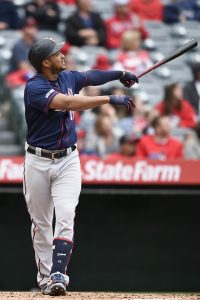
To this point, Cron has replaced now-retired franchise icon Joe Mauer‘s production with aplomb. Schoop also had a tough act to follow in Brian Dozier, an excellent Twin from 2012-17 whom the team traded last summer amid a disappointing season. So far, Schoop hasn’t been fazed either.
Like Dozier, Schoop followed up an impressive 2017 with a down ’18, in which the Orioles traded him to the Brewers in July. Schoop wasn’t good with either team last year, and the Brewers understandably decided after the season to non-tender him instead of giving him a potential $10MM-plus salary in arbitration.
On Dec. 6, a week after he reached free agency, Schoop found a new home in Minnesota at a $7.5MM salary. The 27-year-old has begun his Twins tenure by slashing .266/.321/.514 (118 wRC+) with 10 HRs through 187 trips to the plate. Whether it’s sustainable is in question, though. Schoop has posted below-average strikeout and walk rates, which admittedly has been the case throughout his time in the majors, while swinging and missing at an all-time high rate and making less contact than ever. Encouragingly, though, there isn’t a large gap between Schoop’s wOBA (.356) and xwOBA (.347).
With the help of Cron and Schoop, the Twins’ offense has been the driving force behind their first-place start. But pitching has also been a major reason for the team’s revival. Berrios, Jake Odorizzi and Kyle Gibson get most of the attention in their rotation, but another offseason scrapheap pickup – left-hander Martin Perez – has logged a sterling 2.17 ERA through 49 2/3 innings out of their rotation. Before he got to Minnesota, Perez was largely a back-end starter in Texas from 2012-18. He was borderline unusable last year, an injury-shortened campaign, and the Rangers declined his $6MM club option thereafter. In doing so, the Rangers had to pay Perez nearly half that money ($2.35MM). They weren’t exactly teeming with starters at the time, which showed how far the former promising prospect, 28, fell out of favor in Arlington.
Perez has found new life with the Twins on a $4MM guarantee, though, and may be pitching his way into their 2020 plans. They’ll have to decide on a $7.5MM option after the season, but the way things are going, it doesn’t look as if Perez will end up back in free agency then. Perez’s rise has come thanks in part to a noticeable increase in velocity. His fastball and sinker each averaged around 93 mph last year, but they’re in the 95 range this season. While Perez’s walk rate of 4.08 per nine isn’t appealing, he has upped his K/9 from 5.48 to 8.69 in a one-year span. At the same time, hitters are making less contact off Perez, whose 10.9 swinging-strike percentage far outdoes the 7.8 mark he managed in Texas. When they have put the bat on the ball, the contact hasn’t been all threatening, evidenced in part by Perez’s paltry .283 xwOBA (compared to a .298 wOBA).
When Perez and the Twins’ other starters have handed off to the club’s bullpen, they’ve given the reins to relief corps which has made strides since 2018. The loss of the lights-out Ryan Pressly, whom the Twins traded to the Astros last summer, has stung. However, three more members of the Twins’ buy-low offseason bonanza – righties Ryne Harper, Blake Parker and Mike Morin – have come through to help ease the pain of Pressly’s loss.
Harper was already in the organization last season, but he spent it in the minors and wasn’t a lock to stick around this year. The Twins re-signed him to a minor league deal, however, and have since seen his emerge as a trustworthy piece of their bullpen. The 30-year-old Harper, who hadn’t even pitched in the majors prior to 2019, leads Twins relievers in innings (22, tied with Taylor Rogers) and has pitched to a stingy 1.64 ERA/2.57 FIP with 8.18 K/9 and 2.05 BB/9. Granted, regression for the soft-tossing Harper is likely on the way – it’ll be hard to maintain a .220 batting average on balls in play and an 85.2 percent stand rate, and perhaps even tougher for a fly ball-heavy hurler to continue limiting home runs. Nevertheless, one can’t quibble with the unexpected production he has given Minnesota to this stage.
The 33-year-old Parker has been similarly effective through 17 1/3 innings, having registered a 1.04 ERA in an effort to prove the Angels were wrong in non-tendering him last November. Parker isn’t going to keep this up, as his .190 BABIP, 96.2 percent strand rate, uninspiring strikeout and walk rates (7.27 K/9, 3.63 BB/9), and FIP (3.63) indicate. No matter, the groundball-heavy Parker undoubtedly looks worthy of Minnesota’s $3.2MM investment.
The team’s paying even less to Morin, who signed a minors deal in December after struggling with the Angels, Royals and Mariners in previous years. Since the Twins promoted Morin, 28, to the majors May 3, he has worked 9 1/3 innings of one-run ball without issuing a walk.
Roughly a third of the way through the season, Minnesota has been a juggernaut. Whether the Twins will continue to fare this well is up for debate, though it’s hard to envision a team with this much talent nosediving out of the race. Regardless of whether you believe the Twins are for real, though, it’s fair to say a good portion of their success has come thanks to the shrewd, low-risk offseason moves Falvey and Levine made.
Photo courtesy of USA Today Sports Images.
The Twin Gems Of The Spring Extensions
The dizzying run of extensions this spring drew quite a lot of attention. Several contracts were pointed to as being notably team friendly. Others were of obvious importance because they involved superstars entering walk years.
The sheer volume of transactions tended to obscure the fine details of each particular decision. And several of the extensions were all but buried in the news. When the Twins set up the mics to announce extensions for Jorge Polanco and Max Kepler, the full rush of deals hadn’t yet occurred. But the moves came at the same time that star hurlers Aaron Nola and Luis Severino were signing on the dotted line, drawing much of the attention away from a Minnesota club that was coming off of a middling 2018 season and hadn’t been quite as bold as might have been anticipated in free agency. And the flood of later signings ensured that the Twins’ deals would receive relatively little attention.
Frankly, given the costs involved, those signings did not represent an especially monumental moment for the franchise. The Joe Mauer contract, this was not. The Twins did not strike deals with top young starter Jose Berrios or high-end outfielder Eddie Rosario, both of whom would likely have commanded bigger dollars. Better-known former top prospects Byron Buxton and Miguel Sano weren’t really in position for extensions after rough seasons.
So, did we sleep on the Twins? From a team perspective, the roster upside was obvious, but nobody foresaw a 36-17 start to the year and a ten-game lead over the sagging Indians. And what of the extensions they signed? Any sober examination of the Polanco and Kepler contracts at the time of signing would have noted the potential upside but settled on relatively modest expectations. With a third of the season in the books, both deals look like slam dunks.
Let’s look first at Polanco. When the Twins promised him $25.75MM over five years, they were obviously quite comfortable with the risks and had expectations of excess value. But it’s hard to imagine they anticipated the sort of monster production they’ve received from the 25-year-old shortstop.
When MLBTR’s Steve Adams pointed to Jose Ramirez as a comp, he was thinking primarily of the latter’s contract — not his ensuing breakout. As it turns out, Polanco has followed Ramirez in converting contact ability into power.
This can’t be called a total surprise. As Adams wrote in assessing the Polanco deal, “if he can tap into a bit more power, there’s perhaps room to take his game to another offensive level.” Certainly, the Twins felt there was something more in the tank after a strong but hardly elite showing in 2018. The stated expectation was that the “best is yet to come” and that Polanco would “continue to develop and grow.”
But that was all projection and feel-good press conference talk. Did anyone really think Polanco would turn on the jets in this manner? He’s now slashing .332/.404/.584 with nine home runs in 228 plate appearances. Better yet, he has boosted his walk rate up to 10.5% and hasn’t even needed to add swing and miss (14.9% strikeout rate) to boost his pop. There’s likely a bit of regression in store, with a .363 BABIP and decent spread in Statcast results/expectations (.418 wOBA vs. .382 xwOBA). But the arrow is obviously pointed upward.
It’s easy to see how the contract could become the sort of bargain that helps fuel a lengthy contention window. One need only look at Ramirez. The Twins had ample control over Polanco already, as he was only a 2+ service-class, non-Super Two player. (He’d have had more but for an ill-advised PED suspension.) Because they made the deal before arbitration and in advance of a true breakout, the Twins can control Polanco through the 2025 season for a total cost of just $47MM, with the final two seasons coming via option ($10.5MM/$1MM buyout, $12.5MM/$750K buyout).
Things are looking quite nice on the Kepler side of things as well. He inked a five-year, $35MM deal. The calculus was different from the get-go in his case, though the decision to make the deal was also driven by a belief that he was primed to improve. Kepler had already reached arbitration as a Super Two, agreeing to a $3.125MM salary with the organization earlier in the winter. With three more arb trips to build from that baseline, and a track record of solid home run production, Kepler was able to command a higher payday.
In some respects, this was the riskier deal for the team. True, he had shown plenty of skill: the 26-year-old had already cracked twenty long balls, turned in three seasons of .180+ isolated power, and made great strides in his plate discipline in 2018 (11.6% walk rate vs. 15.7% strikeout rate). He’s also regarded as a quality defensive outfielder. At the same time, it took a bit of a leap of faith to entrust this kind of cash in a corner outfielder that hadn’t yet turned in a full season of league-average production by measure of wRC+.
So far, so good. Kepler has already launched a dozen long balls in 211 plate appearances. He’s maintaining that strong K/BB blend. And he’s up to a .281 batting average on a .272 batting average on balls in play — a reversal of some poor fortune from 2018 (.224 batting average, .236 BABIP). Statcast credits him with more hard contact (44.5%) and a loftier launch angle (17.2 degrees) than ever before.
Kepler’s early showing surely makes the Twins feel even better about their commitment than they did at the time. Beyond the $35MM guaranteed, the Twins have another year of control at just $10MM ($1MM buyout).
Will Polanco and Kepler keep this up for the long haul? Or even the duration of the present season? That’s hard to say. A fair but conservative estimate would anticipate some regression. But it’d also recognize a very real increase in the present and anticipated future on-field value of these players.
While these contracts largely fell through the cracks at the time they were struck, they now look to be among the best buys of the spring. The team deserves credit for rightly identifying these targets. But it’s also a credit to Polanco and Kepler. They accepted reasonably fair deals, based upon their prior track records, then set to work turning those contracts into potential bargains. As for the Twins organization, these deals didn’t change the near-term complexion of the roster in the least. But they sure do help brighten the long-term outlook.
Twins Place Michael Pineda On IL, Select Devin Smeltzer
The Twins announced today that righty Michael Pineda has been placed on the 10-day injured list with right knee tendinitis. He’ll be replaced on the active roster by lefty Devin Smeltzer, whose contract was selected.
Pineda’s right knee represents one of only a few concerns with a Minnesota roster that has fired on all cylinders to open the year. He underwent meniscus surgery in the same joint late last season, thwarting his effort to make it back to the big leagues in 2018.
Thus far in 2019, the 30-year-old righty owns a 5.34 ERA with 7.6 K/9 and 1.7 BB/9 in 59 frames. In many respects, Pineda looks like much the same pitcher he has always been. His pitch mix is familiar; though he has lost some velocity, averaging 92.7 mph on his fastball, he is generating swinging strikes (11.7%) at close to his career rate (12.5%).
Even as his team thrives on hitting homers, Pineda has been done in by the long ball. He’s allowing 2.14 per nine on a 17.1% HR/FB rate. Pineda is drawing far more contact in the air than ever before, with a 0.76 GB/FB rate that lags well behind his career 1.19 mark.
Entering the year, Pineda had never allowed a double-digit average launch angle. Opposing hitters are sitting at 17.5 degrees in 2019. And Statcast’s figures suggest he has actually been a bit fortunate, giving him a .338 wOBA and .350 xwOBA.
Some adjustments are obviously in order for Pineda, though obviously the first order of business will be getting his knee back to health. It is not known at this time what kind of timeline the club anticipates.
Meanwhile, the club will get its first look at the 23-year-old Smeltzer, who came to Minnesota in last summer’s Brian Dozier swap. He’s an increasingly interesting hurler to watch. As chief baseball officer Derek Falvey explains, the club “had some ideas around pitch mix adjustment” and other such tweaks that Smeltzer has adopted to promising effect. (Via Dan Hayes of The Athletic, on Twitter.)
Through 54 2/3 innings in nine upper minors starts this season, Smeltzer carries a sparkling 1.15 ERA with 7.9 K/9 and 1.6 BB/9. He has allowed only 39 hits and two home runs, though both of those shots have come since he was promoted to Triple-A. Smeltzer’s K/BB mix has also taken a step back at the highest level of the minors.