
Remembering An Athletics One-Hit Wonder
It was 16 years ago that the Athletics traded away a successful homegrown talent in left-hander Mark Mulder, whom they sent to the Cardinals in exchange for righties Dan Haren and Kiko Calero and first baseman Daric Barton. Mulder was a former No. 2 overall pick (1998) who, along with Tim Hudson and Barry Zito, helped comprise the feared Big Three in Oakland’s rotation. While Mulder pitched to a 3.92 ERA as an Athletic and racked up almost twice as many wins (81) as losses (42) in their uniform, he struggled down the stretch in 2004, thereby sealing his fate with the club.
Although Mulder had a nice first season in St. Louis, injuries played a part in torpedoing his career from there, as he only threw 106 innings of 7.73 ERA ball from 2006-08. In hindsight, it wasn’t a great trade for the Cardinals, but the A’s did get serious value out of it. Haren turned in three highly productive seasons in Oakland before the team flipped him to Arizona in a major 2007 deal, while Calero enjoyed two impressive years out four with the club. By measure of fWAR, though, neither Haren nor Calero matched Barton’s top season as a member of the team. When comparing his best season with the rest of his career, Barton’s one of baseball’s clearest examples of a one-hit wonder from the previous decade.
It’s worth noting that Barton was actually one of the premier prospects in baseball during his days on the farm – Baseball America ranked him between 32nd and 67th four years running. As BA wrote before the 2007 season: “Oakland general manager Billy Beane called Barton the best hitter in the minors when he traded for him, and he remains the system’s best pure hitter. He has a textbook swing, fluid and short with a bit of loft, hinting at future power. His exceptional plate discipline allowed him to control the strike zone at Triple-A as a 20-year-old, and he’s advanced enough to know to use the whole field.”
Barton seemed on his way to proving his supporters correct, albeit over just 84 plate appearances, as he debuted in Oakland and batted a marvelous .347/.429/.639 (181 wRC+) with four home runs. But it took until 2010 for Barton to truly produce like a star over a full season. While Barton only mustered 10 homers in 686 PA and 159 games that year, he nonetheless totaled 5.0 fWAR, tying him with a couple familiar names in then-Phillie Jayson Werth and perennial Cardinal Yadier Molina. Barton got there on the strength of his exceptional eye and his strong defense. The lefty swinger posted the game’s eighth-highest on-base percentage and an overall line of .273/.393/.405 (126 wRC+), and he ranked among the sport’s top-graded fielders with 19 Defensive Runs Saved and an Ultimate Zone Rating of 11.8.
Oakland looked as if it had its long-term answer at first then, but it was all downhill from there. Barton’s numbers took a turn for the worse the next season and he was never a big league regular again. He continued to draw walks at a high clip, but the powerless Barton limped to a line of .216/.323/.284 (76 wRC+) with a mere four HRs and 0.1 fWAR during a 600-PA span over the rest of his time in the majors. The A’s even designated Barton for assignment in 2013, though he did stick with the organization into the next season. Barton hasn’t been heard from in the majors since then, though, and until today, he hadn’t been mentioned on MLBTR’s pages since the Blue Jays’ Triple-A club released him in July 2015.
Barton did play in Mexico for a few seasons after his run in MLB and Triple-A ended, but the 34-year-old’s now out of baseball. That surely wasn’t the way he or the A’s expected his career to conclude in the wake of his magical 2010 effort, but thanks to that one huge year, he had a more productive MLB career than most who appear in the league.
Can The Nats’ Farm Produce More Stars?
The Nationals won the 2019 World Series and have much the same core in place for the next several seasons … with one major exception. Third baseman Anthony Rendon is now a member of the Angels after an astronomical effort last year.
Filling in at the hot corner is one thing. The Nationals gobbled up a bevy of veterans that can probably hold things down as needed. Well-conceived mix and match approaches can work; the Nats need not fret that they failed to retain Rendon or bring in a replacement on the order of Kris Bryant and Nolan Arenado.
Relying on platoons and cycling through veterans is a fine strategy … to a point. It’s hard to platoon all over the field due to roster limitations. Grinding out good-enough, affordable production works best when it’s done as a complement to a fleet of star-level performers.
That’s essentially how the D.C. organization reached the promised land last year. The Nationals’ farm system has rarely ranked among the best in the game in recent seasons. But the team has nevertheless sustained exceptional overall results ever since its 2012 breakout — with a few peaks and valleys, but all winning seasons — due in large part to its ability to promote or sign new star performers. Even as Ian Desmond, Wilson Ramos, Jordan Zimmermann, and Bryce Harper departed, the club brought in Max Scherzer and Patrick Corban via free agency … and, more importantly, graduated Trea Turner and Juan Soto. Now, with Rendon out — and even with Stephen Strasburg retained — the Nats’ mid-term outlook may depend upon the ability to find another core piece to deliver output worth far more than his salary.
For the Nats, the big question isn’t whether they’ve got someone to match Rendon’s production at third base in 2020; it’s doubtful they do. Rather, it’s whether they can cook up another high-level star to take Rendon’s place as a multi-year, cost-controlled stalwart.
That’s a long-winded way to say: ease off on poor Carter Kieboom. The Nationals’ top prospect could indeed be the heir to Rendon’s third-bag throne, but he’s not the only hope here. Kieboom is an exciting talent at the plate, but he’s just 22 years of age, struggled quite a bit last year in the majors, and hasn’t yet mastered the third base position despite coming up as a shortstop.
No doubt the dream scenario is for Kieboom to explode onto the scene. He’s ready for a full test, though the outcome remains uncertain. But really, he may actually not be the top candidate to step into the void. Rendon was long the lower-profile co-star to Harper. Perhaps Victor Robles — the organization’s former top-ranked prospect — can be the same to Juan Soto.
In the case of Robles, he’s already a valuable MLB performer — and he’s barely a hundred days older than Kieboom. Robles roamed center field for 155 games last year, performing at about 10 percent below a league-average offensive player. But he was an excellent defender and baserunner.
Just how good was Robles without the bat in hand? Plenty to make up for the so-so hitting effort. Fangraphs graded him out as a solid regular at 2.5 WAR in his rookie campaign. But Baseball-Reference, which relies upon DRS rather than UZR, was wowed by Robles’s glovework and credit him with over four wins above replacement.
Regardless, there’s a nice floor to work from. Any improvement at the plate — let alone a real breakout — could make Robles into a certified star. But there are reasons for trepidation, too. Though he popped 17 long balls, Robles managed only a meager 23.0% hard-hit rate (bottom 4% leaguewide) and carried a .292 xwOBA that lagged his .317 wOBA. Given that he faced questions about quality of contact in the minors, particularly after returning from a major wrist injury, it’s fair to wonder if Robles will ever really do much more damage at the dish.
While most of the top Nats prospects are pitchers, there is one other possibility of interest: middle infielder Luis Garcia. He ran into some difficulties last year at Double-A, but did so while playing at that lofty level at 19 years of age. Garcia was turning heads this spring, with a .417/.462/.542 output in 27 plate appearances. The odds are low that he’ll blossom into anything approaching a star on Rendon’s order, but his ceiling probably encompasses some All-Star level performances.
Perhaps it’s too much to say that the Nationals absolutely need another young star. But it’d represent far and away the clearest path to a return to the top of the NL East heap after two seasons spent chasing the Braves. The Nationals can’t assume their expensive and excellent (but not especially youthful) rotation will be as good as it has been. The bullpen is a perennial question mark. And there are veteran timeshares scattered over much of the rest of the roster.
A breakout from Robles or Kieboom — or, in the near-future, Garcia — would potentially give the Nats a trio of position-player stars to help keep the contention window open for a full decade or more. Or, perhaps, two of those youngsters may settle in as excellent, cost-controlled regulars, which might be about as good as a single star. Regardless, the point remains: the Nationals’ top-heavy roster and farm needs to score a few more hits. If that doesn’t come to pass, it’s fair to wonder whether the relatively thin farm system will be enough to support a winning team for much longer, given the ever-rising costs of the team’s stars (even in relation to a hefty payroll) and the pending free agency of other significant portions of the roster after the 2020 campaign.
Odd Man Out In Cincinnati?
From 2016-18, Scott Schebler ranked third among Reds outfielders in games played and total innings. Acquired alongside Jose Peraza and Brandon Dixon in the three-team deal that sent Todd Frazier to the White Sox, Schebler struggled in his first taste of action with the Reds early in ’16 but finished quite well upon returning from Triple-A for the final two months. In his final 213 plate appearances that year, Schebler slashed .290/.357/.461 and set himself up to serve as Cincinnati’s primary right fielder in 2017.
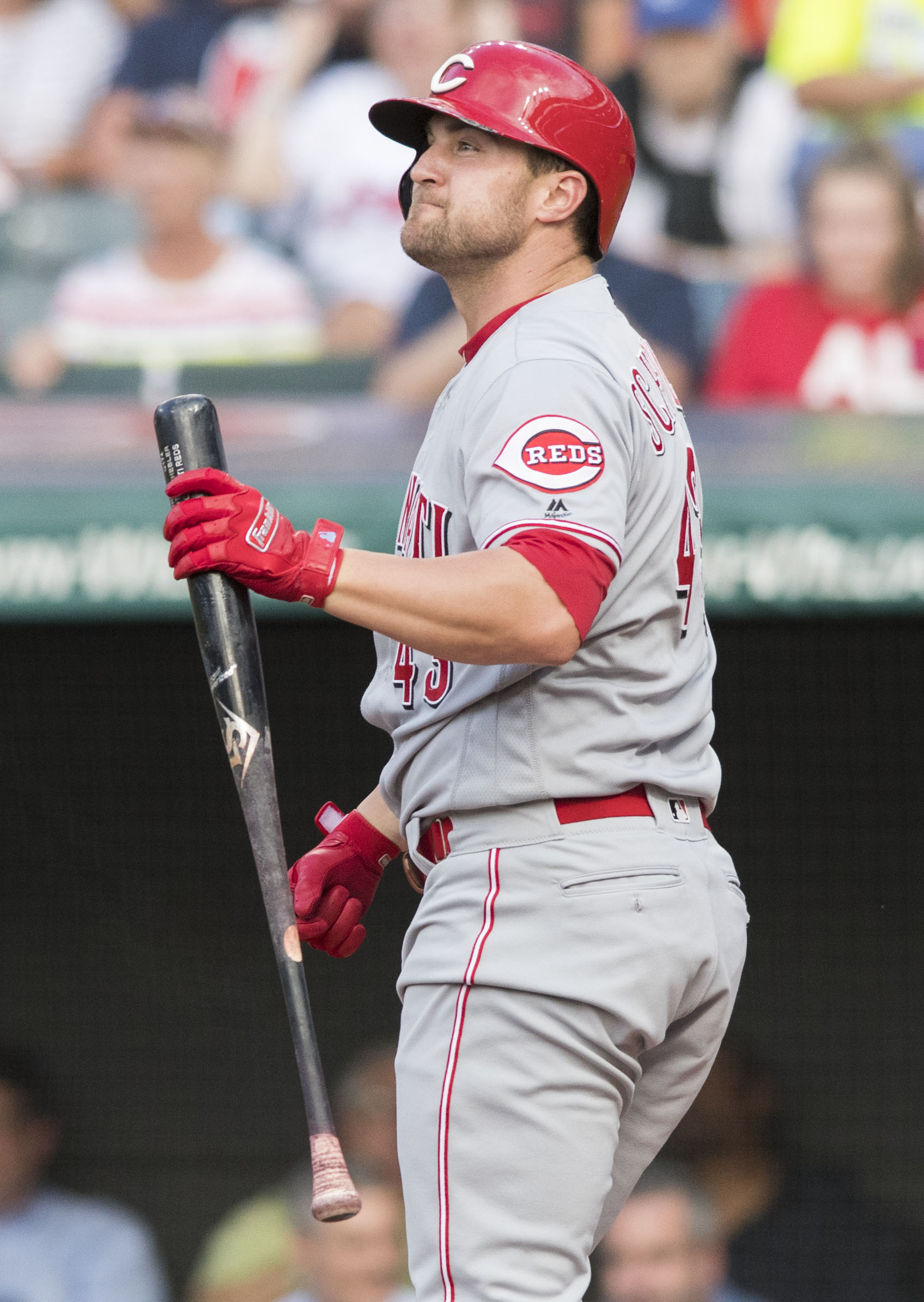
Schebler, who turned 26 shortly after that strong ’15 finish, indeed logged the lion’s share of innings in right field the following season. His overall .233/.307/.484 batting line was about league-average, per park- and league-adjusted metrics like OPS+ (102) and wRC+ (98), but Schebler clubbed 30 homers and played solid defense in the outfield (+2 DRS, -1.2 UZR, +3 OAA). A year later, his .255/.337/.439 slash again checked in above average (107 OPS+, 108 wRC+).
In 2019, however, the Reds were clearly motivated to emerge from a longstanding rebuild (of which Schebler himself was a product). Cincinnati acquired Yasiel Puig, Matt Kemp, Alex Wood, Sonny Gray and Tanner Roark over the winter, clearly seeking to fortify a roster that lost 95 games in 2018. Jesse Winker had mostly solidified left field, and top prospect Nick Senzel was knocking on the door to the Majors in center. A spring injury to Senzel led the Reds to open the year with Schebler in center field, and in 95 plate appearances, his bat cratered: .123/.253/.223. There was some poor luck on balls in play (.154), but Schebler also saw his strikeout rate climb as his hard-hit rate and average exit velocity plummeted. He was optioned to Triple-A in early May.
Schebler went down with an oblique injury not long after being sent down and missed more than a month of action. He was placed back on the minor league injured list less than three weeks later and due to a shoulder injury that ultimately required surgery. In 212 Triple-A plate appearances, he slashed just .216/.274/.325.
And while Schebler mended on the IL in August, Aristides Aquino was called to the Majors and posted a ridiculous .320/.391/.767 slash in his first month of action. His bat flopped in September (.196/.236/.382), but Aquino firmly put himself on the map as an option in future seasons. Over the winter, the Reds signed Japanese star Shogo Akiyama and slugger Nick Castellanos. They also acquired Travis Jankowski from the Padres.
Things appear rather bleak for Schebler in Cincinnati at this point. He’s out of minor league options and sits behind Winker, Senzel, Akiyama and Castellanos on the depth chart — perhaps Aquino, too. Phil Ervin is a younger, better defender who hit .271/.331/.466 in 260 plate appearances last season. Both he and Jankowski, whose best asset is his glove, are more logical reserve outfielders. It’s also worth remembering that setup man Michael Lorenzen is a two-way player who logged 89 innings in the outfield last year.
Perhaps expanded rosters will make it possible for the Reds to carry Schebler. The Reds would probably like to see how he looks with a healthier shoulder. However, even if his roster spot is salvaged, at-bats would figure to be hard to come by with such a glut of outfield candidates. And as the only one of the bunch who is out of minor league options, Schebler seems to be on the shakiest ground at the moment.
We of course don’t know when play will resume and when the transaction freeze will be lifted, but whenever it does, it wouldn’t be much of a surprise if Schebler eventually lands elsewhere. Last year’s rough showing notwithstanding, he’s controllable through 2023 and was a slightly above-average hitter with passable defense in parts of four seasons from 2015-18. He ranked well above average in terms of hard-hit rate, exit velocity and barrel rate in 2017-18.
Schebler may not be a star, but there’s still a potentially useful player in there. A rebuilding club — e.g. Tigers, Orioles, Pirates — could hope that with a change of scenery, Schebler could again be a reasonably productive player. It’s just hard to imagine that happening with such a stacked outfield mix in Cincinnati.
How Nomar Mazara Can Reach His Potential With The White Sox
One of the wild cards of the 2020 season will be the development of 25-year-old outfielder Nomar Mazara, who will look to finally break out, this time in a new environment. By now, Mazara has had four whole seasons to prove himself at the Major League level, and in 2019 he was largely the same player as he was when he debuted with the Rangers in 2016. Last year was critical for the marriage between Mazara and the Rangers; if Mazara were to establish himself as a building block for Texas, he needed to take the leap that the club has been expecting since it signed him in 2011 as an amateur. Unfortunately, that progress didn’t really come, and the Rangers dealt Mazara to the outfield-needy White Sox in December.
At 6’4″ and 215 lbs., Mazara looks the part of an MLB slugger: his frame alone is enough to convince spectators that he’s got superstar potential. He’s almost in the Giancarlo Stanton/Joey Gallo class of physicality, and his mammoth home runs lend credence to that comparison—Mazara hit the longest homer in MLB last year with a Statcast-measured 505-foot blast. When Mazara gets into one, your eyes light up at the thought of him mashing with regularity.
But the fact of the matter is that Mazara has yet to hit more than 20 homers in a season, and has in fact never put up a season of even 1.0 WAR by FanGraphs’ measure (Baseball-Reference agrees). It’s been frustrating for Rangers fans to follow his development, not because he’s been a bad player, but simply because they recognize he could be so much more.
While his average exit velocity of 89.1 mph only ranked in the 51st percentile last year, his hardest-hit balls tell a different story: his maximum exit velo, 114.6 mph, ranked number 41 among all MLB hitters. That’s something you might expect from a perennial 30-homer guy, not someone who’s plateaued at the 20-home run threshold. So what’s holding him back?
For one thing, his ceiling has thus far been limited by just average on-base skills: Mazara has never walked at a rate higher than 9% in a single season, meaning that his yearly on-base percentage has consistently hovered around .320, which is just about MLB-average. Even when he does tap into his prodigious power, that leaves him a step below the likes of Gallo or Stanton, who command enough respect from pitchers—and are disciplined enough—to generate above-average walk rates.
Last year, Mazara was at his most aggressive since entering the big leagues: he swung the bat more often at pitches both inside and outside the zone, and that change yielded mixed results. As you might expect, more swings means that he also missed more often than ever, though that didn’t adversely affect his strikeout rate. His walk rate was the lowest of his career, but the more assertive Mazara was able to post his best hard-hit and slugging numbers yet, though not by a huge margin.
But none of that looks to be the driving force behind Mazara’s stagnation; we’ve seen plenty of players put up big power numbers with subpar plate discipline. To this point in his career, the most frustrating part of Mazara’s game is the frequency with which he does damage. Mazara just hasn’t been able to get to that power as often as we’d like to see. And whether he reaches his ceiling in Chicago seems to hinge on one particularly troubling facet of his game, and that’s his inability to pull the ball in the air.
To preface: generally, pulling fly balls is an undeniably good thing, at least for players with the strength to swing for the fences: in 2019, MLB hitters posted a cumulative wRC+ on pulled grounders of -5. That’s really bad. 100 denotes average, so we’re talking about 105% below average. On the other hand, that number for pulled fly balls was an astronomical 403. So pulling the ball tends to be a profitable endeavor for MLB sluggers. That’s no surprise, and it’s the reason baseball has experienced a “fly ball revolution” in the last half-decade.
But Mazara has thus far been unable to take advantage of that revolution. When he pulls the ball, the results just haven’t been there simply because he hits the ball on the ground too often: in 2019, 66% of the balls Mazara hit to right field were grounders, by the far the least favorable outcome for a player of his stature. In essence, the best way to get extra-base hits—fly balls to the pull field—just haven’t been a significant weapon in Mazara’s arsenal. When he does pull the ball, he simply isn’t doing as much damage as he could be by elevating the ball. That’s been the case for his entire career, and frankly I think it’s the single biggest thing preventing Mazara from becoming an All-Star.
Interestingly, the same trend isn’t true of his hits to the opposite field: in fact, he hit the ball in the air much more often when going to left field (54.1 FB%, compared to just 23.9 GB%), and that translated to better results: Mazara posted a 139 wRC+ when going the other way, which is well above league average. His production on opposite field swings gives us a glimpse of what could be if he’s able to generate a similar batted-ball distribution to his pull field. And one figures those numbers would only get better when he pulls the ball, where it’s easier for hitters to get to their strength. He’s capable of elevating the ball, and good things happen when he does, but to this point he’s failed to do so when it’s most advantageous.
He’ll get the starting right field gig with the White Sox this summer, and while Chicagoans might have preferred their team to go after someone with a more solid track record, the fruits of acquiring Mazara might be sweeter than any other outfielder on the market. The South Siders have had success developing young players in recent years, and Mazara could fit right in with their burgeoning young core. So whatever the mechanical or mental source of the trend we described above, they’ll hope the player development staff can unlock what Texas couldn’t and tap into Mazara’s electric talent. That could make the difference between whether he merely tantalizes with his potential, or actualizes it.
The One Who Got Away From Cleveland
Tomorrow marks the two-year anniversary of a seemingly innocuous decision that ultimately backfired. On May 4, 2018, the Indians designated third baseman Gio Urshela for assignment. Five days later, they traded him to the Blue Jays for cash considerations, ending his decade-long tenure in the organization.
The decision to move on from Urshela made perfect sense at the time. He had never been a top prospect, instead profiling as a glove-first depth infielder. His offensive numbers in the high minors were fine but unspectacular. That wasn’t the case in MLB, though, as he’d hit just .225/.273/.314 (56 wRC+) in parts of three seasons. Most pressing, he’d exhausted all his minor-league options by 2018. Rather than carrying Urshela on an active roster already featuring Francisco Lindor, José Ramírez, Jason Kipnis and Erik González (himself out of options and capable of playing shortstop), the front office elected to move on.
Urshela played in just 19 games in Toronto before they too cut him loose. He cleared waivers, was traded to the Yankees, and didn’t return to the majors in 2018. He became a minor-league free agent after the season. Presumably finding no MLB interest, he returned to the Yankees on a minor-league deal last November.
That under-the-radar series of events proved massively important in 2019. With Miguel Andújar injured, the Yankees turned third base over to Urshela. He responded with an out-of-nowhere breakout, hitting .314/.355/.534 (132 wRC+) in 476 plate appearances. It’s an open question whether he can sustain anything approaching that production moving forward, but his underlying batted ball metrics were fantastic. In February, 68% of MLBTR readers opined the hot corner in the Bronx was Urshela’s to lose, even with Andújar returning. The 28-year-old is under team control through 2024, making him a potential long-term asset for the New York organization.
For the Indians (and to a lesser extent, the Jays), seeing Urshela’s success with an AL rival has to be a bitter pill to swallow. Obviously, they couldn’t have seen his 2019 season coming. No one around the league did, seeing as Urshela was available for little more than an MLB roster spot an offseason ago. Every team has players they wish they hadn’t let get away in retrospect (some significantly more painful than losing Urshela). Perhaps the 28-year-old simply needed a change of scenery and/or a new voice on the player development side to unlock another gear. Regardless of how and why it happened, there’s no doubt Urshela washing out in Cleveland proved to be a huge gain for the Yankees.
How Worried Should The Cardinals Be About Paul Goldschmidt?
The Cardinals reached the 2019 NLCS on the strength of their pitching and defense, as the team’s offensive efforts could best be described as middle of the pack. After letting Marcell Ozuna leave in free agency and trading Jose Martinez to the Rays, St. Louis did more to subtract than add from the lineup during the offseason, as Brad Miller and the re-signed Matt Wieters were the only position players inked to Major League contracts.
Young players like Tommy Edman, Harrison Bader, Lane Thomas, Tyler O’Neill, and (eventually) top prospect Dylan Carlson are expected to make up some of this offensive slack as they grow into being big league regulars. If and when the 2020 season gets underway, however, the Cards are also counting on several underachieving veteran bats — i.e. Dexter Fowler, Matt Carpenter, Yadier Molina — to get back to form.
At the very least, Paul Goldschmidt performed markedly better than that group. The six-time All Star’s first season in St. Louis saw him hit .260/.346/.476 with 34 homers over 682 plate appearances. This worked out to a 113 OPS+ and 116 wRC+, both of which ranked second on the team (behind Edman) among Cards batters with at least 349 PA. Goldschmidt also came up big in the Cardinals’ five-game triumph over the Braves in the NLDS, posting a 1.383 OPS over 23 plate appearances to help lead St. Louis to its first postseason series victory since 2014.
All in all, it was a very solid showing for a veteran hitter in his age-31 season. However, “very solid” is not what the Cardinals were expecting from Goldschmidt, especially given their major investment in his future during the 2018-19 offseason.
The Cards paid a hefty price to acquire Goldschmidt from the Diamondbacks in December 2018, sending Luke Weaver, Carson Kelly, minor league infielder Andy Young, and a Competitive Balance Round B pick in the 2020 draft (that 75th overall pick was used on Dominic Fletcher, a strong defensive outfielder ranked by MLB Pipeline as the 20th-best prospect in Arizona’s farm system). It was a lot to give up for just one year of Goldschmidt’s services, though the Cardinals kept the slugger away from free agency by signing him to a five-year, $130MM extension last spring, locking Goldschmidt up for the 2020-24 seasons.
It was the priciest contract in Cardinals history, topping the seven-year, $120MM deal given to Matt Holliday in the 2009-10 offseason. The Holliday contract, incidentally, is widely considered to be one of the best nine-figure free agent deals in baseball history — entering his age-30 season at the time of the agreement, Holliday remained a very productive player until almost the very end of the seven-year pact, as injuries began to take their toll. He was limited to 703 PA over the last two seasons (2015-16) of his Cardinals contract, though Holliday still managed a 113 OPS+ and 115 wRC+ during that stretch.
Some might call this a “very solid showing” for an injury-plagued Holliday in his age 35-36 seasons….especially considering that it essentially matched what the 31-year-old Goldschmidt did over only slightly fewer plate appearances in 2019.
Granted, that observation is probably better served to illustrate that Holliday was a very underrated player moreso than it was to hint that Goldschmidt is already in a decline phase. Still, considering how sharply Goldschmidt’s 2019 numbers dropped off from his superstar-level production in Arizona, the Cardinals can’t be happy about already having to consider if he has already peaked.
From 2013-18, Goldschmidt batted .301/.406/.541 over 3944 PA for the Diamondbacks, hitting 181 homers and posting a 149 wRC+/150 OPS+. His 2019 campaign, therefore, marked easily the worst season of seven-year span, and Goldschmidt also posted the lowest batting average, OBP, slugging percentage, walk rate (11.4%), and BABIP (.302) of those seven years in 2019, while generating his second-highest strikeout rate (24.3%).
As per Statcast numbers that date back to 2015, Goldschmidt also posted his lowest hard-hit ball rate (42.4%), exit velocity (90.1 mph) and xwOBA (.361) of the Statcast era. His xwOBA is higher than his .346 wOBA, however, and since Goldschmidt had never previously enjoyed less than a .340 BABIP in any of his full Major League seasons, there is some element of bad luck to his 2019 results. As MLBTR’s Connor Byrne pointed out last July, however, Goldschmidt’s sprint speed has been in decline as he has gotten older, which has been borne out in his dwindling stolen base totals and, by extension, his ability to beat out grounders and keep up those inflated BABIP numbers.
Connor’s piece (titled “The Surprisingly Disappointing Paul Goldschmidt”) was published on July 2….which, in classic reverse-jinx form, ended up being just about the nadir of Goldschmidt’s season. After posting a .742 OPS from Opening Day through July 2, Goldschmidt proceeded to hit .274/.354/.554 over his final 326 PA. It marked the second straight year that Goldschmidt rebounded from tough beginning to a season, as he had only a .721 OPS through his first 243 plate appearances of the 2018 campaign before crushing it to the tune of a whopping 1.040 OPS over his 447 remaining PA.
It’s possible St. Louis could look at those 2018 numbers and think that Goldschmidt might just be evolving into a slow-start type of player. And again, it should be noted that Goldschmidt in no way was a bad player in 2019, with a 2.9 fWAR. The issue is that the Cardinals were certainly counting on Goldschmidt’s prime to last at least a couple of years into his extension, not see it potentially already end before his extension even begins.
As a what-if, let’s imagine Goldschmidt hadn’t inked that new deal with the Cards and instead tested free agency. On the heels of his 2019 performance and going into his age-32 season, he wouldn’t have come anywhere close to five years and $130MM on the open market. Jose Abreu was the only other major name in the first base market, and the unusual nature of Abreu’s relationship with the White Sox makes him something of an outlier rather than as a Goldschmidt comp. Abreu openly wanted to remain in Chicago, to the point that he accepted the team’s one-year, $17.8MM qualifying offer and then signed a further extension through the 2022 season (an extra two years and $32.2MM).
Abreu is a year older than Goldschmidt and doesn’t have such a long track record of elite performance. Yet, considering how many felt the White Sox were generous in their extension with Abreu, could something in the neighborhood of a three-year guarantee for $50MM-$60MM have been Goldschmidt’s ceiling in free agency? Teams are less willing than ever to pay a premium for anything below top-level offense from a first base-only player, and it’s likely multiple clubs would have been worried by Goldschmidt’s 2019.
Plus, a qualifying offer would have also been attached to Goldschmidt’s services, and it’s not out of the question that he could have himself accepted the $17.8MM QO as a form of a pillow contract. On the other hand, he also might have been wary about leaving any further potential long-term money on the table since his early-career extension with the Diamondbacks ended up being a bargain for the club. Goldschmidt and his representatives might have looked for a multi-year deal that, ideally, contained an opt-out after the first year, allowing Goldschmidt to re-enter the market if he did indeed prove that 2019 was an aberration.
In any case, the qualifying offer could have potentially helped the Cardinals in re-signing Goldschmidt at a much lower price than $130MM. Or, while walking away from Goldschmidt entirely would have been bold given how much they sent to the D’Backs, the Cards could have looked elsewhere and, in this scenario, had $130MM in future funds to allocate to another offensive player. Perhaps St. Louis could have made a big push for Anthony Rendon, or maybe outbid the Twins for Josh Donaldson (a longtime Cardinals target).
It’s all total speculation, of course, as Goldschmidt is on the Cards’ books through the 2024 season. Of all the veterans St. Louis is relying on once baseball eventually gets underway, the length and cost of Goldschmidt’s contract make him the player the Cardinals most strongly hope can get back on track.
Remembering A Disastrous World Series Performance
The worst bullpen meltdown of the 2001 World Series was not the one you think. You probably go right to Byung-Hyun Kim blowing saves in games four and five in Yankee Stadium, putting the Diamondbacks on the brink of elimination heading into game six. But that’s not it.
You might also think of Mariano Rivera blowing the save in game seven. Mark Grace singled, Rivera turned a sac bunt attempt into runners on first and second, Tony Womack eventually knocked home the tying run. Then Tim McCarver – without so much as a spoiler alert – laid out exactly what was about to happen like he’d seen it already, and Luis Gonzalez shoveled a ball over the drawn in infield to win the World Series. Just like that, the greatest closer of all time blew game seven of the World Series, ending a Yankee dynasty in its tracks.
But that’s not it either. I’m talking about Jay Witasick‘s beautifully disastrous performance in game six.
With the Yankees up three games to two in the 2001 World Series, the series shifted back to Arizona for a critical game six. The Yankees were just one win away from their fourth consecutive World Series championship, while the Diamondbacks, in their fourth season, hadn’t yet existed in a world in which the Yankees were not the champs. Kim’s consecutive blown saves put Arizona in this position, but in game six, it would be the Yankees bullpen that would implode. Though Jay Witasick’s meltdown didn’t come in as high a leverage situation as Kim’s (nor Rivera’s), it was something to behold.
Witasick entered Game 6 with runners on second and third with the Yankees trailing 5-0. It was still early. The game was in reach. Here’s how hitters fared against Witasick that inning:
- Single to LF
- Single to LF
- Single to LF
- Single to RF
- Tony Womack strikes out swinging (phew!)
- Single to CF
- Double to LF
- Single to CF
- Double to CF
- Reggie Sanders strikes out swinging (finally!)
In a game when the Yankees could have clinched a World Series victory, Joe Torre let Witasick stay in the game to surrender four consecutive hits – twice! – in one inning. By the time Reggie Sanders finally struck out, the Diamondbacks led 12-0. Relievers are often made to wear it the way Witasick did here, but a win in this game meant a World Series title. This wasn’t a normal game. This was the type of game when – normally – you never give up. Witasick’s 8 earned runs tied him with Grover “Pete” Alexander for the most runs ever given up in a World Series game. Alexander took 2 1/3 innings to give up that many in the 1928 World Series against the Yankees.
Witasick would give up two more hits the next inning (he started another inning!), giving him a final line that looks like this (parents, cover your children’s eyes): 1 ⅓ innings, 10 hits, 9 runs (8 earned), 4 strikeouts. Randy Choate came on and allowed Witasick’s stragglers to score, by which point the Diamondbacks led 15-0. Luis Gonzalez – their consensus best player – was pulled for rest in the bottom of that inning (the 4th inning!). Given the stakes of the game, it’s amazing that Torre allowed Witasick to get shelled the way he did.
I’ll give Torre this: games four and five of the 2001 World Series went into extra innings, and leading 3 games to 2 going into game six, the Yankees had some cause to pack it in by the time Andy Pettitte left the game without recording an out in the third inning. And it’s not as if Witasick was giving up home runs. These were mostly bleeders through the left side of the infield – but they weren’t totally cheap knocks either.
On the other hand, when Pettitte exited the game, it was still just a 5-0 deficit in the 3rd inning. Of course, Torre also had reason to doubt whether his offense could come back from a deficit that large. In the first five games of the series combined, the Yankees had scored a total of four runs in innings 1 through 8. Without a pair of clutch ninth-inning home runs from Tino Martinez and Scott Brosius, the Yankees came dangerously close to losing all 7 games of the series (which, of course, would have been impossible).
Still, Witasick’s ill-fated stint in the third and fourth inning of game 6 stands out as a woeful performance with the season on the line. Witasick put together a solid professional career, pitching for 7 teams over 12 years with a 4.64 ERA/4.69 FIP, and it’s hardly his fault that Torre decided to pack this one in by the third inning, but it’s worth a re-watch nonetheless.
Merrifield Or Kingery?
Scott Kingery and Whit Merrifield aren’t exactly at the same place in their careers.
Merrifield, 31, led his team in bWAR last season and is considered by many as the best player on their rebuilding club. He’s a late-bloomer, but on the wrong side of thirty nonetheless, with 3.5 seasons under his belt as an above-average player. MLBTR’s Mark Polishuk recently wrote this of Merrifield: “The 31-year-old is one of the better all-around veteran assets in the game, considering his ability to play multiple positions, his inexpensive contract that could extend through the 2023 season, and his three consecutive seasons of strong production.” He boasts a career batting line of .296/.344/.445, good for 109 wRC+.
Kingery, 26, disappointed in a major way in his first shot at the big leagues, but he rebounded last year with an honest effort as a multi-positional asset for the contending Phillies. In just his age-25 season, Kingery posted a line of .258/.315/.474 across 500 plate appearances while socking 19 long balls. MLBTR’s Jeff Todd recently wrote this: “Kingery had some ups and downs in his second season in the bigs, but ultimately made huge strides and turned in a league-average offensive season.” To this point, Kingery’s career line stands at just .242/.291/.407 – but the former 2nd round pick produced a 101 wRC+ last season. At a similar age, Merrifield was splitting his time between Double and Triple A.
Financially-speaking, both are signed to long-term deals. Because Merrifield debuted on the older side, he signed a very team-friendly deal through potentially his age-34 season. He’ll make $5MM in 2020, $6.75MM in 2021, just $2.75MM in 2022, and the Royals hold a team option for $10.5MM in 2023. Many thought Merrifield would be traded to a contending team this winter, but the Royals love him, and given his contract, there’s no particular rush to move him. By not moving him, they’re missing out on the opportunity to add young talent to the organization, but Merrifield is producing now, and his story is one that might give many Kansas City farmhands hope.
Kingery is signed even longer. The Phillies will pay him $1.75MM in 2020 (in theory), $4.25MM in 2021, $6.25MM in 2022, and $8.25MM in 2023. Philadelphia also holds three team options: $13MM in 2024, $14MM in 2025, and $15MM in 2026.
Kingery’s deal brings a lot more upside, with Merrifield likely brings more near-term value. Given the current standings of the Phillies and Royals, an argument could be made that a straight-up swap of the two multi-positional right-handers makes a lot of sense. Kingery has yet to prove that he can produce a season like Merrfield’s 5.2 bWAR effort in 2018, but he’s also five years younger and signed for a longer period. Their deals, meanwhile, converge in 2023, where a 34-year-old Merrifield would be making more on a one-year deal than the 29-year-old Kingery, who at that point will have three relatively reasonable team options remaining.
Both players boast well-rounded games, with Kingery bringing a bit more pop potential, while Merrifield has superior bat skills. Kingery has swiped 25 bases while only being caught 7 times over his two seasons, while Merrifield led the AL in stolen bases in both 2017 and 2018. Last year, Merrifield’s volume and efficiency fell off a bit as he swiped just 20 bases in 30 chances. Both players have capably moved around the diamond, both infield and outfield. The gap between Merrifield’s 110 wRC+ last season and Kingery’s 101 wRC+ isn’t as great as the perceived talent gap between the two players. If nothing else, assume some age-related regression for Merrifield, while Kingery develops further as he grows into his prime, and don’t these two inch just a little closer?
Merrifield is the quick-trigger choice, but given a comprehensive look at both players, an argument can be made that Kingery is the better asset. All in, which would you prefer to have on your team: Merrifield’s proven qualities or Kingery’s rising upside? Put another way, who has the better asset: the Royals or Phillies?
Whit Merrifield Or Scott Kingery?
-
Whit Merrifield 58% (3,206)
-
Scott Kingery 42% (2,287)
Total votes: 5,493
Offseason In Review: Baltimore Orioles
The Orioles kept pretty quiet again this winter. They added a couple veteran stopgaps to temper the timelines of their young players. They also lost two Baltimore mainstays: Dylan Bundy and Mark Trumbo – both of whom had been with the big league club since 2016. Chris Davis and Mychal Givens are the only players left on the roster who have seen postseason action in an Orioles’ uniform.
Guaranteed Contracts
- Jose Iglesias, SS: one-year, $3MM (includes $3.5MM club option for 2021)
- Kohl Stewart, RHP: one-year, $800K if he stays in majors
- Total spend: $3.8MM
Trades and Claims
- Traded RHP Dylan Bundy to Angels for RHP Isaac Mattson, RHP Zach Peek, RHP Kyle Brnovich and RHP Kyle Bradish
- Traded IF Jonathan Villar to Marlins for LHP Easton Lucas
- Claimed RHP Hector Velazquez off waivers from Red Sox
- Claimed IF Andrew Velazquez off waivers from Indians
- Claimed IF Ramon Urias off waivers from Cardinals
- Claimed RHP Travis Lakins off waivers from Cubs
- Claimed IF Pat Valaika off waivers from Diamondbacks
- Claimed IF Richard Urena off waivers from Blue Jays
Notable Minor League Signings
Notable Losses
The Orioles are an interesting team from a short-season perspective. They don’t have the depth to compete over a full slate of 162 ballgames, but in some bizarro post-coronavirus tournament? They’re still probably not competitors – but they could be peskier than most suspect. Then again, that goes for all potential cellar-dwellers.
Specific to the Orioles, GM Mike Elias made clear early in the offseason what his priority number one would be: pitching depth. Elias found himself repeatedly scouring other organizations in 2019 for low-cost pitching to stanch the bleeding, and he didn’t want the O’s to be in that position again. Rushing minor-league talent to fill the void is not a palatable option for Elias. His offseason focus wasn’t so much about building a talent base in the majors as it was about protecting the future talent from the ill effects of hurried development. In that very-limited scope, Elias’ plan is sound. So while fans might not get goose bumps over the Orioles’ new arms, in this context, Tommy Milone and Wade LeBlanc are legitimate gets.
Milone has pitched in the majors in every season since 2011, and he very well might lead the majors in earned travel miles over that span. After making his debut with the Nationals, Milone pitched for the A’s for 2 1/2 years and Twins for 2 1/2 years, ably filling a rotation slot with a 4.14 ERA/4.36 FIP. 2017 was less kind as he produced lackluster results with the Brewers and Mets before taking a second turn with the Nats in 2018. Last season, however, Milone turned back the clock a tad, providing 111 2/3 innings of 4.76 ERA/5.00 FIP ball for the Mariners. Similar production would suit the Orioles’ needs just fine in 2020, especially under the conditions of a shortened season. It’s pretty darn close to a lateral move from, say, Aaron Brooks, one of last season’s stopgaps, but important nonetheless for the pitching-poor Orioles.
LeBlanc has a longer track record, but of similar shape and sound to Milone’s career. LeBlanc started his career with the Padres from 2008 to 2011. From there he went to the Marlins to the Astros, before boomeranging in 2014 from the Angels to the Yankees and back to the Angels again in the span of the 2014 season. He missed all of 2015, rehabbed with the Blue Jays’ Triple-A team in 2016 before reappearing in the majors for the Mariners and Pirates. “Boomerang” LeBlanc returned to the Mariners in 2018, where he enjoyed a semblance of stability for a pair of seasons, going 15-12 with a 4.57 ERA/4.80 FIP across 283 1/3 innings.
No, LeBlanc, 35, and Milone, 33, aren’t the same pitcher, but you’d be forgiven for getting them confused. 4.46 ERA to 4.47 ERA, 4.68 FIP to 4.58 FIP, 6.6 K/9 to 6.7 K/9. Both are among the absolute softest-tossers in the league, with Milone’s fastball averaging 87.1 mph, while LeBlanc, according to Statcast, has a “heater” that averages 86.3 mph (though he only throws it 5.7% of the time). Here’s a fun fact: LeBlanc appears in the 0th percentile for fastball velocity. Call it a case of baseball rubbernecking, but I personally would love to see a rotation with Milone, LeBlanc, and John Means, whose 91.7 mph fastball may look downright Johnsonian in comparison.
Whether either or both makes the team, let alone the rotation, is still very much in doubt (before the coronavirus craziness, MASN’s Roch Kubatko thought LeBlanc a lock to make the roster). Fellow newcomer Kohl Stewart might be a safer bet to line up behind Means, Alex Cobb and Asher Wojciechowski – though not because of his track record. Stewart comes from sturdier prospect stock as the fourth overall pick of the 2013 draft, and he’s still just 25-years-old. He arrives in Baltimore with just 62 big league innings and a matching 4.79 ERA/FIP.
On paper, Stewart is a fine low-cost gamble for a team like the Orioles, but whether or not he’s actually worth a look will depend on what the Orioles see in him that the Twins did not. If it’s just a paper gambit, there’s not a ton in Stewart’s recent history to get all that excited about – not with just 1.31 K/BB and a long list of injuries that have sapped him of his once-strong potential. But if they can improve his pitch sequencing, there may still exist some version of top-prospect Stewart to unearth. On the whole, these arms (Milone, LeBlanc, Stewart) were brought in specifically to keep younger arms out of the fire, but if/when the O’s tire of this approach, they have a number of hurlers in the upper minors to keep on your rookie radar.
On the offensive end, the most obvious plus from the 2019 season hit the most worrying snag possible: Trey Mancini doesn’t expect to play baseball in 2020, not after a Stage III Colon Cancer diagnosis. Read his piece in the Players’ Tribune, however, and you’ll be more encouraged about Baltimore baseball than before. Mancini hit .291/.364/.535 with 35 home runs, 106 runs and 97 RBIs in 2019. His 3.5 bWAR/3.6 fWAR (132 wRC+) places him in legitimate All-Star territory, even if that distinction was bestowed upon Means in 2019. If there’s baseball in 2020, Mancini will be missed.
But if Mancini can find the silver lining in his diagnosis, we can find it for the on-field Orioles. Playing time is a limited commodity – more so in 2020 than usual – and Mancini’s absence means ample opportunities for other Orioles to establish their credibility. Our own George Miller wrote about Anthony Santander as a potential breakout candidate, and he might be the most direct beneficiary of Mancini’s absence. But waiver claims like Pat Valaika or Andrew Velazquez could see the trickle down effect while coming off the bench. Velazquez, in particular, impressed manager Brandon Hyde and his staff this spring. DJ Stewart is another candidate to see time keeping Mancini’s spot warm, along with Dwight Smith Jr., Cedric Mullins, Ryan McKenna or Yusniel Diaz.
Ryan Mountcastle could also eventually make the big league club and see time either at first, third, DH, or the outfield. Mountcastle is in the conversation as the best power hitter in the Orioles’ system, and he might be the first of a new wave of Orioles’ prospects to get excited about. He just needs a defensive position.
On the dirt, the Orioles should feature a mostly new middle infield. Richie Martin and Jonathan Villar saw the most time up the middle in 2019. Villar finds himself in a Marlins’ uniform these days, while Martin will have to earn his keep to stay on the major league roster. Last year’s Rule 5 selection could use seasoning time in the minors, though he will compete for a roster spot. Moving on from Villar was somewhat surprising, even if his price tag was getting a little high ($8.2MM in 2020). It’s not as if the Orioles have a ton of financial commitments on the roster, and he’d been a rare plus on the offensive end (107 wRC+). Still, he has just one season left of control, and there might not have been much action on the trade market. Elias did well to at least get something in return for Villar, though Easton, a 23-year-old 14th-round draft pick from 2019, does feel like a light return.
In their stead, Jose Iglesias and Hanser Alberto figure to get most of the playing time up the middle. Iglesias brings a steady glove and consistent major league production to a lineup sorely lacking in veteran experience. But he’s also a textbook second division starter, never having produced more than 2.5 bWAR in a single season, and just as often coming up shy of the 2.0 bWAR mark. Still, his glove should help.
Alberto hit .305/.329/.422 last season, a breakout of sorts of the versatile infielder. Parts of three previous seasons with the Rangers produced a mere .192/.210/.231 line. Even the current version of Alberto isn’t a clear plus on that end (96 wRC+), not with a 2.9% BB%, even if he does put the ball in play (9.1% K%).
Alberto and Iglesias don’t have a real firm hold on their positions atop the depth chart (although it’s not as if Ramon Urias, Dilson Herrera, Stevie Wilkerson and Jose Rondon are beating the door down). Velazquez may steal some at-bats, though like Alberto, he can move around the diamond, and there’s probably room for both in 2020. Richard Urena – a waiver claim from the Blue Jays – is a semi-interesting name to keep in mind. He didn’t impress enough over his time in Toronto to keep a 40-man spot, and most of the buzz around him comes from his strong showings in rookie ball. But if the switch-hitting infielder were ever to walk at the rate he did back then, he could develop into a useful bat as he enters his prime years. For now, however, he’ll start the year with Triple-A Norfolk.
Lastly, the Orioles said goodbye to Mark Trumbo and Dylan Bundy, two of their longest-tenured players. Trumbo and the Orioles had some good times, but health issues and too much of an all-or-nothing approach limited his utility. Orioles fans can look back fondly on his first year in orange and black, however, when Trumbo hit .256/.316/.533 as the AL’s home run king. He slugged 47 long balls in 2016 as a big part of that Wild Card team. Unfortunately for both team and player, Trumbo came nowhere close to repeating that production in the three years since (.242/.295/.413 with 40 home runs across 992 plate appearances). Trumbo appeared in just 12 games in 2019. At 34-years-old, there’s a decent chance he’s played his last game in the majors.
Bundy was a much-heralded prospect coming up, appearing for the first time for two appearances as a 19-year-old way back in 2012. He didn’t reappear in the majors until 2016, and he never quite took off. He finished his Baltimore career with a 38-45 record across 127 games with a 4.67 ERA/4.75 FIP. Still just 27-years-old, Bundy will look to join a long list of former Orioles to find their groove elsewhere. Elias sent Bundy to the Angels for four pitchers. None are huge prospects, with Kyle Bradish the highest ranked, landing as the Orioles #22 prospect (per Fangraphs). Isaac Mattson lands at #31, Zach Peek at #37, while Kyle Brnovich does not rank. There’s not an obvious star there, but the Orioles need prospects of all shapes and sizes, and there’s something to be said for returning three ranked arms and a flyer for a back-end starter (*though not all outlets include the four on the O’s top-30 prospects list).
2020 Outlook
For those not paying attention, you might assume the Orioles were the worst team in baseball again in 2019. But the Tigers swooped in and took that title, leaving the 108-loss Orioles without a distinction on which to hang their hats. It’s not as flashy, but we’ll give them this: the Orioles had the 4th largest year-over-year improvement from 2018 to 2019 in the American League. Their 7-win improvement (from 47 to 54 wins) outpaced all but the Twins, White Sox, and Rangers in that department. If Manager Brandon Hyde can just quadruple that feat in 2020, why, they’d be over .500. More likely, the Orioles are ticketed for a fourth consecutive season in the AL East basement.
How would you grade the Orioles’ offseason moves? (Link for app users.)
How would you grade the Orioles' offseason moves?
-
C 34% (728)
-
D 30% (639)
-
F 20% (438)
-
B 12% (267)
-
A 4% (92)
Total votes: 2,164
Which Current Managers Had The Most Productive Playing Careers?
For the most part, if you’re a manager in Major League Baseball, it means that you played in the bigs earlier in your life. Out of the game’s current 30 skippers, only seven fell short of the majors. That list consists of the Orioles’ Brandon Hyde, the Angels’ Joe Maddon, the Braves’ Brian Snitker, the Mets’ Luis Rojas, the Cardinals’ Mike Shildt, the Pirates’ Derek Shelton and the Padres’ Jayce Tingler. Of course, no MLB experience as a player doesn’t mean you’ll fail as a manager (just ask the resoundingly successful Maddon). Nevertheless, with baseball shut down and so little going on in the sport, I figured it would be interesting to see which current managers accumulated the most value when they played. Keep in mind that we’re only using one metric (fWAR), which certainly isn’t the end-all, be-all, and this doesn’t take factors such as intangibles and playoff performance into account (some of these guys produced some memorable postseason moments). However, fWAR does give at least a general idea about the kinds of careers these managers had as players (and here’s a fun fact: There’s only one ex-pitcher here). Take a look…
- Don Mattingly, Marlins (first baseman for the Yankees from 1982-95): 40.7 fWAR in 7,721 plate appearances
- Dusty Baker, Astros (outfielder for the Braves, Dodgers, Giants and Athletics from 1968-86): 37.9 fWAR in 8,021 plate appearances
- David Ross, Cubs (catcher for the Cubs, Red Sox, Braves, Dodgers, Reds, Pirates and Padres from 2002-16): 22.4 fWAR in 2,644 plate appearances
- Bud Black, Rockies (left-hander for the Mariners, Royals, Indians, Blue Jays and Giants from 1981-95): 18.2 fWAR in 2,053 1/3 innings
- Dave Martinez, Nationals (outfielder for the Cubs, Expos, Rays, White Sox, Giants, Braves, Rangers, Reds and Blue Jays from 1986-2001): 18.1 fWAR in 6,48 plate appearances
- Craig Counsell, Brewers (infielder for the Rockies, Marlins, Diamondbacks, Brewers and Dodgers from 1995-2011): 17.6 fWAR in 5,484 plate appearances
- David Bell, Reds (infielder for the Phillies, Cardinals, Mariners, Indians, Giants and Brewers from 1995-2006): 13.5 fWAR in 5,380 plate appearances
- Dave Roberts, Dodgers (outfielder for the Indians, Dodgers, Red Sox, Padres, Giants from 1999-2008): 10.3 fWAR in 3,092 plate appearances
- Aaron Boone, Yankees (infielder for the Reds, Yankees, Indians, Marlins, Nationals and Astros from 1997-2009): 10.0 fWAR from 1997-2009
- Rocco Baldelli, Twins (outfielder for the Rays and Red Sox from 2003-10): 8.0 fWAR in 2,065 plate appearances
- Joe Girardi, Phillies (catcher for the Yankees, Cubs, Cardinals and Rockies from 1989-2003): 5.6 fWAR in 4,535 plate appearances
- Gabe Kapler, Giants (outfielder for the Tigers, Rangers, Rockies, Red Sox, Brewers and Rays from 1998-2010): 5.4 fWAR in 3,315 plate appearances
- Scott Servais, Mariners (catcher for the Astros, Cubs, Giants and Rockies from 1991-2001): 4.9 fWAR in 2,778 plate appearances
- Ron Roenicke, Red Sox (outfielder for the Dodgers, Phillies, Giants, Padres, Reds and Mariners from 1981-88): 3.6 fWAR in 1,294 plate appearances
- Mike Matheny, Royals (catcher for the Brewers, Blue Jays, Cardinals and Giants from 1994-2006): 2.8 fWAR in 4,287 plate appearances
- Bob Melvin, Athletics (catcher for the Tigers, Giants, Orioles, Royals, Red Sox and White Sox from 1985-94): 2.5 fWAR in 2,095 plate appearances
- Ron Gardenhire, Tigers (shortstop for the Mets from 1981-85): 0.9 fWAR in 777 plate appearances
- Chris Woodward, Rangers (shortstop for the Blue Jays, Mets, Mariners, Braves and Red Sox from 1999-2011): 0.7 fWAR in 1,986 plate appearances
- Charlie Montoyo, Blue Jays (second baseman for the Expos in 1993): 0.0 fWAR in five plate appearances
- Rick Renteria, White Sox (infielder for the Pirates, Mariners and Marlins from 1986-94): minus-0.2 fWAR in 456 plate appearances
- Torey Lovullo, Diamondbacks (second baseman for the Tigers, Yankees, Angels, Mariners, Athletic, Indians and Phillies from 1988-99): minus-0.5 fWAR in 837 plate appearances
- Terry Francona, Indians (first baseman/outfielder for the Expos, Cubs, Reds, Indians and Brewers from 1981-90): minus-1.7 fWAR in 1,826 plate appearances
- Kevin Cash, Rays (catcher for the Rays, Blue Jays, Red Sox, Yankees and Astros from 2002-10): minus-2.4 fWAR in 714 plate appearances