
When Padres Gave Up An Eventual 2-Time Cy Young Winner
Although right-hander Corey Kluber has been one of the most successful starters in recent memory, it’s not as if his he was a can’t-miss prospect who was expected to turn into the two-time American League Cy Young winner he became. Kluber entered the pros as a fourth-round pick of the Padres in 2007, but he wasn’t lights-out at preventing runs at the lower levels of the minors with them during his time with the franchise. The Padres eventually deemed Kluber expendable when they sent him to the Indians in a July 2010 three-team trade that also involved the Cardinals. The headliners then were outfielder Ryan Ludwick (he went from the Cardinals to the Padres) and righty Jake Westbrook (the Indians shipped him to the Redbirds). Little did anyone know Kluber would turn into the most valuable player in the deal.
If we go back a decade, Ludwick was amid a rather impressive run with the Cardinals, largely because of a 5.3-fWAR campaign in 2008 in which he posted a jaw-dropping 151 wRC+. While he fell back to earth from there, the Padres – who were playoff contenders in 2010 – expected him to at least serve as a solid regular in their uniform. But the Padres, despite winning 90 games that year, didn’t end up making the playoffs, and they never got much value from Ludwick. He slashed a weak .228/.301/.358 (86 wRC+) over 664 plate appearances in a Padres uniform in 160 games before they sold him to the Pirates in July 2011.
Ludwick’s subpar production in San Diego makes it all the more unfortunate that the team said goodbye to Kluber, who later evolved into one of the top starters of the past several years. Kluber came into his own in 2013, his first full season in the majors, and proceeded to post a sterling 2.96 ERA/2.89 FIP with 9.91 K/9 and 1.86 BB/9 across 1,238 2/3 innings through 2018.
As mentioned, Kluber took home a pair of Cy Youngs during his halcyon stretch. He also earned three All-Star nods, ranked 10th among all qualified starters in ERA, and helped the Indians to four playoff berths and three AL Central championships. Not bad for someone who was unheralded when the Indians got him. Westbrook, whom the Indians gave up, was quite good in their uniform at times, and he did enjoy success in St. Louis, but that’s nonetheless a trade that Cleveland would make again in light of how much Kluber blossomed as a member of the club.
However, now 34 years old, Kluber is no longer part of the team with which he broke out. After a disappointing, injury-ruined 2019, the Indians sent Kluber and his waning team control (he has a guaranteed one year, $18.5MM left on the five-year, $38.5MM pact the Indians gave him in 2015) to the Rangers for reliever Emmanuel Clase and outfielder Delino DeShields. It has never come off as an overwhelming return for Cleveland, especially in light of Clase’s recent 80-game suspension for performance-enhancing drugs. Then again, Kluber didn’t look like a special pickup when he joined the Indians, and look how he panned out. Regardless of what happens with Clase and DeShields, you can’t argue with what the Indians got from Kluber when he was in their rotation. For the Padres, though, he’s a star who got away.
Photo courtesy of USA Today Sports Images.
On The Royals’ Pair Of Potential Stars
The Royals are trying to pull off a tough feat: a quick, low-pain rebound in place of a lengthy slog of a rebuild. That’s a tall task for any organization, but especially for a small-market franchise that pushed a lot of chips onto the table as part of a successful effort to maximize a recent window of contention.
As you might expect, the development of existing players is critical to this effort — as much or more than prospects, the younger big leaguers who’ll be relied upon to produce in the next few seasons. It’s absolutely critical for the K.C. organization to find some big-time production from players who aren’t commanding big salaries. Otherwise, deciding to hang onto Whit Merrifield, Salvador Perez, and other veterans could really sting in the long run.
The Royals have a pair of pre-arbitration players whose up-and-down careers to this point suggest equal parts upside and uncertainty. At times, shortstop Adalberto Mondesi and corner outfielder/infielder Hunter Dozier have performed like stars. But can they do so sustainably?
There’s plenty at stake for all parties. Both Mondesi and Dozier enter the 2020 season with two full years of MLB service, but not enough to reach Super Two status. Accordingly, they’ll be playing for their first big payday — as first-time arbitration-eligible players — whenever this campaign gets underway.
These two players have notable lineages and abundant physical ability. Mondesi’s dad had a long and excellent MLB career. Dozier was the eighth overall pick in the 2013 draft.
Their careers have certainly seen some peaks and valleys from those starting points. Mondesi shot up onto top-prospect rankings and burst onto the MLB scene with his first extended action in 2018, when he showed a rare blend of power (14 home runs in 291 plate appearances) and speed (32 stolen bases). But he took a step back at the plate last year — he posted an 82 wRC+ and Statcast credited him with a putrid .282 xwOBA — and ended up being shelved late in the season with shoulder surgery that he’s still fully recovering from.
Dozier’s dip came earlier in his professional career, as he struggled to convert promise into production in the minors. Health issues also intervened. By the end of the 2018 campaign, Dozier seemed likely to be a bust. He had reached but struggled at the MLB level and wasn’t hitting much in the upper minors. And then came 2019 … when Dozier suddenly broke out at the game’s highest level. He launched 26 long balls and posted a .279/.348/.522 slash line over 586 plate appearances, producing 85th percentile exit velocity and 80th percentile sprint speed. While Statcast still saw some good fortune in the batted-ball outcomes (.337 xwOBA vs. .360 wOBA), that hardly took the sheen off of a breakthrough campaign.
I’m not going to tell you I know what to expect from this duo. Each has struggled with swings and misses at some points, but also shown an ability to produce despite occasionally hefty strikeout rates. Their respective power potential has likewise alternately shown up and fallen off.
The upside here is tremendous. At his best, in 2018, a 22-year-old, switch-hitting Mondesi produced 2.5 rWAR and 2.8 fWAR in less than a half-season. He could be a true superstar if he can return to that level of output over a full campaign. Dozier was a 3.2 rWAR/3.0 fWAR performer in 139 games last year. That also reflects poor baserunning numbers and defensive grades at third base. Dozier graded better in right field, where he’ll appear primarily in 2020. Perhaps there’s still more upside in that regard.
There’s a load of overall uncertainty in Kansas City, but also some intriguing talent. The team’s other obvious boom-or-bust players — Maikel Franco, Jorge Soler, Danny Duffy — are set for free agency after 2021. Then there’s a host of younger players and prospects that have yet to put down much or any track record in the majors. Mondesi and Dozier occupy a middle ground of experience and contractual control that makes the 2020 season particularly pivotal for them and the team. If these two can settle in as steady stars, the Royals could be looking at three more campaigns apiece of cost-controlled quality to build around.
The Rays’ Next Breakout Reliever?
Remember that February 2018 three-way trade among the Rays, Yankees and Diamondbacks? Tampa Bay parted with the most noteworthy player at the time in outfielder Steven Souza Jr., but injuries weighed him down in Arizona and kept him from making an impact there. He’s now a member of the Cubs. The most valuable commodity from the deal could be infielder/outfielder Nick Solak, whom the Rays acquired, though they sent him to the Rangers in a different trade last summer. But the Rays haven’t come away empty-handed from the Souza swap. They may actually have a breakout reliever on their hands as a result of that transaction.
In May 2018, a couple months after the Souza trade occurred, the Rays received pitchers Sam McWilliams and Colin Poche from the Diamondbaks to complete their end of the return. McWilliams was regarded as the better prospect at the time, and he’s still a member of the Tampa Bay organization, but he hasn’t reached the majors yet. Poche – a 26-year-old left-hander – has racked up some big league experience, on the other hand.
After dominating in 2018 with the Rays in Triple-A ball, where he posted a 1.08 ERA/1.75 FIP with 14.04 K/9 and 3.06 BB/9 in 50 innings, Poche’s run prevention numbers took a huge step backward at the minors’ highest level last year. Poche only put up a 6.26 ERA across 27 1/3 frames with the Durham Bulls, though he did manage a far better 3.00 FIP with an otherworldly strikeout/walk ratio (15.8 K/9 versus 2.96 BB/9).
The Rays called Poche up near the beginning of June, and he got off to a rocky start, allowing two earned runs and taking the loss against the Red Sox in his debut. Poche went on to surrender at least one earned run in each of his next two outings, and he hit a nadir when he gave up six in a defeat to the Yankees on July 16. That performance was a major reason why Poche concluded the season with a subpar 4.70 ERA/4.08 FIP over his first 51 2/3 innings in the majors, as was a paltry 18.3 percent groundball rate. Those numbers look pretty mediocre overall, but that’s not to say all hope is lost.
If you look at several other key categories, Poche was actually one of the best relievers in baseball last season. In fact, he finished no worse than 20th in the majors in strikeouts per nine (12.54), swinging-strike percentage (17.2), infield fly rate (16.2 percent) and batting average against (.180). The awful average hitters logged against Poche was no fluke, per Statcast, which placed him in the league’s 100th percentile in expected BA (.170). And Poche was in the 90-plus percentile in such categories as expected weighted on-base average and expected slugging percentage, to name just a couple.
There’s always concern about how lefties fare against righties, especially now that MLB is adopting a three-batter minimum rule. Poche seems equipped to handle batters of either handedness, however, as he allowed almost matching production versus lefties (.274 wOBA) and righties (.281) last season. A four-seam fastball that owned the opposition was one of the reasons for his success; although he doesn’t throw incredibly hard (93 mph), hitters struggled to a .276 wOBA/.266 xwOBA against the pitch, which he threw almost exclusively (88.5 percent) and which FanGraphs assigned high marks. However, as FanGraphs’ Michael Augustine observed over the winter, Poche may have relied too much on that offering and not enough on his breaking ball. There could be something to that. According to Statcast, that pitch – while limited in use – did hold hitters to a laughable .124 wOBA/.104 xwOBA.
Maybe if Poche does lean less on his fastball going forward, he’ll join the ranks of the top lefty relievers in baseball. That type of breakout can’t be dismissed, especially when talking about a member of the Rays’ bullpen. Just over the past couple seasons, they’ve seen the likes of Emilio Pagan (whom they’ve since traded), Nick Anderson (whose ascent was recently covered here), Oliver Drake and Chaz Roe blossom in their uniform. Poche’s not there yet, but he did impress in many ways last year, and it may not be long before he becomes the latest Rays reliever to turn into a major success story.
Photo courtesy of USA Today Sports Images.
A Nice Bargain Pickup In Pittsburgh
The past two trips through free agency haven’t exactly been all that kind to Jarrod Dyson. The 35-year-old speedster waited until mid-February to find a one-year, $2MM deal with the Pirates this winter. That contract was penned two years (nearly to the date) after he signed a two-year, $7.5MM deal with the D-backs. Dyson has been able to find big league deals, but the lengthy waits and relatively small guarantees make clear that he’s not a highly in-demand player. I’m not here to say that Dyson should’ve been commanding lucrative three- and four-year offers in either of those instances, but his deal with the Bucs could still pan out as a nice bargain.
Dyson would be miscast as an everyday player — he’s a career .247/.319/.388 hitter — but he’s a legitimately elite defender and baserunner who is at least a passable option against right-handed pitching (.250/.320/.351). The lack of power is glaring, of course, but Dyson’s batting average and on-base percentage against righties are right in line with the league averages for the decade he’s been in the Majors.
Beyond his shortcomings at the plate, though, Dyson is excellent. Since 2012, his first full season in the Majors, Dyson ranks sixth among all big league outfielders in both Defensive Runs Saved (81) and Ultimate Zone Rating (55.6). Those rankings come in spite of the fact that everyone ahead of him (with the exception of Kevin Kiermaier) has logged 1200 or more innings than his 5543 innings. Jason Heyward and Alex Gordon are both over 9000 innings of defense in that time. On a per-game stat like UZR/150, Dyson ranks slightly ahead of both those two. Among outfielders with at least 1000 innings dating back to 2012, only Kiermaier, Mookie Betts, Harrison Bader and (perhaps surprisingly) Aaron Judge have posted marks higher than Dyson’s 12.6 UZR/150. Giving Dyson more reps in the field obviously means living with his sub-par offense on a more regular basis, but he’s one of the best defensive outfielders of the past decade.
It’s a similar tale on the basepaths. Dyson ranks third among the 3140 players who’ve had a big league at-bat since 2012 in terms of FanGraphs’ composite baserunning value (BsR). The only two players ahead of him are Billy Hamilton and Mike Trout — and Trout has had more than twice as many plate appearances. Dyson is sixth overall in stolen bases in that same group, and he has vastly fewer games played and plate appearances than the five ahead of him (Dee Gordon, Hamilton, Jose Altuve, Starling Marte, Rajai Davis). He’s been successful in an outstanding 85 percent of his career stolen base attempts.
The Pirates signed the right-handed-hitting Guillermo Heredia to team with Dyson in center field, Beyond that pairing there’s no immediate threat to step into the spot. Jason Martin, acquired in the trade that sent Gerrit Cole to Houston, had a big half-season in Double-A in 2018 but has hit just .242/.297/.383 in 640 plate appearances in Triple-A. JT Riddle was signed to fill a utility role but has only logged 235 innings in center and figures to fill more of a bench role.
Dyson isn’t going to provide much with the bat, barring a huge BABIP spike, but there’s also a bit of room for him to rebound a bit from a rough two years in Arizona, where he hit just .216/.302/.299. The Pirates may want to try batting Dyson lower in the order than the D-backs did in 2019, when he hit leadoff for 376 of his career-high 452 plate appearances; Dyson, for comparison, walked 18 times in 101 plate appearances hitting eighth in front of the pitcher over the past two seasons in Arizona. Any extra bases on balls are a welcome addition for a player with his wheels.
Beyond that, Dyson began hitting the ball in the air considerably more once he left the Royals in 2016. Perhaps it’s simply attributable to the increasing focus on launching the ball, but the drop from a 57.7 percent grounder rate to a 47.7 percent mark doesn’t seem ideal for Dyson’s skill set. His fly-ball rate, conversely, rose from 23.7 percent to 32.6 percent.
Even if Dyson keeps hitting the ball in the air more than he did in his Royals days, his glove and baserunning will prove plenty valuable. But from 2013-16, Dyson was worth an average of 2.5 bWAR per season and never saw a single season south of 2.1 — despite only playing on a part-time basis. His lone replacement-level season in his career came in 2018, when he was plagued by a .216 average on balls in play. A move down the order and/or a change in his approach at the plate could make Dyson a pretty tidy bargain.
A Shortstop Showdown
While they’re not in the same division, a pair of centrally based major league teams have produced a couple of the majors’ top-performing shortstops. The White Sox of the American League Central have seen Tim Anderson turn into a rather valuable player. The same goes for the Cardinals of the National League Central and Paul DeJong. They’re pretty similar in value, age and contract situations, but which of the two would you rather have?
Anderson, 26, was a first-round pick in 2013 who debuted in ’16 and took some time to find himself as a major league hitter. In 1,643 plate appearances from his first year through 2018, he hit a below-average .258/.286/.411 (86 wRC+) with 46 home runs and 51 stolen bases. A high strikeout rate (26 percent) and a low walk percentage (3.4) were part of the problem. Those K/BB trends largely stayed in place last year (2.9 percent and 21 percent, respectively), but Anderson nonetheless found another gear a hitter. He slashed .335/.357/.508 (130 wRC+) with 18 homers and 17 steals en route to a career-best 3.5 fWAR (he combined for 4.1 in the prior three seasons) and an AL batting title. Of course, he was also the beneficiary of a .399 batting average on balls in play – up .110 points from the previous year – and Statcast wasn’t as bullish as his bottom-line production (.363 weighted on-base average versus .328 expected wOBA).
Shifting to the defensive side, Anderson hasn’t been a consistently good player, at least not according to the metrics. By Defensive Runs Saved and Ultimate Zone Rating, he has been a plus player twice and a minus fielder twice. The most recent campaign fell into the latter category, as he posted minus-12 DRS with a minus-9.1 UZR. DeJong, meanwhile, has greatly outdone Anderson as a defender since debuting with the Cardinals in 2017. Last season, for instance, DeJong put up 26 DRS and 11.4 UZR, making him one of the sport’s top fielders.
Also 26, DeJong has graded as a solid performer on a regular basis dating back to his first game in the majors. He has been at least a 3.0-fWAR player every season, including a career-high 4.1 mark in 2019. DeJong, unlike Anderson, has struggled to hit for average of late, but he was a 30-HR man last year – a season in which he finished with a .233/.318/.444 mark (100 wRC+) across 664 plate appearances. Going by wRC+, it was the third consecutive time that DeJong registered league-average or better offensive numbers. That and his excellent defense have combined to make DeJong quite valuable for St. Louis.
Beyond the production on the field, you have to consider the two players’ contracts when comparing them. They’re pretty alike in that regard, too. Anderson inked a six-year, $25MM extension heading into the 2017 season. That deal also includes a $12.5MM club option for 2023 and a potential $14MM salary the next season. Whether or not the White Sox pick up either option, they’re surely not regretting the gamble now. Likewise, the Cardinals must be happy that they locked DeJong into a six-year, $26MM pact prior to 2018. That deal includes a $12.5MM option for 2024 and $15MM in ’25.
There’s a lot to like about both of these shortstops, but if you have to pick one, whom would you want on your team? (Poll link for app users)
Tim Anderson Or Paul DeJong?
-
DeJong 61% (3,859)
-
Anderson 39% (2,478)
Total votes: 6,337
An Angels Error
The Angels inked infielder Zack Cozart to a three-year, $38MM contract after the 2017 season, but now he surely counts as one of their least effective big-money signings in recent memory. When the Angels brought Cozart in, they expected he would carry what looked like a breakout offensive season into the future. That didn’t happen. In fact, Cozart’s tenure with the Halos went so poorly that they essentially sold him and the $12MM-plus left on his contract to the Giants over the winter. The Angels had to include young shortstop Will Wilson, their first-round pick last summer, in the deal in order to get Cozart’s money off the books, and the Giants quickly released Cozart. He hasn’t found a new team since then.
For the most part, Cozart had an unspectacular run with the Reds, who selected him in the second round of the 2007 draft. From his 2011 debut through the 2016 campaign, he was roughly a one- to two-WAR type of player who wasn’t much of a threat as a hitter. He only combined to slash .246/.289/.385 (80 wRC+) in those seasons, but exceptional glovework made him a regular. Cozart managed 43 Defensive Runs Saved and a 31.4 Ultimate Zone Rating at shortstop during that span.
Considering his track record, the Reds would have been right to expect another low-offense, high-end defensive year out of Cozart in 2017. Instead, though, he produced a career campaign at the plate that helped make him one of the most valuable players in baseball. Owing in part to a significant increase in walks and a much higher batting average on balls in play than usual, Cozart hit .297/.385/.548 (139 wRC+) with a personal-best 24 home runs in 507 plate appearances. Between the increased offense and his above-average defense (4 DRS, 4 UZR), Cozart logged 5.0 fWAR. The timing couldn’t have been better for him, but the Reds weren’t fully convinced he was suddenly a star player. They didn’t issue Cozart a qualifying offer after his outstanding campaign, which surely made him more appealing to teams seeking infield help on the open market.
Although Cozart was a shortstop throughout his Cincinnati stint, he ultimately wound up with the Angels as a third baseman/second baseman. He wasn’t going to steal the shortstop job from Andrelton Simmons – one of the greatest defenders the game has ever seen – but the hope was that the two would eat up every ground ball that came their way, and that Cozart’s offensive explosion would prove to be sustainable. Unfortunately, though, Cozart was just passable, not extraordinary, as a defender with the Angels. In a little over 600 combined innings between the keystone and third from 2018-19, he recorded zero DRS and 1.0 UZR. But his value truly torpedoed because of his work at the plate, where he hit a hideous .190/.261/.296 (54 wRC+) with five homers and minus-0.6 fWAR as a member of the club.
Worsening matters, various injuries limited Cozart to a meager 96 games and 360 trips to the plate in an Angels uniform. Just last July, a left shoulder ailment forced Cozart to undergo season-ending shoulder surgery. That pretty much concluded Cozart’s run with the Angels, and it helped pave the way for the signing of third baseman Anthony Rendon to a seven-year, $245MM contract this past offseason.
Had Cozart actually lived up to his contract, it’s anyone’s guess whether Rendon would have turned into an Angel. Regardless, Cozart now counts as one of the most regrettable signings in franchise history, and it’s unclear whether the 34-year-old will ever play in the majors again. To Cozart’s credit, though, he can say something that most major leaguers can’t: He was a 5.0-WAR player once whose performance earned him a sizable payday.
Photo courtesy of USA Today Sports Images.
A Quietly Built, Quietly Strong Bullpen
The 2019 Twins captured the baseball world’s attention with their historic home run output, and most of the other talk surrounding the team focused on questions within the rotation. The Twins won the AL Central with ease but were yet again bounced by the Yankees in a familiarly lopsided series. Entering the offseason on a low note and with four starting pitchers reaching free agency, the focus was again on the rotation. Yet somewhere along the way, the Twins quietly put together one of the most formidable collections of relievers in the game.
Following last year’s All-Star break, Twins relievers ranked ninth in the Majors in ERA (4.03) but led MLB in FIP (3.56), xFIP (3.87), SIERA (3.53) K-BB% (20.7%) and walk rate (5.9%). The Twins, long known for their reliance on soft-tossing, “pitch to contact” arms, saw their bullpen post the fifth-best overall strikeout percentage (26.6%). They tied for fourth in swinging-strike percentage (13.1%) and ranked fifth in opponents’ chase rate on pitches outside the strike zone (33.9%).
A half season’s worth of bullpen data is obviously not a definitive declaration of their status as elite, but the post-All-Star-break qualifier is of some note with regard to the Twins in particular. Minnesota opened the season with a host of reclamation projects and cast-offs in the relief corps. From Opening Day through the Midsummer Classic, the Twins saw Mike Morin, Blake Parker, Matt Magill, Ryne Harper, Adalberto Mejia and Trevor Hildenberger all make at least 13 appearances and total 14 or more innings. Harper, to his credit, was a legitimate contributor — although fielding-independent metrics forecast some regression, and his production faded in the second half.
The rest of that largely nondescript group was more or less out of the picture in the second half. Mejia, Morin, Magill and Parker were designated for assignment in a span of two weeks in mid-July. Mejia was claimed by the Angels, Morin was traded to the Phillies for cash, Parker also signed in Philadelphia after electing free agency, and Magill was traded to Seattle for cash. Harper’s role was reduced as his results regressed, and Hildenberger only tossed 2 1/3 innings as September call-up before being non-tendered in the winter. (Harper was designated for assignment and traded to the Nats in February.)
What was left of the Twins’ bullpen proved to be a remarkably effective unit.
Taylor Rogers cemented himself as the club’s closer after the addition of a new slider spurred a 2018 breakout. He threw his first slider in 2018 on Memorial Day, and dating back to that game, Rogers owns a 2.07 ERA (2.52 FIP, 2.77 xFIP) with 11.4 K/9, 1.6 BB/9, 0.77 HR/9 and a 48.7 percent ground-ball rate in 117 1/3 innings.
Tyler Duffey showed promise as a starter in his debut season with Minnesota but had bounced between the Majors and minors since. Duffey has acknowledged that at first, he wasn’t fully comfortable or familiar with much of the new data that was presented to him by the Twins’ analytics department, but he fully bought in this year and ditched his two-seamer and changeup to go with a four-seam and curveball-heavy arsenal. The result? A 2.50 ERA (3.06 FIP, 2.94 xFIP) with a career-high 12.8 K/9 and a whopping 15.3 percent swinging strike rate. In the second half of the season, Duffey posted a 1.53 ERA with a 47-to-8 K/BB ratio.
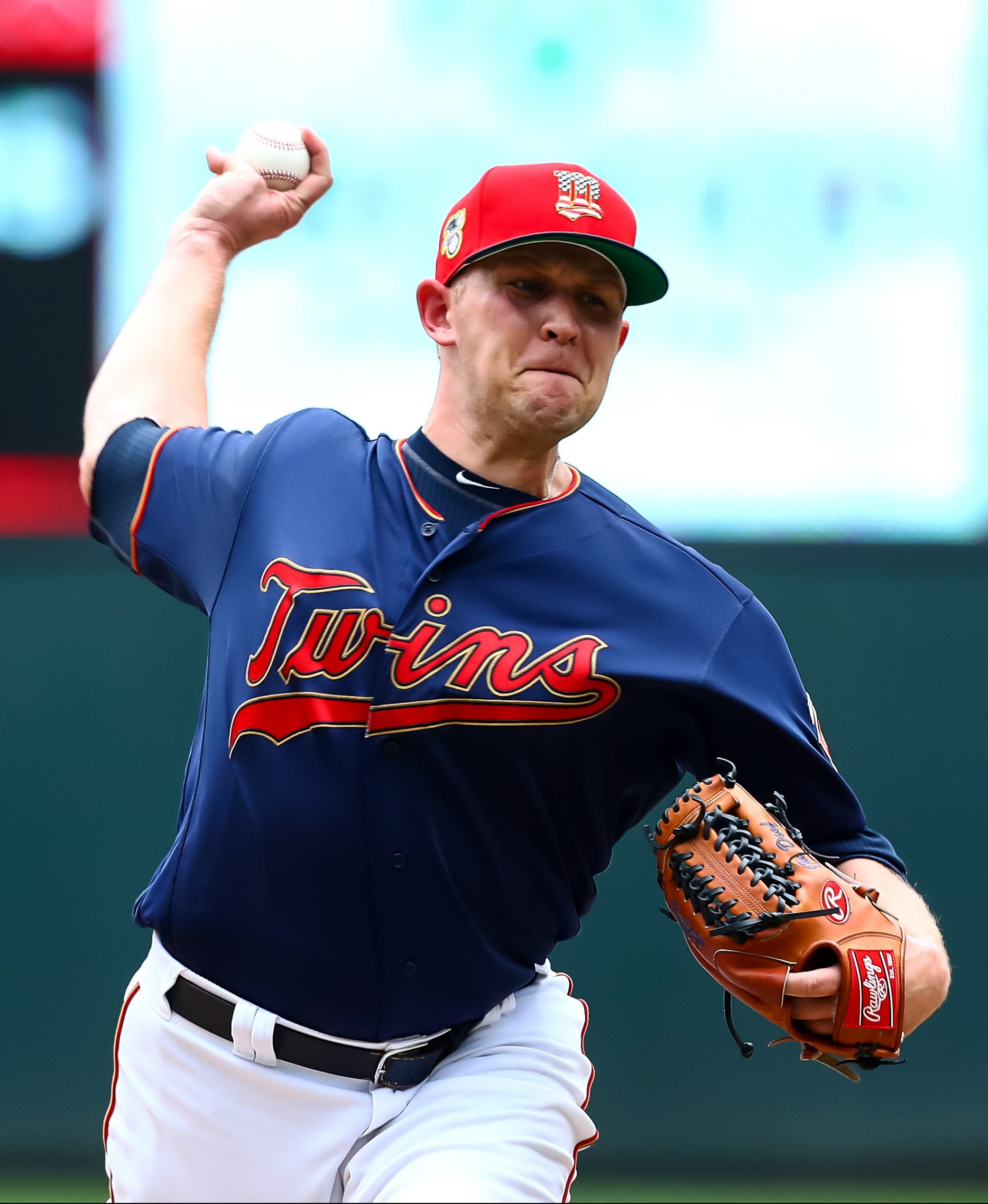
Another former starter, Trevor May, has steadily improved his relief work since returning from Tommy John surgery in 2018. The 30-year-old free-agent-to-be rattled off 64 1/3 innings of 2.94 ERA ball in 2019, including a 2.81 ERA (3.81 FIP, 3.67 xFIP) in 32 second-half innings. May saw his strikeout percentage spike from 25.5% in the first half to a hefty 35% in the second half, and his walk rate made similarly positive gains (11.9% in the first half; 7.3% in the second).
The Twins’ late-July acquisition of veteran Sergio Romo wasn’t the biggest headline grabber of deadline season, but the three-time World Series champ pitched 22 2/3 innings of 3.18 ERA ball (3.35 FIP, 3.91 xFIP) with a pristine 27-to-4 K/BB ratio. The two-plus months Romo spent in the organization clearly made a favorable impression, as he returned on a one-year, $5MM deal with a club option for the 2021 season.
But the most anonymous parts of the bullpen’s success were rookie right-handers Zack Littell and Cody Stashak.
Littell, a 24-year-old rookie, was summoned for depth in mid-May and took a long-relief beating during a blowout in order to save the ‘pen (eight runs in four innings). Optioned to Triple-A the next day, Littell returned about a month later and proceeded to reel off 30 2/3 innings of 0.88 ERA ball with a 27-to-8 K/BB ratio. The only runs scored against him came on a trio of solo homers. Obviously, Littell isn’t going to make it through a season with a 100% strand rate, but that dominant finish to the year likely cemented his spot in the ‘pen.
As for Stashak, he was never regarded as a prospect of particular note even within the Twins’ system, but he logged a 3.13 ERA with a 23-to-1 K/BB ratio in 23 innings in his MLB debut. Stashak is an extreme fly-ball pitcher who doesn’t throw especially hard or generate great spin on his heater or four-seamer … yet he posted an eye-popping 28.7% swinging-strike rate on his slider last year. There’s likely some regression coming for both Littell and Stashak, but both positioned themselves as near-term pieces even if they do take a step back.
At this point, outside of Rogers, the closer, it’s perhaps become apparent that this is a group of all right-handers. As such, targeting lefty relievers seemed like a logical course of action this winter. And the Twins did indeed go out and get the reliever who was the second-toughest pitcher on lefties in all of baseball last year (min. 30 innings): Tyler Clippard — another righty.
Clippard joined the Twins on a modest $2.75MM guarantee for the 2020 season, and while he doesn’t throw with his left hand (obviously), his dominant changeup makes him an excellent weapon against southpaw swingers all the same. Lefties posted a laughable .123/.210/.255 batting line against Clippard in 2019. That translated to a .207 wOBA, tying Roberto Osuna and trailing only Oliver Drake (another former Twin — oops) for best in the big leagues. That wasn’t necessarily a one-year aberration, either, as Clippard has better career numbers against lefties (.187/.266/.322) than righties (.207/.295/.387).
If the Twins want to add a true lefty to the mix, they can always move Devin Smeltzer and/or hard-throwing Lewis Thorpe into that role, although the plan for them appeared to be to continue working as starters early this spring. Perhaps expanded rosters will bring that pair and others into play; righties Randy Dobnak, Jorge Alcala and Sean Poppen all made their big league debuts last year, with Dobnak in particular impressing as a starter. Waiver claim Matt Wisler is another depth option with an intriguing Statcast profile. Among non-roster players, southpaw Danny Coulombe punched out 61 hitters in 36 1/3 Triple-A frames last year and had looked impressive with the Twins this spring. Jhoulys Chacin could give some long relief innings and provide rotation depth.
The Twins’ bullpen may be lacking a bit in name value, but among the 366 pitchers who faced at least 200 hitters last year, the Twins placed five in the top 70 in terms of xwOBA: Rogers (20), Duffey (22), Clippard (31), Romo (43) and May (tied for 70th). And none of their second half success was attributable to their biggest deadline pickup — righty Sam Dyson, who now famously kept a shoulder injury to himself prior to being traded and required surgery after just 11 1/3 ugly innings.
When a team jettisons about half its bullpen in a two-week span in July and sees its primary deadline acquisition bust, most would expect rough waters ahead. Instead, the Twins quietly enjoyed some of the best relief work of any club in last year’s second half and look well positioned for the future. Both May and Clippard will be free agents this coming winter, but there’s plenty of room to re-sign either and several depth in-house depth options to step up into those spots should they land elsewhere.
Has Seattle Found Its Solution At Short?
He’s still only 25, but if you go back to his days as a prospect, Mariners shortstop J.P. Crawford was seen as an elite young talent. Crawford was the 16th overall pick of the Phillies in 2013, and Baseball America ranked him as the sixth-best farmhand in the sport after the 2015 season.
“At his best, he has a future as an all-star shortstop who can play above-average defense and hit for power,” BA wrote.
Crawford, however, hasn’t realized that vast potential with either organization he has played for to this point. Injuries did play a part in derailing Crawford’s tenure with the Phillies, but even when he was healthy enough to take a major league field from 2017-18, he put together an unspectacular line of .214/.333/.358 with three home runs in 225 plate appearances. Having seen enough, the Phillies dealt Crawford to the Mariners in December 2018 in what was a rather noteworthy trade. The retooling Mariners gave up infielder Jean Segura and relievers Juan Nicasio and James Pazos in order to acquire Crawford and first baseman Carlos Santana.
There’s no more Santana in Seattle – the team flipped him to Cleveland before he ever donned an M’s uniform – so the deal was largely about finding a long-term answer at shortstop. For at least some portion of last season, it looked as the Mariners were on to something. Crawford came flying out of the gates after debuting with the Mariners in the first half of last May, but his production plummeted after June.
In each of July, August and September, Crawford posted a wRC+ of less than 65. With an overall mark of 63 in the second half of the season, he was the third-worst offensive player in baseball, logging a .188/.288/.299 line in 229 trips to the plate. Crawford did draw walks (11.8 percent) and limit strikeouts (18.8) better than the average hitter then, though a .224 batting average on balls in play down the stretch didn’t help his cause. However, Crawford largely brought the low BABIP on himself with a lack of meaningful contact. According to FanGraphs, Crawford finished with the majors’ second-highest soft-contact rate (26 percent) and its third-worst hard-contact percentage (24.1). Statcast wasn’t impressed, either, as it placed Crawford in the basement of the league in important offensive categories such as average exit velocity, expected weighted on-base average and barrel percentage, to name a few.
The biggest roadblock the left-handed Crawford faced in 2019 was his inability to do anything against same-handed hurlers, who turned him into one of the worst hitters in the league. He batted an awful .160/.268/.179 with a stunningly low .019 ISO against them, but a much more palatable .255/.333/.456 with a .201 ISO versus righties. Unfortunately, it wasn’t the first time Crawford has run into that type of trouble, evidenced in part by the fact that he has never hit a single homer off a lefty during 144 tries in his career, and he’s a lifetime .144/.272/.171 batter against them. To state the obvious, that’s not going to cut it.
Crawford’s going to have to major strides against southpaws in order to amount to anything more than a platoon player in the majors. And it’s not as if he has shown he’s a defensive wizard whose work at short will cover for his flaws at the plate. Through almost 1,100 innings (including 806 a season ago), he has put up minus-9 Defensive Runs Saved and a minus-1.7 Ultimate Zone Rating.
The good news is that there’s still time for Crawford to figure it out. He’s controllable for five more years, and the Mariners don’t look as if they’ll contend for at least the next season or two, so they can afford to be patient with Crawford. So far, though, Crawford hasn’t shown many signs that he’ll live up to the hype he garnered as a prospect.
Photo courtesy of USA Today Sports Images.
The Reds May Have To Replace 2 Solid Starters
If we’re lucky enough to see a 2020 Major League Baseball season, it could prove to be the year the Reds finally escape from a long-running stint toward the bottom of the National League Central. Not only did the Reds have an aggressive offseason, as MLBTR’s TC Zencka outlined, but they feature one of the game’s most promising rotations on paper. Luis Castillo, Sonny Gray, Trevor Bauer, Anthony DeSclafani and free-agent pickup Wade Miley comprise a formidable starting five. The problem for the Reds is that they may never see that rotation in action if the coronavirus leads to a canceled season. Even if that group does work together this year, there’s a decent chance that neither Bauer nor DeSclafani will be part of the team beyond then.

Bauer may be the No. 1 starter on a market that won’t have a Gerrit Cole or a Stephen Strasburg type. Granted, Bauer’s only two years removed from performing like an elite pitcher with the Indians. Last season wasn’t nearly as successful, though, as Bauer had immense difficulty keeping runs off the board after the Reds acquired him from their in-state rivals in July. Bauer has pitched to a horrid 6.39 ERA in 56 1/3 innings in their uniform so far, but the Reds are no doubt expecting a rebound in 2020. Otherwise, they wouldn’t have kept the 29-year-old strikeout artist around on a $17.5MM salary.
DeSclafani won’t cost the Reds nearly as much this year (just under $6MM), but the 30-year-old gave the Reds better numbers than Bauer in 2019. Returning from two injury-affected seasons, DeSclafani logged a 3.89 ERA/4.43 FIP with 9.02 K/9 and 2.65 BB/9 in 166 2/3 innings. Even if there’s no season, then, he should be able to find a decent payday should he join Bauer on the open market.
The Reds will definitely take a hit if they lose both Bauer and DeSclafani, though the good news is that Castillo, Gray and Miley should still make for a solid foundation a year from now. What would they do about the other two spots, though? Well, the Reds do have a slew of pitchers among their highest-graded prospects – MLB.com has six pitchers in the team’s top 15, including No. 1-ranked Nick Lodolo – but it remains to be seen how many will be able to contribute in the near term. And perhaps someone like former top prospect Jose De Leon, whom the Reds traded for in November, could force his way into the mix. There’s also Tyler Mahle, who was a standout farmhand in his own right not that long ago, though his production was less than stellar during a 25-start season in 2019 (5.14 ERA/4.66 in 129 2/3 innings).
If the Reds aren’t sold on their in-house options for next season, there are always the trade and free-agency routes. Notably, the Reds didn’t draft a single member of their current rotation – they either a swung a deal to land them or signed them. So, you know president of baseball operations Dick Williams and general manager Nick Krall aren’t shy about looking elsewhere, and they further proved it this past offseason by signing Miley, Nicholas Castellanos, Mike Moustakas, Shogo Akiyama and Pedro Strop to deals worth a combined $165MM-plus. Based on that level of spending, you’d think the Reds would do their best to retain Bauer and DeSclafani. If not, they could try for any number of free agents (Robbie Ray, Marcus Stroman, Mike Minor, Jose Quintana, Masahiro Tanaka and James Paxton are also on track to become available) and/or make a trade. It’s tough to speculate so far in advance as to who may wind up on the block, but Mike Clevinger and Carlos Carrasco (Indians), Jon Gray (Rockies) and Chris Archer (Pirates) are a few of the starters who come to mind.
COVID-19 is negatively affecting every team, but Cincinnati might be near the top. It has built what looks like a respectable team as a whole and a capable starting staff, but there’s a chance it won’t get to see its present roster in action. And it’s going to sting even worse if the Reds lose Bauer after giving up a well-regarded prospect in outfielder Taylor Trammell for him last summer. The Reds will likely issue Bauer a qualifying offer next winter, which would entitle them to some compensation if he departs, but that wasn’t the goal when they acquired him. Rather, the hope is that Bauer and DeSclafani will help form an easily above-average rotation in 2020 and end the club’s six-year playoff drought.
Photo courtesy of USA Today Sports Images.
Kolten Wong Leads 2021-22 Class Of Free Agent Second Basemen
It’s an MLBTR tradition to maintain a list of not only the immediately pending group of free agents, but also those next in line. As part of the festivities, a certain number of folks fail to read the headline and prefatory language closely, thus prompting vehement protestations about players wrongly included or excluded.
To forestall that outcome to the extent possible, we just ran through the full 2020-21 free agent class on a position-by-position basis. (Catchers, first basemen, second basemen, shortstops, third basemen, corner outfielders, center fielders, designated hitters, starting pitchers, lefty relievers and righty relievers.) Please explore those lists for the players who’ll be on the open market after the 2020 season.
What follows is a list of second basemen who are presently slated to qualify for free agency after the 2021 season. We’ve already run through the amazing group of shortstops, some big-name veteran backstops, and star first basemen coming to the market. It’s important also to understand that this list is far from exhaustive, in that many second basemen set for free agency in 2020-21 will ultimately ink one-year deals that put them back on track to return to the open market post-2021.
This is how the 2021-22 second base market shapes up at this point (season-age for 2022):
Top of the Class
- Kolten Wong (31): If he can repeat his 2019 campaign, Wong will suit up again for the Cardinals in 2021 on a $12.5MM club option. That’d put him on track to potentially lead the ensuing free agent class. At his best, Wong contributes solid value across the board; last year, he turned in a 108 wRC+ with excellent glovework and baserunning.
Other Established Veterans
Most of these players have substantial experience at other positions, but could conceivably end up as candidates for regular or partial time at second base in the 2021-22 offseason.
- Starlin Castro (32): The Nats were convinced by Castro’s mid-2019 turnaround (first half 60 wRC+; second half 129). If he performs as they hope, he’s still young enough to be a factor in his return to the open market.
- Eduardo Escobar (33): Though he’s better-known for his work at the hot corner, Escobar’s flexibility is a nice asset. He owns a .270/.327/.501 slash over the past two seasons and is generally regarded as an average defender.
- Wilmer Flores (30): If Flores plays well in 2020, he’s a pretty good bet to be picked up on a cheap $3.5MM club option. That’d make him a part of this class, where Flores would again be a bat-first utility infielder. He’s an average hitter against righties who destroys southpaw pitching.
- Greg Garcia (32): A true utility infielder who can be thrown into just about any spot, Garcia has spent most of his time at second base. He’s an approximately league-average hitter for his career, with little power but an uncanny ability to draw free passes.
- Danny Santana (31): He has either been really good or really bad at the plate in the big leagues, but last year Santana was firmly on the upswing. He adds value on the bases and can play most anywhere on the field.
- Eric Sogard (36): If the Brewers pick up his $4.5MM club option, Sogard will join this class. He’s a left-handed hitter who can jump in anywhere in the infield. Sogard was a quality offensive performer in 2017 and 2019, but had a miserable intervening season.
- Donovan Solano (34): Solano put up a surprising 116 wRC+ in 81 games with the Giants last year, so perhaps he could end up on a late-career run.
- Chris Taylor (31): The value here lies in the combination of extreme versatility, including substantial experience at shortstop and in center field, with a quality bat. He has trended down offensively since his breakout 2017 season but remains an above-average hitter.
End of an Era?
- Dustin Pedroia (38): While he’s still holding out hope of a return, Pedroia’s persistent efforts to get his left knee back to playing shape just haven’t worked out. Odds are, he’ll hang ’em up at the end of his deal even if he’s somehow able to make it back to the MLB diamond.