
25 Impending Free Agents Vying For Paydays
MLBTR chief Tim Dierkes released his latest free agent power rankings for the upcoming winter on Aug. 8, listing the top 10 soon-to-be unsigned players. But the prominent impending free agents who will be among the absolute best available in the 2017-18 class certainly aren’t the only players who have made cases for nice offseason deals, as you’ll see below…
Hitters
C – Alex Avila, Cubs: The Tigers reunited with Avila last winter for a guaranteed $2MM after he had a decent offensive year with the White Sox, but not one reminiscent of his lone All-Star season (2011). The lefty-swinging Avila has turned back the clock this year, though, with stellar production (.269/.390/.483 in 274 plate appearances) stemming from his familiar patience and a newly adopted fly ball-oriented approach. And the quality of contact the 30-year-old has made has been outstanding, as Statcast shows (via Baseball Savant). When the Cubs acquired Avila at last month’s non-waiver trade deadline, the change in teams relegated him from the starting job he had in Detroit to a backup role. But with star backstop Willson Contreras now on the shelf with a hamstring injury, Avila will have a few more weeks to showcase himself in a contract year. There’s potential for that to backfire, granted, considering Avila is a poor hitter against same-sided pitchers and isn’t a particularly effective defender.
1B – Yonder Alonso, Mariners; Lucas Duda, Rays; Logan Morrison, Rays:
Like Avila, both Alonso and Duda have switched uniforms over the past couple weeks. Alonso went from the Athletics to the Mariners after the former touted prospect finally broke out at the age of 30, while the Mets transferred Duda to Tampa Bay. Alonso, another fly ball-first convert, has had the stronger season of the two, though the left-hander’s still a liability versus southpaws and has cooled off in recent months. The 31-year-old Duda carries a more established track record than Alonso and is in the middle of yet another fine season. One of Duda’s teammates, the 29-year-old Morrison, has mimicked Avila and Alonso in generating outstanding results by hitting the ball in the air more. Tampa Bay allocated a guaranteed $2.5MM last offseason to Morrison, who has repaid the club with serious power (28 home runs, .268 ISO) and patience (14.1 percent walk rate) en route to a .249/.357/.517 line in 454 PAs.
It’s unclear how much demand there will be for first basemen during the upcoming offseason – last winter certainly wasn’t a great one for the position – but these three have done everything in their power to secure raises. They’ll also represent much cheaper alternatives to Eric Hosmer, the No. 1 first baseman set to hit the open market.
SS – Zack Cozart, Reds: The rebuilding Reds have haven’t been able to find a taker via trade for Cozart dating back to last season, which probably has more to do with a lack of demand at shortstop than his own performance. Cozart has long been a marvelous defender and was a 3.9 fWAR player in 174 games from 2015-16, a stretch in which he mixed that terrific work in the field with acceptable offense. More of the same seemed likely this season, but Cozart has been even better. Thanks to a shocking offensive breakout (.318/.404/.587 with 16 HRs and a .269 ISO in 354 PAs), the 32-year-old has put up 4.0 fWAR, which ranks first among free agents-to-be. All the more impressive is that Cozart has compiled that WAR in limited action, having gone on the disabled list twice.
The injuries could work against Cozart on the market, of course, and teams might not totally buy into the out-of-nowhere offensive brilliance. After all, Cozart’s running a .342 batting average on balls in play that’s markedly superior to his career number (.282), and his line drive, fly ball and ground-ball rates align with career norms. Still, the righty-swinger is undoubtedly a quality piece and someone who should outearn his 2017 salary ($5.33MM) going forward.
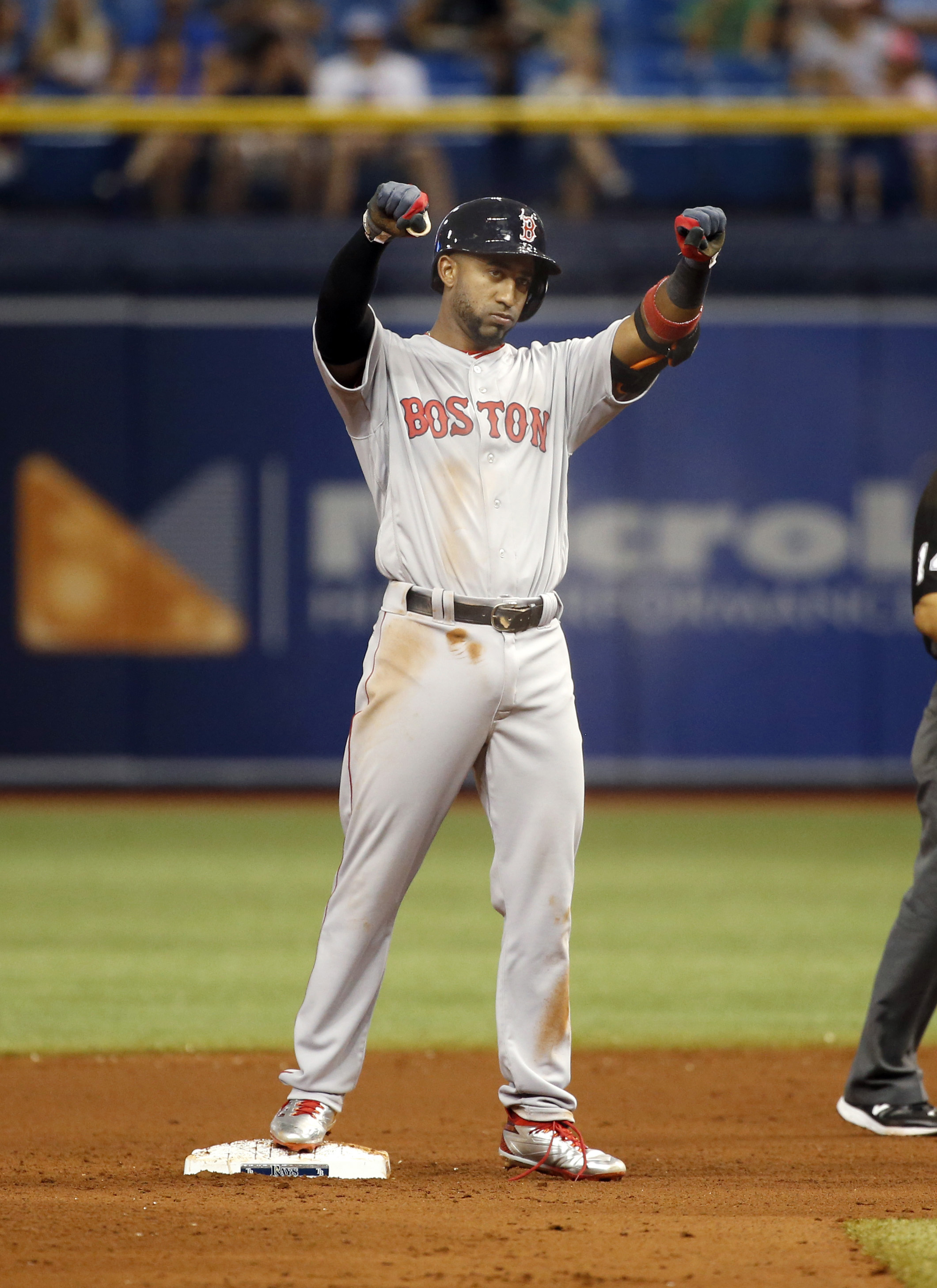
INF/OF – Eduardo Nunez, Red Sox: Nunez has primarily played third base this season, but one of his main selling points is that he’s a multi-position guy. Along with the hot corner, the 30-year-old has lined up at second, short and left field on several occasions this season. Although Nunez, whom the Giants traded to the Red Sox last month, isn’t an especially well-regarded defender, the versatility and his offensive prowess combine to make him appealing. The right-handed contact specialist is now amid his third straight season with a better-than-average wRC+ (a career-best 116, per FanGraphs) and has followed last year’s 40-stolen base effort with 21 steals on 26 attempts.
OF – Jay Bruce, Indians; Howie Kendrick, Nationals; Carlos Gomez, Rangers; Jarrod Dyson, Mariners; Curtis Granderson, Mets:
The 30-year-old Bruce, whom the Mets just dealt to the Indians, is yet another player benefiting from hitting more fly balls, as FanGraphs’ Dave Cameron pointed out after the trade. Of course, decent offensive production isn’t really anything new for the lefty-hitting Bruce, who’s one home run away from reaching 30 for the fifth time. On the other hand, defensive metrics indicate he’s having a terrific year in the field, which is a notable change over his recent woes in the grass.
Kendrick has also been known as a good offensive player throughout his career, though the .345/.394/.469 line he has combined for with the Phillies and Nationals this season is obviously a mirage to some extent. The .420 batting average on balls in play won’t hold, for example. Still, as an outfielder/infielder who can hit, he’s a useful piece. The fact that Kendrick’s already 34 will scare off some teams during the offseason, however.
Gomez and Dyson, meanwhile, join the Royals’ Lorenzo Cain as the premier center field-capable options set to hit the market. It seems Gomez, 31, truly has put his disastrous stretch with the Astros from 2015-16 behind him. The former star with the Brewers experienced a renaissance as a Rangers reclamation project late last season and has continued to play well this year. Since hooking on with Texas, he has hit .262/.347/.483 with 23 homers, 16 steals and a 3.1 fWAR over 118 games. Texas believed in Gomez’s end-of-season performance in 2016 enough to re-up him for $11.5MM last winter, and his success since then should net the Scott Boras client another hefty payday.
Dyson’s drawbacks include the fact that he’s neither young (he’ll turn 33 on Aug. 15) nor a big-time offensive threat. He’s not exactly an automatic out, though, given that he reached base at a 34 percent clip last year and has gotten aboard 32.6 percent of the time this season. When Dyson does get on, he’s a terror. He’s set for a fifth 30-steal season, and his baserunning value goes beyond that – only Billy Hamilton has been better this year, according to FanGraphs’ BsR metric. Dyson’s also a fantastic defender. The best aspects of the ex-Royal’s game make him an extreme bargain for the Mariners at $2.8MM, so he clearly deserves more with free agency looming.
Set to turn 37 next March, Granderson is the oldest position player on this list, meaning a multiyear deal could be out of the question for the highly regarded veteran. The lefty-swinger remains a valuable offensive cog, though, and could be a fit for AL teams looking for someone who can play some outfield and hit enough to serve as a DH. Aside from a horrid April in which he batted .128/.174/.221, Granderson has been his typical above-average self with the bat (.230/.335/.472 with 16 HRs and a .242 ISO in 382 PAs).
Honorable mentions: Kurt Suzuki, C, Braves; Mark Reynolds, 1B, Rockies; Cameron Maybin, OF, Angels; Jon Jay, OF, Cubs; Austin Jackson, OF, Indians; Seth Smith, OF Orioles; Daniel Nava, OF, Phillies.
Click to continue reading…
Carlton Fisk: Sox Changed, Thanks To Postal Snafu
Even in this modern era, with MLBTR tracking the prospects of any conceivable free agent and setting a clock to the service time of every top prospect this side of Sidd Finch, the story still astounds:
A future Hall-of-Famer freed by … postal laxity?
Thirty-six years ago, the biggest gaffe in baseball postmarking history—a case made for Contract Law 101—freed Carlton Fisk from the Red Sox. Boston GM/owner Haywood Sullivan mailed out contract renewals to two players in their option year, Fisk and Fred Lynn, past the mandated Dec. 20 deadline.
The flub freed up Fisk—ironically, an unyielding New Englander who never sought to leave the Red Sox—as an unrestricted free agent.
Let’s dig deeper into one of the odder offseason occurrences in baseball history.
—
Carlton Fisk: Let me make one thing perfectly clear: I never planned to leave Boston.
Honestly, it broke my heart to leave New England. I grew up there, in a little town in New Hampshire called Charlestown. It was one of those towns, look right, look left, and you’ve seen everything. No movie theater. No swimming pool. No traffic lights. It was a thousand people. My graduating class was the biggest ever: 32 kids! It was in me—still is. And as kids, we all dreamed of wearing a Red Sox uniform or a Celtics jersey.
So, why’d I leave? Well, I was 33 years old. I’d made money in the game, sure, but ownership wasn’t exactly giving it away. I had my family to think of, and my own pride. I wanted to be paid fairly—and the plain fact is that from the moment I was drafted [1967] I’d been underpaid by the Red Sox. That’s how it was in those days.
Also, Boston was in a sort of transition. Honestly, it didn’t seem clear to me that the front office was dedicated to our core group of guys, or to winning.
Indeed, the two baseball Soxes seemed to be working in opposite directions in 1981.
Boston was just five seasons removed from the thrill of the 1975 World Series, which it lost in dramatic fashion in seven games to the Cincinnati Reds, and a few years past its historic, regular-season AL East division race collapse, culminating in Bucky F’ing Dent’s tiebreaker game-winning home run in 1978.
Meanwhile, in Chicago, excitement greeted the 1981 season after Jerry Reinsdorf and Eddie Einhorn purchased the club from Bill Veeck and signaled that the days of Veeck’s hamstrung purse strings were over. With a promising young pitching staff already in place and a solid base of position players, the team felt it was just one key offensive acquisition away from contention.
Jerry Reinsdorf: We didn’t come in with an agenda to make a “splash,” but looking around at the state of things, we wanted to make it clear to fans that things would change. We tripled the promotional budget. We made efforts to upgrade Comiskey Park. And we were willing to look into any way we could help the club, be it by trading for a player or signing one.
Eddie Einhorn*: We were excited to get our hands dirty and improve the ballclub. We kept Roland Hemond, the GM who built our first great White Sox team, and we had some money to spend if an opportunity came along. [Note: Einhorn died in 2016; the interview referenced in this article was conducted during Spring Training 2011.]
Roland Hemond: Bill Veeck had already spent some of Edward DeBartolo’s money after DeBartolo agreed to buy the White Sox. Not many people remember this, but Bill never was supposed to leave the White Sox. He sold the White Sox to DeBartolo for $20 million and the promise of staying on with the team as President. But American League owners had it out for him, and rejected the sale two different times.
But initially, Bill was excited to have some financial freedom, which he hadn’t enjoyed for the five years he’d owned the team in the 1970s. We picked up Ronnie LeFlore from Montreal. We signed a catcher, Jim Essian, to some big money.
Reinsdorf: Those deals were made under a prospective DeBartolo ownership, but once the owners rejected DeBartolo and voted for us, we were on the hook for the contracts.
More than the roster, we honestly thought we had a bigger issue with the off-field things like improving an aging ballpark, and increasing attendance. We knew the White Sox were an up-and-coming team, and figured its natural development in 1981 would be a step forward, without any other acquisitions.
Einhorn: But then we heard Carlton Fisk was a free agent.
When the Red Sox missed their deadline to renew the Fisk and Lynn contracts in December 1980, an unprecedented situation arose. Never before in the free agency era had a player been freed from his contract because of a clerical error. With no precedent from which to base a decision, an arbitration date was set in January 1981 to determine Fisk’s fate.
Fisk: The easiest solution would have been for the Red Sox to rip up my old contract and make me a fair market offer. I generally knew what I was worth. People talk. It wouldn’t have been complicated. Treat me fairly, and I’m right back in Florida with the Red Sox in spring training, with a few more dollars in my pocket. But the Red Sox never made a fair market offer. Their offer was so low it wasn’t even worth considering.
Lynn, who received his 1981 contract even later than Fisk, bailed out on the arbitration process early on by agreeing to a deal that would send him to his hometown California Angels along with pitcher Steve Renko for Joe Rudi and Frank Tanana. The center fielder also received a contract from Angels owner Gene Autry for $5 million over four years.
Fisk, on the other hand, didn’t have a trump card in negotiations like driving a trade to his hometown—the New Hampshire native was already there, with the Red Sox. But without an offer worth considering from Boston, the veteran was driven by principle to see the arbitration process through.
Fisk: I didn’t have any doubt we’d win in arbitration. It was very simple: Haywood Sullivan did not tender me a contract. The Red Sox sort of admitted, ‘Well, we forgot.’ One of their defenses was that they didn’t understand the agreements with the Players’ Association. I thought, ‘Hey, wait a minute, we’re talking about the uniform player’s contract that they’ve been using for 100 years!’ That’s when I knew for sure we’d win, and we did.
It was reported that Boston had offered Fisk a three-year, $1.5 million deal, but some felt it was merely a face-saving pitch, made after the fact.
Fisk: I can say that offer is definitely not true, because if I was offered that, I may have taken it—at least we would have been close, and negotiated from there. The Red Sox weren’t even in the ballpark with the money or the years they offered, believe me.
Even still, they had a chance to sign me. Make a fair offer—I’m an unrestricted free agent now, so you’re going to compete against other teams, and the offer needs to be competitive—and I’ll stay.
But while I was still waiting to hear something concrete from Boston, Chicago called and made an offer I couldn’t turn down.
Because of the unique and late nature of the contract infraction, and the somewhat protracted arbitration process, Fisk was declared a free agent late in the offseason, after teams had already reported to spring training. The entire process generated a sort of Fisk Watch: Would he leave the Red Sox? Where would he go?
Reinsdorf: We had Essian, and we’d signed another catcher, Marc Hill, but when Fisk became available, you had to consider him. Remember, this was late in the offseason, way late. Signing Carlton had the potential to be disruptive. But we had to pick up the phone and call.
Einhorn: We were still so new to everything. I was doing all sorts of things to put our stamp on the team, like staffing up the front office, even choosing a new mascot. Jerry was trying to improve ticket sales and fix up the ballpark. The initial reaction to us in Chicago had been a little lackluster; the White Sox hadn’t won in a while, and fans were tired of five-year plans. So getting a chance to reach out to Carlton was a timely opportunity.
After some protracted negotiation and last-minute twists, Fisk signed with the White Sox for five years and $3 million, almost tripling his 1980 salary. Getting Fisk to change his Sox wasn’t as universally lauded as hindsight might lead us to think today—at the time, the veteran backstop was 33 years old, and many thought his best days were behind him.
Fisk: Yeah, I’d hear that from some people. It’s a little trick management plays on you. When you’re younger and outproducing your salary, the team talks about how young you are, you’re still unproven, there’s a pecking order with salaries, don’t breed dissent with the veterans. When you get older, teams say that you’re over the hill, even if you’re still producing. You think, wait, do I even get one season to be paid fairly?
But the White Sox were upfront with me. They played up the opportunity there, with a young pitching staff and a mix of younger players and veterans, a changing of the guard in ownership. They looked to me for leadership and encouraged that, without it sounding like a burden. They pointed out there were opportunities with advertisers that I might not get in Boston. Jerry and Eddie were enthusiastic guys. They seemed fair. It was a really difficult decision, but in the end, my gut said it would be a good move for me and my family.
Later on, Haywood Sullivan was talking about how the White Sox pressured me and gave me a take-it-or-leave-it deal. Do I look like a guy who’s going to let himself get strongarmed?
For catcher Jim Essian—who had signed a club record four-year, $1 million contract just a couple of months earlier—the Fisk signing was a mixed bag.
Essian: Of course, I wanted to get my 400 at-bats that year. That’s why I came back to Chicago. The White Sox had made me a priority. It’s easy to forget today, but a million-dollar contract, even over several years, was a big deal in 1981. I was really proud. It was a validation of a lot of hard work I’d put in to be a major leaguer.
Well, in comes Fisk, and there goes my chance to start. For a while [manager] Tony [La Russa] was talking like me and Carlton would split the catching duties. But even if that was the plan, I knew that if Fisk started hitting, he’d be playing every day. He was an All-Star. He wasn’t the kind of guy who begged out of games, even if he was in a rough stretch. But Fisk was a class guy, and a leader, and we needed that.
While Essian played little in 1981 and was dealt to the Seattle Mariners after the season, the Fisk signing also had an unintended, negative impact on Chicago’s key superstar. Center fielder Chet Lemon, a two-time All-Star and by far the most valuable position player on the club in 1980 (notching 4.2 WAR in his age 25 season), took notice of the deal—and wasn’t digging it.
Lemon: I was very comfortable in Chicago. I loved the team, and playing for the White Sox fans. The new ownership and Roland Hemond sat down with me in spring training in 1981 and laid out a five-year contract extension [1983-87] that would have made me the highest-paid on the team. Everything went smoothly, but I never got around to signing the deal.
While the contract was just sitting on the table, a couple of weeks later they signed Carlton Fisk. For the team, that was great. For me, suddenly I wouldn’t be the highest-paid player on the club. I thought I’d done a lot for the White Sox in my five seasons, and it hurt a little bit that a new guy, even Carlton Fisk, would sweep right in like that.
I can look back now and see that it’s a little childish to be caught up in who makes the most money, but I was still a young kid and it mattered to me. I decided I wouldn’t sign the contract, and that we’d talk again after the season.
After the 1981 season, pressure was mounting on the White Sox to get a return for Lemon in case he bolted as a free agent after the 1982 season. At the end of November, and without significant extension discussions, Chicago dealt Lemon to the Detroit Tigers for Steve Kemp—ironically, a player also in the last year of his contract who was a risk to bolt the White Sox after the season. (Kemp indeed signed elsewhere, with the New York Yankees, in 1983.) Meanwhile, Lemon signed a 10-year deal—the longest in the majors at the time—with Detroit and produced 23.0 WAR over the five seasons that his unsigned extension with the White Sox would have covered.
Lemon: Things worked out great for me in Detroit [the Tigers won the World Series in 1984]. But I’ve always loved the White Sox fans. Things could have been different.
At the time of the Fisk signing, everyone in baseball felt the clock was ticking on the catcher’s career—even the White Sox, who despite shelling out millions weren’t certain the catcher would finish out his contract (two mutual option years at the end of the deal were understood to be fulfilling a future front office position, not a roster spot).
Yet somewhat amazingly, Fisk ended up playing far beyond his five-year contract, and 343 more games for the White Sox than he played in Boston. He remained a catcher his entire career (97% of Fisk’s games were at catcher), retiring after being released in mid-season in 1993, at age 45. With Fisk’s final game, he broke Bob Boone’s record for games caught, with 2,226—a record he held for 16 years, until it was broken by Ivan Rodriguez.
Ozzie Guillen [who spent the most games as Fisk’s White Sox teammate]: We loved to give Fisk s— about his age, and he gave it right back. We had a great, young pitching staff in the early 1990s and they didn’t want to put up with his old man bulls— [imitates all of Fisk’s mannerisms]: adjusting his chest protector, his cup, his mask, walking out to the mound every other pitch and barking instructions to the infield. Remember when Joe Mauer was catching for Minnesota, walking out to the mound every other pitch? That was Fisk. We had an aggressive staff: Black Jack [McDowell], [Alex] Fernandez, [Jason] Bere, [Wilson] Alvarez. They wanted to attack guys but Fisk was like a human stop sign.
Don’t get me wrong. Carlton Fisk was a great player and a great teammate. Best catcher I ever played with on the Sox. But it was time. No player wants to admit it—I f—— didn’t, for sure. But it was his time.
Of everyone involved in Fisk changing Sox, no one suffered more than Sullivan. The GM/owner was already under heavy criticism after the 1978 collapse, as he dealt away or released many of the team’s assets (including Luis Tiant, Bill Lee, Bernie Carbo, Reggie Cleveland, Ferguson Jenkins, and Jim Willoughby) and drafting poorly (most notably picking his own son, non-prospect Marc, in the second round in 1979). In 1983, Sullivan’s last year as GM, he watched Fisk’s move to No. 2 in the batting order spur the White Sox to an AL West title and 99 wins, while overseeing a 78-84 season in Boston.
Sullivan always had maintained the reason that the Fisk and Lynn contracts weren’t mailed promptly was the fact that, due to mutually agreed-upon clauses, the two players were already under contract for 1981.
Fisk: Haywood claimed he offered me more money, more years, more everything. Again, there’s an easy answer to that: If he had, I would have taken it and stayed in Boston my entire career.
It’s funny, at the time people were talking about me betraying the Boston Red Sox. Everyone made a big deal about December 20, like it was some fluke, and the Red Sox got cheated because of [the deadline]. What no one talks about is the Red Sox had seven months to offer me a contract—they never did. Even during the hearing, the Red Sox could have made it all go away with a fair offer. They didn’t. I wasn’t interested in beating the Red Sox—but I did want what’s fair.
Once his White Sox career began, Fisk would take particular relish in sticking it to the Red Sox—especially at Fenway. A career .300 hitter in Boston, Fisk upped that average to .314 as a member of the White Sox. Fisk hit homers in 3.8% of his career plate appearances and 4.4% of his Fenway appearances, but as a member of the White Sox visiting Fenway upped his longball rate to 6.9%. In the end, over 107 career games vs. the Red Sox Fisk hit .310, with 27 homers and 68 RBI.
And there was never a more dramatic a moment for Fisk as a visitor to Fenway Park than in his first game there, on Opening Day 1981, when he hit the an eventual game-winning, three-run homer in the top of the eighth to spur a 5-3 White Sox win.
With the White Sox, Fisk would produce another 28.8 WAR, ending his career with 68.3. At age 37 in 1985, he put up career numbers of 37 home runs and 107 RBI.
Yet in spite of an acrimonious divorce and more time logged in White Sox than Red, Fisk was inducted into the Baseball Hall of Fame in 2000 as a member of the Red Sox.
Fisk: There was nothing hard about the decision to go into the Hall of Fame as a member of the Red Sox. Boston is my hometown and my home team. There’s no way I can ever divorce myself from that home run—not a day goes by when I don’t hear about it from someone. With all respect to the White Sox and my long career there, that particular decision wasn’t difficult at all.
Brett Ballantini has been a sportswriter for two decades, drawing on hundreds of interviews over the years to compile oral histories of great moments in major league baseball, basketball, and hockey. Follow him on Twitter @PoetryinPros.
Top 25 August Trade Candidates
Since last week’s rendition of MLBTR’s Top 25 August Trade Candidates, Yonder Alonso (No. 8) has been traded, while several others on the list — Jay Bruce, Curtis Granderson, Neil Walker, Asdrubal Cabrera — have reportedly cleared revocable trade waivers. (Click here to see all the players to have cleared.) We’ve also seen infielder Sean Rodriguez return to Pittsburgh via trade, while righty George Kontos was claimed by the Pirates and simply let go by the Giants. Here are this week’s updated rankings…
1. Marco Estrada, Blue Jays: Estrada’s results have fallen off since early June, but he’s still missing plenty of bats and has rattled off three useful outings. Estrada was outstanding in 2015-16 and could help to stabilize a potential contender’s rotation down the stretch. He’s an impending free agent with $4.05MM remaining on his deal, but the Jays were willing to absorb salary when trading Francisco Liriano.
2. Jay Bruce, Mets: July interest in Bruce was tepid, at best, but he’s a 30-homer bat with improved numbers against lefties and improved defensive ratings. There could be some legitimacy to those defensive grades, as well, with Bruce now three years removed from knee surgery that initially caused his once-stellar ratings to plummet. He’s owed $3.76MM and has already cleared waivers.
3. Asdrubal Cabrera, Mets: New York could elect to exercise a reasonable $8.5MM option on Cabrera, especially since it comes with a hefty $2MM buyout. The switch-hitter is in a slump at the plate but has added third base to his defensive repertoire, increasing his versatility. He, too, has already cleared waivers.
4. Curtis Granderson, Mets: With a nearly 1.000 OPS since mid-May, the Grandy Man’s remaining $15MM salary seems rather reasonable. He’s still owed about $4.3MM of that sum, but the Mets could grease the wheels on a trade by including some cash. Like teammates Bruce and Cabrera, Grandy has cleared waivers.
5. Daniel Nava, Phillies: The switch-hitting Nava keeps raking — primarily against right-handed pitching — and the Phillies are reportedly likely to give first base prospect Rhys Hoskins a promotion to play some corner outfield in the near future. Moving a productive short-term piece like Nava would help to clear some playing time, and Nava’s 2017 production should appeal to teams with corner outfield/first base needs.
6. Zack Cozart, Reds: He’s raked all year when healthy and is still one of baseball’s absolute best defenders at shortstop. As an impending free agent on a rebuilding club, Cozart is a clear trade candidate. He’s hit well since being activated from the DL, and even though there aren’t many contenders with clear needs at short, Cozart’s glove is so good that he could be expected to displace a starter. Speaking speculatively, the Rays, Royals and D-backs make sense here.
7. Tyler Clippard, White Sox: Since a trade to the White Sox, Clippard has righted the ship. Over his past seven innings, he’s held opponents scoreless on three hits and three walks with nine strikeouts. It’s a small sample of success after some prolonged struggles for Clippard in New York, but the cost of acquisition should be minimal and his track record is strong.
8. Jed Lowrie, Athletics: The A’s can hang onto the veteran Lowrie for 2018 thanks to a very reasonable $6MM option, but it’d be hard to justify pushing Lowrie to the bench for a prospect like Franklin Barreto when Lowrie is flirting with an .800 OPS and has hit well all year. He can play anywhere in the infield, making him an ideal bench option for a contender — especially a team with a potential infield vacancy in 2018.
9. Drew Storen, Reds: He’s had some recent homer troubles, but Storen has a 13-to-1 K/BB ratio since the All-Star break. Four of the six big flies he’s given up this season have come in his home bandbox ballpark. Great American Ball Park has been host to the most homers per game in 2017, and while part of that is due to a poor Reds pitching staff, GABP has long been a notorious hitters’ haven. Storen’s velocity is down, but his K/BB numbers are solid. His results may improve with a better home park.
10. Jim Johnson, Braves: Johnson was placed on revocable waivers last week, meaning he’s either cleared or been claimed and pulled back (and thus will not be moved). Until reported otherwise, the assumption here will be that he can be moved, but he drops down the list this week due to the possibility that he’s off the market — and the still-mixed results he has produced.
11. Rajai Davis, Athletics: Davis has quietly raked since the All-Star break, hitting .339/.393/.571 with three homers and eight steals. He’s not a premium defender in center, but he’s been roughly average there and can handle all three spots. And, what team couldn’t use some more speed off the bench in September?
12. Ian Kinsler, Tigers: Kinsler reportedly went on trade waivers this week, and the Brewers are said to have interest. The two sides discussed Kinsler last month, which could provide some groundwork for talks if Kinsler makes it to Milwaukee on waivers. Kinsler hasn’t shown his usual pop but is still a strong defender with a history of offensive production. His affordable 2018 option adds to his appeal.
13. Yusmeiro Petit, Angels: Petit’s ERA continues to hover around the 2.50 mark, and he’s worked five consecutive multi-inning appearances. With a 69-to-13 K/BB ratio through his first 64 1/3 frames with the Halos and a $2.25MM base salary, Petit represents an affordable means of lengthening any ‘pen without sacrificing quality innings.
14. Jhoulys Chacin, Padres: GM A.J. Preller implied that the Friars’ primary offers for Chacin were primarily non-prospects, and the team valued Chacin’s stability and success at home more than adding a warm body to the bottom of their minor league depth charts. The Padres may re-sign Chacin, but if some team steps up and offers even an intriguing low-level prospect, Chacin could yet be moved.
15. Brandon Phillips, Braves: Phillips has been playing third base Ozzie Albies’ promotion, which could add to his appeal. The Reds are paying all but $1MM of his salary, which could make him attractive as an affordable veteran bench option for contending clubs.
16. Bud Norris, Angels: There have been a few notable duds among Norris’s most recent outings, though he’s continuing to rack up the strikeouts. He has now allowed 4.09 earned per nine on the year, but Norris owns a 13.2% swinging-strike rate and brings mid-nineties heat.
17. Matt Belisle, Twins: He’s earning just $2.05MM and has a 14 1/3 inning scoreless streak with a 15-to-2 K/BB ratio. The Twins have won a few games lately and are in the Wild Card mix, but Belisle has been really good this year outside of three catastrophically bad outings that fell between April 26 and May 29. If the Twins slip out of the race by late August, he could go.
18. Brad Ziegler, Marlins: He’s owed just under $11MM through the end of the 2018 season and recently spent more than a month on the DL. Ziegler has a great track record but poor 2017 numbers, so the Fish will need to eat some money to move this contract, which will almost certainly clear waivers if it hasn’t already.
19. Carlos Gomez, Rangers: Gomez raked in June and hit well in July, so he has generally been going well of late and owns a .251/.334/.460 slash for the year. With good baserunning and center-field capability added to the mix, Gomez could represent a plug-and-go option if a team finds a sudden need for a semi-regular up the middle. He is earning a fairly hefty $11.5MM salary, though, so adding him would mean taking on a fair bit of cash.
20. Neil Walker, Mets: Walker is earning at the qualifying offer rate ($17.2MM), so he’s a pricey piece. While he had been hitting quite well before suffering a hamstring injury, he has struggled badly since his return — with just four base hits, none for extra bases, since making it back on July 28th.
21. Santiago Casilla, Athletics: Casilla has turned in six straight scoreless outings since coughing up two home runs on July 26th, leaving the 37-year-old with a 4.07 ERA for the season. He’s also set to earn $5.5MM next year, so teams won’t look to make a move unless they want to install him in their 2018 pen. While the overall record isn’t terribly inspiring, Casilla has shown a mid-nineties fastball with a swinging-strike rate of just over 10% — just as he has for the last several campaigns.
22. Mike Napoli, Rangers: Napoli is struggling to keep the average north of .200 and is striking out more than ever. The power is legitimate, but that’s about all he brings to the table in 2017. Clubs do love to add vets with playoff experience and good clubhouse reps this time of year, though, and Napoli certainly fits that bill.
23. Lance Lynn, Cardinals: With St. Louis on a winning streak, a trade of Lynn looks far less likely. That could change by month’s end, so he’ll remain on the list. But, like the two pitchers following him in slots No. 24 and 25, a trade doesn’t seem likely. He’s listed due to the fact that there’s a faint chance he’ll move and because he’d carry more impact than most August trade candidates.
24. Ervin Santana, Twins: Minnesota still hasn’t given any indication they’ll sell pieces controlled beyond 2017, and the Twins are still in the Wild Card mix. Santana would be among the best starters available if the Twins crater, though, so he stays on the back of the list.
25. Justin Verlander, Tigers: He’s looking more and more like a premium starter, and has cleared waivers, but the 34-year-old’s contract remains a huge impediment to a deal. He’s the best arm out there if the Tigers chance their stance and express a willingness to eat 40 to 50 percent of the $64MM or so that Verlander is still owed through 2019. Odds of that still seem rather slim, though, unless a contender decides it simply has to have another starter for its postseason rotation.
Injured
Scott Feldman (Reds), J.J. Hardy (Orioles), Cameron Maybin & Yunel Escobar (Angels), Tyson Ross (Rangers), Ian Krol (Braves), Kevin Siegrist (Cardinals), Johnny Cueto (Giants), Edinson Volquez (Marlins), Erick Aybar (Padres)
Also Considered
Ricky Nolasco (Angels); Matt Joyce (Athletics); J.A. Happ & Jose Bautista (Blue Jays); R.A. Dickey, Kurt Suzuki, Matt Kemp & Nick Markakis (Braves); Denard Span, Jeff Samardzija & Nick Hundley (Giants); Giancarlo Stanton, Junichi Tazawa, A.J. Ellis, & Dee Gordon (Marlins); Darren O’Day, Zach Britton & Seth Smith (Orioles); Clayton Richard & Yangervis Solarte (Padres); Hyun Soo Kim (Phillies); Andrew Cashner (Rangers); Derek Holland, Miguel Gonzalez, James Shields & Mike Pelfrey (White Sox)
Knocking Down The Door: Acuña, Borucki, Calhoun, Crawford, Hoskins
“Knocking Down the Door” is a regular feature that identifies minor leaguers who are making a case for a big league promotion.
Ronald Acuña, OF, Atlanta Braves (Triple-A Gwinnett) | Braves Depth Chart
The Braves were non-contenders in 2016 when they surprisingly called up top prospect Dansby Swanson from Double-A and inserted him into the starting lineup. Out of playoff contention late in the season once again, would they do the same with the 19-year-old Acuña, considering how Swanson has mostly struggled in his first full MLB season?
There is one notable difference between Swanson in 2016 and Acuña in 2017. Swanson was having a decent season in Double-A (.261/.342/.402 in 84 games) at the time of his call-up. Acuña has been absolutely tearing the cover off of the ball and seemingly getting better throughout the season during stints in High-A, Double-A and Triple-A. In 26 games since a July promotion to Gwinnett, the right-handed batter is slashing .347/.426/.574 with four homers, seven doubles, 13 walks and 22 strikeouts.
While the Braves will likely explore a trade for one of their current outfielders this offseason in anticipation of Acuña’s arrival as an everyday player in 2018, they could work him into the mix late this season with three-to-four starts per week.
—
Ryan Borucki, SP, Toronto Blue Jays (Double-A New Hampshire) | Blue Jays Depth Chart
The 23-year-old lefty was pitching in High-A less than a month ago, so a promotion to the Major Leagues soon after probably seems unrealistic. However, the recent trade of Francisco Liriano and the fourth disabled list stint for Aaron Sanchez has left the team’s rotation so thin that journeyman Nick Tepesch is being added to the 40-man roster to start on Wednesday to replace another journeyman, Cesar Valdez, who was placed on the disabled list after allowing 12 earned runs over his past two starts.
Meanwhile, Borucki has been outstanding since a promotion to Double-A, posting three consecutive seven-inning starts with a total of 18 strikeouts while allowing only one earned run, 11 hits and three walks in 21 innings. The former 15th-round pick, who idolized Mark Buehrle as a kid and is comparable in many ways, is already on the team’s 40-man roster and only at 119 innings on the season.
—
Willie Calhoun, 2B/LF, Texas Rangers (Triple-A Round Rock) | Rangers Depth Chart
In six games since the July 31st trade that sent him from the Dodgers to the Rangers for Yu Darvish, Calhoun is 7-for-25 with four homers, pushing his season total to 27. Not only can the lefty-swinging Calhoun hit for power—he also had 27 homers and 25 doubles in Double-A in 2016—he’s one of the toughest hitters to strike out in the Minors. Hitting 25+ homers in the upper minors is notable, but accomplishing that feat while striking out fewer than 100 times is extremely rare. The 22-year-old struck out 65 times while drawing 45 walks in 2016. He has 36 walks and only 50 strikeouts this season.
The good thing about being traded to the American League is that Calhoun’s future position in the Major Leagues, whether it’s second base or the outfield, probably doesn’t have to be sorted out before he gets the call to the Majors. The kid can flat out rake. With Mike Napoli struggling—he’s 4 for his last 32 with 17 strikeouts— the Rangers could give Calhoun plenty of at-bats at the DH spot with an occasional look at second base or in left field.
—
J.P. Crawford, SS, Philadelphia Phillies (Triple-A Lehigh Valley) | Phillies Depth Chart
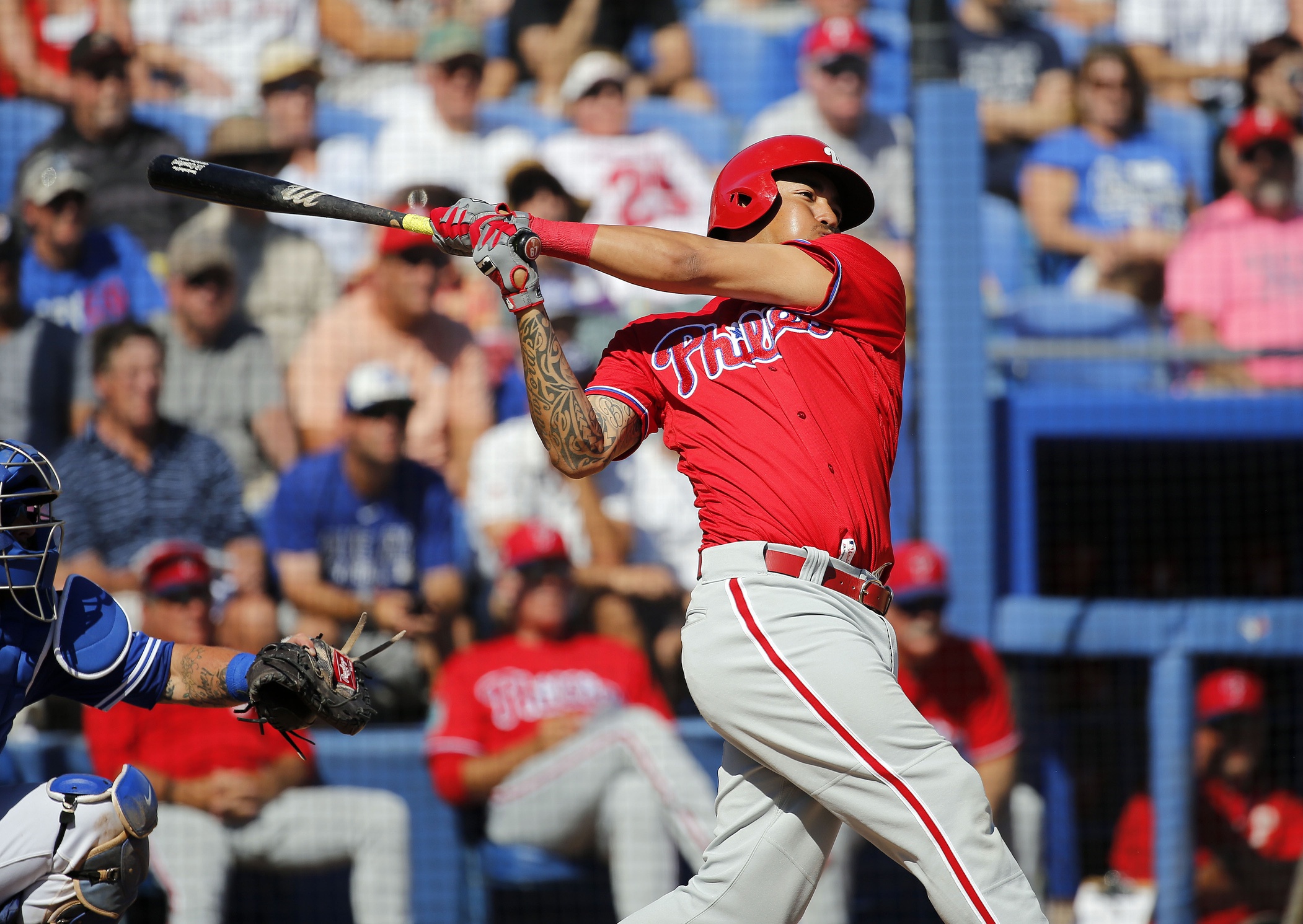 After an impressive stint in Double-A earned him an early-season promotion to Triple-A in 2016, Crawford appeared to be on the fast track to the Majors. Of course, only the “light-hitting” Freddy Galvis appeared to be standing in his way at the time. But in an unpredictable turn of events, Galvis went on a home run binge while the 21-year-old Crawford, considered one of the top prospects in baseball, struggled during his first taste of Triple-A. Since last July, Galvis has homered 24 times in 706 plate appearances while posting an OPS over .700.
Crawford was never going to simply be handed the starting shortstop job, but any chance of a 2017 promotion was dwindling unless he forced himself back into the picture. His performance in July, and so far in August, probably fits that description. With an OPS over 1.000, 10 homers, six doubles, three triples, 21 walks and 27 strikeouts over that span, Crawford has earned a late-season look as the Phillies’ regular shortstop. Galvis, who will be a free agent after the 2018 season, has probably done enough over the past year to generate some offseason trade interest whether he plays regularly down the stretch or not.
—
Rhys Hoskins, 1B/LF, Philadelphia Phillies (Triple-A Lehigh Valley) | Phillies Depth Chart
With the Phillies committed to giving Tommy Joseph a full season to show what he can do as the team’s starting first baseman, it appeared that Hoskins, one of the most productive hitters in the Minors over the past three seasons, would probably have to wait until 2018 before getting a chance. But following the release of Michael Saunders, the trade of Howie Kendrick, and Aaron Altherr‘s second trip to the disabled list, the Phillies’ outfield is looking thin enough that the 24-year-old Hoskins was given the green light to play left field for the first time in his professional career on Monday. He played there again on Tuesday.
While a slight increase in defensive versatility could be a key to Hoskins arriving in the Majors this season, maybe as soon as this week, it’s hard to imagine him not being the starting first baseman in 2018. Joseph is having a below-average season for a first baseman (.741 OPS, 16 HR, 97 K) and is currently in a 1-for-22 slump. Hoskins still has to prove that he can hit MLB pitching, but his current .280/.383/.571 slash line with only 75 strikeouts is a pretty good indicator that he will do just that.
Photos courtesy of USA Today Sports Images.
2017-18 MLB Free Agent Power Rankings
The non-waiver trade deadline is behind us, and about one-third of the regular MLB season remains. The list of top free agents for the 2017-18 offseason is beginning to come into focus. Below, the projected free agents are ranked based on their current earning power. To view the full list of players eligible for free agency after the season, click here.
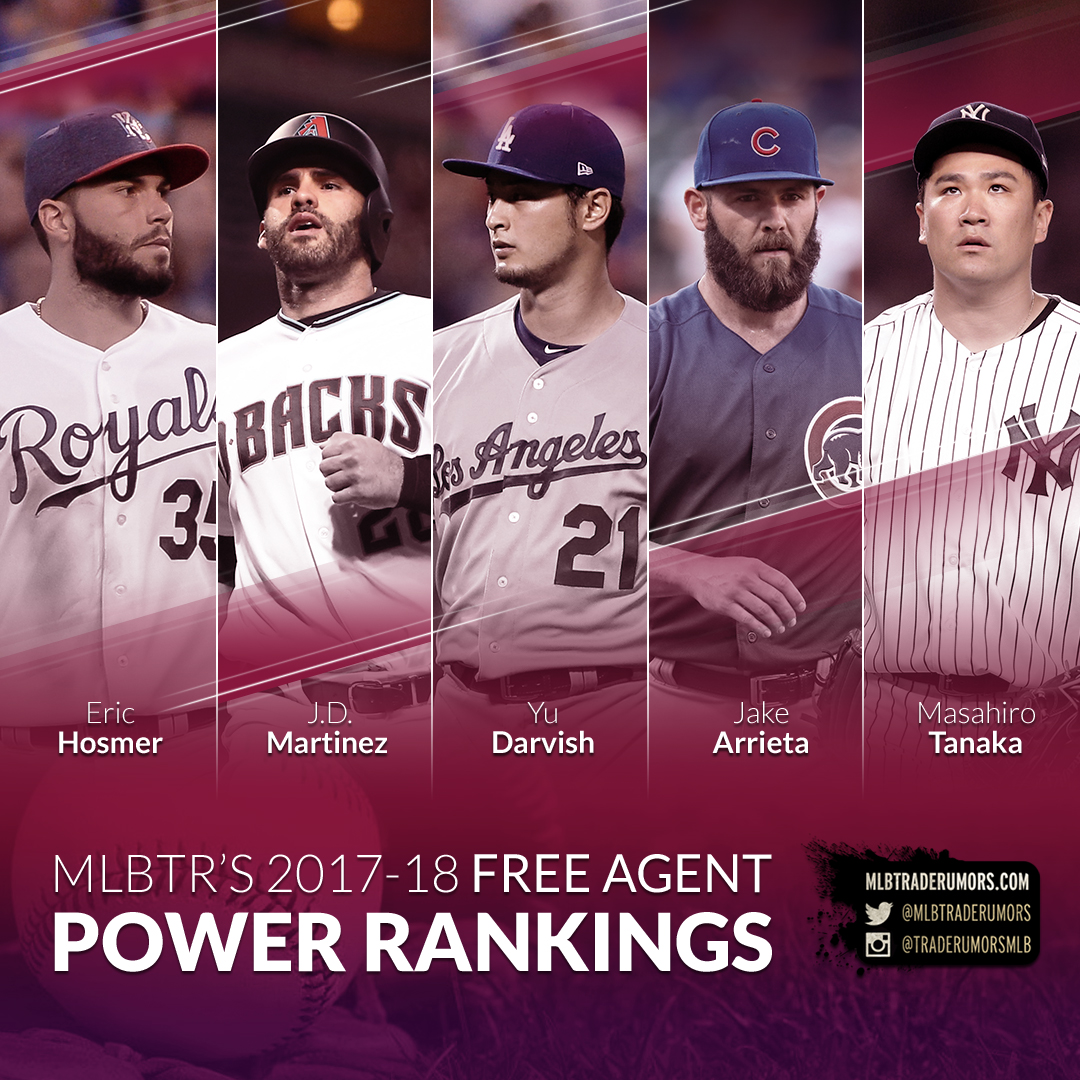
1. Yu Darvish. The Rangers traded Darvish to the Dodgers right at the July 31st deadline, making him ineligible for a qualifying offer after the season. The Dodgers seemingly added the former strikeout king as a playoff luxury. Darvish began his Dodgers tenure with one of his best starts of the season, a seven-inning gem against the Mets. Darvish’s leap to the best team in baseball grants the pitcher a major pitch framing upgrade, as explained by Chris Anders at Beyond The Box Score. Darvish is around nine starts away from his second career 200-inning campaign, quieting health concerns related to his Tommy John surgery. When he takes the mound next spring, he’ll be three years removed from that procedure. The righty turns 31 soon, so we’re projecting a six-year contract this winter.
2. J.D. Martinez. Martinez, the best hitter in the upcoming free agent class, was traded from the Tigers to the Diamondbacks on July 18th, removing his qualifying offer eligibility. He was hit in the hand by a pitch in his second plate appearance for Arizona, but avoided a serious injury. Martinez has slugged 39 extra base hits in 293 plate appearances, a rate surpassed only by Mike Trout and Nolan Arenado among regular players. However, Martinez’s right field defense continues to diminish his value. With a six-year contract in play for the soon-to-be 30-year-old, his agent may be best suited looking toward the American League.
3. Jake Arrieta. With a strong seven-start run, Arrieta has shaved his ERA down to 3.83. He’s proven durable since his Cy Young breakout in 2015, and he’s only about five months older than Darvish. The two righties have a similar free agent profile: still quite good, but not at peak levels. Our current projection is a five-year deal for Arrieta, who recently laughed off the idea of accepting a one-year qualifying offer. Talking to Bob Nightengale of USA Today this week, Arrieta expressed a lack of concern about his upcoming foray into free agency.
4. Eric Hosmer. Hosmer hit .352/.408/.561 from May through July, boosting his free agent stock immensely. Still, he’s been out-hit this season by impending free agent first basemen Yonder Alonso, Logan Morrison, and Lucas Duda, so the market features cheaper (but older) alternatives. Plus, Hosmer seems a strong bet to receive a qualifying offer from the Royals, dampening his value a bit. Every free agent class seems to have that one polarizing player, and it might be Hosmer this winter. Is this really a $100MM+ player, or will sabermetrics win the day?
5. Masahiro Tanaka. Speaking of enigmas, Tanaka has a chance to experience free agency in advance of his age-29 campaign. The catch is that he’ll have to opt out of the $67MM the Yankees are obligated to pay him over the 2018-20 seasons. Tanaka has been very good in his last 13 starts (and downright brilliant in his last eight), but it’s difficult to ignore his season mark of 1.87 home runs allowed per nine innings. If Tanaka thinks he can get something close to Jordan Zimmermann‘s five-year, $110MM pact, opting out is the correct call.
6. Justin Upton. Upton, too, is facing an opt-out decision. He’s owed four years and $88MM and will turn 30 years old in a few weeks. Upton raked in June and July, and has a shot at a five-year deal. Even if he’s unsure of earning more money on the open market, Upton may like the idea of leaving the rebuilding Tigers to choose his next team. If he does opt out, Upton will be ineligible to receive a second career qualifying offer. On July 30th, Upton told George Sipple of the Detroit Free Press, “I haven’t thought about it, honestly. But I mean, I came here to win, so I’d have to see what the landscape is like at the end of it. I enjoy playing here. I enjoy the guys in the clubhouse. I enjoy the atmosphere, the city. That decision is long down the road, months away.”
7. Mike Moustakas. Moustakas’ home run barrage has continued, leaving the Royals’ third baseman second in the American League with 32 bombs. Barring injury, Moose seems likely to become the first Royal to hit 40 home runs. At his current pace, he’ll wind up closer to 50. Even with a paltry 4.3% walk rate, Moustakas seems like a candidate for a five-year deal heading into his age-29 season, despite a probable qualifying offer.
8. Lorenzo Cain. Cain is quietly on track for his third career season worth at least four wins above replacement. The value isn’t quite as obvious as the position players ranked above him, but capable center fielders with above-average bats are hard to find. We’re projecting Cain to get four years, with a shot at five. Like his teammates on this list, Cain may get a qualifying offer. Under the new CBA, that’s not nearly as limiting as it has been in the past.
9. Wade Davis. The Cubs’ laid-back closer has a career-worst walk rate, but he also has a 2.31 ERA and zero blown saves on the season. Davis will likely have Mark Melancon‘s four-year, $62MM contract in his sights, even if that particular deal doesn’t look so great currently.
10. Greg Holland. Holland leads MLB in saves and has slightly outpitched Davis this year. The Rockies’ stopper has a $15MM player option he’s likely to decline in search of a multiyear deal. Despite missing all of 2016 due to Tommy John surgery, Holland should be a popular free agent.
Johnny Cueto, previously a mainstay on this list, must decide after the season whether to opt out of the $84MM remaining on his contract with the Giants over the next four years. He’s currently on the disabled list with a mild flexor strain, an injury that may be enough to convince Cueto to play it safe and keep his current deal. Also falling off the list is Michael Pineda, who had Tommy John surgery in mid-July and will miss most of the 2018 season.
Players just missing the power rankings top ten include Logan Morrison, Zack Cozart, Lance Lynn, and Carlos Santana. LoMo sits sixth in the AL with 28 home runs. Cozart is tied with Upton for the free agent WAR lead with 3.6, despite a pair of DL stints. Lynn’s strong ERA looks somewhat dubious when stacked up against pedestrian peripheral metrics. Santana, meanwhile, has turned it on lately but is trying to distance himself from a very poor start to the year. Ultimately, these players may be hard-pressed to find four-year deals, though there’s still time left to bolster their stock.
Updates On 2018 Club Options Over Pitchers
We checked in last night on the status of some position players whose teams will be deciding on club options at the end of the year. This morning, we’ll do the same with regard to hurlers. As before, we aren’t considering player options/opt-outs (like Johnny Cueto and the Giants) or mutual options (as with Mike Minor and the Royals).
- Tony Barnette, RP, Rangers — $4MM option, $250K buyout: Barnette produced great results last year with less-than-exciting peripherals. In 2017, he’s got double-digit strikeouts per nine but also owns a 5.55 ERA — owing to a high BABIP, low strand rate, and double the rate of homers allowed. With a healthy 14.2% swinging-strike rate to support the strikeout numbers, Barnette may actually still represent a nice value for Texas.
- Jerry Blevins, RP, Mets — $7MM option, $1MM buyout: There have been a few ups and downs, but on the whole Blevins has been a quality member of the Mets’ pen once again. He’s carrying 12.4 K/9 on a 14.1% swinging-strike rate that’s easily a career best. New York would be hard pressed to find a similar power lefty in free agency for a more appealing price.
- Madison Bumgarner, SP, Giants — $12MM option, $1.5MM buyout: There was never any question of this option being picked up, even when MadBum suffered a significant injury earlier in the year. He’s back and has been plenty effective, so any slight doubt is completely gone; whether the sides will attempt a new extension this winter, though, remains to be seen.
- Matt Cain, SP/RP, Giants — $21MM option, $7.5MM buyout: Despite the high buyout tag, this one has long seemed mostly a foregone conclusion to be declined. Cain has just never rediscovered his pre-injury form and was finally bumped to the pen. He is carrying an abysmal 4.7% swinging-strike rate on the year — nearly half his career average and the lowest in the game among pitchers with at least 20 innings.
- R.A. Dickey, SP, Braves — $8MM option, $500K buyout: Dickey is beffuddling hitters with his knuckler about as much as he has in the prior four seasons, with a solid 4.03 ERA over 134 frames. Atlanta still needs to fill out the rotation for 2018, so this seems like a pretty easy “yes.”
- Nathan Eovaldi, SP, Rays — $2MM option: We haven’t heard much of Eovaldi’s progress as he works back from elbow surgery, but that’s not all that surprising given the expected timetable for his procedure — a second Tommy John that also included a flexor tendon repair. The Rays still have some time to decide whether to continue their investment in the talented hurler, who could be an interesting asset if he’s able to get back to the mound.
- Yovani Gallardo, SP, Mariners — $13MM option, $2MM buyout: It’s hard to see the M’s taking on the $11MM difference here. Gallardo has allowed over five earned runs per nine for the second consecutive year and ERA estimators (4.96 FIP; 5.02 xFIP; 5.16 SIERA) see the results as a roughly accurate reflection of his performance. It is worth noting, though, that Gallardo has gained about two miles per hour on his average fastball, which may increase his appeal as a turnaround option in free agency.
- Matt Garza, SP, Brewers — $5MM option: Garza has posted solid results, with a 3.68 ERA over 88 frames, though the peripherals (6.1 K/9, 2.8 BB/9, 42.4% groundball rate) don’t excite and ERA estimators are a bit skeptical. Assuming he remains healthy and generally effective the rest of the way, there’s little reason for the Brewers to pass on such a reasonably priced rotation piece.
- Gio Gonzalez, SP, Nationals — $12MM option, $500K buyout: The veteran lefty has long underperformed ERA estimators, but now it’s just the opposite as he carries a career-low 2.66 ERA through 142 1/3 innings. He’s no longer suppressing home runs like he once did, has lost another 1.5 mph on his average fastball, and has benefited from a 85.1% strand rate and .241 BABIP. Still, this is an easy pick-up as things stand … and likely won’t be a choice anyway, as the option will vest once Gio reaches 180 frames — which he’s all but assured of doing for the first time since 2013.
- Craig Kimbrel, RP, Red Sox — $13MM option, $1MM buyout: Last year’s 5.1 BB/9 walk rate is firmly in the rearview mirror and Kimbrel is back as perhaps the game’s most dominant reliever. His 44.6% K%-BB% is a career high, as is his league-leading 20.6% swinging-strike rate. Which is to say, there’s really nothing more to discuss; he’s coming back to Boston barring a catastrophic injury.
- Boone Logan, RP, Indians — $7MM option, $1MM buyout: A lat strain will force Logan out for a lengthy stretch, perhaps the rest of the season. That certainly changes the picture somewhat on the option. Logan has remained a somewhat frustrating pitcher: his strand rate has hovered around 60% over the past two years even as he continues to post compelling swinging-strike, strikeout, and groundball numbers. Cleveland had handled him very deliberately early on, giving him just 21 frames over 38 appearances, and that relatively narrow role could reduce his utility to the team in the future. This one could conceivably go either way, and may yet be impacted by Logan’s recovery efforts between now and decision time (five days after the World Series).
- Wade Miley, SP, Orioles — $12MM option, $500K buyout: Even looking beyond the ugly results — a second consecutive year with a 5+ ERA — this has been a rough season for the lefty. He has allowed 5.2 BB/9, nearly double his career average, while coughing up home runs on nearly one-fifth of the flies put in play against him. Baltimore needs arms, but it seems reasonable to anticipate that the club will find more appealing ways to spend the $11.5MM gap between the option price and buyout.
- Matt Moore, SP, Giants — $9MM option, $1MM buyout: It’s tough to know what to make of the 28-year-old, who just hasn’t been all that effective this year after seeming to show improved form in 2016. San Francisco made a rather significant investment in trade assets to get him at last year’s deadline, and will value the chance to control Moore at a reasonable rate for 2019, but the results are surely troubling. Odds are the Giants will decide the upside outweighs the risk here.
- Ricky Nolasco, SP, Angels — $13MM option, $1MM buyout: Home runs have beena big problem for Nolasco this year, as he has allowed nearly two per nine on an 18.1% HR/FB rate. Otherwise, he looks like much the same pitcher as ever and even sports a career-high 11.1% swinging-strike rate. He has also worked out of the zone more than ever before, but hasn’t seen a major jump in walk rate. It’s a pretty hefty price tag, but perhaps it’s not totally inconceivable that the injury-riddled Halos would value the chance to retain the typically durable veteran.
- Martin Perez, SP, Rangers — $6MM option, $2.45MM buyout: The first of three option years, this provision was obviously intended to be exercised unless things really turned south. Perez has not been very good, with a 5.46 ERA and just 5.9 K/9 against 3.4 BB/9 with a lower-than-usual 45.8% groundball rate, but he’s young and evidently healthy. The Rangers need the innings and the price is right.
- Glen Perkins, RP, Twins — $6.5MM option, $700K buyout: Major shoulder surgery has drastically altered his career path, but the former Twins closer is finally nearing a return. It’s still possible the club could find appeal in this price tag for the respected veteran, though he’ll have to show it on the mound over the next seven weeks.
- Anibal Sanchez, SP/RP, Tigers — $16MM option, $5MM buyout: There were some intriguing peaks at one point over the summer, but the 33-year-old’s overall body of work does not inspire confidence — particularly, the fact that he has been torched for nearly two-and-a-half dingers per nine. There’s no realistic chance that Detroit will take on the extra $11MM to keep Sanchez.
- Chris Sale, SP, Red Sox — $12.5MM option, $1MM buyout: He’s been even better than advertised. As with Kimbrel, it’s an easy call for the Sox.
- Huston Street, RP, Angels — $10MM option, $1MM buyout: The 34-year-old has turned in four scoreless appearances since finally returning to the bump, which is somewhat promising but also far too little to serve as the basis for an assessment. Odds are this’ll remain too steep a price for the Halos to pay, though, especially given the backdrop of multiple injuries, age, and a forgettable 2016 campaign.
- Josh Tomlin, SP, Indians — $3MM option, $750K buyout: The sticker price is just so reasonable here that it’s hard to see Cleveland passing. Tomlin has been mostly himself despite a 5.38 ERA. He’s averaging less than one walk and just over seven strikeouts per nine innings. As ever, he’s susceptible to the long ball. The difference between this year’s iffy results and his solid work over the prior two seasons? A .328 BABIP and 65.6% strand rate. Tomlin still looks like a solid back-end starter and remains a bargain.
Updates On 2018 Club Options Over Position Players
With about two-thirds of the season in the books, elements of the coming offseason player market are coming into focus. Before we know the full slate of players on the open market, though, teams will first have a chance to determine the fates of some veterans who can be controlled through contract options. We’ll assess those here. Note that we are only looking at situations where the team will make the call exclusively. So we are not looking at player options/opt-outs (as with the Tigers and Justin Upton) or mutual options (e.g., Adam Lind and the Nationals).
Here are the position players whose contracts include club options for 2018:
- Jose Altuve, 2B, Astros — $6MM option: Altuve is turning in an MVP-caliber campaign, making this perhaps the easiest offseason decision in the game. The bigger question here is whether Houston will look to try for an extension with Altuve controlled only through 2019.
- Alexi Amarista, INF, Rockies — $2.5MM option, $150K buyout: Amarista carries a 46 wRC+ on the year. While he offers defensive versatility, like most utility types, he continues to grade as a sub-replacement-level player. Odds are he’ll go back to the open market.
- Michael Brantley, OF, Indians — $11MM option, $1MM buyout: The 30-year-old isn’t playing to his prior standard and will perhaps always carry some health questions, but he has produced at a solidly above-average rate with the bat. This figures to be a fairly easy pick-up for Cleveland unless a new shoulder problem crops up over the coming months.
- Asdrubal Cabrera, INF, Mets — $8.5MM option, $2MM buyout: Reports on the Mets’ intentions with regard to Cabrera have varied, and it seems an open question whether the team will commit the extra $6.5MM to keep Cabrera. The switch-hitter could provide options at second and third, while also giving the team an insurance policy at short, and he’s still hitting near the league-average rate. What really stands out when looking at his stat line, though, is his abysmal baserunning grade: by measure of Fangraphs’ BsR, Cabrera has detracted more value on the basepaths than any player in the league has contributed.
- Andre Ethier, OF, Dodgers — $17.5MM option, $2.5MM buyout: While Ethier could still be ready to return late in the year after failing to suit up to this point, it’s tough to imagine a scenario where the Dodgers take on that salary.
- Tyler Flowers, C, Braves — $4MM option, $300K buyout: Even if you don’t believe the 31-year-old can keep up his prodigious efforts at the plate — he carries a .368 BABIP after checking in at .366 last year — he’s an easy choice to stay in Atlanta. There’s little chance the club could find a more appealing solution on the open market at this rate of pay.
- Logan Forsythe, 2B, Dodgers — $8.5MM option, $1MM buyout: When the Dodgers shipped out Jose De Leon to get Forsythe, the assumption was this contract would stay on the books. That’s no longer clear, as the veteran has posted a tepid .238/.365/.318 slash — somewhat oddly exhibiting a near-doubling of his career walk rate (to 16.0%) combined with a total collapse of power (.079 isolated slugging, three home runs).
- J.J. Hardy, SS, Orioles — $14MM option, $2MM buyout: Long an outstanding defender with an all-or-nothing approach at the plate, Hardy has seen his glovework grades slip even as his batting line has fallen to a career-worst .211/.248/.308 level. With a lengthy DL stint added to the mix, he’s clearly heading to free agency — though perhaps he can still boost his market standing if he can make it back and show more down the stretch.
- Ian Kinsler, 2B, Tigers — $10MM option, $5MM buyout: The bat hasn’t kept pace with its output from 2016, but Kinsler still earns excellent grades in the field. With only a $5MM gap between the option and the buyout, it’s all but certain he’ll be retained. What isn’t yet known is whether and where the Tigers will trade him.
- Jed Lowrie, 2B, Athletics — $6MM option, $1MM buyout: It remains surprising that Lowrie wasn’t dealt at the deadline, as he has turned in a quality all-around year. While he has fallen off a bit at the plate of late, he seems a useful piece and the 2018 salary is easily justified. Oakland could keep him to aid the transition to a younger roster, or clear him out to make way. A deal could come this August or at any point over the winter.
- Andrew McCutchen, OF, Pirates — $14.75MM option, $1MM buyout: Yeah, Cutch is back. The Bucs won’t face any questions about the option, but there’ll be plenty of speculation — once again — about a trade.
- Chris Stewart, C, Pirates — $1.5MM option, $250K buyout: The 35-year-old has rarely been all that productive offensively, but he has struggled worse than ever before in 2017. It’s a cheap contract, to be sure, but Pittsburgh will need to consider whether it’s better served finding another option to back up Francisco Cervelli.
12 Potential Free Agent Starters With Slipping Stock
Earlier this week, we examined eight impending free agent hitters who have endured difficult contract years in 2017. Today’s edition focuses on soon-to-be free agent starting pitchers who haven’t reached their past levels thus far, perhaps setting themselves up for disappointing trips to the open market in the offseason.
Masahiro Tanaka, Yankees | Salary: $22MM
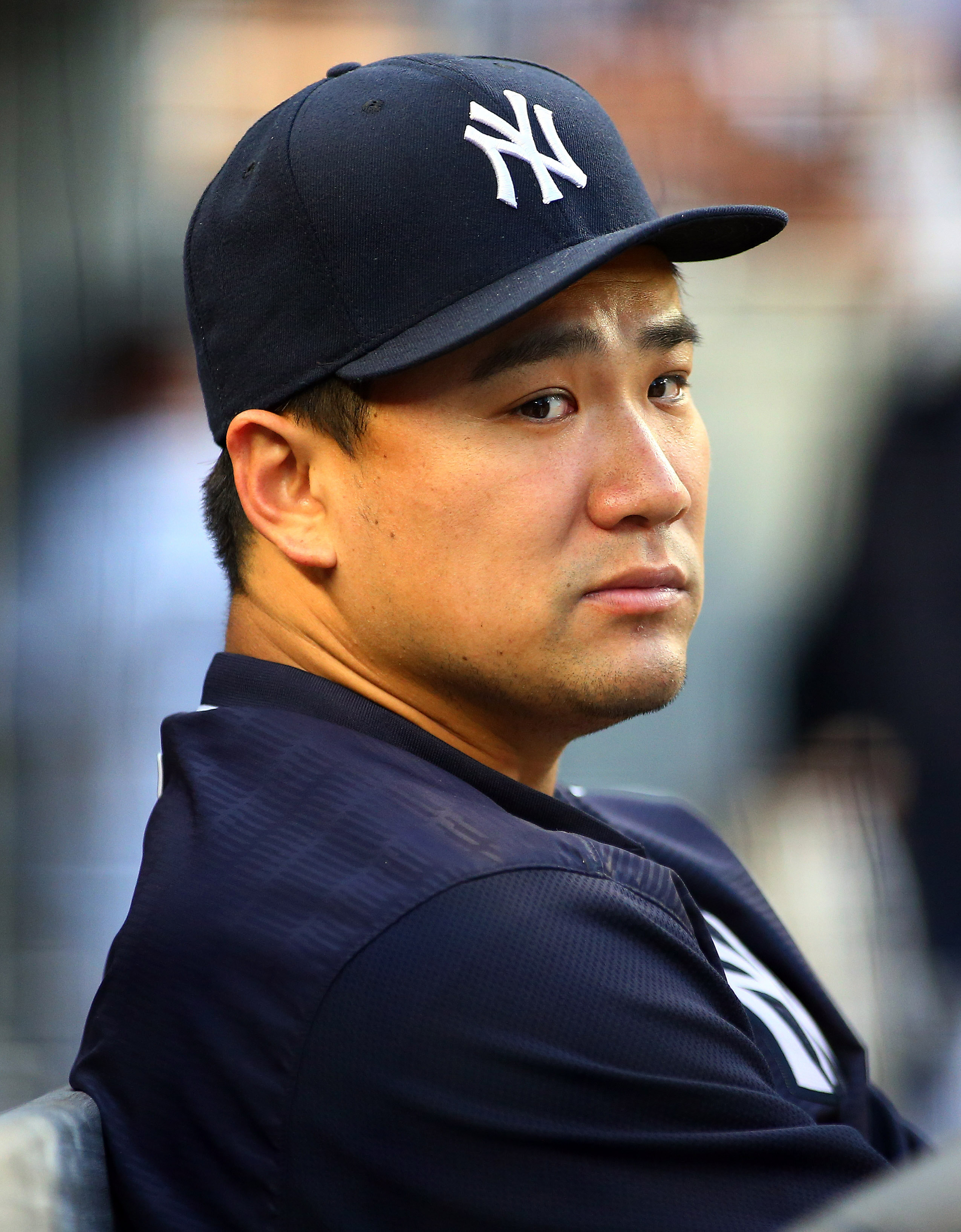
Tanaka can stick with the Yankees beyond this season and make a guaranteed $67MM through 2020, so he’s in much better shape than most pitchers who entered 2017 vying for new deals. However, Tanaka came into the year looking like a shoo-in to opt out of his current contract over the winter, and now there’s at least a bit less certainty on that front.
With a 4.93 mark through 129 2/3 innings, the right-hander’s ERA has climbed nearly two runs since he posted a sterling 3.07 figure over 199 2/3 frames last year. Still, aside from a bloated home run-to-fly ball rate (22 percent, up from 12 percent in 2016) and a career-worst batting average on balls in play (.311, compared to .270 from 2014-16), there are reasons for optimism. Tanaka’s velocity looks fine, while his swinging-strike (15 percent) and contact (70.8 percent) rates easily rank as career highs. Further, at 20.2, he’s running the majors’ 13th-best strikeout-walk percentage among starters. All said, it’s dubious as to whether Tanaka’s stock actually is down to any significant extent. Nevertheless, the 28-year-old’s sudden homer and run prevention issues have clearly come at an inopportune time.
Johnny Cueto, Giants | Salary: $21MM
Cueto, like Tanaka, has a looming opt-out decision. The 31-year-old righty will have to choose between eschewing a guaranteed $89MM through 2022 and remaining in San Francisco after the season ends. There may be less certainty with Cueto’s situation than Tanaka’s, as the former is a few years older and has been the bigger disappointment this season. He’s also on the disabled list at the moment with a mild flexor strain, though there’s no ligament damage. Prior to landing on the shelf, Cueto registered a 4.59 ERA – a sizable increase over the seasonal ERAs he put up from 2010-16, when he never surpassed 3.64 during an individual campaign.
More walks, less velocity, fewer grounders and an uptick in homers allowed are among the reasons for the longtime ace’s newfound woes. Cueto averaged fewer than two free passes per nine in each of the previous two seasons, but he’s now up to his highest figure in that department since 2009 (3.19). At the same time, Cueto, who has exceeded a 50 percent grounder rate in three seasons (including 2016), is down to 39.2 percent in that area this year. That’s Cueto’s worst mark since 2008, and a lower frequency of wormburners has helped lead to a 15.4 percent homer-to-fly ball ratio. While that may not look catastrophically high, it’s alarming relative to Cueto’s rate from 2008-16 (9.9 percent) and for someone who calls the pitcher’s haven known as AT&T Park home.
Jeremy Hellickson, Orioles | Salary: $17.2MM
Hellickson was effective enough as a Phillie in 2016 to warrant a qualifying offer, which he surprisingly accepted last November in lieu of testing a weak free agent market. Unfortunately for Hellickson, the success the righty enjoyed last season hasn’t transferred to 2017, meaning he’s unlikely to rake in another substantial salary next year. Now an Oriole after the Phillies dealt him last week, the 30-year-old has teamed a subpar ERA (4.45) with personal-worst strikeout (5.13 K/9), ground-ball (34.7 percent) and swinging-strike (8.2 percent) rates through 119 1/3 innings.
Jake Arrieta, Cubs | Salary: $15.64MM
With a 3.88 ERA, 8.74 K/9 and 2.96 BB/9 in 127 2/3 innings, Arrieta certainly hasn’t had a poor year. That said, by no means has Arrieta matched his fantastic stretch from 2014-16, a period in which the righty won an NL Cy Young (2015) and combined for the majors’ second-best ERA (2.42) and sixth-best fWAR (16.1). Decreased velocity and a dip in grounders have contributed to Arrieta’s descent, though agent Scott Boras has still publicly lobbied for a $200MM-plus contract on his client’s behalf. On one hand, it’s often a fool’s errand to bet against Boras. On the other, neither Arrieta’s decline in production nor the fact that he’ll enter his age-32 season in 2018 will aid him on the open market.
Marco Estrada, Blue Jays | Salary: $14MM
Estrada unexpectedly managed premier results with the Blue Jays from 2015-16, with a 3.30 ERA that ranked 20th among starters and stemmed from his ability to induce weak contact. No starter over that two-year span outdid Estrada’s 14 percent infield fly rate, in fact, and he encouragingly continues to pace the majors in that category this season (15.4 percent). Nevertheless, the low-.200s BABIP that Estrada induced over the previous two seasons has skyrocketed to .309 in 2017, helping lead to a 5.12 ERA over 128 1/3 innings. It’s not all bleak, though: Estrada’s expected weighted on-base average against, .301, is 43 points better than his actual wOBA, according to Statcast (via Baseball Savant), and the righty’s 24 percent strikeout rate is his best since 2012. There’s hope for a revival, then, but the run prevention troubles and Estrada’s age (34) figure to work against him as he seeks his next deal.
Clay Buchholz, Phillies | Salary: $13.5MM
It was only two years ago that the longtime Boston whipping boy ranked fourth among starters (100-inning minimum) in FIP and 24th in ERA. That season is now a distant memory for Buchholz, who struggled in his final season with the Red Sox last year. The Sox traded the 32-year-old to the Phillies during the offseason, but Buchholz wasn’t able to use his platform campaign to revive his career. He took the mound just twice this season before undergoing surgery on a torn flexor pronator mass in his right forearm in April.
Francisco Liriano, Astros | Salary: $13MM
Like Buchholz, Liriano came into the year with depressed stock that has continued to worsen. Although Houston sent a decent outfield prospect, Teoscar Hernandez, to Toronto for Liriano prior to the July 31 trade deadline, the Astros are using the left-hander as a reliever. Liriano, 33, hasn’t impressed as a starter dating back to last season, and this year has been especially trying. Across 83 2/3 frames (20 appearances, 18 starts), the former front-of-the-rotation option has produced a 6.02 ERA and seen his strikeout, walk and ground-ball numbers trend in the wrong direction. Liriano’s K-BB percentage (7.9) is at its lowest since 2011, while his 43.9 percent grounder rate is the worst he has registered since 2012. He’s also down to a 9.7 percent swinging-strike rate, representing almost a 5 percent drop since 2015.
Chris Tillman, Orioles | Salary: $10.05MM
Tillman was someone the Orioles could count on for quality innings from 2012-16, a five-year stretch in which he threw no fewer than 172 frames four times and combined for a 3.81 ERA (4.27 FIP). Understandably, the Orioles showed interest in giving the steady righty a contract extension last winter, but they’re surely glad they held off at this point. Perhaps thanks in part to shoulder issues that cropped up last season, Tillman’s velocity has been down for most of this year, and he has logged ghastly numbers. After the 29-year-old Tillman paired an 8.10 ERA with a 4.59 BB/9 in 15 starts and 66 2/3 innings, the Orioles removed him from their rotation Saturday. Notably, all 194 of Tillman’s major league appearances have come as a starter, but he’ll next take the mound as a reliever in what has been a hellish contract year.
Andrew Cashner, Rangers | Salary: $10MM
Based on run prevention and ground-ball percentage, Cashner doesn’t belong here. After all, the 30-year-old righty is sporting an outstanding 3.36 ERA, which puts him in company with aces such as Stephen Strasburg and Jacob deGrom, and has induced grounders at a 50.4 percent clip through 107 innings. If you take a deeper dive, though, there are some notable red flags: Among the 89 starters who have amassed at least 100 innings this year, Cashner ranks 88th in K/9 (4.63), swinging-strike percentage (5.9) and contact rate (86.8 percent). Worse, he’s dead last in K/BB ratio (1.28). Additionally, Cashner’s velocity has fallen to career-worst levels this year.
Michael Pineda, Yankees | Salary: $7.4MM
It’s not really through any fault of Pineda’s that he made this list, but the torn ulnar collateral ligament he suffered in his right elbow last month erased any hope of a substantial offseason payday. Prior to undergoing Tommy John surgery, the 28-year-old mixed tantalizing performances with frustrating ones, as he’s wont to do, though he still would’ve been a candidate to land a healthy contract over the winter. Instead, Pineda will likely have to settle for the type of deal ex-teammate Nathan Eovaldi did last offseason, when the August 2016 Tommy John recipient joined the Rays on a pact featuring a couple million in guarantees for one year and a club option for the next.
Tyson Ross, Rangers | Salary: $6MM
Ross, 30, was a bona fide front-line starter before he suffered a shoulder injury on Opening Day 2016 that forced the then-Padre to sit out the season. The righty then underwent thoracic outlet syndrome surgery last October, but he still drew vast interest as a free agent over the winter before managing to secure a solid amount of guaranteed money from Texas. While a return to form this season could have netted Ross a multiyear deal in free agency, a renaissance hasn’t been in the cards. Since debuting in June, Ross has registered a 7.52 ERA with 7.52 K/9 and 5.57 BB/9 across seven starts and 32 1/3 frames. If those numbers don’t look ugly enough, Ross’ ground-ball rate has plunged from a career 55.2 percent figure to 38.9 percent this year, and his velocity is easily the lowest it has ever been.
Brett Anderson, free agent | Salary: $3.5MM (Cubs)
Last winter, one year after the Dodgers deemed him worthy of a $15.8MM qualifying offer (which he accepted), Anderson inked a buy-low deal with the Cubs on the heels of a truncated 2016. It was understandable on the reigning World Series champions’ part to gamble on the injury-prone Anderson’s talent, but they ended up parting with the southpaw in late July after a stint in which he recorded miserable results on the mound and spent time on the DL. Anderson, 29, threw just 22 innings over six starts with Chicago and limped to an 8.18 ERA, 6.55 K/9 and 4.91 BB/9. Dating back to last season, when injuries limited the then-Dodger to a mere 11 1/3 frames, Anderson has surrendered 35 earned runs on 39 hits and 16 walks, with 21 strikeouts, in 33 1/3 innings.
Photo courtesy of USA Today Sports Images.
MLBTR Originals
This week’s original content from the MLBTR staff:
- While the non-waiver trade deadline passed on July 31, there are still several notable veterans teams could deal during the waiver process this month. With that in mind, Steve Adams listed the top 25 August trade candidates. Considering both trade likelihood and trade value, Steve put Braves reliever Jim Johnson at No. 1.
- Prior to Monday’s frenzy, Jeff Todd and Steve ranked the top 25 pre-deadline trade candidates. Sonny Gray and Yu Darvish tied for first, and both ended up changing teams Monday. The first eight players on the list all found new homes, in fact.
- Jason Martinez highlighted rising farmhands from the Rays, Astros, White Sox, Rockies and Mets in this week’s version of his “Knocking Down the Door” series.
- In the first MLBTR mailbag in a while, Steve fielded questions on Braves infielder Johan Camargo, Yankees outfielder Jacoby Ellsbury‘s trade value (or lack thereof), Pirates center fielder Andrew McCutchen‘s future and international spending.
- Several established hitters have endured contract years ranging from nightmarish at worst to mediocre at best in 2017. I checked in on eight of those players.
Top 25 August Trade Candidates
The MLB “trade deadline” comes with an important caveat: it’s still possible to trade players thereafter — as we explained recently. This year, in particular, August could be a prime time for deals, with numerous possible trade candidates still playing for teams that aren’t in contention. (And that’s all before considering players that could become available as the standings shift; we’ll track any such developments as this ranking evolves over the coming weeks.)
Generally, the most likely August movers are veterans on big contracts and role players (utility infielders and middle relievers) who’ll reach the open market at season’s end. Such players typically clear waivers or are claimed by teams with serious interest, thus facilitating player movement, while more appealing players are typically snared by a waiver claim and pulled back when no deal materializes.
Here’s an initial list of the top August trade candidates — ordered by factoring both their trade likelihood and trade value:
1. Jim Johnson, Braves: Johnson has already been placed on revocable waivers, so we should know shortly whether he made it through or was claimed. Given his affordable $5.5MM salary in 2018 and solid results thus far in 2017, the former AL saves leader could help a contending club in a setup capacity.
2. Marco Estrada, Blue Jays: Estrada’s results have fallen off since early June, but he’s still missing plenty of bats. The Jays may well have to eat some of the remaining $4.5MM of his $14MM salary, but Estrada’s 2015-16 track record could make him an appealing target for clubs looking to stabilize the back of their rotation. Kansas City had interest shortly before the non-waiver deadline.
3. Asdrubal Cabrera, Mets: The Mets are “warming” to the idea of exercising Cabrera’s option, per Newsday’s Marc Carig, but he’s a respectable bat that can help out at three infield positions. He’s a nice insurance piece for a contending club’s bench, at the least, and he can be controlled through the 2018 season.
4. Jay Bruce, Mets: Bruce didn’t garner much interest prior to the non-waiver deadline, but he’s been pretty consistent at the plate throughout the 2017 season. Any club that sees its offense struggle or incurs an injury in the outfield (or at first base) over the next four weeks would probably consider Bruce the best bat on the August trade market.
5. Curtis Granderson, Mets: As was the case in 2016, the Grandy Man has recovered from a terrible start to the season. He’s hitting .280/.404/.578 over his past 198 plate appearances and can help out in either corner spot or in center from time to time. The remaining $4.8MM on his deal should clear waivers.
6. Jed Lowrie, Athletics: Similar to Cabrera, Lowrie is a solid bat that can play all over the infield — even if he’s not a standout defender at any one spot. He’s also hitting .270/.347/.442 this season while playing on a modest $6.5MM salary with a $6MM team option for 2018.
7. Drew Storen, Reds: Cincinnati isn’t going anywhere in 2017, and Storen has been a solid, if unspectacular presence in the Reds’ bullpen. His 7.8 K/9 rate and 3.4 BB/9 rate are both far cries from the dominant levels he posted in 2015, and Storen is also sitting on a 90.4 mph average fastball. The results have been solid, though, and his $3MM salary is affordable. For a team looking at cheap middle relief help, he could fit the bill.
8. Yonder Alonso, Athletics: Alonso’s bat has cooled since his ludicrous run in May, but he’s still hit at a decidedly above-average clip since June 1. There have been some conflicting reports about what type of extension talks (if any) his camp has had with the A’s, but there’s never been any suggestion that a long-term deal is likely.
9. Neil Walker, Mets: Walker has just two hits in 19 plate appearances since returning from a partial hamstring tear and is earning $17.2MM after accepting a qualifying offer last winter. That makes him extremely likely to clear waivers, but he’ll need to pick up the pace with his bat to garner legitimate interest.
10. Lance Lynn, Cardinals: As it stands, the Cards are 4.5 games back from the NL Central lead, making a trade of Lynn tough to imagine. St. Louis reportedly put a big asking price on him at the deadline. But things could certainly look quite a bit different by the end of the month. Interestingly, division rivals have both the potential need and the waiver position to represent strong potential fits for Lynn, which could make for an interesting situation to watch.
11. Jhoulys Chacin, Padres: Chacin has quietly been excellent over his past 10 starts, and the remainder of his $1.75MM salary (~$564K) wouldn’t be a deterrent to any contender. GM A.J. Preller told Dennis Lin of the San Diego Union-Tribune that he held Chacin because the Padres’ farm is stocked to the point where there’s no sense in adding a non-prospect just to make a deal. But, if a team is willing to part with a youngster the Pads like, Chacin would represent a low-risk opportunity to stabilize a rotation (and, perhaps, work from a pen in the postseason).
12. Brandon Phillips, Braves: Not many contenders have needs at second base, but Phillips has shifted over to the hot corner in the wake of Ozzie Albies‘ promotion, which could add to his appeal if he looks passable there. The Reds are paying all but $1MM of his salary and he’s hit fairly well, so he could be a reasonable bench target for a contending team.
13. Bud Norris, Angels: The Halos’ only trade on deadline day was moving David Hernandez, and they’re currently just three games out of the AL Wild Card race. Norris has given up a pair of grand slams recently but has been stellar for most of the season with career-best strikeout numbers largely supporting his bullpen breakout. If the Angels slide by month’s end, the impending free agent is a logical trade candidate.
14. Yusmeiro Petit, Angels: Petit has been one of the best multi-inning relievers in the game this season — a trait that could be highly beneficial to a contender looking to rest its staff down the stretch without sacrificing much in the way of quality innings. His ability to work multiple innings would be nice to have in the postseason as well.
15. Matt Belisle, Twins: Belisle had a terrible May, was solid in June and didn’t allow a single run in the month of July. He posted a 13-to-2 K/BB ratio in 12 2/3 frames last month and has a 1.80 ERA, 2.99 FIP and 3.86 xFIP dating back to June. He’s earning $2.05MM this year.
16. Brad Ziegler, Marlins: Ziegler is expensive and has been injured, but the Fish would likely pick up part of the tab for submariner. He’s still racking up ground-balls at a premium rate and is still deadly against righties, but he’s owed $11.3MM through 2018.
17. Carlos Gomez, Rangers: Despite trading Yu Darvish, Texas doesn’t seem set to call it a season just yet. Were that to change, Gomez’s above-average bat and solid work in center might intrigue a team in need of help at any of the three outfield spots.
18. Mike Napoli, Rangers: His strikeout rate is higher than ever, and he’s scarcely hitting .200, but Napoli has seven homers in 77 PAs against lefties. His .325 isolated power (slugging minus batting average) against southpaws would fit well on a contender’s bench if the Rangers absorb some salary.
19. Daniel Nava, Phillies: As is par for the course for the switch-hitting Nava, he’s crushed right-handed pitching and struggled mightily against lefties. A team in search of a veteran bat and off the bench could take a look.
20. Tyler Clippard, White Sox: He’s somehow allowed only two runs despite yielding five hits and five walks with a pair of wild pitches in 5 1/3 innings since going to Chicago. Any team taking on Clippard would be looking to buy low on his track record. A team with a deep ‘pen, though, could gamble on a return to form for Clippard.
21. Santiago Casilla, Athletics: Casilla recently lost his grip on the ninth inning in Oakland and is owed $6.95MM through the end of the 2018 season. His velocity is still there, though, and he’s averaging 8.6 K/9.
22. Miguel Gonzalez, White Sox: Gonzalez was on a nice little run before the Red Sox shelled him for seven runs in 1 2/3 innings yesterday. He’s not an exciting addition, but he could be a stopgap fifth starter for a contender dealing with injuries.
23. Derek Holland, White Sox: Holland’s control has been a problem all year, and he’s been the most homer-prone starter in baseball this season as well. Getting out of Guaranteed Rate Field and pitching in front of a better defense could help his output, but his strong start to the year is a distant memory.
24. Ervin Santana, Twins: Minnesota traded only rental assets before the deadline, and there wasn’t much talk at all on players controlled beyond the 2017 season (i.e. Santana). A trade doesn’t seem very likely, but he’s on the list solely because he could be a potential difference-maker on a contender if things go really far south for the Twins.
25. Justin Verlander, Tigers: It’s even tougher to see Verlander moved with about $65MM still owed to him through 2019 and a full no-trade clause. But, he was the center of countless rumors last month, and that will continue now that he’s cleared revocable waivers.
Injured
Zack Cozart & Scott Feldman (Reds), J.J. Hardy (Orioles), Cameron Maybin (Angels), Tyson Ross (Rangers)
Also Considered
Yunel Escobar & Ricky Nolasco (Angels); Rajai Davis & Matt Joyce (Athletics); J.A. Happ & Jose Bautista (Blue Jays); R.A. Dickey, Kurt Suzuki, Matt Kemp & Nick Markakis (Braves); Denard Span, Jeff Samardzija & Nick Hundley (Giants); Giancarlo Stanton, Junichi Tazawa, A.J. Ellis, & Dee Gordon (Marlins); Darren O’Day, Zach Britton & Seth Smith (Orioles); Clayton Richard & Yangervis Solarte (Padres); Hyun Soo Kim (Phillies); Andrew Cashner (Rangers); Ian Kinsler (Tigers); James Shields & Mike Pelfrey (White Sox)