
Rhys Hoskins’ Offensive Resurgence
Rhys Hoskins’ first season in Milwaukee was a disappointment. The Brewers signed the veteran slugger to a two-year, $34MM free agent contract over the 2023-24 offseason. Hoskins had missed his entire walk year because of a Spring Training ACL tear. He entered the offseason healthy, and Milwaukee placed a sizable bet — especially by their standards — that he’d look no worse for wear in 2024.
The deal included an opt-out after the first season. The ideal outcome for everyone involved was Hoskins would mash for one year, opt out, potentially receive and reject a qualifying offer, then sign elsewhere on a longer-term contract. That isn’t how things played out. Hoskins started the season well enough, but he hit .203/.285/.395 from the start of June through season’s end. He decided not to opt out, leaving the Brew Crew with a $22MM commitment for a first baseman coming off the worst season of his career. The contract meant they couldn’t drum up trade interest, leaving them to retain Hoskins as the team’s second highest-paid player.
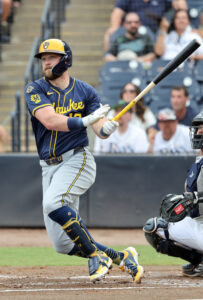
While it wasn’t what the front office had planned, that investment looks a lot better now than it did two months ago. Hoskins has been one of the best hitters in baseball. He’ll take a .300/.402/.500 batting line into tonight’s series opener in Pittsburgh. He joins Aaron Judge, Freddie Freeman and Will Smith as the only four hitters with at least 100 plate appearances and the rare .300/.400/.500+ triple slash.
Hoskins looks like the impact bat he was throughout his tenure in Philadelphia. He’s taking walks at a characteristically excellent 14% rate while striking out at a manageable 22.3% clip. He has hit seven home runs while averaging 91.4 MPH on batted balls. It’s an across the board improvement relative to his first season in Milwaukee. He’s taking more free passes, striking out less often, and making more authoritative contact. This has been a better start than his strong first two months of last season. He carried a .239/.342/.471 slash with fewer walks and hard-hit balls through the end of May 2024.
It’s true that Hoskins has benefitted from a career-high .362 average on balls in play. That’s going to come down, and Hoskins is highly unlikely to hit above .300 all year. He was more reliably a .245 hitter for the Phillies. That’s a fairer baseline. That’s also sufficient for a player with 25-30 home run pop and an extremely disciplined plate approach. Hoskins was consistently around 25-30 percent better than an average hitter during his time in Philadelphia, as measured by wRC+. That was enough to make him a top 40 or so hitter in MLB.
Hoskins’ rebound also figures to make him an interesting trade candidate. The Brewers are out to a 24-26 start, putting them fourth in the NL Central. They’re six games back in the division and 4.5 out of the Wild Card race with five teams to jump. They’re certainly not out of it with more than 110 games to make up the gap, yet they’re also not clear-cut contenders as they were every season between 2018-24.
Even if the Brewers don’t find themselves as true “sellers,” they could try to move Hoskins. Like many small-market contenders, Milwaukee tends to take a more flexible trade approach — shopping expensive veterans with dwindling club control windows while targeting cheaper players who could immediately contribute to the MLB team. Hoskins would be a candidate for that kind of move even if the Brewers are at or slightly above .500 in July.
On the one hand, Hoskins would be a straightforward trade candidate as one of the best available rental bats. The Red Sox need first base help after the Triston Casas injury. The Giants have gotten a dismal .193/.294/.339 line from their first basemen and could use a short-term bridge before calling upon top prospect Bryce Eldridge. (That Hoskins is a Sacramento native who attended Sacramento State would be an added bonus.) The Mariners, Twins and Reds are other teams that could upgrade at first base.
That’s complicated by the contract, which could be onerous for some teams. Hoskins is living up to his salary in a vacuum, but many clubs are reluctant to take on significant money midseason. There will still be roughly $5.6MM of his $18MM salary to be paid from the deadline through the end of the regular season. More notably, there’s a $4MM buyout on an $18MM mutual option for 2026. The option is going to be declined — quite likely by Hoskins — and the team will need to pay the buyout on February 1, 2026. That might be a bigger stumbling block for an acquiring club. It’s possible teams will want the Brewers to cover a portion of the buyout to facilitate a trade.
Teams may negotiate conditional cash considerations for option buyouts in trade talks; last summer’s trade of Eloy Jiménez from the White Sox to Baltimore is one recent example. That’s not an option on waivers, however. Hypothetically, say the Brewers hold Hoskins past the deadline but fall firmly out of contention in August. It’s possible they’d take the increasingly common approach of trying to dump his salary by placing him on outright waivers before the September 1 deadline for playoff eligibility. There’s a decent chance Hoskins would clear in that scenario, as a claiming team would become responsible for the entire option buyout for what amounts to one regular season month (plus a hopeful playoff run).
Perhaps the Brewers will catch fire over the next two months and make that all a moot point. If Hoskins rakes all season and helps Milwaukee back to the postseason, they could hold him and even consider a qualifying offer to potentially recoup a draft choice if he walks as a free agent.
Image courtesy of Klement Neitzel, Imagn Images.
Can Kyle Schwarber Earn $100MM On His Next Contract?
Designated hitter Kyle Schwarber is slated for free agency at the end of this season. Recently, a couple of different writers have floated a rough $100MM figure as a possibility for his next contract. On May 6th, Jeff Passan of ESPN published a column where he described Schwarber getting to $25MM annually over a four-year deal as “eminently reasonable.” About a week later, Scott Lauber of the Philadelphia Inquirer wrote that Schwarber’s recent performance might “lead to the $100 million contract” which previously eluded him.
While Passan did conclude that nine figures is “reasonable” for Schwarber, he is aware that it would set a new precedent. He writes that “a designated hitter who’s going to be 33 next Opening Day getting a nine-figure deal” would be an “outlier” but believes that Schwarber is himself an outlier and deserving of a contract that breaks the mold.
This post will dig in on those current precedents to see how far Schwarber would have to push the market in order to hit the century mark, with the help of MLBTR’s Contract Tracker.
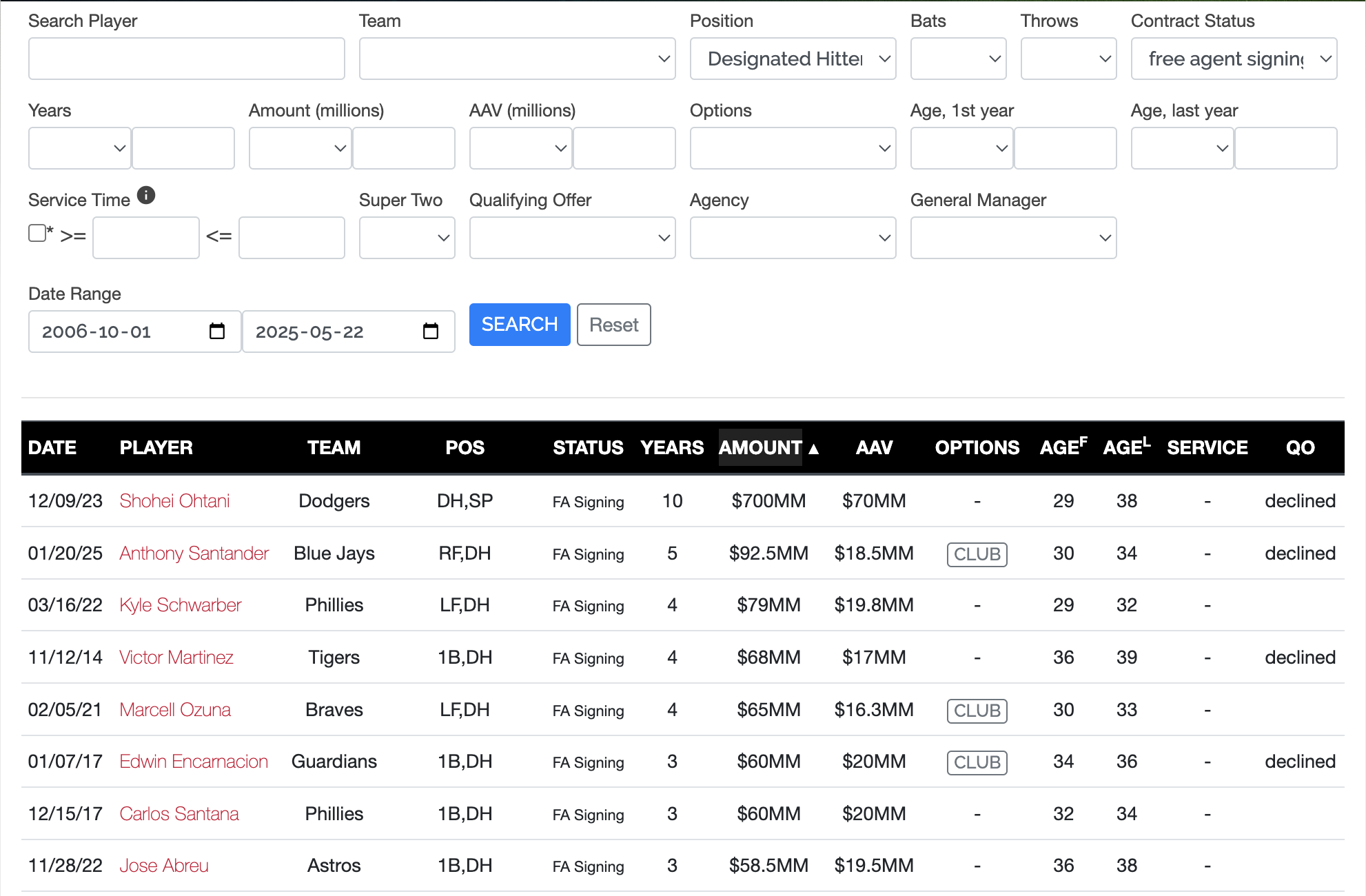
This image (link for app users) shows all the free agent deals for designated hitters going back almost 20 years, sorted by total guarantee. As you can see, designated hitters have not been paid $25MM annually, nor have any received a $100MM guarantee.
Shohei Ohtani is out on an island here, for obvious reasons. He’s a unicorn in terms of on-field ability as a two-way player and his international stardom is unparalleled. No one else has topped $20MM annually. Anthony Santander came close to the century mark in terms of total sticker price but his $92.5MM deal had notable deferrals which pushed the net present value closer to the $70MM range. He’s also not a strict DH, having logged over 1,000 innings in the outfield for the Orioles last year.
Next on the list is Schwarber himself. The last time he hit the open market, he was going into his age-29 season, yet he could only get $79MM over four years, an AAV just under $20MM. Inflation usually pushes the market forward but somewhat similar players like Joc Pederson and Santander could only get to $18.5MM annually in the most recent offseason.
Schwarber is better than those guys, but let’s also look at the age question. Here are all free agent contracts for hitters starting at age-33 or older, regardless of position.
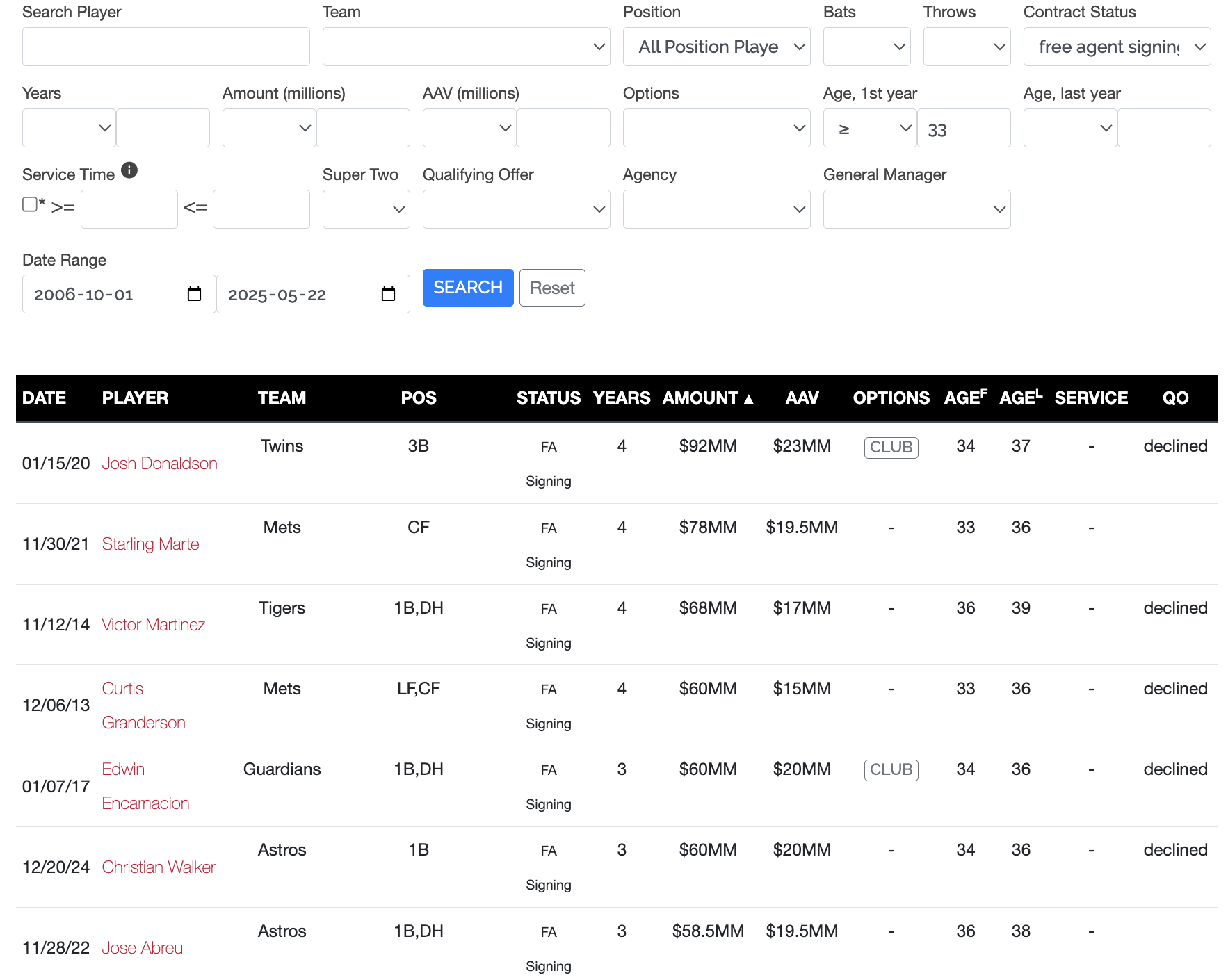
In this image (link for app users), we can see that no free-agent hitter has received a $100MM guarantee beginning at age 33, nor have any secured a $25MM annual salary beginning at that age. Another path to $100MM would be to get $20MM annually over five years. But as shown in that image, there have been no recent deals of that length for players in this age category.
Josh Donaldson did come close to the $25MM AAV and $100MM total. But at the time of that deal, he was still an above-average third baseman. He had just hit 37 home runs for Atlanta while being credited with ten Defensive Runs Saved and nine Outs Above Average. He continued playing well through the first half of that deal but was subpar at the plate in the final two years.
As for Starling Marte, his 2021 season saw him post a 132 wRC+, play over 1,000 innings in the outfield, and steal 47 bases in just 120 games. Still, he was limited to four years and an AAV just under $20MM.
So, designated hitters don’t get $100MM contracts. Nor do players pushing into their mid-30s. For Schwarber to get $100MM as a 33-year-old DH, some team would have to consider him to be worth significantly more than any other previous player in those categories. In fact, 33-year-old Schwarber would have to be valued higher than 29-year-old Schwarber.
What Schwarber has working for him is that he has found a new gear at the plate since coming to Philadelphia. Since signing that deal with the Phils, he has hit 148 home runs. He has drawn walks at a 15.4% clip. His 28.7% strikeout rate is high but he’s always been in that range. Overall, he has a .224/.348/.496 line and 131 wRC+ for the Phillies. Only Aaron Judge and Ohtani have hit more home runs in that time. Judge and Juan Soto are the only guys ahead of him in terms of walk rate, while the wRC+ number is 11th for hitters with at least 2,000 plate appearances in that span. This year, Schwarber’s even above his own pace, with 17 home runs already, a .253/.390/.573 line and 164 wRC+.
Prior to coming to Philadelphia, he had been a few notches below that. From 2017 to 2019, he slashed .234/.337/.492 for a 113 wRC+ with the Cubs. His 12.9% walk rate was good but a few ticks below what the pace he has subsequently managed in Philly. Similarly, he hit 94 home runs over those three seasons, a pace of just over 30 annually. That’s very good, but he’s pushed that up to an almost 45-homer annual pace with the Phils.
He then had a dip in the shortened 2020 campaign. He did hit 11 home runs but his .188/.308/.393 line led to a 91 wRC+. The Cubs could have retained him for 2021 with a projected arbitration salary in the $8-10MM range, but they decided to move on instead. He bounced back tremendously in 2021, splitting his time between the Nationals and Red Sox. He signed a $10MM deal with Washington and was traded to Boston at the deadline. He hit 32 home runs and put up a .266/.374/.554 line for a 145 wRC+.
It’s possible that his rough 2020 showing was still fresh in the minds of baseball decision makers and hampered his market the last time he was a free agent. Since then, he has shown himself to be incredibly reliable at the plate, erasing the memory of his non-tender.
The question now is whether teams will think he can keep it going. When he signed his last contract, he was still a somewhat viable fielder. He has never been good in left field but nonetheless was a regular out there prior to signing with the Phils and got roughly 1,000 innings on the grass in both 2022 and 2023. He has become almost exclusively a DH more recently, with just 41 innings in the field in 2024 and 36 so far in 2025. That means he’ll need to keep hitting to provide any value.
Even the most talented players are subject to declining performance in their mid-30s. Donaldson and Marte were performing well on both sides of the ball in their platform years, but Marte has essentially been a replacement-level player starting with his age-34 season. Donaldson’s bat fell below league average in his age-36 campaign. José Abreu was the A.L. MVP in his age-33 season but was unplayable by his age-36 season.
That could leave Schwarber with a few good years to go. Perhaps not playing the field will help him to gracefully descend that aging curve. Looking at some of the names above, Edwin Encarnación had 34 home runs and a 130 wRC+ in his age-36 season. Victor Martinez had 32 bombs and a 168 wRC+ in his age-35 campaign. He followed that up with a nightmare season, 11 homers and a 77 wRC+, but was able to bounce back with a solid campaign at the age of 37 that features 27 long balls and a 120 wRC+.
Santander just hit 44 home runs last year and still couldn’t get to nine figures, even though he was going into his age-30 season. However, he has never had strong walk rates, so his overall offensive profile is less than Schwarber’s. Even with those bombs, he only had a 129 wRC+ last year, his best such mark in a full season. Schwarber’s average production over three-plus years in Philadelphia has been better than that, with a big spike here in 2025.
Pederson put up a 151 wRC+ last year but was mostly shielded from lefties. He has a .209/.305/.328 line and 78 wRC+ against southpaws in his career. Schwarber had some platoon issues earlier in his career but seems to have put those behind him. At the time of signing his deal with the Phillies, he had a .214/.324/.361 line and 86 wRC+ without the platoon advantage. Since coming to Philly, he has a .235/.357/.468 line and 130 wRC+. Amazingly, his wRC+ against lefties has been growing year over year: 95 in 2022, then 107 in 2023, 153 last year and a shocking 223 so far in 2025. That could certainly be an argument for Schwarber doing better than he did on his last deal.
It’s also perhaps worth noting that lowering the age cut-off by one year opens up another interesting comp from recent years. While Donaldson’s $92MM deal is the top mark for a 33-year-old, Freddie Freeman got a six-year $162MM deal going into his age-32 campaign. He’s a better overall hitter than Schwarber with a career 143 wRC+. He’s also a first baseman and not limited to the DH spot. Those factors and the one-year age difference are arguments for Schwarber coming in below Freeman, but it’s possible for him to do so and hit the century mark.
Another factor to consider is the qualifying offer, as Schwarber has never received one. Since he was traded in 2021, he wasn’t eligible to get a QO prior to signing with the Phils. If he sticks in Philadelphia all season long and keeps producing like this, they would surely issue him one, which would probably be in the range of $22MM or so.
Would a team be willing to make a four-year, nine-figure bet on a 33-year-old DH and give up a draft pick in the process? It’s never happened before. Time will tell if Schwarber is unique enough to set some new benchmarks.
Photo courtesy of Bill Streicher, Imagn Images
Poll: Should The Royals Be Worried About Salvador Perez?
Veteran catcher Salvador Perez is the face of the Royals franchise, the last man standing from the club’s 2015 World Series team, and a nine-time All-Star with five Gold Gloves and five Silver Sluggers to his name. He’s one of the most important players in the organization’s history, and in that sense the 35-year-old’s legacy is already secure. That impenetrable legacy does little to help the Royals’ playoff odds in 2025, however, and in that regard Perez’s performance this year has been lacking. He’s hit just .218/.254/.324 across 46 games and 190 plate appearances so far in 2025. That leaves him with a wRC+ of just 57 and negative WAR according to both Baseball Reference and Fangraphs, and that’s in spite of a brief hot streak where he collected 14 hits (including eight doubles) in ten games from April 24 to May 6.
That sort of production just won’t cut it for a Royals club that has playoff aspirations. Their 27-22 record entering play today is enough to keep them in the thick of the Wild Card race, but the recent losses of both Seth Lugo and Cole Ragans from the front of their rotation will put more pressure than ever on the offense to score runs. Perez is typically a key part of that offense, and with other key cogs in the lineup like Vinnie Pasquantino and Jonathan India also struggling to produce early in the year, Perez remains as important as ever. Can he turn things around, or do the Royals have a tough decision to make this summer about a franchise legend’s playing time in a pennant race?
A look at the underlying metrics provides plenty of reason for optimism. The most glaring factor in Perez’s downturn in performance is his anemic .106 ISO, which would put him on par with the 2024 performances of light-hitting, contact-oriented bats like Nico Hoerner and Nolan Schanuel. That’s a worrisome comparison to make considering Perez averaged 30 homers per season from 2021 to 2024, but the good news is that all signs point to this power outage coming to an end sooner rather than later. Despite hitting just two home runs so far this year, Perez’s 13.0% barrel rate is actually his best since he smacked 48 bombs in 2021 and his 45.7% hard-hit rate is better than it was in either of the past two seasons. In fact, Perez’s barrel and hard-hit rates are almost identical to those of Pete Alonso this year.
That could make it easy to write off Perez’s lackluster performance so far this season as little more than a fluke that should correct itself in due time, and the Royals are surely hoping that’s the case. With that being said, there are at least some potential red flags in the veteran’s performance that are worth keeping an eye on. While Perez has never been a particularly well-disciplined hitter, his 22.6% strikeout rate and 4.2% walk rate are both trending in the wrong direction relative to his All-Star 2024 season. He’s also hitting slightly more balls on the ground with fewer line drives relative to last year. All four of those figures are well within the bounds of Perez’s career norms, however.
Perhaps the biggest reason for concern regarding Perez is his age. As a 35-year-old catcher, it would hardly be a surprise if he wasn’t as physically capable of maintaining peak performance across 162 games as he was in his younger days. Regular reps at first base and DH should help that somewhat, but it’s still worth noting that Perez has seen his offense take a turn for the worse when the calendar flips to July in each of the past two seasons. If that trend of Perez slowing down as the year progresses continues in 2025, he may be running out of time to turn his overall season numbers around despite the solid underlying metrics to this point in the year.
How do MLBTR readers think the rest of Perez’s 2025 campaign will play out? Will he bounce back to around where he’s been in recent years, as the underlying numbers suggest? Or has he struggled too deeply for too long in the first half to make up for a potential slowdown after the All-Star break? Have your say in the poll below:
What's Salvador Perez's Outlook For 2025?
-
He'll be able to turn things around somewhat, but his slow start and history of slowing down in the second half will hold him back and he'll finish the year a league-average hitter. 52% (2,592)
-
He'll continue to struggle and end the year a below-average hitter. 37% (1,857)
-
He'll rebound and post a season similar to or better than last year when all is said and done. 11% (554)
Total votes: 5,003
Bo Bichette’s Earning Power Spectrum
Last month, MLB Trade Rumors published an early Power Rankings looking ahead to the upcoming free agent class. Kyle Tucker was an obvious choice for the top spot and Dylan Cease ended up pretty comfortably in second. The next few entrants were tougher to separate, but Bo Bichette ended up third.
Bichette’s free agency was and is tough to peg. He has a strong track record of success, but his 2024 season was awful. His bat has been strong on the whole, though with a swing-happy profile that lacks walks. His defense has been passable enough to stick at short, but he’s not great there.
Of the potential top free agents this coming winter, he seemingly has some of the widest error bars. This post will take a look at the spectrum, using MLBTR’s Contract Tracker as a guide.

As you can see in that screenshot (link for app users), I’ve used the dropdown bars to search for free agent deals for shortstops over the past five years. I’ve then ranked them by the total guarantee on the contract. There are some pretty clear tiers in earning power, so let’s see where Bichette could fit in.
From 2019 through 2023, his production was quite consistent. He splashed onto the scene with a 143 wRC+ in 46 games in his debut season but then his wRC+ finished in the 120 to 130 range in each of the next four seasons. His home run total in the three full seasons from 2021 to 2023 fell between 20 and 29. His walk rate was on the low side in each of those campaigns, falling between 4.5% and 5.9%, but he also struck out less than average and ran batting averages near .300.
The defensive reviews have been mixed. Defensive Runs Saved has him at -11 for his whole career, though a big chunk of that is a -16 in 2022 alone, which looks like a clear outlier. Apart from that, he’s generally been near average, give or take a few runs on either side. Outs Above Average, however, doesn’t like his glovework at all. Bichette has -22 OAA for his career and has been below average in almost every season. The only campaigns in which he’s finished with a positive OAA were the shortened 2020 season and his injury-marred 2024 campaign.
Still, the bat was enough to produce plenty of value. FanGraphs had him between 3.9 and 4.9 wins above replacement in each season from 2021 to 2023. Baseball Reference pegged him between 3.7 and 5.9.
Things went off the rails last year. Bichette seemingly battled leg injuries all year, twice going on the IL due to right calf strains. He got into just 81 games, hit only four home runs and produced an ugly .225/.277/.322 batting line, 71 wRC+.
Turning to 2025, Bichette seems to have bounced back to his old self. Through 211 plate appearances, he has a .292/.341/.431 and 121 wRC+. That’s despite a slow start. Through the end of April, he still hadn’t hit a home run, leading to a decent but powerless .295/.328/.364 line and 97 wRC+. Since the calendar has flipped to May, he has finally gone over the fence four times, helping him hit .288/.365/.561 for a wRC+ of 163 this month.
Turning to the Contract Tracker list, at the top is a level that Bichette shouldn’t be able to get to, with Corey Seager at $325MM followed by Trea Turner at $300MM. Seager got his deal going into his age-28 season, the same age Bichette will be next year. However, Seager was simply better. His power output was fairly close to Bichette’s but with far more walks, leading to a 142 wRC+. His defense was also graded higher.
Seager had 19.8 fWAR at the time he signed with the Rangers. Bichette could actually go past that since he’s at 17.2 fWAR right now, but that’s mostly due to Seager’s injuries (most notably, Tommy John surgery). Seager produced that WAR total in just 514 regular season games as a Dodger, whereas Bichette already has 655 games under his belt. There was some injury risk with Seager but he was far better on a rate basis and that’s what the Rangers paid for.
Turner was a bit older, going into his age-30 season, but his combination of offense, defense and speed gave him a massive ceiling Bichette can’t match. In his final two seasons before free agency, he produced 7.1 and 6.4 fWAR. As mentioned, Bichette has topped out at 4.9.
The next two names on the list are a bit unusual. Xander Bogaerts getting $280MM registered as a huge surprise at the time and the deal hasn’t worked out for the Padres so far. In the industry, that one is chalked up to the Friars going a bit wild. Owner Peter Seidler was in poor health and was allowing the front office to spend like never before, seemingly throwing caution to the wind with the knowledge that he didn’t have much time left.
Carlos Correa‘s deal is also an unusual data point. His earning power was initially far higher. He had agreed to a 13-year, $350MM deal with the Giants before they got scared by his physical and walked away. The Mets agreed to a 12-year $315MM deal with Correa before they, too, balked at his medicals. The $200MM deal with the Twins was therefore the product of a fairly unprecedented situation. The unique quartet of vesting options in the deal reflect the odd circumstances and could add millions more to Correa’s bank account.
There’s a case for Bichette to be in the next tier. I’ll circle back to Marcus Semien in a second and focus first on Willy Adames, Dansby Swanson, Javier Báez and Trevor Story. Each signed his contract going into his age-29 season and earned between $23.3MM and $26MM annually. Adames and Swanson got a seventh year, pushing their total guarantees to $182MM and $177MM respectively. Báez and Story were each capped at six years and $140MM total.
Bichette will be one year younger than everyone in that group, theoretically giving him a bit more earning power. The question will be whether he’s ranked as highly apart from that. Adames is a better defender, with 11 OAA and -3 DRS in his career. That latter figure is a bit odd, as he was clearly in positive range before posting -16 DRS 2024 and -7 so far as a Giant.
Offensively, he had often been similar to Bichette. He had a 126 wRC+ in 2020 and a 120 in 2021, with 25 home runs in the latter season. His power remained in 2022 and 2023 but low batting averages dropped his wRC+ to 109 and 94 in those seasons. He bounced back in 2024 with 32 home runs and a 119 wRC+. His fWAR totals have generally been in the Bichette range of three to five per season.
Swanson was always a glove-first shortstop with questions about the bat. Through 2021, he still had a career 88 wRC+. But in 2022, his walk year, he hit 25 home runs and produced a 117 wRC+. Thanks to his excellent defense and 18 stolen bases, he was able to produce a 6.6 fWAR season. That was a tier above anything Bichette has done, but he had only done it once. Still, it was enough for the Cubs to buy in.
Báez and Story were more erratic. Báez was a subpar hitter in his first few seasons but provided enough on defense and the basepaths to be useful. His offense improved as he neared free agency but wasn’t consistent. His wRC+ spiked to 131 in 2018 and dropped to 112 the year after. The shortened 2020 season was a disaster, with a wRC+ of 57, before he bounced back to 117 in 2021. At his heights, he was almost a six-win player, getting to 5.8 and 5.6 fWAR in 2018 and 2019. Those were higher than any Bichette season, but he was also well below at times.
Somewhat similarly, Story hit a higher peak than Bichette by producing 6.0 fWAR in 2019. He hit 35 home runs, though playing in Denver during the juiced ball season surely helped him a bit in that regard. Still, the 122 wRC+, 23 steals and strong defense led to a six-win season. He also had 2.0 fWAR in the shortened 2020 campaign with similar production. But in his walk year, 2021, his wRC+ dropped to 98 and he only produced 2.2 fWAR. That tepid platform season and some concerns about his elbow health knocked him down a bit.
Here is the fWAR total for each in the six seasons leading to free agency, including the shortened 2020 season for all in the name of fairness:
Baez: 21.9 in 782 games
Story: 20.3 in 745 games
Adames: 20.1 in 795 games
Bichette: 15.8 in 609 games
Swanson: 15.1 in 789 games
Bichette is right in the thick there. As mentioned, Swanson bloomed in his walk year, so it makes sense he would be at the bottom of this six-year list. If Bichette has a typical year for him, he could add another three or four wins and get fairly close to the other shorstops on the list. Factor in some inflation and that he’s a year younger than everyone in that pack and he has a case to earn something around $200MM.
What will also work in his favor is that he’ll be the clear top shortstop this winter, as Adames was in the most recent offseason. Alongside Bichette, the only other potential everyday shortstop this winter would be Ha-Seong Kim. He is still recovering from last year’s shoulder surgery and needs to both recover and play well enough to opt out of the second season of his two-year deal with the Rays. Even in a best-case scenario where that all happens, his earning power would be below a healthy and productive Bichette.
This is all still somewhat hypothetical. As mentioned, Bichette seems to be getting back to his 2021-23 pace this year, but in a fairly small sample. There’s still lots of time for the season to turn on him. If he ends up having more 2024-style struggles, he could certainly fall. Let’s turn to the Contract Tracker again.
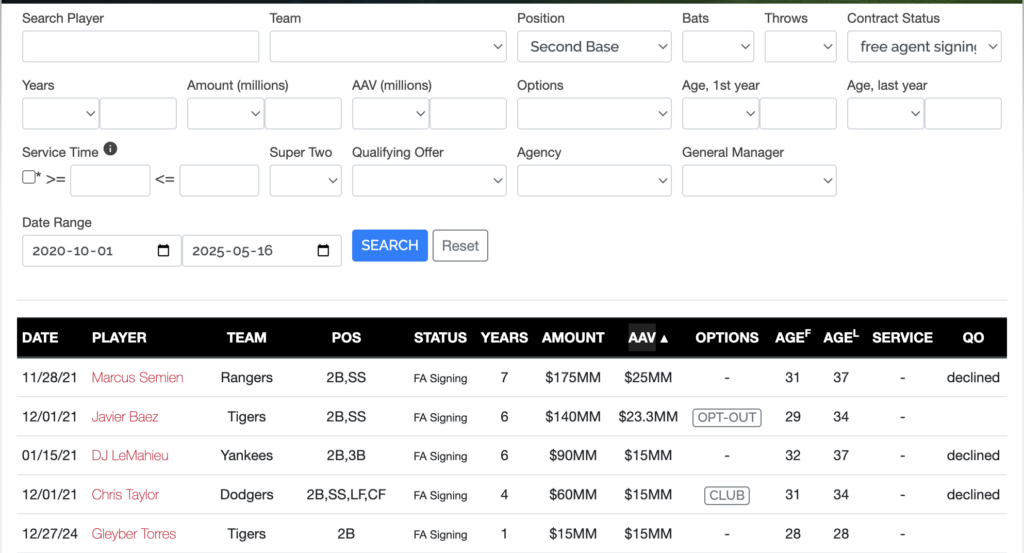
These are the top deals for second basemen by average annual value in the past five years (link for app users). This perhaps paints a picture of Bichette’s floor. Given his questionable defense, it’s possible that clubs may view him as someone who’s likely to move to second base fairly soon. And the earning power of second basemen is clearly lesser than that of shortstops. Semien did get $175MM from the Rangers, though that’s an outlier. At the time, the Rangers were five years into a deep rebuild and were eager to speed up the process with aggressive spending.
Gleyber Torres is an interesting comp for Bichette, as there are some parallels. Torres was once a highly-touted shortstop prospect, but with a better bat than glove. Unlike Bichette, he couldn’t stick at short. The Yankees moved him to second base for good in 2022, his age-25 season.
His offensive production has been somewhat comparable to Bichette’s on the whole. He went into free agency with a .265/.334/.441 line and 113 wRC+, a bit below Bichette’s typical range. He also had a tepid platform year, slashing .257/.330/.378 for a 104 wRC+ in 2024. He settled for a one-year, $15MM “prove it” deal with the Tigers.
It currently seems unlikely that Bichette would fall quite that far. His career wRC+ of 120 is a few ticks above what Torres brought to the open market last fall. Bichette also has a leg up defensively, as he will be going into free agency as a viable shortstop, at least for the short term.
But a soft finish in 2025 could hamper Bichette. In that scenario, he’d be going into free agency on the heels of two fairly disappointing seasons in a row. That was the situation Cody Bellinger was in going into 2023. After two injury-marred seasons with the Dodgers, he was non-tendered and settled for a one-year, $17.5MM pact with the Cubs for his age-27 season. He bounced back that year and went into the open market ahead of his age-28 campaign.
But there were enough question marks from his inconsistency, health and defense that he settled for a three-year, $80MM deal to return to the Cubs, well below initial expectations. He earned opt-out chances after each season in that deal but declined the first chance after a good-not-great 2024 season.
Time will tell where Bichette ultimately puts himself on this earning spectrum, but it appears to be quite wide. Anything from $20MM to $200MM seems somewhat plausible, depending on his performance over the four-plus months, which will make him a fascinating player to track.
A qualifying offer would be something of a footnote when talking about a $200MM deal but would certainly become noteworthy if Bichette finds himself on the other end. The QO was $21.05MM in the most recent offseason and will surely go up for the coming winter, after a number of recent mega deals. The QO is calculated by averaging the salaries of the 125 top-paid players. Each of Juan Soto, Alex Bregman, Blake Snell, Vladimir Guerrero Jr. and Corbin Burnes earned AAVs of $35MM or higher recently. Though there are some deferrals in those deals, the QO value is sure to rise.
Bichette would only be eligible to receive a QO if he sticks with the Jays until the end of the season. Players traded midseason are not eligible to receive one. If the Jays fall out of the race and trade Bichette at the deadline, the QO won’t be a factor for him — yet another detail that could sway a volatile free agent case with many factors at play.
Photo of Bichette courtesy of Dan Hamilton, Imagn Images
Poll: How Effective Has The Prospect Promotion Incentive Been?
The Prospect Promotion Incentive was instituted as part of the latest collective bargaining agreement prior to the 2022 season. As the name implies, it’s designed to incentivize teams to more quickly promote their top prospects to the majors and avoid service time manipulation to gain a seventh year of team control over a given player. If an eligible player wins the Rookie of the Year award or is a finalist for either the MVP or Cy Young award before he reaches arbitration eligibility, then his team will be awarded a pick immediately after the first round of the following year’s draft.
Over the first three years of the incentive’s existence, four players have earned a PPI pick for their team: Julio Rodriguez, Gunnar Henderson, and Corbin Carroll all did so by winning their league’s Rookie of the Year award, while Bobby Witt Jr. did so last year by finishing second in AL MVP voting. That’s more than one player per year bringing in an extra pick for their team, and that collection of some of the league’s brightest young stars would have otherwise been prime candidates for service time manipulation; all were viewed as among the game’s best prospects, and all except Carroll had not yet signed an extension with their club although both Witt and Rodriguez would do so later on. The Mariners, in particular, had a history of manipulating service time with their best prospects including a controversy surrounding their handling of then-top prospect Jarred Kelenic.
In the cases of Rodriguez, Henderson, and Witt, the club in question evidently felt that the combination of a potential PPI pick and a full season of their top prospect in the majors was the better choice to pursue than the possibility of a seventh year of team control. The fact that players who finish in the top-two of Rookie of the Year voting are awarded a full year of service time even if they have not yet reached 172 days naturally surely factors into that calculation as well; the Pirates held star right-hander Paul Skenes back from their Opening Day roster and ended up with the worst of both worlds when he won the NL Rookie of the Year award last year. Not only did they not receive a PPI pick for Skenes’s win after he wasn’t included on their roster to begin the year, but his win cost them that extra year of team control gained by holding him back in until May anyway. 2015 NL Rookie of the Year Kris Bryant surely would’ve appreciated the opportunity to get that same bump in service time and move his free agency up to the 2020-21 offseason.
Not all instances of the PPI’s influence are quite this cut-and-dry, however. One recent trend regarding PPI-eligible prospects has been for clubs to put potential Rookie of the Year candidates on their Opening Day roster (or promote them early enough in the season so that they retain PPI eligibility) before giving them a short run in the majors and optioning them to the minor leagues if they don’t excel. The Cubs recently did exactly this with top infield prospect Matt Shaw, who was promoted back today after making the Opening Day roster, struggling in 18 games, and then spending a month at Triple-A. The Orioles have used this tactic when handling the promotions of Grayson Rodriguez and Jackson Holliday, as well.
Exactly how much those demotions had to do with service time and how much they had to do with performance can be debated, but it’s a method that allows a team to essentially hedge their bets by only extracting that extra year of team control once the PPI-eligible player has struggled enough in the majors to make a top-two finish in Rookie of the Year voting extremely unlikely. Aside from those cases, there are also some teams that seem completely undeterred from holding down their top prospects by the PPI. The aforementioned Pirates fall into this group even after the debacle with Skenes last year, as they’ve shown no inclination towards promoting top pitching prospect Bubba Chandler despite his dominance at Triple-A and the club’s struggles at the big league level.
How do MLBTR readers view the incentive? Has it been a success because it’s allowed players like Skenes to earn a full year of service while getting players like Henderson the opportunity to break camp with the big league team on Opening Day of their rookie seasons? Or is the fact that players like Chandler are still being held down in the minors while players like Shaw and Holliday have been sent back to Triple-A once they’re no longer good bets to bring in a PPI evidence enough that the system is ineffective? Have your say in the poll below:
Does The Prospect Promotion Incentive Work?
-
Yes, it's an effective tool to encourage teams to promote their young stars even if it's not utilized by every team. 57% (1,226)
-
No, teams have continued to hold down their top prospects too frequently for it to be considered a success. 43% (942)
Total votes: 2,168
Poll: National League Playoff Outlook
We’re now a little over a quarter of the way through the 2025 regular season. With Memorial Day fast approaching, it’s hard for struggling teams to continue arguing that it’s still early. That isn’t to say playoff positions are set in stone, of course; on this day last year, the Cubs were firmly in playoff position while the Mets club that eventually made it all the way to the NLCS was still three games under .500. If the season ended today, the Dodgers, Cubs, Mets, Padres, Phillies, and Giants would be your playoff teams in the National League this year.
With four-and-a-half months left in the baseball calendar, which team currently outside of that group has the best chance of breaking their way into the mix? Yesterday’s poll covering the American League was won by the Red Sox (25%), who narrowly bested both the Rangers (20%) and Astros (20%) in a tight contest. Here’s a look at a few of NL’s the options, listed in order of record entering play today:
St. Louis Cardinals (24-20)
The Cardinals essentially left their roster untouched outside of the departure of veterans like Paul Goldschmidt and Kyle Gibson over the offseason. Right-hander Phil Maton was the club’s only major league free agent signing. Running back last year’s 83-win team without its former MVP first baseman didn’t do much for the Cardinals’ projections, but a recent nine-game win streak has allowed St. Louis to change the narrative. Willson Contreras has started hitting again, Masyn Winn could be breaking out, and Matthew Liberatore is making the decision to move him to the rotation look wise. If the Cards can keep playing anything close to this well, thoughts of selling Ryan Helsley at the deadline are likely to vanish before the calendar flips to July.
Arizona Diamondbacks (23-21)
The fourth team in a crowded four-team NL West race, the Diamondbacks have held their own this year despite injuries plaguing superstar Ketel Marte and the loss of A.J. Puk from an already-leaky bullpen. Corbin Burnes has delivered a sub-3.00 ERA despite shaky peripherals, Merrill Kelly and Brandon Pfaadt look like solid mid-rotation pieces, and Corbin Carroll is a superstar. If Zac Gallen (4.59 ERA) and Eduardo Rodriguez (7.07 ERA) can even pitch close to their respective 3.91 FIP and 4.30 FIP marks, Arizona should be a real threat to reach the postseason.
Atlanta Braves (22-22)
That Atlanta finds itself even in this conversation after going 0-7 to start the year is an impressive feat. The tandem of Sean Murphy and Drake Baldwin behind the plate has been a sensational one, and AJ Smith-Shawver is turning into a potential front-of-the-rotation surprise alongside Chris Sale and Spencer Schwellenbach. With a .500 record despite getting just one start from Spencer Strider and zero plate appearances from Ronald Acuna Jr. so far, it’s not hard to imagine the Braves fighting their way into the playoffs by season’s end. For that to happen, players like Matt Olson and Ozzie Albies will need to start hitting while closer Raisel Iglesias (5.71 ERA) will need to turn things around or be replaced by someone who can more consistently nail down save opportunities.
Milwaukee Brewers (21-23)
Disappointing performances from Christian Yelich, William Contreras, and Jackson Chourio to this point in the year have limited the Brewers’ performance so far. (Contreras is playing through a broken middle finger, which can’t help.) Thankfully, players like Rhys Hoskins and Brice Turang have both looked excellent so far and the Brewers have proved they can win mostly on the strength of their pitching before. Freddy Peralta and rookie Chad Patrick have been excellent, Brandon Woodruff is nearing a return, and top prospect Jacob Misiorowski is throwing 103 mph with dazzling results at Triple-A. If the star hitters can perform at a higher level going forward, perhaps that would be enough to get them back into the mix.
Cincinnati Reds (21-24)
It’s been a frustrating season for the Reds so far. The rotation, led by Hunter Greene and Andrew Abbott, has been strong, but those contributions have been dampened by a frustrating lineup that has failed to get consistent quality production out of anyone but Jose Trevino and Gavin Lux. Even Elly De La Cruz has been a roughly average hitter overall, while key pieces like Matt McLain and Spencer Steer have been bitterly disappointing. Fortunately, Noelvi Marte seems to be coming around after a disastrous 2024. There’s still enough time that if the club’s young lineup can go on a heater, it’s easy to imagine a strong pitching staff carrying them back into the postseason conversation.
The Rest Of The Field
The five teams mentioned above are all within five games of a Wild Card spot. The rest of the league would have a lot more work to do. The Nationals have an exciting young core featuring James Wood, CJ Abrams and MacKenzie Gore but lack the pitching depth to capitalize on it. The Marlins have gotten a big performance from Kyle Stowers, but a disappointing pitching staff that includes an 8.10 ERA from Sandy Alcantara is keeping the playoffs out of reach. The inverse is true in Pittsburgh, where Paul Skenes leads an impressive rotation but Bryan Reynolds has a wRC+ of just 55. Meanwhile, the Rockies are the team that can be most decisively counted out of the playoff picture in a season where they’re poised to contend for the modern loss record.
_____________________________________
Which of the teams outside of the NL playoff picture entering play today do MLBTR readers think stands the best chance of making it into the postseason? Have your say in the poll below:
Which Current NL Non-Playoff Team Is Most Likely To Make The Postseason In 2025?
-
Atlanta Braves 37% (1,358)
-
St. Louis Cardinals 22% (796)
-
Arizona Diamondbacks 17% (617)
-
Cincinnati Reds 11% (402)
-
Milwaukee Brewers 6% (204)
-
The final NL playoff field will be identical to the current standings. 5% (174)
-
Colorado Rockies 2% (63)
-
Pittsburgh Pirates 1% (36)
-
Washington Nationals 1% (20)
-
Miami Marlins 0% (10)
Total votes: 3,680
The Orioles’ Pair Of Rental Bats
The Orioles dropped both games of a doubleheader against Minnesota yesterday, falling 11 games under .500. They kept the bad times rolling with another loss this afternoon, getting to 12 games under. It’s the nadir of their season so far, one from which they’ll have a difficult time coming back.
As of last week, general manager Mike Elias wasn’t interested in contemplating the possibility that they’ll be deadline sellers. “We’ve got a record that’s not reflective of who we believe our team is, that I don’t think anyone thought our team was, and we’re digging a hole out of the standings right now because of that,” the GM told Joel Sherman and Jon Heyman of The New York Post on their podcast last Tuesday. “Hopefully, we claw back a lot of real estate in the standings and we get back in the mode that we fully expected to be. That is my focus right now. If it somehow evolves otherwise, I’ll address it then.”
The team has dropped six of eight games since those comments. Even with Zach Eflin returning from the injured list over the weekend, the starting rotation looks untenable. Colton Cowser and Jordan Westburg face uncertain timelines to make it back from their own IL stints. The odds are very much not in their favor. FanGraphs has the O’s playoff chances down to a season-low 4.4%. The front office certainly didn’t anticipate being deadline sellers, but it’s increasingly difficult to see them avoiding that fate.
It would be surprising if the Orioles dealt any controllable core pieces like Westburg, Adley Rutschman or Jackson Holliday. It’d be tough to find a taker on Tyler O’Neill given his annual $16.5MM salaries and opt-out clause. Tomoyuki Sugano has had solid results in his first big league season, but he probably has modest trade value on a $13MM salary given his below-average velocity and 14.2% strikeout rate.
That leaves a pair of rental bats as Baltimore’s top trade candidates: Ryan O’Hearn and Cedric Mullins. The former has systematically improved over his two and a half seasons at Camden Yards. O’Hearn was a career .219/.293/.390 hitter when the Orioles acquired him from the Royals over the 2022-23 offseason. He turned in what was then a personal-best .289/.322/.480 slash during his first season in Baltimore. Last year’s batting line seems superficially like a step back — he hit .264/.334/.427 in 494 plate appearances — but it came with a dramatically superior strikeout and walk profile than he showed in 2023.
O’Hearn has maintained those impressive plate discipline metrics while hitting for more power early this year. He carries a .287/.374/.519 mark with seven longballs across 123 plate appearances. O’Hearn isn’t chasing pitches outside the strike zone. His 15.4% strikeout rate is well below the 22.1% league average. He’s making hard contact (a 95+ MPH exit velocity) on half his batted balls, well up from last season’s 40% clip.
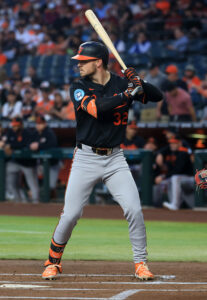
The rate stats are slightly inflated by the O’s tendency to shield O’Hearn from unfavorable platoon matchups. They’ve mostly kept him away from left-handed pitching, giving him just 94 plate appearances against southpaws over the past three seasons. He’s more of a strong-side platoon bat than a true everyday player, but O’Hearn is thriving in that role. He is up to a .280/.339/.465 slash in nearly 900 plate appearances against righty pitching as a member of the Orioles.
That kind of production is a bargain for a player making an $8MM salary. O’Hearn will be a first-time free agent next year, as he enters his age-32 season. It’s tough to see the Orioles making him a qualifying offer that’d likely be north of $21MM. He has a good shot at a multi-year contract, but the O’s would probably be better served letting him walk to open first base/DH playing time for Coby Mayo. That all points to a trade.
Baltimore won’t pull the trigger on that kind of move two and a half months from the deadline, but he seems likely to be available in July. The Giants and Red Sox are the most obvious potential suitors for a rental first baseman. Boston will be without Triston Casas all season. San Francisco has gotten nothing out of LaMonte Wade Jr. this year. They won’t want to block top prospect Bryce Eldridge in 2026 but should make a short-term add at the position. The Rangers and Mariners would also make sense as landing spots.
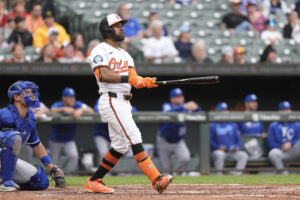
The Orioles would need a stronger return on Mullins, who may end up being one of the best all-around position players available. The lefty-hitting center fielder takes a .230/.335/.446 line with eight homers into today’s game against Minnesota. Most of that production came early in the season. Mullins carried a .278/.412/.515 slash through the end of April. He’s hitting .119/.119/.286 thus far in May. He’s clearly amidst a skid at the plate, but he still ranks among the sport’s most productive center fielders overall. He is tied for fourth at the position in homers and ranks eighth in on-base percentage (minimum 100 plate appearances).
Even if Mullins was punching above his weight through the season’s first few weeks, he’s a quality player. He has been an average or better hitter in five consecutive seasons. He has topped 30 stolen bases in three of the last four years. The public metrics are split on his glove — he rates more highly by Statcast’s Outs Above Average than he does in the estimation of Defensive Runs Saved — but there’s no doubt that he can play center field. There’s a dearth of talent at the position on the trade market, especially if Luis Robert Jr. continues to underperform offensively.
Mullins is making $8.725MM in his final season of arbitration control. There’s a decent chance the O’s would make him the qualifying offer if he’s not traded, but a multiple-prospect package could be superior to one compensatory draft pick. The Guardians, Phillies, Mets, Rangers and A’s are just a handful of contenders that could look for an upgrade in center field.
Respective images courtesy of Mark J. Rebilas and Gregory Fisher, Imagn Images
Poll: American League Playoff Outlook
We’re now a little over a quarter of the way through the 2025 regular season. With Memorial Day fast approaching, it’s hard for struggling teams to continue arguing that it’s still early. That isn’t to say playoff positions are set in stone, of course; on this day last year, the Mariners and Twins were firmly in playoff position while the eventual AL West champion Astros were in fourth place in the division and seven games under .500.
If the season ended today, the Tigers, Yankees, Mariners, Guardians, Royals, and Twins would be your playoff teams in the American League this year. With four-and-a-half months left in the baseball calendar, which team currently outside of that group has the best chance of breaking their way into the mix?
Here’s a look at a few of the options, listed in order of record entering play today:
Houston Astros (22-20)
Houston’s first season in a post-Kyle Tucker, Alex Bregman world has been an uneven one. Jose Altuve does not look like the difference-maker he once was in his age-35 season. He’s hitting .256/.302/.369 (90 wRC+) and has effectively played at replacement level. His batted-ball profile suggests he may even be a bit fortunate to have the modest rate stats he currently possesses. Yordan Alvarez is injured, Yainer Diaz is well-below average at the plate, and neither Christian Walker nor Cam Smith is producing the way Houston hoped.
On the positive side, Isaac Paredes (141 wRC+) and Jeremy Pena (139 wRC+) have both been excellent at the plate. Hunter Brown is looking like an early Cy Young candidate, and the late-inning duo of Josh Hader and Bryan Abreu is one of the best 1-2 punches in baseball. If Alvarez can get healthy and the team can find some outfield help this summer, it wouldn’t be a shock to see Houston make its tenth consecutive postseason.
Texas Rangers (23-21)
Entering the season, the Rangers looked like they had an excellent offense that would be held down by questions about the pitching staff. The reality they’ve faced this year is the opposite: Marcus Semien, Adolis Garcia, Jake Burger, and Joc Pederson have all been somewhere between disappointing and terrible. Corey Seager has been injured, and Evan Carter started the year in the minors. Josh Jung, Josh Smith, and Wyatt Langford have been the only standout performers in the lineup so far this year.
That’s been offset by phenomenal performances in the rotation despite injuries to Jon Gray, Cody Bradford, and Kumar Rocker. Jacob deGrom is back and striking out a third of batters like it’s 2019, but he’s arguably the #3 starter in a rotation where Nathan Eovaldi and Tyler Mahle have sub-2.00 ERAs. Even emergency addition Patrick Corbin is turning back the clock with a 3.35 ERA across seven starts. If the Rangers’ vaunted offense can wake up a bit, it’s easy to imagine the 2023 World Series champs making a run.
The Athletics (22-21)
John Fisher’s aggressive offseason after abandoning Oakland for West Sacramento is paying off in the standings, though it’s mostly been due to young players breaking out. Jacob Wilson is looking like a unicorn in the mold of Luis Arraez. Tyler Soderstrom has emerged as a breakout slugger. Shea Langeliers is in the midst of a career year at the dish.
The pitching is cause for concern, but Gunnar Hoglund has looked good in his first taste of big league action, while both Luis Severino and Mason Miller have peripherals that suggest their results should improve with time. Three of last year’s most productive players — Lawrence Butler, JJ Bleday, and Brent Rooker — have taken steps backward, however. That will limit the club’s potential if they can’t get back on track.
Toronto Blue Jays (22-22)
With Vladimir Guerrero Jr. now in the fold for life, now all the Blue Jays have to do is win with him. The returns on that front are mixed. Veterans like George Springer, Kevin Gausman and Chris Bassitt are doing their best to make everyone forget about their age, but the performances of longer-term pieces like Anthony Santander, Bowden Francis and Jose Berrios are deeply concerning. Jeff Hoffman has been among baseball’s best closers so far and Bo Bichette is an above-average hitter again, but Alejandro Kirk has been pedestrian at the plate and Guerrero’s 131 wRC+, while terrific relative to the rest of the league, represents a major step back from last year’s 165. A healthy and effective return from future Hall of Famer Max Scherzer would go a long way to stabilizing the rotation, but players like Santander and Berrios will need to get going if playoff baseball is to return to Canada this year.
Boston Red Sox (22-23)
After pushing in by adding Garrett Crochet and Bregman this winter, the Red Sox entered the year looking like one of the AL’s best teams. While they haven’t exactly been bad, the season certainly hasn’t worked out that way so far. Crochet and Bregman are both as-advertised or better, and Wilyer Abreu is looking like a bona fide lefty slugger to pair with Rafael Devers.
Kristian Campbell has begun to cool off after a torrid start, however, and the rotation injuries have begun to pile up. It’s anyone’s guess who will be playing first base on any given day. Triston Casas is out for the year. Romy Gonzalez is on the injured list. Devers doesn’t sound keen on another position change. Roman Anthony and Marcelo Mayer are knocking on the door in the minors, and perhaps their eventual debuts will be the spark this team needs to get back into the playoff mix.
The Rest Of The Field
The five teams mentioned above are all within two games of a Wild Card spot, but the rest of the AL can’t be counted out. The Rays will benefit from the eventual returns of players like Ha-Seong Kim and Shane McClanahan, but they need more offense from key pieces like Yandy Diaz, Brandon Lowe, and Junior Caminero. The Orioles should have the lineup to compete, but they have some key bats struggling and will need to figure out their disastrous pitching staff to get back into the race. The Angels have faded after a hot start, but players like Luis Rengifo and Taylor Ward should start hitting eventually. The White Sox still have an abysmal offense, but the rotation has been surprisingly solid with Rule 5 pick Shane Smith in particular looking like a steal.
____________________________________________________
Which of the teams outside of the AL playoff picture entering play today do MLBTR readers think stands the best chance of making it into the postseason? Have your say in the poll below:
Which Current Non-Playoff Team Is Most Likely To Make The Postseason In 2025?
-
Boston Red Sox 27% (1,248)
-
Texas Rangers 20% (947)
-
Houston Astros 20% (922)
-
Athletics 9% (407)
-
Toronto Blue Jays 8% (374)
-
The current six teams in playoff position will hold on and reach the postseason. 7% (336)
-
Baltimore Orioles 4% (208)
-
Tampa Bay Rays 2% (110)
-
Chicago White Sox 2% (85)
-
Los Angeles Angels 1% (66)
Total votes: 4,703
Poll: Is Javier Baez Back?
During the 2021-22 offseason, the Tigers felt they were close enough to competing that it was time to start spending. Then-GM Al Avila signed two major free agents that winter: southpaw Eduardo Rodriguez and shortstop Javier Baez. Those offseason moves did not work out, generally speaking. The Tigers lost 96 games in 2022 as Rodriguez posted below-average numbers in an injury-marred season while Baez put up the worst full season by wRC+ of his career with a figure of 89. Avila was fired that August, giving way to a new regime under president of baseball operations Scott Harris.
Baez, meanwhile, went on to have a pair of disastrous seasons marred by injury and ineffectiveness in 2023 and ’24, hitting a combined .208/.251/.315 (56 wRC+) while being limited to just 216 games by hip and back issues. Those injuries eventually required season-ending hip surgery last year, leaving Baez on the sidelines while his team went on a miracle run last September that led them to Game 5 of the ALDS. Entering 2025, there were heightened expectations for the Tigers following that September surge.
For Baez personally, however, expectations had never been lower. The 32-year-old had multiple All-Star appearances and Gold Glove awards under his belt, but he entered 2025 without a specified role in Detroit despite the three years and $73MM remaining on his contract. Injuries during Spring Training paved the way for Baez to have a clearer role in Detroit, but even on Opening Day he was limited to a utility role where he would mostly face left-handed pitching.
Things changed once the season began, however. Baez took quite well to both center field and third base despite having virtually no experience in the outfield and only sparing appearances at the hot corner. In more recent weeks, his role has moved from a part-time utility role to being the club’s go-to option in center field, where he’s started 16 of the club’s last 20 games. Baez has always been an impressive defender anywhere he plays when healthy, so perhaps the veteran taking to new defensive positions isn’t exactly surprising. More shocking than his glove work this year has been his impressive offensive production: he’s hit a whopping .319/.357/.513 with a wRC+ of 148 across 126 plate appearances.
Even when Baez was at his best, he was a somewhat fickle hitter. While some seasons saw Baez hit extremely well, such as his 2021 (117 wRC+) and 2018 (131 wRC+) campaigns, he was actually below average at the dish in three of his six seasons as an everyday player for the Cubs. Given that unevenness, Baez’s 89 wRC+, two-win performance during his first season with Detroit wasn’t incredibly shocking. And when the injuries began to pile up in 2023 and ’24 and his offensive numbers began to rapidly decline, few expected him to ever return to the above-average form he showed during his days on the north side of Chicago.
Is 126 plate appearances of strong production enough to change that narrative? The underlying numbers offer mixed reviews. Baez’s 24.6% strikeout rate and 4.0% walk rate this year are virtually identical to his 23.9% strikeout rate and 4.3% walk rate across his first three seasons in Detroit. That strikeout rate is actually five points lower than his strikeout rate with the Cubs, but the main red flag in Baez’s performance with the Tigers wasn’t his free-swinging approach. After being a consistent power threat during his days in the National League, where his ISO is an impressive .212, Baez saw his power evaporate over his first three seasons in Detroit as his ISO plummeted to just .126.
Going from 2024 Elly De La Cruz to 2024 Alex Verdugo in the power department is a drastic downturn in performance, and while Baez’s .193 ISO this year hasn’t gotten all the way back to his previous heights, it’s a big step in the right direction. That renewed power might not be entirely sustainable, however. Baez is posting his lowest hard-hit rate since 2017, his 6.8% barrel rate is actually lower than last year, and he’s hitting more grounders (51.6%) than ever before. That suggests his current power output (five homers and eight doubles) may not be entirely sustainable, and his massive .398 BABIP surely isn’t either for a player who routinely posted BABIPs in the .340 to .350 range at his peak.
Perhaps that means Baez’s return to form this year is nothing more than a mirage, but there are some positive signs in his underlying data. Baez is swinging outside the strike zone less than ever before in his career, and his in-zone contact rate is also the best of his career. That improved plate discipline may not be showing up in his walk rate at this point, but better pitch selection could be allowing him to avoid making the worst types of contact; his 3.4% infield fly ball rate is tied with 2019 for the best figure of his career, and his 12.5% soft-contact rate would be 40th best in the sport if he had enough plate appearances to qualify.
Those subtle improvements don’t support his star-level production so far, but his .291 xwOBA is a perfect match for the wOBA he posted for Detroit back in 2022. Perhaps that means offensive production on the low-end of what was expected of him at his peak, in line with the 2016, ’17, and ’22 seasons, could be sustainable for the veteran. Given that Baez was a potential DFA candidate just a few months ago, the Tigers would surely take that sort of solid, two-to-three win production from their $140MM man very happily.
How much do MLBTR readers buy into Baez’s resurgence? Will he be able to continue tapping into his power enough to float above-average offensive numbers despite shaky peripherals? Will he fall back to Earth and be a replacement level player going forward, as he was the past two years? Or will he find a middle ground as an average to slightly-below average hitter who remains valuable thanks to strong defense? Have your say in the poll below:
What is Javier Baez's outlook for 2025?
-
His numbers won't stay this good, but better health and even decent offense will be enough to make him a two-win player thanks to his defense. 45% (2,086)
-
He'll post his best season since 2021 and emerge as an above-average hitter this year. 35% (1,600)
-
This hot start is a flash in the pan and he'll be a replacement level player once again at the end of the season. 20% (923)
Total votes: 4,609
Poll: Will The Rockies Break The Modern Loss Record?
To say the Rockies have had a rough start to the season would be a major understatement. The club’s 7-34 record speaks for itself, and their struggles appeared to reach a crescendo late last week, when they lost four games in three days by a combined score of 55-12. That includes a demoralizing 21-0 loss to the Padres on Saturday. Longtime manager Bud Black was fired the next day.
It’s pretty much impossible to argue that Black, a well-respected manager with 18 years of experience between the Rockies and Padres, is at particular fault for the state of the team. The Rockies have issues that run far deeper than the manager’s office. Dodgers skipper Dave Roberts suggested as much in the wake of Black’s firing on Sunday, telling reporters (as relayed by Bill Plunkett of the Orange County Register) that he didn’t believe Hall of Fame manager Casey Stengel “could change the outcome” of the Rockies’ season.
It’s difficult to argue with that point. The Rockies, after all, lost 101 games last year. They had the National League’s worst offense (82 wRC+), struck out more than any other team, and were middle of the pack in homers despite calling Coors Field home. The pitching was even worse, as Colorado had the league’s worst ERA (5.48), FIP (4.94), and SIERA (4.62). Even when adjusted for the park factors of Coors Field, it was a league-worst showing in virtually every category. Their best pitcher to make even one start last year was Ryan Feltner, whose pedestrian 4.49 ERA was three points better than average (103 ERA+) after adjusting for park factors. The back of the bullpen was no better, as saves leader Tyler Kinley ended the season with a 6.19 ERA.
That was last year’s ball club, and things have only gotten worse. The Rockies essentially stood pat over the winter, with outfielders Mickey Moniak and Nick Martini joining infielders Kyle Farmer, Tyler Freeman, and Thairo Estrada as the club’s primary additions. Estrada has yet to appear in a regular season game for the Rockies. The other four are all below replacement level according to both bWAR and fWAR.
Disastrous as the Rockies season has been, breaking the modern loss record just one year after the 2024 White Sox set a new one with their 41-121 season may seem far-fetched. Even a 101-loss club that didn’t add much over the winter shouldn’t usually be assumed to regress by more than 20 games.
That’s where the injuries come in. Colorado was able to stay in some of its games last year thanks to standout performances from Ezequiel Tovar and Brenton Doyle, who paired league average offense with Gold Glove-caliber defense at shortstop and center field. This year, Tovar played poorly across 16 games before going on the injured list. Doyle has remained healthy, but his 60 wRC+ is deeply disappointing and defensive metrics haven’t been nearly as impressed with his work in the outfield as in previous seasons. Feltner is also currently on the injured list alongside Tovar, and $182MM man Kris Bryant remains out indefinitely amid nearly half a decade’s worth of injury woes that have knocked him so far from his MVP status that he no longer plays every day even when healthy.
Typically, even the combination of a low-quality roster and frustrating injury issues wouldn’t be enough to make a team a contender for worst of all time. But Colorado plays in the NL West, which this year has not only has the reigning World Series champion Dodgers but a trio of strong contenders. The Padres and Giants are both in playoff position. The Diamondbacks, who went to the World Series as recently as 2023, are just a few games behind San Diego and San Francisco.
The other four teams in the Rockies’ division are a combined 98-67, good for a .594 winning percentage that translates to a 96-win pace over a 162-game season. If the Rockies were to double their current win percentage over their final 121 games this year, they’d finish the season with a record of 48-114, just seven games ahead of the White Sox’s 2024 record. Perhaps the only saving grace for the Rockies in this conversation is that the middle of May leaves ample time to turn things and get ahead of the .253 winning percentage from last year’s South Siders.
Where do MLBTR readers fall on this issue? Will the Rockies continue on this pace and wipe the White Sox’s 2024 campaign from the history books just one year after the fact? Or will they be able to turn things around enough to avoid that embarrassing fate? Have your say in the poll below:
Will the Rockies set a new modern loss record this year?
-
Yes, they'll lose at least 122 games. 61% (2,768)
-
No, they'll lose 120 games or fewer. 35% (1,580)
-
They'll tie the 2024 White Sox exactly with 121 losses. 5% (222)
Total votes: 4,570