
Finding A Landing Spot For Austin Jackson
Recently, I took a stab at finding some logical landing spots for David Freese, who somewhat surprisingly still sits on the open market despite having entered the offseason as the top free-agent third baseman. With Spring Training underway, let’s turn to another one of the three remaining players from MLBTR’s Top 50 free agents that still remains unsigned: Austin Jackson. (Justin Morneau is the other.)
Jackson never developed into the star-level talent that some expected after his first few seasons in the Majors, and the fact that has bat has taken a step back over the past two seasons certainly hasn’t bolstered his stock. Detractors can point to the fact that he’s a fairly strikeout-prone player without the pop to mask those punchouts, and his defensive ratings have declined along with his production at the plate from 2014-15.
However, Jackson’s offensive output was diminished, to some extent, by the pitcher-friendly expanses of Seattle’s Safeco Field, and even his deteriorated bat hasn’t been abysmal. Over the past two seasons, his .261/.310/.364 batting line, when adjusted for park, is about 10 to 11 percent below the league average (per wRC+ and OPS+, respectively). Defensive Runs Saved and Ultimate Zone Rating have rated Jackson as an average defender in center field over that same stretch of two years. Even if that’s more or less what Jackson is at this stage of his career — a somewhat below average bat with an average glove in center field — that skill set carries some value to big league clubs, especially if he can be had on a one-year deal. He won’t cost his new club a draft pick, and having just turned 29 earlier this month, Jackson is younger than most free agents and certainly young enough that some degree of rebound shouldn’t be ruled out.
The Angels reportedly offered Jackson a one-year deal worth $5-6MM, which he’s said to have turned down. Whether finances or playing time were the impetus for passing on that deal — MLB.com’s Alden Gonzalez noted that Jackson may still not have been in line for everyday at-bats with the Halos — Jackson remains on the market as the month of February winds down. An injury or suspension to a starting outfielder could create an opening for Jackson that doesn’t appear evident at the time being, but let’s run down a few possible landing spots for Jackson that look evident at this very moment…
- Indians — Cleveland is reportedly tapped out in terms of payroll, but the suspension of Abraham Almonte only weakened what was already a thin mix of outfielders. The money may not be there, but the Indians are perhaps the most obvious on-paper fit for Jackson. Their current outfield mix will consist of something like Rajai Davis, Lonnie Chisenhall, Collin Cowgill and Will Venable.
- White Sox — The Sox reportedly made a two-year offer to Dexter Fowler before he returned to Chicago’s other team, and they’ve been linked to a number of trade targets in the outfield. Jackson would provide a reasonable backup to Adam Eaton in center and could see regular at-bats in the outfield corners, as his glove would be an upgrade over that of either Melky Cabrera or Avisail Garcia.
- Orioles — Baltimore famously lost out on Fowler last week with the aforementioned return to the Cubs, and they’ve been connected to Jay Bruce in trade scenarios as well. Jackson would step into right field and serve as an everyday option there that could provide more certainty than Nolan Reimold, Ryan Flaherty and Rule 5 pick Joey Rickard.
- Royals — The Royals aren’t an oft-cited landing spot for an outfielder, but longtime reserve Jarrod Dyson currently projects to get the bulk of the playing time in right field. Dyson’s outstanding glove and baserunning certainly make him an intriguing starting candidate, and there’s a case to be made that he and Jackson are too similar to consider Jackson a true upgrade. For what it’s worth, the Royals did sign a Scott Boras client to a one-year deal rather than give Dyson an everyday look last year (Alex Rios).
- Angels — They may have been turned down, but if the Angels decide to change course on their Daniel Nava/Craig Gentry platoon and look for an everyday option, Jackson does make some sense for the Halos.
- Blue Jays — Toronto attempted to land Bruce in a trade with the Reds and was prepared to send Michael Saunders to the Angels in that swap. Clearly, the team is open to some form of outfield upgrade, and sending Saunders to another club would lessen the financial hit that would be taken by adding Jackson to the payroll. Jackson would make for an even more right-heavy lineup for the Jays, however. Admittedly, this one might be kind of a stretch.
- Brewers, Reds— Either of these clubs consider Jackson an upgrade in the outfield, but both have potential future pieces that could benefit from the at-bats that would go to Jackson, making a signing seem unlikely. However, it’s not out of the question that one of the two teams could eventually consider him a value pickup that could be flipped in a midseason trade.
All of that said, I’ll open this one up to MLBTR readers everywhere with a poll (MLBTR app users can weigh in by clicking on this link)…
Which Club Will Sign Austin Jackson?
-
Orioles 27% (2,788)
-
White Sox 21% (2,198)
-
Indians 14% (1,411)
-
Angels 11% (1,090)
-
Other 9% (949)
-
Blue Jays 5% (469)
-
Reds 5% (462)
-
Brewers 4% (439)
-
Royals 4% (429)
Total votes: 10,235
MLBTR Originals
A look back at the original reporting and analysis found on MLBTR the last seven days:
- In a special piece for MLBTR, Bradley Woodrum looked into which players have increased likelihood of having to undergo Tommy John surgery. From Derick Velazquez in January to Lance Lynn in November, there were 112 ulnar collateral ligament (UCL) injuries requiring reconstructive surgery. Once a career-killer, UCL injuries have become a much more survivable injury, but they’re still obviously something to be avoided. We highly recommend that you read Woodrum’s in-depth article.
- In the latest edition of the MLBTR Mailbag, Steve Adams and Charlie Wilmoth were asked whether teams could organize a sign-and-trade deal involving a qualifying offer player. In addition to that, they touched on Khris Davis, Mark Melancon, Andrelton Simmons, Austin Jackson, and more.
- If you’ve listened to the MLB Trade Rumors Podcast before, we’d love your feedback. Please help us out and take this brief ten-question survey. A new episode of the podcast is released every Thursday and can be accessed on iTunes, SoundCloud, and Stitcher.
- Recently, MLB Trade Rumors launched our official Instagram account: @TradeRumorsMLB. Each day, we’re sharing images about the hottest topics in baseball. We invite you to give us a like, weigh in with your thoughts in the comments, and even pass the link on to a friend. Follow us on Instagram today!
Predicting Tommy John Surgeries
From Derick Velazquez in January to Lance Lynn in November, there were 112 ulnar collateral ligament (UCL) injuries requiring reconstructive surgery — commonly called Tommy John Surgery (TJS) — in the 2015 season. Once a career-killer, UCL injuries have become a much more survivable injury over the last 30 years. And while more and more players are successfully returning from TJS, the procedure itself is a catastrophic event and requires a minimum of a year to recover.
That makes predicting UCL injuries a valuable and worthy endeavor. From the GM to the fantasy owner, being able to steer away from players with early warnings signs of UCL injuries can save a team’s season. The red flags for UCL injuries are not big, though, and many UCL injuries appear from nowhere. But using a large data set, culled from a variety of valuable resources, we can find the tiny red flags, the little baby red flags.
For the past seven months, I have been working with Tim Dierkes and his staff to develop a model to predict Tommy John surgery. The creation of this model required, quite literally, hundreds of thousands of lines of data and hundreds of man hours to combine and connect and test data from a variety of disparate sources. The project also took, as a sacrifice, one of my computer’s CPUs, which burned out shortly after completing some herculean computations. Fare thee well, i7.
[For further details on the process, results, and limitations of this study, please refer to Bradley’s MLBTR Podcast appearance and MLBTR Live Chat.]
The Results
The following is an attempt to quantify the risks that foreshadow potential UCL injuries. It is a combination of FanGraphs player data, Jeff Zimmerman’s DL data, PITCHf/x data, a bunch of hard work, and the keystone data: Jon Roegele’s TJS data, as stored on Zimmerman’s Heat Maps. We also checked our numbers against Baseballic.com, which houses arguably the most comprehensive injury data online.
And while most efforts at quantifying TJS risk have focused on recent appearances or recent pitches, our research takes a step further back and examines injury risks on an annual basis. It seeks to consider the problem from the GM’s view, and not the game manager’s.
The following names are sorted by greatest risk to least. For more details about the columns and the model that has created this data, continue reading after the embedded data.
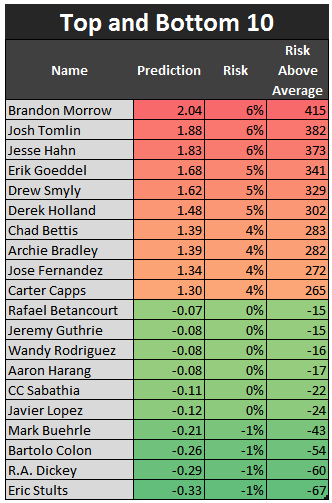
Click Here for Interactive Tableau and Full Results
The results include three terms that help define where the players fit:
- Prediction: My method of regressing the variables against pending TJS events resulted in a scale of 0 to 7, where 7 is the season before a player undergoes TJS. So our top player above, Brandon Morrow, ranks a 2.04 out of 7.00, meaning he is nowhere near a player about to absolutely have a shredded UCL. But it is certainly above average.
- Risk: This is the player’s prediction, divided by the highest possible result, 7. Then, I then multiply the result by the degree of confidence I have in the model, which is the R^2 of .22. R^2 is the statistical tool for checking how much the model explains the variation in the data. It is unconventional to multiply the regression result against the R^2, but I wanted to firmly assert that this model can only explain — at most — 22% of the variation we find in the TJS population. I have additionally listed the results as whole numbers in an effort to limit the perception of precision that a decimal place conveys.
- Risk+: This is merely a representation of how far above average or below average the player’s risk is. Here, 0% indicates a league-average risk; 100% is 2x the league average; 200% is 3x, and so on.
The Raw Numbers section includes the specific variables involved (explained in further detail in the “The Inputs” section). The Indexed Section includes the same data, but indexed (unless it is binary). That means the average is 100, twice the average is 200, and so on. This is the same as wRC+ or OPS+ or even Risk+, minus the % sign and with league average at 100 instead of 0%.
The Inputs
Over the preceding months, I have tested, prodded, and massaged many numbers. These were the factors that ultimately proved to have the strongest, most consistent relationships with impending TJS:
- LHP = 1: MLB pitching staffs have been 28% left-handed since 2010. TJS victims are 25% left-handed. Throwing the ball with your right hand — unlike Tommy John, the original — is the first tiny red flag.
- St. Dev. of Release Point: Previous studies (such as here and here) have attempted to connect release point variations with injuries. In the various models I created, release point had a consistent, while small, predictive power. I did not control for whether or not the pitcher appeared to have a deliberate difference in release points (as in, guys who pitch from multiple arm slots), but the infrequency of that trait does not seem to impact the variable.
- Days Lost to Arm/Shoulder Injury in 2015: After many different permutations of what constitutes “an injury” or an “arm,” I landed on this unusual definition of an arm/shoulder: It’s everything from the wrist back, including the elbow, shoulder, and — why not — the collarbone. So it’s basically the principle upper-body actors of the throwing motion. No fingers, no legs. So if a player injured this arm/shoulder/collarbone area, the sum of their missed days has a decently-sized red flag planted on it. This is among the most important predictive factors for TJS — which makes intuitive sense. Previous injuries could be a forewarning of a bigger injury, or it could be a contributing factor in creating an UCL injury as pitchers compensate for a tweak or a partially-recovered injury.
- Previous TJS?: This is a count of how many times the pitcher has gone under the knife. While only a small percentage of pitchers have Tommy John Surgery in their career, it strongly predicts a second surgery. Since 2010, there have been 10,000+ pitchers in the majors and minors combined. In that time, about 560 pitchers in the minors and majors have had TJS, and 57 were repeats. So the ratio of MLB and MiLB players to TJS victims is about 5%, but the repeat rate is over 10%. In other words, TJS begets more TJS.
- Hard Pitches: This variable is the sum of four-seam fastballs (FA), two-seam fastballs (FT), and sinking fastballs (SI) as categorized by the default (MLBAM) PITCHf/x algorithm. Various attempts to include different pitch types and pitch counts all proved inferior to just a raw count of the hardest three pitches that the PITCHf/x database records.
- ERA-: This is a park-, league-, and era-adjusted ERA, as reported by FanGraphs. This is the most puzzling part of the model, and the part I am least comfortable about, but a good ERA- (below 100) correlated weakly but negatively with good health. Possible bad data aside, the only theory I can muster to explain this is the idea that pitchers in the middle of good years are more likely to pitch on short rest or make emergency relief appearances in extra-inning games or key late-season games. The elite closer is more likely to pitch the three-consecutive-days marathon than the struggling middle reliever.
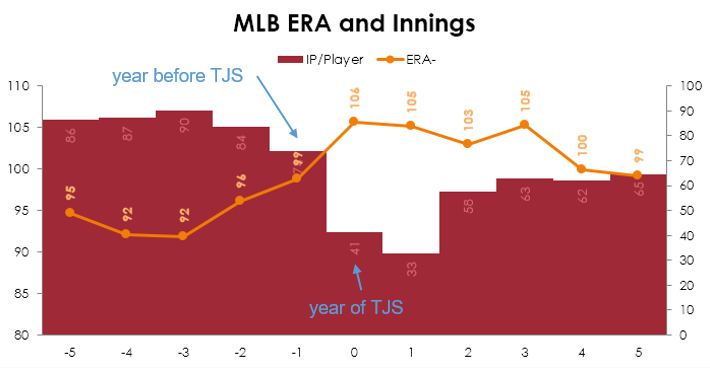
- Age: Here is another iffy variable. Why do older guys without a previous TJS have fewer Tommy John Surgeries? Well, for one, there are fewer older pitchers than younger pitchers, but even after we control for that, we see fewer 38-year-olds going under the knife. The reason is probably that fewer late-career guys see a major UCL tear as worth trying to overcome, and instead call it a career. Few can forget the end of Ramon Ortiz‘s 2013 season, when the then-Blue Jays starter suffered what appeared to be an UCL injury and left the field in tears. Many assumed the 40-year-old righty would end his career then, but Ortiz was fortunate enough to avoid a UCL tear and managed to pitch in Mexico as recently as 2015. Had the 2014 injury been an UCL tear, Ortiz may have just ended his career then. There is also some survivor bias in here. Guys with truly durable UCLs are more likely to make it to their age-35 seasons (and beyond).
Here is a breakdown of the variable and coefficients involved:
| Coefficients | Standard Error | P-value | |
|---|---|---|---|
| Intercept | 1.6319 | 0.27 | 0.00 |
| Average of LHP? | -0.1847 | 0.07 | 0.01 |
| Avg Arm Slot STDDEV | 1.6667 | 0.54 | 0.00 |
| Arm/Shoulder? | 0.0110 | 0.00 | 0.00 |
| Previous TJS? | 0.2981 | 0.07 | 0.00 |
| Hard Pitches | 0.0001 | 0.00 | 0.15 |
| ERA- | -0.0020 | 0.00 | 0.04 |
| Age | -0.0524 | 0.01 | 0.00 |
It is important to remember that the coefficients here do not visibly represent the strength of each variable because they each use a different scales. For instance, the largest Previous TJS is 2, but the largest Hard Pitches number is 2,488. (That said, Previous TJS is a much more predictive variable.)
P-values, in short, are the probabilities that the given variable is actually meaningless. Traditionalist might bristle at some of the P-values involved there. I personally find the customary cut-off P-values of .10, .05, or .01 artificial and unnecessarily limiting. Others are welcome to disagree.
Why is Player X So High/Low?
So your favorite pitcher is Brandon Morrow, and you’re distressed to see him top the charts here. Let’s look at why:
- In 2015, Morrow missed 155 days after having debris removed from his shoulder. That’s 22x the league average among pitchers that completed at least 30 innings. No other pitcher on this list missed more days. (The average time missed was a little under 7 days.)
- And despite missing most of the year, he still managed to throw a large amount of fastballs because, as Brooks Baseball puts it, he “relied primarily on his Fourseam Fastball (95mph) and Slider (88mph)…” Morrow threw his fastball almost 60% of the time in 2015.
- Lastly, he is just barely on the wrong side of the average age of this group. While the age variable is still an odd one, it is important to keep in mind that TJS culls the herd in the early years. If Morrow were 36 and coming off an injured season of this magnitude, he would still probably be the most likely TJS candidate, but he’d get a few bonus points for proving his UCL could have lasted this long in the first place.
I am pleased to see the likes of R.A. Dickey, Mark Buehrle, and Bartolo Colon at the bottom of the list. They are older pitchers with incredibly steady release points and no recent injury history (Dickey, of course, doesn’t have a UCL in the first place, though obviously the statistical algorithm in question doesn’t take such factors into consideration. We left his name in the results regardless of that fact, for those wondering why, as a means of illustrating the type of pitcher likely to rank low on the list). Of course, these guys, at their age, are perhaps even more likely to be ineffective and retire mid-season than they are to suffer a catastrophic injury, but that is neither here nor there.
Free agent Tim Lincecum also makes the list, and in a very positive way with a risk that is 51% below the league average. While any GM or fantasy owner looking into a Lincecum 2016 season will no doubt be aware of his injury history, it is a great sign for the two-time Cy Young winner hoping to move forward in his likely-post-Giants career. The strongest contributing factors to Lincecum’s risk, however, are his inconsistent release point and the fact he makes a living off mixing up four generally slower pitches. While he has not shown great effectiveness in the past four seasons, avoiding TJS could buy him enough time to find a rhythm with his greatly decreased velocity.
Young Marlins ace Jose Fernandez only missed 35 days due to a biceps issue — if we don’t count the 97 days he missed recovering from TJS in 2015 — but that previous elbow operation combined with his young age suggests he is at greater risk of a second TJS heading into 2016. Again, we need a caveat here to remind us that age, while a predictor of TJS, may not be a good predictor of UCL tears.
Mark Buehrle, Bartolo Colon, and Eric Stults all have negative risk rates. Does that mean they are growing additional ulnar collateral ligaments? Yes. Almost certainly.
Rejected Variables
There are a few variables not included that might seem intuitive or necessary to include, but ultimately did not make the cut:
- Velocities: Early versions of this model included pitch velocities, but it became apparent after later revisions that pitch velocities — at least given the present variables — was serving as a poor proxy for the number of hard pitches thrown. It follows that guys with fast fastballs throw those fastballs frequently. Take, for instance, freshly Rockie’d reliever Jake McGee, who has a scintillating fastball and rumors of maybe another pitch. Throwing hard may not actually lead to elbow injuries, but throwing a LOT of hard pitches might.
- Other Pitch Frequencies: Throwing breaking stuff did not seem to have a meaningful relationship with TJS events — at least above and beyond the relationship with hard pitch totals. That does not mean sliders might not result in shoulder injuries or knuckleballers don’t have more fingernail issues, but in the given sample, with the given scope of our investigation, breaking and off-speed pitches did not create meaningful relationships.
- Altitude of Home Park: Despite the considerable effort it took to match up each player’s home park with their park’s altitude, this attribute appears to have no effect on TJS. One might suspect that environmental issues impact the prevalence of certain injuries, but we can cross off altitude for now.
- Non-Arm Injuries: I figured leg injuries — given how important legs are in delivering a pitch — or general injuries might have a connection to TJS if in no other way than causing inconsistency in the pitcher’s delivery or release. But once we add in the arm/shoulder injury days into the calculation — along with previous TJ operations — the value of other injuries goes away.
- Injuries in Previous Seasons: Despite connecting players up with five years of injury history, the unstable relationships (i.e. high P-values) also came with negative coefficient — suggesting an injury in 2013 makes you stronger against a possible UCL injury in 2015. That makes no sense.
Room for Improvement
Without comprehensive dumps from the PITCHf/x data at Brooks Baseball or the Baseballic.com injury database, and without good information on late-career UCL injuries that result in retirement instead of TJS, and without medical records from these players themselves, we will always be playing catch-up with our prediction models. If I am a team considering one of the players listed above, I would defer to medical and pitching experts opinions following a thorough medical examination.
But from our perspective, from the data available in the public sphere, these are the best, strongest tiny red flags I could find. And I hope and expect they will push this field forward. If you’d like to discuss my Tommy John research further, check back at MLBTR at 7:30pm central time, as I’ll be doing a live chat.
A special thanks to Jon Proulx who helped do some very boring data work with me!
MLBTR Mailbag: QOs, Snell, A’s, Pirates, Simmons, Jackson
Spring Training is here, but with a few high-profile players still available via free agency and rosters far from settled, the stove is still hot here at MLBTR. Here’s today’s mailbag.
Why hasn’t anyone organized a sign and trade for one of the qualifying offer players? The original team could sign them and trade them for a prospect, saving the acquiring team a draft pick and the former team a prospect. I know they can’t be traded without the player’s consent, but the player would obviously have negotiated the contract with the new team. Or even a team like the Braves signing a QO player (forfeiting their second-rounder) and getting a prospect back. — James M.
It’s too blatantly a means of circumventing the qualifying offer process as stipulated within the Collective Bargaining Agreement. I realize that it’s possible that the Mets will end up trading Alejandro De Aza this spring, but it’s pretty clear to see that New York didn’t think it had a real chance of re-signing Cespedes when De Aza was signed. That they were able to land him a month later after Cespedes’ market didn’t develop the way that his camp hoped, De Aza was relegated to a fifth outfielder, more or less. That’s sub-optimal for team and player, and I think the Commissioner’s Office would be able to see that in approving the trade. Something like the Braves signing Ian Desmond and trading him 24 hours later wouldn’t get that benefit of the doubt.
What are the thoughts on the Blake Snell extension rumors? He hasn’t even made an MLB start. — Zachary H.
The Rays have every incentive to lock Snell up as early as possible if they believe that he’s on a path to becoming a mid-rotation starter or better. Snell is one of the game’s 20 or so best prospects, and by going year to year through the arbitration process with the Rays, he could earn something in the vicinity of $20-25MM over the life of the six years (well, seven, realistically, as the Rays will almost assuredly keep him in the minors for three weeks at the beginning of the season to extend control by one year, barring an extension) that he’s guaranteed to be with the team. There’s huge financial incentive to take a slight risk — previous contracts of this ilk have cost $10-15MM total — in order to lock in most or all of a player’s arbitration years well in advance in exchange for discounted club options on his free-agent seasons. Not only does it potentially give them an above-average starter at a fraction of his market cost (assuming the options come with a relatively modest salary), it gives Tampa Bay a huge trade chip down the line if the team sees fit. If the Rays are confident in their projections of Snell, there’s little reason not to try for some kind of long-term deal. Realistically, this probably goes on with top prospects quite a bit more than we hear about.
From Snell’s perspective, it’s a huge risk; if he has any degree of success, that type of contract will be among the most team-friendly in the game. On the other hand, if he has an injury (as lefty Cory Luebke did when he twice had Tommy John surgery after signing a four-year, $12MM deal after one full season in the Majors) or simply struggles in his initial Major League trials (a la Jon Singleton, who also signed long-term prior to his MLB debut), then he comes out quite a bit ahead of where he’d have otherwise been. It’s always a balance of the human factors that drive the player to seek his first fortune and the business reasons for betting on himself.
Now that the A’s have their #4 power hitter in Khris Davis, will they finally be viewed as legit team that can make the playoffs? — Ross K.
With all due respect to Davis and the A’s, adding another 25- to 30-homer bat doesn’t really change a huge amount for me in terms of their projections. I’m still concerned with Oakland’s patchwork options at the infield corners and Billy Butler at DH. And, in the rotation, there’s virtually no certainty beyond Sonny Gray. I’m a fan of Jesse Hahn‘s ability, but he’s shown clear durability issues, and beyond him the A’s will rely on Kendall Graveman, Chris Bassitt, Rich Hill, Aaron Brooks and still-injured starters Jarrod Parker and Henderson Alvarez to round out the rotation. Sean Manaea could eventually help in 2016, but they have a lot that needs to go right. I think the AL is deep enough and talented enough (Oakland included) that any of the 15 teams could be a playoff team if you squint, but adding Davis — a left-field only bat with a shaky glove that’s being asked to cover a huge, expansive space — doesn’t put them over the top in any sort of way for me.
Were the Pirates right to keep closer Mark Melancon, or should they have dealt him to save money and to fill a starting pitching need? — Nick C.
If Pittsburgh could’ve flipped Melancon for a starting pitcher as they did with the comparably priced Neil Walker, that would have been my preferred route. That said, there’s no direct evidence such a possibility was available to the Pirates, and it’s hard to know what Melancon’s market might have been. Two other top closers in Craig Kimbrel and Ken Giles returned impressive trade packages this winter, but Melancon’s market might have been complicated somewhat by the presence of Kimbrel, Giles, Aroldis Chapman and others potentially available. And as MLBTR’s Charlie Wilmoth has noted elsewhere, the current mini-trend of building super-bullpens (as Boston has done with Kimbrel, Koji Uehara, Junichi Tazawa and Carson Smith and the the Yankees have done with Chapman, Andrew Miller and Dellin Betances) seems based in large part on acquiring pitchers who rack up strikeouts. That’s not Melancon — as great as he was last season, his strikeout rate fell to 7.3 K/9, and his average fastball velocity dipped as well, although he remained excellent at inducing ground balls and limiting walks. I’m sure there are 29 other teams that would love to have Melancon in their bullpen, but it’s unclear how many might have been willing to pay the kind of price the Pirates would have wanted.
Are we undervaluing the addition of Andrelton Simmons for the Angels? It’s a major acquisition that seemingly flew under the radar because the majority of the value is tied to defense. He’s likely a three- to four-win improvement at shortstop with the glove alone. Isn’t it difficult to quantify how much his defense really helps the team? — Jacob S.
I don’t think anyone undervalued the improvement that came with adding Simmons at the time of the deal. The buzz surrounding him has somewhat cooled now, though, due to the Angels’ still-glaring question marks at second base and in left field. Had the Halos added another legitimate infielder or added a left field bat following the acquisition of Simmons, there’d probably be quite a bit more hype surrounding the additions made by Billy Eppler and his staff this offseason. I don’t know that I agree with Simmons being a four-win improvement over Erick Aybar, but I do feel that he’s a notable upgrade, and even though they parted with Sean Newcomb to get him, the trade has significant long-term value for the Angels. All that said, the reason it’s drawing less attention now is that the Angels kicked their winter off with a bang but followed with virtually no moves of consequence. Right or wrong, that’s going to cause the move to be overshadowed.
To me the Reds make a good fit for Austin Jackson. Would a one-year deal in the range of $5MM plus an option do it? Jackson would give the Reds depth, flexibility, decent leadoff insurance, and with a good season, a trade target for a prospect. Your thoughts? — Brian F.
I don’t know that Jackson is signing for as little as $5MM — Juan Uribe just got about that much despite being eight years older — and adding the option wouldn’t be something that Jackson or agent Scott Boras would want if they do settle on a one-year deal. If it’s a one-year deal, it’ll be one signed with an eye toward retrying on next year’s weak market.
As for the Reds’ end of the equation, while there’s sense to it, they haven’t really shown the desire to add veterans on big league deals, especially not ones that will potentially take time away from younger players. The Reds still need to get Billy Hamilton regular playing time with the hope that he can develop some semblance of OBP skills, and they want to get long looks at players like Adam Duvall, Scott Schebler and, eventually, Jesse Winker. The presence of Jay Bruce will stand in the way of those players getting at-bats somewhat as it is, and adding Jackson to the mix will only add another roadblock. On paper, I agree that there’s some sense to your scenario for the Reds, but it doesn’t seem realistic in the end.
MLBTR Originals
A look back at the original reporting and analysis found on MLBTR the last seven days:
- All-Star Giants second baseman Joe Panik joined host Jeff Todd on this week’s edition of the MLBTR podcast. Panik discussed his offseason rehab from a back injury, the development of his power at the plate, and how his background as a finance major impacts how he follows contractual matters in baseball. He also shared fond memories of his time with retired teammates Jeremy Affeldt and Tim Hudson as well as a story of an influential conversation with teammate Hunter Pence early in his career. A new episode of the podcast is released every Thursday and can be accessed on iTunes, SoundCloud, and Stitcher.
- We’re now more than halfway through the month of February and David Freese finds himself still on the open market. Recently, MLBTR’s Steve Adams surveyed the market for the third baseman to try and find a fit. Freese has been a league-average or better bat throughout his career according to both OPS+ and wRC+, and he’s coming off a pair of seasons in Anaheim where he batted a combined .258/.322/.401 (106 OPS+, 108 wRC+). At the same time, there are reasons not to be so gung-ho about the veteran and many of the clubs with clear third base issues have taken care of that position already.
- In Tuesday’s chat, Steve fielded questions on the White Sox, Juan Uribe, the Khris Davis trade, and how to make the ideal mac and cheese.
- In the latest edition of the MLBTR Mailbag, Steve answered questions on the Cardinals, Braves, and the Orioles’ farm system.
- If you’re not already, you should be following MLB Trade Rumors on Instagram.
Nationals To Sign Juan Gutierrez
The Nationals will sign right-hander Juan Gutierrez to a minor league deal, according to MLBTR’s Steve Adams (on Twitter). The deal does not include an invite to Washington’s big league camp.
Gutierrez appeared in 114 games for the Royals, Angels and Giants over the 2013-14 seasons, posting a 4.08 ERA, 6.7 K/9 and 2.47 K/BB rate over 119 relief innings. The 32-year-old was non-tendered by San Francisco following the 2014 season and re-signed with the team on a minor league deal, though he exercised a June 1 opt-out clause in his contract since he wasn’t on the Giants’ Major League roster. Gutierrez signed on with the Phillies and Nationals on minor league deals as well in 2015 but never cracked the bigs, ending up with a 3.98 ERA over 61 innings at the Triple-A level.
Free Agent Spending Trends: Pitching vs. Hitting
With the bulk of this offseason’s free-agent spending complete, I thought it might be interesting to look back at some spending trends over the last several free-agent periods. There was a big jump in overall spending in 2013-14, and the market has continued to grow since. While the total spend decreased last year, AAV continued to rise, and we’re headed for new records in both total outlay and dollars per year this winter.
One interesting aspect of the 2015-16 market, of course, has been the general success experienced by pitchers. While several notable bats have come in under expectations, pitching flew off the shelves and still seems in demand. True, Yovani Gallardo has yet to sign, but reports suggest he could still be in line for over $40MM. It’s not clear the same can be said for fellow qualifying-offer-bound hitters Ian Desmond and Dexter Fowler, each of whom came into the winter with greater anticipated earning power than Gallardo.
So, how have spending patterns shifted over the past three years? Let’s go to the data. (For what it’s worth, I tried to break things down further, but was ultimately uncomfortable with the lines I would’ve been forced to draw between, say, relievers and starters or infielders and outfielders.)
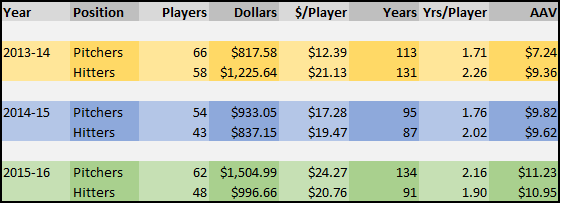
(Image link for mobile app users..)
Clearly, there’s a shift in results. Let’s take a look at a few of the key figures across the three-year period, in graph form. To begin, we have witnessed a major swing in the total outlay made to pitchers as opposed to hitters:
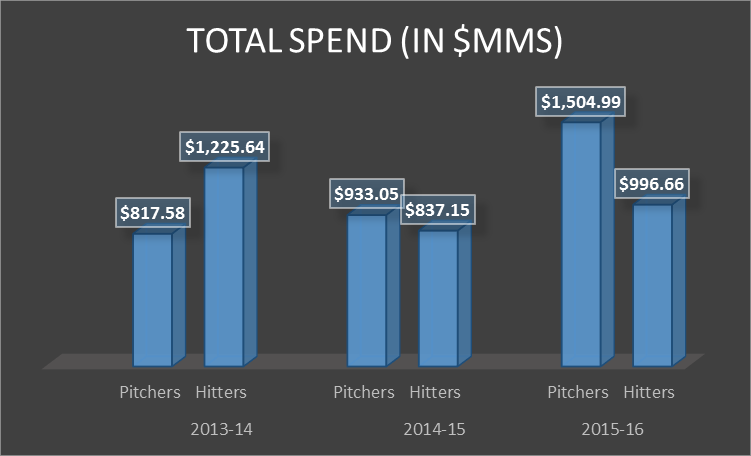
(Image link.)
Free-agent pitchers have posted some notable gains by other measures, too. Consider the average length of contract:
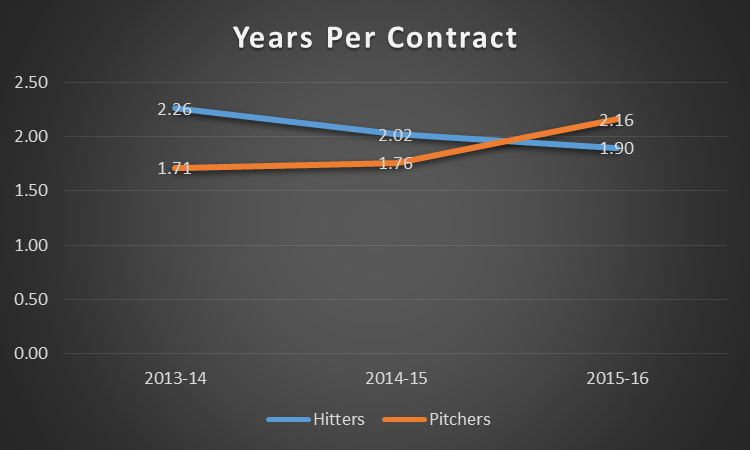
(Image link.)
There’s also been a bump in AAV that closed down a gap that existed at the start of the period in question:
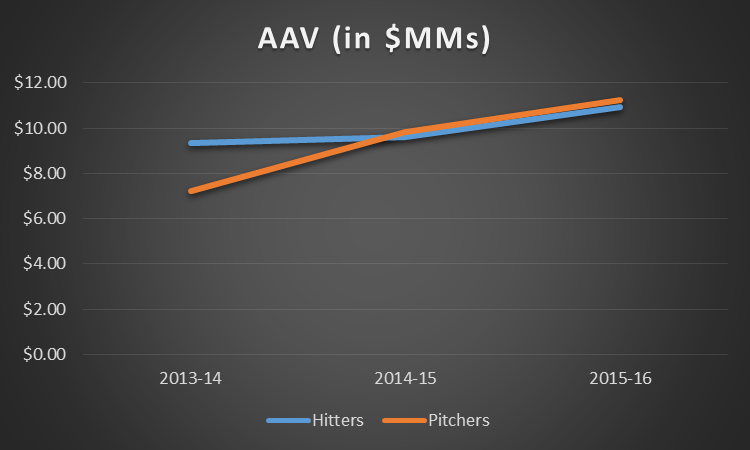
(Image link.)
It’s possible that this is simply a straightforward reflection of the quality of the players available. Let’s have a look at the pitchers who were able to command $30MM+ overall commitments (that includes posting fees, where applicable):
2013-14
Masahiro Tanaka ($175MM), Ubaldo Jimenez ($50MM), Matt Garza ($50MM), Ricky Nolasco ($49MM), Jason Vargas ($32MM), Scott Feldman ($30MM)
2014-15
Max Scherzer ($210MM), Jon Lester ($155MM), James Shields ($75MM), Ervin Santana ($55MM), Brandon McCarthy ($48MM), David Robertson ($46MM), Francisco Liriano ($39MM), Andrew Miller ($36MM)
2015-16
David Price ($217MM), Zack Greinke ($206.5MM), Johnny Cueto ($130MM), Jordan Zimmermann ($110MM), Jeff Samardzija ($90MM), Mike Leake ($80MM), Wei-Yin Chen ($80MM), Ian Kennedy ($70MM), Scott Kazmir ($48MM), Kenta Maeda ($45MM), J.A. Happ ($36MM), John Lackey ($32MM), Darren O’Day ($31MM)
And here’s what that looks like in table form, to get a visual sense of the impact this volume and quality of players may have had on driving salary.
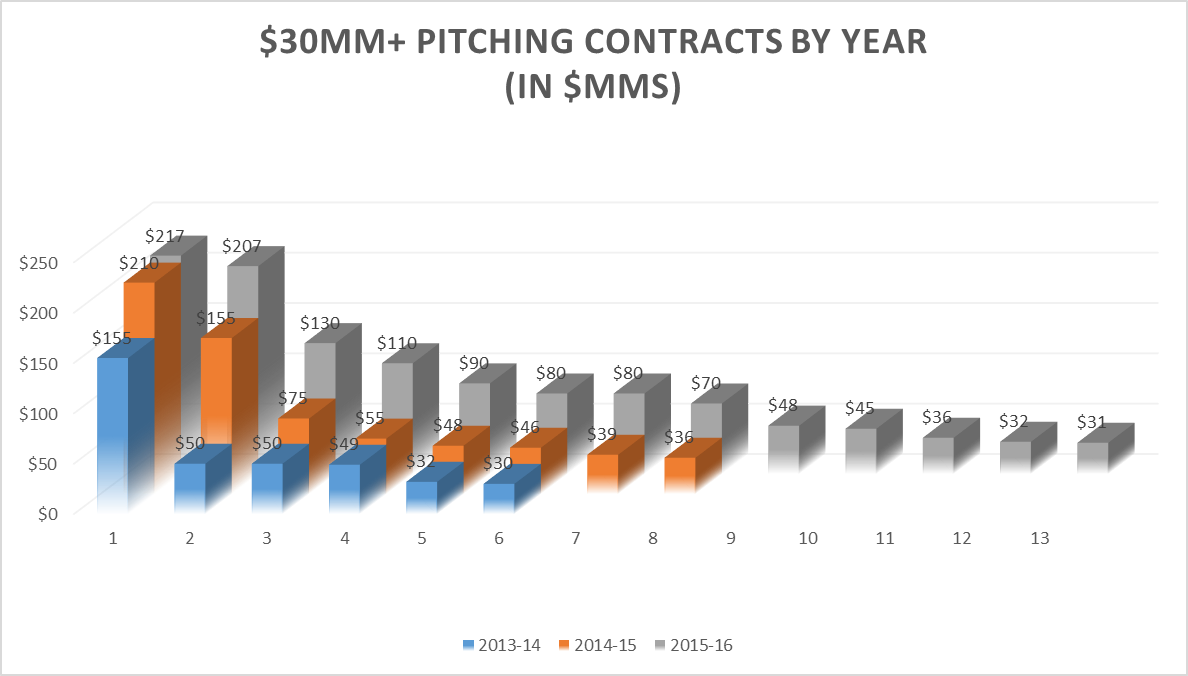
(Image link.)
It’s possible that some of the inclination toward pitching is the result of an imbalance between the volume and quality of hitting versus pitching prospects entering the game right now. Fangraphs’ Jeff Zimmerman wrote a couple of years ago about the shifting aging curve for batters, and that could play a role in the trend as well. Alternatively, the increased demand for arms could be attributable to the very thing (enhanced injury risk) that makes them such a risky investment in the first place.
MLBTR Mailbag: Cardinals, Braves, Uribe, Morneau, Orioles, MASN
It’s been a quiet day on the rumor mill, but thankfully we’ve got some interesting questions to get to in today’s MLBTR Mailbag!
After the loss of John Lackey and Jason Heyward, the Cardinals’ 2 best players in 2015, adding Mike Leake was our only upgrade. We have very little power or speed. With the improvements of the other teams in the NL do you think the Cardinals will make the playoffs?
I’d have liked to see the Cardinals do more with their rotation, as losing Lance Lynn for the season was a significant blow, and Jaime Garcia‘s arm is a perennial question mark. Carlos Martinez and Michael Wacha have both had injury issues in the past as well. All that said, though, to call Leake the team’s only upgrade feels incorrect. The Cardinals added an intriguing bullpen arm in Seung-hwan Oh and improved their catching depth with Brayan Pena as well. Beyond that, there’s enormous room for internal growth; the Cardinals will have full seasons of Stephen Piscotty and Randal Grichuk in 2016, and they’ll also see the return of Adam Wainwright (who scarcely pitched in 2015 due to an Achilles injury) and Jordan Walden to fortify the pitching staff. There’s also a chance that Brandon Moss, now further removed from the microfracture hip surgery he had following the 2014 season, will return to his more productive ways from 2012-14.
The Cardinals had baseball’s second-best run differential in a season without Wainwright last year, and while it’s fair to expect some regression in Grichuk and Piscotty, it’s a huge overreaction to imply that they’re any sort of long shot to make the playoffs. If anything, losses in the Pittsburgh rotation and the continued tear-down of the Brewers and Reds have softened the division. It’s a difficult division with two very good teams joining them at the top (Pittsburgh and Chicago), but the Cardinals should be in the mix for a postseason spot.
The Braves are rumored to have an agreement in place with Kevin Maitan. Do tampering rules count towards international signings? — Mike B.
The concept of tampering generally is invoked with regard to players that are currently under contract with another organization. Maitan isn’t even yet eligible to sign. Generally, though, this sort of thing happens every season with every team. A huge number of the July 2 signings you’ll see have been in place for months, which is why there’s such a landslide of reports on international prospect signings on the day the signing period opens. You can argue that the system needs fixing, and you won’t get a disagreement here, but that situation is no way unique to the Braves.
Two of the best veterans, Juan Uribe and Justin Morneau, are still on the market. These are guys who can either start or provide a productive bat and clubhouse presence off the bench. Why has there been so little news about them and where do you see them landing? — Will M.
There’s been a bit of talk about Uribe recently, as he’s been connected most heavily to the Indians (as a starter at third) but also as a versatile reserve for the Giants and Yankees. Cleveland is the best fit for him, from my vantage point, although there’s a reasonable case to be made that the Astros and Padres could use him just as much as any of those clubs. The Indians seem like the most plausible landing spot for him at this point, just based on the combination of interest and need.
Morneau’s market has been decidedly more quiet, but he still seems like a candidate to land a one-year deal somewhere in Spring Training. It’s possible that at this point, his reps at Relativity are waiting to see if any team incurs a first base/DH injury in Spring Training, as that could open a spot for him. If not, the Astros have the most glaring need at first base of any contending club from where I sit. It’s true that there are some young names on the horizon like A.J. Reed and Tyler White, but Morneau would be a reasonable stopgap to start the season at first base and eventually slide into more of a part-time role. That Evan Gattis recently had core muscle surgery only makes the fit more logical, as any lingering issues from that would prove problematic for Houston.
The Orioles farm system is probably second worst in baseball behind the Angels. In 2014 they forfeited or traded their top 3 picks. How much are they forsaking their long term success if they forfeit 2 top 30 picks for Yovani Gallardo and Dexter Fowler? — Derek R.
Jeff Todd and I actually covered this on the MLBTR Podcast last week. It’s true that the Orioles would be compounding the problem of a largely barren farm system by forfeiting their top two picks in this year’s draft. However, Baltimore’s offseason maneuvering — beginning with Matt Wieters‘ acceptance of the qualifying offer and continuing through re-signing Darren O’Day and Chris Davis, plus adding Hyeon-soo Kim on a fairly high-upside deal — gives a sense that they’re still firmly in “go for it” mode. If the thought is to add Gallardo on a three-year deal and possibly Fowler on a two-year deal (or acquire two years of control over Jay Bruce from Cincinnati), it seems fair to say that they could consider 2016 and 2017 both seasons in that “go for it” window. I think it’s interesting to note that if the Orioles don’t contend in 2016 and struggle again in 2017, their list of trade chips for an accelerated rebuild would be impressive (whether that comes in mid-2017 or following the 2017 season). Manny Machado, Adam Jones and Zach Britton are all controlled through 2018, and any of that trio would, at least at present, seem to represent a player that could fetch a haul were the final year or year-and-a-half of his services placed on the trade market. Baltimore would also be able to potentially listen on the final year of a theoretical Gallardo contract, two years of Jonathan Schoop and as many as three years of Kevin Gausman in that scenario.
All of that, of course, is highly hypothetical, but the point is that the O’s presently have enough high-value, controllable assets that it’s easy to see them successfully pulling off a Braves-esque rebuild in the 2017-18 offseason if things don’t go their way over the next two seasons.
Is the MASN deal ever going to be settled? — Marla A.
This falls within Jeff’s wheelhouse, so I asked him to take a crack at answering your question … and you can blame him for any errors or omissions!
To begin with, those who aren’t familiar with this matter should read about the key decision (to date) right here. As I explained there, the court didn’t actually decide how much the Nats will get from the Mid-Atlantic Sports Network and when they’ll get it; rather, it said that the prior arbitration decision had to be set aside because of a conflict of interest in the Nationals’ choice of representation.
In addition to throwing the matter back open to dispute, that decision also allowed the Orioles (who control MASN) to fight over the forum for a re-hearing and to continue to run the clock on the Nats. That gives Baltimore leverage, as D.C. struggles with stalled and uncertain cash flow.
Now, the ultimate rights fee issue will certainly be settled in some manner, and there’s some hope that will occur sooner rather than later. Commissioner Rob Manfred recently expressed some confidence that there’s an end in sight, saying:“I think in reasonably short order, there will be a resolution of MASN, either by the litigation being done or some other mechanism.”
Of course, let’s remember that we’re talking legal timelines here, and they can be lengthy. It appears that the case is currently sitting in an appellate court, as MASN has appealed the trial court’s decision not to order arbitration before a neutral arbitral forum. If a settlement can’t be worked out at some point, then the case will continue to work its way through the system.
Ultimately, some new arbitration will be initiated, and at that point it should proceed fairly swiftly, with the Nats’ money spigot being turned back on without much delay after a decision is reached. Notice, though, that I say “should”; there’s always the possibility of yet more legal wrangling thereafter, though this particular case is rather unusual in that the underlying arbitration decision was actually thrown out (a relative rarity).
On a relevant — and somewhat ridiculous — note, it’s important to bear in mind that the next rights fee period in the deal (2017-2021) is already fast approaching. Clearly, that needs to be dealt with as well, perhaps with some new initiative to look for a more permanent solution.
Finding A Landing Spot For David Freese
We’re now more than halfway through the month of February, and yet, despite the fact that pitchers and catchers report will begin to report this week, there are a surprising number of starting-caliber players available on the free-agent market. While that can, in some ways, be attributed to what was a very deep crop in terms of outfielders and starting pitchers, that was never true of third base. And yet, David Freese finds himself lingering on the open market and without a team to which he has recently been tied in any sort of convincing manner. Earlier this winter, Freese reportedly talked to the Angels about a reunion, but the team has since acquired Yunel Escobar to handle third base. The White Sox represented an on-paper fit back in November, but their trade for Todd Frazier eliminated the need for a third baseman.
Freese has been a league-average or better bat throughout his career according to both OPS+ and wRC+, and he’s coming off a pair of seasons in Anaheim where he batted a combined .258/.322/.401 (106 OPS+, 108 wRC+). Overall, he’s a lifetime .276/.344/.417 hitter that has averaged 15 home runs per 162 games played. Durability has, at times, been an issue for Freese, but he’s been the victim of a pair of pretty fluky injuries over the past two seasons, twice fracturing a finger in his hand when he was hit by a pitch. Ultimate Zone Rating pegs him as a roughly average fielder, which is better than what a lot of teams will trot out in 2016. A slightly above-average bat and an average glove aren’t necessarily exciting, but there’s value there.
While those are all reasons to consider Freese, there are also reasons to pass. UZR may be fine with Freese’s glove, but Defensive Runs Saved has him quite a bit below average. He’s also 32 years old and set to turn 33 in late April, so he’s entering a stage of his career at which it wouldn’t be all that surprising to see his bat decline. An average player at a premium position certainly holds value, but his limited ceiling means that there are probably several potential suitors that feel they have an in-house option capable of putting up comparable numbers. Realistically, some of them are going to end up being correct in that assessment.
I’d be surprised to see Freese land more than a one-year commitment at this stage of the winter. That, it would seem, creates the potential for a bargain add for a team in need of some infield help. He’s not someone that will take a fringe team and make them a contender, but he can add a couple of wins to a contending club with a questionable option at third base or potentially develop into a trade chip for a rebuilding team come July. And, on a one-year deal, if things go south, it’s relatively easy to cut ties.
That said, let’s take a look around the league to see where Freese might best fit as Spring Training games approach…
- Indians: Cleveland third basemen batted a collective .228/.273/.356 last season, and the team has moved former third-baseman-of-the-future hopeful Lonnie Chisenhall to the outfield. That leaves the defensively gifted but offensively questionable Giovanny Urshela and Jose Ramirez as the favorites for at-bats at the hot corner. Realistically, either could be considered an upgrade over Freese with the glove, but both players contributed to that dismal batting line I just referenced in 2015, and Ramirez could arguably better serve the Indians by bouncing around the infield in a utility capacity. Money is tight in Cleveland, as is so often the case, but they’re considering a run at Juan Uribe, according to multiple reports, and Freese would fill that same need.
- Angels: They might have one of baseball’s highest payrolls, but money also hinders the chances that Freese will return to the Halos, as owner Arte Moreno seems dead set on not exceeding the luxury tax threshold of $189MM. If the Halos clear some money in some form of Spring Training trade, though, it stands to reason that Freese could return and push Escobar from third base over to second base. Angels second basemen hit .250/.295/.352 last season, and incumbent starter Johnny Giavotella has a limited track record at the plate and poor ratings in the eyes of defensive metrics.
- Astros: Luis Valbuena is a capable enough third baseman with the bat, as he showed in 2015 when he blasted a career-best 25 home runs. Valbuena, though, can handle multiple positions and saw 200+ innings at first base last season. He could slide across the diamond to first base early in the year while A.J. Reed finishes developing (and, perhaps, avoids Super Two status), leaving third base open for Freese, whose right-handed bat would mesh well with the Astros’ short porch in left field. Houston third basemen batted just .223/.298/.412 last season. GM Jeff Luhnow knows Freese well from the pair’s days together in St. Louis.
- Brewers: There’s a case to be made that a rebuilding team needn’t spend money on a veteran free agent, as it behooves the team to free some at-bats for younger players (and losing games only strengthens the team’s draft the following season, anyhow). However, Milwaukee will probably be giving a fairly substantial amount of at-bats to fellow veteran Aaron Hill at third base, and Hill could be relegated to a platoon role with Scooter Gennett, clearing the way for a hitter with much more recent success. Manager Craig Counsell spoke about the importance of adding the veteran Hill and his experience to the Milwaukee clubhouse following that trade, and Freese could do the same while providing a better bet to serve as a summer trade chip.
- Braves: Much in the same way that the Brewers could potentially benefit from Freese, the Braves currently project to have a combination of Adonis Garcia and Kelly Johnson at third base now that Hector Olivera is in the outfield. Atlanta has quite a few options there already, as Gordon Beckham can also man third base if needed, but Freese seems a more reasonable bet to produce like a regular at the hot corner.
- Pirates: Pittsburgh’s starting infield is filled in as it is, but adding Freese could allow them to ease Jung Ho Kang back into action and could also push Kang back to shortstop, where is offense would be an upgrade over that of Jordy Mercer, who could probably fill a utility role more aptly than Pedro Florimon. Financial considerations and an already crowded infield picture make this one perhaps a bit of a stretch, though there’s some logic to the fit.
Clearly, not every team listed is a perfect fit, but none of the six mentioned here has a concrete enough infield setting that Freese couldn’t perhaps serve as an improvement. Some other teams I debated listing that ultimately seemed a bit too much of a reach include the D-backs (Jake Lamb and Brandon Drury both represent possible regulars at the position) and Padres (Yangervis Solarte has been similarly productive from 2014-15). An injury in Spring Training, of course, could create further matches for Freese and other remaining free agents — especially those that are most likely limited to one-year deals.
MLBTR Originals
A look back at the original reporting and analysis found on MLBTR the last seven days:
- On the latest edition of the MLBTR Podcast, host Jeff Todd and MLBTR’s Steve Adams broke down the latest chatter around the Orioles — in particular, the club’s reported interest in qualifying offer-bound free agents Yovani Gallardo and Dexter Fowler. Then, they talk through some of their most and least-liked, under-the-radar moves of the winter thus far. A new episode of the podcast is released every Thursday and can be accessed on iTunes, SoundCloud, and Stitcher.
- John Baker, former Major League catcher for the Marlins, Padres, and Cubs, made his writing debut for MLBTR. John, a veteran of seven big league seasons, was hired by the Cubs in December in the role of baseball operations assistant. In his first piece for MLBTR, Baker wrote about the lead-up to Spring Training.
- We’re in mid-February and there are still three qualifying offer free agents left on the board. Recently, MLBTR’s Mark Polishuk asked readers to predict which of the three QO players will be the last to sign: Ian Desmond, Dexter Fowler, or Yovani Gallardo? More than half of you predicted that Desmond will be the last player to put pen-to-paper.
- In the latest edition of the MLBTR Mailbag, Steve fielded your questions on the Gurriel brothers, the White Sox, the Orioles’ pitching depth, Pedro Alvarez, and much more.
- On Tuesday, Steve hosted a chat for MLBTR readers and touched on topics such as Mat Latos‘ deal, Josh Donaldson‘s new two-year pact, Juan Uribe‘s future, and more.
- In Thursday’s chat, Jeff answered questions regarding J.P. Crawford‘s eventual call-up, the remainder of the Dodgers’ offseason, and scary futuristic robot umpires.