
Carlos Torres Choosing Among Three Teams
11:07am: Torres is deciding between major league and minor league offers, Links tweets, and is looking for the right opportunity in making his decision.
10:29am: Reliever Carlos Torres is “very close” to signing with a new club, MLBTR’s Zach Links reports on Twitter, with the righty set to choose between three organizations. Darren Wolfson of 1500 ESPN recently tweeted that a deal was expected by week’s end.
Torres could theoretically match up with any number of clubs. The Orioles have reached out to his reps at Full Circle Sports Management, Roch Kubatko of MASNsports.com reports. The Twins seem a theoretical match, but are not involved, per Wolfson. We’ve also heard prior chatter that the righty has drawn interest from Asian teams, though it’s not clear whether that’s currently under consideration.
Torres, 33, recently elected free agency after he was outrighted by the Mets. The Full Circle Sports Management client had initially agreed to a $1.05MM salary to avoid arbitration with New York, and the club will remain on the hook for one sixth of that value ($175K) regardless of what Torres ends up earning with a new organization.
Last season was a rough one for Torres in the results department, as he ended with a 4.68 ERA. But a .326 BABIP-against and 65.3% strand rate probably impacted the results. And there were other indicators to suggest that he could still be much the same pitcher he was when he logged a 3.24 earned run mark over the prior two campaigns.
Torres posted a career-best 48.3% groundball rate, continued to exhibit good control (2.8 BB/9), and improved his average fastball velocity to 92.5 mph. He did see a slight drop in strikeouts per nine and swinging strike rate, but remained solid in those departments (7.5 K/9, 9.6% SwStr%). All told advanced metrics saw his 57 2/3 frames in much the same light as they did his work in 2013-14.
In the aggregate, it isn’t hard to see why there is interest in Torres. He ought to have every chance to compete for a job in camp, and promises to bolster the depth of any pen. It’s worth noting, too, that he ran up big innings totals in his first two years in New York (183 1/3 total frames), indicating that he could fill a long-man role if needed.
MLBTR Mailbag: Gurriel, Gallardo, ChiSox, O’s, A’s, Alvarez
Much of free agency is in the books, but there are lots of players left as teams look to round out their rosters — and it seems that more international free agents are added to the mix everyday. In this week’s mailbag, we’ll take a look at some questions on the offseason transactions that still remain to be made:
Having seen your update on the MLBTR website regarding the Gurriel brothers out of Cuba, I wonder what teams fit the bill to pursue their talents over the calendar year. I’m a Phillies fan and wonder if Lourdes would be a good fit for them, despite having Maikel Franco at 3B and Crawford rising to the SS position. Would he fit in their left field plans? — Rob O.
Any club with a need in the infield and some money to spend makes sense when looking at Lourdes Gurriel, from my vantage point. The Phillies definitely fit that bill. As you pointed out, Franco and J.P. Crawford are believed to be the long-term answers at third base and shortstop, but it’d make sense for Philadelphia to at least have interest in adding Lourdes Gurriel as a second base option. Scott Kingery was one of their top picks in this most recent draft and may profile as a second base option down the line, but adding depth and talent at the position doesn’t hurt, and either could potentially be moved to left field in the future, if necessary. Alternatively, if Franco ultimately needs to play first base, that could open a spot at third base.
I do agree that Lourdes makes more sense than his older brother, Yulieski, for the Phillies. Yulieski will be 32 in June, so he’s on the older end of the spectrum for a rebuilding club like Philadelphia. Lourdes won’t be 23 until October, although I think that he’ll probably wait to sign until that point, as well, because turning 23 will make him exempt from international bonus pools.
Since their pick is protected and his market is seemingly coming down, why shouldn’t the Reds consider Yovani Gallardo? He could help the young pitchers and could possibly bring a good return at trade deadline. — Jeff L.
I can see the concept working out in the Reds’ favor, but I wouldn’t advocate them taking that gamble. Cincinnati would have to part with the No. 35 overall selection (the first pick in Comp Balance Round A) in order to sign Gallardo. There’s a scenario that’s not too difficult to envision where he signs for one year, pitches to a mid-3.00s ERA for three to four months and gets flipped for a prospect that carries more value than whomever the Reds would select at No. 35. Certainly, having traded both Aroldis Chapman and Todd Frazier, Cincinnati would be able to afford the deal.
However, there’s also a scenario where Gallardo’s recent decline continues. If his strikeout and walk rates keep going the wrong direction, or Gallardo gets hurt, the rebuilding Reds could end up sacrificing a valuable draft asset for an extra win or two in what could be a last-place season. That risk is probably too great in the mind of the front office. If anything, rolling the dice on someone like Chad Billingsley, Justin Masterson or any other formerly useful starter that has seen his career slowed by injuries makes more sense for Cincinnati.
Ultimately, it’s tough to see the Reds making any type of notable commitment. The Reds, after all, just lost out on re-signing Bronson Arroyo because their minor league offer didn’t beat the Nationals’ minor league offer: a $2MM base and $6MM worth of incentives. No matter how far Gallardo’s market has fallen, it hasn’t and won’t drop near that level, and even other once-established veterans seeking minor league deals could look for similar upside to the contract Arroyo landed in D.C.
Are the White Sox still making acquisitions this offseason? If so, who are they targeting? If not, how do you forecast Avisail Garcia and Adam LaRoche for 2016? Are Sox waiting for trade deadline to see if they are in contention to make a further move? — Matt B.
Since the New Year, they’ve been connected to Alex Gordon, Yoenis Cespedes, Dexter Fowler, Andre Ethier and Yasiel Puig, among others. There’s no real indication that the White Sox are done seeking a final upgrade after adding Todd Frazier and Brett Lawrie in trades this offseason. Fowler is still the easiest fit, in my mind. He could make the Sox at least two wins better in 2016, and having traded Trayce Thompson, they could stand to add his athleticism to their outfield. Failing that, the Sox do seem like a good landing spot for Austin Jackson, even if he’s not the left-handed bat they’re reportedly seeking. Jackson would be a massive defensive upgrade over either Melky Cabrera or Garcia, and he wouldn’t require draft pick forfeiture. A one-year deal in Chicago would probably have some appeal to Jackson as well, considering the fact that U.S. Cellular Field is a hitter-friendly environment.
What is the best course of action for the Orioles pitching depth? — David D.
With the (presumably) limited financial resources the Orioles have remaining, I actually think their money is better spent on an outfield upgrade. Gallardo is probably the best free agent starter available on the market, but he’s not as much of an upgrade over the internal options in the fifth spot of the Baltimore rotation as Fowler or Jackson would be over Nolan Reimold, Ryan Flaherty and whatever other options the O’s are looking at in right field. Gallardo’s swinging strike rate was the seventh-lowest in the Majors among qualified starters last season, and he’s more of an innings-eating fourth starter than a difference-maker for a lacking rotation. I’d focus on adding the most value possible with the remaining dollars, then add depth options on minor league deals for pitchers with some upside. Mat Latos, Mike Minor, Tim Lincecum and Justin Masterson all come with upside, although each has obvious health concerns, and the Orioles carry a reputation for having a difficult physical to pass.
Are the A’s really done after just replacing Davis with Alonso and beefing up the bullpen? — Issac G.
You’re forgetting about the reacquisition of Jed Lowrie and the one-year signings of Henderson Alvarez and Rich Hill. Still, there’s enough rotation depth there — Sonny Gray, Jesse Hahn, Kendall Graveman, Sean Nolin, Chris Bassitt, Jarrod Parker, Aaron Brooks, Felix Doubront, Hill and Alvarez (plus top prospect Sean Manaea) — that I can see them dealing from their rotation depth in order to add some further outfield depth in their outfield/DH mix.
What’s up with Pedro Alvarez? No AL team would like a 1B/DH? — Luke L.
Any ML team desperate enough for 25-35 HR to sign Alvarez to a 1 year contract and give him a third baseman’s glove? — Frank K.
Alvarez made 24 throwing errors in 873 innings innings at third base the last year he played there (2014). No team is going to give him regular at-bats there, and I doubt you’d find any that consider him much more than an emergency option at the hot corner. Alvarez is the perfect example of teams not valuing home runs and RBIs in the same way they did 10-15 years ago. There seem to be plenty of fans that disagree with the notion that Alvarez’s defensive shortcomings outweigh his power, but the market certainly doesn’t seem to agree. The Pirates didn’t find any takers for Alvarez and his $8.1MM projected salary, and agent Scott Boras has yet to generate huge interest in his client, it would seem.
Alvarez is hurt by the fact that many American League teams have set combinations at first base/DH. At this point, Alvarez might be the type of player who waits for an injury to pop up in Spring Training and sign a one-year deal with a club that loses a first baseman or designated hitter, because looking around the American League, most clubs are pretty set at those positions.
Spring Training Eve
John Baker, former Major League catcher for the Marlins, Padres, and Cubs, makes his MLBTR debut today. John, a veteran of seven big league seasons, was hired by the Cubs in December in the role of baseball operations assistant. You can follow him on Twitter here.
To most of the population, early February is a pretty regular time. Children fall back into the rhythm of school and afternoon activities, the weather warms, and we await the prescient actions of a groundhog. In the baseball world, we sit on the eve of Spring Training, excited for the launch of a new season. Internationally, players are making their final arrangements at home, shipping cars, signing spring training leases and getting ready to say goodbye to their families.
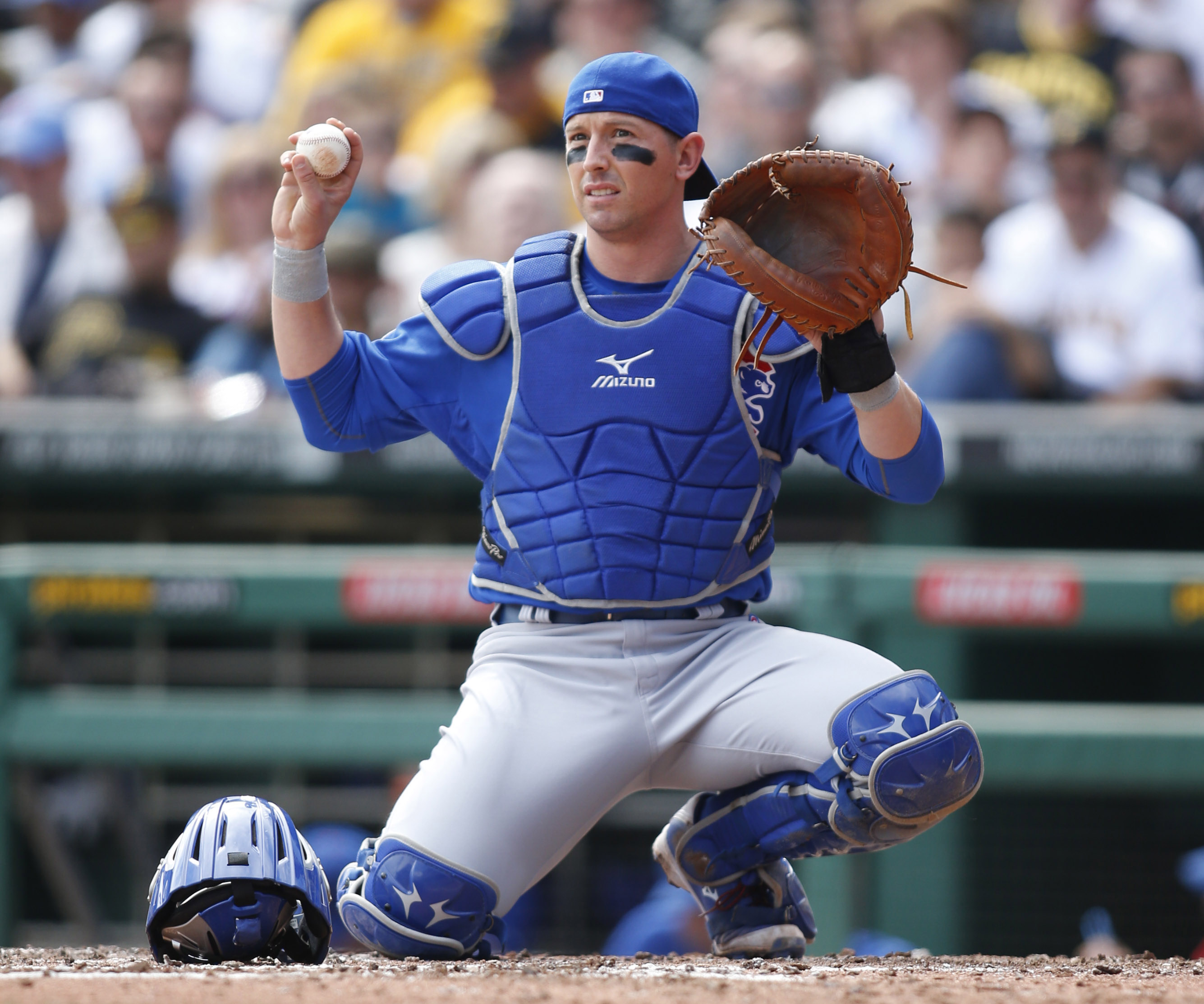
For many players, report day is like Christmas in February. Boxes of equipment are stacked like presents in front of their lockers. New uniforms, pants, and team issue gear are hung neatly like stockings on a mantel. Players sniff their new gloves and take dry hacks with new bats in their underwear. In baseball, grown men are allowed to act like children, and children love holidays. Spring training is also one big family reunion, complete with fascinating characters from all corners of the earth united by the international brotherhood of baseball.
For others, Spring Training can be a source of great anxiety. The entire organization is in one place, watching. Baseball’s full attention turns to two states. Younger players are vying to replace veterans while simultaneously trying to learn from them. Much of the clubhouse is constantly checking MLB Trade Rumors, searching for some clarity about their future. The cliché that baseball is a game of adjustments rings truer in spring training than during any other time. Only a select few players (usually less than 80% of the 25 man roster) truly know where they will be starting the season. Everyone else must adjust. Unless your face is on the cover of the media guide, your certainty about your future is unfounded.
I have experienced spring training from every angle; starting catcher for the Florida Marlins, upstart minor leaguer with the Oakland A’s, backup catcher with the San Diego Padres. I have known I was going to make teams, known I wasn’t, and been completely uncertain. The last two springs of my career were positional competitions battling for one of the last roster spots. I was successful in Chicago, unsuccessful in Seattle. I learned through each new experience and used every obstacle as a chance to test my mental toughness. The game always forced me to adjust.
This year I will be looking at baseball from a new angle. I get to observe and learn from some of the best minds in the game, both on and off the field. I will also be learning about our players, from the bottom to the top of the organization. Instead of sitting behind the plate, I’ll be sitting in meetings. Playing baseball defined much of who I was, and now, how well I’m able to pass on what I’ve learned will determine who I become. Sitting behind a plate is only one item on the long list of things I will miss about being a Major League Baseball player during spring. Mostly I’ll miss the competition, and the drama.
Spring training gently eases us into to the drama and tension of a long baseball season. We have the fear of injury, the uncertainty of pitch count management, the danger of sliding practice gone awry. There is always hope that a heralded prospect finally makes the leap forward that everyone has been expecting. The thrill of seeing a star player in his new uniform is finally realized. The tension builds as games begin and the level of competition gradually increases until opening day, when it all actually counts again.
Organizations are also making their final preparations. Arbitration cases will be settled, last minute roster additions completed, and the focus will turn inward. A tidal wave of optimism is about to hit Sloan Park in sunny Mesa, Arizona. We believe this will be the year we celebrate a world championship in Chicago. The sentiment across baseball is the same. Nearly every team thinks 2016 will be its year. The best part is that now we get to watch it unfold on the field. Finally, it’s time to compete.
Photo courtesy of USA Today Sports Images.
MLBTR Originals
A look back at the original reporting and analysis found on MLBTR the last seven days:
- On the latest edition of the MLBTR Podcast, Steve Adams and host Jeff Todd previewed potential extension talks between players and clubs as we head toward Spring Training. A new episode of the podcast is released every Thursday and can be accessed on iTunes, SoundCloud, and Stitcher.
- Separately, Steve wrote about the last few years of February extensions, noting that Felix Hernandez, Freddie Freeman, Homer Bailey and Ryan Zimmerman all agreed to their current deals in past Februaries.
- Jeff charted free agent spending by team so far this offseason, with the Cubs, Tigers and Giants ranking as the heaviest-spending teams this winter and the Brewers, Reds and Yankees bringing up the rear.
- This afternoon, Mark Polishuk asked which of the remaining qualifying offer free agents (Ian Desmond, Dexter Fowler and Yovani Gallardo) would be last to sign. So far, 52% of MLBTR readers think it will be Desmond.
- In his Tuesday chat, Steve discussed the recent Brewers/Diamondbacks trade as well as the immediate futures of Fowler, Mat Latos and Cliff Lee.
- In Friday’s chat, Jeff answered questions about what the Pirates might do for the rest of the offseason, as well as potential trade fits for James Loney.
- Recently, MLB Trade Rumors launched our official Instagram account: @TradeRumorsMLB. Each day, we’re sharing images about the hottest topics in baseball. We invite you to give us a like, weigh in with your thoughts in the comments, and even pass the link on to a friend. Follow us on Instagram today!
Recent February Extensions
As Jeff Todd and I discussed on yesterday afternoon’s MLBTR Podcast, the month of February typically yields a fair amount of multi-year contracts. The extent of the commitments vary, as some will simply buy out arbitration years while others will others will extend the contracts of emerging stars beyond their arbitration years. Others, yet, have swayed a player from pursuing free agency the following offseason and reflect something closer to open-market value. Regardless of the specific structure, fans can expect to see a handful of extensions this month, if history is any indication.
With a helping hand from MLBTR’s Transaction Tracker and Extension Tracker, here’s a quick look back at the past four years’ worth of February extensions…
2015
- Red Sox, Wade Miley agree to three-year deal worth $19.25MM.
- Royals, Eric Hosmer agree to two-year deal worth $13.9MM.
- Reds, Todd Frazier agree to two-year deal worth $12MM.
- Cardinals, Jon Jay agree to two-year deal worth $10.975MM.
- Marlins, Mike Dunn agree to two-year deal worth $5.8MM.
- Royals, Kelvin Herrera agree to two-year deal worth $4.15MM.
The 2015 wave of extensions were all of the arbitration variety. With the exception of a fourth-year club option on the Miley contract, none of the deals extended club control, instead affording the teams/players cost certainty and the relief of avoiding an extra trip through the arbitration process this winter.
2014
- Braves, Freddie Freeman agree to eight-year deal worth $135MM.
- Reds, Homer Bailey agree to six-year deal worth $105MM.
- Braves, Andrelton Simmons agree to seven-year deal worth $58MM.
- Yankees, Brett Gardner agree to four-year deal worth $52MM.
- Braves, Craig Kimbrel agree to four-year deal worth $42MM.
- Braves, Julio Teheran agree to six-year deal worth $32.4MM.
- Indians, Michael Brantley agree to four-year deal worth $25MM.
- Athletics, Coco Crisp agree to two-year deal worth $22.75MM.
February of 2014 saw the former Braves front office, led by since-fired GM Frank Wren, seek to lock up what was supposed to be the team’s core for years to come. Two years later, then-senior-adviser John Hart is now the president of baseball operations, and the likes of Kimbrel and Simmons have been traded as the Braves stockpile their farm with young pitching.
Meanwhile, the Bailey contract certainly represents a deal on which the Reds would prefer a mulligan. Bailey struggled greatly in 2014 and ultimately underwent Tommy John surgery in 2015. Crisp’s deal has been marred by injuries, while Brantley has taken the step from solid regular into stardom. Gardner dealt with a wrist injury in the second half of last year but has otherwise continued to be a productive player since his deal.
2013
- Mariners, Felix Hernandez agree to seven-year deal worth $175MM.
- D-backs, Aaron Hill agree to three-year deal worth $35MM.
Hernandez’s deal actually contained five years and $135.5MM worth of new money, as he was already controlled for two years and $39.5MM under his previous contract. It was, nevertheless, one of the largest contracts in history for a pitcher at the time. Hill was excellent in 2013, save for about 75 missed games due to a broken hand, but his extension didn’t kick in until 2014. He struggled badly in the first year of his deal and further declined in 2015 before having his salary dumped on the Brewers as part of last week’s five-player trade that sent Jean Segura and Tyler Wagner to Arizona, with Chase Anderson and Isan Diaz going back to Milwaukee alongside Hill.
2012
- Nationals, Ryan Zimmerman agree to six-year deal worth $100MM.
- Dodgers, Clayton Kershaw agree to two-year deal worth $19MM.
- Reds, Sean Marshall agree to three-year deal worth $16.5MM.
- Rangers, Nelson Cruz agree to two-year deal worth $16MM.
- Rangers, Elvis Andrus agree to three-year deal worth $14.4MM.
- Phillies, Kyle Kendrick agree to two-year deal worth $7.5MM.
- Royals, Salvador Perez agree to five-year deal worth $7MM.
- Blue Jays, Casey Janssen agree to two-year deal worth $5.9MM.
- Rockies, Matt Belisle agree to one-year deal worth $4.35MM.
Injuries have impacted Zimmerman’s throwing to the point where he’s had to slide across the diamond to first base, and they’ve also limited him to an average of 78 games over the past two seasons. With four years and $76MM remaining, the Nats very much could use a Zimmerman rebound. The Kershaw deal served to buy out a pair of arbitration years and was followed by a record-setting seven-year, $215MM contract extension. Marshall scarcely pitched over the life of his three-year deal, as shoulder woes have derailed his career (although the contract was in line with the relief market at the time). Andrus’ initial deal looked to be favorable for the Rangers, but the subsequent $120MM extension he received on top of that deal looks regrettable, as his bat never developed, and his defense has regressed as well (per UZR and DRS). Perez’s deal, which includes three club options, has become perhaps the most notoriously club-friendly contract in the league, maxing out at $26.75MM over eight years. There have been repeated reports of possible extension talks with his new representation this offseason.
2015-16 Free Agent Spending By Team To Date
There’s certainly still some work left to be done in the free agent market, so it’s too soon for any grand pronouncements, but the vast majority of the money has probably already been spent. It’s long been clear that this year would include a record overall spend, and that has indeed occurred. (2013-14 had the previous high of just over $2B.) And it seems we’ll likely end up with another new high point in terms of average annual value, though awarding that crown will need to await a final tally.
For now, we’ll focus primarily on spending by team. With Ian Desmond, Dexter Fowler, Yovani Gallardo, David Freese, Austin Jackson, Tyler Clippard, Mat Latos, and Justin Morneau still yet to be taken off of MLBTR’s top fifty free agent board — to say nothing of the many other viable as-yet-unsigned players — there’s definitely more cash to be distributed.
So, the list could well change quite a bit, and that may be something to revisit. But it’s still interesting to take a peak. We did this last year, and the year prior, and some spending patterns have changed. There are obvious reasons for that, of course, which in many cases reflect roster realities and opportunities more than overarching strategies. But the cases of some teams — the Yankees and Mariners, for example — are rather dramatic.
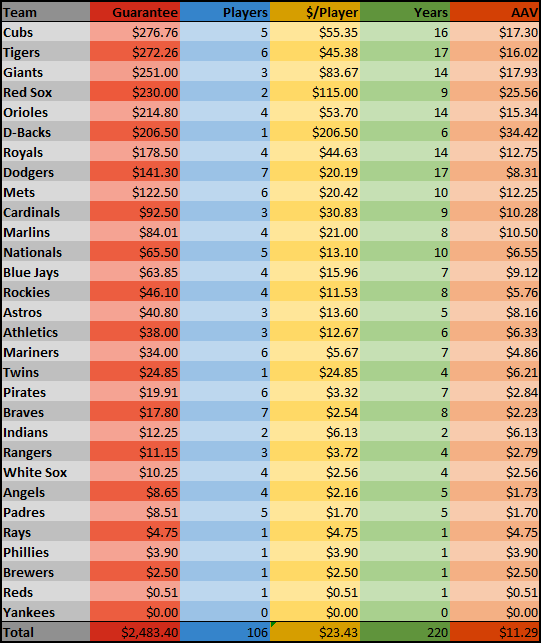
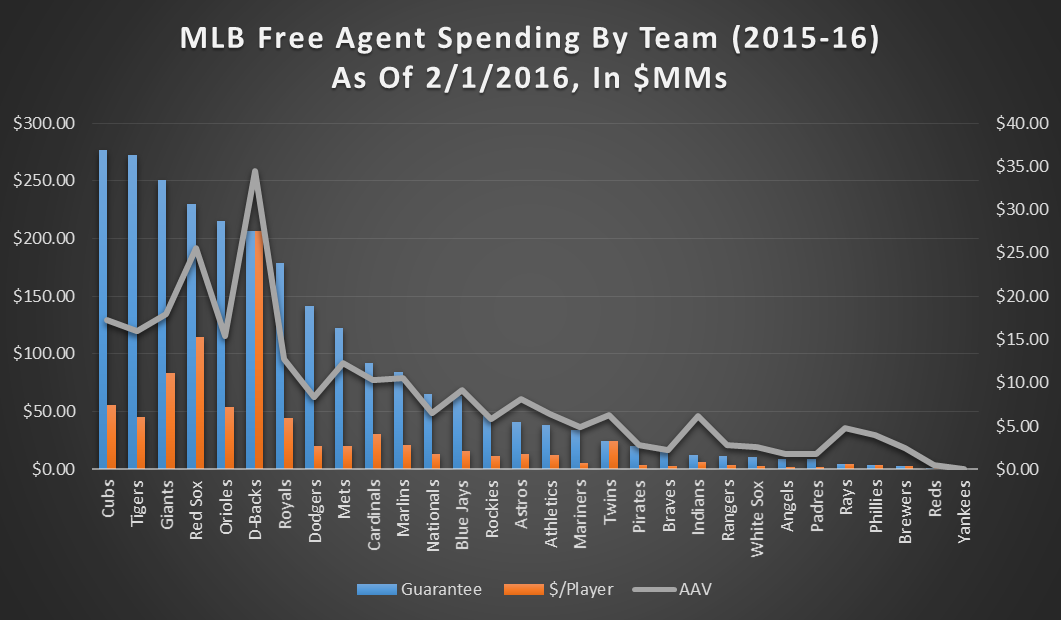
There are several observations apparent from these figures, and others which are buried in the underlying data. The Dodgers, of course, have spread a good bit of money over many players and years. Organizations like the Cubs (Jason Heyward, Ben Zobrist, and John Lackey), Tigers (Justin Upton & Jordan Zimmermann), Giants (Johnny Cueto, Jeff Samardzija, and Denard Span) racked up significant tallies with multiple large contracts. Other clubs’ major splashes are hidden somewhat by multiple, less significant signings, as with the Orioles (Chris Davis), Marlins (Wei-Yin Chen), and Cardinals (Mike Leake). The Rangers and Angels are traditional big spenders, and current contenders, who have been quiet in free agency. And the Diamondbacks’ one big open-market splash — Zack Greinke — remains a sight to behold.
Note that the above figures include the signings and posting fees for Kenta Maeda (Dodgers) and Byung-ho Park (Twins), neither of whom was technically a free agent. The contract between Cuban free agent Yaisel Sierra and the Dodgers is not included, as its precise value remains unreported, though it is said to be in the range of $30MM over six years. (That would, of course, only further drive home that organization’s wide spread of free agent spending.) MLB deals with unreported guarantees are presumptively treated as league-minimum.
Here it is in chart form for visualization:
MLBTR Originals
A look back at the original reporting and analysis found on MLBTR the last seven days:
- On this week’s edition of the MLB Trade Rumors Podcast, host Jeff Todd spoke with Brewers GM David Stearns. Stearns covered an array of topics, including the team’s efforts to acquire controllable talent, the status of veteran catcher Jonathan Lucroy, and what he’s hoping for out of the 2016 season. A new episode of the MLB Trade Rumors Podcast is released every Thursday and can be accessed on iTunes, SoundCloud, and Stitcher.
- This winter, we’ve seen three hitters sign nine-figure contracts. This week, Charlie Wilmoth asked readers to pick the best of the bunch between Jason Heyward‘s (Cubs; $184MM), Chris Davis (Orioles; $161MM), and Justin Upton‘s ($132.75MM; Tigers). Ultimately, MLBTR readers decided that Heyward (~44%) had the most sensible deal of the three, followed by Upton (~39%) and Davis (~17%).
- As we head into February, outfielder Dexter Fowler remains available. Fowler is yet to turn 30, is capable of playing up the middle, and has consistently produced at the plate. Since the start of 2013, Fowler owns a 112 OPS+, and he swatted a career-best 17 long balls last year. Still, the presence of the qualifying offer has clearly hampered his market. Days ago, Jeff asked MLBTR readers to predict where Fowler will land. Click here to check out the results.
- In his chat on Tuesday, MLBTR’s Steve Adams fielded questions on Tim Lincecum, Carlos Gonzalez, and much more.
- In Thursday’s chat, Jeff answered your questions regarding the A’s, Brett Gardner, Austin Jackson, Doug Fister, and more.
- Recently, MLB Trade Rumors launched our official Instagram account: @TradeRumorsMLB. Each day, we’re sharing images about the hottest topics in baseball. We invite you to give us a like, weigh in with your thoughts in the comments, and even pass the link on to a friend. Follow us on Instagram today!
Poll: Best $100MM+ Hitting Contract
Six weeks ago, Jeff Todd asked MLBTR readers which of the four nine-figure contracts given to pitchers this offseason was the best. 37.6% of you said you preferred Jordan Zimmermann‘s deal — the cheapest of the four.
Of course, Jeff couldn’t ask a similar question about contracts for hitters, because the only hitter to agree to a deal over $100MM to that point was Jason Heyward. The hitting market was slow in coming, but now, finally, there have been two other hitters to cross the nine-figure threshold.
Heyward’s deal was the most expensive, at $184MM, although deferrals reduce its present-day value to about $5MM less than that. The deal also contains an opt-out after 2018, and possibly another after 2019 if he stays healthy. He also receives full or limited no-trade protection throughout the contract. Heyward is, of course, highly talented and very young and athletic for a free agent, but in a poll following the announcement of the deal, most MLBTR readers thought the Cubs overpaid.
The Orioles’ Chris Davis received somewhat less than Heyward, at $161MM and with very significant deferrals. He gets a partial no-trade clause but does not receive an opt-out. Davis is over three years older than Heyward and his skill set isn’t nearly as well rounded, which could lead to reasonable questions about how he’ll age over the life of the deal. Davis’ power is, however, second to none.
Justin Upton‘s $132.75MM contract with the Tigers is the most recent of the three. Upton gets an opt-out after 2017, as well as limited no-trade protection. He’s between Heyward and Upton in age. He doesn’t have Heyward’s defensive or baserunning value, and he doesn’t have Davis’ power either, but he’s blossomed into a reliable offensive threat, and his deal is a considerably smaller commitment than Heyward’s, at least.
Davis’ deal might be the riskiest of the three, given his age and issues with strikeouts. But one could argue that there’s more upside in Davis’ deal, too, given that he does not have an opt-out. What you think about the Heyward deal likely depends to some degree on how you weight defense in your assessment of a player’s value (and in your assessment of how he’ll age). Upton’s skill set is perhaps the easiest of the three to grasp — he’s a good, consistent power hitter who gets on base and plays decent defense in an outfield corner. He hasn’t yet blossomed into the MVP-type player he looked like he might be when he was a prospect, although he’s young enough that we might not have seen the best of him yet.
So which of these contracts is the best bet?
MLBTR Originals
Here’s a look at the original reporting and analysis found on MLBTR over the past week:
- Throughout the week, Jeff Todd examined what’s left of the free agent market. On Monday, he looked at remaining starting pitchers, a group headed by Yovani Gallardo and also featuring reclamation-type players like Doug Fister and Mat Latos. On Tuesday, Jeff listed available outfielders. With Yoenis Cespedes off the table, Dexter Fowler leads that group, followed by Austin Jackson and a variety of younger and somewhat interesting bench options. On Wednesday, Jeff reviewed the market for infielders, a group headed by Ian Desmond and Howie Kendrick.
- On this week’s edition of the MLB Trade Rumors Podcast, Steve Adams joined Jeff to discuss where Fowler and Jackson might end up.
- Recently, MLB Trade Rumors launched our official Instagram account: @TradeRumorsMLB. Each day, we’re sharing images about the hottest topics in baseball. We invite you to give us a like, weigh in with your thoughts in the comments, and even pass the link on to a friend. Follow us on Instagram today!
- On Tuesday, Steve chatted about the Justin Upton deal and about potential landing spots for Fister, Jackson and Pedro Alvarez.
- On Thursday, Jeff discussed the Padres’ offseason and the reasons Gallardo remains unsigned.
- Finally, MLBTR compiled the best of the baseball blogosphere in our weekly Baseball Blogs Weigh In list.
The Remaining Market For Infielders
We’ve already checked in on the free agent market for starting pitching and outfielders, and today’s offering also contains some solid names that might’ve gone off the board already in other years. As of January 20th, there’s still a good bit of infield talent left to be found in free agency:
Best Available
- Ian Desmond — Demand for Desmond has always looked iffy, with few big spenders needing shortstops, and his rough 2015 season is certainly cause for hesitation. But, he has quite a lot of upside with a fairly lofty, established MLB ceiling and still has the athleticism required to play anywhere on the diamond.
- Howie Kendrick — He’s not a flashy player and might’ve lost some market steam with some injuries late in 2015, but Kendrick is a dependable, high-quality regular who could still make for a very nice addition.
Potential Major Contributors
- Pedro Alvarez — We all know that Alvarez is a major negative with the glove and has limited on-base abilities, but his power is legitimate, he dominates right-handed pitching, he’s not yet 29, and there’s arguably impact to be had in the right situation.
- David Freese — A respected veteran who has been reliably average in the field and at the plate, Freese’s production has been steady but unspectacular over the years. That dependability is precisely what might make him so interesting to a contender that needs to plug a hole at the hot corner.
- Dae-ho Lee — The Korean slugger is coming off of a big year in Japan’s NPB, but he’ll turn 34 in June and all his potential value is tied up in his bat. There’s no way of knowing how capably he’d adjust to Major League pitching, but his lifetime .901 OPS between the KBO and NPB is intriguing.
- Justin Morneau — He showed enough with a late-2015 run to think he can still deliver a high-OBP bat with just enough pop, and he could make for a nice finishing piece to some rosters.
- Steve Pearce — He’s always handled the glove well at first and even showed he can play some second last year, and even a partial rebound towards his 2014 numbers could make Pearce a great value.
- Jimmy Rollins — A moribund shortstop market is not helping the veteran, who remains a surehanded defender. He could make a good bit of sense as a heavily-used utilityman, particularly for a team with an unproven shortstop.
- Juan Uribe — The 36-year-old just keeps chugging along. He produced at slightly-above-average rates in all facets of the game last year and is valued for his clubhouse presence. Defensive metrics continue to reflect favorably on his glovework at the hot corner as well.
Platoon/Bench/Depth Options
First Basemen
- Ike Davis — Struggled in his latest chance with the A’s but has still yet to turn 29. He bashed 32 homers as recently as 2012.
- Corey Hart — It’s been a long time since he’s been healthy, and his status remains unclear heading into 2016. Prior to multiple knee surgeries, Hart was a consistent 25-30 homer threat.
- Chris Parmelee — It’s never quite translated to the majors, but Parmelee has generally hit well in the upper minors. The former first-round pick isn’t even 28 yet.
- Gaby Sanchez — The 32-year-old’s plans are unclear after a middling season last year in Japan, but he has a history of hitting left-handed pitching well.
Catchers
- Carlos Corporan — If you want a backstop with reasonably extensive, recent MLB experience, Corporan is the safest option in free agency.
- Wilin Rosario — Rosario has never replicated the offense he posted in his rookie year, and defensive questions have led to increased time at first base and in the outfield. There’s been mention of Rosario possibly headed to the KBO, though no Korean team has announced a signing to this point.
Second Basemen
- Dan Uggla — The veteran continued to struggle in his age-35 campaign, though he offers the type of veteran presence that teams love.
- Rickie Weeks — He signed with the Mariners as an outfielder, and that just didn’t work out as Weeks failed to repeat a promising 2014 season.
Third Basemen
- Conor Gillaspie — He’s shown glimpses in the past, isn’t yet 29, and can be controlled for future arb years, but he needs to hit a good bit more since his glove isn’t held in high regard.
- Casey McGehee — It’s hard to put a positive spin on McGehee’s 2015, but he was quite solid the year prior.
Shortstops
- Clint Barmes — While he’s never done much with the stick, Barmes is typically a wizard in the field. But his metrics have dropped off in the last two seasons.
Multi-Position
- Jeff Baker — Things didn’t work out last year in Miami, but Baker should still get a look elsewhere. His career numbers against lefties are impressive.
- Willie Bloomquist — He just didn’t hit enough to stick on the Seattle roster last year, and the 38-year-old didn’t play in the season’s second half.
- Alberto Callaspo — He’s struggled at the plate with the A’s, Braves and Dodgers over the past two seasons, but he’s a switch-hitter with extensive experience at second and third.
- Jonathan Herrera — The 31-year-old has never hit much, but his glove rates well at second, and he can handle shortstop and third base as well.
- Maicer Izturis — Izturis hasn’t played since early 2014 due to serious knee and shoulder injuries.
- Skip Schumaker — His two-year deal with the Reds yielded little in terms of on-field value, but a club could value the 35-year-old’s experience.