
Arbitration Breakdown: Tyson Ross
Over the next few weeks, I will be discussing some of the higher profile upcoming arbitration cases. I will rely partly on my arbitration model developed exclusively for MLB Trade Rumors, but will also break out some interesting comparables and determine where the model might be wrong.
Tyson Ross enters his third year of arbitration eligibility coming off a very strong performance but a weak win-loss record which, while not indicative of his actual talent and performance, still holds weight in the arbitration process. Ross finished below .500 with a 10-12 record, although he had a 3.26 ERA in 196 innings and struck out 212 hitters. The strong performance combined with his poor record have given our model some trouble this year, and I believe that the $4.75MM raise it projects him to get to reach $10MM for 2016 is probably too high. However, I do still think that Ross is due for a large raise.
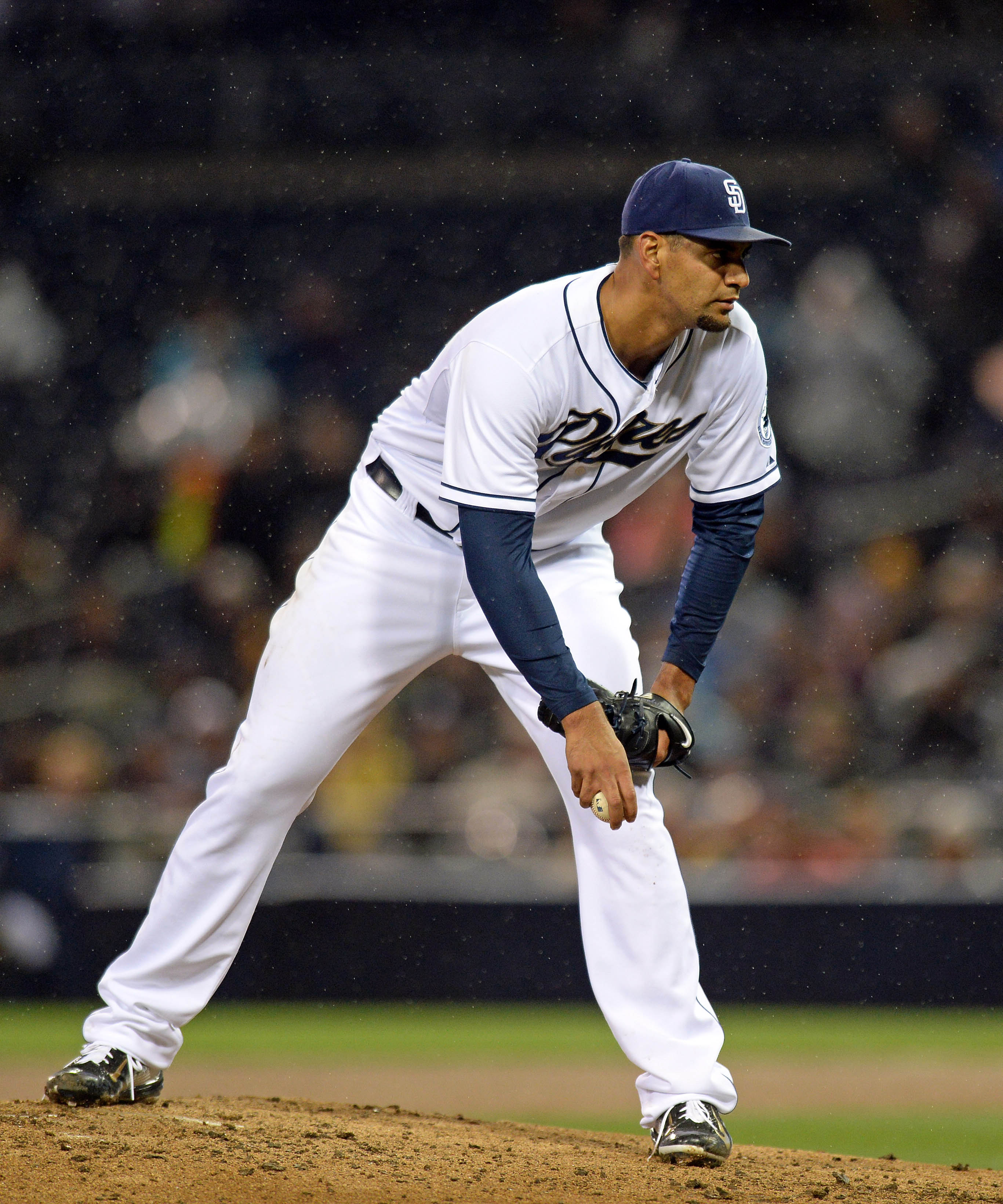
One of the benefits of using a quantitative model to project arbitration salaries is that it enables us to get reasonably accurate estimates for players with atypical numbers. Few pitchers with ERAs as low as Ross have had losing records, and fewer still have been held to only 10 wins. However, the model still had some trouble with Ross this year. So, let’s examine a few pitchers that stand out as reasonable statistical comparables but got raises less than Ross’ projected $4.75MM.
Last year, Jeff Samardzija had a losing record of 7-13 despite a fantastic 2.99 ERA in 219 2/3 innings, ultimately resulting in a $4.46MM raise. Although he had 10 fewer strikeouts overall than Ross and obviously had three fewer victories, his ERA and innings were much better, and I suspect it would be tough to argue that Ross should get a raise $300K larger than the one awarded to Samardzija. If those three victories loom important, it’s conceivable that Ross will in fact hit his projection, but other players suggest more downside is possible.
Two other recent pitchers had exactly 10 wins in their third year of arbitration eligibility and also had about as many innings. In 2012, Matt Garza went 10-10 with a 3.32 ERA 197 strikeouts in 198 innings. He received a $3.55MM raise. Although Ross had two more losses, his case looks similar otherwise. More recently, David Price in 2014 had a 10-8 record with a 3.33 ERA in 186 2/3 innings, but he only struck out 151 hitters. Price had generally similar numbers to Garza but with fewer strikeouts, resulting in a raise of $3.89MM. Price’s similar numbers and larger raise suggest that a panel would agree that the market has shifted, making the Garza result stale. As a result, Ross could argue that Price’s $3.89MM raise a couple of years ago should be a floor, considering Ross’ similar ERA and innings total but vastly superior strikeouts numbers.
Digging further yet, Justin Masterson could also be a plausible ceiling. His 14-10 record clearly topped Ross’ 10-12 record, while his 3.45 ERA was similar to Ross’ 3.26. Masterson had 193 innings and 195 strikeouts, which are not that much less than Ross’ 196 and 212. As a result, the extra wins could suggest Masterson’s $4.07MM raise might be a ceiling for Ross.
Putting these together, it seems clear that the range of potential raises for Ross is probably around $3.9MM to $4.45MM, which would put him between $9.15MM and $9.7MM in 2016. While this is not appreciably less than his $10MM salary projection, it does appear that guessing low on this is the safer bet.
Photo courtesy of USA Today Sports Images.
The Dollar Value Of Recent Opt-Out Clauses
Following a wave of multi-year club options attached to deals, players and their agents have begun to request and receive player options in recent years as well. David Price, Johnny Cueto, and Jason Heyward have each received them this winter, meaning that quantification of such deals is essential for careful team building. (Editor’s note: this article was written before the Dodgers reached an agreement with Scott Kazmir.) Everyone up to the commissioner has expressed concern that these “opt-out” clauses have been included in deals, and some feel teams simply should not give them. However, this is akin to saying that teams should not pay players above the league minimum salary—of course teams would like to do this, but you need to give players compensation to sign them. An opt-out is a way to lower the cost in dollars to the team, because the player will want more money otherwise.
Each of these three deals would be substantially more expensive without opt-out provisions—each opt-out clause is worth around $20MM, by my calculations. To test this, I looked at how a rough weighting of previous years’ WAR would affect a future projection, and compared this to how that projection would crystalize as it got closer. This led to an estimate that a very rough projection of future value 2-3 years in advance would change by about 1.0 WAR over the following 2-3 years. A more sophisticated system would probably change by about 0.7 WAR as it gets closer—and dollar value would probably change by about $7MM per year after accounting for overall uncertainty in salary levels. (The relationship between dollars and WAR utilized in this post is explained at this link.)
Given that potential level of variation, there are still a wide band of possibilities in terms of what a given player’s expected future value will be at the point of decision on an opt-out. But at base, an opt out is a binary choice: yes or no. Based on what we know now, and based on reasonable projections, we can estimate a given player’s future expected value at that point of decision by weighting different possible outcomes.
In other words, if Player X opts out, we can assume it is because his anticipated value at the point of that decision is higher than that which he would have earned through the remaining portion of the contract. But we don’t know exactly how much higher. So, to arrive at a value for the scenario in which a player does opt out, I’ve weighted all of those possibilities and reduced them to a single dollar value. The same holds true of the situations in which the player does not opt out.
We’ll get into each player’s situation further below, but this table shows the results of the exercise. (App users can click on this link to see the table image.)
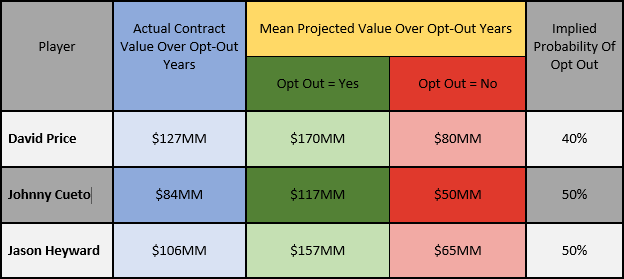
David Price received a contract for seven years at $217MM, but it was really a three-year contract for $90MM with a player option of four years and $127MM. If Price only held teams to a three-year commitment, he would probably get close to $120MM—but this is not what he did. Instead, he will require $127MM for 2019-22, only on the condition that he looks to be worth less than that by then. Although $127MM is not a terrible estimate of his 2019-22 production as of January 2016, this value will probably change drastically by October 2018, one way or the other. If he does not opt out, he probably will have performed worse, and conditional on the assumption that he will not have opted out, I estimate his expected value for his 2019-22 seasons to be $80MM. If he does opt out, he probably will have performed better, and conditional on the assumption that he will have opted out, I estimate his expected value for those seasons to be $170MM. Given that this corresponds to roughly a 40% chance of opting out, his opt-out clause is worth about $17MM, meaning that his seven-year $217MM contract is roughly equivalent to a seven-year $234MM contract with no opt-out clause.
Johnny Cueto’s contract is somewhat trickier, but it essentially amounts to a deal of two years for $46MM, with a player option of four years and $84MM, followed by a club option of one year for $16MM. Cueto would probably be worth $17MM above his salary for 2016-17. But for 2018-21, he is likely to be worth $50MM if he does not opt out and $117MM if he does. With roughly even odds of opting out, this makes his opt-out worth about $17MM. While the club option for 2022 makes the deal somewhat more attractive for the Giants, the odds that he will be worth much more than this are low. Overall, Cueto’s six-year deal for $130MM would probably cost about $147MM with no opt-out clause.
Jason Heyward’s contract is even trickier, but it mostly boils down to a three-year deal for $78MM, followed by a five-year player option for $106MM—except that the first player option (if exercised) is only certain to include one more year for $20MM. That’s because there’s a vesting provision that, if triggered—by Heyward reaching 550 plate appearances in the season following the initial option decision—would give him yet another player option for four years and $86MM. (If he exercises the initial option but then doesn’t reach that PA threshold, then both sides would be stuck with the remaining four years of the contract.) Heyward’s value is further complicated by the fact that signing him required forfeiting a draft pick, which is worth around $9MM.
Although Heyward’s contract contains two opt-outs, it is not all that likely that he opts out after 2019 if he does not after 2018. Players’ values do change substantially, but he is likely to be either much more valuable than his five-year player option after 2018, or much less valuable. It is not that we expect his value to look similar after 2018 and 2019—it is that he will probably already be way above or way below the current expected value near $20MM per year, and is likely to remain way above or way below this line through 2019.
For the first three years of Heyward’s contract, I estimate that he is worth about $22MM more than his contract will pay him. With five years of player option, there is a wide range of potential values afterward. I estimate that he also has about even odds of opting out, but if he does not opt out then he is probably only worth $65MM, while if he does he would be worth $157MM. If he doesn’t opt out after 2018 and does after 2019, he is likely near the middle and the value of the second opt-out is small. The net effect is that his opt-out clauses are worth about $25MM, and he would probably have received $209MM for eight years instead of $184MM had no opt-out been included in the deal.
With values of $17MM for each of the two pitchers and $25MM for Heyward’s pair of opt-outs, these opt-outs help keep costs down for teams. While they contain more downside and less upside than typical free agent contracts, they cost less money as well. As teams move forward in this new market, they should be careful to properly consider the true cost of these player options. If teams are willing to expose themselves to some downside risk, they can lower the cost of acquiring elite players.
Arbitration Breakdown: Jake Arrieta
Over the next few weeks, I will be discussing some of the high-profile upcoming arbitration cases. I will rely partly on my arbitration model developed exclusively for MLB Trade Rumors, but I will also break out some interesting comparables and determine where the model might be wrong.
Jake Arrieta enters his second year of arbitration coming off a Cy Young Award and is due to get a large raise from his 2015 salary of $3.63MM. Our model technically has him projected to receive $10.9MM next season — a $7.27MM raise — but due to our “Kimbrel Rule,” this has been revised down to $10.4MM. The Kimbrel Rule states that no player can receive a raise more than $1MM larger than the current record raise for a player in his service class. The rule was named after Craig Kimbrel a couple of years ago when his track record entering arbitration so far outdid potential comparables that we did not believe the result the model produced. Given that there are generally limits to the extent by which players break existing arbitration records, we have adjusted the model to reflect this and come up with a number of around $1MM.
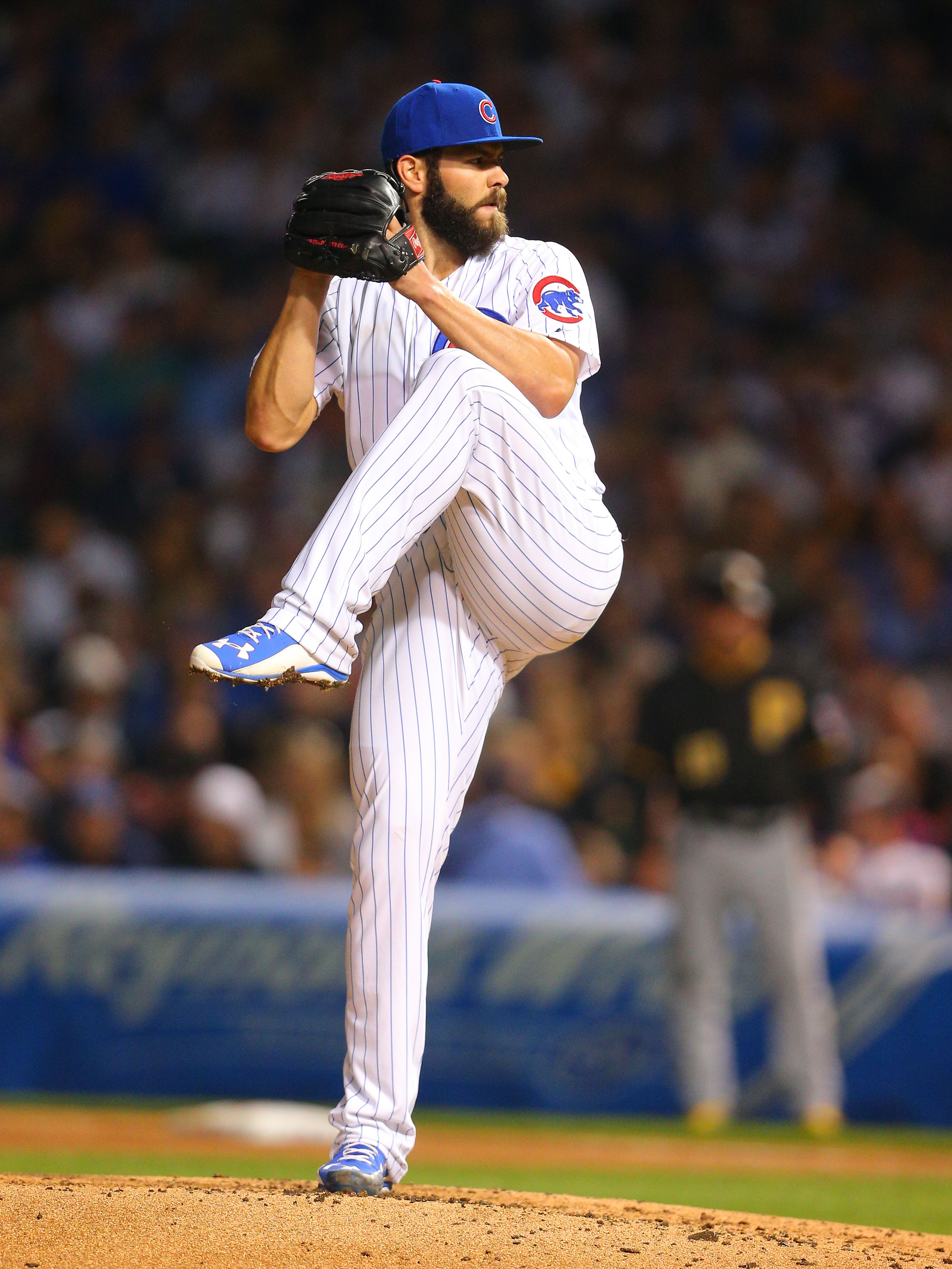
Arrieta’s case is a good application of the Kimbrel Rule, considering the fact that no player in recent years has matched Arrieta’s achievements heading into his second year of arbitration eligibility. The only recent player to win a Cy Young in Arrieta’s service class was David Price three years ago, who went 20-5 with a 2.56 ERA. Comparatively, Arrieta won a couple of extra games and recorded a far superior ERA: he was 22-6 with a 1.77 ERA. Additionally, Arrieta’s 229 innings and 236 strikeouts surpassed Price’s respective totals of 211 and 205 by a significant margin. Price received a $5.76MM raise, so the Kimbrel Rule gives Arrieta projected $6.76MM raise — good for a $10.4MM salary projected for 2016.
Another potential comparable that could come up in a hearing is Felix Hernandez‘s 2010 season. Although Hernandez ultimately signed a multi-year deal, he initially exchanged figures with the Mariners after going 19-5 with a 2.49 ERA. The Mariners offered a $3.4MM raise, while he asked for a $7.7MM raise. Since Price ended up roughly between these two numbers three years later and had won a Cy Young, though, it would be tough for the Cubs to argue that the Hernandez case is more applicable than the case of Price. Hernandez did have the lowest ERA of any pitcher entering his second year of arbitration eligibility in recent seasons, however, but even this was nearly three quarters of a run greater than Arrieta’s 1.77 mark.
Although Price did not and Arrieta has not yet, pitchers get multi-year deals in most cases like these. The downside risk of injury for a pitcher usually encourages them to hedge and cash in on their success, and the risk for the team to have to bid against other teams in the free agent market encourages them to cut a deal as well. As a result, it is difficult to find many elite pitchers who go year-to-year in arbitration. Price was the only pitcher in recent years entering his second year of arbitration eligibility as a 20-game winner, in addition to being the only Cy Young winner. However, Arrieta’s far superior ERA makes Price a weak potential comparable, certainly more of a floor than a ceiling.
If Arrieta does not sign a multi-year deal, he is likely to set a record for second-year arbitration-eligible raises for starting pitchers that will set the baseline going forward. Where he lands will be an excellent test of the Kimbrel Rule, since he perfectly fits the example of pitchers who outperformed their service class in recent years on all arbitration-relevant statistics.
Photo courtesy of USA Today Sports Images.
How Have 2015’s Worst Bullpens Improved Thus Far?
Over the weekend, MLBTR’s Charlie Wilmoth broke down the improvements (or lack thereof) that have been made to the five worst offenses from 2015 thus far. While there’s still a good deal of time remaining this offseason — we can revisit these examinations again come Opening Day — many teams have completed the bulk of their offseason lifting. Perhaps most notably, when it comes to the bullpen, many of the top-flight free agents and trade candidates are off the board. There are still some quality relievers to be had on the free-agent market — Antonio Bastardo and Tyler Clippard stand out as two of MLBTR’s Top 50 free agents that remain unsigned — but the bulk of the relief arms on the market appear headed for one-year commitments or minor league deals.
By ERA, the Rockies, Braves, Athletics, Tigers and Red Sox had the five worst bullpens in baseball in 2015. When sorting the Fangraphs team leaderboards by either FIP or xFIP, we see the bottom five results include four of those teams, though in various orders and combinations. So, while there are obviously many ways to categorize the collective efforts of teams’ relief corps, those five seem a reasonable enough starting point for this exercise.
Rockies (4.70 ERA, 4.09 FIP, 4.23 xFIP): Colorado’s offseason began with the somewhat surprising decision to designate John Axford for assignment, though the mustachioed closer came out ahead in the ordeal. Projected to earn $6.5MM this winter, Axford elected free agency following his DFA and scored a two-year, $10MM guarantee with the A’s that includes additional incentives. Colorado also cut ties with former closer of the future Rex Brothers and right-hander Tommy Kahnle. That pair of decisions was less surprising, as the two relievers combined to issue 36 walks in 43 2/3 innings. In their places, Colorado has signed veteran right-handers Jason Motte and Chad Qualls to two-year deals worth $10MM and $6MM, respectively. One can argue that Motte is a curious fit, to be sure, as a pitcher that neither misses bats nor induces grounders, but Qualls’ 60 percent ground-ball rate and K-BB% of 18.3 percent is appealing even if his ERA was more troublesome in 2015. Colorado will also probably benefit from Adam Ottavino‘s eventual return. The 30-year-old was excellent from 2013-15 before undergoing Tommy John surgery after 10 1/3 brilliant innings last season. The Rox felt confident enough in Ottavino to give him what was to many an eyebrow-raising $10.4MM extension spanning 2016-18, but if he returns anywhere near his 2013-15 form, that price will be more than acceptable. Increased usage from intriguing righties Jairo Diaz and Miguel Castro could also yield better results, but it does appear, on paper, that there’s room for further additions here.
Braves (4.69 ERA, 4.37 FIP, 4.29 xFIP): The Braves have added a slew of minor league arms in trades over the past 12 to 15 months, many of whom will eventually figure into the team’s bullpen, even if some are presently viewed as starters. This winter, the team has brought back Jim Johnson on a one-year deal with the hopes that he’ll recreate the success he found in Atlanta last season while avoiding the type of meltdown he had following his trade to the Dodgers. Also returning to the club is right-hander David Carpenter, who signed a minor league pact after a down season in 2015 following a trade from Atlanta to the Yankees last winter. (That trade netted Manny Banuelos, though the Braves also parted with Chasen Shreve.) Alexi Ogando serves as another notable right-hander to land a minor league deal with Atlanta, and he’ll presumably compete for a bullpen role this spring. Right-hander Jose Ramirez also joined the Braves in a trade with the Mariners, giving the team a high-upside arm, albeit it one with some question marks (durability, control). Also coming by way of trade is lefty Ian Krol, though he had a down season in Detroit before being included in the Cameron Maybin trade. Right-hander Shae Simmons will be returning from Tommy John surgery, and fallen closer Jason Grilli should make his way back from a season-ending Achillies injury in the early portion of next season as well. Ultimately, however, the Braves are looking more to the collection of young arms they’ve stockpiled the past two winters than flashy moves to bolster their bullpen — not a surprising tactic for a club that is in the middle of rebuilding. It’s possible that Atlanta will make further one-year additions, as such players could become trade chips this winter.
Athletics (4.63 ERA, 4.36 FIP, 4.21 xFIP): Oakland has been one of the most active clubs in adding bullpen help this winter, shelling out a combined $32MM for Axford (two years, $10MM) and Ryan Madson (three years, $22MM). Madson’s contract was something of a shock, considering the fact that he’s 35 years old and 2015 was the first time he’d been healthy enough to throw in a Major League game since 2011. However, his track record prior to his lengthy injury layoff and last year’s results were outstanding. Axford’s season was bizarrely segmented, as he yielded 19 runs in just 17 2/3 innings across the middle two months of the season but sandwiched those ugly results between 38 other innings in which he allowed just seven total runs. A move to a far better pitchers’ park figures to help Axford, though it seems that control will always be an issue for him. Oakland also added lefty Marc Rzepczynski in a trade with the Padres that sent Drew Pomeranz to San Diego. Closer Sean Doolittle should be in better health this season, and if he’s back to form, he represents one of the game’s better lefty relievers. Also new to the green and gold is Australian hurler Liam Hendriks, added in a trade that sent Jesse Chavez to Toronto. Hendriks never panned out as a starter despite promising minor league numbers with Minnesota, but he flourished as a relief pitcher last year with a 2.92 ERA, 9.9 K/9 and 1.5 BB/9 in 64 2/3 innings with the Jays.
Tigers (4.38 ERA, 4.37 FIP, 4.38 xFIP): Detroit’s nearly identical ERA/FIP/xFIP is rather remarkable in terms of similarity, but it also speaks to the underwhelming relief pitching that has now plagued the team for several years. New GM Al Avila has acted decisively in seeking to upgrade the ‘pen, shedding Krol and right-hander Al Alburquerque (via trade and non-tender, respectively). Francisco Rodriguez will serve as the new closer in Detroit after coming over in a trade from the Brewers (minor leaguer Javier Betancourt was the primary piece sent to Milwaukee). Avila added right-hander Mark Lowe on a two-year, $11MM deal that reflects Detroit’s confidence in the hard-thrower’s 2015 resurgence. The Tigers also landed southpaw Justin Wilson from the Yankees by sending a pair of pitching prospects to New York. The Tigers will hope that the combination of K-Rod, Lowe and Wilson will pair with an improved Bruce Rondon to give the team the quality relief contingent it has so often lacked. They’ll also again look to Alex Wilson to play an important role, although the right-hander’s middling strikeout rate is something of a concern.
Red Sox (4.24 ERA, 4.64 FIP, 4.35 xFIP): The expectation when Dave Dombrowski came on board as president of baseball operations was that he’d shake up the bullpen and show no fear in trading prospects, and that exact scenario manifested with the acquisition of Craig Kimbrel. The Sox paid an exorbitant price to land three years of Kimbrel, parting with Javier Guerra, Manuel Margot, Carlos Asuaje and Logan Allen. However, pairing Kimbrel with Koji Uehara (who will move back to a setup role) wasn’t where Dombrowski stopped; the new Boston exec also added right-hander Carson Smith in a trade that sent Wade Miley to the Mariners. Smith is far from a household name but quietly enjoyed one of the more dominant rookie seasons in recent memory last year, posting a 2.31 ERA with 11.8 K/9, 2.8 BB/9 and a 64.8 percent ground-ball rate. Roenis Elias, also acquired in that trade, could serve as starting depth but would also be intriguing in a left-handed relief role, based on his career splits.
MLBTR Originals
A look back at the original reporting and analysis found on MLBTR the last seven days:
- So far this offseason, 69 players have signed for a total of $1.609B. Last week, MLBTR’s Jeff Todd asked readers to weigh in on how high free agent spending will go. More than 60% of you said that total free agent spending will top $2.5B when all is said and done this winter.
- Which free agent outfielder would you rather sign: Yoenis Cespedes, Alex Gordon, or Justin Upton? MLBTR’s Steve Adams pitted the three free agents against each other and the results were actually pretty close between all three.
- The month of January isn’t typically a big month for free agent signings, but this year, things could be very different. In anticipation of what should be a very exciting month, MLBTR’s Charlie Wilmoth looked back at major activity from Januarys past.
- What have last year’s lowest-scoring offenses done to improve in 2016? Charlie delved into the moves made by the Braves, Marlins, White Sox, Phillies, and Reds.
- Free agent hurlers Jeff Samardzija and Mike Leake both came away with sizable paydays this winter. On Saturday, Charlie asked MLBTR readers which contract they prefer: Shark’s five-year, $90MM pact or Leake’s five-year, $80MM deal.
- On Tuesday, Steve hosted a chat and discussed the White Sox, Aroldis Chapman, the Nationals, and more. On New Year’s Eve, Jeff fielded a wide range of questions from MLBTR readers.
- On Sunday morning, MLBTR featured the best of the baseball blogosphere in our weekly segment, Baseball Blogs Weigh In.
Poll: The Jeff Samardzija And Mike Leake Contracts
Early last month, the Giants agreed to terms on a long-term contract with veteran righty Jeff Samardzija. Two weeks later, the Cardinals agreed to terms with another veteran righty, Mike Leake. The two contracts were identical in duration (five years) and similar in value ($90MM for Samardzija, $80MM for Leake). They were also interrelated — the Giants were the team that most recently employed Leake before the Cardinals signed him, while the Cardinals were connected to Samardzija before the Giants signed him. Both pitchers were a tier below David Price, Zack Greinke, Johnny Cueto and Jordan Zimmermann, all of whom received nine-figure deals. Beyond those similarities, however, lie a number of key differences about what, exactly, their contracts attempted to accomplish.
Of the two pitchers, Samardzija is widely perceived as having greater upside — with his mid-90s velocity, tough slider and 6’5″ frame, many of his attributes match those of an ace. He will, however, be 31 this month, and his performances so far in his career have not matched that ace profile. His 2015 season with the White Sox, in particular, was extremely disappointing — he posted a 4.96 ERA, and while ERA estimators suggested that figure could have been somewhat better, his K/9 has plummeted from 9.3 in 2012 to 6.9 last season, while his ground ball rate fell to a mere 39%.
On the bright side, Samardzija has been one of the game’s most durable starters, throwing over 210 innings in each of the past three seasons. And as long as he stays healthy, he seems likely to get at least somewhat better results in the next few years than he got in 2015, when he had to pitch in front of a poor defense and in a tough ballpark in a DH league. Samardzija’s 2015 season wasn’t a good one, but it also represented something of a perfect storm. But the error bar on Samardzija’s future performance is large, and where he lands might depend somewhat on Giants coaches’ ability to help him get back to missing bats, and to inducing ground balls when he doesn’t.
Like Samardzija, Leake has reliably eaten innings. Unlike Samardzija, he’s been very consistent, posting ERAs well below four in each of the last three seasons and regularly inducing ground balls at around a 50% clip. He also limits walks, which prevents opposing batters from doing too much damage against him, and he helps himself by fielding and hitting very well. Leake is also one of the offseason’s youngest free agents — he only turned 28 in November and could well have several prime-era seasons ahead. Also, his contract is worth $10MM less than Samardzija’s (although Samardzija’s limited no-trade clause is preferable to Leake’s full no-trade).
If Samardzija looks like an ace, though, Leake looks like something far less than that. While he isn’t quite a soft-tosser, his stuff isn’t at all overwhelming, and he’s small, at 5’10” — Leake isn’t a lefty, but he’s always seemed like he should be one. Leake has obviously reached the point in his career where it’s wise to judge him more on his performance record than on his profile, but not all the indicators there are positive, either. While Samardzija’s ability to strike batters out has diminished in recent seasons, Leake has never really had that ability, and his K/9 dropped to a mere 5.6 in 2015. Career paths are hard to predict, but it’s difficult to imagine Leake becoming anything close to an ace as he gets older. He does, however, seem more likely than Samardzija to provide league-average innings over the course of his contract.
So which contract do you prefer? Which player’s deal was best for his team?
Checking In On Last Year’s Lowest-Scoring Offenses
On January 2 of last year, MLBTR’s Zach Links looked at the lowest-scoring offenses in the 2014 season and what they had done that winter to improve. In 2015, the five lowest-scoring teams in baseball were the Braves (573 runs), Marlins (613), White Sox (622), Phillies (626) and Reds (640). What’s perhaps most striking about that list in comparison to the five teams Zach profiled (the Padres, Braves, Reds, Rays and Cubs) is that there are more teams than usual simply not acting like improving for the upcoming season is a top priority. The Braves and Phillies headed into the 2015-16 offseason already in the midst of obvious rebuilds; the Reds, having traded Todd Frazier and Aroldis Chapman this winter, now appear to be close to that status. Meanwhile, the Marlins continue to exist in a state of flux. Only the White Sox have made decisive moves to improve their run-scoring.
It should, perhaps, be noted that many of the top hitters in this winter’s free agent class remain on the market, with Justin Upton, Yoenis Cespedes, Chris Davis and Alex Gordon yet to find new teams. A team looking to upgrade its offense will have more opportunities to do so this month. But with a few exceptions (like the Cardinals, who actually finished 24th in the Majors and 11th in the NL in runs scored with 647 despite winning more regular-season games than any other team), it looks like many of the teams most likely to sign one of those players are teams whose offenses were already good.
With that in mind, though, there are plenty of interesting things even rebuilding teams can do with their offenses, including acquiring prospects and clearing space for young players. So let’s look in on what 2015’s lowest-scoring teams have done this offseason.
- Braves – Atlanta re-signed A.J. Pierzynski and signed Tyler Flowers, giving them a pair of veteran backstops to compensate for the departure of former top prospect Christian Bethancourt, who they shipped to San Diego. They also made a couple small signings of veterans Gordon Beckham and Emilio Bonifacio to shore up a shaky infield and bench, and they added a couple hitters via minor league free agency, Nate Freiman and Ryan Lavarnway (actually a re-signing), who could provide a bit of upside. Replacing Andrelton Simmons with Erick Aybar obviously will hurt defensively, but might not make much difference on offense. The Braves’ key move to help their hitting, though, was their trade of Shelby Miller to Arizona for a package that included Ender Inciarte (an already-good outfielder who will likely replace the departed Cameron Maybin if he doesn’t head elsewhere in another trade) and 2015 No. 1 pick Dansby Swanson. If Swanson develops, he could have a profound effect on the Braves’ future offensively.
- Marlins – Miami re-signed Ichiro Suzuki and Jeff Mathis, and has otherwise had a quiet offseason in which it will return many of the hitters it featured last year. That might not be all bad, of course — Giancarlo Stanton only played in 74 games in 2015, and a full season from him would be a huge help. The Marlins’ other two young outfielders, Christian Yelich and Marcell Ozuna, were much better in the second half of 2015 in the first, and they (along with Stanton and Dee Gordon) could help anchor a Marlins offense that looks likely to score more runs than it did last year.
- White Sox – The White Sox are, in some ways, this offseason’s equivalent of the 2014-15 Padres — the team taking the most urgent action to address an offense that struggled the previous season. Unlike the Padres, whose series of trades for a bunch of square pegs last winter had a deleterious effect on the franchise, the White Sox’ moves seem to have been well chosen. Chicago’s performances at both second base and third base were among the worst in baseball in 2015, and their deals for Brett Lawrie and especially Frazier were decisive moves to strengthen both positions. The additions of Alex Avila and Dioner Navarro perhaps weren’t as dramatic or as likely to be effective, but those players will provide help at another position at which the White Sox struggled. The team has shown at least some interest in many of the top free agent bats available this offseason, and it could also still potentially use a shortstop.
- Phillies – Philadelphia’s main moves this offseason (such as their trade of Ken Giles for a package that included Vincent Velasquez and Mark Appel, and their deals for rotation-filling pitchers Charlie Morton and Jeremy Hellickson) have mostly been oriented around pitching, but they’ve made a few small moves that could help their offense as well. Outfielder Tyler Goeddel, selected from the Rays with the first pick in the Rule 5 Draft, could potentially provide a bit of help. Waiver claim Peter Bourjos should figure in their outfield plans as well, although he’s not likely to hit much.
- Reds – Cincinnati hasn’t made any big-league signings this offseason, and the defining moves of their winter have been their trades of Frazier and Chapman, which have returned two grab bags of young players. Jose Peraza, the key to the Frazier deal, could collect plenty of at-bats for the Reds in 2016, particularly if the team is ever able to deal Brandon Phillips, but Peraza is a light hitter who figures to make most of his offensive impact with his speed. Scott Schebler, a lefty-hitting outfielder acquired in that same deal, could help somewhat, although his upside appears to be limited. The prospect from the Chapman trade most likely to help the Reds’ offense in 2016 is third baseman Eric Jagielo, although he hasn’t yet played at the Triple-A level and might not reach Cincinnati until late in the season. In the Rule 5 Draft, the Reds grabbed Jake Cave, another lefty-hitting outfielder; he did not hit well at Double-A last year and doesn’t seem like a great bet to add much offense, at least not right away. The Reds don’t look to have improved their offense enough to compensate for Frazier’s departure. They are, however, in an earlier stage of rebuilding or re-tooling than the Braves or Phillies are (or perhaps they’ve just approached it somewhat less aggressively). They should also benefit next season from better health — having Devin Mesoraco behind the dish could make a big difference.
Exploring January Free Agent Signings
The month of January isn’t typically a big month for free agent signings, but this year, it might almost have to be. An uncharacteristic number of big-name free agents are still available, including Justin Upton, Chris Davis, Yoenis Cespedes, Alex Gordon, Ian Desmond, Wei-Yin Chen, Dexter Fowler, Ian Kennedy, Yovani Gallardo and Howie Kendrick, among others, remain available. By this point in the year, key free agents have usually already signed, but this winter, many teams will be doing their offseason shopping well after Christmas.
Too see the difference between this year and previous winters, here’s a look at key January transactions from the last five seasons, via MLBTR’s Transaction Tracker. As we’ll see, January frequently contains a bit of drama, and top free agents do sometimes wait to sign. None of the last five offseasons have seen the kind of free agent movement that seems likely in the coming weeks, however.
- 2015: The only significant free agent move in January was indeed a big one: the Nationals’ agreement with Max Scherzer to a seven-year, $210MM deal on the 19th. Beyond that, the largest deal was the Astros’ $8MM pact with Colby Rasmus. James Shields ($75MM) and Francisco Rodriguez ($13MM) were the only key free agents who signed in February.
- 2014: This was the recent offseason with the most post-New Year’s activity. The Yankees signed Masahiro Tanaka to a $155MM contract in late January, and the Brewers got Matt Garza on a four-year, $50MM deal at around the same time. In addition, James Loney agreed to a three-year, $21MM pact with the Rays, who also signed Grant Balfour for two years and $12MM. A number of key free agent signings (Ubaldo Jimenez, Bronson Arroyo, A.J. Burnett, Fernando Rodney, Nelson Cruz) were delayed until February, while Ervin Santana (whose market, like that of Cruz, was depressed by the qualifying offer) did not sign until March. Two other qualifying offer free agents, Stephen Drew and Kendrys Morales, did not sign until after the season had begun.
- 2013: Nick Swisher and Edwin Jackson both signed right after New Year’s, each getting four-year deals in excess of $50MM. Later that month, Rafael Soriano and Adam LaRoche each got two-year deals in the $20MM-$30MM range. Two free agents with qualifying offers attached, Michael Bourn and Kyle Lohse, signed later.
- 2012: The Tigers signed Prince Fielder to a huge nine-year, $214MM contract in late January. The other key free agent deals that month were those of Coco Crisp and Hiroki Kuroda, both of them comparatively minimal in value. In early February, Jackson agreed to a one-year, $11MM deal with the Nationals.
- 2011: Soon after the new year, Adrian Beltre agreed to a five-year, $80MM deal with Texas. Later in the month, Soriano got three years and $35MM from the Yankees. The only significant February signing was Vladimir Guerrero‘s one-year, $8MM deal with the Orioles.
An obvious common denominator with many of these signings was that a number of key players were represented by Scott Boras, including Scherzer, Fielder, Beltre, Bourn, Jackson, Lohse, Soriano, Rodriguez, Drew and Morales. As is widely known, Boras operates on his own timeline, and his clients’ frequent late signings reflect that. For this year, that’s worth keeping in mind for Davis, Chen and Kennedy.
The other obvious common denominator is the qualifying offer, which had obvious effects on free agents like Bourn, Lohse, Santana, Cruz, Drew and Morales. The qualifying offer could end up having a significant effect on the markets of a few current free agents, like Kennedy.
Still, those two factors do not explain the logjam of free agents currently on the market. Most of them (Upton, Cespedes, Gordon, Desmond and so on) are not Boras clients. And many free agents who might have been most affected by the qualifying offer (Marco Estrada, Rasmus, Matt Wieters, Brett Anderson) either already signed or accepted their QOs.
In any case, this year’s free agent market figures to be considerably busier in January (or even later) than it typically is. In a recent column, FOX Sports’ Ken Rosenthal explored reasons why the market has been so slow. Some usual big spenders, like the Yankees and Angels, have been relatively quiet on the free agent market. In addition, the trade market has perhaps been a factor — recent deals involving Craig Kimbrel, Aroldis Chapman, Todd Frazier, Andrelton Simmons, Shelby Miller and Ken Giles, for example, have shown that the trade market has had plenty of good talent available. As MLBTR’s Jeff Todd implied last month, too, the signing of one of the many numerous bats available via free agency could lead to a run on the rest. In the meantime, though, a number of stars still need homes, so expect plenty of activity in the coming month.
Free Agent Faceoff: Cespedes vs. Upton vs. Gordon
Few would’ve expected all three of Justin Upton, Yoenis Cespedes and Alex Gordon to remain on the free-agent market with just over two days of the calendar year remaining, but none of the trio has found a new team for the 2016 season at this juncture. With Jason Heyward off the board — and to a team, the Cubs, that didn’t figure to impact the corner outfield market anyhow — the market for the remaining top-tier outfielders should pick up in the not-too-distant future. Any of the three would represent a corner outfield upgrade for just about any team on the market, but each has points in his favor and points against, so let’s take a quick look at each outfielder.
Upton: The youngest player of the trio in this discussion, Upton will play next season at just 28 years of age. He’s four years younger than Gordon and two years younger than Cespedes, meaning any team that signs him will be buying more of his prime than they would in signing one of his competitors. Upton was the No. 1 pick in the 2006 draft, and while he hasn’t developed into the superstar projected by many scouts, he’s a well-above-average bat that could bolster any offense. Upton’s bat was about 20 percent better than the league average in 2015 with the Padres, and that gels with his career line. He’s averaged 25 homers and 148 games per season dating back to 2009 and does have one elite, superstar-caliber season (2011) under his belt. That year, he showed a glimpse of his true ceiling, hitting .289/.369/.529 with 31 homers and 21 steals. In the outfield, Upton is a solid, if unspectacular defender. He’s received positive marks in right field and left field from both Ultimate Zone Rating and Defensive Runs Saved, although neither considers him an elite defensive option. He’s the weakest defensive player of this trio but also shouldn’t hit a decline phase in that regard as soon as his two corner counterparts.
Cespedes: The only player of this bunch that isn’t tied to draft pick compensation, Cespedes also boasts the most power of the group. Upton’s .202 isolated power (slugging minus batting average) is impressive, but Cespedes’ career mark of .215 tops it, and his 2015 mark of .251 bests anything ever compiled by Upton or Gordon. Defensive metrics absolutely love Cespedes in left field, where has a penchant for highlight-reel throws and above-average range. Cespedes, though, has seen his walk rate decline in each of his big league seasons. His .328 OBP from 2016 is almost entirely a function of his .291 batting average, and if that mark regresses to his career level of .271 going forward, Cespedes could struggle to keep his OBP above .300. A player with his power, defense and speed can certainly add value in other ways, but a poor approach and lack of plate discipline will become more prounounced issues if his power begins to fade in the later stages of what could be a six- or seven-year contract.
Gordon: At 32, Gordon is the oldest of the remaining top tier of outfielders. He has the least power of the group by a wide margin, but he’s also been easily the best defensive player, ranking eighth in the Majors in Defensive Runs Saved and fifth in Ultimate Zone Rating among all players at any position over the past three years. Gordon strikes out the least of this bunch and walks the most, so he has a considerably different skill set than his younger, more powerful free-agent peers. Gordon figures to command the shortest commitment of this trio — a five-year deal is the expectation here — and while that’s an advantage in some regards, the reasoning behind that term (his age) is not. Upton, for instance, could sign a contract with an opt-out after three years, as Heyward did, and still re-enter the market younger than Gordon is right now. A five-year deal for a 32-year-old is a risky proposition, and having rejected the Royals’ qualifying offer following the 2015 season, Gordon comes with the additional red flag of draft pick compensation.
As stated earlier, any of the three would represent an upgrade for most clubs. The White Sox, Giants, Padres, Angels, Orioles, Tigers, Indians and Royals could all use corner outfield upgrades, though not all of those clubs has the financial means to add a top free agent. (Notably, Kansas City’s most recent offer reportedly resulted in Gordon’s camp telling him they have “no chance” to re-sign him.) Further fits could arise in the wake of trades, too.
There’s no true apples-to-apples comparison, as each player figures to command a different price tag. MLBTR predicted a five-year, $105MM deal for Gordon earlier this offseason while estimating a six-year, $140MM deal for Cespedes and a seven-year, $147MM deal for Upton (though Upton could command an opt-out, as the youngest of the group, which would be yet another wrinkle to the equation). There are a number of factors to be considered, but for the rudimentary purposes of this poll, we’ll simply ask, in a vacuum…
Which free agent outfielder would you rather sign?
-
Justin Upton 38% (7,504)
-
Yoenis Cespedes 36% (7,099)
-
Alex Gordon 27% (5,342)
Total votes: 19,945
Where Does The 2015-16 Free Agent Market Stand?
As the end of 2015 approaches, it seems an opportune time to take stock of the free agent market. Plenty of contracts have met or exceeded already-lofty expectations. But it’s also rather notable that a variety of high-end players — including five of MLBTR’s ten highest-rated free agents coming into the winter and multiple players predicted to earn over $100MM — remain available.
Thus far, 69 players have signed for a total of $1.609B. That’s a big chunk of change, to be sure, but still falls shy of the $2B+ in total commitments handed out in the winter of 2013-14.
Expectations have long been that this year’s market would break records in terms of total spend, and the quality and volume of free agents still unsigned continues to suggest that will occur. There’s no question that a huge amount of earning potential remains available at this point in the current market. Above-average to premium position players include Justin Upton, Yoenis Cespedes, Chris Davis, Alex Gordon, Ian Desmond, Dexter Fowler, Howie Kendrick, and Denard Span. There are still quality arms out there, as well: Wei-Yin Chen, Kenta Maeda, Yovani Gallardo, Ian Kennedy, and Scott Kazmir among them.
Every one of those players placed among MLBTR’s top thirty available free agents. All but Span was predicted to land a $50MM+ contract. And we attributed over $1B in total earning capacity to those thirteen players alone.
But with the free agent market dragging along slowly, especially for position players, ESPN.com’s Buster Olney wonders whether it’s time for some of those players to consider pillow contracts. He says that Upton, Desmond, and Kazmir are among those who ought to begin thinking about taking one-year deals. And Olney suggests that some — he names Gallardo and Kennedy — might even need to prepare for the possibility of a holdout into the regular season.
From my perspective, it certainly wouldn’t be surprising to see a few top-fifty free agents settle for a chance to re-enter the market with as part of a weaker 2016-17 class. But there’s also little reason to give up on a bigger contract at this stage, and good reason to believe that many or most will still reach or exceed expectations.
Olney is right to note that next year’s much-less-appealing slate of free agents will provide some incentive for players to settle for one-year arrangements. But the less exciting market to come also impacts teams, who have some added incentive to lock into a player at an area of need if the future replacement options don’t look promising.
I’d suggest, too, that a delay in the market shouldn’t necessarily be interpreted as an indication that money has dried up. We’ve seen before that funding can still available well into the spring. Back in that boom class of 2013-14, for example, over $440MM was spent after the calendar turned to the near year (not including players who waited until mid-season, but factoring in the total outlay needed for the Yankees to land Masahiro Tanaka).
And this year’s remaining free agent class is much more impressive than the group whose signing timeline was put on hold by the great Tanaka chase. It should be paid as such, even if each individual won’t max out their earning potential.
We’ve already heard, for instance, that at least Davis, Gordon, and Kazmir have fielded significant offers, and are apparently holding out for something better. And it’s not at all uncommon for big cash to be committed late. We’ve seen nine-figure deals go to players like Tanaka, Max Scherzer, and Prince Fielder after the new year. And there are numerous examples of lengthy contracts with $10MM+ AAVs that have been handed out in January, February, or March — including James Shields, Ubaldo Jimenez, Matt Garza, Nick Swisher, and Michael Bourn.
It’s probably worth bearing in mind the lesson of Ervin Santana, whose market fell apart after he apparently pushed too hard for a bigger contract. But his case also demonstrates that the downside risk isn’t so bad, either, as he struck a $15MM contract for his single season and then got over $50MM the next year upon re-entering the market.
While it’s true that there’s more supply left this time around than is usually the case, that could simply be a reflection of the outstanding class of players on the open market and the numerous options at some positions. The market for power bats, in particular, has several players and teams involved who may be waiting for a first mover to break the present standstill.
In some ways, moreover, the early spending this year suggests that there will still be plenty of cash to go around over the next few months. Nobody anticipated the Diamondbacks committing over $200MM to one player. Jason Heyward and Ben Zobrist both went to a team (the Cubs) that didn’t necessarily seem in clear need of adding them. The trickle-down effect is that the other clubs with interest in those kinds of players remain in the market.
At this point, it’s also worth noting, only eleven clubs have even committed $20MM to a single player. The Dodgers, Angels, Rangers, Astros, White Sox, Yankees, and Mets are not among them. And only five teams have awarded contracts of $50MM or more, with the Cubs and Giants each giving two. So there’s probably more capacity — if not also willingness — to spend.
However the market develops, it seems fair to say that we could be in for an unusually active spring in terms of free agency. As camp begins to approach and extension season moves into focus, there’s still plenty of potential for intrigue.
My own expectation is that the market will still pay out over $2.5B in total commitments by the time it’s all said and done. In addition to the thirteen players discussed above, there are numerous other members of the open market who seem likely to sign guaranteed deals. What do you think?
Will Total Free Agent Spending Top $2.5 Billion?
-
Yes 61% (3,155)
-
No 39% (1,981)
Total votes: 5,136