
Offseason Outlook: Minnesota Twins
After an extended run atop the AL Central last decade, the Twins turned in their fourth consecutive 90-loss season and saw many of their top prospects sidelined by injury.
Guaranteed Contracts
- Joe Mauer, 1B: $92MM through 2018
- Ricky Nolasco, RHP: $37MM through 2017
- Glen Perkins, LHP: $18.15MM through 2017
- Phil Hughes, RHP: $16MM through 2016
- Kurt Suzuki, C: $12MM through 2016
- Mike Pelfrey, RHP: $5.5MM through 2015
Arbitration Eligible Players (service time in parentheses; projections via Matt Swartz)
- Trevor Plouffe, 3B, (3.162): $4.3MM projected salary
- Tommy Milone, LHP, (2.164, Super Two): $2.8MM
- Brian Duensing, LHP, (5.104): $2.5MM
- Jordan Schafer, OF, (4.121): $1.5MM
- Anthony Swarzak, RHP, (4.038): $1.4MM
- Eduardo Nunez, SS/3B, (3.090): $1.2MM
- Casey Fien, RHP, (2.143, Super Two): $1.1MM
- Non-tender candidates: Duensing, Swarzak, Nunez
Contract Options
- Jared Burton, RHP: $3.6MM club option with $200K buyout
Free Agents
- None
The Twins’ offseason began with what was a surprising move for many, given the team’s loyalty to its front office and coaching staff, as Ron Gardenhire was dismissed from his managerial role and offered another position within the organization. While Gardenhire weighs that decision, the coaching staff will look markedly different next season, as none of the coaches are guaranteed a spot in 2015. The coaching staff will be determined by the new manager and by GM Terry Ryan once Gardenhire’s successor is appointed. Paul Molitor is the primary internal candidate, though Terry Steinbach is another option. Other names floated from outside the organization have been Red Sox bench coach Torey Lovullo, White Sox third base coach Joe McEwing, Rays bench coach Dave Martinez and former Pirates skipper John Russell.
As Ryan told Mike Berardino of the St. Paul Pioneer Press in late September, the rotation will be the focus of the offseason for the Twins. Hughes has been an unquestionable bright spot — one of the best free agent signings from the 2013-14 offseason — but his acquisition was the only of Minnesota’s three rotation expenditures that paid dividends in 2014. The re-signing of Pelfrey to a two-year, $11MM contract has been an abject failure, and a 5.38 ERA in 159 1/3 innings wasn’t what the Twins had in mind when signing Nolasco to a four-year deal. Perhaps there’s some reason for optimism with him, however, as Nolasco’s .351 BABIP is tied for the eighth-highest single-season mark since 1900 (among pitchers with 150+ IP), and metrics such as FIP (4.30) and xFIP (3.97) feel that his performance wasn’t as bad as that ERA would suggest. Nolasco does have a low career strand rate, which typically keeps his ERA higher than his FIP, but not to this extreme.
The Twins’ internal options didn’t exactly pan out either. Former top prospect Kyle Gibson improved upon a rough debut season but logged a 4.47 ERA in 179 1/3 innings and endured a particularly rough patch from mid-August to mid-September before finishing strongly. Kevin Correia struggled all season before being sent to the Dodgers for a PTBNL, and trade acquisition Tommy Milone didn’t perform any better. Prospect Trevor May posted a cringe-worthy 7.88 ERA, though he showed a propensity for strikeouts and was plagued, to an extent, by a .377 BABIP. Top prospect Alex Meyer didn’t make it to the show but did post solid Triple-A numbers before some shoulder discomfort sidelined him in late August.
The Twins’ rotation problems are tied directly to another team deficiency — their defense. Minnesota’s collective .315 BABIP was the highest in all of baseball this season, and their defense ranked near the bottom of the league in terms of both Ultimate Zone Rating and Defensive Runs Saved. While the infield defense was mostly passable (albeit unspectacular), the team’s -36.2 UZR in the outfield ranked 29th of 30 teams, and no MLB club posted an uglier outfield DRS mark than Minnesota’s -50. The departure of Josh Willingham (via an August trade) and the likely return of converted shortstop Danny Santana to the infield — something the organization has expressed a desire to see — create the opportunity for better outfield defense. (The pitching staff, of course, compounded the defensive shortcomings by finishing with the worst K/9 rate in all of baseball for the fourth consecutive season.)
Minnesota’s bullpen was a relative strength for much of the season, but late swoons by Fien and Perkins, plus some questionable performances from September call-ups, submarined the unit’s collective numbers. Perkins was particularly out of sorts, and his season was eventually cut short due to a forearm strain and some nerve irritation (his UCL is reportedly fine). The Twins will be able to retain the entire group if they wish, though names like Duensing and Swarzak could be non-tender candidates, and I’d expect Burton’s option to be declined. Minnesota drafted Louisville closer Nick Burdi in the second round of this year’s draft, and it’s very possible that he and his 100-102 mph fastball eventually claim a bullpen spot next year. Stephen Pryor, acquired from the Mariners in exchange for Kendrys Morales, could fight for a spot as well. A veteran addition is possible, but the Twins don’t seem likely to spend extravagantly on the relief corps this offseason.
Looking at the team’s arbitration eligible players, Plouffe, Milone, Schafer and Fien seem like locks to be retained, while the others — Duensing, Swarzak and Nunez — are less certain. Cutting ties with those three players would leave Minnesota with about $69MM committed to the 2015 payroll. That would be well south of the team’s $85.5MM Opening Day payroll in 2014 — a figure that grew significantly after adding Morales on a one-year deal in June — so it seems fair to suggest that Ryan could have $20-25MM to spend, should he choose.
History has taught us that the Twins will not be serious players for the likes of Max Scherzer and Jon Lester, both of whom have legitimate shots at landing seven-year contracts. James Shields, the next-best arm on the market, seems too much of a stretch as well. The Twins seem more likely to explore the second tier of starting pitchers, which will include one name they pushed for late last offseason: Ervin Santana. The Twins reportedly made Santana a three-year offer in the $30-33MM range in Spring Training, but Santana preferred a one-year deal in the National League in hopes of cashing in on a bigger deal this offseason. It would make sense, then, to see Minnesota again express interest. Brandon McCarthy‘s excellent finish to the 2014 season could make him a desirable target for Ryan as well.
If the team is looking at a buy-low candidate, longtime division rival Justin Masterson seems like a good fit. The Twins’ infield defense was markedly better than the outfield defense in 2014, and Masterson’s gaudy ground-ball rate would minimize the impact of a potentially questionable outfield defense in 2015. His strikeout rate remained strong as well, but the Twins would need to be convinced that the knee injury which plagued Masterson’s 2014 season (and likely played a large role in his fastball velocity dropping from 91.6 mph to 88.9 mph) is now healed. Brandon Morrow and Brett Anderson are another pair of high-upside names that come with injury risk but could make sense on one-year deals. The Twins did show interest in Anderson last year before he was dealt to Colorado. Each of these three arms would give the Twins a legitimate trade chip in July should they remain healthy on a one-year deal and should the Twins again fail to contend. The success experienced by Hughes in 2014 could cause pitchers in this vein to give a bit of a longer look at the benefits of pitching in Target Field.
Looking to the outfield, it’s clear that the Twins could use at least one upgrade. While top prospect Byron Buxton — whose season was all but lost due to wrist injuries and a frightening concussion — will eventually claim center field, Aaron Hicks has failed to do so in the short term. Schafer impressed the Twins after being claimed on waivers and figures to have locked up a spot as a fourth outfielder. A run at Cuban slugger Yasmany Tomas doesn’t seem realistic; the Twins have never bid that highly on an international free agent, and Tomas could clear $100MM.
If the Twins move Santana back to shortstop and non-tender Nunez (leaving the utility role to Eduardo Escobar), they could pursue options at any of the outfield positions (with Oswaldo Arcia occupying one of the two corner spots). Colby Rasmus is an interesting buy-low candidate, but if he’s looking to rebuild value, a pitchers’ park like Target Field probably isn’t the best setting. Melky Cabrera‘s price tag could preclude a serious pursuit from Minnesota, and while they had interest in Nelson Cruz late last offseason, his price tag figures figures to be prohibitive as well. A trade for a defensively gifted outfielder such as Peter Bourjos would make sense for Minnesota, in my mind. He could provide elite center field defense while Buxton develops, and he would also improve results for the team’s pitching staff. Bourjos’ modest salary would allow Ryan to focus his resources on improving the rotation.
Other areas such as catcher and designated hitter likely don’t need to be addressed. The Twins opted to sign Suzuki to a two-year extension rather than trade him this summer when a market failed to materialize, and switch-hitting slugger Kennys Vargas looked impressive in a second-half call-up, batting .274/.316/.456 with nine homers in 53 games. It’s possible that the Twins could receive trade interest in Suzuki this offseason, given the weak market for catchers after Russell Martin. The team does have an interesting alternative in Josmil Pinto, but Suzuki is well-liked in the organization and it’d be somewhat surprising to see him moved so quickly after signing that contract. Suzuki doesn’t seem to be worried about the idea, as he said in August that he and his agents at MVP Sports Group didn’t think it was necessary to try for a no-trade clause.
One interesting point to consider (a topic which Andrew Bryz-Gornia noted at SB Nation’s Twinkie Town) is the future of Plouffe. The former first-rounder quietly had an excellent season (3+ rWAR and fWAR) and looks to have found a home at third base. The only problem is that Miguel Sano is the Twins’ heir apparent at third and could force his way onto the Major League roster next season. It’s possible that the Twins could once again shift Plouffe’s position to a corner outfield spot (they employed a similar trajectory with Michael Cuddyer early in his career), but with an in-house stopgap such as Escobar under control, Plouffe strikes me as an under-the-radar trade target for teams in need of help at the hot corner.
The Twins will first have to determine who will succeed Gardenhire, and when they do, improving the rotation as well as the outfield defense should be priorities in what will be a busy offseason for Ryan and assistant GMs Rob Antony and Wayne Krivsky.
MLBTR Originals
A look back at the original reporting and analysis found on MLBTR this past week:
- Tim Dierkes ushered in a new season of MLBTR’s recurring series Free Agent Profile with his prediction of a seven-year, $105MM contract for Cuban outfielder Yasmany Tomas.
- Agent Matt Sosnick told Tim Josh Willingham has yet to a make a definitive decision about retirement.
- Tim was the first to report Phillies GM Ruben Amaro Jr., while in Japan, scouted Kenta Maeda.
- Mark Polishuk examined the trade candidacy of four members of the Reds’ starting rotation: Johnny Cueto, Mat Latos, Mike Leake, and Alfredo Simon.
- Steve Adams asked MLBTR readers to name the best in-season waiver claim. Nearly 21% of you cited the Twins’ pick-up of outfielder Sam Fuld as the shrewdest move.
- Steve hosted the MLBTR live chat this week.
- Zach Links put together the best of the baseball blogosphere in Baseball Blogs Weigh In.
Free Agent Profile: Yasmany Tomas
Last October, despite some questions about his ability, Cuban slugger Jose Abreu signed a six-year, $68MM contract with the White Sox heading into his age-27 season. Abreu’s MLB debut exceeded the most optimistic expectations, and now another Cuban player known for huge power is about to burst on the scene: Yasmany Tomas. Tomas, just 24 in November, defected from Cuba in June and should be granted MLB free agency shortly. He’s a right-handed-hitting corner outfielder with five years in Cuba’s Serie Nacional under his belt, and that experience, paired with his age, makes him exempt from international spending limitations. Teams will be able to spend whatever they wish to sign him.
Strengths/Pros
The opportunity to sign a potential star player for his prime years comes along at most only a handful of times each year, typically with players coming out of Cuba or Japan. Abreu was heading into his age 27 season, younger than any normal free agent but still potentially catching some decline at the tail end of his contract. Since Tomas turns 24 in November, a seven-year deal would conclude with his age-30 season. He really couldn’t be much younger without being subject to each team’s international signing bonus pool money, which currently tops out around $5MM and includes a 100% tax on overages of 10% or more.
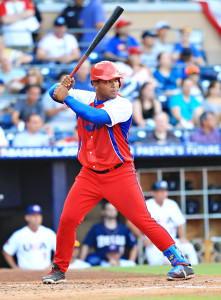 Tomas’ best attribute is his power, a trait that is in short supply in today’s game. Only 14 players hit 30 or more home runs in 2013, and fewer might reach that threshold this year. Tomas has 70 raw power on the 20-80 scale, wrote Baseball America’s Ben Badler in June, so he profiles as one of those rare 30+ home run bats. “He’s got a ton of power,” countryman Rusney Castillo told WEEI’s Rob Bradford through a translator this month. Tomas has produced a .290/.345/.504 throughout his career in Cuba, although those numbers include a pair of seasons in which he slugged just .385 (2009-10) when he was still a teenager.
Though Tomas checks in at 6-foot-2 and 240 pounds, he’s “agile for his size,” according to MLB.com’s Jesse Sanchez. Sanchez also says Tomas has a strong arm, so he fits the typical right field profile (some teams may prefer him in left, of course).
One more plus: Tomas is not subject to a qualifying offer, so the cost will be entirely financial. Other free agent hitters like Hanley Ramirez, Pablo Sandoval, Victor Martinez, Melky Cabrera, and Nelson Cruz are expected to receive and turn down qualifying offers and therefore require forfeiture of a draft pick.
Weaknesses/Cons
Badler wrote in his June scouting report that Tomas has below-average speed. More recently, Badler cited scouts who clocked Tomas at 6.9 seconds in the 60-yard dash at his Sunday showcase, which could be considered average speed.
Tomas may need some Triple-A seasoning, delaying his 2015 MLB impact. Badler noted that Tomas’ most recent season in Cuba wasn’t his best, writing, “This past season in Cuba…Tomas seemed to regress, even losing playing time in the second half, which one source said was the result of an arm injury he sustained crashing into an outfield wall in February.” Word is that Tomas has no physical issues currently.
Badler also noted that Tomas has shown some “swing-and-miss tendencies” and can struggle with quality breaking stuff. According to Sanchez, Tomas is “characterized as ‘high-risk, high-reward’ type of player in some international scouting circles.” He seems to come with a lesser reputation and less certainty than Abreu did last year. Not much has been written about Tomas’ defense, except that Sanchez feels the player has room for improvement.
Personal
Sanchez spent time with Tomas prior to his showcase this month, and was struck by his “youthful enthusiasm.” According to longtime friend Carlos Damas, Tomas is “always laughing.” I’ve heard Tomas likes to play video games in his spare time, and is often seen outside playing stickball with local kids.
The son of a fuel truck driver, Tomas is one of six children. As you might expect, the slugger found it very difficult to leave his home country.
Market
Tomas’ showcase in the Dominican Republic drew hundreds of scouts, wrote Badler. It is believed that nearly every team in baseball had a presence. MLB Network’s Peter Gammons pegged the Giants as the early favorite, also naming the Phillies, Padres, Rangers, and Tigers as potential front-runners. The Phillies had a private showcase with Tomas on Monday; the Rangers host him today. On Monday, Badler named the Rangers, Phillies, Yankees, Diamondbacks, Giants, and Mets as teams with a strong presence at Tomas’ showcase. The Marlins and Pirates were also known to be in attendance.
Expected Contract
Tomas’ agent Jay Alou told Jorge Ebro of El Nuevo Herald in early September that he expects to top the record contract for a Cuban player, which is Rusney Castillo’s seven-year, $72.5MM deal with the Red Sox signed in August. While a six-year deal is possible for Tomas, seven makes more sense, especially if Tomas is not expecting to spend all of 2015 in the Majors. Seven years also gives the opportunity of increasing the overall contract total.
I believe Abreu’s stellar season inflated the Cuban market, leading to a likely inferior player in Castillo to top his total guarantee less than one year later. Nothing pays in free agency like power, so I agree with Alou’s expectation of continuing to raise the bar beyond Castillo’s $72.5MM. On September 14th, Nick Cafardo of the Boston Globe passed along the opinion of one international scout who feels Tomas could command $100MM. Tomas’ range seems wide right now. I see about $80MM as the floor, and $110MM as the ceiling. My prediction at present: $105MM over seven years.
Photo courtesy of Alyson Boyer Rode.
Trade Candidate(s): The Reds’ Starting Pitchers
The Reds’ hopes of challenging in the NL Central were dimmed by several major injuries this year, and this visit from the injury bug was particularly damaging to a team who already faced some big decisions in the offseason. With just over $71MM committed to 10 players on the 2015 payroll, the mid-market Reds may be forced to save some money by moving a starting pitcher. Though Cincinnati’s durable and deep rotation has been a big part of the club’s success in recent years, pitching seems like a natural area for payroll reduction simply due to the fact that three starters will enter their third year of arbitration eligibility.
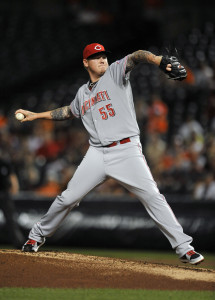 Two pitchers who won’t be dealt are Homer Bailey and Tony Cingrani. The Reds have already committed to Bailey in the form of a six-year, $105MM extension, and wouldn’t have been likely to move him even if Bailey hadn’t recently undergone forearm surgery. Cingrani has also had injury problems, spending most of 2014 on the DL with shoulder problems. Had Cingrani been able to build off of his impressive 2013 rookie season, the Reds would’ve felt at least a bit better about trading one of their more established starters (Bronson Arroyo wasn’t re-signed last winter in part because the Reds were comfortable with Cingrani).
It’s possible Cincinnati could trade multiple starters, though I’d suspect that the team wouldn’t want to lose too much pitching depth until they know Bailey and Cingrani are fully healthy. The Reds would probably rather not have David Holmberg or Dylan Axelrod as full-time rotation members next year, top prospect Robert Stephenson still needs some seasoning (a 4.74 ERA in 136 2/3 IP at Double-A in 2014) and the newly-signed Raisel Iglesias could still wind up in the bullpen.
The Reds’ other four pitchers are all controlled only through 2015, so the team likely wouldn’t score a truly huge return in a trade but all carry value even as one-year pitchers. The candidates…
Johnny Cueto: The Reds have a $10MM option on Cueto for 2015 that is sure to be exercised given how well Cueto has pitched. After an injury-shorted 2013, Cueto bounced back in a major way by posting a 2.15 ERA, 8.9 K/9 and 3.73 K/BB rate over a league-leading 222 innings.
Cueto’s next contract will be in the nine-figure range, and it’s unclear if the Reds would be willing ink another major extension given how much money has been tied up in recent deals with Bailey, Joey Votto and Brandon Phillips. Cueto would net the biggest return in a trade, though moving their ace would seem to hint that the Reds are punting on 2015, which I doubt they’re prepared to do. On the other hand, the Reds could trade Cueto for Major League parts (such what the Rays and Red Sox received for David Price, John Lackey and Jon Lester before last July’s trade deadline) and use a Cueto deal to reload rather than rebuild.
Keeping Cueto would give the Reds stability at the top of their rotation, and they could still explore dealing Cueto at next year’s trade deadline if they fall out of the race. If they’re contending and wanted to keep Cueto, Cincinnati could then get a compensatory draft pick via the qualifying offer if he leaves in free agency after the 2015 season.
In a recent Insider-only piece, ESPN’s Buster Olney recently explored Cueto’s trade market and raised the possibility that the Reds could clear some payroll space by attaching Phillips, for example, to Cueto in a trade package. With several notable starters available as free agents this winter, Olney believes some teams might prefer trading for a year of Cueto rather than making an expensive multiyear commitment for an ace on the open market. Also, a contending team that potentially loses their ace in free agency (such as if Max Scherzer leaves the Tigers or James Shields leaves the Royals) could look to Cueto as a short-term replacement to keep their rotation strong for another run in 2015.
Mat Latos: Ken Rosenthal of FOX Sports recently cited Latos as perhaps the likeliest of the Reds’ starters to be dealt, as both Latos and Cueto can make a case for commanding an extension larger than Bailey’s deal. While Cueto is two years older than Latos, presumably the Reds would be more inclined to extend their homegrown product than they would Latos, who missed part of 2014 with an elbow injury. Latos has a 3.25 ERA in 102 1/3 IP this year, though ERA indicators show that he hasn’t pitched quite that well (3.64 FIP, 4.00 xFIP, 4.08 SIERA) and both his ground ball and strikeout rates dropped significantly below his career averages. The right-hander’s average fastball velocity also dropped to 90.7 mph, down from 92.5 mph in 2013.
The Reds already tested the market for Latos at the trade deadline, so I tend to agree with Rosenthal that if a Cincy starter is moved, it’ll probably be Latos. His declined numbers could be explained by his elbow issues, and if fully healthy, Latos could be a standout front-of-the-rotation starter for several teams. He earned $7.25MM in 2014 in the last year of a two-year extension, and he’ll be eligible for arbitration for a third and final time this winter.
Mike Leake: Another pitcher with a third arb year remaining, Leake will get a raise from his $5.925MM salary in 2014. The right-hander has been a reliable rotation piece over his five Major League seasons, not missing many bats (career 6.1 K/9) but inducing a lot of grounders (49.8% ground ball rate) and eating a lot of innings, averaging 191 IP over the last three years.
Leake comes with the fewest question marks of any Cincinnati starter, lacking the injury histories of Cueto and Latos but also never pitching nearly as well as those two have at their peaks. While Leake’s ceiling in the bigs may never surpass the “solid” level (he has an even 100 ERA+ over his career), this also means that the Reds could extend him at a much lower price than Cueto or Latos. A Leake extension could look something like the five-year, $65MM deal the White Sox gave John Danks a few years ago, as Leake and Danks are decent comparables in terms of age and career numbers to that point in their careers, plus both had one arb year left before free agency.
The Reds put Leake and Latos on revocable waivers in August, possibly in a move to gauge trade interest for the upcoming offseason. I’d guess there’s a better chance Leake stays in Cincinnati than goes, though the Reds will certainly get interest in the durable 26-year-old.
Alfredo Simon: The big surprise of the group, the 33-year-old Simon moved from the bullpen to the rotation as an injury fill-in and wound up making his first All-Star team. Though his performance has very much come back to earth in the second half, Simon still has a 3.48 ERA through 178 1/3 innings on the season despite a middling 5.9 K/9.
Simon is arb-eligible for the third time this winter and he’ll earn a healthy raise over his $1.5MM salary, though the raise will hardly break the bank. Simon’s age and career track record give him a very modest amount of trade value, so it’s likely he stays with the Reds and competes for the fifth starter’s job (or returns to the pen) if and when a rotation spot opens up via trade.
With this variety of available starters and a wide variance in asking prices for each of the four pitchers, many teams could fit as potential trade partners for the Reds under the “you can never have too much pitching” argument. If the Reds look to deal a starter and fill an everyday lineup hole at the same time, they’ll likely target a left fielder or a shortstop as upgrades on Ryan Ludwick and Zack Cozart, respectively. Ludwick has a $9MM mutual option for 2015 but after two negative fWAR seasons, the Reds might instead buy him out (for a deferred $4.5MM) and look for other options.
Using these needs to speculate about trade partners, the Cubs, Diamondbacks and possibly the Indians stand out as teams with a shortstop surplus. The Red Sox have a glut of outfielders and are known to be looking for starting pitching. The Dodgers could finally solve their long-standing logjam in the outfield and, if it meant getting back Cueto or Latos, would be willing to eat a lot of salary on one of their high-priced outfield bats.
As Ken Rosenthal noted (video link), the Reds could employ some gamesmanship with their starters and perhaps leverage them against each other in figuring out which (if any) pitchers they want to sign over the long term. Between these negotiations and waiting for the free agent pitching market to play out, Cincinnati might wait until January or even February to move a starter. At this point, the only thing that seems certain about the Reds’ 2015 rotation is that at least one of Cueto, Latos, Leake or Simon won’t be on the roster come Opening Day.
Photo courtesy of Joy R. Absalon/USA Today Sports Images
MLBTR Originals
A look back at the original reporting and analysis found on MLBTR the last seven days:
- Steve Adams created a 2015 Free Agent Leaderboard on FanGraphs allowing MLBTR readers to track the performance of the upcoming free agent class.
- For those looking beyond this offseason, Steve updated the list of 2016 free agents.
- Brad Johnson opines Victor Martinez, Brandon McCarthy, and Andrew Miller are the three free agents who have most improved their value.
- Charlie Wilmoth, in the latest Free Agent Stock Watch, is bullish about the prospects of Melky Cabrera given his performance this season and the weakness of the free agent corner outfield market.
- Jeff Todd asked MLBTR readers whether the Giants will re-sign Pablo Sandoval. More than 55% of you believe he will leave his heart in San Francisco and take the rest of his body elsewhere.
- Brad asked MLBTR readers which team will win the Yasmany Tomas sweepstakes. A plurality of you (over 17%) see the Yankees winning the bidding war for the 23-year-old Cuban outfielder.
- Steve hosted this week’s chat.
- Zach Links compiled the latest edition of Baseball Blogs Weigh In.
The Most Improved Free Agents
Behind the scenes at MLBTR, we’re busy discussing and polishing our Top 50 Free Agents list for the 2015 offseason. While we’ll wait until the appropriate time to officially release the list, it’s not too soon to talk about a few of the players who have done the best to improve their free agent stock. In general, I’m looking at players who weren’t even on the radar when Steve Adams kicked off our 2015 Free Agent Power Rankings series on April 15. Today, we’ll take a look at a pure hitter, a starting pitcher, and an elite reliever.
1. Victor Martinez. I’m sure Martinez’s appearance on this list is of no surprise. When we compiled our initial power rankings post, 25 players were named. Martinez was not one of them. The 35-year-old designated hitter is limited in defensive versatility, but his bat is clearly elite. He is enjoying a fantastic offensive season with a .335/.404/.566 line and 31 home runs. All are career bests. He’s even stolen three bases (also a career best). The exceptional performance comes with a 10.5% walk rate and 6.6% strikeout rate, making him one of just two players with more walks than strikeouts (Jose Bautista is the other).
Martinez, who earned $12MM this season, will receive a qualifying offer, according to Buster Olney of ESPN. It’s difficult to handicap how the slugger will perform on the free agent market. The only recent comparable player is David Ortiz, although the short contracts he signed with the Red Sox do not appear to be directly applicable to Martinez’s situation.
The Tigers will have some leverage in retaining Martinez, where he can continue to hit with Miguel Cabrera. The White Sox are also said to be interested, per Bruce Levine of 670TheScore.com. Chicago appears to be an ideal fit with its extremely hitter friendly stadium (Detroit’s Comerica Park is a neutral stadium), and he would make a good tandem with Jose Abreu. We seem to have the basic ingredients for a bidding war, and other teams will likely enter the fray.
2. Brandon McCarthy. What a fascinating season it’s been for McCarthy. His fastball gained two mph over previous seasons, and he’s posted the highest ground ball rate of his career at 52.7%. While his 3.93 ERA is merely decent, advanced ERA estimators like xFIP (2.90) and SIERA (3.03) expect better things to come. He’s also buffed his strikeout rate to 7.72 K/9 while maintaining an elite walk rate of 1.53 BB/9.
McCarthy was easy to overlook entering the season. His command and control profile made him a steady but uninspired rotation option. His first 18 starts came with the Diamondbacks, where he flashed excellent peripherals with an unseemly 5.01 ERA. He was dealt to the Yankees prior to the July trade deadline. In 13 starts, he’s pitched to a 2.54 ERA that is supported by his peripherals. Many pundits (including this one) worried about the influence of Yankee Stadium on the homer prone starter, but his HR/FB ratio has regressed to league average in New York.
Prior to this season, he never managed more than 170 and two-thirds major league innings in a single season. That came in 2011. He’s frequently dealt with injuries including recurring “stress reactions” in his pitching shoulder. His most recent shoulder injury occurred in 2012. This season, he’s managed a career high 194 and two-thirds innings with a chance to eclipse the 200 inning threshold.
A sabermetrically inclined front office – especially one with a large ballpark – could justifiably view McCarthy as the fourth best free agent starter, after the triumvirate of Max Scherzer, Jon Lester, and James Shields. McCarthy’s history of shoulder problems will likely temper enthusiasm for a large contract offer. That might serve to increase demand by making him an affordable, second-tier option. McCarthy, who is entering his age 31 season, could top the four-year, $49 million contract signed by Ricky Nolasco last offseason. However, a smart club would include language to mitigate risk from future shoulder flare-ups.
3. Andrew Miller. If Miller was on anybody’s radar entering the season, it was as a moderately interesting LOOGY. By halving his walk rate and proving he’s no platoon pitcher, Miller will enter the offseason as an untested but possibly elite closing option. Due to his inexperience recording saves, clubs may still look at him as a setup reliever.
Split between the Red Sox and Orioles, the 30-year-old southpaw has posted a 1.93 ERA in 60 and two-thirds innings. His 14.84 K/9 is impressive, especially in light of his 2.37 BB/9. He’s allowed just 32 hits on the season and is one of three relievers to cross the 100 strikeout threshold – four others appear poised to do so by the end of the season.
No recent left-handed reliever has entered free agency coming off of such a strong season, which puts Miller in uncharted waters. Jeremy Affeldt, who signed a three-year, $18MM contract with the Giants following the 2012 season is a distant comparable. Joaquin Benoit is probably the best example among recent right-handed pitchers. He signed a two-year, $15.5MM contract with an option after emerging as the Tigers closer. However, he was also entering his age 36 season, so he was considerably older than Miller. Per the MLBTR Transaction Tracker, no non-closing reliever has signed a contract with over a $20MM guarantee. Miller has a chance to be the first. Prior to the 2007 season, Justin Speier signed a four-year, $18MM contract that could serve as a barometer of sorts once inflation is included.
MLBTR Originals
A look back at the original reporting and analysis found on MLBTR this past week:
- Steve Adams profiled Josh Harrison as a possible extension candidate and sees three years and $15-16MM as the parameters for a deal between the Pirates and the 27-year-old utilityman.
- Jeff Todd presented a Free Agent Stock Watch on Nationals infielder Asdrubal Cabrera and believes his performance down the stretch and in the playoffs will determine the market for his services.
- Charlie Wilmoth issued a Free Agent Stock Watch on Yankees third baseman Chase Headley.
- Tim Dierkes was the first to learn Wily Mo Pena, after spending three seasons in Japan, wants to return to MLB in 2015 and three teams are interested.
- Tim also broke the news left-hander Mike Zagurski asked out of his minor league contract with the Blue Jays and the club granted his request.
- Zach Links was the first to report infielder Matt Hague and right-hander Blake Wood would be placed on waivers by the Blue Jays and Royals, respectively.
- Jeff updated the progress players with a 2015 vesting option are making toward exercising those options.
- Jeff asked MLBTR readers whether the Orioles will extend qualifying offers to pending free agents Nelson Cruz, J.J. Hardy, and Nick Markakis. Nearly 47% of you predict the club will tender Cruz, but there is much less support for Hardy (28%) and Markakis (25%) receiving a QO.
- Zach assembled the best of the baseball blogosphere for you in Baseball Blogs Weigh In.
Extension Candidate: Josh Harrison
Asked to create a list of candidates for the 2014 NL batting title five months ago, few would have seriously suggested Pirates utilityman Josh Harrison. However, it’s September 11th, and the .318 mark that Harrison carried into the day paced the National League. A decline in performance for Pedro Alvarez and an eventual season-ending injury for the slugging third baseman have opened the door for Harrison to serve as the club’s everyday option at the hot corner down the stretch — an opportunity on which he has capitalized. Though the 27-year-old Harrison had never even topped 276 plate appearances prior to this season, he’s tallied 472 and should finish the season well north of 500.
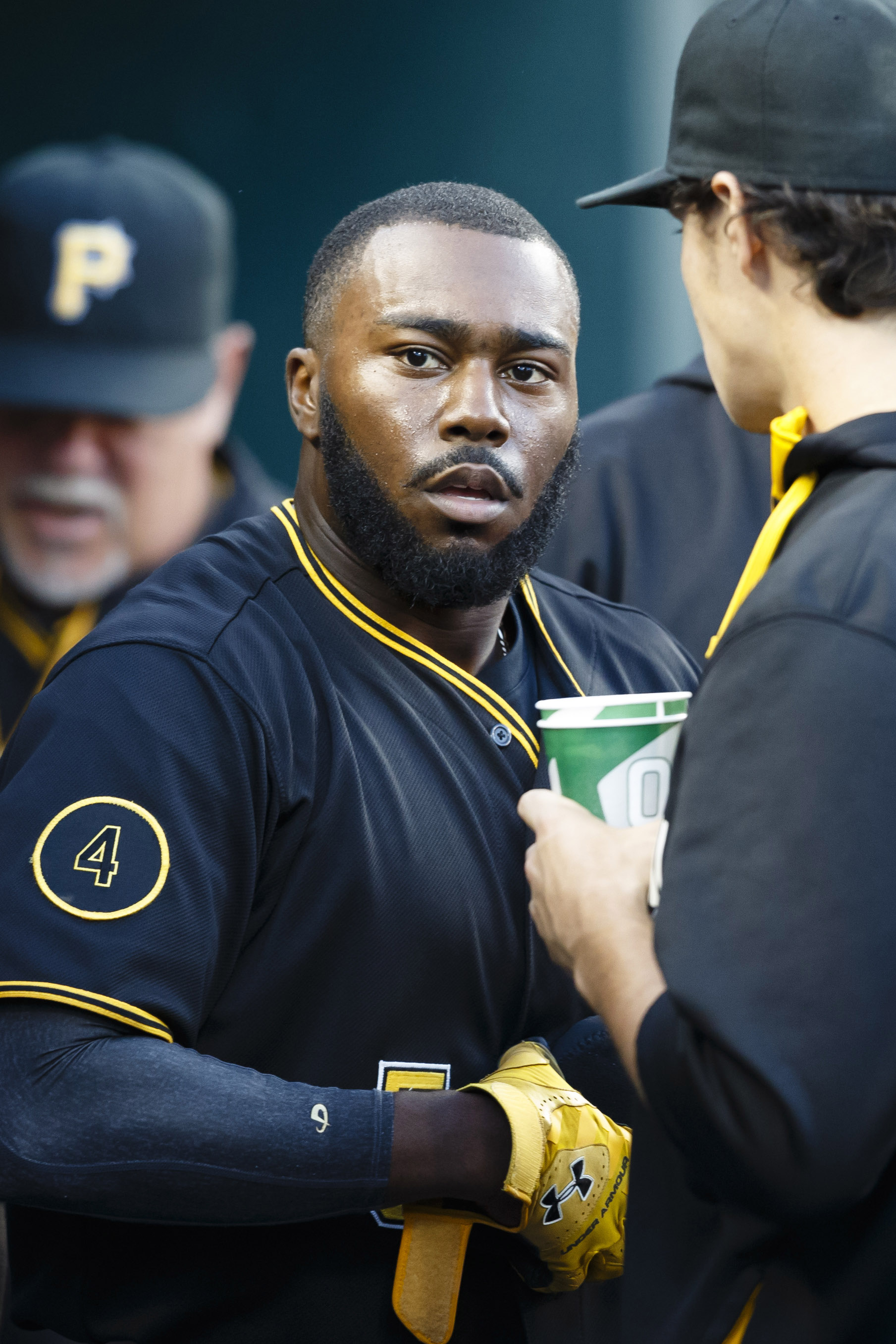 The Pirates acquired Harrison with little fanfare in the 2009 trade that sent Tom Gorzelanny and John Grabow to the Cubs and watched him produce steady batting average and on-base percentage marks as he ascended the minor league ranks. However, while his glovework graded out favorably heading into the season, he also carried a career slash line of just .250/.282/.367 into 2014.
Harrison hasn’t drastically changed his approach at the plate — his swing and contact rates are similar to his previous marks — but he’s slightly increased his walk rate, cut down on his pop-ups and laced line drives at a career-high rate. On top of that, Harrison has found some power despite never hitting more than six homers in a minor league season. He’s swatted 13 long balls and posted a .196 isolated power mark even though he plays at PNC Park, which is known to significantly diminish right-handed pop. The end result has been an outstanding .318/.351/.514 batting line to go along with those 13 homers, 17 steals and strong defensive marks.
Harrison has cleared three years of Major League service time now and will be eligible for arbitration this offseason. Clearly, an NL batting title, 15 or so homers and 20 or so steals will help his agents at Millennium Sports Management make a strong case. However, first-time arb salaries are based on a player’s entire career to that point, unlike second- and third-time arb salaries which are based more on a player’s most recent season. With the agents likely touting an elite platform season and the team likely pointing to earlier seasons to drive the cost down, a multi-year contract might be worth examining. Pittsburgh would get cost certainty, while Harrison would receive financial security in the event that he does not replicate his brilliant 2014.
Of course, from the Pirates’ point of view, they may look at Harrison as a player whose most consistent attributes are defense and baserunning — two aspects that, while valuable, are not highly rewarded in arbitration. While he does have a career-high in homers, the Pirates could also look to Harrison’s average fly-ball distance of 279.98 feet — 136th in the Majors according to BaseballHeatMaps.com — and the fact that seven of his 13 homers fall into the “just enough” category on ESPN’s Hit Tracker. Those two stats suggest that he may have difficulty sustaining this level of power, which would subsequently deflate his arb prices in future cases. A low-payroll team like the Pirates may express hesitancy at over-committing in the event that his power numbers won’t stay this high.
As such, Harrison and the Pirates may have trouble reaching common ground should either side look to pursue a long-term deal that buys out free agent years. The Pirates will cite Harrison’s short track record and reliance on defense and baserunning to provide value. Harrison’s agents, meanwhile, will likely position him as a breakout player and could point to five- or six-year pacts signed by other infielders in the past year or so. However, even a similar late bloomer like Matt Carpenter had an excellent 2012 season and a fourth-place MVP finish in 2013 before signing his six-year, $52MM contract. Harrison has just one elite season.
While Harrison isn’t the first player to jump from utility player to All-Star (though the feat certainly isn’t common), few, if any players have found themselves in his situation and his service bracket and ultimately inked a long-term deal. A look at extensions for infielders with three to four years of service time shows few deals that serve as comparables. Pablo Sandoval signed a three-year, $17.5MM to buy out his arb years at the same stage of his career, but he had a much better offensive profile at that point. Elvis Andrus‘ original three-year, $14.4MM extension was signed when he had an even three years of Major League service. He lacked an offensive season in the vein of Harrison’s excellent 2014, but he had a longer track record of providing value.
The Pirates are one of baseball’s most cost-conscious teams, and as such there would seem to be some benefit to securing Harrison’s arbitration paydays, and for a player with no track record prior to 2014, I’d think that holds some appeal to him as well. Perhaps the two sides could work out a three-year deal in the $15-16MM range to provide Harrison with a lifetime of financial security but still position him to hit free agency at a relatively young age in search of a significant payday. While Pittsburgh would undoubtedly have interest in adding a club option that could push the total value of the contract into the Michael Brantley range (four years, $25MM) if exercised, that doesn’t seem to be a worthwhile trade-off for player and agent, even if the buyout was fairly significant.
Beyond Harrison’s three arbitration years, the situation feels to this writer like one in which the team’s lack of margin for error (due to payroll constraints) makes betting on Harrison’s surprise breakout a bit too risky to pay him like the late-blooming star he could very well be. Of course, there’s risk for the team to pass on a long-term deal as well; if Harrison is capable of sustaining something close to this level of production, his price tag on a long-term deal a year from now could exceed that of Carpenter.
Photo courtesy of USA Today Sports Images.
Free Agent Stock Watch: Asdrubal Cabrera
Indians-turned-Nationals middle infielder Asdrubal Cabrera will finish his eighth year of MLB action at just 28 years of age, presenting a rare youthful free agent option. He can hit and play up the middle. Yet he left Cleveland as something of a disappointment, and has not generated nearly as much hype as was once expected heading into his first crack at free agency. Once expectations are moderated for reality, however, it is apparent that Cabrera remains a rather intriguing player to watch on the coming market.
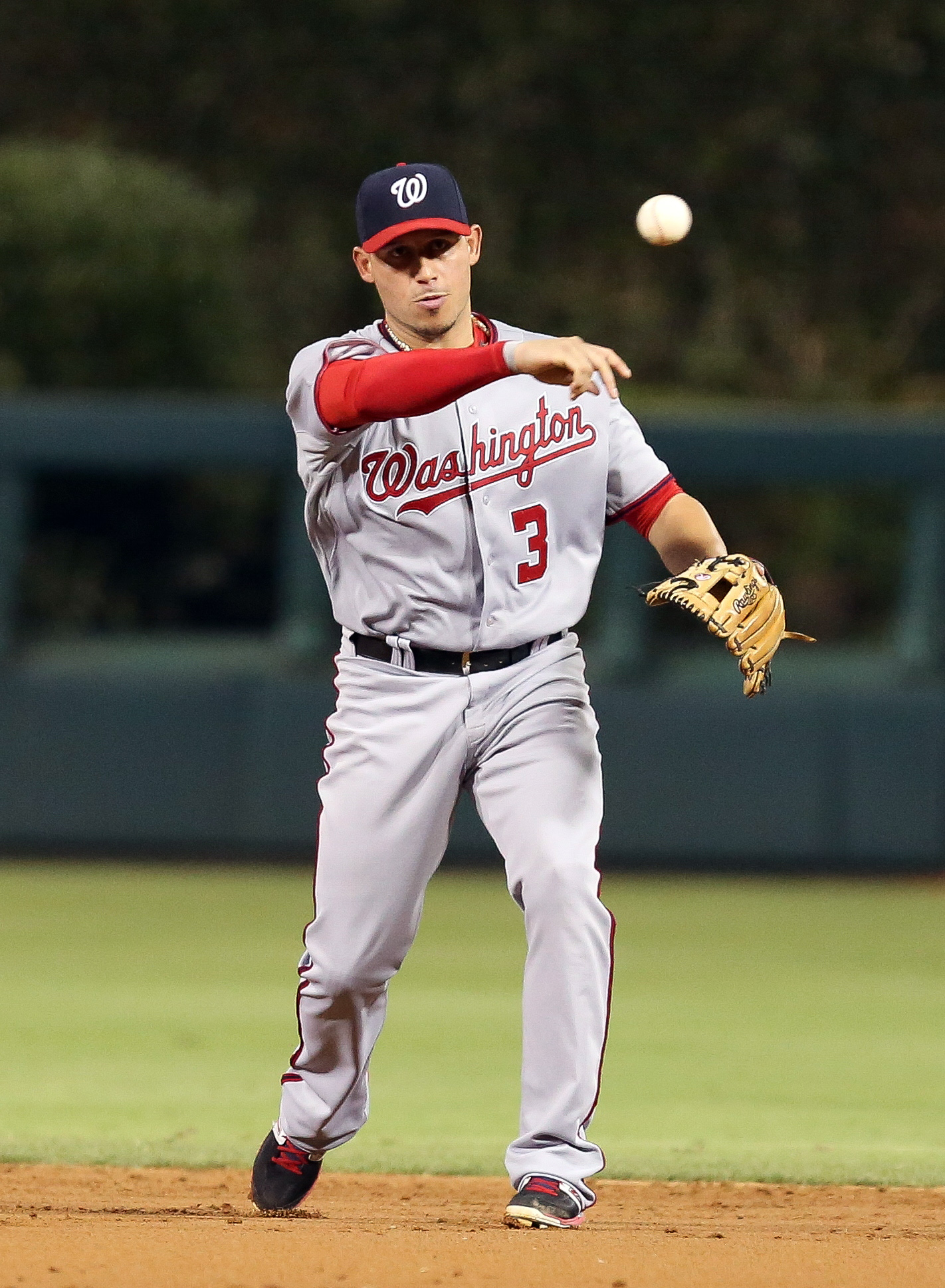
Cabrera’s free agent case remains difficult to figure. Over the 2007-12 period, he slashed .279/.342/.416 while manning an up-the-middle defensive spot (mostly, shortstop). Though advanced metrics never viewed him as even an average fielder, Cabrera delivered some value on the basepaths and was at least a solid, above-average regular in the aggregate.
That account of Cabrera took something of a turn, however, more recently. Over 978 plate appearances with Cleveland since the start of 2013, Cabrera’s OPS fell beneath the .700 level, making for a below-average bat that significantly reduced his overall appeal.
Nevertheless, in need of a veteran infielder down the stretch, the Nationals made a move to acquire Cabrera at the trade deadline. Notably, the Indians agreed to pay all of Cabrera’s salary in the deal, while acquiring an interesting but little-hyped prospect in Zach Walters. On a busy deadline day, the swap looked like a relatively low-impact, gap-filling move for Washington.
Since heading to the NL East-leading Nats, however, Cabrera has looked energized. He owns a .252/.341/.443 slash in the first 133 National League plate appearances of his career, including five home runs and two stolen bases. His resulting 115 OPS+ looks much more like the marks he was putting up in his heyday. Nearly as importantly, perhaps, Cabrera has looked comfortable at second, racking up 284 errorless innings at the position.
Without question, Cabrera’s late-season run of success at the plate will have a positive impact on his free agency. He has at least suggested the possibility that he is still capable of being the hitter of old; whether he’s convinced scouts, of course, remains to be seen.
The defensive returns, on the other hand, are somewhat more ambiguous. To be sure, proving that he is capable of solidly handling the keystone is a nice feather in Cabrera’s hat. At the same time, misplays have not been the major knock on his glove. Range is the primary concern, and he’s continued (obviously, in a short sample) to receive well-below-average marks in that respect.
So, where does Cabrera fit into the middle-infield market? Things are somewhat more crowded over at shortstop, where J.J. Hardy probably sets the standard and Jed Lowrie and Stephen Drew also present possible starting-caliber options. And that assumes that Hanley Ramirez is pursued primarily as a third baseman; if enough serious bidders look at him as a shortstop, the market would look even more crowded.
But Cabrera is perhaps best positioned to benefit from a lack of options at second, given his arguably superior bat (to all but Ramirez, at least) and recent experience at the keystone. Clubs looking to add a new second bagger will find limited possibilities on the market; as things stand, Emilio Bonifacio is probably the most appealing candidate.
Cabrera also has added appeal given that he will not turn 29 until the offseason, making him the youngest shortstop-capable player available to the highest bidder. That holds significant value, particularly when viewed alongside the fact that he does not have any significant recent injury history. Cabrera will also come free and clear of draft compensation, as his mid-season trade ensures that Washington will not be able to make him a qualifying offer. Particularly given the down years at the plate from Hardy (at least in terms of power production), Lowrie (who has been better in the second half), and Drew (who has been awful since his mid-season signing), Cabrera stacks up reasonably well.
In the aggregate, though Cabrera may never take the final step forward to become a truly premium ballplayer, he has shown the ability to produce at his earlier levels and should draw fairly significant and potentially broad interest. Depending on his performance down the stretch and in the post-season, he still has some capacity to climb up free agent boards and become a sought-after asset heading out of the 2014 season.
Poll: Orioles’ Qualifying Offers
It’s been a quiet day on the transactional front, so a poll seems in order. Looking ahead at free agency, one of the more interesting situations involves the Orioles’ crop of pending free agents. The club has several key pieces of the lineup set to reach the open market: Nick Markakis, Nelson Cruz, and J.J. Hardy. But the question remains whether some or all will receive qualifying offers.
MLBTR’s Steve Adams took a look at Markakis as a possible free agent back in May, noting that the 30-year-old’s hot start could lead to a significant turnaround in value. While he has not maintained that pace, Markakis has put up a .278/.339/.387 slash that constitutes better-than league-average production. Defensive metrics are not in love with his glove, but credit him with improvements over recent seasons. Also aiding Markakis as he looks ahead to a new deal is the fact that the upcoming free agent market appears rather thin in the corner outfield, especially in younger options. As Ken Rosenthal of FOX Sports recently suggested, the club could pay him a $2MM buyout on his $17.5MM mutual option but still make him the QO.
Cruz, meanwhile, has done nothing but rake since joining the O’s on a one-year, $8MM pact. That deal cost the club a compensation pick, but looks like a bargain in hindsight. Cruz leads the league with 39 long balls and has slashed a robust .262/.331/.532 triple-slash in 596 plate appearances. But looking forward, he is 34 years old and is a limited defensive player (though he has rated out as an approximately average corner outfielder in limited action this year). On the other hand, even if Baltimore would rather not pay Cruz $15MM next year, might the qualifying offer be worth it? Having missed his chance to cash in on a multi-year deal last year, Cruz could well be motivated to take another crack at a player’s market. And if he does take the offer, that seems an attractive-enough rate for a single season commitment.
Then there is Hardy, who is quite an interesting player in his own right. The shortstop continues to create immense value with the glove while delivering league-average offense. Though his power numbers have taken a big step back this year, Hardy has managed to compensate with a higher batting average and on-base percentage. (Though he has ridden a career-high .332 BABIP, Hardy has also raised his line-drive percentage this year.) All said, the 32-year-old is almost certainly the best shortstop on the upcoming market, if one views Hanley Ramirez as a third baseman at this point. Just look at these current season, three-year, and five-year comparisons to fellow soon-to-be free agents Asdrubal Cabrera, Jed Lowrie, and Stephen Drew. It still seems somewhat hard to imagine that Baltimore will let him reach the open market without restriction, especially given that the long-anticipated move of Manny Machado to shortstop could once again be delayed (and would, in any event, simply open a hole at the hot corner).
So, which players are likely to receive a qualifying offer from the O’s? (Select all that apply.)
Which Orioles Will Get Qualifying Offers?
-
Cruz 47% (6,247)
-
Hardy 28% (3,789)
-
Markakis 25% (3,318)
Total votes: 13,354